TECHNICAL REPORTS OF THE METEOROLOGICAL RESEARCH INSTITUTE No.65 2012
repeated torrential rains over Java Island. SOLA, 3, 93–96.
Yabu, S., S. Murai, and H. Kitagawa, 2005: Clear-sky radiation scheme. NPD Report, Numerical Prediction Division, JMA, 51, 53-64. (in Japanese)
Yamasaki, M., 1983: A further study of the tropical cyclone without parameterizing the effect of cumulus convection, 1983, Papers in Meteorology and Geophysics, 34, 221-260.
Yamasaki, M., 1984: Dynamics of convective clouds and ‘CISK’ in vertical shear flow-with its application to easterly waves and squall-line systems, 1984, J. Meteor. Soc. Japan, 62, 833-863.
Yamasaki, M., and H. Seko, Effect of the gravity wave on the convection cells, 1992, Proceedings of Spring meeting of Meteorological Society of Japan, A108 (in Japanese).
Yoden, S., K. Saito, T. Takemi, and S. Nishizawa, 2008: New stages of international collaborations which serves for mitigation of meteorological disasters in Southeast Asia, Tenki, 55, 705-708. (in Japanese)
Zumberge, J. F., M. B. Heflin, D. C. Jefferson, and M. M. Watkins, 1997: Precise point positioning for the efficient and robust analysis of GPS data from large networks, J. Geophys. Res., 102(B3), 5005–5017.
S. Djajadihardja, 2007: The impact of trans-equatorial monsoon flow on the formation of I. Appendix I-1. Newsletters
I-2. Introduction to a web-based decision support tool for ensemble numerical weather prediction with Gfdnavi
Outline
Major Research Subjects Topics
The 1st International Workshop JSPS-LIPI Workshop
The 5th AOGS Annual Meeting
Contents
Newsletter
No. 1 (Dec. 2007)
International Research for Prevention and Mitigation of Meteorological Disasters
in Southeast Asia
International Research for Prevention and Mitigation of Meteorological Disasters in Southeast Asia
MEXT Special Coordination Funds for Promoting Science and Technology for FY 2007 - 2009 in Asia S&T Strategic Cooperation Program
International Research for Prevention and Mitigation of Meteorological Disasters in Southeast Asia
Outline
Motivations
Risk of high-impact weather in Southeast Asia is potentially increasing because of the economical development and urbanization. Global warming and climate change might become another factor for the increase of the risk. It would be a good timing for us to start an international research project for prevention and mitigation of meteorological disasters in Southeast Asia, because the research environment is rapidly changing by the growth of computer powers and the improvement of internet infrastructures. Regional meso-scale models can be run with personal computers for downscale numerical weather predictions (NWPs). Data transfer via internet is getting fast enough to perform near-real time NWPs.
Utilization of probability information obtained by ensemble NWPs is a challenge for the development of decision support tools. Assessments of the impact of new observational data on the improvement of NWPs with advanced data assimilation schemes are also important subject in these days.
Thus, we have just started “International Research for Prevention and Mitigation of Meteorological Disasters in Southeast Asia” under the Ministry of Education, Culture, Sports, Science and Technology (MEXT) Special Coordination Funds for Promoting Science and Technology, supported for FY 2007-2009 under Asia S & T Strategic Cooperation Program.
Research Groups
Three main affiliations of this international research project are Kyoto University, Meteorological Research Institute (MRI) of Japan Meteorological Agency (JMA), and Institut Technologi Bandung (ITB) in Indonesia. Shigeo Yoden, Professor of Meteorology in Kyoto
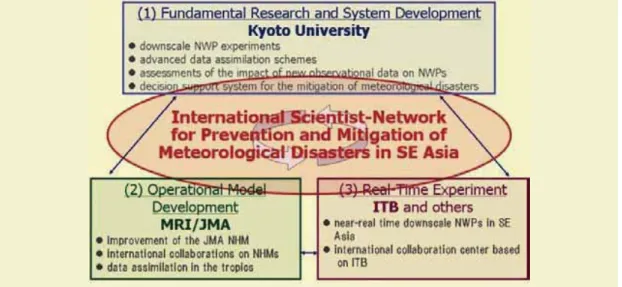
University, is the leader of this project, and Kazuo Saito, Head of the 2nd Research Laboratory, Forecast Research Department of MRI, and Emmy Suparka, Professor and Vice President of ITB are group leaders in these two institutes. As shown in Fig. 1, fundamental research and system development will be done at Kyoto University, while operational model development will be done at MRI/JMA. Real-time experiment will be done at ITB and other institutes outside Japan.
Figure 2 shows an example of our recent preliminary attempts. Tri W. Hadi, Lecturer of ITB, constructed his own PC cluster by himself to perform downscale NWPs. Experimental weather forecast is on the web page of Weather and Climate Prediction Laboratory (WCPL) at http://weather.geoph.itb.ac.id/
Our purpose is to establish “International Scientist-Network for Prevention and Mitigation of Meteorological Disasters in Southeast Asia” through research and development of downscaling NWP systems.
Figure 2. Recent attempt by Dr. Tri W. Hadi
Figure 1. Research Groups
(a) Experimental downscale numerical weather predictions (NWPs) in the tropics with regional meso-scale models
(b) Assessments of the impact of new observational data on the improvement of NWPs with advanced data assimilation schemes
(c) Development of a unified data base and decision support system for prevention and mitigation of meteorological disasters
Major Research Subjects
Newsletter No. 1
International Research for Prevention and Mitigation of Meteorological Disasters in Southeast Asia
Topics
JSPS-LIPI workshop "Japan Indonesia Reserch Collaboration on Natural Disasters"
This workshop was held on June 20, 2007 in Jakarta, Indonesia, under the auspices of JSPS (Japan Society for the Promotion of Science) and LIPI (Indonesian Institute of Sciences) to build strong networks of international cooperation to prevent natural disasters between Japan and Indonesia. Shigeo Yoden (Kyoto University) presented an overview paper on this new project.
The final report of the workshop can be found at the following web page: http://www.jsps.go.jp/english/e-astrategy/02_report070620.html
A session "Numerical Weather Prediction and Data Assimilation in Southeast Asia" (AS06) convened at the 5th Annual Meeting of Asia Oceania Geosciences Society
This session is convened by Tieh-Yong Koh (Nanyang Technological University), Shigeo Yoden (Kyoto University), and Tri Wahyu Hadi (Institut Teknologi Bandung) in the 5th AOGS Annual Meeting held in Busan, Korea, 16-20 June, 2008. Details can be seen in the following web page: http://www.asiaoceania.org/aogs2008/mars/pubSessionView.asp?sID=51
Session Description: Despite advances in numerical weather prediction (NWP) and data assimilation techniques for the recent decades, little discussion (and perhaps progress) has been made on these fronts in Southeast Asia. In this session, we want to share our experiences in actually trying to simulate realistically the region's synoptic and mesoscale weather over 1-2 day time scale. Downscaling of weather information in longer time scales in combination with global long-range forecasts is also an important subject of this session. Through the discussions we want to initiate a platform for scientists interested in mesoscale NWP and data assimilation in Southeast Asia to interact. We also welcome more theoretical work like data assimilation techniques for using data from advanced observational platforms like satellite and radar.
Abstract Submission Deadline: 24 January, 2008.
International Research for Prevention and Mitigation of Meteorological Disasters in Southeast Asia
Newsletter No.1 December 26, 2007
MEXT Special Coordination Funds for Promoting Science and Technology for FY 2007 - 2009 in Asia S&T Strategic Cooperation Program
Shigeo Yoden
Department of Geophysics, Kyoto University, Kyoto 606-8502, Japan Tel: +81-75-753-3932
Fax: +81-75-753-3715
E-mail: [email protected]
Web: http://www-mete.kugi.kyoto-u.ac.jp/project/MEXT/
The First International Workshop on Prevention and Mitigation of Meteorological Disasters in Southeast Asia
The first international workshop of this research project will be convened by Shigeo Yoden (Kyoto University) and Kazuo Saito (Meteorological Research Institute, Japan Meteorological Agency) in March 3-5, 2008, at the Palace Side Hotel in Kyoto, Japan. Details on this workshop will be announced in the following web page: http://www-mete.kugi.kyoto-u.ac.jp/project/MEXT/
MRI Scientists visit NTU and ITB Topics
Report on the 1st International Workshop Internet satellite “Kizuna” (WINDS)
Contents
Newsletter
No. 2 (Mar. 2008)
International Research for Prevention and Mitigation of Meteorological Disasters
in Southeast Asia
International Research for Prevention and Mitigation of Meteorological Disasters in Southeast Asia
MEXT Special Coordination Funds for Promoting Science and Technology for FY 2007 - 2009 in Asia S&T Strategic Cooperation Program
International Research for Prevention and Mitigation of Meteorological Disasters in Southeast Asia
MRI Scientists visit NTU and ITB
Two scientists, Kazuo Saito and Syugo Hayashi of the Meteorological Research Institute (MRI), visited the Nanyang Technological University (NTU) of Singapore and the Institut of Teknologi Bandung (ITB) of Indonesia in February 2008. Their visit was done to discuss the collaboration on the International Research for Prevention and Mitigation of Meteorological Disasters in Southeast Asia and to confirm the portability of the JMA nonhydrostatic model (NHM) on computers at oversea research institutes.
On Monday 11 and Tuesday 12, Saito and Hayashi visited the Division of Applied Physics at the School of Physical and Mathematical Sciences of NTU, and met Assistant Professor Tieh-Yong Koh and Dr.
Rosbintarti Kartika Lestari, who has been studying the regional atmospheric modeling under the guidance of Prof. Koh. At NTU, a cluster machine consists of IBM e-servers with AMD Opteron252 2.6GHz 16CPU and AMD Opteron Dual Core 275 2.2GHz 48CPU has been used for numerical weather prediction experiments with the COAMPS model. A test of NHM using JRA25 reanalysis data of JMA and visualization by ‘Webpandah’ (a visualization tool for NHM data developed at JMA) were conducted. Figure 1 shows the example of a simulation by NHM with a horizontal resolution of 30 km where JRA25 data at 00 UTC 7 January 1982 is used for the initial condition.
The duo also visited the satellite office of KAGI21 (Kyoto University Active Geosphere investigations for the 21st century COE Program) and the Faculty of Earth Sciences of ITB on Thursday 14 and Friday 15 February to meet Assistant Professor Tri Wahyu Hadi and his students, I Dewa Gede Junnaedhi and Nurjanna Joko Trilaksono (Fig. 2). At ITB, a
cluster machine consists of 8 nodes 4 CPU Intel Quad-Core 660 2.4 GHz has been employed for near real time NWP experiments with MM5 and WRF models. A test of NHM using JMA’ s high resolution GSM data distribute from the Japan Meteorological Business Support Center (JMBSC) was successively performed. Figure 3 shows the example of a simulation by NHM where high resolution GSM data at 00 UTC 14 February 2008 is used for the initial condition.
(Kazuo Saito, MRI/JMA) Figure 1. Surface wind and 6 hour accumulated precipitation by NHM with a horizontal resolution of 30 km. JRA25 data at 00UTC 7 January 1982 was used as the initial condition. 5 CPU of the NTU’ s cluster machine was employed.
Figure 2. Photograph taken at the satellite office of KAGI21 of ITB. From left to right, Nurjanna Joko Trilaksono, Syugo Hayasi, Tri Wahyu Hadi, Kazuo Saito, I Dewa Gede Junnaedhi, and Ida Yayuk Purnamasari (Sectretary of the KAGI21 satellite office).
Figure 3. Surface pressure and 3 hour accumulated precipitation at 12 UTC 14 February 2008 by NHM with a horizontal resolution of 30 km. High resolution GSM data at 00UTC 14 February 2008 is used as the initial condition.
The first international workshop of this research project on
“Prevention and Mitigation of Meteorological Disasters in Southeast Asia” was held on March 3-5, 2008, at the Palace Side Hotel in Kyoto, Japan. In total fifty eight researchers participated from twelve countries and regions in East Asia, Southeast Asia and South Asia.
The workshop was opened by the address and introduction about the MEXT program by Dr. Hirokazu Kobayashi, Program Officer of JST (Japan Science and Technology Agency). After the keynote address about this project by the project leader, Shigeo Yoden (Kyoto University), there were seven sessions with a total of forty two invited talks: Suparka, Hadi, Saito, Hara, Islam, Xin, Ratag, Thalongsengchanh, and Gouda had presentations in the Session I “High-resolution numerical weather predictions”; S.Hayashi and Nishizawa in the Session II “Tutorials and demonstrations”; Bounlom, Saravuth, Tangang, T. Hayashi, Seko, Lestari, Tsuboki, Iwasaki and Ueno in the Session III “High-impact weather and its simulation/prediction”; Tsuda, Shoji, Begkhuntod, H.
Ishikawa, Kunii, Duc, Enomoto, and Prasad in the Session IV “Satellite observations, their applications and data assimilation”; Koh, Kang, Lai, Mukougawa, Jampanya, Sanga, Promasakha and Horinouchi in the Session V “Model output statistics, predictability, and decision supports”; Satomura, Trilaksono, Otsuka, Y. Ishikawa and Takemi in the Session VI “High-resolution model as a fundamental research tool”; and all participants had open discussions in the Session VII “Future research and collaborations”. Further details can be found in our Web page,
http://www-mete.kugi.kyoto-u.ac.jp/project/MEXT/
There were presentations about new research results on numerical weather predictions, new observational data, and decision support tools/systems, and we also had enthusiastic discussions. We do hope this workshop will help us for making future international research collaborations among Asian scientists. We are going to have the second international workshop at ITB in Bandung, Indonesia in March 2009, and the third one at Ritsumeikan Asia Pacific University in Beppu, Japan in March 2010.
(Seiya Nishizawa, Kyoto Univ.)
Report on the 1st International Workshop
Newsletter No. 2
International Research for Prevention and Mitigation of Meteorological Disasters in Southeast Asia
Topics
International Research for Prevention and Mitigation of Meteorological Disasters in Southeast Asia
Newsletter No.2; March 10, 2008
MEXT Special Coordination Funds for Promoting Science and Technology for FY 2007 - 2009 in Asia S&T Strategic Cooperation Program
Shigeo Yoden
Department of Geophysics, Kyoto University, Kyoto 606-8502, Japan Tel: +81-75-753-3932
Fax: +81-75-753-3715
E-mail: [email protected]
Web: http://www-mete.kugi.kyoto-u.ac.jp/project/MEXT/
The International Symposium for Applications of “Kizuna” of Wideband InterNetworking engineering test and Demonstration Satellite (WINDS) and successful launch of “Kizuna” on February 23, 2008
The International Symposium for Applications of “Kizuna” of Wideband InterNetworking engineering test and Demonstration Satellite (WINDS) was held on December 4 (Tuesday), 2007 at Meiji Kinenkan in Tokyo. There were 6 Addresses, including “ICT based e-health and disaster mitigation management system” by Professor Utoro Sastrokusumo (School of Electrical Engineering and Informatics, Institut Technologi Banding (ITB), Indonesia), and 5 Speeches. Shigeo Yoden (Kyoto University) participated in the Panel discussion “WINDS Application Experiments Now Needed in the Asia Pacific Region” as one of 6 panelists, and presented our international research activity, “An experimental down-scale numerical weather predictions in Southeast Asia with the aid of WINDS”.
The “Kizuna” is a communications satellite that enables super high-speed data communications of up to 1.2 Gbps to develop a society without any information availability disparity, in which everybody can equally enjoy high-speed communications wherever they live (http://www.jaxa.jp/countdown/f14/index_e.html). The “Kizuna” was launched at 5:55 p.m. on February 23, 2008 (JST) successfully with H-IIA F14 from the Tanegashima Space Center. The multi-beam antennas had been successfully deployed at 8:35 p.m. on March 1 (JST) and the critical operation phase was completed. The “Kizuna” will further drift into the geostationary orbit at about 143 degrees east longitude in March. The initial functional verification of the onboard equipment will be done for about four months.
Our proposal for test use of the “Kizuna” has been accepted to
transfer ensemble forecast data and adaptive observation data for downscale numerical weather predictions. We hope we can also use the
“Kizuna” for teleconference between Kyoto University and ITB in the second International Workshop on Prevention and Mitigation of Meteorological Disasters in Southeast Asia, which will be held in March, 2009 in Bandung, Indonesia.
Photo No. : P-017-06848 in the KIZUNA Photo Gallery at the JAXA Web page, http://www.jaxa.jp/index_e.html
Report on the AOGS 2008 Session AS06 Topics
The WWRP Beijing Olympics 2008 Forecast Demonstration /
Research and Development Project
Contents
The Second Domestic Workshop
Newsletter
No. 3 (Oct. 2008)
International Research for Prevention and Mitigation of Meteorological Disasters
in Southeast Asia
International Research for Prevention and Mitigation of Meteorological Disasters in Southeast Asia
MEXT Special Coordination Funds for Promoting Science and Technology for FY 2007 - 2009 in Asia S&T Strategic Cooperation Program
振興調整費
International Research for Prevention and Mitigation of Meteorological Disasters in Southeast Asia
Report on the AOGS 2008 Session AS06
In conjunction with the program of International Research for Prevention and Mitigation of Meteorological Disasters in Southeast Asia (see Newsletter No. 1, Dec. 2007), Shigeo Yoden (Kyoto University), Tieh Yong Koh (Nanyang Technological University), and Tri Wahyu Hadi (Institut Teknologi Bandung) has successfully convened a session (AS06) entitled Numerical Weather Prediction and Data Assimilation in Southeast Asia at the 5th Annual Meeting of Asia-Oceania Geoscience Society (AOGS) that was held in Busan, Korea during 16-20 June 2008 (Photo 1). This session was aimed at setrengthening and widening the network of researchers interested in weather and climate prediction in Southeast Asia.
As many as 13 presentations were registered to the A06 session of the AOGS 2008 and only one was cancelled. The core members of the International Research for Prevention and Mitigation of Meteorological Disasters in Southeast Asia research team who attended this session are : Shigeo Yoden and Shigenori Otsuka (Kyoto University), Kazuo Saito and Shugo Hayashi (MRI), Tieh Yong Koh (NTU), and Tri Wahyu Hadi (ITB). An invited talk by Hongwen Kang of APEC Climate Center (APCC) highlighted some new results in multi-model outputs statistical downscaling prediction. In addition, there are contributed talks by Fredolin Tangang (National University of Malaysia), Der Song Chen (Central Weather Bureau of Taiwan), Kevin Kei Wai Cheung (Macquarie University, Australia), Che-Kiat Teo (NTU), Bhuwan Chandra Bhatt (NTU), and Ok-Yeong Kim (Pukyong National University, South Korea).
The A06 session of the AOGS 2008 has highlighted one fundamental problem in lieu of advanced NWP modeling i.e. the predictability of weather system in the Southeast Asian region.
This confirms that the complexity of weather systems in Southeast Asia, that comprises the Maritime Continent, is one of the most challenging problem in atmospheric predictability due to dominant role of the mesoscale convective system. The very same problem that is also actually addressed by Professor Taroh Matsuno in his Axford Lecture of AOGS 2008 “Modeling of Tropical Convection by Use of an Ultra-High Resolution (3.5-7 km) Global Atmosphere Model – New Age of Tropical Meteorology”. In such a situation, the “International Research for Prevention and Mitigation of Meteorological Disasters in Southeast Asia” is an excellent program to provide a knowledge hub for young scientists in Southeast Asian countries to access latest information on the ever developing science and technologies of weather and climate prediction.
As a side activity, the core members of the International Research for Prevention and Mitigation of Meteorological Disasters in Southeast Asia research team also visited the APEC Climate Center (APCC) in Busan on 16 June 2008. We would like to thank Dr. Hongwen Kang and Dr. Karumuri Ashok for their kind arrangement of the visit. Beside us, it turned out that many other scientists attending the 5th AOGS Annual Meeting were also interested in the program, so that in total there were more than 20 participants visiting APCC in the afternoon of 16 June 2008. Inline with the goals of our collaborative international research program, APCC has an excellent ensemble climate forecast data center that could help scientists in the APEC region (including those in Southeast Asia) to conduct research in the application of climate prediction. APCC has also been developing data management and data processing tools to make climate prediction more amenable for developing Asia-Pacific countries. Undoubtedly, closer collaboration with APCC in the future is necessary for the success of our program.
(Tri Wahyu Hadi, ITB)
“Numerical Weather Prediction and Data Assimilation in Southeast Asia” on June 16, 2008
Photo 1. Opening talk by Dr. Tieh Yong Koh.
International Research for Prevention and Mitigation of Meteorological Disasters in Southeast Asia
Topics
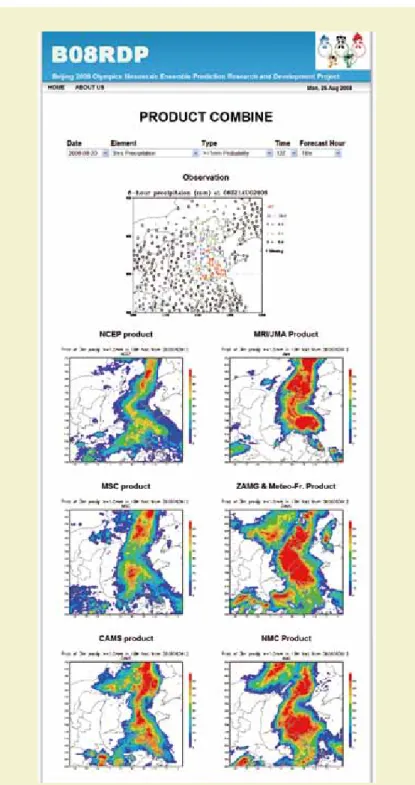
The WWRP Beijing Olympics 2008 Forecast Demonstration / Research and Development Project (B08FDP/RDP) is an international research project for a short range weather forecast of the WMO World Weather Research Programme (WWRP), which succeeded the Sydney 2000FDP. The B08FDP/RDP is divided into two components; the FDP component for a short range forecast up to 6 hours based on the nowcasting (http://www.b08fdp.org), and the RDP component for a short range forecast up to 36 hours based on the mesoscale ensemble prediction (MEP) system (http://www.b08rdp.org). Aims of the RDP project are to improve understanding of the high-resolution probabilistic prediction processes through numerical experimentation and to share experiences in the development of the real-time MEP system. In the 2008 experiment, six participating systems from Austria and France (ZAMG and Météo-France), Canada (MSC), China (NMC and CAMS), Japan (MRI/JMA) and United States (NCEP) joined B08RDP, and intercomparisons of MEP systems were conducted for one month from 24 July to 24 August, including the period of the Olympic games.
Every participants ran their MEP forecasts in real-time and sent the 36 forecasts to the CMA’s ftp server. The products were displayed every day on the B08RDP’s website (Fig. 1) for reference of Beijing Meteorological Bureau’s forecasters.
Collaborating with the Numerical Prediction Division of JMA, MRI developed its MEP system with a horizontal resolution of 15 km. It consists of 11 members: one control run and ten perturbed members.
Initial conditions of the control run were given by the meso 4DVAR analysis which assimilated precipitation data over China, while initial perturbations were computed by the global targeted singular vector method.
Lateral boundary perturbation method was newly implemented, and the latest version of NHM was employed as the forecast model. MRI also supported the Hong Kong Observatory (HKO) team by providing boundary conditions to NHM used in the HKO’s B08FDP short range forecasting system SWIRLS.
Results and outcome of the intercomprisons will be discussed at the 4th international B08FDP/RDP workshop held in 2009 at Beijing.
(Kazuo Saito, MRI)
The WWRP Beijing Olympics 2008 Forecast Demonstration / Research and Development Project
Figure 1. Example of the B08RDP product. Probability of precipitation greater than 1 mm in 3 hours from 03 UTC to 06 UTC 21 August 2008 predicted by MEP systems of 6 participants. Initial time is 12 UTC 20 August (FT=18). Observation shows
International Research for Prevention and Mitigation of Meteorological Disasters in Southeast Asia
Topics
September 9 (Tue) 1310-1330 Opening
1330-1620 Session 1: Observation and Data Taiichi HAYASHI (DPRI, Kyoto University)
Recent research trend of mesoscale phenomena in South Asia.
Takehiko SATOMURA (DG, Kyoto University) Precipitation characteristics in northern Indochina.
Noriyuki NISHI (DG, Kyoto University)
Detection of precipitation using split-window measurements by geostaionary satellite.
Hirohiko ISHIKAWA (DPRI, Kyoto University)
Myanmar Cyclone Nargis: Satellite images and numerical experiments by WRF.
Masato SHIOTANI (RISH, Kyoto University)
Stationary circulation observed in the upper troposphere over the western Indian Ocean.
Yoshinori SHOJI (MRI, JMA)
Global realtime analysis of GPS data and plan of assimilation experiments.
Takeshi HORINOUCHI (RISH, Kyoto University) Gfdnavi: present and future prospects.
Seiya NISHIZAWA (DG, Kyoto University)
Experimental development of a decision support system for prevention and mitigation of meteorological disasters with Gfdnavi.
1620-1700 Invited talks
Shuichi MORI (JAMSTEC/IORGC)
Present status of JEPP/HARIMAU radar-profiler network observations in Indonesia.
Manabu YAMANAKA (JAMSTEC/IORGC)
Coastline length governing equatorial rainfall amount.
1700-1730 Discussions on data archive and cooperation
International Research for Prevention and Mitigation of Meteorological Disasters in Southeast Asia
Newsletter No.3; October 31, 2008
MEXT Special Coordination Funds for Promoting Science and Technology for FY 2007 - 2009 in Asia S&T Strategic Cooperation Program
Shigeo Yoden
Department of Geophysics, Kyoto University, Kyoto 606-8502, Japan Tel: +81-75-753-3932
Fax: +81-75-753-3715
E-mail: [email protected]
Web: http://www-mete.kugi.kyoto-u.ac.jp/project/MEXT/
The Second Domestic Workshop
September 10 (Wed)
0910-1200 Session 2: Numerical weather prediction Shigeo YODEN (DG, Kyoto University)
Ensemble forecasts with regional models.
Kohei ARANAMI (NPD, JMA)
Improvements of utility tools to carry out NHM and introduction of DVD-NHM.
Syugo HAYASHI (MRI, JMA)
Intercomparisons of NHM and WRF forecasts over topical and Japan areas.
Tohru KURODA (MRI, JMA)
Development of utility tools for NHM execution in tropics and reproduce/forecast experiments of Nargis.
Kazuo SAITO (MRI, JMA)
Tidal wave simulation on ensemble forecast of Nargis.
Mitsuru UENO (MRI, JMA)
Some aspects of typhoon structure represented in the JMA meso-analyses and synthetic data.
Masaru KUNII (MRI, JMA)
Regional data assimilation experiment in southeast Asia.
Hiromu SEKO (MRI, JMA)
Structure of the regional heavy rainfall occurred at Santacruz, India on 26 July 2005.
1200-1230 Discussion on Bandung WS
The second domestic workshop on the International Research for Prevention and Mitigation of Meteorological Disasters in Southeast Asia was held in September 9-10, 2008, at the Meteorological Research Institute in Tsukuba, Japan. There were 28 participants and we had active discussions. The program was as follows:
Report on the 2nd International Workshop
Topics
Contents
A workshop on “Ground based atmospheric observation network in equatorial Asia”
Joint Sessions and Activities in Institut Teknologi Bandung
Newsletter
No. 4 (Mar. 2009)
International Research for Prevention and Mitigation of Meteorological Disasters
in Southeast Asia
International Research for Prevention and Mitigation of Meteorological Disasters in Southeast Asia
MEXT Special Coordination Funds for Promoting Science and Technology for FY 2007 - 2009 in Asia S&T Strategic Cooperation Program
振興調整費
International Research for Prevention and Mitigation of Meteorological Disasters in Southeast Asia
Report on the 2nd International Workshop
The second international workshop of this research project on
"Prevention and Mitigation of Meteorological Disasters in Southeast Asia" was held on 2-5 March, 2009, at Jayakarta Hotel in Bandung, Indonesia. In total 47 researchers participated from 12 countries and regions in East Asia, Southeast Asia, and South Asia.
This workshop was also partially suported by the Organization for the Promotion of International Relations of Kyoto University.
The workshop was opened by the welcome address by Dr.
Emmy Suparka (Bandung Institute of Technology), followed by the welcome address by Dr. Takashi Nishigaki, Program Officer of JST (Japan Science and Technology Agency). After the keynote speech by the program leader Dr. Shigeo Yoden (Kyoto University) and the presentation by Dr. Mu Mu (Chinese Academy of Sciences), seven sessions were held. In session I, Hadi, Hayashi, Islam, Xin, and Wong gave talks on "Downscale Numerical Weather Predictions (NWPs)". In section II, Seko, Takemi, Iwasaki, Y.
Ishikawa, Rajeevan, and Kuroda gave talks on "Tropical disturbances and precipitation process". Session III and IV were the joint sessions (see the next page). In session V, H. Ishikawa, Promasakha, and Ratag gave talks on "Risk management and community preparedness". After session V, Saito, Hayashi, and Kuroda from MRI (Meteorological Research Institute) demonstrated JMA (Japan Meteorological Agency)-MRI NHM (Non-Hydrostatic Model) as a tutorial seminar. In session VI, Mukougawa, Gouda, and Permana gave talks on "Extended range NWPs". In session VII, Shoji and Junnaedhi gave talks on "Data assimilation". During the workshop, 14 posters were presented by
Ito, Kawabata, Kim, Kunii, Nugroho, Otsuka, Saito, Seko, Seto, Sofian, Surmaini, Putra, Listiaji, and Fithra.
In this workshop, various new results since the first international workshop in 2008 were presented. We will have the third international workshop at Ritsumeikan Asia Pacific University, Beppu, Japan in March 2010.
(Shigenori Otsuka, Kyoto Univ.)
A joint banquet with the "Workshop on Ground-based Atmosphere Observation Network in Equatorial Asia" was held on March 2 at Jayakarta hotel, Bandung. Following a speech of welcome by Dr. Lambok Marinangan Hutasoit, the dean of the Faculty of Earth Sciences and Technology (ITB) at the beginning of the banquet, Dr. Toshitaka Tsuda (Kyoto University) addressed the importance of the collaborative relationship to prevent and mitigate meteorological disasters in South Asia. All the participants for both workshops enjoyed a delicious food and conversation.
The joint session "Observational network" and "New methods in observation, data assimilation, and NWPs" were held in March 3-4. As many as 10 speakers had impressive presentations on the observational network in South East Asia and the most recent research progresses in observation, data assimilation, and NWPs.
Dr. Manabu D. Yamanaka (JAMSTEC) highlighted HARIMAU project, which is a high-resolution observational network with the meteorological radars and wind profilers for monitoring convective activities. Dr. Tieh Yong Koh (Nanyang Technological University) address a closer regional coordination in plans for developing infrastructure in the light of new observational networks and sophisticated numerical models. Dr. Toshitaka Tsuda (Kyoto Univ.) introduced an application of GPS radio occultation data to the temperature and humidity, and Dr. Seon Ki Park (Ewha Woman Univ.) addressed data assimilation and parameter estimation to improve forecast accuracy of disastrous weather system. Dr.
Chun-Chieh Wu (National Taiwan Univ.) introduced a targeted observation for improving tropical cyclone predictability,
DOTSTAR and T-PARK. The participants made an active discussion concerning the presentations across the research areas.
On May 5, many participants visited the Faculty of Earth Sciences and Technology of ITB. The dean illustrated the basic outlines of the faculty with a number of durians for hospitable reception. The participants asked the questions such as foreign exchange program and teaching system, and envisioned a future of the university.
(Kosuke Ito, Kyoto Univ.)
Joint Sessions and Activities in Institut Teknologi Bandung
Newsletter No. 4
Topics
Contents
MRI Scientist visited CMMCS in India
Lectures in KAGI21 International Summer School 2009
Visits to three institutions in Jakarta, Indonesia for further international research collaborations
Newsletter
No. 5 (Oct. 2009)
International Research for Prevention and Mitigation of Meteorological Disasters
in Southeast Asia
International Research for Prevention and Mitigation of Meteorological Disasters in Southeast Asia
MEXT Special Coordination Funds for Promoting Science and Technology for FY 2007 - 2009 in Asia S&T Strategic Cooperation Program
振興調整費
International Research for Prevention and Mitigation of Meteorological Disasters in Southeast Asia
Syugo Hayashi of the Meteorological Research Institute visited CSIR / CMMCS (Council of Scientific and Industrial Research / Centre for Mathematical Modeling and Computer Simulation) of India in March 2009. His visit was done to help the installation of the JMA nonhydrostatic model (NHM) to the CMMCS's computer system and to promote the mutual collaboration between MRI and CMMCS.
From 23rd to 25th March, Hayashi visited CMMCS and met Krushna Chandra Gouda, a research scientist of CMMCS (Photo. 1).
NHM was installed in the CMMCS's super computer SGI ALTIX 3700 BX2, which has 24 CPUs of Itanium2 processor at 1.6GHz clock speed, 96GB physical memory. Intel Fortran and C compilers and MPI libraries are available for parallel computing. To see NHM's output with the NuSDaS format (JMA original data format), a visualization software package ‘WEBPANDAH’ was installed in the web-server SGI ORIGIN. As the disk storages of both machines are shared, access from ORIGIN to the result of NHM by ALTIX is easy.
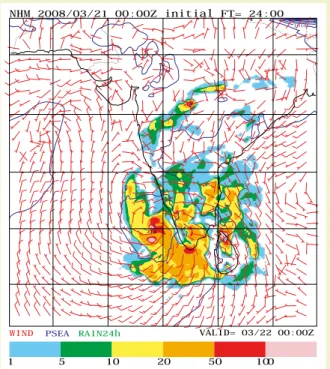
For a test, a heavy rain case in south India on 22nd March 2008 was selected. The 24 hour simulation was conducted with the 20 km horizontal resolution. The NCEP final analysis with 1 degree is used for initial and boundary conditions. Figure 1 shows the 24 hour
accumulated precipitation, sea level pressure and surface wind at 00 UTC 22 March 2008 predicted by NHM. The observed intense rain was well simulated, but some positional errors remained.
In the afternoon of 25th March, Hayashi made a presentation at the CMMCS seminar. The introduction of NHM and the performance of NHM in mid- and low- latitudes were shown. At low latitudes, NHM performance is insufficient compared with mid-latitudes. Therefore, tuning of the model for low-latitudes is needed to improve the forecast accuracy. In addition, it has to be confirmed that the model performance improves with finer horizontal resolutions (e.g., 5 km). Cooperation of researchers in various countries/regions is needed for further model's improvements.
(Syugo Hayashi, MRI / JMA)
MRI Scientist visited CMMCS in India
Photo 1. Photograph taken at the hotel Basil Ikon (Bangalore, India). Krushna Chandra Gouda (left) and Syugo Hayashi (right).
Figure 1. Predicted 24 hour accumulated precipitation, sea level pressure and surface wind at 24-hour forecast by NHM with a horizontal resolution of 20 km. NCEP final analysis at 00 UTC 21 March 2008 was used as the initial condition.
1 5 10 20 50 100
79+
214+
247+
NHM 2008/03/21 00:00Z initial FT= 24:00
RAIN24h VALID= 03/22 00:00Z
1010
L
H
PSEA WIND
International Research for Prevention and Mitigation of Meteorological Disasters in Southeast Asia
Visits to three institutions in Jakarta, Indonesia for further international research collaborations
On August 14, 2009, Prof. Shigeo Yoden took an early flight from Singapore and arrived around 08:30 local time at the Sukarno-Hatta International Airport, Jakarta. I picked him with a chartered car and we started a “one day tour” to three institutions in Jakarta, Indonesia : (1) Japan International Cooperation Agency (JICA) – Indonesia Office, (2) Southeast Asian Ministers of Education Organization, Regional Open Learning Center (SEAMOLEC), and (3) Meteorological, Climatological, and Geophysical Agency (BMKG) Head Quarter. The main purpose of our visit was to explore new possibilities to promote collaboration between Kyoto University, Bandung Institute of Technology (ITB), and other institutions in Indonesia on the development of weather prediction technology for mitigating hydrometeorological disasters in Indonesia and other tropical Asian Countries through a JST-JICA program, Science and Technology Research Partnership for Sustainable Development (SATREPS).
The most important institution that we visited this time was the JICA Indonesia Office, which is located at Jl. Sudirman in Central Jakarta. Our purpose for visiting JICA was to obtain detailed information on the implementation of SATREPS in Indonesia. Mr. Kiichi Tomiya, a senior representative of JICA, kindly accepted our visit from 11:30 until 12:00 local time (Photo 1).
From this visit, we learned the possibility for Kyoto University and ITB to submit a proposal to SATREPS.
The second institution we visited was SEAMOLEC, which is located in Ciputat area, South Jakarta. It was unfortunate that we could not see the Director, Dr. Gatot Haripriyanto because of his health problem. Mr. Ith Vuthy (Deputy Director of Program) and Ms. Dina Mustafa (Research and Development Manager) cordially met us and gave comprehensive explanations about the center’s activities (Photo 2). We found out that, with wide access to educational resources in Southeast Asian countries, SEAMOLEC is one of potential counterpart to enhance “weather and climate literacy” in the region.
The visit to BMKG office was planned just a few days before Prof. Yoden’s arrival in Jakarta. In spite of very limited time, we decided to visit BMKG because our partnership with the national weather service will be crucial for the envisioned proposal to SATREPS. Due to the timing, it was difficult to see higher authorities at BMKG but we met Dr. Dodo Gunawan (staff of Research and Development Center) and Mr. Sasmito
Photo 1.
Our tour of the day was completed but we had to catch up with Prof. Yoden’s flight through a terrible traffic jam. I was relieved when I saw Prof. Yoden finally came out of the check in counter several minutes before it was closed, but I kept thinking about the big work on the preparation of our new proposal during my
Photo 2.
Photo 3.
International Research for Prevention and Mitigation of Meteorological Disasters in Southeast Asia
International Research for Prevention and Mitigation of Meteorological Disasters in Southeast Asia
Newsletter No.5; October 31, 2009
MEXT Special Coordination Funds for Promoting Science and Technology for FY 2007 - 2009 in Asia S&T Strategic Cooperation Program
Shigeo Yoden
Department of Geophysics, Kyoto University, Kyoto 606-8502, Japan Tel: +81-75-753-3932
Fax: +81-75-753-3715
E-mail: [email protected]
Web: http://www-mete.kugi.kyoto-u.ac.jp/project/MEXT/
Lectures in KAGI21 International Summer School
Two lectures on “Decision support system for prevention and mitigation of meteorological disasters” and
“DVD-NHM” were given during the 5th KAGI21 International Summer School in Ohmi-Maiko, Siga on 26-27 September 2009. There were 14 participants (7 from Asian countries and 7 from Japan).
Shigenori Otsuka was the lecturer of the former. In the lecture, the participants learned how to utilize ensemble numerical weather forecasting data for disaster prevention and mitigation, in which a decision support system built on a web-based visualization tool and database server
"Gfdnavi" was used. The data for the exercise was an output of an experimental ensemble numerical weather forecasts on cyclone Nargis, which attacked Myanmar in May 2008. The data was provided by Dr. Kuroda (MRI / JMA) and his colleagues. The participants used laptop PCs to run the decision support system and tried several visualization methods to extract information from ensemble numerical weather predictions.
Syugo Hayashi (MRI/JMA) was the lecturer of the latter. In his lecture, the participants learned how to perform numerical simulations using a nonhydrostatic regional weather forecasting model JMA-NHM installed on a bootable DVD-ROM (DVD-NHM). Using DVD-NHM on the laptop PCs, the participants performed numerical experiments on a low-pressure system over Japan on 23rd April 2008, following instructions shown on a web-browser. The horizontal resolutions were 20 km and 5 km with one-way nesting. The participants learned how to analyze the result with a web-based visualization tool
"web-pandah".
(Shigenori Otsuka, Kyoto University)
Photo 1.
Photo 2.
Summary of the Activities for Three Years Topics
Report on the 3rd International Workshop
Contents
Newsletter
No. 6 (Mar. 2010)
International Research for Prevention and Mitigation of Meteorological Disasters
in Southeast Asia
International Research for Prevention and Mitigation of Meteorological Disasters in Southeast Asia
MEXT Special Coordination Funds for Promoting Science and Technology for FY 2007 - 2009 in Asia S&T Strategic Cooperation Program
振興調整費
International Research for Prevention and Mitigation of Meteorological Disasters in Southeast Asia
Summary of the Activities for Three Years
In Kyoto University, a number of experimental downscaling Numerical Weather Predictions (NWPs) were performed to investigate meteorological disasters in Southeast Asia (a flood event in Jakarta in February 2007, Myanmar cyclone Nargis, etc).
In those experiments, several regional atmospheric models including JMA-NHM were used. New observational data were utilized in those research activities for model validation. For example, performance of downscaling NWPs over Indochina region was investigated using surface station data in Laos for validation. Numerical experiments with very high resolution (~ 100 m in horizontal) were also performed to investigate highly isolated heavy rainfall events such as a flash flood event in Kobe city.
A prototype of a decision support system for prevention and mitigation of meteorological disasters is developed, by which ensemble NWP data can be analyzed and displayed. The system was developed based on Gfdnavi, a web-based database server and analysis tool. Using the output of an experimental ensemble NWP on Myanmar cyclone Nargis which was provided by MRI as a test
(1) Fundamental Research and System Development (Kyoto University)
(2) Operational Model Development (Meteorological Research Institute / Japan Meteorological Agency) dataset, how to analyze and display ensemble NWPs on tropical cyclones is documented with an interactive documentation system.
(Shigenori Otsuka, Kyoto Univ.)
Among the research groups of the International Research for Prevention and Mitigation of Meteorological Disasters in Southeast Asia, the Meteorological Research Institute of the Japan Meteorological Agency (MRI/JMA) was in charge of the part of
‘Operational model development’. This part was divided into the following three subjects:
-- Development of NHM and verification of its performance in the tropics.
-- Preparation of experimental tools and collaborations for tropical NWP.
-- Data assimilation experiment in the tropics.
As for the first subject, Seko et al. (2008) conducted a numerical simulation of the Mumbai heavy rainfall which occurred in July 2005 in India. Using the global analysis data of JMA for initial and lateral boundary conditions, the intense rainfall system was successfully reproduced. Hayashi et al. (2008) conducted statistical verification of short term NWP over Southeast Asia and compared two mesoscale models (NHM and WRF) using the same
Figure 2. Group photo taken at the High Performance Computing Center of VNU on 6 October 2009. From left, Dr.
L. Duc of NHMS, Prof. D. Uu and Prof. P. Anh of VNU, Dr.
Kuroda and Dr. Saito of MRI, Prof. K. Xin of VNU and Dr. Son and Dr. N.H. Dien of HPCC.
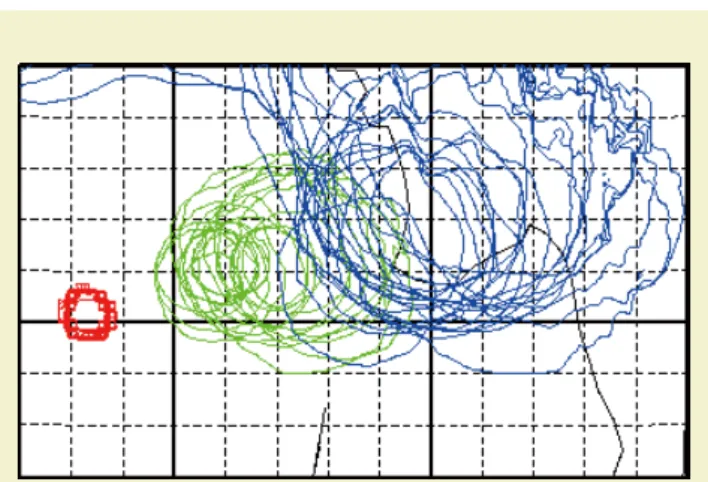
Figure 1. Spaghetti diagram of surface pressure for the experimental ensemble NWP on cyclone Nargis. The figure was produced by the prototype of a decision support system.
conditions. Threat scores for precipitation from the two models were comparable, while WRF tended to predict more rains than NHM.
International Research for Prevention and Mitigation of Meteorological Disasters in Southeast Asia
Summary of the Activities for Three Years
In Kyoto University, a number of experimental downscaling Numerical Weather Predictions (NWPs) were performed to investigate meteorological disasters in Southeast Asia (a flood event in Jakarta in February 2007, Myanmar cyclone Nargis, etc).
In those experiments, several regional atmospheric models including JMA-NHM were used. New observational data were utilized in those research activities for model validation. For example, performance of downscaling NWPs over Indochina region was investigated using surface station data in Laos for validation. Numerical experiments with very high resolution (~ 100 m in horizontal) were also performed to investigate highly isolated heavy rainfall events such as a flash flood event in Kobe city.
A prototype of a decision support system for prevention and mitigation of meteorological disasters is developed, by which ensemble NWP data can be analyzed and displayed. The system was developed based on Gfdnavi, a web-based database server and analysis tool. Using the output of an experimental ensemble NWP on Myanmar cyclone Nargis which was provided by MRI as a test
(1) Fundamental Research and System Development (Kyoto University)
(2) Operational Model Development (Meteorological Research Institute / Japan Meteorological Agency) dataset, how to analyze and display ensemble NWPs on tropical cyclones is documented with an interactive documentation system.
(Shigenori Otsuka, Kyoto Univ.)
Among the research groups of the International Research for Prevention and Mitigation of Meteorological Disasters in Southeast Asia, the Meteorological Research Institute of the Japan Meteorological Agency (MRI/JMA) was in charge of the part of
‘Operational model development’. This part was divided into the following three subjects:
-- Development of NHM and verification of its performance in the tropics.
-- Preparation of experimental tools and collaborations for tropical NWP.
-- Data assimilation experiment in the tropics.
As for the first subject, Seko et al. (2008) conducted a numerical simulation of the Mumbai heavy rainfall which occurred in July 2005 in India. Using the global analysis data of JMA for initial and lateral boundary conditions, the intense rainfall system was successfully reproduced. Hayashi et al. (2008) conducted statistical verification of short term NWP over Southeast Asia and compared
Figure 2. Group photo taken at the High Performance Computing Center of VNU on 6 October 2009. From left, Dr.
L. Duc of NHMS, Prof. D. Uu and Prof. P. Anh of VNU, Dr.
Kuroda and Dr. Saito of MRI, Prof. K. Xin of VNU and Dr. Son Figure 1. Spaghetti diagram of surface pressure for the experimental ensemble NWP on cyclone Nargis. The figure was produced by the prototype of a decision support system.
conditions. Threat scores for precipitation from the two models were comparable, while WRF tended to predict more rains than NHM.
Newsletter No. 6
(3) Real-Time Experiment (Institute Teknologi Bandung in Indonesia and partners in the other countries) As for the second subject, experimental tools using the JMA’s
NWP data were prepared for oversea collaborators. Information on tropical NWP is on the project website of MRI. (http://www.mri- jma.go.jp/Project/Kashinhi_seasia/Eng/ en_MRI_kashinhi.htm). As the link of the international partnership, MRI scientists visited partner institutes and discussed collaborations (Table 1). The latest visit was on 6-9 October for Vietnam [Vietnam National University (VNU; Figure 2), National Hydro-Meteorological Service of Vietnam (NHMS), and Department of Meteorology, Hydrology and Climate Change of the Ministry of Natural Resources and Environment].
On 2 May 2008, a cyclone ‘Nargis’ made landfall in Myanmar and caused the worst natural disaster in the country. Numerical simulations and mesoscale ensemble prediction (MEP) of Nargis
and the associated storm surge (Kuroda et al., 2010; Saito et al.
2010) and data assimilation experiments (Kunii et al. 2010; Shoji et al. 2010) were conducted. A prototype of the decision support system was developed using the MEP result as the input data.
(Kazuo Saito, MRI)
The “International Research on Prevention and Mitigation of Meteorological Disaster in Southeast Asia (IRPMMDSEA)”, in a sense, is some sort of a survey on implementation of high resolution Numerical Weather Prediction (NWP) and its potential to mitigate the meteorological disasters in Southeast Asia through a series of workshops in Indonesia and Japan. At least, the need to increase the accuracy of weather and climate prediction through enhanced utilization of NWP in Southeast Asian countries has been successfully raised as one consensus in these workshops. I observed that more indigenous efforts to develop better NWP systems in each of the countries have also been demonstrated in the last workshop in Beppu, Japan.
During the 3-year implementation of IRPMMDSEA, we are trying to focus on developing “NWP literacy” among key meteorological communities in Indonesia. Academically, introductory courses on NWP have been included in the new curriculum (2008) of undergraduate program of meteorology at ITB. NWP is also being socialized on the official web site of ITB (http://www.itb.ac.id/). It has also been reported that NWP experiments are now being set up and carried out at several research and operational institutions in Indonesia.
IRPMMDSEA is approaching its end in March 2010 but efforts
initiatives include submission of a new proposal that aims mainly for a real implementation of operational NWP and establishment of a local forum on NWP development in Indonesia. I hope the snow ball of NWP in Southeast Asia will keep rolling and growing for the advances of tropical meteorology and the betterment of mankind in the region where meteorological disasters are a Figure 3. A screen shot of ITB web site. Red circle indicate the link to our experimental NWP results.
Table 1. Visits of MRI scientists to partner institutes.
(*Visit to HKO was supported by HKO.)
ITB Indonesia 2008.2.11-12 NTU Singapore 2008.2.14-15 No.2
CSIR India 2009.3.23-25 No.5
VNU Vietnam 2009.10.6-9 No.6
HKO Hong Kong 2009.2.9-13*
Partner
Institute Country/
Region Period Report in
Newsletter
International Research for Prevention and Mitigation of Meteorological Disasters in Southeast Asia
Topics
International Research for Prevention and Mitigation of Meteorological Disasters in Southeast Asia
Newsletter No.6; March 29, 2010
MEXT Special Coordination Funds for Promoting Science and Technology for FY 2007 - 2009 in Asia S&T Strategic Cooperation Program
Shigeo Yoden
Department of Geophysics, Kyoto University, Kyoto 606-8502, Japan Tel: +81-75-753-3932
Fax: +81-75-753-3715
E-mail: [email protected]
Web: http://www-mete.kugi.kyoto-u.ac.jp/project/MEXT/
Report on the 3rd International Workshop
The third international workshop on “Prevention and Mitigation of Meteorological Disasters in Southeast Asia” was held on March 1-3, 2010, and the open symposium on “Meteorological Disasters and Adaptable Society in the Asia-Pacific Region” was held on March 4, 2010, at Ritsumeikan Asia Pacific University (APU) in Beppu, Japan. 61 researchers and graduate students from 13 countries participated in the workshop, and 63 people including the citizens of Beppu participated in the open symposium.
At the workshop, 41 researchers made oral presentations and 15 researchers and graduate students presented their posters.
At the open symposium, Dr. Sanga-N. Kazadi (APU) took the chair and gave opening and closing remarks. And Dr. Shigeo Yoden (Kyoto University), Dr. Shunso Tsukada (APU), Dr. Tieh Yong Koh (Nanyang Technological University) and Dr. Toshitaka Tsuda (Kyoto University) gave talks related to meteorological disasters and adaptable society. We also had valuable comments
from Dr. Takashi Nishigaki (Japan Science and Technology Agency) and Mr. Masahiro Kobayashi (Kyushu International Center, Japan International Cooperation Agency).
After the open symposium, the lunch buffet party was held at Pacific Café, APU, and the participants had further discussion on the theme of the symposium.
International Research for Prevention and Mitigation of Meteorological Disasters in Southeast Asia
Topics
International Research for Prevention and Mitigation of Meteorological Disasters in Southeast Asia
Newsletter No.6; March 29, 2010
MEXT Special Coordination Funds for Promoting Science and Technology for FY 2007 - 2009 in Asia S&T Strategic Cooperation Program
Shigeo Yoden Report on the 3rd International Workshop
The third international workshop on “Prevention and Mitigation of Meteorological Disasters in Southeast Asia” was held on March 1-3, 2010, and the open symposium on “Meteorological Disasters and Adaptable Society in the Asia-Pacific Region” was held on March 4, 2010, at Ritsumeikan Asia Pacific University (APU) in Beppu, Japan. 61 researchers and graduate students from 13 countries participated in the workshop, and 63 people including the citizens of Beppu participated in the open symposium.
At the workshop, 41 researchers made oral presentations and 15 researchers and graduate students presented their posters.
At the open symposium, Dr. Sanga-N. Kazadi (APU) took the chair and gave opening and closing remarks. And Dr. Shigeo Yoden (Kyoto University), Dr. Shunso Tsukada (APU), Dr. Tieh Yong Koh (Nanyang Technological University) and Dr. Toshitaka Tsuda (Kyoto University) gave talks related to meteorological disasters and adaptable society. We also had valuable comments
from Dr. Takashi Nishigaki (Japan Science and Technology Agency) and Mr. Masahiro Kobayashi (Kyushu International Center, Japan International Cooperation Agency).
After the open symposium, the lunch buffet party was held at Pacific Café, APU, and the participants had further discussion on the theme of the symposium.
Introduction to a web-based decision support tool for ensemble numerical weather prediction with Gfdnavi
Shigenori Otsuka
Department of Geophysics, Kyoto University Ver. 0.1
Contents
1 Introduction 1
2 How to use Gfdnavi 2
3 Test data: Cyclone Nargis (2008) 8
4 Basic visualization on Gfdnavi 10
4.1 2D tone and contour plot for a scalar field . . . 10 4.2 1D line plot for a scalar field . . . 12 4.3 2D arrows for a vector field . . . 12
5 Basic statistical diagrams 14
5.1 Histogram for one quantity . . . 14 5.2 Scatter diagram for two quantities with the same shape . . . 15 6 Decision support tools for ensemble numerical weather prediction: I.
Basic diagrams 16
6.1 1D line plot . . . 16 6.2 2D contour plot . . . 18 7 Decision support tools for ensemble numerical weather prediction: II.
Advanced diagrams with mathematical operations 20 7.1 1D line plot . . . 20 7.2 2D tone and contour plot . . . 24
1 Introduction
• For mitigation of meteorological disasters, probabilistic information derived from en- semble forecasts are valuable.
• Quick-look of output data from ensemble forecasts is needed to build a decision
• We developed a prototype of a decision support system based on Gfdnavi, which is a database server with an interactive data visualizer on web browser.
• In this tutorial seminar, we demonstrate this prototype decision support system using output of an ensemble experiment on cyclone Nargis.
2 How to use Gfdnavi
Gfdnavi is distributed in the following page:
http://www.gfd-dennou.org/arch/davis/gfdnavi/index.en.htm
Basic flow of analysis
1. Open a terminal emulator (Application →Accessory→ Terminal, or a shortcut icon on your desktop)
2. type “cd gfdnavi-kashinhi” and enter key
$ cd gfdnavi-kashinhi
3. Boot a Gfdnavi server by typing “ruby script/server” and enter key
$ ruby script/server 4. Open a web browser
5. Open the top page by typing “http://localhost:3000” in the address bar 6. Click “Start from here”
7. Data tree