Russian Business under Economic Sanctions:
Is There Regional Heterogeneity?
Yoshisada Shida
Associate Senior Research Fellow, Research Division, ERINA
April 2019
Niigata, Japan
ECONOMIC RESEARCH INSTITUTE FOR NORTHEAST ASIA
ERINA Discussion Paper No.1903e
Russian Business under Economic Sanctions:
Is There Regional Heterogeneity?
Yoshisada Shida† ‡
April 2019
ERINA Discussion Paper No. 1903e
Abstract
The sanctions against Russia, beginning in early 2014, provide us with a unique opportunity to study whether, and how sanctions affect a vast territorial global superpower. This study attempts to empirically examine the economic impact of this event, paying particular attention to the existence or inexistence of its regional heterogeneity. For these purposes, this study used a dataset from a survey that asked the executive managers of Russian regional companies to assess the impact on their management activities in late 2015. The key findings are as follows. First, approximately half of those interviewed perceived the economic sanctions as having a negative impact. Second, no regional variations in the impact of the sanctions could be found. It follows that financial, institutional-framework sanctions, aimed at an entire nation, exert a significant and geographically uniform impact. Moreover, even regional businesses near the Asia-Pacific region, holding strong connections with Asian countries, cannot avoid its impact.
JEL code: M2, F51, P20, R11
Keywords: economic sanctions, enterprise survey, Far East, Russian economy
† The Economic Research Institute for Northeast Asia (ERINA). 13th Floor, Bandaijima Build., Bandaijima 5-1, Chuo-ku, Niigata City, 950-0078, Japan. E-mail: shida.yoshisada.2 [at] erina.or.jp.
‡ This study is financially supported by the ERINA’s research project on “Market Quality in the Far East: from the Viewpoint of Company Management.” The early draft was presented at several places including the 57th JACES annual conference at Kansai University (Osaka, Japan), and the 2nd World Congress of Comparative Economics at Higher School of Economics (St. Petersburg, Russia). I am grateful for the valuable comments and advice from the participants, especially from Professors Andrey Yakovlev, Shinichiro Tabata, Ichiro Iwasaki, and Hirofumi Arai.
1. Introduction
The Ukrainian crisis and the subsequent Russian annexation of the Crimean Peninsula sparked waves of Western sanctions in early 2014. In response to the intensifying conflicts in eastern Ukraine, the United States, and the EU in particular, escalated the severity of its response with more severe, comprehensive economic sanctions. The friendly relationship between Russian president Vladimir Putin and Donald Trump before the US presidential election, enhanced expectations that sanctions would be lifted sooner or later.
The sanctions, however, have continued to be strengthened since then due to the deterioration of the political and economic environment of Russia. Furthermore, the new Russia sanctions bill was signed by the US President in August 2017, imposing strict limitations to the president’s ability to lift sanctions making it practically impossible.1 Given this situation, it is highly likely that sanctions against Russia will continue to be in effect for a long time.
It can also be expected that these unfavorable conditions will influence the Russian economy in various ways and will undermine its future development potential.
Hence, the study of the impact of sanctions is increasing in importance. Highlighting the importance are the economic forecasts and policies being made by the Ministry of Economic Development of the Russian Federation given the continuation of the sanctions (Gurvich and Prilepskiy, 2018). Researchers, as well, attempt to quantify the impact of sanctions but do not reach a consensus: some find specific negative impacts on the Russian economy, while others evaluate the impact as quite marginal or sometimes negligible and not effective as a political tool (Gurvich and Prilepskiy, 2015; IMF, 2015;
Shirov et al., 2015; Dreger et al., 2016; Kholodilin and Netsunajev, 2016; Tuzova and Qayum, 2016; Pestova and Mamonov, 2017, etc.).
Major methodological difficulties here stem from various factors simultaneously affecting the current economic situation (Dreger et al., 2015; Nelson, 2017; Tuzova and Qayum, 2016). That is, the Russian economy started to slow down before the imposition of the sanctions against Russia, followed by external macroeconomic shocks, namely a significant decline in oil prices and a concomitant sharp depreciation of the Russian ruble.
The industrial infrastructure highly dependent on natural resources, as an internal factor,
1 Public Law 115-44 “Countering America’s Adversaries Through Sanctions Act” (CAATSA) is targeting Iran, Russia, and North Korea.
also leaves the Russian economy vulnerable to external factors. Due to the intertwined and interactive relationships between these factors, quantitative assessment of the impact of sanctions separately from other shocks is difficult and needs to be explored.
In this paper, we attempt to empirically examine the impact of economic sanctions on the Russian economy and contribute to the literature in two ways. First, the majority of the earlier studies investigated Russia’s macroeconomic aspects mainly focusing on the relationships between growth, oil price, exchange rate, and economic sanctions, while the impact of sanctions is not sufficiently investigated at the micro-level:
Ahn and Ludema (2017) and Golikova and Kuznetsov (2017) are among them. To tackle this research question, we gathered data by conducting an interview survey of Russian regional enterprises in late 2015. The use of the firm-level micro data enabled us to assess the impact of the sanctions in distinction from other factors. The extent of how much and transmission channels how the economic sanctions affect the Russian economy are to be empirically studied.
Second, this study will focus on the regional aspects of the sanctions. As Golikova and Kuznetsov (2017) pointed out, its impact varies depending on the characteristics of economic agents, as much as other economic shocks. The characteristics necessarily include geographical factor where economic agents are located because Russia, has a tremendous territory, spreading from Europe to Asia. Russian regions are thought to be heterogeneous in terms of socio, demographic, and institutional settings (Leonard et al., 2016). According to World Bank (2018, p. 9), Russia’s unique economic geography resulted in a spatially uneven development which is not observed in other large countries. Zubarevich (2015) concluded that the potential impact of anti-Russian sanctions would be more severe in the peripheral regions taking into account geography.
Considering these geographical factors, the possible regional variation of the impact of the sanctions should be empirically examined. Also, historically, targets of sanctions are small countries while this time sanctions are targeted at the world’s largest country and one of the superpowers of the world. Hence, this event provides us with a unique opportunity to study how sanctions affect the largest country with heterogeneous regions.
In this paper, we will tackle these two research agendas, making use of original survey data. The Economic Research Institute of Northeast Asia (ERINA) conducted an
interview survey of 742 enterprises’ executive managers from 17 regions in late 2015.2 The ERINA enterprise survey investigated how the executive managers evaluate the impact of sanctions on their management activities. Because the survey is designed to compare east and west regions at the firm-level, its use provides us with a unique opportunity to identify the determinants of the impact assessment of sanctions and to address the existence or not of its regional heterogeneity.
The main findings are as follows. First, approximately half of the executive managers interviewed assessed the impact of economic sanctions negatively. Second, we cannot find any geographical variations in the shock. It follows that even regional businesses located near Asia-Pacific regions with strong relationships with non-sending countries cannot avoid the significant impact of economic sanctions.
This paper is organized as follows. In the next section, we briefly will overview the institutional aspect of the economic sanctions against Russia, and review earlier studies. Section 3 will introduce the ERINA enterprise survey and will show the summary results of the survey based on descriptive comparative analysis between regions. In section 4, we will proceed to an empirical analysis of the determinants of subjective evaluations on the impact of the economic sanctions using the ordered probit estimator.
The Final section summarizes our key findings by presenting policy implications.
2. Institutional Outlook and Literature Review of the Economic Sanctions against Russia Hufbauer et al. (2007), a classic on the scholarship of economic sanctions, argue that only one-third of economic sanctions succeeded to achieve their policy goals of forcing targeted countries to change their policies. As of March 2019, the economic sanctions against Russia continued to be in effect and did not lead to the settlement of the territorial disputes with Ukraine. Thus, we also limit the scope of this study to the investigation of the magnitude and transmission channels of their impact. The sending countries do not necessarily aim to force Russia to return the Crimean Peninsula. The US sanctions are said to aim to internationally isolate and economically damage Russia, whereas the EU, with stronger economic relations with Russia, hesitates to impose very harsh sanctions;
instead it aims to demonstrate their objections (Veebel and Markus, 2016; Nelson, 2017).
2 GfK Russia, market research company based in Moscow, conducted the interview survey.
2.1 Overview of the Sanctions against Russia
Aims of sanctions are classified into three: signaling, containment, and refrainment. At its initial stage, the sanctions against Russia are considered to demonstrate objections to the Russian government (signaling). Since the summer of 2014, the severity of the sanctions was strengthened to contain and refrain the Russian behavior, in response to the crash of the Malaysia Airlines Flight 17, intensifying armed conflicts in eastern Ukraine, and non-accomplishment of the Minsk II agreement (Dreyer and Popescu 2014).
The scope of the sanctions, accordingly, has been gradually widened along three tiers. Diplomatic sanctions as the first tier include cancellation of international and governmental meetings, such as G8 (in March-April 2014). Restriction measures as the second tier ban travel and freeze assets of specific individual persons and groups based on the list of the targets (from March 2014). Initially, the targets were only those who were directly connected to the conflicts. However, the list was enlarged to include those who endanger the territorial integrity and the sovereignty of Ukraine, support policymakers, and gain benefits from such policies. This includes Russian and Ukrainian politicians, high ranking officials, military officers, separatists, and oligarchs. US President Donald Trump issued executive order No. 13660 on the Specially Designated Nationals and Blocked Persons (SDN) on 6th March 2014. This order prohibited trade with individual persons and groups on this list, banned their entrance to the US, and froze their assets. The number of targeted individuals and groups has been increasing by issuing successive executive orders (e.o. No. 13660, 13661, 13662, 13685) and by introducing Countering America's Adversaries Through Sanctions Act (CAATSA).3 Meanwhile, the EU also issued several restrictive measures, imposing asset freezes and travel bans on those listed who undermine or threaten the territorial integrity, sovereignty, and independence of Ukraine.4
3 Listed targets of sanctions were initially 114 individuals and 24 entities, then increased to 237 individuals, 457 entities, and 2 vessels as of March 2019. See the list:
https://sanctionssearch.ofac.treas.gov/.
4 170 persons and 44 entities are subject to the restriction measures in March 2019 while they were initially only 21 individuals. See the list:
http://www.consilium.europa.eu/en/policies/sanctions/ukraine-crisis/.
The third and final tier is the introduction of economic sanctions (from July- September 2014). In the United States, the Treasury Office for Foreign Assets Control (OFAC), Bureau of Industry and Security of the Department of Commerce (BIS), and Directorate of Defense Trade Controls of the Department of State (DDTC) all enforce measures of their own. The OFAC imposes sectoral sanctions according to the Sectoral Sanctions Identification (SSI) list (e.o. No. 13662), targeting finance, energy, and defense sectors. Sanctions targeting finance prohibit capital transactions with Russia’s largest government-related banks when their maturity exceeds 30 days. Energy-related sanctions also prohibit major Russian banks from financial deals with a maturity exceeding 90 days.
Research and development activities in the deep-water sea, the Arctic Ocean, the shale oils are prohibited. The BIS and the DDTC banned international trade of military-related commodities. The BIS makes a list of its own that partly overlaps the OFAC’s list, restricting the export license of energy resources.
The EU’s sanctions went into effect July 2014, restricting Russian companies from entering the EU capital market and banned international trade of arms and providing advanced technology and services related to energy development. The EU as well imposes financial restrictions on the Russian state banks and prohibit EU citizens and companies from establishing new debt with a maturity exceeding 30 days. Additionally, EBRD stopped preferential financing and prohibited the export of dual-use goods. The conditions for lifting sanctions are to implement the Minsk II agreement fully. The similar sanctions measures are taken by Albania, Australia, Canada, Island, Japan, Liechtenstein, Montenegro, New Zealand, Norway, Switzerland, and Ukraine.
Russell (2018) points out the following major differences in sanctions imposed by the US and the EU. First, the EU allows the continuation of existing businesses, while the US prohibits them. Second, the EU limits the scope of sanctions in the energy sector to the oil industry, while US sanctions include the gas sector. Third, their lists of sanction targets are not the same although there is some overlap. Forth, the scope of US sanctions are more extensive than that of the EU and includes not only issues related to the Ukrainian crisis, but also those of human rights. Fifth, the EU’s measures are defined by the congressional laws, while the US’s are on presidential orders. According to Rapoza (2017), the objects of EU sanctions are EU citizens and companies only, in contrast to the US sanctions, which are applied abroad if they are engaged in international trade
using dollars via the US banks. In sum, the EU imposes more moderate sanctions with a narrower scope than the US.5
2.2 Literature Review
Economic sanctions are sometimes ineffective in terms of changing policies because sending countries tend to hesitate to impose harsh sanctions given their counter- effects. Concurrently, target countries may avoid their impact by building an alternative relationship with other countries as a loophole when senders are limited to a specific group of countries. Considering these general arguments, many may view the impact of the anti-Russian sanctions rather moderate and instead tend to emphasize other factors to explain the current economic stagnation although it is difficult to separate effects of various factors. The reason is first, senders are only western countries including the EU, and second, Russia has been seeking to build stronger economic relations with the Asia- Pacific region during Putin’s presidency.
Despite limited empirical studies focusing on sanctions against Russia, macroeconomic time-series analyses tend to support these arguments. For example, Tuzova and Qayum (2016) and Pestova and Mamonov (2017) confirmed the marginal impact of sanctions on economic growth and trade. Dreger et al. (2016) concluded that the impact on the exchange rate is negligible while Kholodilin and Netsunajev (2016) showed that economic sanctions affect the growth rates of both of Russian and Euro-zone economies on the one hand and real effective exchange rate on the other hand.
In contrast to most macro studies, Ahn and Ludema (2017), among a much- limited number of empirical studies using micro data at firm level, confirmed a somewhat stronger impact of sanctions. They showed that target companies reduced their revenues by one-third and asset values by half. Golikova and Kuznetsov (2017) confirmed that almost half of the companies investigated felt threatened by the risk of being negatively influenced by sanctions. They found that the size of the company and the geographical area of the business affect the firms’ assessment, which especially concerns large companies with access to international markets, engaging in business with foreign
5 The EU’s sanctions are moderate because the member countries are afraid of its counter-effects although the impact varies among member countries (Hasselbach, 2014; Veebel and Markus, 2016).
partners. Whereas, small and medium enterprises engaged in local markets suffer much less from sanctions.
We now briefly overview earlier studies not limited to empirical ones and summarize the range, mechanisms and transmission channels of the sanctions and how they affect business. As mentioned above, western sanctions against Russia have sectoral orientations (finance, energy, and military industries), and financial limitations are directly targeting at only the largest state banks. Thus, the scope of sanctions as designed are narrow and are not directly related to ordinary citizens, which would lead to the limited sphere of influences of sanctions theoretically. Connolly (2016) argued that the impact of sanctions is marginal because the number of banned import items are small, the Russian government increases state procurements, and sanctions in the energy sector do not matter in the short run.
Some, however, discuss that sanctions cause more extensive damage (Dreyer and Popescu, 2014; Ershov, 2016; Shirov et al., 2015, etc.). There are several transmission channels. First, the targeted large state banks account for 55% of the total asset value in the banking sector, and more than 70% of Central Bank’s financing; meaning that almost half of the banking sector on cash balance is subject to the impact of sanctions (Orlova, 2016). Under such conditions, companies and banks that were previously financed by target banks were forced to restructure or refinance their debt in the domestic capital market, which would, in turn, result in increased costs of financing in the domestic capital market and stronger market pressures on small and medium enterprises financing there.6
Second, soft sanctions are considered to have a significant effect on a wide range of economic agents due to the over-compliance of western lenders and businesses (Johnson, 2015). The financial authorities of sending countries continuously strengthen their monitoring of financial transactions conducted by Russian businesses to see whether they are subject to the sanctions, leading to delays in settlements and the deterioration of the business environment. Foreign businesses hesitate to deal with Russian companies because they are afraid that their partners may become the target of the sanctions.
6 Zakirova and Zakirova (2018) confirmed that banks on the list of sanctions returned to domestic capital market for debt financing, causing increased demands and costs for domestic financing, which then resulted in deteriorating financial conditions of all companies including those not on the list.
Lastly, sanctions are expected to increase political, economic, and geopolitical uncertainties and risk premiums for investment in Russia (Ulyukaev and Mau 2015;
Tuzova and Qayum 2016; Ahn and Ludema 2017). Such conditions stimulate households’
precautionary savings in foreign currencies. These together with decreases in inflows of foreign investments would undermine Russia’s prospects.
Literature review here may lead to the expectation that sanctions negatively and widely affect the Russian economy either directly or indirectly with varying degrees even though its macroeconomic impacts may not be so visible. In these circumstances, geographical factors of the impact of sanctions are of interest. It is natural to expect that the impact of sanctions varies among regions, especially between regions. The western regions have close ties with western countries including countries sending sanctions whereas eastern regions are located near non-sending countries including rapidly developing China where Russia is carrying “Pivot to Asia” or “Turn to the East” policies.
On the contrary, Gurvich and Prilepskiy (2015) and Mau (2016) argue that Asian businesses deal with Russian companies with caution because in the international capital market, Asian investors are also afraid of being targeted and they do not want to damage their relationship with western countries.
3. Findings from the ERINA Enterprise Survey: West versus East
The ERINA conducted an enterprise interview survey in the fourth quarter of 2015 to assess the potential for the economic development of the Russian Far East in comparison to the western part of Russia (see Arai and Iwasaki, 2018). Thus, the survey was designed to cover two different regions located at either end of the Russian territory, that is, eastern and western regions. Seventeen federal subjects were selected from the object areas of the survey interview so that the two regions are similar and comparable in terms economic size (GRP), population, number of enterprises (contrastive in terms of distance to the main domestic markets), and the demographic and economic densities.7 The object of interviewed companies is only joint-stock companies or limited liability companies with
7 The east region includes Primorsky krai, Khabarovsk krai, and Zabaykalsky krai, Jewish A.O., Amur oblast, Irkutsk oblast, Republic of Sakha, and Republic of Buryatia. The west region includes Republic of Karelia, Arkhangelsk oblast, Vologda oblast, Leningrad oblast, Murmansk oblast, Novgorod oblast, Pskov oblast, Smolensk oblast, and Tver oblast.
more than fifty employees. A total of 742 companies were selected from the regions.
The executive manager of the company was interviewed face-to-face and asked to assess the overall and sectoral impact of the economic sanctions on their management activities based on five grades from definitely negative to definitely positive. Table 1 summarized the results. The table on the top (a) confirmed that approximately half of the interviewed executive managers perceived the impact of sanctions as negative (47.4%, or 344 companies out of 742). The proportion of those with a positive view of the impact is only 7.6%. Regional comparison of the survey results in Table 1 bottom (b) shows that there is little difference in the structure of the answer. The proportion of those with a negative impact in the west and east regions are 46.1% and 48.8%, respectively (the difference is only 2.8% points). The chi-square test of independence supports that the relationship between two regions is insignificant at less than the 10 level. That is, the impact of economic sanctions is not negligible and geographically uniform.
[Table 1 here]
Table 1 likewise shows the results regarding various management activities, namely, sales, input procurement, attracting investment, labor force management, research and development (R&D), and international trade. The proportions of those with a negative impact are small and less than 20% in labor force management, R&D, and international trades while no impact exceeds 70% in these activities. On the other hand, the impact on sales, input procurement, and attracting investment are assessed more negatively, as the proportions are 37.8%, 41.8%, and 32.4%, respectively. Moreover, the impact assessment at the regional level differs too: the difference in negative impacts between two regions are small and only 2.6 percentage points in the labor force, 5.0 percentage points in R&D, and 4.7 percentage points in international trade. In these activities, companies in the western region tend to perceive a more negative impact than those in the eastern region. In contrast, both regions showed a more substantial proportion of those with a negative impact on sales and input procurement; negative assessments in sales occupy 39.0% in the east and 36.7% in the west; in input procurement, 41.1% and 42.4%, respectively. The chi-square tests of independence for each aspect of management activities statistically confirmed the observations on the existence or not of regional
heterogeneity. It leads to arguments here that the assessment of the impact of the economic sanctions, in general, is strongly dependent on its sectoral assessment especially on sales and input procurement.
4. Determinants of the Impact of the Economic Sanctions and Its Regional Heterogeneity This section will identify the transmission channels and how the economic sanctions affect the impact assessment of the company’s management activities, with particular attention to the existence of not of regional heterogeneity. Here, our main hypothesis to be empirically examined is that the locational factor of the company does not affect the assessment of the executive manager. First, we will describe the data and the estimation strategy, and then will interpret the estimation results.
4.1 Data and Estimation Strategy
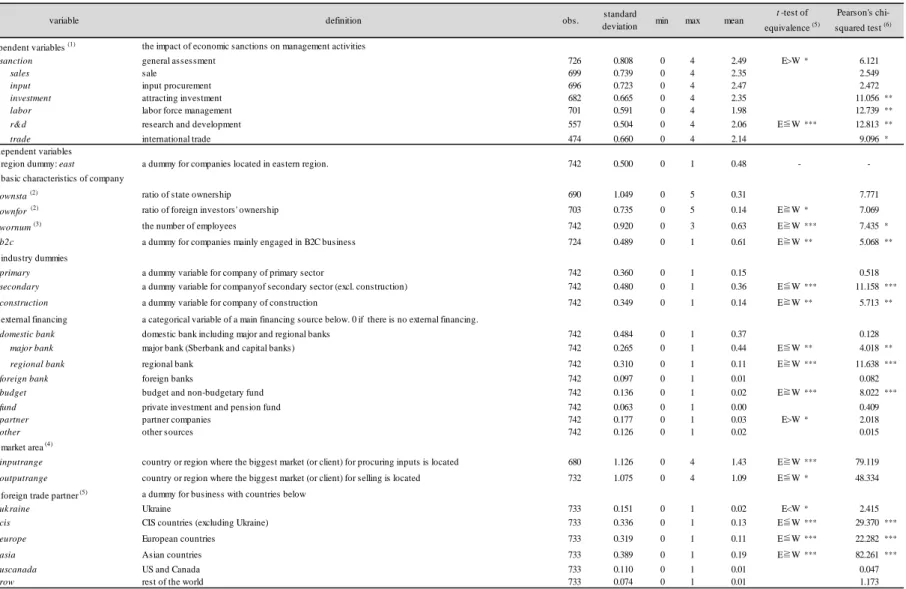
The list of data used in the estimation, definitions, and summary descriptive statistics are shown in Table 2. Table 2 contains the results of tests for equivalence and independence.
[Table 2 here]
Data used are classified into dependent and six groups of independent variables.
Dependent variables are defined as the executive managers’ subjective assessments of the impact of the economic sanctions on their management activities in general (sanction) and on various sectoral assessments, namely, sales, input (procuring input), investment (attracting investment), labor (labor force management), r&d (research and development), and trade (international trade). They are graded in increasing order from 0 (definitely positive impact), 2 (no impact), to 4 (definitely negative impact). As the dependent variables are categorical, we employ the ordered probit model using robust standard errors as follows:
𝑦𝑦= 𝜇𝜇 + 𝛽𝛽1𝑒𝑒𝑒𝑒𝑒𝑒𝑒𝑒+ � 𝛽𝛽𝑖𝑖
𝑛𝑛 𝑖𝑖=2
𝑥𝑥𝑖𝑖+ 𝜀𝜀 ,
where 𝑦𝑦 is a dependent variable, 𝜇𝜇 is a constant term, 𝑥𝑥𝑖𝑖 and 𝛽𝛽𝑖𝑖 are independent variables and their coefficients, and 𝜀𝜀 is an error term. Estimation results using OLS and ordered logit estimators are also reported for reference. This equation will also be applied
to examine sectoral assessments of the impact. Then, determinants of the general assessment of the impact of sanctions are examined further by incorporating sectoral assessment on the right-side in order to consider the relationship between them.
The first and foremost factor for our analysis is the locational factor of the company. We introduce a dummy variable (east) which is (1) if the company is located in the eastern region and (0) if otherwise. The remaining five groups of independent variables are (2) basic characteristics of company, (3) industry dummies, (4) external financing, (5) market area, and (6) foreign trade partner. These variables are likely to be more or less concerned with economic sanctions.
Basic characteristics of the company are a set of control variables, consisting of shares of state and foreign ownership (ownsta and ownfor, respectively), number of employees as a proxy for the size of the company, and dummy variable reflecting company’s business orientation to consumer sector (b2c).
As western countries imposed sectoral sanctions on strategically essential industries, the sector to which the company belongs matters. Thus, (2) industry dummies are included in the estimation although it is impossible to distinguish defense companies in the dataset. We separately treat companies belonging to primary (agriculture, forestry, and fishery), secondary (mining, manufacturing, lifeline industry including electricity and water supply, etc.), and construction sectors.8 Tertiary sector, consisting of trade, transport, and communications, is a default category. There are relatively more companies in the secondary sector in the eastern region while there are more companies of construction and tertiary sectors in the western region.
Because another feature is that financial sanctions directly target major state banks, we control sources of external financing in the following classification: domestic banks including sub-groups, consisting of major banks, that is Sberbank and large banks located in Moscow or St. Petersburg, and regional banks. Some of the major banks are the target of the sanctions, and more or less serve as a dummy reflecting a targeted financing source; budget is expenditures from federal, regional, and municipal governments or extra-budgetary funds; funds are private investment funds and non-state
8 The sectoral classification with 13 sub-industries is possible. We do not use this because this neither changes the estimation results, nor produce a statistically significant coefficient for each industry.
pension funds; partner is defined as financing from partner companies including group or holding companies other than financial organizations. These financing sources are dummy variables, which take the value 1 if the largest financial source in 2014 (prior to the imposition of the sanctions) correspond to one of them, and zero if otherwise or no external financing. It can be expected that companies’ financing from the targeted major banks are subject to the impact of the sanctions. Table 3 shows the breakdown of the external financing sources of the surveyed companies. Almost half of them used an external source, mainly relying on financing by banks (about 40%). It is clear from Tables 2 and 3 that companies in the western region used financing from major banks more than in the eastern region while the latter tend to rely more on regional banks and budget and non-budgetary funds.
[Table 3 here]
Additionally, we will consider how the company works by using two kinds of variables. The first one is concerned with the range of business. It can be expected that companies primarily working in the local market will be less affected by the sanctions than those engaged in international trade. Meanwhile, the costs of trade within the vast territory of Russia may sometimes exceed international trade with a neighboring country, hence, we need to distinguish the range of market area (5) where the company mainly procures raw materials (inputrange) and sells their products (outputrange). Domestic businesses are divided into four, namely, that inside the city of the company’s location, outside the city and within the territory of the federal subject, beyond the boundary of the federal subject up to 3,000 km, and over 3,000 km. This ordinal variable takes the value from 0 to 4 according to its distance while international trade takes the value 5.
Lastly, regions of the company’s trade partners are considered in following (multiple choice): Ukraine, CIS, Europe, US & Canada, Asia, and the rest of the world (row). The first four regions are against the Russian government and imposed sanctions, which may negatively affect business with these countries. In contrast, most of the Asian countries do not impose sanctions. One can argue that a company can replace a trade partner from sending countries to non-sending countries to avoid the impact of sanctions, or that markets, especially financial markets, are globally integrated into a single one
where non-sending countries take business with Russia seriously. Therefore, how a country or region of a trade partner affects the assessment of the impact should also be empirically examined. Table 4 summarizes the breakdown of the survey results by country having companies that are engaged in international business. The share of companies engaged in foreign trade is 67.5% in total, 64.0% and 70.8% in eastern and western regions, respectively. This table shows a clear regional variation in trade partner which is affected by the location of the company: companies in east regions deal more with Asian countries whereas those in west region deal more with European counties.
[Table 4 here]
4.2 Estimation Results
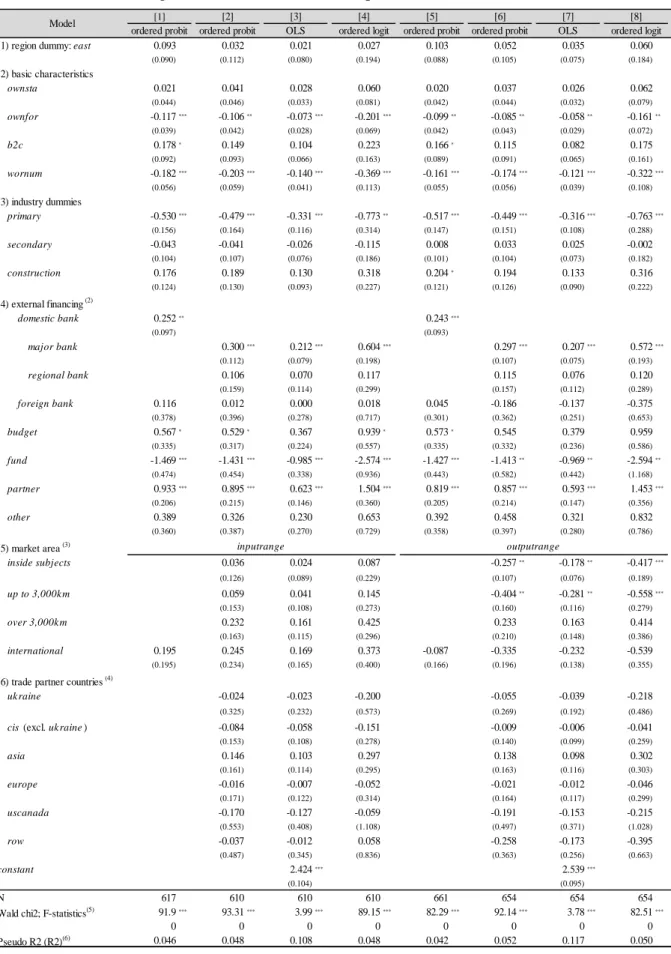
Table 5 shows the estimation results for the determining factors of the general sanctions- impact assessment on management activities. Models [1] and [5] are baseline estimates, and the remaining models use detailed variables on external financing, market area, and trade partners. The ranges of market area for procuring raw materials (inputrange) and for selling products (outputrange) are examined in models from [1] to [4] and [5] to [8], separately.
[Table 5 here]
First and most importantly, a regional dummy variable (east) is statistically insignificant at less than the 10% in all models, indicating that the locational factor of the company does not affect the assessment; this corresponds to the findings from Table 1. It follows that the economic sanctions exerted a geographically uniform effect on a targeted economy independent of the region within the country because the sanctions, aimed at an entire nation, were an exogenous shock on its institutional framework.
Second, the sanctions have varying effects on business depending on the sector and the financing source. These factors are directly or indirectly related to the content of the sanctions. The dummy variable for the primary sector is statistically significant and negative at less than the 5% level. Thus, companies working in agriculture and fishing
suffer less and may benefit from this regime, in which import substitution policies and counter-sanctions of the government may also bolster. In contrast, companies financing from domestic banks, and especially from major banks, tend to perceive a more negative impact as these dummy variables are statistically significant with positive signs at less than 5%.9
Third and interestingly, none of the country or region dummies is statistically significant at less than 10%. The executive managers interviewed did not consider international trade with sending countries to be damaging to their management activities and, at the same time, felt that trade with Asian countries neither positively nor negatively affected the business.10 The effects on market areas are of interest as well. Table 5 shows that involvement in international trade neither improved nor worsened the assessment.
On the contrary, narrower market areas for selling products within the territory of federal subjects and beyond it up to 3,000 km seem to reduce the negative impact assessment. As section 2 discussed, companies engaged in local markets suffer much less from the sanctions. The second and third findings are consistent with each other.
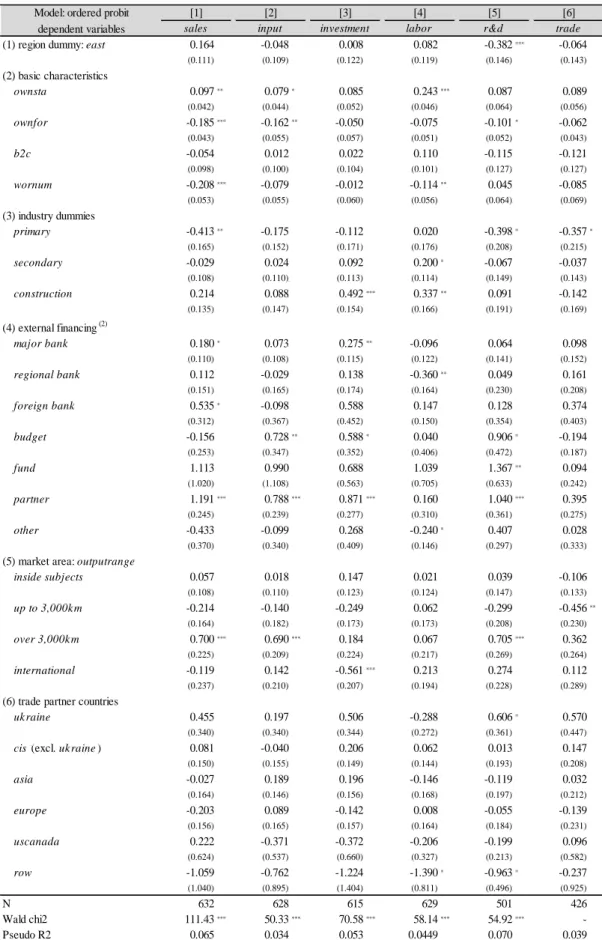
Next, we turn to the impact assessment regarding various management activities.
The estimation results are shown in Table 6. Primary findings are twofold. First, the regional dummy (east) is statistically insignificant in all but model [5] for R&D, the coefficient of which is statistically significant and negative at the 1% level. Second, all dummy variables identifying the countries of trade partners are statistically insignificant in all models except for [5]. These findings are consistent with the results shown in Table 5 on the general assessment. Additionally, looking at each model for the sectoral assessment, we found that model [1] for sales is very similar to the results shown in the general assessment. It follows that the general assessment of the sanctions may stem from the assessment on sales via the financing source.
9 The estimation using individual variables separately identifying Sberbank and capita banks shows that the company financed by capital banks statistically significantly and negatively assess the impact.
10 Inclusion dummy variables for individual Asian countries (China, Japan, South Korea, and India) in the estimations do not produce statistically significant coefficient nor change the result, thus we omitted them from estimations.
[Table 6 here]
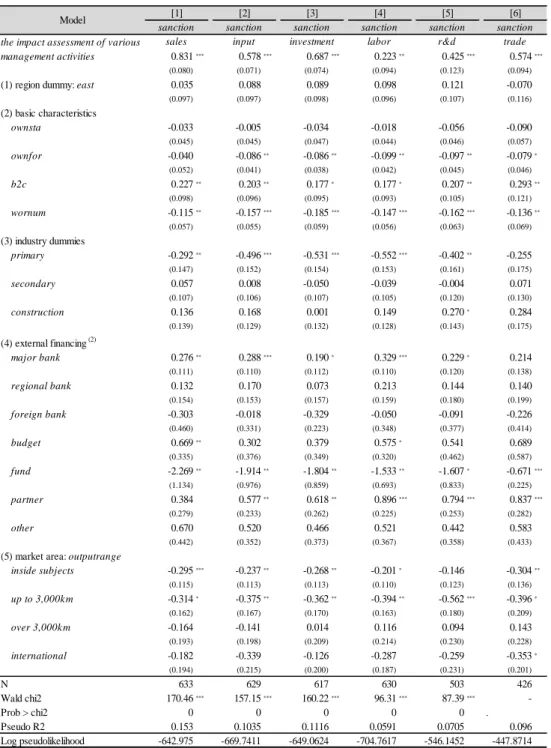
At the end of this section, the relationship between the general and sectoral assessment is examined in Table 7. The estimation results support the previous results in terms of the regional factor, sectoral belongings, and external financing sources.11 It also confirmed that the relationship between them is statistically significant with a positive sign. Among others, the assessment of sales and investments has a much more negative effect on overall management.
[Table 7 here]
From these arguments, we can conclude that the economic sanctions have a significant impact on Russian companies via restriction on the financing of domestic banks, especially major banks located in large cities working on an international capital market level, irrespective of the location of the company and the country of business partners.
5. Conclusions
Five years have passed since the introduction of western sanctions against Russia. During this period, political and economic conditions surrounding Russia have been trending unfavorably as the sanctions continue and are repeatedly strengthened. Thus, how and how much the sanctions affect the Russian economy is a matter of special attention for not only Russia but also the sending countries.
In addition to the policy importance, it should also be emphasized that this time sanctions provide us with a really unique and rare opportunity for studying how much they affect the world’s largest country and one of the political, economic, and military superpowers, and whether they have a geographically varying effect within the country as well. These issues concern the current situation of Russia too. The Russian government is currently carrying “Turn to the East” policies and related regional development policies, counting on the strengthening of partnerships with Asia-Pacific countries, including
11 Country dummy variable for trade partners are not included in the estimations as the inclusion of these variables do not change nor produce any statically significant results.
China as the largest emerging economy in the world, will make up for recent economic losses. In this sense, how the sanctions have the impacted regions geographically and politically distant from the sending countries is of interest.
From our empirical examinations, it can be said that the sanctions affect the Russian economy very negatively at least from the viewpoint of subjective assessment by managers. The survey results revealed that approximately half of the interviewed managers perceived the negative impact of the sanction to some extent. Risks and fears that the business circle is facing are not negligible and more or less affect the performance of their market, and consequently exert pressure on the government policy.
Moreover, we found that the main transmission channels of the sanctions are associated with external financing sources and are independent of countries of trade partners. Western countries imposed financial restrictions on Russian business via selected banks, which in turn affect the entire banking sector. Among them, however, companies financed by major banks were hit harder by the sanctions. In contrast, trade relationships with non-sending countries of the sanctions do not lessen the severity of the impact assessment. Our findings confirm the arguments by Gurvich and Prilepskiy (2015) and Mau (2016) that Asian countries are also disinclined to deal with Russian companies fearing possible involvement in the sanctions.12 These transmission channels of the sanctions generally apply to the various aspects of management activities. The impact on sales and investment, in particular, has a definitive role in the overall assessment.
Last and most importantly, regional heterogeneity in the impact assessment of the sanctions cannot be identified by our analysis. Companies located in eastern and western regions negatively assessed the impact of economic sanctions at almost the same level. This is quite a serious problem for companies in the eastern region because they do not avoid or at least mitigate the impact of sanctions despite the recent prioritizing of the
“Turn to the East” policy. The sanctions obstruct the pursuit of development policies targeted at the Far East regions.
12 Milov (2017) pointed out that the size of the Chinese financial system cannot make up for western loan because its size is too small and it only prefer to finance domestic demand and projects related to the One Belt, One Road strategic initiative.
Reference
Ahn, Daniel P. and Rodney Ludema (2016). “Measuring Smartness: Understanding the Economic Impact of Targeted Sanctions,” Working Paper, 2017-01, U.S. Department of State, Office of the Chief Economist.
Arai, Hirofumi and Ichiro Iwasaki (2018). “Market Quality in the Russian Far East from the Viewpoint of Company Management: Preliminary Report on Microeconomic Comparative Analysis with European Regions,” ERINA Discussion Paper, No.
1602-e, November (revised version).
Connolly, Richard (2016). “The Empire Strikes Back: Economic Statecraft and the Securitisation of Political Economy in Russia,” Europe-Asia Studies, Vol.68 (4), pp.
750–773.
Dreger, Christian, Konstantin A. Kholodilin, Dirk Ulbricht, and Jarko Fidrmuc (2016).
“Between the Hammer and the Anvil: The Impact of Economic Sanctions and Oil Prices on Russia’s Ruble,” Journal of Comparative Economics, Vol. 44 (2), pp. 295–
308.
Dreyer, Iana and Nicu Popescu (2014). “Do Sanctions against Russia Work?” European Union Institute for Security Studies¸ No. 35, December.
Ershov, Mikhail V. (2016). “What Economic Policy Does Russia Need Under the Sanctions?” Problems of Economic Transition, Vol. 58 (3), pp. 181–202.
Golikova, Victoria and Boris Kuznetsov (2017). “Perception of Risks Associated with Economic Sanctions: the Case of Russian Manufacturing,” Post-Soviet Affairs, Vol.
33 (1), pp. 49–62.
Gurvich, Evsey, and Ilya Prilepskiy (2015). “The Impact of Financial Sanctions on the Russian Economy,” Russian Journal of Economics, Vol.1 (4), pp. 359–385.
Gurvich, Evsey, and Ilya Prilepskiy (2018). “Western Sanctions and Russian Reponses:
Effects after Three Years,” in: Torbjon Becker and Susanne Oxenstierna, eds., The Russian Economy under Putin, London and New York: Routledge.
Kholodilin, Konstantin A. and Aleksei Netsunajev (2016). “Crimea and Punishment: The Impact of Sanctions on Russian and European Economies,” DIW Berlin Discussion Papers, No. 1569.
Hasselbach, Christoph (2014). “Resistance Grows in EU to New Russia sanctions,”
Deutsche Welle, 5 September.
Hufbauer, Gary C., Jeffrey J. Schott, Kimberly A. Elliott, and Barbara Oegg (2007).
Economic Sanctions Reconsidered, 3rd edition, Washington, D.C.: Peterson Institute for International Economics.
International Monetary Fund (IMF) (2015). “Russian Federation: 2015 Article IV Consultation,” IMF Country Report, No. 15/211.
Johnston, Cameron (2015). “Sanctions against Russia: Evasion, Compensation and Overcompliance,” European Union Institute for Security Studies Briefs, No. 13, May.
Leonard, Carol S., Zafar Nazarov, and Elena S. Vakulenko (2016). “The Impact of Sub- national Institutions: Recentralization and Regional Growth in the Russian Federation (2001–2008),” Economics of Transition, Vol. 24 (3), pp. 421–446.
Mau, Vladimir (2016). “Between Crises and Sanctions: Economic Policy of the Russian Federation,” Post-Soviet Affairs, Vol. 32 (4), pp. 350–377.
Milov, Vladimir (2017). “Why Sanctions Matter,” The American Interest, August 14, 2017.
Nelson, Rebecca M. (2017). “U.S. Sanctions and Russia’s Economy,” Congressional Research Service, R43895, February.
Orlova, Nataliya V. (2016). “Financial Sanctions: Consequences for Russia’s Economy and Economic Policy,” Problems of Economic Transition, Vol. 58 (3), pp. 203–217.
Pestova, Anna A. and Mikhail E. Mamonov (2017). “Should We Care on the Economic Effects of Western Sanctions on Russia” (mimeo). Available at:
https://sisu.ut.ee/sites/default/files/nem2017/files/pestova_mamonov_final.pdf.
Rapoza, Kenneth (2017). “Here’s How Europe’s Russian Sanctions Differ from Washington’s,” Forbes, June 23.
Russell, Martin (2018). “Sanctions over Ukraine: Impact on Russia,” European Parliament Briefing, EPRS, Members’ Research Service, PE 579.084, January.
Shirov, A.A, A.A. Yantovskii, and V.V. Potapenko (2015). “Evaluation of the Potential Effect of Sanctions on the Economic Development of Russia and the European Union,” Studies on Russian Economic Development, Vol. 26 (4), pp. 317–326.
Tuzova, Yelena and Faryal Qayum (2016). “Global Oil Glut and Sanctions: The Impact on Putin’s Russia,” Energy Policy, Vol. 90, pp. 140–151.
Ulyukaev, Alexei and Vladimir Mau (2015). “Ot ekonomicheskogo krizisa k ekonomicheskomu rostu, ili kak ne dat’ krizisu prevratit’sia v stagnatsiiu,” Voprosy
ekonomiki, No. 4 (2015), pp. 5–19.
Veebel, Viljar and Raul Markus (2016). “At the Dawn of a New Era of Sanctions:
Russian-Ukrainian Crisis and Sanctions,” Orbis, Vol. 60 (1), pp. 128−139.
World Bank (2018). Rolling Back Russia’s Spatial Disparities: Re-assembling the Soviet Jigsaw under a Market Economy, World Bank Group, May 2018.
Zakirova, D.F. and E.F. Zakirova (2018). “Otsenka vliianiia ekonomicheskikh sanktsii na bankovskuiu sistemu Rossiiskoi Federatsii,” Aktual’nyi problemy ekonomiki i prava, Vol. 12 (1), pp. 19−32.
Zubarevich, Natalya (2015). “The Regional Dimension of the New Russian Crisis,”
Social Sciences: A Quarterly Journal of the Russian Academy of Sciences, Vol. 15, No. 4, pp. 3–18.
Table 1 Survey results of the ERINA enterprise survey: assessments of the impact of economic sanctions on management activities (a) All surveyed companies
Number Share (%) Number Share (%) Number Share (%) Number Share (%) Number Share (%) Number Share (%) Number Share (%)
definitely negative impact 77 10.6 41 5.9 65 9.3 44 6.5 8 1.1 6 1.1 19 4.0
rather negative impact 267 36.8 223 31.9 226 32.5 177 26.0 76 10.8 60 10.8 72 15.2
no impact 327 45.0 387 55.4 381 54.7 438 64.2 528 75.3 459 82.4 349 73.6
rather positive impact 48 6.6 37 5.3 21 3.0 20 2.9 73 10.4 23 4.1 23 4.9
definitely positive impact 7 1.0 11 1.6 3 0.4 3 0.4 16 2.3 9 1.6 11 2.3
hard to answer 16 - 43 - 46 - 60 - 41 - 185 - 268 -
total 742 100.0 742 100.0 742 100.0 742 100.0 742 100.0 742 100.0 742 100.0
International trade Sales of products and
services
Procurement of resources and other
materials
Attracting investment Recruitment and employment
Research and Development General assessment
(b) Regional comparison: share (%)
East West East West East West East West East West East West East West
definitely negative impact 13.1 8.4 6.5 5.3 10.4 8.4 9.1 4.1 2.1 0.3 1.2 1.0 5.7 2.4
rather negative impact 35.8 37.7 32.5 31.4 30.7 34.1 22.7 28.8 8.5 12.9 7.9 13.1 11.0 19.0
no impact 44.8 45.3 55.4 55.3 56.1 53.5 63.7 64.7 77.9 73.0 81.7 83.0 75.3 72.1
rather positive impact 5.2 7.9 4.6 5.9 2.5 3.5 3.8 2.2 8.5 12.1 6.7 2.0 5.7 4.0
definitely positive impact 1.2 0.8 0.9 2.1 0.3 0.5 0.6 0.3 3.0 1.6 2.4 1.0 2.2 2.4
total 100.0 100.0 100.0 100.0 100.0 100.0 100.0 100.0 100.0 100.0 100.0 100.0 100.0 100.0
test of independence: Chi-2 (1) 6.1 2.5 2.5 11.1 ** 12.7 ** 12.8 ** 9.1 *
Cramer's V 0.092 0.060 0.060 0.127 0.135 0.152 0.139
Sales of products and services
Procurement of resources and other
materials
Attracting investment Recruitment and employment
Research and Development
International trade General assessment
Note (1) The null hypothesis for the chi-square test of independence is that there is no regional difference in the assessment of the impact of sanctions on management activities. ***, **, and * denote statistical significance at the 1, 5, and 10% levels, respectively.
Source: author’s compilation based on the ERINA enterprise survey.
Table 2 List of data employed in estimation: definition, descriptive statistics, and regional comparison
dependent variables (1) the impact of economic sanctions on management activities
sanction general assessment 726 0.808 0 4 2.49 E>W* 6.121
sales sale 699 0.739 0 4 2.35 2.549
input input procurement 696 0.723 0 4 2.47 2.472
investment attracting investment 682 0.665 0 4 2.35 11.056**
labor labor force management 701 0.591 0 4 1.98 12.739**
r&d research and development 557 0.504 0 4 2.06 E≦W*** 12.813**
trade international trade 474 0.660 0 4 2.14 9.096*
independent variables
(1) region dummy: east a dummy for companies located in eastern region. 742 0.500 0 1 0.48 - -
(2) basic characteristics of company
ownsta (2) ratio of state ownership 690 1.049 0 5 0.31 7.771
ownfor (2) ratio of foreign investors' ownership 703 0.735 0 5 0.14 E≧W* 7.069
wornum (3) the number of employees 742 0.920 0 3 0.63 E≧W*** 7.435*
b2c a dummy for companies mainly engaged in B2C business 724 0.489 0 1 0.61 E≧W** 5.068**
(3) industry dummies
primary a dummy variable for company of primary sector 742 0.360 0 1 0.15 0.518
secondary a dummy variable for companyof secondary sector (excl. construction) 742 0.480 0 1 0.36 E≦W*** 11.158***
construction a dummy variable for company of construction 742 0.349 0 1 0.14 E≧W** 5.713**
(4) external financing a categorical variable of a main financing source below. 0 if there is no external financing.
domestic bank domestic bank including major and regional banks 742 0.484 0 1 0.37 0.128
major bank major bank (Sberbank and capital banks) 742 0.265 0 1 0.44 E≦W** 4.018**
regional bank regional bank 742 0.310 0 1 0.11 E≧W*** 11.638***
foreign bank foreign banks 742 0.097 0 1 0.01 0.082
budget budget and non-budgetary fund 742 0.136 0 1 0.02 E≧W*** 8.022***
fund private investment and pension fund 742 0.063 0 1 0.00 0.409
partner partner companies 742 0.177 0 1 0.03 E>W* 2.018
other other sources 742 0.126 0 1 0.02 0.015
(5) market area (4)
inputrange country or region where the biggest market (or client) for procuring inputs is located 680 1.126 0 4 1.43 E≧W*** 79.119
outputrange country or region where the biggest market (or client) for selling is located 732 1.075 0 4 1.09 E≦W* 48.334
(6) foreign trade partner (5) a dummy for business with countries below
uk raine Ukraine 733 0.151 0 1 0.02 E<W* 2.415
cis CIS countries (excluding Ukraine) 733 0.336 0 1 0.13 E≦W*** 29.370***
europe European countries 733 0.319 0 1 0.11 E≦W*** 22.282***
asia Asian countries 733 0.389 0 1 0.19 E≧W*** 82.261***
uscanada US and Canada 733 0.110 0 1 0.01 0.047
row rest of the world 733 0.074 0 1 0.01 1.173
variable obs. standard
deviation
Pearson's chi- squared test (6)
max mean
min
definition t-test of
equivalence (5)
Notes
(1) The impact of sanctions on management activities in general and its various activities are assessed as follows: 0: definitely positive; 1: rather positive; 3: no impact; 4: rather negative; 5: definitely negative.
(2) This ordinal variable takes the following value according to the share of ownership: 0: 0%; 1: 10%
or less; 2: 10.1-25%; 3: 25.1-50%; 4: 50.1-75%5: 75% or more.
(3) This ordinal variable takes the following value according to the number of employees: 0: 50-99 persons; 1: 100-249 persons; 2: 250-499 persons; 3: 500 persons or more.
(4) This ordinal variable takes the following value according to the distance of market area: 0: inside the city; 1: inside the federal subject; 2: in another federal subject up to 3,000 km; 3: over 3,000 km;
4: abroad.
(5) Dummy variables take the value 1 if the company is engaged in trade activities with the country listed (multiple choice).
(6) The null hypothesis for t-tests of equivalence is that means are the same in eastern (E) and western (W) regions. ***, **, and * denote statistical significance at the 1, 5, and 10% levels, respectively.
(7) The null hypothesis for the chi-square test of independence is that there is no regional difference regarding variables shown. ***, **, and * denote statistical significance at the 1, 5, and 10% levels, respectively.
Source: author’s compilation based on the ERINA enterprise survey