• 検索結果がありません。

The spatial distribution of primary care clinics in an urban city in Korea

N/A
N/A
Protected

Academic year: 2021

シェア "The spatial distribution of primary care clinics in an urban city in Korea"

Copied!
4
0
0

読み込み中.... (全文を見る)

全文

(1)

The spatial distribution of primary care clinics in an urban city in Korea

Kwangsoo Lee

ABSTRACT

This study purposed to analyze the spatial characteristics of primary care organizations within a metropolitan city. Study city was one of the six metropolitan cities in Korea and had a population over 1.5 million. For the analysis, 500mx500m grids were created on the map and then study variables were calculated in each cell. Data was from the 5 ward offices and public health centers. Variables which could not calculated directly from each cell so that they were estimated in each cell based on the formula. Regression analysis models were developed with the number of primary care organization as dependent variable. Road areas, number of subway gate, and number of hospital variables showed higher coefficients than that of population variable. Road areas and number of subway, and number of hospital variables showed large standardized regression coefficients. Population factor was also significant in explaining the distribution of primary care clinics

Keywords : primary care organization, spatial distribution, geographic information system

1. Introduction

The location of health care organizations is known as the one of the key factors for influencing their performances in current healthcare market. The locations of health care organizations were decided where the accessibility between people and organizations is good (Boscarino & Flexner, 1981). Especially, the location is much emphasized when a large portion of their patients come from their neighborhood which is not far from their organizations (Kim, 2006).

Better accessibility for the primary care and preventive services was considered as the key factor for improving the performance of health care system (Dulin et al., 2010). Comber et al (2011) proposed that spatial accessibility for primary care service had impacts on the uses of healthcare services. Tanser et al (2005) proved that as the distance increased between primary care organizations and the residence of people, service uses were decreased significantly. The breast cancer screening rate was varied by the travel distance of people

(Maheswaran et al., 2006).

Primary care organizations are expected to operate in locations where they have better accessibility of people and where they close to the socio-economically attractive areas to improve their performances.

The purpose of this study was to develop a grid-based model and then analyze the spatial characteristics of primary care organizations within a metropolitan city.

Study hypothesis were like these:

H1: primary care organizations are more likely locate to areas where people have better accessibility.

H2: primary care organization are more likely locate to areas where are socio-economically attractive.

2. Methods

2.1 Study area & sample

This study included two types of primary care organization, clinic and oriental medicine clinic which operated in Daejeon metropolitan city. These clinics performed a role of gatekeeper in health care delivery system. Daejeon is one of six metropolitan cities in Korea and the number of population is about 1.5million.

It is composed of five ward offices and 81 Dongs which is the smallest administrative district.

Clinic data was collected from the five public health centers which operated in each ward office in 2010. The Dept. of Health Administration,

College of Health Sciences, Yonsei University Yonseidaegil 1, Wonju,

Gwangwondo, Korea (South) 220-710 Tel: 82-33-760-2426

E-mail: [email protected]

(2)

address of each clinic was collected and then their locations were converted into map data by geocoding method.

Proxy variables were included to represent the socio- economic status of residents in each cell. Those variables were (1) population factor including total population, number of people over 65, (2) economic factors including number of business, number of works, (3) accessibility factors including road area (major arterial road, minor arterial road, others), the existence of subway gate, (4) spatial feature factor including building area (residential building, commercial building, others).

Also, the number of hospitals in each cell was included to control the effects of hospital. Those data were collected from the annual report of the 5 ward offices in Daejeon in 2008.

2.2 Grid-based model

500mx500m grids were created on the study area (Figure 1). Depending on the variables types, different estimation methods were applied to calculate them in each cell.

FIGURE 1. 500mX500m grids on study area

Total population, number of people aged over 65, number of establishments, and number of workers were estimated by these steps. For example, total populations in each cell, step1: calculate the number of total population per unit area for each Dong by dividing total number of population in Dong with the Dong size, step2:

using intersect function to calculate the Dong size in each cell (one or multiple Dong can be included in each

cell), step3: multiply the scores from step1 and step2.

Road area (major arterial road, minor arterial road, others) and building area (residential building, commercial building, others) in each cell was calculated through applying intersect function to calculate the area size of road and building in each cell. The number of subway gate and the number of hospital in each cell was calculated by summing the number of hospital or the number of gate in each cell

2.3 statistical analysis methods

Descriptive analysis was conducted to analyze the distribution of study variables. Second, the relationships among variables were analyzed with the correlation analysis. Third, multivariate regression analysis was applied to analyze the spatial characteristics of primary care clinics. The unit of analysis was each cell. Separate regression models were developed.

3. Results

Figure 2 shows the distribution of clinic (map A) and oriental medicine clinic (map B). Primary care organizations tend to locate at the center of the city.

(A) Clinic (B) Oriental

medicine clinic Figure 2. Distribution of clinic

Figure 3 shows the distribution of total population

(map A) and road area (map B). Like the distribution in

Figure 2, higher number of population was apparent at

the center of city.

(3)

(A) Total population (B) Road area Figure 3. Distribution of total population, road area

Figure 4 shows the distribution of commercial building area (map A) and residential building area (map B). It showed that commercial building areas were more concentrated at the center of city than that of residential building area.

(A) Commercial building area

(B) Residential building area Figure 4. Distribution of building areas

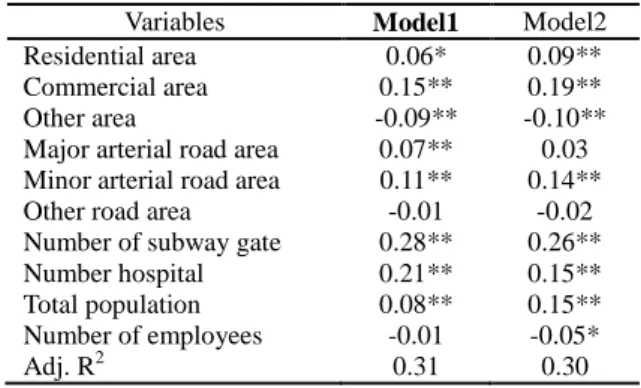
Table 1 shows the standardized regression coefficients of the regression model. Most variables were statistically significant in explaining the location primary care clinics.

Road areas and subway gate variables had higher coefficients than that of population variable. Number of hospital variable also showed large coefficients in the model.

4. Discussion

Road areas and subway gate variables showed large standardized regression coefficients and these results will imply that primary care organizations prefer to operate in

areas with better accessibility.

Table 1. Standardized regression coefficients

Variables Model1 Model2

Residential area 0.06* 0.09**

Commercial area 0.15** 0.19**

Other area -0.09** -0.10**

Major arterial road area 0.07** 0.03 Minor arterial road area 0.11** 0.14**

Other road area -0.01 -0.02

Number of subway gate 0.28** 0.26**

Number hospital 0.21** 0.15**

Total population 0.08** 0.15**

Number of employees -0.01 -0.05*

Adj. R

2

0.31 0.30

Model1: number of clinic, Model2: number of oriental medicine clinic

In addition, number of hospital was also significant variable in explaining the location of them. The reason will be that first, hospitals as well as primary care organizations may prefer locations having similar spatial characteristics, second, they may prefer to location in areas where they may have prestige in health care delivery system, that is, convenient in referring patients to and referring them from hospitals.

The preference of primary care organizations for areas with better accessibility and large population could lead the accessibility problems of people living in other areas.

The unequal distribution of primary care organizations within a city will lead to the inefficient and ineffective uses of health care resources. City policy makers will need to consider how to respond the issues.

All countries and cities are experiencing the shortage of money for delivering healthcare services. And they want to improve the efficiency of their health care system.

References

Boscarino, J., Steiber, S.R., (1982). Hospital shopping and consumer choice. Journal of Health care Marketing, 2, 2, 25-34

Comber, A.J., Brunsdon, C., Radburn, R.,(2011). A

spatial analysis of variations in health access: linking

geography, socio-economic status and access

perceptions. International Journal of Health

Geographics, 25, 10, 44.

(4)

Dulin, M.F., Ludden, T.M., Tapp, H., Blackwell, J., de Hernandez, B.U., Smith, H.A., Furuseth, O.J. Using geographic information systems (GIS) to understand a community's primary care needs. Journal of the American Board of Family Medicine. 2010; 23(1):13- 21.

Kim, S.H., (2006). Analysis of geographic accessibility of the inpatients using GIS. Yonsei University, Dissertation

Maheswaran, R., Pearson, T., Jordan, H., Black, D.,(2006). Socioeconomic deprivation, travel distance, location of service, and uptake of breast cancer screening in North Derbyshire, UK. Journal of Epidemiology and Community Health, 60, 3, 208-212.

Tanser, F., Gijsbertsen, B., Herbst, K.,(2006). Modeling

and understanding primary health care accessibility

and utilization in rural South Africa: an exploration

using a geographical information system, Social

Science Medicine, 63, 3, 691-705.

Figure 2 shows the distribution of clinic (map  A) and  oriental  medicine  clinic  (map  B)
Table 1 shows the standardized regression coefficients  of the regression model. Most variables were statistically  significant in explaining the location primary care clinics

参照

関連したドキュメント

Then it follows immediately from a suitable version of “Hensel’s Lemma” [cf., e.g., the argument of [4], Lemma 2.1] that S may be obtained, as the notation suggests, as the m A

[In particular, if a profinite group is isomorphic to the absolute Galois group of a number field, then the profinite group is of AGSC-type.] Then the main result of the present

We have generated A 4 extensions using Kummer theory of quadratic extensions over cyclic cubic fields, keeping only those extensions whose discriminant is less than the required

In particular, the [proof of the] main result does not give an alternative proof of the Neukirch-Uchida theorem.... Mono-anabelian Reconstruction Algorithm (2) (MRA 1 ) What is

The investigation of the question wether an algebraic number field is monogenic is a classical problem in algebraic number theory (cf. Kov´ acs [19] the existence of a power

gp of a

A combinatorial proof for the largest power of 2 in the number of involutions.. Jang

It is well known that in the cases covered by Theorem 1, the maximum permanent is achieved by a circulant.. Note also, by Theorem 4, that the conjecture holds for (m, 2) whenever m