• 検索結果がありません。

SOX4 expression is closely associated with differentiation and lymph node metastasis in oral squamous cell carcinoma

N/A
N/A
Protected

Academic year: 2021

シェア "SOX4 expression is closely associated with differentiation and lymph node metastasis in oral squamous cell carcinoma "

Copied!
31
0
0

読み込み中.... (全文を見る)

全文

(1)

This article has been published in Medical Molecular Morphology, Volume 47(3), 150-155.

この論文は,Medical Molecular Morphology,47 巻3号,150-155に出版されました.

(2)

SOX4 expression is closely associated with differentiation and lymph node metastasis in oral squamous cell carcinoma

Masahiro Watanabe 1, Yuichi Ohnishi 2, Masahiro Wato 3, Akio Tanaka 3, Kenji Kakudo 2

1 Graduate School of Dentistry, 2 Second Department of Oral and Maxillofacial Surgery, Osaka Dental University, 8-1 Kuzuhahanazono-cho, Hirakata-shi, Osaka 573-1121, Japan

3 Oral Pathology, Osaka Dental University, 8-1 Kuzuhahanazono-cho, Hirakata-shi, Osaka 573-1121, Japan

Tel.: +81-6-6910-1510; Fax: +81-6-6910-1030 e-mail: [email protected]

Key words oral squamous cell carcinoma, SOX4, differentiation, metastasis,

chemoradiation therapy

(3)

Abstract

SOX4 is a member of the SOX family of transcription regulators. In recent years,

SOX4 was shown to be overexpressed in cancers of various organs and related

to epithelial-mesenchymal transition (EMT), which is a metastatic factor. This

study was the first to investigate correlations between SOX4 expression levels

and the clinicopathologic factors of oral squamous cell carcinoma (OSCC). We

analyzed SOX4 expression levels in 50 patients with OSCC using

immunohistochemistry. All samples expressed the SOX4 protein and elevated

SOX4 expression was significantly correlated with gender, T status, and stage

levels. The expression level of SOX4 in primary foci of poorly differentiated

OSCC was higher than that of well differentiated OSCC, which indicated that

SOX4 expression is associated with the differentiation of OSCC. However,

regardless of the differentiation level in the primary focus, SOX4 expression

levels were found to be very high in the metastatic focus. Furthermore, SOX4

expression in metastatic foci was significantly suppressed by neoadjuvant

therapy. These results indicate that undifferentiated OSCC cells expressing

SOX4 are more likely to metastasize and neoadjuvant therapy including

chemoradiation therapy may have some effect in metastatic prevention.

(4)

Introduction

Oral squamous cell carcinoma (OSCC) is one of the most malignant tumors and is generally associated with poor prognosis [1, 2]. About 50% of patients die of this disease or complications within 5 years, in spite of the important therapeutic advances introduced in recent years [3, 4], because OSCC is highly aggressive with rapid local tumor growth and quickly metastasizes to the regional lymph nodes [5].

SOX4 belongs to the sex-determining region Y (SRY) box family that decides embryonic sex in a male [6] and was shown to have a characteristic DNA-binding HMG domain [7] that plays important roles in progenitor cell development and Wnt signaling [8, 9]. A previous study showed that SOX4 was specifically expressed in various organs of the mouse [10]. SOX4 is also expressed in the developing breast and osteoblasts of humans and high levels have been detected in response to progestins [11].

Several studies have recently reported that high levels of SOX4 expression were

detected in the tumors of various organs, including the prostate [12, 13], colon

[14], bladder [15], and lung [16]. Moreover, SOX4 activated the TGF-β pathway,

(5)

which induced epithelial-mesenchymal transition (EMT), a key step toward cancer metastasis [17-20]. However, the role of SOX4 in these tumors has not yet been clarified and previous studies have shown certain contradictions [21-23]. For example, results obtained from immunohistochemistry showed that SOX4 overexpression was significantly correlated with a better prognosis in patients with bladder carcinoma [15], medulloblastomas [24], and hepatocellular carcinoma [25], whereas SOX4 overexpression in gastric cancer was associated with a worse prognosis [26]. In addition, the prognostic significance of SOX4 expression in OSCC has not yet been reported.

In this study, we analyzed the expression of SOX4 in OSCC specimens using immunohistochemistry. Furthermore, we evaluated the relationship between the differentiation and metastatic potency of OSCC and neoadjuvant therapy.

Materials and methods

Patients

Fifty patients with operable oral cancer underwent surgery at the Department of

(6)

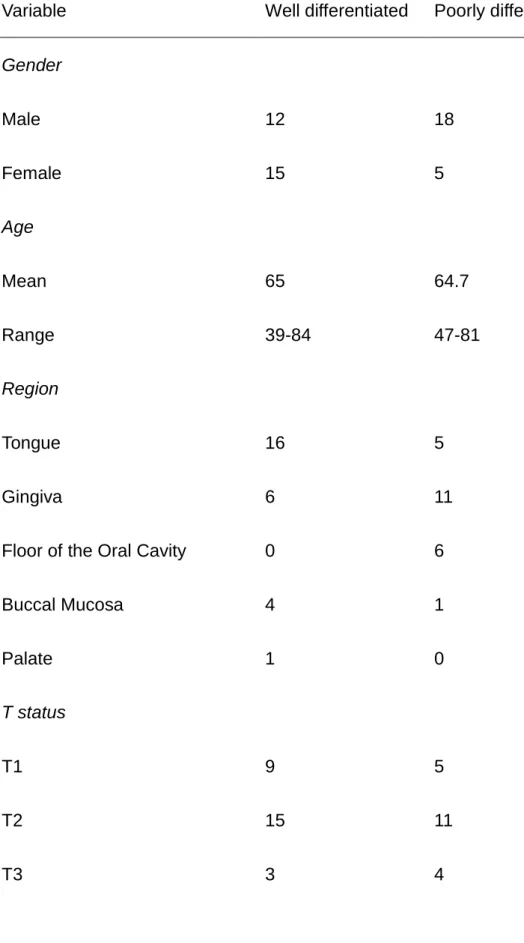
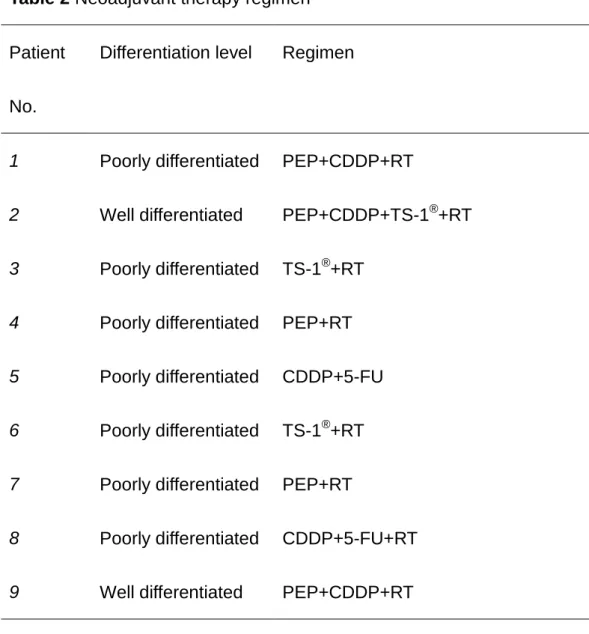
Oral and Maxillofacial Surgery, Osaka Dental University Hospital between 2001 and 2011 (Table 1). This study followed the tenets of the Declaration of Helsinki, and was approved by the Ethics Committee of the above Osaka Dental University (approval No.110723). None of the primary focus received neoadjuvant therapy and, among 19 metastatic samples, 9 samples received neoadjuvant therapy. The concrete contents of neoadjuvant therapy are shown in Table 2. The histologic classification of tumors was based on the UICC classification [27].

Immunohistochemistry

Tissue samples from patients with different stages of oral cancer were fixed in

10% neutral buffered formalin solution immediately after resection and

embedded in paraffin. Four micrometer-thick sections were cut and mounted on

silane-coated glass slides. These sections were deparaffinized in L-limonene

and dehydrated through a graded ethanol series. Antigen retrieval was

performed by autoclaving at 121C for 15 min in Histo VT One

®

(pH 7.0) (Nacalai

Tesque, Kyoto, Japan). Endogenous peroxidase activity was blocked with 3%

(7)

H

2

O

2

for 10 min and nonspecific reactions were blocked with blocking solution (Nacalai Tesque, Kyoto, Japan) for 10 min. Tissue sections were incubated with a rabbit anti-SOX4 polyclonal antibody (1:3000; Abcam, Cambridge, UK) overnight at 4C. Tissue slides were then incubated with an anti-rabbit IgG

peroxidase-conjugated micropolymer (Vector Laboratories, Burlingame, CA) at room temperature for 30 min and visualized by incubation with the 3,3'-diaminobenzidine tetrahydrochloride liquid system (Dako, Tokyo, Japan) at room temperature for 5 min. Sections were then counterstained with hematoxylin and observed using light microscopy (Olympus Corporation, Tokyo, Japan).

Evaluation of slides

The immunoreactivity of the SOX4 protein was evaluated by two independent pathologists who had no knowledge of the patients’ clinicopathologic factors and

outcomes. Nuclear expression of the SOX4 protein was scored

semiquantitatively by the combination of intensity (scored as 1, weak staining; 2,

moderate staining; 3, strong staining) and proportion of positively stained tumor

cells in 1000 tumor cells in high power fields (scored as 1, <40%; 2, 40–60%; 3,

(8)

61–80%; 4, >80%). The sum of staining intensity scores and percentage of positive tumor cell scores was graded as follows: +, 2–3; ++, 4–5, and +++, 6–7.

No discrepancy was observed in the overall interpretation of immunohistochemistry results between the two pathologists.

Statistical analysis

A Mann-Whitney U test was performed using the SPSS software package (versions 13.0, SPSS Inc., Chicago, IL) to assess significant differences between samples. P-values <0.05 were considered significant.

Results

The SOX4 protein was expressed in OSCC patients

The SOX4 protein was clearly stained at various levels in the nuclei of cells in

OSCC specimens. Among 50 paraffin-embedded OSCC tissues of the primary

focus, all cases showed positive, 3 cases (6%) showed weak (+), 22 cases

(9)

(44%) showed moderate (++), and 25 cases (50%) showed strong (+++) expression. Representative cases of different expression levels of the SOX4 protein are shown in Fig. 1a–c.

Expression of the SOX4 protein was positively associated with clinicopathologic factors in OSCC

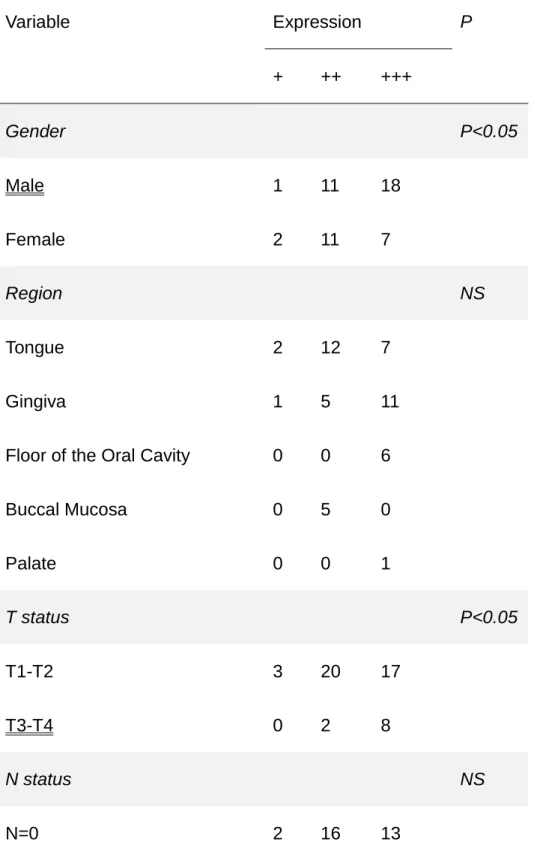
High expression levels of SOX4 were detected in males (P <0.05, Table 3) and the expression of SOX4 was significantly correlated with a large tumor size (P

<0.05, Table 3) and advanced stages (P <0.05, Table 3). However, SOX4

expression was not associated with region or the presence or absence of metastasis (P >0.05, Table 3).

Overexpression of the SOX4 protein in poorly differentiated OSCC and metastatic foci of OSCC

Expression levels of the SOX4 protein in the primary foci of poorly differentiated

OSCC was higher than that of well differentiated OSCC (P <0.05, Table 3, Fig.

(10)

1d). Furthermore, in well differentiated OSCC, SOX4 expression in metastatic foci was higher than that in primary foci (P <0.05, Table 3, Fig. 2c).

Representative cases are shown in Fig. 2a-b.

Downregulation of SOX4 in metastatic foci with neoadjuvant therapy

To investigate the relationship between SOX4 expression and neoadjuvant therapy in OSCC, SOX4 expression levels in metastatic lymph nodes were evaluated between patients who received neoadjuvant therapy and those who did not. SOX4 expression levels in metastatic foci were lower in patients who received neoadjuvant therapy than in those who did not (P <0.01, Table 3, Fig.

3c). This result was not affected by differentiation level of OSCC. Representative cases of primary and metastatic foci in the same patient receiving neoadjuvant therapy are shown in Fig. 3a-b.

Discussion

In this study, our results showed that the nuclei of cancer cells in all OSCC

(11)

samples were SOX4 positive and the elevated expression of SOX4 was positively correlated with gender, T status, and stage progression of OSCC. On the other hand, expression levels of the SOX4 protein in the primary foci of poorly differentiated OSCC was higher than that in the primary foci of well differentiated.

SOX4 has been studied in several types of human cancers and its expression was shown to vary according to cancer type. The expression level of SOX4 in many human cancers, including that of the prostate [12], bladder [15], endometrium [28], and liver [25], was shown to be elevated in vitro and in vivo, whereas it was decreased in gallbladder carcinoma [29] and melanoma [30].

Furthermore, to the best of our knowledge, no study has investigated SOX4 expression in OSCC.

Our study demonstrated that SOX4 overexpression was correlated with T status

and stage level, which is consistent with the results obtained from patients with

gallbladder carcinoma [29]. On the other hand, well differentiated OSCC in our

study consisted of many differentiated tumor cells in the central region of the

focus, and the majority of undifferentiated tumor cells expressing SOX4 existed

in the fringe of the focus. Therefore, well differentiated OSCC may not contain

(12)

many undifferentiated OSCC cells expressing SOX4, and the expression level of SOX4 was lower than that in poorly differentiated OSCC. Although studies on the relationship between SOX4 expression and differentiation in several tumors are limited, a previous report showed that the prolonged expression of SOX4 inhibited correct neuronal differentiation [31] and SOX4 correlated with SOX2, which is critical for maintaining stem cells [32]. In addition, our results suggest that a high level of SOX4 expression in OSCC may be correlated with tumor proliferation and metastasis.

Metastasis is a multistep process, during which primary cancer cells invade adjacent tissues, intravasate, translocate through the vasculature, arrest in distant capillaries, extravasate into the surrounding tissue, and finally proliferate into second tumors [33]. Metastatic cancer cells need anoikis (apoptosis resulting from the loss of cell-matrix interactions) resistance and growth ability in single cells and small cell clusters that are anchorage-independent.

Previous reports demonstrated that miR-335 suppressed metastasis through the downregulation of SOX4 [23, 34, 35]. Moreover, SOX4 was shown to induce EMT [18] and anchorage-independent growth [36].

Thus, in patients with well differentiated OSCC, undifferentiated OSCC cells

(13)

expressing SOX4 in early stage primary foci metastasize and form a second tumor. The proliferative ability of undifferentiated tumor cells expressing SOX4 in metastatic foci is maintained and SOX4 positive tumor cells disappear or differentiate by some factors in the primary focus.

Our findings also showed that neoadjuvant therapy significantly suppressed SOX4 expression levels in the metastatic focus. There have been no previous reports on the influence of neoadjuvant therapy, including chemoradiation therapy, on SOX4 expression. Though the regimen and cycles of neoadjuvant therapy were not similar, the expression level of SOX4 significantly decreased in all cases in this study. It is thought that the majority of OSCC cells died due to neoadjuvant therapy. However, we confirmed that the expression of Ki-67, which is a cell cycle marker, was not significantly affected (data not shown).

Furthermore, our study confirmed cancer cells overexpressing SOX4 in

metastatic foci were strongly positive for Vimentin, one of the EMT markers, and neoadjuvant therapy suppressed Vimentin levels (data not shown).

Therefore, neoadjuvant therapy has the possibility to effectively inhibit EMT by suppressing SOX4 expression levels.

The outcome of the present study demonstrated the clinical significance of the

(14)

overexpression of SOX4 in OSCC. Therefore, we propose that a new therapy

targeting SOX4 may be a useful approach for the treatment of OSCC

metastasis.

(15)

References

1. Massano J, Regateiro FS, Januario G, Ferreira A (2006) Oral squamous cell carcinoma: review of prognostic and predictive factors. Oral Surg Oral Med Oral Pathol Oral Radiol Endod 102:67–76

2. Kademani D (2007) Oral cancer. Mayo Clin Proc 82:878–887

3. Warnakulasuriya S (2010) Living with oral cancer: epidemiology with particular reference to prevalence and life-style changes that influence survival. Oral Oncol 46:407–410

4. Jemal A, Siegel R, Xu J, Ward E (2010) Cancer statistics, 2010. CA Cancer J Clin 60:277–300

5. Sano D, Myers JN (2007) Metastasis of squamous cell carcinoma of the oral tongue. Cancer Metastasis Rev 26:645–662

6. Sinclair AH, Berta P, Palmer MS, Hawkins JR, Griffiths BL, Smith MJ, Foster JW, Frischauf AM, Lovell-Badge R, Goodfellow PN (1990) A gene from the human sex-determining region encodes a protein with homology to a conserved DNA-binding motif. Nature 346:240-244

7. Bowles J, Schepers G, Koopman P (2000) Phylogeny of the SOX Family of

(16)

Developmental Transcription Factors Based on Sequence and Structural Indicators. Dev Biol 227:239-255

8. Busslinger M (2004) Transcriptional control of early B cell development. Annu Rev Immunol 22:55–79

9. Sinner D, Kordich JJ, Spence JR, Opoka R, Rankin S, Lin SCJ, Jonatan D, Zorn AM, Wells JM (2007) Sox17 and Sox4 differentially regulate h-catenin/T-cell factor activity and proliferation of colon carcinoma cells. Mol Cell Biol 27:7802–7815

10. van de Wetering M, Oosterwegel M, van Norren K, Clevers H (1993) Sox-4, an Sry-like HMG box protein, is a transcriptional activator in lymphocytes. EMBO J 12:3847–3854

11. Graham JD, Hunt SM, Tran N, Clarke CL (1999) Regulation of the expression and activity by progestins of a member of the SOX gene family of transcriptional modulators. J Mol Endocrinol 22:295–304

12. Liu P, Ramachandran S, Ali Seyed M, Scharer CD, Laycock N, Dalton WB,

Williams H, Karanam S, Datta MW, Jaye DL, Moreno CS (2006)

Sex-determining region Y box 4 is a transforming oncogene in human prostate

cancer cells. Cancer Res 66:4011–4019

(17)

13. Scharer CD, McCabe CD, Ali-Seyed M, Berger MF, Bulyk ML, Moreno CS (2009) Genome-Wide Promoter Analysis of the SOX4 Transcriptional Network in Prostate Cancer Cells. Cancer Res 69:709-717

14. Andersen CL, Christensen LL, Thorsen K, Schepeler T, Sørensen FB, Verspaget HW, Simon R, Kruhøffer M, Aaltonen LA, Laurberg S, Ørntoft TF (2009) Dysregulation of the transcription factors SOX4, CBFB and SMARCC1 correlates with outcome of colorectal cancer. Br J Cancer 100:511–523

15. Aaboe M, Birkenkamp-Demtroder K, Wiuf C, Sørensen FB, Thykjaer T, Sauter G, Jensen KME, Dyrskjøt L, Ørntoft T (2006) SOX4 expression in bladder carcinoma: clinical aspects and in vitro functional characterization. Cancer Res 66:3434–3442

16. Medina PP, Castillo SD, Blanco S, Sanz-Garcia M, Largo C, Alvarez S, Yokota J, Gonzalez-Neira A, Benitez J, Clevers HC, Cigudosa JC, Lazo PA, Sanchez-Cespedes M (2009) The SRY-HMG box gene, SOX4, is a target of gene amplification at chromosome 6p in lung cancer. Hum Mol Genetics 18:1343–1352

17. Kudo-Saito C, Shirako H, Takeuchi T, Kawakami Y (2009) Cancer Metastasis

Is Accelerated through Immunosuppression during Snail-Induced EMT of

(18)

Cancer Cells. Cancer Cell 15:195–206

18. Zhang J, Liang Q, Lei Y, Yao M, Li L, Gao X, Feng J, Zhang Y, Gao H, Liu DX, Lu J, Huang B (2012) SOX4 induces epithelial-mesenchymal transition and contributes to breast cancer progression. Cancer Res 72:4597–4608

19. Eastham AM, Spencer H, Soncin F, Ritson S, Merry CL, Stern PL, Ward CM (2007) Epithelial-mesenchymal transition events during human embryonic stem cell differentiation. Cancer Res 67:11254–11262

20. Guarino M (2007) Epithelial-mesenchymal transition and tumour invasion. Int J Biochem Cell Biol 39:2153–2160

21. Pramoonjago P, Baras AS, Moskaluk CA (2006) Knockdown of Sox4 expression by RNAi induces apoptosis in ACC3 cells. Oncogene 25:5626–5639

22. Pan X, Zhao J, Zhang WN, Li HY, Mu R, Zhou T, Zhang HY, Gong WL, Yu M, Man JH, Zhang PJ, Li AL, Zhang XM (2009) Induction of SOX4 by DNA damage is critical for p53 stabilization and function. Proceedings of the National Academy of Sciences of the United States of America 106:3788–3793

23. Tavazoie SF, Alarcon C, Oskarsson T, Padua D, Wang Q, Bos PD, Gerald

WL, Massague J (2008) Endogenous human microRNAs that suppress breast

cancer metastasis. Nature 451:147–152

(19)

24. de Bont JM, Kros JM, Passier MM, Reddingius RE, Sillevis Smitt PAE, Luider TM, den Boer ML, Pieters R (2008) Differential expression and prognostic significance of SOX genes in pediatric medulloblastoma and ependymoma identified by microarray analysis. Neuro-Oncol 10:648–660

25. Hur W, Rhim H, Jung CK, Kim JD, Bae SH, Jang JW, Yang JM, Oh ST, Kim DG, Wang HJ, Lee SB, Yoon SK (2010) SOX4 overexpression regulates the p53-mediated apoptosis in hepatocellular carcinoma: clinical implication and functional analysis in vitro. Carcinogenesis 31: 1298–1307

26. Fang CL, Hseu YC, Lin YF, Hung ST, Tai C, Uen YH, Lin KY (2012) Clinical and Prognostic Association of Transcription Factor SOX4 in Gastric Cancer.

PLoS ONE 7: e52804

27. Sobin LH, Wittekind CH (1997) International Union Against Cancer. TNM classification of malignant tumors. 5th ed. New York: Wiley–Liss Publications

28. Huang YW, Liu JC, Deatherage DE, Luo J, Mutch DG, Paul J. Goodfellow PJ, Miller DS, Huang THM (2009) Epigenetic repression of microRNA-129-2 leads to overexpression of SOX4 oncogene in endometrial cancer. Cancer Res 69:9038–

9046

29. Wang C, Zhao H, Lu J, Yin J, Zang L, Song N, Dong R, Wu T, Du X (2012)

(20)

Clinicopathological significance of SOX4 expression in primary gallbladder carcinoma. Diagn Pathol 7:41

30. Jafarnejad SM, Wani AA, Mertinka M, Li G (2010) Prognostic significance of Sox4 expression in human cutaneous melanoma and its role in cell migration and invasion. Am J Pathol 177:32741–32752

31. Hoser M, Baader SL, Bosl MR, Ihmer A, Wegner M, Sock E (2007) Prolonged glial expression of Sox4 in the CNS leads to architectural cerebellar defects and ataxia. J Neurosci 27:5495–5505

32. Ikushima H, Todo T, Ino Y, Takahashi M, Miyazawa K, Miyazono K (2009) Autocrine TGF-b Signaling Maintains Tumorigenicity of Glioma-Initiating Cells through Sry-Related HMG-Box Factors. Cell Stem Cell 5:504–514

33. Humtsoe JO, Kramer RH (2010) Differential epidermal growth factor receptor signaling regulates anchorage-independent growth by modulation of the PI3K/AKT pathway. Oncogene 29:1214-1226

34. Ma L, Teruya-Feldstein J, Weinberg RA (2007) Tumor invasion and

metastasis initiated by microRNA-10b in breast cancer. Nature 449:682–688

35. Huang Q, Gumireddy K, Schrier M, le Sage C, Nagel R, Nair S,Egan DA, Li A,

Huang G, Klein-Szanto AJ, Gimotty PA, Katsaros D, Coukos G, Zhang L, Puré E,

(21)

Agami R (2008) The microRNAs miR-373 and miR-520c promote tumor invasion and metastasis. Nat Cell Biol 10:202–210

36. Liu P, Ramachandran S, Ali-Seyed M, Scharer CD, Laycock N, Dalton WB,

Williams H, Karanam S, Datta MW, Jaye DL, Moreno CS (2006)

Sex-determining region Y box 4 is a transforming oncogene in human prostate

cancer cells. Cancer Res 66:4011–4019

(22)

Table 1 Clinicopathologic factors in 50 patients with OSCC

Variable Well differentiated Poorly differentiated Gender

Male 12 18

Female 15 5

Age

Mean 65 64.7

Range 39-84 47-81

Region

Tongue 16 5

Gingiva 6 11

Floor of the Oral Cavity 0 6

Buccal Mucosa 4 1

Palate 1 0

T status

T1 9 5

T2 15 11

T3 3 4

(23)

T4 0 3 N status

N0 16 15

N1 4 1

N2a 0 0

N2b 7 7

N3 0 0

Neoadjuvant therapy

Yes 2 7

No 9 1

(24)

Table 2 Neoadjuvant therapy regimen

Patient No.

Differentiation level Regimen

1 Poorly differentiated PEP+CDDP+RT

2 Well differentiated PEP+CDDP+TS-1

®

+RT 3 Poorly differentiated TS-1

®

+RT

4 Poorly differentiated PEP+RT 5 Poorly differentiated CDDP+5-FU 6 Poorly differentiated TS-1

®

+RT 7 Poorly differentiated PEP+RT

8 Poorly differentiated CDDP+5-FU+RT 9 Well differentiated PEP+CDDP+RT

PEP=Pepleomycin, CDDP=Cisplatin, 5-FU=5-fluorouracil,

TS-1

®

=Tegafur• Gimeracil• Oteracil potassium, RT=Radiation therapy

(25)

Table 3 Correlation between SOX4 expression and clinicopathologic factors in 50 patients with OSCC

Variable Expression P

+ ++ +++

Gender P<0.05

Male 1 11 18

Female 2 11 7

Region NS

Tongue 2 12 7

Gingiva 1 5 11

Floor of the Oral Cavity 0 0 6

Buccal Mucosa 0 5 0

Palate 0 0 1

T status P<0.05

T1-T2 3 20 17

T3-T4 0 2 8

N status NS

N=0 2 16 13

(26)

N>0 1 6 12

Clinical stage P<0.05

I-II 2 14 8

III-IV 1 8 17

Primary Well 3 18 6 P<0.05

Poorly 0 4 19

Metastasis Well 1 1 7

(Non-adj) Poorly 0 0 1

Well Primary 3 18 6 P<0.05

Metastasis 1 1 7

Adjuvant therapy Yes 6 3 0 P<0.01

(Metastasis) No 1 1 8

(27)

Figure captions

Fig. 1 Various expression levels of SOX4 were shown in representative sections

(a-c). (a) Weak expression of SOX4 in well differentiated OSCC tissues (+). (b) Moderate expression of SOX4 in well differentiated OSCC tissues (++). (c) Strong expression of SOX4 in poorly differentiated OSCC tissues (+++). Bars indicate 100m. (d) Difference in the expression levels of SOX4 between well and poorly differentiated OSCC in primary foci. *P <0.05

Fig. 2 Expression of the SOX4 protein in the primary and metastatic focus in the

same patient of well differentiated OSCC. (a) SOX4 expression in primary focus is weak (+). (b) SOX4 expression in metastatic focus is Strong (+++). Bars indicate 100m. (c) Difference in expression level of SOX4 between primary and metastatic foci of well differentiated OSCC. *P <0.05

Fig. 3 Expression of SOX4 in the primary and metastatic focus in the same

OSCC patient who received neoadjuvant therapy. (a) SOX4 expression in the

primary focus of patient before receiving neoadjuvant therapy was strong (+++).

(28)

(b) SOX4 expression in the metastatic focus of patient after receiving

neoadjuvant therapy was weak (+). Bars indicate 100m. (c) Difference in the

expression levels of SOX4 in the metastatic foci between patients who received

neoadjuvant therapy (Adj) and those who did not (Non-adj). *P <0.01

(29)

a b

c

(30)

a b

(31)

a b

Table 1 Clinicopathologic factors in 50 patients with OSCC
Table 2 Neoadjuvant therapy regimen
Table  3  Correlation  between  SOX4  expression  and  clinicopathologic factors in 50 patients with OSCC

参照

関連したドキュメント

NELL1 (a) and NELL2 (b) mRNA expression levels in renal cell carcinoma cell lines OS-RC-2, VMRC-RCW, and TUHR14TKB and control HEK293T cells were analyzed using quantitative

Consistent with this, the knockdown of ASC expression by RNA interference in human monocytic/macrophagic cell lines results in reduced NF-κB activation as well as diminished IL-8

To examine the expression of cell competition markers at the interface between normal and transformed epithelial cells, we focused on studying the p53 signature of the human

As it is involved in cell growth, IER3 expression has been examined in several human tumors, including pancreatic carcinoma, ovarian carcinoma, breast cancer, and

In regard to the expression and cellular localization of UTI, our previous study in the adult rat has revealed that, while the hepatocyte is the only site for expression of UTI

In humans, three types of TFF (TFF1–3) and their characteristic and co- ordinated distribution together with MUC mucin have been reported. That is, a combination of TFF1 with MUC5AC

Since SgIGSF in the liver and lung is present on the apposing membranes of the same cell types, it is likely to be involved primarily in the homophilic binding, although

 Quantitative analysis by real-time Reverse transcription-polymerase chain reaction (RT-PCR) of chronological change in the expression of hepatocyte growth factor (HGF),