• 検索結果がありません。

THE SUBFAMILY STENINAE MACLEAY, 1825 (COLEOPTERA: STAPHYLINIDAE) OF JAPAN PART 2. STENUS ASYURA-GROUP TO S. CIRRUS-GROUP

N/A
N/A
Protected

Academic year: 2021

シェア "THE SUBFAMILY STENINAE MACLEAY, 1825 (COLEOPTERA: STAPHYLINIDAE) OF JAPAN PART 2. STENUS ASYURA-GROUP TO S. CIRRUS-GROUP"

Copied!
266
0
0

読み込み中.... (全文を見る)

全文

(1)

National Museum of Nature and Science Monographs No. 51 ISSN 1881-9109

THE SUBFAMILY STENINAE MACLEAY, 1825 (COLEOPTERA: STAPHYLINIDAE) OF JAPAN PART 2. STENUS ASYURA-GROUP TO S. CIRRUS-GROUP

Shun-Ichiro Naomi Shûhei Nomura Volker Puthz

National Museum of Nature and Science Tokyo,

August 2019

(2)
(3)

National Museum of Nature and Science Monographs

No. 51

(4)
(5)

ISSN 1881-9109

National Museum of Nature and Science Monographs No. 51

THE SUBFAMILY STENINAE MACLEAY, 1825 (COLEOPTERA: STAPHYLINIDAE) OF JAPAN

PART 2. STENUS ASYURA-GROUP TO S. CIRRUS-GROUP

Shun-Ichiro Naomi Shûhei Nomura Volker Puthz

National Museum of Nature and Science

Tokyo, August 2019

(6)

Fumitaka Wakabayashi, Editor-in-Chief, Department of Science and Engineering Toshio Kubota, Managing Editor, Department of Science and Engineering Ritsuro Miyawaki, Principal Editor, Department of Geology and Paleontology Megumi Saito-Kato, Principal Editor, Department of Geology and Paleontology Toshiaki Kuramochi, Department of Zoology

Shoji Hamao, Department of Zoology Masanobu Higuchi, Department of Botany Yoshihito Ohmura, Department of Botany Ken-ichi Shinoda, Department of Anthropology Kazuhiro Sakaue, Department of Anthropology Yasunori Sato, Institute for Nature Study Makoto Manabe, Collection Center

National Museum of Nature and Science Ueno Park, Tokyo, 110–8718

Japan

Copyright ©2019

National Museum of Nature and Science, Tokyo Published on 1 February, 2019

Printed by International Academic Publishing Co., Ltd., Tokyo ISSN 1881-9109

ISBN 978-4-87803-045-1

(7)

v

CONTENTS

Abstract ... 1

Introduction ... 1

Materials and Methods ... 1

Characters Used for the Taxonomy of Steninae ... 2

Methods of Characterizations, Descriptions and Illustrations ... 3

Taxonomy and Descriptions ... 5

Genus Stenus Lateille, 1797 ... 5

Species-group of S. asyura Naomi ... 5

A list of the species of S. asyura-group ... 7

The kasumi-subgroup ... 9

The asyura-subgroup ... 53

The oni-subgroup ... 106

Incertae sedis ... 127

Species-group of S. indubius Sharp ... 130

A list of the species of S. indubius-group ... 131

The inimitabilis-subgroup ... 133

The indubius-subgroup ... 142

Species-group of S. flammeus Tang & Puthz ... 198

A list of the species of S. flammeus-group ... 199

The flammeus-group ... 199

Species-group of S. cirrus Benick ... 206

A list of the species of S. cirrus-group ... 207

The cirrus-group ... 209

Acknowledgements ... 242

References ... 243

Corrigenda and Addenda to the Steninae of Japan Part 1 ... 247

Habitus Figures ... 248

(8)
(9)

The subfamily Steninae Macleay, 1825 (Coleoptera: Staphylinidae) of Japan Part 2. Stenus asyura-group to S. cirrus-group

Shun-Ichiro Naomi

1

, Shûhei Nomura

2

and Volker Puthz

3

1

Natural History Museum and Institute, Chiba Aoba-cho 955–2, Chuo-ku, Chiba 260–8682, Japan

E-mail: [email protected]

2

National Museum of Nature and Science Amakubo 4–1–1, Tsukuba, Ibaraki 305–0005, Japan

E-mail: [email protected]

3

Burgmuseum Schlitz, Naturwissenschaftliche Abteilung Vorderburg 1, Schlitz, D-36110, Deutschland

E-mail: [email protected]

Abstract This is the second part of a monographic study of the subfamilial-level clade Steninae Macleay, 1825 (Coleoptera: Staphylinidae) of Japan. It treats taxonomically four Asian species- groups of the genus Stenus Latreille, 1797 and their Japanese species: asyura-group (54 species), indubius-group (29 species), flammeus-group (3 species) and cirrus-group (15 species). The known species of Stenus treated here all are redescribed; and the following 6 Stenus species are described as new to science: S. kisomontanus (Nagano Pref.); S. scissilis (Gifu Pref.); S. uncinatus (Gifu Pref.); S.

campaniformis (Yamagata Pref.); S. tuberascens (Fukui Pref.); and S. angusticulus (Ehime Pref.).

Keys to the species of Stenus treated here are given, together with the detailed illustrations of the tax- onomically important structures of all species, and with the habitus photos of the 92 species of Japan and the 4 species of East Asia.

Introduction

This is the second part of our monographic studies, in which we aim at clarifying the Japa- nese fauna of the subfamily Steninae Macleay, 1825 of Staphylinidae (Coleoptera). In the second part (Puthz: Contribution No. 356 on Steninae; Naomi: Contribution No. 59 on Steninae), four Asian species-groups of Stenus (asyura-group, indubius-group, flammeus-group and cirrus- group) are treated taxonomically, which comprise 101 species from Japan. All known Japanese species of these 4 species-groups are redescribed; and 6 new species are described, together with keys to the species. The taxonomically important structures are illustrated in detail for all Stenus species treated; and the habitus photos are also given for the 92 species of Japan and the 4 spe- cies of East Asia.

Materials and Methods

Holotypes of the all species of Stenus treated here are examined by Naomi and/or Puthz.

Depositories of the type specimens are as follows:

(10)

Institutions

AACO: Agriculture and Agrifood Canada, Ottawa CBM: Natural History Museum and Institute, Chiba KUF: Kyushu University, Fukuoka

EUMM: Ehime University Museum, Matsuyama FMC: Field Museum of Natural History, Chicago MHNG: Muséum dʼhistoire naturelle, Genève NHML: Natural History Museum, London NHMW: Naturhistorisches Museum Wien

NMNST: National Museum of Nature and Science, Tsukuba NMP: National Museum of Prague—Natural History Museum OMNH: Osaka Museum of Natural History, Osaka

SMNS: Staatliches Museum für Naturkunde, Stuttgart TUAA: Tokyo University of Agriculture, Atsugi Private collections

cN: Collection of Shun-Ichiro Naomi, Chiba cP: Collection of Volker Puthz, Schlitz cZ: Collection of Lother Zerche, Eberswalde

As far as the methods of the dissection for observation and illustration, see Naomi et al.

(2017: 4–5).

Characters Used for the Taxonomy of Steninae

The characters used in the Part 2 of the Japanese Steninae monograph are basically the same as in the Part 1 (Naomi et al., 2017: 5–20). However, since we observed several new aedeagal structures in some species of Stenus examined in the Part 2, we here describe these new struc- tures as taxonomic characters, and newly use them for the descriptions of species, in which they are found. Furthermore, during the course of our Stenus studies for the Part 2, we first clearly identified the bursa copulatrix in the postabdominal chamber of female Stenus. Thus, we also mention the bursa copulatrix.

Aedeagal median lobe

When the aedeagal median lobe has a small process-like structure at the apicomedian part, it was termed “apicomedian projection” in the Part 1 (Naomi et al., 2017; fig. 5A). On the other hand, in the many advanced members of asyura-group, the median lobe is tricuspidate at apex by the 3 teeth, which are more or less pointed. Out of these 3 teeth, the median one is here called median cusp, while the lateral ones are called lateral cusps. In this paper, we do not discuss the matter as to whether or not the apicomedian projection is homologous with the median cusp in Stenus.

Endophallic dorsal membrane

There exists the characteristically dotted membrane which is dorsal to the endophallic copu- latory tube in several species of the asyura-group (Fig. 26E) and indubius-group (Fig. 61H).

Since it is dorsal in position in the chamber of aedeagal media lobe, it is here called “dorsal

(11)

The Steninae of Japan Part 2 3

membrane” for the sake of description.

Endophallic copulatory tube

In most species of Stenus, the main tube of a copulatory tube is simple (i.e., not divided into the basal and apical tubes; Fig. 60B), or it is more or less divided into the basal and apical tubes without modification (Fig. 3E), or with modifications (e.g., lateral processes; Fig. 17B). How- ever, in S. ohishii and S. fusciceps (indubius-group), the main tube of a copulatory tube is differ- ent in structure from these forms. Namely, it is double-structured by the inner and outer tubes;

and a thin, inner tube exists or runs inside the outer tube (Figs. 80E, 81H).

Bursa copulatrix and the opening (basal pouch) of spermatheca

When observing the proximal part of a spermatheca in the female Stenus, we often obviously see a sack, which is usually subconical or conical. The sack has been often called infundibulum (Puthz, 2005), basal pouch (Naomi, 2006a; etc.), etc. in the previous studies of Steninae. The sack certainly forms the opening of a spermathecal duct, but it was found that it usually almost completely overlaps dorsoventrally with the “bursa copulatrix” (Naomi, 2018a). Morphologically speaking, the bursa copulatrix is a genital structure of female that is completely different from the opening of a spermathecal duct. Thus, we need to recognize them separately in the descrip- tive studies. Namely, the bursa copulatrix is dorsal in position, relative to the basal pouch (e.g., Figs. 85D, 86D). The bursa copulatrix is the receptacle, to which the apex of aedeagal median lobe of male is inserted, for fixing the median lobe in the female genital chamber during copula- tion, while the basal pouch is the opening of a spermathecal duct, into which the endophallic copulatory tube is inserted, for depositing a spermatophore there (Naomi, 2018a).

Methods of Characterizations, Descriptions and Illustrations

As in the Part 1 of the Japanese Steninae monograph, the species-groups of Stenus treated are characterized (or diagnosed) in the Part 2; and the species treated are redescribed or newly described, together with the keys to the species, the illustrations of the taxonomically important structures, and the habitus photos. See at base “Methods of descriptions and illustrations” (Naomi et al., 2017: 20–21), regarding the methods of descriptions and illustrations in the Part 2.

Being different from the Part 1, the species-groups of Stenus treated (i.e., asyura-group, indubius-group, flammeus-group and cirrus-group) all are, however, Asian species-groups, many species of which are distributed in the East Asia. Thus, in the Part 2, added for each species- group is a list of all species which belong to each species-group. The research history on each species-group of Stenus is, when necessary, also added in short. Here, in order for readers to see more precisely how we deal taxonomically with the species in Stenus in the Part 2, we think it better to take up separately and mention in short the matters with characterizations, “incertae cedis”, and revised descriptions (for several structures).

Characterizations

The basic idea on how the species-group of Stenus is characterized in the Part 2, is here men-

tioned in short. It will be good for us staphylinists in a morphology-based taxonomy, if we man-

age to finally detect that a species-group of Stenus results in a monophyletic one (with several

autapomorphies), after we have carefully studied all the species of the species-group in question

during the taxonomic study. On the other hand, in cases where we find that a species-group in

(12)

question does not seem to possess a set of robust apomorphic characters, we must do our best in carefully searching the candidates of the morphological characters that will be useful for charac- terization of the species-group in question, together with a careful survey of the basal (primitive) species which must belong to the concerned species-group. In such cases we tentatively propose a combination of several “good” characters of the species-group for the sake of species identifica- tion.

See Tang & Zhao (2008) and Puthz (2017) for the characterizations of indubius-group; see Tang et al. (2016) for that of flammeus-group; see Puthz (2003a) and Tang et al. (2008) for those of cirrus-group. We will find their characterizations to be proper. And, we hope that this paper will contribute to the characterization of the asyura-group.

Incertae cedis

In the case where the taxonomic position of a Stenus-species is uncertain, the species in question is treated as “incertae cedis”. The “uncertain” taxonomic position here means that, based on our taxonomic studies, a Stenus-species cannot be accurately classified into a species-group nor its subgroup, to which it should belong. We virtually treated only S. dubitativus as incertae cedis in the Part 2.

Revised descriptions

In the Part 2, aiming at the concise and more morphologically adequate descriptions of the species-groups and species in Stenus, we slightly change the methods of descriptions and also revise some morphological terms for descriptions. We think it better to add annotations on some morphological characters.

Hind wings. All Stenus species treated in the Part 2 are brachypterous. Thus, the matter as to whether the Stenus species in question is macropterous or brachypterous, is not mentioned in the description of each species.

Lateroventrites. The descriptions of how the lateroventrites develop in the pregenital abdom- inal segments are useful for species identification in Stenus. The typical conditions of the latero- ventrites are usually found in the 4th to 6th segments of abdomen in Stenus, and thus they are described for each species treated, without reiterating the phrase “4th to 6th segments of abdo- men” in each description.

Ninth tergum of male. The ventral apophysis of male 9th tergum was identified as the antero- ventral extension of antecostal ring in Aleocharinae (Peschke, 1978). The 9th tergum of male in Steninae is, we think, basically same in structure as in Aleocharinae. Thus, the ventral apophysis of male 9th tergum in Stenus is here termed antecostal apophysis.

Endophallic longitudinal bands. In the endophallus of the aedeagus in Stenus, there exist a pair of median longitudinal bands and a pair of lateral longitudinal bands (Naomi et al., 2017).

This is also true of the species treated in the Part 2. In the descriptions of species, the median longitudinal bands and the lateral longitudinal bands are abbreviated as “median bands” and “lat- eral bands”, respectively, for the sake of convenience. Furthermore, the “ventral bands” and the

“dorsal bands” of the median bands are here termed the basal bands and the (dorsally) folded bands, respectively, because in the chamber of median lobe, the median bands are wholly ventral in position, relative to the copulatory tube.

Endophallic copulatory tube. The endophallic “copulatory piece” of Stenus was, in the Part 1

(Naomi et al., 2017, p.15), called “basal tube”, which is composed of the “basal room” and “tube

body” However, it is here newly called “copulatory tube”, following Naomi (2018). Parts of the

(13)

The Steninae of Japan Part 2 5

copulatory tube are also newly called as follows: The copulatory tube comprises the “basal chamber” and “main tube”; and the main tube is divided into the “basal tube” and “apical tube” in cases where the basal part (e.g., very thick, rod-like) is distinctly different in structure from the apical part (e.g., thin, attenuate).

Bursa copulatrix and basal pouch of spermatheca. In cases where both the bursa copulatrix and the basal pouch of spermatheca can be clearly observed in the female of a Stenus-species treated (e.g., Fig. 85D), we are to describe the bursa copulatrix just after the description of sper- mathecal structures. However, it is not easy in many cases for us to clearly observe the bursa copulatrix in the female genital chamber, due to the dorsoventral overlap of it with the basal pouch of spermatheca. This is so especially in cases where they are not sclerotized and more or less membranous. Thus, if we cannot precisely identify “what we might be able to identify at first sight as the basal structure of spermatheca”, as “bursa copulatrix” or “basal pouch of sperma- theca”, we are to simply describe it as “basal structure” after the description of the spermathecal structures.

Taxonomy and Descriptions Subfamily Steninae MacLeay, 1825

Genus Stenus Latreille, 1797 Species-group of S. asyura Naomi

The asyura-group is an East Asian species-group of Stenus, which comprises 62 species. The species of this group are presently distributed only in Japan, Korea and China. This species- group is not characterized by the robust autapomorphies, but it is still considered a natural group, as discussed below in detail, based on the important apomorphic characters of aedeagal median lobe (tricuspidation or bifurcation of the apex of aedeagal median lobe), together with the combi- nation of the characters including the unique habitus, coloration, some postabdominal structures of male and female, etc.

The tenuimargo-group, asyura-group (kasumi-subg., Figs. 102, 103A–F) and indubius-group (Figs. 106, 107, 108A–E) are at base similar to one another not only in their habitus and color- ation, but in several other characters (e.g., 9th ventrite of male; 9th gonocoxites of female), sug- gesting that they seem to be closely allied phylogenetically. The asyura-group is, however, at base distinctly separable from its allied species-groups by the unique tricuspidate or bifurcate apex of aedeagal median lobe. The basal (primitive) species of asyura-group (whose median lobe is not tricuspidate nor bifurcate at apex) are also separable from the species of the allied species- groups, by their possession of the habitus, coloration and postabdominal structures which are unique to the asyura-subgroup. In addition, the asyura-group is separable from the tenuimargo- group by the smaller body size and the shorter antennae and legs; and furthermore, the kasumi- subg. and asyura-subg. are also separable from the latter by the Hypostenus-typed abdomen. The asyura-group is also separable from the indubius-group by the basic form of spermatheca (Figs.

1E. 23C, 46D).

Subgrouping of the asyura-group: The subgrouping of the asyura-group is here taken up, together with the brief description on the research history of this species-group.

The asyura-group was first established by Naomi (1988a), which comprised the following 5

species: S. asyura, S. basara, S. santira, S. bicara and S. kazami; (note here that S. kazami pres-

(14)

ently belongs to the other species-group; unpublished data). Naomi (2012) vaguely referred to the members of asyua-group, but he characterized the asyua-group as follows: “secondary sexual characters of abdominal 6th and 7th sternites of male not developed in general; median lobe of aedeagus broad in general, with its apicolateral corner distinctly angulate”.

In the list of the Japanese Steninae (Naomi & Puthz, 2013), the asyura-group was divided into the following 4 subgroups: dubitativus-subg., kasumi-subg., oni-subg. (as hannia-subg.

there) and asyura-subg. Out of them, the latter 3 subgroups are here treated as the subgroups of asyura-group, although the kasumi-subg. and asyura-subg. are here differently recognized in their members from those treated in Naomi & Puthz (2013). On the other hand, the dubitativus- subg. is recognized as a polyphyletic group, so that the members previously classified there each should be adequately reclassified to the corresponding species-group, to which each belongs. Out of the 14 species of the dubitativus-subg., only 4 species (S. dubitativus; S. incommodus; S.

hayashii; S. nyorai) are recognized as members of asyura-group in the Part 2. S. dubitativus itself is tentatively treated as incertae cedis in the asyura-group. In this paper, the asyura-group is thus constituted by the following 3 subgroups: kasumi-subg., asyura-subg. and oni-subg.

Diagnostic characters of the asyura-group: Body elongate, cylindrical, medium-sized (Fig.

102L) to moderately large (Fig. 103F), but often relatively small in asyura-subg. (Fig. 104L);

coloration: reddish brown (Figs. 103L, 105J) through chocolate brown to dark chocolate brown (Fig. 102L), but often clear yellowish brown to reddish brown in asyura-subg. (Fig. 104L); pro- notum with surface having an indistinct median longitudinal furrow (excepting S. scissilis); bra- chypterous; tarsi each with 4th tarsomere strongly bilobed; 4th to 6th abdominal segments usu- ally without lateroventrites and tergoventrite sutures in the kasumi-subg. and asyura-subg.

(exceptions: e.g., S. clio, S. bishamon having those segments with tergoventrite sutures), or always with tergoventrite sutures in the oni-subg.

Male: Ninth ventrite with paired macrosetae and pointed apicolateral teeth (Figs. 1B, 21D);

aedeagal median lobe moderately broad to broad even at apicolateral corners (i.e., not or only weakly narrowed apically in apical 1/2) and distinctly angulate at apicolateral corners (Figs. 2A, 23A), with the apex usually tricuspidate (kasumi-subg. Fig. 3A; and asyura-subg. Fig. 27B) or bifurcate (oni-subg. Fig. 45C), but showing other diverse forms (e.g., unicuspidate in S. unicuspi- datus Fig. 11G; bicuspidate in S. scissilis Fig. 10C; simply pointed in S. nyorai and some other species Fig. 8C; etc.); endophallus usually with expulsion hooks and copulatory tube well-devel- oped (Figs. 1F, 21E).

Female: Gonocoxites each with a pointed apicolateral tooth (Figs. 1G, 21F); spermatheca having the basic form (Naomi et al., 2017: fig. 7A), usually with capsule very small to small, RT- duct more or less thicker than spermathecal duct, the spermathecal duct usually moderately long (Fig. 1E) to very long (Fig. 8D) but sometimes short with 2 turns (Fig. 2F).

Naturalness of the asyura-group: In many species of the kasumi-subg. (14 out of 21 spe- cies) and asyura-subg. (17 out of 30 species), the apex of aedeagal median lobe is tricuspidate (Figs. 3A, 7D, 12D, 27B, 39B); and the tricuspidation has only rarely occurred at the apex of median lobe in the other East Asian and Oriental species-groups of Stenus: indubius-group (e.g., S. inimitabilis, S. sawadai). No tricuspidation has hitherto been observed in the species of the tenuimargo-group. Such a biased distributional pattern of the tricuspidate condition in the East Asian and Oriental species-groups of Stenus shows that the tricuspidation can be no doubt assessed as an important apomorphic condition for the asyura-group.

The oni-subg. is basically equal in almost all external structures and coloration Fig. 105E–K

to some members of the kasumi-subg. and asyura-subg.; and thus it should be included in the

(15)

The Steninae of Japan Part 2 7

asyura-group. However, the oni-subg. has, interestingly, the aedeagus with the bifurcated apex (Fig. 46E; instead of the tricuspidate apex). The tricuspidate apex of median lobe is supposed to have secondarily lost at the same time when the bifurcated apex has instead evolved.

As a result, the asyura-group will be perhaps considered a natural species-group of Stenus, based on the unique combination of the unique habitus, coloration, and some important postab- dominal structures of male and female (described above), in addition to the afore-mentioned morphological facts: Namely, many species of kasumi-subg. and asyura-subg. possess the aedea- gal apomorphic characters (i.e., median lobe moderately broad to broad even at the apicolateral corners, with the tricuspidate apex), while all species of oni-subg. possess the aedeagal apomor- phic character (i.e., the median lobe characteristically bifurcate at apex).

A list of the species of S. asyura-group kasumi-subgroup

nomuraianus Puthz, 2012 Distribution: Korea (Chungcheongbuk; Geongsangnam) hayashii Puthz, 2003 Distribution: Japan (Honshu)

incommodus Puthz, 1993a Distribution: Japan (Honshu) davidhulli Naomi, 2015 Distribution: Japan (Honshu) inbecillus Naomi, 2015 Distribution: Japan (Honshu) bishamon Naomi, 1998a Distribution: Japan (Shikoku) carura Naomi, 1989 Distribution: Japan (Shikoku)

trispinosus Naomi & Nomura, 2015 Distribution: Japan (Honshu) nyorai Naomi, 1990 Distribution: Japan (Honshu)

=geisha Puthz, 2001a

kisomontanus Naomi, Nomura & Puthz sp. nov. Distribution: Japan (Honshu) scissilis Naomi, Nomura & Puthz sp. nov. Distribution: Japan (Honshu) unicuspidatus Naomi & Nomura, 2015 Distribution: Japan (Honshu) kasumi Naomi, 1987 Distribution: Japan (Honshu)

yatsugatakensis Naomi, 2015 Distribution: Japan (Honshu) sawadaiellus Naomi & Puthz, 1994 Distribution: Japan (Honshu) uncinatus Naomi, Nomura & Puthz sp. nov. Distribution: Japan (Honshu) inaequatus Puthz, 1993a Distribution: Japan (Honshu)

houou Naomi, 2010 Distribution: Japan (Honshu) yasuhikoiellus Naomi, 2010 Distribution: Japan (Honshu) kumoma Naomi, 1987 Distribution: Japan (Honshu) izanagi Naomi & Puthz, 1994 Distribution: Japan (Honshu) asyura-subgroup

dongbaishanus Tang, Liu & Zhao, 2017 Distribution: China (Zhejiang) gajisanensis Oh & Cho, 2017 Distribution: Korea (Gyeongnam, Chungbuk) suryongensis Oh & Cho, 2017 Distribution: Korea (Chungbuk, Gyeongbuk) foliaceus Oh & Cho, 2017 Distribution: Korea (Chungnam, Chungbuk) fusciformis Oh & Cho, 2017 Distribution: Korea (Jeonnam)

brendelli Naomi, 1997 Distribution: Japan (Kyushu)

ruricoralis Naomi, 1998 Distribution: Japan (Kyushu)

clio Naomi Distribution: Japan (Honshu)

(16)

komonoensis Naomi, 2015 Distribution: Japan (Honshu) anfractus Naomi, 2015 Distribution: Japan (Honshu) hijiri Naomi, 1989 Distribution: Japan (Honshu) maruyamai Naomi, 2004a Distribution: Japan (Honshu) oisami Naomi & Puthz, 1994 Distribution: Japan (Honshu) biwa Hromádka, 1980 Distribution: Japan (Honshu) bicara Naomi, 1988a Distribution: Japan (Honshu) araiorum Naomi, 2015 Distribution: Japan (Honshu) jurojin Naomi, 2004a Distribution: Japan (Honshu)

tsukubamontis Naomi, Nomura & Kamezawa, 2015 Distribution: Japan (Honshu) santira Naomi, 1988a Distribution: Japan (Honshu)

=tengu Hromádka

ellipsoides Naomi, 2015 Distribution: Japan (Honshu)

protuberans Naomi & Watanabe, 2015 Distribution: Japan (Honshu) fulvivestis Naomi & Watanabe, 2015 Distribution: Japan (Honshu) basara Naomi, 1988a Distribution: Japan (Honshu)

asyura Naomi, 1988a Distribution: Japan (Honshu) hakonensis Naomi, 2004b Distribution: Japan (Honshu)

nogohakusanus Naomi, Nomura & Kamezawa, 2015 Distribution: Japan (Honshu) yukawai Naomi, 2004c Distribution: Japan (Honshu)

alesi Naomi, 2015 Distribution: Japan (Honshu) daikoku Naomi, 2004b Distribution: Japan (Honshu) oni-subgroup (=hannia-subgroup)

praeclarus Naomi, 2005 Distribution: Japan (Shikoku) hannia Naomi, 1990a Distribution: Japan (Honshu)

naturalis Naomi & Watanabe, 2015 Distribution: Japan (Honshu) zdenae Hromádka, 1990 Distribution: Japan (Honshu)

bunraku Hromádka, 1990 Distribution: Japan (Honshu) haginoi Naomi, 1997a Distribution: Japan (Honshu) oni Naomi, 1988a Distribution: Japan (Honshu)

triprotrudens Naomi & Watanabe, 2015 Distribution: Japan (Honshu) protrudens Naomi & Watanabe, 2015 Distribution: Japan (Honshu) incertae sedis

sulcifer Oh & Cho, 2016 Distribution: Korea (Ganwon)

dubitativus Puthz, 1993 Distribution: Japan (Kyushu: Amami Is.)

Japanese fauna of the asyura-group

The asyura-group consists of 54 species in Japan. The Japanese species are classified into the

3 subgroups (kasumi-subg.:20 species; asyura-subg.: 24 species; and oni-subg. 9 species) and

insertae cedis (1 species). All of these species are indigenous to the Japanese Archipelago.

(17)

The Steninae of Japan Part 2 9

The kasumi-subgroup

The kasumi-subg. was only recently first recognized as a subgroup (14 species) of the asy- ura-group in the list of Japanese Steninae (Naomi & Puthz, 2013), but the diagnostic characters were not described there. At present, this subgroup comprises 20 species in Japan; and it is here first characterized as below. Although the good apomorphic characters are not found for the whole subgroup, the 9 derived species (S. kasumi, S. yatsugatakensis, S. sawadaiellus, S. uncina- tus, S. inaequatus, S. houou, S. yasuhikoiellus, S. kumoma, S. izanagi) are certainly well-charac- terized by the highly apomorphic conditions of endophallic copulatory tube as mentioned below.

The 9 basal members are considered to belong to the kasumi-subg., because the habitus, color- ation and also the several important aedeagal characters (e.g., shape of median lobe, endophallic expulsion hooks, copulatory tube) are more or less similar in their conditions to those of the derived members.

Diagnostic characters of the kasumi-subgroup: Habitus (Figs., 102L, 108I) similar to the species of indubius-subg.; antennae usually moderately long; abdomen without lateroventrites nor tergoventrite sutures in 4th to 6th segments (Hypostenus-type). Male: Endophallic expulsion hooks well-developed, large, each hook usually broad, with anterior plate rounded (Fig. 2D) or pointed (Fig. 9G); copulatory tube with main tube simply attenuate (Fig. 7E) or its basal and api- cal tubes more or less demarcated by a constriction (Fig. 3E) in the basal members, while the advanced members are well-diagnosed as follows: Copulatory tube with the whole main tube (Fig. 17B) or the apical part of main tube (Fig. 14A) rhombic or sub-rhombic in shape, usually reinforced by paired lateral processes and paired apical processes, in addition to the membrane found between the lateral and apical processes. (Note here that the paired lateral processes of copulatory tube are possessed also by a basal member S. carura; Fig. 6E). Female: Gonocoxite with apicolateral tooth acutely pointed, apicolateral setae very long (Fig. 8F); spermatheca vari- ously formed from the duct short with 2 distinct turns (Fig. 2F), through moderately long and coiled (Fig. 1E) or very long and strongly coiled (Fig. 7C).

Key to the Japanese species of the kasumi-subgroup

1(12) Male: Aedeagal median lobe more or less simply pointed or bicuspidate at apex.

2(3) Male: Aedeagal median lobe bicuspidate at apex (Fig. 10C) ...

... S. scissilis Naomi, Nomura & Puthz sp. nov.

3(2) Male: Aedeagal median lobe more or less simply pointed.

4(9) Male: Aedeagal median lobe narrowed apically from the middle to the apicolateral cor- ners, with its apicolateral corner rounded or obtusely angulate.

5(8) Male: Endophallic expulsion hooks connected at posteromesial corners, each with poste- rior plate shorter, broader. Female: Spermathecal duct shorter, thicker.

6(7) Male: Endophallic copulatory tube with main tube swollen at apex (Fig. 1F). Female:

Spermatheca with capsule larger, duct longer with 6 turns (Fig. 1E) ... S. hayashii Puthz 7(6) Male: Endophallic copulatory tube with main tube simply thin at apex (Fig. 2E). Female:

Spermatheca with capsule smaller, duct shorter with 2 turns (Fig. 2F) ...

...S. incommodus Puthz 8(5) Male: Endophallic expulsion hooks connected at anteromesial corners, each with posterior

plate longer, narrower (Fig. 8G). Female: Spermathecal duct longer, thinner (Fig. 8D) ...

...S. nyorai Naomi

(18)

9(4) Male: Aedeagal median lobe almost parallel-sided from the middle to the apicolateral corners, with its apicolateral corner more or less angulate.

10(11) Male: Aedeagal median lobe narrower, bluntly pointed at apex (Fig. 9D); endophallic copulatory tube attenuate but strongly curved at apex (Fig. 9F) ...

...S. kisomontanus Naomi, Nomura & Puthz sp. nov.

11(10) Male: Aedeagal median lobe broader, distinctly unicuspidate at apex (Fig. 11G); endophal- lic copulatory tube attenuate and only very weakly curved at its full length (Fig. 11G) ...

... S. unicuspidatus Naomi & Nomura 12(1) Male: Aedeagal median lobe tri-angulate or tricuspidate at apex.

13(22) Male: Endophallic copulatory tube with main tube not rhombic nor subrhombic.

14(21) Male: Legs with femora thinner; endophallic copulatory tube with main tube more or less baculiform, narrowed apically.

15(18) Male: Aedeagus median lobe with 3 apical cusps located apically and the incision between median cusp and lateral cusp broader.

16(17) Male: Aedeagal median lobe with median cusp smaller (Fig. 3A); endophallic expulsion hooks developed (Fig. 3A). Female: Spermathecal duct shorter and thicker (Fig. 3C) ...

... S. davidhulli Naomi 17(16) Male: Aedeagal median lobe with median cusp larger (Fig. 6E); endophallic expulsion

hooks atrophied (Fig. 6E). Female: Spermathecal duct longer and thinner (Fig. 6A) ...

...S. inbecillus Naomi 18(15) Male: Aedeagus median lobe with 3 apical cusps located apicomedially and the incision

between apical cusp and lateral cusp narrower.

19(20) Male: Aedeagal median lobe with apical sclerotized area longer and median cusp larger than lateral cusps (Fig. 7B); paramere longer (Fig. 7B). Female: Spermathecal duct much shorter and thicker (Fig. 7E) ...S. bishamon Naomi 20(19) Male: Aedeagal median lobe with apical sclerotized area shorter and median cusp equal

in size and shape to lateral cusps (Fig. 9D); paramere shorter (Fig. 7D). Female: Sperma- thecal duct much longer and thinner (Fig. 9C) ... S. trispinosus Naomi & Nomura 21(14) Male: Legs with femora thicker; endophallic copulatory tube with main tube nearly

Y-shaped (Fig. 8E) ... S. carura Naomi 22(13) Male: Endophallic copulatory tube with the whole main tube or the apical part of main

tube almost rhombic or subrhombic.

23(36) Male: Aedeagal paramere with apical area mesially not having flaps; endophallic copula- tory tube with apical area narrower.

24(27) Male: Endophallic copulatory tube without lateral processes.

25(26) Male: Aedeagal median lobe with median cusp longer (Fig. 12D); endophallic copulatory tube with apical processes not or hardly divided right and left, opened ventrally (Fig.

12E) ... S. kasumi Naomi 26(25) Male: Aedeagal median lobe with median cusp shorter (Fig. 18C); endophallic copulatory

tube with apical processes deeply bifurcate apically, closed ventrally (Fig. 18E)...

... S. yasuhikoiellus Naomi 27(24) Male: Endophallic copulatory tube with lateral processes.

28(29) Male: Aedeagal median lobe rounded at apicolateral corners (Fig. 15A) ...

... S. uncinatus Naomi, Nomura & Puthz sp. nov.

29(28) Male: Aedeagal median lobe more or less angulate at apicolateral corners.

30(31) Male: Endophallic expulsion hook with anterior plate acutely pointed at apex (Fig. 17F) ..

(19)

The Steninae of Japan Part 2 11

... S. houou Naomi 31(30) Male: Endophallic expulsion hook with anterior plate obtusely angulate at apex.

32(33) Male: Aedeagus median lobe with apical sclerotized area longer (Fig. 16A); endophallic expulsion hook with posterior plate broader, more weakly, arcuately emarginate at lateral side (Fig. 16F) ... S. inaequatus Puthz 33(32) Male: Aedeagus median lobe with apical sclerotized area shorter; endophallic expulsion

hook with posterior plate narrower, more strongly, arcuately emarginate at lateral side.

34(35) Male: Aedeagal median lobe with median cusp longer (Fig. 13C); endophallic copulatory tube with apical subrhombic area larger (Fig. 13E) ...S. yatsugatakensis Naomi 35(34) Male: Aedeagal median lobe with median cusp shorter (Fig. 14C); endophallic copulatory

tube with apical subrhombic area smaller (Fig. 14A) ... S. sawadaiellus Naomi & Puthz 36(23) Male: Aedeagal paramere with apical area mesially having dorsal and ventral flaps; endo-

phallic copulatory tube with apical area broader.

37(38) Male: Endophallic expulsion hook with its posterior plate subtriangular (Fig. 19C); copu- latory tube with its basal chamber ovoidal (Fig. 19E). Female: spermatheca with its duct longer and thinner (Fig. 19B) ... S. kumoma Naomi 38(37) Male: Endophallic expulsion hook with its posterior plate almost C-shaped (Fig. 18C);

copulatory tube with its basal chamber almost missing (Fig. 20D). Female: spermatheca with its duct shorter and thicker (Fig. 20A) ... S. izanagi Naomi & Puthz

Stenus hayashii Puthz (Figs. 1A–G, 102A) Stenus hayashii Puthz, 2003: 17; Naomi & Puthz, 2013: 142.

Type material examined. Holotype: ♂ (SMNS), Dorogawa, Nara Pref., 15. vii. 2000, Y.

Hayashi leg.

Other material examined. [HONSHU]: 3 ♂1 ♀, Oomine, Nara Pref. (Yamato), 1. vi. 1985, T.

Ito leg.; 1 ♀, Mt. Wasamata, Nara Pref. (Yamato), 14–15. vi. 1997, T. Ito leg.

Distribution. Japan: Honshu (Nara Pref.).

Redescription. Male and female: Body 4.5–4.6 mm (fore body 2.0–2.1 mm) in length, moder- ately shining, with antennae relatively short, very thin, legs relatively short. Head black; pronotum and elytra reddish chocolate brown; abdomen dark chocolate brown; labrum reddish brown; anten- nae reddish brown to dark reddish brown; legs reddish brown. Head weakly concave, with a pair of distinct, longitudinal furrows; punctures round, sparse to moderately dense, very small to small, somewhat irregular. Pronotum with surface weakly uneven, with indistinct median longitudinal fur- row; punctures very dense, moderately large, coarse, somewhat subrugose. Elytra with surface uneven, almost flat near suture; punctures very dense, coarse, subrugose. Tarsi each with 4th tarso- mere strongly bilobed. Abdomen with punctures round to elliptical, moderately dense, small but a bit various in size, shallow in anterior segments, while posterior segments hardly or only indis- tinctly punctate. Lateroventrites missing; tergoventrite sutures almost missing or very thin.

Male: Sixth ventrite (Fig. 1C) posteromedially with a semicircular flat area; 7th ventrite (Fig.

1C) posteromedially with an elongate bell-shaped, shallow depression, which is very shallowly

emarginate; 8th ventrite (Fig. 1C) posteriorly with a small emargination; 9th tergum (Fig. 1A)

with antecostal apophyses long; 9th ventrite (Fig. 1B) minutely serrate posteriorly, with macrose-

tae short, apicolateral teeth acutely pointed, apicolateral setae long; 10th tergum (Fig. 1A) very

(20)

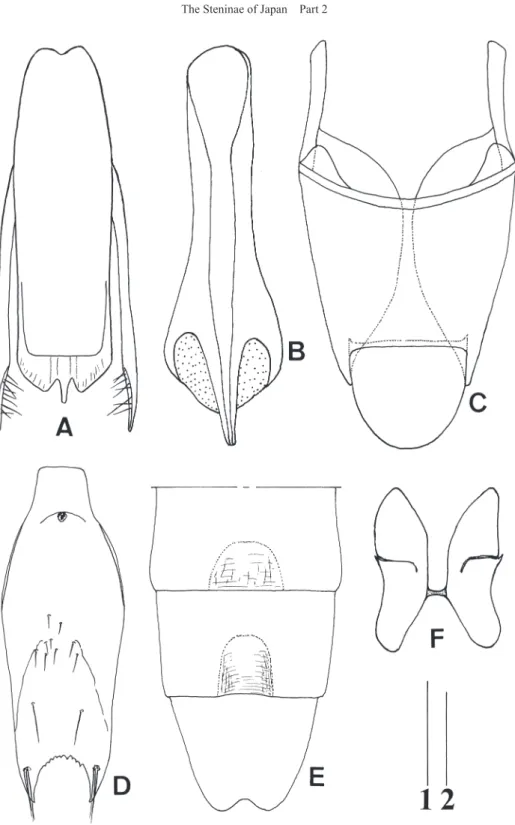
Fig. 1. Stenus hayashii Puthz (A–E, G, Oomine, Nara; F, Dorogawa, Nara). A, 9th and 10th terga of male; B, 9th

ventrite of male; C, 6th to 8th ventrites of male; D, expulsion hooks; E, spermatheca; F, aedeagus; G, posterior

part of gonocoxite. Scale 1: 0.2 mm for A, B, 0.1 mm for D, G; Scale 2: 0.3 mm for C; Scale 3: 0.05 mm for

E; Scale 4: 0.1 mm for F.

(21)

The Steninae of Japan Part 2 13

shallowly emarginate. Aedeagal median lobe (Fig. 1F) elongate, uniformly rounded apicolater- ally, with pointed apex; apical sclerotized area (Fig. 1F) triangular, relatively narrow. Endophal- lic median bands (Fig. 1F) broad, each with basal band longer than folded band; lateral bands (Fig. 1F) very thin; expulsion hooks (Fig. 1D) connected at the posteromesial corners, each hook large, thick, with anterior plate partially separated by a transverse cleft from posterior plate, the posterior plate turning posterolaterally; copulatory tube (Fig. 1F) long, stout, main tube thick, strongly constricted near the apical 1/3, with apical area fusiform. Parameres (Fig. 1F) each long, almost straight, very acutely pointed at apex; apical area long, hardly swollen mesially, furnished basally with a tuft of 4 to 5 setae, mesially with 5 to 6 moderately long setae.

Female: Eighth ventrite simply pointed posteromedially; gonocoxites (Fig. 1G) toothed pos- teriorly, each with apicolateral tooth very long, acutely pointed, apicolateral setae very long.

Spermatheca (Fig. 1E) with capsule subovoidal, moderately large; RT-duct short, moderately thick; duct long, relatively loosely coiled, with 6 turns; basal valve very short, basal sclerotized duct longer than basal valve.

Biology and ecology. S. hayashii is distributed in the mountainous regions of Kinki district, Honshu. The beetles inhabit leaf litter in the natural forest.

Remarks. S. hayashii is allied to S. incommodus, but it is separable from the latter species by the endophallic copulatory tube with its main tube fusiform at the apical part (Fig. 1F), and the spermatheca with its capsule larger and its duct longer, with 6 turns (Fig. 1E).

Etymology. This species is named in honor of Mr. Yasuhiko Hayashi (Kawanishi, Hyogo), who studies the Staphylinidae and related groups.

Stenus incommodus Puthz (Figs. 2A–G, 102B)

Stenus incommodus Puthz, 1993a: 146; Herman, 2001: 2229; Naomi & Puthz, 2013: 142.

Type material examined. Holotype: ♂ (MHNG), Seryo Pass, Kyoto, 6. viii. 1980, I. Löbl leg.

Other material examined. [HONSHU]: 1 ♂, Kamijyohou-ji, Eiheiji-cho, Fukui Pref., 9. v.

2010, M. Saito leg.; 1 ♀, Mt. Kunimi, Fukui Pref., 13. vi. 1982, T. Ito leg.; 2 ♂2 ♀, Hanase, Kyoto-fu, 4. vii. 1987, T. Ito leg.; 1 ♂, Kibune, Kyoto-fu, 1. vi. 1958, Y. Hayashi leg.; 1 ♂, Kurama, Kyoto-fu, 28. v. 1994, T. Ito leg.; 1 ♂1 ♀, Ashiu, Kyoto-fu, 12. vi. 1999, Y. Hayashi leg.; 1 ♂2 ♀, Syuzan, Kyoto-fu, 3. xi. 1979, T. Ito leg.; 1 ♂, Yawata C., Kyoto-fu, 7. xii. 1986, T.

Ito leg.; 2 ♂, Sasayama, Sanda, Hyogo Pref., 26. iv. 1998, T. Ito leg.

Distribution. Japan: Honshu (Chubu and Kinki districts).

Redescription. Male and female: Body 4.0–4.5 mm (fore body 1.9–2.1 mm) in length, mod- erately shining, with antennae moderately long, very thin. Head black; pronotum and elytra red- dish chocolate brown; abdomen dark chocolate brown; labrum reddish brown to dark red; anten- nae and legs yellowish brown to reddish brown. Head weakly concave, with a pair of longitudinal furrows; punctures round, sparse to moderately dense, small, somewhat umbilicate.

Pronotum with surface weakly uneven, with indistinct median longitudinal furrow; punctures

round to elliptical, very dense, various in size, somewhat coarse, two or more punctures some-

times partially fused. Elytra with surface weakly uneven, almost flat near suture; punctures round

to elliptical, very dense, various in size, somewhat coarse. Tarsi each with 4th tarsomere strongly

bilobed. Abdomen with punctures round to elliptical, moderately dense to dense, small, distinct

in anterior segments, while punctures in posterior segments indistinct (i.e., socket hardly concave

(22)

Fig. 2. Stenus incommodus Puthz (A, F, G, Hanase, Kyoto; B, E, Sasayama, Hyogo; C, D, Kurama, Kyoto). A,

6th to 8th ventrites of male; B, 9th ventrite of male; C, 9th and 10th terga of male; D, expulsion hooks; E,

aedeagus; F, spermatheca; G, posterior part of gonocoxite. Scale 1: 0.3 mm for A; Scale 2: 0.2 mm for B, E,

0.1 mm for G; Scale 3: 0.2 mm for C, 0.1 mm for F.

(23)

The Steninae of Japan Part 2 15

at the base of each pubescence). Lateroventrites and tergoventrite sutures missing.

Male: Sixth ventrite (Fig. 2A) posteromedially with a bell-shaped, shallow depression, which is very shallowly emarginate; 7th ventrite (Fig. 2A) posteromedially with a large, moderately deep depression, which is arcuately emarginate; 8th ventrite (Fig. 2A) posteriorly with a medium-sized emargination; 9th tergum (Fig. 2C) with antecostal apophyses long; 9th ventrite (Fig. 2B) minutely or hardly serrate posteriorly, with macrosetae long, apicolateral teeth acutely pointed, apicolateral setae moderately long; 10th tergum (Fig. 2C) entire. Aedeagal median lobe (Fig. 2E) moderately broad, almost distinctly angulate apicolaterally, acutely pointed at apex;

apical sclerotized area (Fig. 2E) triangular with median longitudinal suture, bidentate at anterior margin. Endophallic median bands (Fig. 2E) broad, each with basal band distinctly longer than folded band; lateral bands (Fig. 2E) very thin; expulsion hooks (Fig. 2D) connected at the pos- teromesial corners, each hook large, thick, with anterior plate almost wholly hollowed ventrally, rounded anteriorly, partially separated by a midlateral ridge from posterior plate, the posterior plate projecting posterolaterally; copulatory tube (Fig. 2E) very long, stout, with basal chamber large, almost ovoidal, main tube with basal tube thick, apical tube thin. Parameres (Fig. 2E) very long, each weakly curved laterally behind the base of apical area, pointed apically; apical area very long, weakly swollen mesially, furnished basally with a tuft of 5 to 6 setae, mesially with 7 to 8 setae of different length.

Female: Seventh ventrite medially with an elongate-elliptical, very shallow depression or flat area; 8th ventrite indistinctly angulate posteromedially; gonocoxites (Fig. 2G) toothed posteri- orly, each with apicolateral tooth long, acutely pointed, apicolateral setae very long. Spermatheca (Fig. 2F) with capsule small; RT-duct short to moderately long, thin; duct short with two distinct turns; basal valve short; basal sclerotized duct a little longer than basal valve.

Biology and ecology. S. incommodus is distributed in the plains and low mountainous regions of Kinki district and its neighboring areas, Honshu. The beetles inhabit leaf litter in the natural forest.

Remarks. S. incommodus is allied to S. hayashii, but it is separable from the latter species by the endophallic copulatory tube with its main tube simply thin at the apical part (Fig. 2E), and the spermatheca with its capsule smaller and its duct shorter with 2 turns (Fig. 2F).

Stenus davidhulli Naomi (Figs. 3A–F, 102C) Stenus davidhulli Naomi, 2015: 12.

Type material examined. Holotype: ♂ (CBM), Mt. Hisamatsu, Tottori Pref., 9. vi. 1984, S.

Nomura leg. Paratypes: 2 ♂3 ♀, Akazai, Hyogo Pref., 23. ix. 1979, T. Ito leg.; 3 ♀, same locality, 15. ix. 1986, T. Ito leg.

Other material examined. [HONSHU]: 4 ♂1 ♀, Makura, Maizuru City, Kyoto Pref., 7. iv.

2004, T. Murao leg.

Distribution. Japan: Honshu (Tottori and Kyoto Prefs).

Redescription. Male and female: Body 4.2–4.3 mm (fore body 2.0–2.1 mm) in length, mod- erately or strongly shining, with antennae moderately long, very thin. Head black; pronotum, ely- tra and abdomen reddish brown to dark reddish brown; labrum reddish brown; antennae and legs yellowish brown to reddish brown. Head weakly concave, with a pair of longitudinal furrows;

punctures round, sparse to moderately dense, small, somewhat umbilicate, distinct. Pronotum

(24)

Fig. 3. Stenus davidhulli Naomi (A, E, F, Kyûshô, Tottori; B–D, Akazai, Hyogo). A, aedeagus; B, 9th ventrite of

male; C, spermatheca; D, 6th to 8th ventrites of male; E, copulatory tube; F, median bands. Scale 1: 0.2 mm

for A, B, E, F, 0.1 mm for C; Scale 2: 0.3 mm for D.

(25)

The Steninae of Japan Part 2 17

with surface slightly uneven, with indistinct median longitudinal furrow; punctures round, very dense, moderately large, coarse. Elytra with surface weakly uneven, almost flat near suture;

punctures round to elliptical, very dense, various in size but moderately large in average, some- what coarse. Tarsi each with 4th tarsomere strongly bilobed. Abdomen with punctures round to elliptical, moderately dense, small, distinct in anterior segments, while punctures in posterior segments very fine, sparse. Lateroventrites and tergoventritel sutures missing.

Male: Sixth ventrite (Fig. 3D) posteromedially with a large, semicircular flat area, which is very shallowly emarginate; 7th ventrite (Fig. 3D) with a very large, moderately deep depression, and posteromedially with a large, broad-triangular emargination; 8th ventrite (Fig. 3D) postero- medially with a V-shaped emargination; 9th tergum with antecostal apophyses thick, short; 9th ventrite (Fig. 3B) irregularly serrate posteriorly, with macrosetae short, apicolateral teeth short, pointed, apicolateral setae moderately long; 10th tergum entire. Aedeagal median lobe (Fig. 3A) broad, angulate apicolaterally, tricuspidate at apex; apical sclerotized area (Fig. 3A) transverse, with median cusp moderately long, pointed, lateral cusps weakly developed, blunt. Endophallic median bands (Fig. 3F) relatively broad, with basal bands long, distinctly divergent anteriorly, folded band short, narrowed anteriorly; explusion hooks (Fig. 3A) connected at the posteromesial corners, each with anterior plate demarcated by a transverse suture from posterior plate, the pos- terior plate shortly projecting posterolaterally; copulatory tube (Fig. 3E) with basal chamber ovoidal, main tube with basal tube very thick, apical tube baculiform, thin, slightly sinuous.

Parameres (Fig. 3A) each very long, straight, rounded apically; apical area long, moderately swollen mesially, furnished mesially with 6 to 7 setae of moderate length on the ventro-marginal area, and with a few short setae on the dorso-marginal area.

Female: Eighth ventrite bluntly pointed posteromedially; gonocoxites each with apicolateral tooth short, acutely pointed, apicolateral setae very long. Spermatheca (Fig. 3C) robust, with cap- sule rounded apically; RT-duct very thick, only indistinctly demarcated from spermathecal duct;

duct thick, almost tightly coiled with 4 distinct turns; basal valve short; basal sclerotized duct stout, long. Basal structure mushroom-shaped.

Biology and ecology. S. davidhulli is distributed in the plains and low mountainous regions.

The beetles inhabit leaf litter in the natural forests.

Remarks. Given that S. davidhulli and S. incommodus have in common the 6th and 7th modi- fications of male ventrites, the very long parameres of aedeagus, and the particular structures of endophallus (expulsion hooks and copulatory tube), they are closely allied phylogenetically.

However, S. davidhulli is separable from the latter species by the aedeagal median lobe tricuspi- date at apex (Fig. 3A) and the spermatheca with its duct thicker and longer with 4 turns (Fig.

3C). S. davidhulli is also allied to S. inbecillus, but it is separable from the latter species by the aedeagal median lobe with its 3 apical cusps shorter (Fig. 3A), the endophallic expulsion hook larger (or not atrophied) (Fig. 3A), the copulatory tube with its main tube thicker (Fig. 3E), and the spermathecal duct shorter and thicker (Fig. 3C).

Etymology. This species is named in honor of the biophilosopher Dr. David L. Hull (North- western University, Evanston).

Stenus inbecillus Naomi (Figs. 4A–F, 102D) Stenus inbecillus Naomi, 2015: 14.

Stenus sawadaiellus Naomi & Puthz, 1994: 299 (partim).

(26)

Type material examined. Holotype of S. inbecillus: ♂ (CBM), Nomugi Pass, Nagawa Vil., Nagano Pref., 8. viii. 1996, T. Kishimoto leg. Paratypes of S. inbecillus: 2 ♂6 ♀ (cN), Kozodaira, Hinoemata Vil., Fukushima Pref., 26. vii. 1996, S. Naomi leg.; 1 ♂ (cN), Mt. Azuma, Fukushima Pref., 10. vii. 1985, S. Nomura leg.; 3 ♂1 ♀ (cN), Nakatsugawa, Mt. Azuma, Fukushima Pref., 19. viii. 1996, S. Naomi leg.; 1 ♂ (cN), Renge Spa, Itoigawa City, Niigata Pref., 8. vi. 1990, T.

Kishimoto leg.; 2 ♂ (cN), Mikuni Pass, Niiharu Vil., Gunma Pref., 27. vi. 1997, S. Naomi leg.;

1 ♂ (cN), Mihira Pass, Ozegahara, Gunma Pref., 24. vii. 1995, H. Tamura leg.; 1 ♂, Near Marunuma, Gunma Pref., 7. ix. 1965, Y. Watanabe leg.; 1 ♂ (cN), Yumoto, Nikko, Tochigi Pref., 10. vii. 1994, S. Naomi leg.; 1 ♂, near Marunuma, Nikko, Tochigi Pref., 19. viii. 1991, Y. Shi- bata leg.; 5 ♀ (cN), same data as holotype; 2 ♂2 ♀, Mt. Ontake, Kiso, Nagano Pref., 25. vii.

1986, T. Ito leg.

Paratypes of S. sawadaiellus: 1 ♂1 ♀ (cN), Nigorigo Spa, Gifu Pref., 22. ix. 1972, R. Yosii leg. Distribution. Japan: Honshu (Tohoku, Chubu and Kanto districts).

Redescription. Male and female: Body 3.6–4.5 mm (fore body 1.8–2.3 mm) in length, mod- erately shining, with antennae moderately long, thin. Head and abdomen reddish brown to dark brown; pronotum and elytra yellowish brown to reddish brown; labrum, antennae and legs clear yellow to yellowish brown or reddish brown. Head weakly concave, with a pair of longitudinal furrows; punctures round, moderately dense to dense, small, somewhat umbilicate. Pronotum with surface slightly uneven, with indistinct median longitudinal furrow; punctures round, very dense, moderately large, coarse. Elytra with surface uneven, almost flat near suture; punctures round to elliptical, very dense, medium-sized to moderately large, somewhat coarse. Tarsi each with 4th tarsomere strongly bilobed. Abdomen with punctures round to almost round, moderately dense, small in anterior segments, while punctures in posterior segments elliptical, sparse to moderately dense, very small. Lateroventrites and tergoventrite sutures missing.

Male: Seventh ventrite (Fig. 4F) posteromedially with a subtriangular flat area; 8th ventrite (Fig. 4F) posteromedially with a subtriangular emargination; 9th tergum with antecostal apophy- ses short, thin; 9th ventrite (Fig. 4B) regularly serrate posteriorly, with macrosetae short, apico- lateral teeth very long, acutely pointed, apicolateral setae moderately long; 10th tergum rounded posteriorly. Aedeagal median lobe (Fig. 4E) moderately broad, constricted near the apical 1/3, moderately expanded laterally and angulate at apicolateral corners, tricuspidate at apex; apical sclerotized area (Fig. 4E) anteriorly with a pair of small teeth, medially with a longitudinal line, and with median cusp large, very long, pointed, lateral cusps each bluntly pointed. Endophallic median bands (Fig. 4E) moderately long, narrow; explusion hooks (Fig. 4E) connected mesially, atrophied into very small sclerites; copulatory tube (Fig. 4E) moderately long, with basal cham- ber long, comprising two rods, main tube short, thin, straight, attenuate. Parameres (Fig. 4E) each very long, slender, slightly incurved, pointed apically; apical area very long, weakly broad- ened apically toward the part a little before the tip, furnished with 9 to 10 setae of various length along the mesial margin.

Female: Eighth ventrite (Fig. 4C) bluntly pointed posteromedially; gonocoxites (Fig. 4D) each with apicolateral tooth long, acutely pointed, apicolateral setae very long. Spermatheca (Fig. 4A) with capsule long, rounded apically; RT-duct thick; spermathecal duct moderately thick, tightly coiled; basal valve short; basal sclerotized duct long.

Biology and ecology. S. inbecillus is a relatively common species, which is widely distrib-

uted in the mountainous regions of central Honshu. The beetles inhabit leaf litter in the natural

forest.

(27)

The Steninae of Japan Part 2 19

Fig. 4. Stenus inbecillus Naomi (A, Hinoemata, Fukushima; B–F, Nomugi, Nagano). A, spermatheca; B, 9th ven-

trite of male; C, posterior part of 8th ventrite of female; D, posterior part of gonocoxite; E, aedeagus; F, 7th

and 8th ventrites of male. Scale 1: 0.2 mm for B, E, 0.1 mm for A, D; Scale 2: 0.4 mm for C, F.

(28)

Remarks. S. inbecillus is allied to S. davidhulli, but it is separable from the latter species by the aedeagal median lobe with its 3 apical cusps longer (Fig. 4E), the endophallic expulsion hook smaller (or atrophied) (Fig. 4E), the copulatory tube with its main tube thinner (Fig. 4E), and the spermathecal duct shorter and thicker (Fig. 4A).

Stenus bishamon Naomi (Figs. 5A–F, 102E)

Stenus bishamon Naomi, 1998a: 390; Herman, 2001: 2092; Naomi & Puthz, 2013: 142.

Type material examined. Holotype: ♂ (CBM), Ichinotani Val., Tsuzuro, Ichiu, Tokushima Pref., 5. iv. 1968, M. Yoshida leg. Paratype: 1 ♀, same data as holotype.

Other material examined. [SHIKOKU]: 1 ♂1 ♀, Mt. Tonomaru (1310 m), Kuwadaira, Ichiu, Tokushima Pref., 23. v. 2010, M. Yoshida leg.

Distribution. Japan: Shikoku (Tokushima Pref.).

Redescription. Male and female: Body 3.5–4.2 mm (fore body 1.9–2.1 mm) in length, mod- erately shining, with antennae moderately long, very thin. Head and abdomen dark brown to black; pronotum and elytra dark red; labrum dark red; antennae and legs yellowish brown to red- dish brown. Head weakly concave, with a pair of longitudinal furrows; punctures round to almost round, moderately dense, small. Pronotum with surface weakly uneven, with indistinct median longitudinal furrow; punctures round to elliptical, very dense, moderately large, a little coarse.

Elytra with surface uneven, weakly depressed near suture; punctures round to almost round, very dense, various in size but moderately large in average, coarse. Tarsi each with 4th tarsomere strongly bilobed. Abdomen with punctures round to elliptical, dense, small in anterior segments, while in posterior segments, punctures very small and sparse, or existing simply as setal sockets.

Lateroventrites missing; tergoventral sutures distinct, thin.

Male: Fourth and 5th ventrites (Fig. 5A) each posteromedially with a bell-shaped, flat area;

6th ventrite (Fig. 5A) posteromedially with a similar flat area, but a little narrower and longer;

7th ventrite (Fig. 5A) posteromedially with an elongate bell-shaped, shallow depression, which is weakly emarginate; 8th ventrite (Fig. 5A) posteriorly with a small, almost U-shaped emargina- tion; 9th tergum (Fig. 5C) with antecostal apophyses very long; 9th ventrite (Fig. 5D) minutely serrate posteriorly, with macrosetae long, apicolateral teeth short, acutely pointed, apicolateral setae moderately long; 10th tergum (Fig. 5C) rounded posteriorly. Aedeagal median lobe (Fig.

5B) broad, angulate apicolaterally, tricuspidate at apicomedian part; apical sclerotized area (Fig.

5B) broad, subtriangular, with median cusp long, acutely pointed, lateral cusps small, acutely pointed. Endophallic median bands (Fig. 5B) long, very broad; lateral bands (Fig. 5B) long, thin;

expulsion hooks (Fig. 5B) large, each with the anterior plate acutely pointed anteriorly, partially divided antero-posteriorly into two parts by a lateral membranous area, demarcated by a suture from posterior plate, the posterior plate much smaller than anterior plate; copulatory tube (Fig.

5B) very long, with basal chamber large, ovoidal, main tube thin, almost attenuate. Parameres (Fig. 5B) very long, sinuous in apical 1/3, acutely pointed apically; stem rather thin, mesially with several setae just before apical area; apical area distinctly swollen mesially, furnished mesi- ally with 20 to 23 setae.

Female: Eighth ventrite obtusely angulate posteromedially; gonocoxites (Fig. 5F) irregularly

toothed posteriorly, each with apicolateral tooth long, acutely pointed, apicolateral setae very

long. Spermatheca (Fig. 5E) stout, with capsule rounded apically, short; RT-duct thick, short;

(29)

The Steninae of Japan Part 2 21

Fig. 5. Stenus bishamon Naomi (A–D, Ichinotani, Tokushima; E, F, Tonomaru, Tokushima). A, 4th to 8th ven-

trites of male; B, aedeagus; C, 9th and 10th terga of male; D, 9th ventrite of male; E, spermatheca; F, posterior

part of gonocoxite. Scale 1: 0.2 mm for B–D, 0.1 mm for F; Scale 2: 0.3 mm for A; Scale 3: 0.1 mm for E.

(30)

duct moderately thick to thick, coiled with 4 turns; basal valve moderately long; basal sclerotized duct long, thick. Basal structure bowl-shaped, membranous but sclerotized only at the distal part.

Biology and ecology. S. bishamon is a rare species; and it is distributed in the high mountain- ous regions of eastern Shikoku. The beetles inhabit leaf litter in the natural forests.

Remarks. S. bishamon is allied to S. davidhulli and S. inbecillus, but it is separable from the latter 2 species by the aedeagal median lobe with its apical sclerotized area well-developed and subtriangular, and its 3 apical cusps located on the apicomedian part (Fig. 5B), the paramere characteristically bisinuous in apical 1/3 (Fig. 5B), the endophallic copulatory tube much longer (Fig. 5B), and the spermathecal with its basal sclerotized duct thicker (Fig. 5E).

Etymology. The specific epithet of this species is derived from the name of god “Bishamon”, which appears in the Japanese ancient mythology.

Stenus carura Naomi (Figs. 6A–F, 102F)

Stenus carura Naomi, 1989: 48; Herman, 2001: 2115; Naomi & Puthz, 2013: 142.

Type material examined. Holotype: ♂ (KUF), Mt. Ishizuchi, Ehime Pref., 16. vi. 1981, S.

Naomi leg.

Other material examined. [SHIKOKU]: 1 ♂, Saijyo City, Ehime Pref., 9. vii. 2011. M. Saito leg. Distribution. Japan: Shikoku (Ehime Pref.).

Redescription. Male: Body 3.7–4.5 mm (fore body 1.9–2.1 mm) in length, moderately shin- ing, with antennae moderately long, very thin. Head black; pronotum, elytra and abdomen red- dish brown to dark reddish brown; labrum dark red; antennae and legs yellowish brown to red- dish brown. Head transverse, weakly concave, with a pair of distinct longitudinal furrows;

punctures round, moderately dense, small, somewhat umbilicate. Pronotum with surface uneven, with indistinct median longitudinal furrow; punctures round, very dense, small to medium-sized, coarse. Elytra with surface uneven; punctures round, very dense, small to medium-sized, coarse.

Legs with femora thick, tarsi each with 4th tarsomere strongly bilobed. Abdomen with punctures round to almost round, dense, small, distinct in anterior segments, while punctures in posterior segments very small, shallow. Lateroventrites and tergoventrite sutures missing.

Sixth ventrite (Fig. 6A) posteromedially with a shallow, semicircular depression, which is

very weakly emarginate; 7th ventrite (Fig. 6A) posteromedially with a bell-shaped, moderately

deep depression, which is weakly ridged laterally and moderately emarginate posteriorly; 8th

ventrite (Fig. 6B) posteromedially with a semicircular emargination; 9th tergum with antecostal

apophyses very long; 9th ventrite (Fig. 6F) elongate, hardly serrate posteriorly, with macrosetae

very short, apicolateral teeth short, acutely pointed, apicolateral setae moderately long; 10th ter-

gum (Fig. 6D) entire. Aedeagal median lobe (Fig. 6E) elongate, distinctly angulate apicolaterally,

almost tricuspidate at apex; apical sclerotized area (Fig. 6E) transverse, longitudinally striated,

with median cusp short, pointed, lateral cusps each existing as simple angulation. Endophallic

median bands (Fig. 6E) moderately long, broad; expulsion hooks (Fig. 6C) large, connate by the

posteromesial parts, posteromedially with a round projection, each hook broad-bean-shaped,

with anterior plate hollowed mesially, demarcated by an oblique ridge from posterior plate, the

posterior plate posteriorly with a small, sclerorized tooth; copulatory tube (Fig. 6E) stout, broad,

almost Y-shaped but weakly asymmetrical, with basal chamber small, basal constriction distinct,

(31)

The Steninae of Japan Part 2 23

main tube becoming broader apically, with a pair of apicolateral processes, the right process bifurcate, left process acutely pointed. Parameres (Fig. 6E) each almost rounded apically; apical area moderately long, weakly swollen mesially, furnished basally with a tuft of 8 to 9 long setae on the ventral margin, and mesially with 6 to 10 setae on the ventral and apical margins.

Female: Unknown.

Biology and ecology. S. carura is a rare species; and it is distributed in the mountainous regions of the western part of Shikoku. The beetles inhabit leaf litter in the natural forests.

Remarks. S. carura seems to be allied to S. bishamon and S. davidhulli, but it is easily sepa-

Fig. 6. Stenus carura Naomi (Ishizuchi, Ehime). A, 6th and 7th ventrites of male; B, posterior part of 8th ventrite of male; C, expulsion hooks; D, 9th and 10th terga of male; E, aedeagus; F, 9th ventrite of male. Scale 1:

0.3 mm for A; Scale 2: 0.2 mm for B, D–F, 0.1 mm for C.

(32)

rable from the latter 2 species by the head more strongly transverse (Fig. 102F), the legs with the femora thicker in male (Fig. 102F), the aedeagal paramere shorter (Fig. 6E), and the copulatory tube with its main tube Y-shaped (Fig. 6E).

Etymology. The specific epithet of this species is derived from the name of a god “Carura” in an ancient Japanese mythology.

Stenus trispinosus Naomi & Nomura (Figs. 7A–G, 102G)

Stenus trispinosus Naomi & Nomura, 2015: 188.

Type material examined. Holotype (NMNST): ♂, Mt. Misaka, Kawaguchi Lake, Yamanashi Pref., 24. x. 1999, S. Nomura leg. Paratype, ♀ (cN), same data as holotype.

Distribution. Japan: Honshu (Yamanashi Pref.).

Redescription. Male and female: Body 3.5–3.7 mm (fore body 1.7–1.8 mm) in length, mod- erately shining, with antennae relatively short, thin. Head and abdomen black; pronotum and ely- tra dark red; labrum reddish brown to dark red; antennae and legs yellowish brown to reddish brown. Head weakly concave, with a pair of shallow longitudinal furrows; punctures round, moderately dense to dense, small, umbilicate. Pronotum with surface slightly uneven, with shal- low median longitudinal furrow; punctures round to elliptical, very dense, moderately large, sometimes two or more punctures partially fused. Elytra with surface weakly uneven, shallowly concave along suture; punctures round to elliptical, very dense, various in size, coarse, some- times two or more punctures partially fused. Tarsi each with 4th tarsomere strongly bilobed.

Abdomen with punctures round to almost round, dense to very dense, small to medium-sized in anterior segments, while punctures in posterior segments round to elliptical, sparse to dense or very dense, very small to small, regular. Lateroventrites and tergoventral sutures missing.

Male: Sixth ventrite posteromedially with a semicircular flat area; 7th ventrite posteromedi- ally with a shallow, elliptical depression, which is very shallowly emarginate; 8th ventrite pos- teromedially with a medium-sized, arcuate emargination; 9th tergum (Fig. 7A) with antecostal apophyses relatively short, thin; 9th ventrite (Fig. 7B) very minutely serrate posteriorly, with api- colateral teeth short, acutely pointed, apicolateral setae short; 10th tergum (Fig. 7A) entire.

Aedeagal median lobe (Fig. 7D) moderately broad, obtusely angulate apicolaterally, tricuspidate at apicomedian part; apical sclerotized area (Fig. 7D) transverse, weakly bisinuate at anterior margin, with three cusps of same size, each acutely pointed. Endophallic median bands (Fig. 7E) each broad, narrowed anteriorly; explusion hooks (Fig. 7F) posteromesially connected by mem- brane, each with anterior plate partially demarcated by a suture from posterior plate, the posterior plate posterolaterally protruding, rounded apically, covered with fine denticles; copulatory tube (Fig. 7E) simple, basal chamber with two shafts of different length, main tube simply attenuate.

Parameres (Fig. 7D) each thin, very weakly incurved, acutely pointed at apex; apical area very short, weakly swollen mesially at base, furnished mesially with 5 to 6 short setae.

Female: Eighth ventrite pointed posteromedially; gonocoxites (Fig. 7G) each with apicome- sial tooth small, pointed, apicolateral tooth incurved, pointed. Spermatheca (Fig. 7C) with cap- sule very small; RT-duct long, relatively thick; duct very long, thin, almost tightly coiled; basal valve short; basal duct sclerotized, longer than basal valve. Bursa copulatrix (Fig. 7C) large, cone-shaped.

Biology and ecology. S. trispinosus is a rare species; and it is distributed in the mountainous

(33)

The Steninae of Japan Part 2 25

Fig. 7. Stenus trispinosus Naomi & Nomura (Misaka, Yamanashi). A, 9th and 10th terga of male; B, 9th ventrite of male; C, spermatheca; D, aedeagus; E, endophallus; F, expulsion hooks; G, posterior part of gonocoxite.

Scale 1: 0.2 mm for A–B, D, 0.1 mm for C, E–G.

Fig. 5.  Stenus bishamon Naomi (A–D, Ichinotani, Tokushima; E, F, Tonomaru, Tokushima)
Fig. 9.  Stenus kisomontanus Naomi, Nomura & Puthz (Kiso-komagatake, Nagano). A, 9th ventrite of male; B,  6th to 8th ventrites of male; C, 9th and 10th terga of male; D, aedeagus; E, median bands; F, copulatory tube;
Fig. 14.  Stenus sawadaiellus Naomi (Ontake, Nagano). A, apical part of median lobe with outthrusted endophallus;
Fig. 15.  Stenus uncinatus Naomi, Nomura & Puthz sp. nov. (Shinhotaka, Gifu). A, aedeagus; B, 9th ventrite of  male; C, 9th and 10th terga of male; D, spermatheca; E, 7th and 8th ventrites of male; F, expulsion hooks; G,  posterior part of gonocoxite
+7

参照

関連したドキュメント

Definition An embeddable tiled surface is a tiled surface which is actually achieved as the graph of singular leaves of some embedded orientable surface with closed braid

We give a Dehn–Nielsen type theorem for the homology cobordism group of homol- ogy cylinders by considering its action on the acyclic closure, which was defined by Levine in [12]

Wro ´nski’s construction replaced by phase semantic completion. ASubL3, Crakow 06/11/06

The goal of the present paper is a description of the singularities of the Selberg zeta function in terms of the group cohomology of Γ with coefficients in certain infinite

S., Some results on the main supergraph of finite groups, accepted in Algebra Discrete Math.. [3]

Taking as the connected component of the subgraph in the Baby Monster graph induced on the set of vertices fixed by an element of order 3 and in view of (1.5)(iv) one gets the

In [4] Clark and Schneider studied the meet in the lattice of group topologies and developed a convenient method for finding a basis of open sets for the meet of a countable

When relativistic quantum mechanics and field the- ory emerged, the half-integer internal angular momentum was interpreted in terms of the complex special linear group SL(2, C ) as