Particle Swarm Optimization for Global Optimization Problems
著者 YANG Shiqin
著者別名 楊 詩琴
その他のタイトル 大域的最適化問題のための同種および異種粒子群最 適化法の研究
page range 1‑180
year 2017‑03‑24 学位授与番号 32675甲第399号 学位授与年月日 2017‑03‑24
学位名 博士(理学)
学位授与機関 法政大学 (Hosei University)
URL http://doi.org/10.15002/00013955
Doctoral Dissertation Reviewed by Hosei University
大域的最適化問題のための同種および 異種粒子群最適化法の研究
Research on Homogeneous and Heterogeneous Particle Swarm Optimization for Global Optimization
Problems
楊 詩琴
Shiqin Yang
Supervisor: Professor Yuji Sato, Hosei University
Abstract
The premature convergence problem and the exploration-exploitation trade-off problem are the two major problems encountered by many swarm intelligence algorithms in both global optimization and large scale global optimization. This thesis proposes that the two main problems could be handled by several variants of Particle Swarm Optimization (PSO) de- veloped below. Five variants of homogeneous PSO have been developed for multimodal and large scale global optimization problems, and two variants of dynamic heterogeneous PSO for complex real-world problems.
First of all, an individual competition strategy is proposed for the new variant of PSO, namely Fitness Predator Optimization (FPO), for multimodal problems. The development of individual competition plays an important role for the diversity conservation in the popu- lation, which is crucial for preventing premature convergence in multimodal optimization.
To enhance the global exploration capability of the FPO algorithm for high multimodality problems, a modified paralleled virtual team approach is developed for FPO, namely DFPO.
The main function of this dynamic virtual team is to build a paralleled information-exchange system, strengthening the swarm's global searching effectiveness. Furthermore, the strategy of team size selection is defined in DFPO named as DFPO-r, which based on the fact that a dynamic virtual team with a higher degree of population diversity is able to help DFPO-r alleviate the premature convergence and strengthen the global exploration simultaneously.
Experimental results demonstrate that both DFPO-r and DFPO have desirable performances
Using hybrid algorithms to deal with specific real-world problems is one of the most interesting trends in the last years. In this thesis, we extend the FPO algorithm for fuzzy clustering optimization problem. Thus, a combination of FPO with FCM (FPO-FCM) al- gorithm is proposed to avoid the premature convergence and improve the performance of FCM.
To handle the large scale global optimization problem, a variant of modified BBPSO algorithm incorporation of Differential Evolution (DE) approach, namely BBPSO-DE, is developed to improve the swarm's global search capability as the dimensionality of the search space increases.
To the best of our knowledge, the Static Heterogeneous PSO (SHPSO) has been stud- ied by some researchers, while the Dynamic Heterogeneous PSO (DHPSO) is seldom sys- tematically investigated based on real problems. In this thesis, two variants of dynamic Heterogeneous PSO, namely DHPSO-d and DHPSO-p are proposed for complex real-world problems. In DHPSO-d, several differential update rules are proposed for different parti- cles by the trigger event. When the global best position 𝑝𝑔 is considered stagnant and the event is confirmed, then𝑝𝑔is reset and all particles update their positions only by their per- sonal experience. In DHPSO-p, two proposed types of topology models provide the particles different mechanism choosing their informers when the swarm being trapped in the local op- timal solution. The empirical study of both variants shows that the dynamic self-adaptive heterogeneous structure is able to effectively address the exploration-exploitation trade-off problem and provide excellent optimal solutions for the complex real-world problem.
To conclude,the proposed biological metaphor approaches provide each of the PSO al- gorithms variants with different search characteristics, which makes them more suitable for different types of real-world problems.
Contents
List of figures xi
List of tables xv
Nomenclature xix
1 Introduction 1
1.1 Research Background . . . 1
1.2 Research Motivation . . . 2
1.2.1 Global Optimization Problem . . . 2
1.2.2 Large Scale Global Optimization Problem . . . 3
1.2.3 Motivations of Our Research . . . 4
1.3 Overview of the Thesis . . . 7
1.3.1 Evaluation Method . . . 7
1.3.2 Organization of the Thesis . . . 8
2 Standard Particle Swarm Optimization (SPSO) 11 2.1 Basic Concept of SPSO . . . 11
2.1.1 Neighborhood Communication Topology . . . 12
2.1.2 Definitions and Variables . . . 14
2.2 Pseudocode of SPSO . . . 16
2.3 Variants of Particle Swarm Optimization . . . 17
2.3.1 Fully Informed Particle Swarm (FIPS) . . . 17
2.3.2 Bare Bones Particle Swarms Optimization (BBPSO) . . . 19
2.3.3 Binary Particle Swarm Optimization (BBPSO) . . . 21
2.4 Strength and Weakness . . . 23
2.4.1 Strength . . . 23
2.4.2 Weakness . . . 23
3 Fitness Predator Optimization for Multimodal Problems 25 3.1 Overview and Preliminaries . . . 25
3.1.1 Predator-Prey Optimization (PPO) . . . 26
3.1.2 Solutions . . . 28
3.2 Proposal of Fitness Predator Optimization (FPO) . . . 29
3.2.1 Basic Concept of FPO . . . 29
3.2.2 Pseudocode of FPO . . . 31
3.2.3 A Method for Parameter Control . . . 33
3.3 Experiments . . . 34
3.3.1 Evaluation Method . . . 34
3.3.2 Experiment on Multimodal Problems . . . 35
3.3.3 Experiment on Fixed-dimension Problems . . . 38
3.3.4 Discussion . . . 40
3.4 Summary . . . 42
4 A New Hybrid Fuzzy Clustering Algorithm for Multivariate Data 45 4.1 Overview and Preliminaries . . . 46
4.1.1 Fuzzy c-means Clustering Algorithm . . . 46
4.1.2 Fuzzy Clustering with Quantum-based PSO . . . 49
Contents
4.1.3 Pseudo F Statistic Method . . . 50
4.1.4 Solutions . . . 51
4.2 Fuzzy Clustering with Fitness Predator Optimization . . . 52
4.2.1 Proposal of FPO-FCM Algorithm . . . 52
4.2.2 Experiments and Discussion . . . 52
4.3 FPO-FCM Algorithm with Mixed-F Index . . . 59
4.3.1 The Mixed-F Statistic Method . . . 59
4.3.2 The Flow Chart of FPO-FCM with Mixed-F method . . . 60
4.3.3 Experiments and Discussion . . . 62
4.4 Summary . . . 64
5 Dynamic Virtual Teams for Fitness Predator Optimization 65 5.1 Overview and Preliminaries . . . 66
5.1.1 Dynamic Virtual Team Model . . . 66
5.1.2 Algorithm of Dynamic Virtual Team Model . . . 68
5.1.3 Dolphin Partner Optimization . . . 69
5.1.4 Solutions . . . 72
5.2 Proposal of DFPO . . . 73
5.2.1 Study of Dynamic Virtual Team Model . . . 73
5.2.2 Modified Topology of Dynamic Virtual Team Model . . . 75
5.2.3 Pseudocode of DFPO . . . 77
5.2.4 A Method of Team size Selection in DFPO . . . 78
5.3 Proposal of DFPO-r . . . 80
5.3.1 A Method for Dynamic Team Size Selection . . . 80
5.3.2 Pseudocode of DFPO-r . . . 81
5.4 Experiments . . . 82
5.4.1 Evaluation Method . . . 82
5.4.2 Experimental Results . . . 83
5.4.3 Discussion . . . 83
5.5 Summary . . . 93
6 Modified Bare Bones Particle Swarms for Large Scale Global Optimization 95 6.1 Overview and Preliminaries . . . 96
6.1.1 BBPSO-MC-lbest Algorithm . . . 96
6.1.2 Solutions . . . 99
6.2 Proposal of BBPSO-DE for LSGO Problems . . . 100
6.2.1 Ring Topology of BBPSO-DE . . . 100
6.2.2 Integrated BBPSO-DE with Differential Evolution . . . 102
6.2.3 Redefining the Sample Equations . . . 103
6.2.4 Pseudocode of BBPSO-DE . . . 104
6.3 Experiment . . . 106
6.3.1 Evaluation Method . . . 106
6.3.2 Experimental Results and Discussion . . . 108
6.4 Summary . . . 113
7 Dynamic Heterogeneous Particle Swarm Optimization 115 7.1 Overview and Preliminaries . . . 116
7.1.1 Concept of the Heterogeneous PSO . . . 116
7.1.2 The Static Heterogeneous PSO Model: HGLPSO . . . 116
7.1.3 Solutions . . . 118
7.2 Proposal of Dynamic HPSO (DHPSO) . . . 119
7.2.1 Proposal of DHPSO-d . . . 119
7.2.2 Proposal of DHPSO-p . . . 122
7.3 Experiments . . . 126
Contents
7.3.1 Evaluation Method . . . 126
7.3.2 Evaluation Results . . . 128
7.3.3 Discussion . . . 137
7.4 Summary . . . 140
8 Conclusion and Future Work 143 8.1 The Knowledge Gained from This Study . . . 143
8.2 Conclusion . . . 146
8.3 Future Work . . . 148
Bibliography 151
Appendix A List of Research Papers 161
Appendix B Definitions of the Benchmark Functions 165
List of figures
2.1 A few of swarm communication topology types . . . 13
2.2 Histogram of points sampled by BBPSO . . . 20
2.3 Positions of particles sampled by BBPSO on Ackley function . . . 21
2.4 The standard logistic sigmoid curve . . . 22
3.1 Convergence curve of FPO on 10 dimensions of𝑓2 with 1000 iterations . . 38
3.2 The trajectory of the position of FPO on 2-dimensional Rastrigin function . 39 4.1 Reformulated objective function𝐽𝑚(𝑉 , 𝑋) . . . 48
4.2 Convergence curve of FCM . . . 58
4.3 Convergence curve of FPO-FCM and QPSO-FCM . . . 58
4.4 The flow chart of FPO-FCM withMixed-F. . . 61
5.1 Diagram of dynamic virtual teams . . . 67
5.2 Mean optimum and running time of DPO with different team size on Rosen- brock function . . . 75
5.3 The modified dynamic virtual team topology . . . 76
5.4 The performance comparison between DPO and DFPO on Rosenbrock func- tion . . . 79
5.5 The running time comparison between DPO and DFPO on Rosenbrock func- tion . . . 79
5.6 Different population diversity in various population and dimensions on Ras-
trigin function . . . 81
5.7 Mean optimization errors of Branin function with three algorithms in 20, 50 and 100 times iteration respectively . . . 89
5.8 Mean optimization errors of Shekel function with four algorithms in 20, 50 and 100 times iteration respectively . . . 89
5.9 Mean optimization errors of Shaffers N.2 function with four algorithms in 20, 50 and 100 times iteration respectively . . . 90
5.10 The enhanced rate of mean global optimum and increased time rate . . . 91
6.1 Ring topology ofexplorer-swarm . . . 101
6.2 Ring topology ofmemory-swarm . . . 102
6.3 Group three swarms as one team swarm . . . 103
6.4 Convergence graphs of𝑓1 &𝑓2on 1000 dimensions . . . 108
6.5 Convergence graphs of𝑓3 &𝑓4on 1000 dimensions . . . 111
6.6 Convergence graphs of𝑓5 &𝑓6on 1000 dimensions . . . 111
6.7 Comparison of mean best optimum errors on various dimensions . . . 112
6.8 Comparison of computation time on various dimensions . . . 112
7.1 Two typical topologies of SPSO . . . 117
7.2 Dynamic process of heterogeneity configuration in DHPSO-d . . . 120
7.3 Two kinds of topologies in DHPSO-p . . . 122
7.4 Computation time of different algorithms on benchmark functions with di- mensions of 50 after 30 times of trails. . . 137
7.5 Computation time of LBestPSO and FA on benchmark functions with di- mensions of 50 after 30 times of trails. . . 138
7.6 Computation time of different algorithms on benchmark functions with di- mensions of 100 after 30 times of trails. . . 138
List of figures
B.1 3-D map for 2-d Rosenbrock function . . . 166
B.2 3-D map for 2-d Rastrigin function . . . 167
B.3 3-D map for 2-d Griewank function . . . 168
B.4 3-D map for 2-d Ackley function . . . 169
B.5 3-D map for 2-d Michalewicz function . . . 170
B.6 3-D map for 2-d Levy function . . . 172
B.7 3-D map for 2-d Branin function . . . 173
B.8 3-D map for 2-d Shaffers N.2 function . . . 175
B.9 3-D map for 2-d Schwefel function . . . 176
B.10 3-D map for 2-d Rotated hyper-ellipsoid function . . . 177
B.11 3-D map for 2-d Sphere function . . . 178
B.12 3-D map for 2-d Zakharov function . . . 179
B.13 3-D map for 2-d Sum of different powers function . . . 180
List of tables
3.1 Experiment results for parameters setting in FPO . . . 34
3.2 Evaluation test environment . . . 35
3.3 Experimental execution parameters . . . 35
3.4 Bounds and global optimums of benchmark functions . . . 36
3.5 Experiment A: Statistical results on various dimensions of functions: 𝑓1− 𝑓2 37 3.6 Experiment A: Statistical results on various dimensions of functions: 𝑓3− 𝑓4 39 3.7 Experiment B: Statistical results of fixed dimensions of functions: 𝑓5− 𝑓6 . 40 3.8 Experiment B: Statistical results of fixed dimensions of functions: 𝑓7− 𝑓8 . 41 4.1 Description of benchmark data sets . . . 54
4.2 Evaluation test environment . . . 55
4.3 Parameters Setting of experiment A . . . 55
4.4 Parameters setting of experiment B . . . 55
4.5 Experimental results of A . . . 56
4.6 Experimental results of B . . . 57
4.7 Parameters setting of experiment . . . 62
4.8 Record ofMixed-Findex of non-medical datasets . . . 62
4.9 Comparison of the optimal number of clusters with four cluster indexes . . 63
4.10 Record ofMixed-Findex of medical datasets . . . 63
5.1 Evaluation test environment . . . 73
5.2 The best mean optimum obtained by DPO with various team size on Griewank & Rosenbrock functions . . . 74
5.3 The mean optimum obtained by DPO with various team size on Rosenbrock function . . . 74
5.4 Comparison of mean optimum obtained by DFPO with various team size on Griewank & Rastrigin & Rosenbrock functions . . . 78
5.5 Bounds and global optimums of benchmark functions . . . 84
5.6 Parameters setting on fixed-dimension multimodal functions . . . 85
5.7 Parameters setting on six flexible dimensional functions . . . 85
5.8 Statistical results of optimization errors on fixed-dimension multimodal func- tions . . . 85
5.9 Statistical results of optimization errors on 𝑓5 − 𝑓7 after 20 trials of 103, 2 × 10³ function evaluations, respectively . . . 86
5.10 Statistical results of optimization errors on 𝑓8 − 𝑓10 after 20 trials of 103, 2 × 10³ function evaluations, respectively . . . 87
5.11 Statistical results of optimization errors on 100-Dimension𝑓5− 𝑓7 after 20 trials of2 × 103function evaluations . . . 88
5.12 Statistical results of optimization errors on 100-Dimension𝑓8− 𝑓10after 20 trials of2 × 103function evaluations . . . 88
5.13 Ranking of the best solution quality obtained by Table 5.9, Table 5.10, Table 5.11 and Table 5.12 with 5 kinds of algorithms on𝑓5− 𝑓10 . . . 91
5.14 Ranking of the averaged best solution quality obtained by Table 5.9, Table 5.10, Table 5.11 and Table 5.12 with 5 kinds of algorithms on𝑓5− 𝑓10 . . . 92
6.1 The bound and global Minimum of Benchmark Function . . . 107
6.2 Experimental parameters setting of algorithms . . . 107
List of tables 6.3 Statistical results of optimization errors on unimodal functions after 30 trials 109 6.4 Statistical results of optimization errors on multimodal functions after 30
trials . . . 110
7.1 Evaluation test environment . . . 126
7.2 The bounds and global minimums of benchmark functions. . . 127
7.3 The control parameters setting of algorithms. . . 127
7.4 The statistical results of optimization errors on multimodal functions with a population of 100 and 200 after 30 trials of1 × 104function evaluations . . 129
7.5 The statistical results of optimization errors on unimodal functions with a population of 100 and 200 after 30 trials of1 × 104function evaluations. . . 130
7.6 𝑝 values of 𝑡-test between DHPSO-d and four comparative algorithms on multimodal functions with a significance level of𝛼 = 0.05after 30 trials . 131 7.7 Performance comparison between DHPSO-d and four comparative algorithms on𝑓1--𝑓6 by𝑡-test with a significance level of𝛼 = 0.05. . . 131
7.8 Performance comparison between DHPSO-p and five compared algorithms on𝑓1--𝑓6 by𝑡-test with a significance level of𝛼 = 0.05. . . 132
7.9 𝑝 values of 𝑡-test between DHPSO-d and four comparative algorithms on unimodal functions with a significance level of𝛼 = 0.05after 30 trials . . . 133
7.10 Performance comparison between DHPSO-d and four comparative algorithms on𝑓7--𝑓10 by𝑡-test with a significance level of𝛼 = 0.05. . . 133
7.11 𝑝 values of 𝑡-test between DHPSO-p and five comparative algorithms on unimodal functions with a significance level of𝛼 = 0.05after 30 trials . . . 134
7.12 Performance comparison between DHPSO-p and five comparative algorithms on𝑓7--𝑓10 by𝑡-test with a significance level of𝛼 = 0.05. . . 134
7.13 A modified Bonferroni procedure for DHPSO-d VS HGLPSO. . . 135
7.14 A modified Bonferroni procedure for DHPSO-p VS HGLPSO. . . 136
Nomenclature
Acronyms / Abbreviations
ABC Artificial Bee Colony
ACO Ant Colony Optimization
AFSA Artificial Fish-Swarm Algorithm
AIS Artificial Immune System
BA Bat-inspired Algorithm
BBPSO-DE Bare Bones Particle Swarms Optimization with Differential Evolution BBPSO-MC Bare Bones Particle Swarms Optimization with Mutation and Crossover BBPSO Bare Bones Particle Swarms Optimization
BPSO Binary Particle Swarm Optimization
CC Cooperative Co-evolution
CI Computational Intelligence
CLPSO Comprehensive Learning Particle Swarm Optimization CSO Competitive Swarm Optimization
DE Differential Evolution
DFPO-r Dynamic Fitness Predator Optimization with random team size DFPO Dynamic Fitness Predator Optimization
DHPSO-d Dynamic Heterogeneous Particle Swarm Optimization with differential rules
DHPSO-p Dynamic Heterogeneous Particle Swarm Optimization with polymorphic models
DHPSO Dynamic Heterogeneous Particle Swarm Optimization DPO Dolphin Partner Optimization
EA Evolutionary Algorithms
EC Evolutionary Computation
EDA Estimation of Distribution Algorithms
EPUS-PSO Efficient Population Utilization Strategy for Particle Swarm Optimization
FA Firefly Algorithm
FCM Fuzzy c-means algorithm
FIPS Fully Informed Particle Swarm
FPO-FCM Fuzzy c-means Clustering with Fitness Predator Optimization FPO Fitness Predator Optimization
FS Fuzzy System
GBPSO Global Best Particle Swarm Optimization
Nomenclature
GO Global Optimization
GWO Grey Wolf Optimization
HGLPSO static Heterogeneous Particle Swarm Optimization combined with GBPSO and LBPSO
HPSO Heterogeneous Particle Swarms Optimization
KHM K-Harmonic Means algorithm
LBPSO Local Best Particle Swarm Optimization LSGO Large Scale Global Optimization
MCPSO Modified Competitive Particle Swarm Optimization
NN Neural Networks
PC Premature Convergence
PPO Predator-Prey Optimization
PPSO-FCM Fuzzy C-Mean based on Picard iteration and PSO PSO Particle Swarm Optimization
QE Quantum Error
QPSO Quantum-behaved Particle Swarm Optimization
SGA Simple Genetic Algorithm
SHPSO Static Heterogeneous Particle Swarm Optimization
SI Swarm Intelligence
SPSO Standard Particle Swarms Optimization WDBC Wisconsin Diagnostic Breast Cancer
Chapter 1 Introduction
1.1 Research Background
Computational intelligence (CI) is a set of nature-inspired computational methodologies and approaches to provide solutions for complicated problems and inverse problems [82]. It primarily includes artificial neural networks (NN), evolutionary computation (EC), swarm intelligence(SI), artificial immune system(AIS), and fuzzy systems (FS). Each of the CI parts has its origins in biological systems. NNs model biological neural systems, EC models natural evolution (including genetic and behavioral evolution), SI models the social behavior of organisms living in swarms or colonies, AIS models the human immune system and FS originated from studies of how organisms interact with their environment. The techniques from these five components can be combined to form hybrid systems.
Swarm intelligence (SI) is the collective behavior of decentralized, self-organized sys- tems, natural or artificial. The SI systems typically consist of a population of simple agents interacting locally with one another and with their environment. Examples in natural sys- tems of SI include ant colonies, bird flocking, animal herding, bacterial growth and so on.
Nowadays, swarm intelligence is becoming a new research highlight. Most of research theo-
ries and applications related to swarm intelligence proves that it is a kind of effective method to solve variety of global optimal problems.
Particle Swarm Optimization (PSO) belongs to the field of Swarm Intelligence and is a sub-field of Computational Intelligence. It is a population based stochastic optimization tech- nique developed by Eberhart and Kennedy in 1995 [42], inspired by social behavior of bird flocking or fish schooling. Based on the research of PSO, in this thesis, we propose several improved homogeneous and heterogeneous PSO variants for global optimization problems.
1.2 Research Motivation
1.2.1 Global Optimization Problem
Global Optimization (GO) aims at characterizing and computing global optimal solutions to problems with nonconvex, multimodal, or badly scaled objective functions [37]. Many real-world problems, such as engineering, biotechnology, data analysis, environmental man- agement, financial planning and other related areas, can be formulated as global optimization problems.
This thesis considers the following global optimization problem:
⎧⎪
⎨⎪
⎩
𝑓 ∶ 𝑆 → ℜ
𝑓 (𝑥∗) ⩽ 𝑓 (𝑥), ∃𝑥∗ ∈ 𝑆; ∀𝑥 ∈ 𝑆
(1.1)
where𝑆 ⊂ ℜ𝐷 is a nonempty compact set with𝐷 dimensions [74]. 𝑓 ∶ 𝑆 → ℜ stands for a real-valued nonlinear objective function for mapping from 𝐷 dimensional space to one dimensional fitness value. In general, due to the absence of structural information and the presence of many local extrema, global optimization problems are extremely difficult to solve exactly. To solve such a problem, there are many different types of methods in
1.2 Research Motivation the literature on global optimization, which can be categorized based on different criteria.
For instance, they can be classified by the properties of algorithms that search for new can- didate solutions, such as deterministic and stochastic algorithms [74]. Most deterministic algorithms involve the application of heuristics, such as modifying the trajectory (trajectory methods) or adding penalties (penalty-based methods), to escape from local minima. On the other hand, stochastic algorithms do not require any properties of the objective function.
Therefore, more attention has been paid to stochastic algorithms. Perhaps the most common problem encountered by many GO methods, either deterministic or stochastic is the problem of local minima. Especially in multimodal functions, the existence of many local minima makes it quite difficult for most techniques to detect the global minimum.
1.2.2 Large Scale Global Optimization Problem
A Large Scale Global Optimization (LSGO) problem can be mathematically stated in the equation 1.1. Specifically, there are𝐷number of variables in large scale setting (𝐷 > 100).
Most real-world optimization problems involve a large number of decision variables may be formulated as large scale global optimization problems. For example, inverse problems in the biological systems are a large-scale and highly time-consuming optimization problems [67], [60]. With the arrival of big data, there is an unprecedented demand to solve optimization problems with a number of feature variables, training instances, and classes [10]. The recent advance in the area of machine learning has witnessed very large scale optimization problems encountered in training deep neural network architectures (so-called deep learning), some of which are involved in optimizing over a billion of connection weights in a very large neural network [33]. These models are faced with some challenging characteristics such as strong interaction among parameters and high multimodality.
Many optimization algorithms attempt to solve LSGO problems efficiently in a given number of fitness evaluation budget. Unfortunately, most optimization methods suffer from
the "curse of dimensionality" [4], which implies that their performance deteriorates quickly as the dimensionality of the search space increases. There are two major reasons for the performance deterioration of these algorithms. Firstly, the solution space of a problem often increases exponentially with the problem dimension and more efficient search strategies are required to explore all promising regions within a given time budget. Secondly, the search space exponentially increases with the problem size; so an optimization algorithm must be able to explore the entire search space efficiently, which is not a trivial task. In addition, the characteristics of a problem may change with the scale. Because of such a worsening of the features of an optimization problem resulting from an increase in scale, a previously successful search strategy may no longer be capable of finding the optimal solution.
1.2.3 Motivations of Our Research
Individual Competition Strategy for Multimodal Optimizations
A major issue in global optimization, especially in multimodal optimization is premature convergence problem. The term of premature convergence means that a population for an optimization problem converged too early, resulting in being suboptimal. An accepted hy- pothesis is that maintenance of high diversity is crucial for preventing premature convergence in multimodal optimization [27], [73]. Many kinds of optimization algorithms are proposed to improve the diversity of the population. Some of them are inspired by the social behavior of swarms, herds in nature. In addition, the hunting and search behaviors of predator are implemented by more and more researchers and proved to be an effective method. However, few of SI techniques focus on individual competition and independent self awareness. We note that the individual competition is more likely to reduce the rapid social collaboration process and increase the ability of being out of the local optimum. This motivated our at- tempt to propose a new population-based algorithm with an individual competition strategy to avoid premature convergence for multimodal optimization problems.
1.2 Research Motivation
Hybrid Algorithms for Specific Problem
The use of hybrid algorithms to deal with specific real-world problems is a fact that proves that hybridization is a powerful tool far beyond the discrete algorithm. For instance, in the field of clustering, Fuzzy c-means (FCM) is one of the most popular algorithms. The objec- tive function of the FCM is the multimodal function which means that it may contain many local minima. Consequently, while minimizing the objective function, there is possibility of getting stuck at local minima or saddle points. To increase the probability of locating the global optimum, some researchers adopt the stochastic methods such as evolutionary or swarm-based methods to increase the global convergence ability of fuzzy clustering. In this thesis, we propose a hybrid fuzzy clustering algorithm combination of our new population- based algorithm to provide the excellent optimal solution and avoid to be trapped in the local minima simultaneously.
Differential Evolution Strategy for LSGO Problems
Recently, LSGO has become a well-recognized field of research and various meta-heuristic algorithms such as Simulated Annealing (SA) [8] and variant population-based algorithms, such as, Evolutionary Algorithms (EAs) [3], Estimation of Distribution Algorithms (EDAs) [52], [65], Particle Swarm Optimization (PSO) [42] have been applied to solve them. How- ever, generally speaking, the performance of these algorithms deteriorates when tackling the high dimensional problems [89]. Several particular mechanisms have been proposed to han- dle LSGO problems. Basically, two main categories of approaches can be found, namely, Cooperative Coevolution (CC) algorithms with problem decomposition strategy [76], and non-decomposition based methods [62]. The results of these methods show an efficient per- formance on scalable LSGO benchmark functions (up to 1000D), however, its performance influenced by their control parameters. The best values for the control parameters remain problem dependent, and need to be tuned for each problem. It is motivating to consider these
reasons and difficulties to propose new approaches for tackling LSGO problems. In this the- sis, the mutation and crossover operators of Differential Evolution (DE) are employed for the modified Bare Bones Particle Swarm Optimization (BBPSO) algorithm, which increases the swarm diversity and enhances the search performance as the dimensionality of problem in- creases. In addition, one key advantage of our proposed algorithm is that there is no need to specify any control parameter for each problem that is often required in traditional stochastic algorithms.
Dynamic Heterogeneity to Complex Real-World Problems
In population-based algorithms, finding the global optimal solution of a problem is based on two cornerstones, namely exploration: global search, exploring all over the search space to find promising regions and exploitation: local search, exploiting the identified promising regions to tune the search for the global optimum. It is worth noting that, emphasizing on exploration will lead to waste of time searching over inferior regions of the search space and slow down the convergence rate. On the other hand, emphasizing on exploitation will cause loss of diversity early in the search process, thereby possibly getting stuck into a local optimum. Therefore, in the population-based evolutionary algorithms, it is important to obtain the balance between exploration and exploitation of the search space [23], [17].
Most population-based algorithms and their modifications make use of homogeneous swarms where all of the individuals follow exactly the same behavior. However, modelled with populations of heterogeneous individuals, the optimization algorithm has the ability to maintain an appropriate balance between exploration and exploitation throughout the search process. Recently, heterogeneous systems have drawn the attention of researchers working in different areas of swarm intelligence because designing heterogeneous models more ac- curately and approximately resembles real circumstances. To the best of our knowledge, the Static Heterogeneous Particle Swarm Optimization (SHPSO) has been studied by some
1.3 Overview of the Thesis researchers, while the Dynamic Heterogeneous Particle Swarm Optimization (DHPSO) is seldom systematically investigated based on real problems. In this thesis, we propose two different DHPSO models and extend the analysis of DHPSO models to study their scalability to different dimensional optimization problems.
1.3 Overview of the Thesis
1.3.1 Evaluation Method
All experiments are implemented on a PC with an Intel Core i7 860, 2.8 GHz CPU and Mi- crosoft Windows 7 Professional SP1 64-bit operating system, and all algorithms are written in the Matlab language. Each test algorithm was run on an array of generic benchmark prob- lems. All algorithms were randomly initialized in an area equal to one quarter of the feasible search space in every dimension that was guaranteed not to contain the optimal solution.
Benchmark Problems
For any new optimization, it is essential to validate its performance and compare with other existing algorithms over a good set of test functions. Benchmark problems is a set of test functions which can be used to test the effectiveness of global optimization algorithms. There have been many tests or benchmark functions reported in the literature [38]. In this thesis, we carefully chose some benchmark problems for their variety, for instance, some functions are simple unimodal problems, some are highly complex multimodal problems with many local minima, and the others are multimodal problems with a few local minima. All these benchmark problems are collected from the website of the Virtual Library of Simulation Experiments [Surjanovic and Bingham].
Statistical Analysis
For each algorithm, the statistical results including the best global optimum, the worst opti- mum solution, the average of best global value of each benchmark function and running time with the same fixed times iteration after a number of independent trials. Having gathered some empirical data, differences in performance between several versions of algorithms can become notable. In this thesis, we partly adopt the practice of performing 𝑡-tests on pairs of groups of data; these tests give a 𝑝−value which is compared to a constant called 𝛼 to determine whether a difference is significant or not.
1.3.2 Organization of the Thesis
The main structure of the thesis is thus twofold. On the first hand, five variants of homo- geneous PSO have been developed, each of them implementing the biological metaphor in their own particular way. This provides each of these approaches with different search characteristics, which make them more suitable for different types of problems. On the sec- ond hand, two dynamic Heterogeneous PSO variants were proposed for complex real-world problems. In Chapter 3, a variant of PSO algorithm employed an individual competition strategy, namely FPO, is proposed for multimodal problems. Then inChapter 4, this vari- ant combination of Fuzzy c-means algorithm, named as FPO-FCM, is proposed to provide the excellent data clustering solution. To enhance the global exploration of the FPO al- gorithm for high multimodality problem, a paralleled virtual team approach is introduced in FPO. Thus, an improved Dynamic FPO algorithm (DFPO) is presented in Chapter 5.
Meanwhile, the DFPO with dynamic team size selection strategy, named as DFPO-r, is also provided inChapter 5. Finally, to handle the large scale global optimization problem, the fifth variant of BBPSO algorithm incorporation of Differential Evolution (DE) approach, namely BBPSO-DE, is developed in Chapter 6. Finally, a comparative analysis has been performed to some homogeneous PSO algorithms and static heterogeneous PSO algorithms,
1.3 Overview of the Thesis we prefer to propose two dynamic Heterogeneous PSOS variants (DHPSO-d and DHPSO-p) inChapter 7for complex real-world problems.
In summary, the thesis is organized as follows.
Chpater 1presents the background and the motivation of our research, summarizes the solutions of our research and provides an overview of the thesis.
Chpater 2introduces the standard particle swarm optimization algorithm and several variants of PSO.
Chpater 3 proposes a variant of PSO algorithm employed an individual competition strategy, namely FPO, for multimodal problems.
Chpater 4proposes a hybrid fuzzy clustering algorithm (FPO-FCM) which combination of FPO and FCM for data clustering.
Chpater 5presents DFPO and DFPO-r algorithms to enhance the global exploration of FPO for multimodal problem.
Chpater 6 develops a variant of BBPSO algorithm with Differential Evolution (DE) approach, namely BBPSO-DE, for large scale global optimization problem.
Chpater 7proposes two dynamic Heterogeneous PSO variants, DHPSO-d and DHPSO- p for complex real-world problems.
Chpater 8gives a conclusion on the current research work presented in this thesis and summarizes the future research trends we are focusing on.
Chapter 2
Standard Particle Swarm Optimization (SPSO)
Recently, many nature-inspired optimization algorithms have been developed successfully for solving a wide range of optimization problems. For instance, Evolutionary Algorithms (EAs), Simulated Annealing, Differential Evolution (DE), Ant Colony Optimization (ACO), Estimation of Distribution Algorithms (EDA) and Particle Swarm Optimization (PSO) are just some representative examples among many others. These meta-heuristic algorithms do not rely on gradient information, and are less likely to be stuck on local optima because of their use of population-based candidate solutions, thereby offering significant advantages over traditional single-point and derivative-dependent methods. Among these population- based algorithms, Particle Swarm Optimization (PSO) is a member of the wide category of Swarm Intelligence methods for solving optimization problems.
2.1 Basic Concept of SPSO
Particle Swarm Optimization (PSO) was introduced by Russell C. Eberhart and James Kennedy in 1995. The original PSO algorithm [42] was inspired by the social behaviour of biological
organisms, birds flocking while searching for a food source in a given area. There is a general belief, and numerous instances coming from nature enforce the view, that social sharing of information among the individuals of a population, may provide an evolutionary advantage.
This was the core idea behind the development of PSO [20].
In SPSO, each individual is named as a particle which, in fact, represents a potential solution to a problem. Particles move through the search space being combined of an at- traction to the best solution that they individually have found, and an attraction to the best solution that any particle in their neighborhood has found. Generally, a neighborhood is defined for each individual as the subset of particles which it is able to communicate with.
These neighborhoods can involve two or more particles which are predetermined to act to- gether, or subsets of the search space that particles happen into during testing. The use of neighborhoods often helps the algorithm to avoid getting stuck in local minima. When the neighborhood is expanded into include all members of the population, so all particles are influenced by the best solution found by any member of the swarm, which has been known as a global neighborhood, or 𝑔𝑏𝑒𝑠𝑡 model. The 𝑙𝑏𝑒𝑠𝑡 model, often referred to as a local topology, constitutes perhaps the most significant variation to the original PSO algorithm, and was proposed in one of the very first PSO publications [21]. Much of the PSO litera- ture uses the local topology to describe not just a single swarm model, but applies it to any swarm model without global communication. A number of different limited neighborhood communication topologies have been listed in this chapter.
2.1.1 Neighborhood Communication Topology
There are four main communication topologies shown in Fig.2.1 with populations of 8 par- ticles: star, circle, wheel and isolated.
∗ Star(𝑔𝑏𝑒𝑠𝑡): Each particle is connected to every other member of the swarm.
2.1 Basic Concept of SPSO
∗ Circle(𝑙𝑏𝑒𝑠𝑡): Each individual is connected to its 𝐾 immediate neighbors only. In a regular ring topology, 𝐾 = 2, the individual is affected by only its immediately adjacent neighbors.
∗ Wheel: One particle is connected to all others, and they are connected to only that one.
∗ Isolated: Where individuals only compare to those within specified groups.
Fig. 2.1 A few of swarm communication topology types
The star or𝑔𝑏𝑒𝑠𝑡topology shown in Fig.2.1(A) links every particle with every other, so that the social source of influence is in fact the best-performing member of the swarm.
In the circle topology or or𝑙𝑏𝑒𝑠𝑡topology shown in Fig.2.1(B), which is a regular ring lattice as studied by Watts and Strogetz [93], parts of the swarm that are distant from one another are also independent of one another. Thus one segment of the population might converge on a local optimum, while another segment converges on a different optimum or keeps searching. More recent research has revealed that𝑙𝑏𝑒𝑠𝑡swarm return improved results across various standard problem sets when used in conjunction with other improvements to the algorithm [49].
The wheel topology (See figure 2.1(C)) effectively isolates particles from one another, as all information has to be communicated through the focal particle. This focal particle com- pares solutions of all particles in the neighborhood, and adjusts result in improvement in the focal individual's performance. If adjustments result in improvement in the focal particle's performance, then that improvement is communicated out to the rest of the swarm.
The isolated topology (shown in Fig.2.1(D)) creates islands, or disconnected groups of individuals, which may collaborate among themselves to optimize the function. This would introduce a diminishing of communication, as the isolated particles would not get the infor- mation about the best solution found by the population; nor would the rest of the population benefit from their improved performances.
The choice of communication topologies used has been a matter of individual artistry, with some lore and little data to help the researcher choose a strategy. Some references show that highly connected particle swarm might not be as effective at finding optima in a problem space, compared to moderately connected communication topologies.
2.1.2 Definitions and Variables
Each of the particles is depicted by its position vector𝑥and "flying" velocity𝑣. The par- ticle adjusts its position according to its own flying experience and its neigborhood' flying experience. The equations for updating the position and velocity of each particle 𝑖are the
2.1 Basic Concept of SPSO following[21]:
⎧⎪
⎨⎪
⎩
𝑣𝑖(𝑡) = 𝜛 ∗𝑣𝑖(𝑡 − 1) + 𝜑1∗ (𝑝𝑖(𝑡 − 1) −𝑥𝑖(𝑡 − 1)) + 𝜑2∗ (𝑝𝑔(𝑡 − 1) −𝑥𝑖(𝑡 − 1)) 𝑥𝑖(𝑡) =𝑥𝑖(𝑡 − 1) +𝑣𝑖(𝑡)
(2.1) where𝑡means the current iteration,𝑡−1means the previous iteration. The parameter𝜛is the linear decreasing inertial weight, which decreases from 𝜛𝑚𝑎𝑥 to𝜛𝑚𝑖𝑛 during the iterations.
The parameters 𝜑1 and 𝜑2 are acceleration coefficients. 𝑝𝑖 is the best historical position particle 𝑖has found in the search space and 𝑝𝑔 is the best position found by any neighbor of the particle. The particle's new velocity is calculated according to its previous velocity and the distances of its current position from its own best experience (position) and the group's best experience. Maintaining its own experience is defined as the "cognition" of a particle, which represents the private thinking of the particle itself. Taking advantage of the group's best experience represents the social collaboration among the particles. The fast social collaboration between particles seems to be the reason for clustering of particles because all the particles will tend to move toward the same position, that is, the search area is contracting through the generations. If the global optimum is out of the current search space, then there is little chance for SPSO to find the global optimum.
Another method of balancing global and local searches known as constriction was being explored simultaneously with the inertia weight method [16]. This method introduced a new parameter𝜒, known as the constriction factor, which is derived from the existing constants in the velocity update equation:
𝜒 = 2
∣ 2 − 𝜑 − √𝜑2− 4𝜑 ∣, 𝜑 = 𝑐1+ 𝑐2 (2.2) In order to ensure convergence, the values𝜒 ≈ 0.72984and𝑐1 = 𝑐2= 2.05are obtained.
This constriction factor is applied to the entire velocity update equation:
𝑣𝑖(𝑡) = 𝜒 ∗ (𝑣𝑖(𝑡 − 1) + 𝑐1∗ 𝜖1∗ (𝑝𝑖(𝑡 − 1) −𝑥𝑖(𝑡 − 1)) + 𝑐2∗ 𝜖2∗ (𝑝𝑔(𝑡 − 1) −𝑥𝑖(𝑡 − 1))) (2.3)
where, 𝜖1 and 𝜖2 are independent random numbers uniquely generated at every update for each individual dimension in the range [0,1] according to [16]. The parameter values noted above are preferred in most cases when using constriction for SPSO due to the proof of stability.
Similar, the position of each particle in every iteration by the following equation:
𝑥𝑖(𝑡) =𝑥𝑖(𝑡 − 1) +𝑣𝑖(𝑡) (2.4)
2.2 Pseudocode of SPSO
Having presented the basic concept and definitions and variables used in SPSO, the main function of SPSO is described as follows.
Algorithm 1Main function of SPSO
1: Initialization: 𝑐1 = 𝑐2 = 2.05,𝜒 = 0.7298, population𝑛
2: Initialize each particle's position𝑥𝑖: 𝑥𝑖 = 𝑟𝑎𝑛𝑑() ∈ (𝑥𝑚𝑖𝑛,𝑥𝑚𝑎𝑥),𝑖 ∈ [1..𝑛]
3: Initialize personal best position𝑝𝑖: 𝑝𝑖 =𝑥𝑖,𝐹 𝑖𝑡𝑛𝑒𝑠𝑠(𝑝𝑖) = 𝐹 𝑖𝑡𝑛𝑒𝑠𝑠(𝑥𝑖)
4: Find the best position𝑝𝑔 from all of neighbors:𝑝𝑔 = 𝑎𝑟𝑔𝑚𝑖𝑛(𝐹 𝑖𝑡𝑛𝑒𝑠𝑠(𝑝𝑖))
5: Initialization: 𝑣𝑖= 0.5 ∗ 𝑟𝑎𝑛𝑑(); 𝑟𝑎𝑛𝑑() ∈ (𝑥𝑚𝑖𝑛,𝑥𝑚𝑎𝑥)
6: Repeat
7: for allparticles𝑖 ∈ [1..𝑛]do
8: Generate: 𝜓1 = 𝑟𝑎𝑛𝑑() ∈ [0, 1];𝜓2= 𝑟𝑎𝑛𝑑() ∈ [0, 1]
9: Update particle𝑥𝑖with equation (2.3) and (2.4).
10: Calculate fitness value of each updated particle𝐹 𝑖𝑡𝑛𝑒𝑠𝑠(𝑥∗𝑖)
11: if 𝐹 𝑖𝑡𝑛𝑒𝑠𝑠(𝑥∗𝑖) < 𝐹 𝑖𝑡𝑛𝑒𝑠𝑠(𝑝𝑖)then
12: 𝑝𝑖=𝑥∗𝑖,𝐹 𝑖𝑡𝑛𝑒𝑠𝑠(𝑝𝑖) = 𝐹 𝑖𝑡𝑛𝑒𝑠𝑠(𝑥∗𝑖)
13: end if
14: end for
15: Find the new𝑝∗𝑔: 𝑝∗𝑔 = 𝑎𝑟𝑔𝑚𝑖𝑛(𝐹 𝑖𝑡𝑛𝑒𝑠𝑠(𝑝𝑖))
16: Until maximum iterations are attained
2.3 Variants of Particle Swarm Optimization In Algorithm 1, for each iteration, the number of Fitness Evaluations (FEs) is 𝑛 ∗ 𝐷, where𝑛is the population size and𝐷is the dimension of the problem. Apart from the FEs, which is problem dependent [39], [57], the main computational cost in SPSO is to find the global best optimum𝑝𝑔 from all of the 𝑝𝑖, which is an inevitable operation in most swarm or population based evolutionary algorithms [40], [85]. Consequently, the computational complexity of SPSO is𝑂(𝑛𝐷𝑇 )(𝑇 is the maximum iteration number of SPSO).
2.3 Variants of Particle Swarm Optimization
The original PSO has undergone a number of changes since it was first proposed. In the SPSO, the behavior of particle swarm depends on at least three factors:
∗ population topology: Which defines the neighborhood relations among particles.
∗ model of influence: Which defines the mechanism to select, from each particle's neigh- bors, the set of individuals that act as informers.
∗ update rule: That is used to compute the next position of particle using information from its informers.
Different settings for the population topology, the model of influence or the update rule give rise to different PSO algorithms. In the following subsections, we briefly describe some of the most important developments. For a more detailed description of many of the existing particle swarm optimization variants, see ([47], [25], [15] and [75]).
2.3.1 Fully Informed Particle Swarm (FIPS)
The most salient example of model of influenceis Mendes'fully-informedmodel, in which a particle uses information from all its neighbors, rather than just the best one. In this new
version, the performance of the Fully Informed Particle Swarm algorithm (FIPS) is concep- tually more concise and promises to perform more effectively than the traditional particle swarm algorithm.
When constriction coefficient 𝜒 is implemented as in SPSO, a condensed form of the constricted SPSO can be implemented as follows:
⎧⎪
⎨⎪
⎩
𝑣𝑡+1= 𝜒 ∗ (𝑣𝑡+ 𝜑 ∗ (𝑝𝑚 −𝑥𝑡)) 𝑥𝑡+1 =𝑥𝑡+𝑣𝑡+1
(2.5)
which was then expanded to partition the acceleration weight𝜑between the particle's own previous success𝑝𝑖and the neighborhood's𝑝𝑔, such that𝜑 = 𝜑1+ 𝜑2. Note that𝑝𝑚 in this deterministic model is calculated as𝑝𝑚 = (𝜑1∗𝑝𝑖+𝜑2∗𝑝𝑔)/(𝜑1+𝜑2). The search of particle converges on a point𝑝𝑚 in the search space. An alternate form of calculating 𝑝𝑚 proposed in FIPS is:
𝜑𝑘 = 𝑈 [0, 𝜑𝑚𝑎𝑥
∣ 𝑁 ∣], ∀𝑘 ∈ 𝑁 (2.6)
𝑝𝑚 = Σ𝑘∈𝑁𝑊 (𝑘)𝜑𝑘⋅ 𝑝𝑘
Σ𝑘∈𝑁𝑊 (𝑘)𝜑𝑘 (2.7)
where𝑈 [𝑚𝑖𝑛, 𝑚𝑎𝑥]is a function that returns a vector whose positions are randomly gener- ated following the uniform distribution between𝑚𝑖𝑛and𝑚𝑎𝑥,𝑁 is the set of neighbors of the particle and𝜑𝑘 are parameters calledacceleration coefficients.
In equation (2.7), 𝑝𝑘 is the best position found by individual 𝑘. The function 𝑊 may describe any aspect of the particle that is hypothesized to be relevant [63]. For instance, we use the fitness of the best position found by the particle, and the distance from that particle to the current individual, or have return a constant value. We note that the individual does not influence itself in this version. Other models of influence, such as choosing informer from
2.3 Variants of Particle Swarm Optimization the neighbors at random [45] or with a a probability proportional to their "attractiveness"
have also been proposed in [63].
2.3.2 Bare Bones Particle Swarms Optimization (BBPSO)
The Bare Bones Particle Swarms Optimization (BBPSO) [45] is a version of the particle swarm optimization algorithm in which the velocity and position update rules are substituted by a procedure that samples a parametric probability density function. References [43], [47]
and [16] suggest that a particle's trajectory can be described as a cyclic path centred around a randomly weighted mean of the individual's𝑝𝑖and the best neighbor's previous best points 𝑝𝑔 on each dimension. In the bare-bones particle swarm optimization algorithm, a particle's position update rule as follows:
𝑥𝑖= 𝑁(𝑝𝑖+𝑝𝑔
2 , ∣ 𝑝𝑖−𝑝𝑔 ∣) (2.8)
where𝑁(𝜇, 𝜎) represents a number drawn from a normal distribution with mean𝜇 ((𝑝𝑖 + 𝑝𝑔)/2) and standard deviation𝜎(∣𝑝𝑖−𝑝𝑔 ∣). Note that the barebones PSO facilitates initial exploration, due to large deviations (initially, personal best positions will be far from the in- former's best position). As the number of iterations increases, the deviation approaches zero, focussing on exploitation of the average of the personal best and the informer's best posi- tions. Thus, Kennedy modified the barebones equation to improve its exploration abilities.
The new update rule is:
𝑥𝑖 =
⎧⎪
⎨⎪
⎩
𝑁(𝜇, 𝜎) if𝑈 (0, 1) < 0.5 𝑝𝑖 otherwise
(2.9)
where 𝑈 (0, 1) is a function that generates uniformly distributed random numbers be- tween zero and one. Based on the equation (2.9), there is a 50%chance that the particle𝑥𝑖
Fig. 2.2 Histogram of points sampled by BBPSO
changes to the corresponding personal best position. This version of BBPSO biases towards exploiting personal best positions, referred to as BBExp [45].
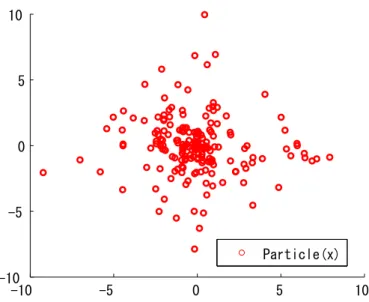
Figure 2.2 shows a histogram of points that were randomly sampled from a normal dis- tribution of BBPSO. Where𝑝𝑖and𝑝𝑔 were held constant at1.0 and−1.0respectively. The Fig.2.2 is a rough bell curve centred midway between the two previous best points and ex- tending symmetrically beyond them. Figure 2.3 shows the positions of 200 particles on one iteration that were randomly sampled by BBPSO in the solution space of a two-Dimensional Ackley function. The versions of BBPSO differed in how𝑔 was defined: 𝑔𝑏𝑒𝑠𝑡, neighbor- hood best, or random neighbor. The performance of the random-neighbor version is inter- esting. Based on the experimental results in [45], the best-performing algorithm was the modified barebones version where𝑔 was a randomly selected neighbor.
2.3 Variants of Particle Swarm Optimization
-10 -5 0 5 10
-10 -5
0 5 10
Particle(x)
Fig. 2.3 Positions of particles sampled by BBPSO on Ackley function
2.3.3 Binary Particle Swarm Optimization (BBPSO)
Most particle swarm optimization algorithms are designed to search in continuous domains.
However, there are a number of variants that operate in discrete spaces. The first variant proposed for discrete domains was the binary particle swarm optimization algorithm [46].
In the binary version, trajectories are changes in the probability that a coordinate will take on a zero or one value. It means that a particle moves in a state space restricted to0and1on each dimension𝑑, where each𝑣𝑖𝑑 represents the probability of bit𝑥𝑖𝑑 taking the value1. In other words, if𝑣𝑖𝑑 = 0.20, then there is a20%chance that𝑥𝑖𝑑will be the value1, and an80%
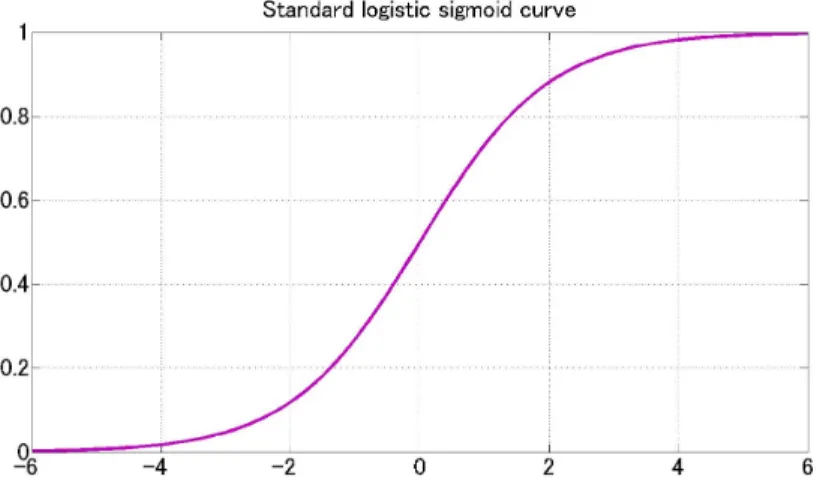
chance it will be the value0. In sum, the particle swarm formula remains unchanged, except that now𝑝𝑖and𝑥𝑖are integers in0, 1and𝑣𝑖, since it is a probability, must be constrained to the interval [0.0, 1.0]. A logistic transformation𝑆(𝑣𝑖𝑑) can be used to accomplish this last modification. In [51], the sigmoid function used in the binary version is:
𝑆(𝑣𝑖𝑑) = 1
1 + 𝑒−𝑣𝑖𝑑 (2.10)
Fig. 2.4 The standard logistic sigmoid curve
Also the equation (2.10) is used to update the velocity vector of the particle. And the new position of the particle is obtained using the equation below [46]:
𝑥𝑖𝑑 =
⎧⎪
⎨⎪
⎩
1 if𝑟𝑎𝑛𝑑() < 𝑆(𝑣𝑖𝑑) 0 otherwise
(2.11)
where𝑟𝑎𝑛𝑑()is a quasirandom number selected from a uniform distribution in [0.0, 1.0].
In the present discrete version, it appears that with𝑣𝑖𝑑functioning as a probability thresh- old, changes in 𝑣𝑖𝑑 might represent a change in first-order position itself. As 𝑆(𝑣𝑖𝑑) ap- proaches zero, for instance, the position of the particle fixes more probably on the value 0, with less chance of change. Trajectory in the current model is probabilistic, and velocity on a single dimension is the probability that a bit will change. Thus even if𝑣𝑖𝑑 should re- main fixed, the position of the particle on that dimension remains dynamic as it flips polarity with probability following from the value of 𝑣𝑖𝑑. According to [46] and [51], the binary PSO performs especially well on number of test problems. It also appears that the binary particle swarm is extremely flexible and robust. The binary PSO can be used in variety of applications, especially when the values of the search space are discrete like decision mak-
2.4 Strength and Weakness ing, solving lot sizing problem [88], the travelling salesman problem [107], scheduling and routing [71], [72].
2.4 Strength and Weakness
2.4.1 Strength
PSO is a population based and intelligent method, which is inspired by the emergent motion of a flock of birds searching for food. In PSO, a population of potential solutions is evolved through successive iterations. Compared to other optimization strategies, it can be easily implemented and it is computationally inexpensive, since its memory and CPU speed re- quirements are low [20]. Moreover, it does not require gradient information of the objective function under consideration, but only its values, and it uses only primitive mathematical operators. PSO has been proved to be an efficient method for many global optimization problems and in some cases it does not suffer the difficulties encountered by other EC tech- niques [21]. Since PSO algorithm has a number of desirable properties, including simplicity of implementation, scalability in dimension, and good empirical performance, it has been applied to solve many real-world problems, such as capacitor placement problem [69], short term load forecasting [90], soft sensor [91], the voltage stability of the electric power distri- bution systems [66], [24], the orbits of discrete chaotic dynamical systems towards desired target region [58], and the permutation flow-shop sequencing problem [88].
2.4.2 Weakness
Perhaps the most common problem encountered by many Global Optimization (GO) meth- ods, either deterministic or stochastic, when coping with the GO problem is the problem of local minima. Especially in multimodal functions, the existence of many local minima makes it quite difficult for most techniques to detect the global minimum. PSO, despite
being an efficient method, also suffers from this problem. In order to avoid being stuck in local optima in the convergence process, some improved PSO have been proposed, such as crossover [11], orthogonal learning strategy [104], chaos [1], and elitist learning strategy [103].
Among population-based algorithms, PSO also has difficulties in keeping balance be- tween exploration and exploitation when solving complex multimodal problems. For in- stance, all particles share its swarm's best experience (the global best) that can lead the par- ticles to cluster around the global best. In case, if the global best is located near a local minimum, escaping from local optimum becomes difficult and PSO suffers diversity loss near the local minimum [79]. In order to address the exploration and exploitation trade-off problem, some other improved PSO have been proposed. Liang proposed comprehensive learning particle swarm Optimization (CLPSO) in which each particle learns from other particles' best experiences for different dimensions via a comprehensive learning strategy [56]. Efficient population utilization strategy for particle swarm optimization (EPUS-PSO) was presented in [36]. In which population size is varied by a population manager according to the status of the solution search. Meanwhile, heterogeneous particle swarm optimization was proposed in [18], [26]. In heterogeneous PSO (HPSO) [26], the particles in heteroge- neous swarms were allowed to follow different velocity and position updating rules from a behavior pool, thereby having the ability to explore and exploit throughout the problem search space.
Chapter 3
Fitness Predator Optimization for Multimodal Problems
A major problem with most of swarm intelligent algorithms in multimodal optimization is Premature Convergence (PC), which results in significant performance loss and sub-optimal solutions. To avoid premature convergence by maintaining diversity in the population, many kinds of optimization algorithms are proposed. However, to the best of our knowledge, few of the swarm intelligent techniques focus on the individual competition. The development of individual competition plays an important role of the diversity conservation in the popu- lation because it could increase individual independent consciousness and reduce the rapid social collaboration process. In this chapter, a new algorithm, Fitness Predator Optimization (FPO), is proposed based on the conceptions of predators to avoid premature convergence for multimodal optimization problems.
3.1 Overview and Preliminaries
In contrast to the unimodal functions, multimodal functions have many local optima with the number increasing exponentially with dimension. This makes them fairly difficult to
convergence to the global minimum. It is suitable for benchmarking the global search abil- ity and the local optima avoidance of an algorithm. In order to solve the multimodal, no- linear, discontinuous and non-differentiable optimization problems, researchers have devel- oped population-based algorithms such as Particle Swarm Optimization (PSO), [21], Ant Colony Optimization (ACO) [19], Artificial Bee Colony (ABC) [41] and so on. To the Par- ticle Swarm Optimization (PSO), all particles share its global best experience that can lead the particles to cluster around the global best. In case, if the global best is located near a local minimum, escaping from local optimum becomes difficult. Diversity declines rapidly in the later iteration period, leaving the PSO algorithm with great difficulties of escaping local optima. Consequently, the clustering particles with fitness stagnation further exacer- bates the premature convergence situation. An accepted hypothesis is that maintenance of high diversity is crucial for preventing premature convergence in multimodal optimization.
3.1.1 Predator-Prey Optimization (PPO)
Many kinds of optimization algorithms are proposed to improve the diversity of the pop- ulation. Some of them are inspired by the social behavior of swarms, herds in nature. In addition, the hunting and search behaviors of predator are implemented by more and more researchers and proved to be an effective method. For example, the basic idea of Artificial Fish-Swarm Algorithm (AFSA) [53] is to imitate fish behavior such as preying, swarm- ing, following with local search of individual fish for reaching the global optimum. The Grey Wolf Optimization (GWO) [64] algorithm mimics the leadership hierarchy and hunt- ing mechanism of grey wolves in nature. Other related swarm intelligent algorithms, such as Predator-Prey Optimization (PPO) [83] in 2006, Dolphin Partner Optimization (DPO) [80]
in 2009, Bat-inspired Algorithm (BA) [102] in 2010, Krill Herd (KH) [28] in 2012 are also proposed to simulate group hunting behaviors.