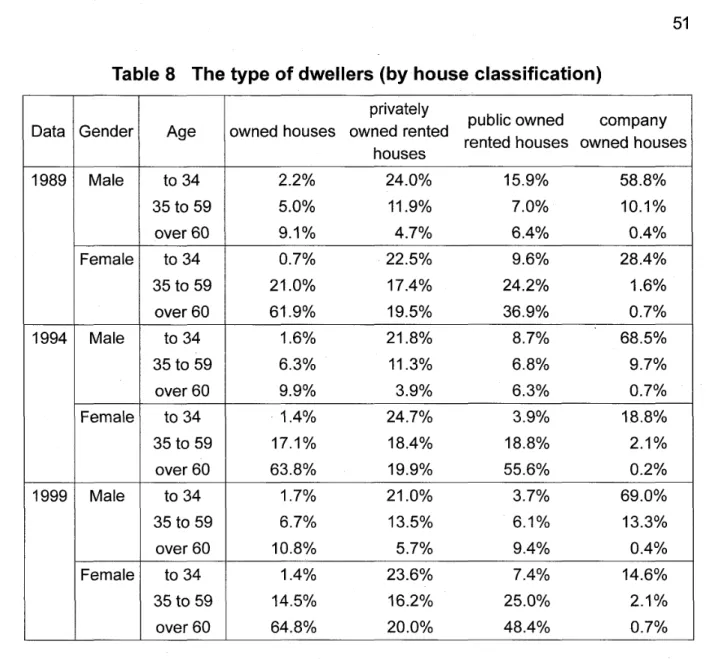
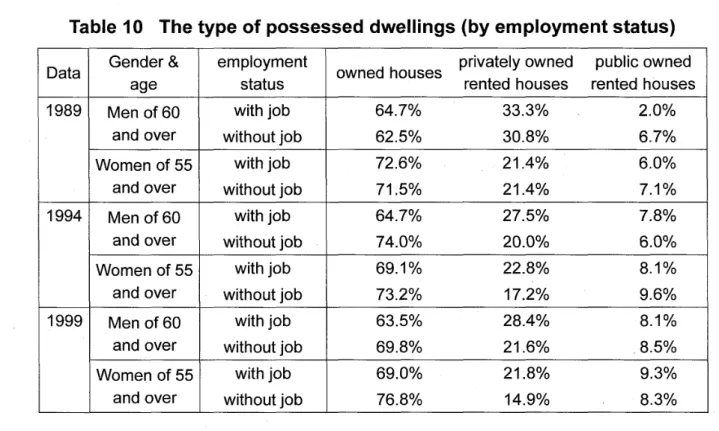
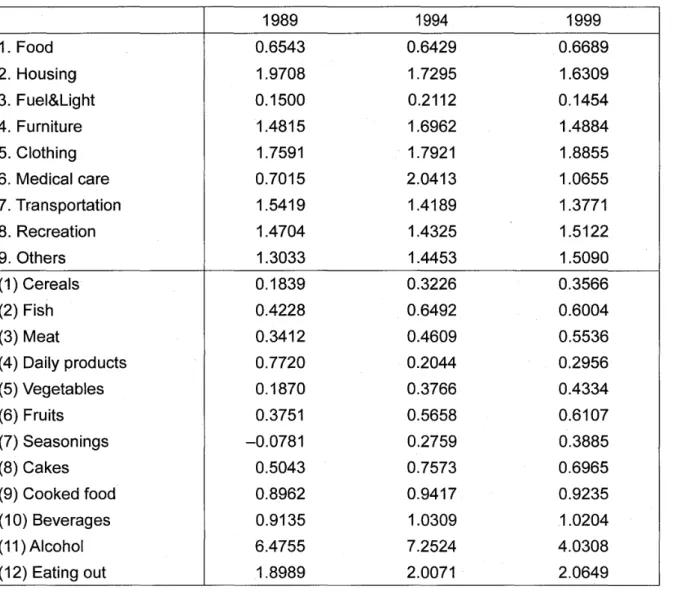
in Japan, 1989‑1999
著者 Hashimoto Noriko
journal or
publication title
Kansai University review of economics
volume 9
page range 41‑72
year 2007‑03
URL http://hdl.handle.net/10112/12264
Expenditure Patterns of One‑Person Household in Japan, 1989 ‑1999
Noriko Hashimoto
The size of household in Japan is shrinking because of the growing tendency to delay marriage and the aging of general population. What stands out especially is the increase of one‑person households. We use the micro data of National survey of Family Income and Expenditure of 1989, 1994 and 1999 to examine expenditure patterns of one‑person households, which vary by attributes such as sex, job status, age, annual income and type of residence. The methodology of Fry et. al.(2000) is applied for dealing with the problem of zero observations.
Keywords : National su,vey of Family Income and Expenditure, micro data, one‑person household, household attributes, expenditure pattern, problem of zero observation
1. Preface
The lifestyle of Japanese household has changed a lot over the last five decades with social and economic development. One notable trend is the dwindling size of an average household. Census reports that the average size of a household decreased from 3.41 persons per household in 1970 to 3.22 in 1980, 2.99 in 1990 and 2.67 in 2000.
The increase of nuclear families and the sharp decline in the birth rate considerably affected this situation, but what stands out is the increase of one‑person households.
In the past, single person households were observed primary among persons who finished school and lived by themselves until they got married. They were considered as rare cases. However, growing tendency to delay marriage or to stay single raised the number of one‑
person households not only in 20's age group but also in 30's and 40's.
* Professor of Econometrics
41
Table 1 Portion of the one‑person households to all households
1970 1980 1990 2000
20's 53.8% 58.7% 67.2% 67.1%
30's 7.5% 11.8% 18.4% 26.7%
40's 6.6% 7.3% 11.5% 16.8%
Source: Census (Ministry of Internal Affairs and Communications 1>)
Table 1 shows the recent change of the percentage in the one‑person households among those generations.
At the same time, rapidly aging population enlarged the number of aged one‑person household as well. Japan is the country with the highest longevity in the world. In 2000, average life for male is 77.72 (65.32) years and 84.60 (70.19) for female. (Numbers in parentheses are life expectancies in 1960.)
As a result of these facts, the Census of 2000 reported that the number of one‑person household in Japan is 12.91 million, which accounts for 27 .6% of all households.
To grasp the situation of one‑person household accurately is imperative because their ratio is significant, and their spending patterns are believed to be different from other type of households. The state of unemployed aged one person household is also crucial in conceiving the future social welfare.
W e use micro data of National survey of Family Income and Expenditure that is approved for use2> to understand the expenditure behavior of one‑person households.
Last year, we used micro data of 1999, to examine the characteristics of one‑person households and estimated expenditure elasticities of commodities of classification by use (Hashimoto (2006)). In this article, we change the setup to enlarge the analysis in following three ways.
First, we use not only the 1999 survey but also 1989 and 1994 surveys.
W e try to understand the attributes of one‑person households, such as sex, occupational state, age‑group, income level, residence ownership, etc., and their transitions over the year. Second, we analyze expenditure data classified not by use but by commodity item. Third, we treat the problem of zero observations specifically via the methodology of Fry et. al.(2000) and calculate elasticities in the MAIDS (Modified Almost Ideal
Demand System, Cooper and Mclaren(1992)) framework.
The composition of this paper is as follows: In section 2, we describe the data for empirical analyses. In section 3, we study the one‑person households in Japan from various attributes, such as sex, occupational state, age‑group, income level and residence types and so on.
In section 4, we explain the model and tools we used to estimate elasticities in this paper. W e take care of the zero observation problem via the methodology proposed by Fry et.al.(2000) and use the framework of MAIDS (Cooper and Mclaren(1992)) for estimation. Empirical results are described in section 5. Besides the expenditure elasticities, the background and circumstances of the households under zero observations are examined. Section 6 offers a brief summary.
2. Data
The National survey of Family Income and Expenditure (hereinafter called NFIE) is conducted every five years since 1959 by the Statistics Bureau, Ministry of Internal Affairs and Communications. It covers all parts of Japan and all categories of business豆 Itis a comprehensive inquest for households'expenditure, saving and debt, holdings of durables and possession of properties such as residence and land. To get detailed results which can not be obtained by usual family surveys, NFIE investigates considerable numbers of households to capture the household's characteristics by their age group, income level, inhabiting districts, and so on.
The survey is conducted in autumn and the number sampled is around 60,000. For example, 54,792 general households'4) and 5,002 one‑person households'data were collected for the 1999 survey.
In section 3, we grasp the characteristics of one‑person households and their transitions of attributes, such as sex, age‑group, occupational state, residence, income and property state by using NFIE micro data of 1989, 1994 and 1999.
3. The characteristics of the one‑person household 3.1 The number of households
The sample number of households in the provided data5) are shown
Table 2 The number of households in provided NFIE micro data Data One‑person
General household Total household
1989 3,294 44,773 48,067
1994 3,782 44,807 48,589
1999 4,012 44,537 48,549
in Table 2.
The increasing percentage of one‑person household can be read from this table (6.9% in 1989, 7.8% in 1994 and 8.3% in 1999).
In this paper, we focus on the behavior of one‑person households.
3.2 Age and Gender compositions
The age and gender composition of data is shown in Table 3.
The gender (male vs. female) distribution shows a ratio of four to six and this tendency varies little over the years.
Next, we take a look at the age composition. Figure 1 shows age distribution6> in 1999. In table 3, age is divided into three goups乃youth (under the age of 35), middle age (35 to 59) and the aged (60 years old and above). This division is marked by color in figures.
As a whole, many of the one‑person households are distributed in the youth layer (under 35 years old) and aged layer (60 years old and above). Looking at the change over the ten years, the ratios of middle
Table 3 Age and gender compositions of the one
—
person householdData Male Female
under 35 35 to 59 above 60 under 35 35 to 59 above 60 1989 1347 894 292 161 1947 546 463 938
(40.89%) (27.14%) (8.86%) (4.89%) (59.11%) (16.58%) (14.06%) (28.48%) 1994 1499 962 329 208 2283 493 511 1279
(39.64%) (25.44%) (8.70%) (5.50%) (60.36%) (13.04%) (13.51 %) (33.82%) 1999 1591 909 405 277 2421 442 512 1467
(39.66%) (22.66%) (10.09%) (6.90%) (60.34%) (11.02%) (12.76%) (36.57%) change rate —3.02% —16.52% 13.88% 41.26% 2.09% —33.54% —9.21 % 28.41 %
magnitude —1.24 —4.48 1.23 2.02 1.24 —5.56 —1.29 8.09
age group remain consistent at 23%, while those of youth decrease sharply from 44% to 34% and those of the aged jump 10% point to 43%
conversely.
W e now examine the age composition by gender in 1999 (Figure 2, dotted line shows the location of mean.)
For Male (upper stand}, one‑person households centers in one location, the youth layer (under 35)鑢 Thenumber of persons in middle age and the aged categories (35 and above) are uniformly small in numbers. It is different for female (lower stand), where fewer one‑
person households are distributed into the youth layer and many are into the aged layer (60 and above). Age composition for female is bi‑ modal as a result.
Next, we examine the transition of the age composition by gender from table 3. From 1989 to 1999, the ratios of middle age group are consistent at 23%, but male ratio slightly increases and female one slightly decreases. In youth, both male and female ratios decrease remarkably (5% point). On the other hand, male ratio increases a little (2% point) and female ratio makes a marked rise of 8 % point in the aged layer. The increase in the aged categories is mainly explained by the addition of female seniors'.
The decrease of single households in youth may look inconsistent with tendencies described in preface. However, the result of the 2004 Household Census shows similar tendency as our observations.
According to the NFIE data, as shown iri section 3.3, almost all the households in the youth layer are on the payroll. Meanwhile, a wave of
"parasite single", young unmarried adult living off his/her parents is more evident in Japan. More young people remain single longer because of the growing tendency to delay marriage. However, the decline in work motivations (typically shown in the increase of NEET) and the increase of nonpermanent employee (so‑called "freeter" Gob‑
hopping part‑timer)) make living alone difficult for these young people.
The percentage of youth that live together with their parents is fairly high as a consequence. The ratio of the youth layer in NFIE data is considered to decline in response to this situation.
Household Census is done by the National Institute of Population and Social Security Research every five years. The result of 2004 survey shows that:
household
疇 一
雪
震
20 $0 40 so 60 ̀ t n i . $0
釦ge
Figure 1 Age distribution in 1999 (All households)
PI
Oq
as
no
q
400
900
200
100
20 40 60 80
/!i̲ge
Figure 2 Age distribution in 1999 (by gender)
400
300
200
100
Table 4 The rate of youth living with parents
Age 25 to 29 30 to 34 35 to 39 Data 1999 2004 1999 2004 1999 2004 Male 58.3% 64.0% 39.0% 45.4% 24.0% 26.5%
Female 51.3% 56.1% 22.9% 33.1% 15.7% 19.8%
source: Household Census(National Institute of Population and Social Security Research)
i) The overall size of households continues to decline. (2.9 persons per household in 1999 to 2.8 persons in 2004)
ii) The percentage of single households remains at 20.0%. This rate is similar to result of the previous survey. The change is in the shrinking of youth layer and the growth of old.
iii) The number of young generation living together with their parents continues to increase considerably. See Table 4.
iv) The rate of living together with aged parent continues to decline. (58.3% in 1994, 52.1 % in 1999 and 48.1 % in 2004)
These tendencies are in accord with those of NFIE data翌 3.3 Employment Situations
Now we observe the employment situations of single households (Table 5).
Most of the people are at work, but the rate is declining as the aged households increase. The participation rates are 72.8% in 1989, 67.4%
in 1994 and 61.7% in 1999.
As shown in Figure 3 and Figure 4, almost all the households in the Table 5 The employment situations of single households
1989 1994 1999
With occupation 2,399 2,550 2,474
employee 2,097 2,278 2,187
permanet worker 1,974 2,071 1,954
part‑timer 123 207 233
without occupation 895 1,232 1,538
not occupied 880 1,186 1,439
job hunter 15 46 99
PIOqosnoq
400
300
200
100
Figure 3
20 40
臼ge
Age distribution of Male households in 1999 (by occupational states)
n
︒ ▼
. .
u a p t~
C‑
c ︒
•~·
:~~.~~~
~~~ 會●會▼▲▼▲
~~~.
••••
~~
··.~~•
·~•·.
~•·•~.•~
▼~•▲‘~・
t▲: 望
\ 5 [
ゞ
7 5
•:~\
~·~~~~ ▼▲●
:~.
▼▲▼ ▲:▼・▲9~▼万~~f·~·~~~~
~·~~
. .
•~•~
,~:' J
~:·・~:~
~~~
~·`· ·~·
•~~▼~ ・~▼▼.~
. . . .
・ ▼ . ・
••
~~·~· ・~•~’~.~~
~·~·
~~~~~
~··
.~・~・~~•・
ハ▼▼•▼▼・~i•▲さ~
~~••’~••
~~ ~~~·
·~~1
・~~~~~~
•~••‘~••
.
.
▲
.~C一~~[~{ら]•••
・~~~~~~ ~·~~▲
合羨
▲
さ▼[~:
PIOqa" noq
300
200
100
60 80
Figure 4
400
800
200
100
300
200
100
20 40 so 80
P,ge
Age distribution of Female households in 1999 (by occupational states)
youth layer are occupied without regard to gender in 1999, and its tendencies are the same in both 1989 and 1994. The rate of households without occupation in the middle aged layer remains low throughout the period, a few percent for male and around 15% for female (mostly for person over age 55). In the end, almost all men under 60 years old and women under 55 years old are occupied.
Most aged households are unoccupied. For male, a lower 70%
household is unoccupied throughout the period. On the other hand, the job‑less percentage rises over the years for female, and reaches 86%
(73.1 % in 1989, 79.4% in 1994 and 85.6% in 1999). Aged single households who continue to work are part‑timers, executives of companies and self‑employed workers.
As a consequence, male participation rate is around 90% and decline only slightly over the years (91.2% in 1989, 89.7% in 1994 and 87 .3% in 1999), while female participation rate falls sharply (60.1 % in 1989, 52.8% in 1994 and 44.8% in 1999). Job‑less percentage for aged group finally exceeds the occupied rates in 1999. This is because large numbers of aged persons are female and many of them are unoccupied.
Among people with occupation, the majority remains employed. The employment rate is around 88 to 89% and has been stable for these 10 years. Employees are divided in two categories: permanent workers and part‑timers. Most of the people are permanent workers, but their rate is declining (94.1 % in 1989, 90.9% in 1994 and 89.3% in 1999).
A lower 90% of the part‑timers are female (Table 6). The aged female dominates the number, but their ratio is low (around 6%) and stable. The ratio of middle‑aged women is highest and reaches over 15%
(11.0% in 1989, 13.1 % in 1994 and 15.4% in 1999). The ratios of part‑ Table 6 The number of part‑timers in single households
Male Female
Data under above under above
All
35 35 to 59
60 All
35 35 to 59
60
1989 20 4 11 5 107 7 51 49
1994 25 10 6
,
182 27 67 881999 30 13 4 13 203 40 79 84