グローバル都市研究 9号(2016) Global Urban Studies, No.9 ― ―ʁ
Ariyoshi OGAWA Rikkyo University
The Politics of Nuclear Power in Time and Space
Abstract
The Fukushima nuclear disaster in March 2011 shook Japan and the whole world. However, the eventual outcome was the restoration of the long-entrenched nuclear power policy regime after a period of blame-shifting among politicians and electricity company managers. Why is this nuclear policy so resilient? This article proposes two hypotheses: one focusing on politics in time and the other on politics in space. The separation of political processes between short- term and long-term contexts leads to the blurring of responsibility for accumulating nuclear risk. The relationship of center-periphery dependency prevailing in Japan imposes a “double- risk society” situation on so-called “atom villages,” which continue to accept energy-related facilities because they feel that they must choose between nuclear and socio-economic risks.
1. The Politics of Time and Space in Unexpected Crises
This study explores the time and space horizons of the politics of crisis by examining the background and impact of the disaster at the Fukushima Daiichi nuclear power plant in Japan following the massive earthquake on March 11, 2011.
After the Fukushima accident, the Tokyo Electric Power Company (TEPCO) management and mainstream nuclear power experts stressed that the whole development was “unexpected.”
Former Prime Minister Noda endorsed this explanation, referring to the “optimistic assumptions” made about disaster risks when speaking at the second Nuclear Security Summit in Seoul on March 26, 2012.
Yet Möller and Wikman-Svahn (2011) suggest that the Fukushima disaster could be seen as a “black elephant” rather than a “black swan.” A “black swan” refers to a high-impact event that exceeds reasonable expectations and could not have been predicted in advance, in
― ―ʂ
contrast to a “white swan,” which is readily visible. On the other hand, a “black elephant” is an extraordinary event, the likelihood of which is ignored despite existing evidence.
Regardless of whether a crisis is a “black swan” or a “black elephant,” it is the outcome of political contestation and construction. The key question to consider is who (or what) should be held responsible for long-term nuclear power policy and its result.
As Pierson (2003) notes, much political research is geared toward short time horizons in terms of both cause and outcome; he calls this the “tornado” type of account. However, many social processes may take a longer time to unfold. Long-term types of explanations are more appropriate for what Pierson calls the “earthquake” type of events, which have rapid outcomes but very slow-moving causal processes; the “meteorite/extinction” type, which has very recent causes and slow-moving outcomes; and the “global warming” type, which has long-term causal processes and outcomes. As Lewin (2007) emphasizes, political accountability can be achieved only when a choice is fully presented and decided upon.
However, choices are shaped and constrained by the politics of time and space. Thus, I first examine the following hypothesis on the politics of time, which I will apply to the case of Fukushima.
Hypothesis 1: To the extent that short-term political processes are separated from long- term political processes, policy choices and political accountability remain diverted or obscured.
The separation of political processes in time is shown in Figure 1.
Figure 1 The Politics of Nuclear Power in Time and Space Time Horizon of Outcome
Short Long
Time Horizon of Cause
Short
I. Tornado
Blame-shifting game
II. Meteorite/Extinction
Pandora’s box (unsolvable problem of permanent disposal, low-dose exposures, etc.)
Long
III. Earthquake
Unaccountable nuclear energy p o l i c y re g i m e a n d a n a b r u p t accident
IV. Global Warming
Unchangeable “addiction” on the part of the “victimized zones” or
“atom villages”
Source: Pierson (2003), Table 5.1, p. 179. Words in italics were added by the present author for the purpose of this article.
グローバル都市研究 9号(2016) Global Urban Studies, No.9 ― ―ʃ Second, the politics of space should also be addressed. According to Gouldʼs comparison of political responses in Europe in the wake of the Chernobyl accident, “West Germany showed what a vigorous federal structure could achieve,” due to two conditions in the country: the political pressures brought to bear by the Green Party, and strong local power.
Gould also observes, “There is no question in my mind that there was a direct and strong correlation between the degree to which a country had made itself dependent on atomic power and the degree to which it employed the tactic of suppressing information” (1990:
115–117). In countries most dependent on atomic power, such as France and Belgium (over 60%), information was most likely to be either manipulated or suppressed by the government, which were highly centralized and relied on advice from atomic scientists.
Poland and other then-socialist countries that had committed to building Soviet-designed reactors also had many reasons to control information flow.
Based on this observation, I propose a second hypothesis, which assumes that a highly centralized and unequal state-society relation is most likely to leave no alternatives to nuclear-driven energy policy, whereas a decentralized political structure is more susceptible to policy and partisan alternatives.
Hypothesis 2: To the extent that the center-periphery relation is hierarchical and charac- terized by dependency, long-term policy alternatives are likely to be deterred.
2. The Politics of Time before and after Fukushima
The Short/Short Context
The politics of crisis in the short/short context (i.e., short-term causes and short-term outcomes) after Fukushima developed into a chaotic political blame-shifting game.
During the knife-edge situation at the Fukushima nuclear power plant, the entire population watched the televised statements by Chief Cabinet Secretary Yukio Edano with breathless concern. People felt insecure as they listened to reports of helicopters watering the site or reportedly “heroic” fire brigades, wondering what Edanoʼs words about “no immediate ill effect on health” really meant. However, people had few choices other than compulsory (in areas designated by a series of concentric circles) or voluntary (such as for mothers with small children) evacuation or leaving the matter passively in the hands of the government and TEPCO.
As national securitization (Buzan, Wæver, & de Wilde 1998) of the nuclear accident proceeded, blame-shifting prevailed among political leaders and TEPCO managers. The opposition Liberal Democratic Party (LDP) politicians, such as former Prime Minister
― ―ʄ
Shinzo Abe and party leader Sadakazu Tanigaki, made public the information that Prime Minister Kan had needlessly ordered a suspension of water injection. This information, perhaps disseminated by a high official in the Ministry of Economy, Trade and Industry (METI), turned out to be false (Yamaguchi 2012). In the Dietʼs Independent Investigation Commission, TEPCO CEO Masataka Shimizu and Director-General Tsunehisa Katsumata both denied having planned a total withdrawal of their employees from the nuclear plant, while the Democratic Party of Japan (DPJ) cabinet members insisted that the company had suggested this.
In the meantime, four different public and private investigation units were established.
First, TEPCO issued a report on December 2, 2011 (TEPCO 2011) that reiterated the
“unexpected” factors of this accident, such as tsunami waves exceeding 10 meters in height and the total loss of emergency power supply and equipment for accident management.
Nevertheless, journalists discovered a report showing that TEPCO had considered countermeasures against tsunami waves higher than previous assumptions, as well as another oral report that a working group under the Nuclear and Industrial Safety Agency (NISA) had warned of the possibility of a huge earthquake and tsunami striking East Japan, like the one that occurred in A.D. 896 (Asahi Shimbun, March 12, 2012 & June 13, 2012). These warnings, whether consciously or due to lack of attention, were never taken seriously by TEPCO.2)
The Long/Short Context
The long/short context (long-term causes, short-term outcomes) in existence prior to the Fukushima disaster can be traced back to the consolidation of an unaccountable nuclear energy policy regime in post-war Japan.
According to the science historian Hitoshi Yoshioka (2011), the atomic energy policy in Japan has been characterized by a “state-directed, privately managed” policy regime. This regime made both democratic accountability for public energy policy and market competition based on costs and rationalization opaque. How was this particular regime consolidated?
The introduction of atomic energy into Japan in the 1950s derived from the U.S. policy of providing nuclear power technology to its allies during the Cold War. In the domestic political arena, individual proponents such as Yasuhiro Nakasone, a nationalist politician and later Prime Minister, and Matsutaro Shoriki, a business leader who would later become a government minister, pushed hard for the first atomic development budget in 1954. The business sector as a whole was skeptical of state control but eager to minimize the development costs. The tug-of-war between businesses and the Ministry of International
グローバル都市研究 9号(2016) Global Urban Studies, No.9 ― ―ʅ Trade and Industry (MITI) led to a compromise: the creation of the Japan Atomic Power Company, funded by both the government and private companies. This coexistence regime allowed the private companies to seek profits while leaving infrastructure improvement and subsidies to the governmentʼs discretion. This regime was consolidated from the 1960s to the 1980s, with support from the introduction of a base-rate scheme of electricity charges. Under this system, the more power companies invested in huge development plans, the more they would be allowed to charge consumers for electricity.
This “state-directed, privately managed” nuclear energy policy regime fit with the conservative development politics long pursued by the LDP government. The decline of LDP politics, tightening of budgets, and global warming discourses created a watershed moment in Japanese politics in 2009, namely, a change of government for the first time in more than half a century. The new DPJ government looked at policy alternatives, such as emission trading and a strengthened feed-in-tariff scheme. However, the mid-term roadmap planned by the Ministry of Environment was set aside by METI (formerly MITI), and the government contemplated the option of withdrawing from the Kyoto Protocol and exporting nuclear power plants to developing countries under the title of a “new growth strategy.” In the wake of the Fukushima disaster, the DPJ has experienced internal disunity on this issue, and the DPJʼs policy of “departure from dependence on nuclear energy” became more blurred in the days of the Noda cabinet, launched in September 2011, than in the previous Kan cabinet.
The Short/Long Context
The politics of (lost) accountability in a short/long context (short-term causes, long-term outcomes) is developing around radiation and decommissioning, issues that are now hotly contested between mainstream experts and critical experts and journalists.
Hiroshi Tasaka, a nuclear expert, who had served the government as a cabinet adviser, delivered a talk titled “The Pandoraʼs Box that the Fukushima Atomic Accident Opened” at the Japan Press Club. Since then, he has warned against “groundless optimistic relief” and pointed to “bunching” risks and costs. Among the unsolved risks, he enumerates not only the uncontrollability of a destroyed reactor (even though it is described as in “cold shutdown”), but also growing amounts of contaminated water, long-term ecological pollution, reactor decommissioning that will span many decades, socio-psychological costs, and the unsolvable problem of permanent disposal (Tasaka 2012).
Journalists have blamed the Nuclear Safety Commission (NSC) and the Ministry of Education, Culture, Sports, Science and Technology for diffusing unsound, shaky
― ―ʆ
benchmarks regarding security against low-dose radiation to a broad range of people, including children (Hizumi & Kino 2012). Onai and Shirabe (2012) criticize the report of the Working Group on the Risk Management of Low-Dose Exposures, which established the benchmark for evacuation and removal work. The report claims that 20 mSv of radiation dose is a level sufficiently low to avoid risk and that this threshold is justified by internationally agreed-upon scientific knowledge, including that of United Nations Scientific Committee on the Effects of Atomic Radiation(UNSCEAR) and International Commission on Radiological Protection(ICRP). However, UNSCEAR and ICRPʼs original reports attach more weight to “social trust” and “participation of all important stakeholders,”
two conditions ignored by the Working Group, which prefers an expert-driven
“enlightenment” model. Such a top-down risk management policy would have deprived the inhabitants of their right to evacuate children to areas with lower radiation levels.
3. The Politics of Accountability in the Center/Periphery and Long/Long Contexts
The politics of time in the long/long context and the politics of space in the center-periphery context overlap and contribute to the most strongly entrenched factors contributing to the resilience of nuclear power policy in Japan. The dependency relationship between the center and the periphery contributed to policy inertia, as did the paradoxical adherence of the
“victimized zones” to nuclear facilities.
Kainuma (2011) focuses on the development of a second source of support for “atom villages,” located among metropolitan elites, in addition to the bureaucracy-industry complex supporting atomic energy at the national level. Typically, rural municipalities were chosen as
“atom villages” because their location was removed from a metropolitan area but still sufficiently convenient to supply electricity consumed by an urban population.
In these “atom villages,” nuclear power plants appeared as a knight on a white horse.
Instead of causing devastating migration or disappointment about plans for heavy and chemical industries, nuclear plants regenerated these communities by bringing jobs to the area and increasing the demand for housing and services. In fact, locals were generally happy about the huge financial transfer legitimized by highly technical discourses (Pickett 2002).
The 1974 power source siting laws (Dengen Sanpo) brought about huge subsidies, which, in turn, encouraged the host local governments to initiate wide-ranging public building projects such as roads, ports, and facilities for sports, garbage disposal, health care, education, social welfare, agriculture, and tourism. Furthermore, regional development
グローバル都市研究 9号(2016) Global Urban Studies, No.9 ― ―ʇ projects such as the promotion of local traditional industries, human resource development, and environmental protection were supported. In a word, nuclear subsidies could be expected to cover virtually all the activities that local municipalities could imagine. In August 2011, Tokyo Shimbun reported that the government budget for nuclear energy over the previous ten years amounted to 4.5 trillion yen, around 40% of which was earmarked for “siting policy.”
That means that around 180 billion yen every year were earmarked for this purpose, and host localities received more than 60% of that amount (Tokyo Shimbun, August 14, 2011).
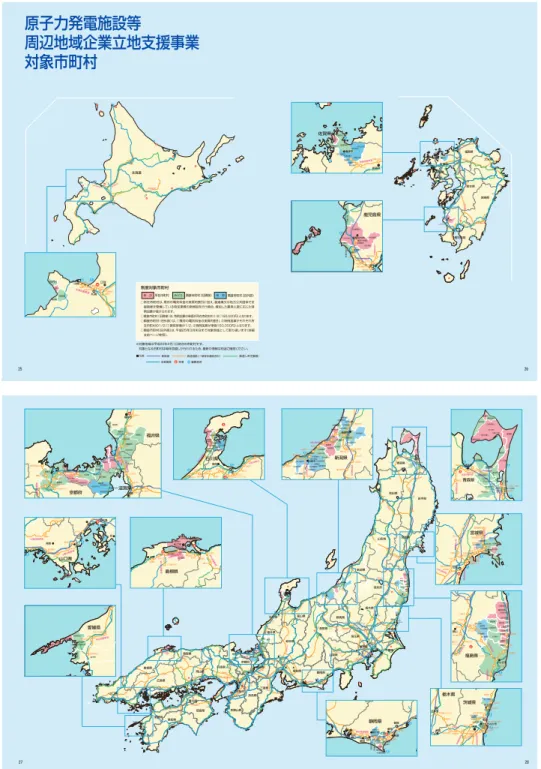
Figure 2 shows the nuclear facility host municipalities covered by the ambient-area enterprise support programs.
However, after receiving their initial financial support associated with facility construction, these local communities faced the prospect of diminishing transfers. This financial mechanism induced “atom villages” to accept expansions of, or additional, nuclear facilities (Ishibashi et al. 2011), which Kainuma describes as “addiction” on the part of the “victimized zones.”
Among Japanʼs many “atom villages,” Rokkashomura village in Aomori Prefecture occupies a particularly paradoxical position. This village and adjacent localities, located on a peninsula of the northernmost prefecture on the Japanese mainland, were offered national nuclear fuel cycling projects in the mid-1980s, following the failure of a regional industrial development plan in the late 1960s and 1970s. If this acceptance is reversed, the state and the industry will lose one of the countryʼs main willing recipients of such facilities, and the localities will lose their economic lifeline (Funabashi, Hasegawa, & Ijima 2012: 85–118).
Survey research conducted in September 2003 (Kayano 2005) found that villagers were ambivalent but that their perspectives were dominated by economic concerns. Among the survey respondents, 57.2% acknowledged the presence of both risk and positive economic effects, 25.4% recognized the economic effects but not risk, 13.8% affirmed risk but not economic effects, and 3.5% perceived neither risk nor economic effects as resulting from the projects. These results indicate that a strong majority had positive views of the economic impact of the nuclear fuel cycling facilities. More than half of these indicated that they had been negative at first but later changed their mind. This survey shows the attitude transformation in communities that nuclear fuel cycling activities have induced over the past 20 years.
There have been international concerns that Japanʼs nuclear fuel cycling projects would accumulate plutonium̶which could potentially be diverted to atomic weaponry̶and since Fukushima it has become much more difficult to regenerate the reprocessing project. But it is no easier to find a policy alternative, due to the asymmetrical interdependence between the
― ―ʈ
Figure 2 Nuclear power siting in mostly peripheral municipalities covered by ambient-area enterprise support programs
Source: Agency for Natural Resources and Energy, “Dengenricchi Seido no Gaiyo” (Overview of Electric Power Source Siting), http://www.enecho.meti.go.jp/about/pamphlet/pdf/dengenrichi.pdf, accessed February 22, 2016.
グローバル都市研究 9号(2016) Global Urban Studies, No.9 ― ―ʉ state and the nuclear industry, on one hand, and the small localities and the rural prefectures on the other hand.
4. Where Have All the Alternatives Gone?
Nuclear energy policy in Japan has been distinguished by the presence of a dominant coalition defending a state-directed, privately managed policy regime that is opposed only by weak protest movements (Honda 2005).
There have been viable cycles of anti-nuclear protest activities in Japan. Anti-nuclear movements often viewed litigation as a direct means of disrupting nuclear power construction and operations. However, the judicial branch tends to acquiesce to the logic of the dominant position among nuclear scientists, although the need for safety review was confirmed in the Ikata nuclear plant case in the 1970s. The plaintiff in this case was supported by critical (and thus low-ranked) nuclear power researchers from the University of Kyoto. These experts were concerned about the risk of meltdown in case of a loss of emergency power supply (which would become a reality at Fukushima) and also about active faults lying underneath nuclear plants. However, the lawsuit was unsuccessful. A quarter- century later, a lower court decision in October 2007, in the Hamaoka Atomic Power Plant case, again favored the defendant. The decision stated, “We must avoid considering too seriously an abstract possibility of a huge earthquake.” Shortly thereafter, the Chuetsu Oki earthquake damaged the Kashiwazaki Kariwa plants (Kaido 2011). Thus, the judiciary can be seen as another contributor to the consolidation of an unaccountable nuclear energy policy regime.
Nevertheless, the most relevant challenge took the form of local revolts that occurred in the 1990s. In 1994, local residents in Makimachi, a small town in Niigata Prefecture, set up the Association for Local Referendum, led by Mr. Sasaguchi, a sake brewer. After being elected mayor a year later, Sasaguchi decided to hold a symposium and then a referendum on nuclear power plants. The referendum attracted 88.29% voter turnout, with 60.85% voting against and 38.55% for the nuclear power plants (Honda 2005, 253–258).
In Fukushima, Governor Eisaku Sato, who had been an LDP member of the Diet, refused to acquiesce to the Mixed Uranium-Plutonium Oxide Fuel for Nuclear Reactors (MOX) program for the Fukushima Daiichi plant. Against strong pressures exercised by the power industry, bureaucracy, and conservative media, Sato suspended the MOX program in 2000 on the grounds that the information and explanations provided to the local population were not credible and contained bogus data on MOX fuel. However, Fukushimaʼs prefectural revolt came to a halt when Sato was charged with bribery in 2006. Sato received a two-year
― ―ʁʀ
sentence, even though the court acknowledged that he had received “zero yen” (Sato 2011).
While he was appealing to the Supreme Court, the new governor, Mr. Yuhei Sato, announced acceptance of the MOX program at the Fukushima Daiichi plant.
According to an Asahi Shimbun opinion poll in May 2012, 29% of respondents supported and 54% opposed restarting the Oi nuclear power plant. Additionally, 20% trusted, to a certain extent, the safety measures for nuclear power established by the government, 51% did not trust them much, and 22% did not trust them at all. Moreover, 44% agreed that they would support the discontinuance of nuclear power generation even if that decision brought with it the possibility of an electricity shortage and inconveniences in daily life, whereas 47%
did not. These responses expressed a notable lack of public confidence in the accounts of nuclear plant operations given by the government and experts.
On June 8, 2012, Prime Minister Yoshihiko Noda announced that he had decided to resume operations at the Oi nuclear power plant. He expressed gratitude to the host prefecture, saying that “Fukui Prefecture and Oi have supported the Kansai region” and that
“We must renew our respect for and gratitude to the host governments” (Asahi Shimbun AJW, June 8, 2012, https://ajw.asahi.com/article/behind_news/politics/AJ201206090053). In the December 2012 election, the LDP returned to power, and Abeʼs second cabinet decided to go ahead with resuming operation of nuclear power plants, starting with the Sendai plants in Kagoshima in 2015 and then the Takahama plants in 2016, after obtaining the approval of the host localities and prefectures.3) Aside from this restoration of nuclear power, the Abe government introduced liberalization of the electricity retail market, from which not only consumers but also TEPCO (at least on a short-term basis) could expect to benefit (Asahi Shimbun, February 21, 2016).
5. Beyond Japan and “Atom Villages”
Following the Fukushima accident, the politics of crisis in the short context was prominent, obscuring the long-term contexts. The outcomes included the blaming of ex-Prime Minister Kan instead of those responsible for the “state-directed, privately managed” policy regime, fear of low-level radiation doses among the remaining residents and their future descendants, and no substantial policy revisions with regard to nuclear power.
In this way, the Japanese nuclear power policy regime confirms Hypothesis 1. The obscuring of policy choice is also buttressed by the continuing dependence of host localities on the nuclear economy, which validates Hypothesis 2.
The European states took different paths in response to the Fukushima accident in spring 2011. The Merkel government in Germany froze its own bill for nuclear operation extensions
グローバル都市研究 9号(2016) Global Urban Studies, No.9 ― ―ʁʁ only three days after the accident in Japan. Chancellor Merkel set up two advisory boards, the Technical Nuclear Safety Commission and the Ethics Commission, to shape authoritative principles for the future of energy policy, basically in line with (but also in several respects ahead of) the Atomausstieg policy of the former Red-Green coalition. In Italy, the July 2011 national referendum overturned Prime Minister Berlusconiʼs policy proposals, which included restarting domestic nuclear power.
In contrast, France is the most prominent case of a “state-directed, privately managed”
policy regime in Europe. After Fukushima, President Sarkozy stood firmly behind the nuclear energy industry, saying that it supported “the power, pride, and independence” of the country. François Hollande, who defeated Sarkozy in the May 2012 presidential election, committed to a moderate reduction of nuclear power and announced the closure of one nuclear plant at Fessenheim. However, the local voters expressed strong resistance against this idea in the National Assembly election (Le Monde, June 5, 2012).
The German and Italian cases may show the relevance of open political opportunity structures such as federalism or referenda.4) Moreover, Chancellor Merkelʼs decision was not limited to temporal relief of mass fear, but influenced future policy principles as well (though these were subsequently challenged by business). In other words, the German leader intended to ensure that accountability for her nuclear policy U-turn would be matched by a long-term account (Hypothesis 1). In addition, this political decision was made against the background of a surge by the Green Party in Lander election campaigns in late March 2011, as demonstrated by the 24.2% support that the Greens received in Baden-Württemberg and the 15.4% who voted for Green in Rhineland-Palatinate (Spiegel Online, March 28, 2011). That development evidences the influence of strong local power, as Gould put it, in stark contrast to the center-periphery dependency in Japan (Hypothesis 2).
In terms of center-periphery dependency, Lithuania is one of the most comparable cases to Japan in Europe. In the 1970s, the Soviet government planned the construction of the Ignalina nuclear plant in Lithuania to supply electricity to the whole northwestern region of the USSR, and the two reactors began operations in 1984 and 1986. The Chernobyl accident and the glasnost reforms prompted the Lithuanian population to express anxiety about health issues. However, the inhabitants of Visaginas, where the Ignalina plant is located, expressed much less concern about the danger of the power plant nearby. This seemingly paradoxical response resembles that of the “atom villages” in Japan. Rinkevicius (2000) describes this communal perception as the result of a “double-risk society” in the sense that people accept the risks of nuclear technology because they believe that a nuclear phase-out would present the risk of losing local employment, welfare, social stability, and quality of
― ―ʁʂ
life. Here, risk derived from the first modernity and risk derived from the second (Beck 2013) are overlaid not in order but in time.
But are hypotheses 1 and 2, implying the continuation of the “double-risk society,”
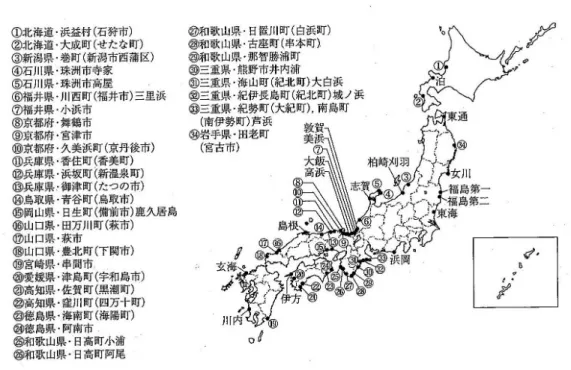
irrevocable and unchangeable? Figure 3 shows the location of existing nuclear power plants along with more than 30 localities that blocked planned nuclear plant construction in Japan.
Those “nonconformist” localities, such as small towns along the Kii Peninsula coasts and Iwaishima Island in the Seto Inland Sea, often have strong communal ties, such as fishermenʼ s cooperatives, with deeper historical origins. The local resitances, whether successful or not, were never made without difficulty. However, Shokan Tachibana, a Buddhist priest living only 8 kilometers away from the Tsuruga nuclear plant, insists, “The longer we resist, the more likely nuclear power plants will be economically ruined, to the point of withdrawal.”
His remark sounds like a popular but strategic vision that may transcend nuclear-related center-periphery dependency in the long term.
The initial securitization of nuclear power risk did not lead to a policy changeover in the short-term context, but it caused a mid-term effect that has normalized citizensʼ protest
Figure 3 Localities that blocked planned nuclear power plant construction Black dots: Existing nuclear power plants in Japan
⑪−㉞:Localities that blocked planned nuclear power plant construction Source:
Yamaaki (2012), p. 3.
グローバル都市研究 9号(2016) Global Urban Studies, No.9 ― ―ʁʃ politics in Japan (Gonoi 2012). The anti-nuclear power movement culminated in 2012 but was followed by anti-State Secrecy Law movements in 2013–2014 and anti-military legislation movements in 2015. The second of these three movements led to the establishment of the Students Against Secret Protection Law (SASPL), which developed into the Students Emergency Action for Liberal Democracy (SEALDs) in the third movement. These new waves of student action are creating a new political culture, such as by using rap music in demonstrations.
It is unknown whether such young urban civil-society movements and communal resistance can cut across the center-periphery gap and eventually work in tandem to change a nuclear power policy that has been entrenched in time and space (Ono 2016).
1) This article is a revised and updated work based on my paper, “Politics of Accountability in Risk and Fear: Coping with the ʻUnexpectedʼ in Japan and Europe,” presented at the 2012 IPSA World Congress, Madrid, July 8–12, and on my chapter, “Risk Society,” in Hiroshi Honda and Takashi Horie (eds), Datsu-genpatsu no Hikakuseijigaku (Comparative Politics of Anti- Nuclear Power), Tokyo: Hosei University Press, 2014. It was supported by JSPS KAKENHI Grants Number 23330043, 26285035, and 24243021.
2) ENSI, the Swiss Federal Nuclear Safety Inspectorate, has clearly pointed to the lack of learning ability in the organization before Fukushima (ENSI 2011).
3) On February. 24, 2016, the Nuclear Regulation Authority (NRA) announced that the No. 1 and 2 reactors of Takahama nuclear power plant in Fukui Prefecture met the new safety standards. The NRAʼs decision may lead to extension of the operation of the aging reactors to up to 60 years, beyond 40-year limit that the DPJ government had introduced (Asahi Shimbun AJW, Feb.25, 2016, https://ajw.asahi.com/article/views/editorial/AJ201602250031).
4) The Italian case demonstrates a more complex context. In Italy, nuclear power development had faced a bottleneck since the 1970s, partly because of technical failure and partly because of political struggles involving Christian Democratic factions as well as the strong oil industry. A national referendum in 1987 led to the decision to abandon the three laws on nuclear power development in Italy. The anti-Berlusconi opposition that campaigned for the national referenda in 2011 intended to combine the issues of privatization of water supply, immunity of ministers, and the plan to restart nuclear power (Ito 2012). Thus, the opposition challenged the incumbent government by questioning its accounts of both short-term and long-term issues.
References
ENSI (Swiss Federal Nuclear Safety Inspectorate). 2011. Lessons Learned und Prüfpunkte aus den kerntechnischen Unfallen in Fukushima.
― ―ʁʄ
Beck, Ulrich. 2013. An Introduction to the Theory of Second modernity and the Risk Society.
London: Routledge.
Buzan, Barry, Ole Wæver, and Jaap de Wilde. 1998. Security: A New Framework for Analysis.
Boulder: Lynne Rienner.
Funabashi Harutoshi, Koichi Hasegawa and Nobuko Ijima. 2012. Kakunenryo Saikuru Shisetsu no Shakaigaku: Aomoriken Rokkashomura [Sociology of Nuclear Fuel Cycle Facilities:
Rokkyashomura Village in Aomori Prefecture]. Tokyo: Yuhikaku.
Gonoi Ikuo. 2012. Demo toha Nanika: Henbou suru Chokusetsu Minshushugi [What is demonstration? Evolving Direct Democracy]. Tokyo: NHK Shuppan.
Gould, Peter. 1990. Fire in the Rain: The Democratic Consequences of Chernobyl. Baltimore: The Johns Hopkins University Press.
Honda Hiroshi. 2005. Datsu−Genshiryoku no Undoh to Seiji: Nihon no Enerugih Seisaku no Tenkan ha Kanoh ka [Movements and Politics of De−Atomization: Can the Japanese Energy Policy Change?]. Sapporo: Hokkaido University Press.
Ishibashi Katsuhiko. 2011(ed.). Genpatsu wo Owaraseru (Bringing an End to Nuclear Power Plants).
Tokyo: Iwanami Shoten.
Ito Takeshi. 2012. “Itaria ni okeru Gempatsu Mondai: ʻDatsu Gempatsuʼ Kokumin Tohyo no Rekishiteki Iso to Kadai” [The Nuclear Power Issue in Italy: Historical Perspective and Problems of Referenda on ʻDenuclearizationʼ]. Senshu University Law Journal 37: 39−55.
Kaido Yuichi. 2011. “Nihon no Shiho wa Genpatsu wo Donoyouni Sabaitekitaka.”[How have the Judiciary in Japan Ruled the Atomic Power Plants] Sekai 2011(1):82−95.
Kainuma Hiroshi. 2011. Fukushima−ron: Genshiryoku−mura ha Naze Umaretanoka [On Fukushima:
Why were the Atom−Villages Born?]. Tokyo: Seidosha.
Lewin, Leif. 2007. Democratic Accountability: Why choice in Politics is Both Possible and Necessary.
Cambridge: Harvard University Press.
Niklas Möller and Per Wikman−Svahn. 2011. “Black Swans and Black Elephants of Nuclear Safety.” Ethics, Policy & Environment 14(3): 273−278.
Onai Takayuki and Masashi Shirabe. 2012. “Jumin dewa naku Risuku wo Kanri seyo: ʻTeisenryo Hibaku no Risuku Kanri nikansuru Wakingu Gurupu Hokokushoʼ ni Hisomu Sajutu” (Risk Management or Mind Control?: Possible Messages in the Report by the Working Group on the Risk Management of Low−dose Exposures). Kagaku 82(3): 314−321.
Ono Hajime. 2016. Chihojichi to Datu−Gempatsu: Wakasa−wan no Chiikikeizai wo Megutte (Local Autonomy and Nuclear Phase−out: About Reginal Economy in Wakasha Bay Area). Tokyo:
Shakai Hyoronsha.
Pickett, Susan E. 2002. Japanʼs Nuclear Energy Policy: From Firm Commitment to Difficult Dilemma Addressing Growing Stocks of Plutonium, Program delays, Domestic Opposition and International pressure. Energy Policy 30: 1337−1355.
Pierson, Paul. “Big, Slow−Moving, and… Invisible: Macrosocial Processes in the Study of
グローバル都市研究 9号(2016) Global Urban Studies, No.9 ― ―ʁʅ Comparative Politics.” In James Mahoney and Dietrich Rueschemeyer (eds.), Comparative Historical Analysis in the Social Sciences. Cambridge: Cambridge University Press.
Rinkevicius, Leanardas. 2000. Public Risk Perceptions in a ʻDouble−Riskʼ Society: The Case of the Ignalina Nuclear Power Plant in Lithuania. Innovation 13(3): 279−289.
Sato Eisaku. 2011. Fukushima Gempatsu no Shinjitsu [The Truth of Fukushima Nuclear Power Plants]. Heibonsha.
Tasaka Hiroshi. 2012. Kantei kara Mita Genpatsu Jiko no Shinjitsu: Korekara Hajimaru Shin no Kiki [The Truth of the Nuclear Power Plant Accident Viewed from the Prime Ministerʼs Office: The Real Crisis ahead of us]. Tokyo: Kobunsha.
TEPCO. 2011. Fukushima Genshiryoku Jiko Chousa Hokokusho (Chukan Hokokusho) [Interim Report on Nuclear Accident in Fukushima]. December 2, 2011.
Yamaguchi Jiro. 2012. Seikenkotai toha Nanndattanoka [What was the Change of Government].
Tokyo: Iwanami Shoten.
Yoshioka Hitoshi. 2011. Genshiryoku no Shakaishi: Sono Nihonteki Tenkai [The Social History of Nuclear Power: The Japanese Development]. Tokyo: Asahi Shimbun Shuppan.
Yamaaki Shin. 2012. Gempatsu wo Tsukurasenai Hitobito: From Iwaishima to the Future (People Fighting back Nuclear Power Plant Construction). Tokyo: Iwanami Shoten.