Economic Activities of Indian Business Groups in Thailand : Continuity and Discontinuity
著者 ESHO Hideki
出版者 法政大学経済学部学会
journal or
publication title
The Hosei University Economic Review
volume 82
number 1・2
page range 51‑104
year 2015‑03‑20
URL http://doi.org/10.15002/00010759
《Abstract》
The economic activities of Indian business groups in Thailand have a long history. If we examine the establishment of representative Indian business groups in Thailand chronologically, the Diwanchand Group comes first, followed by the GP Group, Indorama Group, Adithya Birla Group, and Tata Group.
Shivnath Rai Bajaj, who leads the Diwanchand Kundanlal Group, and Kirt Shah, who leads the GP Group, are PIO (Persons of Indian Origin). On the other hand, A. P. Lohia, who leads the Indorama Group, and S. S.
Mahansaria and Deepak Mittal, who head the Adithya Birla Group, are NRIs (Non-Resident Indians). However, there is “a continuity” among these industrial groups, and the borders between PIO and NRIs are not closed.
The inroads into Thailand made by the Tata Group symbolize the phenomenon of the “Rising New India.” Today, the central location of the
Economic Activities of Indian Business Groups in Thailand:
Continuity and Discontinuity
*Hideki ESHO
* This paper is a revised version of “Economic Activities of Indian Business Groups in Thailand,”
International Jounal of South Asian Studies, vol. 4 (2011).
Indian business groups in Bangkok is no longer Samphen-Pahurat (Little India) or the Ban-Kaek area; it is Sukhumvit. The Thai-Bharat Cultural Lodge, an association with a long history, has become fairly desolate today.
This locational change of the main business activities of Indians in Bangkok is the most remarkable phenomenon that differs from the situation in the 1980s.
1 Characteristics of Indian Diaspora in Thailand
In September 2000, Government of India appointed the High Level Committee on the Indian Diaspora whose Report was submitted to the government in December 2001(GOI 2001). The Report is not only epoch- making: it is the most comprehensive document ever produced on the Indian Diaspora, which encompasses approximately 20 million Indians all over the world1).
In the Report, Indian Diaspora is defined as consisted of NRIs (Non Resident Indians) and PIO (Persons of Indian Origin). NRIs are Indian citizens, holding Indian passports, who reside abroad for an indefinite period of time, whether for employment, carrying on any business or vacation, or for any other purpose. On the other hand, the term of PIO is applied to a foreign citizen of Indian origin or descent.
This report recommended that the government should implement policies that would clearly target the Indian Diaspora. In accordance with this recommendation, Government of India set up the Ministry of Non- Resident Indians’ Affairs in May 2004. In September 2004 this ministry
1) Since this Report was released, the number of overseas Indians increased to over 25 million by 2012 (http://moia.gov.in/accessories.asps?aid=10). Accordingly, the number of overseas Indians residing in each country is also substantially changed.
changed the name to the Ministry of Overseas Indian Affairs (MOIA). The main purpose of this Ministry is to establish a worldwide Indian network to promote investment and remittance2).
Table 1 shows the number of the Indian Diaspora in South-East Asian countries cited in the Report mentioned above. The top destination of the Indian Diaspora is Myanmar where more than 2.9 million Indians live, which account for 6.2 percent of the total population. The next most popular destination is Malaysia where 1, 665,000 Indians resides, or 7.3 per cent of the total population. In case of Singapore, there are 307,000 Indians or 9.7 per cent of the total population. In Thailand, 85,000 Indians, which is only 0.1 per cent of the total population3).
Table1 Number of Indian Diaspora in South-East Asian Countries Population NRIs PIO Stateless Total As per cent of the
population (%)
Brunei 331,000 7,000 500 100 7,600 2.3
Cambodia 11,340,000 150 150 0 300 negligible
Indonesia 200,000,000 500 50,000 0 50,500 negligible
Laos 5,100,000 107 18 n.a. 125 negligible
Malaysia 22,890,000 15,000 1,600,000 50,000 1,665,000 7.3 Myanmar 46,500,000 2,000 2,500,000 400,000 2,902,000 6.2 Philippines 76,000,000 2,000 24,000 12,000 38,000 negligible Singapore 3,160,000 90,000 217,000 negligible 307,000 9.7
Thailand 62,000,000 15,000 70,000 0 85,000 0.1
Vietnam 78,000,000 320 0 10 330 negligible
Source: GOI 2001, p.253.
2) MOIA started to publish a periodical called “Pravashi Bharatiya” (Overseas Indians) to promote networking of overseas Indians and provide information on India to them. Also OIFC (Overseas Indian Facilitation Centre) was set up under the MOIA to collaborate with CII (Confederation of Indian Industry) to promote investment by overseas Indians.
3) The recent data tells us that the number of overseas Indians in Myanmar dramatically reduced to 356,560. On the other hand, the number of overseas Indians in Malaysia increased to 2,050,000, that in Singapore increased to 670,000, and that in Thailand also increased to 150,000 (http://moia.gov.in/accessories.asps?aid=10)..
Compared with studies on the Indian Diaspora in Singapore or Malaysia, those on the Indian Diaspora living in Thailand are far fewer in number.
The reasons are, firstly, because the Indian Diaspora in Thailand is simply much smaller than in Singapore or Malaysia. Secondly, the Thai language is a great barrier to foreign scholars who wish to study the Indian Diaspora in Thailand. Thirdly, most of the Indian Diaspora living in Thailand are
“traders” and have purposely registered low profit out of modesty or fear of having to pay higher taxes (Poolthupya 2008, p.679). Fourthly, the Thai government is generally indifferent or tolerant toward ethnic issues.
Fifthly, 75 per cent of the Indians live in Bangkok and they prefer “non- politicized” life. Finally, having an image of Buddha at Hindu temples has become a norm, not only Indians but also for Thais who visit them for worship (Poolthupya 2008, p.676). Generally speaking, Indians make “a silent minority” (Hussain 1982) in Thai society for long time.
The fact that the majority of Indians migrated to Thailand by their free will is the most conspicuous characteristic. This is quite different from the Indians who migrated to Malaysia, Singapore, or Myanmar mainly as
Table 2 Major Indian Associations in Thailand
Name of Association Year of
Establishment Number of
member Notes
1. Birthplace-based Associations Gujarati-Marwari Society
Maharashtra Mandal Bangkok 1989 100 families Association of the Indians from Maharashtra state living in Bangkok.
Mamdhari Sangat of Thailand
Thai Kannada Balaga 2003 Association of the Indians from Karunataka state living in Bangkok.
The World Punjabi Organization (Thailand Chapter) Set up by Punjabi for helping the poor and those suffer disaster of all kinds.
Mohona-A Bangla Association in Thailand 2004 Association of Bengal loving people living in Thailand. To promote philanthropic
activities and to facilitate understanding and fraternity between Thailand and people of Bengal.
Tamil Cultural Association of Thailand
Siam Sindhi Association 175
The Telugu Association of Thailand 2008 A non-profit organization that represent and serves Telugu people in Bangkok.
South Indian Association of Thailand A group that strives for the betterment of Indians in Thailand.
plantation workers. The first traders who came to Thai were Bohra Muslim from Gujarat, Muslim Tamils and Hindu Tamils. The Gujaratis dealt mainly in precious stones and the export of Thai rice to India, while other groups traded in textiles. By 1925, there were six associations run by the Indian Diaspora. Those were Vishnu Mandir, Arya Samaj, Shri Maha Mariamman Temple, Sri Guru Singh Subha, Gurudwala Sangat and Jamaiat ul Islam (Lochan 2006). All these associations were based on religion. Even today, as we can see from Table 2, religion-based associations, which are closely related with language and birthplace, are prevalent.
As business-based association, the India-Thai Chamber of Commerce is the most representative. This association was officially set up in 1944 and was called Indian Society of Trade. In 1968, accordance to an Act of Parliament, the Royal Thai Government delineated the rules governing the incorporation of foreign chambers in Thailand. The name was thus changed to the Indian Chamber of Trade in January 1969. As an association committed to the furtherance of the business interests of the Indian community in Thailand, the India Chamber of Trade took on the more
Table 2 Major Indian Associations in Thailand
Name of Association Year of
Establishment Number of
member Notes
1. Birthplace-based Associations Gujarati-Marwari Society
Maharashtra Mandal Bangkok 1989 100 families Association of the Indians from Maharashtra state living in Bangkok.
Mamdhari Sangat of Thailand
Thai Kannada Balaga 2003 Association of the Indians from Karunataka state living in Bangkok.
The World Punjabi Organization (Thailand Chapter) Set up by Punjabi for helping the poor and those suffer disaster of all kinds.
Mohona-A Bangla Association in Thailand 2004 Association of Bengal loving people living in Thailand. To promote philanthropic
activities and to facilitate understanding and fraternity between Thailand and people of Bengal.
Tamil Cultural Association of Thailand
Siam Sindhi Association 175
The Telugu Association of Thailand 2008 A non-profit organization that represent and serves Telugu people in Bangkok.
South Indian Association of Thailand A group that strives for the betterment of Indians in Thailand.
Name of Association Year of
Establishment Number of
member Notes
2. Business/Trade Associations
India-Thai Chamber of Commerce 1974 213 Association representing interests of Indian business groups. In 1974, the name was
changed from Indian Chamber of Commerce to India-Thai Chamber of Commerce.
Indian Diamond & Colorstone Club
IIT Alumni Associaton of Thailand 1988 To foster a relationship among former students of IIT who are living in Bangkok..
India-Thai Business Forum 2002 175 Held a monthly dinner meeting with a guest speaker. Founder Chairman is Mr. S.
S. Mahansaria. Started in October, 2002 with 15 members.
3. Culture-based Associations
Thai Bharat Cultural Lodge 1940 175 It was founded by Swami Satyananda Puri with the encouragement from
Rabindranath Tagore to promote comparative studies and exchange between Thai and Indian history and culture.
Thailand Hindi Parishad
India Studies Centre, Thammasat University 1993 It runs with private funding provided by Indian businessmen and companies. It
publishes journals and newletters. Visit of Thai scholars to India and Indian scholars to Thailand for conference, seminars and lectures are organized.
Sanskrit Studies Center, Silpakorn University 1997 It is equivalent to a department and its main purpose is to teach Sanskrit language,
literature and ancient inscriptions.
Thai Indian Internal Security Council 2000 To promote business and create better social welfare.
Indian Women's Club To promote culture as well as charity works including Indian dance teaching to
Indian and Thai people.
Thai-India Cultural and Economic Cooperation Association 2003 To provide knowledge and understanding about India in various aspects.
Indian Cultural Centre, Bangkok 2009 It is under the Indian Council of Cultural Relations, New Delhi. It organizes cultural
evenings, paintings and photographic exhibition, seminars and other Indian art and culture related activities.
4. Religion-based Associations
Sri Marianman Temple (Wat Kaek) 1870 The first established Hindu temple in Bangkok. In 1915, Sri Maha Umadevi Temple
became a formal name.
Thai Sikh Organization (Thailand) (Gurdwara Sri Guru Singh Sabha Bangkok) 1912 925 In 1912, the first Gurudwara was established in Baan Moh. In 1913, a new Gurudwara was established at the corner of Phahurat and Chakraphet. In 1981 it was renovated. It is the biggest Gurudwara in South-East Asia.
Hindu Dharma Sabha (Vishnu Mandir) 1915 Hindu temple of Uttar Pradesh people.
Arya Samaj Bangkok 1920 Association of neo-Hindus who follow the teaching of Swami Singh Sabha. In 1923,
it became a formal branch of Arya Samaj of India.
Hindu Samaj 1924 447 Association set up by Punjabi Hindus.
Geeta Ashram Thailand 1968 Established to promote study and practice of the divine things of Bhagavad Geeta.
It is a branch of the International Federation of Geeta Ashrams headquartered in Delhi.
Radha Soami Satsang Beas 500 A syncretic group involving Akali Sikhs, followed by Namdari Sikhs and some
Sindhis. The followers abstain from meat, alcohol, and drugs. The language used generally Punjabi.
Shree Swaminarayan Satsang Mandal
Sri Digambar Jain Samaj, Bangkok 2007 100 families A temple of Digambar Jain community. There are 500 Jain families living in
Thailand, mostly in Bangkok. Out of them, about 100 are Digambar Jain families and the rest are Shwetanbar families.
Namdari Sangat of Thailand (Namdari Sabha) 544 Association of Namdari Sikhs community in Bangkok.
The Tamil Muslim Association in Thailand 1975 500 Association of Tamil Muslims in Bangkok.
Sources:Sato 1995; Mani 1993; Poolthupya 2008; Lochan 2006; Indians in Thailand (http://www.
thaindian.com/indian-association); Ministry of Overseas Indian Affairs (http://moia.gov.in).
Name of Association Year of
Establishment Number of
member Notes
2. Business/Trade Associations
India-Thai Chamber of Commerce 1974 213 Association representing interests of Indian business groups. In 1974, the name was
changed from Indian Chamber of Commerce to India-Thai Chamber of Commerce.
Indian Diamond & Colorstone Club
IIT Alumni Associaton of Thailand 1988 To foster a relationship among former students of IIT who are living in Bangkok..
India-Thai Business Forum 2002 175 Held a monthly dinner meeting with a guest speaker. Founder Chairman is Mr. S.
S. Mahansaria. Started in October, 2002 with 15 members.
3. Culture-based Associations
Thai Bharat Cultural Lodge 1940 175 It was founded by Swami Satyananda Puri with the encouragement from
Rabindranath Tagore to promote comparative studies and exchange between Thai and Indian history and culture.
Thailand Hindi Parishad
India Studies Centre, Thammasat University 1993 It runs with private funding provided by Indian businessmen and companies. It
publishes journals and newletters. Visit of Thai scholars to India and Indian scholars to Thailand for conference, seminars and lectures are organized.
Sanskrit Studies Center, Silpakorn University 1997 It is equivalent to a department and its main purpose is to teach Sanskrit language,
literature and ancient inscriptions.
Thai Indian Internal Security Council 2000 To promote business and create better social welfare.
Indian Women's Club To promote culture as well as charity works including Indian dance teaching to
Indian and Thai people.
Thai-India Cultural and Economic Cooperation Association 2003 To provide knowledge and understanding about India in various aspects.
Indian Cultural Centre, Bangkok 2009 It is under the Indian Council of Cultural Relations, New Delhi. It organizes cultural
evenings, paintings and photographic exhibition, seminars and other Indian art and culture related activities.
4. Religion-based Associations
Sri Marianman Temple (Wat Kaek) 1870 The first established Hindu temple in Bangkok. In 1915, Sri Maha Umadevi Temple
became a formal name.
Thai Sikh Organization (Thailand) (Gurdwara Sri Guru Singh Sabha Bangkok) 1912 925 In 1912, the first Gurudwara was established in Baan Moh. In 1913, a new Gurudwara was established at the corner of Phahurat and Chakraphet. In 1981 it was renovated. It is the biggest Gurudwara in South-East Asia.
Hindu Dharma Sabha (Vishnu Mandir) 1915 Hindu temple of Uttar Pradesh people.
Arya Samaj Bangkok 1920 Association of neo-Hindus who follow the teaching of Swami Singh Sabha. In 1923,
it became a formal branch of Arya Samaj of India.
Hindu Samaj 1924 447 Association set up by Punjabi Hindus.
Geeta Ashram Thailand 1968 Established to promote study and practice of the divine things of Bhagavad Geeta.
It is a branch of the International Federation of Geeta Ashrams headquartered in Delhi.
Radha Soami Satsang Beas 500 A syncretic group involving Akali Sikhs, followed by Namdari Sikhs and some
Sindhis. The followers abstain from meat, alcohol, and drugs. The language used generally Punjabi.
Shree Swaminarayan Satsang Mandal
Sri Digambar Jain Samaj, Bangkok 2007 100 families A temple of Digambar Jain community. There are 500 Jain families living in
Thailand, mostly in Bangkok. Out of them, about 100 are Digambar Jain families and the rest are Shwetanbar families.
Namdari Sangat of Thailand (Namdari Sabha) 544 Association of Namdari Sikhs community in Bangkok.
The Tamil Muslim Association in Thailand 1975 500 Association of Tamil Muslims in Bangkok.
Sources:Sato 1995; Mani 1993; Poolthupya 2008; Lochan 2006; Indians in Thailand (http://www.
thaindian.com/indian-association); Ministry of Overseas Indian Affairs (http://moia.gov.in).
appropriate name: India-Thai Chamber of Commerce (India-Thai Chamber of Commerce 2004). Now we see economic activities of some representative PIO business groups. All these groups are members of India-Thai Chamber of Commerce.
2 Some Representative PIO Business Groups
2-1 ATEMS (A. T. E. Maskati) Group: The Oldest Indian Business Group
ATEMS Group was founded by A. T. E. Maskati (1832-1898), who is well-known for being one of the first Indians to do business in Thailand. In 1856, he set up A. T. E. Maskati Ltd, the oldest registered trading company in Thailand in Pahurat near the banks of the Chao Phraya River.
(Today they have moved their office and warehouse to a new site in Nakhon Pathom). The Maskati family belongs to Dawoodi Bohra Muslim community in Ahmedabad. Their head office was located in Ahmedabad, from which they dispatched managers to overseas branches (Mani 1993, p. 913). Their business began with the importation of heavy starched, block-printed cotton fabric from Ahmedabad to make traditional Siamese attire. Some of their finest quality fabrics were even worn by the Royal family of Thailand.
Today we can see some of these fine antique pieces at the National Museum. After the Second World War, they diversified into the export of agro-commodities, especially raw jute from Thailand to the rest of the world. They also started to import several well-known brand items to Thailand (http://www.atems.com).
Today the trading activities of ATEMS Group covers six areas such as agricultural and forestry products; inspection and packaging machinery;
chemicals and products for foundry and steel mills; engineering products
primarily for utilities, railways, power, mining and ceramics; “Flavors of Orient”, i.e., which sells natural herbs, spices, ingredients and souvenir products; and lac resin manufacturing. Even today it is a family business.
Along with A.T.E. Maskati Ltd, ATEMS group manages Thevaraya Co.
Ltd, Atem International Co. Ltd. and Flavours of the Orient Co. Ltd.
Among these companies, Flavours of the Orient Co. Ltd. is a joint-venture company with Tea House (Pvt) Ltd. of Sri Lanka, established in 1998 (http://www.atems.com).
2-2 Diwanchand Kundanlal Group: The Most Honored PIO in Thailand Diwanchand Kundanlal Group is led by Shivnath Rai Bajaj (a Hindu born in Pakistan Punjab). Their flagship company is Thai Filament Textiles Co.
Ltd., which was incorporated in 1969 as a joint venture between Diwanchand Group and Teijin Group of Japan. Its manufacturing plant was commissioned in 1971 to produce 100 per cent polyester filament fabrics.
The company is the only polyester filament fabric manufacturer to have been granted the Department of Export Promotion’s logo “Thailand’s Brand”. Its products are exported to Europe, the US, and Japan, etc.
(http://www.thai-filament.com). Diwanchand Kundanlal Group also runs Rembrandt Hotel Corporation, Rembrandt Towers, Shiva Holdings Company Ltd., Trans Global Holdings Ltd., South East Investment Ltd., etc.
The chairman of this group, Shivnath Rai Bajaj contributed much to promote understanding between Indians and Thais. He became a bridge between both countries as president of the India-Thai Chamber of Commerce for two consecutive terms (1971-1973) and a committee member of the Board of Trade for two years. He also served as a member of the Thai-Bharat Cultural Lodge for many years and was also the president of
Hindu Samaj. Because of his immense contributions, he became the first Indian to be awarded the Order of the White Elephant, which was presented by his Majesty the King himself. The Government of India presented him with the Pravasi Bharatiya Samman in 2006 as well as 5th Bharatvanshi Gaurab Samman in 2008 for his tireless services to business and society in a foreign country. He arrived in Bangkok in 1938 from a small village near Lahore at the age of 17 “quite against his will” to help his brothers who were already had an established textile business in Bangkok.
The company was named after his eldest brother and father. In 1944 he married Satwani Kaul, who was not Panjabi Hindu but a second generation Sikh (Masala, February 2010, pp. 58-60). Today Diwanchand Kundanlal Group has offices in India, Dubai, and Singapore.
2-3 Siam Vidhya Group: Investor in Finance and Real Estate
Siam Vidhya group led by Sura Sing Chansrichawla is a representative Namdhari Sikh business group. In the early 1880s the founder of this group, Poola Singh Chawla, left his native Punjab and came to Thailand. He opened a small shop house in Bangkok and started his business as a textile trader. Encouraged by his own success as trader he then ventured into financing textile distributions as well as real estate business. His son, Gurbux Singh, became one of the founders and main shareholders of Bank of Ayudhia, the then eleventh ranking bank in Thailand, although his shares of Bank of Ayudhya were sold out in later years.
Sura Sing Chansrichawla is the son of Gurbux Singh. With the fall of Saigon, the property price fell sharply. Seeing this as an opportunity, Sura Sing Chansrichawla bought as much real estate as he possibly could by using all his assets as collateral. All the land that the company bought was developed by hundreds of separate subsidiaries. Among these companies
were Holiday Inn Crown Plaza (Hotel) in Bangkok, Unico’s 200-acre golf course, tin mines, housing and resort developments in Bangkok, Chiang Mai, and Pattaya, as well as office and apartment buildings. His business strategy was to use balance sheet assets in order to raise funds for the growth of various activities. In the 1970s the Thai government decided to offer new licenses to set-up finance companies. Seizing this opportunity as well, Sura established Unico Finance, and later took over Midland Merchant Finance. Unico Finance was eventually sold off, while Chiangmai Trust and Creditfoncie Unico Housing were added to his portfolio. He also acquired Laem Thong Bank, one of the fifteen licensed commercial banks in Thailand, and established Thai Prashit Insurance. He also expanded his business overseas, by establishing GSP, an offshore banking company, and acquiring 20% equity in Data Line Asia Pacific Limited, a Hong Kong based financial databank. (http://www.sikhreview.org).
However, we cannot find out company names such as Laem Thong Bank, Midland Merchant Finance or Thai Prashit Insurance any more today. In fact, because of the financial crisis in 1997, Laem Thong Bank was taken over by Radanasin Bank, and eventually to be sold to Singapore’s United Overseas Bank. (See Darana Chudasri, “A Cosy Club no Longer,“ Bangkok Post 2002 Mid Year Economic Review.. http://www.bangkokpost.com/
midyear 2002/banking.html).
On the other hand, Unico Group is devoted to the real estate business. It is headed by Mr. Chansrichawla, a nephew of Sura, and comprises three companies, Sunflag (Thailand) Ltd., UNICO Housing Co. Ltd., and UNICO Trading Co. Ltd., which are members of the India-Thai Chamber of Commerce. Incidentally, Holiday Inn Crown Plaza Hotel used to be jointly owned by Chansrichawla and Hari Lal, an Indian living in Hong Kong, but this is no longer the case, as Chansrichawla sold all his shares to the
former.
2-4 GP Group: Rising Star of PIO Business World
The head of GP Group is Kirit Shah (http://www.premjee.com). This group is the most promising PIO business group in Thailand today4).
The Shah (means “trader”) family, who runs GP Group, comes from Kutch, in the Gujarat State of India and belongs to the Jain community.
Kirit Shah’s great grandfather was Devjee Khetjee, who had four sons. His second son, Shivjee, was the grand father of Kirit Shah. Shivjee had one son, Chimanlal Shah, the father of Kirit Shah. In 1868, the Shah family migrated from Bombay to Rangoon (now Yangon), Burma. There they established G. Premjee Company and prospered in rice trade. In 1918, Chimanlal Shah transferred the base of his operations to Bangkok, Thailand and continued to sell rice grown in India, Thailand, Burma, and Sri Lanka to West Asian and African countries. At that time A.T.E. Maskati and Nana family had already established their businesses5).
Up to the 1970s, GP Group traded only rice. From the late 1970s, however, GP Group diversified from rice to other agricultural products such as corn, sorghum, beans, canned food-stuffs, sugar, wheat, and barley. Also, GP Group began to trade corn from the US and Argentina as well as rice from Vietnam, India, Pakistan, Indonesia and China in addition to its main source, Thailand. Further, GP Group expanded its trading base by adding industrial raw materials such as coals, ore, minerals, steel
4)I interviewed Mr. Kirit Shar on 8 January 2009 at his office of Cathey House of North Sathorn.
5)A. T. E. Maskati set up A. T. E. Maskati company in 1956. A. E.. Nana was a Bohra Muslim and trader, who later turned to the real estate business. His inherited property extends on both sides of the Sukhumvit Road area. Even today we can see the name of Soi Nana or BTS Nana station as legacies of his influence.
products, fertilizers and fertilizer materials. Because shipping is a key competitive factor in the international grain trade, GP Group moved progressively into shipping business: charting, owning, handling, agency and brokerage. To strengthen their access to financing for third country trading, the GP Group also forged strong links with international banks in the financial capitals of the world. Moreover, to support the rubber industry in Thailand, GP Group began production of centrifuges, latex concentrate and downstream dipped rubber products. Thanks to their experience in hospital goods, GP Group diversified into soft gelatin capsules for pharmaceuticals and health food supplements. As a further development into the healthcare field, GP Group launched another venture to manufacture and market a wide spectrum of bulk pharmaceutical chemicals. GP Group also entered the jewelry business to serve international markets, as well as real estate and construction businesses.
GP Group has overseas offices in Singapore and Saudi Arabia. Most of the head offices of GP Group companies are located in Cathey House, North Sathorn, Bangkok.
Kirit Shah was born in 1953 in Bombay. He is a Jain, but he lives quite a different life from those Jains who are strict vegetarian. Jains are well- known for their ahimsa (non-killing) and strict asceticism. However, he eats beef as well as pork. According to him, “to be a strict vegetarian is extremely non practical”. Also, he said: “The Government of India provided only poverty evenly among the people in 1950s”. Kirit Shah is a person who is full of innovative ideas and free from fixed notions. This name of Kirit Shah is also apparent by the fact that he broke many taboos by marrying Muslim girl 35 years ago. After graduating from a boarding school in Simla (since there were no English schools in Bangkok in the 1950s), he studied at the University of Bombay for two years. However,
before completing his studies, he came to Bangkok to join his father’s business. His is a PIO and received the Thai nationality in 1998.
GP Group suffered great deal as a result of the exchange and financial crisis in 1997. Consequently, Kirit Shar sold all four rubber or rubber- related companies during 1997-98. In the construction business, there was a joint venture with Ansal Co. Ltd. of New Delhi. However, this company was also closed. Maxwin Construction Co. Ltd. was closed in 1997 as were 15 subsidiaries excluding only one hotel, Amari Atrium Hotel. There are no more companies in construction business today. In the pharmaceutical business, GP Group has two companies. One of them is Lupin Chemical (Thailand). a joint venture with Lupin Chemical Ltd. of India. However, in 2007, Lupin Ltd. withdrew from Thailand and the name of the company has changed to Linaria Chemicals (Thailand) Ltd., a subsidiary of GP Group (https://www.lupinworld.com). Ninety per cent of its products are bulk drugs for export. The other company is Mega Life Science Co. Ltd., which has a 25-year history. Mega Life Science produces two billion soft gelatin capsules per year. It has two plants: one in Thailand and another in Australia. Only one public company limited of the GP Group is Precious Shipping PCL (PSL), the flagship company of GP Group. Recently Kirit Shah founded Precious Shipping (PSL) of Thailand in Mumbai, India. He also founded Great Circle Shipping Agency Limited as a subsidiary of PSL in 1988 (http://www.preciousshipping.com).
Globex Pvt. Ltd. is GP Group’s holding company, which has investments in more than 100 companies. Among them is Phoenix Pulp and Paper PCL, a joint venture between Globex and Ballarpur Industries, a Thapar Group Company of India. Kirit Shah, however, sold all of his shares to Siam Cement in 2004-05. as did Ballarpur Industries. Globex invests in Sila Eastern Co. Ltd., a joint venture with Tata Steel for limestone mining, as
well as in a distribution office of Jet Air Ltd. of India. In gems business, Kirit Shah owns Diamond RuSa Ltd.
When Kirit Shah joined his father in 1970s, big business opportunities were emerging in Thailand. Thai government decided to start opening up the country to investment, and the industrialization of Thailand accelerated. To pursue the Vietnam War, the US Government constructed super highways and opened five military bases in Thailand. In 1973 there was the First Oil Crisis, and Kirit Shar often visited Middle Eastern and African countries where economic boom was occurring. It was at that time when he built relations with buyers in those areas.
Even today, Kirit Shah visits Mumbai once a month. He speaks Thai if necessary, but he never studied Thai in school. According to Shar, because there is no local business for him, speaking Thai is unnecessary. He stressed the importance of being able to speak English and even organize a class for English speaking at his office everyday for anybody to join. He also employs Indians, most of them are employees of Precious Shipping PCL.
Among his 408 total employees, 15-17 are recruited from India.
His first daughter is doing business in Bangkok, while his second daughter and his first son are studying in the US. All three of them do not speak any Indian language. The first daughter is named Nishta Shah, who graduated from Boston University. Now she is the Managing Director of GP Group; however, it is said that she will take over her father’s business in the future. She has started a new business, a designer label for women called “Nusha” (from the Sanskrit word, nasha, for intoxication) to contribute to the diversification of GP Group (Masala, August 2009, pp. 38- 41).
3 Indian FDI to Thailand: An Overview
According to information from the Embassy of India in Thailand, some of the main Indian firms invested in Thailand are Aditya Birla Group, Indorama Group, Phoenix Pulp and Paper PCL, Tata Steel, Tata Motors, TCS (Tata Consultancy Services), Thai Baroda Industries, Dabur Pharma, Usha Martin Industries, Polyplex Corporation, Ranbaxy Laboratories, Lupin Laboratories, and NIIT. In the field of finance, Bharat Overseas Bank (now known as Indian Overseas Bank) started their business in 1973. The Bank of Baroda in September 2005, as did ICICI Bank in September 2005.
In the field of insurance, New India Assurance and Indian Assurance are both doing business in Thailand. All of the companies in the field of finance are public corporations.
A caveat is necessary. Among the companies mentioned above, Phoenix Pulp and Paper PCL is a joint venture comprised of Ballarpur Industries Ltd. of India that made inroad into Thailand in 1975, the European Overseas Development Corporation, the Thai Ministry of Finance, the Industrial Finance Corporation of Thailand and other Thai partners.
However, Ballarpur Industries, a Thapar group company of India, left Thailand in 2004-05. Today Phoenix Pulp and Paper PCL is a subsidiary of Siam Pulp and Paper Ltd., a Siam Cement Group company.
Thai Baroda Industries, established in 1990, is a joint venture between Mumbai-based Baroda Rayon Corporation and Thai capital. It manufactures high-tenacity nylon-6 yarn and cord fabrics for tires. It has a factory in Rayong, Thailand, and its products are sold not only in the Thai domestic market but also exported to Australia, India, Indonesia, South Korea, Philippines, Pakistan, Sri Lanka, and Taiwan. However, in September 2008, it was acquired by SRF Ltd. of India and became a subsidiary of SRF
Ltd., formerly known as Shriram Fibres Ltd., a representative company of Shriram Group of India headed by Arun Bharat Ram.
Lupin Chemical (Thailand) Ltd. was started as a joint venture between Lupin Ltd. of India and GP Group of Thailand. In 2007, however, Lupin Ltd. sold Lupin Chemical (Thiland) Ltd. Today the name of the company is Linaria Chemicals (Thailand) Ltd., which is a company of the GP Group run by Kirit Shar, as referred above.
Ranbaxy Unichem Co. Ltd. of Thailand, set up in 1983, is a joint venture between Ranbaxy Laboratories Ltd. of India and Unicem Ltd. of Thailand.
Ranbaxy Laboratories had four subsidiaries in Thailand including Ranbaxy Unichem Company Ltd., Bounty Holdings Co. Ltd., Unichem Pharmaceuticals, and Unichem Distributors (Thiland) Ltd. Before being acquired in 2008 by Daiichi Sankyo, Ranbaxy Laboratories Ltd. was the largest pharmaceutical company in India.
Thus surprisingly, many Indian subsidiaries in Thailand have already disinvested from Thai market or been acquired by other companies.
Regarding the Indian companies that invested in Thailand, we can obtain more detailed information from BOI (Board of Investment) Thailand. There are some Indian investors who choose not to apply for approval at BOI since it is only granted by the Thai government to investors who satisfy certain conditions (import duty and corporate tax exemption measures apply to approved project). Although the data does not cover all FDI from India to Thailand, these data do provide more detailed information than BOT statistics (Chirathivat 2008).
According to BOI, from 2001 to 2013, the total number of approved projects was 212 (Table 3). During the same period, total approved amount was about Bt.42.6 billion. If we examine the distribution of total registered capital, 82.1 per cent was Indian capital. Table 4 shows the Indian projects
classified by investment size. 192 projects out of the total 212 projects (90.6 per cent of the total) on approved base were small- or medium-sized projects of less than Bt.500million. If we see industry-wise distribution of the Indian projects approved by BOI in Table 5, in terms of number light industries/textiles accounts for 21.7 % , chemicals and paper accounts for 20.8%, electric and electric products accounts for 17.9%, services accounts for 13.7 %, agricultural products accounts for 11.8 %, metal products and machinery accounts for 9.8% , and so on. This is a well-balanced distribution. In terms of investment amount, chemicals and paper accounts for 30.7%, followed by metal products and machinery 26.4%, minerals and ceramics 13.6%, agricultural products 11.3%, services 8.7%, light Table 3 Indian Investment Projects approved by BOI: 2001-2013 (Million Baht)
2001 2002 2003 2004 2005 2006 2007 2008 2009 2010 2011 2012 2013 Total (2001-2013)
1. No. of Projects 12 5 11 19 16 18 23 21 17 13 15 25 17 212
2. Total Investment 1954.4 92.3 3519.3 1615.2 1105.9 2670.6 7398.3 9591.6 3680.2 1740.2 1693.0 6099.7 1620.8 42781.5 (%)
3. Total Registered Capital 431.7 23.5 1258.2 562.8 434.0 482.5 1056.1 2558.4 155.9 246.9 159.0 684.6 194.0 8247.6 100.0
-- Indian 379.1 14.1 1245.6 278.0 407.6 346.7 799.0 2363.3 101.2 201.7 134.0 341.7 160.9 6772.9 82.1
Note: "Indian Investment Projects" refer to projects with Indian capital of at least 10%.
Source: BOI, Thailand.
Table 4 Indian Investment Projects approved by BOI classified by Investment Size, 2001-2013
Investment Size
(Million Baht) Number %
〈 50 120 56.6
50-99 28 13.2
100-499 44 20.8
500-999 11 5.2
〉 1000 9 4.2
Total 212 100.0
Source: BOI, Thailand.
industries and textiles 7.6%.
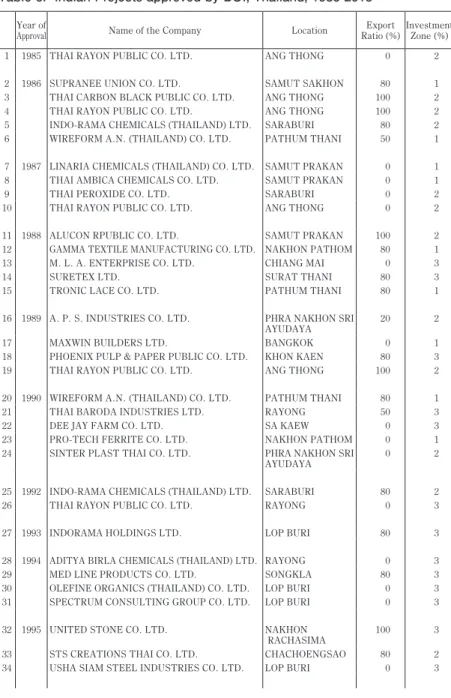
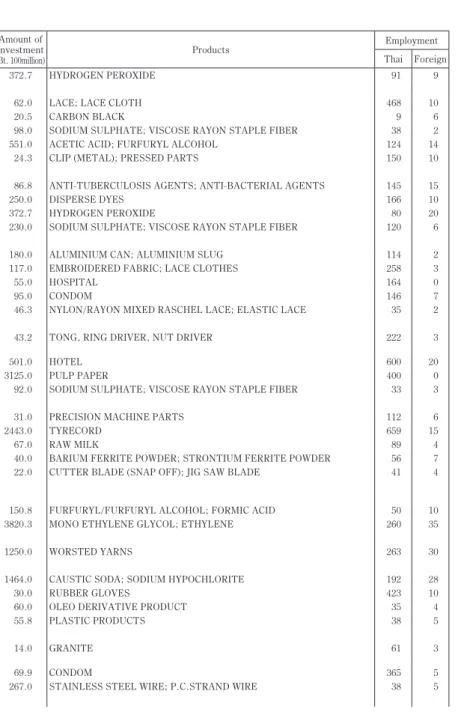
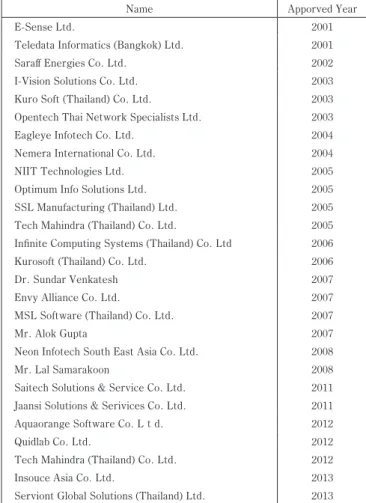
Table 6 shows the list of the Indian projects approved by BOI from 1985 to 2013. However, it doesn’t seem to cover whole approved projects up to 2004, because it doesn’t match the figures cited in Table 3. Since 2005, however, the list covers the whole approved projects.
According to Table 6, total number of approved projects is 241. Among them, there are 13 big projects whose investment each exceed Bt.1 billion:
(1) Pulp & paper project by Phoenix Pulp & Paper PCL (1989; Bt. 3,125 million), (2) Tire cord project by Thai Baroda Industries Ltd. (1990; Bt.
2,443 million), (3) Mono ethylene glycol and ethylene project by Thai Rayon PCL (1992; Bt. 3,820 million), (4) Worsted yarn project by Indorama Table 3 Indian Investment Projects approved by BOI: 2001-2013 (Million Baht)
2001 2002 2003 2004 2005 2006 2007 2008 2009 2010 2011 2012 2013 Total (2001-2013)
1. No. of Projects 12 5 11 19 16 18 23 21 17 13 15 25 17 212
2. Total Investment 1954.4 92.3 3519.3 1615.2 1105.9 2670.6 7398.3 9591.6 3680.2 1740.2 1693.0 6099.7 1620.8 42781.5 (%)
3. Total Registered Capital 431.7 23.5 1258.2 562.8 434.0 482.5 1056.1 2558.4 155.9 246.9 159.0 684.6 194.0 8247.6 100.0
-- Indian 379.1 14.1 1245.6 278.0 407.6 346.7 799.0 2363.3 101.2 201.7 134.0 341.7 160.9 6772.9 82.1
Note: "Indian Investment Projects" refer to projects with Indian capital of at least 10%.
Source: BOI, Thailand.
Table 5 Indian Investment Projects approved by BOI classified by Sector, 2001-2013 (Million Baht)
Sector Number % Amount %
Agricultural Products 25 11.8 5267.6 11.3
Minerals and Ceramics 9 4.2 6311.9 13.6
Light Industries/Textiles 46 21.7 3510.6 7.6
Metal Products and Machinery 21 9.9 12256.1 26.4
Electric and Electric Products 38 17.9 775.0 1.7
Chemicals and Paper 44 20.8 14240.6 30.7
Services 29 13.7 4093.9 8.7
Total 212 100.0 46455.7 100.0
Source: BOI, Thailand.
Table 6: Indian Projects approved by BOI, Thailand, 1985-2013
Year of
Approval Name of the Company Location Export
Ratio (%) Investment Zone (%)
Amount of Investment
(Bt. 100million) Products Employment
Thai Foreign
1 1985 THAI RAYON PUBLIC CO. LTD. ANG THONG 0 2 372.7 HYDROGEN PEROXIDE 91 9
2 1986 SUPRANEE UNION CO. LTD. SAMUT SAKHON 80 1 62.0 LACE; LACE CLOTH 468 10
3 THAI CARBON BLACK PUBLIC CO. LTD. ANG THONG 100 2 20.5 CARBON BLACK 9 6
4 THAI RAYON PUBLIC CO. LTD. ANG THONG 100 2 98.0 SODIUM SULPHATE; VISCOSE RAYON STAPLE FIBER 38 2
5 INDO-RAMA CHEMICALS (THAILAND) LTD. SARABURI 80 2 551.0 ACETIC ACID; FURFURYL ALCOHOL 124 14
6 WIREFORM A.N. (THAILAND) CO. LTD. PATHUM THANI 50 1 24.3 CLIP (METAL); PRESSED PARTS 150 10
7 1987 LINARIA CHEMICALS (THAILAND) CO. LTD. SAMUT PRAKAN 0 1 86.8 ANTI-TUBERCULOSIS AGENTS; ANTI-BACTERIAL AGENTS 145 15
8 THAI AMBICA CHEMICALS CO. LTD. SAMUT PRAKAN 0 1 250.0 DISPERSE DYES 166 10
9 THAI PEROXIDE CO. LTD. SARABURI 0 2 372.7 HYDROGEN PEROXIDE 80 20
10 THAI RAYON PUBLIC CO. LTD. ANG THONG 0 2 230.0 SODIUM SULPHATE; VISCOSE RAYON STAPLE FIBER 120 6
11 1988 ALUCON RPUBLIC CO. LTD. SAMUT PRAKAN 100 2 180.0 ALUMINIUM CAN; ALUMINIUM SLUG 114 2
12 GAMMA TEXTILE MANUFACTURING CO. LTD. NAKHON PATHOM 80 1 117.0 EMBROIDERED FABRIC; LACE CLOTHES 258 3
13 M. L. A. ENTERPRISE CO. LTD. CHIANG MAI 0 3 55.0 HOSPITAL 164 0
14 SURETEX LTD. SURAT THANI 80 3 95.0 CONDOM 146 7
15 TRONIC LACE CO. LTD. PATHUM THANI 80 1 46.3 NYLON/RAYON MIXED RASCHEL LACE; ELASTIC LACE 35 2
16 1989 A. P. S. INDUSTRIES CO. LTD. PHRA NAKHON SRI
AYUDAYA 20 2 43.2 TONG, RING DRIVER, NUT DRIVER 222 3
17 MAXWIN BUILDERS LTD. BANGKOK 0 1 501.0 HOTEL 600 20
18 PHOENIX PULP & PAPER PUBLIC CO. LTD. KHON KAEN 80 3 3125.0 PULP PAPER 400 0
19 THAI RAYON PUBLIC CO. LTD. ANG THONG 100 2 92.0 SODIUM SULPHATE; VISCOSE RAYON STAPLE FIBER 33 3
20 1990 WIREFORM A.N. (THAILAND) CO. LTD. PATHUM THANI 80 1 31.0 PRECISION MACHINE PARTS 112 6
21 THAI BARODA INDUSTRIES LTD. RAYONG 50 3 2443.0 TYRECORD 659 15
22 DEE JAY FARM CO. LTD. SA KAEW 0 3 67.0 RAW MILK 89 4
23 PRO-TECH FERRITE CO. LTD. NAKHON PATHOM 0 1 40.0 BARIUM FERRITE POWDER; STRONTIUM FERRITE POWDER 56 7
24 SINTER PLAST THAI CO. LTD. PHRA NAKHON SRI
AYUDAYA 0 2 22.0 CUTTER BLADE (SNAP OFF); JIG SAW BLADE 41 4
25 1992 INDO-RAMA CHEMICALS (THAILAND) LTD. SARABURI 80 2 150.8 FURFURYL/FURFURYL ALCOHOL; FORMIC ACID 50 10
26 THAI RAYON PUBLIC CO. LTD. RAYONG 0 3 3820.3 MONO ETHYLENE GLYCOL; ETHYLENE 260 35
27 1993 INDORAMA HOLDINGS LTD. LOP BURI 80 3 1250.0 WORSTED YARNS 263 30
28 1994 ADITYA BIRLA CHEMICALS (THAILAND) LTD. RAYONG 0 3 1464.0 CAUSTIC SODA; SODIUM HYPOCHLORITE 192 28
29 MED LINE PRODUCTS CO. LTD. SONGKLA 80 3 30.0 RUBBER GLOVES 423 10
30 OLEFINE ORGANICS (THAILAND) CO. LTD. LOP BURI 0 3 60.0 OLEO DERIVATIVE PRODUCT 35 4
31 SPECTRUM CONSULTING GROUP CO. LTD. LOP BURI 0 3 55.8 PLASTIC PRODUCTS 38 5
32 1995 UNITED STONE CO. LTD. NAKHON
RACHASIMA 100 3 14.0 GRANITE 61 3
33 STS CREATIONS THAI CO. LTD. CHACHOENGSAO 80 2 69.9 CONDOM 365 5
34 USHA SIAM STEEL INDUSTRIES CO. LTD. LOP BURI 0 3 267.0 STAINLESS STEEL WIRE; P.C.STRAND WIRE 38 5
Table 6: Indian Projects approved by BOI, Thailand, 1985-2013
Year of
Approval Name of the Company Location Export
Ratio (%)Investment Zone (%)
Amount of Investment
(Bt. 100million) Products Employment
Thai Foreign
1 1985 THAI RAYON PUBLIC CO. LTD. ANG THONG 0 2 372.7 HYDROGEN PEROXIDE 91 9
2 1986 SUPRANEE UNION CO. LTD. SAMUT SAKHON 80 1 62.0 LACE; LACE CLOTH 468 10
3 THAI CARBON BLACK PUBLIC CO. LTD. ANG THONG 100 2 20.5 CARBON BLACK 9 6
4 THAI RAYON PUBLIC CO. LTD. ANG THONG 100 2 98.0 SODIUM SULPHATE; VISCOSE RAYON STAPLE FIBER 38 2
5 INDO-RAMA CHEMICALS (THAILAND) LTD. SARABURI 80 2 551.0 ACETIC ACID; FURFURYL ALCOHOL 124 14
6 WIREFORM A.N. (THAILAND) CO. LTD. PATHUM THANI 50 1 24.3 CLIP (METAL); PRESSED PARTS 150 10
7 1987 LINARIA CHEMICALS (THAILAND) CO. LTD. SAMUT PRAKAN 0 1 86.8 ANTI-TUBERCULOSIS AGENTS; ANTI-BACTERIAL AGENTS 145 15
8 THAI AMBICA CHEMICALS CO. LTD. SAMUT PRAKAN 0 1 250.0 DISPERSE DYES 166 10
9 THAI PEROXIDE CO. LTD. SARABURI 0 2 372.7 HYDROGEN PEROXIDE 80 20
10 THAI RAYON PUBLIC CO. LTD. ANG THONG 0 2 230.0 SODIUM SULPHATE; VISCOSE RAYON STAPLE FIBER 120 6
11 1988 ALUCON RPUBLIC CO. LTD. SAMUT PRAKAN 100 2 180.0 ALUMINIUM CAN; ALUMINIUM SLUG 114 2
12 GAMMA TEXTILE MANUFACTURING CO. LTD. NAKHON PATHOM 80 1 117.0 EMBROIDERED FABRIC; LACE CLOTHES 258 3
13 M. L. A. ENTERPRISE CO. LTD. CHIANG MAI 0 3 55.0 HOSPITAL 164 0
14 SURETEX LTD. SURAT THANI 80 3 95.0 CONDOM 146 7
15 TRONIC LACE CO. LTD. PATHUM THANI 80 1 46.3 NYLON/RAYON MIXED RASCHEL LACE; ELASTIC LACE 35 2
16 1989 A. P. S. INDUSTRIES CO. LTD. PHRA NAKHON SRI
AYUDAYA 20 2 43.2 TONG, RING DRIVER, NUT DRIVER 222 3
17 MAXWIN BUILDERS LTD. BANGKOK 0 1 501.0 HOTEL 600 20
18 PHOENIX PULP & PAPER PUBLIC CO. LTD. KHON KAEN 80 3 3125.0 PULP PAPER 400 0
19 THAI RAYON PUBLIC CO. LTD. ANG THONG 100 2 92.0 SODIUM SULPHATE; VISCOSE RAYON STAPLE FIBER 33 3
20 1990 WIREFORM A.N. (THAILAND) CO. LTD. PATHUM THANI 80 1 31.0 PRECISION MACHINE PARTS 112 6
21 THAI BARODA INDUSTRIES LTD. RAYONG 50 3 2443.0 TYRECORD 659 15
22 DEE JAY FARM CO. LTD. SA KAEW 0 3 67.0 RAW MILK 89 4
23 PRO-TECH FERRITE CO. LTD. NAKHON PATHOM 0 1 40.0 BARIUM FERRITE POWDER; STRONTIUM FERRITE POWDER 56 7
24 SINTER PLAST THAI CO. LTD. PHRA NAKHON SRI
AYUDAYA 0 2 22.0 CUTTER BLADE (SNAP OFF); JIG SAW BLADE 41 4
25 1992 INDO-RAMA CHEMICALS (THAILAND) LTD. SARABURI 80 2 150.8 FURFURYL/FURFURYL ALCOHOL; FORMIC ACID 50 10
26 THAI RAYON PUBLIC CO. LTD. RAYONG 0 3 3820.3 MONO ETHYLENE GLYCOL; ETHYLENE 260 35
27 1993 INDORAMA HOLDINGS LTD. LOP BURI 80 3 1250.0 WORSTED YARNS 263 30
28 1994 ADITYA BIRLA CHEMICALS (THAILAND) LTD. RAYONG 0 3 1464.0 CAUSTIC SODA; SODIUM HYPOCHLORITE 192 28
29 MED LINE PRODUCTS CO. LTD. SONGKLA 80 3 30.0 RUBBER GLOVES 423 10
30 OLEFINE ORGANICS (THAILAND) CO. LTD. LOP BURI 0 3 60.0 OLEO DERIVATIVE PRODUCT 35 4
31 SPECTRUM CONSULTING GROUP CO. LTD. LOP BURI 0 3 55.8 PLASTIC PRODUCTS 38 5
32 1995 UNITED STONE CO. LTD. NAKHON
RACHASIMA 100 3 14.0 GRANITE 61 3
33 STS CREATIONS THAI CO. LTD. CHACHOENGSAO 80 2 69.9 CONDOM 365 5
34 USHA SIAM STEEL INDUSTRIES CO. LTD. LOP BURI 0 3 267.0 STAINLESS STEEL WIRE; P.C.STRAND WIRE 38 5
35 1996 SAFE GLOVE CO. LTD. SURAT THANI 100 3 20.2 NATURAL RUBBER/SYNTHETIC RUBBER GLOVES 300 5
36 1997 FEMINA LACE DYE WORKS CO. LTD. CHAINAT 0 3 51.9 FABRIC DYEING 31 9
37 STS GEMS THAI LTD. BANGKOK 80 1 24.0 JEWELRY ITEMS; CUTTING & POLISHING OF GEM STONES 50 8
38 PALMAX CO. LTD. LAMPHUN 100 3 24.7 COOKED FOODS; CANNED VEGETABLE/FRUIT 124 2
39 1998 INDO POLY (THAILAND) LTD. NAKHON PATHOM 30 1 2500.0 POLYESTER PRODUCTS; POLYESTER CHIPS 135 15
40 PETFORM (THAILAND) LTD. LOP BURI 0 3 185.0 PLASTIC CAP 82 6
41 WORLD BEDDING CO. LTD. PHETCHABURI 80 3 20.0 BED COVER 136 1
42 1999 ANAND RATHI ADVISORS (THAILAND) CO. LTD. BANGKOK 0 1 2.0 TRADE AND INVESTMENT SUPPORT 65 29
43 STS GEMS THAI LTD. BANGKOK 100 1 20.0 DRESSING ORNAMENT 193 7
44 STS GEMS THAI LTD. BANGKOK 100 1 76.7 JEWELRY; CUT/POLISHED PRECIOUS STONES 424 26
45 2000 ESSEM INTERNATIONAL CO. LTD. CHON BURI 100 3 25.0 BALL POINT TIPS 13 3
46 JACOB S JEWELRY CO. LTD. BANGKOK 100 1 67.0 ORNAMENT 287 5
47 ORIENT PEARL (BANGKOK) CO. LTD. BANGKOK 85 1 45.8 PEARLS; JEWELRY 94 6
48 REX ENTERPRISES CP. LTD. NAKHON PATHOM 95 1 44.3 FEEDING BOTTLES; PLASTIC PRODUCTS FOR KID 310 4
49 SAMUEL INFOTECH CO. LTD. SURAT THANI 95 3 100.0 RUBBER GLOVES/SYNTHETIC RUBBER GLOVES 161 5
50 YAMAKEN APPAREL LTD. SAMUT PRAKAN 100 1 54.7 GARMENT 257 7
51 2001 E-SENSE LTD. BANGKOK 50 1 6.4 SOFTWARE 47 5
52 PETFORM (THAILAND) LTD. LOP BURI 30 3 225.0 PLASTIC BOTTLE (PET) 88 8
53 POLYPLEX (THAILAND) PUBLIC CO. LTD. RAYONG 90 3 1320.0 POLYESTER FILM 140 35
54 SARAFF ENERGIES CO. LTD. LOP BURI 95 3 20.0 PLASTIC PRODUCTS 28 4
55 SUNFLAG (THAILAND) LTD. PHRA NAKHON SRI
AYUDAYA 50 2 250.0 BRIGHT POLYESTER PRODUCTS 85 15
56 TELEDATA INFORMATICS (BANGKOK) LTD. BANGKOK 10 1 4.5 SOFTWARE 21 6
57 THOUNG THAO SIAM CO. LTD. BURI RAM 10 3 9.8 SOCKS 59 1
58 2002 GENERAL SILVER & GOLD LTD. BANGKOK 100 1 10.0 JEWELRY 168 7
59 SARAFF ENERGIES CO. LTD. NONTHABURI 0 1 2.5 SOFTWARE 28 6
60 EXCELLENT THAI CUT LTD. BANGKOK 100 1 4.0 POLISHED DIAMOND 95 5
61 2003 ESSEM INTERNATIONAL CO. LTD. CHON BURI 100 2 33.3 BALL POINT TIPS 11 0
62 EXCELLENT THAI CUT LTD. BANGKOK 80 1 15.0 JEWELRY & PARTS 74 2
63 I-VISION SOLUTIONS CO. LTD. BANGKOK 0 1 2.0 SOFTWARE 16 0
64 KURO SOFT (THAILAND) CO. LTD. BANGKOK 0 1 6.0 SOFTWARE 26 5
65 OPENTECH THAI NETWORK SPECIALISTS LTD. BANGKOK 0 1 10.0 SOFTWARE 39 0
66 PETFORM (THAILAND) LTD. LOP BURI 20 3 70.0 PLASTIC CLOSURES 20 3
67 POLYPLEX (THAILAND) PUBLIC CO. LTD. RAYONG 80 2 1320.0 PET RESIN; POLYESTER FILM 95 25
68 2004 585 JEWELRY CO. LTD. BANGKOK 80 1 20.0 JEWELRY & PARTS 99 1
69 BEMA CO. LTD. NAKHON
RATCHASIMA 100 3 85.0 UNDERWEAR 1000 10
70 EAGLEYE INFOTECH CO. LTD. BANGKOK 0 1 3.0 SOFTWARE 32 0
71 NEMERA INTERNATIONAL CO. LTD. BANGKOK 0 1 23.0 SOFTWARE 104 0
72 PLUS LAB CO. LTD. BANGKOK 20 2 94.0 HIGH PRESSURE VESSEL 84 13
73 POLYPLEX (THAILAND) PUBLIC CO. LTD. RAYONG 80 2 100.0 METALLIZED FILM 14 2
74 ROSY BLUE DIAMOND CO. LTD. PHITSANULOK 100 3 25.8 CUT/POLISHED DIAMOND 350 3
75 SARAFF ENERGIES CO. LTD. KRABI 0 3 466.0 ELECTRIC POWER 39 0