博士学位論文(東京外国語大学)
Doctoral Thesis (Tokyo University of Foreign Studies)
氏 名 三浦 愛香 学位の種類 博士(学術)
学位記番号 博甲第263号 学位授与の日付 2019年2月12日 学位授与大学 東京外国語大学
博士学位論文題目 コーパス語用論:異なる習得段階にある日本人英語学習者による要求 の発話行為を弁別する基準特性の特定
Name Miura, Aika
Name of Degree Doctor of Philosophy (Humanities) Degree Number Ko-no. 263
Date February 12, 2019
Grantor Tokyo University of Foreign Studies, JAPAN Title of Doctoral
Thesis
Corpus Pragmatics: Exploring Criterial Pragmalinguistic Features of Requestive Speech Acts Produced by Japanese Learners of English at Different Proficiency Levels
Corpus Pragmatics: Exploring Criterial Pragmalinguistic Features of Requestive Speech Acts Produced by Japanese
Learners of English at Different Proficiency Levels
コーパス語用論:異なる習得段階にある日本人英語学習者による 要求の発話行為を弁別する基準特性の特定
Aika MIURA
Tokyo University of Foreign Studies 2018
東京外国語大学大学院
総合国際学研究科 博士後期課程 言語文化専攻
三 浦 愛 香
i
Acknowledgements
First and foremost I would like to express my sincere gratitude to my supervisor, Professor Yukio Tono, for his considerable encouragement, constant guidance and support, and invaluable advice and comments during the course of the study. I am also very grateful to the other members of my thesis committee, Professor Masashi Negishi, Professor Asako Yoshitomi, and Professor Hiroshi Sano at Tokyo University of Foreign Studies, as well as the external examiner, Professor Yoshiyuki Notohara at Doshisha University. I am deeply indebted to Dr. Mariko Nomura for checking and replicating annotations and giving me insightful comments in revising the annotation schemes.
Finally, I would like to thank my husband, Takashi Yamamoto, for his constant support and encouragement.
ii
Table of Contents
Acknowledgements ... i
Table of Contents ... ii
Abstract ... v
List of Tables ... viii
List of Figures ... xiv
List of Abbreviations ... xviii
Chapter 1. Introduction ... 1
1.1 Rationale and Objective of the Research ... 1
1.2 Organization of the Thesis ... 6
Chapter 2. Review of Literature... 12
2.1 Introduction ... 12
2.2 Speech Act Theory ... 16
2.3 Politeness Theory and Requests ... 25
2.4 The Cross-Cultural Speech Act Realization Project (CCSARP) ... 29
2.5 Pragmatics and Corpus Linguistics ... 47
2.6 Interlanguage Pragmatics (ILP) ... 67
Chapter 3. Previous Studies ... 94
3.1 Overview of a Series of Learner-Corpus-Based Pragmatic Studies Conducted by the Author ... 94
3.2 Data: The NICT JLE Corpus ... 96
3.3 Challenging “Form-to-Function” Analyses: Extraction of Predetermined Pragmatic Features ... 103
3.4 Analyses of Pragmatic Functions in Longer Stretches of Discourse: Extraction of Manually Annotated Requestive Speech Acts ... 109
Chapter 4. Current Research ... 145
4.1 Theoretical Background of the Current Study ... 145
4.2 Purpose of the Current Research ... 147
4.3 Limitations of the Current Study Based on the Series of Past Studies Conducted by the Author ... 148
4.4 Overview of the Annotation Structure of the Current Research ... 152
4.5 Rationale for Using Shopping Role-Play Interactions in the NICT JLE Corpus 153 4.6 Research Questions ... 155
Chapter 5. Method ... 158
iii
5.1 Target Subjects (i.e., Files) in the Current Study ... 158
5.2 Tags Originally Annotated in the NICT JLE Corpus ... 159
5.3 Annotation Tool: The UAM CorpusTool (UAMCT) ... 161
5.4 Annotation Schemes ... 166
5.5 Reliability of Annotations: How Annotation Schemes were Revised and Annotations were Refined ... 178
Chapter 6. Results and Discussion ... 191
6.1 Research Question 1: Exploring the Functions of the Utterances in Shopping Role Plays in the OPI... 191
6.2 Research Question 2: Assessing the Grammatical Accuracy/Discoursal Acceptability of Learners’ Utterances ... 209
6.3 Research Question 3: Examining the Pragmalinguistic Features and Strategies of Requests ... 222
Chapter 7. Conclusion ... 292
7.1 The Findings to Answer the Research Questions ... 292
7.2 Overall Discussion and Conclusion ... 305
7.3 Limitations of the Present Study ... 315
7.4 Implications for Future Studies on Interlanguage Pragmatics and Pedagogy .... 317
References ... 319
Appendices ... 340
Appendix A: Learner Data Investigated in the Study ... 340
Appendix B: Manuals of Annotation Scheme for Request ... 344
1. Requestive Head Act and Internal Modification ... 344
1.1 Direct Strategy ... 344
1.2 Conventionally Indirect Strategy ... 372
1.3 Not-Classifiable ... 389
1.4 Internal Modification ... 392
2. Supporting Segments ... 410
2.1 Continued/Continuing Utterance ... 410
2.2 Alert ... 411
2.3 Self-Corrected Head Act ... 412
2.4 Confirming ... 413
2.5 Responded Yes Please ... 415
3. Combined Repair Features ... 418
3.1 Repetition ... 418
3.2 Elaboration ... 420
3.3 Prompted Correction ... 421
iv
Appendix C: Manuals of Annotation Scheme for Function ... 422
1. The Test for Determining the Function ... 423
2. Examples of the Whole Interactions ... 429
3. Definitions and Examples of Each Function ... 437
3.1 Dealing with Transaction ... 437
3.2 Communication for Transaction... 456
Appendix D: Manuals of Annotation Scheme of Grammatical Accuracy/Discoursal Acceptability ... 480
1. High ... 480
1.1 Non-Topic Comment ... 480
1.2 Well-Formed Topic Comment ... 481
2. Low ... 482
2.1 Coherent ... 482
2.2 Slightly Incoherent ... 484
2.3 Incoherent... 487
2.4 Japanese ... 491
Appendix E: Replicability of Annotations ... 493
v Abstract
The current study aims to conduct a study on interlanguage pragmatics (ILP) with the use of a learner corpus, and attempts to prove how a learner-corpus-based study can contribute to the field of ILP. In order to fulfill the main objective, the author attempts to extract the criterial pragmalinguistic features of the requestive speech acts produced by Japanese learners of English at different proficiency levels (or the Common European Framework of Reference for Languages [CEFR] A1, A2, and B1 learners). The methodology of the study is to manually identify and annotate the linguistic patterns of requests in the shopping role-play tasks of the National Institute of Information and Communications Technology Japanese Learner English (NICT JLE) Corpus, drawing on the coding scheme developed in the Cross-Cultural Speech Act Realization Project (CCSARP) (Blum-Kulka, House & Kasper, 1989).
In ILP, collecting data via written elicitation tasks called Discourse Completion Tests/Tasks (DCTs) has been a predominant methodology to date. Although this methodology is advantageous in controlling social parameters involved with participants’ roles and situations in given tasks, it has been criticized for not providing data that represent learners’ actual speech act performance in real situations. Naturally occurring spoken data such as learner corpora, on the other hand, can provide a quantitative source in terms of clarifying the developmental transition of learners’
pragmatic competence and re-examining the findings derived from the past studies.
Applying some amendments to the CCSARP coding scheme to fit it into the target spoken learner data, the author classifies the identified requests into direct strategy, conventionally indirect strategy, and not-classifiable depending on the choice of linguistic features; for example, desire (e.g., want) is classified as direct, and ability/permission
vi (e.g., can) is classified as conventionally indirect.
However, the author confronts various challenges of merging a corpus-based study with ILP, in terms of mapping the forms and functions of the requests, especially produced by lower-level learners who tend to manifest underdeveloped speech acts. The present study adopts the following resolutions to tackle these challenges: first, to exclude the identification of non-conventionally indirect requests, which do not exhibit the requestive realizations in surface forms; second, to exclude the assessment of the learners’
sociopragmatic competence, regarding the appropriateness and politeness of their requests; third, to add a newly developed annotation scheme to identify the functions of the requests in order to overcome the task effects among learners at different proficiency levels; and finally, to add a newly developed annotation scheme to determine the degree of the grammatical accuracy/discoursal acceptability of the requests in order to highlight the differences in performance among learners at different proficiency levels.
The current study confirms that the finding that the ratio of conventionally indirect strategies increases and that of direct strategy decreases as the proficiency improves is correspondent with those of non-corpus-based studies conducted by researchers such as Trosborg (1995), Hill (1997), Rose (2000, 2009), and Flores Salgado (2011), who also adopted the CCSARP coding scheme for their classifications. In fact, the distributions of each linguistic pattern determining the requestive strategy are varied across the functions of the requests even within the same proficiency level. For example, A1 and A2 learners tend to produce more conventionally indirect strategies, especially exhibiting ability/permission to ask for permission to test items, when formulaic expressions are available at their disposal, as in “Can I try it on?” The examination of request data from the NICT JLE Corpus allows the author to extract criterial or characteristic pragmalinguistic features that contribute to not only a re-examination of
vii
past studies but also a distinction and determination of the pragmalinguistic competence of learners at different proficiency levels, profiling what the learners can actually do pragmatically at each level.
viii List of Tables
Page Chapter 2
Table 2.1 A typology of speech acts made by Austin (1962) and Searle (1976) --- 20
Table 2.2 Sentence type and speech act examples: correspondent and mismatching (Adapted from Culpeper and Haugh, 2014, p. 168) --- 22
Table 2.3 Request situations, social distance, and dominance in the DCT (Adapted from Blum-Kulka et al., 1989, pp. 14-15) --- 35
Table 2.4 Alerter and Head Act --- 37
Table 2.5 Head Act and Supportive Move--- 37
Table 2.6 Types of request strategies, prototypical forms, and examples --- 38
Table 2.7 Five stages of requests based on the longitudinal studies (Kasper and Rose, 2002, p. 140 [based on Achiba (2003) and Ellis (1992)]) --- 79
Chapter 3 Table 3.1 The whole distribution of subjects, types, and tokens for each level in the NICT JLE Corpus --- 99
Table 3.2 A list of the author’s previous studies on surface-form extractions of pragmatic features from the NICT JLE Corpus --- 104
Table 3.3 A list of the author’s previous studies regarding requestive speech acts in the NICT JLE Corpus --- 110
Table 3.4 An arbitrary classification of linguistic patterns of requestive speech acts according to the degree of politeness --- 132
Table 3.5 Ten responses for Situation (1): Negotiating for exchange or return (Taken from Miura, 2017) --- 138
Table 3.6 Ten responses for Situation (2): Asking for permission to test an item (Taken from Miura, 2017) --- 139
Table 3.7 Ten responses for Situation (3): Expressing their intention to buy a particular item (Taken from Miura, 2017) --- 139
Table 3.8 Kendall’s coefficient of concordance, W, for three situations (Taken from Miura, 2017) --- 140
Table 3.9 Distribution of linguistic features of requests in negotiating for exchange or return (Taken from Miura, 2017) --- 143
ix Chapter 4
Table 4.1 Comparison between traditional pragmatics and corpus pragmatics, and DCTs and learner corpora --- 147
Chapter 5
Table 5.1 Statistical information of each proficiency level --- 158 Table 5.2 Tags representing utterance phenomena --- 159 Table 5.3 Problems with dialogue segmentation into utterances (Taken from Geertzen et al., 2007, p. 141) --- 167 Table 5.4 Stages of the revisions of annotation schemes and the refinement of
annotations by the annotation checker --- 178 Table 5.5 Checked and corrected annotated segments for Request --- 180 Table 5.6 Checked and corrected annotated segments for Function --- 181 Table 5.7 Agreement rates for the Request annotations between the author and
checker --- 183 Table 5.8 Agreement rates for the Function annotations between the author
and checker --- 184 Table 5.9 Agreement rates for the Grammatical accuracy/discoursal acceptability
annotations between the author and checker --- 185
Chapter 6
Table 6.1 Total numbers and ratios of the main and supporting segments --- 192 Table 6.2 Total numbers and ratios of the subcategories of expressing or asking about item --- 196 Table 6.3 Total numbers and ratios of the subcategories of features --- 197 Table 6.4 Statistical descriptions of the segments of features in each file
(i.e., learner) --- 197 Table 6.5 Total numbers and ratios of the subcategories of quality --- 198 Table 6.6 Total numbers and ratios of the categories of communication for
transaction --- 200 Table 6.7 Examples of offering --- 203 Table 6.8 Total numbers and ratios of the subcategories of requesting an action --- 205 Table 6.9 Total numbers and ratios of the subcategories of expressing --- 207 Table 6.10 Examples of positive and negative opinions --- 208 Table 6.11 Total numbers and ratios of the high segments and subcategories of low
segments --- 211
x
Table 6.12 Total numbers and ratios of the main and high segments with frequent
functions --- 213
Table 6.13 Examples of well-formed topic-comment structure in the high category --- 215
Table 6.14 Examples of coherent segments with a topic-comment structure in the low category --- 216
Table 6.15 Examples of slightly incoherent segments with a topic-comment structure with structurally lexical problems --- 217
Table 6.16 Total numbers and ratios of the subcategories of slightly incoherent segments --- 219
Table 6.17 Total numbers and ratios of the subcategories of incoherent segments --- 219
Table 6.18 Examples of structurally, lexically, and semantically unacceptable incoherent segments --- 220
Table 6.19 Examples of structurally, lexically, and semantically acceptable incoherent segments --- 221
Table 6.20 Total numbers and ratios of the segments of main, supporting, and combined repair feature in the Request scheme --- 224
Table 6.21 Total numbers and ratios of the head acts and internal modification of requests --- 224
Table 6.22 Total numbers and ratios of the subcategories of direct and conventionally indirect strategies --- 227
Table 6.23 Total numbers and ratios of the linguistic patterns of the most frequent subcategories of direct strategies --- 229
Table 6.24 Examples of declarative in the statement category --- 230
Table 6.25 Examples of interrogative in the statement category --- 230
Table 6.26 Total numbers and ratios of the linguistic patterns of the most frequent subcategories of conventionally indirect strategies --- 232
Table 6.27 Examples of existence --- 233
Table 6.28 Examples of intention --- 234
Table 6.29 Examples of willingness, subjectivizer, possibility, and suggestory --- 236
Table 6.30 Total numbers and ratios of the categories of internal modification --- 239
Table 6.31 Examples of interpersonal marker, just, DM subjectivizer, downtoner, hedge, and upgrader --- 244
Table 6.32 Total numbers and ratios of elaboration, repetition, and prompted correction --- 246
Table 6.33 Examples of elaboration --- 248
Table 6.34 Examples of repetition --- 249
xi
Table 6.35 Total numbers and ratios of continued/continuing utterance, self-corrected head act, responded yes please, confirming, and alert --- 251 Table 6.36 Examples of self-corrected head act --- 252 Table 6.37 Patterns of self-corrected head acts: A shift from I want to other linguistic
patterns --- 253 Table 6.38 Retrieved total numbers and ratios of the linguistic patterns of head acts with the function of expressing or asking about item (i.e., item) --- 256 Table 6.39 Total numbers, ratios, and examples of the subcategories of existence --- 257 Table 6.40 Total numbers and ratios of the linguistic patterns of head acts with the
function of expressing intention to buy (i.e., intention-buy) --- 258 Table 6.41 Total numbers, ratios, and examples of statement, wish, intention, and
existence --- 259 Table 6.42 Total numbers and ratios of the linguistic patterns of head acts with the
function of expressing or asking about payment --- 261 Table 6.43 Retrieved total numbers and ratios of the linguistic patterns of head acts with the function of negotiating for exchange or return --- 265 Table 6.44 Examples of head acts with the function of negotiating for exchange or
return --- 265 Table 6.45 Retrieved total numbers and ratios of the linguistic patterns of head acts with the function of asking permission to perform --- 267 Table 6.46 Retrieved total numbers and ratios of the linguistic patterns of head acts with
the functions of asking someone to show, asking for permission to test, negotiating for discount, and asking for recommendation --- 270 Table 6.47 Retrieved total numbers and ratios of the high segments and the
subcategories of low segments in the requestive head acts --- 272 Table 6.48 Retrieved total numbers and ratios of the high segments and the
subcategories of low segments in the requestive head acts with the function of item --- 275 Table 6.49 Retrieved total numbers and ratios of the high segments and the
subcategories of low segments in the requestive head acts with the function of intention-buy --- 276 Table 6.50 Retrieved total numbers and ratios of the high segments and the
subcategories of low segments in the requestive head acts with the function of negotiating for exchange or return --- 278 Table 6.51 Retrieved total numbers and ratios of A1 and A2 learners’ high segments
and subcategories of low segments in the requestive head acts with the function of requesting an action --- 280
xii
Table 6.52 Retrieved total numbers and ratios of B1 learners’ high segments and subcategories of low segments in the requestive head acts with the function of requesting an action --- 281
Chapter 7
Table 7.1 Interactional features characterizing a developmental transition from A1 to A2 learners --- 300
Appendices
Appendix C: Manuals of Annotation Scheme for Function
Table C-1 Example 1: A1(Beginner)/learner404.txt --- 430 Table C-2 Example 2: A1(Intermediate)/learner406.txt --- 432 Table C-3 Example 3: B1/file00035.txt --- 435
Appendix E: Manuals of Annotation Scheme for Function
Table E-1 Files replicated by the checker for the Request annotation
scheme --- 493 Table E-1.1 The number of segments annotated and the annotation agreement rate
between the author and checker for Trial 1 of the Request
annotations --- 493 Table E-1.1.1 Segments differently annotated by the author and checker for
file00404.txt (A1) in Trial 1 of the Request annotations --- 494 Table E-1.1.2 Segments differently annotated by the author and checker for
learner1012.txt (A2) in Trial 1 of the Request annotations --- 494 Table E-1.2 The number of segments annotated and the annotation agreement rate
between the author and checker for Trial 2 of the Request
annotations --- 495 Table E-1.2.1 Segments annotated by the author and checker for learner1129.txt (A1) in Trial 2 of the Request annotations --- 495 Table E-2 Files replicated by the checker for the Function and Grammatical
accuracy/discoursal acceptability annotations --- 496 Table E-2.1 The number of segments annotated and the annotation agreement rate
between the author and checker for Trial 1 of the Function
annotations --- 496 Table E-2.1.1 Segments differently annotated by the author and checker for
file00404.txt (A1) in Trial 1 of the Function annotations --- 497 Table E-2.1.2 Segments differently annotated by the author and checker for
xiii
learner1012.txt (A2) in Trial 1 of the Function annotations --- 498 Table E-2.1.3 Segments differently annotated by the author and checker for
learner989.txt (B1) in Trial 1 of the Function annotations --- 499 Table E-2.2 The number of segments annotated and the annotation agreement rate
between the author and checker for Trial 2 of the Function
annotations --- 499 Table E-2.2.1 Segments differently annotated by the author and checker for
learner1129.txt (A1) in Trial 2 of the Function annotations --- 500 Table E-2.2.2 Segments differently annotated by the author and checker for
learner1084.txt (A2) in Trial 2 of the Function annotations --- 501 Table E-2.2.3 Segments differently annotated by the author and checker for
file00057.txt (B1) in Trial 2 of the Function annotations --- 502 Table E-3.1 The number of segments annotated and the annotation agreement rate
between the author and checker for Trial 1 of the Grammatical
accuracy/discoursal acceptability annotations --- 502 Table E-3.1.1 Segments differently annotated by the author and checker for
file00404.txt (A1) in Trial 1 of the Grammatical accuracy/discoursal acceptability annotations --- 503 Table E-3.1.2 Segments differently annotated by the author and checker for
learner521.txt (B1) in Trial 1 of the Grammatical accuracy/discoursal acceptability annotations --- 504 Table E-3.2 The number of segments annotated and the annotation agreement rate
between the author and checker for Trial 2 of the Grammatical
accuracy/discoursal acceptability annotations --- 505 Table E-3.2.1 Segments differently annotated by the author and checker for
learner1084.txt (A2) in Trial 2 of the Grammatical accuracy/discoursal acceptability annotations --- 506 Table E-3.2.2 Segments differently annotated by the author and checker for
file00057.txt (B1) in Trial 2 of the Grammatical accuracy/discoursal acceptability annotations --- 507
xiv List of Figures
Page Chapter 2
Figure 2.1 Brown and Levinson’s strategies for avoiding a face-threatening act (Taken from Brown and Levinson, 1987, p. 60) --- 27 Figure 2.2 The horizontal-reading methodology in pragmatics (P) (Taken from
Rühlemann and Aijmer, 2015, p. 3) --- 50 Figure 2.3 The vertical-reading methodology in corpus linguistics (CL)
(Taken from Rühlemann and Aijmer, 2015, p. 8) --- 50 Figure 2.4 The integrated-reading methodology in corpus pragmatics (CP) (Taken from Rühlemann and Aijmer, 2015, p. 12) --- 52
Chapter 3
Figure 3.1 The CEFR illustrative scale for “obtaining goods and services” (Taken from the Council of Europe, 2017, p. 87) --- 103 Figure 3.2 An excerpt from “file00001” with annotations of request strategies
(Taken from Miura & Sano, 2014, p. 18) --- 114 Figure 3.3 The annotation scheme for naturalness (Taken from Miura,
2015c) --- 127 Figure 3.4 An excerpt from “file00404” (A1 learner given a Beginner task) as an
example of coherent --- 127 Figure 3.5 An excerpt from “file00454” (A1 learner given an Intermediate task)
as an example of incoherent and intelligible (Taken from Miura, 2015c) --- 128 Figure 3.6 An excerpt from “file00451” (A1 learner given an Intermediate task)
as an example of incoherent and unintelligible (Taken from Miura, 2015c) --- 128 Figure 3.7 An excerpt from “file00404” (A1 learner given a Beginner task) as an
example of slightly ill-formed unnatural topic comment (Taken from Miura, 2015c) --- 129 Figure 3.8 An excerpt from “file01129” (A1 learner given Intermediate task) as an example of ill-formed unnatural topic comment (Taken from Miura, 2015c) --- 129 Figure 3.9 The distribution of the linguistic patterns of requests according to the
degree of politeness (Taken from Miura, 2015b) --- 133 Figure 3.10 Prompt for Situation (1) (Taken verbatim from Miura, 2017) --- 137
xv
Figure 3.11 Prompt for Situations (2) and (3) (Taken from Miura, 2017) --- 137
Chapter 4 Figure 4.1 Framework of the series of the previous research on learners’ requests --- 149
Figure 4.2 Multi-layered annotation schemes to extract learners’ requestive speech acts from the NICT JLE Corpus --- 153
Chapter 5 Figure 5.1 Tags representing speaker turns --- 161
Figure 5.2 Start window of the UAMCT --- 162
Figure 5.3 Constructing a layer (i.e., annotation scheme) --- 162
Figure 5.4 Selecting automatic or manual annotation --- 163
Figure 5.5 Determining the domain of annotations --- 163
Figure 5.6 Annotating the level of proficiency --- 163
Figure 5.7 Annotating a requestive head act --- 164
Figure 5.8 Statistical results retrieved from the UAMCT --- 165
Figure 5.9 Concordance lines of features of desire within the B1 level --- 165
Figure 5.10 The annotation scheme for the requests showing higher levels --- 170
Figure 5.11 The annotation scheme for requests --- 171
Figure 5.12 The annotation scheme for direct strategy--- 171
Figure 5.13 The annotation scheme for conventionally indirect strategy --- 172
Figure 5.14 The annotation scheme for functions --- 174
Figure 5.15 The annotation scheme for grammatical accuracy/discoursal acceptability --- 177
Chapter 6 Figure 6.1 The ratio of segments of dealing with transaction and communication for transaction ---193
Figure 6.2 Category of dealing with transaction --- 194
Figure 6.3 The ratio of segments in dealing with transaction ---194
Figure 6.4 Category of communication for transaction ---199
Figure 6.5 Category of grammatical accuracy/discoursal acceptability --- 210
Figure 6.6 The ratio of main segments of high and low ---210
Figure 6.7 The ratio of segments with a topic-comment structure --- 214
Figure 6.8 Category of request --- 223
Figure 6.9 Ratios of request strategies --- 226
xvi
Figure 6.10 Ratios of internal modification --- 240
Figure 6.11 Ratios of the request strategies of head acts with the function of requesting an action--- 263
Appendices Appendix B: Manuals of Annotation Scheme for Request Figure B-1.1 The overall annotation scheme for direct strategy --- 344
Figure B-1.2 Category of obligation --- 345
Figure B-1.3 Category of non-sentential phrase --- 347
Figure B-1.4 Category of desire --- 349
Figure B-1.5 Category of wish --- 358
Figure B-1.6 Category of imperative --- 362
Figure B-1.7 Category of statement --- 364
Figure B-2.1 The overall annotation scheme for conventionally indirect strategy --- 372
Figure B-2.2 Category of ability/permission --- 373
Figure B-2.3 Category of willingness --- 377
Figure B-3.1 The overall annotation scheme for internal modification --- 392
Figure B-3.2 Category of discourse markers --- 394
Figure B-4.1 The annotation scheme for supporting segments --- 410
Figure B-5.1 The annotation scheme for combined repair features --- 418
Appendix C: Manuals of Annotation Scheme for Function Figure C-1.1 The overall annotation scheme for function --- 422
Figure C-2.1 The process of classifying Example (a) --- 423
Figure C-2.2 The annotation procedure of classifying Example (a) --- 423
Figure C-3.1 The process of classifying Example (b) --- 425
Figure C-3.2 The annotation procedure of classifying Example (b) --- 426
Figure C-4.1 The process of classifying Example (c) --- 427
Figure C-4.2 The annotation procedure of classifying Example (c) --- 427
Figure C-5.1 The process of classifying Example (d) --- 428
Figure C-5.2 The annotation procedure of classifying Example (d) --- 429
Figure C-6.1 Category of dealing with transaction --- 437
Figure C-6.2 Category of expressing intention to buy --- 437
Figure C-6.3 Category of expressing or asking about item --- 440
Figure C-7.1 Category of communication for transaction --- 456
Figure C-7.2 Category of requesting an action --- 457
xvii
Figure C-7.3 Category of expressing --- 465
Appendix D: Manuals of Annotation Scheme of Grammatical Accuracy and Discoursal Acceptability Figure D-1 The annotation scheme for grammatical accuracy/discoursal acceptability --- 480
Figure D-2.1 Category of high segments --- 480
Figure D-2.2 Category of low segments --- 482
Figure D-3 Category of coherent segments --- 482
Figure D-4 Category of slightly incoherent segments --- 484
Figure D-5 Category of incoherent segments --- 487
xviii
List of Abbreviations
Abbreviation Meaning
ACTFL American Council on the Teaching of Foreign Languages
BNC British National Corpus
CANCODE Cambridge and Nottingham Corpus of Discourse in English CCSARP Cross-Cultural Speech Act Realization Project
CEFR Common European Framework of Reference for Languages CEFR-J CEFR-Based Framework for English Language Teaching
(ELT) in Japan
CLC Cambridge Learner Corpus
COPT cartoon oral production task
COREC Corpus Oral de Referencia de Español en Contacto DAMSL Dialogue Act Markup in Several Layers
DART Dialogue Annotation and Research Tool DCT discourse completion test or task
EFL English as foreign language
ELT English language teaching
EPP English Profile Programme
ESOL English for speakers of other languages HKCSE Hong Kong Corpus of Spoken English
IELTS International English Language Testing System IFID illocutionary force indicating devices
ICE-GB British component of the International Corpus of English
ILP interlanguage pragmatics
ITAs internal teaching assistants
LLC London-Lund Corpus of Spoken English
MC multiple questionnaires
MICASE Michigan Corpus of Academic Spoken English
NICT JLE National Institute of Information and Communications Technology Japanese Learner English
NLP Natural Language Processing
OPI oral proficiency interview
OPIC Oral Proficiency Interview by Computer
POS part-of-speech
PROBE Pragmatics of Business English
xix
SLA second language acquisition
SPAAC Speech-Act Annotated Corpus for Dialogue Systems
SST Standard Speaking Test
TOEFL Test of English as a Foreign Language
T2K-SWAL TOEFL 2000 Spoken and Written Academic Language Corpus TELC The European Language Certificates
UAMCT UAM CorpusTool
1
Chapter 1. Introduction
This chapter describes the rationale and objective of the current interlanguage pragmatics (ILP) research, which aims to examine requestive speech acts produced by Japanese learners of English at different proficiency levels using a spoken learner corpus.
The chapter begins by introducing the theoretical background of ILP with focus on speech act theory and the Cross-Cultural Speech Act Realization Project (CCSARP). It provides an overview of the methodology adopted in this research, which includes modifying the CCSARP and creating multi-layered annotation schemes to extract the criterial pragmalinguistic features of learners at different proficiency levels. The second half of the chapter outlines the thesis. Chapter 2 reviews the literature and Chapter 3 presents the preliminary studies on learner-corpus-based pragmatics. Chapter 4 introduces a series of research questions that are based on the extant literature and the author’s preliminary studies. Chapter 5 describes the methods used in this study. Chapter 6 presents the results and discussion. Chapter 7 provides concluding remarks.
1.1 Rationale and Objective of the Research
The present study aims to explore the criterial pragmalinguistic features of the requestive speech acts produced by Japanese learners of English at different proficiency levels. The author investigates the shopping role plays in the National Institute of Information and Communications Technology Japanese Learner English (NICT JLE) Corpus, comparing the learner data across the Common European Framework of Reference for Languages (CEFR) A1, A2, and B1 levels.
Speech act theory, which was founded by Austin (1962) and Searle (1969;
1976), has been applied to the examination of English as a Foreign Language (EFL)
2
learners’ acquisition and development of pragmatic competence in an extensive body of researches on interlanguage pragmatics (ILP). Based on the classical speech act theory, the pioneering work, or the Cross-Cultural Speech Act Realization Project (CCSARP), was conducted by Blum-Kulka, House, and Kasper (1989). This work articulated the differences between the choices of linguistic patterns realized in terms of the conventionality of requestive speech acts among speakers of different languages and dialects, as well as the differences between native speakers and non-native speakers. Their coding scheme drawing upon the analyses of large-scale data collected via Discourse Completion Tests (DCTs) has been extensively adopted in ILP to date, and the current study is not an exception.
The present study should be notable for applying the CCSARP scheme to the investigation of learner corpora. Although Archer, Culpeper, and Davies (2008) noted the possibility of using the CCSARP coding scheme to conduct manual annotations of the corpus, there has been a relatively small number of researches involved with corpus-based ILP. One study among this small number is that of Kaneko (2004), who investigated 76 learners at lower and higher intermediate proficiency levels from the NICT JLE Corpus.
In contrast, the present study intends to clarify the overall picture of the requestive speech acts produced by 68 A1 learners, 114 A2 learners, and 66 B1 learners in the same corpus, with full manual annotations.
The author employs a methodology of incorporating the identification of the functions and the grammatical accuracy/discoursal acceptability of all utterances into the analyses of requestive speech acts. The reason for this is that the adoption of the CCSARP coding scheme without any amendments does not perfectly fit into the target learner data in the current study. The background is as follows. Primarily, the CCSARP coding scheme is nothing more than the outcome of the systematic pragmalinguistic classification of the
3
large-scale data of requestive speech acts that were collected from strictly controlled written elicitation tasks, or DCTs. In order to achieve their goal “to establish patterns of request […] realizations under different social constraints across a number of languages and cultures” (Blum-Kulka et al., 1989, p. 12), they implemented their experimental designs by controlling sociopragmatic variation, cross-cultural variation, and interlanguage variation; their DCTs contained eight request situations with varying degrees of social distance and dominance between the speaker and hearer. Thus, the project researchers compared patterns in the requestive realizations of “native and nonnative varieties” (Blum-Kulka et al., 1989, p. 12), but did not investigate and compare the developmental features exhibited by the learners at different proficiency levels from low to high.
In the target data of the current study, which are composed of role-play tasks of the interview test called the Standard Speaking Test (SST), the learners (or test-takers) are required to voluntarily and autonomously participate in the shopping role play as customers, probably with limited intervention by the interlocutors unless the learners do not provide sufficiently ratable utterances. Therefore, the functions of the requestive speech acts become more varied than those of the written products elicited in the CCSARP.
In fact, in the SST, B1 learners are given a negotiation task, while A1 and A2 learners are given a general purchasing task, which may contribute to the creation of requests with different functions depending on each task. This would also lead to the learners’ different choices of linguistic patterns in their requests. Therefore, in the later chapters, the author outlines how multi-layered annotation schemes were constructed in the present study, for example, how the CCSARP was revised and how additional annotation schemes were newly developed in order to extract the pragmalinguistic features of the requests produced by learners at different proficiency levels.
4
Granger (2002) pointed out the advantage of learner corpora since larger amounts of quantitative data on naturally occurring language can provide more generalizable conclusions and help researchers avoid introspective insights, in comparison with experimentally controlled research methods such as the DCTs. For example, based on her research, which was a part of the CCSARP, Blum-Kulka (1991) arrived at a conclusion by distinguishing three stages of the pragmalinguistic and sociopragmatic development of learners; however, her description of the stages seems rather introspective without the support of any quantitative data. Therefore, the present study can play the role of re-examining the intuitive aspects of past studies by providing evidence from a learner corpus reflecting what learners actually said in real (or quasi- natural) situations. Re-examining classical pragmatic theories is an important role of corpus-based pragmatic studies, as Adolphs (2008), Clancy and O’Keeffe (2015), Vyatkina and Cunningham (2015), and De Felice, Darby, Fischer, and Peplow (2013) noted. The rationale for extracting the criterial pragmalinguistic features of the requests produced by learners at different proficiency levels is to prove that learner corpora can actually contribute to ILP in a significant way. Pragmatics is concerned with the speakers’
intended meaning that sometimes cannot be realized in surface linguistic forms, while corpus linguists can retrieve the linguistic patterns that are only realized as surface forms.
Bearing this in mind, the author attempts to show what can or cannot be done to clarify the pragmatic competence of EFL learners by resorting to the learner data provided by corpora.
To explore the criterial pragmalinguistic features of requests, the present study draws on the concept of criteriality (Hawkins & Filipović, 2012, p. xiii). The concept of the criteriality of retrieved linguistic features plays a crucial role in proving how learner corpora can provide supplementary evidence to support the introspective
5
insights of researchers in the past. According to Hawkins and Filipović (2012), criterial features are “properties of learner English that are characteristic and indicative of L2 proficiency at each of the levels and that distinguish higher levels from lower levels” (p.
11). They further distinguished the criterial features that are “transitional” from those that are not (p. 16, 20). “Transitional features” can be found at “the first level at which it is attested and becomes criterial” (p. 20); for example, if the criterial features appearing at the B1 level persist through the B2 and C1 levels, the properties found at the B1 level are considered to be transitional ones. Additionally, if the criterial features are only unique to a particular level, they are also treated as transitional ones. Hawkins and Filipović (2012) also referred to “positive criterial features” (p. 20) and “negative criterial features” (p.
25). “Positive criterial features” are “the correct linguistic properties of English that have been acquired at a certain L2 level and that generally persist all higher levels” (p. 20), while “negative criterial features” refer to “incorrect properties or errors that occur at a certain level or levels and with a characteristic frequency” (p. 25). It should be noted that Hawkins and Filipović (2012) defined criterial features in terms of “their characteristic frequency” (p. 25), as well as the presence or absence of errors in the features, the proficiency level at which the features appear, or whether the features persist through to the higher levels. They intended to “specify the reference levels in the CEFR for English”
(p. xiii) in a project called the English Profile Programme (EPP). Their intention included identifying “a set of linguistic features that will add the necessary specification to CEFR’s functional descriptors for each of the levels” (p. 6). To fulfill their aim, they investigated the Cambridge Learner Corpus (CLC) to extract the criterial features that “can be used as diagnostics of proficiency at the individual learner level” (p. xiii) so that examiners can
“make their practical assessments” (p. 6) with more “improved diagnosis and validation in examining” (p. 16) such as in the Cambridge English for Speakers of Other Languages
6
(ESOL) examinations, of which the CLC consists. The results of their investigation are also beneficial for practitioners, theoreticians, and even examinees or learners, as they offer insight into “the kinds of functions that the CEFR defines” (pp. 15-16).
1.2 Organization of the Thesis
The present thesis consists of seven chapters, along with the appendices, which contain the definitions, descriptions, and examples of the coding schemes developed by the author. The current section briefly outlines the contents from Chapter 2 to Chapter 7.
Chapter 2 reviews the literature regarding the speech act theory in pragmatics, the CCSARP, corpus pragmatics, and ILP. As summarized in section 2.1, the theoretical background of the speech act theory, founded by Austin (1962) and Searle (1976), is described. Basic pragmatic notions such as the illocutionary force indicating devices (IFIDs) of speech acts and the indirectness or conventionality of requests are also described. The issue of politeness is also discussed in terms of requestive speech acts.
Then, the pioneering project called the CCSARP is described, referring to the findings derived from the major studies on requestive speech acts conducted in the project. A discussion of a series of recent criticism of the CCSARP follows. The chapter goes on to review how corpora have been applied to pragmatic studies, addressing the pros and cons of each field; one of the main issues of merging corpus linguistics and pragmatics is the treatment of the mismatch between forms and functions. Further, several recent corpus pragmatic studies, especially concerning the issue of annotations, are reviewed.
Following that, the history of ILP, which is the main focus of the current study, is described by reviewing various research methodologies including a classical data
7
collection method, the DCTs. Finally, past studies on the requests produced by learners at different proficiency levels based on the CCSARP are described. Their findings of requestive realizations are compared in terms of the choices of requestive strategies such as direct and conventionally indirect strategies, in addition to linguistic features modifying the requests such as internal and external modifiers.
Chapter 3 reviews a series of learner-corpus-based pragmatic studies conducted by the author, which are the preliminary studies to the present doctoral study.
Section 3.1 first describes the method of analyzing the NICT JLE Corpus, explaining the structure and contents of the SST, of which the NICT JLE Corpus is composed, and the alignment of the SST with the CEFR levels by referring to the past studies discussed by the author. Next, how the author attempted to change the research methodologies of corpus interlanguage pragmatic studies to tackle the various obstacles confronted is outlined. The first approach discussed is the form-to-function analysis, extracting predetermined pragmatic features such as the discourse markers of I mean and I like.
Since the author encountered difficulties in matching the forms and functions of these markers retrieved from the NICT JLE Corpus, as most of them are usually multifunctional, the author changed her approach to the function-to-form analysis. The pragmalinguistic features of requestive speech acts were manually identified and annotated in the learner data, following the CCSARP coding scheme. However, this category-based approach also proved to implicate various limitations; for example, the CCSARP coding scheme does not perfectly fit into semi-naturally occurring spoken data, which exhibit interactional features such as repetitions, repairs, and interruptions by the interlocutors, and learner data, which contain a great deal of learner-specific features including errors, incomplete sentences, confirmations of the interlocutors’ utterances, and sentence structures influenced by the learners’ first language. Therefore, the author added newly developed
8
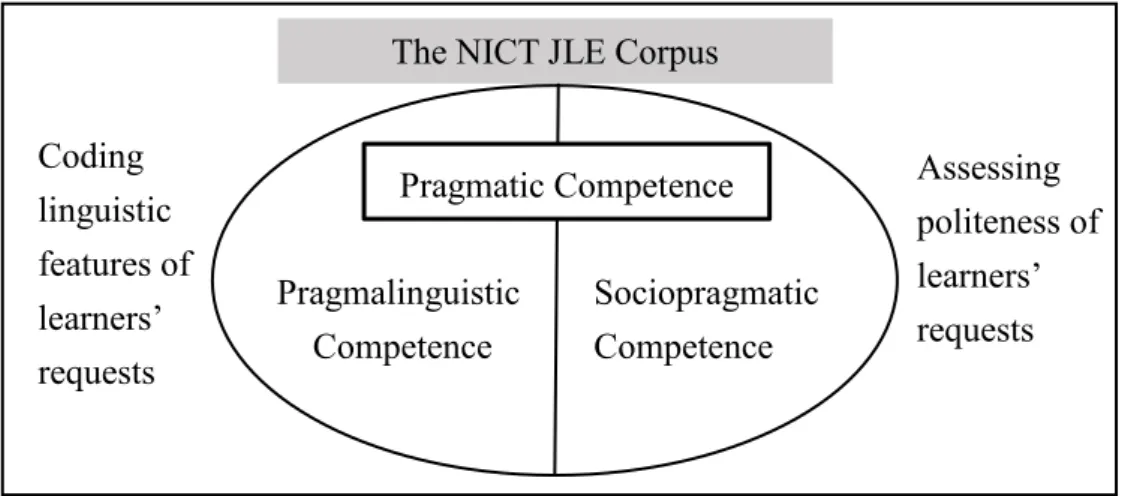
annotation schemes to identify the functions and grammatical accuracy/discoursal acceptability of all of the learners’ utterances. A combination of the multi-layered annotation schemes allowed the author to extract cross-schematically the target requestive speech acts in terms of different functions and different degrees of grammatical accuracy/discoursal acceptability. Finally, the author attempted to evaluate the degree of politeness or appropriateness of the requestive speech acts that the learners produced in terms of their choices of linguistic patterns, namely, the pragmalinguistic features.
However, results of the assessment survey on 10 native-speaking and 10 Japanese- speaking respondents involved with tertiary English education in Japan did not yield significant agreement rates. Therefore, the author decided that the present doctoral study should only focus on the pragmalinguistic competence, rather than the sociopragmatic competence, of Japanese learners of English by examining their requestive speech acts.
Chapter 4 is composed of the present doctoral study’s theoretical background, purpose, limitations, overview of the annotation structure, and rationale for using shopping role-play interactions in the NICT JLE Corpus. The chapter concludes with a series of research questions addressed by the present study. First, discussing the theoretical background of the current study, the author compares traditional pragmatics to corpus pragmatics, and compares the methodology of DCTs to that of learner corpora in ILP. The advantages and drawbacks of the two competing theories and the two competing methodologies are highlighted, along with suggestions of how they can supplement one another. Then, the author describes the purpose of the current research and addresses some limitations, such as the exclusion of analyzing sociopragmatic competence from the study and the effects of task differences on the choices of the requestive strategies of learners at different proficiency levels. Despite these limitations, the author attempts to discuss the advantages of analyzing the shopping role-play
9
interactions in the NICT JLE Corpus for extracting the criterial pragmalinguistic features of the requests produced by learners at different proficiency levels. Constructing the multi-layered annotation schemes is one of the efforts made to tackle these limitations.
Chapter 5 discusses the methods of the current study. The target subjects, the structure and rules of the originally built-in annotated tags in the NICT JLE Corpus, the annotation tool (the UAM CorpusTool), and the overall picture of the annotation schemes for request, function, and grammatical accuracy/discoursal acceptability are described. In this chapter, the issue of the segmentation and boundaries of utterances is also discussed, referring to how researchers in the past have dealt with this issue, especially when annotating spoken corpora. Then, the final part of the chapter is devoted to discussing the reliability of the annotations, referring to how the annotation schemes were revised and how the annotations were refined. The annotation checker was involved with mainly two stages: a random check of the annotations and replication of the annotations.
Unfortunately, it was revealed that the agreement rate between the author and checker in terms of the replicability of the function and grammatical accuracy/discoursal acceptability annotations was not as high as the author expected.
Chapter 6 presents the results and discussion, answering the research questions in this study. The results of the chi-square tests are reported in response to each research question to determine any significant differences among the learners at different proficiency levels. Research Question 1 is involved with exploring the functions of the whole utterances produced by the learners. Statistical results of the utterances with the functions of dealing with transaction and communication for transaction are presented, in terms of their distributions and frequencies in learners across the three different proficiency levels. The findings derived from the requests with different functions among learners at three proficiency levels indicate that B1 learners, who were given a negotiation
10
task, performed significantly different from A1 and A2 learners, who were given a general purchasing task. Research Question 2 concerns the degree of the grammatical accuracy/discoursal acceptability of learners’ utterances. The ratios of segments annotated as high and low (further divided into coherent, slightly incoherent, and incoherent) produced by learners across different proficiency levels are contrasted.
Research Question 3 addresses the results of the main focus of the study: extracting the pragmalinguistic features of the requestive speech acts produced by learners at different proficiency levels. First, the overall statistical results, consisting of the ratios of requestive strategies (i.e., direct, conventionally indirect, and not-classifiable), are reported, detailing the distributions and frequencies of the linguistic patterns that the learners chose to produce in their requestive head acts and internal modification. In addition to describing the interactional features accompanying the head acts of requests, the author reveals findings derived from the cross-schematic extractions of functions and grammatical accuracy/discoursal acceptability of the produced requests. Finally, the author summarizes the criterial pragmalinguistic features distinguishing A1 learners from A2 learners, referring both to statistically confirmed significant differences and non- statistically confirmed but characteristic differences based on quantitative results.
Chapter 7 first summarizes the findings by answering the series of research questions reported in Chapter 6, and then offers an overall discussion and conclusion, limitations of the present study, and implications for future studies in interlanguage pragmatics and L2 pedagogy. The author discusses how the corpus-based present study can contribute to interlanguage pragmatics by facilitating a re-examination of past studies through its supplementary corpus evidence extracted from the NICT JLE Corpus. The author adds the statistical and descriptive outcomes derived from the present study to the developmental stages of Kasper and Rose (2002), who summarized the results of
11
longitudinal studies on a small number of ESL subjects, and to the work of Blum-Kulka (1991), who describes the introspective transition in her study approach on learner development based on the CCSARP. Further, the author discusses the advantages of applying the CCSARP, with some amendments, to corpus-based studies in ILP, as it can greatly contribute to the re-examination of past studies by allowing researchers to achieve a more generalizable and statistically valid overview of learners’ development of pragmalinguistic competence. After addressing the limitations of the research methodologies, the author concludes the present doctoral study by summarizing its methodological implications, such as the provision of a list of the recurrent pragmalinguistic features of requests produced by learners at different proficiency levels for future studies, including those in the area of Natural Language Processing (NLP).
Pedagogical implications are also addressed in terms of the added insight into the functions for the CEFR descriptors and applications to classroom instruction, including a guidance on autonomous learning, as the retrieved pragmalinguistic choices made by learners at different proficiency levels can be a great resource for second language acquisition.
12
Chapter 2. Review of Literature
This chapter reviews the literature and is divided into six sub-sections.
Subsection 2.1 provides an overview of the chapter. Subsection 2.2 discusses speech act theory (Austin, 1962; Searle, 1969, 1976) and its relevance to the field of pragmatics by introducing various important notions, such as illocutionary force-indicating devices (IFIDs) and conventionality, which highlights the gap between the surface forms of utterance and actual intended meaning. Subsection 2.3 describes politeness in requests and, in particular, the notion of face-threatening acts. Subsection 2.4 reviews the influence of the Cross-Cultural Speech Act Realization Project (CCSARP) on analyzing speech act realization patterns and refers to methodologies that are based on the Discourse Completion Tests (DCTs). Subsection 2.5 presents the recent trends of corpus pragmatics and discusses how the researchers tackled various challenges with corpus annotation faced when assigning the functions to utterances whose surface forms remain mismatched.
Subsection 2.6 reviews studies on interlanguage pragmatics (ILP) with a focus on various data collection methods including DCTs, role play, and learner corpora. In particular, it details research whose methods are in line with those of the current study. These include Trosborg (1995), Hill (1997), Rose (2000; 2009), Flores Salgado (2011), and Al-Ghahtani and Alkahtani (2012), who apply the CCSARP coding scheme to investigate the requests of learners at different proficiencies.
2.1 Introduction
This chapter reviews the literature that is crucially related to the present doctoral research. First, the theoretical background of speech act theory is described.
Speech act theory was developed under linguistic philosophy by Austin (1962) and Searle
13
(1969; 1976), who discussed the illocutionary force indicating devices (IFIDs) of speech acts. The theory later included the notion of indirectness or conventionality, discussed in terms of pragmatics by scholars such as Blum-Kulka (1989), Culpeper and Haugh (2014), and so on (see section 2.2). These scholars referred to the gap between the surface forms of the speaker’s utterance and the actual intended meaning. Focused on requests, speech act theory is further explained in terms of politeness, mainly based on the face-threatening acts (FTAs) developed by Brown and Levinson (1987) and concerned with sociological factors such as relative power, social distance, and the ranking of the imposition between a speaker and a hearer (see section 2.3). The dichotomy between pragmalinguistics and sociopragmatics made by Leech (2014) is also important in terms of conducting corpus- pragmatic research on learners’ pragmatic development.
Next, the Cross-Cultural Speech Act Realization Project (CCSARP) is reviewed (see section 2.4). The CCSARP was conducted by Blum-Kulka et al. (1989), and has been the most influential study on the cross-cultural and intralingual variation of speech act realization patterns of request and apology. They used Discourse Completion Tests (DCTs), which seemed to be the easiest and most effective data collection method, allowing researchers to collect various language patterns of the target speech-act strategies from a vast number of subjects with different language backgrounds (i.e., native speakers of different languages and dialects, and learners of different languages) and to easily control the various social parameters involved with participants’
roles and situations in given tasks. The main objective of the project was to investigate the universality of politeness phenomena across languages and cultures, as well as to find implications concerning second language speakers’ acquisition of effective communicative skills without committing pragmatic failures. Blum-Kulka et al. (1989) were concerned with three different variabilities, including sociopragmatic variation,
14
cross-cultural variation, and interlanguage variation. The CCSARP coding scheme of requestive speech acts, on which the present study draws, is then detailed; in this scheme, requestive head acts are divided into direct, conventionally indirect, and non- conventionally indirect strategies, based on the speakers’ choice of linguistic features (see section 2.4.3). Afterwards, several studies in the CCSARP are introduced; Blum-Kulka and House (1989) investigated cross-cultural variation in different situations among the different languages of native speakers (see section 2.4.4.1), and Faerch and Kasper (1989) conducted a study on ILP focusing on Danish learners of English and German, in comparison with native speakers of three languages (see section 2.4.4.2). Finally, criticism of the CCSARP in recent studies is described, in terms of the categorizations of strategies and linguistic patterns (see section 2.4.5.1) and the treatment of politeness (see section 2.4.5.2).
The next section, 2.5, reviews how corpora have been applied to pragmatic studies. As discussed by Adolphs (2008), facilitating the systematic examination of the large-scale digital records of naturally occurring data, corpora allow us to re-examine the intuitive aspects of traditional pragmatics based on invented examples from native speakers’ utterances. First, differences in the approaches of analyzing texts and discourse between pragmatics and corpus linguistics are described. In pragmatics, the horizontal- reading methodology, which examines the contexts wherein utterances occur and the actual intended meaning of speakers in a longer stretch of discourse, is common. On the other hand, the vertical-reading methodology, based on the automatic retrieval of the lexical forms realized in concordance lines, is predominant in corpus linguistics.
Therefore, researchers who intend to merge corpus linguistics and pragmatics would encounter various challenges such as the mismatch between forms and functions, and laborious and time-consuming annotations (see section 2.5.1). Next, the pioneering
15
studies on the corpus-based analyses of native speakers’ speech acts such as those of Aijmer (1996) and Adolphs (2008) are introduced (see section 2.5.2.1). Although fully automatic annotation is not possible in corpus-pragmatic studies, semi-automatically annotated speech-act corpora, which are primarily based on carefully planned manual annotations, are possible; some of these corpora are introduced (e.g., Leech & Weisser, 2003; Seto, 2013; 2016; De Felice et al., 2013; see section 2.5.2.2). Though most of the researchers who adopted semi-automatic annotation dealt with native speakers’ spoken data and the written data of fairly advanced learners of English, their studies have given insightful suggestions for highlighting the difficulties associated with learner spoken data in the present study. The difficulties involve not only how interactional features pertaining particularly to spoken data (e.g., repetitions, repairs, hesitations, and interruptions by the interlocutor) are treated but also how the requests made by lower-level learners (e.g., lexically and grammatically unsuitable choices of requestive forms and socially inappropriate speech act performance) are treated.
The final section, 2.6, reviews interlanguage pragmatics (ILP), starting with how it was developed from empirical pragmatics and cross-cultural pragmatics (Kasper, 1996), which are subdisciplines of pragmatics, into the broader category of second language acquisition (SLA) (Vyatkina & Cunningham, 2015). The methods of data collection in ILP, such as DCTs, role plays, and naturally occurring data including learner corpora, are described (see section 2.6.2). The DCT is the most predominant method since it is easy to control various social variables and elicit the target linguistic forms that researchers want to collect. Via role plays, researchers can collect and examine learners’ spoken data with interlocutors similarly to how they would in natural settings.
Regarding naturally occurring data, longitudinal and cross-sectional approaches are described. Learner corpora composed of learners at different proficiency levels allow
16
researchers to investigate the learners’ use and development of speech acts. However, each method has its drawbacks and advantages; thus, some examples of the past studies with different methods are compared.
Finally, the past studies that investigated the requestive speech acts of learners at different proficiency levels based on the CCSARP coding scheme are described (see section 2.6.3). Trosborg (1995) and Hill (1997) adopted the DCT method, Rose (2000, 2009) and Flores Salgado (2011) used cartoon oral production tasks (COPTs), and Al- Gahtani and Alkahtani (2012) employed the open role-play method. In addition to Hill (1997), Takahashi and Dufon (1989) and Kaneko (2004) investigated Japanese learners of English. Except for Kaneko (2004), who examined the negotiation role plays of 76 upper intermediate learners from the NICT JLE Corpus, no studies have dealt with learner corpora. The findings regarding proficiency levels in these studies indicated a tendency in learners at higher levels to use indirect strategies more frequently than they do direct strategies, which is similar to the results of native speakers. These studies also found a more frequent production of direct strategies by lower learners, except for Al-Gahtani and Alkahtani (2002) and Takahashi and Dufon (1989).
2.2 Speech Act Theory
According to Crystal (1997), pragmatics is defined as “the study of language from the point of users, especially of the choices they make, the constraints they encounter in using language in social interaction and the effects their use of language has on other participants in the act of communication” (p. 301; italics added). Rintell and Mitchell (1989) noted that “When studying the speech acts performed by language learners, a number of different research questions could be asked,” referring to “the
17
variety of strategies observed in the target language environment” (p. 249). This chapter describes how speech act theory has been developed in the field of pragmatics.
While semantics deals with “all aspects of the literal meaning of sentences and other expressions,” “pragmatics is concerned with the conditions according to which speakers and hearers determine the context- and use-dependent utterance meanings”
(Searle, Kiefer, & Bierwisch, 1980, p. x). According to Searle et al. (1980), “the theory of speech acts starts with the assumption that the minimal unit of human communication is not a sentence or other expression, but rather the performance of certain kinds of acts, such as making statements, asking questions, giving orders, describing, explaining, apologizing, thanking, congratulating, etc.” (p. ix). Speech act theory originates in the field of linguistic philosophy, notably in Austin (1962) and Searle (1969; 1976).
Before reviewing various studies focusing on learners’ production of requestive speech acts, which is the main focus of the present study, this section aims to briefly review the philosophical origins of speech act theory, which lead to the notions of directness and indirectness, conventionality and politeness theory in pragmatics. Theory founder Austin’s book How to Do Things with Words was published in 1962, two years after his death (Huan, 2009). Based upon the assumption that “utterances can be described in terms of the actions they perform” (O’Keeffe, Clancy, & Adolphs, 2011, p. 84), speech act theory offers an approach to “the functional value of utterances rather than the form of utterances” (Seto, 2016, p. 1).
The first important notion Austin (1966) introduced is a distinction between performatives and constatives (Archer, Aijmer, & Wichmann, 2012, p. 35; Huan, 2009, p.
1000). “Performatives are utterances which are used to do things for performing acts”
(Huan, 2009, p. 1000), while constatives are utterances or assertions, which are statement- making utterances (Archer et al., 2012, p. 35). According to Archer et al. (2012, p. 35), “I
18
[hereby] apologize” is an example of perfomatives as hereby can be inserted. On the other hand, “I like apples” is not a performative but a constative sentence since it is impossible to insert hereby. Thus, Austin (1969) claimed that there is a set of conditions for a performative to be successful, which he called felicity conditions (pp. 14-15). Seto (2016) illustrated that an utterance “I order you to release the prisoners” can only be successful under the felicity conditions which indicate “circumstances where the speaker has legitimacy authority over the hearer and the hearer will obey the order given” (p. 18) (see Archer et al., 2012, p. 37; Levinson, 1983, p. 229; Huan, 2009, p. 1001).
However, Austin later abandoned his distinction between performatives and constatives as most constatives are actually used to perform speech acts just like performatives (Archer et al., 2012, p. 37; Huan, 2009, p. 1002; O’Keeffe et al., 2011, p.
85). For example, O’Keefe et al. (2011) illustrated an interaction as follows:
A: Is Sally still in hospital?
B: No she’s home.
Although No she’s home is treated as a constative sentence according to Austin’s first distinction, the utterance can be Speaker B’s warning to Speaker A if “A had an argument with Sally and did not want to see her,” when A was about to visit the house (p. 85).
Austin revised his theory and claimed that “all utterances, in addition to meaning whatever they mean, perform specific acts via the specific communicative force of an utterance” (Huan, 2009, p. 1002). Thus, he introduced three kinds of acts accomplished by each utterance: a locutionary act, an illocutionary act, and a perlocutionary act (Archer et al., 2012, p. 37; Huan, 2009, p. 1002; Levinson, 1983, p.
236; O’Keeffe et al., 2011, p. 85). A locutionary act is the physical act of producing an utterance and its apparent meaning. An illocutionary act is the intended meaning of the utterance. A perlocutionary act is the effect achieved through the locution and illocution.
19
The communicative intentions a speaker conveys through their utterances are speech acts such as requests, apologies, refusals, complaints, and thanking. Illocutionary force indicating devices (IFIDs) is a term coined by Searle (1969, p. 30), which means “the formal devices of an utterance used to signal its illocutionary force” (Culpeper & Haugh, 2014, p. 168). In English, the devices are “word order, stress, intonation contour, punctuation, the mood of the verb, and the so-called performative verbs” (Searle, 1969, p. 30). Searle (1976) developed Austin’s theory, and presented classification of speech acts as follows. Table 2.1 summarizes a description by Archer et al. (2012, pp. 39-40).