九州大学学術情報リポジトリ
Kyushu University Institutional Repository
三重項励起子活用における競合的非放射過程の影響 に関する研究
能塚, 直人
https://doi.org/10.15017/4060119
出版情報:Kyushu University, 2019, 博士(工学), 課程博士 バージョン:
権利関係:
2020
Doctoral thesis
Studies on the influence of competitive nonradiative processes on triplet harvesting applications
Naoto Notsuka
Department of Chemistry and Biochemistry Graduate School of Engineering
Kyushu University
Table of Contents
Table of Contents
Chapter 1 Introduction
1. 1. Background ... 2
1. 1. 1. Organic light emitting devices (OLEDs). ... 2
1. 1. 2. Parameters of light emitting performances and decay rate constants of excitons ... 4
1. 1. 3. Spin formation and exciton harvesting in OLEDs ... 5
1. 1. 4. Triplet harvesting materials for OLEDs ... 5
1. 1. 5. Suppression of nonradiative deactivation pathways ... 8
1. 2. Purpose and outline of this study ... 11
1. 3. References ... 15
Chapter 2 Development of afterglow OLEDs utilizing long-lived room temperature phosphorescent emitters 2. 1. Introduction of Chapter 2 ... 20
2. 2. Results and discussion ... 23
2. 2. 1. Dominant factor of knrT under room temperature ... 23
2. 2. 2. Maximization of triplet exciton lifetime of guest molecule ... 34
2. 3. Conclusion ... 35
2. 4. Experimental methods ... 35
2. 4. 1. Preparation of samples ... 35
2. 4. 2. Characterization of properties of samples ... 36
2. 5. References ... 37
Chapter 3
Observation of Nonradiative Deactivation Behavior from Singlet and Triplet States of Thermally Activated Delayed Fluorescence Emitters in Solution
3. 1. Introduction of Chapter 3 ... 41
3. 2. Results and discussion ... 42
3. 2. 1. Bimolecular exciton quenching ... 43
3. 2. 2. Intramolecular exciton quenching ... 50
3. 3. Conclusion ... 52
3. 4. Experimental methods ... 52
3. 4. 1. Preparation of samples ... 52
3. 4. 2. Measurement of photophysical properties ... 53
3. 5. References ... 54
Chapter 4 Summary of this thesis and future perspectives 4. 1. Summary of this thesis ... 57
4. 2. Future perspective ... 59
4. 3. References ... 61
Appendix ... 62
Afterword Publication List ... 73
Acknowledgement ... 75
Chapter 1
Introduction
1. 1. Background
1. 1. 1. Organic light emitting devices (OLEDs)
Because we live in a society where electrical infrastructure has been well- developed, applications run by electricity are essential to our daily life. As an amount of communication traffic increases year by year,1 display devices are desired to extend their presence to unconventional places such as blank walls, glasses,2 and body surfaces.3 Organic devices have high potential for such kinds of applications because of their flexibilities.
Organic electroluminescence (EL) was first reported from an anthracene crystal with the thickness of dozens of micrometers by applying extraordinary high voltage such as 1000 V in 1963.4 After the single crystal studies, various thin film devices had been examined in 1970th to 1980th5 and in 1987, C. W. Tang reported an impressive bilayer organic light-emitting diode (OLED),6 demonstrating ~1000 cd m-2 with a low driving voltage of 5 V. After this report, the OLEDs have attracted extensive attention for display and lighting applications because of
their unique characteristics such as mechanical flexibility, transparency, and solution processability in addition to the high EL efficiency7 Moreover, high contrast and fast response are suitable for use in displays and large-area surface emission is suitable for use in
Figure 1-1. Illustration of a basic three-layer OLED.
Chapter 1 1. 1. Background
lighting applications.8
Nowadays, flat or flexible panel displays utilizing OLEDs have been popular and the market has been rapidly expanding.9 Figure 1-1 shows one of the basic OLED structures, called a bottom-emission type OLED. This bottom type device archetecuture has been commonly used at laboratory scale because of its easy-to-fabrication. The OLEDs consist of stacked thin uniform layers with the thickness of equal to or less than sub-micrometers to produce EL with practicable driving voltage, even though organic amorphous films have low charge carrier mobilities of about 10-3–10-5 cm2 V-1 s-1.10 OLEDs show light emission when electrically generated excitons deactivate to the grand state from the excited states. The excitons are generated by the reconbination of electron- hole pairs injected from an anode and a cathode, respectively. To obtain efficient luminescence from a light emitting layer, the structure of OLEDs has been developed to incorporate various functional layers. Generally, a hole transporting and an electon transporting layers adjacent to the light-emitting layer are formed to transport charge carriers from the electrodes to the emitting layer.11 To confine charge carriers and excitons in the emitting layer, blocking layers are also inserted between the emitting layer and the transporting layers.12,13 Moreover, carrier injection layers, inserted at the interfaces between transporting layers and electrodes, help reducing the driving voltage of the devices.14 Further, in the light emitting layer, a host-guest system, dispersing emitters into a host matrix, can be introduced to improve efficiency.15 Insufficient energy confinement resulting from the mismatched energy difference between the emitter and the host or the adjacent layers causes unexpected exciton deactivation.16 Therefore, the host matrices and adjacent layers should have higher energy gap than that of the emitter. The host is also required to have a good spectral overlap between the emission of the host and the
1. 1. Background
absorption of the guest molecule to induce efficient energy transfer to guest materials.17 Applying bipolar carrier transportability to host matrices by mixing two or more types of materials also helps achieving ideal bipolar carrier transport and successive carrier recombination.18 Furthermore, the encapsulation of OLEDs with inert gas is favorable to prevent undesired reactions with the atmospheric constituents.19
1. 1. 2. Parameters of light emitting performances and decay rate constants of excitons When an electronically
excited organic molecule relaxes, the relaxation processes are divided into two types. A process with light emission is called as a “radiative”
decay process and the process without emission is called a “nonradiative”
decay process. The total exciton decay rate constant ktotal, which
means transition probabilities per time from excited states, is the sum of the individual rate constants of all decay channels as below:
ktotal = k1 + k2 + … + kn = Σ ki . (1-1) An exciton decay lifetime (τ) and a quantum yield (Φ) of a certain pathway of the molecules are connected to the rate constants.
τ = 1 / ktotal = 1 / (kem + knr) , (1-2) Φ = k / ktotal = k / Σ ki = k / τ . (1-3) Here, the relationship between an emission efficiency (Φem) and a ratio of the rate
0 0.2 0.4 0.6 0.8 1
0.0001 0.001 0.01 0.1 1 10 100 1000 10000
kem/ knr Φem
knr
kem
ground state excited state
Figure 1-2. The relationship between Φem and kem/knr. Inset: Illustration of the relaxation process of an exciton.
Chapter 1 1. 1. Background
constants of radiative (kem) and nonradiative decay processes (knr) is illustrated in Figure 1-2.
Φem = kem / (kem + knr) = kem / τ . (1-4) The rate constants of organic emitters are one of the fundamental indicators for evaluating exciton dynamics, photoluminescence (PL) and EL performances. Understanding of exciton dynamics in emissive organic materials is essential for the development of high- performance organic light-emitting applications such as OLEDs,20 bioimaging probes,21 and organic long-persistent luminescence.22
1. 1. 3. Spin formation and exciton harvesting in OLEDs
A possible electron spin multiplicity of excitons, M, resulted from bimolecular reactions between different species is expressed as below:23
M = 2S + 1 , (1-5)
where S is the total spin angular momentum of unpaired electrons (± 1/2) of excitons. The reaction between different species, A and B, through an encounter complex is expressed,
m A + n B ⇄ mn (AB) → Product , (1-6) where m and n represent the spin multiplicity of A and B, respectively, and the product mn gives the number of possible spin states of the encounter-pair AB. Because two doublets, hole and electron pair, recombine in the emitting layer of OLEDs, the exciton can be formed as four types of pair states, one is a singlet and other three are triplets.
Because three-quarters of electrically generated excitons are directly formed in a triplet state, harvesting triplet excitons is crucial to enhance OLED efficiency.24
1. 1. 4. Triplet harvesting materials for OLEDs
Transition probabilities between different energy levels are controlled by the
1. 1. Background
production of three transition factors.25
Total transition factor f = f e × fv × fs , (1-7) where, fe, fv, and fs represent transition factors based on an electronic factor, Franck- Condon (i.e., vibrational) factor, and spin factor, respectively. While the transition between a lowest excited single state (S1) and a ground state (S0) is strongly allowed, the transition between a lowest excited triplet state (T1) and S0 of pure organic aromatics are forbidden due to the small value of fs. Thus, harvesting triplet excitons as light emission are not easy under normal conditions. However, the forbidden transitions become partially allowed by perturbations such as vibronic and spin-orbit coupling. Some organic aromatics are known to show phosphorescence with the transition from T1 to S0 at low temperature.26 Since the nonradiative deactivation factors of triplet excitons are easily suppressed at low temperatures, the slow radiative process of phosphorescence can exceed the nonradiative deactivation pathway, resulted in the appearance of phosphorescence emission.
Generally, the phosphorescence emission decreases with increasing temperature (T) because the temperature-dependent knr from T1 (knrT(T)) becomes larger than the rate constant of phosphorescence (kphos). Therefore, most aromatic molecules show no room- temperature phosphorescence (RTP). Therefore, to observe RTP from organic molecules, kphos should be larger than knrT at room temperature (knrT (RT)).
One effective approach for harvesting triplet excitons as emission is the enhancement of kphos. Introducing heavy atoms like bromine,27 iridium,28 and platinum29 enhances both ISC and kphos through the spin-orbit coupling due to “heavy atom effect”
which is proportional to the fourth power of the number of nuclear charges (Z). So far, such a mechanism has been adopted to practical OLEDs to maximize internal quantum
Chapter 1 1. 1. Background
efficiency28b and in fact Ir(ppy)3 derivatives have been widely used for display applications.30 In this case, the materials are designed to be shortened the exciton lifetime to the order of micro-second. However, there some critical issues to overcome for these emitters. A decrease of EL efficiency at high brightness, called “roll-off”, results from exciton-exciton and exciton-polaron annihilations is caused by the accumulation of triplet excitons.31 Further, exciton reactivity leads to luminance degradation of OLEDs,32 which is especially critical in highly excited energy regions, i.e., blue emitters, because decomposition of materials and the successive exciton quenching by the decomposed products are likely to occur.33,34
Therefore, recent advanced OLEDs often contain blue subpixels based on triplet- triplet annihilation or fusion (TTA/TTF) emitters, which can improve the efficiency with the enhancement of the device stability.35 According to Schemes (1-5) and (1-6), two encountered triplets can produce nine different configurations of the encounter-pair, one is a singlet, three are triplets and five are quintets.
3 M * + 3 M * ⇄ 5 (M … M) * (1-8)
⇄ 3 (M … M) * → 3 M* + 1 M (1-9)
⇄ 1 (M … M) * → 1 M* + 1 M (1-10) Generated singlet contributes to fluorescence and generated triplets can be recycled into these processes. As a result, 15% more singlets can be generated, in addition to 25% of originally generated singlet excitons.35a
Recently, effective electron-photon conversion has also been achieved by thermally activated delayed fluorescent (TADF) emitters.36-38 The TADF mechanism, which was firstly discovered in Eosin Y39 had been significantly developed to aim for electrical excitation,36 resulted in ultimate efficiency.37 In fact, an endothermic intersystem crossing
1. 1. Background
pathway from T1 to S1 (reverse intersystem crossing, RISC), led to delayed fluorescence, resulted in the harvesting triplet excitons under room temperature with nearly 100%.38 The relationship between krisc and ΔEST shows an exponential relationship.
krisc ∝ A × exp (-ΔEST / kBT) , (1-11) where A is a pre-factor, ΔEST is the energy gap between S1 and T1, and kB is a Boltzmann constant. For designing efficient TADF emitters, the energy difference (ΔEST) between S1
and T1 should be minimized to accelerate krisc.
1. 1. 5. Suppression of nonradiative deactivation pathways
Suppression of a nonradiative deactivation pathway also contributes to improve Φem and this idea can be useful not only for OLEDs,40 but also for various applications such as long-lived room temperature phosphorescence (LL-RTP),22a TTA upconversion,41 and optical gas sensors.42
EL from OLEDs containing carbonyl compounds as a phosphorescent emitter driven under low temperature had been reported.43 However, the OLEDs required high driving voltage under the low temperature at which kphos can compete with knrT(T), because charge carrier mobilities in organic semiconductors strongly depends on temperature due to their thermally activated hopping conduction mechanism.44
The total knrT (T) of emitting materials can be divided into two components of an internal factor (knr,intT (T)) and an external factor (knr,extT (T)).22a
knrT (T) = knr,intT (T) + knr,extT (T). (1-12) The rate constant knr,intT (T) is related to the product of fe, fv, and fs. Here, fv corresponds to the square of the vibrational overlap of initial and final states, showing an exponential relationship with the energy gap between the states (ΔE):45
Chapter 1 1. 1. Background
fv ∝ exp (-ΔE) . (1-13) Generally, high-frequency C-H stretching vibration strongly affects fv and the substitution of the hydrogen atom by deuterium can reduce this value.46 This can be explained by the relationship between an energy gap between the vibrionic states (ΔEvib) and effective mass (meff), which is increased by deuteration.
ΔEvib ∝ meff-1/2 , (1-14)
meff = mH mC / (mH + mC) . (1-15) Since deuteration greatly
affects meff, ΔEvib becomes smaller and the number of vibrational quanta (ν) of S0, reaching to T1, increases.
At higher ν value, the overlap integral of the two states decreases due to an increase of the number of nodes in the wavefunction, resulting in the cancellation of the positive and negative contributions (Figure 1-3).
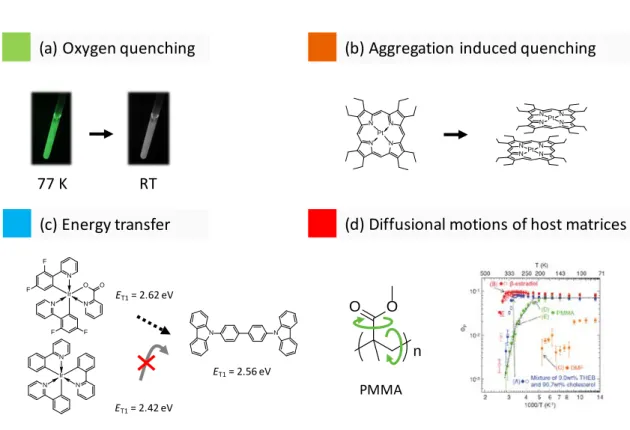
The rate constant, knr,extT (T), can be further divided into several factors (Figure 1- 4), for example, aggregation induced quenching caused by oxygen quenching (kq,O2T
(T)),47 concentration quenching or phase separation (kAIQT (T)),48 energy transfer from the triplet energy level of emitters to the triplet energy level of energy acceptors (kETT (T))16 and diffusional motion of the matrix (kdiffT (T)),22a
knr,extT (T) = kq,O2T (T) + kAIQT (T) + kETT (T) + kdiffT (T) +… . (1-16) Figure 1-3. Schematic illustration of the deuteration effect. Franc-Condon factor of C-D (right) is smaller than that of C-H (left).
∆𝐸vib
S0 ν=m
ν=0
T1
ν’=0 ν=n
ν=0
C H C D
∆𝐸vib
T1 S0
1. 1. Background
In solution, kq,O2T can be predominant over other deactivation pathways even though Ir based complexes are used as an emitter.49 Molecular oxygen (O2) is well-known to quench triplet emitters easily because O2 has a low-lying singlet excited state from a ground triplet state.50 In other words, triplet generators, especially from photo-excitation, can provide effective sensitizers for singlet oxygen.51 Many studies about RTP support that O2 quenching plays a critical role in the vanishment of phosphorescence.22a,25 Further, in solid states films used in OLEDs, kAIQT (T) can be kept to be a smaller value when the emitter is doped in a host matrix at a low concentration of 0.5 ~ 2 mol%. On the other hand, at the high concentration of emitter molecules or a phase separated condition between emitter molecules and host matrices, it results in exciton-exciton annihilation or aggregation induced low-energy lying excimer formation. In addition, kETT (T) becomes larger when impurities contaminated during manufacturing processes or fabrication
77 K RT
(a) Oxygen quenching (b) Aggregation induced quenching
(c) Energy transfer
N N
ET1= 2.62 eV
N N
N N
Pt
ET1= 2.56 eV
N N
N NPt
N N
N NPt
N N
N Ir
ET1= 2.42 eV
N N
N
O O
Ir F
F
F F
(d) Diffusional motions of host matrices
O O
n PMMA
Figure 1-4. Schematic illustration of the nonradiative deactivation factors of triplets caused by a) oxygen quenching, b) aggregation induced quenching, c) energy transfer, and d) diffusional motion of the host matrices.
Chapter 1 1. 2. Purpose and outline of this study
procedures present nearby the emitting molecules. In phosphorescence based OLEDs, the incomplete device structures having host matrices or carrier transport layers with low T1
energy also cause endothermic energy transfer under room temperature.16 Further, thermally diffusional motions of host matrices, leading to an enhancement of kdiffT (T), also reported to quench triplet excitons with increasing the temperature.22a
1. 2. Purpose and outline of this study
The purpose of this thesis is understanding the nonradiative decay processes of excited states aimed for triplet harvesting as light emission and their applications.
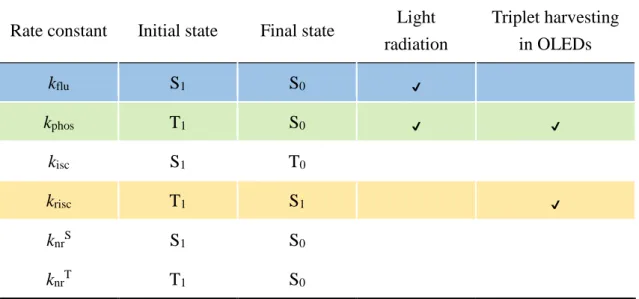
When evaluating the photophysical characteristics of molecules, kem can directly reflect the probability of a radiative transition from the lowest excited state to the ground state, S0, whereas knr is represented as the sum of the remaining non-radiative electron- transition probabilities. In case of deriving deactivation rate constants only from optical measurements, although various types of noncoupled paths, such as vibration-induced quenching, concentration quenching, and energy transfer should be considered, knr cannot be decomposed into each component. As mentioned above, when knr is large enough to compete with kem, clarification of the dominant factor of knr and its suppression is crucial to improve the light-emission abilities of emitters. In particular, triplet excitons are sensitive for nonradiative events and are easily quenched because kphos or krisc is normally much smaller than knrT because of the spin-forbidden nature of the transition at room temperature. Figure 1-5 and Table 1-1 summarize the activation and deactivation processes in organic molecules focused in this study.
1. 2. Purpose and outline of this study
Table 1-1. Summary of transition rate constants in this study.
Rate constant Initial state Final state Light radiation
Triplet harvesting in OLEDs
kflu S1 S0 ✔
kphos T1 S0 ✔ ✔
kisc S1 T0
krisc T1 S1 ✔
knrS S1 S0
knrT T1 S0
k
nrSk
fluS
1S
0T
1k
phosk
nrTk
isck
riscFigure 1-5. Schematic illustration of activation and deactivation processes in organic molecules.
Chapter 1 1. 2. Purpose and outline of this study
In Chapter 2, I demonstrated long-lived phosphorescence at room temperature (LL-RTP) resulting from the suppression of the nonradiative deactivation of triplet excitons in conventional organic semiconducting host–guest systems (Figure 1-5). The nonradiative deactivation pathway strongly depends on the triplet energy gap
between the guest emitting molecules and the host matrices (ΔET1-T1’). The triplet energy gap required to confine the long-lived triplet excitons (~0.5 eV) is much larger than that of conventional host–guest systems for room temperature phosphorescent emitters. By effectively confining triplet excitons, I demonstrate long-lived room temperature phosphorescence under both optical and electrical excitation.
In Chapter 3, I investigated nonradiative decay behavior, including internal and external exciton quenching processes of various types of TADF materials in solution (Figure 1-6). Under air- saturated conditions, both the lowest singlet and triplet excited states of almost all TADF materials
T1
ΦnrT
Φprompt
Φdelay
S0
S1 ΔEST ≲0.2 eV
ΔΦq,O2T ΔΦq,O2S
N N N
N R'
R' NC
N N N
N CN R
R
R R
R R R R
TADF molecules
Figure 1-5. Schematic illustration of Chapter 2.
Investigating the dominant quenching factor in afterglow OLEDs.
Figure 1-6. Schematic illustration of Chapter 3.
Investigating quenching pathways of TADF.
S0 T1
energy
knr, guest(T) kp
Reverse energy transfer
∆ET1-T1’≲0.5 eV
S0’ T1’ knr, host(T)
semiconducting LL-RTP guest host
kp< 100s-1
1. 2. Purpose and outline of this study
showed oxygen quenching. I carefully studied the effect of oxygen quenching for both singlet and triplet spin states to develop a method for determination of the triplet contribution to the total photoluminescence quantum yield from the transient photoluminescence profiles. Furthermore, I observed a clear energy gap law for the internal nonradiative processes.
Finally, in Chapter 4, the thesis is summarized and prospects are discussed.
Chapter 1 1. 3. References
1. 3. References
[1] Cisco Visual Networking Index: Forecast and Trends, 2017–2022 White Paper.
2019.
[2] G. Gu, V. Bulovic, P. E. Burrows, S. R. Forrest, M. E. Thompson, Appl. Phys. Lett.
1996, 68, 2606.
[3] J. A. Rogers, T. Someya, Y. Huang, Science 2010, 327, 1603.
[4] M. Pope, H. P. Kallmann, P. Magnante, J. Chem. Phys. 1963, 38, 2042.
[5] C. W. Tang, S. A. VanSlyke, Appl. Phys. Lett. 1987, 51, 913.
[6] a) P. S. Vincett, W. A. Barlow, R. A. Hann, G. G. Roberts, Thin Solid Films 1982, 94, 171; b) S. Hayashi, E. Etoh S. Saito, Jpn. J. Appl. Phys. 1986, 25, L773.
[7] J. H. Burroughes, D. D. C. Bradley, A. R. Brown, R. N. Marks, K. Mackay, R. H.
Friend, P. L. Burns, A. B. Holmes, Nature 1990, 347, 539.
[8] T. Tsujimura, OLED Display Fundamentals and Applications, Second Edition, John Wiley & Sons, Inc. 2017.
[9] R. Young, Inform. Disp. 2019, 35, 24.
[10] R. G. Kepler, P. M. Beeson, S. J. Jacobs, R. A. Anderson, M. B. Sinclair, V. S.
Valencia, P. A. Cahill, Appl. Phys. Lett. 1995, 66, 3618.
[11] C. Adachi, S. Tokito, T. Tsutsui, S. Saito, Jpn. J. Appl. Phys. 1988, 27, L269.
[12] D. F. O’Brien M. A. Baldo, Appl. Phys. Lett. 1999, 74, 442.
[13] T. Noda, H. Ogawa, Y. Shirota, Adv. Mater. 1999, 11, 283.
[14] a) Y. Shirota, Y. Kuwabara, H. Inada, T. Wakimoto, H. Nakada, Y. Yonemoto, S.
Kawami, K. Imai, Appl. Phys. Lett. 1994, 65, 807; b) S. A. VanSlyke, C. H. Cheng, C. W. Tang, Appl. Phys. Lett. 1996, 69, 2160.
[15] C. W. Tang, S. A. VanSlyke, C. H. Cheng, Appl. Phys. Lett. 1989, 65, 3160.
[16] a) R. J. Holmes, B. W. D’Andrade, S. R. Forrest, X. Ren, J. Li, M. E. Thompson, Appl. Phys. Lett. 2003, 83, 3818; b) M. A. Baldo, S. R. Forrest, Phys. Rev. B 2000, 62, 10958; c) F. C. Chen, G. F. He, Y. Yang, Appl. Phys. Lett. 2003, 82, 1006; d) K. Goushi, R. Kwong, J. J. Brown, H. Sasabe, C. Adachi, J. Appl. Phys. 2004, 95,
1. 3. References 7798.
[17] T. Förstor, Ann. Phys. 1948, 2, 55.
[18] A. B. Chwang, R. C. Kwong, J. J. Brown, Appl. Phys. Lett. 2002, 80, 725.
[19] J. McElvain, H. Antoniadis, M. R. Hueschen, J. N. Miller, D. M. Roitman, J. R.
Sheats, R. L. Moon, J. Appl. Phys. 1996, 80, 6002.
[20] a) T. Tsutsui, S. Saito, Organic Multilayer-Dye Electroluminescent Diodes-Is There Any Difference with Polymer LED? Kluwer Academic, Dordrecht, 1993.
b) L. J. Rothberg, A. J. Lovinger, J. Mater. Res. 1996, 11, 3174.
[21] M. Y. Berezin, S. Achilefu, Chem. Rev. 2010, 110, 2641.
[22] a) S. Hirata, K. Totani, J. Zhang, T. Yamashita, H. Kaji, S. R. Marder, T. Watanabe, C. Adachi, Adv. Funct. Mater. 2013, 23, 3386; b) R. Kabe, C. Adachi, Nature 2017, 550, 384.
[23] D. H. Volman, G. S. Hammond, K. Gollnick, Advances in Photochemistry Volume 14, A Wiley-Interscience Publication, 1988.
[24] A. R. Brown, K. Pichler, N. C. Greenham, D. D. C. Bradley, R. H. Friend, A. B.
Holmes, Chem. Phys. Lett. 1993, 210, 61.
[25] N. J. Turro, V. Ramamurthy, J. C. Scaiano, Modern Molecular Photochemistry of Organic Molecules. University Science Books, 2010.
[26] S.P. McGlynn, T. Azumi, M. Kinoshita, Molecular spectroscopy of the triplet state.
Prentice-Hall, 1969.
[27] O. Bolton, K. Lee, H. J. Kim, K. Y. Lin, J. Kim, Nat. Chem., 2001, 3, 205.
[28] a) M. A. Baldo, S. Lamansky, P. E. Burrows, M. E. Thompson, S. R. Forrest, Appl.
Phys. Lett. 1999, 75, 4; b) C. Adachi, M. A. Baldo, M. E. Thompson, S. R. Forrest, J. Appl. Phys. 2001, 90, 5048.
[29] M. A Baldo, D. F. O’Brien, Y. You, A. Shoutstikov, S. Sibley, M. E. Thompson, S.
R. Forrest, Nature 1998, 395, 151.
[30] P. Semensa, Inform. Disp. 2013, 29, 26.
[31] N. C. Giebink and S. R. Forrest, Phys. Rev. B 2008, 77, 235215.
Chapter 1 1. 3. References [32] P. E. Burrows, S. R. Forrest, T. X. Zhou, L. Michalski, Appl. Phys. Lett. 2000, 76,
2493.
[33] S. Schmidbauer, A. Hohenleutner, B. König, Adv.Mater. 2013, 25, 2114.
[34] N. Lin, J. Qiao, L. Duan, L. Wang, Y. Qiu, J. Phys. Chem. C 2014, 118, 7569.
[35] a) W. Helfrich, W. G. Schneider, J. Chem. Phys. 1966, 44, 2902. b) H. Kuma, C.
Hosokawa, Sci. Technol. Adv. Mater. 2014, 15, 034201.
[36] A. Endo, M. Ogasawara, A. Takahashi, D. Yokoyama, Y. Kato, C. Adachi, Adv.
Mater. 2009, 21, 480.
[37] a) A. Endo, K. Sato, K. Yoshimura, T. Kai, A. Kawada, H. Miyazaki, C. Adachi.
Appl. Phys. Lett. 2011, 98, 083302; b) H. Tanaka, K. Shizu, H, Miyazaki, and C.
Adachi, Chem. Comm. 2012, 48, 11392; c) S. Y. Lee, T. Yasuda, H. Nomura, C.
Adachi, Appl. Phys. Lett. 2012, 101, 093306; d) K. Goushi, K. Yoshida, K. Sato, C. Adachi, Nature Photon. 2012, 6, 253; e) K. Sato, K. Shizu, K. Yoshimura, A.
Kawada, H. Miyazaki, C. Adachi, Phys. Rev. Lett. 2013, 110, 247401.
[38] a) H. Uoyama, K. Goushi, K. Shizu, Hiroko Nomura, and C. Adachi, Nature 2012, 492, 234; b) S. Hirata, Y. Sakai, K. Masui, H. Tanaka, S. Y. Lee, H. Nomura, N.
Nakamura, M. Yasumatsu, H. Nakanotani, Q. Zhang, K. Shizu, H. Miyazaki, C.
Adachi, Nature Mater. 2015, 14, 330; c) Q. Zhang, B. Li, S. Huang, H. Nomura, H. Tanaka C. Adachi, Nature Photon. 2014, 8, 326.
[39] S. Boudin, J. Chim. Phys, 1930, 27, 285.
[40] J. P. Martins, P. Martín-Ramos, C. Coya, M. Ramos Sliva, M.E.S. Eusebio, A.D.
Andrés, Á.L. Álvarez, J. Martín-Gil, J. lumin. 2015, 159, 17.
[41] A. Danos, R. W. MacQueen, Y. Yap Cheng, M. Dvořák, T. A. Darwish, D. R.
McCamey, T. W. Schmidt, J. Phys. Chem. Lett. 2015, 6, 15, 3061.
[42] J Gregory, J. W., Asai, K., Kameda, M., Liu, T., & Sullivan, J. P. (2008). Proc. of the IMecE, Part G: J. Aerospace Eng. 2008, 222, 249.
[43] a) M. Morikawa, et al. 51th Fall meeting, Jpn. Soc. Appl. Phys. 28a-BP-8; b) S.
Hashimoto, H. Suzuki, Appl. Phys. Lett. 1996, 69, 224.
[44] a) R. Coehoorn, W. F. Pasveer, P. A. Bobbert, M. A. J. Michels Phys. Rev. B 2005, 72, 155206; b) N. F. Mott W. D. Twose, Adv. Phys. 1961, 10, 107; c) H. Bässler,
1. 3. References Phys. Stat. Sol. 1993, 175, 15.
[45] W. Siebrand, J. Chem. Phys. 1966, 44, 4055.
[46] W. Siebrand, J. Chem. Phys. 1967, 47, 2411.
[47] G. Mehes, H. Nomura, Q. Zhang, T. Nakagawa, C. Adachi, Angew. Chem. Int. Ed.
2012, 51, 11311.
[48] a) A. Weller, Pure Appl. Chem. 1968, 16, 115; b) Y. Kawamura, J. Brooks, J. J.
Brown, H. Sasabe, C. Adachi, Phys. Rev. Lett. 2006, 96, 017404; c) B. D’Andrade S. R. Forrest, Chem. Phys. 2003, 286, 321.
[49] N. Hasebe, K. Suzuki, H. Horiuchi, H. Suzuki, T. Yoshihara, T. Okutsu, S. Tobita, Anal. Chem. 2015, 87, 2360.
[50] A. A. Krasnovsky, Jr., Photochem. Photohiol. 1979, 29, 29.
[51] J. N. Demas, E. W. Harris, R. P. McBride, J. Am. Chem. Soc. 1977, 99, 3547.
Chapter 2
Development of Afterglow OLEDs Utilizing Long- Lived Room Temperature Phosphorescent Emitters
“Afterglow Organic Light Emitting Diodes”
Ryota Kabe, Naoto Notsuka, Kou Yoshida, Chihaya Adachi, Advanced Materials, 28, 655-660, (2016).
“Confinement of Long-Lived Triplet Excitons in Organic Semiconducting Host-Guest Systems”
Naoto Notsuka, Ryota Kabe, Kenichi Goushi, Chihaya Adachi, Advanced Functional Materials, 27, 40, 1703902, (2017).
2. 1. Introduction of Chapter 2
2. 1. Introduction of Chapter 2
Long persistent phosphors are widely commercialized as glow-in-the-dark paints for watches, indicators, emergency lights, and afterglow safety lamps and are being explored for use in in vivo bioimaging since the emission can be observed long after excitation.1 Presently, this long-lasting emission is realized by an inorganic system of alkali aluminate (Sr, Al, O) doped with rare earths (Europium and Dysprosium),2 which exhibits emission over 10 hours through the trapping and detrapping of photo-generated charge carriers. However, the inorganic phosphor alkali aluminate contains rare elements and requires very high fabrication temperatures over 1000 °C.2 Moreover, this inorganic system requires photo-excitation in the ultraviolet region, the intensity of which is very weak in general modern lighting such as from light-emitting diodes (LEDs) and organic LEDs (OLEDs).
Some organic aromatics are also well-known to show long-lived emission called phosphorescence. While pure organic aromatic compounds have an intrinsically long phosphorescence lifetime exceeding a second, it is not obtained under conventional environmental conditions because of the presence of facile nonradiative deactivation processes from triplet states. Triplet excitons on organic molecules easily deactivate at room temperature because of the presence of thermally activated nonradiative pathways.
The approach for making RTP observable by the enhancement of kphos as introduced in chapter 1, makes the emission lifetime is also very short. In contrast, minimization of knrT (T) by using pure aromatic compounds and rigid host matrices also enables RTP.
Many approaches, like host–guest systems,3 clathrate compounds,4 mixed crystals 5-6 and metal organic frameworks (MOFs),7-8 have been reported. Because of the lack of enhancement of kphos, this type of RTP persists for durations on the millisecond to second
Chapter 2 2. 1. Introduction of Chapter 2
order as a result of the long lifetime of the triplet excited states. Although the RTP duration from aromatic molecules is far shorter than that from inorganic system, organic RTP has some advantages, such as easy color tunability, ON/OFF switching ability,9 and biocompatibility by molecular modification. Further, the presence of triplet absorption can be utilized for reverse saturable absorption 10 and is expected to have applications in nonlinear optics.
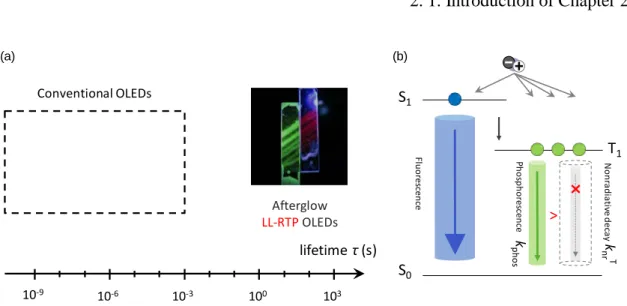
Such long-lived RTP (LL-RTP) may be useful for afterglow lighting as an alternative to afterglow fluorescent lamps, which are widely used for residential lighting because they emit a faint glow even after the power supply is switched off. In the case of afterglow OLEDs, long-lived emission can be obtained in the form of electroluminescence (EL) from an organic LL-RTP emitter layer without requiring an extra layer of inorganic phosphor to produce photoluminescence (PL), making such devices attractive for future lighting applications. Furthermore, dual emission of both fluorescence and phosphorescence is another possibility to harvest all singlet and triplet excitons for light emission. Such a system may have advantages over phosphorescent and
S1
S0
T1
>
knr T
kphos Nonradiativedecay
Phosphorescence
Fluorescence
10-9 10-6 10-3 100 103
lifetime τ (s) (Ir, Pt)RTP
Fluor. TADF
Conventional OLEDs
Afterglow LL-RTP OLEDs
(b) (a)
Figure 2-1. Conceptual illustration of afterglow OLEDs. a) Deactivation lifetimes compared between conventional OLEDs and afterglow OLEDs. b) Deactivation images of afterglow OLEDs.
2. 1. Introduction of Chapter 2
TADF emitters, because it can exhibit two different emission colors from a single emitter molecule, leading to white OLEDs with one kind of emitter (Figure 2-1).
Effective molecular design guideline for LL-RTP from host–guest systems was investigated by Hirata et al. using hydroxysteroid.11 The hydroxyl steroid host provides a rigid amorphous environment for guest emitters, which minimizes the nonradiative decay of the long-lived triplet excitons. However, hydroxysteroid is one of the few host matrices shown to suppress all the host-related quenching factors at ambient conditions. While afterglow OLEDs could be realized by introducing an organic LL-RTP emitter layer into an OLED structure, almost all of the LL-RTP host materials reported to date are electrical insulators because their nonaromatic backbones or containing hydroxyl functional groups.
Hydrophilic functional groups usually result in electron traps in semiconducting devices.12 To realize afterglow OLEDs, we need to investigate a wide variety of host matrices to understand the host-related quenching process in more detail.
This chapter presents LL-RTP from aromatic emitters doped into well-known organic semiconducting host materials. I investigated the dependence of the LL-RTP lifetime on the glass transition temperature (Tg), the triplet energy (ET1) of host matrices, and sample temperature. I demonstrate that the triplet energy gap between the emitting materials and the host matrix (ΔET1-T1’) plays an important role in LL-RTP. These results are important for the confinement of long-lived triplet excitons in organic semiconducting devices.13
Chapter 2 2. 2. Results and discussion
2. 2. Results and discussion
2. 2. 1. Dominant factor of knrT under room temperature Figure 2-2a shows the
aromatic hosts used in this study, most of which are commonly used in OLEDs. The deuterated organic phosphor DMFLTPD-d36 (Fig. 2-2b)
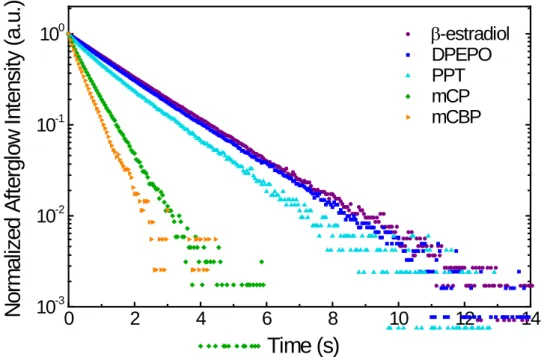
11 was mixed with these hosts with the concentration of 1 wt% and films were formed using melt casting. The room-temperature phosphorescence decay profiles of these mixed films are shown in Fig. 2-2c. The films with β-estradiol, DPEPO, PPT, mCP, and mCBP hosts showed LL-RTP while those with TrisPCz, TPD, and α-NPD hosts showed no LL-RTP.
For each doped film, the
phosphorescence lifetime (τphos(T)) was calculated from the first-order exponential fitting of the emission decay profile, and the phosphorescence quantum yield (Φphos) was calculated from the product of the total emission quantum yield (Φtotal) and the ratio of the integrated phosphorescence spectrum to the total integrated emission spectrum (Table 2-1).
N N
N O
P PO O
➀β-estradiol
➄mCBP
N N N
N
S
P P
O O
HO
OH
➁DPEPO
➅TrisPCz
③PPT
➃mCP
➆TPD
N N
⑧α-NPD
N N
N N N
DMFLTPD
a b DPADBC c coronene
(a) Host molecules
(b) LL-RTP guest molecules
N N
N N
Pt
N N
N Ir
PtOEP
a e Ir(ppy)3
(c) Conventional RTP guest molecules
Figure 2-2. a) The molecular structures of hosts, b) LL-RTP guests and c) conventional phosphorescent guests used in this chapter.
2. 2. Results and discussion
Table 2-1. LL-RTP lifetime, triplet energy level, and glass transition temperature of host and guest materials.
Properties of materials Properties of doped films
Property ET1 ΔET1-T1’ Tg τphos(T) Φtotal Φphos/Φtotal Φf Φphos
(unit) eV eV K s % % % %
DMFLTPD 2.50 a) - - - - - - -
β-estradiol 3.20 0.7 313 1.81 57.4 37.5 35.9 21.5
DPEPO 3.20 0.7 367 1.72 50.0 31.4 34.3 15.7
PPT 2.98 0.48 380 1.50 20.3 68.3 6.4 13.9
mCP 2.85 0.35 339 0.71 41.2 10.3 37.0 4.2
mCBP 2.82 0.32 365 0.45 41.3 10.8 36.9 4.4
TrisPCz 2.65 0.15 427 N. O.b) 28.5 0.0 28.5 0.0
TPD 2.40 −0.10 333 N. O. b) 35.2 0.0 35.2 0.0
α-NPD 2.30 −0.20 372 N. O. b) 24.1 0.0 24.1 0.0
a) measured in frozen 2-MeTHF solution, b) Not observed.
0 2 4 6 8 10 12 14
10-3 10-2 10-1
100 β-estradiol
DPEPO PPT mCP mCBP
N or m al iz ed A ft er gl ow I nt ens ity ( a. u. )
Time (s)
Figure 2-3. Transient room temperature phosphorescence decay curves of DMFLTPD-d36 with the dopant concentration of 1 wt% in various host matrices.
Chapter 2 2. 2. Results and discussion
Although the concentration of guest emitter DMFLTPD-d36 was constant, the τphos
(T) values varied greatly depending on the host molecules (Figure 2-3 and Table 2-1), indicating that the nonradiative decay process is affected by the host molecule. The rate constant of the total nonradiative decay from the triplet excited state (knrT (T)) can be divided into components from the guest (knr,guestT (T)) and host (knr,hostT (T)) as follows:11
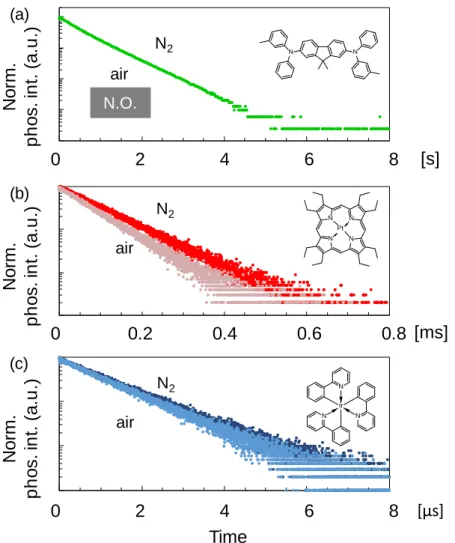
knrT (T) = knr,guestT (T) + knr,hostT (T). (2-1) In organic glasses, knr,hostT (T) caused by oxygen quenching was investigated using some emitters, such as Ir(ppy)3, PtOEP, and DMFLTPD-d36 (Fig. 2-2c), having different kphos from each other. While Ir(ppy)3 showed virtually no changes of the phosphorescent component, PtOEP showed a decrease of Φphos and τphos. (Figure 2-4 and Table 2-2). For DMFLTPD-d36, the phosphorescent emission was disappeared under the air. knr,hostT (T) contributed by oxygen quenching in mCP was confirmed to be 2.6 × 10³ s-1 through the evaluation of PtOEP doped in an mCP film. Here assumed that Φ of intersystem crossing from S1 to T1 (Φisc) of PtOEP is 100%. Compared with kphos
of the LL-RTP emitter, which has less than 100 s-1, this value is enough large to quench its phosphorescence.
When aiming to use LL-RTP emitters in OLEDs, the effects of concentration quenching and oxygen quenching can be avoided by using a low concentration of guest molecules and measuring under vacuum conditions. Thus, the main origin of nonradiative decay of triplet excited states is either thermal diffusional motion or reverse energy transfer. To investigate these two factors, I evaluated the thermal and photo-physical properties of the semiconducting host molecules.
2. 2. Results and discussion
Table 2-2. Phosphorescence lifetime and PLQY of phosphors doped in mCP.
τphos Φphos
compound air N2 air N2
DMFLTPD-d36 N.O. b 0.71 s N.O. b 0.042
PtOEP 72.8 μs 94.2 μs 0.44 0.53
Ir(ppy)3 1.05 μs 1.13 μs 0.90 0.91
b) Not Observed
1.E-03 1.E-02 1.E-01 1.E+00
0E+0 2E+5 4E+5 6E+5 8E+5
1.E-03 1.E-02 1.E-01 1.E+00
0E+0 2E+3 4E+3 6E+3 8E+3
1.E-04 1.E-03 1.E-02 1.E-01 1.E+00
0E+0 2E+0 4E+0 6E+0 8E+0
N.O.
0 2 4 6 8
0 0.2 0.4 0.6 0.8
0 2 4 6 8
Norm. phos. int. (a.u.)
air N2 air
N2
Norm. phos. int. (a.u.)Norm. phos. int. (a.u.)
N N
N N
N N
Pt
N N
N Ir
[s]
[ms]
air N2
[μs]
Time (a)
(b)
(c)
Figure 2-4. Transient phosphorescence decay curves of a) DMFLTPD-d36, b) PtOEP, and c) Ir(ppy)3 doped mCP films in the absence and presence of O2.
Chapter 2 2. 2. Results and discussion
The glass transition temperature (Tg) of each host was examined using differential scanning calorimetry (DSC) and is shown in Table 2-1. All the Tg values are above room temperature, indicating that the hosts can form amorphous films at room temperature. The energy level of the lowest triplet excited state (ET1) of each host was estimated from the onset of the phosphorescence spectrum (Figure 2-5) obtained from an amorphous film at 77 K (Table 2-1). The phosphorescence spectra of the guest emitter molecules DMFLTPD-d36 and deuterated diphenylaminodibenzo[g,p]chrysene (DPADBC-d25), which is discussed later, were obtained from 2-methytetrahydrofuran (2-MeTHF) solution at 77 K.
0 0.5 1
1.8 2 2.2 2.4 2.6 2.8 3 3.2 3.4
0 0.5 1
1.8 2 2.2 2.4 2.6 2.8 3 3.2 3.4
Normalized phosphorescence intensity (a.u.)
Energy (eV)
DMFLTPD DPADBC
TrisPCz mCBP DPEPO
β-estradiol PPT
mCP α-NPD TPD
(a)
(b)
Figure 2-5. Low temperature phosphorescence spectra of a) LL-RTP guests in 2- MeTHF and b) amorphous organic semiconducting hosts formed by melt-cast method.
2. 2. Results and discussion
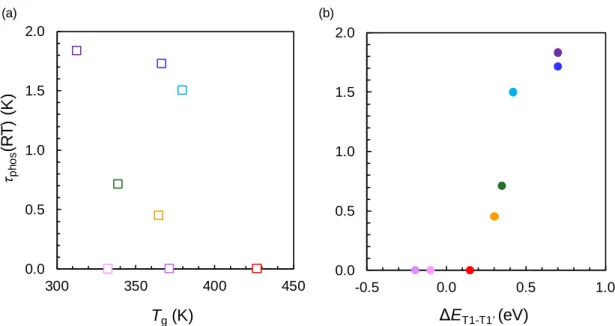
Based on these results, we could not find a correlation between Tg and τphos(RT), indicating that the triplet exciton lifetime does not depend on the thermal stability of the organic semiconducting host matrix (Figure 2-6a). In contrast, the τphos(RT) value was strongly dependent on the ET1 of host matrix (Figure 2-6b). The ET1 gaps between host and guest (ΔET1-T1’) are summarized in Table 1. Although the ET1 gap between mCP (2.85 eV) and DMFLTPD-d36 (2.50 eV) would generally be considered sufficient for preventing quenching in OLEDs, the τphos(RT) was 0.71 s. In the case of DPEPO (3.20 eV), τphos(RT) increased to 1.72 s. These results indicate that reverse energy transfer from triplet state of guest to host is the main factor for the nonradiative decay of triplet excitons and that a large ΔET1-T1’ is required to reduce this process. To confirm this triplet energy transfer process, mixed host matrices of β-estradiol or DPEPO (3.20 eV) and mCBP (2.82 eV) with various concentrations were investigated (Figure ex2-1, Appendix). Although τphos(RT) was almost constant for concentrations of mCBP below 10 wt%, τphos(RT) drastically decreased for concentrations of mCBP over 10 wt%. This can be explained by
0.0 0.5 1.0 1.5 2.0
300 350 400 450
Tg(K) τphos(RT) (K)
0.0 0.5 1.0 1.5 2.0
-0.5 0.0 0.5 1.0
ΔET1-T1’(eV)
(a) (b)
Figure 2-6. The relationship between τphos(RT) and a) Tg or b) ΔET1-T1’ using DMFLTPD-d36 doped films.
Chapter 2 2. 2. Results and discussion
improved Dexter energy transfer from T1 of the emitter to the T1 of mCBP because of a shorter distance between them without greatly modifying the matrix rigidity.
The LL-RTP behavior was also examined for vacuum-deposited films to check the dependence of the fabrication process (Figure 2-7).
Both the amorphous melt-casted glass films and the vacuum-deposited films show almost identical emission decay profiles, indicating that the preparation method has no critical influence.
To understand the thermal activation of the reverse energy
transfer from guest to host molecules, the phosphorescence decay curves of DMFLTPD- d36 doped into β-estradiol, DPEPO, PPT, mCP, mCBP, and TrisPCz glass films were obtained at 5–400 K (Figure ex2-2, Appendix). The calculated τphos(T) as a function of the reciprocal of temperature are shown in Figure 2-8a. The τphos(T) values in the low temperature region below 150 K were almost equal for all of the hosts. In contrast, τphos(T) rapidly decreased as temperature increased above temperature thresholds that show a correlation with the ET1 of the host molecules. The nonradiative deactivation rates (knrT
(T)) were calculated from the temperature dependence of τphos(T) and are plotted in Fig.
2-8b.
Figure 2-7. Transient phosphorescence decay curves of melt-casted films (closed symbols) and vacuum deposited films (open symbols).
1.E-03 1.E-02 1.E-01 1.E+00
0 5 10 15
Time (s)
10 0
10 -1
10 -2
10 -3
Normalized afterglow intensity (a.u.)
melt-casted β-estradiol DPEPO PPT
vacuum deposited DPEPO PPT
2. 2. Results and discussion
In the low temperature region, all of the host–guest films exhibited a first-order exponential decay of knrT (T) in the range of 10−3 to 10−1 s−1. This region can be attributed to the nonradiative deactivation of the guests knr,guestT (T) because most of the host matrices show similar trends. By increasing temperature, knrT (T) rapidly increased at certain temperatures that again correlate with the ET1 of the host molecules. This increase can be assigned to the nonradiative deactivation of the host knr,hostT (T). Because the knr(RT) of mCP, mCBP, and TrisPCz were much larger than the kphos of the emitter
Guest Host
T1
➀➁
③
➃➄
➅
➆⑧
S0
T1
S1
knr, guestT(T) kphos
Reverse energy transfer
∆ET1-T1’< 0.5 eV
S0’
T1’
knr, hostT(T)
Host Guest
N
N N
kphos
a
b
(a) (b)
(c)
knrT(s-1) τphos(T) (s)
Figure 2-8. a) Temperature dependence of τphos(T). b) Temperature dependence of knrT
(T). c) Energy diagram of the materials and the radiative, nonradiative, and energy transfer scheme.
Chapter 2 2. 2. Results and discussion
DMFLTPD-d36 (4.8 × 10⁻¹ s−1 ),11 the triplet excitons in these host–guest films were deactivated by the host molecules and exhibited a shorter τphos(T) at 300 K. Because the knr,hostT (T) value is related not to Tg but the sample temperature, the main deactivation pathway can be ascribed to the thermally assisted reverse energy transfer from the T1 of the guest to the T1 of the host (Fig. 2-8c). From these results, I conclude that knr,hostT (T) is dominant at room temperature and that a very large ΔET1-T1’ of around 0.5 eV is required to confine the long-lived triplet excitons.
To confirm the effect of ΔET1-T1’ on LL-RTP, I also investigated a lower ET1
emitter of deuterated LL-RTP emitter (DPADBC-d25) 9b,11 (Fig. 2-2b). The ET1 for DPADBC-d25 of 2.20 eV obtained from the phosphorescence spectrum in 2-MeTHF solution at 77 K is much lower than that of 2.50 eV for DMFLTPD-d36 (Fig. 2-5). This lower ET1 value of the emitter results in a large ΔET1-T1’ when paired with most of the host molecules. Figure 2-9a shows the emission decay curves of DPADBC-d25 doped into fil
Time (s)
Normalized afterglow intensity (a.u.)
➀➁③④⑤
⑥
⑦
β-estradiol (➀) DPEPO (➁)
PPT (③) mCP (④) mCBP (⑤) TrisPCz (⑥) TPD (⑦) mCBP EL
DPADBC-h25:DPEPO(➁’)
1.5 s
Wavelength (nm)
Electr
Figure 2-9. Transient decay profiles; a) optically excited, b) electrically excited phosphorescence decay curves and c) EL spectra during (blue) and at different times after (red) excitation of DPADBC-d25.
2. 2. Results and discussion
ms of each of the host molecules.
Although the τphos(RT) of 1.25 s in β- estradiol is slightly shorter than the reported value 11 due to the incomplete deuteration (Figure S5), the films with β-estradiol, DPEPO, PPT, mCP, and mCBP as host showed almost identical emission decay profiles at room temperature (Figure 2-10). These results indicate
the contribution of knr,hostT (RT) in these hosts is sufficiently small because of a large ΔET1- T1’ of over 0.6 eV. The τphos(T) values decreased with decreasing ΔET1-T1’ in the hosts of TrisPCz, TPD, and α-NPD. Thus, a very large ΔET1-T1’ of around 0.5 eV is essential to prevent the reverse energy transfer of long-lived triplet excitons from guest to host. This required ΔET1-T1’ values are much larger than the conventional host–guest energy gap of 0.1–0.2 eV used in conventional OLEDs.14Based on the Boltzmann statistics, the energy gap of 0.5 eV corresponds to a significant difference of two states’ population of ~109. Thus, vibrational coupling between guest and host molecules and the local fluctuation of their molecular energy during very long triplet lifetime would enable the guest to host energy transfer.
Furthermore, the experimental data between τphos(RT) and ΔET1-T1’ using DMFLTPD-d36 and DPADBC-d25 as the guest were compared with the equation (2-2, 3).
Here, knr,hostT(RT) was assumed to be based on an Arrhenius equation considering Boltzmann distribution.
(τphos= 1.03 s)EL
0.0 0.5 1.0 1.5
0.0 0.2 0.4 0.6 0.8 1.0 1.2 ΔET1-T1’(eV)
τphos(RT) (s)
PL
Figure 2-10. Relationship between τphos(RT) and ΔET1-T1’ using DPADBC-d25 and the hosts.