103
Energy Exchange and
Excitation
of
Internal
Modes
in
Near
Separatrix Soliton Collisions
S.
V.
Dmitriev’,P.
G.
Kevrekidis**,N.
Yoshikawa’
Institute of Industrial
Science,the University of Tokyo
**Department
of Mathematics and
Statistics,Univ. of
Massachusetts
Solitary
wave
collisionsare
of interest ina
diverse variety of physical settings. We discussthe
near
separatrix soliton collisions ina
number ofintegrable, Hamiltonian systems underweak and moderateperturbations. Intheweakperturbation regime,theradiationless
energy
exchange reported in
our
recent workscan
take place under the conditions ofattractive
soliton interactions and of the number of free soliton parameters being larger than the
number of invariant properties. In the moderate perturbation regime, the soliton internal
modes
can
be excited fora
particular sign of perturbation parameter and theycan
stronglyenhance the energy exchange between solitons to the extent of complete annihilation of
some
ofthem.1. Introduction
Solitons
are
the exact solutions to the integrable nonlinear equations. Thereason
whysolitons
are so
stable is the infinite number of conserved quantities for such equations.Dynamical properties of the system
are
severelyrestricted
by the existence ofan
infinitenumber of
conservation
laws. However, the integrable equations describeroughlyidealizedphysical systems and realistic applications demand the inclusiori of various perturbations.
In the literature there exist quite
a
lot of dataon
the soliton collisions in various nearlyintegrable and non-integrable models [1-8]. Collisions between intrinsic localised modes
have also been studied[9]. It hasbeendemonstratedthat the result of solitoncollision,
even
in the regime of weak perturbation, may differ drastically from the prediction obtained
fromtheintegrable limit [10-13].
In this
paper
we
continue investigation of the phenomena related to the collisionsbetween solitons. We formulatenecessary conditions to observe
a
strong energy exchangein the weakly perturbed integrable systems. In the
case
of weak perturbation, theenergy
exchange is the only possible manifestation of inelasticity of collision. We demonstrate
that, in the
case
of moderate perturbation, the soliton internal modescan
be excited andthey
may
strongly affect the outcome of the solitoninteractions.
It is well known that theunusual effects observed in soliton collisions
can
be attributed to theexistence
of theseparatrix solutions [7,8,14]. We divide the separatrix solutions into two classes, the
separatrices in the space of parameters defining the energy of solitons and the separatrices
104
in the space of parameters that do not affect the soliton energies. It is then demonstrated
that the existence of the separatrices ofthe second kind implies the probabilistic nature of
the soliton collisions in the perturbed systems.
2. Three olitoncollisions in SGE
Theintegrable sine-Gordon equation (SGE)
$u_{ll}- u_{Xl}+\sin u$$=0$, (1)
has the following discreteanalogue
$\frac{d^{2}u_{n}}{\iota\#^{2}}-\frac{1}{h^{2}}(u_{n- 1}- 2u_{n}+u_{n+\mathfrak{l}})+\sin u_{n}=0$, (2)
where $h$ is the lattice spacing and $h^{2}$ will be used
as a
measure
ofdiscreteness.
When$h^{2}arrow 0$, discrete equations (2) reduces to the continuum limit (1). $h^{2}\sim 1$, $h^{2}\sim 0.1$, and
$h^{2}\sim 0.01$
are
thecases
of strong, weak, and extremely weak discreteness. The physicalmeaningofthisclassification willbecome clear later.
Here
we
describe the possible outcome of collision between three $\mathrm{k}\mathrm{i}\mathrm{n}\mathrm{k}\mathrm{s}/\mathrm{a}\mathrm{n}\mathrm{t}\mathrm{i}\mathrm{k}\mathrm{i}\mathrm{n}\mathrm{k}\mathrm{s}$ inSGEin the regime of extremely weak
discreteness
$(h=0.04)$.
One particularthree-soliton SGE solution is defined by nine parameters. Three ofthem
influence the total
energy
of the system. In thecase
of three-kink solution theseare
thevelocities of the kinks $v_{j}$ , $j=$1,2,3. Three other parameters define the positions of
solitons $(x_{0})$
,
at $t$$=0$ (beforethecollisions) and threemore
define thetopological chargesofsolitons, $q=1$ for kink(K)and $q=-1$ for antikink$(\overline{\mathrm{K}})$
.
Energy $E$ and momentum $P$ of
one
SGE kinkare
definedbyits velocity $v$as
follows$E=SS$, $P=$ !v55, $\delta^{-1}=\sqrt{1- v^{2}}$ (3)
The SGE has separatrix solutions of two different kinds. One is the separatrix in the
space
ofparameters that define the totalenergy
of the system. For example, there existsa
twO-soliton separatrix solution with the
energy
equal to 16 (total momentumis assumedtobe equal to zero). This solution is
an
intermediateone
between the kink-antikink solutionwith the
energy
oftwo kinks greaterthan 16and the breather solution with theenergy
lessthan
16. Some
three-soliton separatrix solutions of thiskind
are
given in [14]. The secondtype ofseparatrix solutions
can
be found in thespace
ofparameters that do not affect thetotal
energy
[14].We number the kinks in
a
way that at $t$$=0$ (before the collisions) their positionsare
related
as
$(x_{0})_{\mathrm{I}}<$$(\mathrm{x}\mathrm{O})2<$$(’ 0)_{7}$. and momenta
as
$P,$ $>72$ $>$$\mathrm{P}$.
Because of Lorentzinvariance,
we
have only two independent momenta,say,
$P_{1}$ and $P_{2}$.
Herewe
vary
onlyone
ofthem, $P_{1}$, setting for the others $P_{2}=0$ and $P_{\tau}$. $=-P_{1}$, i.e.,
we
restrict ourselves tosymmetric collisions. Consideration of non-symmetric collisions does not bring
any
new
important physical effects.
Parameters ofkinks such
as
topological charges, $q,\cdot$ ?or
initial positions, $(x_{0})$,
’ do notaffect
energy
and momentum of the system and thus, there isno
physical meaning to $a$priori discriminate
any
setof theseparameters.Three solitons
can
pass
through each otherin
twosuccessive
twO-soliton collisionsor
in
a
three-soliton collision. Ina
weakly perturbed SGE, twO-soliton collisions must be105
momentumconservation. For this
reason
weare
interested inthree-solitoncollisions, whichcan
be achievedby proper choice of the initial coordinate of, say, the middle kink, $(x_{0})_{2}$.For the symmetric collisions it is convenient to set $(x_{0})_{1}=-\mathrm{O}_{0})_{3}$
so
that the three-solitoncollisions
are
expectedwhen $(x_{0})_{2}$ is nearlyzero.
Thus,
we
have the following parameters: momentum, $P_{1}$, the initial coordinate of themiddlekink, $(x_{0})_{2}$, which defines the collision phase; and finally, the topological charges
of the kinks. There
are
eight variants to assign the charges to three kinks. Taking intoaccount the symmetry, the eight variants
are
divided into threegroups
of topologicallydifferent collisions: $\mathrm{K}\overline{\mathrm{K}}\mathrm{K}=\overline{\mathrm{K}}\mathrm{K}\overline{\mathrm{K}}$
, KKK$=\overline{\mathrm{K}}\overline{\mathrm{K}}\overline{\mathrm{K}}_{\tau}$ and $\mathrm{K}\mathrm{K}\overline{\mathrm{K}}=\overline{\mathrm{K}}\mathrm{K}\mathrm{K}=\mathrm{K}\overline{\mathrm{K}}\overline{\mathrm{K}}=\overline{\mathrm{K}}\overline{\mathrm{K}}\mathrm{K}$
.
We willrefertothe
groups
referringtotheir first members.$- 3- 2- 1230\ovalbox{\tt\small REJECT}_{\sim}^{(\mathrm{a})}10.0P_{j}-- 2_{K}- 1-\mathrm{t}_{8- 0.4}230_{\overline{K}}.\ovalbox{\tt\small REJECT}_{0.0}^{(\mathrm{a}’)}1K$
0.5 $f(P)$ 1.0 .8
$\iota$ . $l$ .
$\mathrm{I}\mathrm{o}.4.(x_{0_{\mathfrak{s}}})_{2}^{0.8}$
$- 1- 2201\ovalbox{\tt\small REJECT}^{(\mathrm{b})}P_{j}- 1- 2201\overline{KK}K$
.
..
. $B$.
$B$ 1 $( \beta’)-K\frac{K}{K}$ 0.0 0.5 1.0 $- 0^{\cdot}.2$ -0.0
0.1 0.2 $f(\tilde{P})$ $(x_{0})_{2}$ $\iota$ . 1 $K$ 1 1 1(
$\mathrm{b}’-$)
$K$ $\overline{K}$ $B$ $K$ $\overline{K}$ $K$ $n$ 1 . 1 . $v$ $\mathrm{t}$ 1Fig. 1. Attractive three-soliton collisions, $\mathrm{K}\overline{\mathrm{K}}\mathrm{K}$. Right panels show the momenta of
particles after collision $\tilde{P_{j}}$
as
thefunctionsofcollisionphase, $(x_{0})_{\sim}$,’ and left panels show the
corresponding PDF. Collision with
a
high velocity, $4=2.5,$ in $(\mathrm{a},\mathrm{a}\mathrm{f})$ results only inquantitative change of kink parameters while collision with
a
small velocity, $P_{1}=0.8$, in$(\mathrm{b},\mathrm{b}’)$
may
resultin
fusion ofa
kink-antikink
pair ina
breather.In the following
we
present the numerical results in the following way. We plot thesoliton momenta after collision $\tilde{P_{j}}$
as
the functions of $(x_{0})_{\wedge}$, for two different magnitudes108
inelastic collisions
we
plot the probability density function (PDF) [,-)$(\tilde{P})$, such that$V_{\overline{\rho}}$ $t^{\sim}OP_{K}$ $=1$
.
The PDF representsthe result of inelastic collisions.First
we
note that, KKK and KKK collisionsare
always elastic regardless $P_{1}$ and$(x_{0})_{\underline{0}}$ and only
$\mathrm{K}\overline{\mathrm{K}}\mathrm{K}$ collisions
can
be
inelastic.
This is because only in thiscase
thecollision
is
of attractive type, when solitoncores
of all three kinkscan
merge
and theradiationless energy exchange between solitons
can
happen. Thus, if the probabilities forkinks to have positive
or
negative chargeare
equal, thenenergy
exchange between threecolliding kinks
can
be expectedonlyintwocases
ffom eight.Let
us
focuson
the attractive three-soliton collisions, KKK. In Fig. 1we
show that fordifferent magnitudes of $P_{1}$ there
are
possible two qualitatively different scenarios ofthree-kinkcollisions. When $P_{1}$ is sufficientlylarge $(>P_{1}^{*})$, only quantitative change in the system
is possible [see Fig. 1 $(\mathrm{a},\mathrm{a}\mathrm{f})$, where $P_{1}=2.5$]. In this case, kink momenta after collision $\overline{P_{j}}$
are
different from the pre-collision momenta. Note that the right panels of Fig. 1 show themomenta of particles after collision $\tilde{P_{j}}$ while the left panels show the corresponding PDF.
The thresholdvalue of momentum $P_{1}^{*}$
increases
withincrease
inperturbationparameter, $h^{\sim}$’
Note that inelasticcollisions
are
observed in thevicinityof $(x_{0})_{-},$ $=0$,that is, when all threekinks participatein the collision. For $P_{1}<P_{1}^{*}$, kink and antikink
can
merge
ina
breather [seeFig. 1 $(\mathrm{b},\mathrm{b}\mathrm{f})$, where $P_{1}=0.8$]. Here and later
we
assume
that the two kinks constitutingbreather have equalmomenta, that is whythe two lines in (bf)
merge
when $\mathrm{K}\overline{\mathrm{K}}$ pairmerge
in
a
breather (B). We note that the result of collision is extremely sensitive to the collisionphase, $(x_{0})_{\wedge}.$,inthevicinityof $(x_{0})_{\sim},=0$, especially for small collisionvelocities,
as
in (b1).3. Threeparticle model
To give
a
clear explanation to the peculiarities ofthree-kink collisions described in thepreceding section, let
us
consider the dynamics of three point-wise particles inone-dimensional
space.
Particles havemasses
$m$$=8$, which is the restmass
of SGE kink, andtheycarrytopological charges $q_{j}=\pm 1$
.
Particles with $q=1$ and $q=-1$ will be called kinksand antikinks by analogy with SGE solitons. We
assume
that particles $i$ and $i$ havingcoordinates $x_{i}$ and $x_{j}$ interact viapotential
$U_{lj}(r_{j})=16+q_{j}jq_{j} \frac{16}{\infty \mathrm{s}\mathrm{h}(r_{jj})}$
.
$r_{lj}$. $=x_{j}-x_{i}$, (4)which in
a
crude approximation simulates the interactionbetween two SGE$\mathrm{k}\mathrm{i}\mathrm{n}\mathrm{k}\mathrm{s}/\mathrm{a}\mathrm{n}\mathrm{t}\mathrm{i}\mathrm{k}\mathrm{i}\mathrm{n}\mathrm{k}\mathrm{s}$.
Withoutthe loss ingenerality
we
assume
thattotal momentuminthe system is equalto zero,$m(\dot{x}_{1}+ \mathrm{i}_{2} + \mathrm{i}_{3}.)$$=0$
.
Introducingnew
variables $x_{2}-x_{1}arrow\sqrt{3}\alpha+\beta$, $x_{3}-x_{1}arrow 2\beta,$$tarrow\sqrt{2m}t$, the three particle motion
can
be presented by the Hamiltonian ofa
unit-massparticle moving inthe twO-dimensional potential:
107
Now
we
solve numerically the equations of motion for three particles and present thethree-particle dynamics in the $(\alpha,\beta)$-plane.
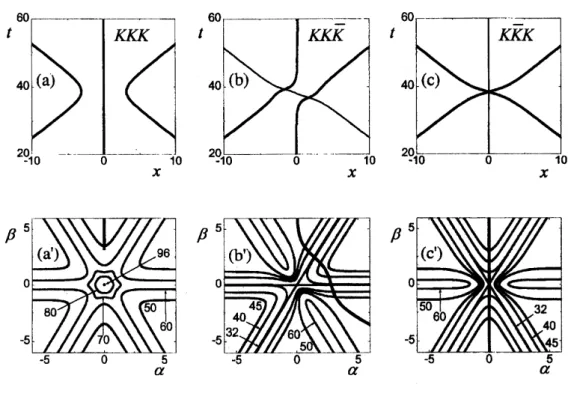
In Fig. 2, we compare the KKK, KKK, and KKKcollisions. For the three cases, the
scattering potentialin Eq. (5)is differentbecause thecharges of particles
are
different. Whensolitons
move
in $(x,t)$space
toward the collision point, the representative particlemoves
inthe $(\mathrm{a},\mathrm{p})$-plane along $\alpha$$=0$ toward the origin from the positive side. In (a), the like
particles repel each other and, in $(\mathrm{a}’)$, particle hits the potential barrierand
goes
back. In (b),the particles collide in two successive twO-soliton collisions. In this case, particle in $(\mathrm{b}$’$)$
passes
thetwopotential troughsone
after another and thenmoves
awayfromtheorigin in thedirection symmetrically equivalent to the direction it
came
from. Cores of all three particlesmerge in the collision in (c) and the representative particle in (cf)
moves
along the ridge ofthe scattering potential, passingthe origin. This kind of motionis motionalong theseparatrix
and, unlike themotion in (a1)and (bf),itis
very
sensitiveto small deviations ffom $(x_{0})_{\underline{\tau}}=0$ .Fig. 7 Comparisonof $(\mathrm{a},\mathrm{a}’)$ KKK, $(\mathrm{b},\mathrm{b}’)$
KKK’
, and $(\mathrm{c},\mathrm{c}’)$ KKK symmetric collisionsfor $(x_{0})_{1}=-(x_{\zeta\}})_{3}=-25$, $(x_{0})_{\mathrm{q}}\sim=0$ and $(\dot{x}_{0})_{1}=-(\dot{x}_{0})_{3}=0.6$ , $(\dot{x}_{0})_{2}=0$
.
Top panelsshow the three-particle dynamics in the $(x,t)$
space
while bottom panels show thecorresponding dynamics of
a
particle inthe $(\alpha,\beta)$-plane.The sensitivity of the result of near-separatrix collision to small deviations from
$(x_{0})_{\wedge},$ $=0$ is demonstrated by Fig. 3, where
we
set $(x_{0})_{2}=1.2$ in $(\mathrm{a},\mathrm{a}’)$, $(x_{0})_{2}=0.2$ in $(\mathrm{b},\mathrm{b}’)$, and $(x_{\mathrm{t})})_{\underline{1}}=$0.123323
in $(\mathrm{c},\mathrm{c}\mathrm{f})$.
In Fig.3
$(\mathrm{a},\mathrm{a}’)$, the deviation from the separatrix israther large and only quantitative change in the particle parameters
can
beseen.
In $(\mathrm{b},\mathrm{b}’)$,collision is near-separatrix and here kink and antikink merge in
a
breather. Taking into108
as
an
illustration of the break-up ofa
breather colliding witha
kink. Collision in $(\mathrm{c},\mathrm{c}\mathrm{f})$illustrates the origin of the fractal soliton scattering [4,10,11]. Note that the representative
particle can oscillate in the scattering potential moving along $\beta=0$ line. This trajectory
(periodic orbit) is obviously unstable and in the presence ofany perturbation the particle
will exponentially deviate from it. In $(\mathrm{c},\mathrm{c}’)$,
we
choose $(x_{0})_{2}$ ina
way that particle is sentalmost along this trajectoryand before it leavestheorigin it makes
a
few oscillationsin thesaddle shape potential. Notethat
every
time when particlepasses
the origin in $(\alpha,\beta)$-planeall three particles in $(x,t)$-plane collide at
one
point. The time the particle spendsnear
theorigin of $(\alpha,\beta)$-plane is the lifetime of the three-soliton bound state. When the scattering
potential has periodic orbits, the probability$p$ to observe
a
bound state with the lifetime $T$decreases algebraically, $p-$$T^{-\gamma}[11,15]$
.
We also note that the collisions presentedin Fig.3 result in strong symmetry breaking, i.e., after the collision, particles do not
recover
theirpre-collision velocities, though, the totalmomentumand
energy are
conserved exactly.Fig.
3.
The sensitivity of the result of near-separatrix collision toa
small deviationsfrom $(x_{0})_{-},$ $=0$ demonstrated by setting $(\mathrm{a},\mathrm{a}’)(x_{0})_{-},$ $=1.2$, $(\mathrm{b},\mathrm{b}\mathrm{f})(x_{0})_{-},$ $=0.2$, and $(\mathrm{c},\mathrm{c}\mathrm{f})$
$(x_{0})_{2}=$0.123323. In $(\mathrm{a},\mathrm{a}’)$ only quantitative change in the system
can
beseen
aftercollision. In the near-separatrix collision shown in $(\mathrm{b},\mathrm{b}\mathrm{f})$
,
kink and antikinkmerge
ina
breather. $(\mathrm{c},\mathrm{c}’)$ illustrates theoriginofthefractal soliton scattering.
3.
Near-separatrix excitation of internal modesThe role of internal modes in near-separatrix collisions will be demonstrated for the
109
$i \psi‘+\frac{1}{2}\psi$
.
$+$$1$$\psi$$1^{2}\psi$$=\epsilon 1$$\psi$$1^{4}\psi$
$\mathrm{C}6$)
For extremely weak discreteness, 1$\epsilon 1\sim 0.01$ , the only manifestation of perturbation is
the
energy
exchange between colliding solitons. Fora
moderate perturbation, 1$\epsilon$ $\mathrm{I}\sim 0.1$,the soliton internal modes
can
be excited for $\epsilon<0$ andnew
physical effectscan
beobserved. Weset $\epsilon$ $=-0.15$ and study the collisions between twosymmetric solitons with
initial velocities $v_{1}=-v_{2}=0.15$ and amplitudes $A_{1}=A_{0,\sim},$ $=1$ for different collisionphase,
$-\pi<\varphi\leq\pi$. The separatrix collision corresponds to $\varphi=0.$ In Fig. 4
we
show theamplitudes of solitons
as
the functions of time. Solitonscollide atabout $t=60$.
Collisionin (a) at $\varphi=1$ is rather far from the separatrix and the inelasticityofcollision is small. At
$\varphi=0.5$ in (b) the energy exchange between solitons is already large but the internal
modes
are
not excited yet. In (c), thecollision is already closetotheseparatrix,
$\varphi=0.18$,and not only the
energy
exchange between solitons but also theexcitation
of the solitoninternal mode become
very
pronounced. Collision in (d) at $\varphi$$=0.01$ is very close to theseparatrix and
one
of the solitons annihilatescompletely. Theenergy
ofthis soliton is firstgiven to theinternal mode of the second soliton and then the
energy
ofthe internal modegradually transforms into the
energy
of the remaining soliton that is why the lowerenvelop in (d)increases.
$\triangleleft^{\triangleright \mathrm{t}}$
$\triangleleft$
Fig. 4. Amplitudes of the two colliding solitons
as
the functions of time. Only collisionphase $\varphi$ is different for the four collisions presented in
$(\mathrm{a})-(\mathrm{d})$
.
Separatrix solutioncorresponds to $\varphi=0$
so
that moving from (a) to (d) the collision becomes closer to theseparatrix. In (a), the inelasticity of collision is rather small, in (b) the
energy
exchangebetween solitons becomes large, in (c) the energy exchange is accompanied by the
excitation of
a
large internal mode, and in (d)one
of the solitons disappears giving its110
4. Discussion and conclusions
Withthe
use
of the SGE andNLSEas
examples,we
haveformulated the twonecessary
conditions for the radiationless
energy
exchange ina
nearly integrable system andconsequently, for the probabilistic nature of their
interaction.
The conditionsare:
theenergyexchange shouldnotbe forbiddenbythe conservationlaws existing in theperturbed
system and the collision should be of attractive type. In the weakly discrete SGE these
conditions
are
satisfied when at least three kinks participate in the collision (because eachkink has
one
parameter and thereare
two constraints from theenergy
and momentumconservation laws) and only when kinks meet each other in the spatial order KKK
(conditionof theattractive collision).
For example, in Korteweg-de Vries $(\mathrm{K}\mathrm{d}\mathrm{V})$ equation, collisions
are
not probabilisticbecause soliton interactions
are
always mutually repulsive. In the NLSE, in-phase solitonsattract, while out-Of-phase solitons repel each other. One soliton has two parameters
(amplitude and phase) and for many practically important perturbations there
are
twoconserved quantities, theHamiltonianand
norm
of the solution.Thus, theenergy
exchangebetween two nearly in-phase NLSE solitons is possible in the
presence
ofa
weakperturbation and the probabilistic character of soliton interactions should berespected.
In the limit of
a
weakperturbation, language of the probability theory naturally entersthe soliton physics. For example,
one
can
talk about probability to observean
inelasticcollision
or
about the lifetime ofa
multi-soliton bound state.References
1. $\mathrm{M}.\mathrm{J}$. Ablowitz and H. Segur, Solitons and the Inverse Scattering Transform, SIAM
(Philadelphia, 1981).
2. D. K. Campbell, J. F. SchonfeldandC. A.Wingate, Physica$\mathrm{D}9,1$, (1983);M. Peyrard
and D. K. Campbell, Physica $\mathrm{D}9,33$, (1983); D. K. Campbell and M. Peyrard,
Physica$\mathrm{D}18$,47 (1986).
3. P. Anninos, S. Oliveira and R. A. Matzner,Phys. Rev. $\mathrm{D}44$, 1147 (1991).
4. J. Yang and Y.Tan, Phys. Rev. Lett.85,
3624
(2000).5. P. G. Kevrekidis,Phys. Lett. A285,
383
(2001).6. D. Cai, $\mathrm{A}.\mathrm{R}$
.
Bishop and N. Gr\"onbech-Jensen, Phys. Rev.$\mathrm{E}\Re$,7246
(1997).7. Y. Nishiura, T. Teramoto and K.-I. Ueda,Chaos 13,962 (2003).
8. Y. Nishiura, T.Teramoto, and K.-I. Ueda,Phys. Rev. $\mathrm{E}67$,056210(2003).
9. Y. Doi,Phys. Rev. $\mathrm{E}68$, 066608(2003).
10.S. V. Dmitriev, Yu. S. Kivshar andT. Shigenari, Phys. Rev. $\mathrm{E}64$, 56613 (2001).
11.S. V. Dmitriev and T. Shigenari, Chaos 12,
324
(2002).12.
S. V. Dmitriev, D. A. Semagin, A. $\mathrm{A}$,Sukhorukov
andT.Shigenari, Phys. Rev. $\mathrm{E}$ \not\in 6,
46609
(2002).13.
S. V. Dmitriev, P. G. Kevrekidis, B. A. Malomed and D. J. Frantzeskakis,Phys. Rev. $\mathrm{E}68$,
056603
(2003).14. A. E. Miroshnichenko, S. V. Dmitriev, A. A. Vasiliev and T. Shigenari,
Nonlinearity13, 837 (2000).