タイトル 中国山間部農村における農民専業合作社の実証研究
−陝西省南部の現地調査に基づいて−
著者 李, 杰; LI, Shunjue 引用
発行日 2016‑09‑30
2016 年度 博士論文
中国山間部農村における農民専業合作社の実証研究
-陝西省南部の現地調査に基づいて-
An Empirical Study on Farmers Specialized Cooperatives in Mountainous Countryside of China -Based on the Fieldwork in Southern Shaanxi Province
北海商科大学 大学院商学研究科
21370037 李顺杰
CONTENT
INTRODUCTION... 2
Part I Research Background and Development Status of FSCs... 9
Chapter 1 Research Status, Significance, and Methodologies... 9
Section 1 Survey of Preceding Studies on Cooperatives...9
Section 2 Research Significance...20
Section 3 Research Methodology...30
Chapter 2 Development of Cooperatives in China...33
Section 1 What is Farmer Specialized Cooperative? An Overview... 33
Section 2 Development Status of FSCs...41
Section 3 Functions of the FSCs in the New Rural Construction... 54
Part II An Empirical Study on FSCs in Zhen'an County...59
Chapter 3 The Development of FSCs in Zhen'an County... 59
Section 1 Progress of Government Policies... 59
Section 2 The Current State of FSCs in Zhen'an County... 68
Section 3 Development Trend and Types of FSCs...77
Section 4 Observations on Three Typical Cases of FSCs... 82
Section 5 Reflections on the Cases Study... 103
Chapter 4 A Field Research on the S Village... 108
Section 1 An Investigative Report on S Village... 108
Section 2 Operations of FSCs at the Local Level... 122
Section 3 The Distinctive Features of the FSCs in S Village... 138
Section 4 Reflections on the FSCs in S Village... 146
Chapter 5 An Additional Case and Rethinking of FSCs... 151
Section 1 A Successful Example of Farmer Cooperation... 151
Section 2 The Changing Form of Government Actions...162
Section 3 The Influence of FSCs on Mountainous Villages...169
Part III Problems and Solutions of Farmer Specialized Cooperatives...178
Chapter 6 Problems and Countermeasures... 178
Section 1 Problems in the Development of FSCs... 178
Section 2 The Regular Countermeasures...184
Section 3 Establishing A New Type of FSCs... 200
CONCLUSION... 208
REFERENCE... 217
An Empirical Study on Farmers Specialized Cooperatives in Mountainous Countryside of China
-Based on the Fieldwork in Southern Shaanxi Province INTRODUCTION
The hometown to the majority of Chinese is a place always radiating the glory of memories of rivers on foot of hills, folk guys, relatives, the old but still “fashionable” shacks, along with the profound feelings of homesick.
In comparison with the sky-scrapers, chaos shopping malls and busy street in cities, the green mountains with briskly flowing brooks, and the farmland emitting pleasant smell of wheat and corn to the heaven can definitely comfort the exhausted mind in cities with its natural tranquility. The beauty of hometown in the countryside always impresses people with warm comfort and familiar simpleness.
The report on “Investigation on Peasants' Return and Starting Their Own Business in 100 Counties” conducted by the Agriculture Bureau of China said that the cling to home land is the key in peasants' decision to go back and start business in their hometown. Fei Xiaotong defined the cling as the psychological complex, such as feelings, attitudes and wishes, that peasants
harbor toward the villages and motherlands where they live in. The rate of urbanization in China has been more than half in 2011 (51.27%), the population in urban area, for the first time in history, exceeded that living in countryside. But another fact which can not be ignored in the meanwhile is that there are still a huge amount of seasonal migrating peasants coming back and force between their hometowns and cities where they are working in. The scale of this migration in 2011 is 2,300 million, and in 2013, it amounted to 2,680 million. There are still many “ citizens ” renting farmland and farmhouse in suburbs to plant vegetables and enjoy the leisure time, experiencing the joy and calmness of this mini or duplicated countryside.
All of these actually showed the unforgettable memories of countryside, a place which is inseparable to human civilization.
Despite the beautiful memories, countryside, especially in the rural mountainous area in northwestern China however, has been going downhill so quickly in the last two decades. On one hand, the decline of countryside is an undeniable fact; on the other hand, it is an issue of development that should be confronted in the area because of its importance due to the geographic features and the large size of population in China. Besides many
initiatives conducted in history, the farmer specialized cooperatives (FSCs) is a new try in promoting the development of countryside. While the practices of farmer specialized cooperative not only closely relate to the agricultural production and the economic development in countryside, the various types of farmer specialized cooperatives also influence deeply on those aspects such as rural culture and custom, form of habitation, ways of living etc.
How could the farmer specialized cooperatives survive and develop themselves in the mountainous area? What are the unique factors influencing the development of farmer specialized cooperatives? How can they administrate farmer specialized cooperative and make it the driver to the harmonious and coordinated development in rural countryside? These are the questions that this research is trying to explore, which also serve as a primary motive of doing this research.
Since the implementation of the Reform and Opening-up policy, the developing process of countryside can be divided into three stages. The first stage started right after the Third Plenary Session of the 11th Central Committee of CPC(the Communist Party of China). The nature of the policy was to reform the production relations in the countryside with the implementation
of the household contract responsibility system, and open the domestic market to the outside world, especially the coastal cities in south-eastern China.
The reform in countryside was actually finished in 1984, which greatly promoted the agricultural production.
Then came the second stage from the early 1990s till 2007. The starting year of the stage is hard to define because the focus of countryside development quickly shifted to the township enterprise with the restoration of agricultural production. Take township enterprises in Shangluo, Shaanxi Province for example, as shown in table 1, the township enterprises in Shangluo region had experienced major changes from 1979 to 1999. The changes not only reflected by number increase, from only 2,560 in 1983 to 61,301 in 1999, and the employment expanded from 27,780 to 196,722. These changes greatly promoted the economic development in the region. The total revenue of township enterprises amounted to 525,000 million yuan in 1999, about 123 times the number in 1983 (4,238 million); the net profit also increased 111 times, from 6.67 million to 740 million in 1999. With the rise and fall of township enterprises in the period, the harmonious development of countryside was neglected to some extent, “Some people becoming rich first” was the
policy encouraged by the central government of China. Terms such as “geti hu” (the small private business based on one person or family members) and
“xia hai” (means the person left their original position of being a governor or other occupations and try to be a business person) became a popular sign of the age. These factors therefore weakened the level of cooperation among peasants in their production, which contributed part of the reasons to the decline of the rural countryside.
The third stage is the era of the new countryside construction and the development of cooperative economy. The issue of the “ Farmer Specialized Cooperative Law of the People's Republic of China”in 2007 marked the beginning of the new era because the rural development and cooperation among peasants once again became the focus the central government.
In contrast to the rural development, cities in China have dramatically Table 1 Township Enterprises in Shangluo Region(1979-1999)
Year Enterprises No. Employment No. Revenue(M) Net Profit(10,000 )
1983 2560 27,780 4,238 667
1984 13939 73,343 8,316 1,017
1987 40910 155,141 30,000 4,943
1999 61301 196,722 525,000 74,000
Source: Made by the author according to data in Shangluo Annals
expanded in both of their land area and population. The statistics showed that the average level of urbanization (in terms of population) was 51.27%
in 2011. Some big cities such as Beijing, Shanghai, and Tianjin even exceed 80 percent, among which, Shanghai peaked at 89.3 percent. Other cities including Guangdong, Liaoning, Jiangsu and Zhejiang also went over 60%. In south-eastern China, countryside has well integrated with cities, the gap between cities and countryside in the area has been narrowed dramatically.
These served as good examples that industrialization can greatly promote the level of urbanization, which also served as the evidences of the success of the Opening-up policy.
However, the importance of countryside has been fully illustrated in China as well as in international communities. Karl Marx had interpreted the countryside as “water tank”regarding its importance. Chairman Mao stated that“the very core issue of China is the issue of countryside and peasants”.
Urbanization is the world trend as well as the strategic option of china.
But the target and final purpose of urbanization is to promote harmonious and coordinated development between cities and countrysides, human being and environment. The urbanization alone can not solve the problems in mountainous
countryside. Professor Zheng Fengtian said in China Economic Weekly(January 7, 2013)“the countryside in China will be relatively in the condition of decline in the long run”. But a“dying”countryside does not accord the basic national situation of China; also, it is negative to the realization of sustainable development. How to promote the rural development in mountainous countryside is another reason of conducting the research.
Part I Research Background and Development Status of FSCs Chapter 1 Research Status, Significance, and Methodologies
Section 1 Survey of Preceding Studies on Cooperatives
1.1 Status of Foreign Studies on Cooperatives
Researches all over the world have been conducted on various economic cooperatives. United Kingdom is the cradle of cooperative organization,which has a long history of more than 150 years. At the end of 1995, there were 532 agricultural associations, a membership of 259,000 farmers in UK, among which about half were comprehensive associations and half were purchasing associations. The sales of these cooperatives amounted to 6 billion pound, which account for 40 percent of the total sales of agricultural products.
Germany is also one of the countries with a long history of cooperative organizations. There are agricultural associations at three levels:
associations at local community; the united agricultural associations;
national agricultural associations. In 1994, there were 6,511 associations, covering 80 percent of farmers in the country, among which there were 2,124 associations also ran other businesses; 3,670 cooperative banks in the countryside with 19,700 branch banks across the country. France is another
important country of agricultural associations with a history of more than 120 years. In 1994,there were 16,800 associations, among which 3,800 associations were engaging in manufacturing and selling, and 13,000 associations focused on providing service. They had a membership of 720,000 farmers which account for 90 percent of the total.
Among those studies, the Japanese Agricultural Association (JAA), which share the common characteristics of farmer specialized cooperatives in China, takes a large proportion. Sakashita Akihiko (2006)analyzed the organizing mechanism and operation of JAA. Shichinohe Chosei(1974) also stressed the importance of cooperation and the role of JAA. Hagihara Shota(2013) categorized the JAA and analyzed its functions and problems. Yuan Fangcheng and Cai Yang (2009) observed the JAA's development in the 20th century and the cooperation between the JAA and farmers in bridging agricultural production and the market. Liu Guanghui(2008) and Liu Shuyun(2005) studied on the supporting system and policies of JAA. Zhou Yingheng, Li Qiang and Geng Xianhui focused on the current status of JAA, explained JAA's challenges from internal and external environment, discovered the the new trend including the decrease in its membership, streamlining the managing levels,
and shift of operational focus to the booming regional economy. Hayami Yujiro's study (2005) asserted that the rural cooperatives, which were represented by the academic associations, the JAA and other organizations, played an intermediate role of government and market to prevent agricultural production from market risks.
1.2 Domestic Research Status on Cooperatives
Meanwhile, abundant researches on various cooperatives in China was conducted. There were quite a few researchers focusing on the cooperatives practiced in 1950s. Chen Yiyuan (2005) analyzed the co-relations between the Cooperatives Campaign and the reinforcement of local governments, and he insisted that the campaign played a positive role in both restoring agricultural productivity and strengthening the control of local governments in countryside. Wang Yuling(2007) discussed that the transformation of individual small-scale peasant economy through agricultural cooperation and the rural industrialization after the founding of New China were two aspects of the same issue. Rural industrialization consisted of the development of industrial enterprises in rural areas and agricultural industrialization.
Moreover, numerous studies were conducted on peasants cooperation in the
countryside since the implementation of reform and opening-up policy. Liu Qian (2004) investigated a small town named Nanjie in Henan Province and established the “Nanjie Town” model. The town had managed to transform from a rural countryside to an industrialized communist community by exercising collectivism and public ownership. Shi Jinshan (2005) compared features and trend of farmers' cooperatives in US, Japan and Europe, then introduced the changes of their principles, scale problems and enterprise trend. Zhou Lianyun and Lu Xiaohui (2006) took a further step on the institutional innovation of farmer specialized cooperatives in the background of market economy. Li Yan (2007) studied the operations of cooperatives in Laiyang city in Shandong Province, where peasant activity, distribution enterprises, and agricultural service departments in the government were found to be well-organized into these cooperatives in order to satisfy the needs of agricultural enterprises that specialized in processing and export. These types of operations were thereafter known as the “Laiyang model”.
Since the “Farmer Specialized Cooperative Law of the People's Republic of China” was implemented, researches boomed at an alarming rate regarding the development of farmer specialized cooperatives. Xu Hongmei and Li Xiaohua
(2009) reviewed the problems of cooperatives in the last three decades since reform and opening-up. They illustrated the functions of cooperatives in promoting urbanization, industrialization and social employment,which greatly narrowed the gap between urban area and rural countryside. Zhang Xiaoshan (2009) stressed the importance of pillar enterprises and elite farmers to the development of farmer specialized cooperatives in China. Sun Xiaohong and Zhang Huijuan (2012) studied on specific distribution system of farmer specialized cooperatives.
Ma Yanli and Huang Shengzhong (2013, p.7) noted in the article Farmer Specialized Cooperatives: the Generalization of the Theory Research and the
Alienation of Practice that extension or generalization of cooperatives refers to a situation in which “the range of farmer specialized cooperative is not appropriately expanded, and various types of farmers' organizations are considered or registered as a farmer specialized cooperative”. Besides farmers' organizations, quasi-enterprises also contribute a lot to the generalization of farmer specialized cooperatives, by aiming to enjoy the same preferential policies designed for farmer specialized cooperatives only, such as tax relief and subsidies. These quasi-enterprises register as farmer
specialized cooperatives and become strong contenders for the national financial subsidies and projects designed for farmers. Their behavior damages the interests of other farmer specialized cooperatives, and is not in accordance with the national policy that is designed to support farmers and the development of rural areas.
Discussion of the quality of farmer specialized cooperatives has been a focus in academic fields. Huang Zuhui et al. (2009) believed that the fundamental nature of an farmer specialized cooperative, such as self-serving, democratic management, is changing. Xiong Wansheng (2009) observed that an farmer specialized cooperative is more in name than in reality. Ma Yanli et al. (2013, p.8) defined the root cause of alienation as being: “in practice, cooperatives are often controlled by the sponsors (enterprise) or major shareholders, the interests of ordinary members cannot be improved”.
Much of the above researches on farmer specialized cooperatives were mainly related to areas in good geographic locations. The research contents firstly include introductions to the principles of farmer specialized cooperative, development process and current status. Then a majority of the studies conducted analysis on problems such as scale problems and enterprise
trend, member investment, cooperatives inefficiency, cooperatives' seeking for rent and the relation between cooperatives and government. Finally, those researches raised suggestions and guidance for the development of farmer specialized cooperatives in China.
However, far less research was conducted in the mountainous countryside, which comprises the largest portion of China in terms of land area. Of the limited research carried out on farmer specialized cooperatives in mountainous areas, 3 aspects were mainly focused upon.
The greatest amount of research done in such regions focused on difficulties that farmer specialized cooperatives are faced with. Yang Kai (2012) conducted field research on farmer specialized cooperatives in the countryside of Wulin Mountain in Hunan Province. He put forward the difficulties such as limited farmland, shortage of capital, talent and labor force due to the low comparative benefits. Du Hongbo (2013) applied SWOT analysis to farmer specialized cooperatives in the Qin-ba mountainous area in Shaanxi Province to determine the strengths, weaknesses, opportunities and challenges that farmer specialized cooperatives faced in the region. Yang Jiangyun et al. (2013) explored the fundamental reasons preventing the
development of farmer specialized cooperatives from the perspective of the existing economic gap between eastern and western China, and from the perspective of geographic location. Li Hong (2014) conducted an investigation in Shouning County in Fujian province. He determined that farmer specialized cooperatives in the county confronted problems such as a lack of sense of cooperation, low levels of education, and poor management. Zhang Xiaoping (2010) also investigated problems with farmer specialized cooperatives in Gansu Province. He noted the existing problems of farmer specialized cooperatives that existed in name only without actual activity, as well as those suffering from poor brand management. Collectively, this above research highlighted the major barriers to the future development of farmer specialized cooperatives in China.
The second aspect of research conducted in mountainous countryside focused on the operation of farmer specialized cooperatives. Liang Biwen (2008) observed operational models of farmer specialized cooperatives in Enshi, in Hubei Province. Of these, an enterprise-driven model, namely the
“enterprise+farmer specialized cooperative+base”model was found to account for 56.42 percent. This was followed by a model of farmer specialized
cooperative in which large planting by professional farmers, which accounted for 26.56 percent of the total. The “ Jiangshan model ” proposed by Guo Hongdong and Jiang Wenhua (2008), who observed a model of cooperative practice in the bee husbandry industry in Zhejiang Province. This model comprised industry associations, related companies, bee farming cooperatives and professional beekeepers.
The third aspect of research within the mountainous countryside attempted to determine the specific role played by farmer specialized cooperatives in mountainous countryside. Liu Yuwen and Shi Liying (2014) discussed the role of farmer specialized cooperatives in the New Countryside Construction strategy in the mountainous countryside of Hebei Province. They proposed suggestions for improvement, such as greater government support, and improvements to supporting systems that would accelerate the development of farmer specialized cooperative in that area.
1.3 The Disadvantages of Previous Studies
In conclusion, the primary focus of previous research within the mountainous countryside was mainly about on the problems encountered by farmer specialized cooperatives and their counter measures, as well as their
models of operation. Also, the major industries in which they were engaged, and the positive impact that farmer specialized cooperatives exert on the rural economy. While the previous research has laid a very good foundation to the future study of farmer specialized cooperatives, it seldom relates to a very important aspect: the influence that farmer specialized cooperatives have on the rural countryside as a whole, such as restructuring rural culture and customs. Furthermore, few research was conducted from the socio-economic point of view to explore the factors influencing the development of farmer specialized cooperative. These factors include rural cultures, customs, families, consanguinity , squire , as well as local government and party members of the Communist Party of China.
Research with such focus would enable understanding of the impact that farmer specialized cooperatives have on rural relationships between villagers, families, and on the relationship between Village Committees and the government. Also, it would take into account the relationship between the development of farmer specialized cooperatives and the strategy of New Countryside Construction. Finally, it would help us to gain an insight into the impact that farmer specialized cooperatives have on the socio-economic
environment of the countryside. For these reasons, this paper focuses on the above 3 aspects in relation to Shan-nan (a mountainous area in the southern Shaanxi Province) to closely observe the development of farmer specialized cooperatives within Zhen'an County, a mountainous countryside area in the southern Shaanxi Province.
Section 2 Research Significance
Mountainous areas normally refer to mountains, hills and rugged plateaus.
In China, mountainous areas cover two thirds of the country: such areas account for 33%, 26%, and 10%, respectively.
Southern Shaanxi Province (also known as Shan-nan region , see Fig.1) mainly includes the 3 prefectures of Shangluo, Ankang and Hanzhong. This region represents a typical example of mountainous countryside, and has been targeted as one of the key areas for national poverty alleviation. It is located in central China, connecting the east and west, and the north and south regions.1
Since farmer specialized cooperatives began to operate in the southern Shaanxi Province, Zhen'an County(see Fig.2) in particular has enjoyed fast economic development. In 2014, Zhen'an was the only county in the southern Shaanxi Province to be awarded the title of “top ten counties of Shaanxi Province” following comprehensive assessment of all counties within that
Fig.1 Map of Shan-nan Region
province.2 Due to its particular environment, economic conditions and policies, farmer specialized cooperatives in the southern Shaanxi Province displayed features that distinguished it from other regions. Therefore, research conducted on farmer specialized cooperatives in this mountainous countryside would have great practical significance and social value for that area.
2.1 Research into the operations of farmer specialized cooperatives in mountainous regions is conducive to deepening our understanding of these
Fig.2 Map of Zhen'an County
cooperatives and in helping to optimize models of farmer specialized cooperatives that are capable of functioning effectively in various topography. The problem with the Laiyang model, Jiangshan model, or the Hebei model of farmer specialized cooperatives is that they only provide summaries of operations of farmer specialized cooperatives within good geographical locations. As a result, the models in those regions emphasize the production scale and process of modernizing production. However, little attention by researchers has been given to determining the type of development model best suited to mountainous countryside, which has poorer production conditions.
Therefore, research into operations of farmer specialized cooperatives within mountainous areas in the southern Shaanxi Province would represent a positive attempt to improve and optimize the cooperative model as a whole.
Similar to other regions of China, southern Shaanxi Province experienced cooperative campaign and people's communes from the early 1950s until the mid-1970s. This collective economic system featured collective labor and an average distribution system. Within this system, the administrative institutions and economic organizations were combined. In such a system, farmers were deprived of their rights and freedom to operate their land
independently, which resulted in low efficiency in agricultural production (Chen Yiyuan, 2005). After the Third Plenary Session of the Eleventh Central Committee in 1978, the household contract responsibility system was reformed, establishing the dominant status of farmers within the production process, and providing them full autonomy over their production.
While such measures greatly promoted rural development, these driving forces came to an end upon entering the 1990s, by which time the driving effects of the household contract responsibility system had gradually diminished, requiring new initiatives for further rural development.
Meanwhile, the rural areas in eastern China had undergone agricultural modernization and rural-urban integration through the new models of cooperation. While much research on farmer specialized cooperatives was conducted in eastern China, little research had been carried out on farmer specialized cooperatives in the southern Shaanxi Province. Fang Hang (2015) conducted an investigation on the status of farmer specialized cooperative development in Zhen'an County. Jian Chunxiao et al. (2013) and Du Hongbo (2013) analyzed tobacco growers' specialized cooperatives in the Shan-nan region.
They put forward suggestions for improvement such as standardizing operations,
unifying planning, perfecting mechanisms, introducing talent, and increasing farmers' income. In addition to the abundant research into other rural areas of China, further study of farmer specialized cooperatives in mountainous area would help provide a more complete model of farmer specialized cooperatives.
2.2 By revealing the functions and limitations of farmer specialized cooperatives in mountainous areas, living conditions in the countryside can be improved, and the gap between rural and urban areas can be narrowed.
Mountainous areas are mainly distributed among the 12 provinces in western China. According to the China Regional Economic Statistical Yearbook (2012), mountainous area have a population of 362.2 million, cover a land mass of 6.867 million square kilometers. That is, mountainous areas account for 27 percent of the total population and 71.5 percent of the total land area. As of this writing, the per capita net income of rural residents in the 12 western provinces is 5,247 yuan, far below the 9,585 yuan in the 10 eastern provinces, and also lower than the 6,530 yuan earned in the 6 central provinces of China.
Since the implementation of China's “Reform and Opening-up Policy” in the 1980s, the southeastern provinces have experienced rapid development.
At the same time, however, the economic gap between the east and west has quickly widened (see Fig.3). As a result of this gap, a huge amount of people flooded into southeastern China. On the one hand, the large number of migrants has provided abundant cheap labor for the development of cities in the region.
On the other hand, it has exerted great pressure on urban transportation, education, medical and other infrastructure of the region, endangering social stability and further economic development. To help alleviate these problems, rural development is the key. Therefore, creation of a vibrant, coordinated and modernized countryside has become a priority. Also, it is a necessary requirement for dealing with the reality of China's large population.
Source: Made by the author acoording to China statistical Year Book(2001-2010).
Therefore, it is of great significance to examine the practical effects Fig. 3
that farmer specialized cooperatives have on rural areas, and to determine existing operational problems in order to improve their model. Because the effects that various farmer specialized cooperatives have on rural areas differ, due to different geographic location and socio-economic conditions, it is very necessary to conduct field research, and to find and solve problems via case studies. As a result, farmer specialized cooperatives will be able to play a more positive role, and help to narrow the gap between the rural countryside and urban areas, both in the east and west.
2.3 Farmer specialized cooperatives also represent one of the possible ways to solve the problem of hollowing of countryside populations, and a means of promoting the rural development in the southern Shaanxi Province.
According to Thodore W.Schults, the economic driving effect of human capital is far more than that of material investment. But the human resource capacity in the countryside is rather low in comparison with that in cities based on the years of education people received. The China Rural Statistical Yearbook (2011) showed that in countryside the illiteracy rate was 5.94 percent, the rate of people who fulfilled primary school education was 24.67 percent, middle school was 52.68 percent, high school was 11.74 percent, college and
university was merely 2.1 percent. The low literacy rate pose great challenge to rural development. Farmer specialized cooperatives in this case provide a possible way. Studies on the models, problems, and management mechanisms of farmer specialized cooperatives would prove helpful in solving the dilemma of development in mountainous rural areas.
Although there is a total population over nine million in the southern Shaanxi Province, it has only a few cities (e.g. Xi'an, Hanzhong and Shangzhou). However, according to the Statistical Yearbook of Shaanxi Province (2013), these cities have already become heavily populated. For example, the resident population of Xi'an in 2012 was 8.55 million. This shows that the impossibility of solving development problems through an increase in the level of urbanization. Furthermore, the geographic features of the region prevent the construction of large cities. Therefore, modernization of countryside would seem the only feasible option. In addition, because economic development in this region has lagged behind, its resident population has experienced a gradual decrease in recent years. The population decline in rural areas of the region has also had a negative influence on peoples' lives, economic production and on their education. For example, the
increased number of the elderly living alone and children left behind in rural areas while parents work in faraway cities poses a potential risk of leading to greater social problems. Therefore, it seems unavoidable that this region explore new ways of integrating the development of both urban and rural areas in the southern Shaanxi Province, farmer specialized cooperatives offer one possible way of doing so.
Above all, research on the farmer specialized cooperatives in mountainous countryside is a real and urgent task to engage in. On one hand, the status of countryside has undergone major changes along with the development of urbanization. Countryside has converted from the place of living and production in history, to a temporary habitat currently for peasants' seasonal return from cities where they are employed most time of the year.
The transportation improvement in mountainous area did little to restore the vitality of the area. On the contrary, it accelerated the outflow speed of local labor forces. These major changes have already caused many social problems such as children being left behind in the countryside by their parents and the seniors with nobody to take care of. More than that, this research is also helpful to the development of farmer specialized
cooperatives in the future. Researches in regions with sound natural environment have more or less been done regarding the development of farmer specialized cooperatives. Studies on farmer specialized cooperatives in mountainous area are in short. It is undeniable that farmer specialized cooperatives have gained tremendous growth in number, a quality and sound development of farmer specialized cooperatives in the future demands fundamental research which can provide support theoretically and practically.
Further more, besides the economic contributions, farmer specialized cooperatives also exert positive role in promoting protection and succession of traditional culture heritage in countryside.
Section 3 Research Methodology
In order to get access to the operation of farmer specialized cooperatives in the mountainous countryside and gain insight into the influencing and determining factors of the effective operation models in the region, a combination of research method were employed in conducting this research.
3.1 Literature Review
Before launching this research, the author firstly focused on reading the previous research regarding cooperatives and cooperative economic organizations in China and other major nations which had a long history of developing cooperation among peasants. In addition, the author also read a lot about the works on urbanization because the farmer specialized cooperative in china is also a key drive to the New Countryside Construction Strategy, which was set to promote urbanization and the coordinated development between cities and countryside. These sources include articles published in major journals, works, and relevant websites. By sourcing, sorting, analyzing and summarizing, it could enrich knowledge related and lay a sound basis to the future study.
3.2 Systematic Analysis
The farmer specialized cooperatives in the mountainous area are different from those in better geographic locations. Therefore, the study on farmer specialized cooperatives in mountainous countryside should be taken from economic,cultural, social perspectives, and try to explain and analyze their existence and operation in the background of rural cultures, customs and their way of living. A systematic research involving government, enterprises, farmers, neighborhood communities is quite necessary. Any explanation failed to take these factors as a whole can not answer the question about why farmer specialized cooperatives came into being, or why they take a certain form of existence. Neither can this kind of research provide any effective countermeasures on how to solve the real problems and promote the development of farmer specialized cooperatives.
3.3 Comparative Study
Based on the analysis on different types of farmer specialized cooperatives, this research tends to compare their development from regional,economic, cultural and educational differences, and analyze the unique factors influencing the farmer specialized cooperative in mountainous
countryside. Through comparison, the research endeavors to supply positive suggestions on the coordinated development of countryside, explore a farmer specialized cooperative model which could function positively in mountainous rural area.
3.4 Field Research
This research focuses on farmer specialized cooperatives in mountainous area. One of the difficulties when conducting the research is that the recorded data, documents and other paper materials are quite limited due partly to the relatively short period of time since the implementation of the “Farmer Specialized Cooperative Law of the People's Republic of China”
in 2007, and partly to the low educational level in the area. In order to obtain primary data, a field research along with personal interview,free chat with villagers, members and initiators of farmer specialized cooperative, and other stakeholders will be conducted.
Chapter 2 Development of Cooperatives in China
Section 1 What is Farmer Specialized Cooperative? An Overview
Cooperation among farmers and cooperative associations have been a common practice since the first appearance of cooperatives in United Kingdom. In China, when it comes to the new expression, many questions arise as to what is the farmer specialized cooperative? What is the difference between the new type of cooperative and the former one practiced from early 1950s to 1970s?
Is the farmer specialized cooperative really “special”? Besides that, people also harbored reservations on its implications and influence on regional development. Thus, it is necessary to get insight into this new term and observe its functions in this part.
The nature of farmer specialized cooperatives in China has developed over the course of many years. The Cooperative Movement began in the early 1950s, which was soon followed by the People's Commune Movement that lasted until 1976. In 1978, further reform to the mechanism of agricultural production in rural areas began with the household contract responsibility system. It was not until 2007 that the practice of farmer specialized cooperatives finally began. The change of organizational form of agricultural production
in the countryside typically reflected efforts made by the Chinese government to solve 3 major problems: those related to peasants, agriculture and to the countryside under different social and economic conditions. Since 2004, China began to pilot farmer specialized cooperatives in Shaanxi, Zhejiang, Shandong, as well as other provinces. In 2007, the “Farmer Specialized Cooperative Law of the People's Republic of China” was put into practice, which greatly promoted the practice of farmer specialized cooperatives.
In chapter one of the second provision of the “ Farmer Specialized Cooperative Law of the People's Republic of China ” , farmer specialized cooperative is defined as an economic and cooperative association for farmers growing the same products, or the service providers and users of a particular type of agricultural production. Based on the household contract responsibility system, a farmer specialized cooperative exercises the principle of voluntary union and democratic management. The definition shows the great importance of the Cooperatives practiced in 1950s and the exercises of farmer specialized cooperatives since it became a major government policy in 2007, they both played a very important role in agricultural production and rural development.
In the first sense, the former cooperatives and farmer specialized cooperatives today share some common features. To begin with, both of the cooperatives and farmer specialized cooperatives have greatly promoted the production mode of agriculture from the traditionally scattered and individual dominated type to scale management. They both emphasize the importance of collective work, mutual benefit and fair distribution. For example, in the initial stage of cooperatives in 1950s, each cooperative had a membership from four or five households to more than 10 households. These households joined the cooperatives with their animals, tools and labor force to provide mutual help in the agricultural production. Each household acted as a shareholder who hand over the access to their land to the cooperative and manage the farmland collectively. In the cooperation, however, it does not change the ownership of the means of production, and the products were allocated based on their contributions or share (it is actually the means of production portion they contribute to the cooperative).
Secondly, the scale management in agricultural production, as a result of the practice of the former cooperatives and the farmer specialized cooperatives, promoted the application of machine in agricultural production
in return. Finally it helped to accelerate the development of non-agricultural industry as well as the agricultural industrialization in the countryside. Gao Huamin (1999, p.424) believed that the purpose of the cooperation in agricultural production is to realize its industrialization.
The definition above also highlights the key differences between farmer specialized cooperatives and common enterprises. The former mainly aims at providing a service to its members besides purely economic benefits. As Chen Yiyuan (2005) noted at that time, the cooperative campaign was a socialist transformation of agriculture towards collective ownership. Besides one of its key purposes being to achieve higher stability of government control in the countryside under the leadership of the Communist Party of China (CPC), farmer specialized cooperatives are both a political and nationwide economic campaign to restore agricultural production. However, nowadays farmer specialized cooperatives operate in a context in which agricultural production is becoming increasingly industrialized and globalized. Therefore, promoting the transformation and upgrading of agriculture is the key operational motive for farmer specialized cooperatives. Although government policies still play a very important role in the operation of farmer
specialized cooperatives, essentially they are self-managed by farmers to provide economic support and mutual assistance, without political nature.
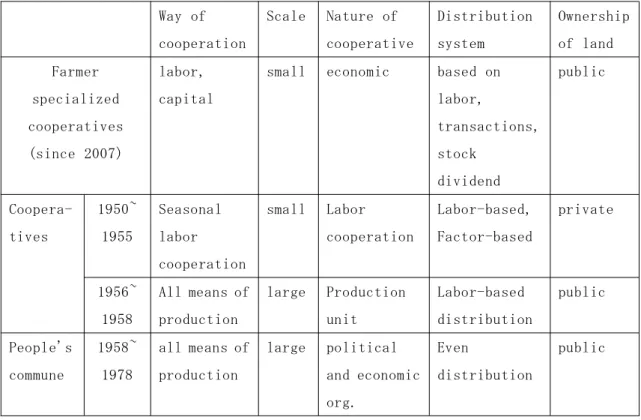
The distinct differences between the cooperatives, practiced from early 1950s to mid 1970s (the people's communes were regarded as the result of cooperative movement and the highest form of cooperatives), and the farmer specialized cooperatives can also be illustrated from their ownership of property(land as a key), way of cooperation, scale of cooperatives, nature of the cooperatives and distribution system.
As shown in table 2, the practices of the cooperatives from 1950s to 1970s can be divided into two phases: the initial stage started with cooperative movement in early 1950s and the people's commune movement. In its initial stage, the cooperative movement appeared naturally among farmers who organized freely according to their production need. The cooperation at that time was mainly in the form of labor exchange; the production resources were owned privately; members would come together to offer help in agricultural production without allocation of products. In most of the cases, this kind of organizations were limited to a small scale both in the range of their activities and business scope. To some degree, they operated like a working
union. Then the cooperatives were quickly pushed to set up people's commune which, as mentioned above, was both a political and economic organization.
It deprived farmers' ownership of their land, working tools, animals and other means of production, exercising public ownership and even distribution within the people;s commune. Besides, the people's commune engaged in variety of business from agricultural production to small workshops manufacturing necessities. In contrast, farmer specialized cooperatives are independent economic organizations. They show greater complexity in its ways of cooperation and distribution. Farmers may set up or join a farmer specialized cooperative by investing their land, labor forces, capital or even talents in it. Benefits and profits are distributed in the form of material products, cash salary and dividend,according to their contributions to the farmer specialized cooperatives. The cooperatives in 1950s practiced collective ownership featured with planned economy while farmer specialized cooperatives are owned by the cooperative members and therefore they are characterized with market oriented operations.
Table 2 Comparisons between the Former Cooperative, People's Commune and Farmer Specialized Cooperative
Way of cooperation
Scale Nature of cooperative
Distribution system
Ownership of land Farmer
specialized cooperatives (since 2007)
labor, capital
small economic based on labor,
transactions, stock
dividend
public
Coopera- tives
1950~
1955
Seasonal labor cooperation
small Labor cooperation
Labor-based, Factor-based
private
1956~
1958
All means of production
large Production unit
Labor-based distribution
public
People's commune
1958~
1978
all means of production
large political and economic org.
Even
distribution
public
Source: Made by the author.
Further more, government played different roles in the expansion of the former cooperatives from 1950s and the farmer specialized cooperatives started from 2007. In the 1950s, the cooperative's expansion was greatly accelerated by the central government in a top-down manner, by which the cooperatives were then quickly transformed into people's communes that administered local affairs. Although the establishment of farmer specialized cooperatives is also guided and encouraged by government policies, they are operated independently by cooperative members. In the purpose of economic
benefits and common prosperity, the farmer specialized cooperatives by no means represent a level of government. But the people's commune had strict system in its structure, its members enjoyed lower flexibility in production management and peasants almost had no options in membership.
The concept above discussed in detail about the nature and evolutionary changes of farmer specialized cooperatives in China. But questions still remain as to what kind of cooperation is going on in mountainous rural areas today? Furthermore, what is the role of farmer specialized cooperatives in rural production, and how does this exert influence on rural development?
Research on these above questions would be helpful to improve the development of farmer specialized cooperatives and contribute to the well-being of those living in mountainous areas.
Section 2 Development Status of FSCs
The rapid development of farmer specialized cooperatives has become an innovative way to gradually form an effective institutional mechanism in agriculture, such as increasing agricultural production and bridge the gap between farmers and markets. With the analysis of the development process, the development models and the scale of farmer specialized cooperatives, people can master the development status of farmer specialized cooperatives in general.
2.1 The Strategic Background of Launching Farmer Specialized Cooperatives The word “cooperative” reminded some people of the old days in 1950s and questions arose as to why the central government of China once again took active measures to encourage the development of farmer specialized cooperatives. Besides the differences between the farmer specialized cooperatives and the cooperatives in 1950s, the fundamental role of countryside and the increasingly worsening situations in rural area exerted great influences on the decision making process of government.
First of all, the hollowing problems of countryside, especially those in
northwestern China, ask for urgent actions taken to restore the vitality.
The term “hollowing problem” was firstly used and explained, in the Japanese Governmental Socio-economic Plan in 1967, as “a state in which it is difficult to maintain a normal living standard, such as disaster prevention, education, medicare and other essential segments which laid fundamental basis to a society. Also, it is difficult to make use of local resources and the production capacities show strong signs of weakening due to the decrease in populations. In other words, the hollowing area refers to a place where its population density is continuously declining and a regular daily life is hard to come by”. According to China Statistics Yearbook (2013), population in urban area was about 712 million at the end of 2012, exceeded the number (about 642 million) in countryside, accounted for 52.57 percent of the total population in China. Thus, the cooperation on the platform of farmer specialized cooperatives is a must in the condition of population decrease in the rural area.
Secondly, the ever-increasing amount of deserted farmland endangered the safety of agricultural production, which served as cornerstone of the social stability. China has a population of more than 1.3 billion, agricultural
production has always been a strategic segment in its overall development.
But the proportion of population engaging in agriculture has fallen dramatically from 70.2 percent in 1978 to 34.8 percent in 2011. The problem not only showed by the loss of agricultural population, a far worse fact is that the remaining population majoring agriculture are the old, women and kids. In the First General Survey on agriculture carried out in 1996, the percentage of peasants over 50 years old was 18.1; but this percentage increased to 32.5 in 2006. The unwillingness to work in the field pose new challenge to the rural development. In June 2011, the central government of China conducted “investigation on 100 villages” showed that the deserted farmland area amount to 40 percent in Binhu Village, Hubei Province. Data also showed that from 2000 to 2003, the loss of farmland nationwide was 135.8 million acre.
The outflow of population in the countryside and the endangered agricultural production formed the general background of the era in which the farmer specialized cooperatives were encouraged.
2.2 Development Process
The development of Chinese farmer specialized cooperatives has
experienced a complicated course in which it was initially promoted by the motives of human beings; then a stage which government played a decisive role;
and finally come to the current phase that featured with the combination of government guidance and independent development. Before the foundation of the people's Republic of China, most farmers were tenant farmers and farm laborers, who lacked the necessary assets and independent development, the situation restricted the development of cooperation among farmers.
In the early stage after the foundation of new China, the central government implemented the reform of the land system, the land ownership was transformed from private ownership, mainly occupied by a few landlords, to public ownership, or national ownership. The reform actually provided the necessary conditions for the early cooperation among farmers in the form of mutual cooperation and agricultural cooperatives right after 1950s. Before the implementation of Reform and Opening-up policy, launching cooperatives and promoting cooperation were actually fell into a campaign-like national movement, which went too far and overlooked the law of development. Thus the numbers and scale of cooperatives were blindly expanded regardless the real situation in the historical stage. Moreover, because in the period, the
ownership of personal property was also completely denied in the Peoples' Commune Movement, it exerted detrimental effects on the farmers' interests and motivations on cooperatives as well as agricultural production.
Accordingly, the development of cooperatives were in great difficulties and came to a cease.
Since the Third Plenary Session of the Eleventh Central Committee was held in 1978, the land management began to exercise “ Family Operation and Collective ownership Two-tier Management System”, which greatly promoted the development of agricultural production. With the gradual transformation, cultivation and maturation of market economy, a number of farmers who engaged in mass agricultural production gradually emerged. The new agricultural production mode has different requirements in operation management including land centralization, employment of machinery, higher level of specialization in agricultural production et al. Therefore, it is inevitable to change the form of organizing the productions in the rural countryside. The specialized farmer cooperative, in this case, is one of the most practical options which is more likely to succeed in countryside. The development of farmer specialized cooperatives mainly went through three stages.
(1) The embryonic stage (from 1978 to 1994). Since the implementation of Reform and Opening-up policy, the central government of China adopted positive policies to encourage the development of various of cooperative economy. From 1983, the Central Committee of CPC and the State Council issued a number of documents regarding the cooperatives' development to encourage, guide and support specialized cooperatives, technical associations, supply and marketing cooperatives and many other forms of cooperative organizations.
After the issue of “The Charter of Farmers specialized Associations” in 1994, there appeared a new type of cooperatives with distinctive modern characteristics.
(2) The initial stage (from 1995 to 2000). In this period, the contents of the cooperative activities gradually expanded from the technical cooperation mainly in the past, to the joint purchase of production means and selling of agricultural products, sharing of capital and facilities and other factors in their production cooperation. In the Document No. 2, issued by the Development and Reform Committee of the State Council in 1998, it encouraged farmers to set up a variety of professional cooperatives, perfect the agricultural service system, and gradually establish cross-regional
operation of professional cooperatives.
(3) The acceleration stage (since 2000). The restructuring of rural economy and the influence brought by the entry of “WTO” gradually revealed the importance of cooperation, which in turn showed the emergency of promoting the development of farmers' cooperative organizations. The Central Committee of the Communist Party of China and the State Council firmly assisted farmers to develop cooperative associations with supportive measures such as subsidies, low interests loans and other preferential policies. In July 1, 2007, the enforcement of the “ Farmer Specialized Cooperative Law of the People's Republic of China” marked a new phase of the cooperative economy, entering a stage of new type of cooperative association, the farmer specialized cooperative.
2.3 Development Model
With the continuous development and growth of farmer specialized cooperatives, the farmers cooperative economic organizations presented diversified development trends, different development models with distinctive characteristics, advantages and disadvantages, and their different adaptability. There are different ways to categorize cooperatives.
But in general, the farmers specialized cooperatives can be put into different groups according to the leading driving forces of their establishment, and the way of their cooperation.
(1) Professional farmers driven type. By the leading role of farmers who engage in mass plantation, or large quantity of livestock cultivation, other farmers, who also engage in providing the same products, also participate in and form a united association to apply for the establishment of farmer specialized cooperatives. Relying on the introduction of new varieties and new technologies, the leading producers organize other farmers to carry out a variety of training to promote the development of a particular product or industry. And finally cultivate competitive advantages in the market place.
The advantages of this type of cooperatives are that most of the leading producers already have possessed relatively good technical basis, the new technology can be put into practice with low cost. Also, they have developed marketing network, which make it easier for them to market their products.
However, the disadvantages are also obvious: the leading farmers may become the sole decision makers, and they are likely to put the cooperatives under their personal control.
(2) Production base driven type. This type of farmer specialized cooperatives give full play to the leading role of the grassroots organizations, which take the production base as a carrier to unite and cooperate with farmers to set up specialized cooperatives, to make full use of their unique resources in producing a particular type of agricultural products or providing service. The advantages of this type are that it is easy to introduce advanced technologies and fine varieties, carry out standardized production, implement intensive management, so as to exercise scale management and improve economic efficiency. The drawbacks of the type actually derive from the production base itself such as the poor product variety, relatively short industry chain, higher requirement on its environment, risk of mass production et al.
(3) Enterprise driven type. This is a kind of cooperatives with well organized production and marketing operation, seeing the farmer specialized cooperatives as the bridge or link between farmers and enterprise. Based on the contract, enterprises provide farmers with raw materials, capital, agricultural facilities and technical assistance via farmer specialized cooperatives. Also, the enterprises buyback the harvest products, then market
the final products after processing. The advantages of enterprise driven type are illustrated by its market oriented operation as well as advanced technology, sufficient capital, mass production, and risk resistant mechanism brought by the cooperation between enterprise and cooperative.
Disadvantages can not be ignored either. In enterprise driven cooperatives, enterprise is more likely to take a dominant role in their cooperation which may be detrimental to the cooperation nature of cooperatives since profit seeking is the priority of enterprise. Other parties in the type may lose their voice in service providing and benefits distribution.
(4) The government oriented type. Led by the township government or the relevant functional departments, the farmer specialized cooperatives were set up to attract farmers to participate in. The government oriented cooperatives on the one hand expanded the business scope of government and accelerated the role transformation of government; on the other hand, governments functioned positively in providing service of technical support and product sales for the farmers. This type of cooperatives enjoyed higher level of organization in the process both of production and products selling.
Therefore, the cooperatives enjoyed higher stability, rich content and a
diversified functions in their cooperation. The government oriented cooperatives also confronted challenges due to the government power invasion into the cooperatives' operation, which easily lead to rigid operation and poor economic benefits.
(5) Stock cooperative. The stock cooperatives differed from other cooperatives in that they raised money from investors, who may or may not get involve in daily operations but share benefits of the cooperatives and operate the cooperative like a stock enterprise. Based on the basic characteristics of the cooperative system, the stock cooperative system has a certain economic strength in both capital raising, responsibility sharing and risk prevention. But the disadvantages are that this type of cooperatives has a complicated organizational structure, and it is more likely to be controlled by those major shareholders. In this condition, the small or weak shareholders and especially farmers will lose their say in cooperative operation and benefits sharing.
2.4 Development Scale
By the end of 2011, according to the data of the farmers' specialized cooperatives registered in the country, there are 521,700 households, an
increase of 37.62% over 2010, a total investment of 720 billion yuan, an increase of 60% over 2010; By the end of 2012, farmer specialized cooperative has 689,000 households, an increase of 32.07% over the previous year, the total investment of 1,100 billion yuan, with the increase of 52.07%. By the end of 2014, the national Industrial and Commercial Department registered FSCs with 1,288,800 households, an increase of 31.18% over the end of last year, total investment of 2730 billion yuan, with an increase of 44.15%, about 94 million households, more than the total number of rural households. The detailed information of these data is shown in Table 3.
Source: Made by the author based on data from the website of China Farmer Cooperatives.
It can be seen from table 3 that in the latest 5 years, rural farmer specialized cooperatives have showed a trend of rapid growth in both its
Table 3. Statistics on FSCs in the Latest 5 years
Year (year-end)
Quantity of household
(10,000)
Growth rate(%)
Capital contribution (Trillion yuan)
Growth over the previous year
(%)
2010 37.91 0.45
2011 52.17 37.62 0.72 60.00
2012 68.90 32.07 1.10 52.07
2013 98.24 42.58 1.89 71.82
2014 128.88 31.18 2.73 44.15
number and the volume of investment. With the average annual growth rate of 35.86%, the number increased by 3.4 times in 4 years. Capital contribution, with the average annual growth rate of 57.01%, increased by 6.1 times in the same period. Through the actual investigation and analysis of the relevant literature, the characteristics are as follows in the development of the past few years: number of farmer specialized cooperatives and their members grow fast; the cooperatives showed positive influence on rural development but the participating rate of farmers is low; the large amount of investment into the cooperatives and the main form of the investment is in cash; the business scope of the cooperatives is relatively concentrated in the field of agricultural production; the operation standardization and branding level of cooperatives is not high; most of the cooperatives major in plantation and animal husbandry; service ability of cooperatives needs improving.
Section 3 Functions of the FSCs in the New Rural Construction
The strategy of the Socialist New Rural Construction is a way to promote urbanization in mountainous area to achieve a coordinated development between regions. It refers to the construction of rural economic, political, cultural and other social aspects under the socialist system in accordance with the requirements of the new era. The ultimate goal is to bring a fundamental improvement of the countryside, which includes the economic prosperity, the better facilities, the beautiful environment, and the harmony of civilization.
Farmer specialized cooperative is based on the system of rural household contract management, through the provision of agricultural products sales, processing, transportation, storage, and agricultural production and management of technique, information and other services to achieve the purpose of mutual aid organizations , with the characteristic of economic cooperation from the beginning of the establishment. It has a certain organizational structure, and members enjoy a certain right and a certain responsibility. Farmer specialized cooperative is another major reform of
the way of production organization after the household contract responsibility system exercised in rural areas in China.
Since 1980s, various forms of farmer cooperative economic organizations have been booming, and the stock cooperation system has been carried out in 1990s. In 2007, the law of farmer specialized cooperative came into force, followed by the flourish of the farmer specialized cooperatives. The range of its service has been expanded, as well as the the expansion of its numbers in China. It has become one of the main driving forces of promoting the innovation of agricultural management system and the development of modern agriculture. In the process of constructing a socialist new rural countryside, farmer specialized cooperatives will play a major role in the following aspects.
(1) It is advantageous to strengthen the farmer's market position, and increase the farmers income. The key task of the socialist new rural construction strategy is to develop rural productivity and increase the income of farmers, which is the material basis for farmers to improve their living standards and lead a quality life; it is also helpful to protect the village environment and to promote the rural civilization. If the
cooperatives can get directly involved in the process of production, processing and circulation of agricultural products according to the market demand, it can reduce the intermediate links, save the transaction costs;
it can also improve the bargaining position and bring farmers competitive advantages in the sale of their products.
(2) It is conducive to the acceleration of rural countryside to be organized with higher standard and improving the quality of farmers. Farmers are the master of the country, they are the main force in the construction of the socialist new countryside. And the new rural construction should pay attention to the development and utilization of the rural human resources.
The construction of socialist new countryside must be helpful to the improvement of the scientific and cultural quality of farmers, such as equipping them with better education and further understanding about cultures, technologies. Farmers who have taken part in the cooperatives can broaden their horizons and enhance their competitiveness to survive and develop in the modern market environment. A number of farmers participating in the operation management of cooperatives have exercised and improved their abilities in the aspects of marketing, division of labor, et al.
(3) It is conducive to promoting the division of agriculture and improving agricultural production efficiency. Modern agricultural production needs to improve production efficiency and scale management. The farmer specialized cooperatives can solve the contradiction between the demand for money and the shortage of capital in rural area. The farmer specialized cooperatives also possess a unique advantage in a certain field by deepening the labor division in the agricultural production and promoting the production efficiency. The farmer specialized cooperatives also have advantage in adopting advanced technology, getting access to production and processing equipment. Some competitive cooperatives can improve production efficiency through technological transformation, institutional innovation and industrial upgrading as well.
(4) It is conducive to the promotion of advanced technology and agricultural industrialization. In the technical service, it can play the overall technical advantages of the members of the cooperative organizations to popularize a new technology or idea by mutual learning, mutual exchange and mutual help. If a certain industry which has distinctive characteristics, a bright market prospect and meets the industrial development plan set by
the local government, the farmer specialized cooperatives can make it bigger and stronger through its pilot demonstration. The practice can also reduce the cost of production and the market risk for a single peasant, which is conducive to the improvement of agricultural product quality and accelerate the pace of industrialization.
(5) It is conducive to promoting the comprehensive reform of rural areas and improving the government service. To promote the comprehensive reform of rural areas, it is a good way to solve the problems of agricultural investment mechanism, land scale management, collective economic management, rural grassroots organization construction and so on. The government utilize the farmer specialized cooperatives to implement the national industrial policy and support measures to reduce the blindness and disorder in agricultural production of farmers. Through farmer specialized cooperatives, farmers can reflect their wishes and requirements to the government timely, and obtain the latest and reliable information of agricultural production, marketing, technology and policy. These will in turn improve the effectiveness of government's regulation on agriculture and rural economy.