Difference in physical fitness and body composition by habits of physical activity in Japanese junior high school students
AKIHARA Yu (Hyogo University of Teacher Education) ODA Toshiaki(Hyogo University of Teacher Education) YAMAMOTO Tadashi(Hyogo University of Teacher Education)
SOGABE Akitoshi (Konan university)
keywords: body composition, physical fitness test, junior high school students
0. Introduction
In recent years, changes in the social environment have led to the advancement of convenience in every aspect of daily life, the decrease in physical activity, and the younger age oflifestyle-related diseases are regarded as problems.
Ministry of Education, Culture, Sports, Science and Technology (MEXT) has pointed out the in- crement of the number of child low physical fitness and bipolarization of the physical fitness (MEXT online1).The period of junior high school aged 13-15years is critical to the development and growth of the body and is time that various health-related habits are formed (Patton &Viner 2007).From this time onwards, it has been recommended that proactive physical activity should be habitualized and empowered not only for the healthy development and development of children, but also for the maintenance of wholeness throughout their lives (Boreham C & Riddoch Cl 2001).
In Japan, MEXT physical fitness test has been carried out as a physical fitness index of junior high school students. In addition, MEXT has conducted a school medical examination (About summary and report of sports agency 2017 physical strength, exercise findings. online).In the examination, although body composition is placed as one of the indices of child’s health and physique (e.g.BMI), it doesn’t include detailed measurement such as segmental unformation and distribution of muscle and fat tissues. There is a bioelectrical impedance analysis (BIA) in one of the ways to investigate body composition. The biggest feature of the BIA method is that it can be measured with reduced economic and temporal costs, and is widely adopted in commercial home body composition meters because of its higher versatility compared to conventional methods. In addition, the multifrequency impedance method using both low frequency and high frequency makes it possible to distinguish between intracellular fluid and extracellular fluid, and to calculate the body composition not only of conventional adipose tissue and lean tissue, but also of fat, muscle, bone, body water content, and many other items (Tanaka et al 1999).In recent years, an 8-point contact electrode method has been
developed to attach contact electrodes to the left and right upper and lower extremities, and it has been shown that measurements can be performed accurately for each region of the upper
extremities, lower extremities, and trunk (Malavolti M et al 2003).
From the above, it is possible to measure the body composition of prepubertal children using the BIA-based method because the BIA-based method is cheaper and simpler than the conventional measuring method. Therefore, the BIA-based method can be useful for understanding the wholeness condition.In addition, it is considered that more detailed features can be clarified by examining the combination of the exercise execution state and the result of the physical fitness test.
Therefore, we aimed to examine the difference between physical fitness and detailed body composition by habits of physical activity in junior high school students.
I.Method
<Subjects>
The Subject were 251 junior high school students in grades 1-3, consisting of 125 students in the regularly active group and 126 students in the inactive group. Table 1 shows a summary of the sub- jects. The active group performed physical activity of 60 minutes or more on average a day regu- larly.
Table1. Subject information
<Measurement items> 1. Body composition
grade active inactive active inactive
1st 7 30 8 24
2nd 34 7 23 22
3rd 36 11 19 30
total 77 48 50 76
male female
physical fitness test for junior high school students consists of the following 1 to 8, and the respective physical fitness factors are measured. All eight items and their physical strength
characteristics are: ① grip strength (kg): muscle strength index; ② sit ups (gyrus): muscle strength and endurance index; ③ sit and reach flexibility (cm): flexibility index; ④ side steps (point): agility index; ⑤20m shuttlerun (gyrus) or 1500 m girls/1000m girls (min): total body endurance index;
⑥50m run (sec): speed index; ⑦ standing long jump (cm): instantaneous force index; ⑧ handball throw (m): instantaneous force and elasticity index;.
<Statistical process>
Measurement results for each item are expressed as mean ± standard deviation. Unpaired t-tests were used to compare body composition and physical strength tests between groups.The risk in all tests was less than 5%.In addition, the risk rate is easily influenced by the sample size, and it is easy to obtain statistically significant results (Mizumoto and Takeuchi 2008), and therefore the effect size which is a standardized index showing the substantial effect is shown.As a measure of the effect size, the effect size of "group d" representing the difference between the mean values of the two groups was defined as small (0.20 or more and less than 0.50), Middle (0.50 or more and less than 0.80), and large (0.80 or more).
Ⅱ.Results
<Individual subject's body composition>
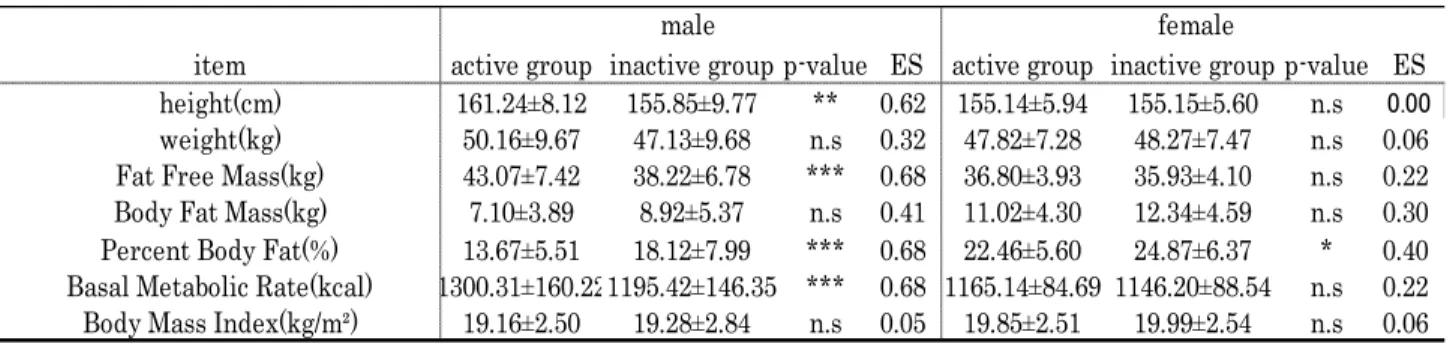
Table 2 shows the body composition and standard deviation of male and female subjects.
Table2. Body composition of male and female subjects
mean ± standard deviation
p-value:*=p<0.05 **=p<0.01 ***=p<0.001 n.s= no significant
ES(Effect Size)= small (0.20 ~0.50), Middle (0.50~0.80), large (0.80~)
In males, significant differences were observed between active and inactive groups in height (p<0.01), fat free mass (p<0.001), percent body fat (p<0.001), and basal metabolic mass (p<0.001).
Effect size levels also differed significantly. Effect size levels exceeded the Middle level for each of these items. In females, there was a significant difference in percent body fat (p<0.05) between the active and inactive groups.
<Fat-free mass by region>
All subjects were divided into five regions (right arm, left arm, trunk, right leg,and left leg).Table 3 shows the fat-free mass by region and standard deviation of all male and female subjects.
Table3. Fat-free mass by region of all male and female subjects
item active group inactive group p-value ES active group inactive group p-value ES height(cm) 161.24±8.12 155.85±9.77 ** 0.62 155.14±5.94 155.15±5.60 n.s 0.00 weight(kg) 50.16±9.67 47.13±9.68 n.s 0.32 47.82±7.28 48.27±7.47 n.s 0.06 Fat Free Mass(kg) 43.07±7.42 38.22±6.78 *** 0.68 36.80±3.93 35.93±4.10 n.s 0.22 Body Fat Mass(kg) 7.10±3.89 8.92±5.37 n.s 0.41 11.02±4.30 12.34±4.59 n.s 0.30 Percent Body Fat(%) 13.67±5.51 18.12±7.99 *** 0.68 22.46±5.60 24.87±6.37 * 0.40 Basal Metabolic Rate(kcal) 1300.31±160.221195.42±146.35 *** 0.68 1165.14±84.69 1146.20±88.54 n.s 0.22 Body Mass Index(kg/m²) 19.16±2.50 19.28±2.84 n.s 0.05 19.85±2.51 19.99±2.54 n.s 0.06
male female
item active group inactive group p-value ES active group inactive group p-value ES female
male
In males, the active group showed significantly higher values than the inactive group in all 5 sites (p<0.001). Effect size levels were also higher than the Middle level for all items. In females, no significant difference was observed in all items, and the effect level was low.
<Physical fitness test>
Table 4 shows the physical fitness tests and standard deviation of all male and female subjects.
Table4. Physical fitness tests of all male and female subjects
mean ± standard deviation
p-value:*=p<0.05 ***=p<0.001 n.s= no significant
ES(Effect Size)= small (0.20 ~0.50), Middle (0.50~0.80), large (0.80~)
In males, the active group showed significantly higher values in all 8 items compared to the inactive group (grip strength, sit ups, side steps, 20m shuttle run, 50m run, standing long jump, hand ball throw: p<0.001, sit and reach flexibility: p<0.05). In females, the active group showed significantly higher values than the inactive group in 6 items (sit ups, side steps, 20m shuttle run, 50m run, standing long jump: p<0.01, handball throw: p<0.05). There were no significant
differences in grip strength and sit and reach flexibility.
Item Active group Inactive group P-value ES Active group Inactive group P-value ES Grip strength (kg) 31.2±7.8 25.6±6.4 *** 0.78 24.8±4.2 24.6±4.6 n.s 0.05 Sit ups (gyrus) 29.0±4.8 23.0±6.1 *** 1.15 24.0±3.8 19.7±5.3 *** 0.91 Sit and reach flexibility (cm) 45.5±10.6 40.93±9.3 * 0.45 44.2±9.1 42.4±9.0 n.s 0.20 Side steps(gyrus) 58.2±6.5 49.3±8.7 *** 1.21 52.4±5.0 48.1±5.8 *** 0.78 20m shuttle run (gyrus) 99.9±19.0 63.2±24.4 *** 1.75 70.6±17.6 52.0±17.1 *** 1.09
50m run (sec) 7.6±0.8 8.5±1.1 *** 1.01 8.7±0.5 9.0±0.6 *** 0.64
Standing long jump (cm) 210.1±23.4 183.1±24.8 *** 1.14 180.1±15.8 167.2±19.2 *** 0.73 Handball throw (m) 21.7±5.3 16.2±4.1 *** 1.14 12.6±3.1 11.3±3.1 * 0.43
Total score(point) 47±11 35±10 *** 1.10 54±6 46±9 *** 0.99
Male Female
Ⅲ.Discussion
<Individual subject's body composition>
As a result of the body composition, significant difference and effect were observed between active group and inactive group except for body weight and BMI index in male junior high school students. Especially, the difference in fat free mass, body fat percentage and basal metabolism was greatly shown.
Since fat free mass includes skeletal and visceral parts, it cannot necessarily be considered to be related to physical strength and exercise ability itself, but it can also be considered to be a large index related to organ development, skeletal and bone density, biological metabolic function and resistivity, etc. (Goran M et al 2015). Oguri et al (2013) reported that obese boys with no exercise habits had a body composition with low fat-free mass, and therefore, it can be said that high fat-free mass was shown in the active that carried out exercise for 60 minutes or more on average per day.
In addition, it can be explained from the viewpoint of the biological metabolic function mentioned above that there was a large difference in the basal metabolic rate between the active and the inactive group, as well as the lean mass.
The percentage of body fat was also significantly different among females. In this study, both males and females were significantly higher in the inactive group than in the active group. Studies on fat free mass in children suggest that exercise habits contribute strongly to their development in addition to nutritional status and lifestyle (Midorikawa 2012). Therefore,in general, the percent body fat, which is an obesity variable, is considered to be significantly different in the inactive group which does not have exercise time other than class per day.
<Fat free mass by region>
In this study, we found that the active group was significantly higher in all five sites in males in terms of fat free mass. However, there was no significant difference between the active and inactive groups in females. Significant differences in all sites in males indicate that exercise may lead to a balanced development. This is similar to that regular physical activity has had a positive effect on
<Physical fitness test>
All total scores were significantly higher in both sexes in the active group than in the inactive group (p<0.001). In other words, the results of the physical fitness test as the physical fitness index are better when the exercise is performed appropriately.
In males, there were significant differences between the active and inactive groups in all 8 items.
Significant differences in all parameters were observed in males, suggesting that fat free mass does not affect the results.
In females, there was a significant difference between the active and inactive groups in six items, except for grip strength and sit and reach flexibility. The results were similar to those of Sasayama et al (2011), which investigated physical activity and physical fitness test for subjects of similar age.
In this study, there was no significant difference in body composition between the active and inactive groups in height or fat free mass. The results may be related to the absence of differences in grip strength, which is an indicator of muscle strength. Sit and reach flexibility, it was different from that reported that the active group showed much higher flexibility than the inactive group (Lo et al 2017). As a factor, it is considered that the value of the active group in this study was lower than the national average.
With respect to the 6 items that were found to be significantly different subsequently, there was no significant difference between the 2 groups in the fat free mass and body fat mass of the trunk region, but there was a significant difference in the physical fitness test.This may be related to muscle strength determinants other than muscle mass, typified by fat free mass. In general, muscle cross-sectional area is a determinant of muscle strength, while other factors include nervous system function. In other words, it is possible that the neurological function worked in the course of
continuous exercise, and that it appeared as a difference in the result of this sit ups. All other items have strength elements other than muscle strength. Therefore, although there was no difference in fat free mass or muscle mass among females from the results of this study, there is a possibility that coordination abilities such as physical manipulation may differ. This seems to have appeared as a difference in the results of the physical fitness test.
That is, even if there is no difference in the body size or body composition of the whole body, it was shown that the exercise of 60 minutes or more on average per day affected each physical fitness factor as a result.
Ⅳ.Conclusion
In this study, the following were clarified by roughly dividing the males and females of junior high school students, which are important periods in physical development and growth, into two groups:
active and inactive group, and comparing and analyzing physical strength related to growth and development using body composition and the items of physical fitness test of the MEXT.
1) In the body composition, the height, fat free mass, body fat percentage, and basal metabolic rate were significantly different between the two groups in males. In females, only the body fat
percentage was significantly different.
2) In the fat-free mass by region, a significant difference of 0.1% was observed in all 5 items in males. There were no significant differences in all parameters among females.
3) In the physical fitness test, significant difference was observed in all 8 items in males. In females, there was a significant difference in 6 items, except for grip strength and sit and reach flexibility.
4) All items with significant differences showed more than a small degree of effect, and as the p- value increases, the effect size was also higher.
From the above, it was clarified that the difference in body composition and physical fitness was observed, though the gender difference was observed by carrying out the exercise of the average 60 minutes or more per day.
Therefore, it is considered that promotion of increment of physical activity in daily life among growing adolescents are crucial. Also, there is a possibility the promotion of importance of physical activity in class of physical education as well as through many opportunity in school education.
References
1) About summary and report of sports agency 2017 physical strength, exercise findings,
http://www.mext.go.jp/prev_sports/comp/b_menu/other/icsFiles/afieldfile/2018/10/09/14098855.
pdf(2019/4/5)
2) Boreham, C, Riddoch, C,(2001)The physical activity,fitness and health of children, J Sports Sci,19:915-929
6) Malavolti M, Mussi C, Poli M, Fantuzzi AL, Salvioli G, Battistini N, Bedogni G,(2003) Cross-calibration of eight-polar bioelectrical impedance analysis versus dual-energy X-ray absorptiometry for the assessment of total and appendicular body composition in healthy subjects aged 21-82 years, Ann Hum Biol, 30:380-91
7) Midorikawa, T,(2012)Body composition of Japanese children, J Phys Fitness Sports Med, 1:339-342
8) Ministry of Education, Culture, Sports, Science and Technology, Central Education Coun cil (24th),http://www.mext.go.jp/b_menu/shingi/chukyo/chukyo0/gijiroku/1266042.htm(2019/4/5) (MEXT online1)
9) Ministry of Education, Culture, Sports, Science and Technology, Physical fitness test implementation guidelines (12-19years old
subject),http://www.mext.go.jp/a_menu/sports/stamina/05030101/002.pdf(2019/4/5) (MEXTonline2)
10) Minsoo C, Ji-Youn K,(2017)Changes in physical fitness and body composition according to the physical activities of Korean adolescents, Journal of Exercise Rehabilitation, 13:568-572 11) Mizumoto A, Takeuchi O,(2008)Basics and Considerations for Reporting Effect Sizesin
Research Papers, Studies in English Language Teaching, 31, 57-66
12) Oguri K, Tachi T, Matsuoka T,(2013)Body composition, skeletal muscle and body fat mass in the body trunk and extremities in male obese children without habitual physical activity, Jpn, J .Human Growth and Development Research, 59:12-19
13) Patton GC, Viner R,(2007)Pubertal transitions in health, Lancet,369:1130-1139
14) Sasayama K, Adachi M,(2011)Association between daily physical activity and fitness in junior high school students, Jpn, J, Phy, Fitness Sports Med, 60:287-294
15) Tanaka K, Kim H, Nakanishi T, Amagai H,(1999)Multi-frequency bioelectrical impedance method for the assessment of body composition in Japanese adults, Jpn, J, Exercise Sports Physiol,6: 37-45
Summary
In recent years, changes in the social environment have led to the advancement of convenience in every aspect of daily life, the decrease in physical activity, and the younger age oflifestyle-related diseases are regarded as problems.
Therefore, this study aimed to clarify the characteristics of physical fitness, exercise ability, and physical fitness of children with different physical fitness levels by roughly dividing the males and females of junior high school students, which are important periods in physical development and growth, into two groups: active group and inactive group, and comparing and analyzing physical fitness related to growth and development using the body composition and the items of the physical fitness tests of the MEXT.
As a result, it was clarified that the difference in body composition and physical fitness was observed, though the gender difference was observed by carrying out the exercise of the average 60 minutes or more per day.
Therefore, it is considered that promotion of increment of physical activity in daily life among growing adolescents are crucial. Also, there is a possibility the promotion of importance of physical activity in class of physical education as well asthrough many opportunity in school education.