JAIST Repository
https://dspace.jaist.ac.jp/
Title 深い統語構造を利用した生命科学文献からの関係抽出
Author(s) Nguyen, Thi Hong Nhung Citation
Issue Date 2014‑12
Type Thesis or Dissertation Text version ETD
URL http://hdl.handle.net/10119/12619 Rights
Description Supervisor:東条 敏, 情報科学研究科, 博士
Doctoral Dissertation
Unsupervised Relation Extraction from Biomedical Literature Using Deep Syntax
NGUYEN, Nhung Thi Hong
Supervisor: Professor Satoshi Tojo
School of Information Science
Japan Advanced Institute of Science and Technology
December 2014
Abstract
The explosive growth of published biomedical research provides scientists with the chance to find correlations or associations between biomedical concepts from the literature. There- fore, there is a growing demand to convert information in free text into more structural forms. This demand motivates many researchers and scientists to work on relation ex- traction, an information extraction task that aims to extract semantic relations between important biomedical concepts. However, most of the previous studies on this topic have focused on specific or predefined types of relations, which inherently limits the types of the extracted relations. To overcome this limitation, we propose a relation extraction system that attempts to locate all possible relations present in the input documents.
In building such a general relation extraction system, we face two challenges: (1) there is no available tool that is trained on a gold standard corpus to recognize all named entities while dictionary-based tools may generate many false positives; and (2) there is no available annotated corpus for such a general schema of relations that can be used for training the extraction model. Our proposed system relies on a dictionary-based named entity recognizer and performs some post-processing to discard spurious entities. It then deals with the second challenge by employing predicate-argument structure (PAS) patterns, which are well- normalized forms that represent deep syntactic relations. In this dissertation, we introduce six PAS patterns for binary relations. After matching the patterns to extract candidates of relations, the system checks the semantic types according to a semantic network to find true relations. Our manual evaluation on a set of 500 sentences randomly selected from MEDLINE has shown a reasonable level of performance of the system (a pseudo F-score of 55.89% on average) compared with other state-of-the-art systems, including ReVerb, OLLIE and SemRep. Our system can detect broader types of relations but less precisely than SemRep, a rule-based semantic interpreter for biomedical text. The evaluation in another setting on pre-defined relations has also shown its wider coverage.
We then have applied our system to the entire MEDLINE corpus and produced more than 137 million semantic relations. The extraction results are useful in their own right, but they also provide us with a quantitative understanding of what kinds of semantic re- lations are actually described in MEDLINE and can be ultimately extracted by (possibly
type-specific) relation extraction systems. The entire collection of the extracted relations is publicly available in machine-readable form, so that it can serve as a potential knowledge base for high-level text-mining applications in the biomedical domain.
When using the extracted relations as an underlying database, the text-mining appli- cations would meet the problem of spurious mismatches caused by the diversity of natural language expressions. Therefore, the second task in our dissertation is to detect synonymy be- tween relational phrases that represent the relations to alleviate the problem of mismatches.
Most of the previous work that has addressed this task uses similarity metrics between rela- tional phrases based on textual strings or dependency paths, which, for the most part, ignore the context around the relations. To overcome this shortcoming, we employ a word embed- ding technique to encode relational phrases. We then apply the k-means algorithm on top of the distributional representations to cluster the phrases. Our experimental results show that this approach outperforms state-of-the-art statistical models including Latent Dirichlet Allocation and Markov Logic Networks.
Keywords: relation extraction, open information extraction, predicate-argument structure, relational phrase clustering, word embeddings.
Acknowledgements
This dissertation would not have been completed without the help, support, guidance and effort of a lot of people. It gives me great pleasure to express my sincere thanks to whom I am greatly indebted.
First of all, I owe my deepest gratitude to my supervisor, Associate Professor Yoshimasa Tsuruoka (The University of Tokyo), for his guidance and support from the first day when I am a fresh PhD student to the present day when I am going to graduate. His constant advising and encouragement have guided me through my most difficult time in research. I have also learned from him much valuable knowledge and experience in the academic life.
I am really grateful to Associate Professor Makoto Miwa (Toyota Technological Institute) for his dedicated guidance, fruitful comments and suggestions on my topic.
I would like to show my sincere thanks to Professor Satoshi Tojo and Associate Professor Thuc Dinh Nguyen (University of Science, HCMC, Vietnam), who have supported me a lot during my doctoral study. I would like to thank Associate Professor Minh Le Nguyen and Professor Hiroyuki Iida for their concern and encouragement after my preliminary defense.
I wish to express the appreciation to Professor Takashi Chikayama (The University of Tokyo), who gave me supportive comments when I did my off-campus research at The University of Tokyo.
A very special thank to the members of Tsuruoka laboratory (The University of Tokyo) and Tojo laboratory, who shared their research ideas, useful experiences and discussions, and to my trustworthy friends, who have stood by and helped me in my daily life.
I would like to thank the FIVE-JAIST project between JAIST and University of Science, HCMC, Vietnam for its financial support during my study.
Last but not least, many thanks go to my family, especially my grandmothers, my mother and sisters, who always encourage, support and believe in me throughout my life.
Contents
Abstract i
Acknowledgements iii
1 Introduction 1
1.1 Relation Extraction from Biomedical Literature . . . 1
1.2 Synonym Resolution for Relational Phrases . . . 3
1.3 Dissertation Outline . . . 5
2 Background 7 2.1 Text Mining . . . 7
2.1.1 Named Entity Recognition . . . 7
2.1.2 Relation Extraction . . . 10
2.2 Biomedical Text Mining . . . 12
2.2.1 NER . . . 12
2.2.2 Relation Extraction . . . 14
2.2.3 Available Resources and Corpora . . . 15
2.3 Open Information Extraction . . . 18
2.3.1 General Domain . . . 19
2.3.2 Biomedical Domain . . . 20
2.4 Predicate-Argument Structures . . . 21
2.5 Synonym Resolution for Relational Phrases . . . 23
2.5.1 Similarity-based Methods . . . 23
2.5.2 Corpus-based Methods . . . 24
2.5.3 Probabilistic Methods . . . 24
2.6 Latent Dirichlet Allocation . . . 26
2.6.1 Formal Definition . . . 26
2.6.2 Gibbs Sampling for LDA . . . 27
2.6.3 Applications . . . 28
2.7 Distributed Word Representations . . . 29
2.7.1 Neural Network Language Model . . . 29
2.7.2 Hierarchical Softmax . . . 30
2.7.3 Applications . . . 31
3 Binary Relation Extraction for Biomedical Texts 33 3.1 Predicate-Argument Structure Patterns . . . 33
3.1.1 Crafting Patterns . . . 34
3.1.2 Matching Patterns . . . 36
3.2 Extracting Semantic Relations . . . 36
3.2.1 Named Entity Recognition . . . 37
3.2.2 Relation Extraction . . . 40
3.3 Experiments and Results . . . 42
3.3.1 Criteria of Manual Evaluation . . . 42
3.3.2 Results of General Relations . . . 43
3.3.3 Error Analysis . . . 45
3.3.4 Evaluating on Predefined Relations . . . 48
3.4 Large-Scale Semantic Relation Extraction . . . 51
3.4.1 Distribution of PAS patterns . . . 51
3.4.2 Analyzing Semantic Relations . . . 52
4 Synonym Resolution for Relational Phrases 55 4.1 Representing Relational Phrases . . . 55
4.1.1 Bag-Of-Words Model . . . 55
4.1.2 Topic Models . . . 56
4.1.3 Word Embeddings . . . 58
4.2 Evaluation Settings . . . 59
4.2.1 Data . . . 59
4.2.2 Perplexity . . . 60
4.2.3 Resolver Metric . . . 60
4.2.4 CBOW Configurations . . . 61
4.3 Experimental Results . . . 61
4.3.1 Perplexity of The LDA Models . . . 61
4.3.2 Clustering Results . . . 62
4.3.3 Combining Word Embeddings and LDA-SP . . . 65
4.4 Discussion . . . 66
5 Conclusions and Future Work 70 5.1 Conclusions . . . 70
5.2 Future Work . . . 71
Bibliography 72 Publications 89 A Guideline for Manual Evaluation 91 A.1 Biomedical binary relations . . . 91
A.2 Evaluation criteria . . . 92
A.2.1 Evaluating entities . . . 92
A.2.2 Evaluating extracted relations . . . 96
A.3 The output’s format . . . 98
A.4 Tasks for annotators . . . 98
List of Figures
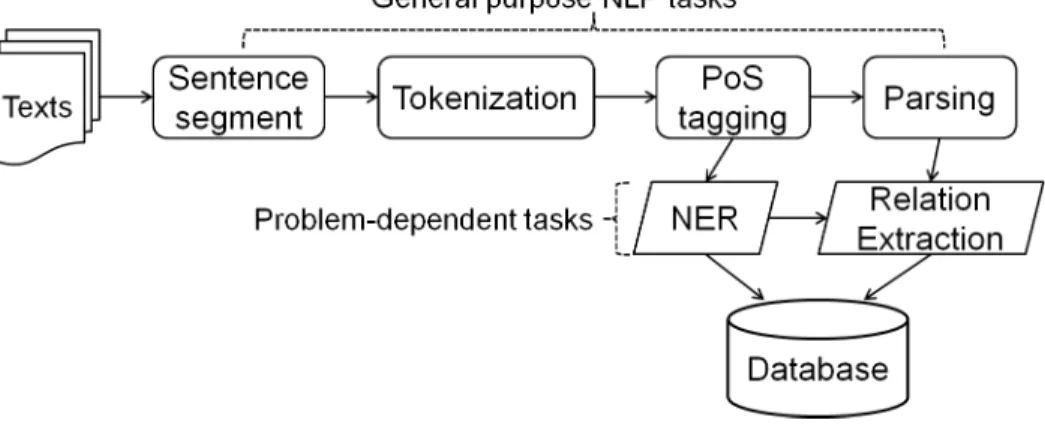
2.1 An overview of text processing tasks. . . 8
2.2 Examples of NER in general domain. . . 8
2.3 Examples of relation extraction. . . 10
2.4 An example of predicate-argument structures. . . 22
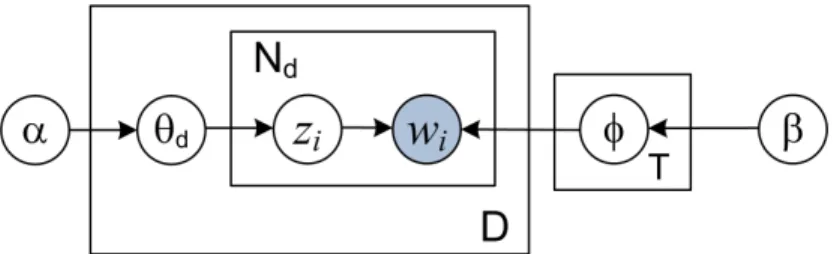
2.5 Graphical model representation of LDA. The boxes are plates representing replicates. The arrows indicate the conditional dependencies between two variables. . . 26
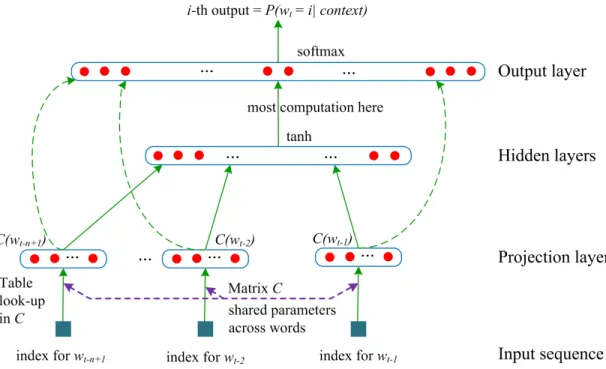
2.6 Neural architecture: f(i, wt−1, ..., wt−n+1) = g(i, C(wt−1), ..., C(Wt−n+1)), where g is the neural network andC(i) is thei-the word feature vector. [9] . . . 30
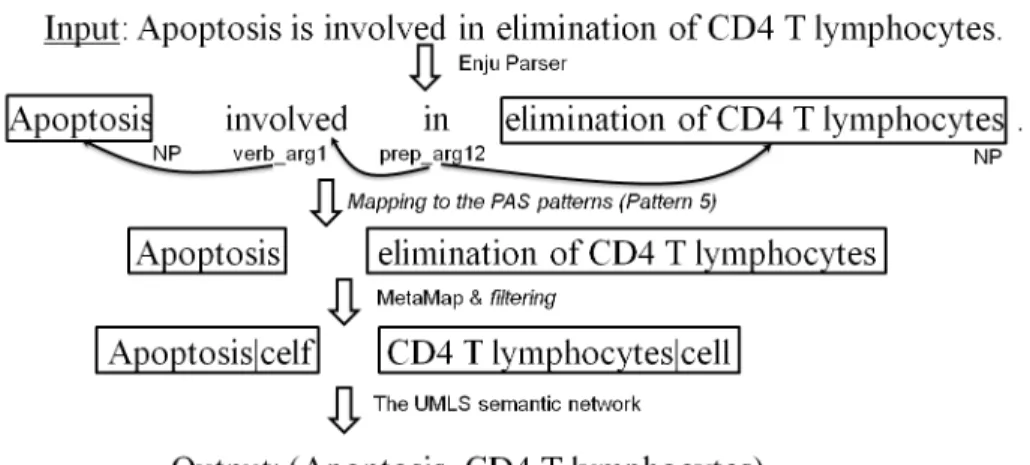
3.1 The working flow of our system. . . 34
3.2 A hierarchical structure of MMO. . . 38
3.3 Examples of biomedical binary relations. (a) The relation is not correct be- cause of one incorrect entity. (b) The relation is not correct because the relationship between the two entities is not represented explicitly by any se- mantic clue. (c) The relation is correct because it satisfies our two criteria of manually evaluation. . . 43
3.4 The number of true relations of the four systems on our test set according to the agreement of the two annotators. The mean numbers are 40.5, 77.5, 216, and 370.5, respectively. PASMED achieved the highest ones in all cases. . . . 44
3.5 Examples of true extracted relations that are treated as false positive ones ac- cording to the annotated PPI and DDI corpora. (a) ‘associated with’ relation. (b) ‘is a’ relation. . . 50
3.6 An example of two PPIs that need coreference information to be identified. Our system can detect a NP pair according to Pattern 5 but cannot extract any relations. . . 50
4.1 An overview of our methods. . . 56 4.2 The graphical representations of (a) the LDA-SP [122] model and (b) the LDA-
SP-sem model. The LDA-SP-sem model sets different roles for the semantic type of each argument. The semantic types are constrained to be in the same topic as their entities. . . 58 A.1 Examples of biomedical binary relations. . . 91 A.2 Examples of extracted relations that do not satisfy the two evaluation prin-
ciples. r1 and r4 break principle 1; r2 breaks principle 2; r3 breaks both principle. . . 96 A.3 An example of indirect relations (dash lines). These relations are not di-
rectly represented through the syntactic structure but can be inferred based on syntactic clues. . . 98
List of Tables
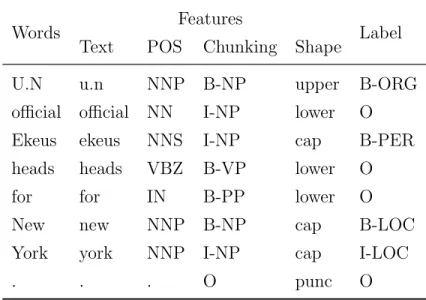
2.1 Representing named entities by the B-I-O style with some word-level features. 9 2.2 Samples of features for the relation<U.N, Ekeus>. . . 11 2.3 Lexico-syntactic patterns by Nebot and Berlanga [97]. . . 21 3.1 Our PAS patterns focus on verb and preposition predicates. An arrow going
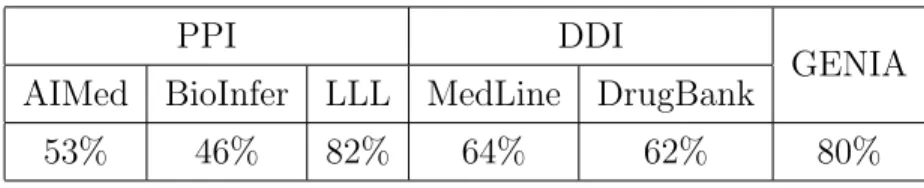
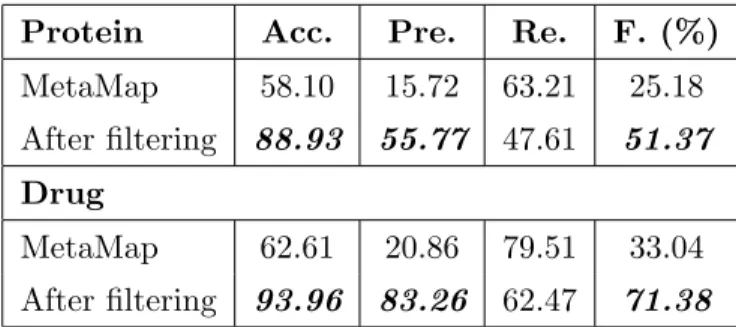
from a to b means that a modifies b, where a is called a predicate, and b is called an argument. <N P1, N P2> is a relevant NP pair in each pattern. . . 35 3.2 Expected recall of our PAS patterns on various corpora. . . 36 3.3 An example of MetaMap Machine Output with theutterance object. . . 39 3.4 Performance of our post-processing on proteins and drugs detection. These
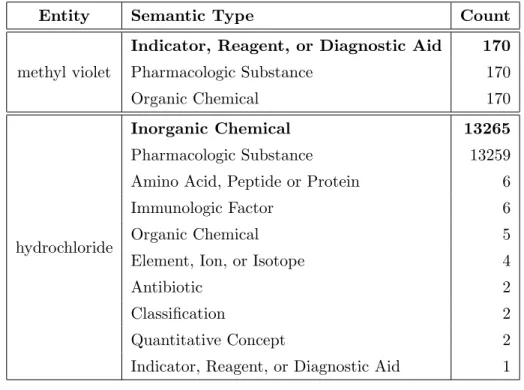
scores were generated by using the CoNLL 2000 evaluation script. . . 40 3.5 Frequency of semantic types of methyl violet and hydrochloride in MEDLINE. 41 3.6 Evaluation results of the four systems according to the two annotators. Sem-
Rep achieves the highest precision, PASMED achieves the highest relative recall. . . 45 3.7 The inter-annotator agreement scores of the four systems and their corre-
sponding scale according to two different standards. . . 46 3.8 Numbers of false positive PASMED’s relations according to the two annota-
tors. We have classified them into three types of errors: C1–false positives caused by incorrect entity extraction (criterion 1), C2–false positives caused by not presented explicitly by linguistic expressions (criterion 2), and Both–
false positives due to both C1 and C2. . . 46 3.9 Performance of our system on AIMed, BioInfer and LLL corpora, compared
with some state-of-the-art systems for PPI. . . 49 3.10 Performance of our system on MedLine and DrugBank corpora of SemEval-
2013 Task 9 [127], compared with the highest and lowest-performing systems in that shared task. . . 49
3.11 The distribution of our PAS patterns in MEDLINE. . . 52 3.12 The ten most frequent types of semantic relations extracted from the whole
MEDLINE. . . 52 3.13 Statistics of protein-protein interactions in the whole MEDLINE. . . 53 4.1 A pseudo-training data that contains a relation phrase of ‘treat with’ with
six relation instances. The full forms of semantic types are: Disease or Syn- drome (dsyn), Therapeutic or Preventive Procedure (topp), Pharmacologic Substance (phsu), and Organic Chemical (orch). . . 57 4.2 Vocabulary of the pseudo-training data in Table 4.1. . . 57 4.3 Perplexity of LDA-SP and LDA-SP-sem on the training and testing sets. . . 61 4.4 Clustering results when BOW, LDA-SP and LDA-SP-sem are used to repre-
sent relational phrases. . . 62 4.5 Clustering results of SNE with varying values of (α+β,λ,µ). . . 63 4.6 Three ways of modeling a relation of<parkinson’s disease, treat with, dopamin-
ergic drug>. . . 64 4.7 Vocabulary size and number of words by each representation. . . 64 4.8 Clustering results when the CBOW model is used to learn relational phrases’
vectors. . . 65 4.9 An example of clustering verbs that convey laboratory procedures by the four
methods. The italic phrases are incorrect terms according to the gold standard. 65 4.10 The highest performance of each method on our evaluating data. . . 66 4.11 Clustering results when using LDA-SP’s output vectors to initialize CBOW. 66 4.12 Examples of good clusters of relational phrases. Each cluster is assigned a
name that conveys its meaning. . . 68 A.1 Examples of extracted relations that are incorrect because their semantic re-
lationships are not shown in the sentence. . . 97 A.2 Samples of the output and the evaluation of binary relations, the two final
columns are filled by annotators. . . 99
Chapter 1 Introduction
In this chapter, we first introduce the context of our research, which relates to biomedical text mining–a general context of relation extraction. We then describe our research objectives:
detecting all possible relations between two biomedical concepts in a document, and synonym resolution of relational phrases based on the output of our system on MEDLINE. Finally, we briefly present the outline of this dissertation.
1.1 Relation Extraction from Biomedical Literature
Biomedical text mining, also known as biomedical natural language processing (BioNLP), is a field of natural language processing that aims to develop methods for extracting useful information from the literature in biomedical and biology domains. The goal of biomedical text mining [26] is to provide researchers with efficient tools to search and visualize necessary information, and uncover relationships between biomedical concepts described in the vast amount of the documents. Not surprisingly, many biomedical text mining systems have been developed, such as Chilibot [20], MEDIE [89, 101], EBIMed [111], Kleio [99], PathText [58, 86], FACTA+ [144], BioCaster [28], and semantic MEDLINE [120].
Generally, a text mining task is divisible into six main subtasks including (1) sentence segmentation, (2) tokenization, (3) part-of-speech tagging, (4) parsing, (5) named entity recognition (NER), and (6) relation extraction. The final step of this pipeline–relation extraction involves using the representation of the structure of the input produced in the preceding steps to identify relations of the marked entities and recognize the types of these relations. Most of the previous work on relation extraction from biomedical literature focuses on specific or predefined types of relations, such as protein-protein interaction [155, 1, 87],
gene-protein relationship [20, 101], drug-drug interaction [127], and biomolecular events [98].
The types of relations that can be extracted by existing approaches are, therefore, inherently limited.
Recently, an information extraction paradigm called Open Information Extraction (OIE) has been introduced to overcome the above-mentioned limitation [8]. OIE systems (e.g., ReVerb[35] and OLLIE [73]) aim to extract all possible relations from Web text. Although the concept of OIE is certainly appealing, our preliminary experiments have suggested that these state-of-the-art systems do not perform well on biomedical text. This is partly because biomedical literature usually uses sentences with more complex structures and specialized vocabulary compared with Web text.
Altman et al. [4] suggested that biomedical text mining should address broader types of entities beyond genes and proteins, and broader types of relations, including complex relations. This suggestion and the observation that OIE systems do not perform well on biomedical text have motivated us to develop a relation extraction that attempts to locate all possible relations present in the literature.
We have built a system that uses Predicate-Argument Structure (PAS) patterns to detect the candidates of possible biomedical relations. We decided to use PAS patterns because they are well-normalized forms that represent deep syntactic relations. In other words, multiple syntactic variations are reduced to a single PAS, thereby allowing us to cover many kinds of expressions with a small number of PAS patterns. The system first applies a deep syntactic parser to input sentences, and then matches its output to predefined PAS patterns to detect relevant noun phrases (NPs). Named entities in these NPs are then detected; and finally, relations between these entities are extracted. The output of our system is a set of all semantic relations contained in the input.
There are two challenges for our system. Firstly, it has to recognize all types of named entities, not only focus on specific ones. This NER task is really difficult since there is no available annotated corpus for all kinds of entities. Therefore, we have to employ a dictionary-based NER tool [6] in this step, which might generate many false positive entities and affect the performance of the next step. The second challenge is that unlike most of previous systems that perform their extraction models based on a specific ontology [28] or a pre-defined structure of relations with gold standard corpora [1, 87, 98, 127], our system solely relies on the textual content of documents to locate relations. This also explains for the reason why we use PAS patterns.
Perhaps the most similar and relevant to our work is SemRep [119, 120] and the system
by Nebot and Berlanga [97] performed a similar task to our work. SemRep is a rule-based se- mantic interpreter that extracts semantic relationships from free text. Their relationships are represented aspredications, a formal representation consisting of a predicate and arguments.
SemRep extracts 30 predicate types, mostly related to clinical medicine, substance interac- tions, genetic etiology of disease and pharmacogenomics. Their predicates were created by modifying 30 relation types of the UMLS Semantic Network1. The system by Nebot and Berlanga [97] extracts explicit binary relations of the form <subject, predicate, object>from CALBC initiative [110]. To detect candidate relations, they proposed seven simple lexico- syntactic patterns. These patterns are expressed in part-of-speech tags in which relational phrases reside between the two entities.
We have designed our system with a particular focus on recall, in regard to its extraction performance. This is primarily because we wanted to extract all binary relations between important biomedical concepts described in the whole MEDLINE. The use of PAS patterns helped us to achieve relatively high recall (while keeping reasonable precision), because PAS patterns effectively represent many lexico-syntactic patterns at an abstract level and thus are robust to various syntactic transformations such as passivization, control constructions, relative clauses, and their combinations, which are quite common in sentences expressing biomedical relations.
We have then applied our system to the entire MEDLINE corpus, and produced more than 137 million semantic relations. The extraction results are useful in their own right, but they also provide us with a quantitative understanding of what kinds of semantic relations are actually described in MEDLINE and can be ultimately extracted by (possibly type- specific) relation extraction systems. The entire collection of the relations extracted from MEDLINE can serve as a potential knowledge base for high-level text-mining applications in the biomedical domain.
1.2 Synonym Resolution for Relational Phrases
Many of the robust text mining systems in the biomedical domain allow end-users to browse and retrieve information from their databases [89, 111, 144]. Implementing such retrieval functionality is usually straight-forward if the system is only concerned with a specific type of information, such as protein-protein interaction and gene-disease association, since it is essentially a database search problem. However, the problem becomes much more difficult
1http://semanticnetwork.nlm.nih.gov/
when the system is designed to cover unrestricted types of relations, which requires the relation in a query to be specified using a natural language expression, such as ‘be induced by’ or ‘result in’. Such relational phrases expressed in natural language often cause spurious mismatches between the user’s query and the textual data in the underlining database. For example, given the input query “What genes are essential for cell survival?”, the system can fail to return the result <stat1, be critical for, cell survival> due to the string-level mismatch between be essential for and be critical for. In most situations, be essential for is equivalent to be critical for, i.e., they form a pair of synonyms, which can be used for alleviating the mismatch problem. Knowledge of synonymous phrases is therefore beneficial in many biomedical text mining applications such as question answering, event extraction, and entailment detection [117, 141].
Previous work that tackled the problem of identifying synonymy between relational phrases employed similarity metrics based on textual strings [159] or dependency paths [71, 83, 94] of the two relational phrases. Kok and Domingos [66] proposed a probabilistic model based on two Markov logic networks (MLNs) [113] to simultaneously cluster objects and relations. Nebot and Berlanga [97] used a probabilistic model inspired by statistical machine translation to cluster relations in biomedical documents. These models are unsu- pervised in the sense that no manual labeling of clusters by human is needed. One of the major shortcomings of their approaches, however, is that they only focus on the textual sur- face of arguments of a relation to estimate the synonymy probability and cannot effectively capture other features, such as the context around the relations.
To address the above shortcoming, we apply the continuous bag-of-words (CBOW) model, a deep-learning technique proposed by Mikolov et al. [80], to represent our relational phrases.
A relation in the format of<entity 1, relational phrase, entity 2>is identified in a sentence, and each of the two entities and relational phrase is regarded as a newly defined word.
We thus treat the entities and the phrase differently from the other words depending on their corresponding roles in the relation. The CBOW model then learns the distributional representations of the relational phrases through a feed-forward neural network language model [9], which allows us to capture the context around a relational phrase when learning its representation.
Sun and Korhonen [135] also used the context around verbs for the task of verb classi- fication by introducing a rich set of semantic features. The features include collocations of verbs, prepositional preference, and lexical preference in subject, object and indirect object relations. The key difference between their work and ours is that we cluster verbs and verb
phrases that compose biomedical relations while they only focus on single verbs.
We have compared our approach with three unsupervised methods: bag-of-words (BOW), latent Dirichlet allocation (LDA) [15], and Semantic Network Extractor (SNE) [66]. Regard- ing BOW and LDA, we treat a relational phrase as adocument(in LDA terms) and entities that share the same phrase as words in the document. The BOW model represents each relational phrase as a sparse vector of occurrence counts of entities. LDA-SP [122], which is developed from LinkLDA [34] to model selectional preferences, simultaneously models two sets of distributions for two entities of a relation. Each entity is drawn from a hidden topic.
LDA-SP assigns a higher probability to the state in which the two hidden topics are equal.
For each relational phrase, the model outputs a vector of the prior topic distribution. We then apply the k-means algorithm on top of vector representations to cluster phrases into synonymous groups.
SNE tackles the task of clustering relational phrases by a probabilistic model trained on two MLNs. Unlike the other methods, SNE performs clustering on a database of relations, i.e., it does not consider the context or the frequency of relations. However, SNE can automatically identify the best number of clusters and simultaneously cluster objects and relational phrases.
We have conducted experiments using a large set of biomedical relations extracted from MEDLINE by our pattern-based open information extraction system presented above. The results show that word embeddings significantly outperform BOW, LDA-SP and SNE. They can boost the performance of clustering by more than 10% of F-score compared with the other methods. In addition, we demonstrate how the obtained clusters of relational phrases could be used to improve the performance of high-level text-mining applications such as question answering and entailment detection.
1.3 Dissertation Outline
The remainder of this dissertation is organized as follows.
• Background (Chapter 2). This chapter first describes details about text mining.
Next, the background of biomedical text mining, including the two important tasks of named entity recognition and relation extraction, and the available corpora available in this field, are presented. Then, approaches of unsupervised biomedical relation extraction and some notable systems are mentioned in this chapter. We also present an overview of predicate-argument structures. Some related work and methods of
synonym resolution for relational phrases are described in detail.
• Binary Relation Extraction for Biomedical Texts (Chapter 3). Details about our pattern-based system, such as noun phrase pairs detection and named entity recog- nition, are shown in this chapter. We then present the principles of manual evaluating extracted relations. We also describe two types of our evaluation scenarios, which is evaluating general and pre-defined relations. Comparison of our system and other state-of-the-art ones are reported. The output of our system on the whole MEDLINE corpus are also discussed in this chapter.
• Synonym Resolution for Relational Phrases (Chapter 4). This chapter de- scribes three methods used for modeling the relations: bag-of-words, topic models, and word embeddings. The original LDA-SP and our modified model, LDA-SP-sem, are presented in detail. We also describe three ways of representing a relation when using word embeddings. Finally, we report the experimental results and discuss the usability of the obtained clusters in high-level text-mining applications.
• Conclusion and Future Work (Chapter 5). We give conclusions on our research by clarifying its advantages and disadvantages. Based on the conclusions, we will propose some future work.
Chapter 2 Background
2.1 Text Mining
Text mining can be defined as a process that aims at extracting interesting and non-trivial patterns or knowledge from unstructured textual data in document collections. There are two points that distinguish text mining from data mining. First, as mentioned above, the data source of text mining are unstructured textual data, while data mining assumes that the data have already been in a structured format. Second, text mining systems involve natural language processes to convert unstructured documents into more explicitly structured data, which is not a concern in data mining systems.
Generally, a text mining system performs six main tasks as depicted in Figure 2.1. These tasks are (1) sentence segmentation, (2) tokenization, (3) part-of-speech tagging, (4) parsing, (5) named entity recognition (NER), and (6) relation extraction. The first four tasks are general purpose natural language processing (NLP) tasks, while NER and relation extraction, tasks of information extraction, are problem-dependent. In this section, we will present an overview of the two tasks in the general domain.
2.1.1 Named Entity Recognition
Named entity recognition (NER) is to identify and classify all phrases which refer to entities, mostly things in the real world, of specified semantic types. In general NER systems, some common entities such as people, places, organizations, date and time [36] are detected as illustrated in Figure 2.2. While specialized applications may be concerned with other types of entities, e.g., percentage, monetary, products, works of art, genes, proteins and other biological entities [6].
Figure 2.1: An overview of text processing tasks.
[ORGAN IZAT ION U.N] official [P ERSON Ekeus] heads for [LOCAT ION New York].
Figure 2.2: Examples of NER in general domain.
A standard way to perform NER is assigning word-by-word tags that capture both the boundary and the type of the named entities [56, 142]. For instance, named entities in Figure 2.2 can be represented by the B-I-O representation shown in Table 2.1. In this scheme, a B label indicates the beginning word of an entity, an I represents the word inside the entity, and anO indicates a word outside any entity. By using this scheme, NER is converted into sequence labeling of words in a sentence. Next, we need to design a set of features to label those words.
Nadeau and Sekine [95] classified common NER features into three categories: word-level features, list lookup features and document and corpus features. Word-level features are defined over the lexical terms composing an entities, e.g., the textual surface, part-of-speech, the chunking tag, and the shape feature of a token as shown in Table 2.1. List lookup features are extracted from publicly available resources, such as a list of place names – gazetteers, dictionary of protein names, stop words, and typical words in organization names. Instead of using available lists or dictionaries, we can perform clustering on a large data to group words that have similar senses or meanings into clusters and use these clusters as lists to extract features for NER. Document features are extracted from the content and the structure of the document containing targeted entities. For instance, we can count the occurrences of a word in uppercased and lowercased forms in a single document. We can also extract meta- information from the document, such as the fact that news often start with a location name or email headers are good indicators of person names.
Given a training set with the above-mentioned extracted features, we can train a classifier
Table 2.1: Representing named entities by the B-I-O style with some word-level features.
Words Features
Label Text POS Chunking Shape
U.N u.n NNP B-NP upper B-ORG
official official NN I-NP lower O
Ekeus ekeus NNS I-NP cap B-PER
heads heads VBZ B-VP lower O
for for IN B-PP lower O
New new NNP B-NP cap B-LOC
York york NNP I-NP cap I-LOC
. . . O punc O
to label sequential words by using any supervised learning methods, e.g., Support Vector Machines (SVMs) [125], Conditional Random Fields (CRFs) [74] and Hidden Markov Model (HMM) [10].
To evaluate a NER system, we need a gold standard, a text data that is annotated by human, and a metric that relates the gold standard and the system’s output. So far, there are several metrics used at MUC, CoNLL and ACE conferences. In the named entity task of MUC-7, a system is scored based on the correct type (TYPE) and the exact text (TEXT) generated by the system [21]. An entity is counted as a correct TYPE if it is assigned the correct semantic class regardless of its boundaries as long as there is an overlap with the gold standard entity. An entity is counted as a correct TEXT if its boundaries are correct regardless of the type. The precision is computed by the fraction of correct answers and the number of entities that a system detects. The recall is computed by the fraction of correct answers and the number of all entities in the gold standard. The final score is the harmonic mean (F-score) of precision and recall. The highest performance of MUC-7 was an F-score of 93.39% [79].
CoNLL used an exact-match evaluation, which is stricter than MUC-7. An entity is counted as correct if its type and boundaries are exactly matching with the gold standard entity. CoNLL also employed the same definition for the precision and recall as MUC-7. The highest performance at CoNLL 2003 was about 92% F-score for PERSON and LOCATION entities, and about 84% for ORGANIZATION [142].
The ACE score [33] is defined by the sum of the value for each system output entity
[ORGAN IZAT ION U.N] official [P ERSON Ekeus] heads for [LOCAT ION New York].
Affiliation
Figure 2.3: Examples of relation extraction.
accumulated over all system output. The system output entity is calculated as:
V aluesys entity =Entity V alue(sys entity)×X
m
M ention V alue(sys mentionm), (2.1) whereEntity V alueandM ention V alueare functions1that score entities or mentions based on their matching to the gold standard.
Among the three metrics, the MUC and CoNLL are intuitive and easy to implement, while the ACE is complex and may make the error analysis difficult.
2.1.2 Relation Extraction
The goal of relation extraction is to detect occurrences of a pre-specified type of relationship between a pair of entities of given types, e.g., affiliation (persons to organizations), interac- tions between genes/proteins, physiological process between proteins and cells. An example of relation extraction based on the named entities from Figure 2.2 is shown in Figure 2.3.
The relation tells us that ‘Ekeus’ is an officer of the ‘U.N’ organization.
Approaches to relation extraction can be divided into two categories: supervised and semi-supervised approaches.
The supervised methods require a gold standard, i.e., a small data that is annotated by human analysts, to learn their model. A simple way is to divide relation extraction into two subtasks: (1) detect whether there is a relationship between two entities, and (2) classify the detected relation into pre-defined categories, e.g., affiliation, directional, and part-of relations. The first subtask can be addressed by training a classifier to decide whether a given pair of entities is true or false. The true pairs are extracted based on the gold standard, while the false pairs can be generated from entities in the same sentence that do not compose relations according to the annotated data. The second subtask can also be implemented by training a classifier with multiple classes. Each class corresponds to a category of relations.
Similarly to NER, after modeling the problem, the next step is to select suitable features
1More detail about these functions is available at http://www.itl.nist.gov/iad/mig/tests/ace/2004/doc/ace04- evalplan-v7.pdf
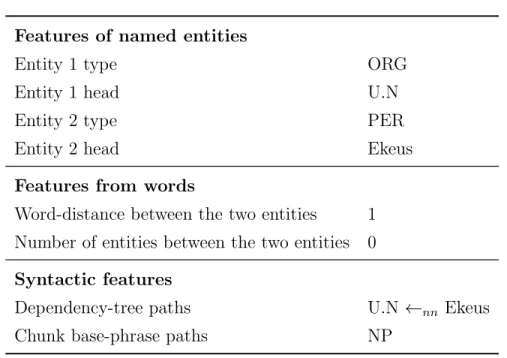
Table 2.2: Samples of features for the relation <U.N, Ekeus>.
Features of named entities
Entity 1 type ORG
Entity 1 head U.N
Entity 2 type PER
Entity 2 head Ekeus
Features from words
Word-distance between the two entities 1 Number of entities between the two entities 0 Syntactic features
Dependency-tree paths U.N ←nn Ekeus
Chunk base-phrase paths NP
for the classifiers. Jurafsky and Martin [56] categorized the common features into three classes as follows:
• Features of named entities, such as headwords or types of the two entities
• Features from the words in the text, such as stemmed words, distance in words between the two entities, and number of entities between the two entities
• Features from the syntactic structure, such as chunk base-phrase paths, dependency- tree paths, and constituent-tree paths.
Samples of features for the relation <U.N, Ekeus>in Figure 2.3 are presented in Table 2.2.
After extracting features, we can train the classifiers by using conventional machine learning methods, e.g., SVM [18, 46].
By using supervised methods, the system can achieve high precision and recall. However, the annotated corpora are not available for all types of relations, and fully supervised methods are not applicable to large-scale relations of Web texts. Another promising approach, called semi-supervised, can create additional features or training data based on prior knowledge, e.g., ground facts, and a large unlabeled data.
Sun et al. [134] employed word clusters as additional features for relation extraction.
They then proposed several statistical methods to select effective clusters, such as calculating the clusters’ information gain or coverage to decide whether a cluster is appropriate feature or
not. They used the English portion of the TDT5 corpora (LDC2006T18) as unlabeled data for inducing word clusters. The experimental results on the benchmark ACE 2004 training data showed that the approach outperformed the supervised relation extraction system by Zhou et al. [46].
Another semi-supervised technique that has recently attracted many researchers in rela- tion extraction is distant or weak supervision [53, 52, 84, 116]. This approach generates its own training data by matching a set of facts from available knowledge-bases (e.g., YAGO [133] and Freebase [17]) to large unlabeled texts. The distant supervision assumes that if two entities participate in a relation, any sentences that contain the two entities might express that relation [84]. For instance, suppose that r(e1, e2) = F ounded(J obs, Apple) is a ground tuple in a knowledge-base ands= “Steve Jobs founded Apple, Inc.” is a sentence containing synonyms for bothe1 = Jobs and e2 = Apple, then s may be a natural language expression of the fact that r(e1, e2) holds and could be a useful training example [52]. The generated training data is then used to learn a relation extractor.
There are two separate methods to evaluating systems of relation extraction [56]. The first method calculates both labeled and unlabeled recall, precision and F-score by exactly matching the generated results with the gold standard. The labeled scores measure the system’s ability to classify relations while the unlabeled ones focus on detected entities. The second method computes the scores based on the extracted tuples rather than on the relation mentions, i.e., it ignores the frequencies of a relation in the text.
2.2 Biomedical Text Mining
Biomedical text mining, also known as biomedical natural language processing (BioNLP), is a narrow field of text mining that aims to develop methods for extracting useful information from the literature in biomedical and biology domains. Therefore, biomedical text mining also follows the same process as text mining. The only difference is that the process is applied to biomedical documents, which requires us to make it suitable for the domain. This section will describe more details about the difference in the two main tasks: biomedical NER and relation extraction.
2.2.1 NER
Compared with general NER, there are some difficulties for biomedical NER as follows:
• Long entity: An entity may be very long, e.g., ‘isolated peripheral blood mononuclear cells’ and ‘oxidative-stress sensitive transcription factor’.
• Irregular name conventions: An entity may be written in various forms, such as
‘Geobacillus sp. strain T1’, ‘Geobacillus sp. T1’, and ‘Geobacillus Strain T1’. There is no convention for presenting the short form of an entity; sometimes they are full short form, but sometimes they are not. For instance, ‘B. cereus’ is a short form of the bacteria ‘Bacillius cereus’; ‘M. TB.’ is a short form of ‘Mycobacterium tuberculosis’.
• Nested named entity: An entity contains another entity, e.g., the RNA entity ‘CIITA mRNA’ includes the DNA entity ‘CIITA’.
Due to its importance to all further processing, NER is one of the most widely studied tasks in biomedical text processing. The early NER systems in the field are typically rule- based or lexicon-based [6, 39, 40, 41, 96, 121, 138]. MedLEE is a general natural language processor for clinical texts, encoding and mapping terms to a controlled vocabulary [39]. GE- NIES [40], adapted from MedLEE, identifies genes and proteins by using BLAST techniques, specialized rules and external resources, including GeneBank and Swiss-Prot. EDGAR [121]
extracts information about drugs and genes relevant to cancer from the biomedical literature based on their semantic and pragmatic analyses. The advantage of these systems is that they do not need labeled data to be trained and they are applicable to large-scale texts.
After its releasing, the GENIA corpus [61] has been used for various supervised learning models, including SVM [57, 85, 164], HMMs [163], and CRFs [76, 129, 161]. Those studies converted NER to sequence labeling and employed the common NER features as mentioned above to address non-nested entities. Nested entities were tackled by modeling the recog- nition as a parsing problem [37] or by reducing the nested problem to one or more BIO problems to make use of existing NER tools [3].
It should be noted that despite the availability of training corpora, the performance of biomedical NER has not been as high as expected. The shared task of BioNLP/NLPBA 2004 used GENIA as dataset for training and evaluation [62], and the highest-performing system only achieved 72.6% of F-score. In the first BioCreative challenge [51], gene mention identification was the first subtask of task 1 and the highest F-score was about 83% [160].
In the BioCreative II, the F-score was improved to 87% [5], and even a combined system assembled by the organizers achieved an F-score of only 90.66% [54].
Most of the previous work has focused on some specific semantic types, such as the gene/protein names [64, 92, 129, 145, 160], gene/protein, cell line and cell type [57, 62, 161,
164], drugs [121, 147], and chemicals [96, 147]. There are only a few studies that tackle a general schema of biomedical entities, e.g., MetaMap[6] and CubNER [162]. MetaMap maps biomedical text to UMLS Metathesaurus concepts. The system first performs lexical and syntactic analysis (general NLP processes) on the input text, and then applies some matching techniques to match the input words with Metathesaurus strings. Pratt and Yetisgen-Yildiz [104] reported that MetaMap achieved a recall of 52.8% and a precision of 27.7% with exact matching, and a recall of 93.3% and a precision of 55.2% with partial matching when applying on 20 MEDLINE titles. CubNER [162] is an unsupervised biomedical NER that has three main steps: (1) collecting seed terms from the UMLS Metathesaurus, (2) detecting candidates of entities based on their own heuristic, and (3) calculating the similarity between the candidates and the seed terms to classify the entities. The system achieved 53.1%, 52.2%, 53.9% and 39.5% F-score on the Pittsburgh, Beth, Partners and GENIA corpus, respectively.
2.2.2 Relation Extraction
Two series of shared tasks including BioCreative [51] and BioNLP shared tasks [60] have significantly contributed to the progress of biomedical relation extraction. The BioCreative tasks focused on protein-protein interaction (PPI), while the BioNLP shared tasks have aimed at bio-molecular events.
A variety of different approaches have been proposed to solve PPI and bio-molecular events. Airola et al. [1] constructed a kernel for learning from dependency graphs of sentences to extract PPI. Miwa et al. [87] proposed a method that combined a bag-of-words kernel, subset tree kernel and graph kernel to capture important information from given sentences and applied it to PPI extraction. They achieved better performance than the Airola et al.’s system. Bj¨orne et al. [12] represented the relationship between entities as a graph; each node can be an entity or even an event. The semantic graph would be updated with more nodes and edges by trigger and event detection. The graph was then post-processed by some heuristics to generate the final semantic one, which represented for event extractions. Their system achieved the highest performance at the BioNLP shared task 2009. The author, then, extended their system [13] to generalized biomedical domains by using an SVM classifier at the post-processing step instead of heuristics.
Riedel et al. [114] applied Markov Logic Networks (MLNs) to extract the event and achieved the best results for negation and speculation events. The highest-performing system in the 2013 shared task was TEES-2.1 [14], which achieved an F-score of about 55% for the CG task. The system represents both binary relations and events with a unified graph and
approaches event extraction task as a mutli-class classification task (SVMmulticlass). Liu et al. [152] and Roller et al. [123] also employed mutli-class classification for their systems.
Other methods such as domain adaptation [88, 115] and dual composition [115] were also applied to this task.
The above approaches require gold standard corpora (i.e. manually annotated corpora) for their training step. It is therefore difficult to apply the learned models to other tasks or to scale them to environments of large documents. Pattern-based methods can tackle this limitation [42, 109, 118, 153]. Rinaldi et al. [118] introduced three levels of patterns to detect relations. The first level is syntactic patterns; the second one is semantic rule, which normalizes many possible syntactic variants (e.g. active, passive, nominalizations). On the third level they combined semantic rules with lexical and ontological constraints to obtain specialized queries that can detect a domain-specific relation.
RelEx [42] extracted protein-gene interactions by using three crafted rules. Their rules were constructed based on the dependency parse tree of a sentence. The system then filtered out candidates of relations by performing some post-processes including negation check, effector-effectee detection, enumeration resolution and restriction to a set of relation terms.
RelEx was applied to about 1 million MEDLINE abstracts, and extracted about 150,000 relations with an estimated performance of both 80% precision and 80% recall. Recently, Xu et al. [153] proposed a pattern-learning approach to extract treatment-specific drug- disease. They first identified drug-disease pairs according to drug and disease lexicons from the UMLS Metathesaurus and DrugBank. They then learned patterns of treatment based on some initial extracted ones. Their system finally detected 34,305 unique drug-disease treatment pairs from the whole MEDLINE. Though these pattern-based approaches can be implemented without a labeled corpus, they are designed to a specific type of relations, not to a wide range of types. In order to address this limitation, we will propose a set of patterns that covers a wide range of relation types. More related work to this approach will be presented in the following sections.
2.2.3 Available Resources and Corpora
A variety of biomedical resources and corpora have been published and made available to the research community. In this section, we will introduce some notable ones that are often used in BioNLP.
MEDLINE/PubMed
MEDLINE/PubMed is a primary source for input documents in BioNLP. It is a collection of documents but it is not static since it grows every year. MEDLINE is a bibliographic database containing citations and author abstracts from more than 5,600 biomedical journals.
Currently, MEDLINE contains over 21 million references generally from 1946 to the present2. One MEDLINE citation represents one journal paper and includes some fields, such as title, authors, and abstract. PubMed3 is a search engine providing access to the MEDLINE database. PubMed indexes each MEDLINE citation and assigns a PubMed Unique Identifier (PMID) to it.
So far, there are many text mining systems applied to the whole MEDLINE, such as MEDIE [89], Bj¨orne et al. [11], MedScan [29], AliBaba [102], and SemMedDB [59].
The Unified Medical Language System
The Unified Medical Language System4 (UMLS) is a large set of lexical resources that inte- grates key terminology in the clinical domain. The UMLS provides three knowledge sources:
the UMLS Metathesaurus, the Semantic Network and SPECIALIST Lexicon and Lexical Tools. The UMLS Metathesaurus is a dictionary of terms from many vocabularies. Cur- rently, the 2014AA version contains more than 2.9 million concepts and 11.6 million unique concept names from over 150 source vocabularies. The Semantic Network is a hierarchy of 54 semantic relations between 133 semantic types. The semantic types in the Semantic Network are consistent with categories of all concepts in the UMLS Metathesaurus. SPE- CIALIST Lexicon and Lexical Tools is a set of NLP tools that support lexical variation and text analysis tasks in the biomedical domain.
The Open Biomedical Ontologies
The Gene Ontology (GO)5 is one of the first open ontologies in the field. The GO pro- vides a controlled vocabulary of terms representing gene product properties. It covers three domains: (1) cellular component describes locations of sub-cellular structures and macro- molecular complexes; (2) molecular function describes activities such as binding activities at the molecular level; and (3) biological process, a recognized series of events or molecular
2http://www.nlm.nih.gov/pubs/factsheets/medline.html
3http://www.ncbi.nlm.nih.gov/pubmed
4http://www.nlm.nih.gov/research/umls/
5http://www.geneontology.org/
functions.
Other ontologies for phenotype, biochemistry and anatomy structured similarly to GO can be found at the Open Biomedical Ontologies website: http://www.obofoundry.org/.
The BioLexicon
The BioLexicon6 is a lexical resource that combines terminologies of several public data resources such as UniProtKb7, ChEBI8 and NCBI taxonomy9. The resource [141] contains over 2.2 million of both domain-specific and general lexicon entries with information of four part-of-speech (POS) categories (nouns, verbs, adjectives and adverbs), and over 1.8 million terminological variants, as well as over 3.3 million semantic relations with over 2 million synonymy relations.
Applications of BioLexicon to lemmatisation of biomedical text, information retrieval, and information extraction were reported in Thompson et al. [141].
DrugBank
The DrugBank database [69] is a unique bioinformatics and cheminformatics resource that combines detailed drug (i.e. chemical, pharmacological and pharmaceutical) data with com- prehensive drug target (i.e. sequence, structure, and pathway) information. The database contains 7,681 drug entries including 1,545 FDA-approved small molecule drugs, 155 FDA- approved biotech (protein/peptide) drugs, 89 nutraceuticals and over 6,000 experimental drugs. Additionally, 4,218 non-redundant protein (i.e. drug target, enzyme, transporter, or carrier) sequences are linked to these drug entries. Each DrugCard entry contains more than 200 data fields with half of the information being devoted to drug/chemical data and the other half devoted to drug target or protein data.
GENIA
The GENIA corpus [61] is an annotated corpus for molecular biology. The corpus consists of 2,000 MEDLINE abstracts with more than 400,000 words. It is fully annotated with both linguistic and semantic markups, including sentence boundaries, token boundaries, POS tags, and named entities of 47 biologically categories. Part of the corpus were annotated
6http://www.ebi.ac.uk/Rebholz-srv/BioLexicon/biolexicon.html
7http://www.uniprot.org/
8http://www.ebi.ac.uk/chebi/
9http://www.ncbi.nlm.nih.gov/taxonomy
with syntactic trees, coreference resolution and biomolecular events, which have been used in the BioNLP shared task.
The GENIA corpus has been demonstrated to be the most heavily used corpus in the BioNLP community, as described in Section 2.1.1 and Section 2.1.2.
Five Protein-Protein Interaction Corpora
In biomedical relation extraction, protein-protein interaction (PPI) has been the most widely studied relation because of its important role in biological processes. There are five commonly used corpora of this relation type, including AIMed, BioInfer, HPRD50, IEPA and LLL.
AIMed10 was created from 200 PubMed abstracts containing PPI and 30 abstracts with no PPI. BioInfer11consists of about 1,100 sentences from PubMed abstracts that contain at least one pair of interacting proteins. HPRD5012consists of 50 abstracts referenced by the Human Protein Reference Database (HPRD). The IEPA corpus [32] was constructed from about 300 PubMed abstracts, each abstract contains at least two biochemical nouns. The LLL13corpus, consisting of only 55 sentences, was the shared dataset for the Learning Language in Logic 2005 challenge. The domain of LLL is gene interactions of Bacillus subtilis.
All the five corpora contain annotation of identifying genes or proteins. Among them, only LLL and BioInfer contain information on the types of the entities, such as ‘individual protein’ and ‘protein complex’. Moreover, these two corpora also distinguish the types of PPI, e.g., ‘positive action binding’ and ‘positive action cross-link’ in BioInfer, and ‘explicit action’ and ‘Binding to Promoter’ in LLL, while the others only label interactions. Pyysalo et al. [105] provided a software tool necessary to convert those corpora into a shared XML- based format.
2.3 Open Information Extraction
Open Information Extraction (Open IE) has become prevalent over traditional relation ex- traction methods, especially on the Web. The idea of Open IE is to avoid the need for specific training examples and to extract a diverse types of relations. More details about Open IE systems for Web text and for biomedical domain will be presented in this section.
10ftp://ftp.cs.utexas.edu/pub/mooney/bio-data/
11http://mars.cs.utu.fi/BioInfer/
12http://www2.bio.ifi.lmu.de/publications/RelEx/
13http://genome.jouy.inra.fr/texte/LLLchallenge/
2.3.1 General Domain
Banko et al. [8] introduced Open IE as a novel information extraction paradigm that fa- cilitates domain independent discovery of relations extracted from text and readily scales to the diversity and size of the Web corpus. An Open IE system extracts tuples consist- ing of argument phrases (arg1, arg2) from the input sentence and a relational phrase (rel) that expresses the relation between arguments, in the format of (arg1; rel; arg2). Open IE systems that have been developed up to now include TextRunner [8], StatSnowBall [165], WOE [151], ReVerb [35], and OLLIE [73].
TextRunner [8] consists of three modules, including Learner, Extractor and Assessor.
The Learner first applies a parser to sentences of its own training data to detect candidate tuples (ei, ri,j, ej), in which ei, ej are base noun phrases. It then assigns each tuple as true or false based on some syntactic constraints. Finally, a Naive Bayes classifier was learned on these extracted tuples. The Extractor extracts candidate tuples from input sentences by using some heuristics and sends the tuples to the classifier, if the tuple is validated as true, it would be passed to the Assessor. Finally, the Assessor assigns a probability to the tuple.
TextRunner was applied to a corpus consisting of over 9,000,000 Web pages and has shown the ability of extracting a broader set of facts.
The WOE systems [151] also approached Open IE in the same way as TextRunner.
However, they made use of Wikipedia as a source of training data for their extractors, which led to further improvement over TextRunner. In addition to traditional relation extraction, StatSnowBall [165] also addressed Open IE on Web text. They used the discriminative MLNs [103] to learn the weights of their generated patterns and applies some softened hand rules to assign the weights.
Fader et al. [35] proposed ReVerb to overcome two shortcomings in Open IE systems:
incoherent extractions and uninformative extractions. ReVerb introduced a syntactic con- straint to validate incoherent extracted relations, and a lexical constraint to avoid overly- specific relation phrases. Their system achieved an area under the curve that is 30% higher than WOE or TextRunner.
Since ReVerb focuses on relations mediated by verbs (verb, verb + preposition, verb + noun + preposition), OLLIE [73] is proposed to extract other relations mediated via nouns and adjectives. First, it uses a set of high precision seed tuples from ReVerb to bootstrap a large training set. Second, it learns open pattern temples over this training set.
Next, OLLIE applies these pattern templates at extraction time. BothReVerband OLLIE assign a confidence value to each extracted triple, instead of simply classifying them as true
or false.
TreeKernel, a more general method than the above systems was presented by Xu et al.
[154]. They employ multiple SVM models with dependency tree kernels for their two tasks:
determining if a sentence potentially contains a relation between two entities and confirming explicit relation words for those entities. The shortest path between the two entities along with the shortest path between relational words and an entity are considered as a candidate tree path and input to a tree kernel. They finally used kernel-based SVMs to classify a relation triple as true or false.
Recently, Mesquita et al. [78] proposed Exemplar to identify both binary and n-ary relations. Exemplar employed six patterns based on dependency trees to extract n-ary relations. Their experimental results implicated substantial gains over both binary and n- ary relation extraction tasks compared with ReVerb, OLLIE and TreeKernel.
2.3.2 Biomedical Domain
SemRep [119, 120], a rule-based semantic interpreter, extracts semantic relationships from biomedical text. Their relationships are represented aspredications, a representation consist- ing of a predicate and two arguments. SemRep extracts 30 predicate types, mostly related to clinical medicine, substance interactions, genetic etiology of disease and pharmacogenomics.
SemRep relies on ‘indicator’ rules which map verbs and nominalizations to predicates in the Semantic Network, such as TREATS, AFFECTS and LOCATION OF. For example, an indicator rule says that the nominalization treatment must be mapped to the predicate TREATS. SemRep also enforces domain restrictions by using meta-rules that require all semantic relations to be present in the Semantic Network. For instance, a pair of semantic types that matches to the predicate TREATS is ‘Pharmacologic Substance’ and ‘Disease Syndrome’. Therefore, the arguments associated with treatment for example, must have been mapped to the Metathesaurus concepts with the semantic types of ‘Pharmacologic Substance’ and ‘Disease Syndrome’. Consequently, for each type of relations, SemRep has to refine the corresponding ‘indicator’ rules and meta-rules based on the the UMLS Semantic Network. Regarding this point, our patterns are more general than SemRep, since they are tailored to capture deep syntactic relations and not restricted to any specific set of verbs.
Rosemblat et al. [124] have recently extended SemRep’s coverage to the field of medical informatics. They adapted ontology engineering processes to build a semantic representation of an unsupported domain, and then integrated it with the UMLS Metathesaurus so that SemRep can be applied to the new domain. They conducted some experiments to compare
Table 2.3: Lexico-syntactic patterns by Nebot and Berlanga [97].
Pattern Examples
[E] verb [E] [levamisole] activates [macrophrages]
[E] verb phrase [E] [PAF] consistently inhibited [killer cell]
[E] verb phrase + prep [E] [polysaccharide] was treated with [periodate]
[E] prep + noun + prep [E] [cytostatic drugs] in combination with [OK-432]
[E] to + infinitive [E] [fibroblasts] to produce [growth factor(s)]
[E] neg-verb-phrase [E] [haptens] does not inactivate [B lymphocytes]
[E] to be [E] [Strongyloidiasis] is an [intestinal disease]
SemRep and the enhanced SemRep, their results have shown that the enhanced version performed better than SemRep in terms of precision.
McIntosh et al. [77] presented a bootstrapping system that does not use manually-crafted seeds of tuple or pattern. The system first identifies the terms in the target categories by using some hand-picked seed terms. Next, their relation discovery module automatically finds the relation and their seeds based on some heuristics and sends the terms back to the term recognition module. Their system was applied to MEDLINE abstracts to extract relations between 10 categories of entities and achieved high precision, the highest one was 87.9%.
The system by Nebot and Berlanga [97] extracts explicit binary relations of the form
<subject, predicate, object>from CALBC [110] initiative. To detect candidate relations, they proposed seven simple lexico-syntactic patterns as shown in Table 2.3. These patterns are expressed in part-of-speech tags in which relational phrases reside between the two entities.
By contrast, our PAS patterns do not restrict the order of relational phrases and arguments in sentences. This means that our system can detect more relations than Nebot and Berlanga’s system.
2.4 Predicate-Argument Structures
A relation is described in a sentence by a composition of a predicate and its arguments, which forms Predicate-Argument Structure (PAS). A predicate that indicates a particular type of relation can be a verb, a phrase or a preposition. Figure 2.4 shows an example of a PAS in a sentence. In this example, ‘activates’ is a predicate and ‘LPS’ and ‘macrophages’
Figure 2.4: An example of predicate-argument structures.
are its two arguments, in which ‘LPS’ is the subject and ‘macrophages’ is the object. The verb ‘activate’ indicates the relationship of interaction between the two arguments. In this work, six PAS patterns that we propose focus on verb and preposition predicates.
Using PASs has been a practical approach to domain-independent information extraction.
Gildea and Palmer [43] and Surdeanu et al. [136] built systems that automatically identified PAS on the output of a full parser by using machine learning methods. Some annotated corpora of PAS frames such as PropBank [63], VerbNet [65], and FrameNet [7] were employed in their learning models. These detected PASs were then applied to extract information in general domains.
In the biomedical domain, Tateisi et al. [139] introduced a corpus annotated with PAS in verbs including their normalized forms on research abstracts. PASBio [150] and BioProp [22] are PAS frames for the biomedical domain based on PropBank. PASBio was applied to the LSAT system [130] to extract alternative transcripts from the same gene. BioProp was used to train the BIOSMILE system [143], a system that performs semantic role labeling on biomedical verbs. However, these two resources are not general enough for the domain since both of them are restricted to a limited number of verbs. More specifically, BioProp contains 2,382 predicates for 30 biomedical verbs; and PASBio has only 30 predicates14 for 30 verbs describing molecular events15. In this dissertation, we propose six simple PAS patterns that are expected to cover both BioProp’s and PASBio’s two-argument frames.
Instead of using hand-written patterns, Yakushiji et al. [156] automatically constructed their PAS patterns based on the obtained syntactic structures. They then enhanced their system [155] by dividing the patterns into combination patterns and fragmental patterns, and learning a SVM prediction model based on the pattern matching results and scores.
The best performance of their system was an F-score of 57.3%. However, their system was applied to PPI only since it was trained on the AIMed corpus.
Subcategorization frames (SCFs) [117] are similar to PASs. However, compared with PASBio and BioProp, SCFs are more general in the sense that their arguments are not restricted to a specific type but built from phrase types. For instance, a PAS for the verb
14https://sites.google.com/site/nhcollier/projects/pasbio/all-predicates
15The 30 biomedical verbs of BioProp are different from the 30 verbs of PASBio.
‘mutate’ in PASBio is:
Arg1: physical location where mutation happen //exon, itron//
Arg2: mutated entity //gene//
Arg3: change at molecular level Arg4: change at phenotype level
While SCFs for the verb ‘decrease’ are NP (the verb has one argument that is a noun phrase, NP-PP (the verb has two arguments: a noun phrase and a prepositional phrase) and PP-PP (two arguments are both prepositional phrases). Those frames are less restrictive than the PAS frames.
In this dissertation, our proposed PAS patterns are more general than SCFs since our patterns are not restricted to any specific verbs and accept all verbal forms.
2.5 Synonym Resolution for Relational Phrases
The task of finding synonyms for extracted relations is usually known as synonym resolution, or paraphrase discovery. Several unsupervised systems for this task have focused on using similarity-based, corpus-based and probabilistic techniques.
2.5.1 Similarity-based Methods
The DIRT system [71] uses a similarity measure based on mutual information statistics to identify inference rules between relation phrases. The authors assumed that if two depen- dency paths tend to link the same sets of words, their meanings are similar. In their context, a path represents a binary relationship, from each pair of similar path, an inference rule is generated. To compute the path similarity using their assumption, they collected frequency counts of all paths and slot fillers for the paths in a corpus. Each slot filler is considered as the path’s features. For instance, they calculated the similarity between “X finds a solution to Y” and “X solves Y” based on the instances of the slots X and Y, with an assumption that if the two paths tend to occur in similar contexts, i.e., the same instances of X and Y, the meanings of the paths tend to be similar.
Min et al. [83] employed the same approach as DIRT to discover paraphrases in WEBRE.
However, there are two differences in their work. First, they measured the similarity between two relational phrases instead of between two dependency paths. Second, features of the relational phrases were ordered pairs of instances of the two slots X and Y while DIRT did not consider the order of the instances. Their empirical tests showed that WEBRE could
![Table 2.3: Lexico-syntactic patterns by Nebot and Berlanga [97].](https://thumb-ap.123doks.com/thumbv2/123deta/6184345.1086150/33.918.149.773.153.395/table-lexico-syntactic-patterns-nebot-berlanga.webp)