Japan Advanced Institute of Science and Technology
JAIST Repository
https://dspace.jaist.ac.jp/
Title
DNAアプタマの高選択性多重 in vitro セレクションの ための競争的濃縮によるリガンド系統的進化法SELCOの 開発
Author(s) Kushwaha, Ankita Citation
Issue Date 2019‑06
Type Thesis or Dissertation Text version ETD
URL http://hdl.handle.net/10119/16071 Rights
Description Supervisor:高村 禅, マテリアルサイエンス研究科,
博士(マテリアルサイエンス)
Doctoral Dissertation
Development of Systematic Evolution of Ligands by Competitive enrichment-SELCO
for highly selective and multiplex in vitro selection of DNA aptamers
Ankita Kushwaha
Supervisor: Professor Yuzuru Takamura
School of Material Science
Japan Advanced Institute of Science and Technology
June 2019
Thesis Title Development of Systematic Evolution of Ligands by Competitive enrichment-SELCO for highly selective and multiplex in vitro selection of DNA aptamers
By Ankita Kushwaha
Thesis Advisor Professor Yuzuru Takamura
Thesis Commitee
Chairman Professor Yuzuru Takamura Examiner Professor Toshifumi Tsukahara Examiner Associate Professor Yuichi Hiratsuka Examiner Associate Professor Hidekazu Tsutsui
External Examiner Professor Kiyoshi Yasukawa (Kyoto University)
Abstract
Aptamers are oligonucleotide or peptide molecules that bind to a specific target molecule and can be engineered through in vitro selection equivalently known as SELEX (systematic evolution of ligands by exponential enrichment). The technique for selection was developed in 1990 and since then the field of molecular selection has seen continuous evolution due to the active interest of biologists. Molecular recognition, an interesting characteristic of aptamers allows them to rival antibodies popular for their diagnostic property. In addition to this, aptamers have far-reaching applications in therapeutics, bioimaging, drug-discovery and other. However, in addition to high affinity, specific recognition holds more essential significance for the reliable detection of target molecules in the presence of other similar configuration bulk molecules. Despite the enormous number of reports on aptamer, a small number of aptamers have reached clinical trials stage. This limitation can be met through an alternative for selection of highly specific candidates to a certain extent. In addition, the traditional method of SELEX is still complex, time consuming and high cost. The selection process involves multiple rounds of amplification leading to undesirable PCR bias and the successful rates are low in general. Here, we present a novel approach called ‘Competitive non-SELEX’ and termed as ‘SELCO’ (Systematic Evolution of Ligands by Competitive enrichment) for readily obtaining aptamers that can discriminate between highly similar targets.
This approach is based on the theoretical background presented here, in which under the co-presence of two similar targets, a specific binding type can be enriched more than a nonspecifically binding one during repetitive steps of partitioning with no PCR amplification between them. This principle was experimentally confirmed by the selection experiment for influenza virus subtype-specific DNA aptamers. Namely, the selection products (pools of DNA aptamers) obtained by SELCO were subjected to a DEPSOR-mode electrochemical sensor, enabling the method to select subtype-specific aptamer pools. From the clonal analysis of these pools, only a few rounds of in vitro selection were sufficient to achieve the surprisingly rapid enrichment of a small number of aptamers with high selectivity, which could be attributed to the SELCO principle and the given selection pressure program.
The subtype-specific aptamers obtained in this manner had a high affinity (e.g., KD = 82 pM for H1N1; 88 pM for H3N2) and negligible cross-reactivity. The kinetics of H1N1-specific DNA aptamer showed close resemblance with respective monoclonal antibody thus suggestive of aptamer potential comparable with antibodies. By making the H1N1-specific DNA aptamer a sensor unit of the DEPSOR electrochemical detector, an influenza virus subtype-specific and portable detector was readily constructed, indicating how close it is to the field application goal. The identification and evaluation of the selected aptamers were performed by cloning and sequencing.
The identified aptamers were tested for their kinetic parameters by SPR and their specificity was evaluated by electrochemical detection. So, a novel technology for isolation of specific aptamers for multiple targets has been described here. Rapid, PCR-free and simple concept along with the compliance of experimental inferences with the theoretical explanation of SELCO holds significance in the future potential of this technology for other in vitro selection.
Keywords: Aptamer, SELEX, SPR, electrochemical sensor, influenza virus
Preface
The theory of natural selection and evolution has been determining in understanding the idea of origin of life. Several theories were proposed to understand the concept of how life started from the beginning. The discovery of RNA as a self-replicating entity marked the potential of nucleic acid molecule to be over and above simply units of genetic information. Furthermore, the assembly of different processes made possible to amplify and select molecules in vitro.
In molecular biology, a combinatorial chemistry technique for producing oligonucleotide ligands (aptamers) that bind target molecules is in vitro selection also referred as Systematic Evolution of Ligands by EXponential enrichment (SELEX). The fundamental of in vitro selection is to isolate binding ligands from non-binding ligands for a target molecule by repeated selection cycles of binding, partitioning and amplification. Aptamers have been widely applied in analytical, bioanalytical, imaging, diagnostic and therapeutic fields. Due to the inherit merits of this technology, substantial achievements have been made regarding selections, modifications and applications of aptamers. However, few aptamer-based products have successfully entered into the clinical and industrial use. Besides, it is still a challenge to obtain highly specific aptamers in an efficient manner. This study was designed with the mindset to be able to select specific aptamers for real time point-of-care application. The selection forces administered during the process are determining in the selectivity of isolated ligands. On theoretical background, the introduction of competition induced selection force with the presence of a competitor target is a novel approach nearer to specific aptamer selection. The preliminary findings during the course of this research are supportive for the development of a unique technique of Systematic Evolution of Ligands by COmpetitive enrichment (SELCO).
Also, simple and straightforward evaluation can be attained by the integration of the selected aptamer with electrochemical-sensing platform. This research has been developed and advanced under the supervision of Prof. Yuzuru Takamura and Assoc. Prof. Manish Biyani at School of Material Science in Japan Advanced Institute of Science and Technology. I hereby declare that details furnished here are true and correct to the best of my knowledge and belief and I shall be held liable for any misleading/untrue information.
Ankita Kushwaha
Acknowledgement
This research has been accomplished with support of particular individuals. The guidance of Prof. Yuzuru Takamura has been extremely helpful and of utmost importance in the successful completion of this research. Also, dialogue and consultation with him helped develop insight, learning and critical thinking skills essential for scientific research. The guidance of Assoc.
Prof. Manish Biyani have principal role in the development of this research from scratch to concrete. His continuous mentoring by innumerable discussions on day-to-day observations have far-reaching significance in the progression of this work. The enlightenment developed from the theoretical perspective for this research has been the contribution of Prof. Koichi Nishigaki. The experienced and trusted guidance of co-worker Keiko Kawai have been absolutely essential for developing hands-on training skills for careful equipment handling.
Also, the comments of the committee members have sincerely been considered and proven vital for the improvement of this research. The indefinite love, continuing support of parents and their lessons of right-minded approach in life have been ineffable and consistent encouragement from brother has been the pillar of my hold-up throughout.
Ankita Kushwaha
Table of Contents
Abstract ... i
Preface ... ii
Acknowledgement ... iii
Chapter I General Introduction ... 1
1. Introduction ...1
2. In vitro selection ...2
Aptamers ...2
Systematic evolution of ligands by exponential enrichment (SELEX) ...3
3. Development of in vitro selection technology ...5
4. Application of aptamers ...9
Developed aptamers in clinical trials... 10
Aptasensors in point-of-care testing ... 14
5. Impediment of aptamer development and subsequent outlook... 18
Conclusion ... 18
Research Outline ... 19
Chapter II Development of competitive selection, SELCO (Systematic Evolution of Ligands by Competitive enrichment) for the selective and rapid enrichment of DNA aptamers ... 20
1. Introduction ... 20
2. Materials and Methods ... 21
SPR Measurements ... 23
Electrochemical Measurements ... 24
3. Results and Discussion ... 25
In vitro competitive selection ... 25
Theoretical Note ... 32
4. Conclusion... 34
Chapter III Identification and evaluation of selected aptamers via SELCO for subtype H1N1 and H3N2 of Influenza A virus ... 35
1. Introduction ... 35
2. Materials and Methods ... 37
Cloning and Sequencing ... 37
SPR Measurements ... 37
Electrochemical Measurements ... 37
3. Results and Discussion ... 38
Evaluation of cloned DNA aptamers ... 38
Evaluation of SPR measurements of DNA aptamers ... 41
Evaluation of electrochemical measurements of DNA aptamers ... 43
Discussion (SELCO)... 45
4. Conclusion... 48
Chapter IV Development of Apta-DEPSOR for selective point-of-care testing of infective-
subtype of Influenza A virus ... 49
1. Introduction ... 49
2. Materials and Methods ... 51
Electrochemical Measurements ... 51
3. Results and Discussion ... 52
Specificity evaluation of identified aptamer ... 52
Quantitation of an influenza virus subtype using Apta-DEPSOR ... 53
4. Conclusion ... 55
Chapter V Conclusion and Future Work ... 56
References ... 57
List of Publications ... 68
1
Chapter I General Introduction
1. Introduction
The theory of evolution brought us nearer to the question about the emergence of life and its origin. The biggest challenge in this endeavor was to unravel the chemical processes that made the synthesis of complex molecules containing information possible. In 1966, Norm Pace and Sol Spiegelman reported that ribonucleic acid (RNA) could serve as template for the synthesis of RNA. This report thus supported that RNA could be the instructive agent in a replication process and satisfy the operation of a self-replicating entity. Furthermore, this work provided the set-up for studying the genetics and evolution of a self-duplicating nucleic acid molecule. On the basis of this and other reports, Carl Woese, Francis Crick and Leslie Orgel suggested RNA to be the first informative molecule. The idea of the RNA world was the most exciting discovery based on the catalytic properties of RNA reported by the laboratories of Thomas Cech and Sidney Altmann. After the establishment of the RNA World hypothesis the experimental proof of concept on the evolution of a self-replicating informational system was challenging and required assemblage of all necessary tools to do so. In 1970, Howard Temin and David Baltimore discovered reverse transcriptase, an enzyme that can make deoxyribonucleic acid (DNA) from an RNA template. Furthermore, the purification of reverse transcriptase allowed for synthesis of DNA from RNA template was an essential tool for the development of in vitro evolution technology. Also, random synthesis of oligonucleotides and establishment of polymerase chain reaction (PCR) made it possible for specific amplification of DNA sequences. The above-mentioned discoveries paved the pathway for the invention of an ingeniously efficient method to amplify, mutate and select molecules with desirable properties1–5.
In 1980, a study on the Human Immunodeficiency Virus (HIV) and adenovirus indicated that these viruses encode a number of small structured RNAs that bind to viral or cellular proteins with high affinity and specificity. In case of HIV, a short RNA ligand called trans-activation response (TAR) element promotes trans-activation and virus replication by binding with the viral trans-activator of transcription (Tat) protein. Similarly, adenovirus also has a short RNA
aptamer, virus-associated (VA)-RNA, that regulates translation6–9. In 1990, Gerald F. Joyce`s group at the Scripps Research Institute used the in vitro mutation, selection and amplification to isolate RNA with enzymatic functionality. Larry Gold`s group at the University of Colorado used a randomized eight-nucleotide sequence to identify sequences of T4 DNA polymerase in vitro and named the process Systematic Evolution of Ligands by Exponential enrichment (SELEX) (US Patent 5,270,163). J.W. Szostak and A.D. Ellington at the Massachusetts General Hospital (Boston) reported a library with 100 randomized nucleotides for the selection of target-organic dyes. The ultimate functional form of a protein is determined after the post- translational modifications. Henceforth, it is necessary to detect the proteins in order to fully understand the cellular function, detection of diseases or monitoring the progression of an existing disease state and the effect of a drug on an organism. Nucleic acid ligands evolved, termed as aptamers, originated from the Latin “aptus” meaning to fit and “meros” meaning part and SELEX, an in vitro selection technology for the separation of binding ligands from non-binding ligands was established10–12.
Here, the basics of this unique technology and its development over the years have been reviewed. Moreover, the characteristic property of recognition molecule-aptamers showing resemblance to the antibodies have been discussed in detail. Also, a brief account of the aptamer products in clinical trials has been summarized. Other than this, the biosensing platform is an interesting aspect for the developing and already developed aptamers from point-of-care perspective. Thus, information about the much-studied aptamer sensors is also presented. These topics have been deliberately considered for understanding the limitations of the current technology alongside the great achievements.
2. In vitro selection Aptamers
The concept of “magic bullet” was envisioned by German scientist Paul Ehrlich of medicine, where a treatment would target only the disease-causing agent with high specificity and affinity and leave the healthy tissue untouched13. The foundation of magic bullet and the accomplishment could be realized in monoclonal antibodies and eventually epitomized in aptamers as both are active in identifying the disease-causing agent with high affinity and
specificity, differentiating between the target. The following factors can be considered to contribute towards the binding affinity between aptamers and their targets: hydrogen bonding, structure compatibility, stacking of aromatic rings, electrostatic and hydrophobic interactions and van der Waals forces14. The widely accepted in vitro selection methodologies have been remarkable in discovery of binding bio-probes/aptameric reagents for a range of biomolecules such as simple ions15, small molecules11,16, peptides17, single proteins18,19, ,organelles20, viruses21 and even entire cells18. Nucleic acid aptamers are high-affinity nucleic acid ligands (20 to 60 nucleotides) selected through ssDNA or RNA binding a specific target molecule from a random pool in vitro. Along with DNA/RNA oligonucleotides, peptide molecules have also been acknowledged for their recognition characteristic. Peptide aptamers are combinatorial protein molecules with specific binding affinity to the target of interest isolated in intracellular condition. Basically, the peptide aptamer comprises of the short peptide region inserted within a scaffold protein. The short peptide region interacts with the target protein and the scaffold region enhance the binding affinity and specificity through restriction on the conformation of the binding peptide. Due to the scaffold integration, the smaller peptide entity is capable of strong interaction with the target molecule. Thus, the advanced properties of the peptide aptamers make them more relevant in terms of molecular interaction studies when compared to DNA/RNA aptamers. However, the stability of the DNA aptamers cannot be disregarded. The application of the peptide aptamers in biological study and therapeutics include in vitro detection of various proteins in a complex mixture to in vivo modulation on proteins and cellular functions22.
Systematic evolution of ligands by exponential enrichment (SELEX)
Systematic evolution of ligands by exponential enrichment (SELEX) is a well-established and efficient technology for the generation of oligonucleotides with a high target affinity. The conventional SELEX methodology comprises of three main steps: binding, partitioning and amplification. Prior to the selection cycle, a library comprising of 1015 random unique sequences is synthesized. Each unique sequence contains random bases in the variable region generally of 20-50 nucleotides flanked by conserved primer binding sites on both ends which are used for PCR amplification by annealing primers. Firstly, for the binding step the library is incubated with the target molecules for indicated time. After incubation, the non-binding sequences are separated from the binding by partitioning methods. The number of rounds
necessary for selection can be determined by a variety of parameters such as the characteristic and composition of the target, library design, the conditions of selection, target-oligonucleotide ratio and the efficiency of the separation method. The stringency of SELEX process governs the affinity of the binding bio-probe to the target which is progressively increased over the successive rounds by changing the binding and washing conditions such as buffer composition, volume, time and or decreasing the target concentration in the final rounds of selection. Then the binding ligands are eluted and amplified by PCR/rtPCR for DNA/RNA oligonucleotide. This amplified pool of selected ligands is used for the next cycle of selection repeating the same steps as mentioned above. After several rounds of selection cycle, the enriched pool of sequences is further proceeded with cloning and sequencing and the selected aptamer candidates are then tested for their binding abilities (Figure1).
Figure1. Basic Process of Systematic Evolution of Ligands by Exponential enrichment (SELEX).
The traditional method of SELEX comprises of three main steps:(i) binding, (ii)partitioning and (iii) amplification followed by cloning & sequencing. The obtain candidate are then evaluated for their binding parameters and evaluated for candidate determination post-SELEX.
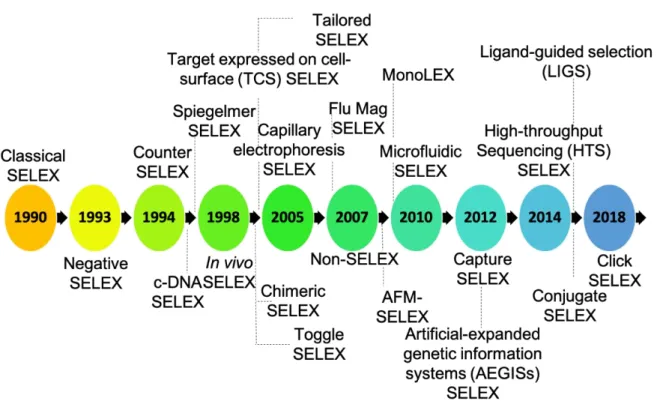
Generally, the hit rate is low, however if a successful candidate is evolved then post-SELEX characterization of the aptamer is performed to enhance its functionality. Thus, the conventional approach offers a complex and tedious process and the identification of aptamer against relevant targets remains a challenge23–25. So, several modifications were developed, and new types of SELEX process have evolved in the last 29 years (Figure 2). Some of the well-established ones are, negative-SELEX26, counter SELEX27, capillary electrophoresis SELEX28, microfluidic SELEX29, cell SELEX30, in vivo SELEX31 and high-throughput sequencing SELEX32 .
3. Development of in vitro selection technology
Vast interest in aptamers stimulated continuous development of SELEX, which underwent numerous modifications since its first application in 1990. Novel modifications made the selection process more efficient, cost-effective and significantly less time-consuming. Here a comprehensive and up-to-date review of recent advances in SELEX methods, pinpointing their advantages, main obstacles and limitations is presented.
Negative SELEX
In 1992, Ellington and Szostak introduced the method of eliminating false-positive results by performing negative SELEX. Generally, during the selection process some of the sequences might bind to the immobilization matrix enabling partitioning. So, after three selection cycles they incubated the library with purification support agarose as negative selection. After the removal of the non-specific binding sequences, the affinity of the resultant pool was enhanced by 10-times as compared to without negative SELEX26.
Counter SELEX
In 1994, Jenison et al. introduced the counter SELEX27 method in which an additional step of incubation with structurally similar targets is performed to enhance the specificity of aptamers. This method is beneficial to effectively discriminate against non-specific oligonucleotides. Counter SELEX is a kind of negative SELEX which uses similar configuration molecules for partitioning pressure. This method has been integrated with other modified SELEX technology such as cell-SELEX33, immuno-affinity SELEX34, quartz crystal microbalance (QCM) SELEX35 to name a few to improve the selectivity of aptamers.
Capillary Electrophoresis SELEX
The conventional SELEX method requires 10-15 rounds of selection cycles to obtain aptamers thus making it more labor intensive and time consuming. Capillary Electrophoresis SELEX (CE- SELEX)28,36, another modification of SELEX developed in 2004. In this method, the difference in the electrophoretic mobility of the target bound sequences from the unbound sequences was used for separation. This was a highly efficient method enabling selection of high-affinity aptamer candidates from 1-4 selection rounds. Furthermore, another CE-based technology called non-SELEX37, selects an aptamer without amplification. This method accelerated the selection procedure and minimized the DNA amplification bias caused by repetitive steps of PCR. Non-Equilibrium Capillary Electrophoresis of Equilibrium Mixtures (NECEEM), a highly efficient affinity-method was used to partition the oligonucleotides-target complex from the free oligonucleotides. The time for the selection process has been further reduced by this technology. However, limited volume of library can be injected into the capillary thus limiting the number of sequences.
Microfluidic SELEX
A microfluidic SELEX (M-SELEX) prototype29 was developed in 2006 by Hybarger et al.
combining traditional SELEX with microfluidic system. The prototype contains reagent-loaded micro-lines, a pressurized reagent reservoir manifold, a PCR thermocycler and actuatable valves for selection and sample routing. In 2009, Luo et al. described a more rapid, efficient and automatic aptamer selection system38. This system integrated the magnetic bead-based SELEX process with microfluidics technology and a continuous-flow magnetic activated chip- based separation device. Single round of selection was able to yield an enriched aptamer pool that could bind to recombinant botulinum neurotoxin type A with high affinity. However, the limitation of microfluidics such as aggregation of magnetic beads and microbubbles in the microchannel lead to distortion in flow streams might affect the aptamer purity and recovery process. However, these disadvantages were further improved by fabricating the microchannel with ferromagnetic materials by Soh et al. With this improved SELEX, they obtain aptamers with a Kd value of 25 nM in only three rounds of selection. Also, in 2009, Park et al. developed another novel microfluidic SELEX incorporating nanoporous sol-gel protein microarray39 material which was able to hold a large number of target molecules enabling selection against multiple targets. Several target molecules with Kd in low nM range
have been generated using sol-gel SELEX40,41. However, the concerns of protein integrity and stability through multiple selection cycles in sol-gel SELEX still exist.
Cell SELEX
Based on the observation that selected aptamers in vitro fail to recognize and bind to the same protein at endogenous levels or cellular condition, cell SELEX was developed. The merit of this technology lies in the fact that it employs the whole live cells as target which increases the possibility of selected aptamer to be used directly for diagnostic and therapeutic applications. Also, the molecular targets are in their native conformation thus the obtained aptamers represent the eventual results. There is no requirement for protein purification or prior-knowledge of the molecular targets on cell surface and this process can pave pathway for discovery of new biomarkers and unknown surface proteins. The first report of cell-SELEX was in 2003 by Daniels et al. for successfully obtaining a DNA aptamer against tenascin-C using a glioblastoma-derived cell line, U25130. Ohuchi et al. designed a novel SELEX method TECS SELEX42, in which a cell-surface displaying recombinant protein was directly used as selection target thus combating the time consuming and difficult process of purifying proteins. Other methods based on cell-SELEX such as FACS-SELEX43, 3D cell SELEX44 and cell-internalization SELEX45,46 have also been developed.
In vivo SELEX
For the functionality of aptamers in vivo the aptamers selected in vitro might not be purposeful thus leading to development of in vivo-based SELEX method for generating tissue- penetrating aptamers directly within animal models of the target disease. Mi et al. firstly tried to select aptamers inside a tumor of a living organism in 201031. A library of 2`- fluoropyrimidine-modified RNA aptamers was injected into the tail vein of intrahepatic tumor-bearing mice. Then the aptamers were extracted from the liver tumors, amplified and re-injected into other similar tumor-bearing mice. With this method they could successfully select aptamers against p68 and RNA helicase with Kd values in nM levels. Another example is of Cheng et al. identifying aptamers that could bind to brain capillary endothelia and penetrate into the parenchyma demonstrating feasible generation of aptamers using live- animal model as selection targets47.
One round SELEX
Several reports showing selection of high affinity aptamers in Nano-molar affinity range with one round selection have been reported. The MonoLEX method is a straightforward procedure to isolate high-affinity DNA aptamers for Vaccinia virus. This comprises of single affinity chromatography step, followed by segmentation and signal final PCR amplification step of bound aptamers. This process highlights the reduction of competition between aptamers of different affinities during PCR step, advantage for the single round selection48. In another method DNase-based digestion was used for selection of proteins blotted on membrane. Unbound and weakly bound sequences were efficiently removed49.
Artificial/non-natural and modified nucleotide SELEX
To increase the nucleotide repertoire with only four natural nucleotides for selection of bunding ligands, artificial and non-natural nucleotides50 are being employed for selection process. Also, artificially expanded genetic information systems (AEGISs)51 have been innovated. However, such systems can be used for few targets and limited due to activity of polymerase and tagging process essential to perform multiple selection rounds.
High-Throughput Sequencing SELEX
The identification of the candidate aptamer in the pool after the final selection round is mainly done by Sanger sequencing. However, in most cases the aptamers in the final pool are not the ones with high affinity and specificity. Thus, it becomes difficult to analyze which is the best aptamer. Recently, a new technology, high-throughput sequencing (HTS) was introduced which allows for sequencing the library across all the selection rounds thus remarkable for analysis of the enriched sequences at early stage. This method is time efficient and assists in avoiding PCR bias caused by over selection. Also, large scale analysis of sequence datasets by robust bioinformatics tools further facilitates comprehensive characterization of aptamers including binding affinity and /or specificity, structure prediction, abundance quantification and aptamer-target interactions52. In 2010, Cho M et al. showed the first application of high- throughput sequencing32. Several aptamers against different targets have been identified using HTS-SELEX53–55.
Figure 2. The timeline for the development of SELEX technology from beginning. This flow- chart demonstrates the modification of SELEX developed with the progressing time to meet the challenges of conventional technique. An attempt to list all the major discovery in the course of progression has been made.
4. Application of aptamers
After three decades of antibodies mediated sensing technology, aptamers are being well recognized at the forefront of the detection technology due to their advantageous characteristic traits such as high affinity and specificity. Aptamers have been yielded with affinity in the M range for small molecules such as dopamine (2.8mM), ATP (6mM) and nM- pM range against proteins such as VEGF, KGF56,57. In general, high affinity is considerable as high-specificity for a variety of targets, thus reporting the aptamers that can discriminate between targets using subtle structural differences such as presence of hydroxyl group or a methyl group, enzymes with similar catalytic function a-, g- thrombin and also enantiomers.
In the case of caffeine and theophylline which differ only in a methyl group, aptamers demonstrated a high molecular discrimination as compared with antibodies27,58,59. Aptamers can be generated that bind essentially any target with high-affinity, thus similar in their
function to monoclonal antibodies and this property enhances the number of clinical indications that are potentially detectable by these nucleic acid-peptide compounds.
Henceforth, aptamers can be considered as nucleotide-analogues of antibodies. And in the best of our interest, these engineered biomolecules have several properties that enhance their applications, better than the competitor antibody molecule. The process of identification of the antibody is a long and complex one and dependent on the host animal.
Moreover, antibody generation process is furthermore complicated in the case of toxic targets, that can be harmful for the host or low molecular weight compounds which trigger a minimal immunogenic response. Also, antibody show batch to batch variations which have been reduced by the monoclonal antibody preparations, however the purification and processing process is a lot more tedious. On the other hand, aptamer-generation is significantly easier and cost-effective as compared with the production of antibodies. They are selected by the in vitro selection strategy and high-throughput screening systems independent of a host. They are non-immunogenic and non-toxic. After post-SELEX characterization of selected aptamer, they can be generated accurately and reproducible by automated chemical synthesis. Moreover, the aptamer selection strategies can be defined and monitored for the selection of candidate aptamer with desirable traits60–62. Aptamers can be renatured easily and do not lose their functionality in varied temperature and physiological conditions that would otherwise denature the antibodies permanently. Antibodies are large and complex molecules sensitive to non-physiological pH and temperature, thus limiting their potential to be reusable. On the other side, aptameric reagents can undergo reversible denaturation and renaturation, not affecting their structure. Furthermore, the kinetic parameters can be changed on demand in an aptamer-based interaction and they can be easily transported at ambient temperature without degradation and stored in cold and subjected to numerous freeze-thaw cycles. These smart biomolecules have been widely applied in analytical, bioanalytical, imaging, diagnostic and therapeutic fields63.
Developed aptamers in clinical trials
In the present situation, the aptamer science is amplifying/becoming larger with the rate of minimum one new aptamer research being reported each day. For the accumulation of such substantial data a separate aptamer database has been created for ease of theoretical biologists64. Several successfully emerging aptamers have found their position in the stage of
clinical trials for specific conditions, thus demonstrating the factual importance of the aptamers in clinics. Based on their properties of being able to block the receptors and inhibit the protein activity with high affinity and specificity they have been well-applied in the discovery of therapeutic drugs. Macugen (OSI Pharmaceuticals, Melville, NY) is a good example of a successful aptamer based therapeutic for the treatment of age-related macular degeneration. This aptamer inhibits the anti-vascular endothelial growth factor, that participates in the growth of abnormal blood vessels in the eyes that cause vision loss.
Macugen has been approved by FDA for patients with neo-vascular age-related macular degeneration65. There are several other reports of aptamers undergoing clinical trials (Table 1). Protein tyrosine kinase-7 (PTK7) is reported to play an important role in motility and invasity of cancer cells and it overexpresses in different human cancers. Sgc8, a 41 oligonucleotides ssDNA aptamer selected by cell-SELEX is a specific ligand of PTK7. In this study, Sgc8 was linked to a bi-functional group NOTA for 68Ga chelation for the detection of colorectal cancer (CRC), third common cancer and fourth leading cause of death worldwide.
PTK7 is overexpressed in CRC and correlated with tumor differentiation, lymph node metastasis, distant metastasis stage of CRC patients. The clinical application of 68Ga labeled ssDNA aptamers Sgc8 will be studied in healthy volunteers and colorectal patients (NCT03385148). EYE001, an anti-VEGF Pegylated aptamer was used for a pilot study of intravitreal injection for advanced ocular disease of Von Hippel-Lindau (VHL) to treat retinal tumors in patients with Von Hippel-Lindau syndrome (NCT00056199). EYE001 decreases production of VEGF, a growth factor important for formation of new blood vessels which is elevated in VHL. Findings from studies of retinal diseases have suggested that EYE001 can reduce retinal thickening and improve vision. Archemix Corp., ARC-1779 is an optimized, second generation, PEGylated aptamer that exerts a novel antithrombotic action through targeting the A1 domain of activated von Willebrand factor (vWF). ARC-1779 has potential therapeutic benefit in acute coronary syndromes and von Willebrand`s disease as well as in vWF-related platelet disorders such as thrombotic thrombocytopenic purpura (TTP) (NCT00632242). The actions of ARC-1779 can be readily reversed by binding to complementary sequence of oligonucleotides thus offering potential therapeutic benefit in surgery66. In a second clinical study of NOX-A12, the safety, tolerability and pharmacokinetics and effect of mobilization of hematopoietic stem cells of NOX-A12 alone and in combination with Filgrastim was done (NCT01194934). In another study, the REG-1 aptamer-RNA target to
Factor IXa was evaluated (NCT00113997). The anticoagulation system REG-1 was designed to improve control of blood thinning. The REG1 system is designed such that one part of the system stops the activity of factor IX (protein that helps blood clot)67 while the other part of the system (the antidote) inactivates the drug and stops the thinning process. ARC1905, an anti-C5 aptamer was tested in combination therapy with Lucentis0.5 mg/Eye in subjects with subfoveal choroidal neovascularization secondary to age-related macular degeneration (AMD) (NCT00709527).
Although aptamers have several merits in therapeutics, short half-lives, nuclease degradation and rapid renal clearance have limited their efficiency in vivo. However, to remove such barriers various modifications and conjugations of aptamers have been adopted. Most aptamers in clinical studies have been modified in general at (i) ends of nucleic acid chain, (ii) sugar ring or nucleoside and (iii) phosphodiester linkage68,69. The aptamers are easily excreted through renal filtration because of their small size. So, the main strategy to avoid this is attachment of bulk moieties such as cholesterol70, polyethylene glycol (PEG)71, proteins72, liposomes73, organic and inorganic materials74. Aptamer can also be used as targeted drug delivery system, due to specific binding to a target molecule or an intended site. Based on the delivery agents by the aptamers, the aptamer targeted drug delivery systems have been classified in three major categories: aptamer-small molecule, aptamer-RNA and aptamer- nanomaterial conjugated systems.
Table1. Developed aptamers advantageous for in vivo diagnostic applications in clinical trials1
Aptamer/Drug Form Target Condition/Disease Phase
68Ga-Sgc8 DNA Protein tyrosine kinase-7 (PTK-7) Colorectal Cancer Early Phase 1
EYE001 RNA VEGF
(Decreases production) Von Hippel-Lindau (VHL) Disease Phase 1
ARC1779 DNA A1 domain of activated vWF (von Willebrand factor)
Purpura, Thrombotic Thrombocytopenia, Von Willebrand Disease Type-2b
Phase 2 NOX-A12 RNA CXCL 12
Mobilization of HSC (hematopoietic stem cells) Hematopoietic Stem Cell Transplantation Phase 1 REG-1 RNA Coagulation Factor IXa Anticoagulant for conditions such as
heart attack and another coronary artery disease
Phase1
E10030 DNA Platelet-derived growth factor (PDGF) (Anti-PDGF pegylated aptamer)
Age-related macular degeneration Phase 1 ARC1905 DNA Complement factor C5
(Anti-C5 aptamer) Age-related macular degeneration Phase 1
1 This data has been collected from the site of clinicaltrials.gov
Aptasensors in point-of-care testing
In addition to the other applications, substantial progress has been made in the development aptamer-based sensors for the diagnostic/detection purposes (Table2). Aptasensors are biosensors based on aptamers as recognition element. The critical characteristic for aptamer biosensors is their specificity independent of physical parameters such as pH, temperature.
Aptasensors were first reported in 1966, in an optical sensor system, consisting of human- neutrophil elastase coated beads that interact with fluorescent-tagged aptamers. Further, an aptasensor was developed in which a radiolabeled aptamer was used for the detection of protein kinase C isozymes and another in which an enzyme-linked sandwich assay used a SELEX-derived fluorescently labeled oligonucleotide75–77.
Figure 3. Application of aptamer-based sensors in point-of-care testing. This figure is demonstrating the application of the aptamer developed by SELEX technology for detection of specific biomarker in clinical sample and allow rapid and reliable point-of-care diagnostics by integration of aptamer as sensing element.
A variety of methodologies such as electrochemical biosensor, optical and mass-sensitive biosensor are employed for the construction of aptasensors. Novel microfabrication
technologies based on electrochemical analysis using several techniques such as electrochemical impedance spectroscopy (EIS), potentiometry with ion-selective electrodes (ISEs), electrogenerated chemiluminescence (ECL), cyclic voltammetry (CV) and differential pulse voltammetry (DPV) are attractive biosensing platforms with high sensitivity, compatibility, miniaturization and low-cost78–83. The first report of the aptasensors based on electrochemical transduction phenomenon was reported in 2004 by Ikebukuro et al. Since then the affinity-based biosensing platform has been continuously evolving in the field of clinical diagnostics, environmental monitoring and point-of-care testing84–86.
There are hundreds of publications in the field of aptasensors in the past decade, with different transduction platforms. Amidst the discovered aptasensors, electrochemistry is the most promising field providing innovations with high specificity, reasonably low prices and possibility of miniaturization. This is mainly because of the low-cost production of micro- electronic circuits and their convenient interface with normal electronic-readout and processing. The group of Plaxco et al. are pioneers in development of label free biosensors, effective for the recognition of thrombin by electrochemical detection approach. In such biosensors, the DNA aptamer is immobilized on the electrode surface from one end and linked to a redox label on the other end. The redox probe is either activated or deactivated by the formation of the aptamer-target molecule complex, thus measuring the changes in the redox activity by highly sensitive electrochemical technique, AC voltammetry. In 2006, Xiao et al, developed an electrochemical aptamer-based sensor comprising a redox-tagged DNA aptamer directed against blood clotting enzyme thrombin. The thrombin binding reduces the current from the redox tag, readily signaling the presence of the target. In another work, by Cash et al 2009, the double stranded DNA was used as a support scaffold for the small molecule receptor, sensors for detection of protein-small-molecule interactions were fabricated for detection of low nM concentration of antibodies against the drug digoxigenin.
Quartz crystal microbalance (QCM) and surface plasmon resonance (SPR) are two widely described techniques for transduction and detection of non-labeled aptamers. A microfabricated cantilever-based sensor functionalized with aptamers as receptors of Taq DNA polymerase uses the label-free protein detection strategy. Also, atomic force microscopy (AFM) has been used to measure the specific interaction between a protein immunoglobulin
E (IgE) and an aptamer. In addition, a surface acoustic wave biosensor array couples’ aptamers to detect thrombin and HIV-1 Rev peptide87–89.
Table2. Recent reported studies of aptamer-based sensors for clinical point of care testing application
Biomarker/Condition Aptamer Detection Transduction LOD/Range Reference
Prostate Specific Antigen
(PSA)/Prostate Cancer DNA GQDs-AuNRs CV, DPV, EIS 0.14ngmL-1 90
Osteopontin/Breast Cancer RNA -AU electrode CV 8nM 91
CCRF-CEM cell/ Leukemia Sgc8 GO-apt-FAM FRET 10 cellsmL-1/102to 1*107 cellsmL-1
92
C-reactive Protein/ Cardiac Disease RNA SiMSs-Au NPs SWV 0.0017ngmL-1/0.005ngmL-1 to 125ngmL-1
93
Vascular endothelial growth factor-
165 (VEGF165)/ Cancer Angiogenesis - Nanoplasmonic Optical 25pgmL-1- 25ugmL-1 (comparable to ELISA)
94
Haemagglutinin protein (HA)/ H1N1
Flu aHP(DNA) GO/KF-polymerase
strand displacement Fluorescence (HA)2.5gml-1 / (H1N1 virus)1*102 TCID50
95
AIV H5N1/ Avian Flu DNA Au-stav-bio-apt SPR 0.128 to 1.28 HAU 96
Human Immunodeficiency Virus type 1 Trans-activator transcription protein (HIV-1 Tat)/ HIV
RNA Diamond-FET Potentiometric - 976
Hepatitis C Virus (HCV)/ Hepatitis - GCE-GQDs EIS, CV, DPV 3.3 pgml-1 98
Plasmodium falciparum glutamate
dehydrogenase (PfGDH)/ Malaria DNA aptaFET/ IDE (Intedigitated gold micro electrodes)
Potentiometric 48.6pM/100fM to 10nM 99
Murine Noriovirus (MNV)/ Viral
gastroenteritis AG3(DNA) GNPs-SPCE SWV 180 virus particles 100
Glycated Human Serum Albumin
(GHSA)/ Diabetes Mellitus DNA GO-G8apt Fluorescence 50 gmL-1 101
5. Impediment of aptamer development and subsequent outlook Conclusion
From the study of literature about SELEX and aptamers, it can be assumed without any doubt that remarkable achievements have been made since the first report in 1990. The recent developments of making the selection process more visible and clearer at each step with high- throughput sequencing and binding analysis with different techniques such as Isothermal Titration Calorimetry (ITC), Microscale Thermophoresis (MST), Surface Plasmon Resonance (SPR) and Flow-cytometry mark the development of this technology leading to successful isolation of aptamer candidates for real-time applications. However, despite the great advances coming to the forefront of aptamer selection and application, few aptamers have successfully commercialized. On observation, following are some of the listed factors responsible for the setbacks to be considered and evaluated (Table 3).
Table 3. List of several challenges in the SELEX technology in present scenario
S.No. Challenges
i. The traditional SELEX process is still complex, time consuming and high cost ii. The successful rates are low in general
iii. Repeated amplification in each cycle might induce PCR-bias iv. Most selected aptamer have high-affinity and low-specificity
v. Most aptamers are obtained in vitro thus shrinking their efficacy in vivo
vi. Molecular size of aptamers reduces their in vivo applications thus demanding post- SELEX optimization
vii. Restricted amplification of modified and/or unnatural nucleic acid with polymerase viii. The dominating antibody-market and lack of dependency on aptamer due to
unfilled gaps restricts the overall leap towards aptamer commercialization
Research Outline
In chapter I, the development of SELEX is reviewed, and the key aspects of this technology are described. Also, the barriers for the evolution of aptamers in the present scenario have been assessed.
In chapter II, an alternative strategy for the selection of aptamer, termed as Systematic Evolution of Ligands by Competitive enrichment (SELCO) has been demonstrated. The novel characteristic of competition-induced selection in presence of competitor target (similar configuration) has been considered based on theoretical explanation. The supportive experimental results in the preliminary stage have been reported here.
In chapter III, the successful identification and evaluation of aptamers selected via novel concept of SELCO has been described. The factual experiments for identification of aptamer and evaluation of structure and kinetics are reported here.
In chapter IV, the development of electrochemical sensor for evaluation of specificity and point-of-care application has been demonstrated. The results of successful model aptamer selected via SELCO integrated with original developed DEPSOR-mode electrochemical sensor for quantitative analysis have been reported here.
In chapter V, a summary of challenges, measures and inferences developed throughout the course of this research have been described. Also, an account of future perspective for this novel technology has been added.
Chapter II Development of competitive selection, SELCO (Systematic Evolution of Ligands by Competitive enrichment) for the selective and
rapid enrichment of DNA aptamers
1. Introduction
An in vitro selection termed SELEX (Systematic Evolution of Ligands by EXponential enrichment) has allowed researchers to identify a diversity of DNA/RNA aptamer molecules.
SELEX is operated using an iterative cycle of three fundamental steps, namely binding, partitioning, and amplification, and it can gradually enrich target-binding DNA/RNA molecules over the selection cycle12,63,102. Although the SELEX protocol has long been performed with success14,103, the difficulty involved in selecting aptamers with high specificity remains104. The current approach to this problem uses “negative selection,” which is universally applied to select aptamers that bind to a molecule of interest from a pool of non-bound molecules to a particular target of no interest (thus, they are negatively selected). This approach is widely applied, and in the case of SELEX, for example, there are reports that negative selection had the greatest positive results in selecting for cell-specific aptamers105. Although this approach is useful, in principle, it requires multiple rounds of negative and positive selections. The SELEX process essentially requires many rounds of selection using PCR, leading to the amplification of undesired biases106–108. Unfortunately, the final success ratio of SELEX-based experiments has not been high109,110 although some cases were clearly successful111,112. Therefore, SELEX-based technology requires some effective improvements.
Here, we propose a novel approach for obtaining selective aptamers without PCR amplification procedures, namely ‘SELCO’ (Systemic Evolution of Ligands by Competitive enrichment), in which in vitro selection is performed using a solution system containing all the positive and negative targets. The rapid, precise, and selective detection of viruses is absolutely required to prevent breakouts/pandemics. This is especially true of the highly infectious influenza virus. In this chapter, we showed the plausibility of using SELCO on close targets of influenza virus subtypes (H1N1 and H3N2). On the whole, a powerful approach for rapid selection of aptamer with high sensitivity is presented here, and it addresses several theoretical considerations.
2. Materials and Methods Chemicals and Reagents
The recombinant protein Influenza A H1N1 (A/California/04/2009) Hemagglutinin/HA Protein (His Tag) and Influenza A H3N2 (A/Aichi/2/1968) Hemagglutinin/ HA Protein (His Tag) were purchased from Sino Biological.The Ni-NTA magnetic beads were purchased from QIAGEN (Hilden, Germany). . Ex Taq HS DNA polymerase was purchased from Takara Bio (Kusatsu, Shiga, Japan). The respective oligo-sequences were ordered from Eurofins (Tokyo, Japan).
The streptavidin magnetic beads (1 µm) were purchased from New England Biolabs (Ipswich, MA, USA).
Immobilization of target molecules on Ni-NTA beads
To perform SELCO, we used the closely related subtypes of the influenza A virus H1N1 and H3N2. The targets H1N1 (abbreviated as TH1N1) and H3N2 (abbreviated as TH3N2) were immobilized onto Ni-NTA magnetic beads (20–70 µm) and Ni-NTA agarose resin beads (45–
165 µm), respectively, according to the protocol for immobilizing the protein target stated by the manufacturer.
Library Design and Primers
The DNA library used for the selection was made up of a random 30-nucleotide region flanked by a 20-nucleotide primer region on both sides, specifically, 5′- AGCAGCACAGAGGTCAGATG(N30)CCTATGCGTGCTACCGTGAA-3′. For PCR amplification, the forward primer 5′-AGCAGCACAGAGGTCAGATG-3′ and the biotinylated reverse primer 5′- TTCACGGTAGCAGCGATAGG-3′ were used.
In vitro selection process by exponential enrichment
The plus strand ssDNA pool was heated to 90°C for 5 min and immediately cooled to 4°C and placed for 15 min, followed by incubation at 25°C for 15 min. Following this step, the target TH1N1 was immobilized on the Ni-NTA beads were incubated with 100 pmol of the ssDNA initial pool in the presence of the binding buffer (PBS buffer (pH 7.4), 100 mM NaCl, 5 mM KCl, 2 mM MgCl2, 1 mM CaCl2) for 60 min. The supernatant was then removed by washing four times with washing buffer (PBST buffer (pH 7.4 with 0.05% Tween20), 100 mM NaCl, 5 mM KCl, 2 mM MgCl2, 1 mM CaCl2). The selected aptamer DNA pools, which are bounded on beads, were recovered by heat treatment (90°C for 5 min followed by immediate removal of the supernatant). Further the selected pool was amplified with Ex Taq HS DNA Polymerase. PCR annealing temperature were studied for a varied range from 50ºC to 65ºC. The amplification
reaction was optimized at 98ºC for 2 minutes followed by 20 cycles of 98ºC for 10 seconds, 59ºC for 5 seconds and 72ºC for 10 seconds finally 72ºC for 4 minutes after the last cycle.
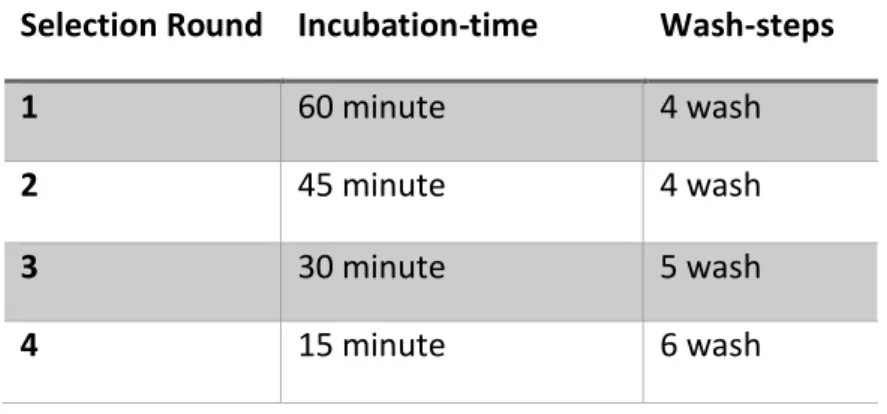
BIOTIN-labelled ds-DNA pool candidates after each round of amplification cycle were bound to the streptavidin magnetic beads (1 µm) by incubation for 15min at room temperature following which the ss-DNA was separated by heating at 90 ºC for 5 min. The separated ss- DNA pool was collected with the help of magnet stand and used for the next round of selection. A total of 4 rounds of selection were performed with gradual decreasing incubation time and increasing wash-steps.
Table 4. Selection conditions for each round SELEX for subtype-H1N1 of Influenza A virus Selection Round Incubation-time Wash-steps
1 60 minute 4 wash
2 45 minute 4 wash
3 30 minute 5 wash
4 15 minute 6 wash
In vitro selection process by competitive enrichment
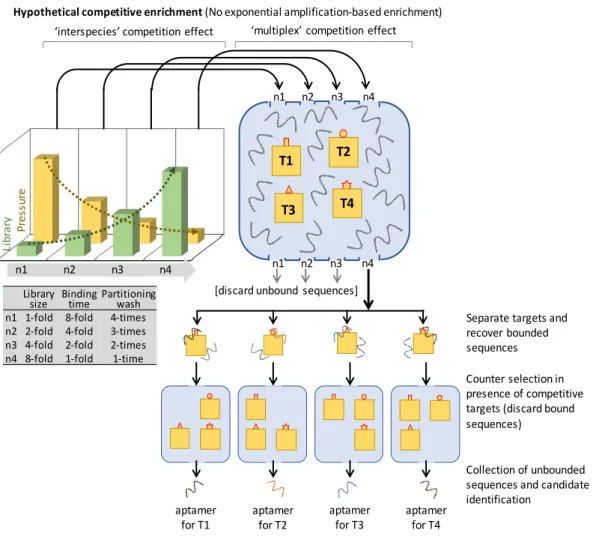
The plus strand ssDNA pool was heated to 90°C for 5 min and immediately cooled to 4°C and placed for 15 min, followed by incubation at 25°C for 15 min. Following this step, the targets TH1N1 and TH3N2 that were immobilized on the Ni-NTA beads were incubated with 100 pmol of the ssDNA initial pool in the presence of the binding buffer (PBS buffer (pH 7.4), 100 mM NaCl, 5 mM KCl, 2 mM MgCl2, 1 mM CaCl2) for 60 min. The supernatant was then removed by washing three times with washing buffer (PBST buffer (pH 7.4 with 0.05% Tween20), 100 mM NaCl, 5 mM KCl, 2 mM MgCl2, 1 mM CaCl2). In each wash, the sample solution was briefly centrifuged at 1000 g for 10s and the supernatant was removed carefully. The same procedure was repeated by 4 rounds with a successive addition of 200 pmol, 400 pmol, and 800 pmol of the ssDNA pool, changing the incubation time and washing frequency 30 min (3 times washing), 15 min (2 times washing), and 7.5 min (1 time washing), respectively. Finally, both the targets immobilized on the magnetic or nonmagnetic beads were separated by magnetic force using a magnet stand or centrifugation force (1000 g for 10 s), respectively,
followed by the removal of the supernatant. The selected aptamer DNA pools, which are bounded on beads, were recovered by heat treatment (90°C for 5 min followed by immediate removal of the supernatant). The selected aptamer DNA pools for TH1N1 and TH3N2 were then briefly incubated with the crude Ni-NTA beads for 15–20 min in order to remove any nonspecific candidates, if exists. The specific DNA pools selected against TH1N1 and TH3N2 were then briefly incubated with the different target solution, TH3N2 or TH1N1, to remove false positives. The specific pools for each target selected by SELCO were amplified by PCR (initial incubation at 98°C for 2 min, followed by 20 cycles of 98°C for 10 s, 59°C for 5 s, and 72°C for 10 s, and finally, 72°C for 4 min). Gel electrophoresis was used to monitor the successful amplifications using 8% polyacrylamide gel with 8 M urea at a temperature of 60°C.
SPR Measurements
The SPR measurement was performed using a BIACORE X100 instrument. A sensor Chip-NTA and NTA reagent kit (GE Healthcare, Uppsala, Sweden) were used for the immobilization of the His-tag protein target for the interaction studies according to the manufacturer’s instructions. The running buffer HBS-P was used for all the experiments and 0.35 M EDTA was used for regeneration. The single-cycle mode was performed to compare the pool for TH1N1
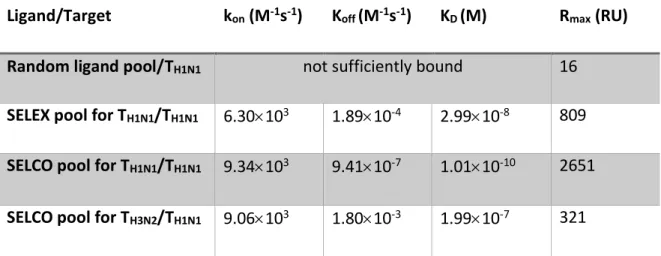
selected by conventional method and SELCO. For this, 4 independent experiments were performed for the immobilization of ligand H1N1 (0.01 mg/mL) in the running buffer onto the sensor surface at a level of 2500–3000 RU, with a contact time of 60 s and stabilization period of 60 s. The different analytes used for comparison were the random library, pool for H1N1 selected by conventional method, pool for H1N1 selected by SELCO, and pool for H3N2 selected by SELCO. The selected ssDNA pool solutions of the following concentrations: 37, 7.4, 1.48, 0.296, and 0.0592 µg/mL were prepared in the running buffer and sequentially injected, starting with lowest concentration, at a flow rate of 30 µL/min for 60 s, followed by 60 s of dissociation. The kinetics of the association and dissociation were studied and compared.
Electrochemical Measurements
A disposable three-electrode screen-printed chip obtained from Biodevice Technology, Co.
(Ishikawa, Japan), was used for this experiment. The disposable electrochemical printed (DEP) chip works on the principle of three-electrode system for electrochemical analysis, with a carbon-based working electrode (3 mm in diameter), a counter electrode, and an Ag/AgCl reference electrode. Two µL of the recombinant proteins H1N1 and H3N2 at a concentration of 0.25 µg/µL were dropped onto the working electrode of the DEP chip, which was then incubated for one hour at 4°C. This incubation allowed for the passive adsorption of the target protein onto the working electrode surface. After the incubation, excess target protein was rinsed three times with 100 mM PBS, and the chip was dried by gentle-blowing air. To suppress nonspecific adsorption, 3.5 µL of blocking buffer (100 mM PBS containing 1% BSA) was added to the chip; it was then incubated overnight at 4°C. For the electrochemical analysis, the chip was further rinsed three times with 100 mM PBS buffer and dried before it could be used for the assay. A 2-µL sample made up of Au nanoparticles conjugated to the selected DNA aptamer pool candidates was dropped onto the target-modified DEP chip surface; the chip was then incubated for 15 min at room temperature. It was then rinsed three times with 100 mM PBS buffer and connected to an electrochemical analyzer system (Model 650 A, CH Instruments, Inc., Austin, USA). Thirty µL of 0.1 M HCl was dispensed onto the DEP chip to electro-oxidate the AuNPs at a constant potential of +1.4 V for 40 s, immediately followed by DPV detection from +0.6 V to 0 V, with a step potential of 4 mV, a pulse amplitude of 50 mV, and a pulse period of 0.2 s. The selected pools by SELCO for TH1N1
and TH3N2 were tested and for specificity validation, the selected pool for TH1N1 was reacted with the TH3N2-modified DEP chip and vice-versa. All the experiments were repeated three times to confirm the consistency of the analysis.
3. Results and Discussion In vitro competitive selection
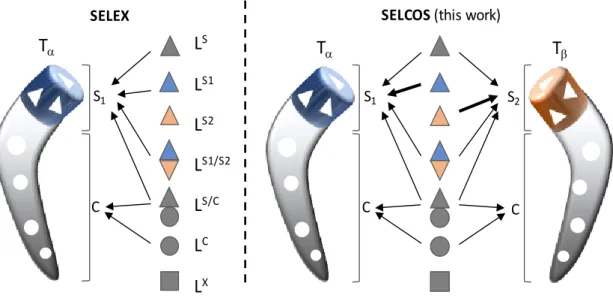
As shown in Figure 4, the pool of ligands (aptamer candidates) consists of various molecules that can be named LS, LS1, LS2, LS1/S2, LC, LS/C, and LX depending on their binding nature in relation to the target molecules Tα and Tβ (see details in the legend to Figure 4). Clearly, there is a difference in their behaviors under conventional SELEX and SELCO, which holds two or more target molecules. Those targets compete with one another for common ligands (especially, LS, LS1/S2 and LS/C) that can bind both targets Tα and Tβ during SELCO but exclusively Tα in conventional SELEX. This characteristic is the origin of the name “SELCO”.
For this reason, the ligands that bind to the S1 site (i.e., a Tα-specific site) are decreased to half except LS1 (which binds exclusively to S1 site), resulting in enriched LS1. Clearly, this effect cannot be expected from conventional SELEX. Therefore, in the equilibrium state of the interaction between the targets and the pool of ligands, we can expect a more LS1-enriched (in other words, Tα-specific ligand-enriched) result from SELCO than SELEX. Under our experimental conditions (see the protocol in Methods and Figure 5), the near-saturation of binding sites with ligands is expected to be attained (an 8-fold excess of ligands against a target molecule at the final stage). The selection products (ligands) obtained in this way were processed for a negative selection (the selected ligands were treated with a mixture of all the possible targets except the genuine one and then the nonbinding ligands were collected), although this process is theoretically omittable. Note that SELCO procedure does not depend on the PCR amplification, which is a prominent difference from conventional SELEX (see Figure 5) and as also discerned earlier by protocol of non-SELEX113. This property simplifies the whole procedure and saves experimental cost when selecting DNA aptamers. Incidentally, several studies have supported the idea that the presence of competitor molecules can enhance the specificity of the selected candidate114–116 though none has highlighted on the competitive effect pointed out in the work.
Figure 4. Schematic drawing of SELCOS (competitive non-SELEX). Comparison of (conventional) SELEX and SELCO in the ligand binding mode to the target protein. A pool of ligands is classified into 7 types in their binding mode to two different targets (T and T), which are composed of the common site (C) and the specific site (S1 or S2) as follows: LS, LS1, LS2, LS1/S2, LS/C, LC, and LX. As shown in the figure, each ligand binds to its own binding site(s).
For example, LS is a ligand that can bind to the specific site of both targets (T and T), while LS1 and LS2 bind to the S1 or S2 sites only, respectively. This result indicates that the same site can be recognized differently depending on a ligand. LS1/S2 binds to both S1 in T and S2 in T. LS/C binds to both site S (i.e., S1 and S2) and site C. LC binds to the common site of T and T. LX does not bind to either T or T.
Voltammetry (DPV)
Working electrode Reference electrode Counter electrode
[AuCl4]- Au + 4Cl-
Potential
Current
Working electrode Aptamer
bounded AuNPs
Influenza virus protein DEP-chip
3e-
Selected aptamer
selective aptamer
Gold Nanoparticles (AuNPs)
control (AuNPs without aptamer)
(many virus carrying sample)
DEP-chip
DPV DPV
(b2)
DEP-chip
(few virus carrying sample)
(b1) (a)
T LS T
LS1 LS2 LS1/S2 LS/C LC LX
SELEX SELCOS (this work)
C S1
T
S2
C S1
C