Japan Advanced Institute of Science and Technology
JAIST Repository
https://dspace.jaist.ac.jp/
Title 冷感剤メントールによって誘起される膜の物理化学特
性変化に関する研究
Author(s) Gusain, Pooja Citation
Issue Date 2017‑06
Type Thesis or Dissertation Text version ETD
URL http://hdl.handle.net/10119/14751 Rights
Description Supervisor:高木 昌宏, マテリアルサイエンス研究科
, 博士
氏 名
POOJA GUSAIN学 位 の 種 類
学 位 記 番 号 学 位 授 与 年 月 日
博士(マテリアルサイエンス)
博材第
428号 平成
29年
6月
23日
論 文 題 目
Detailed Membrane Physiochemical Pathways Involved in Cold-sensitization Induced by 1-Menthol
(冷感剤メントールによって誘起される膜の物理化学特性変化に関す る研究)
論 文 審 査 委 員 主査 高木 昌宏 北陸先端科学技術大学院大学 教授 大木 進野 同 教授 芳坂 貴弘 同 教授 山口 拓実 同 准教授 堀 克敏 名古屋大学大学院 教授
論文の内容の要旨
Background: Lipid rafts are specialized membrane microdomain enriched in saturated lipid, sphingolipids, and cholesterol1. These regions are rather tightly packed in the liquid ordered phase, unlike the disordered phase present in the bulk of the biological membrane. Lipid rafts serve as a platform for the regulation of various cellular processes involved in signal transduction and membrane trafficking2. Some membrane proteins, such as ion channels, are localized on lipid rafts. The activity of a channel is controlled by specific molecules, and changes in activity resulting from molecular binding in a channel generate a sensation, such as warmth, cold, or anaesthesia. This binding molecule may not only affect the channel, but also the lipid bilayer, thus altering the physical properties of the membrane.
Therefore, channel activity is also influenced through the lipid membrane, and specific changes in the physical properties of lipid membranes by several sensing molecules have been revealed3. The two important parameters: hydrophobic acyl chain ordering and hydrophilic head group interaction could represent the sensing mechanism leading to channel activation. Hence, it becomes very important to perceive these structural changes of lipid on interaction with such sensing molecules.
The complexity of living system makes understanding the importance of chirality challenging.
Biological molecules are often chiral, such as DNA, proteins, carbohydrates, lipids, and steroids. Menthol is also chiral. There are several diasteriomers of menthol, of which the most common are (1S, 2R, 5S)-2-isopropyl-5-methylcyclohexanol (d-menthol) and (1R, 2S, 5R)-2-isopropyl-5-methylcyclohexanol (l-menthol). l-Menthol is the main form found in nature and is widely used in products such as toothpaste, chewing gum, and cigarettes. l-Menthol is believed to bind onto TRPM8 and causes a well-known, desired, cooling sensation4. In contrast, d-menthol does not exist in nature and does not induce cooling
sensation. The underlying significant differences in the interaction between d-/l-menthol and the lipid membrane are not well understood. The first step in addressing this is to elucidate how and where d-/l-menthol each interact with a membrane. Considering these facts, we used GUVs as model membranes (artificial cells) and live cells to examine the interaction between a lipid membrane and d-/l-menthol.
Research Objective: Each part of the human body acts for the original roles and every role for each sense is far more crucial for their proper functioning. One of the important functions of our body is the sensing various external stimuli. The different sensitization includes cold, warm, anesthesia, etc. which is provoked by activation of some sensing channels. The activity of these channels is induced by external molecules leads to opening/closing of the channels, thus changes the physiological states of the membrane. Menthol, a chiral molecule, is one of the candidates, inducing cold sensitization to the body by activating a sub family of ion channels, termed as transient receptor potential melastatin 8 (TRPM8). Although many studies have been reported about the interaction between menthol and membrane, the mechanism at the molecular level is still remains unclear. With this understanding, I aimed to scratch physiological changes induced by menthol on the model membrane and related mechanism for its cooling behaviour.
Experimental: To study the detailed mechanistic pathways at a fundamental level, I worked on both cell-sized liposomes, i.e., GUVs as a model membrane and biological membrane specifically HEK293 cell line. By using both model membrane and biological membrane, I have shown the different localization and interaction sites of d- and l-menthol. In contrast, the role of cholesterol to alter the physiochemical properties of membrane was also demonstrated. Preparation of liposomes and staining protocol for HEK293 cells are depicted in scheme 1. The detailed procedure for the sample preparations have been discussed in chapter 2 and 5.
Scheme 1. Preparation of Liposomes (a) and staining protocol for HEK293 cells (b)
Lipids (CHCl3) +
Menthol (MeOH) Lipid film Hydration with Milli Q water (37 0C, over night)
Liposomes N2gas
flow Milli Q
+ DMEM (non-serum) HEK293-cell
1000 rpm,
5 min 1000 rpm,
5 min
+ DMEM (non-serum
×2 1000 rpm,
5 min Wash
1000 rpm, 5 min
×2 Wash
+ DMEM (non-serum) + fluorescent dye
+ 0.02 % BSA/PBS (-) 1 mL
37 ℃ 10 min Staining reaction (a)
(b)
Results and discussion: In chapter 1, first we studied the initial interaction of menthol on homogeneous model membrane composed of DOPC lipid, Cholesterol, and l-menthol. We have shown that l-menthol can interact directly with the model membrane and has specific interaction. Figure 1 (a, b). Shows typical phase-contrast microscopic images in both DOPC/Chol (control) system and DOPC/Chol/menthol. The vesicle consisting of DOPC/Chol retained the spherical shape, even if the temperature was increased from 21 ºC to 25 ºC. On the other hand, the membrane fluctuation was observed in DOPC/Chol/menthol with same temperature change. Previous studies showed that menthol has dual behaviours, at higher temperature and concentration it has a tendency to exhibit itching/burning sense while at low temperature and concentration has cool sense. From fluctuation data, we could observe the clear concentration effect of menthol on the model membrane. The effect of menthol concentration on the thermo-sensitive fluctuation of DOPC/Chol liposomes is depicted in Figure 1(c).
Fig.1 Typical microscopic images (a, b). Thermal-responsiveness response of menthol-containing lipid vesicles (c). Percentage of lipid vesicles, which started fluctuating at a given level of temperature increase. The vesicles contained DOPC/Chol (black), 2.5 % menthol (light grey dashed), 5 % menthol (blue), 10 % menthol (dark grey dashed), 20 % menthol (black dotted), and 30 % (grey solid line). (n=30).
At lower concentration of menthol, the maximum fluctuation could be observed, while at a higher concentration rate of fluctuation declined. Generally, the thermo-induced membrane fluctuation was caused by the acquisition of the excess membrane area. The absence of fluctuation in thek DOPC/Chol vesicles suggested that the membrane area remained steady. Dynamic real-time observation of membrane dynamics revealed that the menthol-containing membrane was more thermo-responsive than without menthol. The increase in the temperature enhanced the number of water molecules near polar head groups, leading to an increase in steric repulsive interaction between them and resulted into the excess surface area of liposomes. As a consequence, liposomes started fluctuating depending on the hydrophilicity of the head group. Further, to elaborate more about the specific interaction of menthol involved in
(a) 21 °C 25 °C
(b)
0 10 20 30 40 50 60 70 80 90 100
0 2 4 6 8 10 12 14 16 18
Fluctuated liposome/Total No.of liposomes
ΔT for fluctuation initiation DOPC/Chol(80/20) DOPC/Chol/men(78/19.5/2.5) DOPC/Chol/men(76/19/5) DOPC/Chol/men(72/18/10) DOPC/Chol/men(68/17/15) DOPC/Chol/men(56/14/30) (C)
cold-sensitization, we examined the chirality-dependent interaction in both homogeneous and heterogeneous systems discussed in chapter 3 and 4.
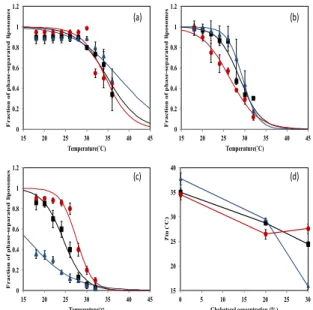
In order to understand the effects of d- or l-menthol on the phase separation more clearly, the miscibility temperature was observed over the temperature range from 18
˚C to 38 ˚C using thermo-controller. First, we observed the phase separation of binary lipid mixtures consisting of the unsaturated lipid DOPC and the saturated lipid DPPC without Chol at temperature ranging from 18 ˚C to 38
˚C (obtained using thermo controller). The miscibility temperature Tm is defined as the temperature at which 50 % of GUVs become heterogeneous. Figure 2 shows the fraction of liposomes forming phase-separated structures at each temperature tested. No clear difference in miscibility temperature was obtained by adding d- or l-menthol to the binary system DOPC/DPPC, as shown in Fig.
2(a) and (d). Next, we observed phase
separation in the DOPC/DPPC/Chol (Chol = 20 %) ternary lipid mixture. Also, the system without menthol and the d-/l-menthol-containing systems showed no significant differences in miscibility temperature, as shown in Fig. 2(b) and (d). At Chol = 30 %, however, clear and significant phase behaviour differences induced by d- or l-menthol were apparent, as shown in Fig. 2(c) and (d). Notably, d-menthol stabilized phase separation, whereas l-menthol dramatically lowered the phase-separated fraction. These findings can be explained by considering the change in the lipid bilayer physical state near phase transition. From the results obtained we proposed a model showing possible interaction of d-/l-menthol with lipid bilayer which could affect the cold sensing properties of TRPM8. We also believe that TRP channels can sense the temperature-dependant changes in the lipid bilayer.
Conclusions: In current issue, I have explored deep understanding of the membrane interaction and physiochemical changes upon external stimuli i.e., menthol at the molecular level. Moreover, the mechanical pathway involved in the cold-sensitization induced by l-menthol was clarified. I successfully demonstrated first attempt to assess the interaction of signalling molecule “menthol” with model cell membrane. Different approaches had been attempted to clarify physiological changes and morphology
0 0.2 0.4 0.6 0.8 1 1.2
15 20 25 30 35 40 45
Fraction of phase-separated liposomes
Temperature(˚C)
0 0.2 0.4 0.6 0.8 1 1.2
15 20 25 30 35 40 45
Fraction of phase-separated liposomes
Temperature(˚C)
(b)
0 0.2 0.4 0.6 0.8 1 1.2
15 20 25 30 35 40 45
Fraction of phase-separated liposomes
Temperature(˚C)
(c)
15 20 25 30 35 40
0 5 10 15 20 25 30
Tm (˚C)
Cholesterol concentration (%)
(d) (a)
Fig. 2 Miscibility temperature measurement for DOPC/DPPC/Chol/menthol system at Chol = 0 % in (a), 20 % in (b), and 30 % in (c). Black lines and black squares indicate DOPC/DPPC/Chol without menthol. Red lines with red circles and blue lines with blue triangles are DOPC/DPPC/Chol with d-menthol and l-menthol, respectively. Change in the miscibility temperature as a function of Chol concentration (d).
change induced by menthol along with the importance of chirality in the biological processes. These dynamic changes in the membrane properties enable to picture the related mechanism behind sensation such as warmth, cold, and anaesthesia. Therefore, studies on lipid rafts and membrane lipids could offer more information to unravel the mechanism involved in the channel functioning.
References:
1) Simons, K. & Toomre, D. Lipid rafts and signal transduction. Nat Rev Mol Cell Biol 1, 31–39 (2000).
2) van Meer, G., Voelker, D. R. & Feigenson, G. W. Membrane lipids: where they are and how they behave. Nat Rev Mol Cell Biol 9, 112–124 (2008).
3) Kopeć, W., Telenius, J. & Khandelia, H. Molecular dynamics simulations of the interactions of medicinal plant extracts and drugs with lipid bilayer membranes. FEBS J. 280, 2785–2805 (2013).
4) BG, G. Menthol modulates oral sensations of warmth and cold. Physiol Behav 35, 427–34 (1985).
Keywords : Lipid rafts, d- and l-menthol, membrane fluctuation, phase separation, miscibility temperature
論文審査の結果の要旨
This dissertation is about physicochemical approaches in cooling sensitization by menthol.
Chapter 1; Detailed information and basic knowledge about membrane, their phase behavior depending on lipid composition and cholesterol content was described. Recent studies on menthol cooling property to its related mechanism on TRP channels were discussed.
Chapter 2; The effect of menthol on thermo-induced membrane dynamics was examined. This is the first attempt to demonstrate direct observation of the dynamic response of lipid vesicles in real-time. The results clarified that menthol has direct interaction with membrane and significantly affects membrane dynamics. In addition, the physical changes in membrane dynamics induced by temperature increase were discussed.
Chapter 3; Effect of d- and l-menthol on properties of homogeneous membrane was examined.
D-Menthol showed stronger effect on membrane properties compared to l-menthol. Membrane fluidity and main transition temperature changes shown by d-menthol indicates its preference to Ld phase.
Contrarily, l-menthol did not change the fluidity and transition temperature significantly. This implies that l-menthol may evenly distribute at the head part of both DOPC and DPPC lipid.
Chapter 4; The phase behavior in DOPC/DPPC/Chol system at different cholesterol concentration was studied thoroughly in the presence of d- and l-menthol. Different concentrations of d- and l-menthol strongly altered the phase behavior and membrane integrity. l-Menthol is likely stabilized the raft like
structure at certain cholesterol concentration related to a model for cooling sensitization. High l-menthol concentration may represent the model for pain sensation as it could incur the perturbation in the lipid bilayer.
Chapter 5; HEK293 cells were employed to assess the effect of d- and l-menthol on raft stabilization.
The highlight of this chapter is to correlate the studies obtained from the model membrane and provide a better understanding to sensing mechanism.
In this dissertation, different approaches were attempted to clarify physiological changes induced by menthol along with the importance of chirality in the biological processes. Therefore, the committee concluded that this dissertation is sufficient for the degree.