
HLA class II領域に作用したパプア集団特異的な自然選択
6
0
0
全文
(2) MHC 2020; 27 (2). HLA class II 領域に作用したパプア集団特異的な自然選択. エンスデータを用いて,6 番染色体上にはたらいた正の 自然選択を検出した。検出の指標には,iHS6) を使用した。. 結 果. マイナーアリル頻度が 1% 以上かつ 95% 以上のサンプ. パプア集団における正の自然選択の検出(図 1). ルでタイピングができているバイアレリックな 6 番染色. 6 番染色体全体の SNP に対し正の自然選択の指標で. 10). 体 上 の SNP と い う 条 件 で,PLINK software v1.90b5.2. ある iHS を計算した。その結果,HLA class II 領域周辺. を用いてフィルタリングを行った。Beagle 5.0(beagle.. に有意な iHS を示す SNP が集中していることがわかっ. 28Sep18.793). 11). を用いて Phasing を行い,最終的には, 12). た。最も低い P 値を示し,最も強い正の自然選択のシ. において祖先アリルが高精. グナルが得られた SNP は HLA-DRB3,DRB5 のイントロ. 度に推定されている6番染色体上のアリル. ン上に存在する rs200439840 であった(iHS=7.11, P=1.13. 1000 ゲノムプロジェクト. × 10 − 12)。. 13). (295,531SNPs)に対し,R パッケージ rehh version 2.0.4. パプア集団における HLA アリルの推定. を用いて iHS を計算した。 自然選択の作用した HLA ハプロタイプの検出. HLA class II 領域に作用した正の自然選択が検出され. 自然選択の検出に用いたものと同じ個人のシークエン. たことから,パプア集団(n=14)の HLA class II アリル. ス デ ー タ か ら, 各 個 人 の HLA class II 遺 伝 子(DPB1,. を推定した(表 1)。最も高頻度に見られた HLA アリル. DRB1,DQA1,DQB1)のアリルを推定した。推定には,. は そ れ ぞ れ,DRB1*15:01(10/28=35.7%),DPB1*04:01. HLA 領域近傍(chr6:29600000-33100000, NCBI GRCh37). ( 1 4 / 2 8 = 5 0 % ), D Q A 1 * 0 1 : 0 2 ( 1 0 / 2 8 = 3 5 . 7 % ),. に存在する,rsID のついた 41,864SNPs と R パッケージ. DQB1*03:01(9/28=32.1%)であった。これらのアリル. HIBAGv1.4. 14). を用いた。HIBAG 法では,HLA アリルの. について,HLA アリル間の連鎖不平衡についてみてみ. ジェノタイプデータと高密度な SNP データからなるリ. ると,DRB1*15:01 と DQA1*01:02(D’=0.838, r2=0.702),. ファレンスパネルから,ブートストラップサンプリング. DRB1*15:01 と DQB1*06:02(D’=1, r2=0.6),DQA1*01:02. を繰り返して複数の判別器を生成,それらの推定結果を. と D Q B 1 * 0 6 : 0 2( D ’ = 1 , r 2 = 0 . 6 ),D Q B 1 * 0 3 : 0 1 と. 統合することで判別精度の高い判別器(SNP データか. DQA1*05:05(D’=1, r2=0.844)が強い連鎖不平衡にあり,. ら HLA アリルを推定するモデル)を生成することがで. それぞれがハプロタイプを形成していることが示唆され. きる。本研究では,開発者が提供しているアジア集団の リファレンスパネルを用いてモデルを作成,パプア集団 の SNP データにモデルを適応し,HLA アリルを推定した。 推定した HLA アリル同士の連鎖不平衡の指標として D’,r2 を計算し,同一ハプロタイプを形成しているアリ ルを推定した。加えて,HLA アリルと最も強く正の自 然選択のシグナルが得られた SNP 間の連鎖不平衡の指 標として D’,r2 を計算し,正の自然選択のターゲット となった HLA アリルを推定した。Allele Frequency Net Database15) から,正の自然選択のターゲットとなったと 考えられる HLA アリルの頻度分布のデータを取得し, R パッケージ leaflet 2.0.216) を用いて描画した。 HLA-DRB1 アリル頻度を用いた主成分分析 推定した HLA-DRB1 アリル頻度とオセアニア地域集 団の HLA アリルに関する先行研究 16,17) および Allele Fre-. 図 1 パプア集団の 6 番染色体における iHS の -log10(P 値)の. quency Net Database15) 上に登録されている東南アジア集. 分布 濃 い グ レ ー で 示 し た HLA class II 領 域(chr6:32,407,61933,096,890)において P 値のピークが見られる。物理的な位置 は NCBI GRCh37 に基づく。. 団,オセアニア集団(計 58 集団)の HLA-DRB1 アリル 頻度を用いて主成分分析を行なった。. 54.
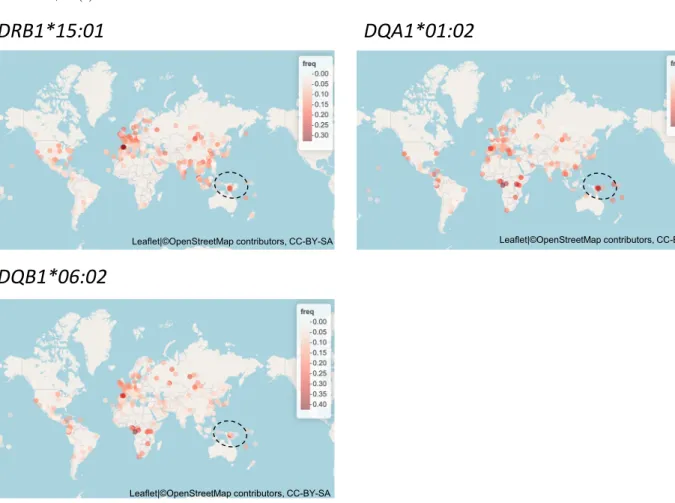
(3) MHC 2020; 27 (2). HLA class II 領域に作用したパプア集団特異的な自然選択 表 1 パプア集団(n=14)における HLA class II アリルの推定結果 DRB1 アリル 04:05 08:03 09:01 11:01 12:01 13:12 14:04 15:01 15:02 合計. DPB1 n 3 2 1 7 1 1 2 10 1 28. DQA1. DQB1. アリル 01:01 03:01 04:01 05:01 104:01. n 1 5 14 7 1. アリル 01:02 01:03 01:04 03:03 05:01 05:03 05:05. n 10 3 2 3 1 1 8. アリル 02:01 03:01 04:02 05:02 05:03 06:01 06:02. n 1 9 3 1 3 4 7. 合計. 28. 合計. 28. 合計. 28. た。DPB1*04:01 については強い連鎖不平衡(r2>0.4)に あ る よ う な HLA ア リ ル は 検 出 さ れ な か っ た。 ま た, DRB1*15:01(D’=1, r 2 =0.74),DQA1*01:02(D’=1, ,DQB1*06:02(D’=1, r2=0.44) は rs200439840 と r2=0.74) 強い連鎖不平衡にあることがわかった。 HLA-DRB1 アリル頻度を用いた主成分分析(図 2) HLA-DRB1 アリル頻度を用いて主成分分析を行ったと ころ,パプアニューギニアやポリネシア,メラネシア, オーストラリアの集団からなるクラスターと東南アジア とミクロネシアの集団からなるクラスターに分かれた。 考 察 現代パプア集団において HLA class II 領域周辺に有意 な iHS を示す SNP が確認され,この領域に強い正の自 然選択が最近まで作用していたことが示唆された。また, 強い正の自然選択のシグナルを示す SNP と DRB1*15:01 ( D ’ = 1 , r 2 = 0 . 7 4 ), D Q A 1 * 0 1 : 0 2 ( D ’ = 1 , r 2 = 0 . 7 4 ), DQB1*06:02(D’=1, r2=0.44)が強い連鎖不平衡にあるこ とが示され,これらの HLA アリルが正の自然選択を受 けたことが示唆された。図 3 に示すように,これらのア 図 2 HLA-DRB1 アリル頻度を用いた主成分分析結果. リルはパプアニューギニアにおいて高頻度に存在するア リルであり,正の自然選択によって頻度を増したことが. このハプロタイプ上の他の遺伝的要因が自然選択を受. 示唆された。本研究においてこの 3 つのアリル同士が強 い 連 鎖 不 平 衡 に あ る こ と, 先 行 研 究. 19). において. け,ハプロタイプの頻度が増したと考えられる。. DRB1*15:01,DQB1*06:02 がパプア集団においてハプロ. HLA-class II 遺伝子の中で最も広く調べられている. タイプを形成していることが報告されていることから,. HLA-DRB1 のアリル頻度を用いて主成分分析を行なった. 検出された 3 つのアリルは同一ハプロタイプ上に存在す. ところ,オセアニアの集団とアジアの集団で大きく分か. ると考えられる。そのため,3 つのアリルが独立に自然. れ,HLA-DRB1 アリル頻度の分布は,パプアニューギニ. 選択を受けたのではなく,これらのアリル,あるいは,. アを含むオセアニアの集団と東南アジアの集団で大きく. 55.
(4) MHC 2020; 27 (2). HLA class II 領域に作用したパプア集団特異的な自然選択. 図 3 パプア集団で正の自然選択を受けた HLA-class II アリルの分布 Allele Frequency Net Database15) のデータに基づく。パプアニューギニアは丸(黒・点線)で囲んだ領域にある。. MHC. Nat. Genet. 38: 1166–1172, 2006.. 異なることが示唆された(図 2)。パプアニューギニア. 5) Sabeti PC, et al.: Detecting recent positive selection in the hu-. において最も高頻度に存在するアリルに正の自然選択が. man genome from haplotype structure. Nature 419: 832–837,. 作用していることから,両地域の地域差の形成には正の. 2002.. 自然選択が寄与していると考えられた。同様に,他集団. 6) Voight BF, Kudaravalli S, Wen X, et al.: A map of recent positive. においても正の自然選択が地域特異的な分布に寄与して. selection in the human genome. PLoS Biol. 4: e72, 2006. 7) O’Connell JF, Allen J: The process, biotic impact, and global im-. いる可能性があり,今後調べていく必要がある。. plications of the human colonization of Sahul about 47,000 years ago. J. Archaeol. Sci. 56: 73–84, 2015.. 利益相反:申告すべき事項なし. 8) Kline K, McCarthy JS, Pearson M, et al.: Neglected tropical diseases of oceania: review of their prevalence, distribution, and opportunities for control. PLoS Negl. Trop. Dis. 7: 1–9, 2013.. 引用文献. 9) Mallick S, et al.: The Simons Genome Diversity Project: 300 ge-. 1) Prugnolle F, et al.: Pathogen-driven selection and worldwide. nomes from 142 diverse populations. Nature 538: 201–206,. HLA class I diversity. Curr. Biol. 15: 1022–1027, 2005.. 2016.. 2) Meyer D, Vitor VR, Bitarello BD, et al.: A genomic perspective. 10) Chang CC, et al.: Second-generation PLINK: rising to the chal-. on HLA evolution. Immunogenetics 70: 5–27, 2018.. lenge of larger and richer datasets. Gigascience 4: 7, 2015.. 3) Sabeti PC: Positive natural selection in the human lineage. Sci-. 11) Browning SR, Browning BL: Rapid and accurate haplotype. ence (80-.) 312: 1614–1620, 2006.. phasing and missing-data inference for whole-genome associa-. 4) de Bakker PIW, et al.: A high-resolution HLA and SNP haplo-. tion studies by use of localized haplotype clustering. Am. J. Hum.. type map for disease association studies in the extended human. 56.
(5) MHC 2020; 27 (2). HLA class II 領域に作用したパプア集団特異的な自然選択 Genet. 81: 1084–1097, 2007.. 16) Cheng J, Karambelkar B, Xie Y: leaflet: Create Interactive Web. 12) 1000 Genomes Project Consortium, et al.: A global reference for. Maps with the JavaScript “Leaflet” Library. R package version. human genetic variation. Nature 526: 68–74, 2015.. 2.0.2., 2018.. 13) Gautier M, Klassmann A, Vitalis R: rehh 2.0: a reimplementation. 17) Ohashi J, et al.: HLA-DRB1 polymorphism on Ha’ano island of. of the R package rehh to detect positive selection from haplotype. the Kingdom of Tonga. Anthropol. Sci. 114: 193–198, 2006.. structure. Mol. Ecol. Resour. 17: 78–90, 2017.. 18) Ohashi J, Yoshida M, Ohtsuka R, et al.: Analysis of HLA-DRB1. 14) Zheng X, et al.: HIBAG–HLA genotype imputation with attri-. polymorphism in the Gidra of Papua New Guinea. Hum. Biol.. bute bagging. Pharmacogenomics J. 14: 192–200, 2014.. 72: 337–347, 2000.. 15) González-Galarza FF, et al.: Allele frequency net 2015 update:. 19) Mack SJ, et al.: Evolution of Pacific/Asian populations inferred. new features for HLA epitopes, KIR and disease and HLA ad-. from HLA class II allele frequency distributions. Tissue Antigens. verse drug reaction associations. Nucleic Acids Res. 43: D784–. 55: 383–400, 2000.. D788, 2015.. 57.
(6) MHC 2020; 27 (2). HLA class II 領域に作用したパプア集団特異的な自然選択. Population specific positive selection acted on the HLA class II region in Papuans Mariko Isshiki1), Jun Ohashi1) 1). Department of Biological Sciences, Graduate School of Science, The University of Tokyo. The first colonization into Oceania occurred about 47 thousand years ago. Modern Papuans are the descendants of the first immigrants and considered to have adapted to Oceanian environment over the years. The Human Leukocyte Antigen (HLA) plays an important role in acquired immunity and has been reported to have undergone natural selection in human populations. In this study, we examined whether natural selection has acted on the HLA region in modern Papuan genomes. We estimated integrated Haplotype Score (iHS) across the chromosome 6 and detected a signal of a strong positive selection acted on HLA class II region. A high linkage disequilibrium between a SNP with the strongest signal (rs200439840) and haplotype DRB1*15:01-DQA1*01:02-DQB1*06:02 was observed. The haplotype DRB1*15:01-DQB1*06:02 was commonly observed in Melanesia populations. Our results indicate that this haplotype was adaptive to Oceanian environment and increased by positive selection. Key Words: positive selection, HLA, Oceania, Melanesia. ©2020 日本組織適合性学会. 58.
(7)
図
関連したドキュメント
, 6, then L(7) 6= 0; the origin is a fine focus of maximum order seven, at most seven small amplitude limit cycles can be bifurcated from the origin.. Sufficient
We consider a bitangential interpolation problem for operator- valued functions defined on a general class of domains in C n (including as particular cases, Cartan domains of types I,
The proof uses a set up of Seiberg Witten theory that replaces generic metrics by the construction of a localised Euler class of an infinite dimensional bundle with a Fredholm
This will put us in a position to study the resolvent of these operators in terms of certain series expansions which arise naturally with the irrational rotation C ∗ -algebra..
This will put us in a position to study the resolvent of these operators in terms of certain series expansions which arise naturally with the irrational rotation C ∗ -algebra..
This will put us in a position to study the resolvent of these operators in terms of certain series expansions which arise naturally with the irrational rotation C ∗ -algebra..
We note that in the case m = 1, the class K 1,n (D) properly contains the classical Kato class K n (D) introduced in [1] as the natural class of singular functions which replaces the
These include the relation between the structure of the mapping class group and invariants of 3–manifolds, the unstable cohomology of the moduli space of curves and Faber’s
