Effects of newly developed coffee filter on contents of functional components
in coffee
コーヒーの機能性成分含量に対する新規コーヒーフィルターの効果
Koichiro Shimomura
Graduate School of Life Sciences, Toyo University, 1-1-1 Izumino, Itakura-machi, Ora-gun, Gunma,
374-0193 Japan
TEL: x81-276-82-9208 e-mail: [email protected]
Coffee contains important functional compounds, such as caffeine, chlorogenic acid, trigonelline. In this
work the influences of different filters, paper and metal filters (Golden Cafe Filter: GCF) and hot water
temperature for coffee brew on the contents of functional compounds mentioned above was investigated.
The contents of these three compounds in the coffee prepared with GCF were slightly higher than those
brewed with paper filter. The effect of the extraction temperature (85, 90, 95 ˚C) on functional compounds
of coffee prepared with both of paper filter and GCF was investigated, the concentration of these three
compounds increased with a temperature rise. The coffee prepared with GCF showed slightly turbid
compared to that with paper filter, but the fine coffee powder was not felt as a taste. The yield of coffee oil
extracted from the coffee brewed with GCF was approximately 1.2 times higher than that from the paper
filter. However HPLC analysis revealed that the caffeine found in the coffee oil prepared with GCF was
approximately 66 % in that with paper filter. The content of functional compounds of coffee solution brewed
by using GCF was higher than that brewed with paper filter, it might contribute to reduction of the
environmental load since GCF is a reusable filter.
Keywords : HPLC、trigonelline、chlorogenic acid、caffeine、Golden Cafe Filter
I. INTRODUCTION
特徴的な味と香りを持つコーヒーは、世界中で一般的 な飲み物となっている。経済的に重要なコーヒー豆は、 2 種類の特徴ある Coffea arabica、C. canephora があり、 コーヒー飲料の原料として広く使用されている。1, 2 コー ヒーは、覚醒作用などを持つメチルキサンチン誘導体で ある caffeine、抗酸化作用を持ちフェノール性化合物の chlorogenic acid、ピリジンアルカロイドで神経保護作用 が報告されているtrigonelline などを含有している。3-5 こ れら化合物の人間に対する薬理作用について、種々の研 究がある。1, 3, 6 人体に対するコーヒーの有効性について は、近年パーキンソン病、2 型糖尿病、肝炎、肝臓がんな どの予防やヒト血液細胞の DNA 損傷の保護などの報告 がある。3, 5-9 焙煎されたコーヒー豆を粉砕後、湯で抽出することに より苦味や香りなど独特な味を持つコーヒー飲料とな る。コーヒーの調製には、サイフォン、ネルドリップ、 ペーパードリップ、フレンチプレス、直火式エスプレッ ソなどの方法があり、一般には、紙製フィルターを用い てコーヒーメーカーやハンドドリップによりコーヒーを Paper
Yoshiyuki Ichinosawa and Seichin Kinuta
Optnics Precision Co.,LTD. 26
Fujimi-cho, Ashikagashi, Tochigi, 326-0037 Japan
TEL: x81-284-43-3611 FAX: x81-284-43-0707 e-mail: [email protected]
(Received 4 November, 2020 Accepted 29 January, 2021)
淹れている。これまで市販されている金属製のコーヒー フィルターは、紙製フィルターと比べると長期間使用で きるので、環境負荷の低減が期待される。
このような事から、超微細加工技術を活用し新規な金 製のコーヒーフィルター(Golden Cafe Filter)が作製され
た。10 このフィルターは金と銀の合金材料をベースとし、 外周表面の材料は純金で、フィルターの開孔もマイクロ メーター精度で加工したものである。コーヒーの粉末が フィルターの孔に詰まる懸念についてもフィルター製作 において独自の工夫がされ、洗浄が容易で、長期間の使 用が可能なフィルターである。化学反応が起きにくく、 コーヒーに含有される物質に影響を与えない素材である 金に着目しており、紙製のフィルターに比較しコーヒー の味の向上が見込まれるとの報道も有る。11 そこで今 回、紙製およびこの新規の金製の2種類のコーヒーフィ ルターを用いてハンドドリップにより調製したコーヒー の機能性成分であるtrigonelline、chlorogenic acid および caffeine のコーヒー溶液中の含有量について検討した。
II. EXPERIMENTAL PROCEDURE
II-A. Material
コーヒー豆は、サザコーヒーのガテマラ豆を用いた。 コーヒーをろ過するフィルターは、HARIO V60 ペーパー フィルター02M (VCF-02-100M)および株式会社オプトニ クス精密の金製フィルター(Golden Cafe Filter)を用いた (Fig. 1)。このフィルターの材質は金合金(Au-25%Ag)を 芯とし、最表面に最表面は厚さ10 m の純金(Au)で加工 したものである。 株式会社より購入し、標準品として使用した。これらの 化合物の化学構造式は、Fig. 2に示した。その他ぎ酸(純 度 99%)などの試薬は、市販の特級試薬および高速液体 クロマトグラフ用を使用した。
II-B. Preparation of coffee
コーヒーミル [カリタ NEXTG(ネクスト G)] で挽い たコーヒー豆の粉末(最も一般的な中挽き)(株式会社サ ザコーヒー、ガテマラ)は、温度調整機能付きケトル(ブ リューイスタ アルティザン グースネックケトル 600 mL)を使用して、上記2種類のフィルターに 20 g(中 挽き)を入れ、湯量300 g で抽出した。 参考にした井崎英典の抽出方法の手順を以下に簡潔に 記載する。適温に調整した湯を 3 投に分けて注湯した。 1 投目が蒸らし、2 および 3 投目が本抽出とした。1 投目 (60 g)、1 分間後に 2 投目(60 g)、2 分間後に 180 g を 注湯した。12 重量および時間は、ハリオV60 メタルド リップスケール (VSTM-2000HSV) を用いて測定した。
II-C. Extraction of coffee oil
II-D. HPLC analysis
ハンドドリップで調製したコーヒー溶液の上記3種類 (trigonelline、chlorogenic acid、caffeine)の機能性成分の分 析には、各サンプル約1 mL を遠心分離(4,800 g、1 分間) 後、上清部分をHPLC にて分析した。コーヒーオイルの 分析は、各サンプルを1 mL MeOH(HPLC 用)に溶解し、 さらに MeOH で希釈して分析した。HPLC 分析条件は、 Yashin らなど 13-15 の方法を参考に本実験用に改変した。 すなわち、カラム:TSKgel ODS-100V (4.6 x 250 mm, 3 μ m)(東ソー)、 移動相:A: 0.1 % ギ酸、B: CH3CN、 A:B=80:20(5 分間保持)→ 60:40(10 分間)→ 5:95(3 分間)→ 5:95(5 分間保持)→ 80:20(1 分間で)(グラ ジエント時間:24分間)、流速:0.6mL/min、カラム温度: 40˚C、検出:280 nm (UV)で行なった。分析した成分の溶III. RESULTS and DISCUSSION
III-A. Content of functional compounds in
brewed coffee
紙製および金製フィルターで調製したコーヒーの機能 性成分の含有量について検討した。コーヒー溶液の調製 は、コーヒー豆Guatemala の推奨抽出温度 85 ˚C で行っ た。 金製フィルターは微細な孔が空いているので、抽出効 率が高いことが期待された。結果は、井崎の方法で調製 したコーヒーは、Table 1 に示す様に金製フィルターの trigonelline、chlorogenic acid および caffeine の 1 mL あたりの平均含有量は、ペーパーフィルターの約1.1 倍以上 であった。また、ペーパーおよび金製フィルターで淹れ たコーヒーにおける3 種類の機能性成分のそれぞれの変 動係数 (CV) は、0.009〜0.053 と非常に良い値であった。 Angeloni らが V60 を用いて抽出した コーヒー中の caffeine (0.74 mg/mL)の測定値は、我々の実験結果に近い 値 (0.72 mg/mL)であった(Table 1)。16
III-B. Extraction temperature for coffee
preparation
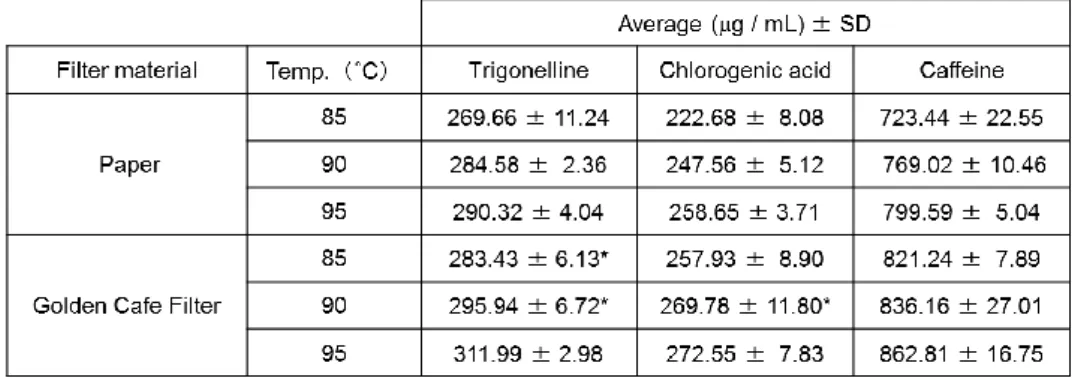
上述のコーヒーの調製では、抽出温度を85 ˚C として いたので、抽出温度を高くすると機能性成分のコーヒー 溶液中の含有量がどのように変化するか調べた。これま でに異なる焙煎豆3 種を用いて 85~95°C の注湯温度で調 製したコーヒーの官能評価の結果、ほとんどの評価項目 において有意な差はみられないが、2 種類のコーヒーに おいては温度が高い方が溶液の色が濃く、85°C では評価 が低くなる傾向があることが報告されている。17 そこで、 85 ˚C とより高い温度 90 ˚C および 95 ˚C の注湯温度にお ける機能性成分含有量について検討した。Table 1. Effect of filter materials on contents of functional compounds in coffee solution.
Table 2. Effects of filter materials and different brewing temperature on contents of coffee functional compounds in coffee solution. 出時間(分)は以下である:trigonelline (4.5)、chlorogenic acid (8.8)、caffeine (10.3)。3種類の成分の定量値はピーク 面積を用いた絶対検量線法により算出した。定量分析値 は、個別に調製したコーヒー溶液3 あるいは 5 検体の平 均値 (µg/mL ± SD)で表した。
Table 2 に示すように抽出の湯の温度が高くなると、2 種類のフィルターで調製したコーヒー1m L 中の機能性 成分含有量は多くなった。Table 2 に*で示すように一部 有意差が認められないものの各温度および3 種類の機能 性成分の平均含有量は、金製フィルターの方が多い値で あった。同一温度における各化合物のそれらの値は、1.04 〜1.16 倍であった。更に、変動係数は 0.006〜0.043 と良 好な値であった。
III-C. Relationship between coffee oil and
contents of functional compounds
コーヒーを今回の実験に用いたコーヒー粉末重量と湯 量で調製した時に、Fig. 3 に示すようにコーヒー溶液の 表面に形成される泡の違いが観察された。 紙製フィルターを使用すると、抽出開始からフィルタ ーから滴下したコーヒーの溶液表面に泡が形成され、抽 出終了後の数分間、泡は残存した。一方、金製フィルタ ーで調製したコーヒーには泡の形成は見られず、コーヒ ー表面に細かなオイルの粒子が観察された。コーヒーの 溶液表面に存在するコーヒーオイルの差で泡の形成に違 いがあることが推察された。 そこで、2 種類のフィルターで調製したコーヒーのコ ーヒーオイルの違いについて検討した。コーヒーの調製 温度は抽出温度の実験で使用した中間の値である 90 ˚C でコーヒーを調製し、エーテルを用いてコーヒーオイル を抽出した。金製フィルターで調製したコーヒーには、 紙製フィルターよりオイルが約 1.23 倍多く含まれてい ることが明らかとなった (Table 3 )。紙製および金製フィ ルターで調製したコーヒー100 mL から抽出したコーヒ ー オ イ ル 中 の 機 能 性 成 分 を HPLC 分析した結果、 trigonelline は全く検出されず、また、chlorogenic acid は 検出限界に近い極微量であった。しかし、caffeine の量は、 コーヒー100 mL に換算すると、それぞれ 9.1 mg と 7.4 mg であった。オイル量の少ない紙製フィルターが約 1.2 倍多く含んでいた。
IV. CONCLUSION AND FUTURE PLAN
今回コーヒーの抽出実験に使用したフィルターは、汎 用されている紙製のものと近年市販された新規な金製の コーヒーフィルター(Golden Cafe Filter)を使用し、これ まで調製したコーヒーを比較する上でよく分析されてい るコーヒーの機能性成分である trigonelline、chlorogenic acid および caffeine を指標にして、抽出の違いを検討し た。Golden Cafe Filter の方が、今回 HPLC 分析した 3 成 分のコーヒー溶液中の含有量は、ペーパーフィルターを 用いて調製したコーヒーより高いことが分かった。
Golden Cafe Filter は中心部が金を主成分とする銀(25%)
を含む合金で、表面部が厚さ約10 μm の純金構造で、
長方形(約50 x 150 μm)の多数の孔があいた特殊構造 である。そのため、調製したコーヒーは紙製フィルター では生じない微粉末が少量カップの底に沈殿した。 Golden Cafe Filter のフィルターの孔のサイズは製作時に 調整できるので、コーヒー微粉末の沈殿量は制御可能と 期待される。また、コーヒーオイルの微細粒子がコーヒ ー溶液表面に観察された。コーヒーオイルの量は、Golden Cafe Filter の方が紙製フィルターと比較し約 1.2 倍多い ことが確認でき、味や香りに優位なコーヒーの抽出を可 Fig. 3. Difference of bubble formation, left: no bubble
was observed on coffee surface brewed with Golden Cafe Filter, right: many bubbles on coffee surface brewed with HARIO V60 Paper Filter.
能にしているものと推察された。これまでコーヒーの味、 香りについて機器分析が行われており、18, 19 Golden Cafe Filter の味、香りへの寄与が考えられ、また、オイル 中のcaffeine 含有量は予想に反して紙製フィルターのコ ーヒーの方が多い理由が不明で、今後、更に検討する必 要がある。
ACKNOWLEDGEMENTS
実験にご協力いただいた株式会社オプトニクス精密技 術顧問 久貝健一氏および東洋大学大学院生命科学研究 科 山本浩文教授に深謝いたします。また、貴重なサンプ ルを一部提供いただいた株式会社サザコーヒー取締役 小泉準一氏に感謝します。REFERENCES
1
I. A. Ludwig, P. Mena, L. Calani, C. Cid, D. D. Rio,
M. E. J. Lean, and A. Crozier, Food & Function, 5,
pp. 1718-1726 (2014).
2
C.-L. Ky, J. Louarn, S. Dussert, B. Guyot, S. Hamon,
and M. Noirot, Food Chemistry, 75, pp. 223-230
(2001).
3
K. Oka, Yakugaku Zasshi (Journal of the
Pharmaceutical Society of Japan), 127, pp.
1825-1836 (2007) (in Japanese).
4
A. Farah, M. C. Monteiro, V. Calado, A. S. Franca,
and L. C. Trugo, Food Chemistry, 98, pp. 373-380
(2006).
5
M. Jeszka-Skowron, A. Zgoła-Grześkowiak, and T.
Grześkowiak, Europian Food Research Technology,
240, pp. 19-31 (2015).
6
J. Fahanik-Babaei, T. Baluchnejadmojarad, F.
Nikbakht, and M. Roghani, Metabolic Brain
Disease, 34, pp. 191-201 (2019).
7
P. He, Y. Noda, and K. Sugiyama, Biosci.
Biotechnol. Biochem., 65, pp. 1924–1927 (2001).
8
G. Pahlke, E. Attakpah, G. Aichinger, K. Ahlberg, C.
M. Hochkogler, K. Schweiger, D. Schipp, V.
Somoza and D. Marko, Journal of Functional Foods,
55, pp. 285-295 (2019).
9
G. R. Romualdo, A. B. Rocha, M. Vinken, B.
Cogliati, F. S. Moreno, M. A. G. Chaves and L. F.
Barbisan, Food Research International, 123, pp.
567-589 (2019).
10
Optnics precision Co.,LTD homepage,
https://www.optnics.co.jp/cgi/manual/data/1587542
687_1.pdf,(accessed 2020-10-1.)
11
Optnics precision Co.,LTD homepage,
https://www.optnics.co.jp/cgi/pressnews/data/1367
248097_2.pdf, (accessed 2020-10-1.)
12バリスタ・チャンピオンが教える美味しいコーヒーの 淹れ方手順まとめ 【動画・レシピあり】
https://diamond.jp/articles/-/222679, (accessed
2020-10-1.)
13
A. Yashin, Y. Yashin, X. Xia, and B. Nemzer,
Journal of Food Research, 6, pp. 60-82 (2017).
14
A. P. Craig, C. Fields, N. Liang, D. Kitts, and A.
Erickson, Talanta, 154, pp. 481-485 (2016).
15
M. Jeszka-Skowron, A. Zgoła-Grześkowiak and T.
Grześkowiak, European Food Research and
Technology, 240, pp. 19-31 (2015).
16
G. Angeloni, L. Guerrini, P. Masella, M. Bellumori,
S. Daluiso, A. Parenti and M. Innocenti, Food
Research International, 116, pp. 1327-1335 (2019).
17
M. Izumi and M. Takaya, The Japan Society of
Cookery Science), 41, pp. 257-261 (2008) (in
Japanese).
18
N. Cordoba, L. Pataquiva, C. Osorio, F. L. M.
Moreno
and R. Y. Ruiz, SCIENTIFIC REPORTS, 9,
pp. 1-12 (2019).
19