A unified
viewpoint
about
geometric
objects in
hyperbolic
space and the
generalized
$\mathrm{t}_{)}\mathrm{i}\mathrm{l}\mathrm{t}$formtlla
Akira USHIJIMA
$(+\ovalbox{\tt\small REJECT} q_{\mathrm{L}}\ovalbox{\tt\small REJECT} \mathrm{B})*$Interactive Research Center ofScience, Graduate School ofScience and Engineering,
Tokyo Institute of Technology, 12-1 $\mathrm{O}$-okayama $2- \mathrm{c}\mathrm{h}\overline{\mathrm{o}}\mathrm{m}\mathrm{e}$, Meguro-ku,
Tokyo 152-8551, Japan
152-8551 $\mathrm{B}^{\sum_{\prime’\backslash \backslash }}\subset\cross\star \mathfrak{B}$LU 2$\mathrm{T}\mathrm{B}$ 1 25 1$\tau-$
$\ovalbox{\tt\small REJECT},\overline{\forall\backslash }\mathcal{I}\Leftrightarrow \mathrm{x}_{\mp}^{\mathrm{R}}\mathrm{x}_{\neq}^{\mathrm{R}}\mathrm{r}^{-},arrow \mathrm{c}\Phi\supset;_{\mp}rightarrow if\mathrm{F}_{J\iota}^{*}\ovalbox{\tt\small REJECT}_{\grave{i}}\}\Phi^{\mathrm{R}}\neq\hslash \mathrm{J}\mathrm{F}_{X^{\backslash }}^{*.*}(J|\iota\Phi\ovalbox{\tt\small REJECT}\ovalbox{\tt\small REJECT}\yen$
$E$-mail address: ushij imaimath.titech.$\mathrm{a}\mathrm{c}$.jp
Abstract
$\mathfrak{o}-\triangleright\backslash \nearrow^{\backslash }y_{\supset \mathrm{i}}*\mathrm{p}\mathrm{f}\mathrm{f}\mathrm{i}\mathrm{h}\sigma)|\mathrm{f}_{-\backslash ’\backslash \backslash \backslash }^{\mathrm{g}_{\theta)}\mathrm{g}_{1_{\sim}^{\wedge}i1\mathrm{b}T77\triangleleft}}\backslash \cdot\nearrow\ovalbox{\tt\small REJECT}\backslash \yen\Phi k\hat{\mathrm{x}}\Leftrightarrow \mathrm{b}$\yen$T\circarrow-\mathit{0}$)$\not\in*\mathrm{f}\mathrm{f}\mathrm{i}\theta^{*}3$
$-\mathrm{F}\neg\lambda\lambda \mathrm{f}\mathrm{f}\mathrm{i}\mathrm{f}\mathrm{f}\mathrm{i}\emptyset\downarrow\overline{\ovalbox{\tt\small REJECT}}_{\backslash }\ovalbox{\tt\small REJECT}\# 6\lambda\lambda \mathrm{f}\mathrm{f}\mathrm{i}_{=\mathrm{n}}^{*\mathrm{p}_{\mathrm{a}7k_{\lambda}^{\wedge}b6\beta\}_{\sim}^{\sim}\mathrm{t}\mathrm{J}_{\tau}}}I’\backslash \backslash \mathrm{r}5\mathrm{J}\mathrm{p}\ovalbox{\tt\small REJECT}\Re \mathrm{f}\mathrm{f}\mathrm{i}\iota\grave{l}\backslash \#|\mathrm{J}\mathrm{f}\llcorner\# 69\mathrm{E}\mp’\mathrm{f}\mathrm{f}\mathrm{i}_{\backslash }\not\cong\Phi\hslash\not\in$
$\ovalbox{\tt\small REJECT} \mathrm{f}\mathrm{f}\mathrm{i}\mathrm{f}\mathrm{f}\mathrm{i}_{\backslash }’+_{\backslash }\uparrow\supset \mathrm{f}i^{\backslash }\mathrm{R}\mathrm{f}\mathrm{f}\mathrm{i}\ \mathrm{V}^{\mathrm{Y}}\mathrm{o}\gamma \mathrm{c}-\lambda\lambda \mathrm{f}\mathrm{f}\mathrm{i}_{\supset=7\mathrm{f}\mathrm{f}\mathrm{i}\#*\mathfrak{g}7^{\gamma_{t\ovalbox{\tt\small REJECT} 1\overline{\mathrm{n}}\mathrm{I}\mp}}}^{*\mathrm{P}}\sigma)_{\pm}\backslash rightarrow \mathrm{B}0\lambda|1\ovalbox{\tt\small REJECT} \mathrm{t}\emptyset t_{\backslash }^{\backslash }\not\in\yen \mathrm{f}\mathrm{f}\mathrm{i}k\hat{\mathrm{x}}\ovalbox{\tt\small REJECT} T6$
$’\backslash \backslash \backslash \not\in \mathrm{i}\mathit{0})\mathrm{t}^{arrow}\mathrm{l}\perp^{\mathrm{g}\}_{\sim}^{-}\ulcorner_{\llcorner}\llcorner T\not\subset \mathrm{b}\ovalbox{\tt\small REJECT} 9^{-}0}\llcorner$
’
$\Leftrightarrow a)*\backslash \iota\iota\ulcorner\llcorner\not\in:\mathrm{t}\yen\grave{\tau}\ovalbox{\tt\small REJECT} l_{\sim}^{\wedge}\lrcorner;\mathfrak{y}_{\tau}$ J. R. Weeks $i_{i\mathrm{E}}^{\grave{\grave{\mathrm{Y}}}’}\ovalbox{\tt\small REJECT}\llcorner f_{arrow}^{-}$
tilt $\epsilon:\ovalbox{\tt\small REJECT} h\mathrm{i}\mathrm{l}\mathrm{g}\mathrm{g}\int*\}_{\sim}^{arrow}*\backslash \iota \mathrm{b}T$
$\mathrm{i}_{l_{\wedge}}\Gamma \mathrm{i}\ovalbox{\tt\small REJECT}\llcorner_{\backslash }\ll^{-}\sigma)’\mathrm{r}4\ovalbox{\tt\small REJECT} \mathrm{x}\sigma^{\backslash }\frac{\mathrm{B}}{\prime\backslash }l\mathrm{Z}:\ovalbox{\tt\small REJECT} \mathfrak{h}t_{\mathrm{f}}‘*\emptyset\hslash i:\neq\grave{\mathrm{x}}\ovalbox{\tt\small REJECT}$ To
Key words: tilt formula, canonical decomposition, convex hull
construction, simplex, hyperbolic geometry.
1991 Mathematics Subject Classifications: Primary: $51\mathrm{M}10$;
secondary: $51\mathrm{M}09,57\mathrm{Q}15$.
1
Introduction
This paper is a summary of [Us3].
. D. B. A. Epstein and R. C. Penner gave in [EP] a method for decomposing
any noncompact complete hyperbolic manifold of finite volume with weight at
each cusp into ideal polyhedra. This decomposition is called the Euclidean decomposition, and defined via a convex hull construction in Lorentzian space.
Each vertex of the hull is in the positive light cone and corresponds to a lift
of a cusp, and each face of the hull corresponds to an ideal polyhedron in the
*The author is partially supported by JSPS Research Fellowships for YoungScientists and Grand-in-Aid for Scientific Research, the Ministry of Education, Science and Culture.
manifold. Especially if all weights are equal, then the decomposition is called
the canonical decomposition.
For a $\mathrm{s}\mathrm{i}\iota \mathrm{n}\mathrm{p}\mathrm{l}\mathrm{e}\mathrm{x}$ in Lorentzian space whose vertices are in the positive light
cone, J. R. Weeks defined in [Wel] the tilt relative to each of its faces. It gives
an efficient tool for deciding whether or not the dihedral angle between two simplices holding a face in common is convex. So it becomes a useful tool to
deternline whetheror not agiven decomposition ofthe manifoldis obtained from the convex hull. He also provided an efficient forlnula, called the tilt formula,
to obtain tilts from intrinsic geolnetry of the silnplex when its dimension is two
or three. Using this formula, he made the hyperbolic structures computation
program “SnapPea” (cf. [We2]). Then M. Sakuma and J. R. Weeks generalized
the tilt forlluula to general dilnensions in [SW].
S. Kojima gavein [Kol, Ko2] a method for
decolnposing.any
completehyper-bolic manifold of finite volume with non-empty totally geodesic boundary into
partially truncated polyhedra. In many cases each polyhedron is a partially
truncated silnplex. Since such a silnplex is lifted to a simplex in Lorentzian
space whose vertices may not be in the positive light cone, it is meaningful to
generalize the concept of the tilt and to establish the tilt formula for the
gen-eralized tilt. The lnain purpose of the paper is to do it (see $\mathrm{T}\mathrm{h}\mathrm{e}\mathrm{o}\mathrm{r}\mathrm{e}\ln 4.4$ and Corollary 4.5).
The author would like to thank Professor Katsuo Kawakubo for his
encour-agelnent. The author wouldalso liketo expresses his sincere gratitude to
Profes-sor Makoto Sakulna and Professor Jeffrey R. Weeks for their helpful comments
and advice.
2
Lorentzian space and hyperbolic geometry
2.1
Basic
facts
on
Lorentzian space model
The $n+1$-dimensional Lorentzian space (or simply Lorentzian$n+1$-space) $\mathrm{E}^{1,n}$ is the real vector space $\mathrm{R}^{n+1}$ of dilnension $n+1$ with the Lorentzian inner
product $\langle x, y\rangle:=-x_{0}y_{0}+x_{1}y_{1}+\cdots+x_{n}y_{n}$, where $x=(x_{0}, x_{1}, \ldots, x_{n})$
and $y$ $=$ $(y_{0}, y_{1}, \ldots, y_{n})$. Throughout this paper, we assume $n$ $\geq$ 2.
The Lorentzian norm of $x$ in $\mathrm{E}^{1,n}$ is defined to be the complex number
$\sqrt{\langle x,x\rangle}$. If the Lorentzian norm of $x$ is zero (resp. positive, imaginary),
then $x$ is said to be light-like (resp. space-like, time-like). The coordinate
$x_{0}$ of
$\mathrm{E}^{1,n}$ is called the height. Now we define six connected subsets in $\mathrm{E}^{1,n}$ as follows: the set of time-like vectors with positive height is $T^{+}$ $:=$
{
$x\in \mathrm{E}^{1,n}|\langle x,$$x\rangle<0$ and $x_{0}>0$},
the set of time-like vectors with negativeheight is $T^{-}:=$
{
$x\in \mathrm{E}^{1,n}|\langle x,$$x\rangle<0$ and $x_{0}<0$},
theset of light-likevectorsis $L:=\{x\in \mathrm{E}^{1,n}|\langle x, x\rangle=0\}$ , the setoflight-like vectors with positive height
is $L^{+}:=$
{
$x\in \mathrm{E}^{1,n}|\langle x,$ $x\rangle=0$ and $x_{0}>0$}
$(\subset L)$, the set of light-like vectors with negative height is $L^{-}:=${
$x\in \mathrm{E}^{1,n}|\langle x,$ $x\rangle=0$ and $x_{0}<0$}
$(\subset L)$, andthe set of space-like vectors is $S:=\{x\in \mathrm{E}^{1,n}|\langle x, x\rangle>0\}$
.
Then $\mathrm{E}^{1,n}$ isdis-jointly divided as follows: $\mathrm{E}^{1,n}=T^{+}\mathrm{u}T^{-}\mathrm{u}L^{+}\mathrm{u}\{\mathit{0}\}\mathrm{u}L^{-}\mathrm{u}S$, where $\mathit{0}$ is the
origin $(0,0, , . . , 0)$ of $\mathrm{E}^{1,n},$ and $\cdot \mathrm{u}$
.
means
the disjointunion of sets. We call
$T^{+}$ the
future
cone, $T^{-}$ the past cone, $L$ the light cone, $L^{+}$ the positive lightcone, $L^{-}$ the negative light cone, and $S$ the side cone. For any $x\in \mathrm{E}^{1,n}$ with $\langle x, x\rangle\neq 0$, we denote by $n(x)$ its normalizedvector, that is,
$n(x):= \frac{x}{\sqrt{|\langle X,X\rangle|}}$. Let $H_{T}^{+}:=$
{
$x\in \mathrm{E}^{1,n}|\langle x,$ $x\rangle=-1$ and $x_{0}>0$}
be the upper sheet of the(standard) hyperboloid of two sheets. The restriction of the quadratic form
induced by $\langle\cdot, \cdot\rangle$ on $\mathrm{E}^{1,n}$ to the tangent space of $H_{T}^{+}$ is positive definite and
gives a Riemannian metric on $H_{T}^{+}$. The space obtained from $H_{T}^{+}$ equipped with
themetric above is called the hyperboloid model ofthe$n$-dimensional hyperbolic
space, and we denote it by $\mathrm{H}^{n}$
.
If $x$ and$y$ are points in $H_{T}^{+}$ and $d$ denotes the
hyperbolicdistance between $x$ and $y$, then the following relation holds (see [Na,
p. 45], [Ra, (3.2.2)] or [Th, Proposition $2.4.5(\mathrm{a})$]$)$:
$\langle x, y\rangle=-\cosh d$
.
(2.1)$\dot{\mathrm{A}}$
ray in$L^{+}$ started from theorigin
$\mathit{0}$ corresponds to apoint inthe ideal
bound-ary of$\mathrm{H}^{n}$. The set of such rays forms
the sphere at infinity, and we denoteit by
$S_{\infty}^{n-1}$. Then each ray in $L^{+}$ becomes a point at infinity of $\mathrm{H}^{n}$. The (standard) hyperboloid
of
one sheet $H_{S}$ is defined to be $H_{S}:=\{x\in \mathrm{E}^{1,n}|\langle x, x\rangle=1\}$ .Let us denote by 72 the radial projection $\mathrm{f}\mathrm{r}\mathrm{o}\ln \mathrm{E}^{1,n}-\{x\in \mathrm{E}^{1,n}|x_{0}=0\}$ to
an affine hyperplane $\mathrm{P}_{1}^{n}:=\{x\in \mathrm{E}^{1,n}|x_{0}=1\}$ along the ray from the origin
$o$. The projection $P$ is a homeomorphism on $\mathrm{H}^{n}$ to the
$n$-dimensional open
unit ball $\mathrm{B}^{n}$ in
$\mathrm{P}_{1}^{n}$ centered at the origin $i:=(1,0,0, \ldots, 0)$ of
$\mathrm{P}_{1}^{n}$, which gives the projective model of$\mathrm{H}^{n}$. The affine hyperplane
$\mathrm{P}_{1}^{n}$ contains not only
$\mathrm{B}^{n}\mathrm{u}\partial \mathrm{B}^{n}\approx \mathrm{H}^{n}\mathrm{u}S_{\infty}^{n-1}$ . In this identification, the points near the intersection $S\cap\{x\in \mathrm{E}^{1,n}|x_{0}=0\}$ are mapped to an end of $\mathrm{P}_{1}^{n}$. So we can naturally
extend $\mathcal{P}$ to the mapping from $\mathrm{E}^{1,n}-\{\mathit{0}\}$
to the $n$-dimensional real projective space $\mathrm{P}^{n}:=\mathrm{P}_{1}^{n}\mathrm{u}\mathrm{P}_{\infty}^{n}$, where $\mathrm{P}_{\infty}^{n}$ is the set of lines in the affine hyperplane
$\{x\in \mathrm{E}^{1,n}|x_{0}=0\}$ through $\mathit{0}$. But we
use
the notation $\prime \mathrm{p}$ for the mappingobtained as above to save letters since there would be no confusion. We denote
by $\mathrm{E}\mathrm{x}\mathrm{t}\overline{\mathrm{B}^{n}}$
the exterior of $\overline{\mathrm{B}^{n}}$
in $\mathrm{P}^{n}$.
We call an affine hyperplane in $\mathrm{E}^{1,n}$ through the origin a linear hyperplane.
Avectorsubspace of$\mathrm{E}^{1,n}$ is said to be time-like if
it has a time-like vector, space-like if every nonzero vector in it is space-like, or light-like otherwise. Suppose
$P$ is a time-like linear hyperplane, and let $R$ be a half-space in $\mathrm{E}^{1,n}$ bounded by $P$. Then we can associate a unique vector $w\in H_{S}$ so that $\langle w, q\rangle\leq 0$ for
any $q\in R$. This establishes a well-known duality between points on $H_{S}$ and
half-spaces in $\mathrm{E}^{1,n}$ bounded by tilne-like linear hyperplanes. Now we
give an
half-space $R_{u}$ and a hyperplane $P_{u}$ in $\mathrm{E}^{1,n}$ as follows:
$R_{u}$ $:=$ $\{x\in \mathrm{E}^{1,n}|\langle x, u\rangle\leq\frac{\langle u,u)-1}{2}\}$ ,
$P_{u}$ $:=$ $\{x\in \mathrm{E}^{1,n}|\langle x, u\rangle=\frac{\langle u,\tau\iota\rangle-1}{2}\}=\partial R_{u}$ .
We denote by $\Gamma_{u}$ (resp. $\Pi_{u}$) the \’intersection of $R_{u}$ (resp. $P_{u}$) and $H_{T}^{+}$. We
call $\tau r$ a normal $ve\mathrm{c}tor$ to $P_{u}$ (or $\Pi_{u}$).
By the definition, a hyperplane $P_{X}$ is linear if and only if $x\in H_{S}$. Then
$\Pi_{X}$ is a geodesic hyperplane in $\mathrm{H}^{n}$. Let
$y$ be a point in $\mathrm{H}^{n}$, and we denote by
$d$ the signed distance between $\Pi_{X}$ and $y$, that is, the hyperbolic distance (in
the usual sense) of $\Pi_{X}$ and $y$ with signature positive (resp. negative) if $y\in\Gamma_{X}$
(resp. $y\not\in\Gamma_{X}$), that is, if $\langle x, y\rangle\leq 0$ (resp. $\langle x,$$y\rangle>0$). Then there is a
following well-known relationship between $\langle x, y\rangle$ and $d$ (see, for example, [Ra,
Theorem 3.2.12]):
$\langle x, y\rangle=-\sinh d$. (2.2)
For two different $\mathrm{g}\mathrm{e}.0$desic hyperplanes in
$\mathrm{H}^{n}$, the following theorem is a
well-known one:
Theorem 2.1 (see [Ra, Theorem 3.2.6, 3.2.7 and 3.2.9]) Let $x$ and $y$ be
two points in $H_{S}$ with $x\neq\pm y$, and we denote by $N$ the vector subspace
of
$\mathrm{E}^{1,n}$
spanned by $x$ and $y$.
(1) $|\langle x, y\rangle|<1$ $\Leftrightarrow$ $N$ is space-like
$\Leftrightarrow$ $\Pi_{X}$ and $\square y$ intersect in $H_{T}^{+}$.
(2) $|\langle x, y\rangle|>1$ $\Leftrightarrow$ $N$ is time-like
$\doteqdot\Rightarrow$ $\Pi_{X}$ and $\Pi y$ are disjoint, and $N\cap H_{T}^{+}$
is a unique common orthogonal
geodesic line to $\Pi_{X}$ and II
$y$.
(3) $|\langle x, y\rangle|=1$ $<\Rightarrow$ $N$ is light-like
$<\Rightarrow$ $P_{X}\cap P_{y}$ is light-like. So $\Pi_{X}$ and
$\prod_{\square }y$
meet at infinity.
For two geodesic hyperplanes $\Pi_{X}$ and II
$y$ in
$\mathrm{H}^{n}$ (so
$x,$ $y\in H_{S}$), we call $\Pi_{X}$
and II$y$ are ultraparallel ifthe condition of
$\mathrm{T}\mathrm{h}\mathrm{e}\mathrm{o}\mathrm{r}\mathrm{e}\ln 2.1(2)$ holds, and parallel if
the condition of $\mathrm{T}\mathrm{h}\mathrm{e}\mathrm{o}\mathrm{r}\mathrm{e}\ln 2.1(3)$ holds. Next we suppose $\Pi_{X}$ and $\square y$ intersect,
that is, the condition of Theoreln 2.1(1) holds. Then we have the following relation (see [Th, Proposition $2.4.5(\mathrm{c})]$ and $[\mathrm{S}\mathrm{W}$, Lemma 2.7]):
where $\theta$ is the dihedral angle between
$\Pi_{X}$ and $\Pi y$ which is measured in
$\Gamma_{X}\cap\Gamma_{y}$.
We note that this relation holds even if $\Pi_{X}$ and $\Pi y$ are parallel. In this case
we regard $\theta$ as $0$.
For an arbitrary point $u$ in $H_{S},$ $P_{u}\cap \mathrm{P}^{n}$ becomes a hyperplane in $\mathrm{P}^{n}$,
moreover $P_{u}$ intersects $\mathrm{B}^{n}$. Since$P(u)$ is apoint in$\mathrm{E}\mathrm{x}\mathrm{t}\overline{\mathrm{B}^{n}}$
, the cone consisting
of lines through $P(u)$ and a point in $P_{u}\cap\partial \mathrm{B}^{n}$ is tangent to $\partial \mathrm{B}^{n}$. We call
$P_{u}\cap \mathrm{P}^{n}$ the polar hyperplane of $P(u)$ in $\mathrm{P}^{n}$, and $\mathcal{P}(u)$ the pole of $P_{u}\cap \mathrm{P}^{n}$ (see, for example, [Ke, p. 544]). For an arbitrary point $v$ in $\mathrm{E}\mathrm{x}\mathrm{t}\overline{\mathrm{B}^{n}}$
, we denote
by $\Omega(v)$ its polar hyperplane and by $\Psi(v)$ the hyperplane in $\mathrm{B}^{n}$ with pole
$v$,
i.e., $\Psi(v):=\Omega(v)\cap \mathrm{B}^{n}$.
2.2
What
is
$\square u$?
In this subsection we classify $\Pi_{u}$ with respect to the position of $u$. We first
note that, if $u$ is the origin of $\mathrm{E}^{1,n}$, then
$P_{u}$ is an empty set, so is $\Pi_{u}$.
Case 1. Suppose $u$ is a time-like vector, i.e., $u\in\{x\in \mathrm{E}^{1,n}|(x, x\rangle<0\}$
.
Then, since $-\langle u, u\rangle>0$, we can rewrite the definition of $P_{u}$ as follows:
$P_{u}=\{x\in \mathrm{E}^{1,n}|\langle x,$ $\frac{u}{\sqrt{-\langle u,u\rangle}}\rangle=\frac{\langle u,u\rangle-1}{2\sqrt{-\langle u,u\rangle}}\}$
Nowwe can easilycheck that theright side of the definition is lessthan-l.
So, for $\Pi_{u}$ being non-empty, the height of $u$ must be positive. Then, by
equation (2.1), $\Pi_{u}$ is the set of points in the hyperbolic spaceeach ofwhich
is $|\log(-\langle u, u\rangle)|/2$ away from $n(u)=u/\sqrt{-\langle u,u\rangle}$, which means that
$\square u$ is the sphere of radius $|\log(-\langle u, u\rangle)|/2$ with center $n(u)$. We here
note that $\Pi_{u}=\{u\}$ if and only if $\langle u, u\rangle=-1$.
Case 2. Suppose$u$ is a space-like vector, i.e., $u\in S=\{x\in \mathrm{E}^{1,n}|\langle x, x\rangle>0\}$.
In this case we can rewrite the definition of $P_{u}$ as follows:
$P_{u}=\{x\in \mathrm{E}^{1,n}|\langle x,$ $\frac{u}{\sqrt{\langle u,u\rangle}}\rangle=\frac{\langle u,u\rangle-1}{2\sqrt{\langle u,u\rangle}}\}$
By equation (2.2), $\Pi_{u}$ is the set of points in the hyperbolic space each
of which is $|\log\langle u, u\rangle|/2$ away from the geodesic hyperplane $\Pi_{n(u)}$. We
call such a hypersurface $\Pi_{u}$ an equidistant hypersurface, and $\Pi_{n(u)}$ the
axial hyperplane of$\Pi_{u}$ (cf. [Fe, p. 39]). We here note that $\Pi_{u}$ is geodesic
if and only if $u\in H_{S}=\{x\in \mathrm{E}^{1,n}|\langle x, x\rangle=1\}$.
Case 3. Suppose $u$ is a light-like vector, i.e., $u\in L--\{x\in \mathrm{E}^{1,n}|\langle x, x\rangle=0\}$.
In this case we can rewrite the definition of $P_{u}$ as follows:
Since the right side of the definition is negative, for $\square u$ being non-empty,
the height of $u$ must be positive. Then the set $\Pi_{u}$ is called a horosphere
whose center is the ray through $u$.
Sulnmarizing previous discussions, we obtain the following proposition: Proposition 2.2 The correspondences between points in $\mathrm{E}^{1,n}$ and geometric
behaviors
of
$\Pi_{u}$ are asfollows:
2.3
Widths
We next define the width ofa point in $T^{+}\mathrm{U}L^{+}\mathrm{u}S$, and observe its relationship
to the Lorentzian norm.
Definition 2.3 Let $u$ be a point in $T^{+}\mathrm{u}L^{+}\square S$. Then the width, say $\delta_{u}$, is
defined as follows:
(1) If $u\in T^{+}$, then $\delta_{u}$ is the signed radius of $\Pi_{u}$, where the sign is defined
to be positive (resp. negative) if $|\langle u, u\rangle|\leq 1$ (resp. $|\langle u,$ $u\rangle|\geq 1$).
(2) If $u\in S$, then $\delta_{u}$ is the signed distance between $\square u$ and $\Pi_{n(u)}$, where
the sign is defined to be positive (resp. negative) if $|\langle u, u\rangle|\leq 1$ (resp. $|\langle u, u\rangle|\geq 1)$.
(3) If$u\in L^{+}$, then $\delta_{u}:=(-\log(u, u))/2$ , where $(\cdot, \cdot)$ lneans the Euclidean
inner product, that is, $(u, u):=u_{0}^{2}+u_{1}^{2}+\cdots+u_{n}^{2}$ if$u=(u_{0}, u_{1}, \ldots, u_{n})$.
The discussion in previous subsection implies the following proposition: Proposition 2.4 Suppose $u\in T^{+}\mathrm{u}L^{+}\mathrm{u}$S. Then the following relation holds:
$\delta_{u}=\{$
$- \frac{1}{2}\log|\langle u, u\rangle|$
if
$u\in T^{+}\mathrm{u}S$,$- \frac{1}{2}\log(u, u)$
if
$u\in L^{+}$3
Definition
of
a
tilt
“Tilts” are defined on “faces” of (
$‘ \mathrm{w}\mathrm{e}\mathrm{i}\mathrm{g}\mathrm{h}\mathrm{t}\mathrm{e}\mathrm{d}$” $n$-simplices in the
projective model
$\mathrm{B}^{n}$, and a “weighted”
$n$-simplex is a “generalized” $n$-simplex with weights at
each vertex. So in this section we first define generalized $n$-simplices in $\mathrm{B}^{n}$,
secondly define weighted $n$-simplices, and finally define tilts.
3.1
Generalized
n-simplices
The projective model $\mathrm{B}^{n}$ has the advantage that
it enable us to describe
poly-hedra in $\mathrm{H}^{n}$ in terms of Euclidean
terminology. For example, we can regard an
ideal polyhedron in $\mathrm{H}^{n}$ as an
Euclidean polyhedron in $\mathrm{P}_{1}^{n}$ whose vertices lie in $\partial \mathrm{B}^{n}$.
Using this advantage, in this subsection we define generalized n-simplices
in $\mathrm{B}^{n}$.
Let $V=\{v_{0}, v_{1}, \ldots, v_{n}\}$ be a set of independent points in $\mathrm{P}^{n}$, and let
$V_{\mathrm{i}\mathrm{n}}:=\{v\in V|v\in\overline{\mathrm{B}^{n}}\}$ and $V_{\mathrm{e}\mathrm{x}}:=\{v\in V|v\in \mathrm{E}\mathrm{x}\mathrm{t}\overline{\mathrm{B}^{n}}\}=V-V_{\mathrm{i}\mathrm{n}}$
.
With-out loss of generality, we may
assume
$V_{\mathrm{e}\mathrm{x}}$ $=\{v_{0}, v_{1}, \ldots , v_{k}\}$ and$V_{\mathrm{i}\mathrm{n}}=$
$\{v_{k+1}, v_{k+2}, \ldots , v_{n}\}$ for
some
$k\in\{-1,0,1, \ldots, n\}$, by changing indices ifnec-essary. This notation
means
that $V_{\mathrm{e}\mathrm{x}}=\emptyset$ and $V_{\mathrm{i}\mathrm{n}}=V$ when $k=-1$, and that $V_{\mathrm{e}\mathrm{x}}=V$ and $V_{\mathrm{i}\mathrm{n}}=\emptyset$ when $k=n$. Now wesuppose $V$ satisfies the following two
conditions:
Condition 1. If $V_{\mathrm{e}\mathrm{x}}$ has more than one point,
then for arbitrary different
points $v_{i}$ and $v_{j}$ in $V_{\mathrm{e}\mathrm{x}}$ hyperplanes $\Psi(v_{i})$ and
$\Psi(v_{j})$ with poles $v_{i}$ and $v_{j}$
respectively do not intersect in $\mathrm{B}^{n}$.
Condition 2. The set $V_{\mathrm{i}\mathrm{n}}$ is wholly contained in one
connected component
of$\overline{\mathrm{B}^{n}}-\bigcup_{i=0}^{k}\Omega(v_{i})$.
We note that, when $k=-1$, Condition 2
means
that $V\subset\overline{\mathrm{B}^{n}}$.
For each point $v_{i}$ in $V_{\mathrm{e}\mathrm{x}}$, there is a unique point
$v_{i}’$ in $H_{S}$ such that $P(v_{i}’)=$
$v_{i}$ and $V_{\mathrm{i}\mathrm{n}}\subset R_{v_{;}^{J}}$. Let $|v_{0}’v_{1}’\cdots v_{k}’v_{k+1}v_{k+2v_{n}|}\ldots$ be the affine simplex in
$\mathrm{E}^{1,n}$ with vertex set
{
$v_{0}’,$ $v_{1}’,$$\ldots,$$v_{k}’,$$v_{k+1},$ $v_{k+2\cdot.v_{n}\}},.,$. Since the points in $V$
are independent in $\mathrm{P}^{n}$, vectors
{
$v_{0}’,$$v_{1}’,$$\ldots,$$v_{k}’,$ $v_{k+1},$ $v_{k+2,\ldots,v_{n}\}}$ are linearly
independent in $\mathrm{E}^{1,n}$, namely
the hyperplane through $n+1$-points $v_{0}’,$ $v_{1}’,$
$\ldots$ , $v_{k}’,$ $v_{k+1},$ $v_{k+2,)}\ldots v_{n}$ does not contain the origin
$\mathit{0}$. Thus we can define
72
$(|v_{0}’v_{1}’\cdots v_{k}’v_{k+1}v_{k+2}\cdots v_{n}|)$, an $n- \mathrm{s}\mathrm{i}_{1}\mathrm{n}\mathrm{p}\mathrm{l}\mathrm{e}\mathrm{x}$ in $\mathrm{P}^{n}$ with vertex set$V$, and
denote it by $|v_{0}v_{1}\cdots v_{n}|$
.
We note that, if $V_{\mathrm{e}\mathrm{x}}=\emptyset,$ $|v_{0}v_{1}\cdots v_{n}|$ is just the$n$-dimensional affine simplex in $\mathrm{P}_{1}^{n}\approx \mathrm{R}^{n}$ with vertex set $V$.
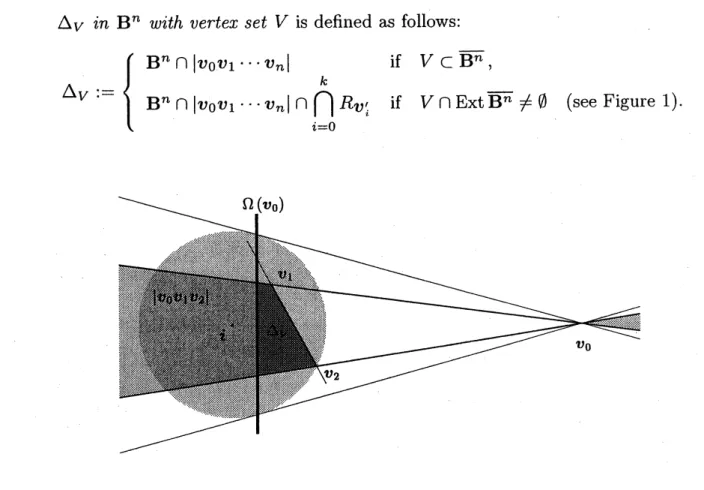
$\Delta_{V}$ in $\mathrm{B}^{n}$ with vertex set $V$ is defined as follows:
$\Delta_{V}:=\{$
$\mathrm{B}^{n}\cap|v_{0}v_{1}’\cdot\cdot v_{n}|$ if $V\subset \mathrm{B}^{n}$
$\mathrm{B}^{n}\cap|v_{0}v_{1}\cdots v_{n}|\cap\bigcap_{i=0}^{k}R_{v_{j}}$, if $V\cap \mathrm{E}\mathrm{x}\mathrm{t}\overline{\mathrm{B}^{n}}\neq\emptyset$ (see Figure 1).
Figure 1: An example of a generalized 2-simplex in $\mathrm{B}^{2}$
Each face of $\Delta_{V}$ is either contained in a face of $|v_{0}v_{1}\cdots v_{n}|$ or in $\Psi(v_{i})$ for some $v_{i}\in V_{\mathrm{e}\mathrm{x}}$. We call the former an internal
face
of $\triangle_{V}$, and the later anexternal
face
of $\Delta_{V}$ (cf. [Kol, Ko2]). For each vertex $v_{i}$ of $\triangle_{V}$, we denote by$\mathcal{F}_{i}$ the hyperplane in $\mathrm{P}^{n}$ through $n$ points $\{v_{0}, v_{1}, \ldots, v_{i-1}, v_{i+1}, \ldots, v_{n}\}$. If
an internal face of $\Delta_{V}$ coincides with $\mathcal{F}_{i}\cap\triangle_{V}$ for some $v_{i}\in V$, then we call the face the opposite
face
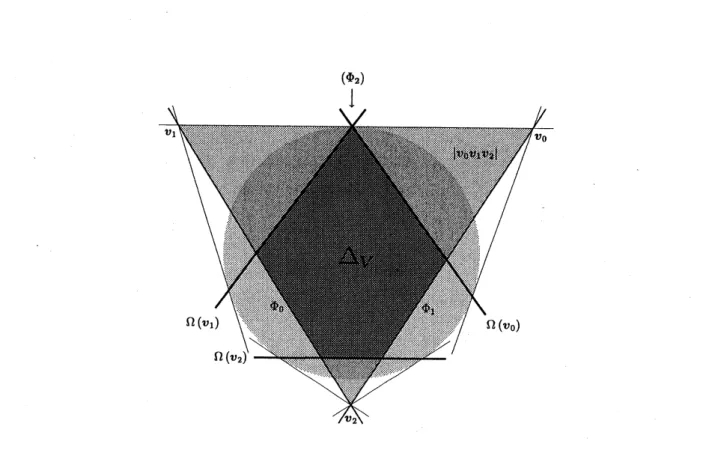
of $v_{i}$, and denote it by $\Phi_{i}$. By the definitions of thenotation, we have an injective correspondence from the internal faces of $\triangle_{V}$ to
the vertex set. We here note that this correspondence may not be surjective
(see Figure 2). We may use the symbol of opposite faces to denote internal
faces without referring to vertices. Let $\Phi_{i}$ and $\Phi_{j}$ be internal faces, and $\mathcal{F}_{i}$ and
$\mathcal{F}_{j}$ their corresponding geodesic hyperplanes in the previous sense. Then we
say that $\Phi_{i}$ and $\Phi_{j}$ (with $i\neq j$) are parallel (resp. ultraparallel, intersecting) if
$P^{-1}(\mathcal{F}_{i})\cap H_{T}^{+}$ and $P^{-1}(\mathcal{F}_{j})\cap H_{T}^{+}$ are parallel (resp. ultraparallel, intersecting)
(cf. Theorem 2.1). The dihedral angle between $\Phi_{i}$ and $\Phi_{j}$ is defined to be
the dihedral angle between $\mathcal{P}^{-1}(\mathcal{F}_{i}^{-})\cap H_{T}^{+}$ and $P^{-1}(\mathcal{F}_{j})\cap H_{T}^{+}$ measured in $P^{-1}(\triangle_{V})\cap H_{T}^{+}$
.
By Condition 1, we can see that each connected componentof external faces is totally geodesic. We also note that a vertex of $\triangle_{V}$ as a
polyhedronin hyperbolic space is not a “vertex” of the generalized$n$-simplex$\triangle_{V}$
if it is made from the intersection of an external face and an edge of $|v_{0}v_{1}\cdots v_{n}|$
Figure 2: A generalized 2-simplex with one degenerate internal face
3.2
Weighted
$7l$-simplices
We recall that $\triangle_{V}$ is a generalized
$n$-simplex with vertex set $V$. At each
ver-tex, we give a real number called weight. Let $W$ be the set of weights of all
vertices. Then we call a triplet $(\Delta_{V}, V, W)$ a weighted $n$-simplex in $\mathrm{B}^{n}$. Now
Definition 2.3 ilnply the following proposition:
Proposition 3.2 (lift proposition) For a weighted $n- simpl\underline{ex(}\triangle_{V},$ $V,$$W$) in theprojective model $\mathrm{B}^{n}$, there exists a unique
affine
$n$-simplex $\triangle_{V}$ in $\mathrm{E}^{1,n}-\{\mathit{0}\}$with vertex set $\hat{V}satisfying$
, the following
four
conditions:(1) $\hat{V}\subset T^{+}\mathrm{u}L^{+}\mathrm{u}S$;
(2) $P(\hat{V})=V_{i}$
(3) For any $u\in\hat{V}\cap S$, we have
$\triangle_{V}\subset R_{n(u)}\cap \mathrm{B}^{n}$;
(4) For any $u\in\hat{V}$, the width
$\delta_{u}$ is equal to the weight
of
$/\mathcal{P}(u)$.
$\square$We call $\overline{\triangle_{V}}$
the
lift
of the weighted $n$-simplex $(\triangle_{V}, V, W)$ in $\mathrm{B}^{n},\hat{V}$ thelift
of the vertex set $V$, and $u$ the lift of the vertex72
$(u)\in V$.
We here note thatcondition (2) means $\hat{V}$
is aset of linearly independent vectors in $\mathrm{E}^{1,n}$. We also note that $P(\overline{\triangle_{V}})$ does not always coincide with $\triangle_{V}$, though
72
(
$\hat{V})=V$.3.3
Definition of
tilts
and the
tilt
proposition
R. C. Penner gave in [Pe, Proposition $2.6(\mathrm{b})$] a criterion of convexity of the
lifts of adjacing two (2-dimensional) ideal triangles along a face. J. R. Weeks
independently gave in [Wel, Proposition 3.1] a criterion of convexitywhen
sim-plices are 2 and $3$-dilnensional ideal simplices. This criterion is expressed by
using “tilts,” and allow him to lnake the hyperbolic structures computation
$\mathrm{p}\mathrm{r}\mathrm{o}\mathrm{g}\mathrm{r}\mathrm{a}\ln\zeta$‘SnapPea” (cf. [We2]). He also provided an efficient formula, called
the tiltformula, to obtain tilts from intrinsic geometry of the sinlplex when its
$\mathrm{d}\mathrm{i}_{1}\mathrm{n}\mathrm{e}\mathrm{n}\mathrm{s}\mathrm{i}\mathrm{o}\mathrm{n}$ is two (see [Wel, $\mathrm{T}\mathrm{h}\mathrm{e}\mathrm{o}\mathrm{r}\mathrm{e}\ln 3.2]$) and three (see [Wel, $\mathrm{T}\mathrm{h}\mathrm{e}\mathrm{o}\mathrm{r}\mathrm{e}\ln 5.1]$).
M. Sakulna and J. R. Weeks generalized the tilt formula to general
dimen-sions in [SW]. The idea of R. C. Penner is translated by M. N\"a\"at\"anen in [N\"a,
Lemma 3.3] into the case where simplices are triangles, and by the author in
[Us2, Proposition 3.5(2)] into the case where silnplices are truncated triangles
(i.e., orthogonal hexagons). In this subsection, using Weeks’ lnethod, we
ob-tain a criterion of convexity when two weighted $n$-simplices in $\mathrm{B}^{n}$ are adjacent
along internal faces. Now we start with the definition of the tilt of a weighted
$n$-simplex in $\mathrm{B}^{n}$ relative to an internal face.
Fix a weighted $n- \mathrm{s}\mathrm{i}_{1}\mathrm{n}\mathrm{p}\mathrm{l}\mathrm{e}\mathrm{x}(\triangle_{V}, V, W)$ in $\mathrm{B}^{n}$, and take an internal face $\Phi_{i}$ of $\triangle_{V}$. Then there is a unique point
$m_{i}$ in $H_{S}$ such that $\Phi_{i}\subset P_{m_{j}}\cap \mathrm{B}^{n}$ and $\triangle_{V}\subset R_{m_{j}}\cap \mathrm{B}^{n}$. We define the normal vector $p$ to the lift $\overline{\triangle_{V}}$
of $(\triangle_{V}, V, W)$
by the condition that $\langle p, x\rangle=-1$ for all $x\in\overline{\triangle_{V}}$
.
Definition 3.3 Under the assumptions stated above, the tilt $t_{i}$
of
$(\triangle_{V}, V, W)$relative to $\Phi_{i}$ is defined as follows:
$t_{i}:=\langle m_{i}, p\rangle$
Let $(\triangle_{V_{0}}, V_{0}, W_{0})$ and $(\triangle_{V_{1}}, V_{1}, W_{1})$ be two weighted $n$-simplices in $\mathrm{B}^{n}$, and
let $\Phi_{0}$ (resp. $\Phi_{1}$) be an internal faceof$(\triangle_{V_{0}}, V_{0}, W_{0})$ (resp. $(\triangle_{V_{1}},$$V_{1},$ $W_{1})$). Then we say that $(\triangle_{\underline{V}_{()}}, V_{0}, W_{0})\mathrm{a}\mathrm{n}\mathrm{d}\underline{(}\triangle_{V_{1}},$ $V_{1},$ $W_{1})$ are adjacent along $\Phi_{0}$ and $\Phi_{1}$ if
$\overline{\triangle_{V_{\mathrm{t}\mathrm{J}}}}\cap\overline{\underline{\triangle_{V_{1}}}}=\Phi_{0}=\overline{\Phi_{1}}$, where $\Phi_{0}$ (resp. $\overline{\Phi_{1}}$) is the lift of
$\Phi_{0}$ (resp. $\Phi_{1}$) in $\overline{\triangle_{V_{0}}}$
(resp. $\triangle_{V_{1}}$). Nowwe call $\Phi_{0}$ and $\Phi_{1}$ joint
faces.
Forconvenience we additionallyassume that $V_{0}=\{v_{0}, v_{1}, \ldots, v_{n}\},$ $V_{1}=\{v_{1}, v_{2}, \ldots, v_{n}, v_{n+1}\}$, and that the
joint faces are opposite faces of $v_{0}$ and $v_{n+1}$. We denote by $t_{0}$ (resp. $t_{1}$) the
tilt of $(\triangle_{V_{()}}, V_{0}, W_{0})$ (resp. $(\triangle_{V_{1}},$ $V_{1},$ $W_{1})$) relative to $\Phi_{0}$ (resp. $\Phi_{1}$). Then the following proposition correspondent with [Wel, Proposition 3.1] holds.
Proposition 3.4 (tilt $\mathrm{p}\mathrm{r}\mathrm{o}\mathrm{p}\mathrm{o}\mathrm{s}\mathrm{i}\mathrm{t}\mathrm{i}\mathrm{o}\underline{\mathrm{n})}$ Under the assumptions stated above, the
dihedral angle
formed
by $\overline{\triangle_{V_{\mathrm{O}}}}$ and$\triangle_{V_{1}}$ is convex (flat, concave respectively)
$in\square$
$\mathrm{E}^{1,n}$
4
Tilt
formulas
As we sawinthe previous section, tiltsaredefinedon internal facesofgeneralized $n$-simplices. But when $n=2$, internal faces nuay be degenerate, that is, some of
opposite faces nuay not exist in $\mathrm{B}^{2}$ (see Figure 2). Then we
cannot defined the tilt on the degenerated internal face. But once the dilllension is greater than
two, the following proposition guarantees the existance of all internal faces.
Proposition 4.1 Suppose $n$ is greater than or equal to three. Then,
for
anyweighted $n$-simplex $(\triangle_{V}, V, W)$ in $\mathrm{B}^{n}$, the opposite
face
$\Phi_{i}$of
an arbitraryvertex $v_{i}\in V$ exists in $\mathrm{B}^{n}$.
Proof
of
Proposition4.1.
All we have to show is that the opposite face $\Phi_{n}$intersects $\mathrm{B}^{n}$ when
$v_{0},$ $v_{1},$ $\ldots,$$v_{n-1}\in \mathrm{E}\mathrm{x}\mathrm{t}\overline{\mathrm{B}^{n}}$ and each line $l(v_{i}v_{j})$ in $\mathrm{P}^{n}$ through $v_{i}$ and $v_{j}$, where $0\leq i<j\leq n-1$, touches $\partial \mathrm{B}^{n}$
.
Let $w_{1}$ (resp.$w_{2})$ be the tangent point of $\partial \mathrm{B}^{n}$ and $l(v_{0}v_{1})$ (resp. $l(v_{0}v_{2})$). Then
$w_{1}$ does
not coincide with $w_{2}$ wheiv $n\geq 3$. Since $n$-dilnensional ball $\overline{\mathrm{B}^{n}}$
is convex, the line $l(w_{1}w_{2})$ intersects $\mathrm{B}^{n}$. Thus $l(w_{1}w_{2})\cap \mathrm{B}^{n}$ is a (non-empty)
$\mathrm{s}\mathrm{e}\mathrm{g}\mathrm{m}\mathrm{e}\mathrm{n}\mathrm{t}\square$
contained in the opposite face $\Phi_{n}$. This completes the proof.
4.1
Generalized distances
Previous tilt formulas, for exmaple [$\mathrm{S}\mathrm{W}$, Theorem 2.1], suggest that we have to measure hyperbolic distances between geometric objects defined by weighted
vertices and their opposite faces. But as the vertex $v_{0}$ and its opposite face in
Figure 1, they may intersect. So, to denote our tilt formula, we have to define
a sort ofunification ofdistances and angles, which we call generalized distances
defined below.
Definition 4.2 Let $x$ be a point in $H_{S}$, and $y$ an arbitrary point in $T^{+}\mathrm{u}$
$(R_{X}\cap L^{+})\mathrm{u}(R_{X}\cap S)$. Then the generalized distance $d$ between $x$ and $y$ is
defined as follows:
Case 1. If$y\in R_{X}\cap L^{+}$, then$d$ is defined to be the signed distance between $\Pi_{X}$
and $\Pi y$.
Case 2. If $y\in T^{+}$ or $y\in S$ with ($x,$$y\rangle\leq-\sqrt{\langle y,y\rangle}$ (that is, $\Pi_{X}$ and $\Pi_{n(y)}$
are parallel or ultraparallel), then $d:=d_{n}-\delta_{y}$, where $d_{n}$ is the signed
distance between $\Pi_{X}$ and $\Pi_{n(y)}$, and $\delta_{y}$ is the width of $y$.
Case 3. If $y\in S$ with $(0\geq)\langle x, y\rangle>-\sqrt{\langle y,y\rangle}$, that is, if $\Pi_{X}$ and $\Pi_{n(y)}$
intersect, then $d:=\sqrt{-1}\theta-\delta_{y}$, where $\theta$ is the dihedral angle between
By the definition of the generalized distance together with Proposition 2.4,
we can obtain the following proposition:
Proposition 4.3 Let $x$ be a point in $H_{S}$. For an arbitrary point $y\in T^{+}\mathrm{u}$
$(R_{X}\cap L^{+})\mathrm{U}(R_{X}\cap S)$, the following equality holds:
$\langle x, y\rangle=-\frac{e^{d}+\nu e^{-d}}{2}$ ,
where $\iota/:=\langle y, y\rangle$, and $d$ is the generalized distance between $x$ and $y$
.
$\square$4.2
The
case
where the dimension
is greater than
two
In this subsection we suppose the dimension $n$ is greater than or equal to three. Fix a weighted $n$-simplex $(\triangle_{V}, V, W)$ in $\mathrm{B}^{n}$
.
Then Proposition 4.1 guaranteesthat all internal faces of $\triangle_{V}$ exist in $\mathrm{B}^{n}$, namely we can always define the tilt
$t_{i}$ for each internal face $\Phi_{i}$. We denote by $\hat{V}=\{u_{0}, u_{1}, \ldots, u_{n}\}$ the lift of $V$, and we define $\iota/_{i}:=\langle u_{i}, u_{i}\rangle$
.
Let $d_{i}$ be the generalized distance between $m_{i}$and $u_{i}$, where we recall that $m_{i}$ is the point in $H_{S}$ such that $\Phi_{i}\subset P_{m_{i}}\cap \mathrm{B}^{n}$
and $\triangle_{V}\subset R_{m_{i}}\cap \mathrm{B}^{n}$. Now we define $Q_{i}$ as follows:
$Q_{i}:= \frac{2}{e^{d_{\dot{2}}}+\iota_{i}e^{-d_{?}}},\cdot$
We denote by $\theta_{ij}$ the dihedral angle between $\Phi_{i}$ and $\Phi_{j}$, that is, the dihedral
angle between $\Pi_{m_{j}}$ and $\Pi_{m_{j}}$ measured in $\Gamma_{m_{j}}\cap\Gamma_{m_{j}}$. We note that $\theta_{ij}=0$
if $\Phi_{i}$ and $\Phi_{j}$ are parallel. Then we have the following theorem:
Theorem 4.4 (tilt formula for $n\geq 3$) Under the notation
defined
above, thetilt
of
a weighted $n$-simplex relative to eachof
its (codimension one) internalfaces
may be computed asfollows:
$=$
We may say the $(n+1)\cross(n+1)$ matrix on the $\mathrm{r}\mathrm{i}_{\epsilon}\sigma,\mathrm{h}\mathrm{t}$ side of the formuladenoted
above the Gram matrix
of
the generalized $n$-simplex $\Delta_{V}$ (cf. [Vi, p. 39]). Theproof of this theorem is a word-by-word interpretation of that of Theorem 2.1
4.3
The
case
where the dimension is
two
As
we saw in Figure 2, some internal faces of a weighted 2-simplex $(\triangle_{V}, V, W)$in $\mathrm{B}^{2}$ may be degenerate.
So Theorem 4.4 does not always hold when the dimension $n$ is two. But under the assumption that all internal faces exist, an analogue of Theorem 4.4 holds. We here note that $\Pi_{m_{\mathrm{i}}}$ and $\square m_{j}$ may
be ultraparallel for some $m_{i},$$m_{j}\in H_{S}$ with $i\neq j$ (see Figure 1 again). So we should replace each element $-\cos\theta_{ij}$ of the Gram matrix in the previous
theoreln by $-\cosh\delta_{ij}$, where $\delta_{ij}$ is the generalized distance between
$m_{i}$ and $m_{j}$.
bom now on, we consider the case where some internal faces are de-generate. For example we
assume
that only the opposite face of thever-tex $v_{2}$ $\in$ $V$ is degenerate (see Figure 2 again). In this case, we put
$m_{2}$ $:=\sqrt{\nu_{1}}u_{0}+\sqrt{\nu_{0}}u_{1}$. Then $m_{2}$ is a non-zero vector in $L$. Now we can show that two sets $\{u_{0}, u_{1}, u_{2}\}$ and $\{-Q_{0}m_{0}, -Q_{1}m_{1}, -Q_{2}m_{2}\}$ form
two bases of $\mathrm{E}^{1,2}$ and are dual to each other, where $Q_{2}:=-\langle m_{2}, u_{2}\rangle^{-1}=$
$-(\langle u_{0}, u_{2}\rangle\sqrt{\nu_{1}}+\langle u_{1}, u_{2}\rangle\sqrt{\nu_{0}})^{-1}(\neq 0)$
.
Now using equations $\langle m_{0}, m_{2}\rangle=$ $-Q_{0^{-1}}\sqrt{\iota/_{1}}$ and $\langle m_{1}, m_{2}\rangle=-Q_{1^{-1}}\sqrt{\iota/_{0}}$, we can easily obtain the followingcorollary:
Corollary 4.5 (tilt formula for $n=2$ with one degenerate internal face)
Under the assumptions stated above, the following relation holds:
$=($
$-\cosh\delta_{10}\mathrm{l}$ $-\mathrm{c}\mathrm{o}_{1}\mathrm{s}\mathrm{h}\delta_{01}$ $-Q_{0^{-1}\sqrt{\nu_{1}}}-Q_{1^{-1}\sqrt{\nu_{0}}}$)
References
[EP] D. B. A. Epstein and R. C. Penner, Euclidean decompositions
of
noncom-pact hyperbolic manifolds, Journal of Differential Geometry 27 (1988),
67-80.
[Fe] Werner Fenchel, Elementary Geometry in Hyperbolic Space, De Gruyter
studies in mathematics 11, Walter de Gruyter, 1989.
[Ke] R. Kellerhals, On the volume
of
hyperbolic polyhedra, MathematischeAn-nalen 285 (1989), 541-569.
[Kol] Sadayoshi Kojima, Polyhedral decomposition
of
hyperbolicmanifolds
withboundary, On the Geometric Structure of Manifolds, edited by Dong Pyo
Chi, Proceedings ofWorkshops in Pure Mathematics, Volulne 10, Part III
[Ko2] Sadayoshi Kojima, Polyhedral decomposition
of
hyperbolic3-manifolds
with totally geodesic boundary, Aspects of Low Dilnensional Manifolds,
edited by Y. Matsumoto and S. Morita, Advanced Studies in Pure
Math-ematics 20 (1992), 93-112.
[Na] Minoru Nakaoka, Soukyoku Kikagaku Nyuumon (Japanese; Introduction
to Hyperbolic Geometry), Library of Mathematical Sciences 5,
Saiensu-sya, 1993.
[N\"a] Marjatta N\"a\"at\"anen, A cellular parameterization
for
closedsurfaces
with adistinguished point, Annales Acadelniae Scientiaruln Fennicae Series A. I.
Mathematica 18 (1993), 45-64.
[Pe] R. C. Penner, The decorated Teichm\"uller space
of
punctured surfaces,Communications in Mathematical Physics 113 (1987), 299-339.
[Ra] John G. Ratcliffe, Foundations
of
Hyperbolic Manifolds, Graduate Textsof Mathematics 149, Springer-Verlag, 1994.
[SW] Makoto Sakunua and Jeffrey R. Weeks, The generalized tilt formula,
Ge-ometriae Dedicata 55 (1995), 115-123.
[Th] William P. Thurston, Three-Dimensional Geometry and Topology,
Prince-ton Mathematical Series 35, Princeton University Press, 1997.
[Usl] Akira Ushijima, The canonical decompositions
of
somefamilyof
compactorientable hyperbolic
3-manifolds
with totally geodesic boundary,Geolne-triae Dedicata 78 (1999), 21-47.
[Us2] Akira Ushijima, A canonical cellular decomposition
of
the Teichm\"ullerspace
of
compactsurfaces
with boundary, Colnmunications inMathemat-ical Physics 201 (1999), 305-326.
[Us3] Akira Ushijima, The tilt
formula for
weighted simplices in hyperbolicspace, preprint.
[Vi] E. B. Vinberg, Hyperbolic
reflection
groups, Russian MathematicalSur-veys 40 (1985), 31-75.
[Wel] Jeffrey R. Weeks, Convex hulls and isometries
of
cusped hyperbolic3-manifolds, Topology and its Applications 52 (1993), 127-149.
[We2] Jeffrey R. Weeks, SnapPea, A program for creating and studying
hyper-bolic 3-1nanifolds,