Japan Advanced Institute of Science and Technology
JAIST Repository
https://dspace.jaist.ac.jp/Title
Effects of Ti oxidation state on ethylene, 1-hexene comonomer polymerization by MgCl_2-supported Ziegler‒Natta catalysts
Author(s)
Senso, Nichapat; Praserthdam, Piyasan;
Jongsomjit, Bunjerd; Taniike, Toshiaki; Terano, Minoru
Citation Polymer Bulletin, 67(9): 1979-1989 Issue Date 2011-08-31
Type Journal Article
Text version author
URL http://hdl.handle.net/10119/10718
Rights
This is the author-created version of Springer, Nichapat Senso, Piyasan Praserthdam, Bunjerd Jongsomjit, Toshiaki Taniike, Minoru Terano, Polymer Bulletin, 67(9), 2011, 1979-1989. The original publication is available at
www.springerlink.com,
http://dx.doi.org/10.1007/s00289-011-0610-0 Description
Effects of Ti oxidation state on ethylene, 1-hexene comonomer
polymerization by MgCl
2-Supported Ziegler-Natta Catalysts
Nichapat Senso1, Piyasan Praserthdam1, Toshiaki Taniike2, Minoru Terano2*
1Center of Excellence on Catalysis and Catalytic Reaction Engineering, Chulalongkorn
University, Thailand
2School of Materials Science, Japan Advanced Institute of Science and Technology, Japan
In this work, the influences of the Ti oxidation state on the catalytic properties of MgCl2-supported Ziegler-Natta catalysts in ethylene homo- and co-polymerization with
1-hexene. Three catalysts having different Ti oxidation states were synthesized by milling TiCl4, TiCl3 or TiCl2 together with MgCl2. With these catalysts having different Ti oxidation
states, the polymerization conditions such as the Al concentration, temperature, and 1-hexene concentration were varied to figure out their catalytic abilities in ethylene homo- and co-polymerization. The Ti oxidation state affected the catalyst activity largely, having unique dependences on the polymerization conditions. A higher oxidation state led to a higher activity, slightly larger comonomer incorporation, and lower molecular weight as well as its narrower distribution. However, rough characteristics of copolymers were similar among the different Ti oxidation states.
Introduction
Current industrial production of polyethylene and polypropylene still largely depends on MgCl2-supported heterogeneous Ziegler-Natta (ZN) catalysts [1-3]. The mechanical and
rheological properties of polyethylene and polypropylene are strongly affected by molecular weight (MW) and molecular weight distributions (MWD) [4(a,b,c), 5-6] as well as by chemical composition distribution (CCD) in the case of copolymer. Therefore, it is industrially crucial to control these parameters by catalyst and polymerization technologies.
Homogeneous catalysts represented by metallocene catalysts are generally single-site catalysts so as to give monodisperse MW and chemical composition, and are advantageous in the incorporation of bulky or polar comonomers. On the other hand, ZN catalysts are multi-sites catalysts and generally lead to broad MWD and CCD, which have been regarded to be advantageous for some polymer properties.
To control the MWD and CCD of polymers with Ziegler-Natta catalysts, the nature of active sites is critically important in a sense that different active sites produce polymers with different MWs and CCs. Several factors are responsible for the nature of active sites such as Ti nucreality [4(a,d)], dispersion [7(a)], oxidation state [7(b), 8, 9(a, b, c), 10], interaction with MgCl2 support [4(d), 7(c)], and so on. The oxidation state of Ti species has been regarded as
one of the key factors to cause CCD and MWD; Ti species undergo stepwise reduction during polymerization and as a result the Ti oxidation state becomes a mixture of tetravalent (Ti4+), trivalent (Ti3+) and divalent (Ti2+) states [10(a)]. Many researchers have investigated the relationship between Ti oxidation state and polymerization performance. Baulin et al. [8] studied the effects of the Ti oxidation state on the activity of a TiCl4/MgO catalyst by
increasing alkylaluminum concentration. A contact of a TiCl4/MgO catalyst with A1Et3
under conditions similar to those of polymerization (A1/Ti of 150-200 for 1 h at 70°C), more than 90% of Ti4+ was reduced (96 % to Ti3+ and 4 % to Ti2+). They were not able to find any
quantitative correlation between the degree of Ti reduction and catalytic activity. It was found later that the catalytic activity decreased by precontact between catalyst and alkylaluminum [9(a), 10(a)]. An even stronger reduction (80 % Ti2+ and 20 % Ti3+) has been reported by Kashiwa et al. [10(a)] for a TiC14/EB/MgC12 catalyst after a two-hour reaction
with A1Et3 (A1/Ti = 50) at 60°C. They also observed that the catalyst thus obtained was
only slightly active for the polymerization of ethylene and completely inactive for propylene polymerization; however, the activity was recovered by re-oxidizing Ti with a chlorinating agent such as t-BuCl. It was concluded that a direct relationship exists between the activity and Ti oxidation state. Kissin et al. [11] studied a relationship of the molecular weight and chemical composition with the Ti oxidation state by varying the polymerization time from 5-40 min. Based on deconvolution of molecular weight and crystallinity distributions in gel permeation chromatography (GPC) and temperature rising elution fractionation (TREF), they obtained the following conclusions: i) Ti4+ is active for ethylene and propylene homopolymerization and for ethylene/α-olefin copolymerization, and produces polymers with low molecular weights and high comonomer contents. ii) Ti3+ is also active for the above mentioned polymerization, producing polymers with moderately high molecular weight. iii) Ti2+ is active only for ethylene homopolymerization, giving very high molecular weight polymers. Zakharov et al. [4(c)] have prepared Ti2+ (η6-benzene-Ti2Al2Cl8), Ti3+ (TiCl3
n-dibutylether) and Ti4+ (TiCl4) supported on MgCl2, and investigated behaviors of different Ti
oxidation states in ethylene polymerization and ethylene/1-hexene copolymerization. Their results demonstrated that Ti2+, Ti3+ and Ti4+ were highly active in both of ethylene polymerization and ethylene/1-hexene copolymerization, on the contrary to the results obtained by Kissin et al. [11]. The advantage of their work for the effects of the Ti oxidation state is to have prepared the catalysts from precursors with the corresponding oxidation states. However, not only the oxidation state but also the presence of the extra ligands such as
n-dibutylether, and η6-benzene and Al2Cl6 might affect the catalytic behavior and polymer
properties. In other words, it is not sure if the nature of η6-benzene-Ti2Al2Cl8 is similar to
that of TiCl2 formed by reaction of TiCl4 with alkylaluminum. Another research [12] showed
that a higher temperature or a larger alkylaluminum/TiCl4 ratio increases the activity until
some optimum value for the average oxidation state is achieved, while the activity starts to drop beyond the optimum value. The optimum average oxidation state was Ti2.2+ for ethylene polymerization. A similar relation between the catalytic activity and optimum oxidation state was also found for different types of ZN catalysts such as TiCl2,
SiO2/MgCl2/THF/TiCl4 and AlCl3/TiCl4 [13-15]. In finding a relationship of the oxidation
state with MW and MWD of polyethylene, Zakharov et al. [4(b)] conducted a comprehensive study with systematically varying the Ti oxidation and dispersion states using the above-mentioned three precursors [4(b, c)]. They found that isolated Ti2+ and Ti3+ ions supported on MgCl2 were more active than a supported TiCl4 catalyst, which turned into a mixture of
isolated and clustered Ti3+ after the interaction with alkylaluminum. Moreover, it was shown that produced polyethylene had similar MW and MWD in spite of the sharp distinctions in the Ti oxidation and dispersion states for their catalysts. Thus, the source of MWD was not straightforwardly understood.
From the previous reports mentioned above, the effects of the Ti oxidation state are still controversy on the catalytic activity, polymer molecular weight, and comonomer response in olefin polymerization using Ziegler-Natta catalysts. The co-presence of different Ti oxidation states during polymerization is still an importance problem. In this study, TiCl2,
TiCl3 and TiCl4 were directly supported on MgCl2 to get better understanding on the role of
the Ti oxidation state in ethylene homopolymerization and ethylene/1-hexene copolymerization. The activity behavior was found to be sensitive to the oxidation state of
the TiClx precursors, while polymer structures such as MW and CC were basically insensitive,
supporting the previously obtained results [4(b, c)].
Experimental
Materials
Anhydrous MgCl2 and α-TiCl3 (donated by Toho Titanium Co., Ltd.), TiCl4 (Wako Pure
Chemical Industries, Ltd.), anhydrous TiCl2 (Aldrich) and AlEt3 (donated by Tosoh
Finechem Co.) were used without further purification. Heptane (Wako Pure Chemical Industries, Ltd.) was used after dehydration by passing through a column with molecular sieve 13X, and 1-hexene (Wako Pure Chemical Industries, Ltd.) was distilled with sodium/ benzophenone.
Catalyst preparation
Three kinds of MgCl2-supported catalysts with different Ti oxidation states were prepared as
follows [7(a)].
i) TiCl2/MgCl2: 36 g of MgCl2 and 2.34 g of TiCl2 were put into a 1 L stainless steel pot
containing 55 stainless steel balls (25 mm diameter) and then vibration ball-milled under nitrogen for 30 h at RT.
ii) TiCl3/MgCl2: 36 g of MgCl2 and 3.1 g of TiCl2 were similarly milled for 30 h at RT.
iii) TiCl4/MgCl2: 108 ml of TiCl4, 108 ml of heptane and 36 g of MgCl2 were similarly
milled for 30 h at RT, and then the ground product was treated with TiCl4 (200 ml) at
90°C for 2 h with stirring under nitrogen, followed by washing with heptane repeatedly.
These catalysts, TiCl2/MgCl2, TiCl3/MgCl2 and TiCl4/MgCl2, are designated as Ti2M, Ti3M
and Ti4M. Their titanium contents were 2.36, 2.31 and 1.38 wt%, respectively.
Polymerization
Slurry polymerization in n-heptane was performed under constant ethylene pressure of 0.5 MPa at the polymerization temperature between 50-70°C for 1 h. Triethylaluminum (TEA) was used as cocatalyst, whose concentration was 2.0-30.0 mmol/l. The polymerization was initiated by the injection of the catalyst slurry. The catalyst concentration in the polymerization slurry was fixed at 3.5 mg/ l. Ethylene/1-hexene copolymerization was carried out under the same polymerization condition and procedure. The 1-hexene concentration was 2.5-10 vol%.
Characterization
Polymer characterization
13C NMR spectra of copolymers were recorded on a Varian Gemini-300 spectrometer at
120°C using 1,2,4-trichlorobenzene as a diluent and 1,1,2,2-tetrachloroethane-d2 as a solvent. MW and MWD of polymers were determined by gel permeation chromatography (GPC, Alliance GPC 2000, Waters), using 1,2,4 trichlorobenzene as a mobile phase.
Results and discussion
Influence of Al concentration
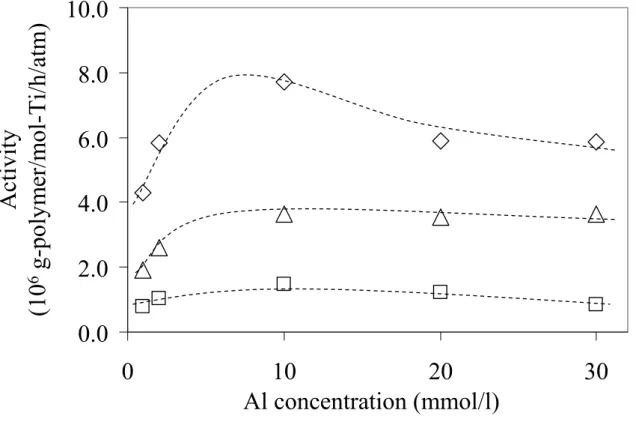
The alkylaluminum concentration largely affects the polymerization kinetics through activation and deactivation of Ti species. The deactivation rate was known to be correlated with the rate of reduction of Ti species [10(a)]. Figure 1 shows the effect of the Al
concentration on the Ti2M, Ti3M and Ti4M catalytic activities in ethylene polymerization. The ethylene polymerizations rates for the three catalysts showed different trends with increasing the Al concentration. In the case of Ti2M, it was rather constant, consistent with the previously reported results [14, 16]. This could be explained by the fact that Ti species cannot be reduced over Ti2+ by alkylaluminum, and the formed active sites are regarded as quite stable with negligible deactivation with alkylaluminum. This conclusion was supported by previous experimental reports [7(c), 4(b), 17]. On the other hand, the ethylene polymerization rates for Ti3M and Ti4M increased and then became nearly constant up to 10 mmol/l of the Al concentration. This trend appeared to be in agreement with the results obtained by Bresadola et al. [16]. They found that the catalytic activity for ethylene polymerization was nearly constant in the range of 50-200 Al/Ti. They observed a slow decrease of Ti4+ and Ti3+ amount accompanied with a small increase of Ti2+. The total amount of the Ti3+ and Ti2+ species, both of which are active for ethylene polymerization, was reported to be substantially constant, giving a constant activity. The catalytic activity for Ti4M once reached the maximum and then gradually dropped over 2.0 mmol/l of the Al concentration, which differed from the constant trends for Ti2M and Ti3M. This could be explained by the fact that TiCl4 easily migrates on MgCl2 in the presence of alkylaluminum
to aggregate with each other in the curse of the reduction, leading to the gradual decrease of the active site concentration [7(a)]. TiCl2 and TiCl3, that are originally solids, are bound much
more tightly than TiCl4 on MgCl2, to depress the aggregation-induced deactivation.
Figure 2 shows the ethylene/1-hexene copolymerization activities with varying the alkylaluminum concentration. The activity of Ti2M was enhanced with the addition of a small amount of 1-hexene, although the activities were the lowest among the three catalysts. Interestingly, copolymers produced with Ti2M had similar composition and sequence distribution to those produced with the other two catalysts, even though the 1-hexene
incorporation became lower for higher Al concentrations. These results are in disagreement with the previous explanation [11] that Ti2+ is comonomer insensitive and produces homopolyethylene only. In the case of Ti3M and Ti4M, the polymerization rates were drastically increased with the addition of 1-hexene, while the activity variation in terms of the Al concentration obeyed a similar trend for the homopolymerization in Figure 1. The observed rate enhancement by the addition of 1-hexene is known as a rate enhancement effect by comonomer [18-20]. In the case of ethylene copolymerization with -olefin, physical explanations seem more plausible, such as the acceleration of monomer diffusion through less crystallizable copolymers [21], and the acceleration of the catalyst fragmentation in copolymerization [20]. The difference in the observed rate enhancements by 1-hexene for the three catalysts might arise from the difference of their incorporation efficiency of 1-hexene.
Table 1 shows sequence distribution of ethylene/1-hexene (E/H) copolymers obtained at different Al concentrations. The copolymers contained 0.37-0.61 mol% of 1-hexene, in which butyl branches existed in an isolated manner without any HHH, HEH and EHH triad sequences. All of Ti2M, Ti3M and Ti4M show a similar trend, even though a higher oxidation state tends to lead to larger incorporation: the 1-hexene incorporation is the highest at the lowest Al concentration and then drops for higher concentrations.
Influence of the polymerization temperature
The influence of the polymerization temperature on the activities of homo- and co-polymerization is shown in Figure 3. The temperature was varied in the range of 50-70˚C. Higher catalyst activities for the ethylene homopolymerization were obtained by increasing the polymerization temperature. Although Ti4M was the most sensitive to the temperature change, the behavior was similar among the different Ti oxidation states. In comparison, the copolymerization activities increased more sharply than the homo-polymerization at 60°C,
but rather dropped at 70°C, probably because the 1-hexene solubility was decreased upon increasing the reactor temperature.
Influence of the 1-Hexene concentration
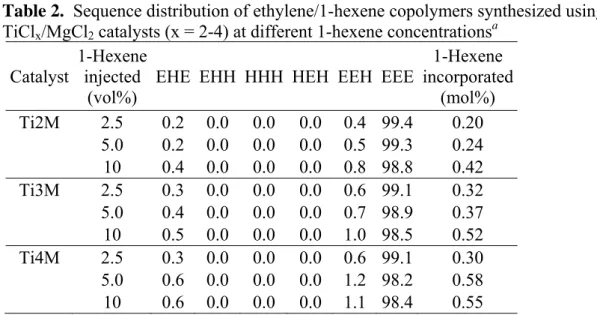
The effects of the 1-hexene concentration on the polymerization rates and resulting polymer properties were investigated for the different Ti oxidation states. As shown in Figure 4, all the catalysts activities were linearly increased for the 1-hexene concentration. The sequence distributions of copolymers prepared with the three catalysts are shown in Table 2. The produced copolymers again had similar composition and sequence distribution without sequential 1-hexene insertion. Incorporation of 1-hexene in copolymers was basically increased in correlation with the 1-hexene concentration, but not simply proportional to it. There might be a critical incorporation amount, below which the incorporation efficiency is lower for the 1-hexene concentration, and above which the incorporation efficiency discontinuously increases and then becomes stable. This might be related to some discontinuous change in the monomer diffusivity, in lowering the crystallinity by incorporation of 1-hexene. It is notable that a higher oxidation sate led to higher incorporation efficiency, even with the similar response to the 1-hexene concentration. The molecular weights and their distributions of copolymers synthesized with the three catalysts are summarized in Table 3. Ti2M produced a copolymer with the broadest MWD as compared with those obtained by Ti3M and Ti4M. The broadness of MWD for Ti2M arose mainly from the formation of a high-molecular weight tail, as indicated in the highest Mw. The lowest incorporation of 1-hexene and the highest molecular weight partly agrees with the previous proposal by Kissin et al. [11] However, it should be stressed that the obtained copolymers had roughly similar characteristics in CC and MW, in agreement with the results by Zakharov et al. [4(b,c)]
Conclusion
We have investigated the influences of the oxidation state on ethylene homo- and co-polymerization using MgCl2-based Ziegler-Natta catalysts made from TiCl4, TiCl3, and TiCl2
precursors. The Ti oxidation state had large effects on the catalytic activity in both of ethylene homo- and co-polymerization with 1-hexene. Especially, TiCl2/MgCl2 had a unique
response that was very different from TiCl4/MgCl2 and TiCl3/MgCl2 upon varying the Al
concentration and 1-hexene concentration. All the copolymers produced by the catalysts had similar sequence distribution, even though the increase of the oxidation state caused a slight enhancement of 1-hexene incorporation. Similarly, molecular weights and their distributions of the copolymers were not largely dependent on the Ti oxidation state. Thus, it was concluded that the oxidation state was not important for the copolymer characteristics, while it played a major role in the catalytic activity.
References
[1] D. T. Lynch, M. O. Jejelowo and S. E. Wanke, Can. J. Chem. Eng., 69, 657 (1991). [2] S. Piotr, Polym. Plast. Tech. Eng., 28, 493 (1989).
[3] J. C. Chadwick, A. Miedema, B. J. Ruisch, O. Sudmeijer, Makromol. Chem., 193,1463
(1992).
[4] (a) L. G. Echevskaya, M. A. Matsko, T. B. Mikenas, V. E. Nikitin, V. A. Zakharov, J. of Appl. Polym. Sci., 102, 5436 (2006). (b) A. A. Tregubov, V. A. Zakharov, T. B. Mikenas, J. Polym. Sci., Part A: Polym. Chem., 47, 6362 (2009). (c) T. B. Mikenas, A. A. Tregubov, V. A. Zakharov, L. G. Echevskaya, M. A. Matsko, Polimery, 53, 353 (2008). (d) A. G. Potapov, V. V. Kriventsov, D. I. Kochubey, G. D. Bukatov, V. A. Zakharov, Macromol. Chem. Phy.,
198, 3477 (1997).
[5] K. Czaja, M. Bialek, J. of Appl. Polym. Sci., 79, 356 (2000).
[6] C. Giuliano, M. Giampiero, P. Anteo, Macromol. Symp., 173, 195 (2001).
[7] (a) T. Wada, T. Taniike, I. Kouzai, S. Takahashi, M. Terano, Macromol. Rapid Commun.,
30, 887 (2009). (b) H. Mori, K. Hasebe, M. Terano, Polymer, 40, 1389 (1998). (c) T.
Taniike, M. Terano, Macromol. Rapid Commun., 29, 1472 (2008).
[8] A. A.Baulin, E. I. Novikova, G. Ya. Mal'kova, V. L. Maksimov, L. I.Vyshinskaya, S. S. Ivanchev, Vysokomol. Soed. A, 22, 181 (1980).
[9] (a) K. Soga, S. I. Chen, R. Ohnishi, Polym. Bull., 8, 473 (1982). (b) K. Soga, T. Shiono,
Y. Doi,Polym. Bull., 10, 168 (1983). (c) K. Soga, T. Uozumi, J. R. Park, Makromol. Chem., 191, 2853 (1990).
[10] (a) N. Kashiwa, J. Yoshitake, Makromol. Chem., 185, 1133 (1984). (b) N. Kashiwa, J. Yoshitake, T. Tsutsui, Polym. Commun., 28, 292 (1987). (c) S.I. Kojoh, M. Kioka, N. Kashiwa, Eur. Polym. J., 35, 751 (1999).
[11] Y. V. Kissin, F. M. Mirabella, C. C. Meverden, J. of Polym. Sci.: Part A: Polym.
Chem., 43, 4351 (2005).
[12] D. B. Ludlum, A. W. Anderson, C. E. Ashby, J. of Amer. Chem. Soci., 80, 1380 (1958). [13] H. S. Mobarakeh1, M. F. Monfared1, M. Vakili, Iranian Polym. J., 15, 569 (2006).
[14] C. J. Benning, W. R. Wszolek, F. X. Werber, J. Polym. Sci., Part A-1: Polym. Chem., 6, 755 (1968).
[15] M. K. Skalli, A. Markovits, C. Minot , A. Belmajdoub,Catal. Lett., 76, 1 (2001).
[16] D. Fregonese, S. Mortara, S. Bresadola, J. Molecular. Catal. A: Chem., 172, 89 (2001).
[17] Y. Ono, T. Keii, J. Polym. Sci., Part A-1: Polym. Chem., 4, 2441 (1966).
[18] Y. S. Ko, T. K. Han, H. Sadatoshi, S. I. Woo, J. Polym. Sci.: Part A: Polym. Chem., 36, 291 (1998).
[19] I. Kim, J. H. Kim, H. K. Choi, M. C. Chung, and S. I. Woo, J. Appl. Polym. Sci., Part A: Polym. Chem., 48, 721 (1993).
[20] J. C. W. Chien, T. Nozaki, J. Polym. Sci., 31, 227 (1993).
Table 1 Sequence distribution of ethylene/1-hexene copolymers synthesized using TiClx/MgCl2 catalysts (x = 2-4) at different Al concentrationsa
Catalyst Al conc.
(mmol/l) EHE EHH HHH HEH EEH EEE
1-hexene incorporated (mol%) Ti2M 2.0 0.5 0.0 0.0 0.0 1.1 98.4 0.54 10.0 0.4 0.0 0.0 0.0 0.7 98.9 0.37 30.0 0.4 0.0 0.0 0.0 0.8 98.7 0.42 Ti3M 2.0 0.6 0.0 0.0 0.0 1.1 98.3 0.56 10.0 0.5 0.0 0.0 0.0 1.0 98.5 0.52 30.0 0.5 0.0 0.0 0.0 1.1 98.4 0.53 Ti4M 2.0 0.6 0.0 0.0 0.0 1.2 98.2 0.61 10.0 0.6 0.0 0.0 0.0 1.1 98.4 0.55 30.0 0.6 0.0 0.0 0.0 1.1 98.3 0.57
a Polymerization conditions: catalyst amount = 3.5 mg/l; temperature = 60°C; polymerization
time = 1 h; ethylene pressure = 0.5 MPa; 1-hexene concentration = 10 vol%; TEA concentration = 2-30 mmol/l.
Table 2. Sequence distribution of ethylene/1-hexene copolymers synthesized using TiClx/MgCl2 catalysts (x = 2-4) at different 1-hexene concentrationsa
Catalyst 1-Hexene injected (vol%)
EHE EHH HHH HEH EEH EEE incorporated 1-Hexene (mol%) Ti2M 2.5 0.2 0.0 0.0 0.0 0.4 99.4 0.20 5.0 0.2 0.0 0.0 0.0 0.5 99.3 0.24 10 0.4 0.0 0.0 0.0 0.8 98.8 0.42 Ti3M 2.5 0.3 0.0 0.0 0.0 0.6 99.1 0.32 5.0 0.4 0.0 0.0 0.0 0.7 98.9 0.37 10 0.5 0.0 0.0 0.0 1.0 98.5 0.52 Ti4M 2.5 0.3 0.0 0.0 0.0 0.6 99.1 0.30 5.0 0.6 0.0 0.0 0.0 1.2 98.2 0.58 10 0.6 0.0 0.0 0.0 1.1 98.4 0.55
a Polymerization conditions: catalyst amount = 3.5 mg/l; temperature = 60°C; polymerization
time = 1 h; ethylene pressure = 0.5 MPa; 1-hexene concentration = 2.5-10 vol%; TEA concentration = 10 mmol/l.
Table 3. Molecular weight and their distribution of copolymers synthesized using TiClx/MgCl2 catalysts (x = 2-4)a Catalyst Mn x 10–5 Mw x 10–5 Mw/Mn Ti2M 3.6 14 4.0 Ti3M 3.2 12 3.7 Ti4M 3.7 12 3.2
a Polymerization conditions: catalyst amount = 3.5 mg/l; temperature = 60°C; polymerization
time = 1 h; ethylene pressure = 0.5 MPa; 1-hexene concentration = 10 vol%; TEA concentration = 10 mmol/l.
Figure Captions
Figure 1. Influence of the Al concentration on the ethylene homopolymerization activities. The homopolymerization was conducted at 60 ºC for 1 h under 0.5 MPa of ethylene. TEA was used as cocatalyst.
Figure 2. Influence of the Al concentration on the ethylene copolymerization activities. The copolymerization was conducted at 60 ºC for 1 h under 0.5 MPa of ethylene. 10 vol% of 1-hexene was added as the comonomer.
Figure 3. Influence of the polymerization temperature on the activities of the ethylene homo- and co-polymerization. The polymerization was conducted under 0.5 MPa of ethylene for 1 h. 10 mmol/l of TEA was used as cocatalyst. 10 vol% of 1-hexene was added in copolymerization.
Figure 4. Relationship between the 1-hexene concentration and catalytic activity. The copolymerization was conducted at 60 ºC for 1 h under 0.5 MPa of ethylene. 10 mmol/l of TEA was used as the cocatalyst.