Self
-similar
solutions
of two
-point
free
boundary
problem
for heat
equation
Jong-Shenq
Guo
Department of Mathematics, National Taiwm Normal University
and
Yoshihito
Kohsaka
(
高坂良史
)
Mathematical Institute,Ibhoku University
(東北大学大学院理学研究科数学専攻)
1Introduction
and
main
result
We studythe following twopoint free boundary problem:
$\{$
$u_{t}=u_{\varpi}$, $-\xi_{1}(t)<x<\ (t)$, $t>0$
$u_{x}(-\xi_{1}(t),t)=\mathrm{t}\mathrm{m}(\theta_{1}-\beta_{1})$, $u(-\xi_{1}(t),t)=\mathrm{C}_{\mathrm{Z}}(\mathrm{t})$$\tan\beta_{1}$
,
$u_{x}(\xi_{2}(\mathrm{t}),t)=\tan(h-\theta_{2})$, $u(\xi_{2}(t),t)=\xi_{2}(t)\tan\hslash$
,
$u(x,0)=u_{0}(x)$, $\xi_{1}(0)=\xi_{01}$
,
$\xi_{2}(0)=\xi_{02}$,(1.1)
where $\beta.\cdot$ and $\theta.\cdot$
are
given constants satisfying$\beta_{\dot{l}}\in[0,\pi/2)$ and $\theta.\cdot\in(0,\beta_{\dot{\iota}}+\pi/2)$,
$i=1,2$, $\xi 01$ and$\xi 02$
are
positiveconstants, $\mathrm{u}_{0}\in C^{2}[-\xi_{01}, \ ]$satisfying the compatibilityconditions, and $u_{0}>0$ in $(-\xi_{01},\xi oe)$
.
In this problem $(u,\xi_{1},\xi_{2})$are
unknown functionsto be found.
Taistype offree boundaryproblemarisesin thecombustiontheory todescribe flme
propagation. It is motivatedbymathematicalmodeling ofcombustionin $[1, 5]$
.
Notethatthe prescribed angle condition at each ffeeboundary makes the problem (1.1) different
fromthe Stefanproblem. For adetailed overviewof
more
generalor
differentmodelswe
refer the reader to the work of Vazquez [5].
Tae
purpose
in this talc is to prove the existence of self-similar solutions for theproblem (1.1), which is classified by angle conditions, and also to analyze the stability
of them.
Tae problem (1.1) has fundamentalproperties
as
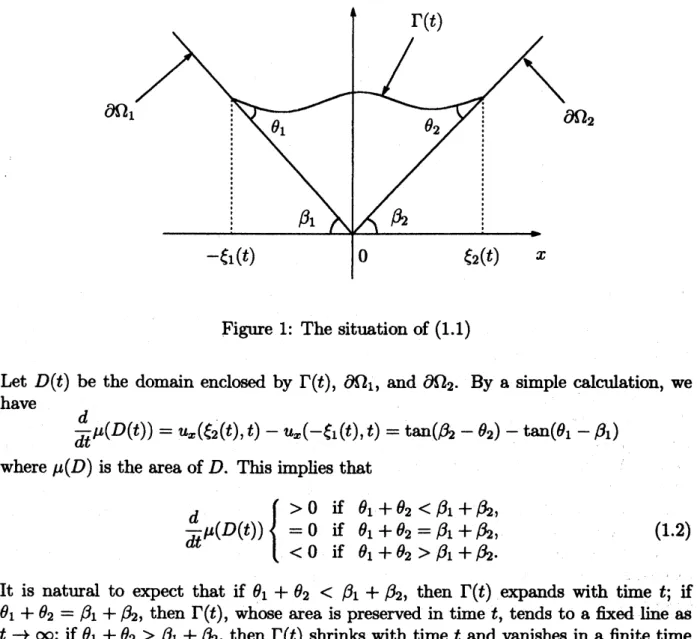
folows. Set$\Gamma(t):=\{(x, u(x,t))|-\xi_{1}(t)<x<\xi_{2}(t)\}\subset \mathrm{R}^{2}$,
$\partial\Omega_{1}:=\{(x, z)|z=-(\tan\beta_{1})x, x \leq 0\}$, $\partial\Omega_{2}:=\{(x, z)|z=(\tan/\%)x, x \geq 0\}$
.
数理解析研究所講究録 1258 巻 2002 年 94-107
Figure 1: The situation of (1.1)
Let $D(t)$ be the domain enclosed by $\mathrm{F}(\mathrm{t})$, $\partial\Omega_{1}$, and $\partial\Omega_{2}$
.
By asimple calculation,we
have
$\frac{d}{dt}\mu(D(t))=u_{x}(\xi_{2}(t), t)-u_{x}(-\xi_{1}(t),t)=\mathrm{t}\mathrm{m}(h -\theta_{2})-\tan(\theta_{1}-\beta_{1})$
where$\mu(D)$ is the
area
of $D$.
This implies that$\frac{d}{dt}\mu(D(t))\{$
$>0$ if $\theta_{1}+\theta_{2}<\beta_{1}+oe$,
$=0$ if $\theta_{1}+\theta_{2}=\beta_{1}+\hslash$,
$<0$ if $\theta_{1}+\theta_{2}>\beta_{1}+\$
.
(1.2)
It is natural to expect that if $\theta_{1}+\theta_{2}<\beta_{1}+\beta_{2}$, then $\Gamma(t)$ expands with time $t$;if
$\theta_{1}+\theta_{2}=\beta_{1}+\beta_{2}$, then $\Gamma(t)$, whose
area
is preserved in time $t$, tends to afixed line as$t$ $arrow\infty$;if$\theta_{1}+\theta_{2}>\beta_{1}+h$, then $\mathrm{F}(\mathrm{t})$ shrinks with time $t$ and vanishes in afinite time
$T=T(u_{0},\xi_{01}, \xi_{02})$
.
Toanalyze the asymptoticbehavior of $\Gamma(t)$, we define the following.
Definition 1.1 (Self-similar) Let $\rho>0$ and set
$u^{\rho}(x,t):=\rho^{-1}u(\rho(x-x_{0})+x_{0},\rho^{2}(t-t_{0})+t_{0})$
.
We say that $u$ is
self-similar
with the center $(\# 0,t_{0})$if
$u^{\rho}(x,t)=u(x,t)$for
any $\rho>0$.
Note that the problem (1.1) is invariant for the rescaling $u\mathrm{h}arrow u^{\rho}$
.
If $u$ is self-similarandis also asolution of (1.1) for
some
$\mathrm{w}\mathrm{O}$, $\xi_{01}$, and $\xi_{02}$, thenwe
$\mathrm{c}\mathrm{a}\mathrm{U}$such$u$ aself-similar
solution of (1.1).
There
are
severalreferences studying self-similar solutions for this type of freebound--ary
problem. For thecase
$\beta_{1}=0$ and $h$ $=\pi/2$, which isone
point free boundary$x$
Figure
2:
$\beta_{1}=0$andh
$=\pi/2$ (see [3, 4])problem,
we
refer to $[3, 4]$.
In [4] the author proved the existence and uniqueness ofaself-similar solution for aquasilinear parabolic equation $u_{t}=(a(u_{x}))_{x}$ in the
case
$\theta_{1}+\theta_{2}<\pi/2$, where $a\in C^{2}(\mathrm{R})$and the first derivativeof$a$ is positive. The asymptotic
stability ofthis self-siilar solution
was
also obtained. In [3] they considered afocusingproblem with $\theta_{1}=\pi/4$ md $\theta_{2}=\pi/2$
.
Itwas
proved that aself-similar solution, $\mathrm{w}\underline{\mathrm{h}\mathrm{i}}\phi$vanishes inffiite time, exists uniquely and that allsolutions
are
asymptotically equal tothis self-siilar solution. For the
case
$\beta_{1}=\beta$ $=0$,we
refer to [2]. In [2] they studied inseveral space dimensionand established atheoryofexistence, uniqueness and regularity
for radial symmetric solutions having bounded support. They also investigated the $\mathrm{f}\mathrm{e}\succ$
cusing behavior, which is shown to be self-similar, for solutions whose support expands infinite time toffil ahole. We remark that the
one
dimensional problemin their modelis aspecial
case
ofour
problem.In order to investigatethe existence of self-similar solutions of (1.1),
we
consider thefollowing problems. Now
we
set $\alpha_{1}:=\theta_{1}-\beta_{1}$ and $\alpha_{2}:=h$ $-\theta_{2}$.
$\underline{\mathrm{C}\mathrm{a}\mathrm{s}\mathrm{e}\alpha_{1}<\alpha_{2}}\cdot$.Analyze
forward
$self- s\dot{\iota}m.kr$ solutions. That is, for$u(x,t)=\sqrt{2t}v(x/\sqrt{2t})$, $\xi_{1}(t)=\sqrt{2t}p$, $\xi_{2}(t)=\sqrt{2t}q$,
we
study $\{$ $v’(-p)=\mathrm{t}\mathrm{m}\alpha_{1}v’+\eta^{\sqrt}-v=0,$’ $v(-p)=p\mathrm{t}\mathrm{f}\mathrm{f}\mathrm{i}1\beta_{1}-p<\eta<q,$ , $v’(q)=\tan\alpha_{2}$, $v(q)=q\mathrm{t}\mathrm{m}\$.
(1.3)In the problem (1.3), $v,p,q$
are
unknownfunction and constants to be found.Case $\alpha_{1}=\alpha_{2}$:Analyze stationaly
self-similar
solutions. In this case, afamily of the$\overline{\mathrm{s}\mathrm{t}\mathrm{r}\mathrm{a}\mathrm{i}\mathrm{g}\mathrm{h}\mathrm{t}\mathrm{l}\mathrm{i}\mathrm{n}\mathrm{e}\mathrm{s}}$,
namely $u(x)=(\tan\alpha)x+d$ where $\alpha:=\alpha_{1}=\alpha_{2}$ and $d$ is any positive
constant, is stationary solutionsof (1.1).
$\underline{\mathrm{C}\mathrm{a}\mathrm{s}\mathrm{e}\alpha_{1}>\alpha_{2}}$:Analyze backard
self-similar
solutions. That is, for$u(x,t)=\sqrt{-2t}v(x/\sqrt{-2t})$, $\xi_{1}(t)=\sqrt{-2t}p$, $\xi_{2}(t)=\sqrt{-2t}q$,
$\{$
$v’-\eta v’+v=0$, $-p<\eta<q$,
$v’(-p)=\mathrm{t}\mathrm{m}\alpha_{1}$, $v(-p)=p\mathrm{t}\mathrm{m}\beta_{1}$,
$v’(q)=\tan \mathrm{a}2$, $v(q)=q\mathrm{t}\mathrm{m}\beta_{2}$
.
(1.4)
In the problem (1.4), $v,p,q$
are
unknown function and constants to be found.We
are
ready to stateour
main results.Theorem 1.1 The following hold:
(i) Assume that $\alpha_{1}<\alpha_{2}$
.
Then there existsa
unique (up to the translationof
time $t$)forward self-similar
solutionfor
(Ll). Moreover, it is asymptotically stable.(ii)
Assume
that $\alpha_{1}=\alpha_{2}$.
Then there exists a unique stationaryself-similar
solutionfor
(Ll) withagiven$D_{0}$, whichis the domain enclosed by$\Gamma 0:=\{(x,u\mathrm{o}(x))|-\xi 01\leq$$x\leq\xi_{02}\}$, $\partial\Omega_{1}$, and $\partial\Omega_{2}$
.
(iii) Assume that $\alpha_{1}>\alpha_{2}$
.
Then there is a constant $G_{\mathrm{c}}$($<$ -tm$\beta_{1}$) depending onlyon
$\alpha_{1}$ and $\beta_{1}$ such that the following hold.
(iii-a) There exists at least one backward
self-similar
solutionfor
(Ll) $if-\beta_{1}\leq$$\alpha_{2}<\alpha_{1}\leq h$
.
(iii-b) There exist at least two backward
self-similar
solutionsfor
(1.1)if
$\mathrm{t}\mathrm{m}^{-1}G_{\mathrm{c}}<$$\alpha_{2}<-\beta_{1}<\alpha_{1}\leq h$
.
(iii-a) There exists at least
one
backwa$\mathrm{r}d$self-similar
solutionfor
(Ll) $if\tan^{-1}G_{\mathrm{c}}<$$\alpha_{2}<-\beta_{1}$ and$h$ $<\alpha_{1}$
.
(iii-d) There $e$$\dot{m}ts$ at least
one
backwa$rd$self-similar
solutionfor
(1.1)if
$\alpha-\leq\alpha_{2}\leq$$\mathrm{t}\mathrm{m}^{-1}G_{\mathrm{c}}$
for
some $\overline{\alpha}\in(-\pi/2, \alpha_{1})$ depending only on$\alpha_{1},$ $\beta_{1}$, and$h$.
Remark 1.1 The exact existence for the
case
(iii) and the stability for thecases
(ii), (iii)are
still open.2Case:
$\alpha_{1}<\alpha_{2}$Give $\alpha_{1},\beta_{1},p,q$, with $\beta_{1}\in[0,\pi/2)$, $\alpha_{1}\in(-\beta_{1},\pi/2)$, $p>0$, $q>0$
.
Letus
consider theinitial valule problem:
$\{$ $v’(-p)=\tan\alpha_{1}v’+\eta v’-v=0,$’ $v(-p)=p\mathrm{t}\mathrm{m}\beta_{1}\eta>-p,$
.
(2.1)Let $F(\eta)=\eta v’(\eta)-v(\eta)$
.
Then by (2.1)we
have $F’(\eta)=-\eta F(\eta)$.
It follows that$v’(\eta)=-F(\eta)=pA_{1}e^{(\mathrm{p}^{2}-\eta^{2})/2}$, $\eta>-p$, (2.2)
where $A_{1}:=\tan\alpha_{1}+\tan\beta_{1}$
.
Note that $A_{1}>0$, since $\alpha_{1}>-\beta_{1}$.
This implies that $v’>0$.
Byan
integration of (2.2) ffom -p to $\eta(>-p)$,we
obtain$v’(\eta)=\tan\alpha_{1}+pA_{1}e^{\mathrm{p}^{2}/2}[I^{-}(p)+I^{-}(\eta)]$ (2.3)
where
$I^{-}( \eta)=\int_{0}^{\eta}e^{-\neq/2}ds$
.
Set
$G(p,q):=\sqrt(q)=\tan\alpha_{1}+pA_{1}e^{p^{2}/2}[I^{-}(p)+I^{-}(q)]$
.
Moreover, by integrating (2.3) ffom $-p$to $\eta(>-p)$,
we
obtainthat$v(\eta)=\eta$tm$\alpha_{1}+_{M}A_{1}e^{p^{2}/2}[I^{-}(p)+I^{-}(\eta)]+pA_{1}e^{(\mathrm{p}^{2}-\eta^{2})/2}$
.
Set
$H(p,q):= \frac{v(q)}{q}=\mathrm{t}\mathrm{m}\alpha_{1}+pA_{1}d/2[I^{-}(p)+I^{-}(q)]+\frac{p}{q}A_{1}e^{(p^{2}-q^{2})/2}$
.
It is
easy
to compute that$\{$
$\frac{\frac{\partial G}{\ovalbox{\tt\small REJECT}}}{\partial q}(p,q)=pA_{1}e^{(p^{2}-P)/2}(>0)(p,q)=pA_{1}+(p^{2}+1)A_{1}e^{p^{2}/2},[I^{-}(p)+I^{-}(q)](>0)$
,
$\frac{\partial H}{\Phi}(p,q)=pA_{1}+(p^{2}+1)A_{1}d/2\{[I^{-}(p)+I^{-}(q)]+\frac{1}{q}e^{-q^{2}/2}\}(>0)$
,
$\frac{\partial H}{\partial q}(p,q)=-\frac{p}{q^{2}}A_{1}e^{\phi^{2}-q^{2})/2}(<0)$
.
For given $\alpha_{2}(>\alpha_{1})$ and $h$ $\in[0,\pi/2)$,
we
want to solve the equations$G(p,q)=\tan$
a2
and $H(p,q)=ta$h.
(2.4)for
some
$p>0$ and $q>0$.
Ifwecan
find thepair of$(p,q)$ satisfying (2.4), $(v,p,q)$ is thesolution of (1.3).
Remark 2.1 Clearly $G(p, q)>\mathrm{t}\mathrm{m}\alpha_{1}$
.
This claims that if$\alpha_{1}\geq\alpha_{2}$, thereare no
$(p,q)$
satisfying (2.4). Thatis, there
are no
forwardself-similar
solutions of (1.1) for$\alpha_{1}\geq\alpha_{2}$.
Let consider the equation $G(p,q)=\mathrm{t}\mathrm{m}\alpha_{2}$ for
a
$\mathrm{g}$.ven
$\alpha_{2}(>\alpha_{1})$.
We first observe that$G(p,q)$ is monotone increasingin$p$and $q$
.
Note that thelimit of$I^{-}(q)$as
$q\uparrow+\infty$existsand is also finite. Since $G(0, +\infty)=\mathrm{t}\mathrm{m}\alpha_{1}$ and $G(+\infty, +\infty)=+\infty$, there is aunique
$p_{\infty}>0$ such that
$G(p_{\infty}, +\infty)=\mathrm{t}\mathrm{m}\alpha_{2}$
.
In addition, since $G(0,\mathrm{O})=\mathrm{t}\mathrm{m}\alpha_{1}$ and $G(+\infty,0)=+\infty$, there is aunique
$m$ $>0$such
that
$G(n,0)=\mathrm{t}\mathrm{m}\alpha_{2}$
.
$p$
Figure 3: $(p, q)$-line satisfying $G(p,q)=\tan\alpha_{2}$
Prom the monotonisity in$p$ of$G$, itfollows that$p_{\infty}<n$
.
Thenwe
havefor$p\in(p_{\infty},\mathrm{M})$$G(p,\mathrm{O})<G\emptyset$,$\mathrm{O})=\tan\alpha_{2}=G(p_{\infty}, +\infty)<G(p, +\infty)$
Themonotonisityin$q$of$G$implies thatfor each$p\in(p_{\infty},p_{0})$ there isaunique$q=g(p)>$
$0$ such that $G(p,g(p))=\tan\alpha_{2}$
.
Note that $g(+\infty)=p_{\infty}$ and $g(0)=p_{0}$.
Differentiating$G(p,g(p))=\mathrm{t}\mathrm{m}$$\alpha_{2}$ with respect to$p$,
we
obtain$\frac{\partial G}{\partial p}(p,g(p))+\frac{\partial G}{\partial q}(p, g(p))\cdot g’(p)=0$
.
Thus
we are
led to $\phi(p)<0$, since $\partial G/\partial p>0$ and $\partial G/\partial q>0$ (see Figure 3).Let consider the equation $H(p,q)=\mathrm{t}\mathrm{m}\beta_{\mathit{2}}$ for agiven$h$ $\in[0,\pi/2)$
.
Weobserve that$H(p,q)$ is monotone inscreasing in $p$ for all $q>0$ and monotone decreasing in $q$ for all
$p>0$
.
Note that $H(p, +\infty)=G(p, +\infty)$ and $\alpha_{2}<h$.
Since $H(p_{\infty},0^{+})=+\infty$ and$H(p_{\infty}, +\infty)=\tan\alpha_{2}$, there is aunique $\overline{q}>0$ such that
$H(p_{\infty},\overline{q})=\tan\$
.
In addition, since $H(p_{\infty}, +\infty)=\mathrm{t}\mathrm{m}\alpha_{2}$ and $H(+\infty, +\infty)=+\infty$, there is aunique $p_{*}(>p_{\infty})$ such that
$H(p_{*}, +\infty)=\mathrm{t}\mathrm{m}h$
.
Then
we
have for$p\in(p_{\infty},p_{*})$$H(p, +\infty)<H(p_{*}, +\infty)=\mathrm{t}\mathrm{m}h$ $=H(p_{\infty},\overline{q})<H(p,\overline{q})$
.
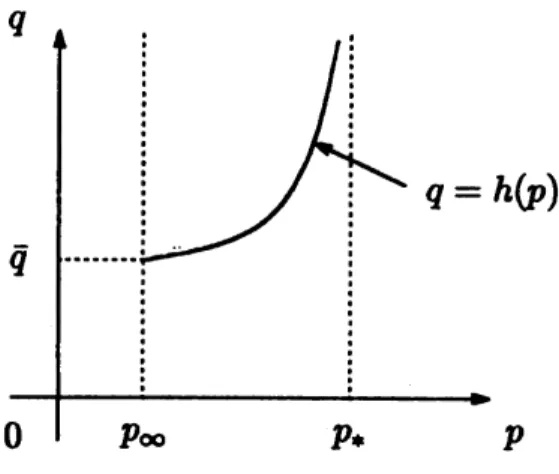
The monotonisity in$q$of$H$implies thatforeach$p\in(p_{\infty},p_{*})$ there is aunique$q=h(p)>$
$\overline{q}$such that $H(p, h(p))=\mathrm{t}\mathrm{m}h$
.
Note that $h(p_{\infty})=\overline{q}$ and $h(p_{*})=+\infty$.
Differentiating$H(p, h(p))=\mathrm{t}\mathrm{m}h$ with respect to$p$,
we
derive$\frac{\partial H}{\partial p}(p, h(p))+\frac{\partial H}{\partial q}(p, h(p))\cdot h’(p)=0$
.
Figure 4: $(p,q)$-Hue satisfying $\mathrm{H}(\mathrm{p},$ $=\mathrm{t}\mathrm{m}h$
Therefore
we
find $h’(p)>0$, since $\partial H/\Phi>0$ and $\partial H/\partial q<0$ (see Figure 4).We
are
ready to state and prove the folloing $\mathrm{t}\mathrm{h}\infty \mathrm{r}\mathrm{e}\mathrm{m}$Theorem 2.1 Assume that$\alpha_{1}<\alpha_{2}$
.
Thenfor
given $\beta_{1},h\in[0,\pi/2)$, $\alpha_{1}\in(-\beta_{1},\pi/2)$,anti$\alpha_{2}\in(\alpha_{1},h)$ there is
a
unique solution $(v,p,q)$ to the problem (L3).Proof. Combine Figure 3and Figure 4. Then
we see
that there is aunique $(p,q)$ with$p\in(p_{\infty},\overline{p})$, where $\overline{p}:=\dot{\mathrm{m}}\mathrm{n}\{n,p_{*}\}$, and $q>\overline{q}$ such that $g(p)=h(p)=\mathrm{g}$
.
This provethetheorem. $\square$
We state thefollowing theorem withouthe proof.
Theorem
2.2
(Stabilityof
$a$forward self-similar
solution) Assrrrrge that$\alpha_{1}<\alpha_{2}$.
Alsoassume
that $u_{0}\in C^{2}[-\xi_{01},\xi_{02}]$satisfies
the compatibility conditions and $u_{0}>0$ in$(-\xi_{01},\xi\alpha)$
.
Let$\Gamma(t)$ bea
smooth solutionof
(Ll) with the initial data$\Gamma_{0}=${(
$x$,Uo(x)) $|-$$\xi 01\leq x$ $\leq\xi_{02}\}$ and $S(t)$ be $a$
forward
self-similar
solution denotedas
$S(t):=\{(\hat{x}, \sqrt{2t}v(\hat{x}/\sqrt{2t}))|-\sqrt{2t}p\leq\hat{x}\leq\sqrt{2t}q\}$
where $(v,p, q)$ is a solution
of
(LS). Then $S(t)$ is asymptotically stable in thesense
:$d_{H}(\Gamma(t),S(t))\leq Ct^{-\delta}$, $t>1$
,
for
some
$\delta\in(0,1/2)$ atetia $co$nstant$C(>0)$, which depends on the initial data$\Gamma_{0}$.
Here$d_{H}$ denotes the
Hausdorff
distance.To provethis theorem,
we
constructa
suk olutionand asuper-solution,whichconverge
to $S(t)$ asymptotically
as
t$arrow\infty$, and applythe strong $\ovalbox{\tt\small REJECT}\tau \mathrm{m}$ principle.3
Case:
$\alpha_{1}=\alpha_{2}$In this case, there is afamily of$stat\dot{\iota}ona\eta$
self-similar
solutions of (1.1), that is,$u_{d}(x,t)=u_{d}(x)=(\mathrm{t}\mathrm{m}\alpha)x+d$,
where $\alpha:=\alpha_{1}=\alpha_{2}$ and $d$ is any positive constant. The corresponding fixed end points
to $u_{d}$
are
given by$p= \frac{d}{\tan\alpha_{1}+\tan\beta_{1}}$, $q= \frac{d}{\tan\beta_{2}-\tan\alpha_{2}}$
.
According to (1.2), the condition $\alpha_{1}=\alpha_{2}$ implies the area-preserving property. Let $D_{0}$
be the domain enclosed by $\Gamma_{0}:=\{(x, u_{0}(x))|-\xi_{01}\leq x\leq\xi_{02}\}$, $\partial\Omega_{1}$
,
and $\partial\Omega_{2}$.
Set$A_{1}:=\tan\alpha_{1}+\tan\beta_{1}$ and
A2
$:=\tan Oh$ $-\tan\alpha_{2}$.
Let$d_{*}=\sqrt{\frac{2A_{1}A_{2}}{A_{1}+A_{2}}\mu(D_{0})}$
.
Thenastationaryself-similar solution of(1.1) isuniquely
determined
as
$u\ (x)=ax+d_{*}$for agiven $D_{0}$
.
4
Case:
$\alpha_{1}>\alpha_{2}$Give $\alpha_{1},\beta_{1},p$,$q$, with $\beta_{1}\in[0,\pi/2)$, $\alpha_{1}\in(-\beta_{1},\pi/2)$, $p>0$, $q>0$
.
Letus
consider theinitial valule problem:
$\{\begin{array}{l}v’’-\eta v’+v=0v,(-p)=\mathrm{t}\mathrm{a}\mathrm{n}\alpha_{1}\end{array}$
Then
as
beforewe
have$\eta>-p$, (4.1)
$v(-p)=p\tan\beta_{1}$
.
$v’(\eta)=-pA_{1}e^{-(p^{2}-\eta^{2})/2}$, $\eta>-p$
,
(4.2)where $A_{1}=\tan\alpha_{1}+\tan\beta_{1}>0$
.
Note that $v’<0$.
Byan
integration of (4.2) fiom $-p$to $\eta(>-p)$,
we
obtain $v’(\eta)=\mathrm{t}\mathrm{m}\alpha_{1}-pA_{1}e^{-\mathrm{p}^{2}/2}[I^{+}(p)+I^{+}(\eta)]$, $\eta>-p$, (4.3) where $I^{+}( \eta)=\int_{0}^{\eta}e^{s^{2}/2}ds$.
Set $\hat{G}(p,q):=v’(q)=\mathrm{t}\mathrm{m}\alpha_{1}-pA_{1}e^{-p^{2}/2}[I^{+}(p)+I^{+}(q)]$.
In addition, byintegrating (4.3) again,
we
derive that$v(\eta)=\eta$tm$\alpha_{1}-\eta pA_{1}e^{-p^{2}/2}[I^{+}(p)+I^{+}(\eta)]+pA_{1}e^{-(p^{2}-\eta^{2})/2}$
.
Alsoset
$\hat{H}(p,q):=\frac{v(q)}{q}=\mathrm{t}\mathrm{m}\alpha_{1}-pA_{1}e^{-\mathrm{p}^{2}/2}[I^{+}(p)+I^{+}(q)]+\frac{p}{q}A_{1}e^{-(\mathrm{p}^{2}-q^{2})/2}$
.
It is
easy
to compute that $\{$ $\frac{\partial\hat{G}}{\Phi}(p,q)=-\mathrm{p}A_{1}+(p^{2}-1)A_{1}e^{-p^{2}/2}[I^{+}(p)+I^{+}(q)]$, $\frac{\partial\hat{G}}{\partial q}(p,q)=-pA_{1}e^{-\psi-q^{2})/2}(<0)$, $\frac{\partial H}{\Phi}(p,q)=-pA_{1}+(\mathrm{p}^{2}-1)A_{1}e^{-\#/2}\{[I^{+}(p)+I^{+}(q)]-\frac{1}{q}e^{q^{2}/2}\}$,
$\frac{\partial\hat{H}}{\partial q}(p,q)=-\frac{p}{q^{2}}A_{1}e^{-(\mathrm{p}^{2}-q^{2})/2}(<0)$.
For given $\alpha_{2}(<\alpha_{1})$ and $h$ $\in[0,\pi/2)$,
we
want tosolve the equations$\hat{G}(p,q)=\mathrm{t}\mathrm{m}\alpha_{2}$ and $\hat{H}(p,q)=\mathrm{t}\mathrm{m}\$
.
(4.4) for
some
$p>0$ and $q>0$.
Ifwe
can
find the pair of$(p,q)$ satisfying (4.4), $(v,p,q)$ is thesolution of (1.4).
Remark 4.1 Clearly $\hat{G}(p,q)<\mathrm{t}\mathrm{m}\alpha_{1}$
.
This claims that if$\alpha_{1}\leq\alpha_{2}$
,
thereare no
$(p,q)$satisfying (4.4). That is, there
are no
backward self-similar solutions of(1.1) for$\alpha_{1}\leq\alpha_{2}$.
In order to solve (4.4), let study the fuctions $\hat{G}$
(p,q) and $\hat{H}$(p,q).
Now set
$J(p):= \frac{p}{p^{2}-1}e^{p^{2}/2}-I^{+}(p)$ for p$\neq 1$,
$K(q):=I^{+}(q)- \frac{1}{q}e^{f/2}$ for q $>0$
.
We compute that
$\mathcal{J}(p)=-e^{\mathrm{p}^{2}/2}\underline{1}<0$
for $p\neq 1$, (4.5) $(p^{2}-1)^{2}$
$K’(q)= \frac{1}{q^{2}}e^{q^{2}/2}>0$ for $q>0$, (4.6)
and observe that
$J(0)=0$, $J(1^{-})=-\infty$, $J(1^{+})=+\infty$, $J(+\infty)=-\infty$, (4.7) $K(0^{+})=-\infty$, $K(+\infty)=+\infty$
.
(4.8)It follows from (4.6) and (4.8) that there is aunique $r_{0}>0$ such that
$K(q)\{$ $<0$ if $=0$ if $>0$ lf $0<q<r_{0}$, $q=r_{0}$, $q>r_{0}$
.
102
First
we
study the function $\hat{G}$(p,q). Note that
$\{$
$\frac{\partial\hat{G}}{\partial p}(p,q)<0$ for $p\in(0,1]$,
$\frac{\partial\hat{G}}{\partial p}(p, q)=A_{1}(p^{2}-1)e^{-\mathrm{p}^{2}/2}[I^{+}(q)-J(p)]$ for $p>1$
.
Since $(I^{+})’(q)>0$, $I^{+}(0)=0$, and$I^{+}(+\infty)=+\infty$, there is aunique$p_{\mathrm{c}}(q)>1$ suchthat
$J(p_{\mathrm{c}}(q))=I^{+}(q)$for each$q>0$
.
Wehave$p_{\mathrm{c}}(0^{+})\in(1,+\infty)$, $p_{\mathrm{c}}(+\infty)=1$, and$p_{\mathrm{c}}(q)<0$.
These imply that for all $q>0$
$\frac{\partial\hat{G}}{\partial p}(p,q)\{$ $<0$ if $p<p_{\mathrm{c}}(q)$; $=0$ if $p=p_{c}(q)$; $>0$ if $p>p_{\mathrm{c}}(q)$
.
(4.9) Thenwe
find $G_{\mathrm{c}}$ $:= \hat{G}(p_{c}(0),0)=-\tan\beta_{1}-\frac{1}{p_{\mathrm{c}}^{2}(0)-1}(\tan\alpha_{1}+\tan\beta_{1})(<-\mathrm{t}\mathrm{m}\beta_{1})$.
(4.10)Next
we
study the function $\hat{H}(p, q)$.
Note that$\{$
$\frac{\partial\hat{H}}{\Phi}(p,q)A_{1}(p^{2}-1)e^{-p^{2}/2}[K(q)-J(p)]$ for $p\neq 1$,
$\frac{\theta\hat{H}}{\partial p}(1,q)=-A_{1}<0$
.
Consider the
case
$0<p<1$.
For $q\geq r_{0}$$\frac{\partial\hat{H}}{\Phi}(p,q)=-pA_{1}+A_{1}(p^{2}-1)e^{-\mathrm{p}^{2}/2}[K(q)+I^{+}(p)]<0$
.
(4.11)Onthe other hand, byvirtueof (4.5) and (4.7),
we
see
that $J(p)<0$for$p\in(0,1)$.
Thisimplies that for each$p\in(0,1)$ there exists aunique $q_{s}(p)\in(0, r_{0})$ such that
$K(q_{\epsilon}(p))=J(p)$
.
Note that $q_{s}(0^{+})=r_{0}$
,
$q_{J}(1^{-})=0$,
and $t_{s}(p)<0$.
Thuswe
derive for $0<q<r_{0}$$\frac{\partial\hat{H}}{\partial p}(p,q)\{$
$>0$ if $0<q<q_{\epsilon}(p)$;
$=0$ if $q=q_{\epsilon}(p)$;
$<0$ if $q>q_{s}(p)$
(4.12)
Consider the
case
$p>1$.
It follows from (4.5)-(4.8) that there exists aunique $q_{\tau\iota}(p)>0$such that
$K(q_{u}(p))=J(p)$
.
Note that $q_{u}(1^{+})=+\infty$, $q_{u}(+\infty)=0$, and $\phi_{u}(p)<0$
.
Thereforewe
are
led to $\frac{\partial\hat{H}}{\Phi}(p,q)\{$ $<0$ if $0<q<q_{u}(p)$; $=0$ if $q=q_{u}(\mathrm{p})$; $>0$ if $q>q_{u}(p)$.
(4.13)Let consider the equation $\hat{G}(p,q)=tan\alpha \mathit{2}$ for
a
$\mathrm{g}$
.ven
$\alpha_{2}(<\alpha_{1})$.
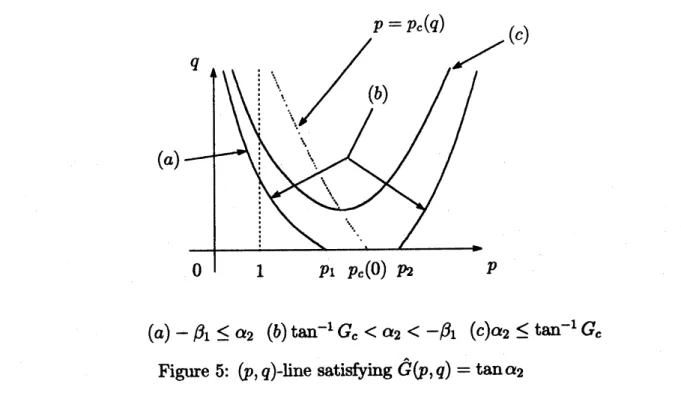
We separate intothree cases; $(a)-\beta_{1}\leq\alpha_{2}$, (b)$\mathrm{t}\mathrm{m}^{-1}G_{\mathrm{c}}<\alpha_{2}<-\beta_{1}$
,
$(c)\alpha_{2}\leq \mathrm{t}\mathrm{m}^{-1}G_{\mathrm{c}}$.
For the sake of
convenience,
we
analyze them in order of $(c)arrow(b)arrow(a)$.
Recallng (4.9) again, this implies that
$\{$
$J^{\wedge}(\mathrm{p})<0$ for $0<p<\tilde{p}$,
$J^{\wedge}(p)>0$ for $p>\tilde{p}$
.
$\mathrm{h}$ addition, using the
reduction to absurdity,
we see
$g(0^{+})=+\infty$ and $g(+\infty)=+\infty$(see Figure $5(c)$)
$\underline{\mathrm{C}\mathrm{a}\mathrm{a}\mathrm{e}\tan^{-1}G_{\epsilon}<\alpha_{2}<-\beta_{1}}.\cdot$ We observe that $\hat{G}(0,\mathrm{O})=\tan\alpha_{1}(>\mathrm{t}\mathrm{m}\alpha_{2})$
and
$\hat{G}(p,0)$ $=$ tm$\alpha_{1}-pA_{1}e^{-\neq/2}I^{+}(p)$
$arrow \mathrm{t}\mathrm{m}\alpha_{1}-A_{1}=-\mathrm{t}\mathrm{m}\beta_{1}$($>\tan$a2)
as
p $arrow+\infty$.
Then it follows ffom (4.9) that there exist $p_{1}\in(0,p_{\epsilon}(0))$ and $n$ $\in(p_{\mathrm{c}}(0),+\infty)$ such
that $\hat{G}(p_{1},0)=\hat{G}\omega,0)=\mathrm{t}\mathrm{a}\mathrm{n}\mathrm{a}2$
.
For$p\in(p_{1},h)$,
we
obatin that $\hat{G}(p,\mathrm{O})<\mathrm{t}\mathrm{m}\alpha_{2}$.
Inview of $\partial\hat{G}/\partial q<0$, we are led to $\hat{G}(p,q)<\mathrm{t}\mathrm{m}\alpha_{2}$
for$p\in(p_{1},h)$ and $q>0$
.
Thus for$p\in$ $(p_{1},\infty)$ there isnosolution of$G\wedge(p,q)=\mathrm{t}\mathrm{m}$a2. For
$p\in(0,p_{1})\cup(p_{2},+\infty)$,
we
observethat $\hat{G}(p,\mathrm{O})>\tan n$a2. Since $\hat{G}(p, +\infty)=-\infty$
and $\partial\hat{G}/\partial q<0$ for all $p>0$, there is
a
unique $q=\hat{g}(p)>0$ such that $\hat{G}(p,\hat{g}(p))=\mathrm{t}\mathrm{m}\alpha_{2}$ for each$p\in(0,p_{1})\mathrm{U}(p_{2}, +\infty)$
.
Appying the
same
argumentas
thecase
$\alpha_{2}\leq\tan^{-1}G_{\mathrm{c}}$, we see
. $\{$
$J^{\wedge}(p)<0$ for $0<p<p_{1}$, $J^{\wedge}(p)>0$ for $p>n$
.
We also have $g(0^{+})=+\infty$ and $g(+\infty)=+\infty$
.
Moreover, bymeans
of $\hat{G}(p_{1},0)=$$\hat{G}(p_{2},\mathrm{O})=\mathrm{t}\mathrm{m}\alpha_{2}$,
we
derive$\hat{g}(p_{1})=\hat{g}(p_{2})=0$ (see Figure $5(6)$)).
$(a)-\beta_{1}\leq\alpha_{2}$ $(b)$$\mathrm{t}\mathrm{m}^{-1}G_{\mathrm{c}}<\alpha_{2}<-\beta_{1}(c)\alpha_{2}\leq \mathrm{t}\mathrm{m}^{-1}G_{\mathrm{c}}$
Figure 5: $(p, q)$-line satisfying $\hat{G}(p,q)=\tan\alpha_{2}$
$\underline{\mathrm{C}\mathrm{a}\mathrm{s}\mathrm{e}-\beta_{1}\leq\alpha_{2}}$:Let$p_{1}\in(0,p_{c}(0))$bedefined
as
the above. Recallng$\hat{G}(p,0)arrow-\mathrm{t}\mathrm{m}\beta_{1}$
as
$parrow+\infty$ with $\partial\hat{G}/\infty>0$ for $p>p_{\mathrm{c}}(0)$,we
have $\hat{G}(p,0)<\tan\alpha_{2}$ for $p>p_{1}$.
Itfollows from $\partial\hat{G}/\partial q<0$ that $\hat{G}(p, q)<\mathrm{t}\mathrm{m}\alpha_{2}$ for$p>p_{1}$ and $q>0$
.
Thus for $p>p_{1}$there is
no
solution of$\hat{G}(p,q)=\tan$a2. For$p\in(0,p_{1})$, we derive that $\hat{G}(p,\mathrm{O})>\mathrm{t}\mathrm{m}\alpha_{2}$.
Since $\hat{G}(p, +\infty)=-\infty$ and $\partial\hat{G}/\partial q<0$ for all $p>0$, there is aunique $q=\hat{g}(p)>0$
such that $\hat{G}(p,\hat{g}(p))=\tan\alpha 2$ for each $p\in(0,p_{1})$
.
Appying thesame
argumentas
theprevious case,
we
derive $J^{\wedge}(p)<0$ for$p\in(0,p_{1}),\hat{g}(0^{+})=+\infty$, and$g(p_{1})=0$ (see Figure$5(a))$
.
Let consider the equation$\hat{H}(p,q)=\tan \mathrm{o}\mathrm{e}$ for agiven$h$ $\in[0,\pi/2)$
.
Since$\hat{H}(p,0^{+})=$$+\infty$ and $\hat{H}(p, +\infty)=-\infty$ for all $p>0$, it
follows
from $\partial\hat{H}/\partial q<0$ that for$\mathrm{e}\mathrm{a}\mathrm{A}$$p>0$
there is aunique $q=\hat{h}(p)>0$ such that $\hat{H}(p,\hat{h}(p))=\mathrm{t}\mathrm{m}\mathrm{o}\mathrm{e}$
.
Nowwe
compute that$\hat{H}(p,q_{u}(p))=$ -tm$\beta_{1}-\frac{1}{p^{2}-1}A_{1}(<0)$ for $p>1$, (4.14)
$\hat{H}(p,q_{\epsilon}(p))=-\mathrm{t}\mathrm{m}\beta_{1}+\frac{1}{1-p^{2}}A_{1}$, for $p\in(0,1)$
.
(4.15)It folows ffom (4.14), $\tan h>0$, and $\partial\hat{H}/\partial q<0$that$\hat{h}(p)\in(0,q_{u}(\mathrm{p}))$ for$p>1$
.
Then,in viewof$\partial\hat{H}/\partial q<0$and (4.13),
we
have $\hat{h}’(p)<0$ for$p>1$.
Note that $\hat{h}(1)\in(0, +\infty)$and $\hat{h}(+\infty)=0$, since $q_{u}(1^{+})=+\infty$ and $q_{u}(+\infty)=0$
.
Hereafter,we
investigate $\hat{h}(p)$for $p\in(0,1)$
.
By (4.15), $H(p,q_{\epsilon}(p))=\tan\beta_{2}$ is equivalent to$p^{2}= \frac{\tan h-\tan\alpha_{1}}{\tan\beta_{1}+\mathrm{t}\mathrm{m}h}\in(0,1)$
.
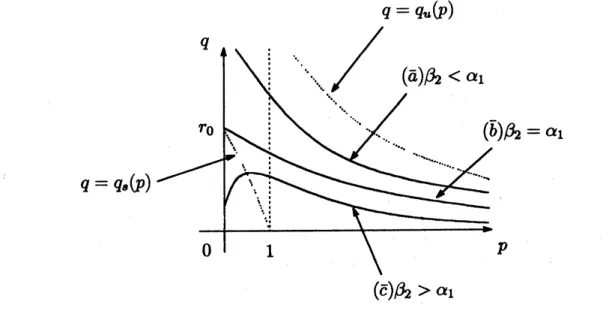
(4.16)We separate into three cases; $(\overline{a})h<\alpha_{1}$, $(\overline{b})Oh=\alpha_{1}$, $(\overline{c})h>\alpha_{1}$
.
Case $\beta_{2}<\alpha_{1}$:Notethat there is
no
p $\in(0, +\infty)$ satisfying (4.16). Since$\mathrm{t}\mathrm{m}\beta_{1}+\mathrm{t}\mathrm{m}h\leq$
$A_{1}$,
we
hve$\hat{H}(p,\hat{h}(p))=\mathrm{t}\mathrm{m}\hslash$ $\leq$ $-\tan\beta_{1}+A_{1}$
$<$ $- \mathrm{t}\mathrm{m}\beta_{1}+\frac{1}{1-p^{2}}A_{1}=\hat{H}(p,q_{l}(p))$ for p $\in(0,$1).
Recallingthat $H\wedge(p, q)$ is monotone decreasing in
$q$,
we
see
$\hat{h}(p)>q_{\epsilon}(p)$ forall$p\in(0,1)$.
It follows from $\partial\hat{H}/\partial q<0$, (4.11), and (4.12) that $\hat{h}’(p)<0$ for aU
$p\in(0,1)$
.
$\mathrm{h}$ad 市 tion,
we
derive $\hat{h}(0^{+})=+\infty$ (see Figure 6). Indeed, if $\hat{h}(0^{+})<+\infty$,
for any
$q_{\star}> \max\{2\hat{h}(0^{+}), r_{0}\}$
we
have $\hat{H}(p, q_{\star})arrow \mathrm{t}\mathrm{m}\alpha_{1}$as
$parrow 0^{+}$.
Then (4.11) impliesthat there is
a
$p_{\star}\in(0,1)$ such that $H(p, q_{\star})>\mathrm{t}\mathrm{m}oe$ $=\hat{H}(p,\hat{h}(p))$ for aU $p<p_{\star}$.
Itfollows fiom $\partial\hat{H}/\partial q<0$ that $q_{\star}<\hat{h}(p)$ for aU $p<p_{\star}$
.
This 油 a\mbox{\boldmath $\omega$}n廿紬ction. Hence$\hat{h}(0^{+})=$ 十科科.
$\underline{\mathrm{C}\mathrm{a}\mathrm{a}\mathrm{e}\beta_{2}=\alpha_{1}}$:
APPlying
thesame
argumentas
the previouscase,
we
have $\hat{h}(p)>q_{l}(p)$for $\mathrm{a}\mathbb{I}p\in(0,1)$ and $\hat{h}’(p)<0$
.
Moreover, since $\hat{H}(p,r_{0})<\mathrm{t}\mathrm{m}\alpha_{1}=\tan h=\hat{H}(p,\hat{h}(p))$and $\partial\hat{H}/\partial q<0$ imply that $\hat{h}(p)\in(q_{e}(p),r_{0})$ for
$\mathrm{a}\mathbb{I}$
$p\in(0,1)$,
we
see
$\hat{h}(0^{+})=$ ’ (seeFigure 6).
$\underline{\mathrm{C}\mathrm{a}\mathrm{a}\mathrm{e}h>\alpha_{1}}$:There is aunique $p\dagger\in(0,1)$ satisfying (4.16). That is, $\hat{H}(p_{\dagger},q_{l}(p|))=$ $\mathrm{t}\mathrm{m}\hslash$
.
Using (4.12) and $\partial\hat{H}/\partial q<0$, it iseasy
tosee
that$\{$
$\hat{h}(p)<q_{l}(p)$ and $\hat{h}’(p)>0$ for $0<p<p\dagger$, $\hat{h}(p)>q_{l}(p)$ and $\hat{h}’(p)<0$ for $p_{\mathrm{f}}<p<1$
.
Note that $\hat{h}(0^{+})\in[0,r_{0})$ (see Figure 6).
Rom
now
on,we
assume
$\beta_{1},\hslash\in[0,\pi/2)$, $\alpha_{1}\in(-\beta_{1},\pi/2)$, and $\alpha_{2}\in(-\pi/2,\alpha_{1})\cap$$(-\pi/2, \ )$
.
Weare
ready to state and prove the folloing theorems.Theorem 4.1
Assume
$that-\beta_{1}\leq\alpha_{2}<\alpha_{1}\leq h$.
Then there is at leastone
solutionto the problem (1.4). Assume that$\mathrm{t}\mathrm{m}^{-1}G_{\mathrm{c}}<\alpha_{2}<-\beta_{1}<\alpha_{1}\leq h$, Then there
are
atleast two solutions to the problem (L4).
Theorem 4.2 Assume that $\mathrm{t}\mathrm{m}^{-1}G_{\mathrm{c}}<\alpha_{2}<-\beta_{1}$ anti
h
$<\alpha_{1}$
.
Then there is at leastone solution to the problem (L4).
Proof of Theorem 4.1 and 4.2. For the first half ofTheorem 41, combine Figure
$5(a)$ and $\mathrm{F}\mathrm{i}\mathfrak{M}\mathrm{e}$ $6(\overline{b})$,$(\overline{c})$
.
For the second half ofTheorem
41, combine Figure$5(\mathrm{a})$ md
Figure 6(6),$(\overline{c})$
.
For Theorem 42, combineFigure$5(\mathrm{a})$ and Figure $6(\overline{a})$
.
$\square$Theorem 4.3 Assume that$\alpha_{2}\leq \mathrm{t}\mathrm{m}^{-1}G_{\mathrm{c}}$
.
Then there $a\dot{|}sts$$\alpha_{*}\in(-\pi/2,\alpha_{1})$
depend-irng only on$\alpha_{1}$, $\beta_{1}$, and
oe
such that theproblem$(1_{-}4)$ has at least onsolution$f\alpha_{2}\geq\alpha_{*}$
.
q$=q_{u}(p)$
$q=$
$(\overline{c})h>\alpha_{1}$
Figure
6:
$(p,q)$-line satisfying $\hat{H}(p,q)=\mathrm{t}\mathrm{m}$A
Proof. Recall that for $(\overline{p},\tilde{q})$
on
the line$p=p_{\mathrm{c}}(q)$we
have $\tilde{q}=\hat{g}(\tilde{p})\in(0,+\infty)$ satifying $\hat{G}(\tilde{p},\hat{g}(\tilde{p}))=\mathrm{t}\mathrm{m}\alpha_{2}$.
This is also writtenas
$\hat{G}(p_{\mathrm{c}}(\tilde{q}),\tilde{q})=\tan\alpha_{2}$.
Since$\hat{G}(p_{\mathrm{c}}(\tilde{q}),\tilde{q})=-\mathrm{t}\mathrm{m}\beta_{1}-\frac{1}{p_{\mathrm{c}}^{2}(\tilde{q})-1}A_{1}$
is monotone decreasing in $\tilde{q}$, the fimction $\tilde{q}=\tilde{q}(\alpha_{2})$ is monotone decreasing as $\alpha_{2}$
in-creases.
Note that $\tilde{q}(\alpha_{2})arrow+\infty$as
$\alpha_{2}arrow-\pi/2$ and $\tilde{q}(\alpha_{2})arrow 0$as
$\alpha_{2}arrow \mathrm{t}\mathrm{m}^{-1}G_{\mathrm{c}}$.
Combining this fact and Figure 6, we see that there exists $\alpha_{*}\in(-\pi/2,\alpha_{1})$ such that
the problem (1.4) has at least
on
solution if$\alpha_{2}\geq\alpha_{*}$.
0References
[1] J. D. Buckmaster and G. S. S. Ludford, Theory of $\mathrm{L}\ovalbox{\tt\small REJECT}$ Flames, Cambridge
University Press, Cambride, 1982.
[2] V. A. Galaktionov, J. Hulshof and J. L. Vazquez, Extinction andfocusingbehaviour
of spherical and annular flames described by afree boundary problem, J. Math.
Pures Appl., 76 (1997),
563-608.
[3] D. Hilhorst and J. Hulshof, Afree boundary focusingproblem, Proc. Amer. Math.
Soc, 121 (1994),
11931982.
[4] Y. Kohsaka, Free boundary problem for quasilinear parabolic equation with fixed
angle of contact to aboundary, Nonlinear Analysis, 45 (2001),
865894.
[5] J. L. Vazquez, The free boundary problem for the heat equation with fixed
gffii-ent condition, Free boundary problems, theoryand applications, Zakopane, Poland
(1995), Pitman ${\rm Res}$
![Figure 2: $\beta_{1}=0$ and h $=\pi/2$ (see [3, 4])](https://thumb-ap.123doks.com/thumbv2/123deta/6030852.1066925/3.892.310.609.130.364/figure-beta-h-pi.webp)