JAIST Repository
https://dspace.jaist.ac.jp/
Title
Collision prevention using group communication
for asynchronous cooperative mobile robots
Author(s)
Yared, Rami; Defago, Xavier; Wiesmann, Matthias
Citation
21st International Conference on Advanced
Information Networking and Applications, 2007.
AINA '07.: 244-249
Issue Date
2007-05
Type
Conference Paper
Text version
publisher
URL
http://hdl.handle.net/10119/7798
Rights
Copyright (C) 2007 IEEE. Reprinted from 21st
International Conference on Advanced Information
Networking and Applications, 2007. AINA '07. This
material is posted here with permission of the
IEEE. Such permission of the IEEE does not in any
way imply IEEE endorsement of any of JAIST's
products or services. Internal or personal use of
this material is permitted. However, permission
to reprint/republish this material for
advertising or promotional purposes or for
creating new collective works for resale or
redistribution must be obtained from the IEEE by
writing to [email protected]. By choosing
to view this document, you agree to all
provisions of the copyright laws protecting it.
Description
Collision prevention using group communication for asynchronous cooperative
mobile robots
∗Rami Yared, Xavier D´efago, Matthias Wiesmann
†JAIST, School of Information Science
Japan Advanced Institute of Science and Technology
Email: {r-yared, defago, wiesmann}@jaist.ac.jp
Abstract
The paper presents a fail-safe mobility management and a collision prevention platform for a group of asynchronous cooperative mobile robots. The fail-safe platform consists of a time-free collision prevention protocol, which guaran-tees that no collision can occur between robots, indepen-dently of timeliness properties of the system, and even in the presence of timing errors in the environment. The collision prevention protocol is based on a distributed path reserva-tion system. Each robot in the system knows the composi-tion of the group, and can communicate with all robots of the group.
A performance analysis of the protocol provides insights for a proper dimensioning of system parameters in order to maximize the average effective speed of the robots.
1
Introduction
Many interesting applications of mobile robotics envi-sion groups or swarms of robots cooperating toward a com-mon goal. Consider a distributed system composed of co-operative autonomous mobile robots cultivating a garden. Cultivating a garden requires that mobile robots move in all directions in the garden sharing the same geographical space. A robot has no prior knowledge about neither the paths of other robots, nor their speeds.
A robot uses its local sensing system to detect unknown fixed obstacles in the garden, and a robot is based on its lo-cal motion planning facility to compute a path between the current location and the goal. This path avoids the collisions with fixed known obstacles.1
∗Work supported by MEXT Grant-in-Aid for Young Scientists (A)
(Nr. 18680007).
†Swiss National Science Foundation Fellowship PA 002-104979. Now
with Google Switzerland, Freigustraße 12, 8002 Z¨urich
1The robots are the only moving entities in the considered applications.
In cooperative autonomous mobile robot environments, where robots move with unpredictable speeds, sensor-based motion planning approaches cannot guarantee safe motion, as mobile robots may collide with each other, because of the unpredictable speeds of robots and the uncertainty of the sensory information.
Specification. The robots are not provided with vision ca-pability. In the considered applications, there is no central-ized control nor global synchronization.
Problem. The robots are moving in different directions
sharing the physical space, thus collisions between mobile robots can possibly occur. It is very important to focus on the problem of preventing collisions between mobile robots. Collision prevention leads to a dependable system and pre-vents the occurrence of serious damage to the robots, which could cause failures in the system.
Requirements. It is essential to provide a fail-safe plat-form on which mobile robots can rely for their motion. This platform guarantees that no collision between robots can oc-cur.
A robot knows neither the positions of other robots nor their destinations. Additionally, the speed of a robot is un-known by other robots, and there is no un-known upper bound on robot’s speed, so a robot cannot estimate the position of another robot in the system. Therefore, robots need to coop-erate in order to achieve a fail-safe motion. Cooperation is, however, difficult to obtain under the weak communication guarantees offered by wireless networks, because retrans-mission of messages is needed to ensure message delivery in wireless environments. The communication delays to de-liver messages are difficult to anticipate. The previous argu-ments ensure that a time-free collision prevention protocol is indispensable.
Contribution. In this paper, we present a fail-safe plat-form on which cooperative mobile robots rely for their mo-tion. Our fail-safe platform consists of a time-free collision prevention protocol for an asynchronous system of cooper-ative mobile robots, and guarantees that no collision can oc-cur between robots, independently of timeliness properties of the system, and even in the presence of timing errors in the environment. The collision prevention protocol is based on a distributed path reservation system. The paper presents proofs of correctness of the protocol and proves the dead-lock freedom, and the liveness properties of the protocol. A performance analysis of the protocol provides insights for a proper dimensioning of system parameters in order to max-imize the average effective speed of the robots.
Related work. Martins et al. [4] demonstrated a
sce-nario of three cooperating cars, elaborated in the CORTEX project, which relies on the existence of Timely Computing Base TCB wormholes. The TCB concept was introduced by Ver´ıssimo and Casimiro in [6, 7]. Martins et al. in [4] use an application’s fail-safety and time-elasticity to overcome the uncertainty of the environment. The approach of Matins et al. [4] is time-elastic, while our approach is time-free.
Nett et al. [5] presented a system architecture for coop-erative mobile systems in real-time applications. The ap-proach of Nett et al. [5] aims at real-time cooperative mobile systems. The communications are synchronous, assuming the existence of a known constant upper bound on the com-munication delays, the infrastructure is based on wireless LAN, and the protocols use the access point as a central router. Our approach fundamentally differs in several as-pects, our approach is asynchronous, and the mobile robots form naturally a mobile ad hoc network on which they rely for their communication. MANETs have no centralized control nor global synchronization, also they do not guar-antee the real-time constraints to deliver messages.
Structure of the paper. The rest of the paper is
orga-nized as follows. Section. 2 describes the system model, definitions, and terminology. Section. 3 defines the colli-sion prevention problem and its specification. In Section. 4, we present our collision prevention protocol. Section. 5 presents a performance analysis of the protocol. Section. 6 concludes the paper.
2
System model and terminology
2.1
System model
We consider a system of n mobile robots S =
{r1, . . . , rn}, moving in a two dimensional plane. Each robot has a unique identifier. The total composition of the system is known to each robot.
Robots have access to a global positioning device that, when queried by a robot ri, returns ri’s position with a bounded error εgps.
The robots communicate using wireless communication such that a robot rican communicate with all robots of the system. Communications assume retransmissions mecha-nisms such that communication channels are reliable.
The system is asynchronous in the sense that there is no bound on communication delays, processing speed and on robots speed of movement.
2.2
Total Order Broadcast.
Total Order Broadcast, also called (atomic broadcast), is a group communication primitive, which ensures that all correct processes deliver all the messages in the same order. Therefore, the total order broadcast ensures that all the cor-rect processes agree on the same total order delivery of the messages, so they can behave consistently. The total order broadcast primitive also guarantees several other properties. If a correct process broadcasts a message m then, this pro-cess eventually delivers m. The total order broadcast also ensures that if a process delivers a message m then, all cor-rect processes eventually deliver m. Furthermore, for any message m, every process delivers m at most once, and only if m was previously broadcasted by some process. (see D´efago et al. [1] for a survey).
2.3
Definitions and terminology
Paths. A chunk is a line segment along which a robot
moves. A path of a robot is a continuous route composed of a series of contiguous chunks. A path can take an arbitrary geometric shape, but we consider only line segment based paths for simplicity.
Errors. The are three sources of geometrical incertitude
concerning the position and the motion of a robot. Error re-lated to the position information provided by the position-ing system denoted εgps. In addition, the motion of a robot creates two additional sources of errors. The first error is related to the translational movement, denoted: εtr. The second error is related to the rotational movement, denoted: εθ.
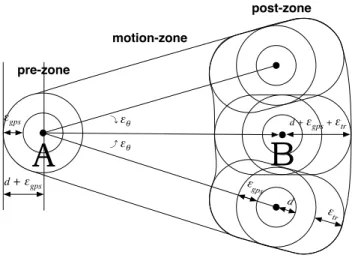
Zones. A zone is a finite convex area of the plane. A zone is defined as the area needed by a robot to move safely along a chunk. This includes provisions for the shape of the robot, positioning error, and imprecision in the moving of the robot. The zone must contain the chunk the robot is following. Figure 1 shows the zone Zifor a robot ri lo-cated in point A and moves along the segment AB, where d represents the radius of the geometrical shape of ri. The
pre-zone post-zone J ! " I !" ! gps ! gps d + ! gps + !tr d + !gps motion-zone d ! tr
A
B
Figure 1. Reservation Zone.
zone Ziis composed of the following three parts, illustrated in Figure 1: the first part named pre-motion zone and de-noted pre(Zi), is the zone that robot ri possibly occupies while waiting (before moving). The second part named mo-tionzone and denoted motion(Zi), is the zone that robot ri possibly occupies while moving. The third part named post-motionzone and denoted post (Zi), is the zone that robot ri possibly reaches after the motion.
3
Collision prevention protocol
3.1
Problem Specification
Before entering a zone Z, robot r executes reserve(r, Z). After leaving a zone Z, robot r executes release(r, Z).
A robot ri releases the zone Zi that it has owned and keeps only a part of post (Zi) under its reservation. The part of the zone that has been released by riis denoted: RelZi.
Operations. We say that two reservation operations
reserve(ri, Zi), reserve(rj, Zj) conflict if ri 6= rj and Zi ∩ Zj 6= ∅, we denote this o1 ./ o2. If a robot r exe-cuted reserve(r, Z) but did not execute yet release(r, Z), we say that r owns zone Z.
Schedules. We call a schedule an ordered sequence of
op-erations S = {o1, . . . om} where every operation is either reserve(ri, Z
j
i) or release(ri, Z j i).
The notion of schedule is closely related to the notion of histories used to model database operations [2]. The nota-tion o1
S
o2is used to mark that operation o2happens after o1 in schedule S. We say that a schedule is correct, if it enforces the following constraints.
• if a robot r executes release(r, Z), then it executed reserve(r, Z) before.
• if robot r owns zone Z then there is no robot r0 that owns a zone Z0such that Z ∩ Z0 6= ∅
If in a given schedule all robots own at most k zones, we say that this is a k-schedule. As robots need to be able to reserve at least two zones (the one currently occupied and the next one) k ≥ 2. We say that two schedules Sa and Sb are compatible if:
• All operations of a given robot are in the same order, i.e. ∀r | ori Sa or j 7−→ ori Sb or j.
• All conflicting operations are in the same order i.e. ∀oi, oj| oi./ ojoi
Sa
oj 7−→ oi Sb
oj
We say that two schedules are equivalent if they are com-patible and contain the same set of operations:
• They contain the same set of operations, i.e. ∀o | o ∈ Sa 7−→ o ∈ Sb
The local schedule Srof robot r is the ordered subset of a schedule that only contains operations that either initiated by robot r or conflict with operations initiated by robot r.
Scheduler. A scheduler is an algorithm that takes as input a sequence of zone requests and builds as output for every robot r ∈ R a local schedule Sr. A scheduler is correct if all local schedules Srare compatibles with correct schedule S. We distinguish two types of deadlocks, the first type of deadlocks is due to a cyclic happens after relation, and the second type of deadlocks is due to pathological situation of intersection between two requested zones. The details of deadlock situation are explained in the extended version of the paper [8]. We say that a scheduling algorithm is dead-lock free if it avoids deadlocks. In the rest of the paper, we concentrate on algorithms that are correct and deadlock free.
4
State Machine Scheduler
The protocol is essentially a mutual exclusion on geo-graphical areas. It is based on the state machine approach of Lamport [3]. Briefly, the idea is as follows. Each robot maintains a copy of the reservation queue and a protocol ensures that all requests/releases are delivered in the same sequence. With all replicas starting in the same state, they evolve consistently with no need for further synchroniza-tion.
4.1
Basic idea.
The algorithm consists of a distributed path reservation system, such that a robot must reserve a zone before it moves. When a robot reserves a zone, it can move safely inside the zone. All robots run the same protocol. When a robot wants to move along a given chunk, it must reserve the zone that surrounds this chunk. When this zone is re-served, the robot moves along the chunk. Once the robot reaches the end of the chunk, it releases the zone except for the area that the robot occupies. When moving along a path, the robot repeats this procedure for each chunk along the path.
4.2
Detailed scheduler description
We present the variables used in the protocol.
• Zi is the zone currently requested or owned by robot ri.
• Dagwait is a directed acyclic graph represents the
wait-for relations between robots, such that the ver-tices represent the robots, and a directed edge from vertex(ri) to vertex(rj) indicates that riwaits for rj. We explain briefly2the phases of the scheduler with respect to a robot ri. The robot riis located in the pre-motion zone pre(Zi). When robot rirequests a new zone Zi, it proceeds as follows.
1. TO-Broadcast. ri performs a total order broadcast of a message that consists of two parts. The first part is a REQUESTwith the parameters of the requested zone Zi, and the second part is a RELEASEof the previous owned zone.
2. Append-Vertex. When the robot ri TO-delivers a
new message, a new vertex is added to the wait-for graph Dagwaitand an existing vertex is removed from the graph. The new added vertex corresponds to the REQUEST part of the message and the removed ver-tex corresponds to the RELEASE part of the message. When a robot releases the previous zone, the corre-sponding vertex and its incoming edges are removed from the wait-for graph. When a robot ri requests a new zone Zi, a new vertex is added to Dagwait with outgoing edges from the new vertex to all the vertices of the graph such that the corresponding zone inter-sects with the requested zone Zi. When the vertex that represents the robot riin Dagwaitbecomes a sink ver-tex (has no outgoing edges), the requested zone Zi is reserved to ri.
2The algorithm, omitted due to space limitations, is presented in the
extended version of the paper [8].
3. Request-Rejection. As the possibility of deadlock ex-ists, the scheduler can reject some zone requests to avoid deadlock situations. The routing algorithm of the robot needs to be able to handle those rejections, either by retrying at a later time, or by planning a dif-ferent route.
4. Rejection-Handler. If the request (ri, Zi) is rejected due to a Request-Rejection situation then, the routing algorithm of robot ri handles the rejected request ei-ther by retrying at a later time, or by planning a dif-ferent route (alternative path). If there is no available alternative path and the request is still rejected after a certain number of trials then, an exception is raised.
5. Release. When ri reaches the post-motion zone
post (Zi), it computes its new position and thus it com-putes the zone to be released which is Zi except the place that ri may possibly occupy (footprint in addi-tion to the posiaddi-tioning system error εgps). Initially, the released zone is set to ⊥. All the robots build the same wait-for graph Dagwait.
Property 1 (Liveness) If a robot ri requestsZi then even-tually (riownsZior an exception is raised).
rirequests Zi⇒ ♦ (riowns Zior Exception)
Property 2 (Non triviality) Exception is raised only if there is no available alternative path and the request is re-jected after a certain number of trials.
The proofs of the correctness, the deadlock freedom and the liveness properties of the scheduler, are omitted due to space restrictions. They can be found in the extended ver-sion of the paper [8].
5
Performance analysis
We study the performance of our protocol in terms of the time needed by a robot ri to reach a given destination when robots are active (robots do not sleep). We compute the average effective speed of robots executing our collision prevention protocol. We provide insights for a proper di-mensioning of system parameters in order to maximize the average effective speed of the robots. For simplicity, we as-sume in this section that the physical dimensions of robots are too small such that a robot can be considered as a point in the plane. The geometrical incertitude related to the posi-tioning system, translational and rotational movements are neglected.
5.1
Time needed to reserve and move a
chunk
The average physical speed of a robot is denoted by: Vmot. We calculate the average time required for a robot ri to reserve and move along a chunk of length Dchwith a physical speed Vmot.
When a robot requests a zone, it releases the previously owned zone thus, a robot waits at most for (n − 1) robots where n is the number of robots in the system. So, the av-erage number of robots that riwaits for is: navg= n−12
Communication delays. In order to evaluate the
perfor-mance of the protocol, we need to consider an average com-munication delays in the system, although the protocol is time-free. The average communication delays in the sys-tem is denoted: Tcom. When all the robots are active run-ning the protocol, then the time needed to reserve and move along a chunk denoted Tchis the sum of the time needed by each of the following steps:
1. The delay to deliver a message, which depends on the performance of the total order broadcast algorithm. We consider that the delay to deliver a message is T n, where T is a constant.
2. The time to receive the release messages from navg
robots each of which has owned its zone for Dch Vmot time
units. navg(Tcom+VDch mot)
3. The time needed by rito move along a chunk. VDch mot
Therefore, the time needed to reserve and move along a chunk Tchis: Tch= Tn + n − 1 2 Tcom+ ( n + 1 2 ) Dch Vmot (1)
5.2
Average effective speed
We compute the average effective speed V of a robot ri as a function of the chunk length Dchand of the number of robots n in the system.
The average effective speed V is:
V = Dch
Tn + n−12 Tcom+ (2Vn+1 mot)Dch
(2)
The previous relation shows that the effective speed is a function of the chunk length and the number of robots n, also the effective speed depends on some system-based
fixed parameters such as the communication delays Tcom
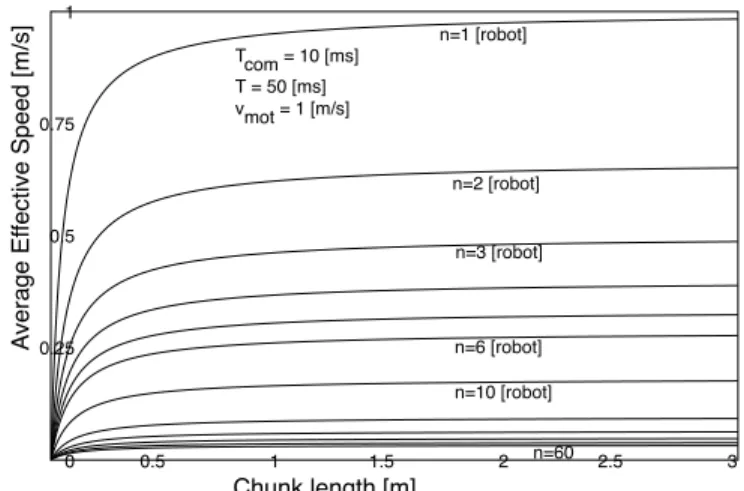
and the physical speed of robots Vmot. The effective speed depends also on the performance of the total order broadcast algorithm. 0 0.5 1 1.5 2 2.5 3 0.25 0.5 0.75 1 A verage Ef fective Speed [m/s] Tcom = 10 [ms] T = 50 [ms] vmot = 1 [m/s] n=1 [robot] n=2 [robot] n=3 [robot] n=6 [robot] n=10 [robot] n=60 Chunk length [m]
Figure 2. Effective speed vs chunk length.
5.3
Average
effective
speed
vs
chunk
length
We focus on the relation between the average effective speed and the chunk length for a given number of robots n. The effective speed increases as the chunk length increases. The explanation is that a robot ri waits at most for n − 1 robots (in a group of n robots) to move along each chunk of its path. rineeds to do a certain number of steps to reach the destination, and the number of steps depends on the chunk length. When the chunk length increases, the number of steps decreases. Therefore, the average effective speed V increases with the chunk length Dch. Equation 2 implies that the average effective speed approaches toward the value
2Vmot
n+1 as the chunk length tends to infinity. Figure 2 repre-sents the relationship between the effective speed and the chunk length for different values of the number of robots. The average effective speed of robots increases as the chunk length increases for a given number of robots. There is an optimal value of the chunk length that maximizes the ef-fective speed of the robots. The efef-fective speed keeps this maximal value as the chunk length getting longer than the optimal value. The average effective speed has a horizontal asymptote at 2Vmot
n+1
Numerical values. The values of the fixed system
param-eters are: Tcom = 10[ms], Vmot = 1[m/s]. We consider
that the time required to deliver a message is T n, where T = 50[ms]. The number of robots varies from one robot until 60 robots, and the chunk length varies from zero to 3 meters. The average effective speed increases as the chunk length increases until it reaches a maximal value. Figure 2 shows that, in a case of a system composed of 3 robots for example, the maximal effective speed is 0.48[m/s] which corresponds to optimal chunk length ≈ 2[m].
0 2.5 5 7.5 10 0.25 0.5 0.75 1 Dch=1 [cm] 5[cm] 10[m] A verage Ef fective Speed [m/s] Number of robots envelop of the set of curves
Figure 3. Effective speed vs number of robots.
5.4
Average effective speed vs number of
robots
We focus on the relation between the average effective speed V and the number of robots n in the system for a given value of the chunk length. The effective speed decreases as the number of robots increases for a given chunk length, because a robot rimust wait for more robots. Figure 3 shows the variation of the average effective speed with respect to the number of robots for different values of the chunk length.
Numerical values. The chunk length varies from 1[cm]
until 10 meters. (Figure 3). The set of curves in Figure 3 have an envelop curve, given by the following equation:
V = 2Vmot
n+1 =
2 n+1
• The envelop curve corresponds to the average effec-tive speed for very high values of the chunk length (tends to infinity), because the average effective speed approaches to a constant value.
• All curves in Figure 3 approaches to zero, when the number of robots tends to infinity. (horizontal asymp-tote at effective speed = 0).
6
Conclusion
We presented a fail-safe mobility management and achieved a collision prevention platform for a group of asynchronous cooperative mobile robots.
Our fail-safe platform consists of a time-free collision prevention protocol, which guarantees that no collision can occur between robots, independently of timeliness propties of the system, and even in the presence of timing er-rors in the environment. The collision prevention protocol is
based on a distributed path reservation system. Each robot in the system knows the composition of the group, and can communicate with all robots of the group. We proved the correctness, the deadlock freedom, and the liveness proper-ties of the protocol. We have analyzed the performance of the protocol and provided insights for a proper dimension-ing of system parameters in order to maximize the average effective speed of the robots. We have also successfully im-plemented a working prototype of the platform on Pioneer 3DX robots, in Java and using the ARIA library3.
Acknowledgments
We are grateful to Nak-Young Chong, Nikolaos Galatos, Maria Gradinariu, Yoshiaki Kakuda, Takuya Katayama, Richard D. Schlichting, Yasuo Tan, Tatsuhiro Tsuchiya.
This research was conducted for the program “Fostering Talent in Emergent Research Fields” in Special Coordina-tion Funds for Promoting Science and Technology by the Japan Ministry of Education, Culture, Sports, Science and Technology.
References
[1] X. D´efago, A. Schiper, and P. Urb´an. Total order broadcast and mul-ticast algorithms: Taxonomy and survey. ACM Computing Surveys, 36(4):372–421, December 2004.
[2] J. Gray and A. Reuter. Transaction processing: concepts and tech-niques. Data Management Systems. Morgan Kaufmann Publishers, Inc., San Mateo(CA), USA, 1993.
[3] L. Lamport. The implementation of reliable distributed multiprocess systems. Computer Networks, 2:95–114, 1978.
[4] P. Martins, P. Sousa, A. Casimiro, and P. Ver´ıssimo. A new program-ming model for dependable adaptive real-time applications. IEEE Dis-tributed Systems Online, 6(5), May 2005.
[5] E. Nett and S. Schemmer. Reliable real-time communication in coop-erative mobile applications. IEEE Trans. Computers, 52(2):166–180, 2003.
[6] P. Ver´ıssimo. Uncertainty and predictability: Can they be reconciled? In Future Directions in Distributed Computing, pages 108–113, 2003. [7] P. Ver´ıssimo and A. Casimiro. The Timely Computing Base model
and architecture. IEEE Trans. Computers, 51(8):916–930, 2002. [8] R. Yared, X. D´efago, and M. Wiesmann. Collision prevention using
group communication for asynchronous cooperative mobile robots. Research Report IS-RR-2007-002, Japan Advanced Institute of Sci-ence and Technology (JAIST), Hokuriku, Japan, February 2007.
3ARIA: Advanced Robotics Interface for Applications.