Japan Advanced Institute of Science and Technology
JAIST Repository
https://dspace.jaist.ac.jp/Title
Innovation Study for Materials Science Laboratory Management, Supported by Knowledge Science Tools : Five Cross-Disciplinary Projects
Author(s) Tsuruoka, Hiroyuki; Yoshinaga, Takashi; Nakamori, Yoshiteru
Citation
Issue Date 2007-11
Type Conference Paper
Text version publisher
URL http://hdl.handle.net/10119/4155
Rights
Description
The original publication is available at JAIST Press http://www.jaist.ac.jp/library/jaist-press/index.html, Proceedings of KSS'2007 : The Eighth International Symposium on Knowledge and Systems Sciences : November 5-7, 2007, [Ishikawa High-Tech Conference Center, Nomi, Ishikawa, JAPAN], Organized by: Japan Advanced Institute of Science and Technology
Innovation Study for Materials Science Laboratory Management,
Supported by Knowledge Science Tools: Five Cross-Disciplinary Projects
Hiroyuki Tsuruoka†* Takashi Yoshinaga†, Yoshiteru Nakamori†
†Center for Strategic Development of Science & Technology
Japan Advanced Institute of Science and Technology(JAIST)
*[email protected]
Abstract
It has become a topical and widely accepted ar-gument that innovation is the key to revitalizing competitiveness of a country, company and uni-versity. As a graduate university having the School of Knowledge Science, and the School of Materials Science, we have organized to make “innovation studies” for Materials Science Laboratory, supported by Knowledge Science tools with collaboration of these two schools as 5 cross-disciplinary projects. Knowledge Science side has provided knowledge tools, and Materials Science side has applied them to produce more creative and innovative research systems and research findings.(trial to induce innovation)
Principle of innovation has been explained by our model in this paper, based on the innovation portfolio strategy by Niwa’s diagnosis model4) (by prof. K.Niwa).
Targets(subjects) of innovation for laboratory management have been examined based on the Schumpeter classification7)
5 projects have been evaluated as proceeding level, the type by Niwa model and the subject by Schumpeter model.
Finally, we would like to conclude for this type of cross-disciplinary research, that the open minded collaboration and forward-facing pres-entation of the results are inevitable.
Keywords: Innovation, Laboratory management,
Cross-disciplinary, Knowledge tools,
1 Instructions
In Japan and other advanced industrialized countries the whirlwinds of innovation are blowing. In the early 1990s Japan experienced a major shift as its international competitiveness
began to decline. Under the conditions of the so-called “lost” 16 years that have since passed, the idea that innovation is the key to revitalizing competitiveness has become a topical and widely accepted argument. Governments and industry associations are vigorously trying to promote innovation in organizations, economic activities, and technology development, and similar efforts are being pursued in all major industries and enterprises too. Local innovations are also being attempted at the regional level.
The source8) of the competitiveness of a country, university, and company are (advanced) science and technology, for which this university is named. In America, a massive change in the structure of science and technology, evident on an international scale, occurred over a 50-year pe-riod beginning with the establishment of the Na-tional Science Foundation in 1950 by the famous Vannevar Bush (previously Director of the Office of Scientific Research and Development), and the effects of this continue to reverberate to this today. Bush believed that, in essence, science flowed from the desire of scientists to satisfy their curi-osity, but also that the resulting knowledge should be applied to promote the prosperity of the nation. This concept has long shaped11) Amer-ica’s science and technology policy and its in-fluence has remained firmly in place down through the years, as evidenced by the Young Report of 1985 (“Global Competition: The New Reality”) a report of the President’s Commission on Industrial Competitiveness, and the “Palmis-ano Report” (“Innovate America”) issued in 2004 by the NII (National Innovation Initiative). Last year Japan’s the Cabinet Office launched a simi-lar initiative—the “Innovation 25” project . As a result, vigorous innovation-oriented initiatives are now being taken at industry, government, and academia levels.
The Japan Advanced Institute of Science and Technology (JAIST) is a graduate university consisting of three schools—the School of Knowledge Science, the School of Information Science, and the School of Materials Science. Since its program on the theme of “Technology Creation Based on Knowledge Science” was certified by the Ministry of Education, Culture, Sports, Science and Technology (MEXT) as a 21st Century COE (Center of Excellence) Pro-gram in October 2003, the School of Knowledge Science has continued to implement the pro-gram1). This year marks the concluding year of the program. After an interim appraisal in Octo-ber 2005 the program was partially revised. This program is made up of four basic initiatives. Of these, Project No. 2 consists of five cross-disciplinary projects relating to innovation. The key purpose of these five innovation projects is to stimulate and promote innovation, with the aim of improving the management and results produced by materials science laboratories, through the utilization of knowledge science. To achieve this, cross-disciplinary teams made up of professors and students from both knowledge science and materials science laboratories were formed to pursue research together. Here I will report on the progress and results that these teams have produced to date. This initiative represents a very interesting trial on innovation research by a multi-disciplinary team (combining humanities and sciences).
1) Design of the cross-disciplinary
inno-vation creation projects
1-1) Themes and composition of 5 cross-disciplinary projects
The objective of research in each project is to improve the management and productivity of materials science laboratories. Studies were conducted under the following titles.
2A: Innovation in the mature polyolefin chemical industry
2B: Knowledge creation initiatives backed up by a research philosophy
2C: Knowledge representation(animation) theory for coordination
2D: Knowledge management of laboratories based on cultural anthropology
2E: Knowledge management of experimental laboratories using mobile blog albums
Each project team is composed of 2 to 4 pro-fessors and 2 to 3 students (Masters and PhD) from various disciplines, led by a materials sci-ence professor. The teams meet once to several times each month.
1-2) Cross-disciplinary integration model
This model offers the knowledge tools from the knowledge science side, and combines these with materials science laboratories and physics theory, to generate management methods that can deliver richer results and more advanced knowledge. This “integration” model is outlined in Fig. 1.3)
Fig.1 Laboratory innovation creation model Thus, “more creative research (lab) activities (results)” (Y) can be expressed by the formula below.
Y=F ZW (X) (1)
Here, we provide some further explanation to help avoid confusion. This project aims at ini-tially providing knowledge tools from the knowledge science side and applying these to research work on the materials science side, and then finally producing more creative and inno-vative research systems and research findings (multi-disciplinary). If this integration progresses as described, and new academic disciplines are created out of a genuine integration (in-ter-disciplinary), we would regard the initiative as very successful.
Y=More creative research (lab)activities(results)
X=Existing research (lab)activities(results)
W:Knowledge tool for creative re-search activities Z:Compilation and sharing of results Knowledge creation theory research and Ba
2) Creation and implementation of the 5
cross-disciplinary projects
Based on the above-mentioned design, we re-started (some projects were re-started afresh) the five projects from the beginning of the new aca-demic year of 2006. All of these projects were relaunched with the goal of promoting cross-disciplinary study and innovation creation. Accordingly, this report on innovation creation and implementation covers approximately one and a half years of program activities.
2-1) General progression of the projects
Since the intended subject of this research is materials science laboratories for science and technology research, the projects started initially
with proposals for the knowledge science side to provide knowledge tools that can be applied to materials science laboratories. However, over time problems arose relating to the application of the knowledge tools that were initially proposed. Conversely, some projects were started by ex-ploring the needs of the materials science side.
A common element of the projects, however, was that initially, when team members from the knowledge science side participated in the seminars of the materials science laboratories and took notes in the labs, this itself caused a certain amount of suspicion and caution and an exclu-sionary reaction. As the projects were carried out, continuous efforts were made to weaken this sense of opposition. Table 1 includes the results of the attempted integration.
3. Examination of innovation studies 3-1) Innovation portfolio strategy
According to “Management of Technology” (MOT)4 by Professor Kiyoshi Niwa, portfolio strategies for technological development in the leading-edge fields of corporate enterprise, which are continually exposed to waves of innovation, can be summarized according to the following four innovation patterns.
(i) Sustainable innovation: Further improv-ing the functions and performance of the current leading technology
(ii) Destructive innovation: Increasing competitiveness by reducing price, even at the cost of lower performance, using alternatives to the existing technology (iii) Blue ocean innovation: Increasing
com-petitiveness by lowering standards where acceptable, and adding instead new, dif-ferent functionality, after analysing the products of other companies in the same industry (i.e. enhancing desirability by subtraction and addition)
(iv) Revolutionary innovation: Developing products that customers are not aware of, but which they desire after learning about them (i.e. creation of new opportunities for customers)
3-2) Principle of innovation
The essence of innovation is the problem of mapping between a function space to an attribute space. This is based on the fact that what cus-tomers want is a function, as explained above in the examples of 3-1). Then, assuming that a cer-tain attribute (part or product) provides this function, successful innovation can be achieved by either providing the same function via an al-ternative attribute so that a lower price can be offered; by offering an additional amount of performance (alpha) that is desirable to the tomer; or provide a new function that the cus-tomer was not aware of. Figure 2 below illus-trates this point. (Note that the Niwa model does not include destructive innovation by means of new inventions.)
Figure 2 Principle of Innovation When this principle is applied to these pro-jects, knowledge tools serve as seeds and to at-tributes. At the same time, the functions of re-search (labs) that require innovative improve-ment correspond to needs, located in the function space. In view of this, the most successful project teams will be those that are able to discover (in-fer) the most needed and desired needs of labs and then quickly provide the labs with knowledge tools that have the attributes to fulfil these func-tions.
3-3) Focus of innovation based on the Schumpeter model
Here, we attempt to think through the focus of innovation efforts based on the writings of Schumpeter7 , which are regarded as the “bible” of innovation. Considering numerous examples of corporate activities, Schumpeter categorized the focus of these activities into five classes. Applying this scheme to national, municipal, and individual levels is an interesting concept.5 The Schumpeter model can be applied to these pro-jects as outlined in Table 2. Unlike the case manufacturing companies, it can be difficult to determine whether something is a production process (item 2 below) or raw material or re-source (item 4 below) in the context of the trying to produce good research findings (knowledge).
Table 2 Focus of innovation for labs, based on the Schumpeter model
3-4) Key for progress in cross-disciplinary projects
a) Above, we sorted out the principles and focus of innovation, but even with this knowledge projects may not proceed well. Whether or not cross-disciplinary research proceeds effectively towards its goal depends on whether there is matching and synergy between the knowledge tools (seeds) and the needs of the laboratory. Or, even if matching and synergy have not yet oc-curred, it is essential to set a place and time (for a certain duration) for meetings that promote mu-tual respect and understanding between people from diverse disciplines. Some of the various knowledge tools that have been provided to the materials science laboratories over the past few years, for example, have not yielded any research fruits, due to incompatibility with the needs of the research lab—or where compatible, due to lack of user-friendliness. Whether a project is ac-complished well depends on whether the needs on the function side are fulfilled, regardless of whether the needs like on the knowledge side or materials side. For this reason, success in such research depends on whether or not the final de-cisions are made on the function space side. Recognition of this fact is important.
b) Another issue is whether or not integration (mutual understanding) between the various dis-ciplines proceeds smoothly—something that relates to aspects of Japanese culture. Making use
of the SECI model6 developed by Ikujiro Nonaka, the first head of the School of Knowledge Sci-ence at JAIST, one of the current authors deliv-ered a presentation describing how the process of knowledge creation in Japanese companies fea-tures a higher proportions of socialization, S, and internalisation, I, when comparing with Western companies, but lower proportions of externalisa-tion, E, and combinaexternalisa-tion, C.9 This is illustrated in Fig. 3 below.
Generally, the case of corporate mergers in Japan shows that compatibility between the cul-tures of the two companies (feelings and behav-iour patterns) is even more important than the expected business synergy effect. This fact re-lates the high values of S and I in the corporate workplace, as defined by the SECI model.
Fig. 3 Field of SECI model in which Japanese corporate culture is strong
In these projects too, cross-disciplinary re-search between people from different fields pro-ceeded with the highest probability of success in the following cases: Knowledge side students joined the materials science side labs, but had to pass through a period of endurance until they were recognized as colleagues (action started from S: socialization) by the materials science side. During the period of endurance, the knowledge side students explored the needs of the materials science laboratory, all the while keeping in mind the question of how knowledge tools could be of value. It is interesting that the importance of Japanese cultural factors may be so
strong even in a university setting.
4) Conclusion
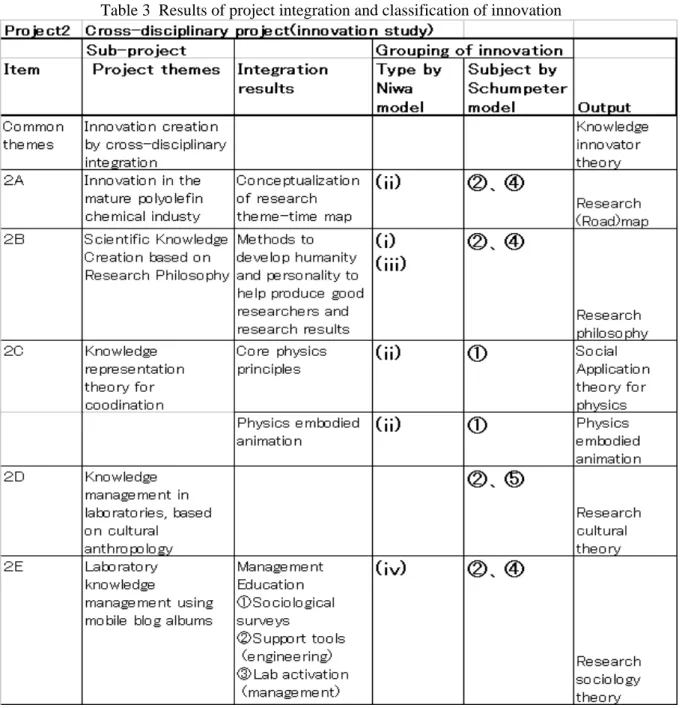
(1) Table 3 summarizes an analysis of the inno-vations that we tried to induce in the process of pursuing each project, based on the above un-derstanding of innovation. This classification is organized in accordance with each of the Niwa model and Schumpeter model, which are outlined above.
(2) Cross-disciplinary integration (leading-edge fields of integration) and innovation creation are emphasized in the third phase of the govern-ment’s Science & Technology Basic Plan2). Through these projects, the professors and stu-dents who have experienced multi-disciplinary research work have acquired integration skills, while appreciating the difficulty of this. In view of this, we have concluded that such projects are valuable.
(3) The purpose of scholarship is to shape the future of society. In terms of integration, some of these projects were able to achieve sufficient integration, while others were not. Some projects failed to reach integration because the partici-pants pushed their own particular scholastic frameworks too heavily. We thus concluded that a flexible way of thinking, aligned with the aims of the project, is essential for the success of this kind of program.
References
[1]. JAIST Home Page, The 21st COE Pro-gram, “Technology Creation based on Knowledge Science”
[2]. Ministry of Education & Science, The 3rd. Basic Plan for Science & Technology, a
decision by Cabinet, March 2006
[3]. Nakamori Yoshiteru,”Chishiki Souzo Ba Ronshu” p8, Vol 1,No. 2, Center for Strategic Development of Science and Technology, JAIST, Nov. 2004
[4]. Niwa Kiyoshi, “Management of Tech-nology,” p146, Tokyo University Pub-lishing, Oct.2006
[5]. ibid, p156
[6]. Nonaka I.,Takeuchi H., “The Knowl-edge-Creating Company,” Toyo Keizai Shinpo-Sha, 1996
[7]. Schumpeter, J,A.,”Theorie der Wirtschaftlichen Entwicklung 2,” 1926 (Translation by Shionoya, Nakayama, Tohata, Iwanami-Shoten, 1977)
[8]. Tsuruoka Hiroyuki. ”Chishiki Souzo Ba Ronshu,” p1, Vol 4, No.2, Center for Strategic Development of Science and Technology, JAIST, Jun.2007
[9]. Tsuruoka Hiroyuki, “Creating Competi-tive Corporate Culture Freeing from Japanese Language Culture,” p702, The Proceeding of the 19th.annual conference. The Japan Society for Science Policy and Research Management