博 士 学 位 論 文
COLONIZATION INFLUENCES TOWARDS
INCONFORMITY OF LAND USE AND
TRANSPORTATION IN DEVELOPING COUNTRIES
途上国における植民地化が土地利用と交通の不整合に
与える影響に関する研究
ABSTRACT VI
ACKNOWLEDGEMENT X
CHAPTER ONE – INTRODUCTION TO RESEARCH
1.0 Introduction 2
1.1 Research Gap 5
1.2 Review of existing papers 7
1.3 Research Focus 9
1.4 Research Objectives 10
1.5 Flow Chart of Research 11
1.6 Research Structure 12
CHAPTER TWO – CONCEPTS ON LAND USE AND TRANSPORTATION IN DEVELOPING COUNTRIES
2.0 Definition of developing country 15
2.1 Relationship between land use and transportation planning 20
2.2 Colonization Relation to Land use and Transport 23
2.3 Developing Countries after the World War Two 27
2.3.1 British Colonized Countries 31
3.1 Safe City Planning 36
3.2 The Compact Cities Goal 42
3.3 Balancing Social and Natural Hazard 44
3.4 Comparison Strategies before and after the Great Earthquake 46
3.5 Comparison Using Text Mining Analysis 49
3.6 Analysis Results By Text Mining Analysis 50
3.7 Reconstruction Plan in Yamada 52
3.8 Integration Efforts in Japan 54
CHAPTER FOUR – VARIATION OF LAND USE AND TRANSPORTATION PROBLEMS IN DEVELOPING COUNTRIES
4.0 Situation of Developing Countries 57
4.1 Method of Data collection 60
4.2 Testing the hypothesis 61
4.3 Result of Analysis 62
4.4 Application of the Factor Analysis 67
4.4.1 Steps of applying Factor Analysis 72
5.0 Influences of Independence 82
5.1 Text Mining Data Analysis Method 83
5.2 Results of Analysis 87
5.3 Summary 93
CHAPTER SIX – CASE STUDY IN TAIPING TOWN, MALAYSIA
6.0 Introduction 95
6.1 Land use and Transportation in Malaysia 96
6.2 Land use System in Peninsular Malaysia 98
6.3 The Transportation System in Peninsular Malaysia 100
6.4 The British System 101
6.5 The Modern Taiping Town Develop by The British 102
6.6 The Land use and Traffic System of Taiping 104
6.7 The Grid Iron Pattern Road Problems 106
6.8 Preliminary Survey in Taiping Town 113
6.8.1 Result of Survey 116
7.0 Introduction 125
7.1 Solving Land Use and Transportation Problems in Developing 128
Countries
7.2 Recommendation for Developing Countries 129
7.3 Step by Step Integrated Transportation 132
7.3.1 Integrated Transport Mode in Case Study Town of 135
Taiping, Malaysia
7.3.2 Utsunomiya Strategy in Alternative Transportation Mode 140
7.4 Bicycle as Initial Alternative Transport Mode 143
7.5 Buses and Light Railway Transit as Alternative Transport Mode 146
CHAPTER EIGHT - CONCLUSION OF RESEARCH
8.0 Findings of Study 153
8.1 Possible Application of Research 157
LIST OF CHARTS 165 LIST OF TABLES 166 LIST OF REFERENCES 168
Urbanization, migration, population issues, traffic congestions, squatters, environmental deprivation, urban poor and so many more problems related to land use and transportation has occurred in developing countries. These problems are said to be the result of economy deficiency in developing countries. Therefore, economy improvement is given much attention rather than planning over appropriate land use and transportation. Clearly, factors to land use and transportation problems have led to more misperception. This research seeks factors influences land use and transportation problems in developing countries. In addition, this research also investigate reasons to this problem occurred in developing countries and reasons why it has happened in developing countries. Chapter one of this research explains the objectives, goal and structure of this research. It also clarifies on the flow and the connection between thesis chapters.
Gradually, developing countries cities grow from small town then expand to cities through development and rapid use of automobile. In brief, for developing countries, the needs of achieving economy progress are given most attentions as part of development needs. Accordingly, problems such as traffic congestions and squatters often occurred as result of reckless poor planning between land use and transportation. At the same time, automobile industries flourish in developing countries and has shaped the use of automobile thus extends more problems. The dependability of people towards automobiles continues to cultivate as poor public transportation in developing countries remains unattended by the government. For that reason, the concept of developing countries and the relationship between land use and transportation is described in
social and natural threat, developed countries also need to plan for sustainable land use and transportation planning. Chapter Three of this thesis writes about Japan City Planning strategy in balancing the needs of land use and transportation system. Learning from Japan strategy, developing countries needs to understand the planning between land use and transportation. This is to understand the factors involves for proper land use and transportation planning as to avoid more urban problems from happening.
How far economy factor contribute to land use and transportation problems?
Chapter Four of this thesis explains on the result of survey conducted to understand the
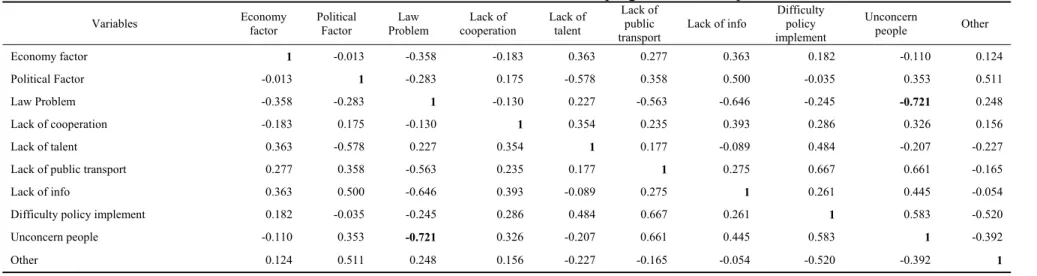
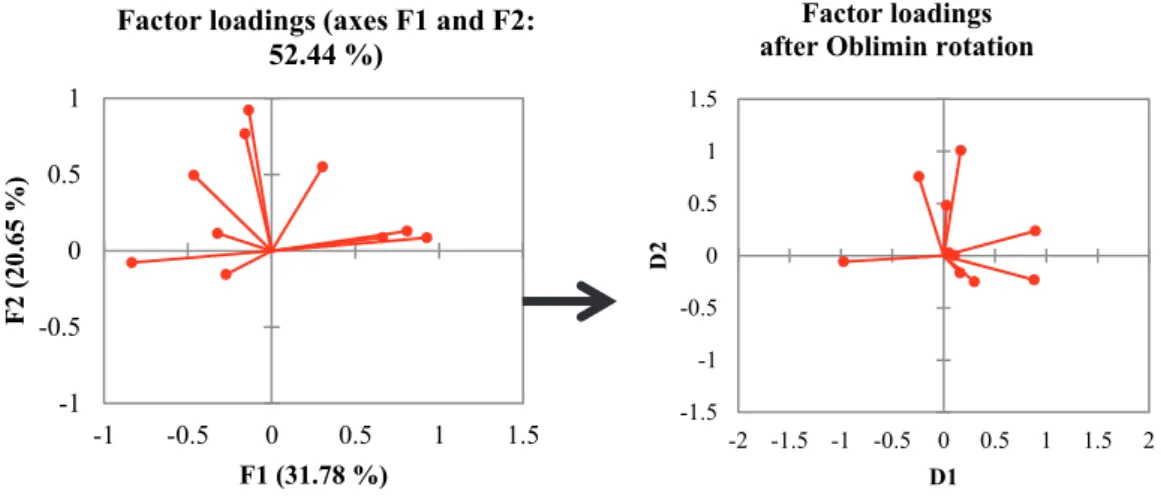
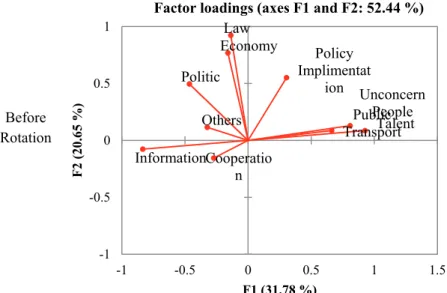
problems of land use and transportation in developing countries. Factor Analysis is used to simplify and understand reason contribute to land use and transportation problems in developing countries. Based on hypothesis, this research suggests land use and transportation problems in developing countries can be cause by colonization. Colonization can differ factors contribute to land use and transportation problems because it is able to influence the town planning system and also it has delay development as result of deferral in independence.
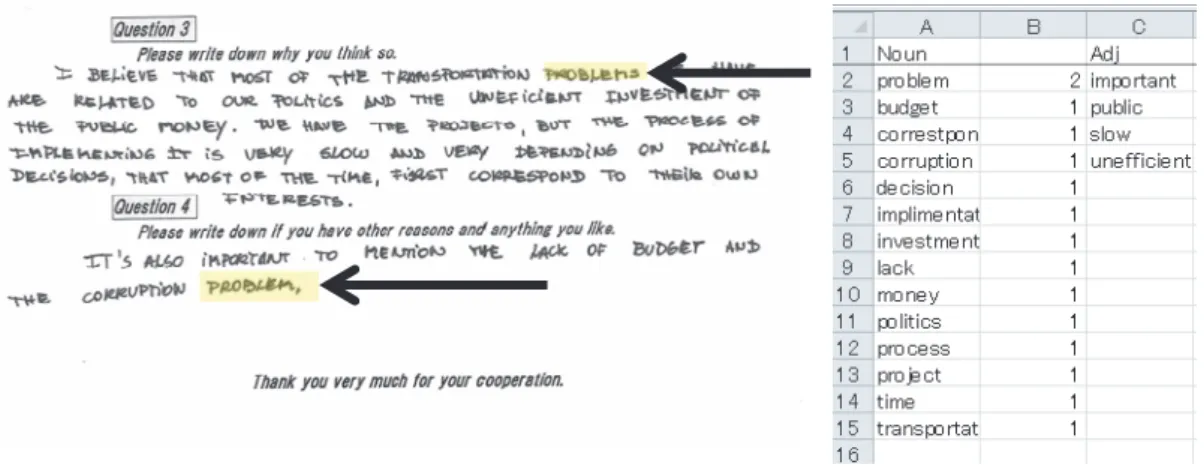
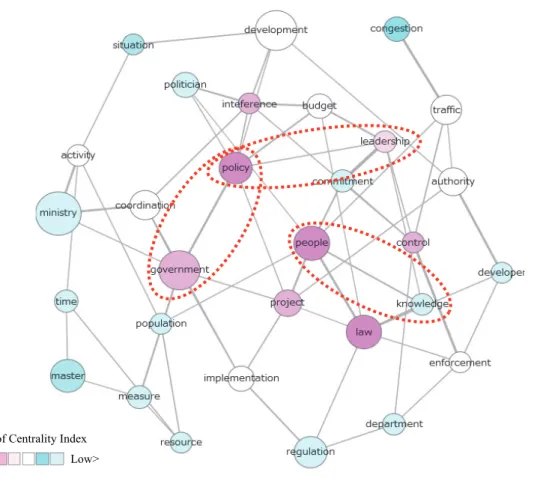
Equally important, Chapter Five of this thesis further explains on respondent’s open ended answers in the influence of the factor in land use and transportation problems. Using Text Mining Analysis, this research found problems of land use and transportation are not mainly caused by economy factor. Instead, there are many other important factors namely political factor, difficult policy implementation, law, knowledge and skills among people as well as lack of information. Based on the analysis, problems of land use and transportation in developing countries can be caused
improvement in integration, knowledge, research and also human skills. The understanding of the government to provide good public transportation, reduce dependability of people towards automobile and also avoiding land use planning based on automobile are also vital for developing countries. Hence, economy factor is not the main factor determining problems of land use and transportation after all in developing countries.
As many known, developing countries are countries later gain independence and many actually gain freedom after the World War 2 ends. These countries are now gradually improving and building up their country and that is why economy became the focus of the country. Chapter Six of this thesis explain on the influence of colonization in current land use and transportation problems in one of developing country town development. As automobile number grows, town that was design and planned during colonization must adapt to current situation. Therefore, based on the town characteristic, town must be planned effectively to avoid problems as result of two styles of town planning.
Chapter Seven of this thesis recommends integrated and alternative transport
mode for developing countries. Step by step transport system should be introduced based on the growth of the developing countries itself. As economy improves, bicycle can be used as alternative transport mode and it can be integrated with Bus Rapid System (BRT) and gradually change to Light Railway Transit system suited to the needs and urban form condition. The integration between automobile and non-automobile transport mode should be the focus of intention for all developing countries.
countries problems through colonization factor. Subsequently, it is important to distinguish the differences among developing countries to solve land use and transportation problems. Colonization factor has actually influence land use and transportation problems but it does not limit the effort to improve land use and transportation problems. In summary, it is most important to understand that economy is not compulsory a benchmark for developing countries shifting from developing to develop. There are other main factors must take into consideration for the success of land use and transportation planning among developing countries.
“In the name of Allah, the Most Merciful and the Most Gracious”
The issue of land use and transportation in developing countries is closed to me personally. Hence, completing this research by knowing the real problems of land use and transportation and deliberate that there are differences between developing countries enlighten me in many ways.
Firstly, I need to convey my deepest appreciation and gratitude to Professor Akinori Morimoto. He has supervised my research closely and teaches me valuable knowledge on land use and transportation planning. I must also send my deepest appreciation to Professor Hiromi Fujiwara for his guidance in completing my studies in this university. I should also thank few other lecturers namely Professor Nakajima, Professor Ikeda, Professor Ohmori, Associate Professor Yasumori, Associate Professor Yokoo, Associate Professor Maruoka and Assistant Professor Osada for their help and advices. I am grateful to meet great people and make new friends during my study in Utsunomiya University.
I should also thank to Majlis Amanah Rakyat Malaysia (MARA) for the 3 year scholarship. Thank you to many other agencies in Japan and Malaysia specifically Taiping Local Authority Town Planner Mrs. Norsiah and First Galleria Taiping, Mr. Anuar Isa for their assistance in completing this research. Thank you to my husband Mohd Ridha for his motivation and emotional support throughout this journey. Thank you to my friends in Utsunomiya and Malaysia for their advices and prayers. Special thanks to my parents, parents in law and families for their prayers, sacrifices and moral support. I am now a mother, wife, daughter and a philosophy doctor. Alhamdulillah.
CHAPTER ONE
INTRODUCTION TO RESEARCH 1.0 Introduction
Land use and transportation research is fundamental to conduct as the integration between them often unsuccessful to understand. The integration between land use and transportation are challenging hence it is important to carry out a research deepening our understanding on this topic. In order to understand the connection between them, it is equally important to understand the problems too. Land is excavated, develop and redevelop again to meet the necessities of human desires. As the number of world population increase, human make use of all spaces and land available. Most of the time, the extensity of physical development has overcome the principles of sustainable development especially in countries where economy growth is given priority. Therefore, problems such as urbanization, rural urban migration, traffic congestions, squatters, environmental deprivation, urban poor and so many more related to land use and transportation has occurred in developing countries.
In developing countries, land use and transportation problems are not left out. In these countries, economic growth is put forward before anything else. This is because, economic growth is so important for the country to develop. Many have claims problems in economy contribute to poor planning and could not solve their problems in land use and transportation. It seems that with the improvement of the economy, it will solve all problems. No wonder economy is given so much priority. How far is this true? Can we accept the main factor contributes to land use and transportation problems are
improvement in land use and transportation planning? The reality is now many developing countries are growing in an exponential graph. However, many countries failed to plan for sustainable land use and transportation planning. So, land use and transportation problems still occur. Consequently, it is very essential to understand the factors contribute to land use and transportation problems in the developing countries. This is to recommend method to solve land use and transportation problems. The failure to plan over proper planning necessities not only touches the aspect of physical damages to the city but also human behaviour (Lee and Moudon, 2004, Fox, 1995). So, land use and transportation planning in deed an important element of a country growth.
Land use and transportation problems can happen anywhere in any regions of the world. Develop countries like United States and Japan also faces problems in land use and transportation (Cervero, 1989, Ewing et.al, 2003, Koike et.al, 2003, Koike et.al, 2005). As well-versed, economy factor is still resuming being important for any government development. According to Cervero (2013), developing countries monocentric pattern of development through its economy development focus in urban areas may contribute to the problems in land use and transportation planning.
Figure 1.1: Cervero (2013) stated many developing countries are more monocentric Higher Job Opportunity Better Infrastructure Higher Salary Education Opportunity Focus of Economy Activity City Centre
Compared to develop countries, the factors differ developing countries from develop countries land use and transport are through urban form, density, decentralization, poor road hierarchies and spatial mismatches. Developing country urban forms that tend to concentrated at urban areas contributed to congestions problems in the urban core. So, what are the real factors affecting land use and transportation problems in developing countries? Do they vary from each other and what are the reasons for the constant problems?
Developing countries occupies more than 50% of the total countries throughout the world. Many developing countries such as China, India and Brazil are going stronger in economy and becoming at par with develops countries. Instead, there are also developing countries having severe problems in economy growth. The state of their land use and transportation condition in developing countries are also worrying and develop country strategy seems unfit to many developing countries condition. Although economy level are different, land use and transportation problems seems to occur in any developing countries. Regardless of the economy growth, land use and transportation problems still happen. Why this problem is does still happen even though there are economy improvements? Is there any other reason behind it?
Developing countries consist of countries with upper middle income to least income. Besides, developing countries also consists of countries with various backgrounds especially in its town planning history. Additionally, developing countries also consists of countries that were colonized during the First World War or the Second World War. Some of the countries just gained 10 to 20 years of independence as they are still colonized after the world war ends.
1.1 Research Gap
As we all know, developing countries are currently in the midst of rapid development. The constant and the difficulties to solve land use and transportation problems in developing countries encourage this research to be conducted. Nonetheless, there is no certain benchmark or references to determine what is wrong and what is right based on history because history remains as history. No standard guidelines or reference can be made to justify the influence of colonization towards current land use and transportation problems especially in developing countries. As many developing countries were once colonized, it is important to understand the influences of colonization in the current land use and transportation problems. If it is possible for the two different style of town planning to be contradict and has affect to the current land use and transportation problems. As far as this research concern, there are few research relates to colonization with land use and transportation problems and researcher could not find any of the research related to developing countries. Therefore, the significant of the research are:
a. The actual factor contribute to land use and transportation problems in developing countries.
b. Connection and influences of past colonization to the current land use and transportation problems.
According to Barter (2000), land use patterns in developing cities after the post war decades shaped the post war transport patterns. Looking back at the history, colonization has occurred in most developing countries. Besides being colonized, these countries have inherited colony planning style. The influences of colonization however could not be denied in developing countries. However, it depends on how deep
colonization has rooted in the country and the extensity of the influences. It is also depends on the current independence government to move on from using colonial style towards the new government style. The important of these research findings in colonization influences as to understand the condition as to solve land use and transportation problems. When we know more about the background of the problem we could understand better on how to solve the problem. It is also important so that developing countries don’t solely focus on economy improvement as a solution to land use and transportation problems.
Respondents of this research are professionals of land use and transportation planning from many developing countries. The time period of data collection and the background of the respondents in land use and transportation problems made this research genuine. Based on their response, this research then conducted multivariate analysis to understand the problems of land use and transportation in developing countries. The responds are taken from survey from the year 1999 until year 2012 during a program conducted by Japan International Cooperation Agency (JICA) each year. Respondents in this survey are professional who involved directly in land use planning, land use development and policy, transportation planning and policy in their country. The analysis and findings are clarified in chapter four, five and six of this thesis. While chapter two, three and seven are works reviews to support the research findings.
1.2 Review of existing papers
Land use and transport problems are widely discussed by many researchers to list a few (Gakenheimer, 1993, Ding, 2003, Leinbach and Sein, 1999, Cervero, 2000, Cervero, 1989, Ewing et.al, 2003, Koike et.al, 2003, Koike et.al, 2005). It is common anyway, to find developing country relationship to land use and transportation is influence by economy factor. According to Cervero (2013), economy factor plays a role in developing countries land use and transportation problems. Cervero (2013) studied that planning over integrated land use and transport must be pro poor hence understanding the needs of people in developing countries. Gwilliam (2003) stated that weaker policy contribute to urban transport problems in developing countries. This is supported by Gakenheimer (1999) stated that policy making is important in controlling problems in rapid motorization occurs in developing countries. In addition, Barter (2004) finds a policy or planning strategy that supports the automobile development will direct to the expansion of automobile dependability thus explaining to us the importance of policy factor in the problems of land use and transportation.
The failure of transportation plans and poor land use planning can affect the quality of life (Downs, 1999, Newman and Duncan, 1979, Ewing, 2008). However, as times passes and as economy gets stronger does these problems consistently existed? Or does it vanish and improves over time? According to Homes (2013), British as colonizer not only colonized but a creator of towns. Many of developing countries are colonized by the British so it is important to see if these towns suffer land use and transportation problems as result of their planning. Table 1.1 elaborates more other additional significant research related to land use and transport. Further literature reviews are written in the second chapter of this thesis.
Table 1.1: Significant research related to land use and transportation problem in developing countries
References Aspects of land use and transportation
Reasons for land use and transportation problems
Shariff (2012) Spatial arrangement of urban fabric and other determinants
such as government policy, government vehicle financing, household and travel characteristic becoming more important than income in determinant of private vehicle in Malaysia.
Barter (2000) Public policy in transport decision makers in Asian relates to the problems of poor public transport, traffic problems and lack of investment fund.
Post war: reflected transport patterns and shaped urban land use patterns creating centralised, high urban densities, mixed land used and commercial activity along major roads.
Acharya (2005) Decline modal share of public transport as result of delayed investment and direct policy.
Nawi et. al (2013) Passenger car sales in Malaysia are related to GDP, interest rate, consumer price index, exchange rate and unemployment rate.
Mohamad and
Kiggundu (2007) Private car ownership in Malaysia is not controlled because of poor policies, strong motorcar industry and public transport deficiency.
Aldukali et. al
(2011) Transport policies in developing countries fail because of lack of proper planning; mixture of traffic roads and the affordability of car ownership worsen by lack of public transport facilities and parking spaces.
Newman and
Kenworthy (1996)
Political authoritative and in developing countries contribute to traffic issues in developing countries.
Kutzbach (2009) Rising income, travel time, policy relates to the rise in car use and decline in bus use in in developing countries.
Daimon et. al (2007) Establishment of policy is need to coordinate relationship between land use and transportation to form high density urban area as to keep trip length shorter and using public transport for longer trips.
Hook and
Replogogle (1996)
Growth in motor vehicle ownership not necessarily outcome of GDP and incomes but influenced by public policies, transportation subsidies and system.
Luo et. al( 2007) Relocation of high income people in city area contribute to the high used of car in the city.
Rabinovitch (1996) Land use planning, economy development policy, public
Developing and developed country is different
Evren and Akad Planning made in USA and European countries is questionable
to apply in developing countries due to different institutional framework.
Bose (1998) Develop and developing countries strategies should differ as
developing countries are needs of cost effective solutions.
Gwilliam (2003) Developing country cities is absence of political organization
that contributes to the problem of policy reform in managing public transport.
Gakenheimer (1993) There are conflicts of land use and transportation planning orientations.
Transportation and land use strategies to alleviate congestion can be done through increase capacity, improve traffic flow and the encourage use of auto trip reduction.
McCoubrey (1988) English planning model was used in wide range of developing
countries however are not suitable in the current developing countries condition due to industrialization society and rapid urban growth.
Homes (2013) British colonialism influences many of their colonies especially
in the process of urbanization. It has inherited the colonial situation, approaches and continues the tradition of colonial into the current society inheriting social segregation affecting the kind of current planning.
1.3 Research Focus
This research is focus into problems of land use and transportation in developing countries. Multivariate statistical analysis is used to define variations of problems existed. Developing countries have different history, culture, social structure, population, religion, political belief and many more. Therefore, solving land use and transportation problems could not be solve by just improving economy as economy factor also contributes to the problems of land use and transportation. Hence, this research is also focus into findings why problems of land use and transportation occur in developing countries and does it contributed by colonization reasons. Currently, there is no other specific research conducted towards land use and transportation problems in developing
countries related to influence of colonization. The originality of this research is to prove the linkage between colonization influences with land use and transportation problems in developing countries. Planning history is often neglected in the research of urban and regional planning or often compromise although history formed as based for countries growth. In fact, there are developing countries grow from the shadow of the first world countries. Soon as they claim independence, tradition continues and we are wondering if the many land use and transportation problems occur in the country are results of the colonization influences?
1.4 Research Objectives
The purpose of this study is to understand the problems of land use and transportation in developing countries. The study will analysed the factors involved in the problems of land use and transportation in developing countries. The objectives are:
a. To recognize the problems of land use and transportation in developing countries.
b. To investigate reasons contributes to the problems of land use and transportation in developing countries.
c. To clarify the differences of land use and transportation problems in developing countries based on hypothesis.
d. To gives recommendation of improvement land use and transportation based on many land use and transport condition of developing countries.
The flow of this research is described as chart 1.1 explaining the relationship between the chapters and also the methodology used to achieve the objectives of this research.
1.5 Flow Chart of Research
Chart 1.1: Flow of the research
Introduction
Understanding Develop Country Strategies Literature Reviews
Evaluating Town Planned by Colonizer Analysis of Colonization Influences
Analysis of Land use and Transport Problems
Chapter1 Chapter 2 Chapter 3 Chapter 5 Chapter 6 Chapter 7 Chapter 4 Recommendation Case Study: Overview of Colonized Design Town Shorter Independence Grid Iron Road Design Influence of Colonial System Transport System Land use Pattern Influences to Reduce Dependability to Automobile Colonized
Design Town Other Developing Countries Factor contribute to Land use and Transport Problems in Developing Countries Colonization influence in Developing Countries Factor contribute to land use and transportation problems Factor Analysis Text Mining Colonized Not Colonized Longer Independence Concepts of Land Use and Transportation, Definition of Developing Countries Japan Strategies in Land use and Transportation Problems Land use and Transportation Problems in Developing Countries Analysis of Existing Research Objectives, Structure, Gap Evaluation on strategies Method Method Chapter 8 Conclusion Method Text Mining
1.6 Research Structure
Chapter one of this research explain the needs to study the problems of land use and transportation in developing countries. This is due to the increase problems of land use and transportation in developing countries. Worsening, developing countries seems to follow the trend of develop country. One of the reasons contributed to the pattern is the methods of solving land use and transportation problems adapted from develop countries. In this chapter, the flow of this research is stated in this chapter for guidance of other chapters throughout this thesis. In addition, chapter one will also detailed out other researches related to land use and transportation problems in developing countries. The originality of this research is based on the uncovered sections of other researches related to land use and transportation problems in developing countries based on own hypothesis.
Chapter two will explain in further the necessity of conducting this research and the philosophy involved in this research. As this research will be narrowed among developing countries, this chapter will explain the definition of developing countries, the relationship between land use and transport as well as the needs of studying the variation of land use and transportation problems among developing countries. In addition, this chapter explain the urban pattern relationship to transportation and how transportation can be planned based on the existing urban pattern.
Chapter three is written based on author paper published in Urban Planning Design Research on “Comparative Study on Reconstruction Plan of Town after the Great East Japan Earthquake”. The application of this paper into this research is to further understanding the land use and transportation of Japan. This chapter explain into the Japanese land use and transportation system existed in solving the problems of land
use and transport especially in balancing the needs of social and natural hazards. This is important to give knowledge and information on how developed country like Japan solving problems of land use and transportation.
In seeking the originality of this research, chapter four will explain the empirical findings of this research. This chapter is also written based on the author paper titled “The Measurement of Land use and Transportation Planning Success in Developing Countries Based on Comparative Analysis” presented in the 2013 EASTS Conference in Taiwan. This chapter includes data analysis of respondents from developing countries professionals on land use and transportation problems in their respective countries. This research finds colonization factor differ developing countries condition. Using the Factor Analysis method, respondent’s results are grouped into significant easier data interpretation.
Chapter five will then explain on the influence of colonization through independence time. Longer independence time means to have different problems from developing countries compared to shorter independence. This chapter is also written based on author paper title “Factors Determining Land use and Transportation Planning Achievement in Developing Countries” published in Sustainable City book and presented in the 2013 WESSEX Conference held in Putrajaya, Malaysia. Using text mining methodology is used to pick up frequent words appear in the respondents explanations on land use and transportation problems in developing countries.
In order to make clear about colonization influences to land use and transportation problems, a case study is selected in a developing country. This is a preliminary survey explained in chapter six of this thesis. Taiping town located at the North part of Peninsular Malaysia is chosen as the case study to understand the
condition of town which is originally planned by the British during colonization period. The preliminary survey although not representative of all developing countries may provide a clue and make clearer about colonization relationship with land use and transportation problems in developing countries. Taiping town located in Malaysia is chosen based on the characteristic of original modern town developed by the British colony. In addition, this is to understand the influence of colonization towards current land use and transportation problem. This is because, colonized road pattern layout and land use pattern are used by current local residents.
Chapter seven of this thesis suggests recommendation to reduce people dependability to private vehicles in developing countries through implementation of integrated alternative transportation system based on different condition of land uses. Finally, in chapter eight of this thesis summarizes the concepts, findings and result of this thesis. Based on the findings and result analysis, future works and possible application of this research is suggest accordingly.
CHAPTER TWO
CONCEPTS ON LAND USE AND TRANSPORTATION IN DEVELOPING COUNTRIES
2.0 Definition of developing country
It is important to understand the definition of developing country. The creation of developing country terminology is based on the economy factor. As the world classify countries into develop, developing and least develop according to economy level, it is also important to study standards use in developing countries land use and transportation. The definition of developing country is basically created to benchmark development achievement of a country. Since, there are many factors of a country development; the definition is often futile to achieve a definite meaning. According to the World Bank, the definition of developing country is referring to the Gross National Income (GNI). The International Statistic Institute (ISI) is using the World Bank terminology on defining developing countries.
According to the CIA World Fact book (2012), developing countries term is based on the International Monetary Fund (IMF) definition. The IMF also listed developing countries based on its country hierarchy in economy achievement. It is very controversial for many countries defining themselves to be under the category of developing or develop. However, it is very clear to us that countries of the world are commonly classified into developed or developing countries based on the level of its economy. How many developing countries listed by these organizations in the world? Table 2.1 consisting categories of all developing countries based on the OECD definition of developing countries economy.
Table 2.1: Categories of developing countries as referred by OECD and JICA
Least Developed
countries Other Low Income Countries Lower Income Countries Middle and Territories
Upper Middle Income
Countries and Territories
Afghanistan Kenya Armenia Albania
Angola Korea Belize Algeria
Bangladesh Kyrgyz Bolivia *Anguilla
Benin Tajikistan Cameroon Antigua and Barbuda
Bhutan Zimbabwe Cape Verde Argentina
Burkina Faso Congo Azerbaijan
Burundi Cote D Ivo ire Belarus
Cambodia Egypt Bosnia and Herzegovina
Central African Rep. El Salvador Botswana
Chad Fiji Brazil
Comoros Georgia Chile
Congo Ghana China
Djibouti Guatemala Colombia
Equatorial Guinea Guyana Cook Islands
Eretria Honduras Costa Rica
Ethiopia India Cuba
Gambia Indonesia Dominica
Guinea Iraq Dominican Republic
Guinea Bissau Kosovo Ecuador
Haiti Marshall Islands Macedonia
Kiribati Micronesia Gabon
Laos Moldova Grenada
Lesotho Mongolia Iran
Liberia Morocco Jamaica
Madagascar Nicaragua Jordan
Malawi Nigeria Kazakhstan
Mali Pakistan Lebanon
Mauritania Papua New Guinea Libya
Mozambique Paraguay Malaysia
Myanmar Philippines Maldives
Nepal Sri Lanka Mauritius
Niger Swaziland Mexico
Rwanda Syria Montenegro
Samoa *Tokelau *Montserrat
Sao Tome and Principe Tonga Namibia
Senegal Turkmenistan Nauru
Sierra Leone Ukraine Niue
Solomon Islands Uzbekistan Palau
Somalia Vietnam Panama
South Sudan West Bank and Gaza Peru
Sudan Serbia
Tanzania Seychelles
Timor Leste South Africa
Togo *St. Helena
Tuvalu St. Kitts Nevis
Uganda St. Lucia
Vanuatu St. Vincent and Grenadines
Yemen Suriname Zambia Thailand Tunisia Turkey Uruguay Venezuela *Wallis and Futuna *Territory
The lists are basically are almost the same between the agencies depending on economy growth of the respective year. The Organization for Economic Co-operation and Development or OECD similarly has their own list of developing countries. Agency like Japan International Cooperation Agency or well known as JICA is also using the OECD definition on developing countries based on country GNI in defining and assisting developing country. Basically, JICA divided all developing countries into 4 categories that are least developed countries, other low income countries, lower middle income countries and upper middle income countries. This is to establish the ranking of economy and the type of assistants needed. JICA is using all categories in defining developing countries list in assisting developing countries development. The list is used in assisting and giving the official development assistance or well known as ODA. The upper middle income countries is based on per capita GNI $3976 - $12 275 (in 2010) while other lower income countries is define by per capita GNI lower than $1005 (in 2010). In short, JICA refer to the ODA list by OECD in defining the list of developing countries.
Developing countries urbanization rates is expected to rise in 2050. According to Rodrigue et. al (2013), 90% of current urban growth occurred in developing countries. As comparison between developing countries, the urbanization population does not limit to colonization factor. As a comparison, Malaysia urbanization population is at 72% almost equal to Mexico urbanization population that is about 78%. Urbanization occurred for several reasons; one of them is the increase of rural urban migration. Rural urban migration occurs as result of imbalance job opportunity and industrialization growth in urban areas. The increase of urbanization also shaped the land use pattern of developing countries, expanding urban lands as population in urban areas getting higher.
In addition, transportation also needs to accommodate the increase of urbanization population. The failure to provide efficient and sufficient transportation system creates problems in land use and transportation in developing countries. Suzuki et. al (2013) stated that automobile dependent sprawl as income rises. Luo et. al (2007) also agrees to the rising income influence to the increase of automobile used in developing countries. In contrast, Kenworthy et. al (1995) stated that rising income is not necessarily associated with increase in automobile as planning policies must be non-automobile mode to avoid automobile dependency. Table 2.2 shows urbanization population between developing countries that was colonized and non-colonized after the World War 2.
Table 2.2: Urbanization population of several developing countries in the world Status after World
War 2 Name of country Urbanization population in 2010 Average Total Population Colonized Developing Country Group Bangladesh 28% 154.7 million India 30% 1.237 billion Malaysia 72% 29.24 million
Sri Lanka 14% 20.33 million
Zimbabwe 38% 13.72 million Algeria 66% 38.48 million Vietnam 30% 88.78 million Indonesia 44% 246.9 million Non-colonized Developing Country Group Brazil 87% 198.7 million Bolivia 67% 10.5 million China 47% 1.351 billion Egypt 43.4% 80.72 million Mexico 78% 120.8 million
Saudi Arabia 82% 28.29 million
Thailand 34% 66.79 million
Turkey 70% 74 million
Transportation is also influenced by urban form as urbanization increase. In developing countries, urban form changes as transportation system expands. Through roads, highways and railways expansion, urban boundary expands. Developing
countries urban growth pattern is a result of several factors including economy, political and transportation. According to Newton (1998), development patterns can be described as dispersed city, edge city, ultra city, compact city, corridor city and fridge city. According to Rodrigue et. al (2013), there are four types of urban spatial structures such as centralized clustered, centralized dispersed, decentralized clustered and decentralized dispersed. The formation of spatial structure creates urban form and it is a result of transportation in shaping the land use pattern. Suggestion to improve traffic congestion must consider the type of urban spatial structures.
Figure 2.1 : Types of urban spatial structures
Source: Rodrigue et. al (2013)
According to United Nations report in 2001, the rural-urban migrations increase urban population thus shaping the kind of cities in developing countries. In addition, transportation also has decentralized urban areas. As a result, there are few urban spatial structures arisen. The relationship between land use and transportation are closer
Centralized
Decentra
liz
although both field are conflicting with each other. According to Gakenheimer (1993), land use planning scales of concern are smaller compared to transportation. The conflict of interest between land use and transportation has making planning of both difficult. As a result, walking cities develop before automobile era tend to conflict after automobile used increase. Thus, the relationship between land use and transportation remains conflicted. By this definition, urbanization and expand of automobile explain the influence of economy factor in land use and transportation. Proven, economy factor contributed to the development of land use and transportation.
2.1 Relationship between land use and transportation planning
The philosophy of this research revives on the idea of investigating the problems of land use and transportation in developing countries. Basically, to achieve a sustainable city, it is important to emphasize on three main values that is social, environmental and economic value. In most developing countries, it is common to focus first on economy success to create stable growth and gain income to the country. This is because, deficiency in economy produces many problems in delivering success land use and transportation planning in developing countries especially in organizing a working infrastructure system. Therefore, many developing countries put economy development as priority. The economy achievement however increases development while problems in environmental and social are less given emphasis. As economy of developing countries is improving, the focus has gradually shifted onto environment and social development to achieve a sustainable development. This includes ensuring a low carbon city, proper waste management, betterment in healthcare and education. The transition of economy factor to other factor is the result of developing status intensification
towards develops countries status as shown in Figure 2.2. Economy is still the main concern in develop countries but scale of concern towards environment and social expanded compares to developing countries where environment and social concerns are influence by scale of economy growth.
However, economy growth varies among developing country situation. This reflected in the four categories of developing countries that are least developed countries, middle income, lower middle income and upper middle income. Economy of a country also fluctuated and although it can be cause of urbanization it cannot be a constant factor. Instead, the basic foundation of land use and transportation are formed by the act of balance between the land use and transportation. The failure to achieve balance between the two components will result many problems as faced by current developing countries such as traffic congestions, urbanization and so on. According to Suzuki et. al(2013), the lack of coordination, lack of knowledge among practitioner inadequate policies and regulations and restrictive national regulations besides financial constraints contribute to problems of land use and transportation in developing countries.
Environment Environment
Social Social
Figure 2.2: Transfer of developing country focus
Developing country Developed country
The relationship between transportation and land use can be explained through automobile expansion towards urban boundaries. For example, a small town consist of mixed land use that is walkable is zero dimensional expand through the development of railway system. The urban boundaries expand as population increase and dispersing urban boundaries through railway connection. The expansion through public transportation is one dimensions change to two dimensions as automobile used increases. Instead, a good integration between public transport, automobile and non-automobile that are three dimensions are better to improve land use and transportation problems in developing countries.
Figure 2.3: The expansion and changes of land use as a result of transportation
In this context, we should understand that there is a mutual relationship between land use and transportation that is best translated through the demand and supply concept. Based on the figure, land use planning supply is provided by the services which are normally provided by the government. In accordance, the demand of urban
Zero Dimensions Walking distance town with mixed land use land use pattern and small population.
One Dimension Town expand through railway route connecting areas outside town increase population. Two Dimensions Town population increase through additional road as automobile use started to increase. Three Dimensions Town expand into city as population increases.
Combination of public transport and private cars are better.
activity also creates demand in traffic activity. The poor supply of traffic facility and urban facility create unsatisfactory supply for the demands. The circular relationship between supply and demand of the two components proven the relationship subsists between them. Hence, it is important to have balance and integration between land use and transportation despite of the economy level of any developing countries. Based on demand and supply theory the increase demand of vehicle on the road with poor supply of urban facility resulting breakdown of a balance relationship. It is appeared when the balance between land use and transportation collapse.
Figure 2.4: showing the relationship between land use and transportation 2.2 Colonization Relation to Land use and Transport
Everything in this world narrates to history. The understanding of the history allows understanding the reason and foundation of a problem. Commonly, focus of developing countries is towards economy and some are now gradually shifted to focus
Urban Activity Residency, Industry
Traffic Activity
Urban Facility Traffic Facility
Urban Planning Master Plan District Planning,
City Revitalization Facility Plan,
Road Maintenance, Rail Maintenance, Traffic Node, Parking area maintenance, Traffic
Operation Management
Demand Supply Demand
Supply
on environment and social development. Consecutively, land use and transportation balance are achieved through equilibrium of supply and demand of the two components. Furthermore, supply and demand are also dependent onto several other factors in development. For example are demography, politics, and education, skills, law and policy development. It also may vary based on a country history and characteristic. The number of skills for example is depends on the maturity of education and research development of the country. The enhancement of research also influence by the political structure of a country. The political structure has a lot in common with the situation of a country whether it inherited foreign colony system or develop own system. That is why, the study of history is important in understanding why variation of land use and transportation problems exists among developing countries.
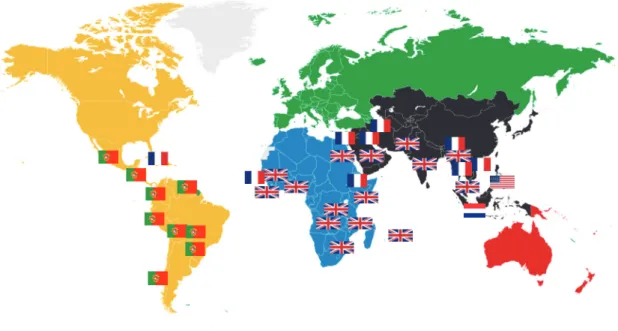
According to Homes (2013), British as colonizer not only colonized but a creator of towns. The creation of town is results of British needs and to preserve their health and sanitation. This is translated through the planning of urban areas where different races or groups stays in different areas to create harmony. This has influence the landscape of urban patterns before and after independence of the country. Nonetheless, the scope of history is a big area to cover. This research focuses into the influence of foreign colonization to developing countries land use and transportation problems. This is because colonization influence the time of independence and could also influence system of a country. The reason is to understand the differences in the land use and transportation problems among developing countries as cause by colonization factor either in the system inheritance or the physical planning done during colonization. Currently, there is about 150 countries from 190 countries are considered developing. Figure 2.5 shows developing countries covered 80% of the world.
Figure 2.5: Developing countries of the world Source: OECD
According to Rodrigue et. al (2013), automobile dependency occurs because of subsidy and the disregarded transportation alternatives. This is true as people do not bare the original cost of transportation for example for fuel, people tends to rely on automobile. The lack of efficient public transport and the ease of driving by expanding roads and highway constructions increase the tendency of driving car. The increase of population, migration and used of automobile directs to the problem of congestions. The beginning of developing country terms is commonly based on economy. But, if we look further into each country, each of them displays variety of growth characteristic. Some was never colonized, some was colonized for decades and some country only shaped after the World War 2. Looking at the list, we can also see that developing countries are not only specifying into certain ethnic or region. The range varies from Sub African regions to Asia regions and Central Europe region. This resembles variation of developing countries characteristic are no bias to any specific region only. Besides
economy achievement of these countries, there are different developing countries characteristic.
a. Developing countries are once colonized by foreigner. b. Developing countries emerged (created) after World War 2. c. Developing countries are not colonized by foreign colony.
There are other factors that may lead to different level of economy achievement such as political condition, urbanization rate, resources availability, labour force, and percentage of skill workers, education and many more. These factors are very much related to the date of independence or whether it was colonized or not and that influences the strength of the government system. Therefore, economy may not be a good benchmark to examine a developing country land use and transportation system. For example, later independence means a country has shorter time to develop efficient self-governing system for land use and transportation system. Therefore, the intensity of land use and transportation problems could not be define based on economy but must be based on other factors as well.
Developing countries that are once colonized by foreigner means the government system may be probably influenced by foreign system. For example, the formerly Malaysia Town and Country Planning Act resembles the British Town and Country Planning Act. For example, colonization of British influences the town planning style of Malaysia. In addition, roads and buildings constructed during Portuguese and Dutch colonization are still remain in certain parts of Malaysia and currently are preserved as historical buildings of Malaysia. Therefore, we could not deny the influence of foreign colonization into the land use system or transportation system.
The influence of colonization for example in the creation of grid iron road pattern is an example of the colonization influence. In addition, there are contradictions of purposes between previous town planning during colonization and the current town planning after post colonization period. Furthermore, there are also countries that were not colonized for example Thailand, Russia and China. Therefore, the influence of foreign system in the local system in the original land use and transportation system especially before automobile era cannot relate with the influence of colonization. So, there are differences between developing countries as there are developing countries with colonization influences and there are countries without. Hence, is there any differences in the factors contribute to land use and transportation problems?
Figure 2.6: Timeline of varies developing countries depending on their independence and colonization influences
2.3 Developing Countries after the World War Two
The colonization theory is rarely discussed in the field of land use and transportation in developing countries. It is due to the rapid development of land use and transportation occurs in developing countries that commonly appear after colonization left the country. However, the traces of colonization modern town development can be found. Shecter and Yacobi (2005) stated that there is an influence of European modernization in Arabic cities at the end period of the Ottoman.
World War 2 ends
Not colonized
Still colonized
Automobile increase
Inherited foreign system Not inherited foreign system Inherited foreign system Independence
countries
Integration of land use and transportation planning is difficult to accomplish even in develop countries. In India and Jordan, land ownership is an important factor that restricted land use and transportation planning. Lack of financial also causing planning for a transport facility is hard to execute because of government has less control towards the land. Therefore, planning execution is difficult unless strong political can produce strong policy. In certain developing countries especially in the new industrialized developing country, economy is given priority over land use regulations. Therefore, we can understand that there are many factors contribute to the success of land use and transportation planning. Review of related studies will further give us information towards the current situation of land use and transportation planning in developing countries.
Developing countries are unique with varies condition and thus making land use and transportation a challenged task. Currently, developing countries population occupies more than half of the world population. The rise of population is a common issue described in many research to list a few (Hook and Replogle, 1996; Morita et.al, 2003; Ocampo et.al 2009; Kusbiantoro, 1998). The increase of population also urge for more land to be developed as residential areas. Population could not be control but we can control development size and location to sustain population. This is more suitable to implement proper planning. It is suggested that developing countries will develop thirty three mega cities by 2015 (Gakenheimer, 1997). The expanding cities tell us how important to manage developing countries as soon as possible. Kusbiantoro (1998) stressed about the increase of population that surge the needs of automobile in Indonesia. The large increase in car usage rate was also said in Hayashi et. al (2004). All of this fact is related to the rise of economy in developing country.
In addition to that, political factor also plays a similar role to economy. According to Dowall and Clarke (1996), it is important to stress about the method of planning land use policy. This is because, poor land use policy can result uncontrolled land development and the imbalance of land price market. Rakodi (2001) stressed that the inappropriate policies resulted the volume of illegal development exceeding legal development. Government in developing countries are seen to be loose in land use policy thus putting politic interest first. From economy factor to government factor, it is clear that there are many factor discussed and relates to the success of land use and transportation planning in developing countries. But, why such diverse factor exists?
According to Evans (2003), as planning decisions are predominantly ended by the politicians, the effects of the planning decisions are also reflected to the desires of the politicians. In this case, the higher involvement of the politician in the structure of planning, the higher influence of politics towards land use and transportation planning. In order to understand about developing country, it is essential to know the term developing countries. International Monetary Finance (IMF) defines developing country according to the level of economies and analytical standards which comprises export earnings from abroad and external financing sources. In order to achieve economy growth many aspects has been neglected including land use and transportation. This can be seen at many prolong urban problems and lack of balance in planning for proper transport facilities to meet land development demand in developing countries. According to Homes (2013), the cities of developing world has influence the policies of government and development agencies due to colonization. This is translated through the planning of social segregation that influences the urban growth. How colonization
relates to this? Table 2.3 shows colony of colonized developing countries after the World War 2 ends included in this research.
Table 2.3: Showing respondents of this research country colonization status
Colonized Developing Countries Non-Colonized
Developing
British France Portugal USA Soviet Netherlands
Bangladesh Algeria Mozambique Philippines Mongolia Indonesia Albania
Bahrain Cambodia Brazil
Ethiopia Cameroon Bolivia
Ghana Laos Colombia
India Syria Chile
Kenya Vietnam China
Malaysia Egypt
Malawi Haiti
Myanmar Jordan
Palestine Mexico
Senegal Nepal
Sri Lanka Panama
Tanzania Peru
Uganda Saudi Arabia
Zambia Thailand
Zimbabwe Turkey
Venezuela
Agreeing to Iyer (2004), in 1995 the poorest twenty countries in the world are all ex-colonies. Based on Iyer research, colonization may influence economy growth. Therefore, there is a lot of pressure in developing countries to improve economy. Iyer(2004) also stressed on the influence of British colonization in India land tenure system. In addition, Almselati et.al (2011) highlights Malaysia urbanization process started as early as during colonization as the implication of British colonization in Malaysia. Like many colonization countries, settler colony like British gives implication towards land use and transportation system since they set up the basis structure of the colonized country. In many colonized countries, inheritance of knowledge and skills are adopted during the colonization. Most of the town planning is planned to the needs of the colony. In terms of land system, coalition between local land system and adopted
independence, lack of experienced in administering the country and financial problems, developing countries still hang on to mother colony. Developing countries mainly are dominated by British colony and Spain. Other colony includes France, Netherlands and the United States.
Figure 2.7: Domination of British colony in many developing countries Source: Google Image
2.3.1 British Colonized Countries
There are about 30 countries under British colonization including Malaysia, India, Singapore, Uganda, Zambia and Hong Kong. This research takes Malaysia (previously known as Malaya or Tanah Melayu) as the case study to understand British colonization influence. The economy growth in Malaysia is currently encouraging and this has stimulated many land developments in Malaysia. However, the rapid development along with population growth has created many land use transportation issues. Traffic congestion is one example of transportation problems in Malaysia. The
congestion is contributed by the rise of private vehicles in Malaysia due to many reasons and one of it is the affordability of owning a private vehicle (Shariff, 2012).
Just like rubbing salt to the wounds, the lack of public transportations facilities and parking spaces worsen the condition of transportation system in Malaysia (Almselati et.al, 2011). Malaysia land use and transportation system can be trace to its policy. According to Barter (2000), the car-oriented planning cause more problems to the traffic in Malaysia. Kasipillai and Chan (2008), stated Malaysia has a high percentage of private vehicles usage and the current transport policy does not solve the problems. During British colonization, British urban planning style was fully applied by the British. Until today, although town planning system in Malaysia has transformed, British urban planning and architecture style can still be found.
According to Jamil (2006), the ethnic segregation is the key element to understand Malaysia economic, politic and social patterns. The effect of British colonization in land use and transportation planning can also be seen in the first town planning act in 1923 known as the Town Planning Enactment for the Federated Malay States of Malaya. According to Ainul (2012), the enactment of this law was to tackle the issue of sanitation and health. During the early years of town planning, land issues are very weak and there are no specific elements of planning control. The British colonization was the initiator of modern town planning system in Malaysia. Almselati et.al (2011) also agrees that the urbanization process in Malaysia is started by colonialism. Time is crucial for developing country especially for colonized developing country to establish land use and transportation planning.
2.4 Summary
In summary, developing countries in character are not similar to each other although in common most developing countries gives greater scale in economy growth. Despite struggle to improve in economy, land use and transportation problems are still varies according to each country background. Each developing country is different in history, culture, religion, population including colonization history. Although this theory seems shallow, it cannot be denied that the background of a country shapes country development. In proving this theory, analyses are explained in the next chapters to compare developing country land use and transportation problems between colonized developing countries and non-colonized developing countries. Analyses are also prepared to compare different developing countries independence period to understand the influence to type of land use and transportation problems face.
CHAPTER THREE
OVERVIEW OF JAPAN CITY PLANNING 3.0 Japan Strategies in Land use and Transportation Planning
As a develop country, Japan has went through all the process of urbanization and confronting problems in land use and transportation. Although in a different economy condition, planning history, law, skills and planning methodology, it is important to understand develop country strategy in land use and transportation planning. Especially on how develop country like Japan balance between the needs of land use and transportation. This chapter is a review of Japan strategy towards its land use and transportation planning focusing in the goal of balance between land use and transport through safe city and compact city. By 2050, more than 50% of the world population will lived in urban areas. Chart 3.1 shows Japan population comparison in 52 years.
Chart 3.1 : Japan population comparison between 1960 and 2012 Source: Japan Statistical Bureau
0 2,000 4,000 6,000 8,000 10,000 12,000 14,000 Hokk aid o Iwate Akita Fukushima
Tochigi Saitama Tokyo Niigata Ishikawa
Ya
ma
na
shi
Gifu Aichi Shiga
Os aka Na ra Tottori Okayama Ya ma guchi Ka ga wa Kochi Saga Kumamo to Miyaza ki Okinawa 1960 2012
The aging population and the declining birth rate are main concern in planning any city. Despite of the concern in its population, Japan is very well-known with efficient transportation system. Japan development and urbanization is rapid and the transportation system was undoubtedly among the best in the world. At the same time, Japan also has constantly preparing for natural disaster such as earthquake and tsunami through technology, engineering and sustainable city planning. Over the years, many preparations were made to face the earthquake and tsunami. This is a mitigation effort towards reducing the number of casualties and destructions of cities.
As a comparison, the population of Japan between 1960 and 2012 showing decrease percentage at certain prefecture. Based on the data provided by the Japan Statistical Bureau, the several prefectures such as Tottori, Shimane, Tokushima, Nagasaki and Oita are showing a slight decrease of population but not in big cities like Tokyo, Osaka, Fukuoka and Saitama. In spite of the earthquake tragedy, Japan is facing another predicament in its population. 25% of Japan total population is estimated to decrease by 2050. It is estimated, 27% of the population will be aged 75 and over. In addition, the child population between the ages of 0 to 14 years old is only 13.1% in 2011. It is projected that in 2050, there are only 9.7% child population at the age of 0 to 14 years old will be recorded in Japan. The imbalance demography between the aging society and the child birth rate is unquestionably worrying. In fact, from the urban planning aspect, planning should be in view of the demography of Japan for the next decade. In 2005, about 44.9% of people in Japan concentrated at the major urban areas that are Tokyo, Nagoya and Osaka. This means, nearly half of the population are urban people. Therefore, more facilities and development planning should fit the aging society and also urban areas. In addition, municipalities focus to a concept that enables efficient