Instructions in Fuzzy Coach-Player
Systems
BY
C
HANDIMAL
S
ANJEEVA
J
AYAWARDENA
B.Sc.Eng. in Electronics and Telecommunication Engineering, University of Moratuwa, 1999
M.Eng. in Electronics and Telecommunication Engineering, University of Moratuwa, 2003
A dissertation submitted in partial fulfillment of the requirements for the Doctor of Philosophy degree in Robotics and Intelligent Systems, Department of Advanced
Systems Control Engineering, Graduate School of Science and Engineering, Saga University
September, 2006
Supervisor
: PROFESSOR KEIGOWATANABEAbstract
Today, the field of robotics research has been merged with several other areas and robotics applications are found in a variety of domains. Human-friendly robotics is one such relatively new and important development. Since the human-friendly robots are meant to be operated with close interactions with humans, their control interfaces should be as natural as possible and should be easy to use. Since the most convenient mode of com-munication for human is the natural language, human-robot interfaces of human-friendly robots should retain natural language capabilities. By observing natural language robotic systems implemented so far, we can identify an inherent drawback. Although it is conve-nient to issue natural language instructions, when performing a non-trivial task, it may be difficult to control a natural language controlled robot because the number of commands required to complete the task may be large. Moreover, it may be required to issue similar commands frequently, reducing the efficiency of the system. This is a result of the limited information content of a natural language instruction. This disadvantage can be eliminated by incorporating learning in the natural language interface.
When implementing a learning mechanism for a natural language controlled robot, the most important consideration is the nature of human observations and the nature of hu-man decision making. Inherently, huhu-man observations are imprecise and huhu-man decisions are subjective. Therefore, natural language controlled robots should be capable of learn-ing from imprecise information. In this thesis, first of all a new architecture called “Fuzzy Coach-Player Architecture” is proposed for learning from natural language instructions is-sued by a human user. This architecture has been developed by observing the real-world relationship between a coach and a player. Then the said architecture is applied to learn three important things in robot control: i.e., situations, actions, and objects.
Learning a situation is to learn what to do in certain circumstances. The theoretical basis for situation learning is developed and it is demonstrated with two path learning appli-cations. In these applications, a robot learns certain paths by accepting verbal instructions. In the first application, a modified version of the conventional probabilistic neural network architecture is used. For the other application, a new kind of probabilistic neural network architecture is developed. Learning an action is, learning to perform a certain action asked by the user. This is demonstrated with a manipulator posture control application. In this application, a user can instruct a robotic manipulator to change its posture with complex verbal commands. Learning an object is, learning to identify an object when it is referred to by a natural language reference. In this application, instead of learning an object as it is, certain object features are learned. The advantage is, once an object feature is learned, that knowledge is applicable when identifying any other object having the same feature.
By comparing experimental results with other natural language controlled robotic systems, it can be concluded that using the methods proposed in this thesis, the efficiency of natural language controlled robots can be improved.
Graduate School of Science and Engineering Saga University
1-Honjomachi, Saga 840-8502, Japan CERTIFICATE OF APPROVAL
Ph.D. Dissertation
This is to certify that the Ph.D. Dissertation of
C
HANDIMAL
S
ANJEEVA
J
AYAWARDENA
B.Sc.Eng. in Electronics and Telecommunication Engineering, University of Moratuwa, 1999
M.Eng. in Electronics and Telecommunication Engineering, University of Moratuwa, 2003
has been approved by the Examining Committee for the dissertation requirement for the Doctor of Philosophy degree in Robotics and Intelligent Systems
at the September, 2006 graduation.
Dissertation committee:
Supervisor, PROF. KEIGOWATANABE
Dept. of Advanced Systems Control Engineering
Member, PROF. MASATOSHI NAKAMURA Dept. of Advanced Systems Control Engineering
Member, PROF. KATSUNORI SHIDA
Dept. of Advanced Systems Control Engineering
Member, PROF. KAZUO KIGUCHI
Dept. of Advanced Systems Control Engineering
Dedication
To my loving parents
First and foremost, I would like to thank my supervisor, Prof. Keigo Watanabe. In spite of the grate difficulty of coping with his high standards, I consider it was a grate opportunity to work with him. He always guided me towards the most current research directions providing me with necessary supervision. At the same time, I admire that he believed in me and gave me the freedom to follow my desired paths.
Secondly, I would like to honor the authors whose work I have referred during my research. Their valuable ideas and the years of research were the foundation pillars of my work. I would also like to thank the Monbukagakusho scholarship scheme of the Japanese government, for funding me to pursue postgraduate studies at Saga University, Japan.
I would be very grateful to the members of my dissertation committee, Prof. Masathoshi Nakamura, Prof. Kazuo Kiguchi and Prof. Katsunori Shida for their valuable comments and suggestions. Whenever I faced academic and administrative difficulties, Prof. Kiyotaka Izumi was there to help me. I extend my thanks to him for his support and corporation. My special thanks go to my Masters supervisor Prof. Indra Dayawansa and to my friend Dr. Koliya Pulasinghe for encouraging me to continue my studies towards a PhD. If not for the continuous support and advice of Dr. Pulasinghe, I would have ended up my carrier as an engineer.
I have had great discussions with my friends Chandima Pathirana, Janaka Bala-sooriya, Banik Chandra, Keisuke Ichida, Guang Lei Liu, Dr. Sanath Jayawardena, and Dr. Duminda Nishanta. Those discussions have had profound impact on the ideas in this thesis. I have learned so much from them. There have been so many others, past and present. I thank you all. I would like to thank all the members of my laboratory, staff of Saga University, and the noble citizens of Saga city for making my life in Japan a pleasant and a memorable one.
I remember my father, mother, brother and sister most reverently for their love, sup-port, and guidance during the best of times and the worst of times, and for being the strength of my success.
Finally and most dearly, I would like to thank my beloved wife Ruwani for being so patient and supportive in spite of my all eccentricities, for not complaining for ruining her weekends, and for being both mother as well as father for my kids.
Contents
Page Title . . . i Abstract . . . ii Approval . . . iii Dedication . . . iv Acknowledgements . . . v List of Figures . . . ix List of Tables . . . xi Chapter 1 Introduction 1 1.1 Human-friendly Robots . . . 11.2 Natural Language Communication with Robots . . . 1
1.2.1 Human-robot communication . . . 2
1.2.2 Limitations of Early Natural Language Controlled Robots . . . 2
1.3 Current Trends in Human-friendly Robots . . . 3
1.3.1 Embodied systems . . . 3
1.3.2 Disembodied systems . . . 3
1.4 Human Decision Making Process . . . 4
1.4.1 Impreciseness of human observations . . . 4
1.4.2 Established models of human uncertainty . . . 5
1.4.3 Objective vs. subjective information . . . 6
1.5 Contribution . . . 6
1.6 Thesis Outline . . . 7
2 Fuzzy Coach-Player System 8 2.1 Introduction . . . 8
2.2 Real-world Analogy . . . 8
2.3 Coach-Player Systems . . . 9
2.3.1 Features of coach-player systems . . . 9
2.3.2 Sub-coach . . . 11
2.4 Applications of the Coach-Player System . . . 12
2.4.1 Path learning . . . 12
2.4.2 Posture control of manipulators . . . 13
2.4.3 Object identification . . . 13
3 Fuzzy Natural Language Instructions 15 3.1 Introduction . . . 15
3.2 Simple Fuzzy-Voice Motion Commands (SFMCs) . . . 16
3.2.1 Command interpretation . . . 16
3.2.2 Applications . . . 19
3.3 Fuzzy-Voice Joint Commands (FVJCs) . . . 19
3.3.1 Command interpretation . . . 19
3.3.2 Applications . . . 21
4 Learning Situations: A Simple Path Learning Application 23
4.1 Introduction . . . 23
4.2 Learning from Fuzzy Natural Language Instructions . . . 23
4.2.1 Robot world state . . . 24
4.2.2 Learning by the sub-coach . . . 24
4.3 Implementation of Sub-coach . . . 25 4.3.1 Gaining knowledge . . . 25 4.3.2 Decision making . . . 25 4.4 Experiments . . . 30 4.4.1 Experiment 1: 2D motion . . . 30 4.4.2 Experiment 2: 3D motion . . . 34 4.5 Summary . . . 34
5 Learning Situations: A Complex Path Learning Application 39 5.1 Introduction . . . 39
5.2 Learning from Fuzzy Natural Language Instructions (General Case) . . . 39
5.2.1 Robot world state . . . 40
5.2.2 Learning by the sub-coach . . . 40
5.3 Neural Network Architecture . . . 41
5.3.1 Design stratergy . . . 41
5.3.2 Network architecture . . . 42
5.4 Implementation of the Sub-coach . . . 45
5.4.1 Knowledge acquisition . . . 45
5.5 Experiment . . . 46
5.6 Summary . . . 48
6 Learning Actions: Posture Control of a Manipulator 50 6.1 Introduction . . . 50
6.2 Complex Fuzzy-Voice Posture Commands (CFPCs) . . . 51
6.3 Implementation . . . 51
6.3.1 Command execution and learning . . . 51
6.3.2 Manipulator motion . . . 61 6.4 Results . . . 64 6.4.1 Case 1 . . . 64 6.4.2 Case 2 . . . 64 6.4.3 Case 3 . . . 65 6.4.4 Case 4 . . . 65 6.4.5 Case 5 . . . 66 6.4.6 Case 6 . . . 66 6.4.7 Demonstration experiment . . . 66 6.5 Summary . . . 68 7 Learning Objects 72 7.1 Introduction . . . 72 7.2 Learning Algorithm . . . 73
7.2.1 Object perception by the robot . . . 73
7.2.2 Lexical representations . . . 74
7.3 Overview of the System . . . 75
7.4 Implementation . . . 77
7.4.1 Experimental setup . . . 77
7.4.2 Low level knowledge base . . . 77
7.4.3 High level knowledge base . . . 79
viii CONTENTS
8 Future Works and Conclusions 81
8.1 Future Works . . . 82
8.2 Conclusions . . . 82
Appendices 84 A Probabilistic Neural Networks 85 A.1 Introduction . . . 85
A.2 Bayes Strategy for Pattern Classification . . . 85
A.3 Network Architecture . . . 86
A.4 Advantages of PNN . . . 87
Publications 88
Figure Page
1.1 Perception of a position. . . 5
2.1 Concept of fuzzy coach-player system. . . 9
2.2 The architecture of a coach-player system. . . 10
2.3 Introduction of a sub-coach into a coach-player system. . . 11
3.1 Membership functions for action modification. . . 17
3.2 Membership functions for previous distance. . . 18
3.3 Membership functions for new distance. . . 18
3.4 Arm nomenclature of the 7-link manipulator. . . 20
3.5 Membership functions: (a) denotes the membership functions for the action mod-ification character variable, a and the previous angle, θ, in the antecedent part; (b) denotes the membership functions for the new angle, α, in the consequent part. . . 22
4.1 Relationship between robot world states and commands. . . 24
4.2 Probabilistic neural network architecture (PNN). . . 27
4.3 Algorithm to deduce di from ˆd. . . 29
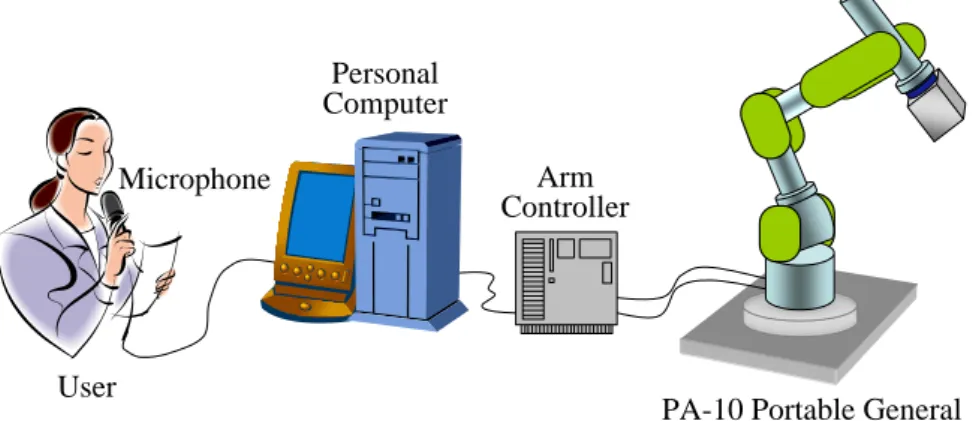
4.4 The experimental setup. . . 31
4.5 Command generation of the sub-coach using the knowledgebase. . . 31
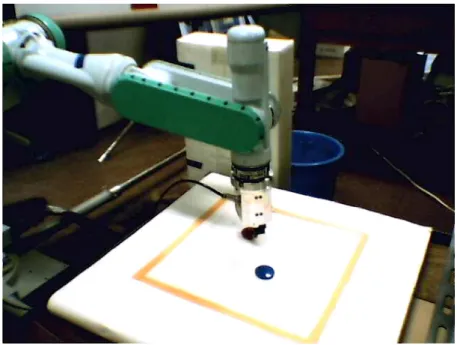
4.6 View of the experimental setup in experiment 1. . . 32
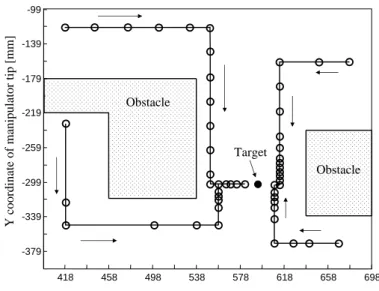
4.7 Training movements performed by the human user (coach) in experiment 1. . . 32
4.8 Some test movements in experiment 1. . . 36
4.9 View of the experimental setup in experiment 2. . . 36
4.10 Sample training movements in experiment 2. . . 37
4.11 Convergence of learning in experiment 2. . . 37
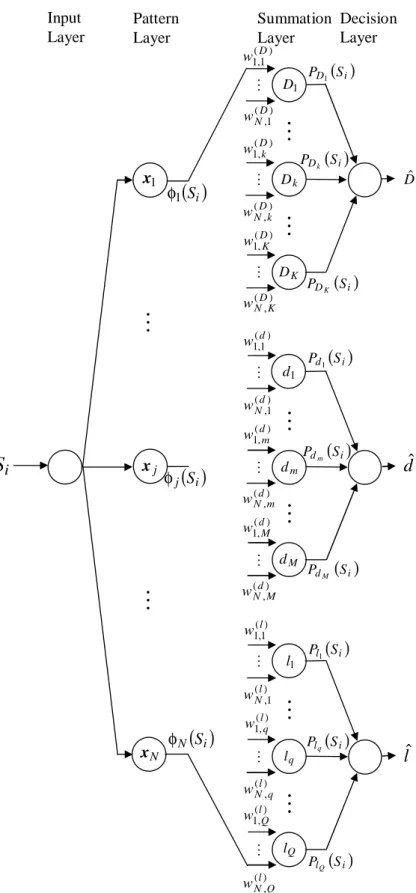
5.1 Neural network architecture. . . 42
5.2 Some sample training movements. . . 47
5.3 Convergence of learning. . . 48
6.1 Algorithm for categorizing the user command. . . 53
6.2 Algorithm for command execution: Case 1. . . 54
6.3 Algorithm for command execution: Case 2. . . 54
6.4 Algorithm for command execution: Case 3. . . 56
6.5 Algorithm for command execution: Case 4. . . 57
6.6 Algorithm for command execution: Case 6. . . 60
6.7 Multiplication factor, k. . . 61
6.8 Algorithm for deriving EFS. . . 62
6.9 Example of case 1: “Bend lower arm far forward.” . . . 64
6.10 Example of case 2: “Bend toward forward.” . . . 65
6.11 Example of case 3: “Move your tip towards upper back.” . . . 66
6.12 Example 1 of case 4: “Bend towards forward and turn far left.” . . . 67
6.13 Example 2 of case 4: “Turn little right and bend towards forward.” . . . 68
6.14 Example of case 6. . . 69
6.15 Demonstration experiment. . . 70
7.1 Overview of object identification system by a robot. . . 75
7.2 Object identification. . . 76
x LIST OFFIGURES
7.3 A view of the experimental setup. . . 76 7.4 Object table. . . 77 A.1 Typical PNN architecture . . . 87
Table Page
3.1 Fuzzy commands used by the human user. . . 16
3.2 Fuzzy-voice joint commands. . . 19
4.1 Training data for PNN in experiment 1. . . 33
5.1 Motion commands. . . 45
5.2 Gripper control commands. . . 46
5.3 Wrist rotation commands. . . 46
5.4 Training data for the neural network. . . 49
6.1 A portion of the CFPC knowledge base. . . 55
6.2 Words or phrase groups bearing similar meanings. . . 58
6.3 Efficiency of command interpretation. . . 71
7.1 Grammar. . . 75
7.2 Object representations. . . 78
7.3 Clustered objects. . . 79
7.4 Lexical symbols to cluster mapping. . . 79
7.5 Objects of same color and shape. . . 80
7.6 Final object identification. . . 80
Chapter 1
Introduction
1.1 Human-friendly Robots
From the inception, the major role of robotics was in the heavy industry. However, the scope of the field of robotics is gradually spreading and moving into new areas. In contrast to the conventional applications in the heavy industry, robotic applications are now found in a broad spectrum of domains. Among these, human-robot interaction is a well-concentrated research area. Various facets of human-robot interaction are being studied under different sub-areas such as human-friendly robots [1], socially interactive robots [2], sociable robots [3], welfare robots [4], [5], socially embedded robots [6], etc.; sometimes overlapping with each other. The nature of human-robot interactions under consideration in modern research varies from simple operations such as recognizing preprogrammed words to more complicated issues such as understanding emotions and gestures [7]. In the context of this thesis, I will use the term “human friendly robots” for this entire range of robots which is capable of interacting with humans at different levels.
Studies of human-robot interaction have become important as robots start to move out factory floor and laboratory test beds into the society. Robots have been introduced as toys [8], [9] and household equipment [10]. For the first time in the history, the World Trade Center (WTC) rescue response provided an opportunity to study the humanrobot interactions (HRI) during a real rescue operation [11]. Most importantly, the robots are being considered for use in elder care as well [12]. If the dreams of researches come true, in future, robots will assist the elderly and disabled people into and out of wheelchairs and beds, be conversant in several languages, watch over babies, and provide a sympathetic ear to the lonely [13].
As robots take on an increasingly ubiquitous role in society, they must be easy for the average person to use and interact with. Essentially, human friendly robots must be easy to use and have natural communication interfaces because the natural human behavior is to express themselves via language, facial gestures and expressions. In this thesis, I will concentrate on an important problem associated with robots that understand natural language communications; i.e. learning from natural language instructions.
1.2 Natural Language Communication with Robots
Undoubtedly, the natural language is the most familiar and the convenient medium of com-munication for human. This argument is supported by the fact that the human head and
brain have been uniquely evolved to produce speech [14]. Therefore, the next generation of computers is expected to interact and communicate with users in a cooperative and nat-ural manner when users carry out everyday activities. Towards this end, a truly intelligent human-robot interface should be able to comprehend what people say, carryout their orders, and answer them in a peer-like manner.
1.2.1 Human-robot communication
The ultimate goal of developing human-robot communication interfaces would be to achieve the level of human-human conversations. This is not a simple task because an agent that provides such a complex language behavior requires competencies in the areas of,
• Phonetics and Phonology: The study of linguistic sounds; • Morphology: The study of the meaningful components of words; • Syntax: The study of the structural relationships between words; • Semantics: The study of meaning;
• Pragmatics: The study of how language is used to accomplish goals; and • Discourse: The study of linguistic units larger than a single utterance.
The most or all tasks in speech and language processing can be viewed as resolving ambi-guity at one of these levels [15].
To achieve this goal, only voice recognition is not sufficient; instead, a robot should be able to understand the underline meaning of a user utterance. Although most of the speech recognition systems available today, such as the ones based on hidden Markov mod-els and hybrid connectionist modmod-els, provide satisfactory performance, little progress have been achieved in regard to the understanding of the true meaning of natural language utter-ances.
1.2.2 Limitations of Early Natural Language Controlled Robots
Attempts to utilize natural language as a communication medium with robots were taken quite early. Shakey [16], the first mobile robot (introduced in 1972) that could claim to reason about its actions had limited language capability; commands could be typed into Shakey’s computer in English, and it would type back a response. However, almost all natural language controlled robots developed until recently, were not conceptually much different from each other. What they could perform was to identify one or more pre-programmed words or phrases in a user utterance and execute a corresponding command or a set of commands. Some important such works are noted below.
A model car controlled by voice instructions was developed by Sugeno et al. [17], [18]. They used voice commands such as “turn right,” “turn left,” “enter the garage,” etc. to control a model car. As far as natural language interface was considered, nothing had been done except identifying a set of pre-programmed commands. In voice controlled wheelchairs developed by Mazo et al. [19] and Komiya et al. [20], each possible user command was restricted to few preprogrammed words.
ASIMO, probably one of the most advanced robots developed so far, has very ad-vanced voice recognition capabilities. Although the number of commands that can be pre-programmed is basically unlimited, conceptually there is no much advancement from the wheel chair developed by Mazo et al. [19]. What ASIMO can do is to comprehend and
1.3. CURRENTTRENDS INHUMAN-FRIENDLYROBOTS 3
carry out tasks based on simple voice commands given in English that have been prepro-grammed [21].
1.3 Current Trends in Human-friendly Robots
There are many robotic systems emerged from different research areas, that have been de-signed to interact with people. Many of these systems target different application domains such as computer interfaces, Web agents, synthetic characters for entertainment, or robots for physical labor. In general, two main streams can be identified within the human-friendly research domain: embodied and disembodied systems.
In embodied systems, the human interacts with a robot or an animated avatar. The concentration in these researches is to embed the robot or avatar with more human like cognitive capabilities. In disembodied systems, the human interacts through speech or text entered at a keyboard. These researches concentrate on developing human friendly interfaces for ordinary robots. By ordinary we mean the robots that are controlled by conventional methods and are already being utilized for useful work.
1.3.1 Embodied systems
The advantage of this line of research is that it is directed towards developing cognitive agents, probably having human-like cognitive capabilities [22]. For example, Oates et al. [23] presented an unsupervised learning method that allowed a robotic agent to identify and represent qualitatively different outcomes of actions. They used human experience to evaluate their method. Roy [24] presented a computational model which could learn words from multisensory data. In a more recent interesting work presented in Roy et al. [25] authors proposed a set of representations and procedures that enable a robotic manipulator to maintain a “mental model” of its physical environment by coupling active vision to physical simulation with the view of creating an interactive robot which could engage in cooperative task with human. Ballard and Yu [26] and Yu and Ballard [27] presented a multimodal interface that could learn words from human users in an unsupervised manner in which users perform everyday tasks while providing natural language descriptions of their tasks.
This line of research is very important; however, due to extremely demanding tech-nical and theoretical requirements of such systems, still they have a long way to go in order to be applied in practical domains.
1.3.2 Disembodied systems
The advantage of this line of research is that it allows us to develop human interfaces for existing robotic systems. Some of the potential areas for such applications are nursing and aiding, helping human in complex tasks such as surgery and implementing space restricted systems where other input-output devices are not feasible. For example, Lin and Kan [28] proposed an adaptive fuzzy command acquisition method for controlling machines using natural language commands such as “move forward at a very high speed.” In Pulasinghe et al. [29], similar commands were used to control a mobile robot handling out-of-vocabulary words. In a more pragmatic approach, Pulasinghe et al. [30] discussed how a robot manip-ulator could be controlled with voice commands to do an assembling task.
The work presented in this thesis is different from the both views above. However, it is related to the second one in the sense that it also concentrates on controlling ordinary robotic systems by human friendly means rather than developing a robot with human like cognitive capabilities.
1.4 Human Decision Making Process
To discuss about human decision making, first we need to explore the nature of human observation because observation stimulates decision making.
The systematic empirical study of judgment and decision making did not begin to emerge as a discipline in its own right until the 1960s, when there was an upsurge of in-terest in the broader and more general field of cognitive psychology that includes memory, thinking, problem solving, mental imagery and language [31].
Until the mid 1970s, the studies of intuitive probabilistic judgment led to the conclu-sion that most people make judgments based on rational methods that are in line with the main rules of statistics and probability theory [32], [33], [34]. However, two factors subse-quently modified this line of research: psychological researches identified the presence of systematic errors in contrast to what was assumed by logistic theories and, in the economic field, Allais [35] demonstrated the existence of a paradox of normative theory that leads to its failure as a descriptive model of decision making.
In an early attempt to develop a theory of thinking, Minsky [36] proposed a memory structure called a “frame” to represent knowledge. He argued that whenever one encounters a new situation or makes a substantial change in one’s view point, he selects from memory a remembered framework called a frame and adapts it to fit reality by changing the details associated with it.
In contrast to sensory perceptions of instruments or robots, human observations are non-metric. Recent researches on human perception of space have provided very com-prehensive results to support this remark. According to the work of Tversky et al. [37], one remarkable feature of human mind is to conceive of some large spaces as integrated wholes. Certain information, like exact metric information, is systematically simplified and even distorted. Directions and axes are not represented analogically or metrically in exact degrees or meters, but rather at least somewhat categorically.
However, even though such fuzziness is associated with perception of space, we know that still humans are capable of doing things like finding their own way to a place, giving directions to another human, or even guiding a mobile robot to a required destina-tion.
1.4.1 Impreciseness of human observations
Above findings about the nature of human observations are emphasized by our day-to-day real world experiences, since we know that we do not perceive anything numerically. When it comes to natural language controlled robots, the commands issued to a robot are affected by the operating human user’s perception about the state of the robot. Although we may define the state of a robot by various measurable parameters, a human user understands them only using his own senses. Therefore, the decisions made by a human user are not precise; rather they are approximate decisions.
1.4. HUMANDECISIONMAKINGPROCESS 5 400 500 600 700 -400 -300 100 -100 0 -500 300
X coordinate of a robot manipulator tip [mm]
Y c oor di na te of a r o b o t m anipula tor ti p [m m ] -200 Source Target Source area Target area
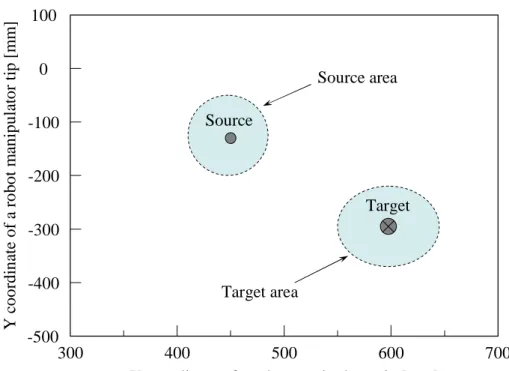
Figure 1.1: Perception of a position.
Consider the illustration in Fig. 1.4.1. Assume that the user wants to guide a robot manipulator to move its tip from Source to T arget. Also, assume that the user can move the manipulator tip either up/down (y axis) or left/right (x axis) using verbal commands. As the first step, user might say “move right” or “move down.” In this case, the exact coordinate positions are Source = (450.80, −132.55) and T arget = (597.94, −291.93). However, for his decision, the user does not use this accurate information. Instead, he might think “what is the best way to move from the source area to the target area.” Thus, the user may take the same decision to move from any other point in the source area to any other point in the target area.
1.4.2 Established models of human uncertainty
This section briefly summarizes existing models that have been used for quantifying human uncertainty.
• Certainty factors: Certainty factors model was developed for the MYCIN medical diagnosis program [38] and was widely used in expert systems of the late 1970s and 1980s. A typical expert system consisted of a set of facts, a set of rules, and an in-ference engine. The inin-ference engine applied a sequence of rules to the set of facts, thereby producing new facts. Uncertainty was modeled through certainty factors as-sociated to facts and rules. Although some expert systems of this kind worked quite well, certainty factors are not popular nowadays, because they tend to produce con-tradictions.
• Fuzzy sets and fuzzy logic: Fuzzy sets and fuzzy logic attempt to model uncertainty through vagueness, rather than probabilities. Fuzzy set theory is a means of specify-ing how well an object satisfies a vague description whereas fuzzy logic is a method for reasoning with logical expressions describing memberships in fuzzy sets [39], [40], [41].
• Dempster-Shafer theory: The Dempster-Shafer theory [42] is designed to deal with the distinction between uncertainty and ignorance. Rather than computing the prob-ability of a proposition, it computes the probprob-ability that the evidence supports the proposition.
• Lower previsions: The theory of lower (and upper) previsions can be seen as a gener-alization of Dempster-Shafer theory [43]. The lower prevision of a statement can be interpreted as a lower limit of the probability of the statement being true. The theory is related to gambling situations where one assumes that the opponent may have more information than oneself.
• Subjective probability: The term subjective probability (as opposed to frequency based probability) means that the subject merely assigns numbers to different events and statements, which obey the rules of probability calculus.
• Bayesian networks: A Bayesian network is a directed graph in which each node is annotated with quantitative probability information. Bayesian networks represent a different perspective than that of classical expert systems: Rather than imitating the human thought process, with uncertainty associated to inference rules, one creates a consistent causal probability model, and uses probability calculus for inference [44]. 1.4.3 Objective vs. subjective information
Subjectivity is associated with anything or anywhere where human factors are involved. There is a self-evident distinction between objective and subjective information. The for-mer, the hard currency of information-processing devices of all kinds, is used to transmit impersonal knowledge, and is readily quantifiable and ultimately reducible to binary digits. The latter is inextricably bound with issues of meaning, value, and perspective, and thus would seem to defy such universal quantification [45].
For example, the objective information contained in any book could, in principle, be uniquely quantified by suitable digitization of its array of letters, symbols, and illustrations, but the subjective information communicated would depend keenly on the readers interest in the subject matter, intellectual heritage, emotional perspective, and personal value sys-tem.
Therefore, in addition to the effects due to imprecise observations, human decisions are affected by the subjectivity.
1.5 Contribution
In the work presented in this thesis, I focus on learning from fuzzy natural language instruc-tions. Although there are many former works in related areas, the importance of learning from natural language instructions has not been addressed.
The motivation behind this work is the observation that for the success of any nat-ural language controlled robotic system, the robot should be capable of learning from the
1.6. THESISOUTLINE 7
instructions issued by the human operator of the robot.
This observation is the result of an inherent disadvantage of natural language con-trolled systems. Although it is convenient to issue instructions, when performing a non-trivial task, it may be difficult to control a natural language controlled robot because the number of commands required may be large. Moreover, it may be required to issue similar commands frequently reducing the efficiency of the system. On the other hand, if there is a learning mechanism, the burden on the user will be reduced as the system matures by learning gradually.
In this work, a new architecture called “fuzzy coach-player system” for learning from natural language commands was proposed. Then it was applied and experimentally verified for three cases; namely, learning situations, learning actions, and learning objects.
1.6 Thesis Outline
Chapter 2 presents the architecture of fuzzy coach-player system for learning from natural language commands. The concept behind the architecture and the potential applications of the architecture are discussed.
Chapter 3 describes the interpretation of fuzzy natural language instructions as ap-plied to robot control. When using natural language to control robots, encountering words and phrases with fuzzy implications is inevitable. In this chapter, the methods used to interpret such commands in the experiments presented in this thesis are discussed.
In Chapter 4, a theoretical model, which is based on imprecision of human observa-tions, proposed for situation learning is presented and it is demonstrated with a simple path learning application. In this experiment, an object sorting robot learns the path from an object table to a bin avoiding obstacles.
In Chapter 5, situation learning is demonstrated with a complex path learning appli-cation. This path learning application is complex in the sense that it learns multiple paths from an object table to multiple bins. The effect of the intention of the human operator, which should be taken into consideration in such complex applications, is discussed and a neural network architecture specially designed for situation learning considering the effect of the user intention is also presented.
Chapter 6 presents action learning. In this chapter, the challenging task of control-ling the posture of a robotic manipulator with natural language instructions is discussed. The proposed idea is demonstrated with an experiment conducted with a 7-link redundant manipulator.
Chapter 7 demonstrates learning objects with natural language instructions. In this chapter, learning to identify objects that are referred to by natural language references is discussed. The method presented relies on learning the grounded meanings of individual object features.
Chapter 8 summarizes the contents of the thesis and concludes the with a discussion of the outcomes of the research and future research directions.
Fuzzy Coach-Player System
2.1 Introduction
Coach-player system is a conceptual architecture that provides a basis for developing human-robot conversational interfaces with learning. This idea emerged from a bird’s-eye view of the real-world relationship between a coach and a player [46], [47].
The majority of learning research in artificial intelligence, computer science, and psychology has studied the case in which an agent begins with no knowledge at all about which it is trying to learn. Although this is an important special case, it is by no means the general case. Most human learning takes place in the context of a good deal of background knowledge. Some psychologists and linguists claim that even new born babies exhibit knowledge of the world [48].
The coach player system can be used for learning by natural language controlled robots, which posses limited built in knowledge. In contrast to human-like cognitive robots, robots with limited knowledge and cognitive capabilities are realizable. If the capability of learning from natural language is built in, they can evolve into more capable robots by interacting with human.
In the following Section 2.2, the real-world analogy of coach-player system is de-scribed. What is the coach-player system is explained in Section 2.3. In Section 2.4, the ap-plications of the coach-player system, especially performed in this thesis, are overviewed.
2.2 Real-world Analogy
In the real-world relationship between a coach and a player, the player possesses some basic skills of a game or a sport. In the contrary, the coach is more experienced and knowl-edgeable. He gives the player instructions at suitable instances so that the coaching process will be successful if the player develops new skills combining his basic skills and the in-structions or advices received from the coach. At initial stages of coaching, the frequency of coach’s instructions is high; but it reduces as the player gains skills.
According to the discussion in Section 1.4 on the nature of human observation, since the coach measures player performance through visual observation and evaluates it based on his knowledge and experience, both the observation and the judgment may not be accu-rate; rather, his observations may be approximate or imprecise while his judgments may be subjective. On the other hand, the mode of communication being the natural language, the instructions issued to the player may contain phrases with fuzzy implications. Neverthe-less, a human player can understand such imprecise instructions with fuzzy implications
2.3. COACH-PLAYERSYSTEMS 9
Evaluation of the player Voice command for modifying
the player motion
Direct observation of player
Player Coach
Figure 2.1: Concept of fuzzy coach-player system.
and behave as directed.
The conceptual relationship between a coach and a player is illustrated in Fig. 2.1. Of course, the true relationship between a coach and a player in the real-world is much more complicated. What shows in Fig. 2.1 is a simplified view that is suitable and sufficient for modeling the intended framework for learning.
2.3 Coach-Player Systems
From the above observation, it is possible to derive a model that is suitable for human-robot cooperative learning.
A robot controlled by natural language instructions must have certain capabilities at a minimum. First, it should be able to understand and interpret a finite set of natural language instructions. Second, a human user should be able to obtain some work performed by issuing a suitable sequence of instructions, each of which is an element of the said finite set of instructions. The number of instructions needed and the time taken to complete a task will depend on the complexity of the task under consideration and the level of complexity or the information richness of each instruction.
Since the amount of information conveyed via a single instruction is finite, guiding a robot to perform a complex task requires multiple instructions. User issues each instruction in a step-by-step fashion observing the robots behavior at each step. This is analogous to the real-world relationship between a coach and a player explained in Section 2.2. Therefore, this type of a system can be called a coach-player system; in particular, it is called a fuzzy coach-player system when fuzzy instructions are used.
2.3.1 Features of coach-player systems
There are three important features in a coach-player system. 1. Interpretation and execution of instructions by the player:
Player interprets a user instruction with his limited capabilities and performs an ac-tion. This involves fuzzy inference if the instruction contains words or phrases bear-ing fuzzy implications. The state or performance of the player changes because of the execution.
User (Coach) User (Coach) Visual observation Controller Controller Subjective evaluation Voice instruction State Robot (Player) Robot (Player) Consult Control signals
Figure 2.2: The architecture of a coach-player system.
2. Evaluation of the player by the coach:
Coach observes and evaluates the change in state or performance of the player. This observation is approximate and the evaluation, which depends on the coach’s knowl-edge, experience, attitude, etc., is subjective. Based on the evaluation, the coach decides to issue the next instruction or to stop.
3. Improvement of the player:
As a result of following coach’s instructions, the player continuously improves its state or performance towards the coach’s intended direction. This continues until the coach is satisfied.
For example, consider a system where a human is guiding a mobile robot to move from one point to another. A typical series of instructions would be
• “move forward slowly” • “move little more forward” • “turn to right”
• “move far” • “stop,” etc.
The user may continue to command until the robot reaches the destination.
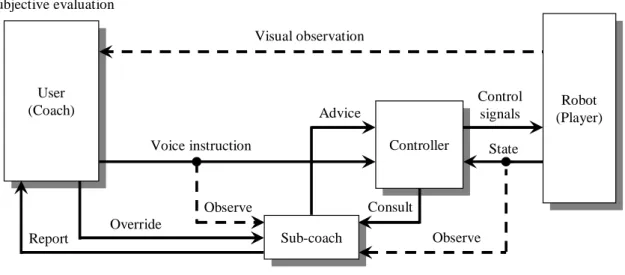
The architecture of a coach-player system is shown in Fig. 2.2. In the figure, “Con-troller” has a limited intelligence that is sufficient to understand a finite set of instructions. If any user instruction is not understandable, it can consult the user.
The system architectures of the majority of the natural language controlled robots available today are similar to that of the above coach-player system. The flaw in this ar-chitecture is that it is inefficient unless the amount of information conveyed by a single instruction is high. With a relatively simple and finite instruction set, repeating similar instructions at similar situations is inevitable leading to a tiresome work in the part of the user.
One alternative is to introduce more and more information-rich instructions, which are necessarily more complicated. For understanding such instructions, the robot needs to be more and more intelligent. In the extreme case, robots with human-like cognitive capabilities may be required.
2.3. COACH-PLAYERSYSTEMS 11 User (Coach) User (Coach) Visual observation Controller Controller Subjective evaluation
Voice instruction State
Sub-coach Sub-coach Robot (Player) Robot (Player) Consult Advice Report Observe Observe Control signals Override
Figure 2.3: Introduction of a sub-coach into a coach-player system.
The other alternative is to introduce a learning mechanism. To achieve this, a new concept of a sub-coach that is explained in the next section is introduced.
2.3.2 Sub-coach
Sub-coach is a software agent that stands in between the user (coach) and the robot (player). It reduces the burden of the coach by learning from voice instructions and emulating a coach to the player.
The concept of sub-coach for learning was first proposed in Jayawardena et al. [49] demonstrating a sub-coach that was able to learn from crisp instructions. The same concept was further amplified by incorporating both crisp and fuzzy instructions in [47], [50], [51], [52]. Figure 2.3 illustrates the architecture of the complete coach-player system with a sub-coach.
Whenever user issues an instruction, the sub-coach observes both the instruction and the state of the robot, thus building a knowledge base gradually. If the user instruction is not understandable with the limited intelligence of the controller, it consults the sub-coach instead of the user. Then, emulating the user (coach), the sub-coach advices the robot with the help of its knowledge base. If the sub-coach is incapable of advising the robot at any instance, it reports that fact to the user, so that the user can issue more simple instructions to the robot. Whenever the sub-coach is advising the robot, the user can observe the outcome and can override the sub-coach if necessary.
This architecture provides three advantages: 1. Elimination of instruction repetitions:
Since the sub-coach continuously observes and learns the instructions and their cor-responding robot states, the need for repeating instructions at states that are similar to previously encountered states is eliminated.
2. Reduction of user burden:
As the sub-coach handles most of the tedious repetitive work, the user has less work load. This enables him to control more than one robot at a time or to be engaged in
another work simultaneously, intervening only when required. 3. Flexible user instructions:
While keeping a small built-in instruction set, there is a possibility of using new user instructions because the sub-coach can learn the new instruction and its equivalent sequence of built-in instructions. Once learned, when the user issues the same in-struction next time, the sub-coach can instruct the robot with the equivalent sequence of built in instructions.
2.4 Applications of the Coach-Player System
In this thesis, learning of three things that are important for natural language controlled robots is discussed. They are learning of, situations, actions, and objects [53]. Although three applications are presented in detail, the coach-player system is not limited to these applications; but may be applied to a wide range of problems because it is a general frame-work.
1. Learning situations: The main control input for a natural language controlled robot is verbal human instructions. When the robot does not have any knowledge about the situations it encounters, it has to rely entirely on human instructions as to what actions to take. What we mean by learning situations is, learning of possible situations and corresponding suitable actions. The trivial method of doing this is to memorize all or a large number of possible situations and actions. In this thesis, an efficient learning architecture, which is based on the approximate nature of human observation and decision-making, is proposed. Section 2.4.1 below briefly describes an application developed in order to demonstrate the proposed idea.
2. Learning actions: A natural language controlled robot should be able to perform the actions instructed verbally. Verbal descriptions of actions are usually not precise. On the other hand, in a flexible natural language controlled robotic system, a user should be able to request the robot to perform a complex action with a single instruction. As in the above case, the trivial solution for this is to build a knowledgebase that consists of a large number of instructions and corresponding actions. Section 2.4.2 describes an action learning application developed using the coach-player system.
3. Learning objects: Identification of objects with verbal references is also very im-portant for natural language controlled robots. To do this, storing the details of a large number of objects together with their natural language references is not effi-cient. Section 2.4.3, presents a coach-player system based method, in which a robot learns how to identify an object by learning the grounded meaning of some important object features, as a human does.
2.4.1 Path learning
The applications that use robot manipulators require controlling the trajectory of the tip of the manipulator. The level of precision depends on the task under consideration. If the ma-nipulator is controlled by natural language instructions, the tip position of the mama-nipulator is changed according to user instructions, thus traversing the user-desired trajectory. For example Pulasingha et al. [30] demonstrated how an assembling task could be performed with a voice controlled redundant manipulator.
2.4. APPLICATIONS OF THECOACH-PLAYERSYSTEM 13
Chapter 4 discusses a simple path learning application where, a manipulator sur-rounded by obstacles is used to pick some objects placed on a table and to place them in a bucket. Sub-coach learns the path from the table to the bucket by observing the user’s instructions and the robot’s states.
The application discussed in Chapter 5 is similar to the above case except that there are multiple buckets. As a result, the path learning becomes more complex and it requires a different strategy from the above case.
In both cases, the robot is capable of understanding a set of simple motion instruc-tions and the user can guide the tip of the manipulator to the target using these simple instructions although a large number of instructions is required to complete one pick-and-place operation. However, as the knowledge of the sub-coach increases, the frequency of user intervention reduces thus allowing the robot to perform pick-and-place operations autonomously.
2.4.2 Posture control of manipulators
To control the posture of a robotic manipulator, each joint should be controlled by providing the joint angles. When a manipulator with six or more joints is considered, this is not a trivial task [54]. Therefore, controlling the posture with voice instructions is extremely challenging.
By employing simple instructions, it is possible to control one joint at a time. For example, it may be possible to rotate a certain joint with instructions like “rotate your wrist little clockwise, “rotate your shoulder little anticlockwise,” etc. by referring to each joint of the manipulator. However, this type of instructions is not sufficient to control the posture of a manipulator in a more complex and useful manner. On the other hand, it will be very inconvenient for a user to bring the manipulator to a desired posture by rotating a single joint at a time. If a manipulator is truly controllable with natural language instructions, it should be possible to use instructions like “reach upper back and turn your tip down,” “bend towards far left,” etc. without imposing any considerable restrictions upon instruction choices.
Coach-player system is an architectural concept in which a player with limited ca-pabilities is developed into a more capable one with the help or intervention of a coach. In other words, a robotic system with certain intelligence or a limited knowledge base is developed into a more advanced and useful system by interacting with a human user.
Suppose that a robotic manipulator understands voice instructions to control each joint but does not understand any other instruction. Therefore, to bring the manipulator to a desired posture, the user has to issue several joint control instructions in sequence. User needs to repeat a similar procedure each time he needs to change the posture of the manipulator. In a coach-player system with a sub-coach, the sub-coach can learn from user instructions and manipulator data, and can learn to execute complex instructions. This application is discussed in detail in Chapter 6.
2.4.3 Object identification
In natural languages, object references are composed of combinations of lexical symbols representing shapes, colors, sizes, etc. In order to infer the meaning of such a combination,
one should know the meaning of each lexical symbol. For example, to identify a “large green car,” one should know what is meant by large, green, and car. In the human learning process, once the grounded meaning of a lexical symbol is learned, humans are capable of interpreting it with relation to different scenarios. This is true for childhood learning as well as for new language learning by adults. Our objective is to apply a similar strategy for learning object identification by robots.
Object perception by any robot is only via sensors. If the camera images are used, it is possible to extract various features of the objects presented in a scene. This is a completely automated process where there is no consideration as to how these objects are represented in the domain of natural languages.
Although the robot perception is limited to sensory data, a human user may refer to objects with combinations of lexical symbols. “red cube,” “blue cylinder,” or “big yel-low sphere” are some examples. In order to execute user instructions that consist of such references, there should be a method to learn the meanings of these lexical symbols.
Chapter 7 discusses an application in detail, in which a robot learns how to identify objects. The implementation is motivated by the coach-player system.
Chapter 3
Fuzzy Natural Language Instructions
3.1 Introduction
Although the main objective of this thesis is to propose an architecture for learning from natural language instructions, the interpretation of such instructions also becomes an inte-gral part in the implementation of experimental systems. Therefore, this chapter summa-rizes some of the available techniques and describes the interpretation method used in the presented work.
For true natural language controlled systems, automatic speech recognition (ASR) is not sufficient. Instead, it is necessary to use other strategies that can decode the intended information contained in natural language expressions.
One very closely related area of research is the symbol grounding problem [55]. Symbol grounding problem arises from the question, how the symbols in natural languages relate to real world entities? Symbol grounding problem is a very hard problem in robotics and AI [56]. In general, the interpretation of natural language instructions that contain fuzzy linguistic information is a subset of the symbol grounding problem. However, our objective is not to solve the symbol grounding problem in general.
Narrowing down the problem domain to machine control, there are some already developed techniques for interpreting commands that contain fuzzy linguistic information. The adaptive fuzzy command acquisition network (AFCAN) proposed by Lin and Kan [28], was able to acquire fuzzy commands via online learning and accepting criticism from a user. In their method, acquiring commands such as “move forward very fast ” was studied. Here, “move forward ” represents the action to be performed while “very fast ” represents the fuzzy linguistic information. For machine or robot control, interpreting this kind of commands is quite useful.
Pulasinghe et al. [29] applied a similar method for controlling a mobile robot. They proposed that the significance of action modification words changes contextually and im-plemented a command interpretation strategy based on a fuzzy neural network.
The command interpretation method used in the work presented in this thesis is very similar to the above two approaches. However, instead of fuzzy neural networks, simple fuzzy reasoning is used. As far as fuzzy linguistic command interpretation is concerned, this thesis does not propose a new concept; rather it presents an interpretation strategy, which is devised based on some of the established ideas. However, the understanding of the methods presented in this chapter is necessary for the understanding and the completion of the rest of the chapters.
Table 3.1: Fuzzy commands used by the human user.
Action Action
modification go up
go down very little
go right little
go left medium
go forward far
go backward
In Sections 3.2 and 3.3, two types of commands applicable to robotic manipulators: i.e., simple fuzzy-voice motion commands and fuzzy-voice joint commands are discussed, focusing on their applications in the implementations presented in Chapters 4, 5 and 6.
3.2 Simple Fuzzy-Voice Motion Commands (SFMCs)
If a human user instructs a robot manipulator to move its tip to a certain point, it has to be performed in a step-by-step fashion. At each step, there are two decisions to be made. They are,
1. the direction to move (or action) and
2. the distance to move (or action modification).
After making these decisions, the user has to issue a command that includes both the direction to move and the distance to move. Out of these two components in the com-mand, the direction command component or the action is non-fuzzy. On the other hand, the distance command component or the action modification is fuzzy. That is because, when natural language commands are used to instruct distances, commands such as “move little ” are more convenient than those containing numerical values.
Table 3.1 shows a set of possible actions and action modifications. Any combination of an action and an action modification can be used as a command. For example, “go very little right” would be a valid command.
3.2.1 Command interpretation
What is meant by “move little ” by a human is not a fixed value. In this work, we have assumed that the actual amount traversed as the response to a distance command depends on the distance traversed immediately before that. This assumption is based on the observation of a natural human tendency.
For example, a human who just traveled 10 km may consider another 1 km as a short distance while another one who just traveled 100 m may consider the same 1 km as a long distance. This is very close to the approach that was adopted in [30].
In the process of interpretation of the meanings of fuzzy distance commands, follow-ing twelve rules are used for fuzzy reasonfollow-ing [57], [58], [59]:
R1 : If a is ‘very little’ and l is L then h is V V S
R2 : If a is ‘very little’ and l is M then h is V S
3.2. SIMPLEFUZZY-VOICEMOTIONCOMMANDS(SFMCS) 17 ) (a AM µ 1 0
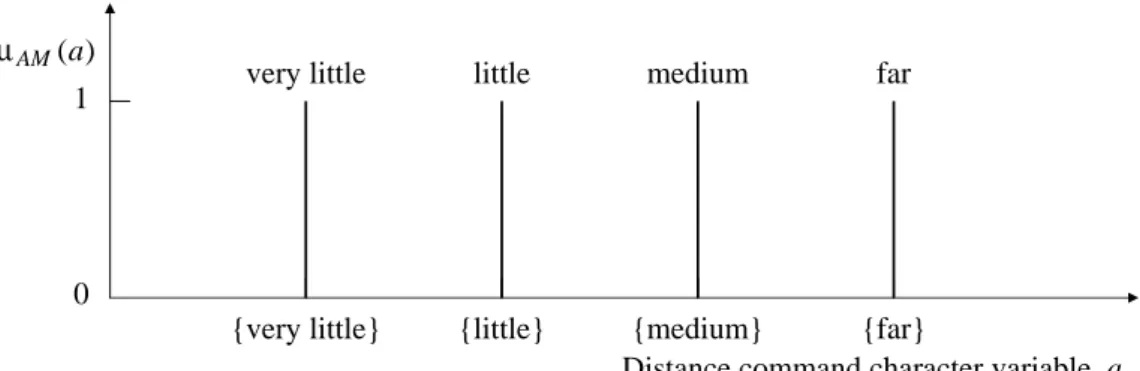
Distance command character variable, a {very little} {little} {medium} {far}
very little little medium far
Figure 3.1: Membership functions for action modification.
R4 : If a is ‘little’ and l is L then h is S
R5 : If a is ‘little’ and l is M then h is B R6 : If a is ‘little’ and l is H then h is V B
R7 : If a is ‘medium’ and l is L then h is V B
R8 : If a is ‘medium’ and l is M then h is V V B R9 : If a is ‘medium’ and l is H then h is F
R10: If a is ‘far’ and l is L then h is F
R11: If a is ‘far’ and l is M then h is V F R12: If a is ‘far’ and l is H then h is V V F
where a is the action modification character variable, l is previous distance, and h is new distance. Fuzzy labels for the previous distance and the new distance are defined by,
L : Low M : Medium H : High for l and
V V S : Very Very Small V S : Very Small S : Small
B : Big V B : Very Big V V B : Very Very Big
F : Far V F : Very Far V V F : Very Very Far
for h.
The support set of the action modification character variable a is the set of action modification command components {very little, little, medium, far} shown in Table 3.1 and its membership value is either 1 or 0: i.e., a has singleton membership functions. The membership functions for a, l, and h are shown in Fig. 3.1, Fig. 3.2, and Fig. 3.3.
The firing strength of the ith rule, αi is computed as,
αi = µAMi(a) · µP Di(l) (3.1)
Here, “·” is the algebraic product. Using Larsen’s product operation rule [60] as the fuzzy implication function, the ith rule leads to the decision,
µN D0
) (l PD µ 1 0 0 10 20 30 40 50 60 70 80 90 100 L M H Previous distance, l [mm]
Figure 3.2: Membership functions for previous distance.
) ( µND h 1 0 4 10 20 30 40 50 60 70 80 90 100 VVS VS S B VB VVB F VF VVF New distance, h [mm] 0
Figure 3.3: Membership functions for new distance.
Consequently, the membership function µN D0 of the inferred consequence is given by, µN D0(h) = µN D0 1(h) ∨ . . . ∨ µN D 0 12(h) (3.3) = α1· µN D1(h) ∨ . . . ∨ α12· µN D12(h) (3.4) To obtain the crisp output value, a defuzzification strategy is required [61]. Using the well-known Centre-of-Area method [62], the crisp output value of the new distance, h0 is
obtained as follows: h0 = R+∞ −∞ P12 i=1αihµN Di(h)dh R+∞ −∞ P12 i=1αiµN Di(h)dh (3.5) After the crisp value of the distance to be traversed, h0 is decided, it can be used to
control the tip position of the manipulator. Initially, there is no distance traveled in response to the previous command. Therefore, the initial input value can be decided according to the workspace of the manipulator.
3.3. FUZZY-VOICEJOINTCOMMANDS(FVJCS) 19
Table 3.2: Fuzzy-voice joint commands.
Axis Direction Action Action Modification
Name of Rotation
S1 + rotate your shoulder left
− rotate your shoulder right
S2 + bend your upper arm forward
− bend your upper arm backward
S3 + rotate your upper arm left
− rotate your upper arm right very little
E1 + bend your lower arm forward little
− bend your lower arm backward medium
E2 + rotate your lower arm left far
− rotate your lower arm right
W 1 + bend your wrist forward
− bend your wrist backward
W 2 + rotate your wrist left
− rotate your wrist right
3.2.2 Applications
SFMCs can provide only direction and distance information. One possible application is controlling a mobile robot. In the case of a manipulator, these commands can be used to change the tip position of a manipulator in up, down, forward, backward, left, and right directions. Although they can change the manipulator tip position in the Cartesian space, they cannot change the orientation or the posture of the manipulator. Therefore, in the case of manipulator control, these commands are very restrictive and inefficient. However, when the manipulator is in a convenient posture to reach the target point, these commands are very useful to fine-tune the tip position to reach the target.
3.3 Fuzzy-Voice Joint Commands (FVJCs)
When controlling a robot manipulator with voice commands, there is no way to control the joint angles using conventional methods [63], [64]. Instead, it would be much more con-venient for a user to issue a command such as “rotate your wrist little right.” FVJCs used during the experiments presented in this thesis are shown in Table 3.2. These commands are related to a 7-link redundant manipulator whose joint configuration, axis nomenclature, and axis motion are shown in Fig. 3.4 [65]. The axis affected by each command and the di-rection of rotation are also given. A valid command may be composed of any combination of an action and an action modification.
3.3.1 Command interpretation
The technique used for FVJC interpretation is similar to the one used for SFMC interpre-tation. It was assumed that the meaning of a fuzzy action modification command such as “very little ” or “little ” depends on the immediate past observation or experience of the user. For example, when the user issued the command “rotate your wrist little right,” the amount of rotation he observed before issuing this command should be taken into consideration
Mechanical Interface Coordinate System
Base Coordinate System Wrist Axis No. 5 (Arm Rotation) E2 Axis No. 3 (Arm Rotation) S3 Axis No. 1 Arm Left/Right Rotation
Shoulder Upper Arm Lower Arm (+) (+) (+) S2 (+) S1 (+) (+) Ym Xm Zm Xi Zi Pitch Roll Yaw Roll Pitch Yaw Axis No. 2
Arm Up/Down Pivot Axis No. 4 (Up/Down Pivot) E1 (+) Axis No. 6 (Hand Pivot) W1 Yi Axis No. 7 (Hand Rotation) W2
Figure 3.4: Arm nomenclature of the 7-link manipulator.
when calculating the actual amount to be rotated.
Once a command is issued, the angle to be rotated is determined using the angle rotated in response to the previous command as an input. Twelve rules have been used for fuzzy reasoning. They are shown below:
R1 : If b is ‘very little’ and θ is L then α is V V S R2 : If b is ‘very little’ and θ is M then α is V S
R3 : If b is ‘very little’ and θ is H then α is S
R4 : If b is ‘little’ and θ is L then α is V S R5 : If b is ‘little’ and θ is M then α is S
R6 : If b is ‘little’ and θ is H then α is M
R7 : If b is ‘medium’ and θ is L then α is S R8 : If b is ‘medium’ and θ is M then α is M
R9 : If b is ‘medium’ and θ is H then α is B
R10: If b is ‘far’ and θ is L then α is B R11: If b is ‘far’ and θ is M then α is V B
3.3. FUZZY-VOICEJOINTCOMMANDS(FVJCS) 21 R12: If b is ‘far’ and θ is H then α is V V B
where b is the action modification character variable, θ is the previous angle, and α is the new angle. Fuzzy labels are defined by
L : Low M : Medium H : High for θ and
V V S : Very Very Small V S : Very Small S : Small
M : Medium B : Big V B : Very Big
V V B : Very Very Big
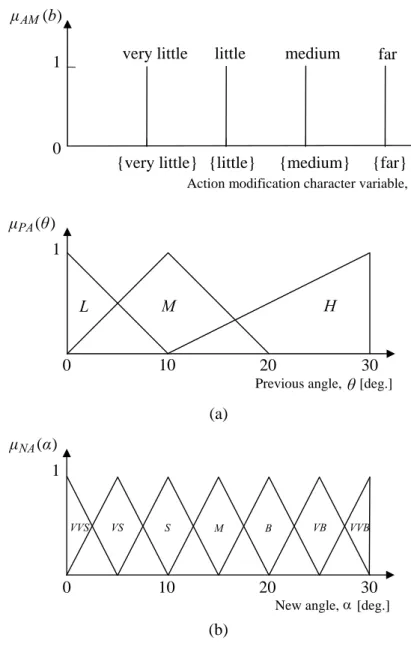
for α. The support set of the action modification character variable b is the set of action modification command components {very little, little, medium, far} shown in Table 3.2 and its membership value is either 1 or 0: i.e., b has singleton membership functions. The membership functions for b, θ, and α are shown in Fig. 3.5.
The firing strength of the ith rule, βiis computed as
βi = µAMi(b) · µP Ai(θ) (3.6)
Here, “·” is the algebraic product. Using Larsen’s product operation rule as the fuzzy implication function, the ith rule leads to the decision,
µN A0
i(α) = βi· µN Ai(α) (3.7)
Consequently, the membership function µN A0 of the inferred consequence is given by µN A0(α) = µN A0
1(α) ∨ . . . ∨ µN D012(α) (3.8) = β1· µN A1(α) ∨ . . . ∨ β12· µN A12(α)
To obtain the crisp output value, a defuzzification strategy is required. Using the well-known Center-of-Area method, the crisp output value of the new angle, α0is obtained
as follows: α0 = R+∞ −∞ P12 i=1βiαµN Ai(α)dα R+∞ −∞ P12 i=1βiµN Ai(α)dα (3.9) 3.3.2 Applications
An FVJC affects a single joint of a manipulator. In the case of a natural language controlled manipulator, since there is no way to input numerical values for joint angles, these com-mands can be used to change the joint angles. However, to use a manipulator dexterously, a rotation around one axis is not sufficient; instead, complex maneuvers that require rotations around multiple axes are required. For that, in addition to FVJCs described above, more complex and information rich posture control commands are required.
However, as discussed in Chapter 6, any complex posture control command can be decomposed into a set of FVJCs. Therefore, FVJCs play an important role in the process of learning and the execution of such complex commands.
) (θ µPA 1 30 10 20 L M H 0 1 30 10 20 0 VS S M B ) (α µNA (a) (b) VB VVB VVS 1 0
Action modification character variable, b {very little} {little} {medium} {far}
very little little medium far )
(b
µAM
Previous angle, [deg.] θ
New angle, [deg.] α
Figure 3.5: Membership functions: (a) denotes the membership functions for the action modifica-tion character variable, a and the previous angle, θ, in the antecedent part; (b) denotes the membership functions for the new angle, α, in the consequent part.
Chapter 4
Learning Situations: A Simple Path
Learning Application
4.1 Introduction
This chapter describes one of two path learning applications developed by using the coach-player system presented in Chapter 2.
In general, a situation is a complex entity that is decided by the robot world state (defined in Section 4.2.1) as well as by the intentions of the user instructing the robot. In two situations, even if the robot world states are equal, those situations are not identical un-less the user intentions are the same. The difference in the user intention requires different actions in those two situations.
However, in certain simple operations, it is safe to ignore the effect of the user in-tention, if it does not change throughout the operation. In the application described in this chapter, the effect of the user intention is not considered. In Chapter 5, a more complex ap-plication is discussed by taking the effect of the changing user intention into consideration. The organization of this chapter is as follows. Learning from fuzzy natural language instructions is described in Section 4.2. The implementation of the sub-coach is discussed in Section 4.3, together with the discussion on a decision making process based on a Prob-abilistic Neural Network (PNN). Section 4.4 presents two experimental results obtained from the implemented system; one is for the case where the tip of the manipulator moves in 2D space, whereas the other is for the case where a pick and place motion is performed in 3D space. The summary of this chapter is described in Section 4.5.
4.2 Learning from Fuzzy Natural Language Instructions
When controlling a robot with natural language, any instruction of the user depends on the state of the robot world. Here, the robot world includes the robot itself, the working environment, and the final objective. User evaluates the world state subjectively using his knowledge and experience, and issues the next instruction that he thinks the most appro-priate. For example, when controlling a mobile robot to navigate through obstacles, if the user thinks that the robot might clash with an obstacle ahead if it continues to travel at the current velocity, he might say “robot, slow down.” Consequently, the robot will reduce the speed, leading to a change in the world state; thus avoiding the collision.
Therefore, the process of controlling a robot using a series of natural language in-structions can be thought of as changing the robot world state repetitively until the required target is achieved [66].
S C i S C S f : → Infinite Finite j C
Figure 4.1: Relationship between robot world states and commands.
4.2.1 Robot world state
Robot world state can be defined using parameters that describe the state of the robot itself such as velocity, acceleration, etc., as well as parameters that describe its relation with the environment such as position, distance to obstacles, etc.
When guiding a robot to complete a job in a step-by-step fashion, at each step, the user has to issue an instruction depending on the current robot world state. Let S be the complete set of all possible world states and Sibe the world state at the ith instance. Then
it follows that,
Si = {x1, x2, ..., xp} (4.1)
Here, x1, x2, ..., xp are the parameters that define the state of the robot world. Thus, a robot
world state is a p dimensional entity and it is a member of a p dimensional state-space. All these parameters are scalar quantities. Whenever a vector is involved, its components are used as different parameters. We will come to more concrete definitions once we discuss the implementation details.
4.2.2 Learning by the sub-coach
Let C be the complete set of all valid instructions and Ci be the user instruction at the ith
instance. Then, we have
Ci = f (Si) (4.2)
Here, f is a subjective function which depends on the knowledge, experience, attitude, etc. of the user. For example, Ci can be something like “go very little.”
Since the robot world state depends on the values of various continuous parameters, S will be continuous. Thus, S may contain an infinite number of points. On the contrary, due to practical limitations, any feasible system will have only a finite number of valid instructions. Therefore, we can assume that C is discrete and finite. Thus, f is a serjective function as shown in Fig. 4.1 [67].
The objective of learning by the sub-coach during training is to learn the subjective function f so that in a later case, it can find the correct instruction corresponding to a world state not encountered during the training. However, since C contains only a finite number of elements, this is reduced to a pattern classification problem where the number of classes is equal to the number of valid instructions. Thus, if the sub-coach can classify an incoming pattern correctly, it can make correct decisions.