Demand for Organic Vegetables
in the Philippines
ῌA Study of Food Establishments and Consumers in Metro Manilaῌ
By
Nina N
OCON* and Akimi F
UJIMOTO**
(Received February +/, ,**//Accepted December 3, ,**/)Summary : Vegetable is considered a cheap nutritional source by most Filipinos, and an important component for the healthy lifestyle of the wealthy few, who represent the niche market for the organic vegetable industry. Because there is a need for updated research for a demand-driven industry, we conducted a series of survey of the demand for organic vegetables in Metro Manila from ,**,to ,**-. We collected information from ++ hotels and restaurants, ++2 general consumers, seven supermarkets and four organic markets.
The main findings of this study were as follows : (+) the majority of the hotels and restaurants showed no intention of purchasing organic vegetables due to their high regard for low price, good quality and stable supply of produce, while general consumers still seemed to be the potential buyers especially if a variety of organic vegetables are regularly available and at an a#ordable price ; (,) carrots accounted for -*ῌ of the total volume of the 1/ vegetables sold in the organic markets ; and (-) demand for carrot medium, tomato ordinary, onion and potato ordinary were highly elastic to price changes, meaning that if there would be stable supply for these vegetables, prices are expected to be lower, resulting in a higher demand. (.) Carrot combined with celery was popularly consumed as juice to naturally cure or prevent cancer. Through the cross-price elasticity analysis, carrots and celery appeared to be complementary goods.
Key words : hotels and restaurants, carrot, celery, price elasticity of demand ῍῍῍῍῍῍῍῍῍῍῍῍῍῍῍῍῍῍῍῍῍῍῍
Introduction
Recently, organic agriculture has experienced tre-mendous development and significant market growth in response to the human and environmental issues around the world+*῎
. The world market doubled to US$,-ῌ,/ billion (,**-) from US$++.2 billion (,***). Al-though most markets are still small and in their infan-cy stage in Asia, countries such as Japan, Thailand, China, and the Philippines are expected to play a sig-nificant role in both domestic and international demand. In the Philippines, organic agriculture only emerged in the early +32*s through the e#orts of NGOs and people’s organizations-, .῎
. The market size is estimated at US$0.+/ million, of which the domestic market ac-counted for .*ῌ/῎
. With the development in the
Philippine organic industry, organic vegetables have attracted several studies in the past : benchmark survey+῎
, farm production+,῎
, market studies,, 0, +-, +0῎ and industry profile., /῎
. These studies examined the econo-mic viability and technological performance of organic vegetable farming and marketing system ; but only few studies were conducted on the actual consumers of organic vegetables.
This paper aims to identify the issues and potential of organic vegetables within the demand sector. We conducted a broader demand study using a series of surveys involving the food establishments (e.g. hotels and restaurants), general consumers, retail markets and key persons in Metro Manila in ,**, and ,**-.
Data sources were three-fold. First, institutional buyers including organic buyers were interviewed in
* **
Department of International Bio῏Business Studies, Graduate School of Agriculture, Tokyo University of Agriculture Department of International Bio῏Business Studies, Faculty of International Agriculture and Food Studies,
Tokyo University of Agriculture ῌ /* ῍.῎ῌ ++,ῌ+,* ῍,**0῎
order to clarify their purchasing behavior for vegeta-bles in March ,**-. Actually, ,. establishments were targeted in Metro Manila based on referrals, previous farm interviews and business track record, but only a total of six hotels and five restaurants were coopera-tive to our research. All establishments catered to high and medium-high income classes. The restaurants ranged from fast food chain to fine dining o#ering a wide array of cuisines (e.g. Italian, Vietnamese and American).
Second, a questionnaire survey was conducted on people referred by market organizers, living or work-ing in Metro Manila in the summer of ,**,. A total of ++2general consumers were asked regarding their veg-etable demand, awareness on vegveg-etable production and food safety, problems encountered in buying organic products, and purchasing behavior towards organic products. A consumer can be characterized with a positive behavior when he/she is willing to buy a certain good at higher price than the value given and vice versa. All respondents were female with an aver-age aver-age of -..2 years old. Eighty-three percent of them had college degrees and most of them were employed, with an average annual household income of 0.2,3,+ pesos (US$+,,./-). The average household size was .., persons. There were ,- organic consumers and 3/ non-organic consumers identified.
Third, several interviews of traders/managers were also conducted in weekly organic markets and super-markets in order to obtain information on their busi-ness operation in general, and the kind and volume of
organic vegetables traded in particular. General infor-mation was taken from a total of four organic markets and seven supermarkets, while specific information was obtained from four organic markets with regular clients.
This paper is divided into six sections. Following this introduction, section two will examine the actual vegetable demand of hotels and restaurants, including the demand for organic vegetables. The third section will present the vegetable demand, organic perception and buying intentions of the general consumers. The fourth section will show the status of the market, focusing on the organic markets and supermarkets. The fifth section will attempt to estimate the price elasticity of demand for selected vegetables. Section six will be the conclusion of this paper.
The Case of Hotels and Restaurants
Vegetables Demanded and Their Sources
As shown in Table +, the total vegetable demand by the ++ food establishments was estimated to be -.,,.* kg per month : ,0,2** kg by hotels and 1,..* kg by res-taurants. According to one purchasing manager inter-viewed, hotels usually procured more than +** kinds of vegetables. The kind and volume of vegetable demanded varied depending on the type of cuisine, season (includ-ing events) and extent of the business operation. Most conventionally grown vegetables demanded were carrot, potato and tomato. This is in line with an earlier finding that potato, onion, tomato, button mushroom and carrots were the top vegetables demanded by Table 1 Vegetable Demand of the Food Establishments in Metro Manila per Month, 2003
hotels and restaurants in Luzon+/ῌ .
It is important to note that seven out of the ++ buyers demanded organic vegetables. The total volume of organic vegetables ranged from ,* kg to +.. kg per month, or *.-ῌ to -0ῌ of the total vegetables, indicat-ing that organic vegetables still had very small share. In fact, organic vegetables demanded by these estab-lishments were largely limited to lettuces and herbs. It should be noted that the high share of -0ῌ was from a restaurant which o#ered several dishes using organic lettuces to their targeted vegetarian and health con-scious customers. Three institutions reported their purchase of hydroponically grown vegetables, consist-ing of tomato and leafy greens.
According to TAGARINO+/ῌ
, institutional buyers tended to purchase vegetables based on certain qualities. For instance, carrots fully trimmed, large and free from cracks, holes and soft spots were preferred in order to satisfy their economic and culinary requirements. Our study revealed that both local and imported vegetables were being utilized in order to obtain good quality vegetables. Certainly, most of the vegetables were supplied by Baguio City through traders and/or whole-sale markets, but some hotels reported purchasing cau-liflower, broccoli and lettuce from Australia and France through a locally-based trader. Although im-ported vegetables were usually priced twice as high, they were apparently clean and trimmed. One purchas-ing manager added that they were more economical because of better size, quality and longer shelf life.
Institutional buyers regarded vegetables as an im-portant commodity among the fresh produce they regularly demanded. To attain good quality, reasonable price, su$cient supply at all times, institutional buyers especially hotels did not engage in contracts with sup-pliers. Instead, every Monday, a weekly price list from three to five pre-selected suppliers is collected. A master list is made to serve as the silent bidding form, and the supplier of a certain vegetable is chosen from the lowest bid for a given week. It seemed that price and quality were the main factors in purchasing vege-tables. Trust was shown to be a strong factor as well. Problems of Organic Vegetables Demand
Cavite farmers were regular suppliers to five-star hotels and restaurants, and fast-food chains in Metro Manila+,ῌ
. However, our study identified four major problems for organic vegetable demand. First, past buyers declined to be interviewed because of no fur-ther interest in organic vegetables and no more purchasing of such produce. This conveyed that there was still an unstable demand for organic vegetables by
food establishments and institutions.
Second, some establishments were considering to stop or not to expand their purchase of organic vegeta-bles, for the following reasons : unstable supply, high price, no certification, unreliability, poor quality and no demand from current clients. With the general demand for low priced vegetables, the establishments seemed to have no intention of buying high priced organic vege-tables.
Third, aside from the strong competition with con-ventional vegetables, there was also an emerging threat from hydroponically grown vegetables. Three out of the ++ establishments were buying these vegetables at the time of study. With its good quality in terms of size and cleanliness, other establishments showed an inter-est in purchasing them as well. Moreover, if imported organic vegetables establish a market in the future, demand for locally produced organic vegetables is ex-pected to decrease.
Fourth, among the current buyers of organic vegeta-bles, only one restaurant, stressing health foods, in-dicated in their menu that organic lettuces were used. Other buyers did not do this because of the relatively small volume purchased.
Our examination of hotels and restaurants revealed that the demand for organic vegetables appeared to be very small. With high consideration for good quality, low price and stable supply, it seemed di$cult for organic producers to penetrate into the food catering market. At the moment, suppliers could only target health-oriented small and medium enterprises. Growth and development of organic agriculture is mainly demand-driven, raising a question as to whether there is a potential demand for organic vegetables among general consumers.
The Case of General Consumers
Our study found that there was 03ῌ awareness of the organic concept among the ++2 general consumers surveyed. Almost half of the respondents understood the term organic to mean free of chemical fertilizers and pesticides. This is in line with earlier studies in Metro Manila0, +-ῌ
. It is important to note that their sources of information varied from personal communi-cation among colleagues to television and newspapers, which could be the result of the various events and information dissemination conducted through the e#orts of NGOs, private institutions and government agencies+0ῌ
.
Table , shows the average household food spending by the consumers surveyed. It should be noted that information from only 0- out of ++2 consumers were
ascertained and used to estimate household food spend-ing. Among them, there were +0 organic consumers. For non-organic consumers, the average annual house-hold food spending was 22,-13 pesos, of which vegeta-bles accounted for +/ῌ, while an organic consumer on the average spent +-.,.,0 pesos and vegetables ac-counted for +2ῌ. This implies that organic consumers actually spent more on vegetables than non-organic consumers. About 0*ῌ of the consumers bought vege-tables weekly at the wet market. The major vegevege-tables demanded were cabbage, eggplant, potato, carrots and string beans. Organic consumers mainly bought their vegetables at the supermarket and/or organic markets, and there were ,* kinds of organic vegetables mentioned, including carrots, eggplant, tomato, as the main ones.
Table - presents the percentage of consumers who were conscious of vegetable production methods and food safety when buying vegetables. In general, there seemed to be a low concern on vegetable production methods, except for more than 0*ῌ of organic consumers who knew about the use of chemical pesti-cides and herbipesti-cides. With regard to food safety, more than 0*ῌ of the ++2 consumers were aware of the possible harm of chemical pesticides and herbicides to health and the environment.
More than /*ῌ of the organic consumers pointed out unavailability and limited choice as their main problems. On the other hand, non-organic consumers complained of high prices and unavailability of organic vegetables in the market. Actually, past studies also reported that consumers would start buying organic vegetables only if a wide variety of these vegetables are regularly available and at a#ordable price0῍
. Ironically, the need for certification was not emphasized by both organic and non-organic consum-ers, indicating that the majority of vegetable transac-tions seemed to be based on trust or the suki system. Suki system is a Philippine traditional mutual agree-ment prevalent in di#erent services and commodities such as vegetables3῍
. In general, the system involves a
buyer and a seller who guarantee each other the transaction of a certain volume of produce at an agreed price on a regular basis.
It should be noted that 0*ῌ of the non-organic con-sumers showed the intention of purchasing organic vegetables if there would be improvements of the problems. Almost half considered the supermarket as their main place of purchase. Despite this finding, there are still two issues to be considered. First, the low vegetable consumption of Filipinos at -3 kg annu-ally was a critical factor for further expansion of the potential market. Thus, only those people with healthy lifestyle could be the target for marketing of organic vegetables. Second, organic vegetables were pegged at a high premium price. Economic condition could be a significant hindrance for the majority of Filipinos. Unless the price decreases, organic vegetables will just be for the niche market.
In the meantime, consumer education, regarding not just organic farming but also the importance of vegeta-bles, should be given emphasis. This could eventually increase the demand for vegetables, especially organic vegetables.
Table 2 Average Annual Household Food Spending by the Consumers Surveyed, 2002
Table 3 Percentage of Conscious Consumers of Vegetable Production and Food Safety When Buying Vegetables, 2002
The Organic Market
Since the first organic market was established in Greenbelt, Metro Manila in +33., several other markets were established and survived, while some operated only for a short span of time or moved locations. Or-ganic vegetables were currently available in various organic markets, supermarkets, health shops and doctor’s clinics (mostly attending to cancer patients) through the e#orts of many NGOs and private entities, such as Alliance of Volunteers in Development Foun-dation (AVDF), The Source, Organic Producers Trade Organization (OPTA) and Gracia Plena Social Action Center.
We conducted a transaction survey at four organic markets, namely A, B, C and D, in Metro Manila in August ,**-. A total of 1/ kinds of vegetables were sold in these markets from January to June ,**-. It should be noted that all kinds of vegetables were not regularly available, and some were o#ered in small quantities. As shown in Table ., a total volume of 3,3.0 kg of organic vegetables were sold during this period. Each consumer bought an average of ..0 kg per week.
Assuming the average household size of ../. persons++ῌ , this was equivalent to an annual per capita tion of /,.0 kg, indicating that their vegetable consump-tion appeared to be higher than the country’s average annual per capita consumption of -3 kg ; however, still less than the recommended intake of 03 kg per year.
Of the total volume sold, carrot medium accounted for the largest share of ,,-1,.- kg. This was followed by carrot big and cucumber local, amounting to 0.3.. kg and ..1.1 kg, respectively. Overall, carrots (including medium and big) alone accounted for -*ῌ of the total volume of vegetable sold. According to several traders interviewed, most carrots were usually sold in bulk of +*ῌ+/ kg weekly, and celery was often sold together because these were processed together and consumed as fresh juice. Researches show that consumption of carrot, which is a good source of beta-carotene, de-creases cancer risk or prevents worsening of the health condition+.ῌ
. One trader mentioned that a third of his customers were cancer patients and physicians.
Table / shows that the average number of customers, volume and value of vegetables per market day for organic markets were ,- people, +*/.2 kg and 1,2+3.+ pesos, respectively. For comparison, the same informa-tion was taken from a supermarket in Los Ban˜os, Laguna in November ,**-, and it became clear that the organic market stood at +ῌ, +2ῌ and ,/ῌ of the super-market in terms of number of customers, volume and value of vegetables, respectively.
According to a past study, eight out of +, supermar-kets studied in Metro Manila were selling organic vegetables+-ῌ
, of which only two sold organic vegetables without any brand. It should be noted that the brand being referred to in this section is a seal or a mark indicating the name of farm, producer or company and where the commodity was produced. We made a fol-low-up survey of seven supermarkets in ,**-, including five identified by the earlier study. It was revealed that
Table 5 Average Number of Customers and Volume of Organic Vegetables Traded per Market Day, JanuaryῌJune 2003 (N῍94)
Table 4 Vegetables Sold in Four Organic Markets Studied in Metro Manila, JanuaryῌJune 2003
only two supermarkets still o#ered organic vegetables but of di#erent brand, and one new supermarket sold unbranded ones. The share of organic vegetables in the total sale of vegetables was estimated to be /ῌ by a manager and was expected to increase in the near future. In addition, another supermarket transacted about .** kg of organic leafy greens per week.
It is noteworthy that two major supermarket com-panies in Metro Manila already established an organic vegetable section within their stores through the cooperation of respective NGOs and private entity. However, according to store managers and division supervisors, most of them still have di$culties in finding a stable supplier of organic vegetables. In contrast, some organic farmers interviewed informally mentioned that there was a lack of buyers and retailers (e.g. super-markets) in Metro Manila, pointing to the fact that supply-demand chain was still weak. It seemed that
the issue of the inaccessibility of consumers, traders and producers,῍
was still apparent and there is a need for establishing an e#ective distribution system such as the teikei (producer-consumer contract) system1῍
in Japan.
Table 0 presents the price di#erentials for selected organic and conventional vegetables based on our surveys. It became clear that organic vegetable prices were generally higher than conventional vegetables by 0ῌ for cauliflower to ,.*ῌ for cabbage. A PBSP study+-῍ reported a +/ῌ/*ῌ price premium, while TAGARINO+0῍ revealed that organic vegetables were sold at /ῌ,/*ῌ higher prices than conventional vegetables.
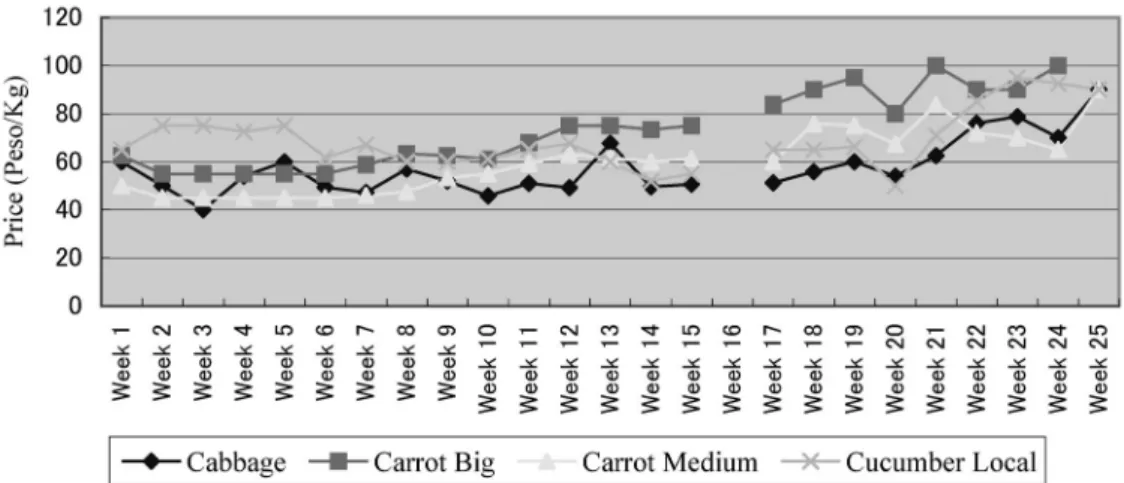
Figure + shows the average weekly price trends of selected organic vegetables. Vegetable prices seemed to be lower during dry months from December to March compared to the wet months. According to a market facilitator, selling price was usually lowered the next market day for unsold produce, reflecting the nature of perishable commodities. Moreover, she also mentioned that prices depended on the purchasing power of the buyer. For instance, a well-o# customer could be o#ered with carrots at a higher price than cancer patients with an average income. Prices were also a#ected by environmental factors such as typhoons. For example, typhoon “Chedeng” damage caused a drastic increase in vegetable prices from week ,*to week ,+.
Estimation of Demand Elasticities
During the transaction survey conducted in August ,**-, price and volume of organic vegetables from January to June ,**- for four markets were collected. The actual price and volume for a total of 3. market days were further calculated for ,. weekly averages. Excluding four weeks of data for January when only
Fig. 1 Weekly Average Prices for Selected Organic Vegetables, JanuaryῌJune 2003 Table 6 Price Differentials for Organic and
Con-ventional Vegetables in a Supermarket in Metro Manila, August 17, 2003
three markets were open, the total of ,* weekly data were used in this section to estimate own-price elastic-ity for selected organic vegetables and cross-price elas-ticity of demand for carrot medium. Unfortunately, socio-economic factors for each transaction could not be ascertained.
Table 1 shows the estimates of price elasticity of selected organic vegetables using a log-linear model : ln Qvῐa῎b ln Pv, where Qv and Pv were defined as volume (kg) and price (peso per kg) of a given vegeta-ble, respectively. Although not statistically significant, the estimated coe$cients for broccoli, potato medium and onion were῏+.+//, ῏+./3* and ῏+.1+., respective-ly. Except for broccoli, all were highly elastic. On the other hand, the estimated coe$cients for carrot medium (῏+.00*) and tomato ordinary (῏,.,+0) were statistically significant at the +ῌ and /ῌ probability level, respectively. These elasticities imply that for one percent increase in its own price per kg, the demand for these vegetables decreases by about +.1ῌ and ,.,ῌ, respectively, indicating highly price-elastic nature of the commodities. If there will be a stable supply of these commodities, the prices are expected to decline, resulting in an increase in demand for organic vegeta-bles. For the case of celery, own-price elasticity was ῏*.3/- and not statistically significant. The estimate indicates that the demand for celery was not respon-sive to its own-price. We assume that demand for celery maybe a#ected by other vegetables (e.g. carrot). Because carrots and celery appeared to be commonly processed and consumed as juice, it is useful to calcu-late the cross-price elasticity of demand for carrot medium. We assume that carrot and celery are comple-mentary goods. Thus, we expect a negative sign for cross-price estimates. Using the log-linear model : ln QCMῐa῎b ln PCM῎c ln PCEL῎Ds, where QCM, PCM, PCEL, and Dswere defined as volume of carrot medium, price of carrot medium, price of celery, and season dummy (* ῐdry season ; +ῐrainy season), respectively, we ob-tained the following results :
lnQCMῐ3.**1῏+.,/1 lnPCM῏*.**2 lnPCEL῏*.,,- DS ῌ,.3-.῍ ῌ῏,..-1῍ ῌ῏*.+2,῍ ῌ῏+.*-2῍ R, ῐ*.0+2 Adjusted R, ῐ*./.0 Nῐ,* Figures in parentheses are the t-values, indicating that only the regression coe$cient of carrot medium price was statistically significant at the +*ῌ probabili-ty level. Although the coe$cient for celery price was not statistically significant, it had a negative sign pointing to the tendency that carrot medium and celery were complementary goods. The regression coe$cient for the seasonality variable was not statistically signifi-cant, but had a negative sign. This suggests that the demand volume for carrot medium decreases in the rainy season, because the price gets higher due to the limited availability of the commodity.
It should be noted that the actual price often reflected the purchasing power of customers and the volume of left-over from the earlier market day, implying that the demand and price relationship was largely determined by other variables. Especially celery was more perish-able than carrot medium and the price for left-over celery tended to be much lower on the following market day. Our estimation is still in the preliminary stage, and future analysis should include other varia-bles such as socio-economic and environmental factors. Moreover, comparison with conventional vegetables should also be considered. We also realize the need for the inclusion of various seasonal data (e.g. annual, monthly, weekly, daily, holidays, paydays) to improve the results of the demand estimation.
Conclusion
This study aimed to examine the potential of the organic vegetable industry in the Philippines, by clari-fication of the demand aspect, based on the series of surveys conducted on hotels and restaurants, general consumers and organic markets located in Metro Manila from ,**, to ,**-. The main findings of this Table 1 Estimates of Price Elasticities for Selected Organic Vegetables, 2003
study were as follows : First, hotels and restaurants showed a relatively small demand for organic vegeta-bles, limited to lettuces and herbs. Further demand for organic vegetables could not be expected due to high price, low quality and unstable supply, except for some specialized establishments. Second, consumers still appeared to be the potential buyers of organic vegeta-bles, but the premium price and low annual per capita vegetable consumption of Filipinos could hinder fur-ther expansion. Third, a total of 1/ kinds of organic vegetables were identified at the on-going organic markets, of which carrots accounted for -*ῌ of the total volume. The prices of organic vegetables were 0ῌ to ,.*ῌ higher than conventional vegetables. Fourth, demand for carrot medium, tomato ordinary, onion and potato ordinary were highly elastic to price changes. This means that if there would be stable supply of these vegetables, prices are expected to de-cline, resulting in a higher demand. Based on cross-price elasticity analysis, carrot and celery appeared to be complementary goods. There also seemed to exist a seasonal influence on the determination of price and demand for carrot, which requires further analysis in the future.
It seemed to be important for the organic vegetable industry to focus on maintaining and strengthening its current niche market through consumer education and information dissemination, while improving the pro-duction capability and quality of products. Moreover, with the advancement of organic vegetable production in other countries, and the influx of high quality and reasonably priced imported vegetables, the impact of international trade on the industry should also be con-sidered in the near future.
In addition, further research is needed on creating a teikei system between consumers and producers in the local setting. With perishable goods, this is one method of achieving e$ciency in marketing, while having har-monious relationship between consumers and producers.
Acknowledgements
We deeply acknowledge the generous cooperation of the supervisors of the food establishments and markets, and consumers surveyed. Also, Mrs. Alexis BANTILES
(AVDF), Mrs. Mara PARDO DETAVERA(The Source), Mrs.
Rosalina TAN (OPTA-Philippines) and Mr. Eduardo
SAMANIEGO(Zachy’s Farm) were most helpful. We also
thank the two anonymous referees for their comments in improving our paper. The field surveys were con-ducted as a part of the Academic Frontier Cooperative Research Project, Tokyo University of Agriculture.
References
+῍ ABUNYAWAN, J., ,***, “A report on the inventory of existing organic producers”, Unpublished Paper, Center for International Trade Exhibits Mission (CITEM), Manila. ,῍ ARNALDO, C., ,***, “Availability of organically grown vegetables in selected retail markets in Metro Manila, +333”, Unpublished Undergraduate Thesis, College of Economics and Management, University of the Philip-pines Los Ban˜os, Los Ban˜os, Laguna, Philippines. -῍ BANTILES, A., ,**+, “Divergence and convergence in the
Philippine organic movement”, Proceedings of the Fifth IFOAM-Asia Scientific Conference, October -+ to Novem-ber ., ,**+, Hangzou, China, pp. +ῌ/.
.῍ BRIONES, A. et al., +331, Program for the development of the organic food industry, United Nations Programme, Manila, Philippines.
/῍ CANONO, J., ,***, Philippine organic products : Organics market brief, A Global Agric. Info, Network Rep. No. RP **+/, USDA-FAS.
0῍ CASIN O, A., +33/, “Market study of organic vegetables in Metro Manila”, Unpublished Undergraduate Thesis, Col-lege of Economics and Management, University of the Philippines Los Ban˜os, Los Ban˜os, Laguna, Philippines. 1῍ HASHIMOTO, S., +333, “Teikei system and sustainable soci-ety”, People First in Asia’s Organic Agriculture, Proceed-ings of the .th IFOAM Asia 33 scientific conference,
Tagaytay City, Philippines, November +2ῌ,+, +333, pp. .-,ῌ.-0.
2῍ HARRIS, B., ,***, “Demand for local and organic produce : A brief review of the literature”, Environmentally Identified Products Review, Report No. ,/.A, Institute for Public Policy and Business Research, University of Kansas, USA. 3῍ HENDRIKS, M., +33., “Trade arrangements and interlinked credit in the Philippines”, In Bouman, F and O. Hospes (eds.), Financial landscapes reconstructed : the fine art of mapping development, Westview press, USA, pp. ,*3ῌ,,+. +*῍ KORTBECH-OLESEN, R., ,**-, “Market”, In Willer, H. and M. Yussefi (eds.), The world of organic agriculture : statistics and future prospects. International Federation of Organ-ic AgrOrgan-icultural Movements (IFOAM), Tholey-Theley, Germany, pp. ,+ῌ,/.
++῍ National Statistical Coordination Board (NSCB), ,**,, Philippine statistical yearbook, Manila, Philippines. +,῍ NOCON, N., R. MIYAURAand A. FUJIMOTO, ,**,,
“Techono-logy and economic performance of organic vegetable farming in the Philippines : A case study of lettuce pro-duction in Cavite”, Journal of ISSAAS, 2, .0ῌ0-. +-῍ Philippine Business for Social Progress (PBSP) : Upland
Marketing Program, +331. Market potential study for organically grown rice and vegetables, Funded by pine Development Assistance Program, Manila, Philip-pines.
+.῍ SLATTERY, M.L., et al., ,***, “Carotenoids and colon cancer”, American Journal of Clinical Nutrition, 1+ : , : /1/ῌ/2,. (Abstract)
+/῍ TAGARINO, D., ,**,, “Institutional buyer’s demand for vegetables”, PIUC research briefs, Vol + : ++, Philippine Institutional University Cooperatives Programme, Benguet State University.
+0῍ TAGARINO, D., ,**,, “Marketing of organically grown vegetables”, PIUC research briefs, Vol + : ++, Philippine Institutional University Cooperatives Programme, Benguet State University.