Transmission and Localization of Cultures:
Focusing Japanese Food in Italy
Yo
T
ABAYASHI※Abstract
Cultures are transmitted when they are in contact. Some of them are rejected and others are desired by the receiving community. From the past we human beings have a long history of this kind of cultural transmission, and in the current globalizing world, cultures travel farther, faster, and more often. This paper aims to clarify some patterns, processes, and outcomes of cultural transmission and localization abroad. The first chapter gives a glance to definitions of the word culture, and examines four forms of cultural transmission, among which the amalgamation/adaptation is to be delineated the most. The second chapter overviews Japanese foodways changing over time. The third chapter discusses under which circumstances transmission and localization of foodways occur. The last chapter describes cases of localization of Japanese food in Italian restaurants. Focusing on Japanese cuisines/food changing inside Japan and travelling abroad, the issues like localization and authenticity are to be discussed, by literature review of the past researches, the governmental documents, description of websites of restaurants, and field work in Milan and Bergamo in Italy. Among our findings is the fact that localization spontaneously occurs beyond control of anybody including the authority, since culture gets localized accommodating local customers tastes and other conditions in its host communities.
Key Words: authenticity, localization, transmission, Japanese food, Italy
Introduction
Cultures are transmitted when they are in contact. Some of them are rejected and others are desired by the receiving community. From the past we human
※ Professor, College of Policy Science, Ritsumeikan University © The Policy Science Association of Ritsumeikan University:
beings have a long history of this kind of cultural transmission, and in the current globalizing world, cultures travel farther, faster, and more often. This paper aims to clarify some patterns, processes, and outcomes of cultural transmission and localization abroad. The first chapter gives a glance to definitions of the word culture, and examines four forms of cultural transmission, among which the amalgamation/adaptation is to be delineated the most. The second chapter overviews Japanese foodways changing over time. The third chapter discusses under which circumstances transmission and localization of foodways occur. The last chapter describes cases of localization of Japanese food in Italian restaurants. Focusing on Japanese cuisines/food changing inside Japan and travelling abroad, the issues like localization and authenticity are to be discussed, by literature review of the past researches, the governmental documents, description of websites of restaurants, and field work in Milan and Bergamo in Italy.
1. Cultural Transmissions
Culture is hard to define. In this chapter, we will firstly take a look at how culture has been defined referring to its characteristics. Then we are overviewing patterns of cultural transmissions between societies since cultures in contact would be most recognized by group of people involved.
1.1. What is Culture?
Definitions of culture are various as well as changing. For example, Edward Burnett Tylor (1832–1917), an English anthropologist, defines culture in his famous Primitive Culture: Researches into the Development of Mythology,
Philosophy, Religion, Art, and Custom (1871) as follows.
Culture or civilization, taken in its wide ethnographic sense, is that complex whole which includes knowledge, belief, art, morals, law, customs, and any other capabilities and habits acquired by man as a member of society (1). One century later, on the other hand, Clifford Geertz, an American ethnographer, argues to replace the definition by Tylor in his epoch-making book, The
Interpretation of Culture (1973).
The concept of culture I espouse . . . is essentially a semiotic one. Believing, with Max Weber, that man is an animal suspended in webs of significance he
himself has spun, I take culture to be those webs, and the analysis of it to be therefore not an experimental science in search of law but an interpretive one in search of meaning (5).
Indeed, there are many other convincing definitions depending on persons or times. In this paper, we refer to Oxford English Dictionary, since it defines
culture in more general and simpler ways as below:
III. Extended uses (from branch I.)
6. Refinement of mind, taste, and manners; artistic and intellectual development. Hence: the arts and other manifestations of human intellectual achievement regarded collectively.
7. a. Chiefly as a count noun. The distinctive ideas, customs, social behaviour, products, or way of life of a particular society, people, or period. Hence: a society or group characterized by such customs, etc.
As the definition in OED mentions development, achievement, and a particular society, people, or period, culture is perceived when it gets formed and accepted by members of a particular society. It is neither static nor universal and changes along the timeline and differs from one place to another. In addition, culture is not always obvious to people living inside the particular culture. Members of a society usually notice their own culture when they encounter with another culture seemingly different from theirs. Seeing differences between the two cultures, people acknowledge their own familiar culture and other new cultures.
1.2. Cultures in contact
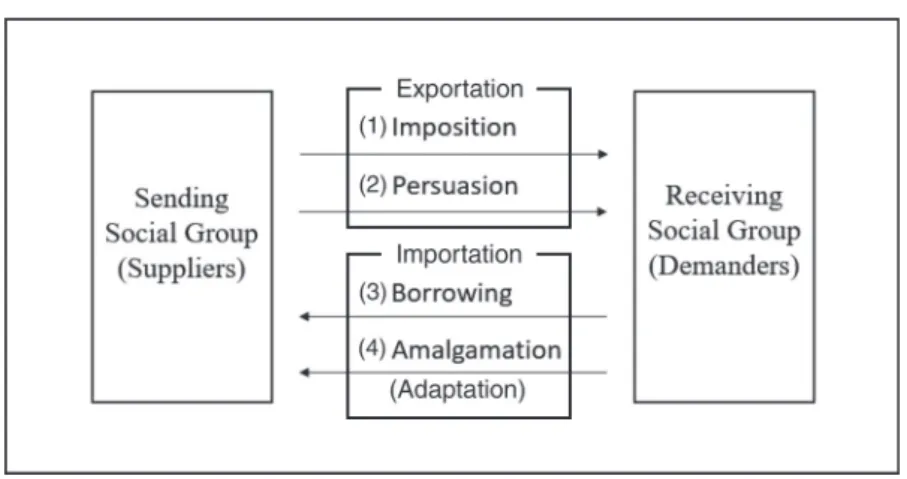
Cultures are transmitted when people get in contact with other group of people. The process often takes place in the order of importation, reception, diffusion, and adaptation/fusion (plus exportation in cases). As for a theoretical framework, we refer to four forms of cultural transmission (Koizumi 2004) in order to understand and categorize various cultural transmission/transformation depending on the relationship between the sender/supplier and the receiver/ demander of the culture transmitted1.
As we see in Figure 1, cultural transmission needs two social groups: one is sending social group (sender/supplier of culture); the other, receiving social group (receiver/demander of culture). Koizumi names four forms of transmission such as (1) Imposition, (2) Persuasion, (3) Borrowing, (4) Amalgamation, focusing on who voluntarily initiates the transmission (2004:160). As you see the arrows in the Figure 1, both imposition and persuasion are initiated by the sender, who wants another society to accept or learn his/her own culture. In this case, the transmission would be sender/supplier-oriented. In imposition, often seen under colonialism for an instance, the supplier imposes an allegedly superior culture, often with violence, regardless of the receiver s will. In persuasion, such as Christianization by missionaries, the supplier persuades the receiver to voluntarily accept a new culture. Both go under the same umbrella term of exportation of a culture from sending/supplying societies to other societies.
Transmission such as borrowing and amalgamation, on the other hand, are receiver/demander-oriented. The receiver/demander wants a certain culture, and then imports or borrows it. However, as we noted before, culture usually changes when in contact with other cultures. Therefore, complete borrowing is unlikely to happen. For instance, many languages have borrowed words from other languages, but they often have different pronunciation and/or different spellings after transmission2.
Amalgamation, more likely to be known as adaptation, mixture, or fusion, is a type of transmission in which the sender s original culture transforms, gets adapted in, and is fused with the receiver s local one. Amalgamation along with borrowing goes under the umbrella term of importation of a culture by
Figure 1: Four Forms of Cultural Transmission(adapted by the author from Koizumi 2004:160)
receiving/demanding societies from sending/supplying ones. However, in nowadays globalizing world, amalgamation, also known as adaptation/fusion, is the most prevalent among the four forms above. This is true because neither complete borrowing often occurs as we see in cases of language, nor does the
sender-oriented transmission such as imposition or persuasion. Recently there
has been much emphasis on equality, democracy, human-rights and in particular multiculturalism, so imposition by force cannot be allowed at least de jure, and even persuasion, in which the receiver would look happy to be persuaded, is not so much recommended, either3.
For the purpose of our current research on cultural transmission and transformation, therefore, we will concentrate on the receiver-oriented
transmission, i.e. importation of a culture. We would like to take food culture for
discussing what happens when two or more cultures meet, since food/dishes are transmitted and spread faster and more extensively in bigger markets with less expensive costs, compared with cultures depending on languages such as literature or straight dramas (Tabayashi 2017:243).
2. Japanese foodways changing over time
Foodways are defined as what we eat, as well as how and why and under what circumstances we eat (Edge 2007:8). Guptill et al. follows him, stating, [t]he concept of foodways focuses our attention on food preparation and consumption, as well as cultural dimensions of food and eating (2017:4). Again,
Oxford English Dictionary gives us a simpler definition, [t]he traditional customs
or habits of a group of people concerning food and eating. Referring to these definitions, this chapter overviews changing foodways in Japan, in order to understand how a culture transforms even inside the place of origin.
2.1. Diachronic change of Japanese foodways
Cuisines typically known as Japanese dishes4 do not have such long history
as we may expect. According to Eric C. Rath, sushi, soba, and tempura, the main edifices of Japanese cuisine . . . were representative of the diet of Edo (Tokyo)5
and Kyoto cuisine (kyo ryori) [which] dates to the Meiji period (1868-1912). . . was not widely used until the Taisho era (1912-1926) (147). Isao Kumakura, a historian and the chief editor of Nihon Shokubunka Tekisuto (Textbook on Japanese food culture) broadly regards Japanese food culture as dishes Japanese habitually had eaten till 1955 (2012:4). He admits that food (culture) is
constantly changing, and yet argues for a reference point to estimate how different our current foodways are from the so-called traditional Japanese food culture (2012:1). More concretely, Kumakura suggests ichij sansai meal for a basic example. Ichij sansai literally means one soup and three dishes with cooked rice (staple food) and Japanese pickles, which we must remember varies from home to home.
2.2. Two drives for conserving traditional Japanese cuisines, washoku
It may be interesting to point out here why, in 2012, the textbook on Japanese food culture was published by Ministry of Agriculture, Forestry, and Fisheries (MAFF). Two years later in 2014, a simpler introductory guidebook to washoku, titled Washoku: Nihonjin no Dentotekina Shokubunka (Japanese cuisines: traditional food culture of Japan) was disseminated by the same ministry. Actually this kind of promotion of Japanese food dates back to 2005 when
Shokubunka Kenkyu Suishin Kondankai (Meeting for advancing food culture
research) got established (Kumakura 2012:1), while Shokuiku Kihon Hou (Basic act on food education) was enacted on the same year. The preamble of Shokuiku Basic Act reads
In such a changing situation surrounding food and nutrition , there s a need to cultivate the philosophy of the nation about food and nutrition and enhance people be able [sic] to practice a healthy dietary life. By keeping on pursuing coexistence of cities and farming/fishing villages and trust between consumers and producers, we expect to empower communities, pass Japan s rich traditions of dietary life, produce ecologically clean food and stimulate consuming and supplying situations (Adachi: n. p.; emphasis added). 6
The article 7 of the Act articulates importance of tradition of the excellent dietary culture. This emphasis on promoting and retrieving traditions of Japanese foodways could be generally explained by two social situations. One is a positive drive to propagate washoku as a cultural heritage by the United Nations Educational, Scientific, and Cultural Organization (UNESCO), which successfully ended up with its registration in December, 2013. Another, rather negative drive is a sense of fear of the Japanese nation of losing traditional food culture. Many books, articles, and posts on websites or other media, discuss changing foodways of Japanese in terms of health, economy, culture, and so on, some of which warn against westernization of Japanese palates and eating habits (Iwamura 2003;
McCurry 2007; Walsh 2007; Ryall 2018). Currently, the two drives, to promote Japanese food culture and to describe changing foodways, seem to accelerate both in global and domestic settings. Research shows that what Japanese eat at home is getting away from traditional Japanese dishes typified as ichij sansai. According to a survey conducted in 2012, many Japanese still take rice, miso-soup, and green tea at home (Noda 2015:45), while another survey of 2012 through 2014 shows that ichij sansei dinner only appeared 1.4 times a week (Iwamura 2017:42), which decreased from 2.7 times in 2003 and 2004. The result demonstrates that Japanese home foodways have changed greatly over the course of time and now they do not often eat Japanese dishes at home7. This we may call
diachronic change of Japanese food culture. Then what about synchronic change? What is happening about Japanese food transmitted overseas? In order to grasp its transmission and transformation outside of Japan, the next chapter explores Japanese food/dishes/cuisines traveling over the globe.
3. Travelling cuisines overseas
As we discussed above, foodways in Japan have been changing particularly from 1950s. However, they are not changing alone with time. They also are changing by contacts with other cultures. This chapter looks at cases of transmission of foodways, as more and more people nowadays are travelling farther and more often in the globalizing world. The first section describes historical cases of cultural transmission, the second focuses on transformation/ localization of imported cultures in a host country, and the last section looks into what authentic washoku signifies as a reference point.
3.1. Cultural transmission by traveling people
Culture is moving around with people traveling. As an earliest case between Europe and Japan, Europa e esta provincia de Japao (1585) written by Luis Frois (1532-97), a Portuguese Jesuit, is considered one of the first exposures of Japanese culture to Europe. He brought European/Catholic culture, either tangible or intangible, to Japan and conversely conveyed Japanese culture, including cuisines, to Europe by the book and other writing of his. Likewise, many books/articles are published on Italian and Japanese cuisines respectively transmitted to and developed in the USA (Cinotto 2013; Cwiertka 2014), and on Italian cuisines transmitted to Japan (Sawaguchi 2015).
smell, and sight, often transmitted rather easily as mentioned above8. However,
any cultures cannot be transmitted by themselves. In the 16th century, Japanese
encountered European culture thanks to Frois who traveled from far away to Japan. In the early 20th century, among many other immigrants in the United
States, Italians in New York and Japanese in Los Angeles brought their foodways to the new land, and provided the food firstly for their family members, then the immigrant neighbors from the same home countries, and finally for the new clients, namely Americans (Cinotto 2013; Cwiertka 2014). Migration to the USA described by Cinotto and Cwiertka was a one-way trip, whereas the cases shown by Sawaguchi were a round trip experience of individual Japanese chefs who opened their own restaurants back in Japan after studying/working in Italy. In either case, people, whether immigrants or professional chefs, moved between two locations, i.e. their home countries and host countries. As you remember, any cultural transmission needs people, at least two parties, say sending society and receiving one. And the cases here are cultural transmission in contact by physically traveling people.
3.2. Localization of transmitted food
3.2.1. Traveling cuisines by traveling people
Cases in the previous section are cultural transmission by people physically traveling overseas. Individuals or group of people have immigrated to another country, and cooked and eaten their own home cuisines (Cinotto 2013; Cwiertka 2014). Regarding Japanese chefs, they have traveled to Italy and come back home with the skills and knowledge of Italian cuisines (Sawaguchi 2015). Either for a one way or round trip, they all have encountered different cultures, and struggled for representing/presenting authentic cuisines at distant locations from places of the cuisines origins. Among their challenges are primarily about material/ ingredients and laws concerning food. Recently, thanks to global networks of transportation and distribution, it is getting easier to obtain imported foodstuff, and yet cooks have difficulty to utilize it due to laws, prices, and/or tastes of local customers9.
3.2.2. Localization of cuisines
Partly because cooks overseas are unable to reproduce authentic dishes as eaten in their home countries, and partly because local customers do not necessarily like authentic imported cuisines, cooks develop recipes in different ways from the original, or create new recipes to suit local customers palates. This
is localization of cuisines. One of the definitions of localization in OED is the action or fact of making something local in character, or of adapting something for a local audience or market. It would be better to quote Gloria Cappelli, a linguist, in order to understand localization more concretely:
Localization is that process by which a product (in the broadest possible sense) is made linguistically and culturally appropriate to the target locale , terms which indicate both a language variety and a set of cultural
preferences (Pym 2001) of the target market where the product must be promoted or sold (Cappelli 2008:1; emphasis added).
Translation studies such as Maci (2013) also share the definition of localization as a process of cross-cultural text adaptation originally mentioned by Anthony Pym (2001)10.
We can apply the term and its definition broadly to cuisines, since transmitted cuisines undergo localization as well. It is true that languages always matter when cultures are getting transmitted. Even a CD/DVD of instrumental music without lyrics sells with at least a translated title, often with explanatory notes on the piece, and more detailed translation is accompanied when the musical score is published. Cuisines may be more heavily involved in languages, as restaurants and cookbooks need not only names and explanations of the dishes but also recipes including ingredients in the target languages. It may also be understood for a way of acculturation, a type in which local cooks/food producers transform dishes to satisfy their customers palates. Please note here it is not people who acculturate to the new dishes as in many cases when we travel abroad, but it is the dishes which accommodate the local people s preference by skills of local cooks. This means local cooks and the dishes are flexible. Due to the limited space in this paper, however, we would like to mainly discuss Japanese dishes served on the table in Italian restaurants, as examples of typical tangible culture. How is sushi or ramen served and how does it taste? How different/ localized are they, compared with the same kind of dishes in the country of their origin, say, Japan?
3.2.3. Authentic Japanese cuisine, washoku: UNESCO cultural heritage as a reference point
We are going to discuss the questions above later in section 4.4. However, in order to answer the questions of difference/localization from the original, we
need a reference point as we discussed the washoku textbook in section 2.2. For the reference point, we may wish to look at the characteristics of washoku presented by Japanese government in the application to UNESCO for registration as a cultural heritage. On December 4, 2013, UNESCO registered washoku (traditional Japanese cuisine) as an intangible cultural heritage, a social custom handed down from generation to generation that expresses Japanese people s respect for nature. ( Washoku Designated UNESCO Intangible Cultural Heritage 2014). The Japanese Government indicated the four characteristics of
washoku in its application in 2012. The following citation seems a bit long, but it
is beneficial for us to capture what Japanese government regards as authentic and original washoku:
1. Diversity and freshness of ingredients, and respect for their inherent flavors
Because of the great latitudinal range of the Japanese archipelago from north to south, the land is characterized by many mountains and proximity to the sea. The richly varied natural environment has meant that each regional Japanese cuisine uses a diversity of ingredients strongly rooted in the terroir. This has been accompanied by the development of cooking methods and utensils that make the most of the ingredients used.
2. An exceptionally well-balanced and healthy diet
The basic composition of the typical Japanese meal, rice with ichij sansai ( one soup and three side dishes ) is said to have ideal nutritional balance. Because washoku makes skillful use of the umami11 flavor, very little animal
fat is used. This is one cause of the longevity of Japanese people, and it also helps to prevent obesity.
3. An expression of natural beauty and the changing seasons
Another characteristic of washoku is the sense of the beauty of nature and of the changing seasons expressed at the table. By decorating food with blossoms or leaves and by using dishes and other utensils that reflect the changing seasons, the Japanese are able to enjoy each season at meal times. 4. Close links with annual events
Japan s food culture has evolved in a close relationship with New Year s festivities and similar annual events. By eating at the same table and sharing nature s bounty, familial and community bonds are strengthened.
You may be surprised to find the description above rather abstract, even considering washoku is registered as an intangible cultural heritage. No name of typical dishes like sushi or tempura (deep-fried dishes) is mentioned, let alone its essential element of dashi (broth). Rather it emphasizes ingredients, nutrition, seasons/seasonal events, and closeness to nature. In other words, washoku presented here is a kind of coordinated composite art, like lyrical opera, consisting of ingredients, nutrition, cooking, tastes, presentation, tableware, and places and occasions in which the dishes are enjoyed.
4. Japanese cuisines abroad: their popularity and localization Although this intangible abstractness of Japanese cuisines mystically attracts the world s attention for sure, it would not be easy for non-Japanese to imagine what they are like only from the verbal explanation above. Nor, there seems easy access to authentic Japanese dishes, since the dishes are generally expensive and it is hard to find good restaurants among many. Then why Japanese food is so popular among non-Japanese?12 This chapter discusses how
popular Japanese food is and how it is localized to be liked among the local people overseas. In this paper, our field is set in Italy because Italy is one of the best-liked countries for food as well as China and Japan (JETRO 2014).
4.1. Popularity of Japanese food abroad
The number of Japanese restaurants outside Japan has been constantly rising: about 24,000 restaurants in 2006 more than doubled to about 55,000 in 2013, and in 2015 more than tripled to 89,000 (Ministry of Agriculture, Forestry and Fisheries 2015). A survey in Moscow, Ho Chi Minh City, Jakarta, Bangkok, San Paulo, Dubai, by Japan External Trade Organization (JETRO 2013), a branch of MAFF, shows us how popular Japanese cuisines are: 66.3% liked Japanese dishes, 46.4% Italian dishes, and 42.5% Chinese dishes (JETRO 2014)13.
Interestingly, the survey is targeted for customers who had purchased Japanese food or gone to Japanese restaurants in either cities, and/or who would like to try out Japanese food/drink or Japanese restaurants in the near future. The point is, JETRO did not define what Japanese food/restaurant is. This means the subjects, i.e. local customers, responded to the survey rather freely, depending on their own ideas of Japanese food. Therefore, the food the subject considers Japanese are often cooked by non-Japanese. Another survey by JETRO (2013) in China, Hong Kong, Taiwan, South Korea, United States, France and Italy, also demonstrates
that the subjects liked ramen and curry and rice as well as sushi, tempura, and yakitori (grilled chicken on skewers) for Japanese food. This exemplifies that Japanese food includes not only authentic washoku, but also originally imported food such as ramen from China, and curry and ricefrom India via United Kingdom14, and that it is being localized at this moment by local or non-Japanese
cooks for local customers tastes.
4.2. Popularity of Japanese Pavilion at Milan World Exposition 2015
Although sushi and some other Japanese food had already spread and got known in many cities, authentic Japanese cuisines remain inaccessible for many people beyond the national border primarily because of high price in general and unfamiliarity. One of the triggers to make Japanese cuisines more accessible, particularly to Italians, was definitely Milan World Exposition 2015 featuring Feeding the Planet, Energy for Life held on May first through October the 15th.
Among 145 countries joining the exposition, Japanese Pavilion was extremely popular, attracting about 2,280,000 of 20 million visitors ( 20 million people visited Milan Expo : Ministry of Economy, Trade and Industry, 2015). The pavilion provides visitors with many choices for food. For an exceptional experience, Minokichi, one of the classiest Japanese restaurants, offered authentic Japanese cuisines with a party of cooks and genuine ingredients specially brought from Japan. It cost more than €100 per person. However, other choices are also available with less expensive costs. Visitors could enjoy their favorite dishes in a food court area with shops specialized in sushi, beef dishes, hamburger, curry, and udon noodles, some of which are from fast food restaurant chains. Actually, it was an invaluable occasion for Italians as well as other visitors to try and taste a variety of new food and cuisines, including authentic washoku15 on the spot in
person. Italians are said to like traditional food cooked by mamma, and they allegedly are a little conservative, regarding tastes (JETRO 2015B; Oshima 2018). Having said that, or more pertinently, therefore, they seem to get attracted to Japanese cuisines which keep traditions and utilize natural ingredients/ seasonings as much as possible16.
4.3. Promotion of Japanese food by Japanese authorities
As we overviewed in the second chapter, Japanese foodways are changing now. Remember that we Japanese are losing traditional foodways is common fears among some professional cooks, researchers of cooking, and educators. With the shared worries, in order to keep and disseminate Japanese food in appropriate
ways, the government decided to issue a certificate to qualified Japanese sushi restaurants overseas. However, this policy actually was not enforced since Japanese government got criticized as Sushi Police (Zimmerman and Ueno 2006) after an experimental implementation in France in 2006 ( Nihon no sushi
wo mamore ). Naturally, it is hard to regulate or authorize any food/dishes as
authentic cuisines overseas, because localized in their host communities, they are changing and beyond control of the original site of the dishes. Eventually, one year later, Japanese government quit its policy of certifying qualified restaurants/ stores serving Japanese dishes/food and changed it to giving a recommendation to the shops17.
Currently the government identifies shops which use/sell produce and products made in Japan, rather than authorizing restaurants serving dishes such as sushi. JETRO calls for supporter restaurants/food shops which help promote made-in-Japan produce/products in foreign countries. Even though both programs are based on certification by Japanese authorities, the ideas are totally different: in the current program restaurants/shops are the subject to support Japanese food products/produce while in the previous one sushi restaurants were the object to be controlled. This change from being controlled to supporting Japanese food/ cuisines are generally welcome, since it is hard to define and thus impossible to recommend good Japanese restaurants to local customers. It is not the government or organizations but local customers who decide what is good for themselves.
Let us briefly look at this program more in detail here. The purpose of the certificate program is for promoting safe and delicious Japanese food products and alcoholic beverages to every corner of the world ( The Certification Program ). To be certified as a supporter store, some requirements should be met either for restaurants or retail stores. For restaurants, (1) consistently serving food made with Japanese Food products, (2) alcoholic beverages produced in Japan shall be offered as a specialty shop, (3) the fact that the restaurant uses Japanese Food and alcoholic beverages is displayed on the menu, and (4) promoting the appeal and characteristics of Japanese food and alcoholic beverages ( The Certification Program ). For stores, (1) consistently selling Japanese food and alcoholic beverages, (2) the fact that products are Japanese foods and alcoholic beverages is indicated on the product shelf, and (3) promoting the appeal and characteristics of Japanese food and alcoholic beverages ( The Certification Program ). The restaurants and stores satisfying these requirements are allowed to use the certification logo shown in Figure 2.
4.4. Cases of localization in Italian Restaurants
According to JETRO 2018, there are 45 supporter stores in Milan, like Poporoya, traditional Japanese restaurant with a Japanese chef, established in 1989 (JETRO Poporoya )18, which fulfill the requirements cited above (JETRO
The Certification Program of Japanese Food and Ingredient Supporter Stores Overseas )19. However, food culture is more flexible and spontaneous than the
authority dictates. For example, in Milan where Japanese restaurants most concentrate among in the capitals of provinces, there are 259 restaurants in 2014 (JETRO 2015A). The number far exceeds that of the supporter stores. In this last section, to be discussed are a couple of cases of locally developed Japanese food/ cuisines in Italy. We are going to cover three Japanese restaurants20 both in
Lombardy province.
Firstly, we would like to discuss Musubi, a Japanese fast food restaurant, meaning onigiri rice ball. The shop was opened in the historic center near Duomo in 2015 (Figure 3). Shop staff is both Italian and Japanese, and as usual for fast food restaurants, no chef is in the shop. The shop is small with no seats but counter tables for about 10 customers.
On its website, the shop introduces itself as follows:
Musubi is the take away shop where the traditional and authentic Japanese cuisine meets the Italian creativity.
Musubi(むすび)is the traditional Japanese name for the rice ball snack wrapped in nori seaweed, commonly called onigiri (おにぎり).
Musubi s philosophy is about connecting Japan and Italy through the simplicity of food: this is why Musubi finds its naming and logo in the most representative comfort food from Japan, as well for its significance of
connecting / linking (musubu むすぶ)(Msubi Japanese Take Away).
The features of the shop are Take away, Fusion, Japanese style, and the menu covers from their signature rice balls to rolls, miso-soup, udon noodles shown in Table 1 (Musubi). Onigiri rice balls have a variety of ingredients inside such as not only tuna and salmon as back in Japan, but also shumai Chinese dumpling, which is rarely seen in Japan.
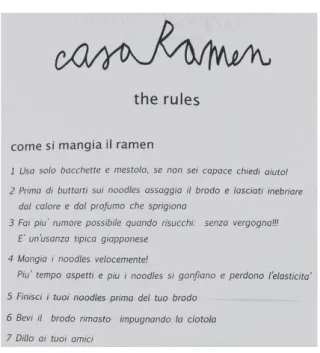
The second case is Casa Ramen, meaning house of ramen in English. The chef is Italian and he has been offering tonkotsu (pork-bone base) ramen noodles and other small dishes since 2013. On the entrance wall, you can see the rules: come si mangia il ramen (how to eat ramen) appear in Italian language, starting with Use only chopsticks and ladle. If you cannot use them, ask for help (translation by the author, Figure 4). Seven rules in total are given for customers unfamiliar with ramen.
Figure 3: Inside of Musubi (photo taken by the author)
Rice ball €3 ∼
Rolls €5.5
Udon noodles €7 ∼ Miso soup €2.5 ∼ Bento (box lunch) €7 ∼ Gyoza dumpling €3.5 ∼
Table 1: Menu of Musubi
The restaurant is so popular that they opened another shop, Casa Ramen Super, very close to the original shop in 2017. Traditional tonkotsu ramen tastes a bit different from the one we eat in Japan: the taste of broth is stronger and less salty. You can check the menu below on Table 2.
The last case is Miyabi, a sushi restaurant, in Bergamo, located one-hour train ride from Milan. The feature of the restaurant is original sushi experience as the title of their website shows (Miyabi). The restaurant was opened as the first Japanese restaurant by a Japanese chef in Bergamo in 2012. Miyabi offers authentic nigiri sushi, sashimi (raw fish), and a variety of sushi rolls as well as carpaccio and shrimp spring rolls. The food is very good even for Japanese customers, so no wonder they opened another shop nearby for taking out in 2017 and the third restaurant in Milan in 2018 too. It wins 29th place among 580
Figure 4: The Rules (photo taken by the author)
Traditional (ramen with seasoned pork, green onion, slice of fishcake) €11
Kaedama (additional noodle) €2
Seasoned egg for topping €1.5
Karaage (fried chicken) €6
restaurants in Bergamo (Miyabi, TripAdviser). When the author ordered a set of sushi and carpaccio, sushi was served before the carpaccio (Figure 5). This order was by chef s recommendation, whereas in Japan customers generally are served firstly sashimi raw fish and then sushi. The menu follows on Table 3.
As we just overviewed three restaurants whose specialties are onigiri, ramen, and sushi, they all serve Japanese food in different ways from in Japan, including the food, the interior and layout in the shop. For example, in Japan onigiri fast food restaurant is rare, ramen is cheaper with shops interior simpler, and sushi shops do not serve carpaccio. These differences are instances of localization. One of the most evident localization worldwide is uramaki, literally inside-out sushi roll. The pioneer uramaki is California rolls, said to be born in Little Tokyo, LA, USA, by a Japanese sushi chef, Ichiro Mashita in the 1960s. He invented uramaki, since it was hard for him to get fresh raw fat belly tuna. He looked for a substitute material for local Japanese customers to eventually find avocado. Also, noticing that Americans did not like the texture of nori sea vegetable, he created an inside-out roll for hiding it ( Uramaki ). Now uramaki with 2,380,000 hits is far more known worldwide than Japanese original norimaki with only 620,000 hits in google search in English. Italy is no exception. Even the menu of Miyabi shows much more uramaki dishes than norimaki. This kind of localization
Figure 5: Sushi set (left) and carpaccio (right) (photos taken by the author)
12 pieces of sushi with miso soup and sea vegetable salad €16
Carpaccio €13 ∼ 15
Hosomaki roll (nori sea vegetable outside) €5 ∼ 5.5 Uramaki roll (nori sea vegetable inside or without nori) €8 ∼
appears in Kaiten sushi (conveyor belt sushi) shops and packaged sushi in the supermarket, too21.
Brief concluding remarks
After having discussed transmission and localization of Japanese food abroad, focusing on domestic changes in Japanese foodways over time, travelling cuisines with traveling people, and Japanese cuisines in Italy, we got many important insights. Among our findings is the fact that localization spontaneously occurs beyond control of anybody including the authority, since culture gets localized accommodating local customers tastes and other conditions in its host communities. However, due to the limitation of space, there is much left for our discussion to be better. To name a few, the author would have had more detailed discussion on the following topics: authenticity including its relation to exclusiveness and flexibility; interviews with restaurant owners already done (Poporoya included) in Milan/Bergamo, and Francesca Scotti, the author of The
Sushi Game (2016) on Japanese food for Italian readers; description on other
books, websites, menus, and comments of the chefs and customers. Even though this paper clarified some patterns and processes of cultural transmission and localization of foodways abroad, our research question of how foodways are transmitted and localized was just partly answered. More detailed description and thorough analysis of authenticity and localization of foodways should wait for forthcoming research.
Acknowledgments
The author heartily thanks the former general director, Hiroto Kobayashi, and current director, Kentaro Ide, of JETRO Milan, and Noriko Ochiai, the co-owner of Miyabi for their sincere cooperation to this research.
Notes
1 There are many studies on mobility of culture, but generally they focus on migration of people and its effects on the host community and the immigrants themselves rather than cultural transmission itself. See Cultural Mobility by Stephen Greenblatt for an instance.
2 Among interesting cases is katakana in Japanese. We say, for example, terebi and write テレ ビ meaning television, borrowed from English, which are totally different from the original in pronunciation as well as writing.
countries against ideology of justice such as freedom, human rights, equality, or environmentalism. For example, Convention on Elimination of All Forms of Discrimination Against Women (CEDAW), which reviews the implementation status of each country, issued a "final opinion" for the Japanese government to eliminate its current policy for choosing one single surname for married couples on March 7, 2016. This is a case of persuasion, but it has no binding power without penalty provision.
4 Japanese language has several expressions such as washoku, nihon ryouri, and nihonshoku, respectively meaning traditional Japanese dishes/cuisines, more formalized Japanese cuisines, and Japanese food. In this paper we use the words washoku, Japanese cuisines, Japanese dishes, and Japanese food, depending on the context. Regarding familiarity of the words in alphabet, washoku hits 1,940,000 while nihon ryori and nihonshoku respectively do 81,300 and 14,800 on Google search in English setting. This means washoku is far more known than other two expressions in English.
5 Edo era is between 1603 and 1868.
6 This is unofficial translation of the preamble (Adachi 2005).
7 We Japanese have many choices to eat out for Chinese, French, Italian dishes and so on. 8 Tangible culture is generally considered to be able to be touched such as dishes served on the
table, paintings, architecture, etc. However, foodways include intangible culture. This is why
washoku got registered as an intangible cultural heritage, which is to be discussed in seetion
3.2.3.
9 For instance, kastuobushi or bonito flakes are unavailable in EU due to the EU laws forbidding importing material containing more than 5.0 g/kg of Benzo a pyrene (BaP). However, this criterion is originally for processed meat products such as ham and sausages, which is taken more in quantity than katsuobushi (European Union 2015). Note on this page explanation of katsuobushi appears.
10 According to Pym, Localization is here understood as a general mode of thought informing cross-cultural text adaptation in the fields of software, product documentation, web technology, and some international news services. It is part of a series of concepts that are steadily making their way into translation studies, although they rarely appear in mainstream linguistics (2001: n.p.).
11 Umami is [a] category of taste corresponding to the savoury flavour of free glutamates in various foods, esp. protein-rich fermented and aged ones such as mature cheeses and soy sauce; spec. the flavour of monosodium glutamate. Also: monosodium glutamate itself. Umami is sometimes described as a fifth basic taste alongside sweet, sour, salt, and bitter (Oxford
English Dictionary).
12 The word ichij sansai not only appears in the application to UNESCO. It has about 20,000 entries in alphabet on the internet. This also exemplifies popularity of Japanese food culture traveling abroad.
13 The survey asked subjects in the cities to choose three most favorite dishes from cuisines of 16 countries. The percentage accounts for the sum of the three dishes they liked as the first, the second, and the third.
14 Remember these dishes have been uniquely developed and localized in Japan before being exported abroad. This is the case of transmission and adaptation of imported culture before exportation.
15 After Milan World Exposition 2015, the number of Japanese restaurants, grocery stores, and supermarkets serving/selling Japanese dishes/food keeps increasing in total, according to the then general director of JETRO Milan, Hiroto Kobayashi, in the interview on September 15, 2017 and current director, Kentaro Ide, in the interview on September 12, 2018. Ide, however, mentioned difficulty to categorize Japanese restaurants too later in our personal communication.
16 Interests toward other cuisines/food beyond traditional Italian meal are not only in Japanese food but also other cuisines, food, or eating habits such as eating out for a happy hour ( apperitivo ) and using frozen food (JETRO, 2015B).
17 Recently, Sushi Skills Institute, organized by All Japan Sushi Association, a private sector originally consisting of sushi chefs, has been promoting to teach cooks from overseas proper skills for preparing sushi and to hold World Sushi Cup, a competition for knowledge and skills of sushi (All Japan Sushi Association).
18 The number amounts to 53 in December 2018, according to Ide, the director of JETRO Milan in personal communication with the author.
19 JETRO also founded a subsection, JFOODO, which is in charge of promoting export of Japanese produce/products to other countries (JETRO 2017).
20 The author visited these three restaurants, Musubi, Miyabi, and Casa Ramen, in 2016, 2017, and 2018. She interviewed the staff in the first two restaurants. However, due to the limited space, the author will not be able to write about the interviews in this paper.
21 In addition to take-away packaged food, there are delivery services on the internet too (JETRO 2015A: Oshima 2018).
References
Adachi, Miyuki. 2005. Shokuiku Basic Act, Act number 63 June 6, 2005 (Basic act on food education). Retrieved on August 23, 2018 (https://www.nuas.ac.jp/IHN/news/pdf/20160526_2. pdf).
All Japan Sushi Association. All Japan Sushi Association Sushi Skills Institute Retrieved on February 17, 2019 (http://www.sushi-ssi.com/english/).
Cappeli, Gloria. 2008. The translation of tourism-related websites and localization: problems and perspectives, in A. Baicchi (eds), Voices on Translation, RILA Rassegna Italiana di
Linguistica Applicata. Roma: Bulzoni Editore, pp.97-115. Retrieved on August 23, 2018
(http://www.gloriacappelli.it/wp-content/uploads/2007/08/cappelli_tourism-website-translation.pdf).
Casa Ramen. Zomato. Retrieved on February 15, 2019 (https://www.zomato.com/it/milano/casa-ramen-isola/menu).
Cinotto, Simone. 2013. The Italian American Table: Food, Family, and community in New York
City. Chicago: University of Illinois Press.
Cwiertka, Katarzyna J. 2014. Modern Japanese Cuisine: Food, Power and National Identity. 2006. Reissued ed. London: Reaktion Books.
Edge, John, T. 2007. The New Encyclopedia of Southern Culture, Vol. 7: Foodways. Chapel Hill, NC: University of North Carolina Press.
European Union. 2015. COMMISSION REGULATION (EU) 2015/1125. Retrieved on January 29 (https://eur-lex.europa.eu/legal-content/EN/TXT/PDF/?uri=CELEX:32015R1125&from= EL).
Farrer, James, (ed.) 2015. The Globalization of Asian Cuisines: Transnational Networks and
Culinary Contact Zones. New York: Palgrave Macmillan.
Frois, Luis, S. J. 2015. The First European Description of Japan, 1585: A Critical
English-Language Edition of Striking Contrasts in the Customs of Europe and Japan. London:
Routeledge. Originally published 1585 as Europa e esta provincia de Japao. Geertz, Clifford. 1973. The Interpretation of Culture. New York: Basic Books.
Greenblatt, Stephen et al. 2010. Cultural Mobility: A Manifesto. New York: Cambridge Press. Guptill, Amy E. et al. 2016. Food and Society: Principles and Paradoxes, 2nd ed. Cambridge:
Polity Press.
joshiki (Table changing and family changing: common sense of marketing to be destroyed by
the truth). 2003. Paperback ed. Tokyo: Chuko Bunko.
Iwamura, Nobuko. 2017. Zannen washoku nimo wakega aru: shashin de miru nippon no
shokutaku no ima (Reasons for unfortunate washoku: current Japanese dinner table seen
through photos). Tokyo: Chuokoron-Shinsha.
JETRO. 2013. Nihonshokuhin ni taisuru kaigai shouhisha ishiki anketo chosa (Survey based on questionnaire on awareness of customers overseas on Japanese food). Retrieved August 29, 2018 (http://www.jetro.go.jp/industry/foods/reports/07001256).
JETRO. 2014. Nihonshokuhin ni taisuru kaigai shouhisha ishiki anketo chosa (Survey based on questionnaire on awareness of customers overseas on Japanese food). Retrieved August 29, 2018 (https://www.jetro.go.jp/ext_images/jfile/report/07001590/compare_6cities_rev.pdf). JETRO. 2015A. Itaria (mirano) ni okeru nihonshoku resutoran jittai chosa: nihonshoku
resutoran eno intabyu kara (Survey on Japanese restaurants in Milan, Italy: interviews on
the restaurants). Retrieved August 29, 2018 (https://www.jetro.go.jp/ext_images/_ Reports/12ba5703b261d87f/resutaurant_mln201503.pdf).
JETRO. 2015B. Mamma no aji ni aichaku mo gaikoku ryori ga jojo ni fukyu: oushu no shoku
bijinesu to shohi no torendo (5) (Attachment to home-made dishes by Mamma while foreign
cuisines are getting popular: food business and trend in consumption in Europe). Tsusho
koho, January 14. Retrieved August 29, 2018 (https://www.jetro.go.jp/biznews/2015/07/8a206
81d26217bff.html).
JETRO. 2017. The Japan Food Product Overseas Promotion Center (JFOODO). Retrieved August 29, 2018 (https://www.jetro.go.jp/en/jfoodo/).
JETRO. 2018. Itaria ni okeru nihonshokuzai sapota ten nintei risuto (List of Japanese food and ingredient supporter stores overseas). Retrieved August 29, 2018 (https://www.jetro.go.jp/ ext_images/jetro/overseas/it_milano/supporter/list1806.pdf).
JETRO. Poporoya. Retrieved February 14, 2019 (https://www.jetro.go.jp/agriportal/supporter/ interview/poporoya.html).
JETRO. The Certification Program of Japanese Food and Ingredient Supporter Stores Overseas. Retrieved February 14, 2019 (https://www.jetro.go.jp/en/trends/foods/supporter. html).
Koizumi, Tetsunori. 2004. On the Forms of Cultural Transmission and Transformation.
Kokusai shakai bunka kenkyu kiyo (Journal of international studies on societies and
cultures). 4: 157-164. Kyoto: Ryukoku University.
Kumakura, Isao. 2012. Nihon shokubunka tekisuto (Textbook on Japanese food culture). Nihon
shokubunka tekisuto sakusei kyodo kenkyukai (Study group for composing a textbook on
Japanese food culture). Retrieved on August 29, 2018 (http://www.maff.go.jp/j/keikaku/ syokubunka/culture/attach/pdf/index-15.pdf).
Maci, Stefania M. 2013. Tourism Discourse: Professional, Promotional and Digital Voices. Genoa: ECIG.
McCurry, Justin. 2007. Health fears as Japan falls for fast food: Type-2 diabetes soars after US chains expand. The Guardian, International ed., April 8. Retrieved August 29, 2018 (https:// www.theguardian.com/world/2007/apr/08/japan.justinmccurry).
Ministry of Agriculture, Forestry and Fisheries. 2015. Kaigai ni okeru nihonshoku resutoran no
kazu (Number of Japanese Restaurants Overseas). Retrieved on August 29, 2018 (http://
www.maff.go.jp/j/press/shokusan/service/pdf/150828-01.pdf).
Ministry of Economy, Trade and Industry Ministry of Economy, Trade and Industry. 2015.
Mirano banpaku nihonkan sapota tsushin (Newsletter from Supporters of Japan Pavilion,
Milan Expo). 16. Retrieved on August 29, 2018 (http://www.meti.go.jp/policy/exhibition/pdf/ milanonews_vol16.pdf).
miyabibergamo.it/ristorante.php).
Miyabi. TripAdviser. Retrieved on February 16, 2019 (https://www.tripadvisor.it/Restaurant_ Review-g187830-d3727003-Reviews-Miyabi-Bergamo_Province_of_Bergamo_Lombardy. html).
Musubi Japanese Take Away. Retrieved February 14, 2019 (http://www.musubimilano.it/). Musubi. Zomato. Retrieved February 15, 2019
(https://www.zomato.com/it/milano/musubi-duomo-milano/menu).
Nihon no sushi wo mamore (Conserve Japanese sushi) . Retrieved February 14, 2019 (http://
karapaia.com/archives/51957344.html).
Noda, Megumi. 2015. Sedaikan no shokutaku menyu no chigai (Difference among generations in meals eaten at home) in Tomomi Shinada (ed.), pp. 44-50.
Oxford English Dictionary. Retrieved on August 23, 2018 (http://www.oed.com/).
Oshima Etsuko. 2018. Mirano ni okeru nihonshoku wo kangaeru ( Japanese Food in Milan).
Itaria-kai kaiho 6 (January 28). Tokyo: Tokyo gaigo itaria kai (Club Italia del TUFS).
Pym, Anthony. 2001. Localization and Linguistics. Paper presented to the SLE Conference, August 2001. Retrieved on August 29, 2018 (https://www.researchgate.net/profile/Anthony_ Pym2/publications).
Rath, Eric C. 2015. The Invention of Local Food, in Farrer, James (ed.), pp. 145-164.
Ryall, Julian. 2018. Food crisis looms for Japan as prices rise. The Telegraph, May 2. Retrieved on August 29, 2018 (https://www.telegraph.co.uk/news/worldnews/asia/japan/1919296/Food-crisis-looms-for-Japan-as-prices-rise.html).
Sawaguchi, Keiichi. 2015. Japanese Cooks in Italy: The Path-Dependent Development of a Culinary Field, in Farrer, James (ed.), pp. 125-141.
Shinada, Tomomi. 2015. Heisei no kazoku to shoku (Family and meals in Heisei era). Tokyo: Shobunsha.
Scotti, Francesca. 2016. The Sushi Game: Guida Banzai alla Cucina Giapponese. Milan: Terre di Mezzo.
Tabayashi, Yo. 2017. Bunka no ido to honan: kaigai ni okeru nihonshoku wo jirei toshite (Transmission and Adaptation: Cases of Japanese Cuisines Traveling Abroad). Policy
Science 24 (4): 237-250. Osaka: Ritsumeikan University.
20 million people visited Milan Expo, a huge success. 2015. Euronews. Retrieved on August 30 2018 (http://www.euronews.com/2015/10/29/20-million-people-visited-milan-expo-a-huge-success/).
Tylor, Edward Burnett. 2010. Primitive Culture: Researches into the Development of Mythology,
Philosophy, Religion, Art, and Custom. 1871. Reprinted ed. Cambridge: Cambridge
University Press.
U r a m a k i . A l l a b o u t S u s h i G u i d e. R e t r i e v e d o n Fe b r u a r y 17, 2019 ( h t t p s : / / w w w. allaboutsushiguide.com/uramaki.html).
Walsh, Bryan. 2007. Lamenting the Decline of the Home-Cooked Meal in Japan. Time, June 06, 2 0 0 7 . R e t r i e v e d o n A u g u s t 2 9 , 2 0 1 8 ( h t t p : / / c o n t e n t . t i m e . c o m / t i m e / w o r l d / article/0,8599,1629880,00.html).
Washoku Designated UNESCO Intangible Cultural Heritage. 2014. Nippon.com. Retrieved August 30 (https://www.nippon.com/en/genre/culture/l00052/).
Washoku: Nihonjin no dentotekina shokubunka (Japanese cuisines: traditional food culture of
Japan). Retrieved on August 29, 2018 (file:///Users/tabayasi/Downloads/washoku_guidebook. pdf).
Zimmerman and Ueno. 2006. California rolls drive them to distraction: Purists in Tokyo want to label what's authentic. Get real, locals say Los Angels Times, December 02, 2006. Retrieved on August 29, 2018 (http://articles.latimes.com/2006/dec/02/business/fi-japanfood2).