Abstract
In this article, we argue that banking regulators under the Basel regulatory framework could benefit from the capital requirements in terms of reducing the likelihood of insolvency of banks, but these standards have possible ill-effects for other important objectives of banking regulations: in particular, the B a s e l f r a m e w o rk d o e s n o t n e c e s s a r i ly c o n t r i b u t e t o t h e improvement of financial intermediation and accumulation of credit risk management skills in the monitoring process. Moreover, blind adoption of the Basel regulatory framework in most of the developing countries, where the preconditions are largely absent, creates adverse consequences on economic activity. We raise related experiences from Japan, Indonesia and Sri Lanka.
Keywords:
Basel regulatory framework; capital regulations; financial intermediation; bank solvency
Why is the Basel Regulatory Framework
Not Necessarily a Universal Panacea?
S
UZUKI, Yasushi
*, W
ANNIARACHCHIGE, Manjula Kumara
**& S
ASTROSUWITO, Suminto
***RITSUMEIKAN INTERNATIONAL AFFAIRS Vol.11, pp.71-94 (2013).
* Graduate School of Management, Ritsumeikan Asia Pacific University, Japan, [email protected] ** Faculty of Management and Finance, University of Ruhuna, Sri Lanka, [email protected] ***SEBI School of Islamic Economics, Indonesia, [email protected]
I
NTRODUCTIONIdeas, knowledge, art, hospitality, travel – these are the things which should of their nature be international. But let goods be homespun when-ever it is reasonably and conveniently possible; and, above all, let finance be primarily national.
-Keynes (1982) The Basel Committee on Banking Supervision (BCBS) was estab-lished at the end of 1974 under the Bank for International Settlement (BIS) mainly as a response to implications of the failure of Herstatt Bank in June 1974. BCBS is composed of senior representatives of bank supervi-sory authorities and central banks of the Group of Ten countries (G-10), i.e., Belgium, Canada, France, Germany, Italy, Japan, Luxembourg, the Netherlands, Sweden, Switzerland, the United Kingdom and the United States.
The high-water mark in the Basel framework remains the 1988 Basel Capital Accord (Eichengreen 1999, p. 24). Currently, over 100 countries voluntarily adopt the 8 percent Capital Adequacy Requirement (CAR) that the BCBS agreed upon in 1988 to shore up the equity cushion of interna-tionally active banks in member countries (Miyoda 1994, Rosenbluth and Schaap 2000). During the 1990s and subsequently after the millennium, the expanded role of the BCBS as the institution responsible for globally applicable standards for banking regulation and supervision has been ac-knowledged. For example, Cornford (2001) has referred to the BCBS as a global standard setter , though the BCBS per se has no enforcement power. Its Accords, Concordats and Core Principles are not legally binding. Never-theless, it has become the regulatory standard for virtually all countries with international banking activities (Emmenegger 2006).
A logical development for managing risk for banks was the increasing codification of risk in the decision-making process of banks. The codified assessment of credit risk developed by US banks aimed to estimate their portfolio s Probability Density Function (PDF) of credit losses and the amount of capital needed to support their credit risk activities. The pro-cess for determining this amount was analogous to value at risk (VaR) methods, which was used in allocating economic capital against market risks (volatility risks), a common financial methodology used in US in the late 1980s. In other words, US banks applied the financial technology and
engineering developed for calculating volatility of financial market prod-ucts and derivatives (such as swaps and options) to quantify credit risks as well. In these exercises, banks express the risk of the portfolio with an algorithmic measure of unexpected credit loss (i.e. the amount by which actual loss may exceed the expected loss) such as the standard deviation of losses or the difference between the expected loss and some selected target credit loss quintile (BCBS 1999a, BCBS 1999b, BCBS 2000, BCBS 2001, BCBS 2006).
The codification of risk and the development of arms length banking are not isolated from the tight rein that US regulators kept on the lending business of banks (Dymski 1999). In US corporate finance, bank loans, most of which are short-term contracts for working capital, have histori-cally contributed to no more than 30 per cent of the total funds that US firms raised (Davis 1995, p. 37). In spite of this, regulators held to the con-servative strategy of enforcing tight CAR and disclosure rules on banks to prevent bank runs. The constant demand, which was further intensified in the 1980s, by the US for level playing field regulations in other national banking regions emanated from the fear of US regulators that tighter cap-ital adequacy requirement on their own national banks might impede competitive edge of US banks in the international financial markets. This can explain why US regulators were at the forefront of the pressure for setting up international capital adequacy standards at Basel.1) In this pa-per, we review why the Anglo-American financial system is not necessarily universally applicable, in particular, in the countries where banks play a pivotal role as financial intermediaries for mobilising household savings to investments in firms. We critically assess the expansion of the Basel II capital adequacy framework and argue that banking regulators under the BIS regime could benefit from the capital requirements in terms of reduc-ing the likelihood of insolvency of banks, but these standards have possi-ble ill-effects on other important objectives of banking regulations, in par-ticular the role of banks as effective financial intermediaries and delegated monitors.
Section 1 begins with an overview of the theories of solvency regulation by means of capital requirements, then, reviews the expanded role of the
1) See Eichengreen (1999) and Miyoda (1994) for historical perspectives on the 1988 Basel Accord
BCBS as the institution responsible for globally applicable standards for banking regulation and supervision. Section 2 critically assesses the codi-fied assessment of credit risk developed by US banks and points out the crucial limitations of the standardized credit risk modelling. Section 3 cri-tiques the new regulatory framework. Section 4 investigates the experienc-es of Japan, Indonexperienc-esia and Sri Lanka, to see how the Basel standards have possible ill-effects for other important objectives of banking regulations and to see whether preconditions were satisfactory. Section 5 concludes.
T
HEORIES OF SOLVENCYREGULATION ANDB
ASELSTANDARDIZED CREDIT RISK MODELLINGIt is worth noting that a key feature of the 1988 Basel Accord was a minimum CAR determined at 8 per cent of aggregate risk-weighted assets as a common framework for maintaining capital adequacy and solvency. We investigate theories of solvency regulation by means of capital require-ments. These approaches have been controversial. Although there are sev-eral approaches attempting to analyze and model the optimal regulatory scheme, partly following Freixas and Rochet (1997), we broadly classify them into two: the portfolio approach and the incentive approach.
The Portfolio Approach was originally developed by Kahane (1977) and examined later by Koehn and Santomero (1980), Kim and Santomero (1988) and more recently by Freixas and Rochet (1997). The main idea was that if banks behaved as portfolio managers when they selected their port-folio of assets and liabilities, it was important that they use risk-related weights for the computation of their capital asset ratio. Interestingly, using a mean-variance model, Kim and Santomero (1988) compared the bank s portfolio choice under incomplete markets for diversifying their risks be-fore and after a solvency regulation is imposed. They showed that the sol-vency regulation entailed a re-composition of the risky portion of the bank s portfolio in such a way that its risks were increased, particularly because some small banks could not completely diversify their risks. Ironically, the probability of the bank s failure often increased after the solvency regula-tions were imposed. This is a controversial point for this approach. For in-stance, Freixas and Rochet (1997) show that this distortion in the banks asset allocation would disappear when regulators used correct measures of risks for computing their risk exposure and solvency ratio. However,
get-ting the correct measures of risk is critical for this approach and it is not clear whether market-based risk weights can be reliable.
In the Incentive Approach, solvency regulations were modelled as so-lutions to principal-agent problems between a public insurance system and private banks. Since insurance by the regulators was costly, solvency regulations were required to create incentives that limited the potential cost in terms of public funds being used to bail out depositors. The new capital adequacy framework was, in reality, more likely to have been driv-en by such an incdriv-entive (principal-agdriv-ent) approach, which was consistdriv-ent with the traditional concern of US regulators to limit the freedom of banks to expose themselves (and thereby the regulator) to large risks. This ap-proach attempted to capture the social cost of an insured failure to justify a capital adequacy ratio. However, this approach also faced difficulties in getting correct measures of risks for computing the exposed risks and the solvency ratio as well as for calculating the optimal level under informa-tion problems. Furthermore, the social utility of the banks own screening and monitoring efforts as financial intermediaries and delegated monitors was not sufficiently reflected in this approach.
Here, we should note that the instruments of banking regulation are specific to national characteristics of each banking sector. Freixas and Rochet (1997, p. 259) classified safety and soundness regulatory instru-ments used in the banking industry into six broad types: (i) Deposit inter-est rate ceilings, (ii) Entry, branching, network, and merger rinter-estrictions, (iii) Portfolio restrictions, including reserve requirements and even, as an extreme case, narrow banking, (iv) Deposit insurance, (v) Capital require-ments, and (vi) Regulatory monitoring including not only closure policy but also the use of market values versus book values. Except for entry and merger restrictions, these regulatory instruments are specific to the bank-ing industry. They concluded that bankbank-ing regulation appeared to involve diverse issues that were so heterogeneous that no general model could en-compass the main issues.
It is worth noting that the main approaches of designing the optimal bank solvency regulation focus on how to ensure financial stability, with less emphasis on how to improve the appropriate financial intermediation for economic development. There is, however, another interesting approach which looks at this issue. For example, Campbell et al. (1992) emphasize the substitutatbility between prudential monitoting and capital
regula-tions in controling the risk taking by bank managers. In their approach they consider three sets of possibilities:
(1) Monitoring of banks assets is impossible, and the regulator uses capital requirements to prevent excessive risk-taking by the bank.
(2) Monitoring is feasible, and the regulator is benevolent. There is substitutability between bank capital and monitoring efforts. At the optimum, capital requirements are less severe and simulta-neously the banks monitoring efforts may prevent them from taking risky loan exposures.
(3) Monitoring is still feasible, but the regulator is self-interested. The crucial limitation is that the monitor (regulator) has limited liability and is unlikely to put much effort into monitoring. This induces distortions in the levels of capital and monitoring that were achieved in version (2). As expected, more will be the bank capital needed for solvency; less will be the monitoring effort of-fered on the part of regulators.
This model does not suggest the optimal level of capital requirements. The monitoring by the regulators aims not only to maintain financial sta-bility but also to make banks undertake the important role of acting as fi-nancial intermediaries and monitors for efficient flows and allocations of financial resources. In this model, assuming that monitoring of banks as-sets is feasible, a lot would depend on whether the regulator is benevolent or self-interested in optimizing the required bank capital and the banks monitoring efforts. Although the causality suggested in the model requires further testing, it sheds light on the relationship between the regulator and the banking industry when designing a financial system that can en-sure sound financial intermediation and appropriate monitoring efforts.
The most important regulatory objectives for any financial regulatory authority are (1) to maintain financial stability, in particular, by prevent-ing contagious bank runs, and (2) to improve sound financial intermedia-tion, including the acquisition and accumulation of skills and knowledge for credit risk management in the monitoring process. According to The BCBS, the 1988 Accord was expected to be the cornerstone of the interna-tional financial architecture and its overriding goal was to promote safety
and soundness in the international financial system (BCBS 1999b, p. 9, BCBS 2004). The introduction of 8 percent CAR under Basel framework aimed to strengthen the international banking system by making interna-tionally active banks maintain an acknowledged buffer particularly to cov-er unexpected losses.
In the subsequent New Accord, the BCBS has urged banking regula-tors to adopt an internationally accepted model for quantifying and aggre-gating credit risks (BCBS 1999a, p. 8). Since then, standard credit risk modelling has become increasingly important in banks risk management and performance measurement processes, including performance-based compensation, customer profitability analysis, and risk-based pricing, even for domestic banks. Although there is a range of practices in conceptual approaches in modelling risk, the BCBS focus is on models that estimate a portfolio s current value and the probability distribution of its future value at the end of the planning time horizon. In general, a portfolio s expected credit loss can be defined as the difference between the two, and the key issue is how to determine the expected probability of default (often termed the expected default frequency or EDF) which is a critical model variable.
In the Anglo-American financial system, the internal credit risk rat-ing for each client firm of a bank is determined by the bank s credit staff and used in the calculation of EDFs. Thus, the EDFs adopted in each bank may vary according to its own circumstances and credit strategy. But the Basel regime has also encouraged lenders to utilize external rating sys-tems, such as Standard & Poor s (S&P) or Moody s ratings for corporate bonds, to justify their own EDFs. The BCBS has decided, in its New Ac-cord, to promote the replacement of prevailing approaches with a new sys-tem in which the risk weights are determined based on credit assessments made by external organizations. The Committee wants to ensure that the regulatory capital charge under the internal rating-based approach is de-termined in a manner that ensures accuracy and consistency with the standardized approach based upon external credit assessments (BCBS 1999b, pp. 37–40, BCBS 2004). The standardization of the basic methodol-ogy in credit risk models promoted by the BCBS has also been driven by US regulators pursuit of a level playing-field for US banks subject to the constraints of Anglo-American financial rules.
The fundamental question that arises is how would the convergence to the Basel Accord conditions affect financial stability and financial
inter-mediation? Apparently, the US Sub-Prime crisis of 2007 tells us that the idea of promoting convergence to international standards would not neces-sarily improve the trade-off between financial liberalization and financial stability.
L
IMITATIONS OF THEA
NGLO-A
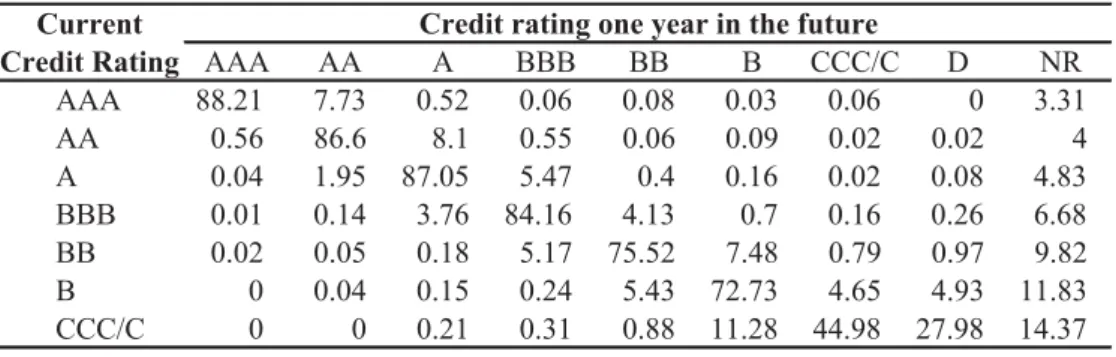
MERICAN METHODS OF CREDIT SCREENINGAND MONITORINGTo see how the algorithmic approach under the Basel rules works, con-sider the credit rating transition matrix provided by S&P in table 1, which shows the probability of migrating from current rating to another rating within one year based on historical data. EDF can be interpreted as a loan s probability of migrating from its current rating grade to default within the credit model s time horizon. For example, the likelihood of a B rated loan migrating to a default state within one year would be 4.93 percent.
The most crucial limitation of the EDF is that it is not appropriate for calculating the probability of default in a long-term loan. One of the au-thors interviewed an ex- Long-Term Credit Bank of Japan (LTCB) staff member who surveyed the so-called KMV model , which was provided by KMV Co. and was widely used as a model for calculating the EDF. The model defines a situation where the asset value of a firm falls below the nominal amount of debt as constituting a default based on the trend of the firm s stock price as an indicator of the firm s value. According to the ex-LTCB staff, KMV provided banks using the model with a one-year EDF es-timate. KMV was confident of the significance of their one-year EDF, but
Table 1: Average one-year global corporate transition matrix, 1981-2009
AAA AA A BBB BB B CCC/C D NR AAA 88.21 7.73 0.52 0.06 0.08 0.03 0.06 0 3.31 AA 0.56 86.6 8.1 0.55 0.06 0.09 0.02 0.02 4 A 0.04 1.95 87.05 5.47 0.4 0.16 0.02 0.08 4.83 BBB 0.01 0.14 3.76 84.16 4.13 0.7 0.16 0.26 6.68 BB 0.02 0.05 0.18 5.17 75.52 7.48 0.79 0.97 9.82 B 0 0.04 0.15 0.24 5.43 72.73 4.65 4.93 11.83 CCC/C 0 0 0.21 0.31 0.88 11.28 44.98 27.98 14.37
Source: Standard & Poor’s (2009)
Current Credit Rating
admitted that it would be difficult to use even a 3-year EDF in real appli-cations. An ex- Industrial Bank of Japan (IBJ) staff reports an almost identical problem with the model in an interview with KMV (FISC 1999, Ohno and Nakazato 2004, pp. 182-190).
Another key feature of algorithmic monitoring models is the use of ex-ternal ratings provided by rating agencies such as S&P and Moody s. This implicitly assumes that each country is equipped with sufficient ratings penetration, though such assumption is fairly unrealistic as far as devel-oping countries are concerned. Moreover, these ratings are provided at the discretion of ratings agencies where the detailed criteria for credit risk as-sessments are not clearly disclosed. An investigation by Nikkei Research in collaboration with the Japan Investor-Relations Association in 2003 re-veals that 53.8 percent of 1,344 valid responses (out of 3,615 publicly list-ed companies as of December 2002) in their sample have not been ratlist-ed. Moreover, only 11.8 percent of companies have deliberately requested to rate their companies. According to this survey, in assessing credit risk, credit rating agencies have relied mainly on (a) consolidated as well as un-consolidated financial statements, (b) prospective operating profits for the next fiscal year or later including mid- and long-term business plans, (c) business strategy and management strategy statements, and (d) informa-tion from operating units. Interestingly, around 59 percent of respondents revealed that they did not fully disclose information to the agency mainly due to their own internal rules about confidentiality. This shows that some critical information was not fully reflected in the credit assessment by the external agencies. Besides, substantial number of companies believes that the rating evaluation criteria were vague and thus, are dissatisfied with the rating. Further, some companies believe that rating agencies do not have competency in rating their companies and claim that the competition among rating agencies is constrained. These findings clearly highlight the inherent limitations associated with rating agencies and process.
Undoubtedly, some risk management instruments become necessary as economies become more complex. Intensified internationalization and tech-nological change make it more difficult for lenders to undertake the role of monitoring investments, which involves making judgements about the via-bility of different firms to carry out innovations and develop new products. Bounded rationality accordingly encourages lenders to use codified ap-proaches for measuring credit risks and to use external sources of risk
as-sessment whenever possible, instead of trying to rely on in-house skills and knowledge for monitoring. But the codified assessment of credit risks under the Anglo-American system does not necessarily solve the problem of un-certainty. As a complete set of risk markets is necessarily absent, it is im-possible in practice to determine a definite value of the EDF without risk of error, even using all available data sets. Thus, even if the credit rating tran-sition matrices provided by external rating agencies are statistically signifi-cant, it cannot indicate in which direction a particular customer will proba-bly migrate. Our knowledge about the past cannot provide a basis for precise calculation of mathematical expectation (Simon 1983).
When it comes to evaluating innovations as opposed to observing firms, the indeterminacy becomes significantly greater. Nevertheless, re-gardless of the arbitrariness of the rules of inference applied to financial data sets, lenders may be persuaded to use statistical EDF and external ratings in measuring credit risk because they are required by regulators to adopt normative procedures for calculating capital adequacy require-ments as well as for risk-based pricing. In the past, bankers were consid-ered professionals in screening and monitoring, and banks played impor-tant roles in mediating stable flows of long-term funds to new industries and enterprises. External-rating agencies played a very limited role in providing credit profiles of bond issuers for non-professional investors who had limited capacities to assess credit information. As lenders increasingly came to rely on statistical EDF provided by external rating agencies for publicly rated corporate bonds, bank lending began to conform to inves-tors behaviour in bond markets.
A
CRITIQUE ONTHE NEW REGULATORYFRAMEWORKThe fundamental definition of capital in Basel II remains unchanged from that of the original Accord as amended and clarified since 1988. The BCBS, however, proposes to clarify and broaden the scope of application of the current Accord to improve the way CAR reflects underlying risks (BCBS 1999b) and sets forward various approaches for making the Accord more sensitive to credit risks. The new risk weighting scheme increases the reliance of regulators on external credit assessment institutions. The BCBS specifies objectivity, independence, transparency, credibility, inter-national access, resources and recognition (BCBS 1999b, p. 34) as criteria
for eligibility of external assessment agents. The BCBS seems to have en-dorsed the effective power of the external rating houses that already have a vested interest in the industry and a track record in credit assessments.
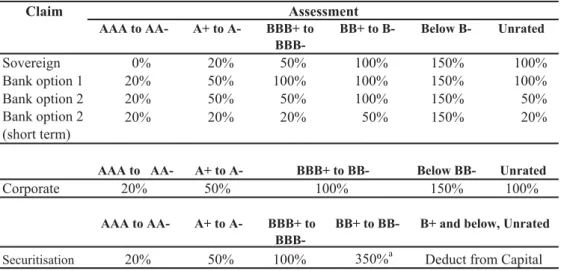
The risk weighting system in the 1988 Accord aimed in part at ensur-ing that banks were not deterred from holdensur-ing low risk assets (for exam-ple, sovereign debt) by risk-weighting loans according to the institutional nature of the borrowers (BCBS 1999b, p. 8). At the same time, the immedi-ate concern of banking regulators was to discipline internationally active banks to set a buffer to cover expected as well as unforeseen losses. There-fore, the risk weighting of assets has been arbitrary, at best, resulting in a crude measure of economic risk. The most salient feature in the new framework is to suggest a more extensive use of external credit rating and standardized approaches for applying the risk weights to respective expo-sures. In particular, the ratings offered by S&P using its methodology (as an example, where rating structure of some other agencies could be equal-ly used) are emphasized by the BCBS as useful for extracting risk weights of booking assets (BCBS 1999b). The subscription of the IMF s Special Data Dissemination Standards is described as another important method for applying risk weights to exposure to sovereign debt. A summary of il-lustrative risk weights prepared by BCBS (2006) based on S&P credit as-sessment scheme is shown in table 2.
Table 2: Risk-weights used in standardized approach for credit risk in Basel II AAA to AA- A+ to A- BBB+ to BBB- BB+ to B- Below B- Unrated Sovereign 0% 20% 50% 100% 150% 100% Bank option 1 20% 50% 100% 100% 150% 100% Bank option 2 20% 50% 50% 100% 150% 50% Bank option 2 (short term) 20% 20% 20% 50% 150% 20% d e t a r n U -B B w o l e B -A o t + A -A A o t A A A % 0 0 1 % 0 5 1 % 0 5 % 0 2 e t a r o p r o C AAA to AA- A+ to A- BBB+ to BBB- BB+ to BB-Securitisation 20% 50% 100% 350%a Notes: a Investors only. Originating banks must deduct from capital Source: BCBS (2006) t n e m s s e s s A m i a l C BBB+ to BB-100%
B+ and below, Unrated Deduct from Capital
The BCBS points out the possible negative incentive effects of a more extensive use of external assessments on the agencies themselves (BCBS 1999b). However, the BCBS seems to leave the problem behind without giving any suggestions on how to deal with potential negative effects, im-plicitly expecting each banking regulator to devise systems to prevent banks from using external assessments in a problematic or mechanical fashion. Meanwhile, the New Accord encourages a number of arbitrary de-velopments.
Even thought the risk weighting for exposures to corporations have been slightly revised in the new accord, as illustrated in table 2, the 100 per cent weight for unrated corporations still remains unchanged. In con-trast, the risk weightings for asset securitisations (collateralized debt obli-gations) as proposed are more sensitive to external credit ratings. This proposal may create an externality of enhancing the presence of major ex-ternal rating houses in loan securitisation and secondary loan trading business. According to the BCBS, the securitisation market is a global one in which a significant number of internationally active banks participate. Furthermore, asset-backed securities issued in the international market typically have a credit rating.
According to Financial Times, there was a conflict between US and Germany until the last moment on the proposed framework on to what extent external ratings and assessments should be applied for the calcula-tion of an adequate buffer? and on how to deal with commercial mortgag-es for capital purposmortgag-es in the new framework? Each regulator was moti-vated to protect its own practices in supervising. The final proposal seems to have been reflected the political conflicts and compromises between the two countries. The revised consultative paper in 2001 proposes alternative approach, a comprehensive and a simple one. Under the former approach, the underlying risk exposure is reduced by a conservative estimate of the value of the collateral (See Cornford 2001, pp. 17-19 for details).
The BCBS does not propose to take the maturity of claims into ac-count for capital purposes (BCBS 1999b, p. 33). In principle, an exposure to one borrower with longer final maturity (for instance, three years) should be considered riskier than that to the other with shorter final ma-turity (for instance, three months) given the credibility of two borrowers are same. Needless to say, the maturity or remaining period of claims is an important factor for banks to make decisions for granting credits.
The BCBS does not take the portfolio effect by concentration or diver-sification into account for capital purposes. In portfolio theory, a portfolio concentrating its investment in particular firms (for example, granting $100million each to ten firms) would be considered riskier than a diversi-fied portfolio (for example, granting $1million each to thousand firms), given these firms have the same credit rank.
The Basel Accord involves possible effects on regulatory arbitrage (Cornford 2001), leading to a vicious circle. For instance, the 1988 Accord has given lenders the incentive of arranging collateralization with securi-ties or getting guarantees by selected OECD public-sector entisecuri-ties for re-ducing the risk weights of their exposures.
These types of arbitrage, in turn, led the BCBS to expand the scope of application of the Accord so that it could capture residual risks. However, the New Accord unavoidably becomes a source of new opportunities for ar-bitrage, in particular, in the field of loan securitisation or credit deriva-tives. The BCBS recognizes, on the one hand, that asset securitisation can serve as an efficient way to redistribute credit risks of a bank to other banks or non-bank investors. On the other hand, the BCBS is concerned with some banks use of structured financing or asset securitisation to avoid maintaining capital commensurate with their risk exposures. There-fore, BCBS proposes to revise the Accord that makes use of ratings by eli-gible external credit assessment institutions for setting capital charges for asset securitisations (see table 2). The BCBS proposes risk weights for claims on securitisation tranches that may result in a special purpose ve-hicle issuing papers secured on a pool of assets (BCBS 1999b, p. 36). The BCBS also claims that bank guarantees in the form of credit derivatives have gained widespread usage. These developments have had important effects on the credit risk profile of many banks (BCBS 1999b, p. 42). This is a never-ending vicious circle. Although the regulation has an aspect of encouraging financial innovation in mitigating and hedging risks, more ac-curacy would be at the cost of more complexity.
C
ROSS COUNTRYEVIDENCEONTHE IMPLICATIONSOFB
ASELF
RAME-WORK
Japan
prolonged and deep, though Japan s financial deregulation was almost complete in 2001 after the financial Big Bang . We know this made a very limited contribution to bailing Japanese banks and recovering Japanese economy from the prolonged stagnation. The average real GDP growth rate in the period from 1992 to 2008 stayed at the lower level of around 1.20 percent p.a. The credit crunch problem particularly to those small and medium enterprises (SMEs) that rely heavily on bank loans for fund-ing continues. In the first half of the 2000s, the change in the classification standards for non-performing loans (NPL) under Basel framework result-ed in a steadily increase of NPLs in financial institutions. Increasresult-ed NPL disposals and heightened managerial resources devoted to deal with NPLs together with increased capital requirements created extra pressure on bank profitability. The erosion of profitability combined with an increase in transaction costs further lead to a downward pressure on banks equity capital (net worth) which in turn lowered banks ability to take risks, such as acquiring new customers, investing in new industries and particularly the risk of lending to SMEs.
The Japanese SMEs play an important role in the economy. The SMEs share in the Japanese economy was 99 percent in terms of the number of firms (SMEA 2005) and 72.6 percent in terms of the number of employees in 2004 while in the manufacturing sector the SMEs share was around 50.5 percent of the overall industrial output and around 56.8 per-cent of the overall value-added (METI 2005). According to statistics of JS-BRI (2003) and JSJS-BRI (2009), the outstanding loans towards SMEs had dropped sharply from JPY 355 trillion at the end of 1997 to JPY 260 tril-lion in December 2003, then to JPY 256.9 triltril-lion in December 2006. And the balance of loans from banks to SMEs stayed below 260 trillion on aver-age during 2006-2008 and remained at JPY 253 trillion in 2009 (SMEA 2010).
According to a survey by Small and Medium Enterprise Agency (SMEA 2004), more than 80 percent of the SMEs whose number of em-ployees numbered less than 300 were required to provide their main banks with a mortgage on their assets or a guarantee by the Credit Guar-antee Association (a governmental agency). Clearly, the Japanese banks were very conservative when it came to assessing the credit risk of SMEs. Some researchers insist that Basel II was not so related to the Japanese banking crisis in the 1990s and the subsequent financial slump until its
implementation in March 2007. We do not agree to the suggestion because from one of the authors experience as a Japanese bank insider, most Japa-nese bank managers began to change the mode of credit risk monitoring even in the 1990s, with the expectation that proposed Basel II regulations and methods of credit risk monitoring would be sooner or later introduced.
According to SMEA (2004), an examination of the rate of growth of total factor productivity in present-day Japanese manufacturing by size reveals that growth, on average, is higher in SMEs than in large enter-prises and thus argue that Japanese SMEs are playing an active role in technological innovation. Nagahama (2002) has estimated the contribution of SMEs to the change in the composition of value-added by industry and by size of firms. According to this survey, the SMEs contributed no less than 75 percent to structural change in the 1990s after the collapse of the bubble economy.
To ensure the supply of sufficient financial resources to innovative SMEs is the most important issue for the Japanese economy and would be a key requirement for revitalizing it. At the same time, innovative SMEs are exposed to severe competition and as a result their future has become more uncertain as clearly visible from the decline of life cycle of hit prod-ucts2) (SMEA 2005). This inevitably increases the credit risk of SMEs where banks and credit risk monitors may find difficulties in the assess-ment under the Basel II standards. This makes long-term financial inter-mediation to SMEs more difficult which has become the biggest dilemma facing the contemporary Japanese financial system
Indonesia
After a series of deregulation packages, Indonesian banking industry activities have gradually been globalized. To maintain their soundness and to be able to compete in the international banking market, the Indonesian banks have to comply with minimum capital requirements to be consistent with BIS standards. Accordingly, commencing from February 1991, the regulator launched CAR framework of Basel and the fulfilment of 8 per-cent capital will be gradually required as follows: 5 perper-cent by the end of March 1992, 7 percent by the end of March 1993 and 8 percent by the end of December 1993 (Binhadi 1995, p. 348).
In addition to that, banks are also required to make provisions for non-performing loans, which is not part of the capital that needed to be raised to fulfil CAR. At the same time, to fight inflation, Bank Indonesia set high cut off discount rates on SBI and SBPU in the open market opera-tions.3) Banks struggled to fulfil their CAR while the requirement on provi-sioning for non-performing loans also pushed banks to be more careful in extending loans. The SBIs became their safe haven, especially since then SBI was considered as a risk-free asset. This combination of policy sub-stantially contributed to the deceleration of credit and reduced the degree of intermediary function that banks carry in the economy. For example, af-ter growing at 56-58 percent in 1989 and 1990, the growth rate of bank credit dropped to only 16 percent in 1991 and 9 percent in 1992. Even the growth rate of bank credit for the private banks in 1992 was only 1 per-cent. Of course, the additional loans granted in 1991 and 1992 were not sufficient for smooth running of the economy. This situation caused diffi-culties for both businesses and banks (Cole and Slade 1996). This credit contraction which was also compounded by the tight monetary policy might have induced quasi adverse selection by banks and possibly ham-pered their lending business opportunity of earning interests, starting to shake the financial soundness of Indonesian banks, partly contributing to the 1997-98 financial crisis in Indonesia. Meanwhile, by 1995, there were 22 banks (out of the total of 240 banks) that did not meet the 8 percent CAR (World Bank 1996). The important lesson learned from this episode is that, requiring banks to meet the 8 percent CAR requirement in consider-ably short time, even shorter than had been the case for the OECD coun-tries has created problems to the economy.
After the 1997-98 crisis, Bank Indonesia has introduced the Indone-sian Banking Architecture (IBA) in 2004. The IBA mainly focused on es-tablishing a resilient and competitive banking system structure with a system of effective regulations and governance, while ensuring customer protection and providing a comprehensive infrastructure system required for an effective banking system. It sets forth the direction, outline and working structures for the banking industry over the next five to ten years (Goeltom 2005).
3) SBI (Sertifikat Bank Indonesia) is a security issued by Bank Indonesia while SBPU (Surat Berharga Pasar Uang) is money market security of Bank Indonesia
In preparing for the implementation of Basel II, Bank Indonesia is-sued a road map and action plan in 2007. Though the Basel II was stipu-lated to be implemented commencing from 2008, considering the readiness of the banking sector, however, the time framework was amended and Ba-sel II was effectively introduced in Indonesia in January 2010, covering the standard approach for credit risk, the standard and internal model ap-proaches for market risk, and basic indicator approach for operational risk. Implementation of pillars two and three will be carried out gradually. It seems that, this gradual application of Basel II aims to avoid any possi-ble negative effect such as a severe credit contraction as was happened in the early 1990s when the authority introduced Basel I.
Sri Lanka
The Central Bank of Sri Lanka (CBSL) acts as the main regulator by regulating and supervising around 70 percent of the financial system in Sri Lanka. According to CBSL statistics, the banking system dominates by holding around 70 percent of the total assets of the financial system. The equity market as a percentage of GDP remains around 23 percent while the corporate bond market is at its infancy accounting bellow 1 percent of GDP at the end of 2008. These factors highlight the primary importance of banks as financial intermediaries in Sri Lankan Economy.
Basel CAR was first implemented in Sri Lanka in 1993. Later in Jan-uary 2003, CBSL set minimum capital requirements at 10 percent for risk weighted assets to accommodate any unforeseen risks. As a result of ag-gressive efforts to improve capital positions, risk management practices, prudential regulations, financial reporting standards and supervisory framework etc. as part of the recommendations of Financial Sector Assess-ment Program of IMF in 2002 significant improveAssess-ments can be observed in the financial system (IMF 2007). Draft guidelines for Basel II were is-sued in 2006 and parallel computations of capital adequacy started since then. In January 2008, CBSL started implementing Basel II with the ini-tial intention to adopt standard approach to credit risk and market risk while basic indicators approach for operational risk assessment. CBSL plans to adopt advanced approaches commencing from 2013 when all the banks are adequately equipped with management skills and appropriate approaches for risk management (SLBA n.d.).
prin-ciples for effective banking and supervision and remains modern and so-phisticated with regular amendments and updates together with standard set of approaches for credit and market risk assessment. Present, banking system encompasses most of the institutional elements of a modern bank-ing system and remains substantially resilient (ADB 2005). NPL ratio has substantially reduced in recent years. Further, capital requirements are maintained well above the Basel CAR except for few banks. Importantly, the financial system remained substantially insulated from the recent US subprime crisis despite indirect adverse effects created by worsened inter-national trade conditions where slight increase of NPL can be observed.
Nevertheless, number of weaknesses such as outdated concepts, ab-sence of laws for new developments, and unconsolidated and overlapping laws are still embodied in Sri Lankan regulatory and supervisory frame-work (Batra 2006). For example, regulations and directives issued by CBSL do not explicitly stipulate general requirements for risk manage-ment processes and procedures for dealing with specific risks (IMF 2007). The supervision framework is currently lacking an approach to consider credit concentration. Moreover, the quality of internal control mechanisms and management skills are not given adequate emphasis.
Partly reflecting the insufficiency of codified modes of risk assessment and reduced regulatory attention, Sri Lanka experienced its first bank failure in December 2002 where almost 80 percent of a small licensed spe-cialized bank s credit portfolio was non-performing due mainly to misman-agement. Signalling the impact of global financial crisis, another private commercial bank faced difficulties in 2008 resulting from confidence crisis in the light of global financial crisis even though the bank was maintain-ing stipulated 8 percent CAR despite the fact that it was sometimes bellow the 10 percent requirement set by CBSL. In this case the CBSL stepped in to restructure the bank and to assure the safety of deposits.
Most of the Sri Lankan banks still adopt local accounting and finan-cial reporting standards where necessary adjustments are made to comply with international standards recommended by Basel II. Lack of interna-tional financial standards, audited financial statements for large part of the borrowers (majority SMEs) together with lack of domestic rating agen-cies and limited rating penetration also seriously undermine the capacity of banks to relate capital requirements to actual risk exposures. Thus, banks extensively rely on collaterals though such an approach to mitigate
credit risk is highly discouraged by the regulators worldwide including CBSL. Increased cost of compliance with Basel II due mainly to existing lapses in the areas of infrastructure, legislature and financial reporting standards etc. discourages implementation, whereas improvement of awareness and perceptions of stakeholders is challenging.
In view of above discussions, it is clear that, substantial lapses still re-main in terms of infrastructure, supervisory review process and market discipline in addition to inherent limitations associated with CAR frame-work. Setting up of necessary data bases, adoption of international finan-cial reporting standards and IT infrastructures and management skill de-velopment etc. remain as critical areas needing immediate attention. These factors seriously undermine the successful implementation of Basel II framework. On the whole, Sri Lanka still focused on compliance-based approach with minimum and simplest approaches available under Basel II. Though it is too early to assess the actual implications of Basel Accord in Sri Lanka, based on the experiences of two bank failures, closer coordi-nation among regulators and financial intermediaries through binding re-lationships can still be identified as more practical and viable way for reg-ulating and supervising Sri Lankan financial system.
C
ONCLUDINGR
EMARKSWe argued why the Anglo-American financial system is not necessari-ly universalnecessari-ly applicable, in particular, in the countries where banks play a pivotal role as financial intermediaries for mobilising household savings to firms investment. To promote the stability of international banking and credit markets, banking regulators at the Basel Committee on Banking Supervision (BCBS) established a minimum capital ratio of 8 percent as the international norm for a capital cushion; lenders are discouraged from assuming credit liabilities that cause their capital ratio to fall below this threshold. But the convergence to standardized credit risk modelling may create a misleading homogenization of information flows and can under-mine the financial stability by amplifying herd behaviour in lending, pos-sibly causing, for instance, a severe credit crunch and prolonged financial slump as was seen in Japan after 1998 (See also Suzuki 2005 for the de-tails).
capi-tal requirements in terms of reducing the likelihood of insolvency of banks. From our cross country evidence, for instance, in Indonesia and Sri Lanka the implementation of Basel accord resulted in good outcomes due mainly to increased supervisory attention on the banking system and to increased efforts to strengthen skills and infrastructure (though Indonesia faced ill-effects, because Basel framework stressed out seemingly hidden problems causing a sudden confidence collapse leading to a financial tur-moil). But, we argue that once the system starts to completely rely on Ba-sel algorithmic standards it probably losses intelligence and expert atten-tion. Instead, it starts to rely on judgments based on mere quantitative estimates that lack realistic interpretations and logic. Thus, rather than blindly adopting Basel mechanistic framework, we should keep human in-telligence based supervision and relationship based monitoring as a com-plementary part in the financial system to fit each country s model of fi-nancial intermediation.
US Anglo-American financial system relies on banks financing only for a limited range of capital requirements whereas long-term investments are generally financed through securities markets. Stock markets and in-vestments more generally require animal spirits (Keynes 1936) in individ-ual initiatives that supplemented and supported reasonable calculations of risk. Thus, credit risks and uncertainty in the US financial framework were ultimately absorbed by a large and diversified base of private inves-tors mainly in the securities market who could afford to take credit risks on their own as fund providers, having assessed the information packaged by investment bankers or venture fund managers. This large and diversi-fied base of relatively small investors with animal spirits in securities markets is a critical and essential foundation for the Anglo-American fi-nancial system and for financing the entire range of economic activities in a growing and changing economy.
We should, however, ask; to what extent can the US system continu-ously rely on its broad, diverse and enthusiastic investor base which had made the financial model workable for most of the time in the past? If a range of animal spirits in the investors becomes shrunk, it would exacer-bate the crowd psychology in lending and investment, and consequently have a deleterious effect on the mediation of financial resources. The US Sub-Prime crisis of 2007 tells us that the idea of promoting convergence to international standards would not necessarily improve even the trade-off
between financial liberalization and financial stability. The next plausible question is that, whether such an investor base is available in vast majori-ty of other countries, particularly in developing countries? Needless to say, an ill-planned and blind adoption of Basel framework would amount to a risky strategy for the countries which do not possess a diversified base of investors with animal spirits.
R
EFERENCESADB, 2005. Sri Lanka: Financial Sector Assessment, Asian Development Bank. Asian Development Bank.
Batra, S., 2006. Insolvency Laws in South Asia: Recent Trends and Developments. Par-is: Organization for Economic Cooperation and Development.
BCBS, 1999a. Credit Risk Modelling: Current Practices and Applications. Basel Com-mittee on Banking Supervision.
BCBS, 1999b. A New Capital Adequacy Framework. Basel Committee on Banking Su-pervision.
BCBS, 2000. Summary of responses received on the report credit risk modelling: cur-rent practices and applications. Basel Committee on Banking Supervision.
BCBS, 2001. The New Basel Capital Accord: an explanatory note. Basel Committee on Banking Supervision.
BCBS, 2004. International Convergence of Capital Measurement and Capital Stand-ards: A Revised Framework [online]. Basel Committee on Banking Supervision. Available from: http://www.bis.org/publ/bcbs107.htm [Accessed 20 May 2010]. BCBS, 2006. International Convergence of Capital Measurement and Capital
Stand-ards: A Revised Framework Comprehensive Version. Basel Committee on Banking Supervision.
Binhadi, 1995. Financial Sector Deregulation: Banking Development and Monetary Policy. Jakarta: Institut Bankir Indonesia (IBI).
Campbell, T., Chan, Y.-K. and Marino, A., 1992. An Incentive-Based Theory of Bank Regulation. Journal of Financial Intermediation, 2, 255-276.
Cole, D.C. and Slade, B.F., 1996. Building a modern financial system : the Indonesian experience. Cambridge: Cambridge University Press.
Cornford, A., 2001. The Basel Committee s Proposals for Revised Capital Standards: Mark 2 and the State of Play. Discussion Papers, No.156, UNCTAD.
Davis, E.P., 1995. Debt Financial Fragility and Systemic Risk. : Oxford.
Dymski, G., 1999. The Bank Merger Wave: The Economic Causes and Social Conse-quence of Financial Consolidation. M.E. Sharpe, Inc.
Eichengreen, B., 1999. Toward a New International Financial Architecture, A Practical Post-Asia Agenda. Institute for International Economics.
club of giants? In: Grote, R. and Marauhn, T., eds., The Regulation of Inernational Financial Markets: Perspectives for Reform. CUP.
FISC, 1999. Risk Kanri Model ni kansuru Kenkyu-kai Hokoku-sho. Financial Informa-tion System Centre.
Freixas, X. and Rochet, J.-C., 1997. Microeconomics of Banking. The MIT Press.
Goeltom, M.S., 2005. Indonesia s Banking Industry: Progress to Date. Country paper for BIS Deputy Governors Meeting, 8-9 December 2005, BIS Papers No 28, Basel: IMF, 2007. Sri Lanka: Financial System Stability Assessment - Update, including
Re-ports on the Observance of Standards and Codes on the following topics: Banking Supervision and Payment Systems. Washington, D.C: International Monetary Fund.
JSBRI, 2003. 2003 White Paper on Small and Medium Enterprise in Japan. Tokyo: Ja-pan Small Business Research Institute.
JSBRI, 2009. 2009 White Paper on Small and Medium Enterprise in Japan. Tokyo: Ja-pan Small Business Research Institute.
Kahane, Y., 1977. Capital adequacy and the regulation of financial intermediation. Journal of Banking and Finance 1, 207-218.
Keynes, J.M., 1982. Collected Writings of John Maynard Keynes Vol. 21 [1933], edited by Moggeridge, D, London
Kim, D. and Santomero, A., 1988. Risk in banking and capital regulation. Journal of Finance, 43, 1219-1233.
Koehn, M. and Santomero, A.M., 1980. Regulation of Bank Capital and Portfolio Risk. The Journal of Finance, 35 (5), 1235-1244.
METI, 2005. Heisei 15 nen Kogyo Tokei Hyo. Industrial statistics in 2003, Ministry of Economy, Trade and Industry.
Miyoda, M., 1994. Revival of US Banks – Merchant bank, Investment bank, Money-center bank, Super-regional bank. Nihon Keizai Shimbun Sha (Japanese).
Nagahama, T., 2002. Sangyo Kozo Henka, Kibo no Henka nado no Gaikan. Financial Review, Ministry of Finance, Policy Research Institute.
Ohno, K. and Nakazato, D., 2004. Kinyuu Gijyutsu Kakumei Imada Narazu. Kinzai Rosenbluth, F. and Schaap, R., 2000. The Domestic Politics of Financial Globalization.
Prepared for American Political Science Association Meeting,
Standard & Poor s, 2009. 2009 Annual Asian Corporate Default Study And Rating Transitions [online]. Available from: http://www2.standardandpoors.com/spf/csv/ equity/2009_Annual_Asian_Corporate_Default_Study_And_Rating_Transitions. pdf [Accessed 26 May 2010].
Simon, H.A., 1983. Alternative visions of rationality. In: Moser, P. K., ed. Rationality in Action: Contemporary approaches. Cambridge University Press.
SLBA, n.d. Basel II Capital Adequacy Framework [online]. Available from: http://www. slba.lk/public-interest/basel-II-capital-dequacy-framework.php [Accessed 24 May 2010].
Enter-prise Agency.
SMEA, 2005. Nendo Chusho Kigyo Hakusho. White Paper, Small and Medium Enter-prise Agency.
SMEA, 2010. Nendo Chusho Kigyo Hakusho. White Paper, Small and Medium Enter-prise Agency.
Suzuki, Y., 2005. Uncertainty, Financial Fragility and Monitoring: will the Basel-type pragmatism resolve the Japanese banking crisis? Review of Political Economy, 17 (1), 45-61.
World Bank, 1996. Indonesia: Dimensions of Growth. Report No. 15383-IND Country Department III, East Asia and Pacific Region, Washington, D.C.: World Bank