82
Selection Networks with
$8n\log_{2}n$Size
and
$O(\log n)$
Depth
Shuji JIMBO and
Akira
MARUOKA
神保秀司
丸岡章
Faculty
of Engineering, Tohoku University
31-Jan-9l,
LA Symposium in Kyoto
Abstract Selection networkscomposed ofcomparatorsthatselect the smallest $n/2$ elements from$n$inputs
are investigated, and such networks with$8n\log_{2}n$size and $O(\log n)$depth are constructed. This result
improves$[AKS83a][AKS83b]$ in constant factor of size andin simplicity of construction, and [Pip90] in
order of depth, in which selection networks with $2n\log_{2}n$ size and $O((\log n)^{2})$depth are constructed.
1
Introduction
An comparator networkis a network consisting of
elements called comparators. A comparator is a
module with two inputs and two outputs which
sorts any two elements on the two inputs. A $(n$,
$k)- selector$, where $1\leq k<n$, is acomparator
net-work with $n$ inputs $(x_{1}, x_{2}, \ldots, x_{n})$ and $n$ outputs
$(y_{1}, y_{2}, \ldots, y_{n})$ such that the set $\{y_{1},.y_{2}, \ldots, y_{k}\}$ consistsofthe smallest$k$elements of
$x_{1},$ $x_{2},$ $\ldots,$$x_{n}$
.
A sorting network with $n$ inputsis a comparatornetwork with $n$ inputs $(x_{1}, x_{2}, \ldots, x.)$ and $n$
out-puts $(y_{1}, y_{2}, \ldots , y_{n})$ such that $y_{1}\leq y_{2}\leq\ldots\leq y_{n}$
.
A sorting network with $n$ inputs is also caUed an
n-sorter.
Since n-sorters are also $(n,k)$-selectors, the existence of n-sorters with $O(n\log n)$ size and
$O(\log n)$ depth, given in $[AKS83a][AKS83b]$,
im-mediately implies the existence of $(n,k)$-selectors
with the same size and depth. Main concern in
$[AKS83a][AKS83b]$ seems to prove just the
exis-tence of n-sorters with thesize and depth, so the
construction of soters is of some intricacy, and the constant factors in the depth and size bound are enormous. In fact, in spite of efforts in [Pat] to improve the previous construction, the numer-ical constant in the size bound have not been brought below 1000. Since selectors don’t do as
much as sortors do, it is natural to ask whether we can obtain much simpler construction of$(n,k)-$ selectors with smaller constant factors. Based on the same fundamental idea as their sorters,
Pippenger[Pip90] constructed $(n, n/2)$-selectors of
approximate $2n\log_{2}n$ size and $O((\log n)^{2})$ depth.
In the same spirit, we asloinvestigatethe
construc-tion, obtainingrelatively simple $(n, n/2)$-selectors of approximate$8n\log_{2}n$ size and $O(\log n)$depth.
In Section 2 we explain notations and defini-tions. In Section 3 we give some genaral
prop-erties of comparator networks. In Section 4, we give some types ofcomparatorsubnetworks which are used to construct selectors. In Section 5, we explain how to assemble the subnetworks to ob-tain selectors. Moreover, the justification of the construction and the size and depth bound of the selectors are discussed.
2
Preliminaries
In the following, basic notations and definitions need for constructing $(n, n/2)$-selectors are
ex-plained.
Notation 1 (The number of the elements of
a finite set) For a finite set $X,$ $|X|$ denotes the
number ofthe elementS of X. 口
Notation 2 (A Cartesian product of map-pings) Let $f$ : $Aarrow B$ and $g$ : $Carrow D$ be
map-pings. $fxg$ denotes the Cartesian productof $f$
and $g$
.
$fxg$ : $A$$xCarrow BxD$ is defined by$(fxg)(x, y)=(f(x), g(y))$
for $aUx\in A$ and $y\in C$
.
The $n$ times Cartesianproduct of$f$,
$\frac{n}{fxfx\ldots xf}$
is denoted by $f^{xn}$
.
口数理解析研究所講究録 第 754 巻 1991 年 82-93
83
Deflnition
1 (A comparator network) Acomparatornetwork is a directed graph$G=(V, E)$
satisfying the following conditions:
1. $G$ has no cycles.
2. If the in-degree of a vertex$v\in V$is$0$thenthe
out-degree of$v$is 1. We call such a vertex an
input terminal.
3. If the out-degree of a vertex $v\in V$ is $0$ then
thein-degree of $v$ is 1. We call such a vertex
an output terminal.
4. The in-degree and the out-degree of a vertex
$v\in V$ exceptinput terminals and output
ter-minals are both 2. We call such a vertex a
compamtor. Only one of two labels, caUed
MAX and MIN, is placed on each ofthe two
edges incident out ofeachcomparatorso that if label MAX isplacedonone of the two edges then label MIN is placed on the other. In this paper, we cal1an edge on which the label
MAX
is placed a $MAX$ edge, and also$c\mathfrak{N}$ anedge on which the label M1Nisplaced a$MIN$
edge.
Fromtheseconditions,we can easilydeducethat the number of the input terminals of $G$ is equal to the one of the output terminals. Let $n$ denote
the number of the input terminals of comparator
networks $G$
.
Moreover, it is easy to see that thereexist aset of$n$ paths from the input terminals of
$G$to theoutputterminals of$G$such that,forevery
two paths $p,$ $q$ of the $n$ paths, the intersection of
the edges on $p$ and the edges on $q$ is empty and
every edge or vertex of $G$ belongs to one of the
$n$ paths, namely the edge disjoint $n$ paths cover
graph $G$
.
Assume that $n$ paths coveringcomparator
net-work $G$ are taken to be fixed. These $n$ paths are
denoted by distinct integers from 1 to $n$
.
We callsuch a path a register. The input terminal on reg-ister $i$ is called input terminal $i$ or the i-th input terminal. Similarly, the output terminal on
regis-ter $i$ is called output terminal $i$ or the i-th output terminal. $\square$
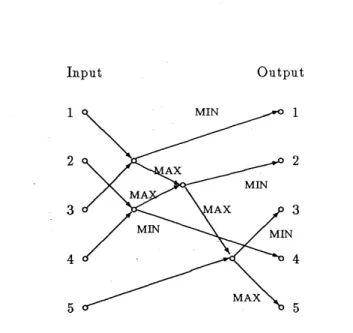
We show an example of a comparator network
in Figure 1.
Deflnition 2 (The mapping associated with
acomparator network) Let$G$be acomparator network with $n$ registers, and $S$ a totally ordered
set. There is a unique way of assigning mappings
to the edges of$G$
.
All those mappings are $S^{n}arrow$ $S$.
Let$e$ be an edge of $G$, and let $f_{e}$ denote the
Input Output
Figure 1: An example ofacomparatornetwork
mapping assigned to $e$
.
$f_{e}$ is determined in the flollowing way.1. If $e$ is incident out of an input termi-nal of $G$ then $f_{e}$ is the mapping
satisfy-ing that $f_{e}(x_{1}, x_{2}, \ldots, x_{n})$ $=x$; for every
$(x_{1}, x_{2}, \ldots, x_{n})\in S$“, where $i$ is an integer denoting theregistercontaining $e$
.
2. If $e$ is incident out of a comparator, the fol-lowing two cases are concidered. Let $e_{a}$ and$e_{b}$
denote the edges incidentintothecomparator.
(a) If label MAX is put on $e$, then $f_{e}$ is the mapping satisfying that $f_{e}(x)$ $=$ $\max\{f_{e}. (x), f_{\epsilon_{b}}(x)\}$
.
(b) If label MIN is put on $e$, then $f_{e}$ is
the mapping satisfying that $f_{\epsilon}(x)$ $=$
$\min\{f_{e}. (x), f_{e_{b}}(x)\}$
.
Let $e_{1},$ $\ldots,$$e_{n}$ denote the $n$ edges incident into
output terminals of G. $\Pi_{G}^{S}$ denote the function,
$f_{e_{1}}xf_{e_{2}}x\ldots xf_{e_{n}}$ : $S^{n}arrow S^{n}$
.
$\Pi_{G}^{S}$ is calledthe mapping associated with G. $y\in S^{n}$ is called
the output
from
$G$ corresponding to $x\in S^{n}$ if$y=$$\Pi_{G}^{S}(x)$
.
In thiscase,$x$iscalled an input to G. $\square$Deflnition 3 (Size and depth ofa compara-tor network) Let $G$ be a comparator network. The size ofGisthe number of comparators
belong-ing to $G$, andisdenoted bysize$(G)$
.
The depth of$G$ is the maximumlength paths from input termi-nals of$G$ tooutputterminals of$G$, and is denoted by depth$(G)$ $\square$
Definition 4 (A selector) Let $k,$ $n$ beintegers
84
A ($n,$ $kf$-selector is a comparator network with $n$
registers and distinguished$k$outputterminalssuch
that, for every input in $S^{n}$, the elements
appear-ing on the distappear-inguished output terminals are all smaller than or equal to each elements appearing on the output terminals not distinguished. $\square$
Definition 5 (A sorting network) Let $S$ be
a totally ordered set. A sorting network with $n$
registers is a comparator network such that, for
every input in $S^{n}$, the output $y=(y_{1}, y_{2}, \ldots , y_{n})$
corresponding to the $input\square$ satisfies the condition
$y_{1}\leq y_{2}\leq\ldots\leq y_{n}$
.
Note that for every 1 $\leq k\leq n-1$ a sorting network with $n$ registers is also an ($n$, k)-selector.
The largest $n-k$ elements in the $n$ input
ele-ments ofan($n$, k)-selector, appear on the$n-k$
out-put terminals other than the distinguished ones. It iseasy to see that an $(n,k)$-selector becomes an (n,n–k)-selector by letting the output terminals
notdistinguished be distinguished, letting the
out-put termminals distinguished be not distinguished
and interchanging thelabels,$MAX$ and $MIN$, on the pair of edges incident out of each comparator.
So without loss of generality, we can assume that
$k\leq\lfloor n/2\rfloor$
.
Notation 3 Let $G=(A, B,E)$ be a bipartite graph and $X$ be a subset of A. $\Gamma_{G}(X)$denotesthe subset of$B$,
$\{y\in B|\exists x\in X((x, y)\in E)\}$
.
$\square$
Deflnition 6 (An expander) Let $0<\alpha\leq 1$
and$\beta\geq 1$
.
Let $G=(A, B, E)$be abipartitegraph withleft vertices $A$, right vertices$B$ and edges $E$.
$G$ is an $(\alpha, \beta)- e$xpander if every subset $X\subseteq A$
with $|X|\leq\alpha|A|$ satisfies $|\Gamma_{G}(X)|\geq\beta|X|$
.
$\square$To construct selectors, we utilize linear size ex-panders $G$ such that the degree of each vertex of $G$ is at most aconstant.
Pinsker[Pin73] first proved the existence of lin-earsizeexpanders. There areseveralresultsto
im-provethat of [Pin73]. In thispaper, we employone
of these results due to Bassalygo[Bas81]. We note
here that, in contrast with these existence results,
Margulis[Mar73] first gave an explicitconstruction
of linear size comparators. After that, several
ex-plicit constructions are alsogivenin literature.
3
Properties of comparator
networks
The following Lemma 1 and Lemma 2 can be
provedbyinduction on the size ofcomparator
net-work $G$
.
Lemma 1 Let $S$ be a totally ordered set and $f$ :
$Sarrow\{0,1\}$ be a
function
such thatfor
all $i,$$j\in S$with $i\leq j,$ $f(i)\leq f(j)$, Let $G$ be a comparator network. Then
for
all$x\in S^{n}$,$\Pi_{G}^{\{0,1\}}(f^{xn}(x))=f^{xn}(\Pi_{G}^{S}(x))$
Lemma 2 (Monotonicity) Let $G$ be a compara-tor netrvork with $n$ registers and $S$ a totally
or-dered set. Let $P=(p_{1}, p_{2}, \ldots, p_{n})\in S^{n},$ $Q=$
$(q_{1}, q_{2}, \ldots, q_{n})\in S^{n},$ $U=(u_{1}, u_{2}, \ldots, u_{n})\in S^{n}$, $V=(v_{1}, v_{2}, \ldots, v_{n})\in S^{n}$, Assume that
$\Pi_{G}^{S}(P)=Q$
and
$\Pi_{G}^{S}(U)=V$
.
If
$u_{1}\geq p_{1},$ $u_{2}\geq p_{2},$ $\ldots u_{n}\geq p_{n}$ then $v_{1}\geq q_{1},$ $v_{2}\geq$$q_{2},$$\ldots v_{n}\geq q_{n}$
.
Notation 4 For $x\in\{0,1\}^{n},$ $\# x$ denotes the
number ofentries of$x$equal to 1. $\square$
Proposition 3 can be proved by Lemma 1 and
Lemma 2. For a set$N$and a set $K,$ $N\backslash K$denotes
the $co$mplement of$K$ withrespect to$N$
.
Proposition 3 A comparator network $G$ with $n$
registers and distinguished $k$ output terminals is
an ($n$, k)-selector
if
$G$satisfies
thefollowingcon-ditions:
Let $N$ denote the set
of
all the outputtermi-nals
of
$G$ and$K$ the setof
the$k$ distinguishedout-put terminals
of
G. Let $x\in\{0,1\}^{n}$ be such that$\#x=n-k$
. If
$x$ is an input to $G$ then theele-ments appearing on $K$ are all $0$ and the elements appearing on $N\backslash K$ are all 1.
Proposition 3justifiesour assumption employed in what follows that the totally ordered set $S$ is taken to be set $\{0,1\}$
.
4
Comparator
subnetworks
obtained
from expanders
$(n,n/2)$-selectors given in thispaper arecomposed
of several kinds of modules. Construction and 33
85
functionof thosemodules areexplainedinthissec-tion.
Definition
7 (A compressor) Let$n,$ $m$be pos-itive integers and let $\alpha,$ $\beta$ be real numbers with$0<\alpha<1$ and $\beta>1$
.
We shall define two typesofcomparatornetworks with $n+m$ registers. Let
$x=(x_{1}, x_{2}, \ldots, x_{n+m})$ be an input to sucha
com-parator network, and $y=$ $(y_{1}, y_{2}, -- , y_{n+m})$
de-note theoutput correspondingto $x$
.
An $(n, m, \alpha, \beta)$-compressor
of
type 1is acom-paratornetwork with$n+m$registers satisfying that if $x\in\{0,1\}^{n+m}$ and $\# x\leq\lfloor\alpha n\rfloor+\lceil\beta\lfloor\alpha n\rfloor\rceil$ then
$\beta\cdot\#(y_{1}, y_{2}, \ldots, y_{n})\leq\#(y_{n+1}, y_{n+2}, \ldots, y_{n+m})$
.
The registers 1,2,
.
..
,$n$ are called upper registersand the registers $n+1,$ $n+2,$$\ldots$,$n+m$ are called
lower registers.
An $(n, m, \alpha, \beta)$-compressor oftype $0$ is a
com-paratornetwork with$n+m$registers satisfying that
if$x\in\{0,1\}^{n+m}$ and $(m-\# x)\leq\lfloor\alpha m\rfloor+\lceil\beta\lfloor\alpha m\rfloor\rceil$
then $\beta(m-\#(y_{n+1}, y_{n+2}, \ldots, y_{n+m}))\leq n-$
$\#(y_{1}, y_{2}, \ldots, y_{n})$
.
The registers $1,2,$$\ldots,$$m$ arecalled upper registers and theregisters$m+1,$$m+$
$2,$
$\ldots,$$n+m$ are called lower registers.
$\square$
Itiseasyto seethat an $(n, m, \alpha, \beta)$-compressor
of type 1 becomes an $(m, n, \alpha, \beta)$-compressor
of type $0$ by interchanging register 1 and register $n+m$, register 2 and register $n+m-1,$ $\ldots$and interchanging the labels, $MAX$ and $MIN$, on the
pair of edges incident out of each comparator.
Proposition 4 $([AKS83a][AKS83b])$ Let$G$ be an $(\alpha, \beta)$-expander with$n$
left
vertices and$m$ right vertices. Let$N$be a comparatornetwork with$n+m$ registers. $N$ is a $(n, m, \alpha, \beta)$-compressorif
$N$satisfies
the following two conditions:1.
If
there is a comparatorof
$N$ which is anin-tersecting vertex
of
two registers $i$ and$j$ with $i<j$, then $i\in\{1,2, \ldots, n\},$ $j\in\{n+1,$$n+$ $2,$$\ldots,$$n+m$},
the edge on $i$ incident outof
the comparator is labeled $MIN$ and the edge on$j$ incident out
of
the comparator is labeled$MAX$
.
2.
If
there is an edgeof
$G$ incidentfrom
the i-thleft
vertex to the j-th right vertex then thereis a comparator
of
$N$ which is an intersectingvertex
of
register$i$ and register$n+j$.
Proposition 5 Assume that there exists an $(\alpha$,
$\beta)$-expander with $n$
lefl
vertices and $m$ right ver-tices. Let $s$ and$k$ denote the numberof
edges andthe maximum degree
of
a vertexof
the expander, respectively. Then there exists a $(n, m, \alpha, \beta)-$compressor
of
type 1 such that its size is $s$ andits depth is $k$.
Proof: This proposition is obvious by the fact that a bipartite graph$G$with themaximum degree
$k$ can be coloured with just $k$ colours so that no
two adjacentedges have the same colour. $\square$
The following Lemma 6 and Lemma 7 are
ob-tained directly from the results of
Bassalygo[Bas81].
Lemma 6 ([Bas81]) There exists an integer
$n_{0}>0$ such that
for
every $n\geq n_{0}$, there exists a$(10^{-5},6)$-expander with$n$
left
vertices and $n$ rightvertices such that its maximum degree
of
a vertexis at most 8.
Lemma 7 ([Bas81]) Let$\mu$ and$\eta$ be realnumbers
with $0<\mu<1$ and $7/8\leq\eta<1$
.
There existpositive integers$m_{0}$ and$s$ such that
for
every$m\geq$$m_{0}$, there exists a $( \mu, \lfloor\frac{1}{\mu}(\frac{2\eta}{1-\eta}-1)\rfloor)$-expander
with $m$
left
vertices and $\lfloor\frac{2\eta}{1-\eta}\rfloor m$ right vertices such that its maximumdegreeof
a vertex is atmost$s \lfloor\frac{2\eta}{1-\eta}\rfloor$
.
Lemma 8 Let $n_{0}$ be as in Lemma 6. For every
$n\geq n_{0}$, there exists a $(10^{-10},18)- e$xpander with
$2n$
left
vertices and $n$ right vertices such that themaximum degree
of
a vertex over itsleft
vertices is at most 64 and the maximum degreeof
a vertexover its right vertices is at most 128.
Proof: Let $G_{1}$ $=$ $(A_{1}, B_{1)}E_{1})$ and $G_{2}$ $=$
$(A_{2}, B_{2}, E_{2})$be$(10^{-5},6)$-expanderswith$n$left
ver-tices and $n$ right vertices such that the maximum
degree of a vertex of $G_{1}$ and the maximum
de-gree of a vertex of $G_{2}$ are both at most 8. Let
$G_{3}=(V, E)$ denote the graph by identifying the i-thright vertex of$G_{1}$ with the i-th left vertex of$G_{2}$
for each $i\in\{1,2, \ldots, n\}$
.
We can devide $V$, theset of vertices of $G_{3}$, into three subsets $V_{1}$
origi-nating in $A_{1},$ $V_{2}$ originating in $B_{1}$ or $A_{2}$ and $V_{3}$
originating in $B_{2}$
.
Identify $V_{1}$ with$A_{1}$ and $V_{3}$ with$B_{2}$
.
Let $H=(A, B, F)$ denote the bipartite graph
such that
$F=\{(a, b)\in AxB|$ There exists a path oflength 2 from$a$ to $b$ on $G_{3}.$
}
Then,it is obvious that $|A|=|B|=n$ , the degree ofeach vertex inAU$B$is at most$8^{2}=64$ and that
$H$is a$(10^{-10},36)$-expander.
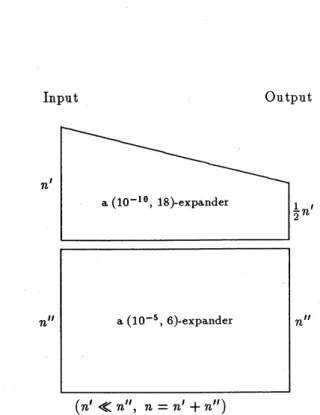
Next, we construct a bipartite graph$G$ with $2n$
86
Input Output
Figure 2: Construction ofa $(10^{-10},18)$-expander
$H_{1}$ and $H_{2}$be$(10^{-10},36)$-expanders isomorphicto
H. $G$ is constructed by identifying the i-th right
vertex of $H_{1}$ with the i-th right vertex of $H_{2}$ for
each$i=1,2,$$\ldots,$$n$as shown in Figure 2. Thus,the
degree of each left vertex of $G$ is at most 64 and the degree of each rightvertexof$G$is at most 128. Moreover, it is easy to show that $G$ is a $(10^{-10}$,
18)-expander. $\square$
ThefollowingLemma9isdeduced fromLemma
6 and Lemma 8.
Lemma 9 For every $\epsilon>0$, there exist positive
integers $n_{1},$ $k_{0}$ and a real number
$\alpha_{0}$ with $0<$
$\alpha_{0}<1$ such that
for
every integer$n\geq n_{1}$, there exists an $(\alpha_{0},6)$-expander with $n$left
vertices, $at$ most $(1 -(\epsilon/28))n-4$ right vertices and at most$8(1+e)n$ edges such that the degree
of
each vertexof
the expander is at most $k_{0}$.
Proof: Note that we can assume that $\epsilon<1$ to
prove the lemma. For $\epsilon>0$, we determin $\alpha_{0},$ $n_{1}$
and $k_{0}$ as follows: $n_{1}= \max\{\lceil\frac{140}{\epsilon}\rceil, \lceil\frac{14}{\epsilon}(n_{0}+1)\rceil\}$, $\alpha_{0}=\underline{27}.10^{-10}\epsilon$ 70 and $k_{0}=128$
.
For every $n\geq n_{1}$, we construct the bipartite
graph$G$as shownin Figure3. The bipartitegraph $A$and$B$inthe figure are the $(10^{-10},18)$-expander
stated in Lemma 8 and the $(10^{-5}, 6)$-expander
Input Output
$n”$ a$(10^{-5},6)$-expander $n”$
$(n’\ll n’’, n=n’+n’’)$
Figure 3: Construction of an $(\alpha_{0},6)$-expander stated in Lemma 6, respectively. The number of
the left vertices of$A$ is $n’=2\lfloor(\epsilon/14)n\rfloor$ and the number of the right vertices of$A$ is $n’/2$
.
$n”$de-notes the number of left vertices of $B$, namely,
$n”=n-n’$
.
It is not hard to see that thebi-partite graph, $G$, is an $(\alpha_{0},6)$-expandersatisfying the condition ofLemma9. $\square$
From Proposition 4, Proposition 5 and Lemma
9, thefollowingLemma 10is proved immediately.
Lemma 10 For every $\epsilon>0$, there exist positive integers $n_{1},$ $k_{0}$ and a real number $\alpha_{0}$ with $0<$ $\alpha_{0}<1$ such that
for
every integers$n$ and $m$ with $n\geq n_{1}$ and$(1- \frac{e}{28})n-4\leq m\leq n$ there exist an$(n, m, \alpha_{0},6)$-compressor
of
type 1 and an $(m,$ $n$, $\alpha_{0},6)$-compressorof
type $\theta$ such that those depthsare bothat most$k_{0}$ and those sizes are both at most
$8(1+\epsilon)n$
.
The following Lemma 11 contributes to
utiliz-ing compressors in order to construct $(n, n/2)-$
selectors.
Lemma 11 Let$X$ be a comparator network with
$n$ registers. Let $x=(x_{1}, x_{2}, \ldots, x_{n})$ be an input
to $X$ and $y=(y_{1}, y_{2}, \ldots, y_{n})$ denote the output
from
$X$ corresponding to the input$x$.
Assume that$x\in\{0,1\}^{n}$ and, therefore, $y\in\{0,1\}^{n}$
.
Let $i,$ $j$and$k$ be integers with $1\leq i<j<k\leq n+1$
.
Assume that there is no comparator in
inter-secting vertices
of
any register in $\{1, 2, \ldots, i-1\}$and any register in $\{i, i+1, \ldots, n\}$ and there is
5$)$ ’
8
$1$no comparator in intersecting vertices
of
anyreg-ister in$\{1, 2, \ldots , k-1\}$ and any registerin$\{k,$$k+$
$1,$
$\ldots,$$n$
}.
(Note that this assumption implies that $\#(x_{1}, x_{2}, \ldots, x_{i-1})=\#(y_{1}, y_{2}, \ldots, y_{i-1})$ ,Therefore,
$\#(y_{1}, y_{2}, \ldots, y_{j-1})\leq\lfloor u\rfloor+c(\lfloor v\rfloor-\lfloor u\rfloor)$
$=u+c(v-u)-((1-c)\Delta u+c\Delta v)$.
$\#(x_{i}, x_{i+1}, \ldots, x_{k-1})=\#(y_{i}, y_{i+1}, \ldots , y_{k-1})$and $\#(x_{k}, x_{k+1}, \ldots, x_{n})=\#(y_{k}, y_{k+1}, \ldots, y_{n}))$
Assume that there exist constants$a>0$ and$0\leq$
$c\leq 1$ such that,
for
every$x\in\{0,1\}$“,if
Now, $(1-c)\Delta u+c\Delta v\geq 0$ holds because $0\leq$
$c\leq 1$
.
Therefore, we conclude that$\#(y_{1}, y_{2}, \ldots, y_{j-1})\leq u+c(v-u)$
$\#(x;, x_{t+1}, \ldots, x_{k-1})\leq a$ on either case. $\square$
then
$\#(y;, y_{i+1}, \ldots, y_{j-1})\leq c\#(x;,x_{i+1}, \ldots, x_{k-1})$
.
(1)
Let $u>0$ and$v\geq u$ be real numbers with $\lfloor v\rfloor-$
$\lfloor u\rfloor\leq a$
.
Then, $\#(y_{1}, y_{2}, \ldots, y_{j-1})\leq u+c(v-u)$if
$\#(x_{1}, x_{2}, \ldots,x_{i-1})\leq u$ and$\#(x_{1}, x_{2}, \ldots , x_{k-1})\leq$
$v$
.
Proof: Let$w=\#(y_{i}, y_{i+1}, \ldots, y_{k-1})$
.
Let $\Delta u=$$u-\lfloor u\rfloor$ and $\Delta v=v-\lfloor v\rfloor$
.
Two cases must be considered.Case 1: $w\geq\lfloor v\rfloor-\lfloor u\rfloor$
.
Since $\#(x_{1},x_{2}, \ldots, x_{k-1})$ $\leq$ $v$ and
$\#(x_{1}, x_{2}, \ldots , x_{k-1})$is an integer,
$\#(x_{1}, x_{2}, \ldots, x_{i-1})$ $=$ $\#(x_{1}, x_{2}, \ldots,x_{k-1})-w$
$\leq$ $\lfloor v\rfloor-w$
.
FromLemma2 and assumption (1), we have
$\#(y_{j}, y_{j}+1, \ldots, y_{k-1})\geq(1-c)(\lfloor v\rfloor-\lfloor u\rfloor)$ ,
which implies
$\#(y;, y_{i+1}, \ldots, y_{j-1})\leq w-(1-c)(\lfloor v\rfloor-\lfloor u\rfloor)$
.
Thus,
$\#(y_{1}, y_{2}, \ldots, y_{j-1})$
$\leq$ $(\lfloor v\rfloor-w)+w-(1-c)(\lfloor v\rfloor-\lfloor u\rfloor)$
$=$ $\lfloor u\rfloor+c(\lfloor v\rfloor-\lfloor u\rfloor)$
$=$ $u+c(v-u)-((1-c)\Delta u+c\Delta v)$
.
Case 2: $w<\lfloor v\rfloor-\lfloor u\rfloor$
.
Since $\#(x_{1}, x_{2}, \ldots, x_{i-1})$ $\leq$ $u$ and
$\#(x_{1}, x_{2}, \ldots , x_{i-1})$ is aninteger,
$\#(x_{1}, x_{2}, \ldots, X_{1-1})\leq\lfloor u\rfloor$
.
On theother hand, by assumption (1), we have $\#(y;, y_{i+1}, \ldots, y_{j-1})\leq c(\lfloor v\rfloor-\lfloor u\rfloor)$
.
Deflnition 8 (An extractor) Let $n,$ $m$ be pos-itive integers and let $0$ $<$ $\mu$ $<$ 1. We shall
define a class of comparator networks, caUed
‘extractors’, with $n+2m$ registers. Let $x=$
$(x_{1}, x_{2}, \ldots , x_{n+2m})$bean input toan extractor and
$y=$ $(y_{1}, y_{2}, \ldots , y_{n+2m})$ denote the output
corre-spondingtothe input $x$
.
An $(n, m, \mu)$-extractor is acomparatornetwork
with$n+2m$registerssatisfying the following
condi-tion: Assume that $x\in\{0,1\}^{n+2m}$
.
Let $d_{1}=\# x$,$d_{0}=n+2m-\# x,$ $c_{1}=\#(y_{1}, y_{2}, \ldots , y_{m})$ and
$c_{0}=m-\#(y_{n+m+1}, y_{n+m+2}, \ldots , y_{n+2m})$
.
The conditionis thatif$d_{1} \leq\frac{3}{4}n+m$ then $c_{1}\leq\mu m$
and
if$d_{0} \leq\frac{3}{4}n+m$ then $c_{0}\leq\mu m$
.
Note that $d_{1} \leq\frac{3}{4}n+m$or $d_{0} \leq\frac{3}{4}n+m$ must
hold because$d_{1}+d_{0}=n+2m$
.
The registers $1,2,$$\ldots,$$m$ of an $(n, m, \mu)-$
extractor are called upper registers. The registers $m+l,$$m+2,$$\ldots,$$n+m$ ofthe extractor are called
middle registers. The registers$n+m+1,$$n+m+$
$2,$$\ldots,$$n+2m$ of the extractorare called lower
reg-isters. $\square$
Thefollowing Lemma 12 states anothertype of modules utilized to construct $(n, n/2)$-selectors.
Lemma 12 $For$ every $7/8\leq\eta<1$ and $0<\mu<$
$1$, there existpositive integers$n_{2},k_{1}$ and a positive
real number 6 such that
for
every integer$n\geq n_{2}$and
for
every integer$m$ with $|\eta(n+2m)-n|\leq 5$there exist an $(n, m, \mu)$-extractor
of
depth at most$k_{1}$ and size at most$S(n+2m)$,
Proof: The proofis omitted due to lack ofspace.
88
5
Construction
of
$(n, n/2)-$
selectors
In this section, we show theprocedureto construct
$(n, n/2)$-selectors and its justification. For
sim-plicity, we assume that $n$ is even. First we define
a comparator network called alayer.
Notation 5 Let $n$and$j$be positiveintegers. For
each integer $i$, let
$x;=\lceil(n/2)(1-\eta^{i})\rceil$ and $y;=(n+1)-x;$ ,
where $\eta$is asin Lenma 12.
$\square$
In what follows, we take the parameters$\eta,$$\mu$in
Lemma 12 so that$\mu\leq\alpha_{0}/100$and $\eta=1-(\epsilon/28)$,
where parameter$\epsilon$ is as in Lemma10.
Notation 6 Let $j_{\max}$ denote the integer,
$\min\{i\in Z|\dot{f}\geq 1$ and
$x,$ $-x_{i-1}< \max\{n_{1}, n_{2},100/\mu\}\}$ ,
where $n_{1}$ isasin Lenma 10 and $n_{2}$ is as inLemma 12. Then, theexistence of a$(y;-x;-1,$ $x_{i}-x_{i-1}$, $\mu)$-extractor is guraranteed by Lemma 12 for $i=$
$1,2,$$\ldots$,$j_{\max}$
.
The existence of an $(x_{*-1}-x_{i-2}$,$x;-x_{i-1},$$\alpha_{0},6$)-compressor oftype 1 and a$(y_{i-1}-$ $y;,$ $y_{i-2}-y_{i-1},$$\alpha_{0},6$)-compressor oftype $0$is also
guaranteed by Lemma 10 for $i=2,3$,–,$j_{\max}$
.
Note that$y_{i}-x;-1=n-2x;,$ $y|-1-y;=x;-x_{i-1}$and $y_{i-2}-y_{i-1}=x_{i-1}-x_{i-2}$
.
For conciseness, we abbreviate the $(n-2x;,$$x;-$
$x_{i-1},$ $\mu$)-extractor, the $(x_{i-1}-x_{i-2},$ $x_{i}-x_{i-1},$ $\alpha_{0}$,
$6)$-compressoroftype 1 and the $(x;-x_{i-1},$$x_{i-1}-$
$x_{-2},$ $\alpha_{0},6$)-compressor of type $0$ to $E(i),$ $C1(i)$
and CO(i), respectively. $\square$
Notation 7 For an positive integer $i\geq 1,$ $X(i)$ denotes set $\{x_{i-1}+1, x_{i-1}+2, \ldots, x_{i}\}$ and $Y(i)$
denotes set $\{y_{i}, y_{*}+1, \ldots , y_{i-1}-1\}$
.
If$x_{i}-x_{i-1}=$$y_{1-1}-y$; then $X(i)=Y(i)=\emptyset$
.
$\square$Deflnition 9 For each$j=1,2,$$\ldots,$$j_{\max}$, we
de-fine the layer of rank $j$ with $n$ registers, denoted
by $L(j)$, as follows.
1. If $j_{\max}=1$ then $L(1)$ is a sorting network,
for example, the one constructed by Batcher’s odd-even merge. In the following part of this
definition, we assume that $j_{\max}>1$
.
2. $L(1)$is $E(1)$
.
3. lf$j<j_{\max}$ then$L(j)$is constructed from$E(j)$,
Cl$(j),$ $C1(j-1),$ $\ldots$, Cl(2), $C0(j),$ $C0(j-1)$,
.
..
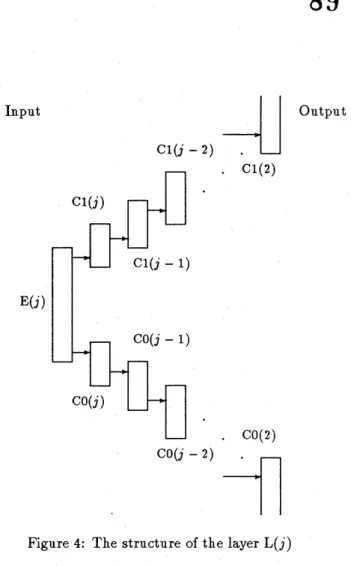
, CO(2) as follows.(a) Join the output terminals on the upper registers of $E(j)$ to the input terminals
on the lower registers of$C1(j)$, the
out-put terminals on the upper registers of $C1(j)$to the inputterminalson the lower registers of$C1(j-1),$ $\ldots$and the output
terminalson the upperregistersof C1(3)
to the input terminals on the lower reg-isters of C1(2) in any way.
(b) join the output terminals on the lower registers of$E(j)$to the input terminals on
the upper registers of$C0(j)$, the output
terminals on the lower registers of$C0(j)$
tothe input terminals on the upper reg-isters of$C0(j-1),$ $\ldots$and theoutput ter-minalson the lower registers of CO(3) to
the input terminals on the upper regis-ters of CO(2)in any way.
4. $L(j_{\max})$ is the comparator network obtained
by exchanging$E(j_{\max}-1)$ in $L(j_{\max^{-}}1)$ for
a sorting network with the same number $oi$ registers as $E(j_{\max^{-}}1)$
.
$\square$
Note: In this paper, to join an output terminaI
of a comparator network to an input terminal of
anothercomparatornetwork means to identifythe two terminals and then replace the identified
ver-texand the two edges incidentto it with one edge. Now, we express a procedure to construct $(n$,
$n/2)$-selectors. In the following procedure,
bold-faced letters represent variables in the procedure
in order to distinguish those variables from general variables. The meanings of the variables in the procedure are as follows:
1. $N$ is a variable to which a comparator
net-work with$n$registers isassigned. An $(n, n/2)-$
selector isto be assigned to $N$ when the
pro-cedure terminates.
2. Inprogress of the procedure, layers are$joi_{1}\iota ed$
to N. $j$is a variable indicating the rank of the
joinedlayer.
3. For each $i=1,2,$$\ldots$,$j,$ $1(i)$ is a variable as-signed a positive number.
[Procedure 1]
1. (Initial setting)
$Narrow L(1),$ $jarrow 1,1(1)arrow 3\mu|X(1)|$ Note: The $symbolarrow means$ assignment.
89
2. If$j_{\max}=1$ then terminatethe procedure.
3. join either $L(j)$ or L(j+l) to thecomparator
network assigned to $N$, say $G$, so that the
i-th output terminal of $G$ isjoined to the i-th
input terminal of thejoined layer(either$L(j)$
or $L(j+1))$for each $i=1,2,$$\ldots,$$n$
.
Thejoint of the layeris the left side inFigure
4.
(a) If$j<j_{\max}$ and l(j) $<7\mu|X(j)|$ then
join L(j+l) to $G$,
$1(i) arrow\frac{24}{49}1(i)$ for each $i=1,2,$$\ldots,j$ ,
$1( j+1)arrow\frac{7}{2}1(j)$ and
$jarrow j+1$
.
(b) Otherwise,
join $L(j)$ and
24
$1(i)arrow-1(i)49$ for each $i=1,2,$$\ldots$,$j$
.
4. $H$there exists an integer$i$such that
$2\leq i\leq j$ and $\sum_{k=1}^{i}1(k)<1$
then let
$i_{\max}= \max\{i\in Z|\sum_{k=1}^{i}1(k)<1\}$
and remove the comparator networks Cl(2),
.
..
, Cl$(i_{\max})$ and CO(2),..
.
, $C0(i_{\max})$ fromthelayer $L(j)$joined in step 3
5. If$j=j_{\max}$ and $\sum_{k1}^{j_{=}}1(k)<1$ then terminate
theprocedure.
6. Go to thestep 3.
$\square$
Procedure 1 progresses asstep $1arrow step2$, first. Next, if the execution does not terminate at step
2 then the loop, step$3arrow step4arrow step5arrow step$
$6arrow step3$, is executed $0$ ormore times, step$3arrow$
step 4isexecuted and theexecution terminates at
step 5, atlast.
$H$ the execution of Procedure 1 terminates at
step 2 then the value of $N$ at the termination is
a n-sortor, namely an $(n, n/2)$-selector. In what
follows, therefore,we assume that theexecution of
Procedure1 terminatesatstep 5,namely$j_{\max}>1$
.
Output
Figure4: The structure of thelayer$L(j)$
Variablej, l(i) are modifiedonlyinstep 3except step 1. And variable $N$is modified onlyin step 3
and step 4 except step 1.
Now, We shall define somenotations in order to
make proof of simple.
Foranyvariable$v$in Procedure 1,$i\in\{3,4\}$ and
non-negative integer$j,$ $V[v|i, j]$ denotes the value
of$v$just after step $i$ has been executed $j$ times if
$j>0$ and. $V[v|i, 0]$ denotes the value of$v$ just before the first execution of step $i$
.
For positiveinteger $j,$ $A(j)$ is defined as follows: If step 3 is executed less than $j$ times then $A(j)=0$
.
$H$ step$3a$is executed in thej-th execution ofstep 3 then $A(j)=1$
.
Otherwise, $A(j)=0$.
We shall prove that the comparatornetwork ob-tainedbyexecuting Procedure 1,denotedby$N(n)$,
is a $(n, n/2)$-selector. $k_{\max}(n)$ denotes the
num-ber oftimesstep 4 is executed in theexecution of Procedure 1. Therefore, step 3 is also executed
$k_{\max}(n)$ times. We abbreviate $k_{\max}(n)$ to $k_{\max}$ when$n$is obvious. Thus,$N(n)=V[N|4, k_{\max}(n)]$
.
Let $i\in\{3,4\}$ and $j\in\{0,1, \ldots,\dot{k}_{\max}(n)\}$
.
Let $s$ and $t$ be positive integers with 1 $\leq s\leq t\leq n$.
Then, letting $f$ denote the function, $\Pi_{V[N|i,j]}^{\{0,1\}}$ :
$\{0,1\}^{n}arrow\{0,1\}^{n}$, we can decompose $f$ as $f=f_{1}xf_{2}x\ldots xf_{n}$
.
90
$N(i, j;s, t)$ denotes thefunction,
$f_{s}xf_{s+1}x\ldots xf_{t}$ : $\{0,1\}^{n}arrow\{0,1\}^{t-s+1}$
Let $k$ be
a.
positive integer and $u\in$ $\{0,1\}^{n}$.
$\nu_{1}(i, j, k;u)$ and $\nu_{0}(i,j, k;u)$ denotes the integers,$\#(N(i, j;1, x_{k})(u)),$ $x_{k}-\#(N(i,j;y_{k}, n)(u))$ , respectively. For an integer $k$ with $0\leq k\leq$ $k_{\max}(n),$ $\xi(k)$ denotes the integer, $V[j|3, k]$ $=$
$V[j|4, k]$
.
For an integer $k$ with $0\leq k\leq k_{\max}(n)$and aninteger $i$ with $1\leq i\leq\xi(k),$ $\lambda(i, k)$ denotes
thereal number, $V[1(i)|3, k]=V[1(i)|4, k]$
.
Observing Procedure 1, the following lemma is obvious.
Lemma 13 Let $k$ be an integer with $0\leq k\leq$
$k_{\max}.$ For each $h=1,2,$$\ldots\xi(k)$, $\lambda(h, k)=\frac{49}{24}\lambda(h, k+1)$
.
For each $h=1,2,$$\ldots\xi(k)-1$,
$\lambda(h, k)=\frac{2}{7}\lambda(h+1, k)$
.
Lemma 14 Let $k$ be an integer.with 1 $\leq k\leq$
$k_{\max}$
.
ThenA$(\xi(k)-1, k-1)<7\mu|X(\xi(k)-1)|$ (2)
and
if
$\xi(k)<j_{\max}$ then$2\mu|X(\xi(k))|\leq\lambda(\xi(k), k)$
.
(3)Proof: First, we shall prove (2). Assume that
$A(k)=1$
.
Observing Procedure 1, it iseasytosee that For every $j=1,2,$$\ldots,$$k_{\max}$, if$A(j)=1$ then$\lambda(\xi(j-1), j-1)<7\mu|X(\xi(j-1))|$ (4) and
$\xi(j)=\xi(j-1)+1$
.
(5)Therefore, by Lemma 13, (4) and (5), $\lambda(\xi(k)-1, k-1)<7\mu|X(\xi(k)-1)|$ holds.
Next, assume that $A(k)=0$
.
For every $j=$$1,2,$$\ldots,$$k_{\max}$, if $A(j)=0$ then the following
ex-pressions hold: $H\xi(j-1)<j_{\max}$ then
$\lambda(\xi(j-1), j-1)\geq 7\mu|X(\xi(j-1))|$ (6)
and
$\xi(j)=\xi(j-1)$
.
(7)Since $A(1)=1$, thereis a positive integer $k_{0}<j$
such that $A(k_{0})=1$ and $A(k_{0}+1)=A(k_{0}+2)=$
...
$A(k)=0$.
Therefore, by Lemma 13, (4), (5)and (7),
$\lambda(\xi(k), k)$ $<$ $\lambda(\xi(k_{0}), k_{0})$
$<$ $12\mu|X(\xi(k_{0}-1))|$
$=$ $12\mu|X(\xi(k)-1)|$ On the other hand, byLemma 13,
$\lambda(\xi(k)-1, k-1)=\frac{7}{12}$A$(\xi(k), k)$
holds. Thus, we have (2).
Next, we shallprove(3). Weassumethat$\xi(k)<$
$j_{\max}$
.
$HA(k)=0$ then (3) obviously holds. If$A(k)=1$ then either of the following two cases
holds:
1. There exists a positive integer $k_{0}<k$ such that $A(k_{0})=0$ and $A(k_{0}+1)=A(k_{0}+2)=$
.
$..=A(k)=1$.
$\ln$ this case, by Lemma 13and (6), we have
$\lambda(\xi(k), k)$ $>$ $\lambda(\xi(k_{0}), k_{0})$
$\geq$ $\frac{24}{7}\mu|X(\xi(k_{0}))|$ $>$ $2\mu|X(\xi(k))|$
.
2. $A(1)=A(2)=\ldots=A(k)=1$
.
In this case,we have
$\lambda(\xi(k), k)$ $>$ $\lambda(\xi(0), 0)$ $>$ $2\mu|X(\xi(k))|$
.
Thus, we conclude (3). $\square$
Lemma 15 Let $k$ be an integer with $0\leq k\leq$ $k_{\max}(n)$
.
Let $u\in\{0,1\}^{n}$ be an input to $N$ with$\# u=n/2$
.
Let $\tau_{1}(i, k)$ and$\tau_{0}(i, k)$ denote thein-tegers, $\nu_{1}(4, k, i;u)$ and $\nu_{0}(4, k, i;u)$, respectively,
for
each $i=1,2,$$\ldots$,$\xi(k)$ , Then,for
each $i=$$1,2,$$\ldots,$$\xi(k)$, $\tau_{1}(i, k)\leq\sum_{h=1}^{i}\lambda(h, k)$ (8) and $\tau_{0}(i, k)\leq\sum_{h=1}^{i}\lambda(h, k)$ (9) hold. 9’
91
Proof:
We shall prove the lemma by inductionon $k$
.
Observing the initial setting of Procedure 1,wehave
$\xi(k)=1,$ $\lambda(1,0)=3\mu x_{1}$
.
Since
$\# u=\frac{n}{2}\leq x,$ $+ \frac{3}{4}(n-2x_{i})$
and $L(1)=E(1)$ is an $(n-2x_{1}, x_{1}, \mu)$-extractor,
we also have
$\tau_{1}(1,0)\leq\mu x_{1}<3\mu x_{1}=\lambda(1,0)$
and
$\tau_{0}(1,0)\leq\mu x_{1}<3\mu x_{1}=\lambda(1,0)$
.
Thus, if $k=0$ then the inequalities (8) and (9)
hold for $i=1=\xi(k)$
.
Assume that $0\leq k\leq k_{\max}-1$ and the
inequal-ities, (8) and (9), hold for each $i=1,2,$$\ldots,$$\xi(k)$,
by induction.
In the $(k+1)- st$ execution of step 3, the layer, $L(\xi(k+1))$ is joined to the comparator network,
$V[N|4, k]$
.
From the assumption of induction and $\# u=$
$n/2$, $\frac{n}{2}-(x_{\xi(k+1)-1}-\tau_{0}(\xi(k+1)-1, k))$ $\leq$ $\frac{1}{2}(n-2x_{\xi(k+1)-1})+\sum_{h=1}^{\xi(k+1)-1}\lambda(h, k)$ $\tau_{1}(\xi(k+1)-1, k)\leq\sum_{h=1}^{\xi(k+1)-1}\lambda(h, k)$
.
Therefore, we $h$ave $\lfloor\frac{1}{2}(n-2x_{\xi(k+1)-1})+\sum_{h=1}^{\xi(k+1)-1}\lambda(h, k)\rfloor$ $- \lfloor\sum_{h=1}^{\xi(k+1)-1}\lambda(h, k)\rfloor$ $\leq$ $\lceil\frac{1}{2}(n-2x_{\xi(k+1)-1})\rceil=\frac{1}{2}(n-2x_{\xi(k+1)-1})$.
Therefore, if $\xi(k+1)<j_{\max}$ then, by applying
Lemma 11 to$E(\xi(k+1))$ and using Lemma14and
Lemma 13, we have $\nu_{1}(3, k+1, \xi(k+1);u)$ $\leq$ $\mu|X(\xi(k+1))|+\tau_{1}(\xi(k+1)-1, k)$ $\leq$ $\mu|X(\xi(k+1))|+\sum_{h=1}^{\xi(k+1)-1}\lambda(h, k)$ $\leq$ $\frac{7}{12}\lambda(\xi(k+1), k+1)$ $+ \frac{49}{24}\sum_{h=1}^{\xi(k+1)-1}\lambda(h, k+1)$
.
If$\xi(k+1)=j_{\max}$ then,observing the structure of
$L(j_{\max})$, we also have
$\nu_{1}(3, k+1, \xi(k+1);u)$
$=$ $\nu_{1}(3, k+1, \xi(k+1)-1;u)$
$=$ $\tau_{1}(\xi(k+1)-2, k)$
$\leq$ $\frac{7}{12}\lambda(\xi(k+1), k+1)$
$+ \frac{49}{24}\sum_{h=1}^{\xi(k+1)-1}\lambda(h, k+1)$
.
Since, byLemma 14 and Lemma 13,$\lfloor\frac{7}{12}\lambda(i+1, k+1)+\frac{49}{24}\sum_{h=1}^{i}\lambda(h, k+1)\rfloor$
$- \lfloor\frac{49}{24}\sum_{h=1}^{1-1}\lambda(h, k+1)\rfloor$ $\leq$ $\frac{7}{6}\lambda(i+1, k+1)+1$ $\leq$ $15\mu|X(i)|$ $\leq$ $7\lfloor\alpha_{0}|X(i)|\rfloor$ and $\frac{1}{7}(\frac{7}{12}\lambda(i+1, k+1)+\frac{49}{24}\lambda(i, k+1))$ $+ \frac{49}{24}\sum_{h=1}^{1-1}\lambda(h, k+1)$ $=$ $\frac{7}{12}\lambda(i, k+1)+\frac{49}{24}\sum_{h=1}^{i-1}\lambda(h, k+1)$
hold for each$i=1,2,$$\ldots$,$\xi(k+1)-1$, by applying Lemma 11 to $C1(\xi(k+1))$ (if $\xi(k+1)<j_{\max}$),
$C1(\xi(k+1)-1),$ $\ldots$and C1(2), we have
$\nu_{1}(3, k+1, i;u)\leq\frac{7}{12}\lambda(i, k+1)+\frac{49}{24}\sum_{h=1}^{1-1}\lambda(h, k+1)$
for each $i=1,2,$$\ldots,$$\xi(k+1)$
.
Note that, by thedefinition of$j_{\max}$,
$\mu|X(i)|>1$
holds for each $i=1,2,$$\ldots,$$j_{\max}-1$ and $\sum_{i=j}^{k}x;=$
92
By using Lemma13, we can obtain
$\frac{7}{12}\lambda(i, k+1)+\frac{49}{24}\sum\lambda(h, k+1)i-1$
$h=1$
$=$ $\lambda(i, k+1)(\frac{7}{5}-\frac{1}{15}(\frac{2}{7})^{i-3})$
On the otherhand,
$\sum_{h=1}^{i}\lambda(h, k+1)=\lambda(i, k+1)(\frac{7}{5}-\frac{8}{245}(\frac{2}{7})^{i-3})$
Hence,
$\nu_{1}(3, k+1, i;\dot{u})\leq\sum^{:}\lambda(h, k+1)$ $h=1$
for each$i=1,2,$$\ldots,$$\xi(k+1)$
.
In asimilar way, wealso have
$\nu_{0}(3, k+1, i;u)\leq\sum_{h=1}^{i}\lambda(h, k+1)$
for each$i=1,2,$$\ldots$,$\xi(k+1)$
.
$H$ no compressors are removed from the joined
layer in the $(k+1)- st$ execution of step 4, it is
obvious that
Proof: The proof is obvious by Lemma 15 and the structure of$L(j_{\max})$
.
$\square$Lemma 17 depth(N(n))$=0(\log n)$
.
Proof: ByLemma 13, we have$\sum_{h=1}^{\xi(k)}\lambda(h, k)$ $=$ $\lambda(1,0)(\frac{24}{49})^{k}\sum_{h=1}^{\xi(k)}(\frac{7}{2}I^{h-1}$
$<$ $2^{210\ n+2j_{\max}-k}$
Since, by the definition of$j_{\max},$ $n\psi^{\max}\geq 1$,
$j_{\max} \leq-\frac{1}{\log_{2}\eta}\log_{2}n$
.
Therefore, $\sum_{h=1}^{\xi(k)}\lambda(h, k)<1$ holds if
$k \geq 2(1-\frac{1}{\log_{2}\eta})\log_{2}n$
.
On the other hand, by Lemma 14, $\xi(k)=j_{\max}$
holds if
$\lambda(\xi(k), k)<1\leq 2\mu|X(\xi(k))|$
.
Therefore, we conclude that
$\tau_{1}(i,K+1)=\nu_{1}(3, k+1, i;u)$
and
$\tau_{0}(i, K+1)=\nu_{0}(3, k+1, i;u)$
for each $i=1,2,$$\ldots,$$\xi(k+1)$
.
Otherwise, by theassumption of induction,
$\tau_{1}(i_{\max}, k)\leq\sum_{h=1}^{i_{\max}}\lambda(h, k)<1$
.
Since $\tau_{1}(i_{\max}, k)$ $\geq$ $0$ and $\tau_{1}(i_{\max}, k)$ $\in$ $Z$,
$\tau_{1}(i_{\max}, k)=0$
.
In a similar way, $\tau_{0}(i_{\max}, k)=0$.
This shows that only $0’ s$ move through C1(2),
C1(3),
.
.
., $C1(i_{ma}.)$ and only l’s move throughCO(2), CO(3),
. ..
, $C0(i_{mal\zeta})$ in the joined layer.Thus, removed compressors above do not work at
all. Therefore, in any case,
$\tau_{1}(i, K+1)=\nu_{1}(3, k+1, i;u)$
and
$\tau_{0}(i, K+1)=\nu_{0}(3, k+1, i;u)$
for each $i=1,2,$$\ldots,$$\xi(k+1)$
.
$\square$
Lemma 16 For every even integer $n>0,$ $N(n)$ is a ($n$, n/2)-selector.
$k_{\max}(n) \leq\lfloor 2(1-\frac{1}{\log_{2}\eta})\log_{2}n\rfloor=O(\log n)$
.
ロ
Lemma 18 There exists a positive integer$n_{3}$ such
that,
for
every even integer$n\geq n_{3},$ $size(N(n))\leq$$8n\log_{2}n$
.
Proof: For a positive integer $k$, let $s_{1}(k)$ the
total sizeofthe compressorscontainedbythe layer,
$L(\xi(k))$, let $s_{2}(k)$ and $s_{3}(k)$ denote thesizes of the
extractor and thesortingnetworkcontainedby the
layer, $L(\xi(k))$, respectively. We also define $s_{1}(0)$,
$s_{2}(0)$ and $s_{3}(0)$ as $s_{1}(0)=s_{3}(0)=0$ and $s_{2}(0)=$
$size(E(1))$
.
Thus,size$(N(n))= \sum_{k=0}^{k_{\max}}(s_{1}(k)+s_{2}(k)+s_{3}(k))$
.
From Lemma 17 and the definition of $j_{\max}$, it is easy to see that $\sum_{k0}^{k_{\max_{=}}}s_{3}(k)=O(\log n)$
.
$H\xi(k)\leq j_{\max}$ then
$A(k-2)=A(k-1)=$
$A(k)=0$ does not hold, for the following reason. Let $k$be an positiveinteger with $\xi(k)\leq j_{\max}$
.
As-sume that $A(k)=A(k+1)=0$
.
Since $\xi(k-1)=$93
$\xi(k+1)$, by using Lemma 14 and Lemma 13, we have
$\lambda(\xi(k+1), k+1)\leq\frac{288}{49}|X(\xi(k+1)-1)|$
.
On the other hand, by the definition of$j_{\max}$, we have
$|X( \xi(k+1)-1)|\leq\frac{101}{99}\cdot\frac{8}{7}|X(\xi(k+1))|$
.
Thus, $\lambda(\xi(k+1), k+1)<7\mu|X(\xi(k+1))|$ and
$A(k)=1$ hold. Moreover, byLemma 11, we have
$s_{2}(k)\leq\eta^{\xi(k)-1}Sn$
.
Therefore, we have$\sum_{k=0}^{k_{\max}}s_{2}(k)\leq 3\delta(\sum_{i=1}^{j_{\max}}\eta^{i-1})n=O(n)$
.
Wealready showed that$\sum_{k0}^{k_{\max_{=}}}(s_{2}(k)+s_{3}(k))=$
$O(n)$and hence itsuffices to show that thereexists
a$f=O(n)$such that $\sum_{k0}^{k_{\max_{=}}(n)}s_{1}(k)\leq 8n\log_{2}n+$
$f(n)$
.
Let $k_{0}=\lfloor\log_{2}n/\log_{2}(49/24)\rfloor$.
We have$\sum_{k=0}^{k_{0}}s_{1}(k)\leq\frac{8(1+\epsilon)}{\log_{2}(49/24)}n\log_{2}n+16(1+\epsilon)n$
.
Since $\log_{2}(49/24)$ $>$ 1 and we may take $\epsilon$as arbitrarily small, it suffices to show that
$\sum_{kk_{0}+1}^{k_{\max_{=}}}s_{1}(k)=O(n)$
.
Since $\sum_{h=1}^{1}\lambda(h, k)<$$(7/5)\lambda(i, k)$byLemma13,if$\lambda(i, k)\leq 5/7$thenthe
compressors, Cl(i) and CO(i), are removed from the layer$j$oined at the j-th execution of step 4 for each $j=k,$$k+1,$$\ldots,$$k_{\max}$
.
Since $\lambda(1,0)<n$,by Lemma 13 and the definition of $k_{0}$, we have
$\lambda(1, k_{0})\leq 1$
.
Therefore, we have the following in-equality by estimating the total size of the com-pressors not removed.$\sum_{k=k_{0}+1}^{k_{\max}}$
$\leq$ 2$\sum_{i=1}^{j_{\max}}8(1+\epsilon)|X(i)|\log\gg 9(\frac{7}{5}(\frac{7}{2})^{i-1})$
$\leq$ $16(1+ \epsilon)\sum_{=j1}^{j_{\max}}(\log_{2}4^{j})|X(i)|$
$\leq$ $32(1+ \epsilon)\sum_{i=1}^{j_{\max}}i(\frac{n}{2}(1-\eta)\eta^{i-1}+1)$
口
FromLenma16, Lemma17 andLemma 18,the followingmain theoremis immediately obtained. Theorem 1
For
every positive even integer $n$,$N(n)$ is an ($n$, n/2)-selector. There exists a
pos-itive integer $n_{3}$ such that,
for
every even inte-ger $n\geq n_{3},$ $size(N(n))\leq 8n\log_{2}n$.
Moreover,depth(N(n))$=O(\log n)$
.
Refere
nces
$[AKS83a]$ M. Ajtai, J. Koml\’os, and E. Szemer\’edi.
An $O(n\log n)$ sorting network. In
Proceedings
of
the 15th Annual $ACM$ Symposium on Theoryof
Computing, pages 1-9, 1983.$[AKS83b]$ M. Ajtai, J. Koml\’os, and E. Szemer\’edi.
Sortingin $c\log n$ parallel steps.
Combi-natorica, 3 (1)$:1-19$, 1983.
[Bas81] L. A. Bassalygo. Asymptotically
optimal switching circuits.
Prob-lemy Peredachi Informatsii,
17:206-211, 1981. English translation in Prob-$le\pi\iota’s$
of
Information
Transmission.[Mar73] G. A. Margulis. Explicit constructions
of concentrators. Problemy Peredachi
Info
rmatsii, 9 (4)$:71-80$, 1973. English translation in Problemsof Information
Transmission.
[Pat] M. S. Paterson. Improved sorting
net-works with $O(\log n)$ depth.
Algorith-mica, to appear.
[Pin73] N. Pinsker. Onthe complexity of a con-centrator. In 7th International
Tele-traffic
Conference, pages 318/1-318/4,Stockholm, June 1973.
[Pip90] N. Pippenger. Selection networks.
In SIGAL
of
IPSJ ’90 Algorithms,pages 2-11, Springer-Verlag, August 1990. (Lecture Notes in Computer Sci-ence 450).
Since$j_{\max}=O(\log n)$, we conclude that $k_{\max ’\sum}$
$s_{1}(k)=O(n)$