Japanese University Students’ Perceptions of “English”
Yuko Igarashi
1. Introduction
With the progress of globalization, the Japanese government has been promoting English language education in order to make Japanese people proficient in English. Closely looking at current English language teaching in Japan, we can see its major characteristic: it is based on a native-speaker (NS) centric view, which is the view that Western, Caucasian males are the sole owners of “correct” English (Kubota, 1998; Kubota & McKay, 2009). Recently, however, there are increasing calls for moving beyond this view and attending to the diversity of English and its users. For example, Canagarajah (2007) claims that instead of focusing on learning a particular variety of English as a target, English learners need to equip themselves with English to communicate with speakers of various English types in transnational settings.
The emergence of the new concept that English learners should move beyond the NS centric view and attend to the diversity of English and its users resulted from the fact that the number of English speakers in non-English speaking countries have been increasing while that of native English speakers in English speaking countries have been diminishing (Crystal, 2003). Note that, in this paper, the way to indicate English speaking countries and non-English speaking countries follows the terms introduced by Kachru (1985) who categorized various countries into the three circles, the Inner Circle, Outer Circle, and Expanding Circle. The Inner Circle refers to a group of countries in which English is spoken by a majority of people as their mother tongue, and the UK and the USA belong to this circle. The Outer Circle indicates a group of countries where English functions as an important communication tool in a multilingual society and the former English/American colonies such as India and Singapore belong to this circle. Countries in the Expanding Circle recognize English as
an international language, and unlike those in the Outer Circle, the countries in the Expanding Circle do not have history of colonization by members of the Inner Circle, nor have they given English any special administrative status; China and Japan are categorized into this circle. There is the fact that the Outer and Expanding Circle have more English speakers, most of whom speak English as their second/foreign language, than the Inner Circle; meanwhile, the NS centric view, which regards English speakers in the Inner Circle as an ideal, is still dominant in many parts of the world. These caused the situation that people perceive English in the Inner Circle to be superior to that in other circles, and that they perceive English varieties spoken in the Outer and Expanding Circle to be incorrect or illegitimate. Thus, there is a discrimination against English in the Outer and Expanding Circle.
Despite this fact and situation, recently some people have claimed that we need to recognize English varieties in the Outer and Expanding Circle as legitimate. Responding to this claim, some schools in Japan started to teach the diversity of English and its users. For instance, Morrison and White (2005) describe how students at Chukyo University learn various types of English in the classroom. Matsuda (2009) also shows evidence that university students taking an accredited teacher preparation program have opportunities to be exposed to English other than just American/British English. Thus, though in Japan there are some universities which make an effort to promote the understanding of various English types in the world, yet a strong presence of an NS centric view is still recognized.
There are several studies describing the NS centric view in Japan. Matsuura, Chiba, and Yamamoto (1994) and Chiba, Matsuura and Yamamoto (1995) examined Japanese college students’ attitudes towards various English accents and found that the students preferred American/British accents to other Asian ones. Matsuda (2003b) researched Japanese secondary school students’ perceptions of English in her study where her subjects perceived English as an international language but they viewed that only native speakers of American/British English were the true owners of the English language. In other words, because of their belief on English ownership, American/ British English is considered to be better than any other variety of English by the subjects. To make Japanese learners of English move beyond the NS centric view,
Matsuda (2003b) thinks the exposure to various types of English is key: As the learners have this exposure, they can have a better idea of the diversity and will be ready to meet with various types of English speakers in the future. Indeed, the exposure to a variety of English in the classroom is also recommended by Canagarajah (2007), Morrow (2004) and Suzuki (1999).
All of these studies illustrate that Japanese learners of English have an NS centric view; however, it is not clear whether they have a preference for either American or British English. Moreover, although some promote the understanding of diversity of English and its users in Japanese universities in order to help English learners move beyond the NS centric view, it is not clear whether the knowledge of such diversity is effective to change the learners’ NS centric view. In the interest of investigating English learners’ preference for a specific type of English in Japan and the influences of knowledge of English diversity to the NS centric view, I raised the following research questions.
1) Do Japanese learners of English show a preference for either American or British English?
2) Is the knowledge of the diversity of English and its users sufficient enough to change the learners’ NS centric view?
In order to answer these questions, a questionnaire survey was conducted in 2015. In the following sections, I will explain the methodology of my survey and describe its results. In the end, I will discuss the findings and implications of my survey.
2. Data Collection Method
I conducted a questionnaire survey in April, 2015 wherein 106 Japanese students at university participated. They are students of the 3rd and 4th year, all of whom belong to the Department of English where not only regular classes for improving basic English skills but also classes for World Englishes (WE) have been offered as well as other
literature and linguistics classes. In this paper, WE refer to simply as “all local English varieties regardless of which of Kachru’s three circles they come from (Jenkins, 2009, p.200).” All of the 3rd and 4th year students have taken English skill-improvement classes as well as linguistics classes which introduce various types of English in speech and grammar. Additionally, they have taken a lecture about Singapore English where its linguistic characteristics, English use in society, and government policy were briefly explained. Therefore, they were exposed to a variety of English accents and grammar at school. They are familiar with the diversity of English and its users. Due to their knowledge of WE, I decided to ask them to be my study participants.
Although I chose to have the 3rd and 4th year students as participants, this choice brought one limitation to my survey. The Department of English that they belong to offers a 4-month study abroad program in the USA where all of the 2nd year students are required to enroll. The 3rd and 4th year students who agreed to join my survey had experienced this study abroad program in their 2nd year, so that they were familiar with American culture and American English. Because of their experience, I asked not only the 3rd and 4th year but also the 1st year students to join my survey in order to obtain an answer for one particular question (what English would you like to be proficient in?) since I suspected the 3rd and 4th year students would probably show a strong tendency of preference for American English. The number of the 1st year students who agreed to answer the question is 86. They had just started to study in the Department of English in April 2015, so they had not taken any classes relevant to linguistics and WE at university. Moreover, they had never lived in a foreign country. Thus, they do not have experience of large exposure to foreign culture although they may have been exposed to some extent to foreign culture by English textbooks and Assistant Language Teachers (ALTs) who are from the Inner Circle at middle and/or high school.
Data of my survey was collected by students filling a questionnaire form which was written in Japanese, and the students answered questions in Japanese. Most of the questions were answered with multiple choices, while some questions required the students to provide reasons or their own views, as you can see them in the Appendix. There are 13 questions in total in the questionnaire. After collecting the written forms, all of the data in the forms were inputted into an Excel worksheet. The section below
will provide my survey results.
3. The Results of My Questionnaire Survey
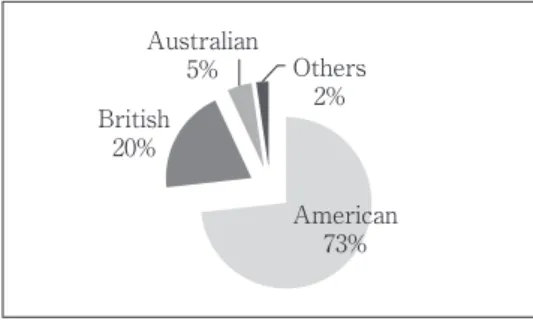
There are 13 questions in the questionnaire, and all of the figures and tables below illustrate answers obtained in my survey. The first question is what type of English students would like to be proficient in. I asked this without restricting the students to choose English from the Inner Circle varieties. This is answered by the 1st year students because, as mentioned in the previous section, the 3rd and 4th year students had enrolled in the US study program. The result of the first question is shown below.
American 73% British 20% Australian 5% Others 2%
Figure 1. Types of English that the 1st Year Students Would Like to Be Proficient in
Figure 1 shows that 73% of the students, or 63 students out of 86, want to acquire American English, followed by British English of 20% and Australian English of 5%. Others include Canadian and Irish English. It is obvious that American English is very popular among the 1st year students even though they do not have any living experience in the USA. In addition, they would like to be proficient in English spoken in the Inner Circle, but not in other circles.
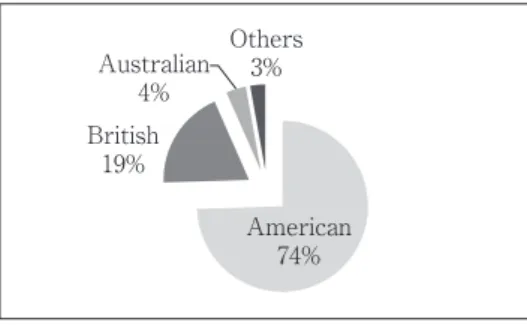
Now I will compare this data with the results of the 3rd and 4th year students. The figure below illustrates the results.
As shown in Figure 2, 74% of the students, or 79 students out of 106, would like to be proficient in American English, followed by British English of 19% and Australian English of 4%. Others also include Canadian and Irish English. This data is very similar to that provided by the 1st year students in Figure 1. Thus, it became clear that American English is very popular among my participants regardless of whether or not they had an American study experience. This implies to me that for the students “English” is the language spoken in the Inner Circle.
Then, I asked all of the students including the 3rd and 4th year, who answered that they preferred American English, about the reasons why they would like to be proficient in American English. The number of the 1st year students who provided the reason is 60, and that of the 3rd and 4th year students is 62. Table 1 shows their reasons and percentages. American 74% British 19% Australian 4% Others 3%
Figure 2. Types of English that the 3rd and 4th Year Students Would Like to Be Proficient in
Table 1. Reasons You Would Like to Be Proficient in American English Reasons 1 st Year Students (60 students) 3rd & 4th Year Students (62 students) 1 It is the most popular English in the world. 38.33% 33.87%
2 I learned it at school. 26.67% 35.48%
3 I just like it. 13.33% 11.29%
4 It is Standard English. 8.33% 9.68%
5 It would be easier to get a job if I can speak it. 11.67% 4.84%
6 Others1 1.67% 4.84%
As illustrated in Table 1, 38.33% of the 1st year students answered that “American English is the most popular in the world,” and 26.67% of them stated that “I learned it at school.” In comparison to their results, 33.87% of the 3rd and 4th year students answered that “American English is most popular in the world,” and 35.48% of them stated that “I learned it at school.” Having these results, we can state that Japanese students usually know American English has been taught in Japanese schools. There is another significant answer in this table: 8.33% of the 1st year students and 9.68% of the 3rd and 4th year students think that American English is Standard English (SE). From their answer, we can see that many students want to acquire American English because they consider it as the most popular English and some think that American English is, in fact, standard.
The results of the first question included those of the 1st year students. The rest of the results obtained by this survey are all answered by the 3rd and 4th year students; they are 106 in total. The second question I asked the 3rd and 4th year students is what type of English has been generally taught in Japanese schools, and their answer is illustrated in the figure below.
1 Others include the following reasons: to know the difference between American and British English and to communicate with people with various backgrounds
American 87% British 6% I don’t know 7%
Figure 3. What Type of English Has Been Generally Taught in Japanese Schools?
Figure 3 shows that 87% of the students think that American English has been taught at school in Japan, followed by 7% of the students who stated that they do not know and 6% of the students who answered British English. These results indicate that most of my participants know that American English has been taught at school in Japan.
Next, I asked whether teachers should teach SE at school in Japan. The figure below describes students’ answer.
Yes 66% No 9% I don’t know 25%
Figure 4. Should Teachers Teach SE at School?
Figure 4 shows that 66% of them think that teachers should teach SE. Although 25% of the students answered “I don’t know,” we can see that many students think that SE should be taught at school.
Then, I asked my participants about English accent. I assume Japanese people generally have a perception that it is better to speak English without any accent, since
it means for them that English speakers without any accent are genuine native English speakers. The figure below illustrates the result of my participants’ answer.
English with an accent is fine to speak as long as people can understand it. 39% People should speak SE because English with an accent is hard to understand. 37% I don’t know. 24%
Figure 5. What do You Think about Speaking English with an Accent?
As shown in Figure 5, 39% of the students think that it is OK to speak English with an accent as long as people can understand it, and 37% of the students state that people should speak SE because English with an accent is hard to understand. My study results show that the number of students who accept English with an accent is close to the number of students who do not accept such English.
Then, I asked whether they feel embarrassed to speak English with an accent, since this type of feeling may be possessed by many Japanese, as Matsuda (2003a) mentioned.
Figure 6. Do You Think that It is Embarrassing to Speak English with an Accent? Yes 9% No 83% I don’t know 8%
not embarrassing. Thus, a majority of my participants accept English with an accent. This is very interesting. Their perception may be caused by their own experience of the study abroad program where they may have met people whose English has an accent, and/or they realized that their English has Japanese accent which is different from their American teachers’. Note that this survey has another limitation; my students show their acceptance toward English with an accent but the accents that they accept may be only limited to those in the Inner Circle. They may show less tolerance toward English varieties in the Outer and Expanding Circles, which were found in the study by Chiba, Matsuura and Yamamoto (1995). To examine this issue will be also my future research topic.
From the result in Figure 6, it seems that my participants are aware of the presence of dialects in English because they recognize English with accents. In order to assure their awareness on English dialects, I asked them whether they have ever heard any English dialects. The result is illustrated in the figure below.
Yes 52% No 22% I don’t know 26%
Figure 7. Have You Ever Heard Any English Dialects?
Figure 7 shows that 52% of the participants (55 students) have heard English dialects although 26% of them answered they do not know and 22% of them said they have never heard the dialects.
Then, I asked the 55 students, who answered that they have heard English dialects, for what dialects they have heard. Their answers are listed in the table below with the categorization into Kachru’s three circles.
Table 2. The List of English Dialects Which You Have Heard
1 Inner Circle Varieties of English
UK, New Zealand, Australia, USA, Canada, Ireland
English Varieties in the UK Cockney, Birmingham, Scotland, Wales
English Varieties in the USA Hawaii, New York, Varieties from various big cities
2 Outer Circle Varieties of English Malaysia, Singapore, India, Philippines
3 Expanding Circle Varieties of English Russia, China
As shown in Table 2, my students were able to list various English dialects. These results tell us that they acknowledge that English has dialects.
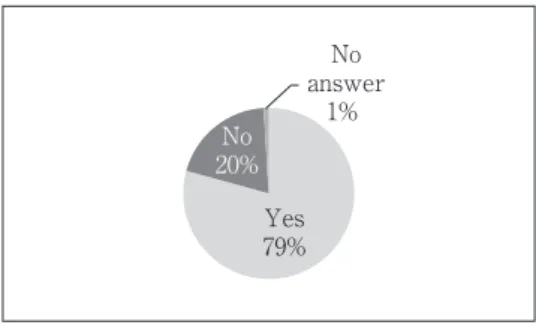
Next, I asked whether all of my participants (106 students) know that American English has dialects since only 55 students answered that they have heard English dialects in Figure 7. The figure below describes students’ answer.
Yes 79% No 20% No answer 1%
Figure 8. Do You Know American English Has Dialects?
Figure 8 shows that 79% of the students know American English has dialects. These results also prove that my participants have the knowledge of WE.
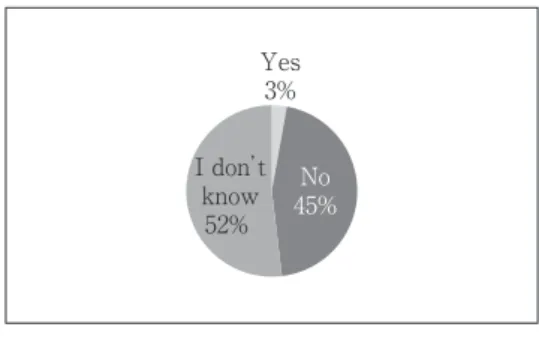
Then, I asked whether students think that English dialects are inferior to SE. The result of their answers is illustrated in Figure 9.
Yes 3% No 45% I don’t know 52%
Figure 9. Do You Think that Dialects Are Inferior to SE?
As described in Figure 9, 45% of the students perceive that English dialects are not inferior to SE. In contrast, 3% of them think the dialects are inferior to SE. Nearly a half of the students have a perception that the dialects are not inferior to SE.
The next question is whether the participants prefer NS teachers of English to Japanese teachers who are fluent in English. I asked this because a majority of them would like to be proficient in American English as illustrated in Figure 1 and 2, which leads us to think that they may have an NS centric view. The figure below demonstrates the result.
Japanese 12% NSs 43% Either 45%
Figure 10. From What Type of Teacher Would You Like to Learn English?
Figure 10 illustrates students’ preference for teachers to learn English. They want to learn English from NSs since 43% of them, or 45 students, answered NSs are preferable; but at the same time, 12% of them prefer Japanese teachers to NSs, and 45% of them answered that to have either teacher is fine. It appears that some students
demonstrate a strong preference for NS teachers; on the other hand, others do not. Although Figure 10 gives us evidence that 57% of participants2 do not show the NS centric view, 43% clearly have such a view.
Then, I asked reasons why they choose NS teachers, which are described in the table below. The number of students who provided the reasons is 29.
Table 3. Reasons You Want to Learn English from NSs
Reasons %
1 They are NSs. 58.62
2 To learn pronunciation from an NS. 24.14
3 To learn words and expressions used by NSs. 6.90
3 To have an English-only environment. 6.90
5 To learn Anglophone culture. 3.45
The table above shows that the dominant reason is because they are NSs, followed by to learn pronunciation from an NS, and to learn words and expressions used by NSs.
Next, I asked whether they want to work in a place where they need to use English. I assume that their motivation of learning English is to work in international settings since they belong to the Department of English which aims to equip the students with a higher level of English and provide some academic knowledge relevant to language and culture. The figure below demonstrates the result.
2 57% of the participants come from 12% of the participants who preferred to have Japanese teachers and 45% of them who wanted to have either teacher.
Yes 45% No 23% I don’t know 32%
Figure 11. Would You Like to Work in a Place Where You Need to Use English?
As shown in the figure above, 45% of the students wish to have a job using English; on the other hand, 23% of them answered negatively and 32% of them stated they do not know yet. Perhaps, those who answered negatively to this question or stated that they do not know may lack confidence in their English skills. They are probably not sure whether their English level is appropriate enough to work in international settings. The reasons why they do not intend to work using English could be examined in the future.
Then, I asked reasons why they study English in the Department of English because, as illustrated in Figure 11, some students do not know whether they would like to work in a place where they need to use English or they do not intend to work in an English speaking environment. This is a multiple-choice question, and the participants are allowed to choose as many listed items as they like. The table below describes the reasons and the percentages which are calculated on the basis of the total items that students provided (315 items in total).
Table 4. Reasons to Study English
Reasons %
1 To acquire English skills 20.63
2 To communicate with people in the world 20.00
3 To communicate with NSs 14.92
4 English is an international language. 14.29 4 To understand other cultures and people 14.29
6 To work in an international society 5.71
6 To have an advantage for getting a job 5.71 8 To acquire the necessary knowledge for an international society 4.44 The table above shows that the major reason to study English is to acquire English skills, followed by the desire to communicate with people in the world, to communicate with NSs, and others. To work in an international society and to have an advantage for getting a job are ranked lower than the desire to communicate with native speakers.
From the result in Figure 11, we can see that approximately half of the students intend to work in international settings. Then, I asked whether they know whom Japanese generally work with in business because, as a matter of fact, many Japanese work with non-NSs in English in business, as Morrow (2004) states. Kubota (2011) shows the language use in two Japanese companies possessing offices in Asia and Europe. The managers from the companies stated in her survey that it is necessary to use not only English but the local language in their overseas offices. This also shows the fact that Japanese business people have to interact with non-NSs in business. Figure 12 describes my participants’ answers on the question of what type of people the Japanese generally work with in business.
NSs 16% Non-NSs 61% I don’t know 23%
Figure 12. What Type of People do the Japanese Generally Work with in Business?
Figure 12 shows that 61% of the participants know that the Japanese generally work with non-NSs in English in business; in contrast, 16% of them answered that Japanese work with NSs in business. Thus, many of the participants have recognized the reality of English use for most of the Japanese in business settings.
From the results of my survey, some characteristics were revealed. First, it is confirmed that a majority of the students would like to be proficient in American English because they consider it to be the most popular English variety. Moreover, all of them choose English in the Inner Circle varieties to be proficient in. These indicate that all of my participants may have the NS centric view.
Second, many students answered that teachers should teach SE at school. This implies that the students want to learn correct and desirable English which is perhaps considered as SE by them. The Japanese language has the standard/common language which is used in the media and education. My participants have been educated that people need to use the standard/common Japanese in public spheres. Since they are familiar with the presence of Standard Japanese, they may apply the perception of that standard to English.
The third finding is that some of my students recognize not only the variations in American English but also variations in English spoken in the world since they were able to list the names of the dialects. Thus, the participants acknowledge the diversity of types and users of English. However, nearly half of them would like to learn English from NSs, and this indicates that they have the NS centric view. Note that although
some of my participants answered that they want to learn English from NSs, their answer can be interpreted from a different perspective, the availability of English teachers. In Japan, many English teachers of non-Japanese, including ALTs, are Caucasians from the countries in the Inner Circle because the Japanese government and companies have a preference for this type of English teacher, which are clearly illustrated by the list of ALTs’ country of origin provided by the Ministry of Education, Culture, Sports, Science and Technology (2013). NSs are widely available and institutions have easy access to them in Japanese society; as a result, the Japanese are taught English by NSs without being asked about their preference for teacher types. Since this environment has been socially constructed, many Japanese have developed a sense naturally that desirable and ideal English teachers are NSs.
The fourth finding is that the students accept English with an accent, and feel that it is not embarrassing to speak English with an accent. Lastly, the students know that in business Japanese mainly communicate with non-NSs. This indicates that my students have the recognition of English varieties and acceptance toward English with an accent. Their recognition and acceptance of various English types can originate from taking linguistics classes or from experiencing the US study program where they may have met people who speak English with an accent and/or may have realized that their English undoubtedly has an accent.
This concludes the summary of findings from my survey. In the next section, I will answer the two research questions and discuss implications from my survey results.
4. Implications from the Survey Findings
My survey results revealed two significant findings. First, a majority of the participants would like to be proficient in American English, more specifically, they have the Amero-centric view, although it seems this view possessed by the participants varies as they answered questions about accents and preferred teachers in different ways. Having these results, I can answer the first research question “Do Japanese learners of English show a preference for either American or British English?” The
answer is that my participants prefer American English to British English. Moreover, all of them would like to be proficient in English varieties in the Inner Circle, which means that they have the NS centric view.
The second finding of my survey is that although my participants have the knowledge of WE, such knowledge does not seem to lead them to move beyond the NS centric view. All of my participants would like to be proficient in English varieties in the Inner Circle even though they were exposed to various English accents and grammar at school. Moreover, many of them answered that they accept English with an accent. Taken together, the following implications can be stated: (1) the simple knowledge of types and users of English does not affect students’ preference for English in the Inner Circle varieties so much, and (2) many English learners in the Expanding Circle tend to set English in the Inner Circle varieties as their target language even though they acknowledge the diversity of English and its users. Therefore, the answer for my second research question “Is the knowledge of the diversity of English and its users sufficient enough to change English learners’ NS centric view?” is no. Simply possessing the knowledge of such diversity does not seem to shift the learners’ NS centric view so much. Then, one issue emerged: how much exposure do English learners need to have in order for them to move beyond the NS centric view? This question needs to be examined in the future.
The finding that simply possessing the knowledge of such diversity does not seem to shift the learners’ NS centric view so much can cause a problem to those who claim that such knowledge can lead English learners to go beyond the NS centric view. They think when the learners understand the diversity of English and its users, they can go beyond the NS centric view and will be ready to meet with various English speakers in the future (Matsuda, 2003b). However, even though my participants are taught the diversity of types and users of English, they cannot move beyond the NS centric view since all of them set English in the Inner Circle varieties as a target. Why can’t the participants move beyond the NS centric view? What else do they need to do to move beyond such a view? These questions have to be answered in the future.
In addition to the questions above, it is necessary to investigate whether the presupposition, “When English learners equip themselves with the knowledge of the
diversity of English and its users, they can go beyond the NS centric view and will be ready to meet with various English speakers in the future,” is correct or not. This presupposition seems not correct, according to my study results. In my study, what my participants demonstrated is that they acknowledge the diversity of English and its users but they would like to be proficient in English in the Inner Circle varieties. It seems that they possess both the acknowledgement of the diversity of English and its users and the NS centric view. Their attitude of accepting English varieties in Outer and Expanding Circles and setting English in the Inner Circle as a target can be a tendency possessed by many English learners in the Expanding Circle. Noticing their attitude, we have other questions: (1) Do English learners set English in the Inner Circle as a target because of the NS centric view or other reasons?, and (2) If English learners cannot move beyond the NS centric view, are they unable to communicate with various types of English speakers? These will be examined in the future.
As examining my study results, various questions were appeared necessary to be investigated. All of these questions will be answered further, since this paper is simply intended to introduce my survey results on Japanese university students’ perceptions of English.
5. Conclusion
This paper has illustrated and pointed out the fact that many of the Japanese students in these classes preferred American English and all of them wished to be proficient in English varieties in the Inner Circle, and that they still have the NS centric view even though they possess the basic knowledge of WE. Thus, such knowledge does not seem to strongly affect their preference for English in the Inner Circle varieties. The evidence of my survey leads me to think that to be aware of the diversity of types and users of English is not enough to allow English learners to move beyond the NS centric view. They must be taught some other issues relevant to WE in addition to the diversity of English and its users. Once they equip themselves with the necessary knowledge, they may be able to move beyond the NS centric view and they can interact with
various types of English speakers by negotiating the relevant codes successfully. This paper discussed whether possessing the basic knowledge of the diversity of types and users of English allows English learners to move beyond the NS centric view, and it was revealed that the following supposition is questionable: When English learners equip themselves with the knowledge of the diversity of English and its users, they can go beyond the NS centric view and will be ready to meet with various English speakers in the future. This supposition seems not correct in some degree because my participants acknowledge the diversity of English and its users but they set English in the Inner Circle as a target. It seems that they possess both the acknowledgement of the diversity of English and its users and the NS centric view. Relevant to this supposition, another question arises: Do English learners need to move beyond the NS centric view in order to communicate with various types of English speakers? These questions have to be answered in the future.
This paper is simply written as the first step of my study on “The use of English with Japanese people,” and raises numerous issues that I need to investigate further. In researching them, I ultimately would like to discuss what “internationalization” is for the Japanese, and I hope these further topics will contribute to improving linguistics as well as English Language Teaching in Japan.
References
Canagarajah, S. (2007). Lingua franca English, multilingual communities, and language acquisition. The Modern Language Journal, 91. 923-939.
Chiba, R., Matsuura, H., & Yamamoto, A. (1995). Japanese attitudes toward English accents. World Englishes, 14(1). 77-86.
Crystal, D. (2003). English as a global language. Cambridge: Cambridge University Press.
Jenkins. J. (2009). English as a lingua franca: Interpretations and attitudes. World
Englishes, 28(2). 200-207.
language in the outer circle. In R. Quirk and H.G. Widdowson (Eds.), English in
the world: Teaching and learning the language and literatures (pp.11-30).
Cambridge: Cambridge University Press.
Kubota, R. (1998). Ideologies of English in Japan. World Englishes, 17(3). 295-306. Kubota, R. (2011). Questioning linguistic instrumentalism: English, neoliberalism,
and language tests in Japan. Linguistics and Education, 22, 248-260.
Kubota, R., & McKay, S. (2009). Globalization and language learning in rural Japan: The role of English in the local linguistic ecology. TESOL Quarterly, 43(4), 593-619.
Matsuda, A. (2003a). Incorporating World Englishes in teaching English as an international language. TESOL Quarterly, 37(4), 719-729.
Matsuda, A. (2003b). The ownership of English in Japanese secondary schools. World
Englishes, 22(3). 483-496.
Matsuda, A. (2009). Desirable but not necessary?: The place of World Englishes and English as an international language in English teacher preparation programs in Japan. In F. Sharifian (Ed.), English as An International Language: Perspectives
and Pedagogical Issues. (p.169-189). UK: Multilingual Matters.
Matsuura, H., Chiba, R., & Yamamoto, A. (1994). Japanese college students’ attitudes towards non-native varieties of English. In D. Graddol and J. Swann (Eds.),
Evaluating Language. (p.52-61). UK: Multilingual Matters.
The Ministry of Education, Culture, Sports, Science and Technology (MEXT). (2013). 4 shidou taisei [4 Structure]. Retrieved from
http://www.mext.go.jp/b_menu/shingi/chousa/shotou/102/shiryo/__icsFiles/afield file/2014/06/30/1348956_02.pdf
Morrison, R., & White, M. (2005). Nurturing global listeners: Increasing familiarity and appreciation for World Englishes. World Englishes, 24(3). 361-370.
Morrow, P. R. (2004). English in Japan: The World Englishes perspective. JALT
Journal, 26(1), 79-100.
Suzuki, T. (1999). Nihonjin-wa naze eigo-ga dekinaika [Why can’t Japanese people produce English?] Tokyo: Iwanami Shoten.