Abstract
Quantitative data was collected to examine the relations between the reading strategy use and readers’ gender, academic major, and reading proficiency. It is aimed at understanding the nature of second language (L2) reading strategies used by Japanese L2 readers of English at the post-secondary level. The Survey of Reading Strategies (SORS) (Mokhtari & Sheorey, 2002) was administered to 130 participants, and the results were analyzed overall and by gender, major, and proficiency. Female and male students were moderate users of Global strategies with very similar patterns, and some mixed results were found in Problem-solving and Support reading strategies with statistically significant differences with eight items. Another inter-group comparison based on major also indicated that Social-Studies and Engineering majors used strategies in a similar way, showing no difference; however, the implications are not conclusive yet. Proficiency-based comparison had significant findings that fluent readers were reading more globally and holistically, using support effectively, while less fluent readers used problem-solving strategies more frequently.
1. Introduction
Research has shown to date that second language (L2) reading proficiency is strongly connected to the strategies that L2 readers use when they read L2 text (See Carrell, 1985, 1991; Makhtari & Reichard, 2008; Oxford, R. L. 2011), and that skilled L2 readers utilize wider varieties of strategies than those who have difficulties in L2 reading. However, as Brantmeire (2002) pointed out,
and Reading Strategy Use
some highlighted discrepancies in research results make it difficult to formulate generalization and that more research is needed to examine L2 strategies. To illustrate, gender-related differences in reading comprehension have also been reported in some studies, while other studies have shown no statistical differences by gender. To take another instance, practitioners’ anecdotal reports and some empirical study results show that particular types of reading strategies are used by non-language major English-for-Specific-Purposes (ESP) students (Sheorey, Kawamura, & Freiermuth, 2008). Some researchers also emphasized the effect of training, which may help readers acquire certain types of strategies if they went through strategy training. Therefore, from a genuine theoretical point of view, it is worthwhile to explore more into the nature of second language literacy acquisition.
Feeling such need, this study is aimed at increasing the understanding of the L2 reading acquisition by examining the relations between gender, major, proficiency and passage reading strategies used by the post-secondary level Japanese students when reading in English.
2. The present study
2.1. Research questions
The present paper reports on a quantitative survey about the metacognitive awareness of reading strategies use in English, by using the Survey of Reading Strategies (SORS) (Mokhtari & Sheorey, 2002). The objective of this study is to investigate how a reader’s gender, academic major, and reading proficiency relate to their strategy use at the post-secondary level in Japan. The three research questions are:
1) whether Japanese female students and male students vary in their perceived use of reading strategies, and if so, how they vary;
2) whether Japanese university students of different academic majors vary in their perceived use of reading strategies, and if so, how they vary; and 3) whether reading proficiency is strongly related to perceived use of reading
2.2. Participants
The participants of this study are 130 Japanese university students, who were, at the time of data collection, either freshman or sophomore students taking a required English reading course in a common core curriculum. Of the 130 students, 69 were Social-Studies majors and the other 61 were Information Sciences and Engineering majors (Engineering majors, hereinafter). There were 58 female students and 72 male students in total. They were all Japanese-as-a-first-language students.
2.3. Data collection
In order to examine the research questions, quantitative data was collected by using the Survey of Reading Strategies (SORS) (Mokhtari & Sheorey, 2002) with slight adaptation. The set of items was translated into Japanese by the writer. See the appendix. The survey has 30 question items designed to discover the types and frequency of strategies that L2 readers generally use when they read L2 text. To identify the participants’ profiles, seven background information questions were added. Mokhtari & Reichard (2002) had originally invented a list called the Metacognitive Awareness of Reading Strategies Inventory (MARSI) for measuring first-language (L1) readers and later converted it into a more L2-reader-friendly form of SORS. The MARSI inventory was used in the pilot study preceding this investigation (Shikano, 2013), in which another group of 60 Japanese university students had participated.
The questionnaire was given to the participants by the present writer and her colleague outside of class time in October 2013, upon their consent to participate. They were told the data would be used only for research purposes and they all answered anonymously.
3. Results and analysis
3.1. Reliability and validity
The Cronbach’s alpha for the instrument was .857. The goodness-of-fit and independence of variables were also tested by the Chi-square test. Acceptable scores were obtained for both tests. For analysis, SPSS 19 was used.
3.2. Participants’ background
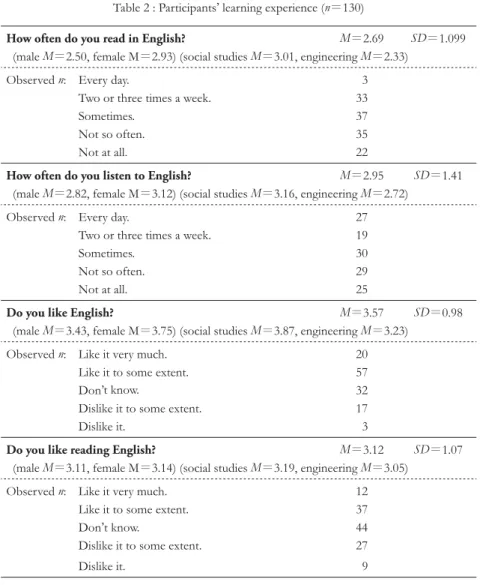
The participants’ profiles and learning experience are shown in Tables 1 and 2, respectively: profile―gender, his/her academic major, and age of onset of English learning; experience―how often they read English (every day, two or three times a week, sometimes, not so often, not at all), how often they listen to CDs/DVDs and have conversations in English (every day, two or three times a week, sometimes, not so often, not at all), how much they like English, and how much they like reading in English (shown in Table 2). On the 5-point scale, “5” means the most frequent/positive response and “1” means the least frequent/ positive response.
The results showed that, in general, the participants tended to have more L2 listening exposure (M=2.95, SD=1.408) than L2 reading (M=2.69, SD=1.019), although both showed moderate frequency in their study habits. Secondly, a relatively large number of participants either liked English very much or liked it to some extent, while fondness of English was not well connected to their L2 reading experience. The inter-group comparison based on gender revealed that there were no statistically significant differences in the learning experiences or habits between females and males except for their L2 reading frequency (t=-2.259, df =128,
p<.05). Female students were more frequent readers than male students.
Another inter-group comparison about the background was made based on academic major, and it indicated that more Social-Studies students liked English (t=3.863, df=127, p<.05) and were reading English more frequently (t=3.730,
df =128, p<.05) than Engineering students. However, the factors causing those
differences are not subject to analysis in this study; nonetheless, it is speculated that the amount of extensive reading assignments given in each class might have
Table 1 : Participants’ profile (n=130)
Gender male 72
female 58
Major social studies 69 (F=42, M=27)
engineering 61 (F=16, M=45) Ago of onset of learning M=10.06 SD=2.87
Table 2 : Participants’ learning experience (n=130)
How often do you read in English? M=2.69 SD=1.099
(male M=2.50, female M=2.93) (social studies M=3.01, engineering M=2.33)
Observed n: Every day. 3
Two or three times a week. 33
Sometimes. 37
Not so often. 35
Not at all. 22
How often do you listen to English? M=2.95 SD=1.41
(male M=2.82, female M=3.12) (social studies M=3.16, engineering M=2.72)
Observed n: Every day. 27
Two or three times a week. 19
Sometimes. 30
Not so often. 29
Not at all. 25
Do you like English? M=3.57 SD=0.98
(male M=3.43, female M=3.75) (social studies M=3.87, engineering M=3.23)
Observed n: Like it very much. 20
Like it to some extent. 57
Don’t know. 32
Dislike it to some extent. 17
Dislike it. 3
Do you like reading English? M=3.12 SD=1.07
(male M=3.11, female M=3.14) (social studies M=3.19, engineering M=3.05)
Observed n: Like it very much. 12
Like it to some extent. 37
Don’t know. 44
Dislike it to some extent. 27
partly affected it. It should also be noted here that almost two thirds of the Engineering-major participants of this study were male and, therefore, gender-major interactions should be carefully treated when analyzing the data.
3.3. Global, problem-solving, and support strategies
There were 30 distinctive reading strategies in the survey, and they were categorized into three sub-scales: global strategies (GLO), problem-solving strategies (PROB), and support reading strategies (SUP). According to prior studies, the commonly accepted definitions of the categories are:
GLO=generalized or global reading strategies aimed at setting the stage for the reading act: for instance, setting a purpose for reading, previewing the text content, predicting what the text is about;
PROB=focused problem-solving or repair strategies used when problems develop in understanding textual information: for instance, checking one’s understanding upon encountering conflicting information, re-reading for better understanding;
SUP=the support mechanisms or tools aimed at sustaining responsiveness to reading: for instance, use of reference materials like dictionaries and other support systems (Martinez, 2008; p. 170, cited in Shikano, 2013).
Global strategies include a holistic and global view to preview the text, pay attention to the organization, retain the meaning of the entire passage, assign meaning to sentences, and so on. Problem-solving strategies are used when readers find problems, get stuck in the middle of the passage, or encounter unknown words. These can be considered as bottom-up processing measures and repair strategies. Support strategies are the use of tools or resources available in the reader’s environment.
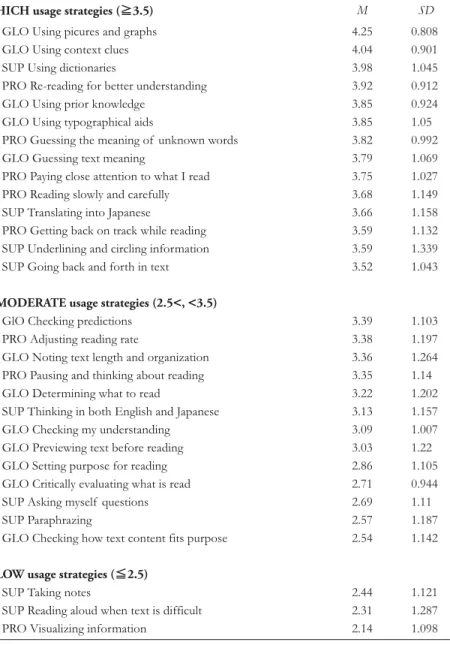
The overall tendency throughout the 30 question items showed that, in general, the Japanese university students of this study tended to use problem-solving strategies (M=3.45) slightly more often than global strategies (M=3.38) and support reading strategies (M=3.10). All the sub-scale mean scores are, however, relatively higher than other studies (Makhtari & Reichard, 2008, for instance), indicating that Japanese participants of the study were upper-moderate users of SORS strategies. Of all the 30 strategies, the most-frequently-used strategy by the Japanese L2 readers at the post-secondary level was a global strategy (GLO) of
Table 3 : High, moderate, low usage of strategies
HICH usage strategies (≧3.5) M SD
GLO Using picures and graphs GLO Using context clues SUP Using dictionaries
PRO Re-reading for better understanding GLO Using prior knowledge
GLO Using typographical aids
PRO Guessing the meaning of unknown words GLO Guessing text meaning
PRO Paying close attention to what I read PRO Reading slowly and carefully SUP Translating into Japanese
PRO Getting back on track while reading SUP Underlining and circling information SUP Going back and forth in text MODERATE usage strategies (2.5<, <3.5)
GlO Checking predictions PRO Adjusting reading rate
GLO Noting text length and organization PRO Pausing and thinking about reading GLO Determining what to read
SUP Thinking in both English and Japanese GLO Checking my understanding GLO Previewing text before reading GLO Setting purpose for reading GLO Critically evaluating what is read SUP Asking myself questions SUP Paraphrazing
GLO Checking how text content fits purpose LOW usage strategies (≦2.5)
SUP Taking notes
SUP Reading aloud when text is difficult PRO Visualizing information
4.25 4.04 3.98 3.92 3.85 3.85 3.82 3.79 3.75 3.68 3.66 3.59 3.59 3.52 3.39 3.38 3.36 3.35 3.22 3.13 3.09 3.03 2.86 2.71 2.69 2.57 2.54 2.44 2.31 2.14 0.808 0.901 1.045 0.912 0.924 1.05 0.992 1.069 1.027 1.149 1.158 1.132 1.339 1.043 1.103 1.197 1.264 1.14 1.202 1.157 1.007 1.22 1.105 0.944 1.11 1.187 1.142 1.121 1.287 1.098 Wording adopted from Mokhtari (2008)
‘using provided visual aids such as tables, graphs, and pictures’ (M=4.25, SD= 0.808), while the least-frequently-used strategy was a problem-solving strategy (PROB) of ‘visualizing information’ (M=2.14, SD=1.098): i.e., active creation of visual organizers for obtaining and classifying information. To have a closer look at the overall tendency of participants’ strategies use, high-usage, moderate-usage, and low-usage strategies are listed in the order of the mean scores, in Table 3.
3.4. Strategy use and genders
To make an inter-group comparison, gender-related characteristics were examined first. As one may see from Table 4 and Figure 1, the two sub-scales of PROB and SUP strategies presented rather mixed tendencies. More specifically, female students reported that they use PROB strategies more often than male participants. The female group’s average exceeded the male group’s average in almost all of the PROB strategies, three of which showed statistically significant differences. First, female students tended to ‘re-read the text to increase their understanding’ (#20) (t=-3.306, df =128, <.05), ‘try to get back on track when they lost concentration’ (#15) (t =-2.924, df =128, <.05), and ‘adjust the reading rate’ (#16) (t=-2.242, df =128, <.05) more frequently than male students. There was one exception, though; male students were slightly higher users of the ‘slow and careful reading’ (#14) strategy, although there was no significant difference. Therefore, one can claim from the data here that female students are higher users of problem-solving or repair strategies, and they know the measures to take when problems develop in understanding textual information. When it comes to the SUP section, the results are mixed. The male group’s average was higher with some strategies, whereas the female group’s average was higher in others. For instance, male students tended to ‘translate the text into Japanese’ (#29) more often (t=2.876, df =128, <.05), whereas female students tended to ‘read aloud to help them comprehend’ (#23) (t=-2.394, df =128, <.05) and ‘use a dictionary and references’ (#25) (t=-2.288, df =128, <.05) more often.
The GLO sub-scale section demonstrated almost identical scores; 12 GLO strategies did not show a statistically significant difference between females and males. The only exception was that male students reported they read more critically by making ‘critical analysis and evaluation’ (#12) than females (t=2.289,
df =128, <.05). Therefore, it may be valid to claim that both male and female
L2 readers have very similar GLO use patterns in high frequency. To sum up, the inter-group analysis between females and males implied that female students are higher users of PRO strategies compared to male students, while the results for SUP strategies split, and that both groups use GLO strategies frequently in similar manners.
Figure 1 : Strategy use by gender
3.5. Strategy use and majors
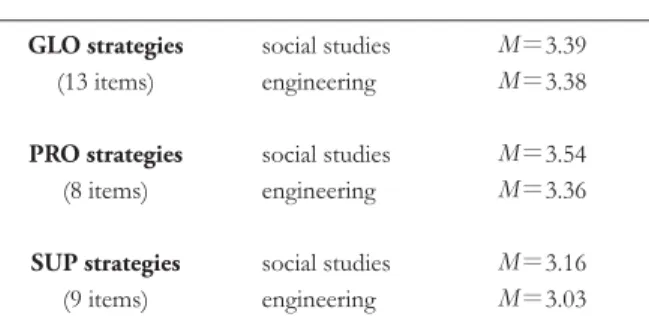
Next, the participants’ strategy use was examined to compare the two academic major groups in order to see whether there are significant differences based on their academic orientation (such as sciences and engineering vs. humanities or social studies). The mean scores of the three sub-scales are shown in Table 5. As
Table 4 : Gender-related differences GLO strategies (13 items) male female M=3.41 M=3.35 PRO strategies (8 items) male female M=3.41 M=3.60 SUP strategies (9 items) male female M=3.08 M=3.12
can be presumed from the table, the attempted t-test results did not confirm a statistically significant difference related to academic majors in a number of items. This is contrary to one’s assumptions that computer-science and engineering ESP students may have characteristic learning styles distinctive from other non-science majors. This needs to be explored more in the future. A few noticeable observations drawn from the data of this study may indicate, though, that Engineering students were just slightly lower in utilization of the SUP strategies. After all, only three out of 30 strategies showed significant major-related differences, although in opposing directions. First of all, Social-Studies majors used a PROB strategy of ‘getting back on track when they lost concentration’ (#15) (t=2.227, df =128, p<.05) more often, which infers that they go back to a certain point in the text when they get lost in comprehension. Secondly, Social-Studies majors also used a SUP strategy of ‘reading aloud when text becomes difficult’ (#23) (t=2.474, df=128, p<.05) more often than Engineering majors. Thirdly, on the other hand, Engineering majors used the SUP strategy of ‘translating the text in English into Japanese’ (#29) (t=-2.418, df =128, p<.05) more often. That is, Engineering students did not use the ‘get back on track’ strategy and the ‘read-aloud’ strategy as often as Social-Studies students did, but they relied more to ‘translation’ of the written input in English into Japanese than the Social-Studies students. This tendency cannot be well explained in this study, but it may partly relate to transfer of instruction that they typically experienced in the previous years. Another interesting finding about majors is that both groups used each item of GLO strategies almost in the same frequency. Therefore, statistical analysis based on the data here infers that the L2 reader’s academic major was not
Table 5 : Major-related differences GLO strategies (13 items) social studies engineering M=3.39 M=3.38 PRO strategies (8 items) social studies engineering M=3.54 M=3.36 SUP strategies (9 items) social studies engineering M=3.16 M=3.03
so strong a predictor for their global and overall reading style. Translation was one distinctive reading strategy that computer-engineering ESP students perceived as useful.
3.6. Strategy use and reading proficiency
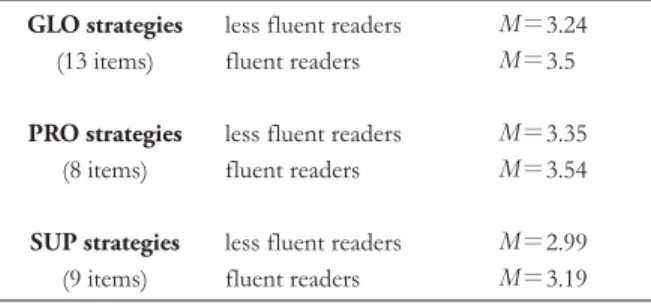
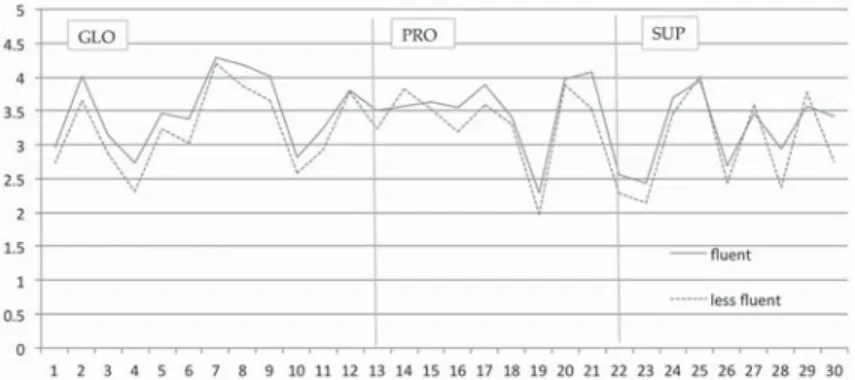
The participants were next divided into two groups based on their self-reported reading proficiency. At the time of the survey, they were shown a reading passage from the DELTA TOEFL practice textbook and were asked to rate it as ‘4= very easy to comprehend, 3=rather easy to comprehend, 2=rather difficult to comprehend, or 1=very difficult to comprehend.’ Then, those who rated 4 and 3 were labeled as ‘fluent readers’ and those who rated 2 and 1 were labeled as ‘less fluent readers’. Based on this self-reported proficiency division, an inter-group comparison between fluent readers (72 students) and less fluent readers (58 students) was made as the next step. The mean scores by group in three categories are shown in Table 6.
Prior research already seems to agree that proficiency is strongly correlated with the variety and frequency of strategy use, as mentioned earlier, and this section confirms their tendency, and it also shows interesting findings. The major finding from the proficiency-based comparison is that fluent (successful) readers generally use reading strategy techniques more often, which supports many of the prior studies, but not always with statistical significance. Another finding is that there were significant differences between the fluent and less fluent groups in their use of GLO strategies; in other words, fluent readers were higher GLO strategy users than less fluent readers. The other two inter-group comparisons by gender
Table 6 : Proficiency-related differences GLO strategies
(13 items)
less fluent readers fluent readers
M=3.24 M=3.5
PRO strategies (8 items)
less fluent readers fluent readers
M=3.35 M=3.54
SUP strategies (9 items)
less fluent readers fluent readers
M=2.99 M=3.19
and major did not show differences about the use of GLO strategies. Among GLO items, fluent L2 readers in particular tended to ‘use prior knowledge’ (#2) (t=-2.233, df =128, <.05), ‘check how text content fits the purpose’ (#4) (t= -2.07, df =128, <.05), ‘use context clues’ (#8) (t=-2.027, df =128, <.05), and ‘use typographical aids’ (#9) (t=-1.957, df = 128, <.05) more often than less fluent L2 readers.
As for the PROB strategies, fluent readers used seven out of the eight PRO strategies more often than less fluent readers, although no statistically significant difference was found with six of them. Only the #21 strategy of ‘guessing the meaning of unknown words’ showed a statistically significant difference (t= -3.521, df =128, <.05), favoring fluent readers. Weaker readers, however, tended to ‘read slowly and carefully’, but there was no significant difference. Of all the SUP strategies, there was no one-sided tendency and therefore the results are mixed. Two strategies were used more often by fluent readers: ‘asking myself questions I like to have answered in the text’ (#28) (t=-3.019, df =128, <.05) and ‘thinking about information both in English and Japanese’ (#30) (t=-3.425,
df =128, <.05). However, less fluent readers tended to ‘translate’ and ‘use
references such as a dictionary’ more often than fluent readers, although with no statistical significance. Another interesting point is that there are certain types of strategies that ‘less fluent readers’ prefer taking or need to take: e.g., ‘reading slowly and carefully’, ‘using a dictionary’, and ‘translating the text into Japanese.’ For instance, while fluent readers do and can solve unknown words from the context,
less fluent readers prefer to or need to use references such as a dictionary. Refer to Figure 2 for the overall comparison based on reading proficiency.
4. General discussion
It has been pointed out for a long time by plenty of research that ‘the readers’ awareness and use of reading strategies are critical to ensuring high levels of reading comprehension’ (Sheorey & Mokhtari, 2008; p. 2) in both L1 and L2 reading. Successful readers do not just ‘dive into the text’ (Pressley, 2002) without a holistic reading plan, regulation or evaluation of the text. They rather use a wide variety of global reading strategies by keeping meaning of the passage in mind, while less successful readers focus more on local problems such as solving unknown words or encoding sentences. Successful readers also can transfer effective L1 strategies well into L2 reading, according to Brantmeier (2002). To repeat, the aim of this research was to have a better understanding of literacy acquisition of Japanese L2 readers in English at the post-secondary level. As to the first research question on the reader’s gender and strategy use, both male and female groups were moderate users of global strategies (GLO) with almost identical average scores, making no significant difference. On the other hand, differences were found with problem-solving strategies (PROB), showing statistical significance with three items. It inferred that female students were more thorough readers than male students, and they double check if they understand the text or re-read until they understand. Furthermore, females may not mind the time involved in using such time-consuming strategies. Both groups showed mixed tendencies when it comes to the support (SUP). On one hand, females use a dictionary or other resources, which may also include ‘people’ near them with whom they can ‘talk aloud’ about the meaning of the text; on the other hand, males preferred translating the text into their mother tongue. To confirm the meaning, translation requires them to focus on local points and to be analytical, which might have been projected in the males’ high use of the ‘critical and analytical evaluation’ GLO strategy.
As to the second research question about the relations of strategy use and majors, contrary to one’s perception or speculation on computer-science and engineering students’ learning styles, the academic major per se did not work as a
strong predictor in this study. Both Social-Studies and Engineering groups were moderate users of GLO strategies, showing a very similar distribution of the scores over the GLO items. However, as was mentioned earlier, judging from the gender ratio of the Engineering group, gender-major interactions need to be treated carefully.
As to the third research question on the strategy use and reading proficiency, there were interesting findings. First of all, significant differences were found with GLO strategies between fluent readers and less fluent readers, unlike the results of other inter-group comparisons by gender and major. Fluent readers showed high use of more critical top-down text processing such as ‘applying prior knowledge’ and ‘checking if the text fits their purpose.’ In other words, those who can read L2 text smoothly tended to see the entire reading process more globally and holistically. This may act to empower readers to become active and creative readers. On the contrary, less fluent readers did not utilize strategies as often as they could have. Possibly they might end up diving into the text and starting to decode the words one by one, without using the ‘support tools’ available around them or ‘talking aloud’ to use human resources around them. By looking into ‘particular strategy types’ preferred by the less fluent reader group, one may be able to presume that they either favor taking or have no choice but to take pinpoint trouble-shooting types, and that they are not yet proficient enough to see the text organization holistically.
In conclusion, as we have discussed earlier, participants of this study were upper-moderate users of SORS reading strategies. They also showed a general tendency of using PRO strategies more frequently than other two sub-sets of GLO and SUP strategies. Arguably, certain types of strategies of GLO may require a certain level of proficiency for the students to fully utilize them, while PRO strategies are often so local and pinpointed that beginning and intermediate readers are able to use them. So, it is assumed that frequent use of PRO strategies may be evidence of the ‘stressful’ reading process in which readers encounter local ‘problems’ and struggle to solve them in the text. It could be interpreted, therefore, that local PRO users were not advanced and skilled readers yet. From these tendencies, it is hypothetically presumed that intermediate readers (not advanced yet, but not beginning) may use more local bottom-up types than the skilled readers who may not have to use local problem-solving strategies, and
also than the entry-level readers who haven’t built the foundation for using the full range of strategies. Exploring into such hypothetical question will be an interesting point to examine in the future.
References
Anderson, N. J. (1991). Individual differences in strategy use in second language reading and testing. Modern Language Journal, 75, 460―472.
Brantmeier, C. (2002). Second language reading strategy research at the secondary and university levels: Variations, disparities, and generalizability. The Reading Matrix, 12-3, 1―14. (Retrieved on 2015.02.21 from http://readingmatrix.com/articles/brantmeier/article.pdf) Ehrman, M. E., Leaver, B. L., & Oxford, R. L. (2003). A brief overview of individual
differences in second language learning. System 31, 313―330.
Martinez, A. C. L. (2008). Analysis of ESP university students’ reading strategy awareness.
IBERICA 15, 165―176.
Mokhtari, K. (2008). Perceived and real-time use of reading strategies by three proficient triliterate readers: A case study. In K. Mokhtari & R. Sheorey (Eds.), Reading strategies of first-
and second-language learners. (pp. 143―160). Norwood, MA: Christopher-Gordon.
Mokhtari, K. & Reichard, C. (2002). Assessing students’ metacognitive awareness of reading strategies. Journal of Educational Psychology, 94-2, 249―259.
Mokhtari, K. & Reichard, C. (2008). The impact of reading purpose on the use of reading strategies. In K. Mokhtari & R. Sheorey (Eds.), Reading strategies of first- and second-language
learners. (pp. 85―97). Norwood, MA: Christopher-Gordon.
Mokhtari, K. & Sheorey, R. (2002). Measuring ESL students’ awareness of reading strategies.
Journal of Developmental Education, 25-3, 2―10.
Mokhtari, K. & Sheorey, R. (2008). Reading strategies of first- and second-language learners. Norwood, MA: Christopher-Gordon.
Oxford, R. L. (2011). Teaching & Researching: Language Learning Strategies. Routledge.
Poole, A. (2009). The reading strategies used by male and female Colombian university students. Profile 11, 28―40. Retrieved on 2015.02.18 from http://www.bdigital.unal.edu. co/15817/1/10539-20251-1-PB.pdf
Pressley, M. (2002). Metacognition and self-regulated comprehension. In A. E. Farstrup & S. Samuels (Eds.), What research has to say about reading instruction (pp. 291―309). Newark: International Reading Association.
Shoeorey, R., Kamimura, Y., & Freiermuth, M. R. (2008). Reading strategies of the users of English as a library language: The case of Japanese ESP students. In K. Mokhtari & R. Sheorey (Eds.), Reading strategies of first- and second-language learners. (pp. 175―183). Norwood, MA: Christopher-Gordon.
strategies of first- and second-language learners. (pp. 1―10). Norwood, MA: Christopher-Gordon.
Shikano, M. (2013). A quantitative survey on metacognitive awareness of reading strategy use in English by Japanese university students. The Bulletin of the Center for International Education,
Appendix:
Adapted SORS (Survey of Reading Strategies) (Mokhtari, & Sheorey, 2002) and its Japanese translation (translated by the present writer)
5-point scale: Always 5 - 4 - 3 - 2 - 1 Never 〈Original English version〉
Global Reading Strategies (GLO)
1. I have a purpose in mind when I read.
2. I think about what I know to help me understand what I read. 3. I preview the text to see what it’s about before reading it.
4. I think about whether the content of the text fits my reading purpose. 5. I skim the text first by noting characteristics like length/organization. 6. I decide what to read closely and what to ignore.
7. I use tables, figures, and pictures in text to increase my understanding. 8. I use context clues to help me better understand what I’m reading. 9. I use typographical aids like bold face and italics to identify key information. 10. I critically analyze and evaluate the information presented in the text. 11. I check my understanding when I come across conflicting information. 12. I try to guess what the material is about when I read.
13. I check to see if my guesses about the text are right or wrong.
Problem-Solving Strategies (PROB)
14. I read slowly but carefully to be sure I understand what I’m reading. 15. I try to get back on track when I lose concentration.
16. I adjust my reading speed according to what I’m reading.
17. When text becomes difficult, I pay closer attention to what I’m reading. 18. I stop from time to time and think about what I’m reading.
19. I try to picture or visualize information to help remember what I read. 20. When text becomes difficult, I re-read to increase my understanding. 21. When I read, I guess the meaning of unknown words or phrases.
Support Reading Strategies (SUP)
22. I take notes while reading to help me understand what I read.
23. When text becomes difficult, I read aloud to help me understand what I read.
24. I underline or circle information in the text to help me remember it. 25. I use reference materials such as dictionaries to help me understand what
I read.
26. I paraphrase (restate ideas in my own words) to better understand what I read.
27. I go back and forth in the text to find relationships among ideas in it. 28. I ask myself questions I like to have answered in the text.
29. When reading, I translate from English into my native language.
30. When reading, I think about information in both English and in my mother tongue. 〈Japanese version〉 Global Strategies 1.英文を読む時に,読む目的を意識する。 2.内容についてすでに知っている知識を使って,理解を助ける。 3.読む前に,全体をざっと見ておおまかなトピックをつかむ。 4.英文の内容が,自分の読む目的にあっているか考える。 5.まず全体をざっと見て,長さや構成をつかむ。 6.細かく読む部分と,読まないでとばしてよい部分を見極める。 7.本文の写真・図表等を見て,理解を助ける。 8.前後の文脈を読み取って,理解の助けとする。 9.太字・斜体など大事な情報に注目しながら読む。 10.情報を分析的にながめ,評価しながら読む。 11.矛盾する情報がでてきたら,正しく読めているか確認する。 12.読むときは,まず何について書かれた文章なのか推測する。 13.自分の推測があっているかどうか確認しながら読む。
Problem-Solving Strategies 14.きちんと理解できるよう,ゆっくり注意深く読む。 15.集中して読めなくなったら,もとに戻ろうと努力する。 16.読むものによって,読む速さを変える。 17.文章がむずかしくなってきたら,しっかり注目して読む。 18.ときどき止まって,読んでいる内容について考える。 19.読み取った情報をマッピングしたり図解したりして,理解を助ける。 20.文章が難しくなってきたら,読み返す。 21.分からない単語や語句は,意味を推測する。
Support Reading Strategies
22.メモをとり,理解の助けとする。 23.文章の意味が理解できないと思ったら,声に出して読んでみる。 24.重要な情報にはアンダーラインを引いたり,◯で囲んだりする。 25.辞書等の参照物を使って,理解を助ける。 26.パラフレーズ(意味を自分のことばで言ってみる)する。 27.情報の関係性をつかむために,行ったり戻ったりしながら読む。 28.内容について質問をもち,文章の中に答を探しながら読む。 29.英文を日本語に訳しながら,読む。 30.読んでいる情報を,英語と日本語と両方で考える。