Journal of National Fisheries University 64 (2) 178 - 181(2016)
短 報
小型水槽を用いたイイダコの水槽内産卵および
初期胚発生に関する研究
吉川廣幸
1†,井野靖子
1,岩谷淳司
1,森島 輝
2Spawning and Embryonic Development of Ocellated
Octopus in Small Tanks
Hiroyuki Yoshikawa
†, Yasuko Ino, Junji Iwatani and Kagayaki Morishima
Abstract:Ocellated octopus (Octpus ocellatus) is one of economically important octopus species in Japan. Here, we showed spawning characteristics and embryonic development, which were essential for the management of natural resource and the establishment of aquaculture techniques for this species. During the period from March to June, 2015, each pair of ocellated octopus was maintained in 10L-tank. Female parents started to lay eggs on the wall of tanks from 9 to 26 days after starting of rearing. During this spawning period from 2nd April to 22nd May, 2015 (at the water temperature of 13.1 to 19.7 ℃), average 17.2 spawning events with average 16.6 eggs from single octopus female were observed. Embryo reached the organogenesis-stage at 17 days post spawning (dps), and then newly hatchlings occurred at average 59.3 dps.
Key words:Octpus ocellatus, cephalopod, embryonic development, aquaculture
1水産大学校生物生産学科 (Department of Applied Aquabiology, National Fisheries University)
2日本水産株式会社大分海洋研究センター (Oita Marine Biological Technology Center, Nippon Suisan Kaisha, Ltd.)
†別刷り請求先
(corresponding author): yoshikawa@fish-u.ac.jp
緒 言
イイダコOctpus ocellatus は日本国内における重要水産 物であり、底曳き網漁業やタコ壺漁業などにより漁獲され ている。本種を含むタコ類の日本国内の漁獲量は、1960 年代後半の10 万tをピークに、2014 年には 3.5 万tと減 少傾向にあり1)、その資源を維持・管理することにより、 持続的な漁業を可能にしていく必要がある。漁場環境や漁 獲に関する適正な管理を進めるためには、産卵、孵化およ び成育に関する生物学的知見は重要な基礎となるが、本種 に関する研究事例は少なく、産卵習性2) 、卵発生3) 、およ び仔ダコ飼育4, 5)の報告が僅かにある。今後、資源量を増 加させるための種苗放流や、天然資源に依存しない増養殖 を念頭におき、人工管理下における種苗生産技術も確立し ていく必要がある。 本研究では、イイダコを小型水槽に収容することにより 水槽内産卵を試み、親ダコの産卵特性を調査したので、こ こに報告する。また、得られた受精卵について、その初期 胚発生に関しても合わせて調査した。材料および方法
2015 年 3 月に瀬戸内海沿岸(山口県宇部市)で底曳き 網漁業者により漁獲されたイイダコ25 個体を独立行政法 人水産大学校内の飼育施設へと搬入した。任意に抽出した 雌5 個体および雄 4 個体は、全長、外套長、体重および生 殖腺重量を測定すると共に、生殖腺指数(生殖腺重量/ 体 重×100, GSI)を求めた。残りの搬入個体は、雌雄を外部179
形態により判別した後、雌雄を1 組として、8 つの 10L 角 型水槽へとそれぞれ収容した。試験期間中、各個体には冷 凍キビナゴおよびマイワシの魚肉を給餌した。各水槽は、 自然海水( 平均 17.0 ±標準偏差 2.8℃ , 11.0 - 21.4℃ ) を 0.5 L/ 分で常時通水し、2015 年 3 月 25 日から 6 月 12 日まで の80 日間、水槽内での産卵状況を調査した。水槽内での 産卵確認は1 日ごとに行い、8 水槽の内 5 つについては、 産卵確認後に親ダコ飼育水槽より卵を回収して、自然海水 を常時通水した300 ml プラスチック容器内で管理し、胚 発生の観察に供した。残り3 つの水槽中に産卵された卵に ついては、親ダコと共に孵化まで飼育・管理した。胚発生 の観察は、瀬川(1999)6)に記述された頭足類の発生段 階に基づき実体顕微鏡(SMZ645, Nikon)下で行った。また、 全ての測定値は、平均±標準偏差で示した。結 果
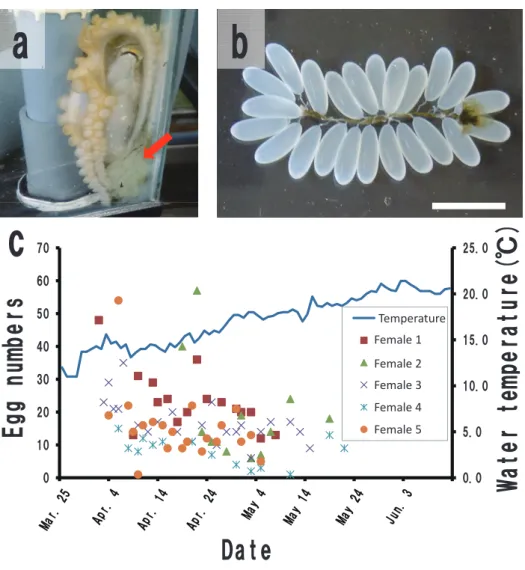
2015 年 3 月に搬入され、任意に抽出したイイダコの全長、 外套長および体重は、雌で全長20.1 ± 4.8 cm、外套長 5.1 ±0.8 cm および体重 91.5 ± 51.8 g(n = 5)、そして雄で全 長18.4 ± 1.2 cm、外套長 5.0 ± 0.2 cm および体重 76.3 ± 25.1 g(n = 4)であった。 搬入個体について、雌雄を1 組として 8 つの 10L 角型 水槽へと収容したところ、水槽内において交接行動が収容 当日より観察され、収容9-26 日目 (14.0 ± 5.5 日目 ) から、 水槽壁面への産卵および卵の保護行動が8 個体全ての雌に おいて観察された(Fig.1a)。産卵された卵の長径は、8.1 ±0.2 mm (n = 12) であり、複数個の卵の柄を寄り合わせて 水槽壁面に産み付けられた(Fig.1b)。産卵は 4 月 2 日か吉川廣幸,井野靖子,岩谷淳司,森島 輝
c
0.0 5.0 10.0 15.0 20.0 25.0 0 10 20 30 40 50 60 70 2015/3/25 2015/4/4 2015/4/14 2015/4/24 2015/5/4 2015/5/14 2015/5/24 2015/6/3 2015/6/13 自然水温(℃) #1 #2‐4 #4 #5 #8Figure 1
a
b
Egg numbers
Water temperature(℃)
Temperature Female 1 Female 2 Female 3 Female 4 Female 5Date
Fig. 1. Spawning of Octpus ocellatus. a) Egg-mass (arrow) laid on a wall of the 10L-tank. b) Egg strings collected from spawning tanks. Bar = 1cm. c) Number of spawning eggs from single female parent and water-temperature during the period 25th May to 12th June, 2015. Data of egg number from 5 females was indicated.
180
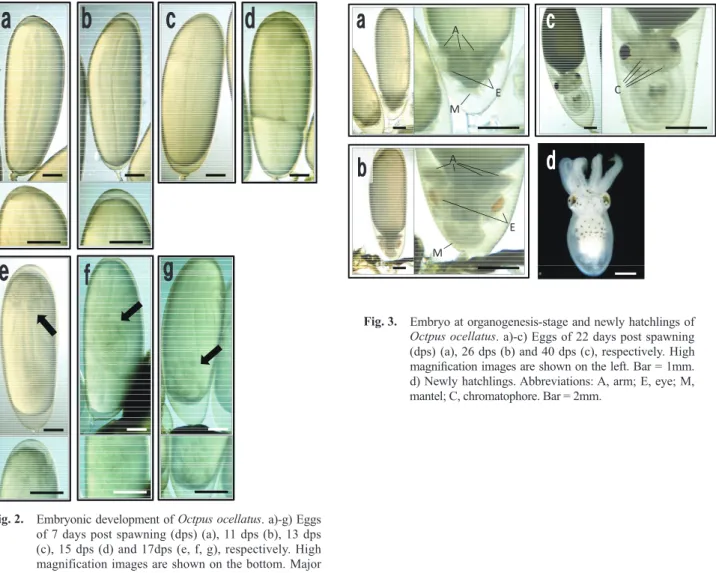
ら5 月 22 日の期間において確認され、産卵水温は、16.4 ±1.9℃ (13.1-19.7℃ ) であった(Fig.1c)。この期間中、1 個体あたり17.2 ± 2.1 回の産卵があり、産卵数は、合計 286 ± 51.2 粒(1 日あたり 16.6 ± 1.1 粒)であった。尚、 3 月 25 日から 6 月 12 日までの飼育期間中、雌は 5 月 14 日に1 尾が斃死し、雄については 4 月 12 日から試験終了 までの間に8 個体全てが斃死した。斃死個体を含む 5 月か ら6 月の親ダコの GSI は、雌 7.8 ± 3.1(n = 7)および雄 4.5 ±1.8 (n = 3) であり、任意に抽出された飼育試験開始前(3 月)の個体では、雌13.0 ± 5.5(n = 5)および雄 2.9 ± 0.7 (n = 4)であったことから、雌の GSI については飼育期間 を通して有意な低下がみられた(p < 0.05, t-test)。 産卵された卵を回収し、その発生段階を経時的に観察し た。産卵された卵は、卵の先端部を動物極として胚盤が形成された(Fig.2a)。産卵後 11 日目 (days post spawning, dps)
に は 胚 盤 葉 の 覆 い 被 せ に よ る 嚢 胚 形 成 が 観 察 さ れ (Fig.2b)、13dps に は 覆 い 被 せ は 卵 表 面 の 3 分 の 1 に (Fig.2c)、15dps には 3 分の 2 に達した(Fig.2d)。17dps に は覆い被せは植物極側にまで至り、主要器官の原基となる 肥厚が観察された(Fig.2e)。この肥厚は、卵の柄側へと移 動し(Fig.2f, g)、器官形成を進行させた(Fig.3a)。26dps には眼に色素が現れ始め(Fig.3b)、33dps には体への色素 胞の発達および腕部伸長が観察された(Fig.3c)。親ダコと 共に水槽内で飼育・管理していた雌3 個体の卵については、 初回産卵後56-63 日目 (59.3 ± 3.5 日目 ) から仔ダコの孵化 が観察された(Fig.3d)。孵化仔ダコの全長、外套長およ び体重は、全長14.7 ± 1.1 mm、外套長 5.9 ± 0.6 mm およ び体重0.08 ± 0.01 g(n = 14)であり、1 日あたり 10.8 ± 6.5 個体の孵化が各水槽で観察された。仔ダコは、孵化後直ち に水槽壁面や底面に付着する底生生活が観察され、給餌し た魚肉への摂餌行動が観察された。
イイダコの小型水槽内産卵と胚発生
a
b
c
d
e
f
g
Figure 2
Fig. 2. Embryonic development of Octpus ocellatus. a)-g) Eggs of 7 days post spawning (dps) (a), 11 dps (b), 13 dps (c), 15 dps (d) and 17dps (e, f, g), respectively. High magnification images are shown on the bottom. Major organ primordia appeared as thickenings (arrow) and faced toward the stalk at 17dps. Bar = 1mm.
Fig. 3. Embryo at organogenesis-stage and newly hatchlings of
Octpus ocellatus. a)-c) Eggs of 22 days post spawning
(dps) (a), 26 dps (b) and 40 dps (c), respectively. High magnification images are shown on the left. Bar = 1mm. d) Newly hatchlings. Abbreviations: A, arm; E, eye; M, mantel; C, chromatophore. Bar = 2mm.