Posted at the Institutional Resources for Unique Collection and Academic Archives at Tokyo Dental College, Available from http://ir.tdc.ac.jp/
Title
Assessment of oral self-care in patients with
periodontitis: a pilot study in a dental school
clinic in Japan
Author(s)
Alternative
Saito, A; Kikuchi, M; Ueshima, F; Matsumoto, S;
Hayakawa, H; Masuda, H; Makiishi, T
Journal
BMC oral health, 9():
27-URL
http://hdl.handle.net/10130/1200
Open Access
Research article
Assessment of oral self-care in patients with periodontitis: a pilot
study in a dental school clinic in Japan
Atsushi Saito*
1, Momomi Kikuchi
1, Fumie Ueshima
2, Shinya Matsumoto
1,
Hiroki Hayakawa
1, Hitomi Masuda
2and Takemi Makiishi
1Address: 1Department of Clinical Oral Health Science, Tokyo Dental College, 2-9-18 Misaki-cho, Chiyoda-ku, Tokyo, 101-0061 Japan and 2Section
of Dental Hygiene, Suidobashi Hospital, Tokyo Dental College, 2-9-18 Misaki-cho, Chiyoda-ku, Tokyo, 101-0061 Japan
Email: Atsushi Saito* - [email protected]; Momomi Kikuchi - [email protected]; Fumie Ueshima - [email protected]; Shinya Matsumoto - [email protected]; Hiroki Hayakawa - [email protected];
Hitomi Masuda - [email protected]; Takemi Makiishi - [email protected] * Corresponding author
Abstract
Background: Oral hygiene education is central to every stage of periodontal treatment. Successful management of periodontal disease depends on the patient's capacity for oral self-care. In the present study, the oral self-care and perceptions of patients attending a dental school clinic in Japan were assessed using a short questionnaire referring to existing oral health models. Methods: A cross-sectional study design was used. The study population consisted of sixty-five patients (age range 23-77) with chronic periodontitis. The pre-tested 19-item questionnaire comprised 3 domains; 1) oral hygiene, 2) dietary habits and 3) perception of oral condition. The questionnaire was used as a part of the comprehensive assessment.
Results: Analyses of the assessment data revealed no major problems with the respondents' perceived oral hygiene habits, although their actual plaque control levels were not entirely adequate. Most of the respondents acknowledged the importance of prevention of dental caries and periodontal diseases, but less than one third of them were regular users of the dental care system. Twenty-five percent of the respondents were considered to be reluctant to change their daily routines, and 29% had doubts about the impact of their own actions on oral health. Analyzing the relationships between patient responses and oral hygiene status, factors like 'frequency of tooth brushing', 'approximal cleaning', 'dental check-up' and 'compliance with self-care advice' showed statistically significant associations (P < 0.05) with the plaque scores.
Conclusion: The clinical utilization of the present questionnaire facilitates the inclusion of multiple aspects of patient information, before initiation of periodontal treatment. The significant associations that were found between some of the self-care behaviors and oral hygiene levels document the important role of patient-centered oral health assessment in periodontal care.
Background
Periodontal disease, a major oral health problem, report-edly affects more than 80% of the adult population in
Japan [1]. When left untreated, periodontitis often causes tooth loss that can place significant burden on individuals [2]. Furthermore, periodontitis has been implicated as an
Published: 29 October 2009
BMC Oral Health 2009, 9:27 doi:10.1186/1472-6831-9-27
Received: 6 April 2009 Accepted: 29 October 2009
This article is available from: http://www.biomedcentral.com/1472-6831/9/27 © 2009 Saito et al; licensee BioMed Central Ltd.
This is an Open Access article distributed under the terms of the Creative Commons Attribution License (http://creativecommons.org/licenses/by/2.0), which permits unrestricted use, distribution, and reproduction in any medium, provided the original work is properly cited.
BMC Oral Health 2009, 9:27 http://www.biomedcentral.com/1472-6831/9/27
emerging risk factor for a number of major systemic dis-eases or conditions, including cardiovascular disease, stroke, and diabetes, as well as for pre-term, low-birth weight infants [3-5]. Prevention of and early intervention into periodontal disease is critical, and oral hygiene edu-cation is central to all stages of treatment. In addition to professional care, successful management of periodontal disease depends on the capacity of patient's oral self-care [6,7]. A change in patient attitude and behavior is often desirable when periodontitis is treated. The information gathered relative to a patient's values and beliefs may be a useful guide in designing effective oral health care inter-ventions [8].
Research into modern approaches to health education on motivating individuals or groups has been done. Concep-tual models such as Health Belief Model (HBM) [9], Self-efficacy [10-12], and Health Locus of Control (LOC) [13,14] have shown some promise. Instruments based on these models have been clinically examined for their abil-ities to explain oral health habits, oral hygiene and perio-dontal parameters.
In order to plan effective interventions which encourage patient self-care, it is first important to collect basic infor-mation regarding self-care behavior and perception. Cur-rently, there is no universally accepted or recommended assessment tool for oral health behavior of periodontitis patients. Because of the limited amount of time available at clinical appointments, utilizing complex instruments based on health behavior models may not always be prac-tical. Thus, there is a need for concise assessment of such data. In this study, the Client Self-care Commitment model (CSCCM) [15] and the New Century model of oral health promotion [16] were used as theoretical frame-works for the assessment. The aim of this exploratory study was to assess oral self-care and perceptions of patients with periodontitis, using a short questionnaire incorporating the essence of the oral health conceptual models.
Methods
SubjectsA cross-sectional study design was used. Subjects were recruited from patients who visited the Suidobashi Hospi-tal, Tokyo Dental College, Tokyo for initial assessment and treatment of periodontitis. Ethics approval was granted by the institutional ethics committee, and the patients gave written informed consent to participate in this study.
Subjects were invited to participate if they were clinically diagnosed with mild to moderate chronic periodontitis. Inclusion/exclusion criteria consisted of the presence of a minimum of four ≥ 4 mm probing depth in different
quadrants with radiographic evidence of bone loss, the presence of ≥ 20 teeth with a minimum of 4 molars, no extensive periodontal therapy in the previous 6 months, and good general health (as assessed by the recruiting cli-nician).
Data collection
Before commencement of initial periodontal therapy, data regarding behavior and perception of self-care were collected by means of clinical oral examination and a self administered questionnaire.
Clinical oral examination
After collection of full medical and dental histories, a per-iodontal examination was carried out. A total of 6 clini-cians (4 dentists and 2 dental hygienists) performed the initial examination. Before the clinicians took part in the study, they were given detailed instructions and under-went comparative examinations with result assessments. The following periodontal parameters were recorded at six sites for each tooth. Probing depth (PD) was measured using a Williams probe with a force of 0.3 N by the exam-iner rounding up to the nearest millimeter. Full-mouth bleeding scores [17] were recorded as the presence or absence of bleeding following measurement of PD. Sev-eral tooth-sites were excluded from the examination; impacted teeth, retained roots, grossly broken down teeth, teeth which were too inaccessible to examine satisfacto-rily. The presence or absence of supragingival dental plaque was recorded by Plaque Control Record (PCR) of O'Leary et al. [18].
Questionnaire
The domains and items of the questionnaire were gener-ated through literature review and the use of conceptual models. From the review of the literature [6,19,20], sev-eral behaviors were identified as key to oral hygiene and self-care. Beliefs and attitudes associated with these oral health behaviors were developed based mainly on the conceptual models of CSCCM [15] and the New Century model of oral health promotion [16], and presented in a questionnaire format (3 printed pages). The base instru-ment was piloted with 67 volunteers during the simulated patient practice at a dental hygiene program for content validity [21]. A peer-focus group of one periodontist and two dental hygienists with extensive clinical experiences further refined the instrument. The final, refined version is composed of 3 domains; 1) oral hygiene, 2) dietary habits and 3) perception of oral condition, with a total of 19-item questions (Table 1). Each question is provided with various levels of agreement or categorical options for the patient to choose from. The clinicians supervised the patients during the completion of the questionnaires to ensure that all questions were understood.
Data Management and Statistical Analyses
In preparation for analyses, data were entered into an Excel spreadsheet and proofed for data-entry errors. The responses to questionnaire items were dichotomized based mainly on the frequency of responses, since we had no prior knowledge on a cut-off reflecting qualitative dif-ferences. The Fisher's exact test was used to assess the rela-tionship between frequencies of the response variables and oral hygiene status. For all statistical calculations, the InStat 3.0 software package (GraphPad, La Jolla, CA) was used. All reported P-values are two-tailed, and P-values less than 0.05 were considered statistically significant.
Results
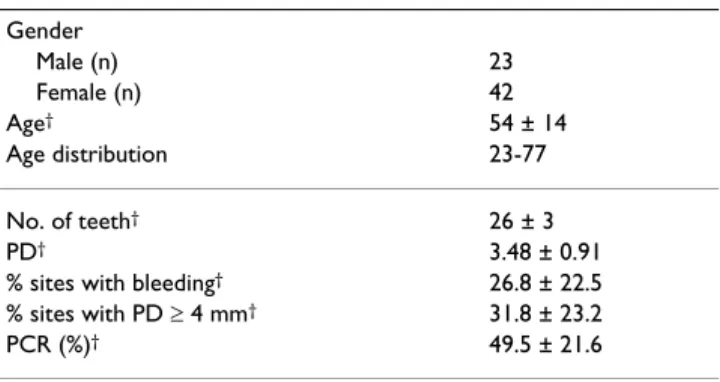
A total of 65 patients (23 males and 42 females; 23 to 77 years of age; mean age: 54 ± 14 years) agreed to participate and responded to the questionnaire. Approximate time required for a participant to fill out the questionnaire ranged from 5 to 13 min. Clinical and demographic char-acteristics of the subjects are shown in Table 2. The partic-ipants had an average of 26 remaining teeth.
Oral hygiene
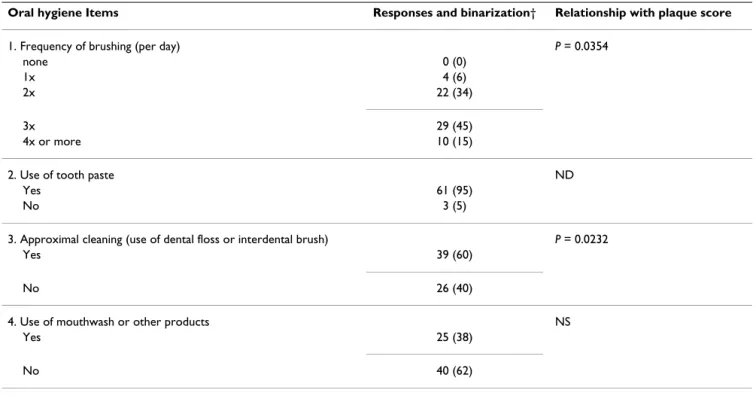
Under the domain of oral hygiene, the questionnaire asked about frequency of tooth brushing, use of denti-frice, approximal cleaning, and use of mouthrinse and other adjunct products (Table 3). Altogether, sixty percent of respondents indicated brushing three times more a day, while 6% indicated brushing only once a day. A majority of respondents were using dentifrice. Two thirds of respondents indicated that they clean proximal surfaces
regularly, with interdental brush or dental floss. Those using mouthrinse or other adjunct oral care products were 38%.
In order to analyze the relationship with plaque scores, the individual PCR data was dichotomized. The cut-off value of the PCR for dichotomization was set at 40%. We decided that this value was appropriate considering (1) mean value of the PCR score, and (2) that the participants were at the pre-treatment stage. When the relationship with plaque score was sought, frequency of brushing and approximal cleaning showed a statistically significant association (P < 0.05) (Table 3). The habit of brushing three times more a day was associated with better PCR scores. Likewise, the habit of approximal cleaning was associated with better PCR scores.
Table 1: The domains and item questions of the questionnaire (translated in English)
Domains Items
Oral hygiene 1. Frequency of toothbrushing 2. Use of toothpaste 3. Approximal cleaning
4. Use of mouthwash or other products
Dietary habit 1. Frequency of meal 2. Self evaluation of diet
3. Frequency of between-meal snacks 4. Types of snacks
Perception of oral condition 1. How often do you check your teeth or mouth inside in a mirror? 2. How would you rate your desire to keep your teeth?
3. What are your hopes for your oral health?
4. How much are you willing to do to improve your oral health? 5. What actions you are likely to take to improve your oral health? 6. Have you been maintaining regular dental check-ups?
7. How much do you follow your dentist's or dental hygienist's advice on oral hygiene care? 8. How important is the prevention of cavities or gum diseases for you?
9. Would you like your dentist or dental hygienist to recommend oral care products? 10. Are you willing to take new challenges and/or change your daily routine? 11. How do you perceive consequences of your actions on oral health?
Table 2: Demographic characteristics and clinical parameters of subjects at baseline (total n = 65)
Gender Male (n) 23 Female (n) 42 Age† 54 ± 14 Age distribution 23-77 No. of teeth† 26 ± 3 PD† 3.48 ± 0.91
% sites with bleeding† 26.8 ± 22.5
% sites with PD ≥ 4 mm† 31.8 ± 23.2
PCR (%)† 49.5 ± 21.6
BMC Oral Health 2009, 9:27 http://www.biomedcentral.com/1472-6831/9/27
Dietary habits
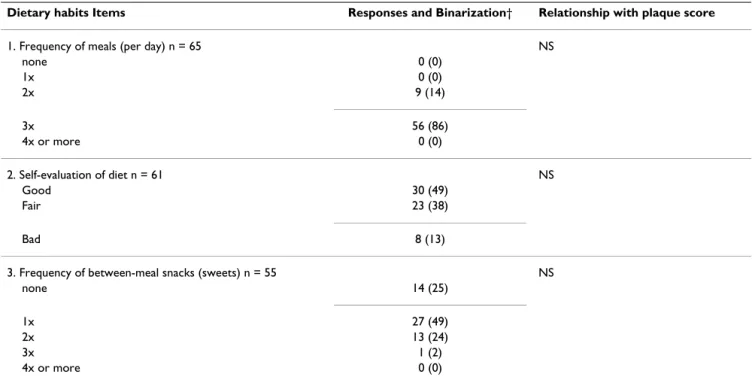
In general, no apparent problems with dietary habits were identified in this population of patients. As for frequency of meals, a majority of respondents (86%) reported eating three meals a day with the rest eating two meals a day (Table 4). Over two thirds of respondents reported snack-ing between meals at least once a day. As for respondents' self evaluation of their dietary status, 87% rated their own habits as good or fair, while 13% rated them as poor.
None of the items showed a significant association with plaque scores (Table 4.)
Perception of oral condition
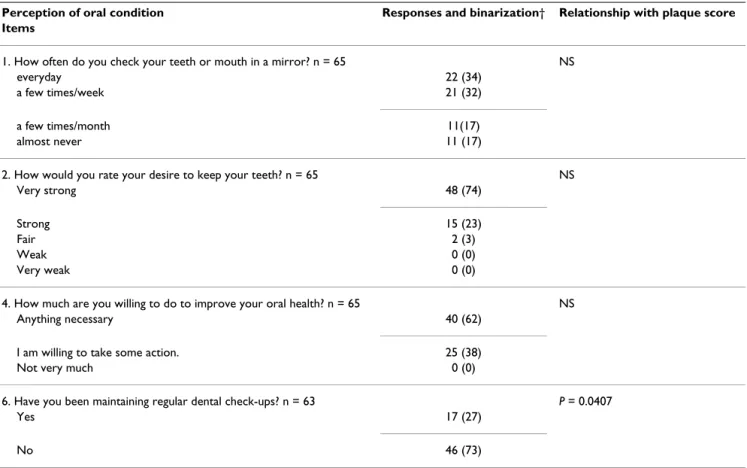
A summary of the responses is shown in Tables 5 and 6. When asked to indicate the frequency of oral self-exami-nation (looking into one's own mouth), 66% of respond-ents reported doing so at least once a week (Table 5). A majority (74%) of respondents indicated a strong desire to keep their teeth for as long as possible. When asked to report other things they desired in relation to oral health, 'eating enjoyment' and 'fresh breath' were the most fre-quent answers. Two thirds of respondents indicated that they would do anything to improve their oral conditions. 'Implementation of the suggested oral care regimen' and 'acceptance of necessary dental care' were the most fre-quently reported behaviors or attitudes that they would be
likely to accept. Less than one third of respondents were regular users of the dental care system (i.e., they had at least one dental visit within 1 year).
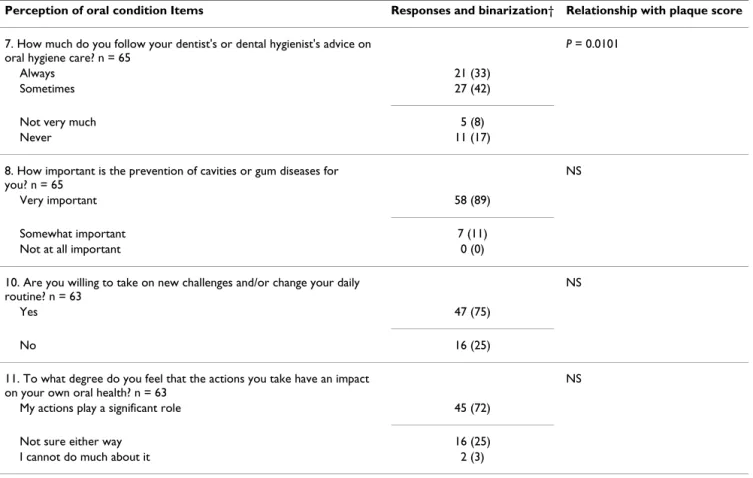
Seventeen percent of the respondents indicated that they never followed or received professional advice on oral care, while everyone acknowledged the importance of pre-vention (Table 6). A majority of them indicated that they would like to receive professional advice on oral care products.
A quarter of respondents did not wish to take on new chal-lenges or change their daily routines. Seventy one percent of them believed that their actions would influence their oral health, while 3% felt they could not.
When the relationship with plaque score was sought, maintenance of regular dental check-ups and acceptance of professional advice were the items which showed a sig-nificant association with PCR scores. Those who had reg-ular dental check-ups had better PCR scores. Also, those who accepted dentist's or dental hygienist's advice on oral hygiene care had better PCR scores.
Discussion
In an age of assessment and accountability, the field of periodontics as well as dental hygiene could benefit by
Table 3: Summary of responses to "Oral hygiene" and their relationship with plaque score
Oral hygiene Items Responses and binarization† Relationship with plaque score
1. Frequency of brushing (per day) P = 0.0354
none 0 (0)
1x 4 (6)
2x 22 (34)
3x 29 (45)
4x or more 10 (15)
2. Use of tooth paste ND
Yes 61 (95)
No 3 (5)
3. Approximal cleaning (use of dental floss or interdental brush) P = 0.0232
Yes 39 (60)
No 26 (40)
4. Use of mouthwash or other products NS
Yes 25 (38)
No 40 (62)
Values are expressed in n (%).
† Responses were grouped into two (as separated by dotted line) and compared with two categories of PCR (≥ 40% vs. < 40%) by Fisher's exact test. P-values less than 0.05 were considered statistically significant.
NS; not significant ND; not determined
adopting models that emphasize the multidimensional nature of oral problems and by considering patient behav-iors and perceptions on oral health.
Although it may be desirable to use a full instrument based on single or multiple health behavior models for a comprehensive assessment, clinicians often experience time constraints posed by active patient care. Therefore, we sought to develop a simple questionnaire that could be completed quickly, yet it would provide information rele-vant to the planning of periodontal treatment. Our 19-item questionnaire imposed very little burden on the patients; they had little difficulty in completing it. Within the limitations of the present study, the clinical use of the questionnaire disclosed salient information regarding periodontitis patients' oral health behavior and percep-tions.
To prevent development of dental caries and gingivitis the usual recommendation is to brush the teeth twice a day and clean interdentally at least once a day [22,23]. In a recent national survey of the Japanese population, brush-ing more than twice-a-day was reported by 70% of those surveyed [1]. In the present study, all participants reported that they brush their teeth at least twice a day, and 60% indicated that they clean interdentally. However, these seemingly favorable behaviors had not resulted in satis-factory level of plaque control, as the mean PCR of the
respondents was 49.5% at the initial examination. Among the respondents, however, those with more frequent toothbrushing (≥ 3× per day) and approximal cleaning habits were associated with better oral hygiene status. Any program or oral hygiene instruction intended to reduce caries and periodontal disease must focus on proximal and interdental areas [6]. It may be necessary to further emphasize interdental cleaning in the development of periodontal care plans.
We chose two conceptual models to study the determi-nants of oral self-care. These models were built on the knowledge base available so far and include aspects that have been neglected by use of singular health behavior model. The CSCCM implies that the dental hygienist works in dialogue with the patient in order to increase empowerment [15]. The dialogue results in a commit-ment where the patients set goals for themselves. The New Century model of oral health promotion [16] can be sum-marized as follows: oral health promotion is a function of oral health-related affect, behavior and cognition, time and situation. This model has been used as a framework for the analysis of oral self-care among adults with diabe-tes in Finland [24]. In our exploratory study, only 17% reported dental visits for a regular check-up within the last year. A similar result was reported in a previous study of a Japanese adult population [25]. Also in our study, 17% reported that they never followed or received professional
Table 4: Summary of responses to "Dietary habits" and their relationship with plaque score
Dietary habits Items Responses and Binarization† Relationship with plaque score
1. Frequency of meals (per day) n = 65 NS
none 0 (0) 1x 0 (0) 2x 9 (14) 3x 56 (86) 4x or more 0 (0) 2. Self-evaluation of diet n = 61 NS Good 30 (49) Fair 23 (38) Bad 8 (13)
3. Frequency of between-meal snacks (sweets) n = 55 NS
none 14 (25)
1x 27 (49)
2x 13 (24)
3x 1 (2)
4x or more 0 (0)
Values are expressed in n (%). Items subjected to the statistical analysis were shown.
†Responses were grouped into two (as separated by dotted line) and compared with two categories of PCR (≥ 40% vs. < 40%) by Fisher's exact test. P-values less than 0.05 were considered statistically significant.
BMC Oral Health 2009, 9:27 http://www.biomedcentral.com/1472-6831/9/27
advice on oral care. These behaviors fall short of the rec-ommended levels. We found, however, that those who maintained regular check-ups and had closer perceived compliance with advice from dentists or dental hygienists had significantly better oral hygiene. These findings emphasize the importance of patient commitment in self-care. Our next step is to plan interventions based on the conceptual models, for the purpose of effectively assisting periodontal patients' self-care.
Attempts have been made to introduce behavioral cogni-tive approaches into patient care. Those efforts have shown some promising results in the oral health out-comes of patients with periodontitis [26,27]. A Chochrane systematic review identified tentative evidence from studies which demonstrated that psychological approaches to behavior management can improve oral hygiene related behaviors [20]. Recently, Syrjälä et al[28] reported the results of a comparative analysis in which psychological characteristics related to health behavior were examined for their ability to explain oral health hab-its, adherence to diabetes treatment, and measures of oral health. They found that self-efficacy was associated with
oral health habits and diabetes adherence. The use of the present questionnaire allows clinicians to incorporate the essence of oral health models in a clinical setting. There are, however, limitations in all health behavior models used to explain the complexity of human health behavior [24]. There are also difficulties in developing effective strategies for improving long-term patient compliance with health promotion regimens, especially for chronic diseases and more so when lifestyle changes are necessary [6,26]. These points should be kept in mind when utiliz-ing the conceptual models in treatment plannutiliz-ing.
The application of oral health models to clinical situa-tions has educational implicasitua-tions as well. Understanding the significance of preventing oral diseases and the basics of oral health promotion through biopsychosocial para-digm has become a primary concern of all dental and den-tal hygiene curricula [16,21,29]. Our clinic is part of the dental school hospital, and it is crucial to educate dental and dental hygiene students as well as young clinicians about the importance of patients' oral health behaviors and perceptions.
Table 5: Summary of responses to item 1 to 6 of "Perception of oral condition" and their relationship with plaque score
Perception of oral condition Responses and binarization† Relationship with plaque score
Items
1. How often do you check your teeth or mouth in a mirror? n = 65 NS
everyday 22 (34)
a few times/week 21 (32)
a few times/month 11(17)
almost never 11 (17)
2. How would you rate your desire to keep your teeth? n = 65 NS
Very strong 48 (74)
Strong 15 (23)
Fair 2 (3)
Weak 0 (0)
Very weak 0 (0)
4. How much are you willing to do to improve your oral health? n = 65 NS
Anything necessary 40 (62)
I am willing to take some action. 25 (38)
Not very much 0 (0)
6. Have you been maintaining regular dental check-ups? n = 63 P = 0.0407
Yes 17 (27)
No 46 (73)
Values are expressed in n (%). Items subjected to the statistical analysis were shown.
†Responses were grouped into two (as separated by dotted line) and compared with two categories of PCR (≥ 40% vs. < 40%) by Fisher's exact test. P-values less than 0.05 were considered statistically significant.
One weaknesses of this study would be the probable bias of the population, which is small in size and not necessar-ily represents the whole population with chronic perio-dontitis in Japan. We were unable to match or analyze the subject by gender in this pilot study. In a previous study in Japan, it has been reported that both age and gender dif-ferences can be a significant factor in oral self-care [30]. In the future study with larger sample size, we will evaluate the effect of age and gender differences. Validity and reli-ability of the questionnaire should be further examined. Additionally, the study only sought associations between patients self-care related behaviors and perceptions, and oral hygiene status at the pre-treatment stage. Another possible limitation is that patients may be hesitant or inconsistent in expressing their personal views about their health when self-reports are utilized [31].
We are in the process of analyzing the relationship between identified health care behaviors and periodontal parameters in larger patient poplulation. Also, our current effort is directed at elucidating the long-term relationship
between patients' health beliefs, behaviors and oral health outcomes.
Conclusion
In summary, the questionnaire facilitates the inclusion of multiple aspects of patient information, before initiation of periodontal treatment. There seems to be much room for improvement of oral hygiene and self-care among individuals presenting for an initial periodontal examina-tion. Within the limits of the present study, the significant associations that were found between some of the self-care behaviors and oral hygiene levels document the important role of patient-centered oral health assessment in periodontal care.
Abbreviations
CSCCM: Client Self-care commitment model; PD: prob-ing depth; PCR: plaque control record
Competing interests
The authors declare that they have no competing interests.
Table 6: Summary of responses to item 7 to 11 of "Perception of oral condition" and their relationship with plaque score.
Perception of oral condition Items Responses and binarization† Relationship with plaque score
7. How much do you follow your dentist's or dental hygienist's advice on oral hygiene care? n = 65
P = 0.0101
Always 21 (33)
Sometimes 27 (42)
Not very much 5 (8)
Never 11 (17)
8. How important is the prevention of cavities or gum diseases for you? n = 65
NS
Very important 58 (89)
Somewhat important 7 (11)
Not at all important 0 (0)
10. Are you willing to take on new challenges and/or change your daily routine? n = 63
NS
Yes 47 (75)
No 16 (25)
11. To what degree do you feel that the actions you take have an impact on your own oral health? n = 63
NS
My actions play a significant role 45 (72)
Not sure either way 16 (25)
I cannot do much about it 2 (3)
Values are expressed in n (%). Items subjected to the statistical analysis were shown.
† Responses were grouped as shown and compared with two categories of PCR (≥ 40% vs. < 40%) by Fisher's exact test. P-values less than 0.05 were considered statistically significant.
Publish with BioMed Central and every scientist can read your work free of charge "BioMed Central will be the most significant development for disseminating the results of biomedical researc h in our lifetime."
Sir Paul Nurse, Cancer Research UK Your research papers will be:
available free of charge to the entire biomedical community peer reviewed and published immediately upon acceptance cited in PubMed and archived on PubMed Central yours — you keep the copyright
Submit your manuscript here:
http://www.biomedcentral.com/info/publishing_adv.asp
BioMedcentral
BMC Oral Health 2009, 9:27 http://www.biomedcentral.com/1472-6831/9/27
Authors' contributions
AS designed the study, performed the data analyses, and drafted the manuscript. MK and FU contributed to data collection and analysis. SM, HH and HM collected data. TM oversaw procedures. All authors approved the manu-script.
Acknowledgements
We thank David Blette for editing the manuscript.
References
1. Dental Health Division of Health Policy Bureau, Ministry of Health and Welfare, Japan: Report on the survey of dental diseases Dental Health Division of Health Policy Bureau, Ministry of Health and Wel-fare, Japan; 2005. (in Japanese)
2. Baelum V, Van Palenstein Helderman W, Hugoson A, Yee R, Fejer-skov O: A global perspective on changes in the burden of
car-ies and periodontitis: implications for dentistry. J Oral Rehabil
2007, 34:872-906.
3. Offenbacher S: Periodontal diseases: pathogenesis. Ann
Period-ontol 1996, 1:821-878.
4. Page RC: The pathology of periodontal diseases may affect
systemic diseases: inversion of a paradigm. Ann Periodontol
1998, 3:108-120.
5. Rose LF, Genco RJ, Cohen DW, Mealey BL, eds: Periodontal medicine St. Louis, BC Decker; 2000.
6. Löe H: Oral hygiene in the prevention of caries and
periodon-tal disease. Int Dent J 2000, 50:129-139.
7. Axelsson P, Nyström B, Lindhe J: The long-term effect of a
plaque control program on tooth mortality, caries and peri-odontal disease in adults. Results after 30 years of mainte-nance. J Clin Periodontol 2004, 31:749-757.
8. Vick VC, Harfst S: The Oral Risk Assessment and Early
Inter-vention System -A clinician's tool for integrating the bio/psy-cho/social risk into oral disease interventions. Compend Contin
Educ Dent Suppl 2000, 30:57-64.
9. Rosenstock IM, Strecher VJ, Becker MH: Social learning theory
and the Health Belief Model. Health Educ Q 1988, 15:175-183.
10. Bandura A: Self-efficacy: toward a unifying theory of
behavio-ral change. Psychol Rev 1977, 84:191-215.
11. Bandura A: Self-efficacy mechanism in human agency. Am
Psy-chol 1982, 37:122-147.
12. Stewart JF, Wolfe GR, Maeder L, Hartz GW: Changes in dental
knowledge and self-efficacy scores following interventions to change oral hygiene behavior. Patient Educ Couns 1996, 27:269-277.
13. Beck KH: Development and validation of dental locus of
con-trol scale. J Prev Dent 1980, 6:327-332.
14. Macgregor ID, Regis D, Balding J: Self-concept and dental health
behaviors in adolescents. J Clin Periodontol 1997, 24:335-339.
15. Calley KH, Rogo E, Miller DL, Hess G, Eisenhauer L: A proposed
cli-ent self-care commitmcli-ent model. J Dcli-ent Hyg 2000, 74:24-35.
16. Inglehart M, Tedesco L: Behavioral research related to oral
hygiene practices: a new century model of oral health pro-motion. Periodontol 2000 1995, 8:15-23.
17. Ainamo J, Bay I: Problems and proposals for recording
gingivi-tis and plaque. Int Dent J 1975, 25:229-235.
18. O'Leary TJ, Drake RB, Naylor JE: The plaque control record. J
Periodontol 1972, 43:38.
19. World Health Organization: Compaing oral health care systems. A
sec-ond international collaborative study. WHO/ORH/ICS II, Geneva 1997.
20. Renz A, Ide M, Newton T, Robinson PG, Smith D: Psychological
interventions to improve adherence to oral hygiene instruc-tions in adults with periodontal diseases. Cochrane Database
Syst Rev 2007, 18(2):CD005097.
21. Sato Y, Saito A, Nakamura-Miura A, Kato E, Cathcart G: Application
of the Dental Hygiene Human Needs Conceptual Model and the Oral Health-Related Quality of Life Model to the dental hygiene curriculum in Japan. Int J Dent Hyg 2007, 5:158-164.
22. Ramsay DS: Patient compliance with oral hygiene regimens: a
behavioral self-regulation analysis with implications for tech-nology. Int Dent J 2000, Suppl:304-311.
23. Kressin NR, Boehmer U, Nunn ME, Spiro A 3rd: Increased
preven-tive practices lead to greater tooth retention. J Dent Res 2003, 82:223-227.
24. Karikoski A, Ilanne-Prikka P, Murtomaa H: Oral self-care among
adults with diabetes in Finland. Community Dent Oral Epidemiol
2002, 30:216-223.
25. Tada A, Matsukubo T: Relationship between oral health
behav-iors and general health behavbehav-iors in a Japanese adult popula-tion. J Public Health Dent 2003, 63:250-254.
26. Jönsson B, Lindberg P, Oscarson N, Öhrn K: Improved
compli-ance and self-care in patients with periodontitis - a rand-omized control trial. Int J Dent Hyg 2006, 4:77-83.
27. Kakudate N, Morita M, Sugai M, Kawanami M: Systematic
cogni-tive behavioral approach for oral hygiene instruction: A short-term study. Patient Educ Couns 2009, 74:191-196.
28. Syrjälä A-MH, Ylöstalo P, Niskanen MC, Knuuttila MLE: Relation of
different measures of psychological characteristics to oral health habits, diabetes adherence and related clinical varia-bles among diabetic patients. Eur J Oral Sci 2004, 112:109-114.
29. Keselyak NT, Gadbury-Amyot CC: Application of an oral
health-related quality of life model to the dental hygiene curricu-lum. J Dent Educ 2001, 65:253-261.
30. Aleksejuniene J, Holst D, Eriksen HM, Gjermo P: Psychosocial
stress, life-style and periodontal health. A hypothesized structural equation model. J Clin Periodontol 2002, 29:326-335.
31. Kawamura M, Wright FAC, Sasahara H, Yamasaki Y, Suh S, Iwamoto Y: An analytical study on gender differences in self-reported
oral health care and problems of Japanese employees. J Occup
Health 1999, 41:104-111.
Pre-publication history
The pre-publication history for this paper can be accessed here: