
トップページ - 横浜国立大学学術情報リポジトリ
27
0
0
全文
(2) 72 S. NEGAMi and A.NAKAMoTo Our terminology for graph theory is quite standard. For example, we use. the notations K., K.., C. and so on to denote the complete groph with n vertices, the complete bipartite gmph with partite sets of size m and n, the aycle. of length n and et al. See [4] for topological graph theory.. 1. Classical results on triangulations. A triangulation on a closed surface F2 is a simple graph G embedded on F2 so that (i) each face of G is bounded by a cycle of length 3 and that (ii) any. two faces have at most one edge in common. Roughly speaking, a triangulation divides a closed surface into several triangles. In topology, a triangulation. on a closed surface is regarded as a 2-dimensional simplicial complex together with faces, but our triangulation is only the 1-skeleton of such a complex.. The smallest example of such triangulations is the complete graph K4 with. four vertices on the sphere, which looks like the tetrahedron. The complete graPh K3 with three vertices on the sphere also divides the sphere into two triangular faces, but K3 is not a triangulation under our definition since those. faces share the three edges. Observe that if two triangular faces share twb edges, then the other two edges, not shared, will form a pair of multiple edges. if they don't coincide. This implies that if G is a simple graph embedded on a closed surface with Condition (i) but not (ii), then G has only two faces. which meet each other along their whole boundary. Thus, we can define a triangulation on F2 as a simple graph embedded on F2 with only triangular faces, allowing the unique exception, K3 on the sphere. Now let G be a triangulation on a closed surface F2 and consider an edge. ac which two faces abc and acd share in G. A diagonal flij) is to replace ac with another diagonal bd of the rectangle abca, as shown in Figure 1. This is just a local deformation of G and the resulting graph G! also divides F2 into. bb --・-・- ))・. ac ac d. d. Figure 1: Diagonal flip.
(3) Diagonal Transformations of Graphs on Closed Surfaces 73 triangular faces. However, if there is an edge bd in G, the diagonal flip at ac. yields multiple edges between b and d, and hence G' is not a triangulation. We forbit such a diagoanl flip not to break the simpleness of graphs.. The question is whether or not any two triangulations on a closed surface. can be transformed into each other by diagonal flips. They are said to be equivalent under diagonal flips if they can. Of cource, they must have the same number of vertices and of edges if they are equivalent to each other.. Note that triangulations with the same number of vertices have the same number of edges by Euler's formula.. The following theorem is the origin of this topic and was proved by Wagner in his paper [16] written in German. An article introducing this theorem can be found in Ore's book [11] on Four Color Problem. His proof is very easy and constructive as shown below, (The meanings of "up to ambient. isotopy" and "up to homeomorphism" will be explained later in the next setction.). THEOREM1(Wagner, 1936). Any two triangulations on the sphere with the same number of vertices a7? equivalent to each other under diagonal flips, mp to ambient isotQPy.. 17oof Let G be any triangulation of the sphere. We represent it as a plane graph, so that there is a big triangle uovw of G and the triangular region with. boundary uovw contains the whole of G. Let v, oq y; z,..., zu be the neighbors of uo, lying clockwise in this order. First suppose that uo has degree at least 4. (If deguo==4, then g=w.) If y is not adjacent to v, then we replace uox with. yv to decrease the degree of uo. Otherwise, the edge yv is placed outside the rectangle uovxzy and the cycle uotuy separates x and z. Thus, x is not adjacent to. g and hence uoy can be replaced with xe by a diagonal flip. Repeating these deformations, we can reduce the degree of uo to 3.. Now suppose that uo has precisely three neighbors v, ui, w and consider the subgraph Gi of G bounded by the triangle uivw. By the same arguments, we can deform Gi by diagonal flips inside uivw so that ui has degree 3 in Gi. and hence degree 4 in G afterward. Repeating these arguments with subgraphs Gi, G2,・・・, we get finally the triangulation which consists of the triangle uovw and the path uiu2・・・u. of vertices of degree 4 adjacent to both. v and w. This is the standard form of the spherical triangulations, as shown. in Figure 2. Therefore, any two triangulations of the sphere with the same number of vertices can be transformed into each other by diagonal flips via this standard form. -.
(4) S. NEGAMi and A. NAKAMoTo. 74. uo. um. wv. Figure 2: The standart form A. of spherical triangulations. 1231 4. 6. 7. 4 5. 5. 1231 Figure 3: The unique embedding of K7 on the torus. The following three theorems have been proved by Dewdney in [3] and by Negami and Watanabe in [10], as natural generalizations of Wagner's theorem for other surfaces.. THEOREM2(Dewdney, 1973). Any tzvo triangulations on the torus with the same number of vertices are equivagent to each other under diagonal flips, mp to. homeomorphism.. THEOREM3(Negami and Watanabe, 1990). Any tzvo tn'angulations on the projective plane with the same number of vertices are equivalent to each other under diagonal flij)s, mp to ambient isotopy.. THEOREM 4 (Negami and Watanabe, 1990). Any two tn'angulations on the Klein bottle with the same number of vertices are equivalent to each other under diagonal flij)s, mp to homeomozPhism.. As shown in the proof of Wagner's theorem, we have the "standard form" of the spherical triangulations with notation A. and all the triangulations with. m+3 vertices on the sphere can be generated from A. by diagonal flips. Similarly to the spherical case, we can choose suitably some standard forms for the torus, the projective plane and the Klein bottle,.
(5) Diagonal Transformations of Graphs on Closed Surfaces 75 For example, the unique embedding of K7 on the torus, given in Figure 3,. is a unique minimal triangulation of the torus. Here a triangulation of a closed surface F2 is said to be minimal if it has the fewest vertices among all. the possible triangulations on F2. Add A. (m>-O) to one face of K7 arbitrarily. chosen. The resulting graph, denoted by K7+A., is obviously a triangulation of the torus which has precisely 7+m vertices. (Define K7+Ao formally as K7.). If we believe Theorem 2, any triangulation with 7+m vertices on the torus will be obtained from K7+A. by diagonal flips. Thus, we may call K7+A. the standard form of the toroidal triangulations.. Similarly, we have the unique eMbedding of K6 on the projective plane, as the unique minimal triangulation of the projective plane (see the left in the Figure 10) and call K6+A. the standard form of the projective-planar triangu-. lations with 6+m vertices. On the other hand, there are precisely three minimal triangulations on the Klein bottle, shown in Figure 4. Negami and Watanabe have chosen the first one from the three as the standard form of the Klein-bottlal triangulations in [10], but we can choose any one from the other. 1. 2. 3. 1. 1. 2. 3. 1 N. 4. 5. 4. 5. 5. 4. 5. 4. 1. 2. 3. 1. 1. 1. 2. 3. 2. 3. 1. 4. 5. 5. 4. 12. 1. 31. Figure 4: The minimal triangulations on the Klein. bottle.
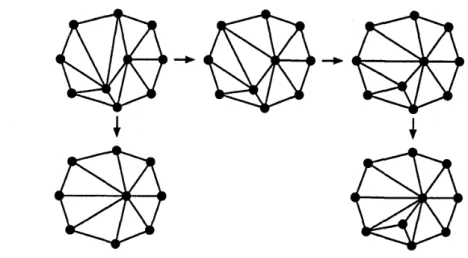
(6) S. NEGAMi and A. NAKAMOTO. 76. .. -・. Figure 5: Moving a vertex of degree 3 two. Observe that any two of the three minimal triangulations of the Klein bottle can be transformed into each other by diagonal flips. There is a common key fact for the proofs in [3] and in [10], which is that a vertex of degree 3 can be moved to any place in a triangulation. For example, two diagonal flips carry a vertex of degree 3 in the upper triangle to. the lower in Figure 5. Since atriangulation is connected, we can move such a vertex step by step to a face arbitrarily chosen in the triangulation. can establish the following logic. Let Gi and G2 be two From this fact, we triangulations with the same number of vertices on the same closed surface.. Suppose that we can deform both of them into ones which have vertices of degree 3, say viEV(Gi), by diagonal flips. By induction hypothesis, Gi-vi can be transformed into G2-v2 by a sequence of diagonal flips. Translate the sequence naturally into a sequence of diagonal flips starting from Gi. When. one of two triangles sharing an edge to which a diagonal flip is applied contains a vertex v of degree 3 corresponding to vl, then we first move v to another face far from these triangles. and next carry out the diagonal flip.. Through this sequence, Gi can be transformed into G2 with v2 moved to somewhere. Finally we get G2, modifying the position of v2 in G2, and conclude that Gi and G2 are equivalent to each other under diagonal flips.. To complete the proof, we have to discuss about whether or not the assumption of Gi and G2 actually holds and about the initial stage of our induction. In fact, these two problems can be solved together as follows. In general, a triangulation G on a closed surface F2 is said to be pseudo-. minimal if G is not equivalent to any triangulation which has a vertex of degree 3 under diagonal flips. (This terminology has appeared in [9].) Then the assumption of Gi and G2 can be rephrased into that neither Gi nor G2 are pseudo-minimal. So it sufi!ices to determine what the pseudo-minimal triangulations are.. Let G be a pseudo-minimal triangulation on a closed surface F2 and deform. G by diagonal flips so as to minimize its minimum degree 6(G). Choose a. /.
(7) Diagonal Transformations of Graphs on Closed Surfaces. v. 1. 4. 2. 77. v. 5. 2. 6. 1. 6. 1. v 3. 5. 3. 3. 4 v. Figure 6:. 2. 4. v. Finding pseudo-minimal triangulations. vertex v of G with degv=6(G)==n and let ui,..., u. be the neighbors of v lying around v in this cyclic order. If ui and ui+2 were not adjacent in G, then we could switch the diagonal vui+i to uiui+2 in the rectangle vuiui+iui+2 and the. degree of v would be reduced by one. This contradicts the assumption of G after the deformation and the choice of v. Thus, G must have edges uiu3, ...,. Un-2Un, Un-iui, unu2・ Then let F;, denote the wheel structure around v with these chords. It is clear that,if n is sufliciently large, then F. cannot be embedded on the torus, the projective plane and the Klein bottle.. For example, F7 cannot be embedded on the torus and moreover the embedding of F6 is strictly restricted on the torus. In fact, it is unique as. shown in Figure 6. Discussing what happens in quadrilateral regions, we can conclude that the whole G including this embedding of F6 is isomorphic to K7.. On the other hand, if v lies on either F4 or Fs, we can find a sequence of diagonal flips to make a vertex of degree 3, but this is contrary to the assumption of G being pseudo-minimal. Thus, K7 is the unique pseudo-minimal triangulation of the torus. This implies that the initial stage of our induction is trivial for the torus and that the required assumption holds for any toroidal triangulation with 8 or more vertices.. By similar arguments, Negami and Watanabe [10] proved Theorems 3 and 4 for the projective plane and the Klein bottle. Note that those depend on what the surfaces are and the higher the genus of a closed surafce is, the harder the. arguments are. They will not work to prove Wagner's theorems for general surfaces.. 2. Equivalence of graphs on surfaces In the previous section, we did not refer to how we compare two given.
(8) 78 S. NEGAMi and A. NAKAMoTo triangulations. What does it mean that two triangulations are the same? Here. we will discuss it to understand the more delicate meaning of Wagner's. theorem. ・. More generally, let Gi and G2 be two graphs embedded on closed surfaces. F? and F;, respectively. They are said to be homeomorphic to each other if there. is a homeomorphism h:Fl->F; with h(Gi)=G2 which induces an isomorphism. I. from Gi to G2. In this case, we say that Gi and G2 are the same one, mp to. homeomorPhism. For example, consider the unique embedding of K7 on the torus, given in Figure 3. First, identify the top and bottom edges of the rectangle to get a cylinder horizontally placed and next identify the both ends of this cylinder to. get one embedding of K7 on the torus. Now twist one end of the cylinder several times before identifying the two ends in the second step and identify. them. Then we obtain another embedding of K7 ort the torus, which looks more complicated than the first one. It is clear that the natural correspond-. ence between the two K7's extends to a homeomorphism between the two tori.. That is, these two embeddings of K7 on the tori are homeomorphic to each other even if their appearances are completely different.. Now recall the statement of Dewdney's theorem, Theorem 2 in the previous section. This must guarantee the existence of a sequence of diagonal flips. which transforms the first embedding of K7 into the second. However, any diagonal flip cannot be applied to any edge of K7 since any pair of vertices are already joined by an edge in K7. That is, it is impossible to transform the first. K7 into the second only by diagonal flips. Thus, these two K7's must be the. same one to solve this dilemma. That is the reason why the phrase "up to homeomorphism" is added to the statement of Theorem 2, as well as Theorem 4.. 0n the other hand, such a modification is not needed for the original version of Wagner's theorem since the proof gives us an algorithm which deforms a given triangulation on the sphere directly into the standard form. Precisely speaking, we need continuous deformations, in addition to diagonal. flips, to move a triangulation freely around the sphere and to adjust the ・1 Such a deformation will be formulated as follows. curvatures of its edges.. An ambient isotQpy H:F2xl-->F2 is a continuous map such that the map h,:F2.F2, defined by h,(x) ==H(x, t), is a homeomorphism over F2 for each tE I with ho the identity map of F2, where I stands for the interval [O, 1]. Two. graphs Gi and G2 embedded on F2 are said to be ambient isotopic or simply isotopic to each other if there is an ambient isotopy H:F2xl.F2 such that hi(Gi) =G2. By definition, ho(Gi)=:Gi. Intuitively, we can say that an ambient isotopy H deforms Gi into G2 continuously, regarding h,(Gi) as the position of t///t. I l.
(9) Diagonal Transformations of Graphs on Closed Surfaces 79 Gi at time t.. Note that we classified the pseudo-minimal triangulations up to homeomorphism by a tacit consent in the sketch of proofs in the previous section.. Thus, our combinatorial arguments usually conclude everything only up to homeomorphism. In particular, it can be proved in a standard topological argument that any homeomorphisim h:P2->P2 over the projective plane p2 extends to an ambient isotopy H:P2XI->P2 so that hi=h. This implies that. any fact up to homeomorphism also holds up to ambient isotopy for the projective plane, as well as Theorem 3.. Recall that we apply any diagonal flip to a triangulation only if it pre-. serves the simpleness of the triangulation. Note that if we do not mind diqgonal fiips' breaking the simpleness, our problem will be easy, so that we. can prove a general theorem up to ambient isotopy, as below. Up to the end of this section, we allow graphs to have loops and multiple edges. Such a graph G embedded on a closed surface F2 is called a pseudotriangulation on F2 if the boundary of each face of G is just a closed walk of. length 3, possibly not a cycle. Thus, Kl] on the sphere is now a pseudotriangulation. Place a vertex vo with one loop eo on the sphere so that eo divides the sphere into two monogonal regions Ri and R2, and put a vertex vi to Ri and v2 to R2 with edges vovi and vov2 added. The resulting graph is also a pseudo-triangulation on the sphere. A diagonal fiips in a pseudo-triangulation is defined as well as in a usual triangulation, but is not required to preserve the simpleness of graphs.. THEOREM5Any two Pseudo-triangulations on a closed sutuce zvith the same number of vertices a7e equivalent to each other under diagonag flips, mp to ambient zsotopy.. thoof Let Gi and G2 be two pseudo-triangulations on a closed surface F2. We. shall deform Gi by diagonal flips and G2 by an ambient isotopy of F2, as follows. Put Gi and G2 together on F2 so that V(Gi)=V(G2).. First deform G2 by an ambient isotopy fixing V(G2) to minimize the crossings of edges of Gi and G2. For example, let A be a face of Gi with boundary cycle uvzu and e an edge of G2 incident to u which goes through A. If e reaches to an inner point x of the edge uv, then we push the arc. of e between u and x toward uv and push it off moreover to eliminate the crossing point x. After these deformations, we can assume either that e is placed along uv or uw in parallel, or that e crosses the opposite edge vzv.. In the latter case, if vw is shared by two distinct faces A and B (Figure 7 (i)), then we replace vw with the other diagonal uz of the rectangular region.
(10) !. S. NEGAMi and A. NAKAMoTo. 80. z 1. : : : :. v. v. IW. I : 1. (i) (ii) Figure 7: Eliminating crossings. AUB with boundary uzzgw, by the diagonal flip, so that the arc e n(AUB) is contained in one of trianglar faces with boundaries uvg and uwg. If both sides of vw are incident to the face A (Figure 7 (ii)), then vw has to coincide with vu and is contained in the 2-cell region bounded by the self-loop uw. The arc. of e starting from u goes around v, crossing uv several times, and either terminates at v or comes back. In this case, we can find an ambient isotopy which eliminates all the crossings on uv.. Eliminating crossings in the above ways, we can assume finally that the edges of Gi and G2 do not meet each other except at their ends and are placed in parallel in pairs. Now there is an ambient isotopy which carries each edge. of G2 onto the corresponding edge of Gi. 1. 3. Irreducible triangulations As is mentioned in Section 1, the final stages of their proofs of Theorems. 2, 3 and 4 depend strongly on the individual surfaces although they have a large common part. This causes the difficulty in generalizing those theorems for other surfaces. To solve this problem, Negami has proposed recently a nice idea which connects the diagonal flip with the contraction of edges and proved the following for general surfaces in [9].. THEOREM 6 (Negami, 1992). Fbr any closed sutuce F2, there exists a positive integer N=N(F2) such that ijC Gi and G2 are two triangulations on F2 with lV(Gi)1 =1V(G2)1}})AL then Gi and G2 are equivalent under diagonal 77ips, mp to. homeomorphism. For example, the integers N for the sphere, the torus, the projective plane and.
(11) Diagonal Transformations of Graphs on Closed Surfaces 81 the Klen bottle are 4, 7, 6, 8 in order, which follows from Theorems 1, 2, 3 and. 4. Each of these values is equal to the minimum number of vertices that- the triangulations in each surface have, here denoted by A(F2). Of cource, if any. two triangulations on F2 with the same number of vertices are equivalent to each other under diagonal flips, the value of N(F2) will coincide with A(F2). In general, Ringel det-ermined in [12] and [14] the precise values of A(F2) 'J.. for all the closed surfaces and showed that the complete graphs attain those. values in most of cases. Since the complete graph cannot be' deformed into any other graph by diagonal flips, if KA(F2) triangulates F2 and has two or more. embeddings of different homeomorphism types, then N(l72) must be greater than A(F2).. Theorem 6 says nothing about the value of N(F2) but 'only its existence, while Negami's proof in [9] suggests how to determine N(F2), related t6 the notion of irreducible triangulations, defined below.. Let G be a triangulation on a closed surface F2 and ac an edge of G. Then there are two triangles abc and acd sharing this edge ac in G. The 'contraction. of the edge ac is to shrink ac to a point a==c until the two faces abc and acd. degenerate to edges ab=cb and ad=:cd, as shown in Figure 8, so that we obtain another triangular embedding of a graph Gi. However we forbit ourselves to carry out a contraction of an edge, as well as a diagonal flip, if it deforms a given triangulation into a non-simple graph, that is, if a and c have. another common neighbor other than b and d. If a triangulation G can be transformed into another Gi by contracting edges under this rule, then G is said' to be contractible to G!.. A triangulation G on a closed surface F2 is said to be ineducible if G is not. contractible to any other triangulation on F2. For example, the complete'graph K4 on the sphere is irreducible since the contraction of each edge yields K3 on. the sphere, which is not a triangulation. However, this example is so special.. ba;. b a. c ...-..-. d. l)"'. d. Figure 8: Contraction of an edge.
(12) 82 S. NEGAMi and A.・NAKAMoTo In fact, an irreducible triangulation can be defined, with the unique exception. K4, as one each of whose edge is contained in at least three triangles, two of. which bound faces but the other do not. Obviously by defintion, any triangulation on F2 is contractible to one of irreducible triangulations of F2.. One of the key facts in Negami's proof is that if a,triangulation G is contractible to another triangulation T, then G is equivalent to T+A. under diagonal flips with lV(G)1=lV(T)1+m, where T+A. denotes any triangulation obtained from T by adding the standard form A. of the spherical triangu-. lation with m+3 vertices to any face of Tl Note that this notation T+A. is so ambjguous since jt depends on the choice of a face to which A. js added, but clearly any two triangulations denoted by T+A. are equivalent to each. otherunderdiagonalflips. , -. Figure 9 illustrates how a contraction of an edge is related to diagonal flips, which is the essence of his proof. Roughly speaking, the contraction of an edge can be realized by deleting a vertex of degree 3 following diagonal flips. This implies that if G is not irreducible, then G is not pseudo-minimal.. Another key fact is that for any two triangulations Gi and G2, there is a. non-negative integer mi and m2 such that Gi+A., is equivalent to G2+Am, under diagonal flips, where Gi and G2 are not assumed to have the same number of vertices. In this case, Gi and G2 are said to be stably equivalent to. each other under diagonal flips. To prove this fact, consider a common refinement G of Gi and G2, and observe that G is contracitible to both Gi and G2. By the first fact, G is equivalent to both Gi+A., and G2+A., and hence so. they are. Note that if Gi+A., is equivalent to G2+A.,, then Gi+A.,+le is equjvalent to G2+A.,+le for any posjtjve jnteger le>O.. To complete the proof of Theorem 6, we need one more fact that there. -・-. >. .. ,. Figure 9: Edge contraction and diagonal. ,. flips.
(13) Diagonal Transformations of Graphs on Closed Surfaces. 83. 11 3. 2. 3. 2. 2. 3. 2. 3. 11. Figure 10: Irreducible triangulations of the projective plane. exist only finitely many irreducible triangulations Of a given closed surface.. To show this, Negami used Wagner's conjecture, whose affirmative solution is given in [15]. In general, a graph H is called a minor of a graph G if H can. be obtained from G by deleting and contracting edges. Wagner's conjecture states that every infinite series of graphs includes a pair of graphs one of which is a minor of the other and this fact is known to be independent of Peano's axioms. It will be interesting to try an elementary proof of the finiteness of the irreducible triangulations.. For example, it is easy to show in an elementary way that the sphere has unique irreducible triangulation as K4. Barnette also showed in [2] that there are precisely two irreducible triangulations of the projective plane, given in Figure 10, one of which is the unique embedding of K6 on the projective plane. It is easy to see that the second one with 7 vertices can be transformed into. K6+Ai by three diagonal flips. This implies that any triangulation on the projective plane is contractible to one of these and hence is equivalent to K6+. A. under diagonal flips in either case, which follows from the arguments in Section 1.. On the other hand, there exist precisely 21 irreducible triangulations of the. torus. Lavrenchenko determined their complete list in [5]. The only pseudo-. minimal one among those is the unique embedding of K7 as is mentioned at the end of Section 1 and hence any triangulation is equivalent to K7+A.. The irreducible triangulations of the Klein bottle have never been classi-. fied yet. For example, prepare two copies of irreducible. triangulations in Figure 10 and glue them together along a pair of faces. Then we obtain an irreducible triangulation with 9, 10 or 11 vertices on the connected sum of two. projective plane, which is homeomorphic to the Klein bottle. There will be another type of irreducible triangulations on the Klein bottle which do not split in this way..
(14) 84 S. NEGAM! and A. NAKAMoTo In general, let Ti,..., 71, be all the irreducible triangulations of a given. closed surface F2. Then there is a posivite interger N=N(F2) such that if lV(Ti+A.,)l=1V(71i+A.,)1})IV] then 7>+A.,. i's equivalent to 71i+A.e,. under diagonal flips, since they are stably equivalent to each other and finite in number. Choose any triangulation G on F2 so that G has at least N vertices and suppose that, G is contractible to 71i. Then G is equivalent to 71i+A., with. a suitable mi and hence to Ti+A., with fi V(G)l=1V(Ti)l+mi by the first key fact and the property of AL Therefore, any two triangulations on F2 with at least N and the same number of vertices can be transformed into each other by diagonal flips via the standard form Ti+A., chosen here. These arguments suggest that if we have the complete list of irreducible triangulations of a closed surface F2, then the value of N(F2) in Theorem 6 will be determined. More precisely, the number IV(l72) is equal to the minimum number N such that for any two of pseudo-minimal triangulations Tt and 71i, if IV(71i+A.,)l=IV(7}f+A.,)1}}iA7] then 71i+A., i's equivalent to 7">+A.,,. under diagonal flips. Note that the complete list of pseudo-minimal triangulations is a subset of that of irreducible triangulations and that any triangula-. tion obtaited from a pseudo-minimal one by diagonal flips is also pseudominimal. Thus, if N(F2) >A(F2), then there will be a class of pseudo-minimal triangulations, but not minimal, which is closed under diagonal flips. However,. we conjecture that any pseudo-minimal triangulation is minimaL See [9] for the details.. 4. Bipartite quadrangulations Now we will deal with a new class of graphs on closed surfaces, called quadrangulations and describe Nakamoto's results on them in [6] with additional observations. Some part goes in parallel to the previous arguments on triangulations, but there are several phenomena peculiar to quadrangulations. A graph G 2-cell embedded on a closed surface F2 is called a quadrangulation on F2 if G is simple and if each face of G is bounded by a cycle of length. 4. Thus, the simplest example of quadrangulations is the cycle C4 of lenght 4. on the sphere. Recall that we exclude K3==C3 on the sphere in case of triangulations. If we respected this convention, then we should exclude C4 and should take the complete bipartite graph K2,3 on the sphere with three faces as. the smallest quadrangulation on the sphere. However, any choice from these does not play an essential role in our arguments below.. To construct another example of a typical quadrangulation, consider a rectangle subdivided by an (n+1)× (m+1) grid so that its vertical and hori-.
(15) Diagonal Transformations of Graphs on Closed Surfaces 85 zontal edges have length n and m respectively and identify each opposite pair. of edges. Then we obtain a quadrangulation on the torus which is isomorphic to C.XC. as a graph. If both n qnd m are even, then C.XC. is bij)antte, that is, we can assign black and white to its vertices so that any pair of adjacent vertices get different colors. Otherwise, C.XC. contains an odd cycle. This example guarantees the existence of non-bipartite quadrangulations although all the quadrangulations on the sphere are bipartite.. Here we define two diagonal transformations for the quadrangulations as follows. Let viv2v3v4 and viv4vsv6 be the boundary cycles of two faces sharing an edge viv4. Then the diagonal slide is to replace viv4 with another diagonal v2vs (or v6v3) of the hexagonal region bounded by the cycle viv2v3v4vsv6, as. shown in Figure 11. We do not carry out the diagonal slide, as well as a diagonal flips, if it yields a non-simple graph.. Another transformation is called the diagonal rotation, which generalizes the notion defined in [6]. Let v be a vertex of degree n in a quadrangulation G and let vwibiw2, vzv2b2w3,..., vw.b.wi be the boundary cycles of the n faces incident to v in G. The diagonal rotaiton around v is to rotate the n edges vwi, .... , vw. around v to be vbi,..., vb. in the 2n-gonal region bounded by the. cycle wibi・・・w.b.. Clearly, this does not destroy the simpleness of a quad-. rangulation. Nakamoto has introduced only a diagonal rotation around a vertex of degree 2 and we also will use only it in this section.. Notice that both a diagonal slide and a diagonal rotation preserve the bipartiteness of quadrangulations, as the coloring of vertices with black and. white suggests in both Figures 11 and 12. That is, a quadrangulation G is bipartite if and only if so is any quadrangulation G' obtained from G by one of these deformations. Thus, it is impossible to transform a bipartite quad-. rangulation into a non-bipartite one. It is another important fact that any. diagenal slide does not change the number of black vertices and of white '. V2 V3 V2 V3 Vl V4 --I' Vl V4 ' '. '. V6' V5 V6・ V5 Figure11:Diagonalslide .,. '.
(16) S. NEGAMi and A. NAKAMoTo. 86. W2. W2 b2. bl. .. v. W3. Wl. bl. b2 v. Wl. b3. W3 b3. Figure 12: Diagonal rotation. vertices while a diagonal rotation around v changes the color of v in a bipartite quadrangulation with black and white vertices. This implies that two. bipartite quadrangulations with partite sets of different sizes cannot be transformed into each other by only diagonal slides. Therefore, we need also diagonal rotations to establish the following theorem.. THEOREM 7 (Nakamoto, 1993). Fbr any closed sutuce F2, there exists a positive intager M=M(F2) such that of Gi and G2 are two bipartite quadrangulations on F2. with lV(Gi)l=lV(G2)l2Mi then Gi and G2 ar2 equivalent unaer diagonal slides and diagonal rotations around ventces of dagree 2, mp to homeomofPhism The diagonal rotation plays the role to change the sizes of partite sets of. a quadrangulation, so we can expect that only diagonal slides are needed to transform bipartite quadrangulations with partite sets of the same size. The. following theorem can be regarded as a refinement of Theorem 7 and is the one as we expect. Here we assume that any bipartite quadrangulation G has a fixed coloring of vertices with black and white and denote the sets of black. and white vertices by VB(G) and Vw(G), respectively. THEOREM 8 (Nakamoto, 1993). Fbr any closed sutuce F2, there exist a pair of positive integers B==B(F2) and W=W(F2) such that ijC Gi and G2 are two bij)artite. quadrangulations on F2 zvith lVb(Gi)1=lV)?(G2)1;}iB and 1Vw(Gi)1 ==1Vw(G2)1}) VV] then Gi and G2 am2 equivalent under diagonal slides, mp to homeomorphism.. Let G be a quadrangulation on a closed surface F2 and abcd the boundary cycle of a face A of G. The contraction of the face A at a and c is to shrink. the region of A until the two paths bad and bcd coincide, as shown in Figure 13. There are two ways to contract one face at two diagonal pairs of vertices. on its boundary. A face A with boundary cycle abcd as above is said to be contractible (at a and c) if the contraction of A (at a and c) yields another.
(17) Diagonal Transformations of Graphs on Closed Surfaces. b. b a. c. d. 87. .. a=. d. Figure 13: Contraction of a face. quadrangulation G', that is, if Gi is simple. A quadrangulation G is said to be. conrmctible to another quadrangulation Gi if we can transform G into G! by contractions of faces, preserving the simpleness of quadrangulations.. As the reader might expect, the contraction of a face corresponds to the contraction of an edge in a triangulation and plays the same role. Thus, an ir7fieducible quadrangulation on a closed surface is defined as one that is not. contractible to any other quadrangulation on the same surface, and a quadrangulation G is irreducible if and only either if any diagonal pair of vertices. a and c on the boundary cycle abcd of each face has the third common neighbor other than b and d or if they are joined by an edge ac in G. The second condition however implies that G is not bipartite, and hence any irreducible bipartite quadrangulation, we deal with here, satisfies only the first one.. Figure 14 suggests how the face contraction is related to the diagonal slides, which is very similar to the relationship between the edge contraction and the diagonal fiips for triangulations. Roughly speaking, any face contrac-. tion can be realized by deletion of a vertex of degree 2 following several diagonal slides. From this, we can conclude that if a quadrangulation G is contractible to an irreducible quadrangulation T, then G is equivalent to T 'with a suitable number of vertices of degree 2 added in order, denoted by T+. r., under diagonal slides and diagonal rotations. Note that we need here the diagonal rotations to modify the sizes of partite sets.. For example, every quadrangulation G on the sphere is contractible to the. smallest quadrangulation C4 and is equivalent to C4+r. with IV(G)1==m+4. Thus, any two quadrangulations on the sphere are eq'uivalent to each other under diagenal slides and diagonal rotations around vertices of degree 2, We shall show a similar observation for the projective plane at the end of this.
(18) S. NEGAMI and A. NAKAMOTO. 88. .. .. ,. Figure 14: Face contraction and diagonal slides. paper. . ,. To carry out the same arguments as for the triangulations in the previous. section, the finiteness of irreducible quadrangulations on a closed surface plays. the important role as well as that of irreducible triangulations and can be proved easily if we restrict those to only bipartite ones, assuming Wagner's. conjecture. For we can translate the problem into that within the graphminor arguments in this case, as follows. Let G be a bipartite quadrangulation on a closed surface F2 with partite. sets Vb(G) and Vw(G) and let GB be the graph with vertex set V(GB)=Vb(G). and with edges each of which joins two black vertices in the boundary cycle of each face of G. We can also define Gw similarly as one with V(Gw) =. Vw(G). Then GB and Gw are the duals of each other, that is, (GB)"=Gw and. GBConversely, == (Ggiven vv) *・ ' a 2-cell embedding of "a graph H on a closed surface F2 with dual H*, we can construct a quadrilateral embedding of a bipartite graph,. denoted by R(H), with partite sets V(H) and V(H*) by drawing edges radially. from each vertex v'EV(H*) to all the vertices vEV(H) on the boundary of the face which contains v*. This bipartite graph R(H) is called the radial. graph of H on F2. The radial graph R(H*) of the dual H* of H clearly coincides with R(H). Note that・the quadrilateral embedding R(H) is a quadrangulation o.f F2 if and,only if the boundary of any face of H is a cycle;. otherwise, R(H) would nQt be simple. , In・the previous notation and this terminology, we can say that G is the radial graph of both GB and Gw, that is, G==R(GB) ==R(Gva). Observe that the.
(19) Diagonal Transformations of Graphs on Closed Surfaces 89 contraction of a face abcd of G at a pair of black vertices a and c induces the contraction of the edge ac in GB while that at a pair of white vertices b and a. induces the deletion of the edge ac in GB. This implies that the graph GB! whose radial graph is the result G! of any face contraction is q minor of GB. Thus, the finiteness of irreducible quadrangulations on F2 can be translated into the finiteness of the minimal elements, with respect to the minor relation,. among those graphs on F2 each of whose faces has a cycle boundary. Wagner's conjecture guarantees the latter.. This argument does not work for the non-bipartite quadrangulation even if the same fact holds for them. However, the essential difficulty in our proof for the non-bipartite ones arises in the arguments of the stable equivalence. Two quadrangulations Gi and G2 are said to be stably equivalent to each other if there exist a pair of non-negative integers mi and m2 such that Gi+r., and G2+r., are equivalent to each other under diagonal slides and rotations, where. G+r. denotes a quadrangulation obtained from G by adding m vertices of degree 2 to faces in order.. Recall the argument on the stable equivalence over the triangulations,. which is quite simple. Negami [9] found a common refinement of any two triangulations and showed that this is contractible to both of them. In our. case, we,can also find easily a common refinement of any two quadrangulations on the same closed surface, but it is hardly possible to find their. common refinement contractible to both of them. In fact, we can construct a pair of non-bipartite quadrangulations which makes it impossible, accroding to the theory of cycle parities in the next section.. Under this situation, Nakamoto [6] found two bipartite quadrangulations Gi and G2, with the same number of vertices, other than a common refinement G for any pair of quadrangulations Gi and G2 so that each of Gi i's contractible to Gi and both of them are contractible to G, not requiring G to be contractible. to both Gi and G2. Then Gi is equivalent to both Gi+r., and G+r., for each i, and hence Gi+r., and G2+r., can be transformed into each other via G+ rn,=G+rn, by diagonal slides and rotations.. Now we have prepared the same facts as what we need to prove Negami's theorem for the triangulations and hence the same logic works for the proof of. Theorem 7. However, we have to discuss more carefully to prove Theorem 8. See [6] for the details.. Nakamoto also has shown in [6] examples of non-bipartite quadrangulations on the Klein bottle which have the same and arbitrarily large number. of vertices but which are not equivalent under diagonal slides. We shall discuss,,these with more general arguments in the next section. Here we.
(20) S. NEGAMi and A. NAKAMoTo. 90. .. .. Figure 15: Moving a vertex of degree 2. should note that the diagonal rotation around a vertex of degree 2 is not needed for non-bipartite quadrangulations. For it can be realized as a sequence of diagonal slides.. In his theory, the vertices of degree 2 in quadrangulations play the same role as ones of degree 3 in triangulations. For example, a vertex v of degree 2 can be moved to any place in a quadrangulation only by diagonal slides, as. shown in Figure 15, but we cannot control freely the possition of the two edges around v without diagonal rotations. However, moving v along an odd cycle takes the same effect as the diagonal rotation around v. If the vertex v is not incident to such a cycle C, then we add diagonal slides before and after this so that they carry v to a face incident to C and back to the quadrilateral. region where v was placed. This operation is always possible when the quadrangulation is not bipartite, since it contains an odd cycle.. Finally; '・we shall show another observation on bipartite quadrangulations. in [6]. A quadrangulation G on a closed surface'F2 is said to be pseudominimal if G cannot be transformed into one which has a vertex of degree 2 by diagonal slides, similarly to the definition of pseudo-minimal triangulations.. For example, the complete bipartite graph Kin, . is clearly pseudo-minimal on a. closed surface F2 if it can quadrangulate F2 since no diagonal slide can be applied to it.. In case of triangulations, we have never found inequivalent pseudominimal ones on the same closed surface. However, it is easy to find such examples for quadrangulations. To do this, consider the following formula of the genus of Kb,,., given by Ringel in [13].. r(K..)==[(M-2)4("-2)1 (m,ni)2) Moreover, the complete bipartite graph K.. quadrangulates the orientable.
(21) Diagonal Transformations of Graphs on Closed Surfaces 91 closed surface Sg of genus g if. (m - 2) (n - 2). 9=. 4. is an integer. Thus, for all the pairs (m, n) with this condition, K.,.'s are pseudo-minimal on F2 and are not equivalent to one another under diagonal slides and diagonal rotations around vertices of degree 2.. For example, Ka6 and K44 are inequivalent pseudo-minimal quadrangulations on the torus Si. Of cource, they are stably equivalent and indeed K36 +. r. is equivalent to K44+r. if and only if 3+6+n==4+4+m and if n, m > O. This implies that the number M(Si) for the torus in Theorem 7 must be equal. to or greater than 10. Thus, M(F2) does not coincide with the number of vertices of the minimal quadrangulations on F2 in general, in contrast to our conjecture on the triangulations.. 5. Cycle parity of even embeddings In this section, we shall work in a more geneal situation. Our theory below will enable us to discuss more accurately on non-bipartite quadrangulations in terms of algebraic topology.. A face A of a graph G on a closed Surface F2 is said to be even (or odd). if its boundary walk has an even (or odd) length and an embedding of G on F2 is said to be even if each face of G is a 2-cell and even. For example, any. 2-cell embedding of a bipartite graph on a closed surface is even since it contains no odd cycle. In particular, a connected graph has an even embedding. on the sphere if and only if it is planar and bipartite. Negami has shown in [7] and [8] a characterization of those graphs that have even embeddings on the projective plane, using the notion of "coverings" of graphs. It is so diMcult. to prove its analogy for other surfaces.. An even embedding of a graph on a closed surface has a nice property from a point of view of algebraic topology, as shown below, which is based on the next lemma. In general, a closed curve on a surface F2 can be represented. as the image of the unit circle Si={(c y)ER2: x2+y2=1} by a continuous map 7:Si->F2. Two closed curves represented with 7o, ri are said to be homotopic to each other if there is a continuous map ¢:SiXIL->F2 such that ¢o=ro and Oi. =7i, where ¢t:S2->F2 is the continuous map defined by ¢,(x)=¢(c t) for each. tE I. Since any cycle in a graph G embedded on F2 can be regarded as a closed curve on F2, we can say whether or not two given cycles in G are homotopic to each other on F2..
(22) 92 S.NEGAMi and A.NAKAMoTo LEMMA 9. Let G be a groph 2-cell embedded on a closed suhace F2 with only even faces. 71hen the lengths of two aycles in G have the same Pan'ty ijr the37 a7e. homotQPic to each other on F2. -. We need some technical arguments if we want to prove this lemma in a strict way. The phenomenon is however quite simple. We can understand that any two homotopic cycles in G can be transformed into each other on F2 by a sequence of the following elementary deformation, which preserves the parity of their lengths; Let C be a closed walk and W the bgundary walk of a face A,. and suppose that a segment of VV is contained in C. Then we can carry this segment continuously across A to the opposite segment of W, fixing its ends. It is obvious that if VV has an even length, then the length of the closed walk obtained from C by this deformation has the same parity as that of C. Let F2 be a closed surface and G a graph 2-cell embedded on F2. Roughly speaking, the fundamental group zi(F2) of F2 (with a suitable base point) is a group consisting of all the closed curves on F2, classified up to homotopy, with. natural compositions as its multiplication. Since each face of G is simply connected, any closed curve on F2 can be carried homotopically into G' . That is,. it is homotopic to a closed walk in G. This implies that some cycles in G generate zi(F2).. By the above lemma, any two cycles of G have the same parity if they represent the same element of zi(F2). Thus, we can assign "O" or "1" to each element of zi(F2), according to whether the element can be represented as an. even cycle or an odd cycle. Denote this assignment by pN G:zi(F2)-->Z2. This. map PG is a group homomorphism and depends only on the embedding of G on F2. (In other words, if we re-embed G on F2, then PG also changes in general.). By well-known facts on homotopy and homology groups, pNc factors through Hi(F2; Z2) uniquely, that is, there is a unique homomorphism pG: Hi(F2; Z2)->Z2 such that PG=pG・q, where q:zi(F2)->Hi(F2; Z2) is the composi-. tion of the abelianization and reduction modulo 2. This homomorphism pc can be regarded as an element of the cohomology group Hi(F2; Z2). We shall call this the cycle parity of G on F2.. It is easy to see that both the diagonal slide'and the diagonal rotation aroud a vertex of any degree preserve the parity of the length of cycles with the same homotopy type on F2. Thus, we have the following theorem. THEOREM 10. Let Gi ana G2 be tzvo quadrangulations on a closed suhace F2. if Gi is equivalent to G2 under diagonal sliaes and rotations mp to ambient isotopy, then pG,==pc, in lli(F2; z2). -.
(23) Diagonal Transformations of Graphs on Closed Surfaces 93 For example, the sphere S2 has the trivial cohomology Hi(S2; Z2) =O, so all. the quadrangulations on the sphere have the same cycle parity, which assigns O to all of their cycles. This corresponds to the fact that every quadrangulation on the sphere is bipartite. On the other hand, Hi(P2; Z2):):Z2 for the projective plane P2 and this consists of two elements, one of which assigns O to all the cycles and the other assigns 1 to each essential cycle in P2. They are the cycle parities of bipartite and non-bipartite quadrangulations on the projective plane, respectively, which are not equivalent, as we have seen in the previous section. (A cycle is said to be essential on a closed surface F2 if it. does not bound any 2-cell region on F2. In this case, the cycle represents a. non-trivial element in zi(F2).) ・' It should be noticed that two quadrangulations equivalent up to homeomorphism might have distinct cycle parities. In general, two elements pi and p2 in Hi(F2; Z2) are said here to be congraent if there is a homeomorphism h:F2. -i. F2 which induces a homomorphism h':Hi(F2; Z2) . Hi(F2; Z2) with h'(P2) = pi. In this case, for each clQsed curve r on F2, p2 assigns the same parity to. h(7) as pi assigns to r Thus, the cycle parities pG and ph(G) of quadrangulations G and h(G) are congruent for any homeomorphism h:F2->F2, and we have: THEOREM 11. Let Gi and G2 be two quadrangulations on a closed sudece F2. IZf Gi is equivalent to G2 under diagonal slides and rotations mp to homeomoTphism, then the cycle parity pG, is congruent to pc, in Hi(F2; Z2). -. Note that the number of congruence classes of Hi(F2; Z2) depends on the homeomorphism type of the surface F2 rather than the algebraic struture of Hi(F2; Z2). For example, the torus T2 and the Klein bottle K2 have the same. cohomology ' ' Hi(T2; z,) =.Hi(K2; Z2) =-Z2eZ2. but the numbers of their congruence classes are different, as shown beiow.. Choose any two simple closed curves on the torus which cross each other at only one point and call them the meridian and the longitude, respectively. Then Hi(T2; Z2) consists of four elements (O, O), (1, O), (O, 1), (1, 1) and can be generated by (1, O) and (O, 1), one of which assigns 1 to the meridian and. O to the longitude and the other assigns O to the meridain and 1 to the longitude. It is easy to see that all the three non-trivial elements are congru-. ent to each other. Thus, the torus has precisely two congruence classes of cycle parities.. The above is based on the fact that any system of two simple closed.
(24) !. S. NEGAMI. 94. and A.NAKAMOTO. m. n. m. ". n. -. .. Figure 16: Inequivalent quadrangulations on the Klein bottle. i. :. curves on the torus crossing each other at a point can be chosen as a. 1. "meridian-longitude system". On the other hand, a simple closed curve on the. !. Klein bottle which cuts open the Klein bottle into an annulus is unique up to. ambient isotopy and is called the mendian of the Klein bottle. This implies that (1, O) is congruent to (1, 1) but is not to (O, 1). Thus, thetKlein bottle. has three congruence classes of cycle parities. The trivial one (O, O) corresponds to the class of bipartite quadrangulations and the other two correspond to those of non-bipartite ones, which are not equivalent up to homeomorphism.. For example, Figure 16 gives us two inequivalent non-bipartite quadga,;,gzi/t/ro".s,,o,"fihs,5izih",b.otg.ie6.9bos/l:・,e,dg,'8M,,geg5a."//,.・,/g/2,Zf8,/'.'2.M,・:",,Z".d.O.f. get the whole Klein bottle from each rectangle, identifY''each horizontal pair of paths in parallel and each vertical pair of patfiis`ifi" tihti-parallel to be the. meridian. They have the same number of vertices,, namely mXn vertices but cannot be transformed into each other by diagonal slides since their cycle. parities(1,O)and(O,1)arenotcongruent. ・ '・. '. It is easy to see that any element in Hi(F2; Z2) can be the cycle parity pG. of a certain quadrangulation G on the closed surface F2. Prepare a 4g-gonal disk 94g for the orientable closed surface Sg of genus g (- 6fi'S 2' d-gonal one for the non-orientale closed surface Alb of genus g) and label its edges with ai, bi, ai-i , bi'i, ..., a,, b,, a,-i, b,Mi (or ci, ci, ..., c,, c,) in this cyclic order. Identify. each pair of edges with the same lables, taking:',their directions into accoUnt as. we usually do. Then we obtain the surface Sg and the cycles ai, bi, ... ., ag, bg generate Hi(S,; Z2). Given an element pGHi(F2; Z2), subdivide ai and ・bi?to be. paths whose lengths have the same parities as p(ai) and p(bi).,have, and subdivide the whole S24g into quadrilaterals. It is clear that pG=p'for the resulting quadrangulation G on Sg. The same argument works fOr..nhe non-. orientable closed surface AIg with ci,..., cg. ・" ・'', -・ From these observations, a natural question arises; Does the}number of.
(25) Diagonal Transformations of Graphs on Closed Surfaces 95 equivalence classes of quadrangulations on a closed surface F2 with the same. number of vertices up to homeomorphism coincide with the number of congruence classes in Hi(F2; Z2)? Equivalently, are two non-bipartite quadrangulations. on F2 equivalent under diagonal slides up to homeomorphism if their cycle parities are congruent? Following Negami's and Nakamoto's style, we conjecture that this is the case for quadrangultations with sufficiently many vertices.. It also is easy to see that the contraction of any face of a quadrangulation. G does not change the cycle parity pG. Thus, if the cycle parities of two quadrangulations Gi and G2 on a closed surface F2 are not congruent in Hi(F2; Z2), then neither Gi nor G2 is contractible to the other. This implies that the. number of congruence classes in Hi(F2; Z2) gives us a lower bound for the number of the pseudo-minimal quadrangulations on F2. As an application of the cycle parity, we shall classify the irreducible quadrangulations on the projective plane. THEOREM 12. There are precisely tzuo ineducible quadrangulations on the Projective Plane, as shown in Figure 1Z one of which is not bipartite and is isomorphic to K4 and the other is bipartite and is isomo71)htc 'to 'K3,4. P?roof Let G be an irreducible quadrangulation on the projective plane P2 and. A a face of G with boundary cycle abcd. Then there is either (i) an edge ac or (ii) a path axc of length 2 in G since G is irreducible. In Case (i), G contains an odd cycle abc, which has to be essential on P2.. This implies that the cycle parity pG of G is the non-trivial one and hence every essential cycle has an odd length in this case. The diagonal pair of b and d also are joined by an edge bd or a path byd of length 2. The latter is not the case however; otherwise, the even cycle bcdy would be essential. Thus, we have found K4 with vertices a, b, c, d embedded on P2 so that abcd bounds. tt. '. '. -le..- .--.--s ttt-. xs. s. tt. N. ss. lt ss. tt. :. x. : x. : tt. X. sN s. tt. tt. N. s. tt. xt. SN NS-..e. ---. K4. ttN tN "s ts. ts NNt tt gst. ----.4..s. '. I : t. k ss. s. ss. x. l : tt '. ---- ..)-. K3, 4. Figure 17: Irreducible quadrangulations on the projective plane.
(26) 96 S. NEGAMi and A. NAKAMoTo a face. This is the same one as the left in Figure 17 and has three quadrilateral faces, one of which is a face of G. The other two also are faces of G by. Lemma 3 in [6]. This lemma implies in general that a cycle of length 4 bounds a face in an irreducible quadrangulation if it bounds a 2-cell region.. Therefore, this embedding of K4 coincides with the whole G. In Case (ii), G contains an even cycle abex which is essential and hence pG has to be trivial. This implies that G is a bipartite quadrangulation on P2. By Euler's formula, we can conclude that G has a vertex v of degree 3. Then the union of the three faces incident to v forms a hexagonal region containing v at the center. Let viv2v3v4vsv6 be the boundary cycle of this region with vi, v3 and. vs adjacent to v. Since these three faces are not contractible, there are edges viv4, u2vs, v3v6 in G. Now we have found Ka4 with partite sets {v2, v4, v6} and {v, vi, v3, vs}. This Ka4 is embedded on P2 with six faces in the same way as. given in the right of Figure 17. By Lemma 3 in [6] again, we conclude that. this embedding coincides with the whole G. -. Combining the above theorem with Nakamoto's arguments introduced in Section 4, we can prove the following concrete theorem for the projective plane.. COROLLARY 13. Two quadrangulations on the Pr(ij'ective Plane afl? equivalent to each other under diagonal slides and diagonal rotations around vertices of dagree 2, mp to ambient isotopy, of and only of both or neither of them are bij)artite.. Proof Any quadrangulation G on the projective plane is contractible to one of. two irreducible quadrangulations classified above, denoted simply by K4 and Ka4 respectively. As is shown in Section 4, this implies that G is equivalent to. either K4+r. or K34+T., where IV(G)1=m+4=n+7, and G is not bipartite in the former case while G is bipartite in the latter case. Thus, the theorem follows. -. References [1] [2] [3]. D. Archdeacon and B. Richter, Construction and classification of self-dual polyhedra, J Combin. 7)heo7y, Sex B 54 (1992), 37-63. D. Barnette, Generating the triangulations of the projective plane, J Combin. 71heoTy, Ser B 33 (1982), 222-230. A. K. Dewdney, Wagner's theorem for torus graphs, Discrete lt4tith 4 (1973), 139149.. [4]. J. L. Gross and T.W. Tucker, "Topological Graph Theory", John Wiley & Sons, New York, 1987.. [5]. S. Lawrenchenko, The irreducible triangulations of the torus, Ulerain. Geom. Sb. 30.
(27) Diagonal Transformations of Graphs on Closed Surfaces 97 (1987), 52-62, in Russian.. [6]. A. Nakamoto, "Diagonal transformations in quadrangulations of surfaces", Master Thesis, Yokohama National University, 1993.. [7]. S. Negami, Projective-planar graphs with even duals, J Groph 71heo7y 16 (1992), 287295. S. Negami, Projective-planar graphs with even duals ll,"Graph Structure Theory",. [8]. edited by N. Robertson and P. Seymour, Contempora7y Math. 147(1933), 363-379.. [9]. S. Negami, Diagonal flips in triangulations of surfaces, to appear in Discrete Math.. [1O]. S. Negami and S. Watanabe, Diagonal transformations of triangulations on surfaces, Tsuleuba J Math. 14 (1990), 155-166. O. Ore, "The four-color problem", Academic Press, New York, 1967. G. Ringel, Wie man die geschlossenen nichtorientierbaren Flachen in m6glichst wenig Dreiecke zerlegen kann, Math. Annalen 130 (1955), 317-326. G. Ringel, Das Geschlecht des vollstandigen paaren Graphen, Abh. Math. Sem. U)ziv. Htimburg 28 (1965), 139-150.. [11]. [12] [13] [14]. G. Ringel, Minimal triangulations on orientable surfaces, Acta Math. 145 (1980), 121154.. [15]. N. Robertson and P. Seymour, Graph Minors XVI, Wagner's conjecture, preprint. K. Wagner, Bemekungen zum Vierfarbenproblem, J der Deut. Math. Ver. 46, Abt. 1, (1963), 26-32.. [16].
(28)
図
関連したドキュメント
This, together with the observations on action calculi and acyclic sharing theories, immediately implies that the models of a reflexive action calculus are given by models of
She reviews the status of a number of interrelated problems on diameters of graphs, including: (i) degree/diameter problem, (ii) order/degree problem, (iii) given n, D, D 0 ,
This section describes results concerning graphs relatively close to minimum K p -saturated graphs, such as the saturation number of K p with restrictions on the minimum or
We show that a discrete fixed point theorem of Eilenberg is equivalent to the restriction of the contraction principle to the class of non-Archimedean bounded metric spaces.. We
Reynolds, “Sharp conditions for boundedness in linear discrete Volterra equations,” Journal of Difference Equations and Applications, vol.. Kolmanovskii, “Asymptotic properties of
It turns out that the symbol which is defined in a probabilistic way coincides with the analytic (in the sense of pseudo-differential operators) symbol for the class of Feller
We give a Dehn–Nielsen type theorem for the homology cobordism group of homol- ogy cylinders by considering its action on the acyclic closure, which was defined by Levine in [12]
Applying the representation theory of the supergroupGL(m | n) and the supergroup analogue of Schur-Weyl Duality it becomes straightforward to calculate the combinatorial effect
