College Semester Study Abroad Program:
Overview, Goals and Reflections
Anne CRESCINI
Rodger WILLIAMSON
(The Center for Fundamental Education, Hibikino Campus) (Faculty of Foreign Studies)
KeyWords
semester study abroad, sister-city
Abstract
Although declining in recent years, the number of Japanese students studying in the
United States every year is still over 20,000. According to Open Doors International,
in 2009, 24,264 Japanese students spent time studying for some length of time at an
American university (2009). Many of these students participated in a program of a
semester of less. Recent research (Dwyer, 2004) has shown that while perhaps
long-term programs (a semester or more) have a more significant impact on language
growth, most students studying abroad, regardless of length, report increase in
intercultural development and personal growth (quoted in Chieffo and Griffiths 2009,
pp. 367-368). All study abroad programs can have an impact on a student
's life. In
the past few years, the University of Kitakyushu (UKK) has been putting a stronger
emphasis on English-language learning in an effort to produce more
globally-minded citizens. One result of that emphasis has been the implementation of a regular
semester-long study abroad program at Tacoma Community College (TCC) in the
United States. This program, and the effect on students
'lives is the focus of this paper.
First, a brief history of the Kitakyushu-Tacoma sister city relationship will be
given, along with a description of mutual exchange programs; next, the University
of Kitakyushu-Tacoma Community College study abroad program will be covered in
detail. This will be followed by student comments on the good points and bad points
of this program, as well as reflections on how this program changed them. Lastly, the
authors will reflect on the usefulness of this program, and how it can be made better
and have a more lasting language and cultural impact on UKK students
'lives, helping
to shape them into more confident global citizens.
1.1 Introduction
In the fall of 2008, the first group of students in the new UKK-Tacoma Community College (TCC) semester study abroad program set off for the United States. Many people on both sides of the Pacific worked hard to make this program a reality, and the start of this program marked a new chapter in the sister-city relationship between Kitakyushu and Tacoma, as well as an exciting new longer term English-language study opportunity for UKK students.
This paper will discuss various aspects of the Kitakyushu-Tacoma relationship, but place focus on the semester study abroad program and its effect on the students. As this is a new program, not many people are familiar with it. This paper hopes to give a clear and detailed introduction to this exciting new program, hopefully motivating students to participate in it, and faculty to support it.
2. The Sister-City Relationship 2.1 History
In 1958, an exchange of gifts prompted the cities of Moji, Japan and Norfolk, Virginia to enter into a sister-city relationship. This motivated Moji's neighboring city, Kokura, to apply for their own sister-city in 1959, and Kokura was matched with the city of Tacoma, Washington. The two cities immediately entered into a sister-city relationship. However, both Moji and Kokura soon encountered financial hardship and were forced to join with three other cities: Tobata, Yahata, and Wakamatsu to form the city of Kitakyushu in 1963 ( Kitakyushu Bridges , 2009). The newly formed city of Kitakyushu proudly continued its relationships with Norfolk and Tacoma, as well as later establishing ties with Dalian, China, Incheon, Korea, and most-recently, Hai Phong, Vietnam.
2.2 City Facts
Kitakyushu was formed in 1963, and now has a population of around 1 million people. It is the 13th largest city in Japan. It is located in Southern Japan, on the island of Kyushu,
and is around a two-hour flight from the capital of Tokyo. Historically known for steel, metal and shipping industries, it is becoming a force in producing new computer software, automobile technology and environmental technology. Once one of the most polluted cities in Japan, Kitakyushu has worked hard to clean its air and water, and in recent years has won international recognition for its contribution to the environment. It was named an Environmental Model City in 2008 ( Kitakyushu Bridges , 2009).
Tacoma is an international city with a population around 200,000. Like Kitakyushu, it is located on a body of water, the Puget Sound, and it is the 3rd largest city in the state of
Washington. It is in an ideal location, 32 miles south of Seattle, and 31 miles north of the state capital. It has also received recognition, being named one the nation's Most Livable Communities. (tacomaculture.com, n.d.)
2.3 Exchange Programs
2.3.1 Student Exchange Project
Beginning in 2000, the two cities started a mutual student exchange. Every year, one student from Tacoma, and one student from Tobata High School in Kitakyushu participate in a one-year exchange program. These students have the opportunity to experience education in another country, stay with a host family and improve language skills. (tacomaculture.com, n.d)
2.3.2 Tacoma Pierce County Baseball Exchange
This program began in 1988 with the aim of promoting cultural understanding and goodwill through sports (tacomaculture.com, n.d.). In this program, high school students from Kitakyushu and Tacoma were selected to join a traveling team to play a series of baseball games against each other. The program alternated locations, being held in Japan one year and the U.S. the next year. In total, it was held in Kitakyushu eight times and Tacoma six times ( Kitakyushu Bridges , 2009). These students played baseball and learned about each other's culture through living with a host family for the duration of their stay. This program continued successfully for 13 years before being discontinued in 2005 (tacomaculture.com, n.d.).
2.3.3 Eco-Business Seminar in Seattle
Tacoma's neighboring city of Seattle to participate in a forum promoting close cooperation on environmental issues between Kitakyushu and Seattle-Tacoma. Over 50 businessmen and academics attended, and it resulted in new tie-ups and possible business opportunities between Tacoma and Kitakyushu ( Kitakyushu Bridges, 2009).
2.3.4 UKK Short-Term Study Abroad to TCC
Since 2000, students at the University of Kitakyushu have had the opportunity to participate in a one-month intensive English program at TCC. The program has been offered seven times since 2000, during UKK's spring or summer vacation period. In total, 33 students have participated in the program, 27 in the summer programs and 7 in the spring programs (Crescini and Williamson, 2010, p. 106).
3. About Tacoma Community College
Tacoma Community College states on its website that its goals are creating community within the college, and supporting the community outside the college (tacomacc.edu, n.d). This college held its first classes in 1965.
There are about 15,000 students, and 790 faculty and staff in the TCC community. It is about 65% female and 35% male. It is a diverse student body, with about 65% of the student body describing themselves as white, and 39% as students of color. This number includes African-Americans, Asians, Hispanics, Native Americans, and other groups. In 2008-2009, there were around 400 international students. 37% of students are attending TCC with goals of academic transfer to a larger university, with 32% studying work training, and the rest attending for a variety of reasons, such as basic skills education (tacomacc.edu, n.d).
4. The UKK-TCC Semester Exchange Program 4. 1 Student Participation
In 2008, a new study abroad opportunity was introduced to UKK students. For the first time, in the fall of 2008, students had the opportunity to participate in a one-semester study abroad program at TCC.
This program's aim was for participation between 25-30 students every semester. 15 of the places are reserved for students in the Foreign Language Faculty's English Language Department. 15 spots are open to students studying in other departments, including students
studying at the Faculty of Environmental Engineering at UKK's Hibikino Campus. The number of participating students is flexible, but is capped at 30 students a semester.
4.2 Term
Students participating in the Spring Semester program leave Japan in the middle of March and return to Japan at the end of August. Students participating in the Fall Semester program leave at the beginning of October and return to Japan at the end of February.
4.3 Cost, Scholarships and Financial Aid
The estimated cost of the program every year is about 1,000,000 yen. This amount can vary significantly based on the exchange rate, but that is the number given to students every year.
8,300 U.S. Dollars are needed to cover the cost of tuition at TCC, payment to host families, TCC student fees, and participation in a mandatory TCC student health care plan. The cost of the airplane ticket to TCC also varies depending on the time of departure, but should cost about 170,000 yen for departing students. This was the cost for the students who participated in the Spring 2010 program. Of course, summer departures are slightly more expensive, and students should be aware that transportation costs vary from program to program and year to year.
The University of Kitakyushu does provide some financial aid to participating students. In 2009, each student received 267, 900 yen to put towards to cost of tuition fees at TCC. In addition, eligible participating students received 130,000 each in scholarship money.
In the end, students usually end up paying the same amount of tuition as they would if they stayed at UKK for one semester. This is considered one of the key points of the program. They can graduate in four years and pay about the same amount of tuition as they would if they stayed four years in Japan. Or course, they still must pay extra for the airfare and living expenses for one semester in Tacoma.
One mentor at Tacoma suggested that daily expenses are where the students can save money. Bus fare in Tacoma is very cheap, only $1.75 (200 yen) flat fee for one ride. Transfer on any city bus is free. They can also purchase cheap bus passes, which are much cheaper than the JR train passes students purchase in Japan. Other daily expenses such as food and clothing are also generally cheaper than in Japan, so students can actually live cheaper than in Japan if they are careful.
4.4 Application Process
Students are required to submit necessary paperwork for application about six months prior to the departure period. For example, for a mid-March departure, the application deadline is June 25. They must submit the application form, and official score reports from either the TOEFL or TOEIC test. Test scores for both tests are only valid for two years. In regards to the TOEFL test, ITP, PBT, CBT and iBT test scores all receive equal consideration.
4.5 Selection Process
The first round of the selection process includes evaluation of relevant documents including the student application and relevant test scores. Students are notified of the results of this process at the beginning of July.
Students advancing to the second round of the process are each interviewed for about 5-10
minutes. These interviews occur in the middle of July.
Final selection and approval occurs at the end of July meeting of the International Education Committee. Results of students' interviews and grades are evaluated, and the students who have met all the relevant criteria are approved.
Currently around 25 students may participate each term. One term begins in April, and one term begins in October. If more than 25 students apply, they may be selected based on TOEIC and TOEFL scores.
4.6 Credit Exchange
Although each department has different policies regarding receiving credit for study at TCC, students can receive credit for most classes that they attend at TCC. Regarding the English Language Department, the classes approved for credit have already been decided, and students can receive up to 18 course credits for their studies at TCC. In the end, students receive enough credits to cover the semester at TCC, and they can graduate on time with no problems.
This is a program that is integrated into the curriculum at UKK, not a stand-alone language only program. This is a current trend in study abroad, having students study their major areas (in UKK's case, most but not all students are English majors) and receive a semester's worth of credits so a student can relax while abroad and not worry about having to catch up upon return to Japan in order to graduate on time with their friends. This is especially
important in Japan with the time restraints of job hunting, a process that usually begins at the end of junior year. Wanner (2009) states that, Study abroad will have its best results if it is an integral part of a student's chosen curriculum, flowing without artificial boundaries from the home campus to the international site and back (p. 92) . While curriculum will be discussed in more detail later, we would like to point out here that students take regular humanities or history courses at UKK with American students in addition to their English-language classes. This is a program fully integrated into the UKK curriculum, and students are encouraged to participate. It has the full support of the faculty and staff at UKK, another integral part to a successful program.
4.7 Visa Procedure
Students attending the Tacoma program are required to obtain a student visa to study in the United States. According the U.S. State Department website, all foreign nationals traveling to the United States for the purpose of study must have an F or M student visa, and may not enter under the Visa Waiver Program (VWP) It states that travelers planning to work or study cannot travel on VWP (n.d.) After receiving an I-20 form from Tacoma giving them permission to study in the U.S, students must complete a detailed visa application procedure, as well as pay various application fees. After completing this stage of the process, they must make an appointment online for a visa interview at the U.S. Consulate in either Fukuoka or Osaka. They are required to do all this on their own, but if they have any problems, the international office staff at UKK is willing to give them any assistance they may need.
4.8 Lodging
Students participating in this program stay with university-approved host families for the duration of their stay at TCC. There are one to three students with each host family, but never more than one Japanese student per family. Students cannot choose their host families.
Students who register for this program are asked to fill out a questionnaire about themselves at the beginning of the program as part of the application process. Based on the responses, students are placed with what TCC thinks is a suitable host family. The desires of the host families are also taken into account, and TCC tries to match students and families as best as possible. Sometimes, problems between students and host families do arise. On such occasions, TCC steps in as a mediator and discusses the problem with the student and family
trying to find a mutual solution. If in the end the student and family prove to be incompatible, the student will be placed with a new host family. Families for this program are also required to live on a direct bus route to TCC, as almost all students in this program go to TCC by bus.
One student made the following comment about her host family. My host family always prepared delicious meals for me and took me everywhere I wanted. They supported my health, helped me cook American food, and watched movies with me. The are like my real family even now.
4.9 Student Numbers
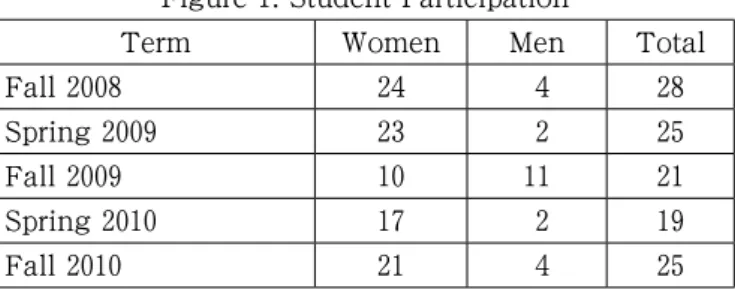
Up to now, this program has been held three times, beginning in Fall 2008. Here is a breakdown of student participation.
Figure 1: Student Participation
Term
Women
Men
Total
Fall 2008
24
4
28
Spring 2009
23
2
25
Fall 2009
10
11
21
Spring 2010
17
2
19
Fall 2010
21
4
25
Most students participating in the program are from the English Department, although there were some students from the Literature and Economics Departments.
4.10 Chaperone System
For the initial groups attending Tacoma, a UKK staff member accompanied the students to Tacoma. This staff member stayed in Tacoma for about a week to assist students during their initial period of adjustment. In addition to helping students, the chaperone took photos and video of life in Tacoma to use in the guidance sessions at UKK for subsequent groups. Once the program was running well and enough information was collected, the chaperone program was phased out. However, this staff member is still in charge of conducting the pre-departure guidance sessions. Currently, communication is maintained with Tacoma students through Skype, and the students are interviewed using Skype once they settle into their routine at Tacoma. Skype is also used if there are any problems occurring during stays in Tacoma.
4.11 Orientation Weekend
Upon arrival in Tacoma, students meet the Tacoma staff, and they are also assigned one or two mentors. The mentors are usually other international students, but sometimes, American students may also serve as mentors. They then participate in many events and activities, and there are many team-building activities to help them get acquainted with other students and make new friends. Because students are living with host families and not on campus, they must soon open bank accounts in order to pay the monthly fees to their host families. During this orientation weekend, they also purchase cell phones and make their student IDs. The Tacoma staff and mentors are very helpful during this process, and they give the students assistance if they encounter any problems. They also take the students around campus and show them different buildings, and take them shopping for things essential for daily life.
Because the UKK students will be taking classes with other international students, the orientation sessions are conducted entirely in English. The main purpose of the various activities is getting the students to learn to speak out and speak up, something that is usually very difficult for Japanese university students to do.
4.12 Classes
UKK students attend English for Academic Purposes (EAP) courses at TCC. At the beginning of this program, all UKK students studied together in the same classes with no other international students present. Recently, however, that has been changing, and UKK students are able to take classes with other international students from around the world.
The ESL portion of the program consists of three classes: a 3-credit culture and conversation class, a 2-credit pronunciation and conversation class, and a 5-credit reading and writing class. This is the stated goal of the Culture/Discussion and Pronunciation/Conversation classes:
In these classes, students will be conversing in English about all aspects of American culture (religion, politics, education, sports, music, etc.) There will be many opportunities to develop speaking skills and to practice American-style conversation. These classes will include vocabulary practice as well as conversational activities. Group projects will be assigned through out the quarter. There will also be instruction and practice in recognition and production of individual phonemes of American English and of word accent and intonation levels at the high Intermediate-advanced level. Students will
participate in a variety of speech activities: field trips, interviewing, speech giving, poetry reading, role playing or debate.
The goals of the reading/writing class are as follows: Since students are coming in with TOEFL scores of more than 500, this will be an advanced reading and writing class. The goals of this class will be to improve reading comprehension and vocabulary by reading from a wide variety of literary and scholarly sources, and to write and revise in-depth compositions.
Some students see classes with only Japanese students as a drawback because the students are not forced to speak English. Many of the earlier students saw this lack of interaction with other international students as a drawback, and would have preferred to take classes with students from other countries.
In addition to intensive English classes, they also attend a humanities course and a history course. There are about 25 Japanese students mixed in with 10-20 American students. One popular history class is, American History/American Film. This class is challenging for most students because they have to write several papers in English, watch old films, and participate in class discussions about the films. Most students say that while this was the most difficult course, it was also the most beneficial to their English studies. The professor of this course, Dr. Duchin, is always a favorite among TCC students. One past student commented that these classes were challenging and good experiences for Japanese students.
Figure 2. Excerpts from a TCC syllabus
History 231
American History/American Film
Instructor: Dr. Brian Duchin
Course Overview:
This course will explore the key social, cultural, political, and economic trends in American society and culture from 1933 to the 1990's. It will take Hollywood feature films as its primary sources. It will explore the tension between poverty and plenty in American life. It will follow the evolving relationship among the individual, the community, and government in modern American society. It will trace America's climb to world power and investigate the nation's understanding of the costs and benefits of international leadership. It will also examine the political, social, and cultural movements that transformed the American experience, including, the civil rights movement, feminism, identity politics and the new conservatism. It will focus throughout on the dynamic tension between individualism and consensus in the evolution of American national identity and culture.
Required Reading:
David Horowitz and Peter Carroll, On the Edge: The United States in the 20th Century
Course Format:
Classes will combine film screenings with lectures and discussions. Students will take part in these activities to enhance their understanding of the films, the period and their issues, and to gain a deeper understanding of United States history, culture and film.
Requirements:
Students will view films in class, as well as additional films assigned weekly to be viewed outside of class. Students will write brief responses on every film watched. There will be a weekly online discussion forum, four in-class quizzes, a take-home final exam, and two 4-5
page papers written on assigned topics scheduled during the quarter. There will also be a research project. Consult your syllabus for choices and dates and plan accordingly. Written work may not be submitted electronically.
Course Objectives:
Tacoma Community College has identified six college-wide learning outcomes that form the foundation of our educational emphasis: 1) communication, 2) critical thinking,
3) responsibility, 4) information and information technology, 5) living and working cooperatively, 6) core of knowledge. History 231 will address all of these outcomes.
Upon successful completion of this course students Should be able to:
・understand history as a discipline and as a dynamic process
・develop knowledge of the U.S. in the 20th century including: society, politics,
economics, culture, religion, diplomacy, etc.
・investigate the connections between American history and film ・explore questions of race, class and gender in America
・analyze the complex relationship between the individual and the consensus ・develop comprehension of American culture and national identity
・trace the changing role of government in American life
History 231 will stress the development of skills necessary to understand history and to demonstrate that comprehension:
・To read critically and effectively a variety of texts, including film ・To understand historical perspective and interpretation
・To develop organizational skills
・To think, speak and write effectively about history Grading:
There are 700 possible points broken down as follows:
10 Online Discussions =100 points
10 film responses (P/F) =100 points
4 quizzes =100 points
2 papers =200 points
1 final exam =100 points
1 research project =100 points
TOTAL: 700 points 630-700 points=A 560-629 points=B 490-559 points=C 420-489 points=D 000-419 points=F
4.13 Non-academic activities
Students have a lot time outside of class in which to participate in various cultural activities. The mentor assigned to the UKK group is basically in charge of helping them get acclimated to life in the United States, as well as planning enjoyable activities for them to experience American culture and make friends.
There are many seasonal activities for the students including a Halloween party in the fall and bay canoeing in the spring. All activities are optional but usually most students choose to participate in them. During the quarterly breaks, students usually have about two weeks of free time and during that period many choose to travel on their own. Students from past programs have traveled to California, New York, and Vancouver in Canada, which is only about a three-hour drive from Tacoma. The mentor will help the students make reservations for their trips to help them get the best deals and save time. The TCC staff also recommends local activities to the students such the Taste of Tacoma food festival, Owens Beach, ice hockey games, the History Museum, the Glass Museum, Downtown Tacoma, Tacoma Public Library, South Center Mall, Washington University, Skiing. Tacoma students and staff often graciously not only recommend places for students to go, but take them to these places during their own private time.
4.14 Return to Japan
After returning to Japan, students are required to apply individually to receive credits for their time at Tacoma. Credits are not received automatically; students must apply.
After returning to Japan, students are also responsible for doing short presentations in English about their time at Tacoma at the guidance sessions for subsequent groups
5. Student Feedback
We sent out a questionnaire to students who were past participants in the program, and we asked them to answer three questions:
1) What was the best thing about your experience in Tacoma?
2) What could be improved about the program?
5.1 What was the best thing about your experience in Tacoma?
Here are some of the answers we received from students.:
We did not have a lot of big events but everything was so nice that I cannot choose the best one…like my birthday party, 4th of July, trips…but I think the best thing in this program was people I met there. I met many people from different countries and I learned a lot of different ways of thinking and seeing things. I think I have become more generous than before! I could not see my friends, host family and teachers if I did not go there. I still keep in touch with them and my days in Tacoma were awesome thanks to them.
My best experience is trip with my friends. I had to think about plan, airplane ticket, hotel and so on. So I had to call and check to travel agency and internet. It was difficult and felt nervous, but the experience gave me confidence.
I guess the best experience that I have in Tacoma is I could make a lot of connections with my host family and friends there. If I had not visited Tacoma, I could not have any idea and the way people in America think. I could have learned not only how to use the English grammar properly but also a bunch of things which are like skateboarding, hanging out in America or something like that (cultures).
I liked Mr. Lamos's class so much. He taught us about stereotype, how to communication and nationality, etc. That was so interesting and so good topic for us. I also like program that go to stadium and watch a baseball game!!
The best thing about my experience was staying and playing with my host family. I really enjoyed home stay and also I learned a lot of things from my host family. Of course it taught me about American life or culture or people, too. But I really wanna say is that I could learned how much Family is important. That was actually most important study for me. I also enjoyed class activities. My favorite was Leona's class. That class was like a petit trip! As the place of contact with American students, History class was great. I discussed movies with them, and then I got big confidence. So, I REALLY DIDN'T CARE how hard that class was!
5.2 What could be improved about the program?
Tacoma's life was just awesome, but if something have to be changed, this is the way of deciding tutors. Most of them were really good, but some people were too friendly for Japanese girl, I thought.
I don't come up with any idea to make this program better-it was awesome. But I have one thing I want to tell you. Some of us were kind of poor (unlucky) because they lived (homestay) very far from TCC. You know this is not a serious problem, however, they had to go home earlier than others. It means they got fewer opportunities compared to others. I'm worrying about it.
If I could change something, I wanted to talk with my roommate more. Because she changed home stays early…so I didn't have a chance to talk with her a lot. To talk with friend is really good things for student from UKK.
I think tutorial system can be improved. I liked tutorial class we took in summer quarter. A teacher, Tess, held a tutorial class for UKK students only. But we, English major students had to take a tutorial class on our own for credits at UKK in spring quarter. Not only UKK students, but all students can take the tutorial classes and we had to make a reservation for that, but it was hard to make a reservation and I didn't like it. I thought if I had to take tutorial classes for credits, they should give us more classes to take or they can give us credits only for the number of classes we take. But I really liked tutorial class Tess gave us in summer quarter.
5.3 How did this program impact you?
I joined this program because I was very poor at talking English. I like English and can listen and read, but I could not talk and say what I wanted to say. Now I am still poor but I am sure that I am better at talking than before going to Tacoma. And I am sure that this experience will help me somehow when I get my job or in my life.
This program's impact is big for me. Study abroad is my dream since I was a Junior High School student, so TCC is a treasure in my life. If I didn't go to TCC, my life is really different from now. I still talk and contact my friends who stay in America. I wanna keep this relationship and study English hard.
6. Authors' Reflections
This program is only in its third year of existence, but looking at the continued high participation, and positive student feedback, we feel it is on its way to achieving its goal of raising up more confident, culturally-aware English speakers. The purpose of the paper was to give an overview of the program, along with student and teacher feedback. We consider this
paper as a portal to future research, which will involve delving into the advancements in the students' language and cultural awareness.
Many of the students who have been to Tacoma report that they are more confident in their spoken English as a result of being at Tacoma. Tanaka and Ellis (2003) conducted a study of students in a similar semester long program and found that natural exposure to English (such as the exposure UKK students receive at Tacoma) and the experience of living in an English speaking country and of being taught intensively through the medium of English by native speakers appears to have had a major impact on these learners' beliefs about their ability to speak English. (p. 79). More research needs to be done on a larger amount of students about this increased confidence in the ability to communicate.
We also plan on doing further studies gauging gains in speaking and listening. Many studies on study abroad suggest bigger gains in fluency (speaking) than in grammar, reading or writing. I can see this gain in native-like fluency in some of the responses I received from the students. There are words such as awesome and bunch of things, words, which Japanese students living in Japan, would rarely use.
However, we would also like to conduct research in gains in listening comprehension, grammar, reading and writing. In previous research, Crescini (2009) showed that even in a brief four-week program, students' scores on the TOEIC test improved, so we are interested to learn what impact a longer program with more immersion into English would have on the TOEIC scores of UKK students. (p.107)
This program is new and young, but we are confident that it will continue to grow and impact the students of the University of Kitakyushu for a long time to come. We look forward to conducting more detailed research to confirm the positive impact this experience is having on the lives of our students.
References
Chieffo, L. and L. Griffiths (2009) Here to Stay: Increasing Acceptance of Short-Term Study Abroad Programs. (pp. 365-389). The Handbook of Practice and Research in Study Abroad: Higher Education and the Quest
for Global Citizenship. New York, New York: Routledge.
Crescini, A. The UKK-ODU Summer Study Abroad Program: An Extensive Overview (2009). Center for Fundamental Education Bulletin. No. 3, 85-109.
Kitakyushu's Study Abroad Programs. Center for Fundamental Education Bulletin, No.8, 95-115. International Policy Division, City of Kitakyushu. (2009). Kitakyushu Bridges. Retrived November 15,
2010. http://www.city.kitakyushu.jp/pcp_portal/
Open Doors Reports 2009. (2009). Record Numbers of International Students in U.S. Higher Education. Retrived January 21, 2011, from http://www.iie.org/en/Research-and-Publications/Open-Doors
Tacoma Community College, Quick Facts. (n.d.).Retrived January 11, 2011, from, http://www.tacomacc. edu/aboutcc/quickfacts/
Tacoma Culture, International Activities (n.d.). Retrived January 21, 2011, from, http://www. tacomaculture.org/international/activitiesasp
Tacoma Culture, International Sister Cities. (n.d.). Retrived January 21, 2011 from, .http://www. tacomaculture.org/international/sistercities/kitakyushu.asp
Tanaka, K. and R. Ellis. Study abroad, language proficiency, and learner beliefs about language learning. JALT Journal, 25.1, 63-85.
United States Department of State. Visa Waiver Program (VWP). Retrived January 28, 2011, from http://travel.state.gov/visa/temp/types/types_1286.html
Wanner, D. Study Abroad and Language (2009). In The Handbook of Practice and Research in Study Abroad. (pp. 81-98). New York: Routledge.