Theoretical Adoption and Subject
Categorization of Insider Trading Regulation
in China
著者
LI You
journal or
publication title
東北法学
number
50
page range
35-84
year
2018-09-30
URL
http://hdl.handle.net/10097/00123737
東北法学 第50号 (2018) 35
論 説
Theoretical Adoption and Subject Categorization
of Insider Trading Regulation in China
中国におけるインサイダ
ー取引規制の
主体に関する理論と類型的研究
*湘 李 CONTENTS I . INTRODUCTIONII. THE DILEMMA OF LEGAL INTERPRETATION TO PRACTICAL CASES
A. Different Expressions of the Subjects in the Chinese Legislation System
B. Different Approaches to Expanding the Scope of the Subjects in Practice
1 . Judicial Approach 2 . The CSRC's Approach
Ill. THEORETICAL INTERPRETATION FOR DIFFERENT SUBJECTS OF INSIDE TRADING
A. Fiduciary Duty Theory B. Misappropriation Theory C. Equal Access Theory
* You LI (李協りゆう),PhD Candidate, School of Law, Tsinghua University; PhD Candidate, School of Law, Tohoku University.
Theoretical Adoption and Subject Categorization of 36 Insider Trading Regulation in China (李)
N. SUBJECTS OF INSIDER TRADING: FROM FOCUSING STATUS TO ACTIVITY RECOGNITION
A. Anti-Fraud or Market Integrity
B. Theoretical Adoption to Subject of Insider Trading in China V. DIFFERENT STANDARDS TO CONFIRMING THE SUBJECTS
OF INSIDE TRADING
A. Categorization of Subjects of Insider Trading B. Different Confirmation to the Subjects
1. Corporate Insiders: Standard of Identity and Slightly Tallying the Trading
2. Temporary Insiders: Medium Factor and Moderately Tallying the Trading
3. Tippees: Conveying and Substantially Tallying the Trading VI. CONCLUSION AND SUGGESTION
I. INTRODUCTION
Insider trading involves the sale or purchase of securities while in
(1)
possession of material, non-public information. Since the establishment of the Chinese Securities Market in the 1990s, the number of insider
(2)
trading cases have steadily increased. From the 3-27 Debt Event in
(3)
1995 (the early stage) to the Hangxiao Steel Structure Case in 2007
(4)
(the mid-term) and the 8-16 Fat Finger Trading Error Event in 2013 (the late term), the endless stream of insider trading cases has consistently triggered public concern regarding the regulation of insider trading. This was especially true in the 2015 Chinese stock market crash, which provoked profound reflection regarding many troublesome problems related to the supervision of the securities market, including the clarification of securities insider trading subjects as the starting point
東北法学 第50号 (2018) 37
for an insider trading regulation system; indeed, these reflections highlighted how legislation had fallen behind practice in China, resulting
(5)
in a failure to effectively guide practice.
Theoretically, whether or not we should prohibit insider trading is a controversial issue. Some scholars who object to the prohibition of such transactions believe that insider trading can help managers to obtain proper rewards and impetus and promote the conveyance of corporate information that enhances the efficiency of market-allocated resources. When insider trading is permitted, stock prices better reflect
(6)
information and will be higher on average. However, other scholars believe that allowing insider trading will make morally hazardous behavior alluring, increase adverse selections, further reduce the efficiency
(7)
of corporate government, and discourage investors. Insider trading undermines the fairness and integrity of the securities markets, which
(8)
leads to dysfunction of securities markets. Although conclusions in this regard are inconsistent, a study of the 103 countries that have stock markets reveals that insider trading laws exist in 87 of them, but enforcement-as evidenced by prosecutions-has taken place in only
(9)
38 of them. In other words, the prohibition of insider trading is the
(10)
mainstream practice that most counties, including Japan and China, have adopted. Inside trading is one of the major illegal financial frauds
(11)
throughout the development of Chinese securities market. China's attitude toward the regulation of trading is quite severe, showing zero tolerance
(12)
to insider trading.
(13)
Theoretical Adoption and Subject Categorization of 38 Insider Trading Regulation in China (李)
With regard to regulations of insider trading, defining the subjects of insider trading has long been an important issue in China. For example, regarding the subjects of insider trading, Article 73 of the Securities Law of the People's Republic of China includes the following statements:
(14)
"the insiders who have access to insider information of securities trading,"
(15)
"the insiders who have illegal obtainment of insider information." These expressions define the subjects of insider trading differently, creating both textual and logical contradictions that prevent the development of a clear definition of the scope of the insiders. Such inconsistent expressions in the regulatory system stem from different theoretical bases - theories that can be found in American law. More specifically, some courts have held that, regarding the scope of the subjects, regulators should adopt the theory of fiduciary duty as a legal foundation meaning only people who bear a fiduciary duty would qualify
(16)
as subjects. Others advocate for expanding the definition of the subjects
07)
of insider trading by applying the misappropriation theory. Still others suggest that regulators should adopt the equal access theory as the
(18)
legal bedrock for insider trading regulation. The proponents of each of these theories can point to relevant judicial cases to support their views. The problem of the definition of the subjects of insider trading in China would evidently be even more complex in a multi-level regulation system that relied more on administrative means. Consequently, this article relies on these theoretical views to analyze the scope, categorization, and confirmation of subjects of insider trading in China.
東北法学 第50号(2018) 39
This article holds the following viewpoints. Because of complex and diverse insider trading subjects in China and longstanding logical contradictions in related legislation, China should adopt the equal access theory to improve its Securities Law. According to this theory, insider trading occurs when subjects clearly know that the information concerned is confidential and still make illegal use of it to engage in securities trading. Meanwhile, the subjects of insider trading can be divided into three categories: corporate insiders, temporary insiders, and tippees. Because of the close relationship between inside information and insiders, subject-related statutes still need to be considered after identifying the individuals involved in insider trading. Therefore, this article is organized into five parts to explain these points in more detail. Part II analyzes the scope of insider trading subjects in China from normative and practical perspectives. Part III outlines the theoretical foundation for the scope of insider trading subjects and its legislative terms in China. Part IV examines more appropriate theories for Chinese regulations. Part V focuses on the categorization of insider trading subjects, and part VI concludes the article.
II. THE DILEMMA OF LEGAL INTERPRETATION TO
PRACTICAL CASES
The evolution of legislation related to Chinese securities market can be divided into three stages: first, the period of establishment (1990-1996); second, the period of development (1997-2008); and third, the period
(19)
Theoretical Adoption and Subject Categorization of 40 Insider Trading Regulation in China (李)
system regarding the scope of insider trading subjects, including certain administrative rules and fundamental laws, require careful analysis. A. Different Expressions of the Subjects in the Chinese Legislation
System
This realistic dilemma actually reflects the fact that insider trading has resulted in an institutional logic confusion, and constituted obstacles in terms of determining relevant transactions and ascertaining
(20)
liabilities. Article 180 of the Criminal Law of the People's Republic of China (1997 Revision), the first legal provision related to insider trading in basic law, established a specialized provision about the crime of insider trading: "People who have inside information on securities trading, illegally obtain inside information on securities trading, or buy or sell securities or leak relevant information prior to the release of information that could have a major effect on the issuance and trading of the securities concerned or on the price of other securities shall be sentenced to not more than five years in prison or criminal detention, provided
(21)
the circumstances are serious." This means that the law's insider trading regulations apply to "the people who are aware of the inside information concerning the securities and futures trading" and "the persons who illegally acquire inside information." Meanwhile, Article 73 of the Securities Law of the People's Republic of China (effective in July, 1999) defined the subjects forbidden from engaging in insider trading as "the people who are aware of the inside information concerning the securities and futures trading" and "the persons who illegally acquire inside
(22)
東北法学 第50号(2018) 41
encompass all people who know and illegally acquire inside information, these Articles limit the scope by categorizing and listing a certain range of inside trading subjects including directors, supervisors, senior managers, and shareholders who hold more than 5% of a given company's shares. We know that regulations regarding insider trading subjects in China have not explicitly identified "any person," and these two Articles are generally interpreted as not applying to "any person." If they did, it would be unnecessary to enumerate the different categories
(23)
of insider trading subJect. However, a series of administrative rules promulgated by the China Securities Regulatory Commission (CSRC), rather than the Securities Law, does use the "any person" designation for insider trading subjects. For example, Articles 4 and 66 of the Administrative Measures promulgated by the CSRC in 2007 include the
(24)
phrases "any insider" and "any institution and individual," which implies an intention to expand the definition to cover all people with inside
(25)
information. In other words, the CSRC holds that inside trading subjects are not limited to a certain set of individuals. These subjects are enumerated in Articles 5 and 6 of the CSRC No.1, and further divided
(26)
into five categories. Together, the five categories include any person who acquires inside information via any other means. This has expanded the definition of insider trading subjects to include "any person." In addition, Article 7 of the Measures (2016 Revision) stipulates that organizations and individuals must keep information on material asset reorganization that they have access to confidential before such information is disclosed in accordance with the law, and that organizations
(27)
Theoretical Adoption and Subject Categorization of
42 Insider Trading Regulation in China (李)
Judicial Interpretation Coded (2012) No. 6 arrived at a similar interpretation, identifying those individuals who are aware of inside information concerning securities and futures trading and those who illegally acquire said inside information as insider trading subjects. Sub-clause 3 of Article 2 places no limitations on the definition of the insider trading subject, indicating that anyone who knows inside information will likely
(28)
be considered an insider trading subject under this regulation. This interpretation also tends to expand the definition of insider trading subjects stipulated in Article 73 of the Securities Law.
The above analysis reveals that the CSRC aimed to expand the definition of insider trading subjects from "people being aware of inside information" and "the persons who illegally acquire inside information" in Article 73 of the Securities Law to "any person" who knows inside information. However, the phrases in these administrative rules, as in the lower-level regulations, do not have the legal capacity to amend upper-level legislation and their application has no judicial effect. Even if the interpretations of both the Supreme People's Court and the Supreme People's Procuratorate have literally expanded the terms to cover "any person," we still do not know whether this is consistent with the real intention of China's national lawmakers. As a result, at the normative level, inconsistencies exist between the terms used in upper and lower level legislation in defining insider trading subjects, and the key dimension of this difference is the inclusion or lack thereof of "any person" in regulations concerning insider trading subjects.
東北法学 第50号(2018) 43
Article 74 of the Securities Law. It is concluded through analysis of the two provisions that parallel relation, without occurring any subordinating and cross-referencing relation, are found between "the people who are aware of the inside information concerning the securities and futures trading" and "the persons who illegally acquire inside information", both of which are stated in Article 73 of the Securities
(29)
Law. Article 74 of the law concerns the term "insider," while Article
(30)
76 of the Securities Law and Article 180 of the Criminal Law concern the persons who illegally acquire inside information. Therefore, the two expressions are different and paratactic and do not include any cross references. However, in terms of the semantic logic or literal meaning, the "people who are aware of the inside information" includes those who illegally acquire inside information, which raises many questions, including: Why do lawmakers want to distinguish "people being aware of inside information" from "the persons who illegally acquire inside information"? What does the word "illegally" mean in this context? Is this word simply intended to emphasize unlawful means? In addition, how do we explain the reference to "the other persons as specified by CSRC," an authoritative provision contained in sub-clause 7 of Article 74 of the Securities Law? Can this phrase be expanded to include any person? At one level, such an expression could be interpreted as indicating that when any concerned party falls into the categories listed in Article 74, said party cannot use inside information to trade. At another level, however, the expression can be interpreted as indicating that when a concerned party knows inside information, but has not been included into the listed categories, said party cannot be prevented from using
Theoretical Adoption and Subject Categorization of 44 Insider Trading Regulation in China (李)
such inside information to trade. In other words, the miscellaneous provision in Article 74 of the Securities Law can be interpreted as not including all individuals - any person - that are aware of the inside information as subjects excluded from insider trading. Alternatively, this clause arguably makes it possible to expand "other persons" to encompass "any person." The absence of any statutory document addressing these contradictory interpretations has resulted in different approaches in practice.
B. Different Approaches to Expanding the Scope of the Subjects in Practice
Courts or the procuratorate or the CSRC can take various approaches to expanding the scope of insider trading subjects in practice.
1 . Judicial Approach
People v. Li and Two Other Persons. This case was published by the
(31)
Supreme People's Procuratorate in September 2015. In this case, Li was a director and secretary of the board of directors of a listed company. The chairman of the board of the company and senior executives, including Li, held a meeting on June 23, 2012, in which they discussed the reorganization of the company's assets. After the meeting, the chairman asked Li to prepare some materials about the assets reorganization. Subsequently, the listed company applied to suspend its securities trading; the application was approved, and the period of temporary suspension extended from July 6, 2012 to November 5, 2012. During this period, Li passed information about the assets reorganization to her husband Song and her cousin Tu. Song and Tu
東北法学 第50号(2018) 45
used the information to separately buy the company's stocks using another person's securities account on July 1 and July 2 and then sold all the aforesaid stocks on November 21, making a profit of 860,120.87 yuan.
I
D1rector L1I
Divulging the information of assets reorganizationI
Her husband: SongI
I
Her cousin: TuI
In this case, since Li participated in the entire asset reorganization process as a director and secretary, she knew the inside information and deliberately conveyed it to her husband and cousin. Li's actions indisputably constituted the crime of inside trading. Meanwhile, Song and Tu, Li's husband and cousin, were not covered by the definition of insider trading subject in Article 74 of the Securities Law, but they fit within the scope of the expression "a close relative or any other person" in Article 2 of Judicial Interpretation Coded (2012) No. 6. Therefore, the court convicted all three persons of the crime of insider trading. However, convicting individuals who did not belong to the types covered by Article 74 of Securities Law of committing the crime of insider trading was not easy. Proving that Song and Tu's approach to acquiring the inside information was unlawful also proved difficult. Courts usually adopt the theory of joint offense to judge such cases. Such a situation occurred in the following classic case.(32)
People v. Li and Other Persons. Tan was the president of a company. He told the local mayor, Li, about the company's restructuring and
Theoretical Adoption and Subject Categorization of 46 Insider Trading Regulation in China (李)
listing plan. Li passed this message to his sister-in-law, Lin, and Lin used other people's accounts to purchase company stocks during the sensitive period, making a profit of 19830,000.00 yuan. In this case, although Li was a public servant, he did not have the power to administer the issuance and trading of securities. In other words, the subject definition in Article 74 of the Securities Law did not cover him. At the same time, although aforementioned rule includes "anyone" in its definition of insider trading subjects pursuant to the Administrative Measures for the Disclosure of Information of Listed Companies, this case happened in 2007 and, according to the legal principle of non retroactivity, the rule could not be applied. Because Tan, as the president of the company, was a typical insider trading subject and because Li participated in the trading, the court ruled that Li and Tan had jointly committed the crime of insider trading.
President Tan Reporting the work progress Mayor: Li j
↓
は:d:言:は
;',,onI His sister-in-law: Lin' 2 . The CSRC's Approach
Between January 2016 and September 2017, the CSRC formally investigated 117 cases. Among these cases, 30% involved statutory subjects who were aware of inside information and directly engaged in insider trading; the other 70% involved non-statutory subjects make up 70%, including relatives, friends, classmates, business partners, and so
(33)
東北法学 第50号 (2018) 47
being aware of the inside information" and "the persons who illegally acquire inside information," such as consanguinity, fellowship, working relationships, and they often contact and divulge inside information to each other by sending messages, calling, dining together, or other similar activities. To regulate non-statutory insider trading subjects, the CSRC adopted an approach that expanded the definition of inside trading subjects in accordance with Articles 74 or 202 of the Securities Law. For example, the CSRC often treats the provision "any other person as prescribed by the securities regulatory authority under the State Council" as the miscellaneous provisions of Article 74 of the Securities Law. Although the courts decide some inside trading cases, the CSRC handles most practical inside trading cases with administrative penalties. Several cases exemplify the CSRC's insider trading-related features.
In CSRC Administrative Sanction Decision (on Kuang, Zhang, and
(34)
Xu), [2010) No.32, Kuang, the former secretary of the directorate, helped the Geli Company reorganize material assets at the behest of the Geli chairman. Zhang, Kuang's wife, overheard Kuang discussing inside information regarding the assets reorganization on their home phone. Zhang divulged and advised her nephew Xu to purchase the company's stocks, and Xu completed relevant inside trading and made a profit. The CSRC considered the three of them as insider trading subjects and issued correspondmg admm1strative sanctions.
Theoretical Adoption and Subject Categorization of 48 Insider Trading Regulation in China (李)
I Kuang's wife: Zhang I�;:�:s::r!;:���:g��:a�
ご
↓
Conveying the information Her nephew: Xu I►
I Former secretary ofdirectorate: KuangThis case involved two difficult points. First, although Kuang previously work as manager and a secretary of the Geli company directorate, he was not an inside trading statutory subject as defined in Article 7 4 of Securities Law, he did not deliberately divulge the inside information, and he did not participate in the trading. Moreover, Zhang and Xu the scope of the definition of subjects in Article 74 of the Securities Law did not cover Zhang and Xu. However, the CSRC held that Zhang should have borne the duty of care and kept the information secret since he participated in the entire process of the company's assets reorganization. Zhang was so careless that he did not take necessary precautions when he discussed the business over the phone, enabling his wife to overhear the inside information. Therefore, according to Article 202 of Securities Law, all three parties were guilty of inside trading.
The above analysis indicates that the courts and the CSRC have adopted different approaches to expand the definition of insider trading subjects. In certain judicial cases, the courts adopted the theory of joint offense; thus, this theory had a limited application since most inside trading cases do not involve judicial procedures. In addition, in practice, this approach does function effectively for more complex and
東北法学 第50号 (2018) 49
diverse inside trading subjects. The CRSC expanded the interpretation of "the people who are aware of the inside information" to meet practical demands, but this approach can easily go beyond the legal aims of the Securities Law and create selective enforcement, and it has received a great deal of criticism from certain scholars. For example, some claim that by investigating the tipper's liability in insider trading cases, the CRSC has adopted a strategy of selective enforcement, and this selective enforcement strategy may cause several problems include inconsistent legal logic of enforcement, motivating complicated insider trading
(35)
activities. Therefore, it is not difficult to get the tendency of expanding subjects of inside trading compared to confusion caused by legal provisions which inconsistent terms used between upper level legislation and lower level regulation. In fact, the forces that have perpetuated this situation can be traced back to a different theory regarding the regulation of insider trading.
皿THEORETICAL INTERPRETATION FOR DIFFERENT SUBJECTS OF INSIDE TRADING
Many countries refer to the rules of the United States (US) regarding the prohibition of insider trading as a legislative blueprint when formulating their insider trading laws and regulations. Section lO(b) of the US's Securities Exchange Act of 1934 and Rule lOb-5 promulgated by the Securities and Exchange Commission (SEC) in 1942 are the two
(36)
Theoretical Adoption and Subject Categorization of 50 Insider Trading Regulation in China (李)
A. Fiduciary Duty Theory
Although the US established laws prohibiting insider trading in 1934, securities insider trading cases appeared in the country as early as 1891. Strong v. Repid, which dates to 1909, was a famous insider trading lawsuit during this early period the US. The fiduciary duty theory was the adopted during this case's judicial trial. The US Supreme Court held that although the company's directors were not obliged to disclose all company-related information related, for the company's important transactions (specific circumstances that might affect the company's stock price, such as corporate mergers or transfers of property), they
(37)
were obliged to do so. Subsequently, this theory was adopted in a majority of verdicts. In 1980, the US Federal Court adopted this theory in determining whether or not the plaintiff in Chiarella v. United
(38)
States Case was an insider trading subJect. In this case, the US Supreme Court required the existence of a fiduciary relationship as a predicate for liability. The Court held that "No duty could arise from petitioner's relationship with the sellers of the target company's securities, for petitioner had no prior dealings with them. He was not their agent, he was not a fiduciary, he was not a person in whom the sellers had placed their trust and confidence. He was, in fact, a complete stranger
(39)
II
who dealt with the sellers only through impersonal market transactions. In 1983, the US Supreme Court reiterated this rationale in Dirks v. SEC. The Court held: "We reaffirm today that a duty to disclose arises from the relationship between parties・ ・ ・, and not merely from one's
(40)
ability to acquire information because of his position in the market. The reapplication of this theory sustained the view that a fiduciary
東北法学 第50号 (2018) 51
duty exists between any two concerned parties, among which, one party is bound by the duty to disclose information - more specifically, to inform trading parties of relevant information to eliminate information asymmetry. In other words, an insider in possession of material nonpublic information must disclose such information before trading
(41)
or, if disclosure is impossible or improper, abstain from trading. In these precedent cases, the courts held that neither Chiarella nor Dirks were not obliged to disclose inside information or abstain from trading, and were therefore not guilty of insider trading. Furthermore, as the court's rulings pointed out, only if a fiduciary relationship exists can insiders be obliged to disclose information, and once the tippee acquires information from an insider, said tippee does not necessarily inherit the fiduciary duty from the insider, and only if both parties have jointly
(42)
violated the fiduciary duty does it constitute a violation of Rule lOb-5. As the above cases indicate, the fiduciary duty theory requires the existence of a specific identity relationship between the subject and the company, meaning the primary standard for identifying an insider is to see whether a fiduciary duty exists between the individual in question and the company. On this basis, we can divide insiders into two categories. First, there are traditional insiders, mainly including the directors, supervisors, and senior managers of issuers or those who have close relationships with the company due to contract control like actual controllers. The other category includes the temporary insiders, mainly those who have external relationships with the company, such as business, service, or even supervision, and hence acquire inside
Theoretical Adoption and Subject Categorization of 52 Insider Trading Regulation in China (李)
information that enables them to engage in insider trading (e.g., lawy ers and accountants). However, the existence of both traditional and temporary insiders is predicated on the fiduciary duty - that they have established a fiduciary relationship with the company due to their
(43)
special identity. Under this theory (as shown in Fig. 1), the existence of a fiduciary relationship is the precondition for an insider to be
(44)
obliged to disclose information when buying or selling securities, and only if the insider violates the duty of disclosure in pursuit of his or her own benefit can such an act constitute insider trading.
Fig. 1
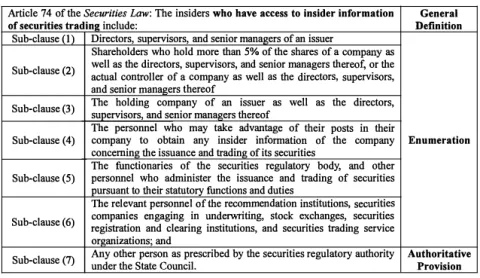
In China, Sub-clauses 1, 2, 3, 4, 5, 6 of Article 7 4 of the Securities Law list the people who are aware of inside information, but this kind of listing does not belong in a "general definition + enumeration + miscellaneous provision," pattern in terms of the legislative technology. In fact, rather than being relatively open and expansive, the first 6 Sub-clauses of Article 74 of the Securities Law only enumerate the people who mentions as being aware of inside information in Article 73 of the Securities Law. From the structure of legislative technology, Article 74 of the Securities Law does not have the relatively open scope represented by "general definition + enumeration + miscellaneous provision." On the contrary, its scope becomes relatively more closed
東北法学 第50号(2018) 53
scope, narrowing the definition to include the 6 listed situations as listed, as well as those identified in accordance with the authorization. According to Article 74 of the Securities Law, this provision can be easily understood as listing the people who are aware of inside information; in other words, Article 74 of the Securities Law includes 7 types of persons who are aware of inside information, encompassing both traditional and temporary insiders. If "other persons" are not included among the 7 types of persons listed in Article 7 4 of the Securities Law, regarding them as insiders, the term used by the Securities Law, proves difficult. Apart from this, although Sub-clause 7 of Article 74 of the Securities Law is considered as a miscellaneous provision, this provision, in fact, is an authoritative regulation that authorizes the CSRC to regulate any insider who has access to any inside information regarding securities trading. This provision extends the definition of "insider," but this merely expands the original closed system, rather than serving as a manifestation of the relatively open enumeration characterized by the "general definition + enumeration+ miscellaneous provision" template.
Theoretical Adoption and Subject Categorization of 54 Insider Trading Regulation in China (李)
Table 1: Article 74 of the Securities Law
Article 74 of the Securities Law: The insiders who have access to insider information of securities tradinR include:
Sub-clause (1) Sub-clause (2) Sub-clause (3) Sub-clause (4) Sub-clause (5) Sub-clause (6) Sub-clause (7)
Directors, supervisors, and senior m anagers of an issuer Shareholders who hold m ore than 5% of the shares of
tha ecroemofp, anor y thas e well as the directors, supervisors, and senior m anagers
a
anctud al sencioonr trmoanllear goerf s a thceormeopf any as well as the directors, supervisors, The holding com pany of an issuer as well as the directors, supervisors, and senior m anagers thereof
The personnel who m ay tak
inse idear dvaninfotagrme aotif on theoir f posts in their com pany to obtain any the com pany concerning the issuance and trading of its securities
The functionaries of the securities regulatory body, and other personnel who administer the issuance and trading of securities pursuant to their statutory functions and duties
Thcome preanleiveans t enpgerasgoinnng el in of unthe derre町coim mtinge,ndstaoticok n institutions, securities exchanges, securities registration and clearing institutions, and securities trading service organizations; and
Any other person as prescribed by the securities regulatory authority under the State Council.
General Definition
Enumeration
Authoritative Provision
The stipulation regarding any insider with access to any inside information about securities trading made in the first 6 Sub-clauses of Article 74 of the Securities Law uses the traditional fiduciary duty theory as the basic theory to define the terms; hence it bears strong status standard. Whether or not a person has a fiduciary duty is key to determining that person's status as an insider with access to any inside information about securities trading.
Fig. 1 depicts the structure of fiduciary duty. The subjects that assume this duty are the director, senior management, controlling shareholders, and actual controllers. Those people have shown evident identity representation due to their positions, functions and powers or
(45)
control factors, and hence they are easily to be confirmed in terms of their external forms. It is also an important reason why the
東北法学 第50号 (2018) 55
identity factors need to take into account when determining the subjects of insider trading under the fiduciary duty theory. Article 74 of China's Securities Law confirms the definition of insiders as encompassing those people who directly bear a fiduciary duty to the company, or alternatively, those who inherit a fiduciary duty, as indicated in Sub-clauses 4, 5, and 6 of Article 74 of Chinese Securities Law. The persons who bear inherited fiduciary duties tend to be closely related to certain special occupations, such as intermediary service providers and civil servants possessing regulatory power.
B. Misappropriation Theory
In Dirks v. SEC, the US Supreme Court adopted the fiduciary duty theory to determine the scope of the definition of a tippee regarding disclosed information. The court stated: "a tippee assumes a fiduciary duty to the shareholders of a corporation not to trade on material nonpublic information only when the insider has breached his fiduciary duty to the shareholders by disclosing the information to the tippee
(46)
and the tippee knows or should know that there has been a breach." The verdict points out that only when a fiduciary relationship exists are insiders obligated to disclose information, and only if they have
(47)
violated this obligation can their actions constitute insider trading. Moreover, "the tippee's obligation has been viewed as arising from his role as a participant after the fact in the insider's breach of a fiduciary
(48)
duty." However, if the insider of company A acquires inside information about company B and engages in securities trading with company B, under the fiduciary duty theory, said insider is not liable for insider
Theoretical Adoption and Subject Categorization of 56 Insider Trading Regulation in China (李)
trading. Therefore, how to regulate information illegally obtained by those who do not have a contractual obligation and the statutory duty to establish a fiduciary relationship with the company - purely corporate outsiders - has become an increasingly urgent dilemma. The US Supreme Court adopted the misappropriation theory in the 1997 case United States v. O'Hagan. According to Section lO(b) and Rule lOb-5, the objects of securities fraud does not limit to the trading counterparts, the corporate outsiders who acquire influential inside information, though does not have fiduciary duty against the trading counterpart, if violate the fiduciary duty or similar relationship of trust and confidence in relation to the source of the information, and private acquire inside information for their own use, then their behaviors belong to the fraud stipulated in Section 10 (b) and Rule lOb-5, and thus constitute the
(49)
insider trading. In this case, the US Supreme Court held that "considering the inhibiting impact on market participation of trading on misappropriated information, and the congressional purposes underlying § lO(b), it makes scant sense to hold a lawyer like O'Hagan a§lO(b) violator if he works for a law firm representing the target of a tender offer,
(50)
but not if he works for a law firm representing the bidder." Therefore, we should explicitly acknowledge the effectiveness of the misappropriation theory and establish the "misappropriation theory" as the theoretical
(51)
basis for identifying such subjects. Fig. 2 (below) depicts the basic structure of misappropriation theory. "The 'misappropriation theory' holds that a person commits fraud 'in connection with' a securities transaction, and thereby violates Section lO(b) and Rule lOb-5, when he misappropriates confidential information for securities trading
東北法学 第50号 (2018) 57
(52)
purposes, in breach of a duty owed to the source of the information."
Fig.2
In China, Article 7 4 of the Securities Law does not further define the person who has illegally acquired any inside information. It was just because there is no definition on this, so academically, there are "right source theory" and "means theory". According to the former, an individual who has a company's inside information but has no right to said information possesses it illegally. In other words, subjects who have no duties or rights that justify their possession of a listed company's inside information but who acquire inside information using
(53)
other means are deemed to have illegally acquired said information. This theory uses other academic theories to extend the interpretation of Article 73 of the Securities Law; in doing so, it exceeds the original theoretical basis of the Securities Law. The other theory holds that anyone who uses illegal means - including stealing, extracting, or
luring-(54)
to acquire inside information illegally acquires said informat10n. This theory stresses the unlawfulness of the means. In fact, the term "illegal" requires an expanded interpretation, and it should not be limited to the range of "illegal means" included in the Article 73 of the Securities
(55)
Theoretical Adoption and Subject Categorization of 58 Insider Trading Regulation in China (李)
stress illegal means; its essence is the inheritance of the fiduciary bearable by the tippees at the lower stream against the information transmitter at the upper stream, thus to solve the issue of equal
(56)
fiduciary duty bearable by the tippee at the lower stream. C. Equal Access Theory
Although the fiduciary duty theory and misappropriation theory can theoretically account for most insider trading subjects, identifying subjects who have no specific official relationships with the company but occasionally acquire inside information will prove difficult. In fact, the first inside trading-related theory to appear in the US was the equal access theory, but its application was restricted because it regulated inside trading in an overly broad manner. The United States Second Circuit Court of Appeals mentioned the "equal access theory" in SEC u. Texas Gulf Sulphur Co. Case. The Court held that "the only regulatory objective is that access to material information be enjoyed equally, but this objective requires nothing more than the disclosure of basic facts so that outsiders may draw upon their own evaluative expertise in reaching their own investment decisions with knowledge equal to that
(57)
of the insiders." This means that, in addition to the directors and managers of a company, any persons who have undisclosed information that may affect the price of the securities can be called an insider, and therefore must follow the "disclose or abstain rule." Thus, if such an insider chooses not to disclose the information in question to the public, the insider cannot buy or sell securities. Meanwhile, this ruling indicates that Rule lOb-5 is based on the justifiable expectation of the securities
東北法学 第50号 (2018) 59
market place that all investors trading on impersonal exchanges have
(58)
relatively equal access to material informat10n. Apparently, the equal access theory aims to create a fair and honest exchange market. Any person, whether a company insider or outsider, who possesses inside information can be subject to the insider trading rules. Fig. 3 below is the basic structure of this theory.
Any Person: insiders and outsiders
Fair Interest Trade/ Sale
Fig. 3
三
After the Cady Roberts Case, the 1969 Texas Gulf Sulphur Case increased the US's willingness to crack down on insider trading activities using the equal access theory. If we take it literally, the equal access theory demands equal opportunity for information acquisition and information symmetry among trading counterparts. The basic issue that divides them is whether all confidential information relating to
(59)
the firm is a corporate asset. The traditional fiduciary duty and misappropriation theory were established within the framework of the principal-agent relationship. Along with the development of the basic theory of corporate governance and the diversification of corporate capital, gaming between the interests of multiple parties within companies continues to intensify. In this context, all parties expect to acquire company information in an equal and timely for the convenience of investment. In order to safeguard equal opportunities for investors, the theory requires that listed companies' information disclosure divisions analyze the proprietary status of inside information, and that the
Theoretical Adoption and Subject Categorization of 60 Insider Trading Regulation in China (李)
inside information disclosure form lists the value of said inside information as belonging to the listed company. However, public market factors affect such valuations; indeed, regardless of the impact on market share prices or on investor selections, this inside information reflects the existence of public factors. This means the disclosure of public information form should give the market proprietary rights to the inside information, thus ensuring that investors can fairly access said information. Therefore, in defining insider trading subjects, we should not limit our consideration to the "identity factor" under the fiduciary duty and "means factor" under the misappropriation theory. Instead, we should identify those subjects to regulation based on their awareness of inside information, then further judge if the subjects'actions constituted insider trading based on whether or not they used insider information to buy or sell securities.
The foregoing analysis shows that Articles 73 and 7 4 of China's Securities Law have not adopted the equal access theory; however, the many regulations promulgated by the CSRC use the regulative term "any person who has access to inside information" to refer to insider trading subjects, suggesting a theoretical adoption of the equal access theory.
東北法学 第50号 (2018) 61
IV. SUBJECTS OF INSIDER TRADING: FROM FOCUSING
STATUS TO ACTIVITY RECOGNITION
A. Anti-Fraud or Market Integrity
Since China's securities market was built relatively recently, China has learned from the corresponding securities regulations in some
(60)
advanced foreign countries or areas, especially the laws of US. Section lO(b) and Rule lOb-5 have undergone continuous development as the law adopted by the US to prohibit insider trading, creating a normative
(61)
system based on the concept of fraud. For example, in Chiarella v. United States the Supreme Court stressed that Rule lOb-5 is directed
(62)
at fraud. For the most part, the prohibition on insider trading in the United States results from administrative and judicial interpretations of a broad anti-fraud rule adopted by an administrative agency pursuant
(63)
to authority under an even broader statutory provision. A significant aim of the exchange act was to eliminate the idea that use of inside information for personal advantage was a normal emolument of corporate office. The two provisions forbid "any person" from engaging in inside trading in the United States, and, in SEC v. Texas Gulf Sulphur Co., the court ruled that any person could be defined as an inside trading subject, not limiting the scope in the corporate officers. However, in Chiarella v. United States, the court adopted a definition based on whether or not a person had a fiduciary duty to the company, instead of applying the equity access theory. The fiduciary duty present obvious status factors to subjects of inside trading and just existed in corporate insider. The misappropriation theory is "designed to protect the integrity
Theoretical Adoption and Subject Categorization of 62 Insider Trading Regulation in China (李)
of the securities markets against abuses by 'outsiders'to a corporation who have access to confidential information that will affect the corporation's security price when revealed, but who owe no fiduciary
(64) II
or other duty to that corporation's shareholders. In other words, the "classical theory" addresses true insider trading (trading by issuers, their employees, or persons otherwise affiliated with the issuer), and the "misappropriation theory" is broad enough to address outsider
(65)
trading (trading by persons who are not affiliated with the issuer). At common law, the insider trading prohibition focused on corporate
(66)
officers and directors, so that the fiduciary duty theory and the misappropriation theory played important roles in the process of defining insider trading subjects in the US. Meanwhile, inside information often comes from listed companies' corporate materials that may influence share prices or investment choices, and the corporate officers may not participate in inside trading directly and usually act as tippers, conveying the inside information in a complex and secretive manner to facilitate inside trading. Accordingly, there is a tippee who receives confidential information from tipper, and the tippee could be held liable. "Tippees must assume an insider's duty to the shareholders not because they receive inside information, but rather because it has been made available
(67)
to them improperly," and, in Dirks v. SEC, the court held that, if he or she satisfied the following criteria: (1) "the insider's 'tip'constituted
(68)
a breach of the insider's fiduciary duty," (2) scienter - the tippees knew or had a reason to know about the breach, and (3) the tippees benefitted
(69)
from the inside trading. "Absent some personal gain, there has been no breach of duty to stockholders. And absent a breach by the insider,
東北法学 第50号 (2018) 63
(70)
there is no derivative breach." The said analysis of the fiduciary duty theory and the misappropriation theory reveals that both theories hold that the interests of individual investors will be damaged if one uses inside information to make a profit. This view not only narrows the definition of inside trading subjects, but also places more attention on the protection of the interests of individual investors than on the
(71)
interests of securities market. In other words, if trading on nonpublic information violates Rule lOb-5 only when the trader or his tipper has a preexisting fiduciary duty to the other transacting party, so that the trader's failure to disclose material facts can be said to defraud that other party, many instances of trading on nonpublic information
(72)
will fall outside the prohibitions of the rule.
Nevertheless, the practical cases reveal that the means being adopted by the traditional insiders in committing inside trading are more and more hidden, and they rarely participate directly in the trading. It is apparent that such theories cannot fully encompass the diversity of insider trading subjects. By contrast, the European Union's insider dealing-related legislation relies on the market theory and prohibits "any person" from engaging in inside dealing; this theory also focuses on maintaining market integrity, which is similar to the equal access theory. Rather than fraud, insider trading is essentially unfair trading behavior with uninformed investor by insider using inside information acquired from unfair opportunities, and these uninformed investors participate in the securities market based on the belief of the fairness
(73)
Theoretical Adoption and Subject Categorization of 64 Insider Trading Regulation in China (李)
its approach to the regulation of inside trading, a change that can be observed in two representative European Union legislative directives Council Directive 89/592/EEC of 13 November 1989 coordinating regulations on insider dealing (the Council Directive 89/592/EEC) and Directive 2003 /6/EC of the European Parliament and of the Council of 28 January 2003 on insider dealing and market manipulation (the Directive 2003/6 /EC). Although Article 2 of the former adopted the "any person" definition insider trading subjects, it qualified this definition with the following expressions "the administrative, management or supervisory bodies of the issuer" and "his holding in the capital of the issuer" and
(74)
"the exercise of his employment, profession or duties." In other words, the Council Directive 89/592/EEC insisted on the recognition of the fiduciary duty or misappropriation theory. However, in the Directive 2003/6/EC, the EU adopted the market theory or the equal access theory. This legislation explicitly stated: "'person'shall mean any natural
(75)
or legal person" and prohibited any person "who possesses inside
(76)
information from using that information" to engage in insider dealing. This change indicates that the EU rescinded its initial definition of inside trading subjects and adopted the equal access theory. Meanwhile, this change also has guiding significance for the EU countries. With regard to the orientation of the reform of legislative system relating to insider trading, at present, it is not yet proper to introduce fiduciary approach in China, whereas market approach may be more suitable to
(77)
東北法学 第50号 (2018) 65
B. Theoretical Adoption to Subject of Insider Trading in China
As preceding analysis indicated, Chinese regulations contain inconsistencies that produce some confusion regarding the definition of insider trading subjects in China. In the Securities law, a person may know confidential information, but he or she can be neither "the person who is aware of the inside information" nor "the person who illegally acquires inside information." The situation of Li in the case of People v. Li and Other Persons exemplifies this dilemma. In addition, listed Chinese companies typically have a party secretary. A primary cause of this confusion is the lack of an explicit theory to guiding Chinese regulations. Nevertheless, we cannot find corresponding basis in the existing laws regarding how to identify such people. This has created a judicial puzzle. In addition, the reasons for the CSRC's selective enforcement is suffering serious
(78)
logic problems in respect of the provisions on insider trading. To address the existing regulatory and practical problems discussed earlier, this paper suggests the adoption of the equal access theory to amend Articles 73 and 74 of the Securities Law. Insisting on the market integrity idea and reconstituting anti-insider trading legal system may be the due choice of enhancing core competitiveness of China's securities
(79)
market and achieving logical consistency and institutional completeness. China should adopt this theory to define insider trading subjects in the securities market for several reasons. First, the fiduciary duty theory, as the traditional basis for the regulation of insider trading, only identifies directors, supervisors, and senior executives as insider trading subjects, mainly on the basis of their fiduciary duty to the company and shareholders; this makes it hard to use this theory to explain
66 Theoretical Adoption and Subject Categorization of Insider Trading Regulation in China (李)
insider trading that involves company outsiders. It is even difficult for the misappropriation theory to address the issue of determining the liabilities of confidential information transmitters. Examples include when someone accidentally learns inside information when he or she is delivering meals to directors and senior executives and then buys or sells securities based on overheard information, or when a person who bears a fiduciary duty to the company discusses a company project
(80)
and is accidentally overheard by his or her family members. Second, the paperless securities have been realized at present, the securities trading has developed from the traditional over the counter trading to trading in the form of public and centralized competitive bidding. Transactions are not conducted face-to-face and they cause damage to
the entire securities market rather than to single investors. Securities trading no longer requires the trading parties to disclose information to each other; the law requires information disclosure to the issuer or the listed company. In the end, in terms of the status of the regulations on insider trading subjects in China, as pointed out in the foregoing paragraph, the logic of the enumeration in Articles 73 and 7 4 of the Securities Law of China is easily misunderstood, making it easy to regard the definition of insider trading subjects as the standard definition, and the miscellaneous provisions are also easily to expand due to the inertia brought by identity factor. However, apparently this understanding does not conform to the facts and will likely produce arbitrary interpretations regarding the definition of insider trading subjects. Moreover, the subjects of insider trading have become increasingly diverse and the process has become increasingly technical, hidden, andc
東北法学 第50号 (2018) 67
(81)
omplicated (i.e. Huang Guangyu Case, Guangda 8-16 Securities Insider
(82)
Trading Case, etc.), causing serious damages to society. The regulation of securities insider trading is so serious that the traditional fiduciary duty theory and misappropriation theory are no longer adequate as the standards for defining the scope of insider trading subjects. In conclusion, the adoption of equal access theory no longer merely concerns whether or not subjects bear a fiduciary duty. Instead, it tests whether subjects clearly know that the information concerned is inside information and still make illegal use of said information. In this way, it generates stronger punishments for unlawful acts and protects the interests of investors, making it the best way to address the abovementioned problems.
However, some people may worry that the application of the equal access theory will create a regulatory system that covers too broad a range of potential insider trading subjects. So, how can we achieve balance between maintaining good faith in the market and avoiding an overly broad definition? Stipulating the exceptions (exemption or waiver clause) also proves quite difficult. It is easy to envision a situation in which a too narrow scope of exceptions may would fail to account for many legitimately exceptional cases; meanwhile a too broad scope of exceptions could undercut our original intention of adopting the equal access theory. However, this worry may not be necessary because the supervision of securities insider trading in China is dominated by administrative regulations. Trading regulation involves a multi-level legal system that includes criminal punishment, relevant established
Theoretical Adoption and Subject Categorization of 68 Insider Trading Regulation in China (李)
administrative punishment, and civil liability. Not all the insider trading cases become criminal proceedings, so worrying about the possibility of being punished severely for accidentally acquiring inside information is unnecessary. As for determining whether or not we should impose punishment in cases where individuals accidentally learn or overhear inside information (i.e. a person overhears a discussion about major undisclosed company news while sunbathing, walking, or eating a meal), we should adopt the equal access theory in judging on whether or not said person has engaged in insider trading and whether or not he or she should be punished accordingly. Guided by market approach, any improper use of inside information should be decided as insider trading, the constitutive elements concerning subject and subjectivity that constitute insider trading as provided by the law in force should be
(83)
abolished. The key lies in determining whether the person clearly knows that the information is inside information and still makes improper
(84)
use of it to make a profit, which requires the existence of an intentional, knowing fraud that damages information equality in the securities market, as well as the rights and interests of other investors.
V. DIFFERENT STANDARDS TO CONFIRMING THE SUB
JECTS OF INSIDE TRADING
A. Categorization of Subjects of Insider Trading
Although more attention should be paid to whether subjects use inside information to trade securities according to the equal access theory, we still care about the identity of subjects after defining the people
東北法学 第50号 (2018) 69
who have taken part in insider trading, and we still need to categorize the subjects of securities insider trading. This categorization should be
(85)
mainly based on the following reasons. First, most insider trading cases are closely related to company insiders, which requires that law on insider trading first focus on those subjects, strictly enforce the information disclosure obligation, and to do a good job in preventing premature information disclosure. The real feature of informed staff
(86)
is securities insider information available to them based on Job. Second, the identity characteristics of insider trading subjects, as a supportive basis to prove their knowledge of insider information, has important practical value, because identifying whether a concerned party knows inside information has always been a difficult issue in judicial practice. Defining the identity characteristics of insider trading subjects in relation to awareness of inside information may help solve this problem. Therefore, China still needs to uphold the categorization of insider trading subjects.
Regarding the standard for identifying insiders, China mainly stresses the specific identities or their specific relationships with the company. However, an inside information in the securities market is no longer limited to information from within companies, and insiders are also no longer limited to insiders within the company. Therefore, the categorization of insider trading subjects should focus on the essence of insider trading - "whether or not the insider bears a certain identity within the company or has a certain relationship with the company" is less important than "whether or not the insider makes use of the
Theoretical Adoption and Subject Categorization of 70 Insider Trading Regulation in China (李)
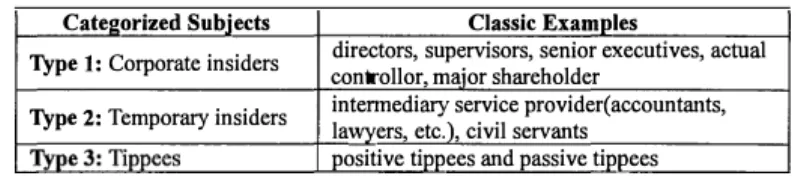
inside information to engage in insider trading to make profit." On the basis of the identity under which one acquires inside information, we can divide the insider trading subjects into three categories: corporate
(87)
insiders, temporary insiders, and tippees. Corporate insiders refer to persons in charge of the company (directors, supervisors and senior executives) or those who have direct or significant obligations to the company due to employment, occupation, or execution of duties (those traditional insiders) - the persons that are prescribed in Sub-clauses 1-4 of Article 71-4 of China's Securities Law. Temporary insiders refer to people outside the company who have the right to or access to inside information due to work relations, including banks, securities dealers, appointed accountants, or lawyers that have business relation with the company, as well as public servants - for example, government management staff who know inside information due to their statutory
(88)
duties (Sub-clause 5-6 of Article 74 of the Securities Law). The tippee
(89)
category is relatively broad, mcluding not only those who acquire inside information through illegal means, but also those who receive said information from company insiders or insiders working as government management officials, directly or indirectly - for example, the spouses, minor children, other relatives, or those who maintain the information under the names of others person.
東北法学 第50号(2018) 71
Table 2: Categorization of Subjects oflnsider Trading Categorized Subjects
Type 1: Corporate insiders Type 2: Temporary insiders
Classic Examples
directors, supervisors, semor executives, actual controllor, major shareholder
intermediary service provider(accountants, lawyers, etc.), civil servants
positive tippees and passive tippees
This categorization's significance stems from the fact that it draws on the regulations of foreign countries but is compliant with the stipulations of China's Securities Law, since it focuses on equal access to market information. Meanwhile, in the process of judicial adjudication, using these three different categories of subjects may help judges determine their respective duties of care and the corresponding extent of subjective illegality. We do not regard subjective fault as the key element when holding company insiders liable; however, when holding temporary insiders and tippees liable, we should consider the subjective criteria such as intentionality and clear awareness. Doing so will not only provide actors who comply with conditions reasonable causes for their defense, but also prevent the creation of too broad a scope of regulation; this also strengthens supervision over insider trading and protects the right of investors to have equal access to information. B. Different Confirmation to the Subjects
In general, a close relationship exists between insider information and corporate insiders, because, through their actions and discussions, corporate insiders create insider information. Meanwhile, the other insider trading subjects often engage in insider trading via mediums
(90)