Population Genetic Analysis and Molecular
Phylogenetic Analysis of Chemosymbiotic Bivalves
Inhabiting Whale Bones
Youki Fukasawa
P
o
p
u
la
ti
o
n
G
e
n
e
ti
c
A
n
a
ly
s
is
a
n
d
M
o
le
c
u
la
r
P
h
y
lo
g
e
n
e
ti
c
A
n
a
ly
s
is
o
f
C
h
e
m
o
s
y
m
b
io
ti
c
B
iv
a
lv
e
s
In
h
a
b
it
in
g
W
h
a
le
B
o
n
e
s
Y
o
u
k
i
F
u
k
a
s
a
w
a
M
a
rc
h
2
0
1
7
Population Genetic Analysis and Molecular
Phylogenetic Analysis of Chemosymbiotic Bivalves
Inhabiting Whale Bones
A dissertation submitted to the Doctoral Program in
Department of Education Interdisciplinary
Graduate School of Medicine and Engineering,
University of Yamanashi
Youki Fukasawa
Contents
Su mma r y. .... . ... . .. .. ... . .. . ... . .. . ... ... . . ... ... .. ... ... ... . ... ... ... . ... ... .. .. .. ... 1
Ge ner a l I nt ro duct io n. . .. . . . .. .. . . ... . .. . ... ... .. ... ... ... . ... .. ... .. .. .. ... ... . ... 3
Sect io n 1 Test o f t he “g eo grap hic st epp ing st o ne hypo t he sis” Abst ract ... ... 6
1.1. Int ro duct io n. . .. . . . ... . .. . ... .. .. . ... .. ... .. ... ... ... . ... ... ... . ... ... 6
1.2. Mat er ia ls a nd Met ho ds . . . .. . ... ... .. ... ... ... . ... ... ... . ... ... .. .. .. ... 8
1.2.1. Mat er ia ls.. . .. . . . ... . . .. .. ... .. .... .. ... .. ... .. ... ... . ... .. ... 8
1.2.2. Seque nc ing o f t he M it o cho ndr ia l N D4 Ge ne . .. .. .. ... . ... ... .. ... . ... .. ... .. .. .. .... 8
1.2.3. Po pulat io n Ge net ic Ana lys is ... .. ... ... . ... .. ... ... . ... ... ... 9
1.3. Resu lt s... ... ... 9
1.4. D isc ussio n.. . .. . . . ... . . .. .. ... .. . . ... ... ... .. ... ... . ... .. ... ... . ... ... ... 10
1.5. Co nc lu sio n.. . .. . . . ... . . .. ... .. .. . . ... .. ... ... ... . ... ... .. ... . ... .. ... 12
Sect io n 2 Test o f t he “e vo lut io nar y st epp ing st o ne hypo t hesis” Abst ract ... ... ... 13
2.1. Int ro duct io n... ... 13
2.2. Mat er ia ls a nd Met ho ds . . . .. . ... .. ... .. ... .. ... ... .. ... . ... . ... 15
2.2.1. Mat er ia ls. . .. . . . .. . .. . ... . .. . ... ... ... ... 15
2.2.2. Seque nc ing o f t he nuc le ar 18S rR N A ge ne a nd t he mit o c ho ndr ia l COI ge ne. . .. . .. . .. . ... ... . . .. ... .. ... .. ... .. .. ... .. ... .. .. .. ... ... . ... ... ... . ... ...15
2.2.3. Phylo ge net ic a na lys is. . .. ... ... ... . ... ... ... . ... ... .. .. .. ... .. ... 16
2.3. Resu lt s. ... . .. . . .. ... .. .. . .. .. ... . .. . ... ... ... ... ... . ... ... .. .. ... 16
2.3.1. Ph ylo ge net ic re lat io ns hip s o f So le myid a e ... .. ... ..16
2.3.2. Phylo ge net ic re lat io nship s o f T hya sir id ae .. . ... . ... .. ... .. .. .. ... ... . .. . . ...17
2.4. D isc ussio n.. . .. . . . ... . . .. .. ... .. . . ... ... ... .. ... ... . ... .. ... ... . ... ... ... 17
2.4.1. Myt ilid ae .. . .. . . . ... . . .. ... .. ... ... ... ... ... . ... ... ... 17
2.4.2. So le myid ae . .. . .. . . . ... . .. . ... ... ... .. ... ... . ... .. ... ... . ... ... .. . ... 17
2.4.3. Thya sir id a e ... ... ... 18
2.4.4. Ant arct ica -o r ig in h ypo t he sis ... .. ... ... . ... .... ... 18
2.5. Co nc lus io n. .. . .. . . .. ... .. .. . . ... ... ... .. ... .. ... .. ... .. ... .. .. .. ... ... . ... . ... 19
Ge ner a l D iscu ssio n.. . .. . . .. ... .. .. . . ... ... ... ... ... ... ... . ... ... .. .. .. ... . ... 20
Ack no w le dg me nt s. .. . .. . . .. .. ... . .. . ... . . ... ... .. ... ... .. .. .. ...22
Re fe re nce s. ... . ... . .. . . .. .. . . .. .. . .. . .. ... . .. ... .. ... .. ... .. .. .. ... . ...23
1
Summary
There have been extensive explorations to resolve deep-sea mysteries. One of the deep-sea mysteries is “where deep-sea organisms in come from and go to?” This mystery comprises two practically different subjects, 1) how deep-sea organisms migrate between their present habitats, and 2) how organisms originally invaded and adapted to deep-sea environments. In the first subject, in order to explain how organisms enable long-distance migration and dispersal, the “geographic stepping stone hypothesis” was proposed. This hypothesis suggests that three kinds of habitats (vents, seeps, and organic falls) are effectively connected for organisms in chemosynthetic communities, permitting migration between them. High dispersal ability of organisms is required for this to be the case, even if intervening habitats serve as stepping stones. In the second subject, in order to explain how shallow-sea organisms could adapt to the deep sea, the “evolutionary stepping stone hypothesis” was proposed, which suggests that organic falls connected shallow-sea habitats with those in the deep-sea chemosynthetic community. Shallow-water organisms adapted gradually to deep-sea environments by exploiting organic falls as intervening habitats. Symbiosis with chemosynthetic bacteria seems to have been established on organic falls, as organisms encountered chemosynthetic bacteria exploiting the hydrogen sulfide and methane produced by decaying organic falls. The intervening habitats of organic falls serve as stepping stones to establish deep-sea vent and seep communities. In this study, we test the “geographic stepping stone hypothesis” in mussels of Mytilidae in Section 1, and test the “evolutionary stepping stone hypothesis” in bivalves of Solemyidae and Thyasiridae in Section 2.
Since organic falls are ephemeral and distributed sporadically, organisms in organic-fall communities must acquire high dispersal ability to migrate from one organic fall to another. However, the dispersal ability of obligate organic-fall organisms has not been investigated thoroughly and the stability of the genetic structure of their communities is unknown. In Section 1, we carried out population genetic analyses based on sequences of mitochondrial NADH dehydrogenase subunit 4 in two mytilid mussels, Adipicola pacifica and Benthomodiolus geikotsucola. We showed genetic similarities between specimens from three distant localities, suggesting that A. pacifica has high dispersal ability. We also showed stable genetic structures of the two organic-fall mussels for about a decade, suggesting that they have propagated from the founder and inbred to maintain their genetic composition or they have been supplied repeatedly with many propagules of stable genetic composition from large sources.
In order to invade and adapt to deep-sea environments, shallow-water organisms have to acquire tolerance to high hydrostatic pressure, low water temperature, toxic methane and hydrogen sulfide, and feeding strategies that do not rely on photosynthetic products. Our previous study showed that the “evolutionary stepping stone hypothesis” was supported in Mytilidae. However, it is not known whether other bivalves hosting chemosynthetic communities experienced the same evolutionary process as or different processes from mytilid mussels. In Section 2, we performed phylogenetic analyses by sequencing the nuclear 18S rRNA and mitochondrial COI
2
genes of solemyid and thyasirid bivalves. We showed that in Solemyidae, the two genera Solemya and Acharax formed each clade, the latter of which was divided into three subgroups. We also showed that in Thyasiridae, the two genera Thyasira and
Maorithyas formed a paraphyletic group and the other genera, Adontorhina, Axinopsis, Axinulus, Leptaxinus, and Mendicula, formed a clade. The “evolutionary stepping
stone hypothesis” was supported in the Solemya clade and one of the Acharax subgroups of Solemyidae, but seemingly was not in the other lineages of Solemyidae and Thyasiridae.
Our studies contribute to resolution of the deep-sea mysteries and advances in understanding biology and nature of the Earth.
3
General Introduction
People are attracted by mysterious cosmos and tend to give their eyes to the sky far from the Earth, although many mysteries of the Earth have not been resolved yet. The Earth is called “Water Planet.” Sea occupies 70% of the terrestrial surface, and deep sea does 95% of the sea volume. The deep sea is defined as an oceanic zone below 200 m depth, where sunlight is extinguished and photosynthesis is quenched. The deep sea holds many mysteries to be resolved. Resolutions of the deep-sea mysteries are important to know the Earth, because the superficial layer of the Earth is fulfilled with deep-sea water.
Organisms have been considered scanty in deep sea due to the lack of diet without photosynthesis until discovery of the chemosynthetic community in the deep-sea vent in 1977 (Corliss and Ballard, 1977; Lonsdale, 1977). Dense organisms flourished there, disproving the so-far common knowledge. The “photosynthetic community” depends on photosynthesis, whereas the “chemosynthetic community” does chemosynthesis. The novel organismic community dependent on distinct diet-supplier was discovered in deep sea only 40 years ago. Thereafter, chemosynthetic communities were found in the deep-sea seep in 1984 (Paull et al., 1984; Kennicutt et al., 1985) and in the sunken whale carcass in 1987 (Smith et al., 1989). The organisms in the chemosynthetic community do not depend on photosynthetic products produced by plants, but mainly rely on products produced by chemosynthetic bacteria. Chemosynthetic bacteria provide vital energy with organisms by oxidizing hydrogen sulfide or methane emitting from deep-sea vents and seeps and supplied by decay of organic falls such as whale carcass and sunken wood. After the discovery, investigations of the chemosynthetic community and deep sea have been accelerated and plentiful knowledges have accumulated. However, deep-sea mysteries still remain to be resolved.
One of such deep-sea mysteries is “where deep-sea organisms in the chemosynthetic community come from and go to?” This mystery comprises two practically different subjects, 1) how deep-sea organisms migrate between their habitats currently and 2) how organisms have invaded and adapted to deep-sea environments evolutionarily. In the first subject, habitats of organisms in chemosynthetic communities are patchily distributed and ephemeral. Vents are located on spreading ridges and back-arc basins, and seeps are found along subduction zones, and organic falls are sporadically distributed on shallow to deep seafloors. Vents are often separated from each other by a few hundred kilometers in vent sectors and by hundreds of meters to a few kilometers in vent fields within a sector (Jollivet, 1996), and seeps and organic falls can be similarly distant to one another. Vents and seeps are short-lived, because they are localized in active geological settings. Vents last less than a few decades, whereas seeps do for comparatively longer period (Tunnicliffe and Juniper, 1990). Organic falls may persist only for several decades to rear organisms in the chemosynthetic community. Thus, organisms have to migrate and disperse for long distances before extirpation of their habitats. In order to explain how organisms enable long-distance migration and dispersal, the “geographic stepping stone hypothesis” was proposed (Smith et al., 1989), suggesting that three kinds of habitats
4
(vents, seeps, and organic falls) were connected with one another for organisms in the chemosynthetic community. Organisms may exploit multiple habitat types, rather than one exclusively. For example, organisms in one vent may migrate to another using a sunken whale carcass as an intervening habitat. Actually, some organisms were found commonly in whale bones and vents or seeps (Baco et al., 1999; Lorion et
al., 2009). However, high dispersal ability of organisms seems to be required, even
though the intervening habitats serve as stepping stones.
In the second subject, the deep sea is nutritionally poor owing to the lack of photosynthesis and represents high hydrostatic pressure and low water temperature. Furthermore, hydrogen sulfide and methane that are indispensable for chemosynthetic bacteria are generally toxic to organisms. Organisms had to cope with these difficulties to establish chemosynthetic communities in severe deep-sea environments. In order to explain how shallow-sea organisms could adapt to the deep sea, the “evolutionary stepping stone hypothesis” was proposed by Distel et al., (2000). The hypothesis suggests that organic falls connected shallow-sea habitats with those in the deep-sea chemosynthetic community. Shallow-water organisms adapted gradually to deep-sea environments by exploiting organic falls as intervening habitats, because organic falls were sporadically distributed on shallow to deep seafloors. Therefore, the intervening habitats of organic falls serve as stepping stones.
Living whales constitute the photosynthetic community, but after death whale carcasses rear organisms in the chemosynthetic community. Thus, whales link the two distinct communities. In order to know the biological world and the earth profoundly, it is important to elucidate whale-mediated life styles of organisms. Therefore, we focused on the ecological role of modern whale carcasses suggested by the “geographic stepping stone hypothesis” and also the evolutionary role of past whale carcasses suggested by the “evolutionary stepping stone hypothesis.”
In this study, we test the two hypotheses by genetic analyses in the following Sections to resolve the deep-sea mystery. We test the “geographic stepping stone hypothesis” using mytilid mussels in Section 1. Mytilid mussels are dominant in shallow sea, but many species reside in deep-sea vents and seeps and organic falls. Many mytilid mussels have been collected and deposited in the Japan Agency for Marine-Earth Science and Technology (JAMSTEC). We regard high dispersal ability as a prerequisite to support the “geographic stepping stone hypothesis.” It is shown that mytilid mussels from vents and seeps have high dispersal ability (Kyuno et al., 2009; Miyazaki et al., 2013), but dispersal ability of those from organic falls has not been investigated so far. Therefore, we aim to elucidate dispersal ability of mytilid mussel species Adipicola pacifica and Benthomodiolus geikotsucola from organic falls. In Section 2, we test the “evolutionary stepping stone hypothesis” using bivalves of Solemyidae and Thyasiridae. Previous studies showed that the “evolutionary stepping stone hypothesis” was supported in mytilid mussels (Miyazaki et al., 2010; Lorion et al., 2013). However, it is possible that not all taxonomic groups adapted to deep-sea environments in the same manner. Organisms other than mytilid mussels may have adopted different strategies for settling niches in the deep-sea chemosynthetic community. Therefore, our second purpose is to elucidate whether the “evolutionary stepping stone hypothesis” is supported in solemyid and thyasirid
5
6
Section 1 Test of the “geographic stepping stone hypothesis” Abstract
Since organic falls are ephemeral and distributed sporadically, organisms in organic-fall communities must acquire high dispersal ability to migrate from one organic fall to another. However, the dispersal ability of obligate organic-fall organisms has not been investigated thoroughly and the stability of the genetic structure of their communities is unknown. In this study, in order to elucidate the dispersal ability and genetic structure in the organic-fall communities, we carried out population genetic analyses based on sequences of mitochondrial NADH dehydrogenase subunit 4 in two mytilid mussels. Adipicola pacifica was obtained from whale and cow bones artificially settled in Japanese waters off Cape Noma (CN) and in the Nansei-Shoto Trench (NS) and Sagami Bay (SB), and Benthomodiolus
geikotsucola from natural whale bones at the Torishima Seamount (TS); both species
are symbiotic with chemoautotrophic bacteria. Genetic differentiation (Fst) indicated
almost no annual change in genetic structure between 2003, 2004, 2005, and 2007 collections of A. pacifica from CN (depth 225 - 229 m), although the 2010 collection had somewhat different genetic structure from the others. Similarly, there was not significant genetic differentiation between 1993 and 2005 collections of B.
geikotsucola from TS (depth 4020 m). The Fst and gene bidirectional mean rate of
gene flow (Nm) indicated high gene flow and no significant genetic differentiation between A. pacifica specimens collected from CN, NS, and SB. The results suggest that the genetic structure is stable and A. pacifica has high dispersal ability. The mismatch distribution suggests that A. pacifica expanded their distribution from SB to NS via CN, as expansion time (τ = 2ut) decreased from SB to CN and NS.
1.1. Introduction
The chemosynthetic community at a hydrothermal vent was found along the Galapagos Rift in 1997 (Corliss and Ballard, 1977; Lonsdale, 1977). In the 1980s, similar communities were discovered on a seep in the Gulf of Mexico (Paull et al., 1984; Kennicutt et al., 1985) and on whale bones at the Santa Catarina Basin (Smith et
al., 1989). Primary production in these communities depends on chemosynthetic
bacteria, which obtain energy by oxidation of methane and hydrogen sulfide that are emitted from vents and seeps. Hydrogen sulfide is also generated by anaerobic bacterial decomposition of whale carcasses and sunken wood. Whale carcasses experience ecological succession: mobile-scavenger stage, enrichment opportunist stage, sulphophilic stage, and reef stage. Many unique animals constituting the chemosynthetic community have been found at the sulphophilic stage (Smith and Baco, 2003). In Japanese waters off Cape Noma near Kagoshima Bay (depth 225 - 229 m), artificially set bones of the sperm whale, Physeter sp., were covered by mytilid mussels Adipicola pacifica and A. crypta (Okutani et al., 2003). Investigations of the whale-fall community have been performed by the Japan Agency for Marine-Earth Science and Technology (JAMSTEC) as reported by Fujiwara et al. (2007). The chemosynthetic community established on natural bones of Bryde’s whale,
7
(Naganuma et al., 1996). A new species of mytilid mussel Benthomodiolus
geikotsucola, which harbored thioautotrophic bacteria, was described from the whale
bones (Okutani and Miyazaki, 2007).
Vents last less than a few decades, whereas seeps persist for comparatively longer period (Jollivet, 1996). Thus, animals must migrate from one vent to another that is sometimes many thousand kilometers away. Two deep-sea mytilid mussels,
Bathymodiolus japonicus and Ba. platifrons, inhabiting vents in the Okinawa Trough
and seeps in Sagami Bay off Japan (Hashimoto and Okutani, 1994), were shown to have high dispersal abilities, as indicated by the lack of genetic differences between the individuals inhabiting the vents and seeps (Miyazaki et al., 2013). The high dispersal ability was also suggested in three vent mytilid mussels, Ba. marisindicus, Ba. brevior, and Ba. septemdierum (Kyuno et al., 2009). High gene flow and low genetic divergence existed between Ba. septemdierum from the Izu-Ogasawara Islands-arc and
Ba. brevior from the North Fiji Basin, although their habitats are 5000 km apart.
Furthermore, perceptible but not high gene flow between Ba. septemdierum and Ba.
marisindicus from the Southern Central Indian Ridge and between Ba. brevior and Ba. marisindicus was shown, although their habitats are almost 10000 km apart.
Smith et al. (1989) proposed that organic falls act as stepping stones that connect chemosynthetic communities, but only a few species are shared between organic-fall and deep-sea vent/seep communities (Smith and Baco, 2003). In contrast, the “evolutionary stepping stone hypothesis” (Distel et al., 2000) was supported by studies of mytilid mussels (Miyazaki et al., 2010; Lorion et al., 2013). According to this hypothesis, shallow-water animals utilized organic falls as stepping stones to colonize deep-sea vents and seeps. For adaptation to deep-sea environments, animals must acquire tolerance to toxic hydrogen sulfide and methane, high hydrostatic pressure, and low water temperature. They also have to modify feeding strategies or acquire new ones to get energy under the deep-sea conditions of poor nutrient availability due to lack of photosynthesis. Since whale bones and sunken wood are sporadically available from shallow to deep waters, this hypothesis can explain how animals evolutionarily acquired the tolerance and developed feeding strategies. Furthermore, organisms must acquire high dispersal ability to exploit patchy and ephemeral deep-sea habitats. We hypothesize that high dispersal ability was also facilitated by organic falls. Dispersal ability of mytilid mussels in the chemosynthetic community of organic falls has been investigated poorly until now. Thus, it is not known where these organisms come from when colonizing organic falls and how they migrate from one organic fall to another. Moreover, it is not known whether genetic structure of mytilid mussels in a community is stable or perturbed. The stability of genetic structure seems to closely correlate with the dispersal ability.
The purpose in this study is to evaluate dispersal ability and stability of genetic structure of organic-fall mytilids by population genetic analyses of the sequences of the mitochondrial NADH dehydrogenase subunit 4 (ND4) gene. First, we indicate annual changes of genetic structures of whalebone-associated mytilid mussels, A.
pacifica and B. geikotsucola obtained from CN and TS, respectively. Next, we
indicate genetic differentiation and gene flow among specimens of A. pacifica from CN, NS, and SB. Finally, we discuss dispersal ability of organic-fall mytilids to test
8
our hypothesis that high dispersal ability was acquired in organic falls to colonize the deep sea.
1.2. Materials and Methods 1.2.1. Materials
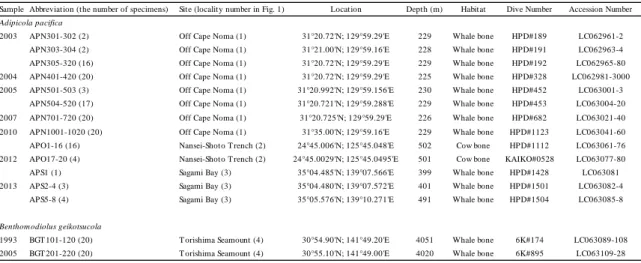
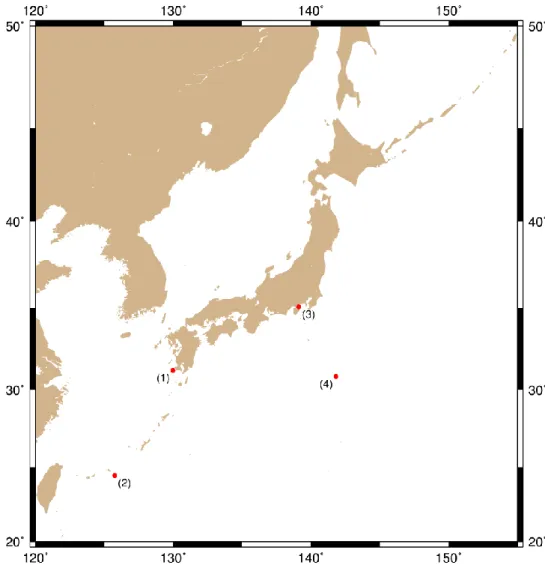
Specimens used in this study are listed in Table 1 and collection sites are mapped in
Figure 1. Mussels were collected from whale bones located in CN (depth 225 - 229
m), TS (depth 4020 m; the depth was recorded at 4051 m in 1992 and at 4020 m by novel bathymetry in 2005), and SB (depth 399 - 491 m), and from cow bones in NS (depth 501 and 502 m) by submersibles, “Kaiko 7000 II”, “Hyper-Dolphin 3000”, and “Shinkai 6500” operated by JAMSTEC. Whale and cow bones were artificially settled in CN, SB, and NS (Fujiwara et al., 2007 and JAMSTEC cruise reports, NT12-22, NT13-06, NT10-07 leg 1, and KR12-01) and natural whale bones in TS were found in 1992 (Fujioka et al., 1993; Wada, 1993). We used 20 specimens of A.
pacifica each from 2003, 2004, 2005, 2007, and 2010 collections of CN and 20
specimens from 2010 and 2012 collections of NS, and eight specimens from 2012 and 2013 collections of SB for population genetic analyses. Because of small number of samples, 2010 and 2012 collections from NS were combined together, as well as those from 2012 and 2013 collections from SB. Additionally, we used 20 specimens of B.
geikotsucola each from 1993 and 2005 collections of TS. All samples were frozen
and preserved at −80˚C or preserved in 100% ethanol, and deposited at JAMSTEC.
1.2.2. Sequencing of the Mitochondrial ND4 Gene
Sequencing was performed essentially as described previously (Miyazaki et al., 2013). Total DNA was prepared from the soft tissue using a DNeasy® Blood & Tissue Kit (QIAGEN GmbH, Hilden, Germany) according to the manufacturer's protocol.
To amplify partial fragments of ND4 in A. pacifica (491 bp) and in B. geikotsucola (402 bp), PCR was performed in reaction solutions containing template DNA and KOD Dash (Toyobo Co., Ltd., Osaka, Japan) under the following conditions: 30 cycles of denaturation at 94˚C for 30 s, annealing at 45˚C for 5 s, and extension at 74˚C for 10 s. When PCR amplification under these conditions was not successful, PCR was performed as follows: initial denaturation at 94˚C for 2 min, five cycles of denaturation at 94˚C for 30 s, annealing at 48˚C for 1.5 min, and extension at 72˚C for 1 min, followed by 35 cycles of denaturation at 93˚C for 30 s, annealing at 51˚C for 1.5 min, and extension at 72˚C for 1 min, and final extension at 72˚C for 7 min. Primers used in this study are described in Table 2. PCR products were purified using a QIAquick® PCR Purification Kit (QIAGEN GmbH, Hilden, Germany).
Direct sequencing of the purified double-strand PCR products was performed using a BigDye® Terminator v1.1 Cycle Sequencing Kit (Applied Biosystems Inc., California, USA) and the same set of primers used for PCR on ABI PRISM 377 and 377XL DNA sequencers (Applied Biosystems Inc., California, USA) according to the manufacturer's directions. DNA sequences were aligned with DNASIS-Mac v3.2 (Hitachi Software Engineering Co., Ltd., Tokyo, Japan) and MEGA 6.0 (Tamura et al., 2013). All sequences are registered in DDBJ (accession numbers LC062961 -
9
LC063128). Comparison between ND4 sequences of A. pacifica determined in this study and the corresponding database sequence of Mytilus edulis revealed the lack of three consecutive nucleotides encoding 34th amino acid of A. pacifica. Similarly, comparison between ND4 sequences of B. geikotsucola in this study and the corresponding database sequence in M. edulis revealed the lack of three consecutive nucleotides encoding 41th amino acid of B. geikotsucola.
1.2.3. Population Genetic Analysis
Population genetic analysis was performed essentially as described previously (Kyuno et al., 2009). The minimum spanning tree that presents relationships among haplotypes was constructed using MEGA 6.0. Genetic differentiation (Fst) and
bidirectional mean rate of gene flow (Nm; the virtual average number of migrants exchanged per generation) were calculated using Arlequin 3.5.1.2 (Excoffier and Lischer, 2010). The significance of Fst was evaluated by calculating 1 × 10⁴ values.
The mismatch distribution was constructed using Arlequin 3.5.1.2, and goodness-of-fit test was used to evaluate discrepancy between observed and model values of the mismatch distribution. The expansion time (τ = 2ut), obtained from the mismatch distribution, is proportional to the number of generations (t) since the population size at equilibrium entered a demographic expansion phase, although the mutation rate (u) of mytilid mussels is unknown.
1.3. Results
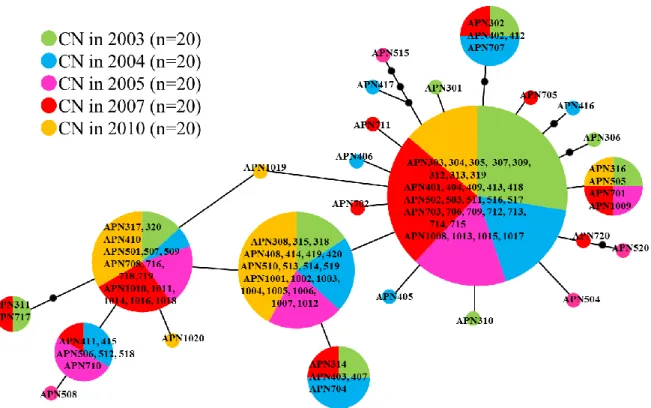
The minimum spanning trees were constructed using 100 specimens of A. pacifica (Figure 2) and 40 specimens of B. geikotsucola (Figure 3) to compare annual changes in genetic structures. In A. pacifica, 27 haplotypes were detected. The haplotype of the greatest majority was shared by 29 (29.0%) specimens from CN in 2003, 2004, 2005, 2007, and 2010. In B. geikotsucola, four haplotypes were detected. The haplotype of the greatest majority was shared by 34 (85.0%) specimens from TS in 1993 and 2005. Two other haplotypes were found in 1993 and another haplotype in 2005. Genetic structures among sampling sites were compared using the minimum spanning tree constructed from 128 specimens of A. pacifica (Figure 4). The haplotype of the greatest majority was shared by 41 (32.0%) specimens from CN, NS, and SB.
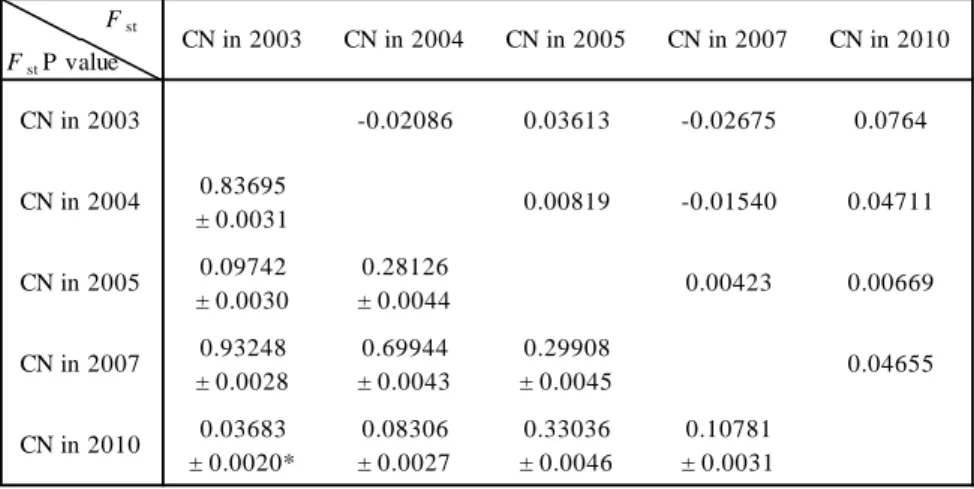
In A. pacifica CN collections, the values of Fst approximated zero in pairwise
comparisons, but a significant genetic differentiation (p = 0.03683) was found between specimens collected in 2003 and 2010 (Table 3). There was no significant genetic differentiation between all combinations except the above combination (p > 0.05), showing almost no annual change in genetic structure. In B. geikotsucola, the Fst
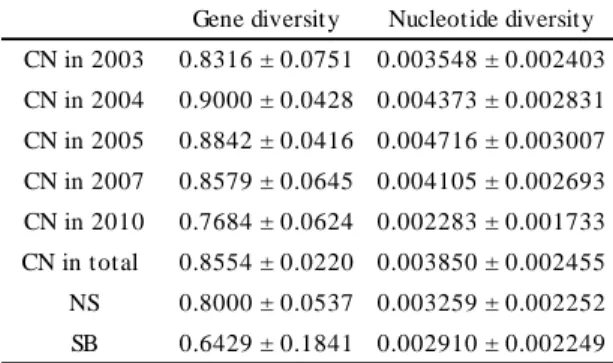
value was ca. 0.11 and there was no significant genetic differentiation between specimens collected in 1993 and 2005 (Table 4). Gene diversity of A. pacifica from CN in 2003, 2004, 2005, and 2007 ranged between 0.83 and 0.90, it was smaller (0.77) in the 2010 collection (Table 5). Nucleotide diversity was between 0.0035 and 0.0047 in 2003, 2004, 2005, and 2007 collections, whereas it was smaller (0.0023) in the 2010 collection. The gene and nucleotide diversities of B. geikotsucola were smaller in 2005 than in 1993 (Table 6).
10
Since there was almost no annual change in genetic structure, data from the annual collections were combined in CN. The values of Fst approximated zero in pairwise
comparisons and there was no significant genetic differentiation between specimens from CN, NS, and SB (Table 7). The values of Nm were more than one between all combinations, indicating extensive gene flow among CN, NS, and SB. Gene diversities from CN (0.86) and NS (0.80) were higher than that from SB (0.64) (Table 5). The nucleotide diversity from CN (0.0039) was higher than that from SB (0.0029), and that from NS (0.0033) was intermediate between two.
Mismatch distributions of A. pacifica from CN, NS, and SB are shown in Figure 5. Goodness-of-fit test showed no significant difference between the observed and expected values (0.978, 0.789, and 0.059 for CN, NS, and SB, respectively). The expansion time decreased in the order of SB (2.395), CN (1.873), and NS (1.719), showing that the number of generations decreased in the same order.
1.4. Discussion
There was almost no annual genetic change among A. pacifica specimens from CN, suggesting that the population propagated from the founder and has maintained its unperturbed genetic composition by inbreeding. Alternatively, the population has been supplied repeatedly with many propagules of stable genetic composition from a large, unknown population. However, the 2010 collection had higher Fst values to the
2004 and 2007 collections (Table 3). Significant genetic differentiation was found between the 2003 and 2010 collections, in particular, suggesting that the genetic composition changed in 2010 probably due to the decline in the population size, as evidenced by the loss of genetic diversity. The decline in population size may have been caused by waste of whale oil which fuels the whale bone community.
There was no genetic differentiation among specimens from CN, NS, and SB, suggesting that A. pacifica has high gene flow and therefore high dispersal ability. As mentioned above, the genetic composition of the 2010 CN collection was somewhat different from that of other CN collections (Table 3). We reassessed genetic differentiation among the specimens from CN, NS, and SB by excluding the 2010 CN collection and combining the 2003, 2004, 2005, and 2007 CN collections together. The
Fst values approximated zero and Nm values were very high (Fst = −0.01655 and Nm =
infinity between CN and NS, −0.00067 and infinity between CN and SB, −0.01053 and 46.98 between NS and SB). The reassessed Fst and Nm values indicate high dispersal
ability of A. pacifica. Other studies also suggest high dispersal ability of organic-fall organisms. The siboglinid bone-eating worm Osedax presented almost no genetic difference between specimens obtained from Monterey Bay and Sagami Bay, suggesting trans-Pacific dispersal (Amon, 2013). Distinct genetic structure of the mytilid mussel, Idas iwaotakii, was not found between the specimens from New Caledonia, Vanuatu, and Papua New Guinea, locations that are from 500 to 2400 km apart (Thubaut et al., 2013).
The “evolutionary stepping-stone hypothesis” is supported in mytilids (Miyazaki et
al., 2010; Lorion et al., 2013). In order to adapt to the deep sea, organisms must
acquire tolerance to high pressure and low temperature. Symbiosis with chemosynthetic bacteria is one of the best strategies to acquire energy under deep-sea
11
conditions of poor nutrient availability due to lack of photosynthesis. Moreover, organisms must acquire the dispersal ability to reach and utilize patchily distributed deep-sea vents and seeps. Ancestors inhabiting organic falls such as whale bones and sunken wood may have facilitated subsequent colonization of deep-sea vents and seeps.
Phylogenetic analyses of mytilid mussels positioned A. pacifica as an outgroup to
Bathymodiolus, which are obligate inhabitants of deep-sea vents and seeps. High
dispersal ability of A. pacifica enables their colonization and utilization of organic falls. Whale bones artificially set at CN were colonized by two Adipicola species, A.
pacifica and A. crypta. The former tends to inhabit bones positioned over the sediment,
while the latter bones buried into the sediment (Fujiwara et al., 2007). A. crypta was not found on the whale and cow bones located in NS and SB. This indicates that, unlike A. pacifica, A. crypta may not have high dispersal ability, and that bone-associated and probably wood-associated mytilids may not always have high dispersal ability, which needs to be further tested by genetic studies. Deep-sea
Bathymodiolus mussels have small-sized eggs and planktotrophic development, which
allows them to disperse long distances. Our preliminary results showed that the egg size of A. pacifica was not different from that of A. crypta, and nearly identical to that of Bathymodiolus. Therefore, we cannot explain the difference in the dispersal ability between A. pacifica and A. crypta. On the other hand, bones at NS and SB may not have represented an environment suitable for survival of A. crypta. The life style, especially dispersal strategy of mytilids inhabiting organic falls such as A. crypta, warrants further studies. Population genetic analyses of more mytilid mussels including organic fall and shallow water species are needed to test our hypothesis that high dispersal ability was facilitated by organic falls.
According to the τ values, the SB population is the oldest and the NS population is the youngest among the studied populations, suggesting that A. pacifica dispersed southward from SB into NS via CN. Larvae of A. pacifica may be transported passively by the currents. However, dispersal from SB into NS seems unlikely because the strong Kuroshio Current in the west Pacific flows northward. Analysis of more specimens from SB is required in order to elucidate the history of A. pacifica expansion (we could use only eight specimens from SB). The τ value (2.062) of A.
pacifica excluding the 2010 CN collection was also intermediate between those of NS
and SB.
The Fst values indicate that B. geikotsucola from TS did not undergo significant
genetic differentiation during 12 years, from 1993 to 2005. The present result suggests that the population has kept its genetic composition either by inbreeding or by a repeated supply of numerous propagules from a large, unknown population. It is likely that genetic transition proceeds at a slower pace in deeper sea waters such as TS than in the shallower sea waters such as CN. The community at TS (4020 m depth) is one of the deepest whalebone-associated communities. Whale bones of CN were eroded and covered with sediments very rapidly over the 8-year period, whereas those at TS showed only a small change (erosion) over the 12-year period (JAMSTEC cruise reports, YK-05-09 leg 1). Moreover, B. geikotsucola had only four haplotypes, while 27 haplotypes were recognized in A. pacifica collections. This may also indicate
12
slower genetic transition in the deeper sea. We collected samples of B. geikotsucola only from TS; hence dispersal ability of B. geikotsucola was not investigated in this study. However, since organic falls have not been discovered in the vicinity of the sampling site, the founder of B. geikotsucola may have been transported long distance to colonize the bones located in TS. This suggests that B. geikotsucola has high dispersal ability. Genetic diversities of B. geikotsucola in 2005 were lower than those in 1993. It suggests the decline in the population size, while infrequent haplotypes may be detected by analysis of more specimens.
1.5. Conclusion
Organisms in deep-sea vents and seeps must have high dispersal ability, because vents and seeps are patchily distributed. We hypothesize that high dispersal ability was acquired in organic falls to colonize deep sea. In this study, we showed by genetic similarities among specimens from three localities that one of the organic -fall mytilid mussels, A. pacifica, has high dispersal ability. However, more species and more specimens from different localities need to be analyzed to test the hypothesis. We also showed stable genetic structures of organic-fall mussels, A. pacifica and B.
geikotsucola, for about a decade, suggesting that they have propagated from the
founder and inbred to maintain their genetic composition or they have been supplied repeatedly with many propagules of stable genetic composition from large sources.
13
Section 2 Test of the “evolutionary stepping stone hypothesis” Abstract
In order to invade and adapt to deep-sea environments, shallow-water organisms have to acquire tolerance to high hydrostatic pressure, low water temperature, toxic methane and hydrogen sulfide, and feeding strategies not relying on photosynthetic products. Our previous study showed that the “evolutionary stepping stone hypothesis,” which assumes that organic falls can act as stepping-stones to connect shallow sea with deep sea, was supported in Mytilidae. However, it is not known whether other bivalves constituting chemosynthetic communities experienced the same evolutionary process as or different processes from mytilid mussels. Therefore, here, we performed phylogenetic analyses by sequencing the nuclear 18S rRNA and mitochondrial COI genes of solemyid and thyasirid bivalves. In Solemyidae, the two genera Solemya and Acharax formed each clade, the latter of which was divided into three subgroups. The Solemya clade and one of the Acharax subgroups diverged in the order of shallow-sea residents, whale-bone residents, and deep-sea vent/seep residents, which support the “evolutionary stepping stone hypothesis.” Furthermore, in Thyasiridae, the two genera Thyasira and Maorithyas formed a paraphyletic group and the other genera, Adontorhina, Axinopsis, Axinulus, Leptaxinus, and Mendicula, formed a clade. The “evolutionary stepping stone hypothesis” was not seemingly supported in the other lineages of Solemyidae and Thyasiridae.
2.1. Introduction
In 1977, a community whose primary production is dependent on chemosynthetic bacteria was found at a hydrothermal vent along the Galapagos Rift (Corliss and Ballard, 1977; Lonsdale, 1977). In the 1980s, similar communities were discovered on a seep in the Gulf of Mexico (Paull et al., 1984; Kennicutt et al., 1985) and on whale bones in the Santa Catarina Basin (Smith et al., 1989). Vents and seeps emit methane and hydrogen sulfide that are oxidized by chemosynthetic bacteria to produce energy for the maintenance of these communities. Shallow-water organisms encountered difficulties in adapting to severe deep-sea circumstances when they invaded and settled in deep sea. The organisms must cope with high hydrostatic pressure and low water temperature; they must also circumvent toxic methane and hydrogen sulfide emitting from vents and seeps. Moreover, the organisms have to refine their feeding strategies or develop novel techniques to acquire energy under deep-sea conditions which are nutritionally poor due to a lack of photosynthetic products. It is unclear how the organisms have adapted to deep-sea conditions and overcome the difficult environment.
Distel et al. (2000) proposed the “evolutionary stepping stone hypothesis,” which assumes that organic falls can act as stepping-stones to connect shallow sea with deep sea. According to this hypothesis, shallow-water organisms utilized organic falls to colonize deep-sea vents and seeps. Organic falls, which are sporadically available from shallow to deep waters, provide the animals with an opportunity to acquire through evolution tolerance to toxic methane and hydrogen sulfide, high hydrostatic
14
pressure, low water temperature, and feeding strategies against oligotrophy. We assumed that high dispersal ability can also be acquired in organic falls owing to the organisms requiring the ability to exploit patchy and ephemeral habitats. The “evolutionary stepping stone hypothesis” has been supported by previous studies of mytilid mussels (Miyazaki et al., 2010; Lorion et al., 2013). We also showed that mytilid mussels in organic falls and deep-sea vents and seeps had high dispersal ability (Kyuno et al., 2009; Fukasawa et al., 2015). However, other deep-sea organisms may have experienced different processes to adapt to deep-sea environments. In the present study, we focus on bivalves belonging to Solemyidae and Thyasiridae to elucidate whether the “evolutionary stepping stone hypothesis” can be supported or other hypotheses are needed by these bivalves.
Solemyidae is an ancient group of bivalves whose fossil records date back to the Ordovician (Pojeta, 1988; Bailey, 2011) and includes, as modern solemyids, two major genera, Solemya and Acharax. Solemyid bivalves are distributed at various depths, reside in low environments such as anaerobic sandy and muddy bottoms and organic falls (Sasaki et al., 2005; Fujiwara et al., 2007; Dubiloer et al., 2008), and nutritionally depend on intracellular chemosynthetic symbionts, which are harbored in their gills (Fisher and Childress, 1986; Conway et al., 1992; Krueger et al., 1996; Barry et al., 2000; Fujiwara et al., 2003; Imhoff et al., 2003; Yamanaka et al., 2008).
The known fossil records of Thyasiridae date back to the Cretaceous (Taylor et al., 2007; Kiel et al., 2008) or Jurassic (Hammer et al., 2011), and modern thyasirids comprise 11 genera (Passos et al., 2007). Thyasiridae predominantly live in fine sediments of the boreal coastal area by burrowing (Kauffman, 1967). It is known that a part of the thyasirid species harbor extracellular chemosynthetic symbionts on their gills (Southward, 1986; Fujiwara et al., 2001; Dufour, 2005). However, Maorithyas
hadalis from the hadal zone in the Japan Trench has exceptionally two types of
intracellular symbionts (Fujiwara et al., 2001), and Thyasira kaireiae is intermediate between extracellular and intracellular symbioses. Chemosynthetic bacteria of T.
kaireiae are enclosed with the cuticle that does not have the membrane structure clearly,
whereas the chemosynthetic endosymbionts are generally enclosed in membrane-bound vacuoles (Fujiwara, 2003).
In solemyid and thyasirid bivalves, symbiosis does not depend on depth and existence of organic falls, although only mytilid mussels that inhabit organic falls and deep-sea vents/seeps represent bacterial symbiosis, but not shallow-sea mytilids. Therefore, it is conceivable that solemyids and thyasirids did not require organic falls to acquire tolerance to toxic hydrogen sulfide and methane and to develop symbiosis, which suggest that they might adapt to deep-sea environments in a way(s) that is different from that by mytilid mussels. In other words, it is possible that the “evolutionary stepping stone hypothesis” cannot be supported by solemyid and thyasirid bivalves.
In the present study, we determine the nucleotide sequences of the nuclear 18S ribosomal RNA (18S rRNA) gene and the mitochondrial cytochrome c oxidase subunit I (COI) gene and deduce the phylogenetic relationships in solemyids and thyasirids to give an insight into their deep-sea adaptation.
15
2.2. Materials and Methods 2.2.1. Materials
The specimens, of which DNA sequences were determined in the present study, are listed in Table 8, and their collection sites are mapped in Figure 6. Most solemyid and thyasirid bivalves were collected by submersibles such as “Kaiko 7000 II”, “Hyper-Dolphin 3000”, and “Shinkai 6500” operated by the Japan Agency for Marine-Earth Science and Technology (JAMSTEC). Acharax japonica from Nabeta Bay, Axinopsida rubiginosa from off Kawarago, solemyid bivalves from off Ashizuri Cape, and Thyasira sp. from off Inatori were collected by dredging. All samples were frozen and preserved at -80°C or in 100% ethanol and deposited at JAMSTEC. The specimens, of which DNA sequences were quoted from the DNA Data Bank of Japan (DDBJ), are listed in Table 9. Almost all thyasirid specimens were very small and often damaged during collection. Thus, we gave priority to molecular analyses using whole bodies than to morphological identification and measurements such as counting the number of ctenidial demibranchs.
2.2.2. Sequencing of the nuclear 18S rRNA gene and the mitochondrial COI gene
Total DNA was prepared from the soft tissue using a DNeasy® Tissue Kit (Qiagen GmbH, Hilden, Germany) according to the manufacturer's protocol.
To amplify the partial fragments of the 18S ribosomal RNA (18S rRNA) and cytochrome c oxidase subunit I (COI) genes, PCR was performed in reaction solutions containing template DNA and KOD Dash (Toyobo Co., Ltd., Osaka, Japan) under the following condition: 1) 30 cycles of denaturation at 94°C for 30 s, annealing at 45°C for 5 s, and extension at 74°C for 10 s. The primers used in the present study are described in Table 10. When PCR amplification under this condition was not successful, PCR was performed under the following modified conditions: 2) initial denaturation at 94°C for 2 min, 5 cycles of denaturation at 94°C for 30 s, annealing at 48°C for 1.5 min, and extension at 72°C for 1 min, followed by 35 cycles of denaturation at 93°C for 30 s, annealing at 51°C for 1.5 min, and extension at 72°C for 1 min, and final extension at 72°C for 7 min. Alternatively, 3) first PCR was performed under the 1) or 2) condition, and the second PCR was performed under the 1) or 2) condition using primers different from those used in the first PCR. Only for two thyasirid bivalves from off Inatori (INT-1 and INT-2), the first PCR was performed with 1F and 9R primers for 18S rRNA and with LCO1490 and HCO2198 primers for COI under the following condition: initial denaturation at 94°C for 3 min, 35 cycles of denaturation at 95°C for 45 s, annealing at 55°C for 3 min, and extension at 72°C for 1.5 min, and final extension at 72°C for 7 min; the second PCR was performed with Th1F and Th1R, Th2F and Th2R, and 5F and 9Rn primers for 18S rRNA and with CS2 and CA2 primers for COI under the 2) condition. PCR products were purified using a QIAquick® PCR purification Kit (Qiagen GmbH, Hilden, Germany).
Direct sequencing of the double-stranded PCR product was performed using an ABI PRISM BigDye® Terminator v1.1 Cycle Sequencing Kit (Applied Biosystems Inc., CA, USA) and the primers used for PCR on Model 377 and 377XL DNA sequencers (Applied Biosystems Inc., CA, USA) according to the manufacturer's directions. Alternatively, direct sequencing was performed using a GenomeLab™DTCS Quick
16
Start Kit on a CEQ™ 2000XL DNA Analysis System (Beckman Coulter Inc., CA, USA) according to the manufacturer’s directions. DNA sequences were aligned with DNASIS (Hitachi Software Engineering) and MEGA 6.0 (Tamura et al., 2013). All sequences obtained in the present study were registered in DDBJ (accession numbers LC186952 - LC187063).
2.2.3. Phylogenetic analysis
We constructed three trees based on only 18S rRNA sequences, only COI sequences, and concatenated 18S rRNA + COI sequences for Solemyidae and Thyasiridae, respectively. Trees were constructed by the neighbor-joining (NJ) and maximum parsimony (MP) methods using MEGA 6.0 (Tamura et al., 2013) and the PAUP*4.0 beta 10 software (Swofford, 2002), respectively. Genetic distances were computed using the Kimura’s two-parameter method (Kimura, 1980). The reliability of trees was evaluated by producing 1,000 bootstrap replicates. The majority-rule consensus MP tree was constructed by conducting a heuristic search based on the 1,000 bootstrap replicates with an unweighted ts/tv ratio. The Bayesian tree was constructed using the MrBayes version 3.1 software (Huelsenbeck et al., 2003) based on the model evaluated by the MrModel test 2.2 (Nylander, 2004). The best models were SYM + G for 18S rRNA, GTR + G for COI, and GTR + I + G for 18S rRNA + COI in Solemyidae. On the other hand, the best models were SYM + I + G for 18S rRNA, GTR + G for COI, and GTR + I + R for 18S rRNA + COI in Thyasiridae. The Monte Carlo Markov chain (MCMC) length was 5 million generations, and we sampled the chain after every 100 generations. MCMC convergence was assessed by calculating the potential scale reduction factor, and the first 25000 generations were discarded. The outgroup species Acila castrensis (Bivalvia, Nuculidae) for Solemyidae and
Myrtea spinifera (Bivalvia, Lucinidae) for Thyasiridae were used. 2.3. Results
2.3.1. Phylogenetic relationships of Solemyidae
In the NJ tree based on 18S rRNA sequences (1300 bp, 253 variable sites, and 119 informative sites), Acharax formed a paraphyletic group composed of three clades,
Acharax 1, Acharax 2, and Acharax 3. Moreover, Solemya formed a clade (Figure 7).
This tree had more taxa than the two other trees, because more data have been registered in DDBJ. In the NJ tree based on COI sequences (400 bp, 256 variable sites, and 178 informative sites), Acharax and Solemya formed clades, respectively, with an only exception of Acharax sp. Lau 1 (Figure 8). In the NJ tree based on concatenated 18S rRNA + COI sequences (1700 bp, 464 variable sites, and 284 informative sites), Acharax and Solemya formed clades, respectively, and the Acharax genera were divided into three clades: Subgroups 1, 2, and 3 (Figure 9). This tree is the most reliable with the longest sequences. The tree showed that the Solemya clade and Subgroup 3 in the Acharax clade diverged in the order of shallow-sea residents, whale-bone residents, and deep-sea vent/seep residents, although this was not well supported by MP bootstrap values and Bayesian posterior probabilities. Subgroups 1 and 2 were constituted by only deep-sea specimens. Acharax sp. Lau 1 was included in Acharax 1 of the 18S rRNA tree (Figure 7) and in Acharax Cluster X of the 18S
17
rRNA + COI trees (Figure 4), but in the Solemya clade of the COI tree (Figure 8).
Solemya sp. SWC2 was included in the Solemya clade of the COI tree (Figure 8), but
diverged basally from other solemyid mussels in the 18S rRNA and 18S rRNA + COI trees (Figures 7 and 9). We constructed the three trees, 18S rRNA, COI, and 18S rRNA + COI. The 18S rRNA tree had more taxa than the two other trees, because more data have been registered in DDBJ. The 18S rRNA + COI tree seems the most reliable, because it was shown that larger sequence data provided more reliable tree (Miya and Nishida, 2000). The COI tree was consistent with the 18S rRNA + COI tree in that Solemya and Acharax formed each clades, whereas the 18S rRNA tree was consistent with the 18S rRNA + COI tree in division of Acharax into the three subgroups and phylogenetic positions of Acharax sp. Lau 1 and Solemya sp. SWC2.
2.3.2. Phylogenetic relationships of Thyasiridae
In NJ trees based on 18S rRNA (793 bp, 231 variable sites, and 118 informative sites), COI (317 bp, 200 variable sites, and 145 informative sites), and concatenated 18S rRNA + COI (1110 bp, 400 variable sites, and 237 informative sites) sequences,
Thyasira formed a paraphyletic group (Figures 10 to 12). The genera, Thyasira and Maorithyas, included specimens that have two demibranchs and symbiotic bacteria.
The other genera, Adontorhina, Axinopsis, Axinulus, Leptaxinus, and Mendicula, formed a clade including specimens that have one demibranch and no symbiotic bacteria. Thyasirid bivalves did not diverge in the order of shallow-sea residents, whale-bone residents, and deep-sea vent/seep residents. T. kaireiae in the Japan Trench and Thyasira sp. off Hatsushima formed a clade as shown by Cluster A in
Figure 10, Cluster B in Figure 11, and Cluster C in Figure 12. Thyasira sarsi was
included in the Thyasira cluster of the 18S rRNA tree, but diverged basally from other thyasirid bivalves in the COI tree and 18S rRNA + COI trees. Similarly to the above Solemyidae, the 18S rRNA tree included more data from DDBJ. In Thyasiridae, the three trees, 18S rRNA, COI, and 18S rRNA + COI, were generally consistent,although the phylogenetic position of Thyasira sarsi in the 18S rRNA tree was different from that in the COI and 18S rRNA + COI trees.
2.4. Discussion 2.4.1. Mytilidae
Miyazaki et al. (2010) indicated that the “evolutionary stepping stone hypothesis” was supported in mytilid mussels, because they diverged in the order of shallow-sea residents, whale-bone residents, and deep-sea vent/seep residents. Moreover, the transition of symbiotic systems in mytilid mussels also supported the hypothesis (Miyazaki et al., 2010). Furthermore, Lorion et al. (2013) revealed, by investigating many mytilids obtained from organic falls, that the evolutionary process as indicated by the “evolutionary stepping stone hypothesis” had occurred not only once in Mytilidae, but also several times in parallel.
2.4.2. Solemyidae
As in the mytilid mussels, splitting in the order of shallow-sea residents, whale-bone residents, and deep-sea vent/seep residents was shown in the Cluster X of the COI tree
18
(Figure 8) and the Subgroup 3 and the Solemya clade of the 18S rRNA + COI tree (Figure 9). This suggested that a part of Acharax and Solemya adapted in parallel to deep-sea environments in the process indicated by the “evolutionary stepping stone hypothesis.”
Acharax sp. Lau 1 and Solemya sp. SWC2 presented markedly high divergent
phylogenetic positions between the 18S rRNA and COI trees, although we used the same specimen in each taxon for sequencing. The present study cannot explain the discrepancies of their phylogenetic positions between the trees.
2.4.3. Thyasiridae
Thyasira bivalves did not diverge in the order of shallow-sea residents, whale-bone
residents, and deep-sea vent/seep residents (Figures 10, 11 and 12) and it suggested that the “evolutionary stepping stone hypothesis” was not supported in this group. However, to evaluate the “evolutionary stepping stone hypothesis” in Thyasiridae, more whale-bone thyasirids have to be investigated, because we used only one whale-bone specimen.
The paraphyletic group composed of Thyasira and Maorithyas included specimens which have two demibranchs and symbiotic bacteria, whereas the clade composed of other genera, Adontorhina, Axinopsis, Axinulus, Leptaxinus, and Mendicula, included specimens which have one demibranch and no symbiotic bacteria. Taking the tree topologies, we assume parsimoniously that the ancestor of Thyasiridae has two demibranchs and symbiotic bacteria, and that the latter genera derived from the former genera. Two demibranchs may be advantageous for symbiosis by increasing the gill surface area where chemoautotrophic bacteria dwell and absorb hydrogen sulfide. Our phylogenetic analysis showed that T. kaireiae in the Japan Trench (5345 m depth) and Thyasira sp. off Hatsushima (855-1173 m depth) were very closely related with each other and might be the same species. If that is the case, this species can be only bivalves that inhabit deep sea with a range of over 4000 m depth.
T. sarsi also indicated a discrepancy in phylogenetic positions between the 18S
rRNA and COI trees. Thyasira sp. Fiji was closely related to M. hadalis in the 18S rRNA tree (Figure 10). We cannot determine whether this specimen was misidentified as Thyasira, because we did not have this specimen, and only the 18S rRNA sequence was available in the database.
2.4.4. Antarctica-origin hypothesis
The “evolutionary stepping stone hypothesis” was supported by two lineages of Solemyidae. However, we could not draw explicit conclusions whether this hypothesis was refuted in the other lineages of Solemyidae and Thyasiridae owing to the lack of whale-bone specimens, especially in Thyasiridae. If the “evolutionary stepping stone hypothesis” is not supported, a new hypothesis is needed to explain their invasion and settlement in deep sea. Therefore, we propose the “Antarctica-origin hypothesis”. In this hypothesis, we assume that benthoses on the narrow continental shelf of the Antarctica are ejected from there and sunk into deep sea by expansion of the ice shelf, and survivors in deep-sea environments expand their habitats from the Antarctic to worldwide deep sea. Shallow-sea residents around the
19
Antarctica have been tolerable to low water temperature and all Solemyidae and some shallow-water Thyasiridae have already acquired symbiosis. Thus, symbiotic Solemyidae and Thyasiridae around the Antarctica need to acquire only tolerance to high hydrostatic pressure to invade deep-sea environments. The expansion of deep-sea organisms from the Antarctic deep sea to worldwide deep sea is supported by some studies. Held (2000) showed that Serolidae (Isopoda) invaded deep-sea environments from the Antarctic region. Embryos of shallow-water urchins around the Antarctica had tolerance to high hydrostatic pressure (Tyler et al., 2000). Bivalvia, Gastropoda, Amphipoda, and Decapoda around the Antarctica had an ability to live in broader depth than those in the Atlantic (Brey et al., 1996).
2.5. Conclusion
To dissolve the strategies of the organisms for invasion and adaptation to deep sea, we analyzed the nuclear 18S rRNA and mitochondrial COI genes of thyasirid and solemyid bivalves, which constitute chemosynthetic communities. In the most reliable 18S rRNA + COI tree of Solemyidae, Solemya formed a clade. Acharax formed a clade composed of three subgroups, two of which consisted of only deep-sea taxa. In the most reliable 18S rRNA + COI tree of Thyasiridae, Axinopsis and
Mendicula (and probably Adontorhina, Axinulus, and Leptaxinus) formed a clade,
whereas Thyasira and Maorithyas formed a paraphyletic group to the clade. The “evolutionary stepping stone hypothesis” was supported by the Solemya clade and one of the Acharax of Solemyidae subgroup, but seemingly was not in the other lineages of Solemyidae and Thyasiridae. Nevertheless, we have to be careful in drawing a conclusion (refutation against the hypothesis), because whale-bone specimens were not enough, especially in Thyasiridae. In the present study, we represented an outline in evolutionary relationships in the two families. However, the reliabilities of the trees were partly not high, the topologies were sometimes inconsistent between trees constructed by different methods, and some taxa presented highly divergent phylogenetic positions between the trees. These warrant further molecular phylogenetic analyses using more specimens, especially those obtained from organic falls, and using other genes to elucidate phylogenetic relationships and evolutionary history in Solemyidae and Thyasiridae. In addition, morphological investigations such as counting the number of ctenidial demibranchs, which could not be done in this study because of tininess and damages of thyasirid specimens, are necessary to know adaptive changes in the evolutionary process.
20
General Discussion
In the present study, we aimed to test two hypotheses, the “geographic stepping stone hypothesis” and the “evolutionary stepping stone hypothesis.” The former proposed by Smith et al. (1989) suggests that three kinds of habitats (vents, seeps, and organic falls) were exploited as intervening habitats for organisms in the chemosynthetic community. The latter proposed by Distel et al. (2000) suggests that shallow-water organisms adapted gradually to deep-sea environments by exploiting organic falls as intervening habitats. We performed population genetic analyses for two organic-fall mytilid mussels, Adipicola pacifica and Benthomodiolus geikotsucola, in Section 1 and performed molecular phylogenetic analyses for chemosymbiotic Solemyidae and Thyasiridae in Section 2.
Organisms which inhabit organic falls and deep-sea vents/seeps have to migrate and disperse among those habitats which are sometimes a few hundred kilometers apart from each other. Thus, high dispersal ability is a prerequisite to support the “geographic stepping stone hypothesis.” In Section 1, we showed genetic similarities among A. pacifica specimens from three localities, Japanese waters off Cape Noma, the Nansei-Shoto Trench, and Sagami Bay, indicating high dispersal ability. Moreover, almost no annual genetic change suggested high dispersal ability in B.
geikotsucola from the Torishima Seamount. These results suggested that organic-fall
mussels had high dispersal ability. This is the first report verifying such high dispersal in an organic-fall organism. Additionally, mytilid mussels from deep-sea vents and seeps have been shown previously to have high dispersal ability as well (Kyuno et al., 2009; Miyazaki et al., 2013). These combined findings support the “geographic stepping stone hypothesis.”
Given the conclusion in Section 1, we now propose a fresh hypothesis, referred to as the “evolutionarily-acquired dispersal ability hypothesis.” This hypothesis assumes that deep-sea benthic organisms acquired high dispersal ability in organic falls as evolutionary strategy, by means similar to the acquisitions of chemosymbiosis and tolerance to toxic methane and hydrogen sulfide, high hydrostatic pressure, and low water temperature. In order to test this hypothesis, dispersal ability of shallow-water mussels should be investigated. If shallow-sea mussels with shared ancestry show lower dispersal ability, higher dispersal ability in deep-sea mussels implies evolutionary acquisition via organic fall, supporting the hypothesis. To the best of our knowledge, however, there are no studies at present definitively demonstrating high or low dispersal ability of shallow-water mussels. This situation warrants investigation of dispersal ability of shallow-water mussels.
Our previous studies indicated that the “evolutionary stepping stone hypothesis” was supported in mytilid mussels, because they diverged in the order of shallow-sea residents, whale-bone residents, and deep-sea vent/seep residents (Miyazaki et al., 2010; Lorion et al., 2013). However, these did not show whether other deep-sea organisms experienced the evolutionary process indicated by the “evolutionary stepping stone hypothesis.” We showed in Section 2 that the “evolutionary stepping stone hypothesis” was supported in a part of solemyid lineages, in which the tree topology showed divergence in the order of shallow-sea residents, whale-bone
21
residents, and deep-sea vent/seep residents. However, the lack of specimens from organic falls prevented us from showing whether the hypothesis was supported or refuted in the other solemyid lineages and thyasirids. The two solemyid clades represented here (Subgroup Acharax 1 and 2) were composed of only deep-sea residents, and only one organic-fall thyasirid specimen was included. Therefore, explorations of organic falls are needed to collect more specimens for further genetic analyses.
As mentioned in Section 2, when the “evolutionary stepping stone hypothesis” is not supported, we must consider other strategies for adaption to deep-sea environments. Thus, we propose the “Antarctica-origin hypothesis.” This hypothesis assumes that Antarctic organisms invaded deep-sea habitats, expanding their ranges from the Antarctic deep sea to worldwide deep sea. In order to test the “Antarctica-origin hypothesis,” phylogenic analyses using individuals sampled at high latitudes around Antarctica should be performed. We are searching for those specimens.
Future testing of new hypotheses and verification of the two hypotheses tested in this study can uncover the current ecological and past evolutionary aspects in deep-sea and organic-fall organisms. These studies lead to resolution of the deep-sea mysteries, especially the mystery of “where deep-sea organisms in the chemosynthetic community come from and go to?” and also resolution of mysteries of the Earth. Therefore, they contribute to advances in understanding biology and nature of the Earth. Furthermore, by providing ecological, genetic, and evolutionary information, we expect that our study will also contribute to protection of deep-sea organisms and development of plans and measures to exploit deep-sea resources without harming nature.
22
Acknowledgments
I am deeply grateful to Dr. Jun-Ich Miyazaki for his instruction and encouragement. I want to thank Dr. Taku Misono, Dr. Futaba Kazama, Dr. Tomoya Iwata, Dr. Kazuhiro Mori, and Dr. Satoko Noda for their useful advices to improve this paper. I would like to express my thanks to Dr. Yoshihiro Fujiwara, Mr. Masaru Kawato, the operation teams of the submersibles, and the officers and crew of the support vessels for their help in collecting the samples.