A SOLUTION TO THE ASM-DPP-TSSCPP BIJECTION PROBLEM IN THE PERMUTATION CASE
JESSICASTRIKER
ABSTRACT. Wegivebijectionsbetweenpermutationsandtwotypesofplanepartitions, descending (DPP) and totally symmetric self-complementary (TSSCPP). These bijections map the inversion number of the permutationto nice statistics on these DPPs and TSSCPPs. We also discuss the possibleextensionof this approach to finding bijectionsbetween alternatingsign matricesand all DPPs and TSSCPPs.
1. INTRODUCTION
Alternating sign matrices (ASMs) and their equinumerous friends, descending plane partitions (DPPs) and totally symmetric self-complementary plane partitions (TSSCPPs), have been both-ering combinatorialists for decades by the lack of an explicit bijection between any two of the three sets of objects. (See [6] [7] [1] [12] [5] for these enumerations and bijective conjectures and [3] for the story behind these papers.) In this summary paper, weoutline the bijections from [8] and [9] betweenpermutationmatrices (whichare a subclass ofASMs) and subclasses of DPPs and
TSSCPPs. The DPP-permutation bijection proceeds in such a way that the inversion number of the permutation matrix equals the number of parts of the DPP. For the TSSCPP-permutation bijection, weidentify the subclass ofTSSCPPscorresponding to permutations and give abijection whichyields adirect interpretation for the inversion number onthese permutation TSSCPPs.
In Section 2, we define ASMs, DPPs, and TSSCPPs and give bijections within their respective families. We recall the standard bijection fromASMs to monotonetriangles. We outline a known bijection from TSSCPPs tonon-intersectinglatticepaths and then transform these to newobjects we call boolean triangles.
InSection3, we identifythepermutation subclass ofTSSCPPs intermsof the booleantriangles of Section 2. We use this characterization to present a direct bijection between this subclass of TSSCPPs and permutationmatrices. Then, in Section4, wegiveabijection between permutation matrices anddescending plane partitions with no special parts.
It is not obvious howto extend this bijection to all ASMs, DPPs, and TSSCPPs. In Section 5, we say a few words on the outlook ofthe general bijection problem.
2. THE OBJECTS AND THEIR ALTER EGOS
Inthis section,wefirst defineASMs andrecall thestandardbijection tomonotonetriangles. We then define DPPs. Finally, we define TSSCPPs and give bijections with non-intersecting lattice paths and new objects we call boolean triangles. In the following two sections, we give bijections frompermutation ASMs to subclasses ofTSSCPPs and DPPs via these intermediary objects. Definition 1. An alternating signmatrix (ASM)isa square matrix with entries$0$, 1, or $-1$ whose
rowsand columns each
sum
to1 and such that thenonzero
entriesineachrow
and column alternate insign.$(001$ $001$ $001)(001$ $001$ $001)(001$ $001$ $001)(001$ $-111$ $001)(001$ $001$ $001)(001$ $001$ $001)(001$ $001$ $001)$
FIGURE 1. The seven $3\cross 3$ ASMs.
See Figure 1 for theseven $3\cross 3$ASMs. It is clear that the alternating sign matrices withno $-1$
entries are the permutation matrices.
Alternating signmatrices
are
knownto be inbijectionwithmonotonetriangles,whichare
certain strict Gelfand-Tsetlin patterns. See Figure 2 for theseven
monotone triangles of order 3 and Figure 7 for theindexing of a general monotone triangle.Definition 2. A monotone triangle of order $n$ is a triangular arrays of integers with $i$ integers
in row $i$ for all $1\leq i\leq n$, bottom row 123 .
. .
$n$, and integer entries $a_{i,j}$ for $1\leq i\leq n,$$n-i\leq j\leq n-1$ such that$a_{i,j-1}\leq a_{i-1,j}\leq a_{i,j}$ and$a_{i,j}<a_{i,j+1}.$
$1 1 2 2 2 3 3$
1 2 1 3 1 2 1 3 2 3 1 3 2 3
1 2 31 2 31 2 31 2 31 2 31 2 31 2 3
FIGURE 2. Theseven monotone triangles of order 3, listed in order correspondingto Figure 1. It is well-known that monotone triangles of order$n$ are in bijectionwith $n\cross n$ alternating sign
matrices via the following map [3]. For each row ofthe ASM note which columns have a partial sum (from the top) of1 in that row. Record the numbers of the columns in which this
occurs
in increasing order. This processyields a monotone triangle of order $n$.
Note that entries $a_{i,j}$ in themonotone triangle satisfying the strict diagonal inequalities $a_{i,j-1}<a_{i-1,j}<a_{i,j}$
are
in bijectionwiththe $-1$ entries ofthe correspondingASM. Also, recall thatthe inversion number ofan ASM
$A$is defined
as
$I(A)= \sum A_{ij}A_{k\ell}$ wherethe sumisoverall $i,j,$$k,$$\ell$ such that $i>k$ and$j<l$.
Thisdefinitionextends the usual notion of inversion in apermutation matrix. We now define descending plane partitions.
Definition 3. A descending plane partition (DPP) is
an
arrayofpositive integers $\{d_{i,j}\}$with$i\leq j$ $($that $is,$ with $the ith row$ indented $by i-1$ units) with weak decrease across rows, strict decreasedown columns, andin which the number of parts in each row is strictly less than the largest part in that rowand is greater than orequal to the largest part in the next row.
$d_{1,1}$ $d_{1,2}$ $d_{1,3}$
. . .
.. . .
.. . . .
$d_{1,\lambda_{1}}$$d_{2,2}$ $d_{2,3}$
.
.
. . .
.
. . . .
. .
$d_{2,\lambda_{2}}$..
$.\cdot$$d_{\ell,\ell}$ .
. .
$d_{\ell,\lambda_{\ell}}$FIGURE 3. The general formofadescending plane partition.
Definition 4. Adescending plane partition is
of
order$n$ ifits largest part is at most$n.$Definition 5. A special part of a descending plane partition is a part $d_{i,j}$ such that $d_{i,j}\leq j-i.$
See Figure 3 for the general form of a DPP and Figure 4 for the seven DPPs oforder 3. The onlyDPP inFigure 4 with aspecial part is 31. The 1 is aspecial part since $1=d_{1,2}\leq 2-1.$
$\emptyset$
2 3 31 32 3 3
FIGURE 4. The sevendescending plane partitions oforder 3.
Definition 6. A plane partition is a two dimensional array of positive integers which weakly decreases across rows from left to right and down columns.
We can visualize a plane partition as a stack of unit cubes pushed up against the corner of a
room. Ifweidentify thecornerof theroomwith theorigin and theroomwiththe positive orthant, then denote each unit cube by its coordinates in$\mathbb{N}^{3}$
, weobtainthe following equivalent definition. A plane partition $\pi$ isa finite set of positive integer lattice points $(i, j, k)$ such that if$(i,j, k)\in\pi$
and $1\leq i’\leq i,$ $1\leq j’\leq j$, and$1\leq k’\leq k$ then $(i’, j’, k’)\in\pi$
.
Aplane partition is totally symmetric if whenever $(i, j, k)\in\pi$then all sixpermutationsof $(i, j, k)$ are also in $\pi.$Definition 7. A totally symmetric
self
complementary plane partition (TSSCPP) inside a $2n\cross$$2n\cross 2n$ box is a totally symmetric plane partition which is equal to its complement, that is, the
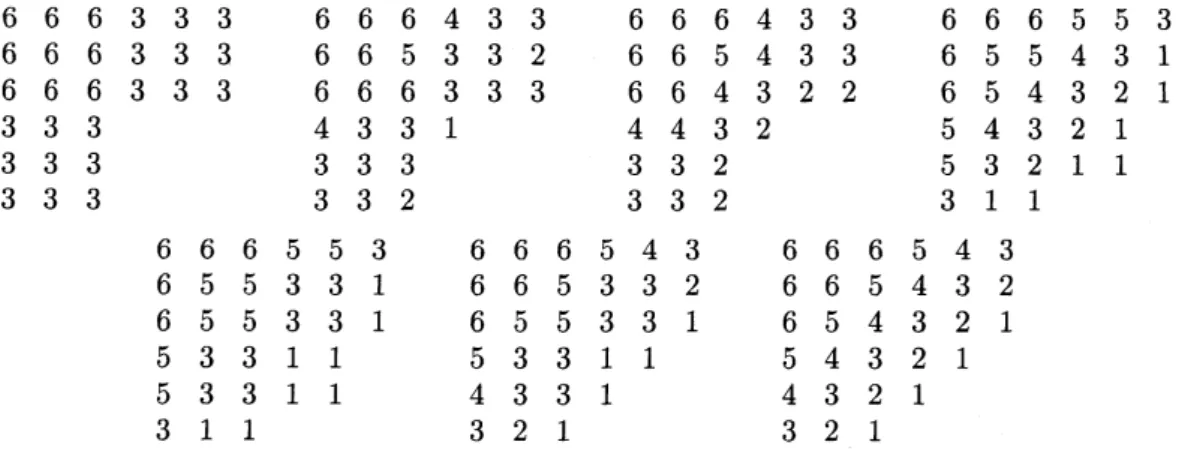
collection ofempty cubes in the box is of the same shape as the collection of cubes in the plane partition itself. 666333 666433 666433 666553 666333 665332 665433 6 5 5 4 3 1 666333 666333 664322 6 5 4 3 2 1 3 3 3 4331 4432 54321 333 333 332 53211 333 332 332 311
$666553 666543 666543$
$655331 665332 665432$
$655331 655331 654321$
$53311 53311 54321$
$53311 4331 43 2 1$
$311 321 321$
FIGURE 5. TSSCPPs inside a$6\cross 6\cross 6$ box
SeeFigure 5 for the sevenTSSCPPs of order 3.
In [4], DiFrancescogives abijection fromTSSCPPs of order$n$ toacollection ofnonintersecting
latticepaths. Thebijection proceeds by takinga fundamentaldomain of the TSSCPP, and instead of reading the number ofboxes in each stack, one looks at the paths going alongside those boxes. This yields a collection ofnonintersecting paths with two types of steps. With a slight further deformation, he obtains that thefollowing objects are inbijection with TSSCPPs. See Figure 6. Proposition 8 (Di Rancesco). Totally symmetric self-complementary plane partitions inside a
$2n\cross 2n\cross 2n$ box are in bijection with nonintersecting lattice paths (NILP) starting at $(i, -i)$,
$i=1$,2,. . . ,$n-1$, and ending at positive integer points on the $x$-axis
of
theform
$(r_{i}, 0)$, $i=$$1$,2,
. . .
,$n-1$, making only vertical steps $(0,1)$ or diagonalsteps $(1, 1)$.
In [4], Di Francesco uses the Lindstr\"om-Gessel-Viennot formula for counting nonintersecting lattice paths via a determinant evaluation to give an expression for the generating function of TSSCPPs with aweight of$\tau$ per vertical step. We will showthat when restricted to permutation
$1$ $\circ|$ $\circ|$ / $\cdot$ $o|$ $\circ|$ $|$ $\circ/$ $\circ/\cdot$ $|$ $O^{/}$ $\circ$ $\circ|$ / $\cdot$ $\circ/\cdot$ / $\cdot$ $O^{/}$
FIGURE 6. Theseven TSSCPP NILP of order 3.
TSSCPPs, this weight corresponds to the inversion number of the permutation. Note that the distribution of the number of vertical steps in all TSSCPP NILPs does not correspond to the inversion number distribution on ASMs.
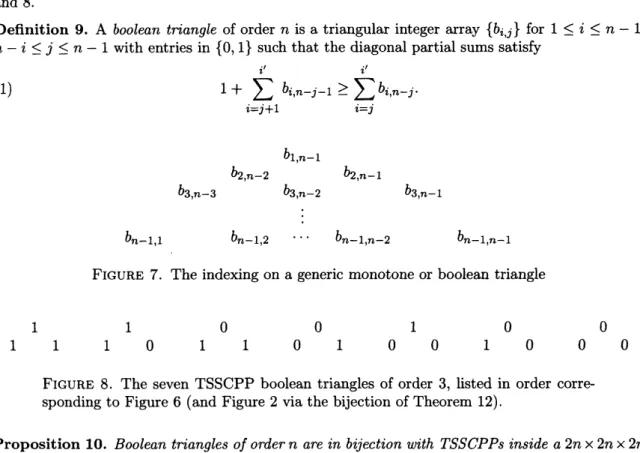
With another slight deformation, we obtain a tableaux version of these NILPs. See Figures 7
and 8.
Definition 9. A boolean triangle of order $n$ isa triangular integer array $\{b_{i,j}\}$ for $1\leq i\leq n-1,$
$n-i\leq j\leq n-1$ with entries in $\{0$,1$\}$ such that the diagonal partialsums satisfy
(1) $1+ \sum_{i=j+1}^{i’}b_{i,n-j-1}\geq\sum_{i=j}^{i’}b_{i,n-j}.$ $b_{1,n-1}$ $b_{2,n-2} b_{2,n-1}$ $b_{3,n-3} b_{3,n-2} b_{3,n-1}$
:
$b_{n-1,1}$ $b_{n-1,2}$ .. .
$b_{n-1,n-2}$ $b_{n-1,n-1}$FIGURE 7. The indexingon a generic monotone or boolean triangle
$1 1 0 0 1 0 0$
1 1 1
01101001000
FIGURE 8. The seven TSSCPP boolean triangles of order 3, listed in order
corre-spondingto Figure 6 (and Figure 2viathe bijection of Theorem 12).
Proposition 10. Boolean triangles
of
order$n$ arein bijection with TSSCPPs inside a$2n\cross 2n\cross 2n$box.
Proof.
The bijection proceeds byreplacingeach verticalstepof theNILP witha 1 and eachdiagonal step with a $0$ and vertically reflecting the array. The inequality on the partialsums
is equivalentto the conditionthat the lattice paths arenonintersecting. $\square$
3. THE TSSCPP-PERMUTATION BIJECTION
In thissection, wegiveabijection between$n\cross n$ permutation matrices and asubclass oftotally
symmetric self-complementary plane partitions inside a $2n\cross 2n\cross 2n$ box, preserving the
inver-sion number statistic and two boundary statistics. First, we identify the permutation subclass of TSSCPPs.
Definition 11. Let permutation TSSCPPs of order $n$ be all TSSCPPs of order $n$ whose
corre-spondingbooleantriangleshave weakly decreasingrows. (In the NILPpicture, each rowhas some
It is easy to seethat thereare $n!$ permutationTSSCPPs. The condition onthe boolean triangle
that the
rows
beweakly decreasing means that allthe $1$’s must be left-justified, thus the definingpartial
sum
inequality (1) is never violated. To construct a permutation TSSCPP, freely choose any number of left-justified $1$’s in each row of the boolean triangle and the rest zeros; there are$i+1$ choices for row $i$, andthe choices are all independent.
We are nowready to state and prove our maintheorem.
Theorem 12. Thereis a
natural
statistic-preserving bijection between$n\cross n$permutation matriceswith inversion number$p$ whose 1 in the last row is in column $k$ and whose 1 in the last column is
in row$P$ andpermutation TSSCPPs
of
order$n$ with$p$ zeros in the boolean triangle, exactly$n-k$of
which are contained in the last row, andfor
which the lowest 1 in diagonal$n-1$ is in row$l-1.$Proof.
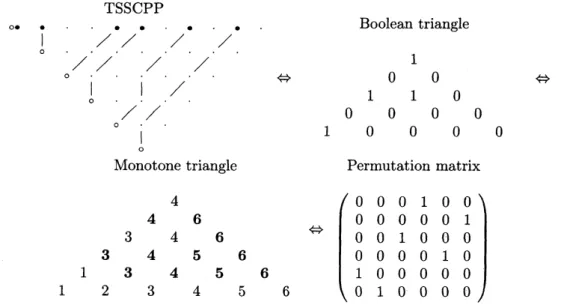
We first describe the bijectionmap. Anexample of thisbijectionis shown in Figure 10. Begin with a permutation TSSCPP of order $n$.
Consider its associated boolean triangle $b=$$\{b_{i,j}\}_{1\leq i\leq n-1,n-i\leq j\leq n-1}$. Define $a=\{a_{i,j}\}_{1\leq i\leq n,n-i\leq j\leq n-1}$ as follows: $a_{n,j}=j+1$ and for$i<n,$
$a_{i,j}=a_{i+1,j}$ if $b_{i,j}=0$ and $a_{i,j}=a_{i+1,j-1}$ if $b_{i,j}=1$
.
We claim $a$ is a monotone triangle.Clearly $a_{i,j-1}\leq a_{i-1,j}\leq a_{i,j}$. Also, $a_{i,j}<a_{i,j+1}$, since if $a_{i,j}=a_{i,j+1}$, then $a_{i,j}=a_{i+1,j}$ and
$a_{i,j+1}=a_{i+1,j+1}$ so that we would need $b_{i,j}=0$ and $b_{i,j+1}=1$
.
This contradicts the fact thatthe rows ofpermutation boolean triangles must weakly decrease. Furthermore, $a$ is a monotone
triangle with no $-1$’sin the corresponding ASM, since each entry is defined to beequal to one of
its diagonal neighborsin the row below. This process is clearly invertible. TSSCPP Boolean triangle $0\bullet$ $\circ|$ . $/^{\bullet}$
$O^{/}/ / / \Leftrightarrow 0 1 0 \Leftrightarrow$
$\circ| / 1 1 0$
$/ 0 0 0 0$
$\circ|$
$1 0 0 0 0$
Monotone triangle Permutation matrix
$1 1 32 33 443 444 456 56 65 6 6 \Leftrightarrow (000001 000001 000001 000001 000001 000001)$
FIGURE 9. An example of the bijection. The matrix on the lower right is the permutation 463512which has 11 inversions. These inversionscorrespondtothe 11
diagonal steps oftheTSSCPP on the upper left.
We now show that this map takes a permutation TSSCPP boolean triangle with$p$ zeros to a
permutation matrix with $p$inversions. Recall that the inversion number of any ASM $A$ (with the
matrix entry in row $i$ and column$j$ denoted
$A_{ij}$) is defined as$I(A)= \sum A_{ij}A_{k\ell}$ wherethe sum is
over all $i,$$j,$$k,$$\ell$
such that $i>k$ and $j<\ell$. This definition extends the usual notion ofinversion
in a permutationmatrix. In [10] we found that $I(A)$ satisfies $I(A)=E(A)+N(A)$ , where $N(A)$ is the number of $-1$’s in $A$ and $E(A)$ is the number of entries in the monotone triangle equal to their southeast diagonalneighbor (entries $a_{i,j}$ satisfying$a_{i,j}--a_{i+1,j}$). Sinceinour case, $N(A)=0$
and $E(A)$ equalsthe number of
zeros
in the correspondingTSSCPP boolean triangle,we
have that $I(A)$ equals the number ofzeros
in $b.$We can see that the zeros of $b$ correspond to permutation inversions directly by noting that
to convert from the monotone trianglerepresentation ofa permutation to a usual permutation $\sigma$
such that $iarrow\sigma(i)$, we set $\sigma(i)$ equal to the unique newentry in row $i$ of the monotone triangle.
Thus for eachentryof the monotone triangle $a_{i,j}$ such that $a_{i,j}=a_{i+1,j}$, there will be an inversion
in the permutation between $a_{i,j}$ and $\sigma(i+1)$
.
This is because $a_{i,j}=\sigma(k)$ for some$k\leq i$ and $\sigma(k)=a_{i,j}>\sigma(i)$
.
These entries $a_{i,j}$ such that $a_{i,j}=a_{i+1,j}$ correspond exactly to zeros in row$i$
of the boolean triangle $b$
.
Thus if a permutation TSSCPP has $p$ zeros in its boolean triangle, itscorresponding permutationwill have $p$inversions.
Also, observethat if the number ofzeros in the last row ofthe boolean triangleis $k$, then the 1
inthe bottom row ofthe permutation matrix will be in column $n-k$
.
So the missing number in thepenultimatemonotone trianglerowshows where the lastrow ofthe boolean triangletransitions from ones tozeros.
So by the bijection between monotone triangles and ASMs, the 1 in the last row of$A$is in column $n-k.$Finally, ifthe lowest 1 indiagonal$n-1$ ofthe booleantriangle is in row$\ell-1$, this means that
theentries $\{a_{i,n-1}\}$ for$\ell\leq i\leq n$ areallequal to $n$. So the 1 in the last column ofthe permutation
matrix is in row$l.$ $\square$
See Figure 10for an exampleof this bijection.
4. THE DPP PERMUTATION BIJECTION
Inthissection wegive abijection between descending plane partitionsof order$n$ withnospecial
parts,$p$ parts, and $k$ parts equal to $n$and$n\cross n$permutationmatrices with$p$ inversions anda 1 in
row $n-k$ of thelast column. We will needthe following lemma.
Lemma 13. There is a natural part-preserving bijection between descending plane partitions
of
order$n$ with no special partsandpartitions with largest part at most$n$ and with at most$i-1$ partsequal to $i$
for
all$i\leq n.$The bijection map isvery simple, so wewill state themap, but refer to [8] for theproofthat it isawell-definedbijection. To map fromtheDPPs tothe partitions, take all thepartsof the DPP andput them inone row in decreasing order. Tomap from the partitions to theDPPs, insert the partsof thepartition into the shape of a DPPin decreasing order, putting as manyparts in arow aspossible and thenmovingonto the first position in the next rowwhenever the next part to be inserted would be forced to be special if added to the current row. So this bijection is simply a rearrangementofparts.
We use this lemmain the following bijection between permutations anddescending plane parti-tions withno special parts.
Theorem 14. There is a simple bijection between descending plane partitions
of
order $n$ with atotal
of
$p$ parts, $k$ parts equal to $n$, and no special parts and $n\cross n$ permutation matrices withinversion number$p$ whose 1 in the last column is in row$n-k.$
Proof.
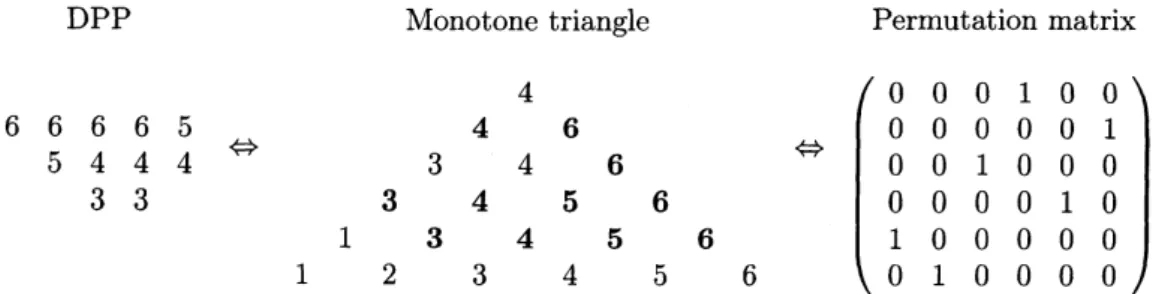
Wefirst describe the bijection map. An example of this bijectionis shown in Figure 10. Begin with a DPP $\delta$of order $n$ with no special parts. From Lemma 13 we know that the parts
of$\delta$
form a partition with largest part at most $n$ and at most $i-1$ parts equalto $i$ for all $i\leq n.$
Usethese parts to make a monotonetriangleoforder $n$ in the following way. Thebottom row of a
monotone triangle is always 123... $n$
.
Let$c_{i}$denotethenumber ofpartsof$\delta$
equalto$i$
.
Beginningwith $i=n$, make a continuous path (border strip) of $i$’s in the triangle starting at the $i$ in the
there are a total of$c_{i}$ northwest steps in the path. In this way, the path stays as far to the east
as possible and has exactly $c_{i}$ entries equal to their southeast diagonal neighbor. Decrement $i$ by
one and repeat until reaching $i=1$. Since there are at most $i-1$ parts equalto$i$, this process is
well-defined. The resulting array is a monotone triangle of order $n$ such that there are noentries
satisfying $a_{i,j-1}<a_{i-1,j}<a_{i,j+1}$ (i.e. either $a_{i,j}=a_{i-1,j}$ or $a_{i-1,j}=a_{i,j-1}$). Thus the monotone
triangle correspondstoan $n\cross n$permutation matrix$A$, since permutationmatricesare alternating
sign matrices with no $-1$ entries.
DPP Monotone triangle Permutation matrix
$6 56 436 346 45 \Leftrightarrow 1 1 32 33 443 444 456 56 65 6 6 \Leftrightarrow(000001 000001 000001 000001 000001 000001)$
FIGURE 10. Anexampleof thebijection. The bold entries in the monotonetriangle are the entries equal to their southeast diagonal neighbor. These are exactly the parts of the DPP. Note that the matrix on the right represents the permutation 463512 which has 11 inversions. These inversionscorrespond to the 11 parts of the DPP onthe left.
The inverse mapfirst takesapermutationmatrix$A$ toits monotonetriangle. Weclaim thatthe
partsofthe corresponding DPP $\delta$ are
exactly theentries ofthe monotone triangle which are equal to their southeast diagonal neighbor, that is, entries $a_{i,j}$ such that $a_{i,j}=a_{i+1,j}$
.
Because oftheshape of the monotone triangle, there are at most $i-1$ such entries equal to$i$
.
Thus theseentriesformapartitionwith largest entry at most $n$ and at most $i-1$ partsequalto$i$ for all$i\leq n$
.
UsingLemma 13 the parts ofthis partition canalways be formed into a uniqueDPP.
This is abijection because the monotone triangle entries $a_{i,j}$ such that $a_{i,j}=a_{i+1,j}$ are exactly
theentries coming from the northweststeps in the border stripswhich areexactly the entries of$\delta.$ Wenowshow that this map takesaDPP with$p$parts toapermutation matrix with$p$inversions.
We again use the fact, notedin [10], that the inversion number ofanASM, $I(A)$, satisfies $I(A)=$
$E(A)+N(A)$, where $N(A)$ is the number of $-1$’s in $A$ and $E(A)$ is the number of entries in
the monotone triangle equal to their southeast diagonal neighbor (i.e. entries $a_{i,j}$ satisfying $a_{i,j}=$ $a_{i+1,j})$
.
Since in our case, $N(A)=0$ and $E(A)$ equals the number of parts ofthe corresponding DPP, wehavethat $I(A)$ equals the number of partsof$\delta.$We can see that the parts of$\delta$
correspond to permutation inversions directly by notingthat to convert from the monotone trianglerepresentationofapermutation to ausual permutation$\sigma$ such
that$iarrow\sigma(i)$, onesimplysets$\sigma(i)$ equaltotheunique newentry inrow$i$ of the monotonetriangle.
Thus for each entryof the monotone triangle $a_{i,j}$ suchthat $a_{i,j}=a_{i+1,j}$, there will bean inversion
in the permutation between $a_{i,j}$ and $\sigma(i+1)$
.
This is because $a_{i,j}=\sigma(k)$ for some $k\leq i$ and $\sigma(k)=a_{i,j}>\sigma(i)$.
These entries$a_{i,j}$ such that $a_{i,j}=a_{i+1,j}$ areexactly theparts ofthe DPP. Thusif a DPP has$p$ parts, its corresponding permutation will have$p$ inversions.
Also, observe that ifthe number ofparts equal to $n$ in $\delta$
is $k$, then $k$ determines the position of
the 1in the lastGolumnofthepermutationmatrix. This is because the path of$n$’s in the monotone
triangle must consistofexactly $k$northwest steps (nonortheaststeps). Soby the bijection between
monotone triangles andASMs, the 1 in the last column of$A$is in row $n-k$. Sofinally, we have a
bijection betweendescending plane partitionsoforder $n$ withatotal of$p$parts, $k$parts equalto
and no special parts and $n\cross n$ permutation matrices with inversion number$p$ whose 1 in the last
columnis in row $n-k.$ $\square$
See Figure 10 for an example of this bijection.
5. TOWARD A BIJECTION BETWEEN ALL ASMs, DPPs, AND TSSCPPs
In this Section,
we
discusssome
of the challenges to finding the ASM-DPP-TSSCPP bijection infull generality.As discussed in the proof of Theorems 12 and 14, the inversion number of
an
ASM satisfies $I(A)=E(A)+N(A)$ where $N(A)$ is the number of -l’s in $A$ and$E(A)$ is the number ofentriesin the monotone triangle equal to their southeast diagonal neighbor [10]. Thus there should be a one to-onecorrespondencebetween these diagonal equalitiesof themonotone triangle andthe non-special partsof the DPP. Difficulties arisequickly, though, sinceevenfor$n=4$there
are
examplesof$4 4 3$
DPPs, such
as
3 1 , whosenon-special partscannot correspond exactly to diagonal equalities of thesame
number in the monotone triangle. Inthe above example, 1 is a special part and 4433 are non-special parts. If the parts 4433 are each entries in the monotone triangle equal to their southeastneighbors, there is noway tofillin the rest oftheentries of the monotone triangle so that there is a $-1$ in the ASM (tocorrespond to the special part of 1 in the DPP). Evidently,
the addition of special parts to the DPP makes the relationship between non-special parts and monotone triangle diagonal equalities morecomplex.
Another complicating factor is that, though there is at most one way to write any collection of numbers
as
a DPP withno special parts (as shown in Lemma 13), the sameis not true ofDPPs with special parts. For example, the parts 55531 can form either the DPP 5 53 5 1 or5 5 5
3 $1^{\cdot}$ Therefore, the positionof theparts inthe DPPmatters when special partsarepresent.
WhileDPPs have the property that the number ofpartsequalsthe inversion number of theASM (this is now proved, though not bijectively [2]), TSSCPPs do not have such a statistic as ofyet. We showed that the number ofdiagonal stepsin apermutation-NILP givesthe inversion number of the permutation matrix, but this isnot true for general TSSCPPs and ASMs. Furthermore, while the number ofspecial parts ofa DPP correspondsto the number of $-1$’s in the ASM, there is no
suchstatisticonTSSCPPs. It wouldseemreasonableto conjecture that the $-1$ of the ASMshould
correspondto allinstances ofaverticalstepfollowedbyadiagonal step
as
yougo from left to right along a row of the NILP (or a $0$ followedby a 1as
you goacross
a row of the boolean triangle).This holds up to$n=4$, and it
seems
to hold for arbitrary$n$ in the specialcases
ofone $-1$ and themaximal number of $-1’ s(L\frac{n^{2}}{4}\rfloor)$
.
But for the number of$-1$’sbetween 1 and $L\frac{n^{2}}{4}$], these statisticsdiverge.
Di Francesco has noted that the distribution ofthe number ofdiagonal steps in the top rowof the TSSCPP-NILP corresponds to the refined enumeration ofASMs. So one might hope to begin a general bijection by determining the $(n-1)st$ row of the monotone triangle from the top row
of the NILP (or the bottom row of the boolean triangle) by left-justifying all the vertical steps and thenbijecting in the
same
wayas
in the permutationcase.
After that, though, it is unclear how to proceed. See Figure 5 for a summary of the various statistics which are preserved in the permutationcase
DPP-ASM-TSSCPP bijections andwhich should correspondin full generality.REFERENCES
FIGURE 11. Thistable show thestatistics preserved by the permutation-TSSCPP-DPP bijections. There is a star by the DPP and TSSCPP statistics that have the
same
distributionas
the ASM statistic in the generalcase.[2] R.E. Behrend, P. Di Rancesco, and P. Zinn-Justin, On the weighted enumerationofalternating signmatrices and descendingplane partitions, arXiv:1103.1176v1 [math.CO] (2011).
[3] D. M.Bressoud,Proofs and confirmations; Thestoryof the alternating signmatrix conjecture,MAA Spectrum, MathematicalAssociationof America,Washington,DC (1999).
[4] P. Di Rancesco, Totally symmetric self-complementary plane partitions and the quantum Knizhnik-Zamolodchikovequation: aconjecture, J.Stat. Mech. P09008 (2006).
[5] G. Kuperberg, AnotherproofoftheASMconjecture, Inter. Math.Not., 3 (1996), 139-150.
[6] W. H. Mills, D. P. Robbins, and H. Rumsey, Jr.,Alternating signmatrices and descending plane partitions, J. Combin. TheorySer. A, 34 (1983),no. 3,340-359.
[7] W. H. Mills, D. P.Robbins, and H.Rumsey, Jr., Proof oftheMacdonaldconjecture, Invent. Math., 66 (1982),
73-87.
[8] J.Striker,A directbijectionbetweendescending plane partitions withnospecial parts and permutation matrices, DiscreteMath.,311 (2011),2581-2585.
[9] J. Striker,A direct bijectionbetweenpermutationsandasubclass of totallysymmetricself-complementary plane partitions, preprent (2012), http:$//www$
.
math.umn.$edu/\sim jessica/tsscpp_{-}Sn$.
pdf.[10] J. Striker, A unifying posetperspectiveonalternating sign matrices, planepartitions, Catalanobjects, tourna-ments,and tableaux, Adv. Appl. Math. 46 (2011),no. 1-4, 583-609.
[11] A.Lascoux, A.andM.Sch\"utzenberger, rbeillis et bases des groupes de Coxeter, Electron. J. Combin., 3 (1996), no. 2.
[12] D. Zeilberger, Proof ofthealternatingsign matrix conjecture, Electron.J. Combin. 3 (1996),no. 2.
SCHOOL OFMATHEMATICS, UNIVERSITY OF MINNESOTA, MINNEAPOLIS, MN 55455