Classifications
of homogeneous
complexity
one
GKM manifolds and
GKM
graphs with
symmetric group actions
Dedicated toProfessors MikiyaMasuda, MasaharuMommotoand Kouhei Yamaguchi on their 60thbirthday.
東京大学大学院数理科学研究科 黒木 慎太郎
Shintar\^o Kuroki
Graduate School of MathematicalSciences, The UniversityofTokyo
ABSTRACT. In this article, we first give aclassification of simply connected, complexity one
GKM manifoldswith extended transitive$G$-actions. This is proved by applying the method
to classify the homogeneous torusmanifolds. Motivatedbythisresult (Theorem 1.2),wenext
classify the3-valentcomplexityone GKMgraphswith certain$S_{3}$-actions.
1. Introduction
Let $(M^{2m}, T^{n})$ be
a
pairof$2m$-dimensional (compact, connected, simply connected) manifoldwith (almost) effective$n$-dimensional torusaction, where
an
almosteffective
means
that the $T^{n_{-}}$action
on
$M^{2m}$ hasa finite kernel. If there is afixed point and theone-skeltonofits orbit spacehas the structure of a graph, then we call $(M, T)a$ (generalized) $GKM$
manifold
(see [GKM,GuZa, Da, Kul, MMP Note that this definitionis slightly wider than the original definition
in $[GuZa]$, i.e.,
we
do notassume
the existence of an equivariant almost complex structre. Byusing the differentiable slice theorem, it is easy to check that $n\leq m$. So the extremal class of
GKM manifolds would be the class when $m=n$
.
Such a GKM manifold is known as a torusmanifold
(see [Ma99, HaMa The torus manifold is defined byHattori-Mausda in2003 asthe topological generalizationoftoric manifolds (i.e., non-singular,complete, toric varieties viewedas
complexanalytic space) in algebraic geometry.
Oneof themotivations of toricgeometry in algebraic geometry is to study the automorphism
groups of toric varieties (see [Co, De, Od Due to the results of Demazure and Cox, the
root systems of fans
or
Cox rings determine the Lie algebras of automorphism groups of toricvarieties. Onthe other hand, in this two decades, motivated by the study of Davis-Januszkiewicz
$[DaJa]$, the notions in toric geometry have been translated into the notions in topology, and
now
it is called toric topology (see $[$BuPa, ToricTop In toric topology,more
general classof manifolds with topologicaltorus $T$-actions, such
as
torus manifolds, is studied. Moreover, theproblems studied in algebraic geometry inspire topologists to study
new
topological problems,such
as
cohomological rigidity problem (see [CMS]).In
particular, from the topological point ofview, thestudy ofautomorphismgroups maybe regarded
as
the study ofextended $G$-actions of$T$-actions (see [Ku3, Ku4 Assume that $G$ is a compact Lie group. Motivated by the works
of automorphism groups of toric manifolds, the extended $G$-actions of
a
torus manifold (anda
symplectic toric manifold) are completely classified by several mathematicians in toric topology
(and in symplectic geometry),
see
[KuMa, MalO, MT, Wi].In algebraic geometry and symplectic geometry, the manifolds with complexity
one
torusactions(not onlytoric manifolds)
are
alsostudiedbyseveral mathematicians (see [ADHL, KaTo,The authorwas partially supported by Grant-in-Aidfor Scientific Research $(S)24224002$, Japan Society for
Mo
In
particular,Arzhantsev-Derenthal-Hausen-Laface
studythe
automorphismgroups
of suchmanifoldsin [ADHL]. The purpose of this articleisto studythe manifolds with complexity
one
torus actions from topological point of view. More precisely,
we
study the extended actions ofa
complexityone
$GKM$manifold, i.e., a GKM manifold $(M^{2m}, T^{n})$ with $m=n+1$, and givea
partial
answer
tothe following problem:PROBLEM 1.1. When does a complexity one $GKM$
manifold
admitan
extended $(M^{2n+2}, G)$actio$n’$? Here, $G$ is a compact (connected) Lie group with maximal torus$T^{n}.$
In this article,
we
solve Problem 1.1 for thecase
of simply connected complexityone
GKMmanifoldswithtransitive extended actions,called
a
homogeneous complexityone
$GKM$manifold.
In order to state
our
main result,we
definesome
terminology. We call$M$an
irreducible if$M$hasthe followingproperty: ifthe manifold has the decomposition $M=M_{1}\cross M_{2}$ then $M_{2}=\{*\}$
.
If$M$is not irreducible, then
we
call$M$a
reducible. Thefollowing theorem is the 1st main result:THEOREM 1.2. Let $(M^{2m}, T^{m-1})$ be
a
simply connected homogeneous $GKM$manifold
witha
complexity
one
torus action. Then, $M$ has the followingdecomposition:.$M^{2m}=M_{1}\cross\cdots M_{k}\cross M^{2n}$
such that $M_{i}s$ are homogeneous irreducible simply connected torus manifolds, i. e., a complex
projective space or an
even
dimensional sphere (see [Ku3]), and $M^{2n}$ isa
simply connected,irreducible, homogeneous, complexity
one
$GKM$manifold.
Furthermore,we
have $n=3$ or 4 andif
$n=3,$ $M$ is oneof
the fohowingmanifolds:
$A_{2}:\mathcal{F}\ell(\mathbb{C}^{3})\cong SU(3)/T^{2}$;
$B_{2}:Q_{3}\cong SO(5)/SO(3)\cross SO(2)$;
$B_{2}:\mathbb{C}P^{3}\cong Spin(5)/Sp(1)\cross\tau_{j}^{1}$
$C_{2}:\mathbb{C}P^{3}\cong Sp(2)/Sp(1)\cross T^{1}$;
$G_{2}:S^{6}\cong G_{2}/SU(3)$,
if
$n=4,$ $M$ isone
of
thefollowingmanifolds:
$A_{3}:G_{2}(\mathbb{C}^{4})\cong SU(4)/S(U(2)\cross U(2))$;
$C_{3}:\mathbb{H}P^{2}\cong Sp(3)/Sp(2)\cross Sp(1)$;
$D_{3}:Q_{4}\cong SO(6)/SO(4)\cross SO(2)$,
where$G_{2}(\mathbb{C}^{4})\cong Q_{4}.$
As a consequence of Massey in [Ma62] and well-known results,
we can
easily check whichmanifoldsin Theorem 1.2 have stably complexstructures.
COROLLARy 1.3. Let $M$ be
a
homogeneous, irreducible, complexityone
GKM manifold. Ifthere is
a
$T$-invariant stably complex structureon
$M$, i.e.,a
unitaryGKM
manifold, then $M$ isone
ofthe followings:$\mathcal{F}\ell(\mathbb{C}^{3})$, $Q_{3},$ $\mathbb{C}P^{3},$ $S^{6}$
or
$G_{2}(\mathbb{C}^{4})$.
Furthermore, every manifold
as
above also hasa
$T$-invariantalmost complexstructure.REMARK 1.4. In Theorem 1.2, the manifolds $\mathcal{F}\ell(\mathbb{C}^{3})$, $Q_{3)}\mathbb{H}P^{2}$ and $G_{2}(\mathbb{C}^{4})$
are
not torusmanifolds. This
can
beprovedbyusingtheir cohomology rings $($see
$[BuPa])$. On
the otherhand,$\mathbb{C}P^{3}$ and $S^{6}$ are torusmanifolds; furthermore, they areunitarytoricmanifolds (see [Ma99]).
From the unitary GKM manifold, we candefinea labelled graph, so-called genelraized $GKM$
graph. Moreover, ifa GKM manifold $(M, T)$ has
an
extension $(M, G)$ suchthat $G$preserves theunitary structure, then itsWeyl group$W(G)=N_{G}(T)/T$ acts
on
the GKM graphinduced from$(M, T)$
.
Motivatedbythis facts and Theorem 1.2,we
may ask thefollowing question:PROBLEM
1.5.
When doesa
3 (resp. $4$)-valent $GKM$ graph admita
rank 2 (resp. 3) Weylgroup actions2
Inthis article,
we
also give apartialanswer
to Problem 1.5. More precisely, we also classifythe 3-valent GKM graphs (not generalized GKM graph) with certain $S_{3}$-actions. The 2nd main
THEOREM
1.6.
Let$(\Gamma, \mathcal{A})$ bea
3-valentcomplexityone
$GKM$graph withan
$S_{3}$-action. Assumethat
for
every Weyl subgroup $W’\subset S_{3}$ and every vertex $p\in V(\Gamma)$, there is a $GKM$ subgraph$(\Gamma’, \mathcal{A}|_{E(\Gamma’)})$ such that$W’$ acts
on
it transitively and$p\in V(\Gamma’)$.
Then, $(\Gamma, \mathcal{A})$ is oneof
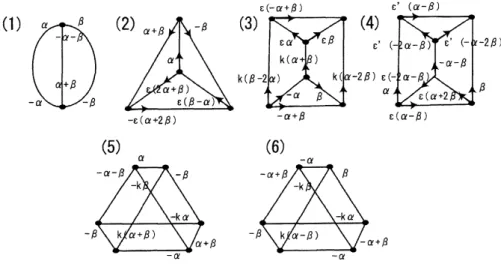
the $GKM$graphs in Figure 1.
FIGURE 1. The listofcomplexity
one
GKMgraphswith certain $S_{3}$-symmetries.Furthermore, by using the invariantsin [Ta]
or
[Ku5],we also have the following corollary:COROLLARy 1.7. In Theorem 1.6, $(\Gamma, \mathcal{A})$ extends to thetorusgraphifandonlyif (2), (3), (4).
The organization of this article isas follows. InSection 2,
we
prove Theorem 1.2. InSection3,
we
quickly recall GKM graphs with Weyl group symmetry. In Section 4,we
give a sketch ofthe proofof Theorem 1.6.
2. Proof of Theorem 1.2 and observations
In this section,
we
prove Theorem 1.2with the method similartothat demonstratedin [Ku3].Moreover, we also give the method to construct infinitely many complexity one GKM manifolds
with extended$G$-actions.
2.1. Proof of Theorem 1.2. Let $(M^{2n}, T^{n-1})$ be asimply connected GKM manifold.
As-sume
$(M^{2n}, T^{n-1})$ hasan
extended $(M^{2n}, G)$, where$G$ isa
compact (connected) Lie group withmaximal torus $T^{n-1}$
.
Then,we
may put $M=G/H$ such that rank $G=$ rank$H=n-1$
and$\dim G/H=2n$for
some
closedsubgroup$H\subset G$.
Because$M$issimply connected,$H$isa
connectedsubgroup.
Let $(\tilde{G},\tilde{H})$ be the universal covering of $(G, H)$
.
Then, by using Borel and De Siebenthal’sresult in $[BoSi]$ and the assumption that the$T^{n-1}$-action is almost effective, wehave
$\tilde{G}=G_{1}\cross\cdots\cross G_{m}$ $\tilde{H}=H_{1}\cross\cdots\cross H_{m},$
where$G_{i}$ is simplyconnectedsimpleLie groupand$H_{i}$ is its closedsubgroup for$i=1$,
}$m$such
that rank $G_{i}=$ rank H $=n_{i}$ and $\dim G_{i}-\dim H_{i}=2d_{i}$. Because the $T_{i}$-actionon $G_{i}/H_{i}$ has
a fixed point where $T_{i}$ is $a$maximal torusof $G_{i}$ and $H_{i}$,
we
have $n_{i}\leq d_{i}$ for all$i$.
Moreover, wehave the following lemma:
PROOF. By using the assumption,
we
have that$n_{1}+\cdots+n_{m}=d_{1}+\cdots+d_{m}-1<d_{1}+\cdots+d_{m}.$
If$n_{i}=d_{i}$ for all$i$, thenit is easy to show the contradiction to this inequality. Therefore,
we
mayassume
$n_{m}<d_{m}$. If$n_{m}\leq d_{m}-2$, then it follows from$n_{i}\leq d_{i}$$d_{1}+\cdots+d_{m}-1=n_{1}+\cdots+n_{m}\leq d_{1}+\cdots+d_{m-1}+(d_{m}-2)$
.
This also gives
a
contradiction. Thus, the equation $n_{m}=d_{m}-1$ holds. Hence, by the aboveequationand$n_{i}\leq d_{i}$,
we
also have $n_{i}=d_{i}$ for $i\neq m$.
口By Lemma2.1,
we
have$n_{i}=d_{i}$ for$i\neq m$.
Hence, it follows from the main theorem of [Ku3]that
we
have thefollowing decomposition:$\tilde{G}=\prod_{i=1}^{a}SU(\ell_{i}+1)\cross\prod_{j=1}^{b}Spin(2m_{j}+1)\cross G_{m}$
$\tilde{H}=\prod_{i=1}^{a}S(U(1)\cross U(\ell_{i}))\cross\prod_{n=1}^{b}Spin(2m_{j})\cross H_{m},$
where$m_{j}\geq 2,$$a+b=m-1$
.
Here,rank$G_{m}=$rankH $=n_{m}$and$\dim G_{m}/H_{m}=2d_{m}=2n_{m}+2.$Consequently,the problem isreducedintotheclassification of$(G_{m}, H_{m})$
.
To classify$(G_{m}, H_{m})$we
consider the followingtwocases.
CASE
1:Assume
$H_{m}$ isa
maximalsame
rank subgroup ofa
compact connected simplyconnected Lie
group
$G_{m}$.
Then, by usingthe table [Ku3, Table 1, 2],we
have that $(G_{m}, H_{m})$ isone
of the following:$A_{3}:(SU(4), S(U(2)\cross U(2)))$, i.e., $M^{8}=G_{2}(\mathbb{C}^{4})$;
$B_{2}:(SO(5), SO(3)\cross SO(2))$, i.e., $M^{6}=Q_{3}$;
$C_{2}:(Sp(2), Sp(1)\cross T^{1})$, i.e., $M^{6}=\mathbb{C}P^{3}$;
$C_{3}:(Sp(3), Sp(1)\cross Sp(2))$, i.e., $M^{8}=\mathbb{H}P^{2}$;
$D_{3}:(SO(6), SO(4)\cross SO(2))$, i.e., $M^{8}=Q_{4}$;
$G_{2}:(G_{2}, SU(3))$, i.e., $M^{6}=S^{6}.$ Note that $Q_{4}\cong G_{2}(\mathbb{C}^{4})$
.
CASE 2: Assume $H_{m}$ is
a
non-maximalsame
rank subgroup of $G_{m}$ suchthat rank $G_{m}=$rank $H_{m}=n$ and $\dim G_{m}/H_{m}=2n+2$. Then, there is a maximal
same
rank subgroup $K_{m}$such that $H_{m}\subset K_{m}\subset G_{m}$
.
Because $\dim G_{m}/H_{m}=2n+2>\dim G_{m}/K_{m}$ (i.e., $\dim G_{m}/K_{m}\geq$$2$rankG $)$,
we
have that $\dim G_{m}/K_{m}=2n$.
Therefore, $G_{m}/K_{m}$ mustbe thehomogeneoustorusmanifold and$K_{m}/H_{m}\cong SU(2)/T^{1}\cong S^{2}$
.
Hence, by [Ku3], $(G_{m}, K_{m})$ ison)of the following:$(SU(k+1), S(U(1)\cross U(k)))$;
$($Spin$(2k+1),$ $Spin(2k))$
.
Because $K_{m}/H_{m}\cong S^{2}$, we also have $k=2$. Therefore, we have $(G_{m}, K_{\pi\iota}, H_{m})$ is one of the
followings:
$(SU(3), S(U(1)\cross U(2)), T^{2})$;
$($Spin(5),$Spin(4),$$Sp(1)\cross T^{1})$,
where Spin(4) $\cong Sp(1)\cross Sp(1)$and Spin (5) $\simeq Sp(2)$. Because$\dim SU(3)/T^{2}==6$and$\dim Spin(5)/Sp(1)\cross$ $T^{1}=6$,
we
have that $(G_{m}, K_{m})$ isone
ofthe following:$A_{2}:(SU(3), T^{2})$, i.e., $M^{6}=\mathcal{F}\ell(\mathbb{C}^{3})$;
$B_{2}:(Spin(5), Sp(1)\cross T^{1})$, i.e., $M^{6}=\mathbb{C}P^{3}.$
2.2. 0bservations. By using the
GKM
manifolds appearing in Theorem 1.2,we can
con-struct otherGKMmanifolds; in particular, we
can
constructinfinitely manycomplexityone
GKMmanifoldswith extended $(SU(3)\cross T^{n})$-actions. Here,
we
showthe construction.EXAMPLE 2.2. Let $X$ be
a
$2n$-dimensional torus manifold with$n\geq 2$ and $\rho$:$T^{2}arrow T^{n}$ be a
faithfulrepresentation. Define the manifold$M_{\rho}(X)$ by thetwisted product
$SU(3)\cross T^{2}X$
bythe standard (right)$T^{2}$-action on $SU(3)$ and the$T^{2}$-actionon$X$ via$\rho$. Becausethe elements
of the image $\rho(T^{2})$ commuteswith the elements in $T^{n}$, the manifold $M_{\rho}(X)$ has the $(T^{2}\cross T^{n})-$
action by the left $T^{2}$-action
on
the $SU(3)$-factor andthe $T^{n}$-actionon
the $2n$-dimensional torusmanifold $X$
.
Because there is a fibre bundle structure $Xarrow M_{\rho}(X)arrow SU(3)/T^{2}$,we
also have$\dim M_{\rho}(X)=2n+6$
.
Moreover, it is easy to check that its one-skeleton has the structure ofa fibre bundle
over
the one-skeleton of $SU(3)/T^{2}$ whose fibre is that of $X$.
Therefore, this isa
complexityone
GKM manifold. Moreover, there isan
extended $SU(3)\cross T^{n}$-action because$SU(3)$ acts naturally
on
the $SU(3)$-factor in $M_{\rho}(X)$. Because there are infinitely many torusmanifolds $X$, we can construct infinitely many complexity one GKM manifolds with extended
$SU(3)\cross T^{n}$-actions.
EXAMPLE 2.3. Let $Y$ be $a(2n-4)$-dimensionaltorus manifold for$n>2$, and$\sigma$: $T^{1}arrow T^{n-2}$
bea faithful representation. Define the twisted product$N_{\sigma}(Y)$ by
$S^{5}x_{T^{1}}Y$
such that $T^{1}$ acts
on
$S^{5}\subset \mathbb{C}^{3}$ diagonally andon a
torus manifold $Y$ via $\sigma$.
Then, $N_{\sigma}(Y)$ is a$2n$-dimensional torus manifold with extended $(SU(3)\cross T^{n-2})$-actions (see [Ku4] for details of
this construction). Here, $SU(3)$ acts onthe $S^{5}$-factor transitively. Now
we can
add the $G_{2}$-factoras
follows:$G_{2}\cross N(Y)$
$\simeq G_{2}\cross SU(3)(S^{5}\cross T^{1}Y)$
$\simeq G_{2}\cross sU(3)((SU(3)/SU(2))\cross T^{1}Y)$
$\simeq (G_{2}/SU(2))\cross T^{1}Y.$
This isan$N_{\sigma}(Y)$-bundle
over
$S^{6}$ (ora$Y$-bundleover$G_{2}/S(U(2)\cross U(1))$, alsosee
[Ku2, Example1.4]), Therefore, $\dim(G_{2}\cross sU(3)N_{\sigma}(Y))=2n+6$
.
Moreover, because $\sigma(T^{1})$ commutes with$T^{n-2}$, the structure of a $Y$-bundle over $G_{2}/S(U(2)\cross U(1))$ induces the $(T^{2}\cross T^{n-2})$-action on
$G_{2}\cross N(Y)$
.
Becausebothofthefibre andthe basespacehavestructuresofGKMmanifolds,$(G_{2}\cross N(Y), T^{n})$is$a(2n+6)$-dimensional GKMmanifold,i.e., complexity3 GKM manifold
with anextended $G_{2}\cross T^{n-2}$-action. However, this mightnotbe
a
complexityone
GKM manifold(see [Ta] or [Ku5]).
Similarly, we
can
also constructother GKM manifolds (might notbe acomplexityone
GKMmanifold) withextendednon-abelian Liegroupactions,by using the otherirreduciblehomogeneous
complexity
one
GKM manifolds.In particular, we
can
generalize theconstructionin Example 2.2as
follows.PRoposiTioN
2.4.
Let $G$bea
compact, connected, non-abelian Lie group with rank$G=n,$and$X$bea$2m$-dimensionaltorusmanifoldsuchthat$n\leq m$
.
Then,for anyfaithfulrepresentation$\rho$ :$T^{n}arrow T^{m}$, the followingmanifold is $a(\dim G-n+2m)$-dimensional GKM manifoldwith the
$T^{n+m}$-action:
$G\cross T^{n}X$
where $T^{n}$ is
a
maximaltorus in$G$ and actson
$X$ via $\rho.$Furthermore, this has theextended $(G\cross T^{m})$-action and
a
complexity $(\dim G-3n)/2.$3. GKM graphs
In this section,
we
recall GKMgraphs introduced in $[GuZa]$, and prepare to proveTheorem3.1. Notations.
Let$\Gamma=(V(\Gamma), E(\Gamma))$bean
abstract graph, where $V(\Gamma)$is the set of vertices and $E(\Gamma)$ is the set of oriented edges of $\Gamma$. Let $e\in E(\Gamma)$. We denote its initial vertex by$i(e)$, the terminal vertexby $t(e)$, $($e.g. $i(pq)=p$and $t(pq)=q)$ and the reversed orientededge of$e$by $\overline{e}$. It is easyto checkthat $i(e)=t(\overline{e})$ and $t(e)=i(\overline{e})$
. Put the set ofalloutgoing edges from the
vertex$p$by $E_{p}(\Gamma)$, i.e., theset of all edges $e$ such that $i(e)=p$. We say $\Gamma$is
an
$m$-valent graph if
$\# E_{p}(\Gamma)=m$ for all$p\in V(\Gamma)$
.
A map between two graphs $\Gamma=(V(\Gamma), E(\Gamma))$ and $\Gamma’=(V(\Gamma’), E(\Gamma’))$ is defined
as
the pairof maps
$f=(f_{V}, f_{E})$ : $\Gammaarrow\Gamma’$such
that the following diagram commutes$E(\Gamma)\downarrow arrow^{f_{E}} E(\Gamma’)\downarrow$
$V(\Gamma) arrow^{f_{V}} V(\Gamma’)$
where twovertical maps
are
themapstakingthe initialvertex, i.e., $e\mapsto i(e)$.
In otherwards, themap of vertices preserves the edges. An automorphismgroup of$\Gamma$, say $Aut(\Gamma)$, is defined by the
set of all maps $f$
on
$\Gamma$ such that bothof$f_{V}$ and $f_{E}$are
bijective.Let $H^{*}(BT^{n})$ be the cohomology ring of$BT$
over
$\mathbb{Z}$-coefficient, i.e., $H^{*}(BT^{n})$ is isomorphic
to the polynomial ring$\mathbb{Z}[\alpha_{1}, ..., \alpha_{n}]$ in the variables$\alpha_{i}\in H^{2}(BT)(i=1, \ldots, n)$
.
3.2. Abstract GKMgraph. Throughoutofthispaper, $\Gamma$
is
an
$m$-valent(connected) graph,where$n\leq m$
. Put
$\mathcal{A}:E(\Gamma)arrow H^{2}(BT)$
.
If$\mathcal{A}$satisfies the following three conditions:
(1) $\mathcal{A}(e)=-\mathcal{A}(\overline{e})$;
(2) the set $\{\mathcal{A}(E_{p}(\Gamma))\}$ is pairwise linearly independent for all$p\in V(\Gamma)$;
(3) there is
a
bijective map $\nabla_{e}$ :$E_{p}(\Gamma)arrow E_{q}(\Gamma)$ for$p=i(e)$ and $q=t(e)$ such that(a) $\nabla_{e}=\nabla_{e}^{-1}$; (b) $\nabla_{e}(e)=\overline{e}$;
(c) $\mathcal{A}(\nabla_{e}(f))-\mathcal{A}(f)\equiv 0$ mod $\mathcal{A}(e)$ for every$f\in E_{p}(\Gamma)$ (calledacongruence relation),
then the map$\mathcal{A}$ is called
an
axialfunction
on
$\Gamma$ and the collection$\nabla=\{\nabla_{e}|e\in E(\Gamma)\}$ is called
a connection. We call the pair $(\Gamma, \mathcal{A})$
a
$GKM$graph, where $\Gamma$ is an$m$-valent graph and $\mathcal{A}$ is
an
axialfunction
on
$\Gamma.$Assume
an
axialfunction$\mathcal{A}$: $E(\Gamma)arrow H^{2}(BT^{n})$ satisfies that the image of$\mathcal{A}$
spans
$H^{2}(BT^{n})$.
Then,
we
call the number $m-n$a
complexity of$(\Gamma, \mathcal{A})$.
REMARK3.1. Let $(M, T)$be
a
$2m$-dimensional GKM manifoldwith invariantalmost complexstructure. Then, theone-skeletonof$M/T$induces the$m$-valent graph$\Gamma_{M}$. Moreover, we
can
definethe axialfunction$\mathcal{A}_{M}$bythe complex tangential representationon each fixedpoint (to define this
complex structure canonically, we need a complex structure around fixed points). Namely, the
$m$-valent GKM graph $(\Gamma_{M}, \mathcal{A}_{M})$ is define by
an
almost complex$2m$-dimensionalGKM
manifold$(M, T)$
.
More generally, we can also define the generalized GKM graph, i.e., the condition (1) in the
axial function$\mathcal{A}$is changed tothe condition$\mathcal{A}(e)=\pm \mathcal{A}(\overline{e})$,from
an
unitaryGKMmanifold$(M, T)$$(i.e.,$ there $is an$ invariant stably complex structure $on M)$ such
as an even
dimensional sphere.We omit the precisedefinitionof the (generalized) GKMgraphinducedfrom a GKM manifold in
this article $(see [Da], [GuZa], [Kul] or [MMP] for$ precise definition)
.
Note that
a more
generallabelled graph (i.e., there might not exist any connections)can
bedefinedby
an
omniorientedGKM manifold(i.e., thereisa
fixedorientationson
$M$and allinvariant2-spheres) such
as
a
quaternionic projective space whose dimensionis greater than four.3.3. Automorphism group of GKM graph. Let
us
define the automorphismgroup ofaGKM graph $(\Gamma, \mathcal{A})$ with$\mathcal{A}$
$(f, \rho)$ is
an
automorphismon
$(\Gamma, \mathcal{A})$ if the following diagram commutes:$E(\Gamma)\downarrow arrow^{f_{E}} E(\Gamma)\downarrow$
$H^{2}(BT) arrow^{\rho} H^{2}(BT)$
where the vertical maps
are
both of$\mathcal{A}$.
We callthe set
{
$(f, \rho)\in Aut(\Gamma)\cross GL(n;\mathbb{Z})|(f, \rho)$ is anautomorphism on $(\Gamma, \mathcal{A})$}
an
automorphismgroupof $(\Gamma, \mathcal{A})$ and denote it by$Aut(\Gamma, \mathcal{A})$.
Thefollowingpropositionis
one
of themotivationsto
considering the 2ndmain resultin thispaper (Theorem 1.6) (also
see
[Kaj]).PRoposiTioN3.2. Ifanalmost complexGKM manifold $(M, T)$extends toanalmost complex
$(M, G)$, then $W(G)=N_{G}(T)/T$ acts on $(\Gamma_{M}, \mathcal{A}_{M})$, i.e., $W(G)\subset Aut(\Gamma_{M}, \mathcal{A}_{M})$
.
PROOF. Let $(M, T)$ be
a GKM
manifold withan
almost complex structure $J$.
Assume thatthere isan extended$G$-action $(M, G)$preserving$J$. Let$g\in W(G)$and$S_{\alpha}^{2}$ beaninvariant2-sphere
in $(M, T)$, where $\alpha\in t^{*}$ is the element corresponding to $S_{\alpha}^{2}$ (i.e., the element appearing in the
tangential representation
on
$S_{\alpha}^{2}$) Then, $gS_{\alpha}^{2}$ satisfies that$TgS_{\alpha}^{2}$
$=$ $(9^{T}9^{-1})gS_{\alpha}^{2}$ (because$g\in N_{G}(T)$) $= 9^{TS_{\alpha}^{2}}$
$=$ $9^{S_{\alpha}^{2}}$ (because $S_{\alpha}^{2}$ is$T$-invariant).
This implies that$gS_{\alpha}^{2}$ is an invariant 2-sphere; therefore, $W(G)\subset Aut(\Gamma)$
.
By definition, the axial function$\mathcal{A}_{M}$ isinduced by the complexstructurearound fixed points
induced from $J$
.
Therefore, it is easyto check that $W(G)\subset Aut(\Gamma_{M}, \mathcal{A}_{M})$, because$G$preservesthe almost complexstructure$J$ of M. $\square$
By theproofdescribed
as
above,we
may think$gS_{\alpha}^{2}=S_{\beta}^{2}$
where $\beta=g^{*}\alpha\in t^{*}$ for $g^{*}\in W(G)$
.
Therefore, the Weylgroup $W$ actionon an
abstract GKMgraph $(\Gamma, \mathcal{A})$ canbe defined as follows. It iswell known that $W$is generated by the reflectionson
$t$; in particular, this preserves the weight lattice (see [Hu]). Hence, for $g\in W$, theisomorphism
$g$
on
$t_{\mathbb{Z}}$inducesthe isomorphism$g^{*}:t_{\mathbb{Z}}^{*}arrow t_{\mathbb{Z}}^{*}$, i.e., the dualof$9\in W$
.
Therefore, the automorphism$g:(\Gamma, \mathcal{A})arrow(\Gamma, \mathcal{A})$ isdefined by
(3.1) $g^{*}(\mathcal{A}(e))=\mathcal{A}(g_{E}(e))$,
where $e\in E(\Gamma)$,$9E:E(\Gamma)arrow E(\Gamma)$ is the bijective map induced from$g\in W\subset Aut(\Gamma)$ (we often
abusetwo notations $g_{E}$ and $g$).
REMARK 3.3. If the extended action $G$ does not preserve the almost complex structure $J$
(even
more
generally the stably complex structure)on
$M$, then $W(G)$ do not act on $(\Gamma_{M}, \mathcal{A}_{M})$.
However, if$M$is
a
unitary GKM manifold and there isan
extended $G$-action (which might notpreserve thestably complex structure),then$g\in W(G)$ action changes therelation (3.1)
as
fohows:$g^{*}(\mathcal{A}(e))=\pm \mathcal{A}(g_{E}(e))$
.
Therefore, $g\in W(G)$ gives theequivalence between $(\Gamma, \mathcal{A})$ and $(\Gamma, \mathcal{A}’)$ where $\mathcal{A}’$ satisfies
$\mathcal{A}(e)=$
$\pm \mathcal{A}’(e)$for all edges$e\in E(\Gamma)$. In $[KuMa]$,
we
also study the extendedactions forthecases
when$G$ does not preserve the stably complex structures (more generally omniorientations) on torus
4.
Sketch
ofa
proof of Theorem 1.6Let $(\Gamma, \mathcal{A})$ be
an
abstract $m$-valentGKM
graph. Motivated byTheorem 1.2,we
classify thefollowing
GKM
graphs:(1) $\Gamma$is a
3
or
4-valent graph;(2) $(\Gamma, \mathcal{A})$ is
a
complexity one, i.e., if$\mathcal{A}$ : $\Gammaarrow H^{2}(BT^{n})$ then $n=2$ $($for $m=3)$or
3 (for$m=4)$, called$a(3, 2)$-type GKMgraph
or
$(4, 3)$-type GKM graph, respectively;(3) if $(\Gamma, \mathcal{A})$ is $a(3,2)$-type (resp. $(4, 3)$-type), there is the symmetric
group
$S_{3}$, the signedsymmetricgroup $S_{2}^{\pm}$
or
the dihedral group $D_{6}$ (resp. $S_{4}$or
$S_{3}^{\pm}$)action
on
it;(4) foreveryWeylsubgroup $W’\subset W$ and every vertex$p\in V(\Gamma)$
,
there is a GKM subgraph$(\Gamma’, \mathcal{A}|_{E(\Gamma’)})$ such that $W’$ acts on it effectivelyand$p\in V(\Gamma’)$;
The assumption (4)
as
above is induced from the fact that there isa
connected $K$-orbit of$p\in M^{T}$ for all $K$ such that$T\subset K\subset G.$
In this paper,
we
only prove thecase
when $(\Gamma, \mathcal{A})$ is $a(3,2)$-type GKM graph with thesymmetric group $S_{3}$-action. For the other cases, we
can
prove similarly (it will be shown insomewhere of the future article).
4.1. The
property
of$S_{3}$-orbits. Let $W=S_{3}$.
Then,itiswell-known that this isa Coxeter
group
and there is the following representation:$W = \langle\sigma_{1}, \sigma_{2}|\sigma_{1}^{2}=\sigma_{2}^{2}=(\sigma_{1}\sigma_{2})^{3}=1\rangle$
$= \{1, \sigma_{1}, \sigma_{2}, \sigma_{1}\sigma_{2_{\rangle}}\sigma_{2}\sigma_{1}, \sigma_{1}\sigma_{2}\sigma_{1}\}.$
Inthis case, there
are
fourWeyl subgroups:{1},
$\langle\sigma_{1}\rangle,$ $\langle\sigma_{2}\rangle,$ $\langle\sigma_{1}\sigma_{2}\sigma_{1}\rangle(\simeq \mathbb{Z}_{2})$,and there is anothersubgroup
$\mathbb{Z}_{3}=\langle\sigma_{1}\sigma_{2}\rangle=\langle\sigma_{2}\sigma_{1}\rangle.$
Therefore, if there isa$W$ actionon$\Gamma=(V(\Gamma), E(\Gamma))$, then thereare the following possible orbit
types for$p\in V(\Gamma)$:
(4.1) $W(p)\simeq W/W,$ $W/\mathbb{Z}_{3},$ $W/\mathbb{Z}_{2}$, or $W/\{e\}.$
By choosing generatorsof$H^{2}(BT)=\mathbb{Z}\alpha\oplus \mathbb{Z}\beta$, for$p\in V(\Gamma)$, we may
assume
that$\mathcal{A}_{p}=\{\mathcal{A}(e)|e\in E_{p}(\Gamma)\}=\{\alpha, \beta, k_{1}\alpha+k_{2}\beta\}$
for
some non-zero
integers $k_{1},$$k_{2}$.
From the next subsection,we
consider thecases
appeared in(4.1) in
case
bycase.
4.1.1. The
case
when$W(p)\simeq W/W$.
Inthiscase, $W$actson
$E_{p}(\Gamma)$; therefore it alsoactson
$\mathcal{A}_{r}$
.
Because$H^{2}(BT)^{W}=\{0\}$,the symmetric group $W$actson
$\mathcal{A}_{p}$ transitively; therefore, it alsoacts
on
$E_{p}(\Gamma)$ transitively. Consequently, we mayassume
that $k_{1}=k_{2}=-1$ and$\sigma_{1}:\alpha\mapsto\beta, -\alpha-\beta\mapsto-\alpha-\beta$; $\sigma_{2}:\alpha\mapsto-\alpha-\beta, \beta\mapsto\beta.$
This implies that the neighborhoodofthis
case
is Figure2.4.1.2.
Thecase
when $W(p)\simeq W/\mathbb{Z}_{3}$. We claim that thiscase
does notoccur.
Because$|W(p)|=2$ and
our
assumption (4), there isan
edge $e\in E(\Gamma)$ such that $V(e)=W(p)=\{p, q\}$and $\sigma_{1}\in W$such that $\sigma_{1}(e)=\overline{e}$. Because $\mathcal{A}(e)=-\mathcal{A}(\overline{e})(=\alpha)$,
we
mayassume
(4.2) $\sigma_{1}:\alpha\mapsto-\alpha.$
On the other hand, the subgroup $\mathbb{Z}_{3}=\{1, \sigma_{1}\sigma_{2}, \sigma_{2}\sigma_{1}\}$ acts
on
$E_{p}(\Gamma)=\{e, e’, e"\}$.
Therefore,because $\sigma_{1}(e)=\overline{e}\in E_{q}(\Gamma)$ and the assumption (4), $\sigma_{2}(\overline{e})=e$
.
However, this implies that$\sigma_{2}:-\alpha\mapsto\alpha$
.
Thisgivesa
contradiction to (4.2). Consequently, there isno
vertex$p\in V(\Gamma)$ suchthat $W(p)\simeq W/\mathbb{Z}_{3}.$
4.1.3.
The casewhen$W(p)\simeq W/\mathbb{Z}_{2}$.
Because $|W(p)|=3$and the assumption (4), in thiscase
there is atriangle GKM subgraph $(\triangle, \mathcal{A}|_{\triangle}=\mathcal{A}’)\subset(\Gamma, \mathcal{A})$ such that $V(\triangle)=W(p)=\{p, q, r\}.$
Becausethe symmetricgroup $W$ actson $(\triangle, \mathcal{A}’)$ transitively,
we
mayassume
that$\sigma_{1}:p\mapsto p, q\mapsto r$;
$\sigma_{2}:p\mapsto q, r\mapsto r.$
Moreover, considering the axialfunctions around $\triangle$,
we can easily check that this
case
mayassume
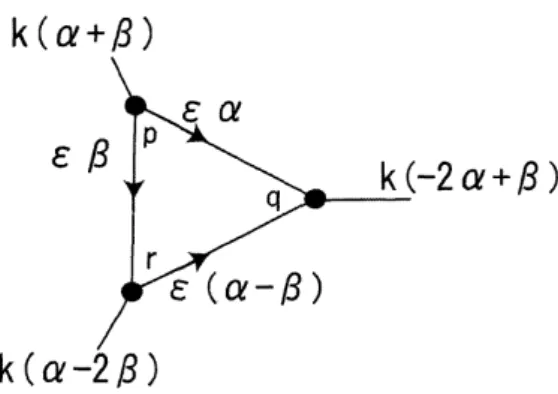
the axial functions appearedin Figure3
(thecase
when $\mathcal{A}(pq)=\epsilon\alpha$ and $\mathcal{A}(pr)=\epsilon\beta$)or
Figure 4 $($otherwise, $i.e., the$case
when $\mathcal{A}(e)=\epsilon\alpha$ and $\mathcal{A}(e’)=\epsilon\beta$ for $e\in E_{p}(\Gamma)\backslash E_{p}(\triangle)$ and $e’\in E_{q}(\Gamma)\backslash E_{q}(\triangle))$.
FIGURE 3. The axial function around $\triangle$
such that $V(\triangle)=W(p)$, where $k$ is
a
non-zero
integer and $\epsilon=\pm 1$.
In thiscase, $\sigma_{1}$ : $\alpha\mapsto\beta$ and $\sigma_{2}:\beta\mapsto-\alpha+\beta.$$\epsilon\alpha$
$\epsilon$
’
$-\epsilon(\alpha+\beta)$
FIGURE 4. The axial function around $\triangle$
such that $V(\triangle)=W(p)$, where $\epsilon,$$\epsilon’=$
$\pm 1$
.
In thiscase,$\sigma_{1}$ :$\beta\mapsto-\alpha-\beta$ and$\sigma_{2}$ : $\alpha\mapsto\beta.$
4.1.4. The case when $W(p)\simeq W/\{e\}$
.
In this case, $|W(p)|=6$.
Byusing the assumption (4),it iseasyto check that $W$actson$\Gamma$transitivelyandthe axial functions
are
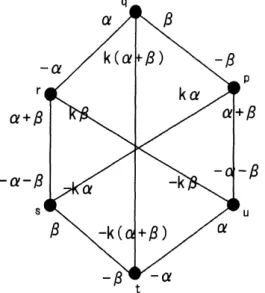
the labelles appearedFIGURE 5. The 1st
case:
$\sigma_{1}:\alpha\mapsto-\alpha,$ $\beta\mapsto\alpha+\beta;\sigma_{2}:\beta\mapsto-\beta,$ $\alpha\mapsto\alpha+\beta,$ where $k$isa non-zero
integer.FIGURE
6.
The 2ndcase:
$\sigma_{1}$ :$\alpha\mapsto-\alpha,$ $\beta\mapsto-\alpha+\beta;\sigma_{2}$ : $\beta\mapsto-\beta,$ $\alpha\mapsto\alpha+\beta,$ where$k$ isanon-zero
integer.4.2. The proof ofTheorem 1.6 for the case when there is an $S_{3}$-action. Finally, in
this section,
we
prove Theorem1.6
by combining the facts described inSection
4.1. If$W=S_{3}$acts
on
$(\Gamma, \mathcal{A})$ transitively, thenthiscase
is one ofthecases
of Figure 5 and Figure6.
Theseare
the
cases
(5), (6) in Theorem1.6.
Assume that $W$ acts on $(\Gamma, \mathcal{A})$ non-transitively. Then, there
are
three possible orbits, i.e.,Figure 2, Figure3 and Figure 4, say type 1, type 2and type 3respectively.
Ifthere isatype 1 orbit,then thisorbit mustbe connectingwith
one
of thefollowingorbits:(1) the type 1 orbit with distinct$\epsilon$’s (this is the
case
(1) inTheorem 1.6);(2) thetype3 orbit withdistinct $\epsilon$’s (this isthe
case
(2) in Theorem 1.6).Assumethatthere is
no
type 1 orbitbutthere is atype2orbit. Then, because there isa$W$-actionis the
case
(3) in Theorem 1.6. Assume that there is notype 1 orbit but there isa
type 3 orbit. Then, similarly, thiscase
isonly the connecting two copies of type3
(with distinct $\epsilon’ s$). This isthe
case
(4) in Theorem 1.6.ThisestablishesTheorem 1.6.
REMARK 4.1. In the end ofthis article,
we
showsome
geometric models for GKM graphsappearing in Theorem 1.6:
$\bullet$ The
GKM
graph(1)is inducedfrom$(S^{6}, T^{2})$,where$S^{6}\simeq G_{2}/SU(3)$ (thereisa
$SU(3)(\subset$$G_{2})$-extended action);
$\bullet$ The
GKM
graph (2) is from$(\mathbb{C}P^{3}, T^{2})$,where$\mathbb{C}P^{3}\simeq P(V(-\alpha)\oplus V(-\beta)\oplus V(\alpha+\beta)\oplus\underline{\mathbb{C}})$ (there isa
$SU(3)$-extended actionon
the first three coordinates);$\bullet$ The GKM graph (3) is from $S^{5}\cross T^{1}P(\gamma^{\otimes k}\oplus\epsilon)$ (there is
a
transitive $SU(3)$-actionon
the $S^{5}$-factor);
$\bullet$ TheGKMgraph (4) is from the connectedsum oftwo copiesof$(\mathbb{C}P^{3}, T^{2})$’swhich induce
the GKM graph (2) (there is
an
$SU(3)$-extended action because this connectedsum
isan
$SU(3)$-equivariant);$\bullet$ The
GKM
graphs (5), (6). Thesecases
are
still notknown,thatis, whichGKM
manifoldsinduce these
GKM
graphs?Some
of them must be obtained from the projectivizationsof equivariant complex 2-dimensional vectorbundles
over
$\mathbb{C}P^{2}$, whichare
not split intoline bundles (see [Kan]), because the projectivization ofWhitney
sum
of line bundlesis isomorphic to $S^{5}\cross T^{1}P(\gamma^{k}\oplus\epsilon)$. In particular, if $k=1$ for the GKM graph (5), this is obtained from the flag manifold $SU(3)/T^{2}\simeq SU(3)\cross U(2)\mathbb{C}P^{2}$, which can be
regarded
as
the projectivization ofsome
complex2-dimensional vector bundleover
$\mathbb{C}P^{2}$$($
see
$[KuSu])$.
Acknowledgment
This article is basedon author’s talk inRIMS Conference “The Topology and the Algebraic
Structures of Ransformation Groups” from May 26th toMay 30th 2014. The author is grateful
to the organizer Takao Sato for giving him the chance to give a talk in the conference. He also
would like to thankProf. Takashi Tsuboifor providing himwith excellentworking conditions.
References
[ADHL] I. Arzhantsev, U. Derenthal, J. Hausen and A. Laface, The automorphismgroup ofa varzety with torus
actionofcomplexity one, $arXiv:1201.456S.$
$[BoSi]$ A.Borel andJ. DeSiebenthal,Lessous-groupesfermesde rangmaximumdesgroupesdeLieclos,Comment.
Math. Helv. 23(1949),200-221.
$[BuPa]$ V.M. Buchstaber and T.E.Panov, TorusActionsand TheirApplicationsin TopologyandCombinatorics,
University Lecture, 24,Amer. Math. Soc., Providence,R.I.,2002.
[ToricTop] V.M.Buchstaber and T.E.Panov, Torzc Topology, arXiv: 1210.2368.
[CMS] S. Choi,M. Masuda and D. Y. Suh, Rigidityproblems intorec topology. a survey. Tr. Mat. Inst. Steklova
275 (2011), 188-201.
[Co] D.Cox, Thehomogeneous coordinate ringofa tomc vareety, J. Algebraic Geom. 4 (1995), no.1, 17-50.
[Da] A.Darby, $Toru\mathcal{S}$ manifoldin equivareant complex bordism,arXiv: 1409.2720.
$[DaJa]$ M. Davis and T. Januszkiewicz, Convexpolytopes, Coxeterorbifoldsand torus action,Duke. Math. J.,62
(1991),no.2,417-451.
[De] M.Demazure,Sous-groupesalgebrequesde rang maximum$du$groupede Cremona,Ann. Sci. Ecole Norm. Sup.
(4) 31970507-588.
[GKM] M. Goresky,R. Kottwitz and R.MacPherson,Equivariant cohomology, Koszulduality, and thelocalization
theorem, Invent. Math. 131 (1998), 25-83.
$[GuZa]$ V. GuilleminandC. Zara, One-skeleta,Bettinumbers, and equivamant cohomology, Duke Math.J. 107,2
(2001), 283-349.
$[HaMa]$ A. Hattori and M. Masuda, TheoryofMulti-fans, Osaka. J.Math.,40(2003),1-68.
[Hu] J. E. Humphreys, Introduction to Lie Algebras and Representation Theory, Graduate Texts in Math. 9,
Springer-Verlag, 1970.
[Kaj] S. Kaji, Weylgroup symmetry on the $GKM$graphofa $GKM$manifold with anextended Lie group action,
to appearin Osaka J. Math.
$[KaTo]$ Y. Karshon andS. Tolman, Centered complexity oneHamiltonian torusactions,Trans. Amer.Math. Soc.
353(2001),no. 12,4831-4861.
[Kul] S.Kuroki, Introduction to$GKM$theory,Trendsin Mathematics- NewSeriesVol11No 2, 113-129(2009).
[Ku2] S.Kuroki, $GKM$graphsinduced by $GKM$manifoldswnth$SU(l+1)$-symmetmes, Trends in Mathematics
-NewSeriesVo112No1, 103-113(2010).
[Ku3] S.Kuroki, Characterezationofhomogeneoustorus manifolds,OsakaJ. Math., Vo147,no. 1,285-299 (2010).
[Ku4] S.Kuroki, Classification oftorusmanifoldswithcodimensiononeextendedactions,Transformation Groups: $Vol16$,Issue 2 (2011),481-536.
[Ku5] S.Kuroki, Necessaryandsufficientconditionofextensionof$GKM$graphs, in preparation.
$[KuMa]$ S. KurokiandM. Masuda, Root systemsandsymmetryofa torus manifold, in preparation.
$[KuSu]$ S. Kuroki and D. Y. Suh, Cohomological non-mgidity
of
eight-dimensional complex projective towers,OCAMIpreprintseries 13-12.
[MMP] H. Maeda, M. Masuda, T. Panov, Torus graphs and simplicial posets, Adv. Math. 212 (2007),458-483.
[Ma62] W. S. Massey, Non-existence ofalmost-complexstructures on quatemionic projective spaces. Pacific J. Math. 1219621379-1384.
[Ma99] M.Masuda, Unitarytorec manifolds,multi-fansandequivareant index Tohoku Math. J. 51 (1999), 237-265. [MalO] M.Masuda, Symmetryofasymplectictoncmanifold. J. SymplecticGeom. 8 (2010),no.4,359-380.
[MT] D. McDuff and S.Tolman, Polytopeswithmasslinearfunctions. $I$,Int. Math. Res. Not. IMRN2010,no. 8,
1506-1574.
[Mo] D. Morton, $GKM$ manifolds with low Betti numbers, Ph.$D$ thesis in University of Illinois at
Urbana-Champaign,2011,
[Od] T.Oda, Convex Bodies and Algebraic Geometry. An Introduction to the Theory ofTonc Varieties,Ergeb. Math. Grenzgeb. (3), 15,Springer-Verlag, Berlin, 1988.
[Ta] S.Takuma,Extendabilityofsymplectictorus actions with isolatedfixedpoints,RIMSKokyuroku1393(2004),
72-78.
[Wi] M. Wiemeler, Torus manifolds with non-abelian symmetmes, Trans. Am. Math. Soc., 364 (2012), No. 3,
1427-1487.
GRADUATESCHOOLOF MATHEMATICAL SCIENCES, THE UNIVERSITYOFTOKYO, 3-8-1 KOMABA, MEGURO-KU,
TOKyO, 153-8914, TOKyO, JAPAN