GENERALIZING
SIERPI\’{N}SKI
NUMBERS TO BASE $b$AMYBRUNNER\dagger ,CHRIS K. CALDWELL,DANIEL KRYWARUCZENKO\dagger ,AND CHRIS LOWNSDALE\dagger
ABSTRACT. Sierpi\’{n}ski proved that thereareinflnitely many oddintegers$k$such that$k\cdot 2"+1$iscomposite
for all$n\geq 0$
.
These$k$are nowcalledSierpiAskinumbers. Wedefine a SierpidSkinumber base$b$to beaninteger$k>1$ forwhich$gcd(k+1, b-1)=1,$ $k$is notarational power of$b$, and$k\cdot b"+1$iscomposite
forall$n>0$
.
Wediscuss ways that thesecanarise,offer$con_{t}|ectured$leastSierpifiski number in eachofthebases $2<b\leq 100$(34 areproven), andshow thatall bases$b$admit Sierpiiiskinumbers. Wealso
show4istheleast base$b$Sierpi\’{n}skinumberfor$inffi\dot{u}tely$manybasee$b$.
1. INTRODUCTION AND HISTORY
In 1958, R.M. Bobinson [25] formedatable ofprimesof the form$k\cdot 2^{n}+1$ for oddintegers$1\leq k<100$
and $0\leq n\leq 512$
.
He found primes for all $k$ values except 47. Some then wondered “Is there an odd $k$ value such that $k\cdot 2^{n}+1$ is always composite?” In 1960, W. Sierpitiski [28] proved that there wereindeed infinitely manysuch odd integers $k$
.
He did this by findinga
small set ofprimes $S$such that fora
suitable choice of$k$, every term of thesequenoe $k\cdot 2^{n}+1(n>0)$ is divisible bya
prime in his ”cover” $S$.
The values$k$which makeeveryterminthesequencecompositeare nowcalledSlerpi\’{n}’ski numbers.Sierpi\’{n}ski however neither gavea value of$k$
nor
soughttheleast such$k$.
In 1962, Selfridge [unpublished] showed that $k=78557$ is also a Sierpibski number, and this is
now believed to be the least Sierpi\’{n}ski number. For three decades mathematicians have been
test-ing all of the values of $k$ less than 78557 to prove this conjecture [2, 9, 20, 22]. All values except
10223, 21181, 22699, 24737,55459, and 67607 have
now
been eliminated by findinga
prime in thecorre-spondingsequence [18].
There
are
twostandard methods ofgenerahzingSierpitski numbers. Several have generalized this ideaby altering the restrictions
on
$k[10,11,14,21]$.
For example,one
may seek Sierpi&ki numbers $k$ forwhich allof$k,k^{2},$$k^{3},$ $\ldots,$
$k^{r}$
are
also Sierpi\’{n}ski numbers for arbitrarily large integers $r[14]$.
Thesecond author is pursuing this direction in arelated paper. Inthispaperwe will pursue the other approach to generalization–by changingthe base.On the Intemet several groups havegeneralized Sierpi\’{n}ski’s result to other bases$b[4,29,30]$
.
See, forexample, theresults in Table 1. There
was
also ashort note by Bowen in 1964 [5] whichwe$wm$mentionseveral times below. But at the timewe began our investigation,
none
ofthesepresented asystematic studyofthegeneralizationor even
acarefulstudy ofthedefinition. Inthispaperwe
willMl thisgapby providing a definition andthen extending thestudied basessystematically to include all of thebases upthrough 100.
We willprovethat Sierpi\’{n}’skinumbers exist for all bases $b>1$, and offer conjectured least Sierpitiski
numbers for the bases$2<b\leq 100$
.
For34of these baseswe
are
able to prove that theconjecturedvaluesare
indeed the least.2. GENERALIZING SIERPINSKI NUMBERS To BASE $b$
A Sierpi\’{n}ski number isanoddinteger$k$suchthat$k\cdot 2"+1$is composite for all$n>0$
.
Beforegeneralizingthisdefinition ofaSierpiffikinumber to other bases $b$, there
are
a coupleofthingswe
must consider.First, whengeneralizing a definition it is traditional to exclude any
cases
thatare
too trivial. Sowebegin by requiring that thesequence $k\cdot b^{n}+1(n=0,1,2, \ldots)$ does have not
a
“one-cover.” That is,there is
no
single prime$p$ which divides every value of the sequence. For example, if$k$ and $b$are
odd, then 2 divides every term (and in fact if2 divides any tem with $n>0$ of any such sequence, then it divides every term).$\overline{Keywo\ovalbox{\tt\small REJECT}}$
and phrases. Sierpi\’{n}’sklnumber,coveringset, generaliidFermat number.
$\uparrow Undergraduate$student. The beginning of this workwaspartially supported byaUniversity ofTennessee atMartin
BRUNNER, CALDWELL,KRYWARUCZENKO AND LOWNSDALE TABLE 1. Conjectured least Sierpi\’{n}ski numbers $k$base $b$
$b$ $N$ $k$
{cover}
$k$’s not yeteliminated ref2 36 78557
{3,5,7,13,
19,37,73}{10223,21181,22699,24737,
[18] 55459,67607}
3 144 125050976086 $\{$5,7,13,17,{2949008,4273396,4660218,
[4,6] 19,37,41,193,767}
6363484, 8058998, 8182316,.
..}
4 12 66741{5,7,13,17,241}
{18534,20446,21181,22699,
[18,30] 23451, 49474,55459, 60849,64494}
5 12 159986{3,7,
13,31,601}{6436,7528,8644,10918,24032,
[4] 26798, 29914,31712, 36412,...}
6 12 174308{7,
13,31,37,97}{10107,13215,
14505,26375,31340, [4] 33706, 36772,50252, 51255,...}
7 24 1112646039348 $\{$5,13,{66936,95626,242334,270636,
[4] 19, 43, 73, 181,193,1201}
303366,357132, 468552,..
.}
Theorem 2.1 (l-covers). The prime$p$ divides $k\cdot b^{n}+1$
for
all non-negative integers $n$if
and onlyif
$p$divides $gcd(k+1, b-1)$
.
Proof.
First,suppose$p$divides $k\cdot b^{n}+1$ forall$n$, then it doesso
for $n=0$and 1, that is$p$ divides$k+1$and $k\cdot b+1$
.
Subtractingthesewesee
$p$divides $k(b-1)$so
$p$divides $gcd(k+1, b-1)$.
Ifinstead$p$ divides$gcd(k+1, b-1)$, then $k\cdot b^{n}+1\equiv k+1\equiv 0(mod p)$
.
ロIn 1964, Bowen [5] showed there where choices of$k$for which $k\cdot b^{n}+1$ is compositefor all$n\geq 0$, but
he did soby using l-covers for allbases except thoserelativelyfew which
are a
power of2plusone.
Second,
some
have suggested that therestriction $k$odd” appears in theabove definition becauseanyfactor of 2 in $k$
can
be absorbed into theexponent $n$, but consider thenumber $2^{m}2"+1$ forsome
flxedpositive integers$m$ and$n$
.
IfthIs numberls to beprime,then itmustbea
Fermat number $F_{n}=2^{2^{n}}+1$and
so
$n+m$ must bea
power of two. It is widely suspected that thereare
only finitely many Fermatprimes, which would
mean
there would be infinitely manyeven
SierpiiiSki numbers thatare
a powerof 2. If the onlyprimeFermat numbers arethe five known,then $2^{16}2^{n}+1$ would be composite for$n>0$, and therefore $2^{16}=65536$wouldbetheleast $Sierpih\epsilon ki$ number, notSe&idge’s 78557.Since the existence ofinfinitelymany Fematprimesis undecidable at thispoint intime,it
seems
bestto define generalized Sierpibskinumbersinsuch away asto excludethe Rmatnumbers and,for bases other than powers of2, to exclude the generalized Fbmat numbers $F_{n}(b)=b^{2^{n}}+1[12]$
.
At theendofthissection (Theorem 2.4)
we
willshow that this is equivalent to addingtherequirementthat $k$ is notarationalpowerof$b$ ($k\neq b^{\epsilon}q$ for integers$p\geq 0$and$q>0$), andhence that $k>1$
.
Those valuesso
omitted(forour range$2\leq b\leq 100$)
are
listed in Table 2.Combiningtheseconsiderationswe generalizeSierpiAski numbers asfollows.
Deflnition 2.2. Let$b>1$ beaninteger. A SlerplAskl number base $b$ (orkSierpitskl) is
an
integer$k>1$ for which $gcd(k+1, b-1)=1,$$k$isnotarational power of$b$, and$k\cdot b^{n}+1$ is composite forall$n>0$
.
Notice that this definition extends the definition of Sierpi\’{n}ski numbers in base 2
as
wellas
the larger integer bases–yet still 78557likelyremainstheleast possible 2-Sierpihski number.We end thissectionby showingwehave properlycharacterized thosepairs$k$and$b$which maygenerate
inflnitelymanygeneralizedFermat numbers. Recallthat the orderof$b$modulo
a
relatively primeinteger $p$, denoted $ord_{p}(b)$, is the least positive integer $m$ for which $p$ divides $b^{m}-1$.
So in particular $ord_{p}(b)$divides$\phi(p)$ (Euler’s $\phi$ fimction of$p$).
Lemima 2.3. Let$e>1,$ $f>0$ and$c\neq 0$ be integers. Write $e=2^{n}e’$ where$e’$ is odd. Then$gcd(c^{\int}-$ $1$, $c’+1)>1$
if
and onlyif
$c$ is odd or$2^{n+1}$ divides$f$.
Proof
Let$d=gcd(c^{f}-1,c^{c}+1)$.
First note that2 divides$d$if andonlyif$c$isodd,so
assume
$c$iseven.
Note that since $e’$ is odd, $c^{2^{n}}+1$ divides $c^{\epsilon}+1$
.
If$2^{n+1}$ divides $f$, then $c^{2^{n}}+1$ divides $d$. Conversely,if any odd prime $p$divides $d$, then $ord_{p}(c)$ divides both $2e$ and $f$, but not $e$
.
Thismeans
$2^{n+1}$ dividesGENERALIZING $SIERPI\acute{N}$SKI NUMBERS TO BASE $b$
TABLE 2. $k\cdot b^{n}+1$ is infinitely often ageneralized Fermat $\ddagger$
$b$ $k$ $b$ $k$ 6 6,36,216, 1296,7776,46656 46 46,2116 8 2,4,8, 16,32 48 48 10 10, 100, 1000 52 52, 2704 12 12, 144 58 58, 3364 16 16, 256,4096,65536 60 60,3600 18 18,324 64 4,16 22 22,484 66 66,4356, 287496, 18974736 24 24, 576, 13824 70 70,4900 26 26 72 72 28 28,784 78 78,6084 30 30 80 80 32 2,4,8 82 82,6724 36 36, 1296 88 88 40 40, 1600,64000 96 96,9216 $\frac{4242,1764}{22,4,8,16,32,64,128,256,512,1024,2048}$100 100 4096,8192, 16384, 32768, 65536
$\frac{44,16,64,256,1024,4096,16384,65536}{iJustth\infty esma11erthanconjectured1eastba\epsilon ebSierpihshand}$ with$gcd(k+1,b-1)=1$.
Theorem 2.4. Let$b>1$ and$k>0$ beintegers
for
which $gcd(k+1, b-1)=1$.
There$\dot{u}$an
integer$c>1$for
which $k\cdot b^{n}+1=F_{r}(c)$for
inflnitely many integer valuesof
$r$ and$n$,if
and onlyif
$k$ is a rationalpower
of
$b$.
Proof.
Let $b>1$ and$k>0$ befixedintegersfor which$gcd(k+1,b-1)=1$.
Suppose there is an integer$c$for which $k\cdot b^{n}+1(n>1)$ is the generalized Fermat number$F_{r}(c)$ for
infinitelymanypairs of integers $r$ and $n$
.
Choose two suchpairs $(r,n)$ and $(s,m)$ with $n<m$.
Then$k\cdot b^{n}+1=c^{2^{r}}+1$ and $k\cdot b^{m}+1=c^{2}+1$
.
Thus $b^{m-n}=c^{2-2^{r}}$, and it follows $b=c \frac{\theta^{*}-2^{r}}{m-n},$ $k=c \frac{n2^{r}-n2}{m-n}$, and therefore $k$ is
a
rational power of$b$(andboth
are
rational powers of$c$).Conversely, suppose$k$is arational power of$b$, say $k=b^{e/f}$ for relatively prime integers$e$ and $f$ with
$e\geq 0$and $f>0$
.
Then because $b$isan
integer, $b=c^{f}$ and $k=c^{e}$ forsome
integer $c$.
Write $f=2^{t}f^{f}$where $f’$ is
an
odd integer. Now $gcd(c^{f}-1, c^{\epsilon}+1)=1$, so by Lemma 2.3 $c$ iseven
and the power of2 which divides $e$ is at least asgreat as the power of 2 which divides $f$
.
So we may write $e=2^{t}e’$ forsomeinteger (not necessarily odd) $e’$
.
Note that if$r$ is anypositive multiple oford$f’(2)$, then $e’\equiv e’2^{r}$$(mod f’)$,
so
we
maysolve thefollowingfora
positive integer$n=n(r)$:$e’+f’n=e’2$‘.
So it follows
$e+fn=2^{t}(e’+f’n)=e’2^{r+t}$, and there
are
infinitelymanychoices of$r$and $n$for which$k\cdot b^{n}+1=c^{\epsilon+fn}+1=c^{e’2^{r+t}}+1=F_{r+t}(c^{\epsilon’})$
.
ロ
3. $N$-COVERS: COVERS AND THEOREMS
The
use
ofcovers was
introduced byPaul Erdds in 1950 [13] for the related form $2^{n}+p$ (to disprovethe de Polignac conjecture). Noticethat I
use
thetermcover
todescribe the set of primesratherthana
BRUNNER, CALDWELL,KRYWARUCZENKOAND LOWNSDALE
Deflnition 3.1. Acover forthe sequence $k\cdot b^{n}+1(n>0)$ is afinite set of primes $S=\{p_{1},p_{2}, \ldots p_{m}\}$ for which each element of the sequence isdivisiblebyaprimein $S$. Weaskthatcoversbe minimal in the
sense
thatno
subset of$S$will alsocover
the sequence. $S$is called an N-cover if$N$ is the least positiveintegerfor which each prime$p$in $S$divides $k\cdot b^{n}+1$ ifand only if$p$divides $k\cdot b^{n+N}+1$
.
We$wm$call thisinteger $N$the period of the cover$S$
.
Finally,we
willsay that the base $b$ hasan
N-cover ifthereisan integer$k$for which $k\cdot b^{n}+1$ has
a
non-trivial N-cover $(N>1)$.
Erdos apparently believed that all Sierpifiski numbers arise from
covers
[16, Section F13]. That isprobably notthe
case
[14, 19]. In section 5wewill show that not all bSierpibSki numbers appeartoarisefrom
covers.
In practice,though, mostsmall examples docome
fromcovers.
There
are
two basic waysofconstructingcovers:
SierpitSki’s approach ofusing the Femat numbeis(generalized Fermat numbers in
our
case) and Selfridge’suse
of factors of $b^{n}-1$.
We begin with thelatter.
$Th\infty rem3.2$
.
$Ever\gamma$ elementof
anN-cover$S$of
$k\cdot b^{n}+1di_{t};desb^{N}-1$.
Proof.
Choose$p\in S$.
This$p$ must divide $k\cdot b^{n}+1$ forsome $n\leq N$.
It then also divides $k\cdot b^{n+N}+1$, sodividestheir difference$k\cdot b^{n}(b^{N}-1)$
.
Since$p$doesnotdivide$k\cdot b^{n}$, thiscompletestheproof. ロForexample, Selfridge)$s$SierpiriSki 78557 arises$hom$ thecover
{3,
5, 7, 13, 19, 37,73}.
Eachprimeof thiscoverdivides $2^{36}-1$, sotoprove78557 isa $Sierpi\Phi kl$number base 2, it is sufficient to show that each of
thefirst 36temsin thesequence 78557$\cdot 2^{n}+1(n>0)$ are divisible byoneofthaeesevenprimes.
The previous theorem also tells usthatfor everyelement$p$of
an
N-coverof$k\cdot b^{n}+1,$$ord_{p}(b)$ divides $N$.
Itis easytoshow $N=1cm_{p\in S}(ord_{p}(b))$.
Unless wesay otherwise, in the rest ofthis article “N-cover” will mean non-trivial $N$ cover, that is
$N>1$
.
Note that if$S$ isan
N-cover forone
$k,b$ pair, then it is alsoa cover
forinfinitely many othermultipliers $k$ and bases$b$
.
Theorem 3.3. An N-cover$S$
of
$k\cdot b^{n}+1$ is also acover
of
$K\cdot B^{n}+1$for
all integers $K\equiv k,$$B\equiv b$$(mod P)$ where $P$ is the prduct
of
the primesin the cover$S$.
It follows by Dirichlet’s theorem that there
are
infinitely many prime multipliers, and infinitely manyprime bases coveredby any given N-cover.
In what follows it will behelpfulto recall the cyclotomic polynomiak$\Phi_{\mathfrak{n}}(x)$. These
are
definedby$\Phi_{n}(x)=\prod_{d|n}(x^{d}-1)^{\mu(n/d)}$ andso $x^{n}-1= \prod_{d|n}\Phi_{d}(x)$
.
This makes $\Phi_{n}(x)$ the “primitive part” of$x^{n}-1$ when factoring, and the $\phi(n)$
zeros
of $\Phi_{n}(x)$are
theprimitive$n^{th}$ roots of unity. For integers$n$ and$b$greater thanone, if
a
prime$p$divides $\Phi_{n}(b)$ but not$n$,
then$p\equiv 1(mod n)$
.
Theorem3.2
can now
begreatlysharpened formore
specificvalues of$N$.
Theorem 3.4. Let$p$ be aprime number. The sequence base$b$ has ap-cover$S$
if
and onlyif
$\Phi_{p}(b)$ hasatleast$p$ distinctprime divisorsgreater than$p$
.
Proof.
Suppose first $S$ is a p-cover of$k\cdot b^{n}+1$.
Sothere is anelement of $S$which divides each elementof$T=\{k\cdot b^{1}+1, k\cdot b^{2}+1, \ldots, k\cdot b^{p}+1\}$
.
If$q$ is an element of $S$, the $ord_{q}(b)$ must divide the periodof$S$, which is$p$
.
This ordercan
notbe one,or
$\{q\}$ would bea
trivialcover,so
$ord_{q}(b)=p$ and therefore$p|q-1$
.
Thismeans
$q$can
onlydivideone
elementof$T$, hence thereare
at least$p$primes in$S$.
Finally,theseprimesdo not divide$b-1$,
so
they each divide $(b^{p}-1)/(b-1)=\Phi_{p}(b)$.
On the other hand, if $\Phi_{p}(b)$ has the $p$ distinct prime divisors: $q_{1},q_{2},q_{3},$ $\ldots,q_{p}$, each greater than$p$,
then none divide $b-1$ so wecan use theChinese Remainder Theorem to show they form ap-cover by
$so_{1}^{1}ving$thesystemof linearequations
$k\cdot b^{1}+1$ $\equiv$ $0$ $(mod q_{1})$ $k\cdot b^{2}+1$ $\equiv$ $0$ $(mod q_{2})$
:
$k\cdot b^{p}+1$ $\equiv$ $0$ $(mod q_{p})$
GENERALIZING SIERPINSKI NUMBERS TO BASE $b$
Forexample, thebase $b$has
a
2-cover if and only if$b+1$ hasat least two distinct odd primedivisors.Examples of this include
$b=14,20,29,32,34,38,41,44,50,54,56,59,62,64,65,68,69,$
) $74,76,77$,83, 84, 86,89, 90, 92,94, 98 $\ldots$For all ofthese listed bases except68 and86,wehaveproventhe 2-cover
generates the least generalized SierpitiSki number base $b$ (see Table 3). Bowen [5] also used 2-covers to
address the bases $b=2^{\epsilon}+1$where $s\neq 2^{m}+1$ and $s>5$
.
Thefollowing theorem shows thatby using 2-covers
we
maycompletelysolve the Sierpiiiski problem for infinitelymany bases.Theorem 3.5. There
are
infinitelymany bases $b$for
which4 is the leastb-Sierpiriski number.Proof.
Thereare
infinitely many primes of the form$p=30m+29$ by Dirichlet’s theoremon
primes in$muchhigherthanthenumberofpowersof2belowxSothereaoeinfinite1ymanyoicesofmwherearithmeticprogressions.A1_{8}othenumberofsuchprim.esbelowxisa\epsilon ymptoticto\frac{x}{81_{oc}hx},asymptotica11y$
$p=30m+29$isprime, and $b=15m+14$ is notapowerof2.
Since
{3,
5}
covers4$\cdot 14^{n}+1$, italsocovers
4$\cdot b^{n}+1$ (forany such$b=b(m)$). Note $gcd(b-1, k+1)=$$gcd(15m+13,5)=1$,andbyour choiceof$b,$ $4$is notarationalpowerof$b$
.
So 4 isab-SierpitiSki number for allsuchchoices of$m$.
To seeitis theleast b.SierpibSkinumber, note thatfirst
our
definition ofb-Sierpiifiskirules out $k=1$.
We
can
not have $k=2$,
as
the first term in the sequenoe $2b^{n}+1$ is $2b+1=30m+29$, the prime$p$.
Finally, $k=3$ isnotpossible
as
then $3b^{n}+1$ has the trivial cover{2}.
$[$:
$]$The base$b$ has a 3-coverif andonlyif $\Phi_{3}(b)=b^{2}+b+1$ has at leastthree distinct divisors greater than3. The first suchbases
are
$b=74,81,87,100,102,107,121$, and 135. Of those bases$b\leq 100$, onlyfor 100 doesthe3-coveryield the leastgeneralized Sierpi\’{n}skinumber. Bases74, 81, and87 have3-covers,
but these producelarger multipliers$k$ than
can
begenerated byother methods.The minimal base forlonger prime period
covers grows
quickly: ($p$, minimalbaae$b$) $=(2,14),$ $(3,74)$,(5, 339), (7, 2601), (11, 32400), and (13,212574).
The structure ofcomposite period covers are more interesting. For example, 4-covers usually arise
$bom$
an
oddprimefactor$p$for which the base$b$has order2 (adivisor of$\Phi_{2}(b)=b+1$), andtwoprimes$q_{1},$ $q_{2}$ for which $b$ has order 4 (divisors of $\Phi_{4}(b)=b^{2}+1$). Then the terms of the sequenoe $k\cdot b^{n}+1$ $(n=1,2, \ldots)$ are divisible by the primesof the 4-coverinapattem like
So
one
choioe of$k$ could be foundby solving the following system. $k\cdot b^{1}+1$ $\equiv$ $0$ $(mod p)$ $k\cdot b^{2}+1$ $\equiv$ $0$ $(mod q_{1})$$k\cdot b^{4}+1$ $\equiv$ $0$ $(mod q_{2})$
For 29ofthe bases in Table3,4-covers provide the least known b.Sierpihski numbers.
Most 6-covers involvefour primes. Often
one
prime in the cover, say$p$, has period 2 $(ord_{p}(b)=2)$,and there
are
threemore
of orders3 or6, say$q_{1},$$q_{2},q_{3}$,dividingthe terms of$k\cdot b^{n}+1$ina
pattemsimilarto
Mostbaseshave
a
12-cover. One wayone
of thesecan
arise is if each of$\Phi_{2}(b),$ $\Phi_{3}(b),$ $\Phi_{4}(b),$ $\Phi_{6}(b)$and $\Phi_{12}(b)$ havea
primitive divisor, call them$p_{2},p_{3},p_{4},p_{6}$and$p_{12}$ respectively. Thenby solvingthefollowingsystem for $k$
$k\cdot b^{1}+1$ $\equiv$ $0$ $(mod p_{2})$
$k\cdot b^{2}+1$ $\equiv$ $0$ $(mod p_{3})$
$k\cdot b^{4}+1$ $\equiv$ $0$ $(mod p_{4})$
$k\cdot b^{6}+1$ $\equiv$ $0$ $(mod p_{6})$ $k\cdot b^{10}+1$ $\equiv$ $0$ $(mod p_{12})$
BRUNNER, CALDWELL, KRYWARUCZENKO ANDLOWNSDALE
Many other such pattems
are
possible with these five primes, but this one is sufficient to prove thefollowing.
Theorem 3.6. Every base$b>2$ whichis not a Mersenne number has $a$ 12-cover.
The prooffollows immediately from the congruences above and Bang’s result [3] that $b^{N}-1$ has a
primitivedivisor exceptwhen $N=2$ and$b$isaMersennenumber ($2^{n}-1,$$n$ apositive integer); or$N=6$
and$b=2$
.
We canalso applyBang’s theorem tothe Mersennenumbers by usinga 144-cover
as
follows. Chooseaprimitive divisor$p$of$\Phi_{n}(b)$ andthensolvethe systm ofcongruences$k\cdot b^{e}+1\equiv 0(mod p)$ foreachof
thepairs $(n,e)=(3,1),$$(4,2),$ $(6,3),$ $(8,5),$ $(9,8),$ $(12,12),$ $(16,20),$ $(18,11),$ $(24,32),$ $(36,23),$ $(48,92)$, and
(72, 41). Similarsystems
are
easily found for bases suchas
120 and 180, but these requiremore
primes. With Dirichlet’s Theoremwe now
havethe following.Theorem 3.7. There
are
infinitely manyprime generalized $Sie\eta i\dagger tsh$numbersfor
every base$b$.
Finally, whensearching for possiblecovers
the followingresultscan
bevery useful.Theorem 3.8.
If
$S$ isan
N-coverof
$k\cdot b^{n}+1$, then$\sum_{p\in S}\frac{1}{ord_{p}(b)}\geq 1$Theorem 3.9.
If
there isa
non-trivialcover for
$k\cdot b^{n}+1$, then$k+1$ has an oddprime divisor.The first of these
was
used by Stanton [31] inhis analysisof possiblecovers
for the$b=2$case.
4. A SIMPLE PROGRAM AND KNOWN RESULTSTheorem3.2
can
be tumed intoasurprisinglyeffectiveprogramtofind N-coversbyloopingon
$k$untilone is found for which $gcd(k\cdot b^{n}+1, b^{N}-1)>1$ for eachof $k=1,2,$$\ldots N$
.
Ifthis is done with a fairlylarge round value of$N$, such
as
5040, then most smallcovers
with relativelysmall $k$ (sayless than $10^{8}$)will be easily spotted.
Daniel Adler, at the time
a
student at University of Tennessee at Martin,was
enlffled to writea
program SierpiAski in$C++$usingthemultiprecision package
GMPl.
When the progrm flndsan
N-cover,it outputs $k$andavectoroflength$N$where the$i^{th}$component is$gcd(k\cdot b^{i}+1,b^{N}-1)(1\leq i\leq N)$
.
Fromthis it
was
asimple hand calculation to find the actual covering set ofprimes.This program
was
run on the 16 nodes ofour
Beowulf cluster for about 80-CPU days to find the congtants$k$ and the associatedcovers
in thefirst columns ofTable3 except for $b=3,7$ and 15. Someindividual values (e.g., 71),requiredsubstantially longer search times.
The program SierpiAski has several limitations. First, one must know something of$N$ in advanoe because theprogram isset up toseek all
covers
with period $N$dividinga specifiedconstant. For Tible 3we usually sought periods dividing $7!=5040$.
It is possible that we missedsome
covers
for smaller $k$values.
Second, the program Sierpifiski only seeks values of $k$ belonging to
covers.
Such $k$ valuesare
Sierpibski numbers base $b$, but there may besmallerkSierpitSkinumbers thatdo not arise from
covers.
We will discuss this in the next section.
Finally, the
program
Sierpitiski is tooslow toflnd the leastcovers
for baseslike 3. For those baseswe
maybegin by factoring$b^{N}-1$ for various small values of$N$and constructcovers
asdescribed in theprevious section. For example, Brennen [7] used this method to find 3574321403229074 (48-cover) for
$b=3$
.
(Thisimprovedearlier results of Bowen [5] andSaouter [27].) Withanimproved algorithmBosma[6] reduced this to$k=125050976086$ (144-cover).
5. POLYNOMIAL FACTORIZATION AND PARTIAL FACTORIZATION
Another way that generalized SierpitSki numbers
can
arise is through factorizationas
polynomials. For example, when$b=27$and $k=8$,each tem factorsas a
difference of cubes:8.$27^{n}+1=(2\cdot 3^{n}+1)(4\cdot 3^{2n}-2\cdot 3^{n}+1)$
.
Similarly8 is$b^{3}$-Sierpidski number for all positive multiples of3. Suchb-SierpibSkinumbers arise whenever
$b$is aperfectcube.
Consider also the factorization $4x^{4}+1=(2x^{2}+2x+1)(2x^{2}-2x+1)$
.
Anytime $b$ is fourth power and themultiplier $k$is 4 times afourth power,everytemofthesequence$k\cdot b^{n}+1$ willallactor
inthisGENERALIZINGSIERPINSKI NUMBERS TO BASE $b$
manner.
Small examples for which this factorization generates the least known generalized Sierpi\’{n}skinumbers base$b$include $(k, b)=(2500,16)$, and (2500,81).
The cases where the least Sierpi&ki numbers arise by polynomial factorization
are
marked by $\#$ inTable 3.
Afinal possibilityisa ”partial factorization,” wherepartof thesequenoe is coveredbya setof primes, and the remainder of the terms factor $a\epsilon$above. For example, the lea$ known $kSierpi\acute{n}\epsilon ki$ number for
base$b=63,$ $k=3511808$,
comes
fromthe partia13-cover{37,
109}
(whichdivide3511808$\cdot 63^{n}+1$when$n\equiv 1,2(mod 3))$ and thefactorable $x^{3}+1$ $($for $n\equiv 0(mod 3))$
.
This was discussed fortheusual base2 Sierpi\’{n}ski numbers by Izotov [19] (see also [14]).
Anotherexampleis$k\cdot 2070^{n}+1$ whoseleast base $b$Sierpi\’{n}ski appearsto be324. Here324
.
2070$n+1$factors
as
$4x^{4}+1$ when $n\equiv 0(mod 4)$,
and then values of$n\not\equiv O(mod 4)$are
covered by{17,
19}.
Toprove 324 isthe least Sierpitiski base2070,
we
must find aprime for each ofthe following values of$k$ :77, 96, 132, 153,and 305. All others
are
known togenerate primes.ThegeneralizedFermat numbers base$b$allow neither factorizations
nor
finite covers, yet itseems
verylikely that there
are
bases$b$suchthat all$F_{n}(b)(n\geq 0)$ arecomposite. These have been excludedby
our
definition, but
we
see no
obviousreason
that there could not beexamples of$b\cdot Sierpi\acute{n}ski$ numbers thathave neither
covers
nor factorizations.6. CHECKING THERESULTS
The conjectured minimal values in Table 3
were
compared against the published results [4, 30] and againstthe results of Robert Gerbicz’sprogramwhich findscovers
veryquickly2.Toprove the multipliers$k$conjecturedin Table 3aretheleast $\triangleright$Sierpifiski numbers is ”simple:” just
find a prime of the fom $K\cdot b^{n}+1(n>0)$ for each potential $K<k$
.
Though conceptually trivial,the amount ofeffortthis
can
takemay be truly massive! This is shom by the originalcase
$b=2$, stillunsettled after 45 years, and still
one
ofthe largerdistributive computing projects: Seventeenor
Bust[18]. The largest prime that theyhave hadtofindso fartoeliminate a$k$value
was
19249.$2^{13018686}+1$with 3, 918,990digits. Theyestimatetheymay need to search to
an
exponent of$n=3,400,000,000,000$justto get a 50% chanoe of finishing of theremaining
cases
[17].To eliminate these $K$ values,
we
began with a Maple program. We then used OpenPFGW [24] for anything larger thana
dozen digits. Thiswas
doneintwo passes: thefirst to trial factorbysmallprimesand perfom
a
probable primalitytest (this took about five CPUyears). Secondwereran
OpenPFGWonour
list ofprobableprimestoprovideclassical $n\pm 1$ primality prooffi [8].Wecompared
our
resultsagainstallpublishedsources
thatwecouldfind, especially[4, 30]. For manyof the smallerbases, Barnes [4] hasresults kommore extensivesearches than
ours–so we
includethoseresults in hble3 also. When comparing tables it is necessary to besensitive of the variety of different
definitions ofgeneralized Sierpiiiski numbers beingused. 7. CONCLUSIONS
Of the many possible generalizations of the Sierpiffiki numbers,
we
have discussed what seemed the most natural tous.
It would be interesting, but difflcult,tostudy the generalized Fermatcases
thatwe excludedinour
deflnition. By Dickson’s conjecture, itseems
likely thatbases$b$canbefoundso
that theleast Sierpihski number is arbitrarily large. One
can
also ask thereverse
question: givena
value$k$,can
we
flnda
base $b$ for which $k$ isa
base $b$Sierpiiiski? A partialanswer
has been provided byone
oftheauthors [23].
Note thatevery
cover
ofa
sequenoeof theform$k\cdot b^{n}+1(n>0)$ is alsoa cover
ofa
sequence $k’\cdot b^{n}-1$$(n>0)$, and vice
versa.
Positive odd integers $k$ for which $k\cdot b^{n}-1$are
composite for all $n>0$are
called Riesel numbers afteran
articlebyRiesel[26] in 1956(sothe Rieselnumberspredatethe Sierpi&kinumbers). Thus anothergeneralizationtostudy would be the generalized Riesel numbers $(k$which make
$k\cdot b^{n}-1$ compositefor all$n>0$ with suitable restrictions
on
$k$ and $b$);as
wellas
thenumbersthat arebothb-Riaeelsand b.Sierpi\’{n}skis. Part of this work is beingdone informally byBarnes and others [4],
as
are
restrictive caseshke seeking the smallest kSierpitski numbers which areprime.A. de Polignac conjectured (and quicklyretracted) the guess that every positive odd number
can
be written in the form$2^{n}+p$foraprime$p$andinteger$n>0$.
He did thiseventhough Euler hadpreviouslyBRUNNER, CALDWELL,KRYWARUCZENKO AND LOWNSDALE
shownthat this
was
notthecase
for 127 or 929 [1]. Againeverycover
of$k\cdot b^{n}+1(n>0)$ is also a coverofasequenoe$b^{n}+k(n>0)$, and vioeversa.
REFERENCES
1. L.Babai,C.Pomerance&P. V\’ertesi,Themathematicsof PaulErdbe,NoticesoftheAMS,45:1(January 1998), 19-31; MR 1490536.
2. R. BaiMe,G. V.Cormack&H. C.Williams,The problem of Sierpi&kl concerning$k\cdot 2"+1$Math. Comput.,37(1981),
2231; MR0616376; corrigendum,39(1982),308; MR0658232.
43..
$AG^{\cdot}$.
S. Bang,IUtheoretisloeUnder\S gel$\epsilon$
erBamae,’
T:&sknfl for$Mat.,5(4)May(1886),$ 7h80$2\infty 8,$
’ $13t\vdash 137$
.
SierpiiiSki conjecture $rmrvation\epsilon$, http://gbarnesOi7.googiepages.coml
Sierp-conj ecture-reserves. htm.
5. R.Bowen,Thesequence$ka^{\mathfrak{n}}+1$ composite for alln, Amer. Math. Monthly, 71:2(1964),$17\succ 176$.
6. W. Boema, Some computationalexperiments in number theory. $\ln$ DlscoveringMathematics with Magma, volume 19
of Algo–lhmi Compat. Math.,pp. 1-30.Springer-Verlag,Berlin, 2006; MR2278921.
7. J. Brennen, PrimeForm e-mail dIscussion list, May 16, 2002, bttp:$//t\cdot cU$
.
groups.yahoo.$com/\zeta roup/prl\cdot\cdot nunb\cdot r\cdot/$message/7147.
S. J.Brillliart,D.H.Lehmer&J.L.Selfridge,New primality criteria and factorizationsof$2^{n}\pm 1$, Math. Comp.,29(1975),
620447; MR 0384673.
9. D. A. Buell&J. Young, Some largeprimesand the SierpiiiSkI problem, SRCTbchnical Report8&$\alpha$)4,$Super\infty mputing$
ResearchCenter,Lanham, MD,May 1988.
10. Y. G. Chen,Onintegersofthetorms$k^{r}-2^{n}$and$k^{r}2^{n}+1$, J. Number Theory,98:2(2003), 31k3l9;MR1955419.
11. Y.G.Chen, Onintegers ofthe forms $k\pm 2^{n}$and$k2^{n}\pm 1$, J. Number Theory, 125:1 (2007),14-25; MR2333115.
12. H. Dubner&W. KeUer, Fbctors of generalIzed Fermatnumbers,Math. Comput., 64(1995) S97-405; MR1270618. 13. P. Erdoe, On integersof theform $2^{k}+p$andsome related problems, Summa Broad. Malh., 2 (1950) 113.123jMR
0044558.
14. M. Filaaeta, C. Finch &M. Kozek, On powers associated with Sierpi&H numbers, Riuel numbers and Polignac’s conjecture, J. Number Theory, 12S:7(2008), 1916-1940; MR2423742.
15. Y. Gallot, Proth.exe,primos.utm. du/programs/gallot/,July2005.
16. R. K. Guy, Unsolved Problemsin Number $Theo\eta$ (3rd d.), Problem Booksin Mathematics, Springer-Verlag, New
York, 2004; MR2076335.
17. L. Heln,P. Moore, P. Samidooet&G. Woltman, Resolution of themlxedSierpiriSki problem, INTEGERS: Elec. J. Comb. Num. Th., toappear.
18. L.Helm&D.Norris,SeventeenorBust-adIstributed attack onthe Sierpi&kiproblem,http:$//www$
.
seventeenorbust. $c\infty/$.19. A.S. Izotov,A noteonSierpitiSki numbers, $F4ma\infty$Quart., S3 (1995),$20\triangleright 207;$ MR96f:ll020.
20. G. Jaeschlce, On the smallest k such that all k$\cdot 2^{N}+1$ are $\infty mpoeite$, Math. Comput., 40 (1983), 381-384, MR $84k:1\mathfrak{M})6$;corrigendum,45(1985), 637; MR$87b:11\alpha)9$
.
21. L.Jones,Variations on a theme’ofSierpiiiski, J. Integer Seq., 10(2007),Article 07.4.4,15pp. (electronic);MR2304362. 22. W.Keller,FactorsofFermat numbers andlarge primesoftheform$k\cdot 2^{n}+1$, Math. Comput.,41 (1983),$661\triangleleft 73;$ MR
8fb:11119; II $(in\infty mplete$draR, 92.02.19).
23. D. Krywaruczenko, AreverseSierpi&ki number problem,$Ro\epsilon e$-Htdman Undergrod. Math. J.(electronic)toappear.
24. C. Nash&J. Fougeron, OpenPFGW (Opensouroesoftware), http:$//toch$
.
groups.yahoo.$com/group/prl*\cdot tor/$.
25. R. M. Bobin$\infty n$, Areport onprimesofthe form$k\cdot 2"+1$and onfactors ofFermatnumbers, Proc. Amer. Math. Soc.,
9(1958)$67\triangleright 681;$ MR20#3097.
26. H. Riesel,$N\Phi a$stora primtal (Swedish: Somelargeprimes), Elementa,39 (1956)258-260.
27. Y. Saouter, A Ftmat-likesequence andprimesof the form 2h.3“$+1$, Research Report 2728, Nov. 1995, citeseer. ist.psu.edu/saouter95fermatlike. htU.
28. W. SierpffikI, Sur unprobl\‘eme$\infty n\infty mant$les nombres $k\cdot 2^{n}+1$, Elem. Malh., 15 (1960) 7h74, MR22 #7983;$\infty rri-$
gendum, 17(IOS2)85.
29. N.Sloane,Theon-line encyclopedia ofintegersequences,$Coq|\propto tur\propto 1$smallest SierpiiiSkinumbers,www.research.att. $con/-nJ\cdot\iota/\iota\cdot qu\cdot nc\cdot s/Al23159$
.
30. R. Smith, Sierpitiski and Riesel $ba\propto$ 6 to 18, Conjectured smaUest Sierpifiski numbers, wwv.marsennetorum.$org/$
shovthread.php7t-6695,August2007.
31. R. G.Stanton,$F\backslash irther$resultsoncovering integersoftheform $1+k\cdot 2^{N}$ byprimes, Combinatorial$ma\ell hemaucs$, VIII
GENERALIZING SIERPINSKI NUMBERS TO BASE $b$
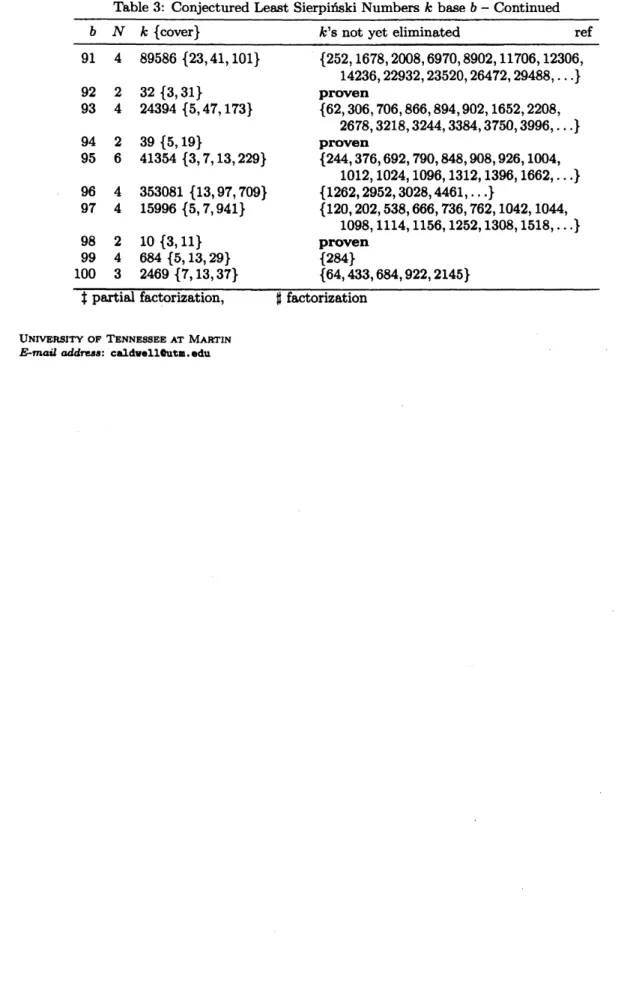
Table 3: Conjectured LeastSierpi\’{n}ski Numbers $k$ base$b$
$b$ $N$ $k$
{cover}
$k$’s not yet eliminated ref8 4 47 {3,5,13} proven 9 6 2344
{5,7,13,73}
{2036}
10 6 9175{7,11,13,73}
{7666}
[4] 11 6 1490{3,7,19,37}
proven [4] 12 4 521{5,13,29}
{404}
13 4 132{5,7,17}
proven 1424{3,5}
proven 15 24 91218919470156 $\{$13,17, {114258,148458,215432,405556, 113,211, 241,1489, 424074,.
..}
3877}
16 $\#$ 2500 proven 17 4 278{3,5,29}
$\{2u\}$ [4] 18 4 398{5,13,19}
{122}
19 12 765174{5,7,13,127,769}
{634,1446,2526,2716,3714,4506,
.
.
.}
20 2 8{3,7}
proven 21 4 1002{11,13,17}
proven 22 4 6694{5,23,97}
{1611,1908,4233,5128}
[4] 23 4 182{3,5,53}
{8,68}
24 12 30651{5,7,13,73,79}
{319,621,656,821,
1099,1851, 1864,2164, 2351, 2586, 3031,3051,3404, 3526,..
.}
25 6 262638{7,13,31,601}
{222,5550,6082,6436,7528,8644,10218,
10918, 12864,12988, 13026, 13548,...}
26 6 221 {3,7,19,37} {32,65,155} 27 $\#$ 8 proven 28 4 4554{5,29,157}
{871,2377,3394,4233,4552}
29 2 4{3,5}
proven 30 6 867{7,13,19,31}
{278,588}
31 12 6360528 $\{$7,13, 19,37,{10366,
13240,69120,70612,76848,331}
99450, 101980, 122806, 124812,...}
32 2 10{3,11}
proven 33 4 1854{5,17,109}
{766,1678,1818}
34 2 6{5,7}
proven 35 6 214018{3,
13,97,397}{46,
1610,2006,2272,2588,3046,3700, 3812,5518,8632, 8800, 9542,10222,.
..}
36 6 1886{13,31,37,43}
proven 37 4 2604{5,19,137}
{94,1272,
1866,2224} 38 2 14{3,13}
proven 39 6 166134{5,7,223,1483}
{2264,2414,2434,3254,3986,4226,..
.}
40 6 826477{7,41,223,547}
{4468,7092,9964,11112, 18285,...}
41 2 8{3,7}
proven 42 4 13372{5,43,353}
{116,988,1117,1421,2794,2903,
3046, 3226, 3897, 4127, 4297, 4643,...}
43 4 2256{5,
11,37}{166,648}
44 2 4 $\{$3,5} proven 45 6 53474{7,
19,23,109}
{474,1908,2444,3106,4530,4990,
6510, 6586, 6624, 7108, 8026, 9774,..
.}
46 6 14992{7,19,47,103}
{892,976,
1132,1798,3261,3477, 3961,4842, 5395, 6015, 6391, 6816,..
.}
47 4 8{3,5,13}
proven 48 6 1219{7,
13,61,181}
{29,36,62,
153,422,1174}
49 12 2944{5,
19,73,181,193}{1134,
1414,1456,2694,2746}BRUNNER, CALDWELL,KRYWARUCZENKO AND LOWNSDALE Table3: Conjectured LeastkConjecturedbaseLeastSierpiiiSki NumbersSierpiiiski Numbers base$b$-Continued
$b$ $N$ $k$
{cover}
$k$’s not yet eliminated ref50 2 16
{3,17}
proven 51 6 5183582{7,
13,379,2551}{5498,6280,6696,7682,8126,8412,
. ..}
52 4 28674{5,53,541}
{1483,1591,2386,3181,3232,3418,5619, 5776, 5988, 6147, 6891, 7147,8638,...}
53 4 IOS6{3,5,281}
{1816, 1838,1862,1892}
54
2 21{5,11}
proven 55 $4i$ 2500{7,17}
{1980,2274}
56 2 20{3,19}
proven 57 4 1188{5,13,29}
{378}
58 4 43071{5,59,673}
{222,787,886,
1102,1923,2182,2656,2713, 3246,3511, 3541, 4021,5274, 6046,...}
59 2 4{3,5}
proven 60 4 16957{13,61,277}
{853,1646,2075,2497,4025,4406,4441,
5064, 5767, 6772,7262,7931,8923,...}
61 6 15168{7,
13,31,97} $\{1570,1u2,3390,3442,3936,6852,7348$, 8710, 8772, 8902, 9208, 9268, 9952,...}
62 2 8{3,7}
proven 63 $3i$ 3511808{37,109}
{3092,3230,4106,7622,
...}
64 2 51{5,13}
proven 65 2 10{3,11}
proven
66
24 21314443 $\{$7,17,37,67,{470,2076,4153,5442,6835,
13201, 73,4357}
17035,...}
67 4 18342{5,17,449}
{154,460,1494,2196,2362,2806,2872,
2874, 3384, 4062, 4618,4996,5668,...}
68 2 22{3,23}
{12,17}
69 2 6{5,7}
proven 70 4 11077{13,29,71}
{3762,4119,5608,9231,10438}
71 18 5917678826 $\{$3,19,37,73,{172,502,508,1942,2782,3776,4490,5002,
1657,5113}
5078, 5266, 5330, 5632, 5950,6338,.. .}
72 4 731{5,61,73}
{493,647}
73 4 1444{5,
13,37}{778,
1344}
74 2 4{3,5}
proven 75 6 4086{7,13,19,61}
{2336,2564,3782}
76 2 43{7,11}
proven 77 2 14{3,13}
proven 78 4 186123{5,79,1217}
{2371,4820,4897,5294,5531,6353,
...}
79 6 2212516{5,7,43,6163}
{24,594,724,1086,
1654,1774,1896,.
..}
80 12 1039{3,7,
13,43,173}{86,92,166,
188,295,326,370,433,472,556 623, 628,692, 770, 778,787, 818, 857,968}
81 $\#$ 2500 {558,1650,2036, 2182, 2350,2378}
82 12 19587{5,7,13,37,83}
{1251,1327, 1570, 1716, 1798, 1908,2251, 2352, 2461,2491, 2731, 2989, 3342,...}
83 2 8{3,7}
proven 84 2 16{5,17}
proven 85 6 346334170 $\{$37,43,193,{7612,11740,27168,31776,32550,34014,
2437}
35088, 36508, 43474, 48204, 50352,...}
86 2 28{3,29}
{8}
87 6 274{7,11,
19,31}{32}
88 12 4093{5,7,31,37,89}
{192,244,958,978,
1452,1585,1678,1779, 2007, 2617, 2838, 3396,.
..}
89 2 4{3,5}
proven 90 2 27{7,13}
provenGENEHALIZING SIERPINSKI NUMBERS TO BASE$b$
Table3: ConjecturedkConjecturedLeastbaseLeastSierpidSkiSierpinski NumbersNumbers base$b$-Continued
$\frac{bNk\{cover\}k’ snotyete\lim inatedref}{91489586\{23,41,101\}}$
{252,
1678,$2m8$,6970,8902,11706, 12306, 14236, 22932, 23520, 26472, 29488,...}
92 2 32{3,31}
proven 93 4 24394{5,47,173}
{62,306,706,866,894,902,1652,2208,
2678, 3218, 3244,$33u$, 3750, 3996,...
$\}$ 94 2 39{5,19}
proven 95 6 41354{3,7,13,229}
{244,376,692,790,848,908,926,
1004, 1012, 1024, 1096, 1312, 1396, 1662,...}
96 4 353081 $\{$13,97,709}{1262,2952,3028,4461,
. .
.}
97 4 15996{5,7,941}
{120,202,538,666,736,762,
1042, 1044, 1098,1114, 1156, 1252,1308, 1518,...}
98 2 10{3,11}
proven 99 4 684{5,13,29}{284}
100 3 2469{7,
13,37}{64,433,684,922,2145}
$\ddagger$ partial factorization, $\#$factorization
UNIVERSITYOFTENNESSEEAT MARrIN E-mail address: caldwel$10utn$