Higher-order
Schr\"odinger
operators
with singular
potentials
東京理科大学・理 岡沢 登 (Noboru Okazawa)
東京理科大学・理D1 田村 博志 (Hiroshi Tamura)
東京理科大学・理 横田 智巳 (Tomomi Yokota)
Department of Mathematics, Science University of Tokyo
Abstract. Theselfadjointness of$\Delta^{2}+\kappa|x|^{-4}(\kappa\in \mathbb{R})$in $L^{2}(\mathbb{R}^{N})$ and the7Yl-accretivity of
$\Delta^{2}+\kappa|x|^{-4}(\kappa\in \mathbb{C})$ in $L^{2}(\mathbb{R}^{N})$ are established ais applications of perturbation theorems
for nonnegative selfadjoint operators. The key lies in two new inequalities derived by
using two real orcomplex parameters.
1.
Introduction
and
results
Let $N\in \mathbb{N}$
.
Then this paper is concerned with the selfadjointness of$\Delta^{2}+\kappa|x|^{-4}$ (when$\kappa\in \mathbb{R})$, and the m-accretivity of$\Delta^{2}+\kappa|x|^{-4}$ (when $\kappa\in \mathbb{C}$) in the (complex) Hilbert space
$L^{2}(\mathbb{R}^{N})$
.
Here $\Delta^{2}$and$|x|^{-4}$ arenonnegative selfadjoint operators in $L^{2}(\mathbb{R}^{N})$, with domains
$D(\Delta^{2});=H^{4}(\mathbb{R}^{N})$ and $D(|x|^{-4});=\{u\in L^{2}(\mathbb{R}^{N});|x|^{-4}u\in L^{2}(\mathbb{R}^{N})\}$, respectively.
First we consider the selfadjointness of $\Delta^{2}+\kappa|x|^{-4}(\kappa\in \mathbb{R})$
.
On the one hand, it isworth noticing that the relation betweensimpleroperators $-\Delta$ and $|x|^{\sim 2}$ is already known
as a model
case.
In [8] it ha.$s$ been proved that $-\Delta+t|x|^{-2}$ is m-accretive in $L^{p}(\mathbb{R}^{N})$ for$t>a_{0}(p)$ and $-\Delta+a_{0}(p)|x|^{-2}$ is essentially m-accretive in $L^{p}(\mathbb{R}^{N})(1<p<\infty)$, where $a_{0}(p)$ is defined as
$a_{0}(p):=\{\begin{array}{ll}p^{-2}(p-1)(2p-N)N, 2(1-N^{-1})\leq p<\infty,-p^{-2}(p-1)(N-2)^{2}, 1<p<2(1-N^{-1}).\end{array}$
In particular, if $p=2$, then $a_{0}(2)=4^{-1}(4-N)N$ and m-accretivity is replaced with
nonnegative selfadjointness. A proofofthe selfadjointness in [7] isbased on the inequality
${\rm Re}(-\Delta u, (|x|^{2}+n^{-1})^{-1}u)\geq-a_{0}(2)\Vert(|x|^{2}+n^{-1})^{-1}u\Vert^{2}$, $u\in H^{2}(\mathbb{R}^{N})$,
where $(|x|^{2}+n^{-1})^{-1}=|x|^{-2}(1+7|^{-1}|x|^{-2})^{-1}$ is the Yosida approximation of $|x|^{-2}(n\in \mathbb{N})$
.
On the other hand, there
seems
to be few works about the selfadjointness of higher orderelliptic operators. In [6] Nguyen discussed the selfadjointness of general
even
order ellipticoperators under several assumptions. However, his result cannot be applied to determine
the critical bound of $\kappa$ for the selfadjointness of $\Delta^{2}+\kappa|x|^{-4}$
.
The first purpose of this paper is to establish the following
Theorem 1.1. Put $A:=\Delta^{2}$ and $B:=|x|^{-4}$
.
Let $\kappa_{0}(N)$ bedefined
asThen the following (i) and (ii) hold.
(i)
If
$N\leq 8$, then $B$ is $(A+\kappa B)$-boundedfor
$\kappa>\kappa_{0}(N)o_{*}s$$\Vert Bu\Vert\leq(\kappa-\kappa_{0}(N))^{-1}\Vert(A+\kappa B)u\Vert$, $u\in D(A+\kappa B):=D(A)\cap D(B)$,
and $A+\kappa B$ is nonnegative selfadjoint
for
$\kappa>\kappa_{0}(N)$.
Moreover, $A+\kappa_{0}(N)B$ isnonneg-ative and essentially selfadjoint.
(ii)
If
$N\geq 9_{f}$ then $B$ is A-boundedas
(1.2) $\Vert B\uparrow\nu\Vert\leq\frac{16}{N(N-8)(N^{2}-16)}\Vert Au\Vert$ , $u\in D(A)\subset D(B)$,
and $A+\kappa B$ is nonnegative selfadjoint
for
$\kappa>\kappa_{0}(N)$.
Moreover, $A+\kappa_{0}(N)B$ isnonneg-ative and essentially selfadjoint in $L^{2}(\mathbb{R}^{N})$
.
Next
we
shall find $\Omega\subset \mathbb{C}$ such that $\{\Delta^{2}+\kappa|x|^{-4};\kappa\in\Omega\}$ is a holomorphic family oftype (A) in the sense of Kato [4, Section VII.2]. We review it in a simple case.
Definition 1. Let $X$ be $a$
oeflexive
complex Banach space. Let $\Omega$ bea
domain in $\mathbb{C}$ and$\{T(\kappa);\kappa\in\Omega\}$
a
familyof
linear operators in X. Then $\{T(\kappa);\kappa\in\Omega\}$ is said to bea
holomorphic family
of
type $(A)$if
(i) $T(\kappa)$ is closed in $X$ and $D(T(\kappa))=D$ independent
of
$\kappa$;(ii) $\kappa\mapsto T(\kappa)u$ is holomorphic in $\Omega$
for
every $u\in D$.
Kato [5] proved that $\{-\Delta+\kappa|x|^{-2};\kappa\in\Omega_{1}\}$ forms
a
holomorphic family oftype (A)in $L^{2}(\mathbb{R}^{N})$, where
$\Omega_{1}:=\{\xi+i\eta\in \mathbb{C};\eta^{2}>4(\beta-\xi)\}$, $\beta:=(N-2)^{2}/4$
.
Borisov-Okazawa [1] proved that $\{d/dx+\kappa|x|^{-1};\kappa\in\Omega_{2}\}$ forms a holomorphic family of
type (A) in $L^{p}(0, \infty)(1<p<\infty)$, where
$\Omega_{2}:=\{\kappa\in \mathbb{C};{\rm Re}\kappa>-\frac{1}{p}\}$ , $p^{-1}+p^{\prime-1}=1$
.
In both $ca_{\wedge}ses$ it is essential to find $\Sigma_{j}$ $:=\Omega_{j^{\mathbb{C}}}$, the complement of$\Omega_{j}(j=1,2)$. Concerning
forth order elliptic operators, there seems to be no preceding work on holomorphic family
of type (A). So we clarify the region where $\Delta^{2}+\kappa|x|^{-4}$ forms a holomorphic family of
type (A) and where $\Delta^{2}+\kappa|x|^{-4}$ is m-accretive in $L^{2}(\mathbb{R}^{N})$ (the definition of (regular)
m-accretivity will be given in Section 3). Our second result here is stated
as
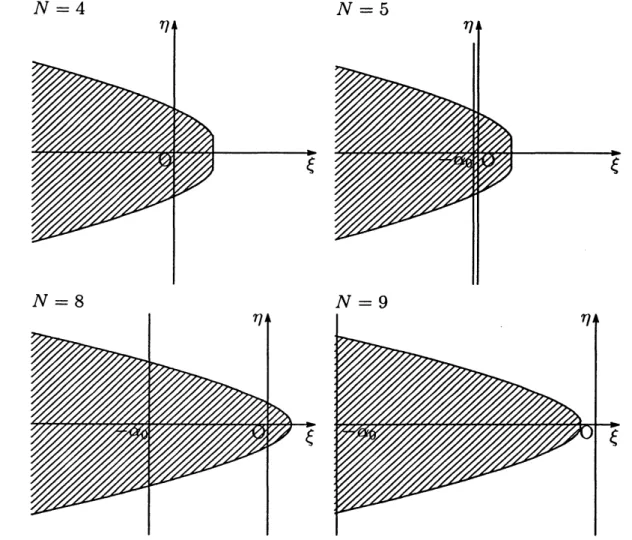
follows.Theorem 1.2. Let $A$ and $B$ be the
same as
in Theorem 1.1. Let $\Sigma$ be a closedconvex
subset
of
$\mathbb{C}$ (see Figure 1) such that$\Sigma:=\{\xi+i\eta\in \mathbb{C};\xi\leq k_{1},$ $\eta^{2}\leq 64(\sqrt{k_{1}-\xi}+(10+N-\frac{N^{2}}{4}))(\sqrt{k_{1}-\xi}+8)^{2}\}$,
where the constant $k_{1}$ is
defined
in (1.1); replace $\Sigma$ withif
$N\geq 9$ [the constant $k_{2}$ is alsodefined
in (1.1)]. Then the following (i) and (ii) hold.(i) $B$ i,s $(A+\kappa B)$-bounded
for
$\kappa\in\Sigma^{c}$, with$\Vert Bu\Vert\leq$ dist$(\kappa, \Sigma)^{-1}\Vert(A+\kappa B)u\Vert$, $u\in D(A)\cap D(B)$,
and $\{A+\kappa B;\kappa\in\Sigma^{c}\}$
forms
a holomorphic familyof
type (A) in $L^{2}(\mathbb{R}^{N})$.
(ii) $A+\kappa B$ is m-accretive
on
$D(A)\cap D(B)$for
$\kappa\in\Sigma^{c}$ with ${\rm Re}\kappa\geq-\alpha_{0},$ $A+\kappa B$is regularly m-accretive on $D(A)\cap D(B)$
for
$\kappa\in\Sigma^{c}$ with ${\rm Re}\kappa>-\alpha_{0}$ and $A+\kappa B$ isessentially m-accretive in $L^{2}(\mathbb{R}^{N})$
for
$\kappa\in\partial\Sigma$ with ${\rm Re}\kappa\geq-\alpha_{0}$, where $\alpha_{0}$ isdefined
as
(1.3) $\alpha_{0}:=\{$ $\frac{0N^{2}}{16}(N-4)^{2}$
, $N\geq 5$
.
$N\leq 4$,In particular,
if
$\kappa\in \mathbb{R}$, then m-accretivity can be replaced with nonnegative selfadjointness.Figure 1: The images of $\Sigma$ for $N=4,5,8,9$ and the value of
$-\alpha_{0}$
The constant $\alpha_{0}$ in (1.3) appears in the Rellich inequality
In [3] Davies-Hinz have shown Hardy or Rellich type inequalities between $(-\triangle)^{m}$ and $|x|^{-2m}(m\in \mathbb{N})$, and it helps us to construct the theory of the selfadjointness.
In Section 2 we review abstract theorems ba.sed on [8]. In Section 3 we prepare
abstract theorems ba.sed on Kato [5] (however, the$a_{\wedge}ss\iota imption$ and conclusions
are
slightlychanged). In Section 4 we derive some new inequalities by using two real parameters and
prove Theorem 1.1 by applying abstract theorems prepared in Section 2. In Section 5 we
generalize inequalities obtained in Section 4 by using two complex parameters and prove
Theorem 1.2 by applying abstract theorenis prepared in Section 3.
2.
Perturbation theory toward Theorem
1.1
This section is a short review of the perturbation theory developed in [7] and [8] for
m-accretive operators in a Banach space. The following two theorems
are
the specialcases of those in [8].
Theorem 2.1 ([8, Theorem 1.6]). Let $A$ and $B$ be nonnegative selfadjoint operators in
a
Hilbert space H. Let $B_{\epsilon}$ $:=B(1+\epsilon B)^{-1}$ be the Yosida approximationof
B. Assumethat there exists some $k_{0}\geq 0$ such that
(2.1) ${\rm Re}(Au, B_{\epsilon}u)\geq-k_{0}\Vert B_{\epsilon}u||^{2}$, $u\in D(A)$.
Then $B$ is $(A+kB)$-bounded
for
$k>k_{0}$as
(2.2) $\Vert Bu\Vert\leq(k-k_{0})^{-1}\Vert(A+kB)u\Vert$, $u\in D(A+kB)$,
and hence $A+kB$ is closed in $H$
for
$k>k_{0}$.
Moreover, $A+kB$ is nonnegative selfadjointon
$D(A)\cap D(B)$for
$k>k_{0}\geq 0$ and $A+k_{0}B$ is nonnegative and essentially selfadjointin $H$
.
Theorem 2.2 ([8, Theorem 1.7]). Let $A,$ $B$ and $B_{\epsilon}$ be the
same
as those in Theorem2.1. Assume that there exists
some
$m_{1}>0$ such that(2.3) ${\rm Re}(Au, B_{\epsilon}u)\geq m_{1}\Vert B_{\epsilon}u\Vert^{2}$, $u\in D(A)$.
Then $B$ is A-bounded as
(2.4) $\Vert Bu\Vert\leq m_{1}^{-1}\Vert Au\Vert$, $u\in D(A)\subset D(B)$,
and $A+kB$ is closed in $H$
for
$k>-m_{1}$. Assumefurther
that there eristssome
$m_{2}\geq\sqrt{m_{1}}$such that $m_{2}^{2}(B_{\epsilon}u, u)\leq(Au, u),$ $u\in D(A)$,
or
equivalently(2.5) $m_{2}\Vert B^{1\prime 2}(1+\epsilon B)^{-1\prime 2}v\Vert\leq\Vert A^{1\prime 2}v\Vert$, $v\in D(A^{1\prime 2})$
Then $A+kB$ is nonnegative selfadjoint in $H$
for
$k>-k_{1z}$ and $A-k_{1}B$ is nonnegative3. Perturbation
theory
toward
Theorem 1.2
First we review some definitions required to state Theorems 3.1 and 3.5. Let $A$ be a
linear operator with domain $D(A)$ and range $R(A)$ in a (complex) Hilbert space $H$. Then
$A$ is said to be accretive if ${\rm Re}$(Au,
$u$) $\geq 0$ for every $\dot{\tau}\iota\in D(A)$. An accretive operator $A$ is
said to be m-accretive if $R(A+1)=H$. An m-accretive operator $A$ is said to be regularly
m-accretive if $A$ satisfies for some $\omega\in[0, \pi/2)$ that
$|{\rm Im}$(Au,$u$)$|\leq(\tan\omega){\rm Re}$ (Au,$u$), $u\in D(A)$.
Let $A$ be m-accretive in $H$. Then $R(A+\lambda)=H$ holds, with
$\Vert(A+\lambda)^{-1}\Vert\leq({\rm Re}\lambda)^{-1}$ $\forall\lambda\in \mathbb{C}$ with ${\rm Re}\lambda>0$.
Therefore we can define the Yosida approximation $\{A_{\epsilon};\epsilon>0\}$ of $A$:
$A_{\epsilon}:=A(1+\epsilon A)^{-1}$
A nonnegative selfadjoint operator is a typical example of m-accretive operator, while a
symmetric m-accretive operator is nonnegative and selfadjoint (see Br\’ezis [2, Proposition
$V\mathbb{I}.6]$ or Kato [4, Problem V.3.32]$)$.
Next we consider the m-accretivity of$A+\kappa B(\kappa\in \mathbb{C})$ where $A$ and $B$ are nonnegative
selfadjoint operators. Since m-accretive operators are closed and densely defined, we will
first find the set of $\kappa\in \mathbb{C}$ where $A+\kappa B$ is closed (and densely defined). Hence we can
connect the two notions of m-accretivity and holomorphic family of closed operators.
Theorem 3.1. Let $A$ and $B$ be nonnegative selfadjoint operators in H. Let $\Sigma\subset \mathbb{C}_{f}$ and
$\gamma$ : $\mathbb{R}arrow \mathbb{R}$. Assume that $\Sigma$ and $\gamma$ satisfy $(\gamma 1)-(\gamma 4)$ and $(\gamma 5)_{0}$ :
$(\gamma 1)\gamma$ is continuous $and-\gamma$ is convex,
$(\gamma 2)\gamma(\eta)=\gamma(-\eta)$
for
$\eta\in \mathbb{R}$, $(\gamma 3)\Sigma=\{\xi+i\eta\in \mathbb{C};\xi\leq\gamma(\eta)\}$,$(\gamma 4)-(Au, B_{\epsilon}u)\in\Sigma$
for
$u\in D(A),$ $\Vert B_{\epsilon}u\Vert=1$for
any $\epsilon>0$,$(\gamma 5)_{0}0\leq\gamma(0)\Leftrightarrow 0\in\Sigma$
.
Then the following (i) and (ii) hold.
(i) $B$ is $(A+\kappa B)$-bounded
for
$\kappa\in\Sigma^{c}$, with(3.1)
11
$Bu||\leq$ dist$(\kappa, \Sigma)^{-1}\Vert(A+\kappa B)u\Vert$, $u\in D(A)\cap D(B)$,and $\{A+\kappa B;\kappa\in\Sigma^{c}\}$
forms
a
holomorphicfamilyof
type (A).(ii) $A+\kappa B$ is m-accretive in $H$
for
$\kappa\in\Sigma^{c}$ with ${\rm Re}\kappa\geq 0,$ $A+\kappa B$ is regularlym-accretive in $H$
for
$\kappa\in\Sigma^{c}$ with ${\rm Re}\kappa>0$ and $A+\kappa B$ is essentially m-accretive in $H$for
$\kappa\in\partial\Sigma$ with ${\rm Re}\kappa\geq 0$.The proofof Theorem 3.1 is divided into several lemmas.
Proof. Let $\kappa\in\Sigma^{c}$ and $\epsilon>0$. To prove (3.1) we shall show that
(3.2) $\Vert B_{\epsilon}u\Vert\leq$ dist $(\kappa, \Sigma)^{-1}\Vert(A+\kappa B_{\epsilon})u\Vert$ , $u\in D(A)$.
Here we may assume that $B_{\epsilon}u=B(1+\epsilon B)^{-1}u\neq 0$. Setting $v$ $:=\Vert B_{\epsilon}u\Vert^{-1}u$, we see that
$v\in D(A)$ and $\Vert B_{\epsilon}v\Vert=1$
.
it then follows from $(\gamma 4)$ that $-(Av, B_{\epsilon}v)\in\Sigma$.
Since $\Sigma$ isclosed and
convex
by $(\gamma 1)$, we have$0<$ dist $(\kappa, \Sigma)\leq|\kappa+(Av, B_{\epsilon}v)|=\Vert B_{\epsilon}\uparrow 4\Vert^{-2}|((A+\kappa B_{\epsilon})u, B_{\epsilon}u)|$,
and hence $\Vert B_{\epsilon}u\Vert^{2}\leq$ dist $(\kappa, \Sigma)^{-1}|((A+\kappa B_{\epsilon})u, B_{\epsilon}u)|$. Now the Cauchy-Schwarz inequality
applies to give (3.2). Letting $\epsilon\downarrow 0$ in (3.2) with $u\in D(A)\cap D(B)$ yields (3.1). The
closedness of $A+\kappa B$ is a consequence of (3.1). This completes the proofof (i) in Theorem
3.1 口
Lemma 3.3. $A+\kappa B$ is m-accretive in $H$
for
$\kappa\in\Sigma^{c}$ with ${\rm Re}\kappa\geq 0$. In particular,if
${\rm Re}\kappa>0$, then $A+\kappa B$ is regularly m-accretive in $H$, with
(3.3) $|{\rm Im}((A+\kappa B)u, u)|\leq(\tan|\arg\kappa|){\rm Re}((A+\kappa B)u, u)$, $u\in D(A)\cap D(B)$
.
Proof. Since the sum of accretive operators is also accretive, it suffices to show that
(3.4) $R(A+\kappa B+\lambda)=H$, $\lambda>0$
for $\kappa\in\Sigma^{c}$ with ${\rm Re}\kappa\geq 0$. Since $A+\kappa B_{\epsilon}$ is also m-accretive (see [10, Corollary 3.3.3]),
for $f\in H$ and $\epsilon>0$ there exists a unique solution $u_{\epsilon}\in D(A)$ of approximate equation
(3.5) $Au_{\epsilon}+\kappa B_{\epsilon}u_{\epsilon}+\lambda u_{\epsilon}=f$,
satisfying $\Vert u_{\epsilon}||\leq\lambda^{-1}\Vert f\Vert$ and hence $\Vert Au_{\epsilon}+\kappa B_{\epsilon}u_{\epsilon}$
II
$=\Vert f-\lambda u_{\epsilon}$II
$\leq 2||f||$.
Therefore wesee from (3.2) that
$\Vert B_{\epsilon}u_{\epsilon}\Vert\leq 2$ dist $(\kappa, \Sigma)^{-1}\Vert f\Vert$,
and hence $\Vert Au_{\epsilon}\Vert\leq 2(1+|\kappa|$dist$(\kappa,$ $\Sigma)^{-1})\Vert f\Vert$. Thus $\Vert u_{\epsilon}\Vert,$ $\Vert$Au,
11
and $\Vert B_{\epsilon}u_{\epsilon}\Vert$are
boundeda.s $\epsilon$ tends to zero. This implies that there exist convergent subsequences $\{u_{\epsilon_{n}}\},$ $\{Au_{\epsilon_{n}}\}$
and $\{B_{\epsilon_{n}}u_{\epsilon_{\mathfrak{n}}}\}=\{B(1+\epsilon_{n}B)^{-1}u_{\epsilon_{n}}\}$ for some null sequence $\{\epsilon_{n}\}$. Since $A$ and $B$
are
(weakly) closed, there exists $u:=w-$lini$narrow\infty^{u}\epsilon_{n}\in D(A)\cap D(B)$ such that
$Au_{\epsilon_{n}}arrow Au$ and $B_{\epsilon_{\mathfrak{n}}}u_{\epsilon_{n}}arrow Bu(narrow\infty)$ weakly;
note that $u_{\epsilon}-(1+\epsilon B)^{-1}u_{\epsilon}=\epsilon B_{\epsilon}u_{\epsilon}$
.
Letting $narrow\infty$ in (3.5) with $\epsilon=\epsilon_{n}$ in the weaktopology of $H$, we obtain (3.4). The regular m-accretivity of $A+\kappa B$ for $\kappa\in\Sigma^{c}$ with
${\rm Re}\kappa>0$ follows to consider the numerical range of $A+\kappa B$; $((A+\kappa B)u, u)=||A^{1/2}u||^{2}+\kappa||B^{1/2}u||^{2}$
$\in\{a+\kappa b\in \mathbb{C};a\geq 0, b\geq 0\}$
$\subset\{z\in \mathbb{C};|\arg z|\leq|\arg\kappa|\}$, $u\in D(A)\cap D(B)$.
Lemma 3.4. The closure
of
$A+\kappa B$ is m-accretive in $H$for
$\kappa\in\partial\Sigma$ with ${\rm Re}\kappa\geq 0$.Proof. Let $\kappa\in\partial\Sigma$ with ${\rm Re}\kappa\geq 0$. First we note that $A+\kappa B$ is closable and its
closure is also accretive (cf. [10, Theorem 1.4.5]). Now $(\gamma 1)$ means that there exists
some
(not unique in general) unit outward normal vector $\nu$ of $\partial\Sigma$ at $\kappa$.
This implies that$\kappa+t\nu\in\Sigma^{c}(t>0)$, with the properties:
${\rm Re}(\kappa+t\nu)\geq 0$, dist $(\kappa+t\nu, \Sigma)=t$, $t>0$.
This implies that $A+\kappa B(\kappa\in\partial\Sigma)$ is approximated by $A+(\kappa+\nu n)B(\kappa+\nu n\in\Sigma^{c})$
with $n\in \mathbb{N}$. Since ${\rm Re}\kappa+\nu\prime n\geq 0$, we
see
that $A+(\kappa+(\nu/n))B$ is m-accretive (seeLemma 3.3), that is, $f\in H$ there exists a unique solution $u_{n}\in D(A)\cap D(B)$ of
(3.6) $(A+\kappa B)u_{n}+(\nu/n)Bu_{n}+\lambda u_{n}=Au_{n}+(\kappa+(\nu n))B\tau x_{n}+\lambda u_{n}=f$,
satisfying
(3.7) $\Vert u_{n}\Vert\leq\lambda^{-1}\Vert f\Vert$
.
Now we can prove that
11
$(\nu/n)B?4_{n}\Vert=n^{-1}\Vert Bu_{n}$Il
$\leq 2\Vert f\Vert$. In fact, it follows from (3.1)that
$\Vert Bu_{n}\Vert\leq$ dist$(\kappa+n^{-1}\nu, \Sigma)^{-1}\Vert(A+(\kappa+\nu n)B)\tau x_{n}\Vert=n\Vert f-\lambda u_{n}\Vert$
$\leq 2n\Vert f\Vert$
.
This yields together with (3.6) that
(3.8) $\Vert(A+\kappa B)u_{n}\Vert\leq 4\Vert f\Vert$ $\forall n\in \mathbb{N}$
To finish the proofwe show that $(\nu\prime n)Bu_{n}$ converges to
zero
weakly in $H$.
It follows from(3.7) that for every $v\in D(B)$,
$|((\nu n)Bu_{n}, v)|=n^{-1}|(u_{n}, Bv)|\leq n^{-1}\lambda^{-1}\Vert f\Vert\cdot\Vert Bv\Vertarrow 0,$ $narrow\infty$
.
Since $D(B)$ is dense in $H$ and $n^{-1}\Vert Br4_{t}n\Vert$ is bounded, we can conclude that $n^{-1}B\tau x_{n}arrow 0$
weakly $a_{\iota}snarrow\infty$. Now let $\{u_{n_{k}}\}$ be a convergent subsequence of $\{u_{n}\}$ and put $u:=w-$ $\lim_{karrow\infty}u_{n}k$. Then we have
$(A+\kappa B)u_{n_{k}}=f-\lambda?4_{n_{k^{-}}}(\nu/n)Bu_{n_{k}}$ $arrow f-\lambda u(karrow\infty)$ weakly.
It follows from the (weak) closedness that $u\in D((A+\kappa B)^{\sim})$ and $(A+\kappa B)^{\sim}u+\lambda u=f$
ThisCompleteStheprOOfof eSSentialm-aCCretiVity of$A+\kappa B$ fOr $\kappa\in\partial\sum$with ${\rm Re}\kappa\geq 0$
.
口Theorem 3.5. Let $H,$ $A,$ $B,$ $B_{\epsilon},$ $\Sigma$ and
$\gamma$ be the
same as
those in Theorem 3.1 with$(\gamma 1)-(\gamma 4)$. Let $\alpha_{0}>0$. Assume that $B_{\epsilon}^{1/2}$
is $A^{1/2}$-bounded, with
(3.9) $\alpha_{0}\Vert B_{\epsilon}^{1/2}u\Vert^{2}\leq\cdot\Vert A^{1/2}u\Vert^{2}$, $u\in D(A^{1’ 2})$.
Assume
further
that $\Sigma$ and$\gamma$ satisfy $(\gamma 5)_{\alpha_{0}}$ instead
of
$(\gamma 5)_{0}$:$(\gamma 5)_{\alpha 0}-\alpha_{0}\leq\gamma(0)$
.
Then the following (i) and (ii) hold.
(i) $B$ is $(A+\kappa B)$-bounded
for
$\kappa\in\Sigma^{c}$, with(3.10) $\Vert Bu\Vert\leq$ dist$(\kappa, \Sigma)^{-1}\Vert(A+\kappa B)u\Vert$, $u\in D(A)\cap D(B)$,
and $\{A+\kappa B;\kappa\in\Sigma^{c}\}$
forms
a holomorphicfamilyof
type (A). In particular,if
$\gamma(0)<0$,then $B$ is A-bounded with
(3.11) $\Vert Bu\Vert\leq$ dist$(0, \Sigma)^{-1}\Vert Au\Vert$, $u\in D(A)\subset D(B)$
.
(ii) $A+\kappa B$ is m-accretive in $H$
for
$\kappa\in\Sigma^{c}$ with ${\rm Re}\kappa\geq-\alpha_{0}$ and $A+\kappa B$ is essentiallym-accretive in $H$
for
$\kappa\in\partial\Sigma$ with ${\rm Re}\kappa\geq-\alpha_{0}$. Moreover, $A+\kappa B$ is regularly m-accretivein $H$
for
$\kappa\in\Sigma^{c}$ with ${\rm Re}\kappa>-\alpha_{0}$, with(3.12) $|{\rm Im}((A+\kappa B)u, u)|\leq(\tan|\arg(\kappa+\alpha_{0})|){\rm Re}((A+\kappa B)u, u)$, $u\in D(A)\cap D(B)$
.
Proof. (i) The closedness of $A+\kappa B$ for $\kappa\in\Sigma^{c}$ is a consequence of Theorem 3.1. Noting
that $\gamma(0)<0$ implies $0\in\Sigma^{c}$, we see from $(\gamma 4)$ that if $\gamma(0)<0$, then
(3.13) $\Vert B_{\epsilon}u\Vert\leq$ dist$(0, \Sigma)^{-1}\Vert Au\Vert$, $\epsilon>0,$ $u\in D(A)$.
Letting $\epsilon\downarrow 0$ in (3.13) for $u\in D(A)$,
we
obtain (3.11).(ii) Let $f\in H,$ $\lambda>0$ and $\kappa\in\Sigma^{c}$ with ${\rm Re}\kappa\geq-\alpha_{0}$. Then we consider the equation
(3.14) $Au,$ $+\kappa B_{\epsilon}u_{\epsilon}+\lambda u_{\epsilon}=f$.
In order to prove $R(A+\kappa B+\lambda)=H$ we only have to show that
11
$u_{\epsilon}\Vert,$ $||Au_{\epsilon}||$ and $||B_{\epsilon}u_{\epsilon}||$ are bounded as $\epsilon$ tends to zero. (3.9) implies that $A+\kappa B_{\epsilon}$ is accretive:${\rm Re}((A+\kappa B_{\epsilon})u, u)=\Vert A^{1\prime 2}u\Vert^{2}+({\rm Re}\kappa)||B_{\epsilon}^{1’ 2}u\Vert^{2}$
$\geq(\alpha_{0}+{\rm Re}\kappa)\Vert B_{\epsilon}^{1/2}u\Vert^{2}$
$\geq 0$.
The accretivity of $A+\kappa B_{\epsilon}$ yields that $\Vert u_{\epsilon}\Vert\leq\lambda^{-1}\Vert f\Vert$
.
$(\gamma 1)-(\gamma 4)$ yield that there exists$c>0$ such that $\Vert$Au,$\Vert\leq c\Vert f\Vert$ and $\Vert B_{\epsilon}\tau\iota_{\epsilon}\Vert\leq c\Vert f\Vert$. As in the proof of Theorem 3.1, we
obtain $R(A+\kappa B+\lambda)=H$. In particular, if ${\rm Re}\kappa>-\alpha_{0}$, then the numerical range of
4. Proof of Theorem 1.1
In order to prove Theorem 1.1 we need
some
inequalities in the realor complex Hilbertspace $L^{2}(\mathbb{R}^{N})$. We review the following lemma proposed by Ozawa-Sasaki [9].
Lemma 4.1. [9, Theorem 1.1] Let $1\leq p<\infty$.
If
$v\in.L^{p}(\mathbb{R}^{N})$ and $x\cdot\nabla v\in L^{p}(\mathbb{R}^{N})$,then
(4.1) $\frac{N}{p}\Vert v\Vert\leq\Vert x\cdot\nabla v\Vert$.
Here we give a simple proof of (4.1) when $p=2$.
Proof. Let $v\in L^{2}(\mathbb{R}^{N})$ and $x\cdot\nabla v\in L^{2}(\mathbb{R}^{N})$. Integration by parts gives
(4.2) ${\rm Re}(\uparrow),$$x \cdot\nabla\uparrow))=-\frac{N}{2}\Vert\uparrow)\Vert^{2}$.
Then the Cauchy-Schwarz inequality applies to give (4.1). $\square$
Using two real parameters, we can obtain the following lemma which plays an
impor-tant role to derive
some
inequalities.Lemma 4.2.
If
$v\in L^{2}(\mathbb{R}^{N})$ and $|x|^{2}\Delta v\in L^{2}(\mathbb{R}^{N})$, then $|x||\nabla v|\in L^{2}(\mathbb{R}^{N})$ and(4.3) $0\leq\Vert|x|\nabla v\Vert^{4}+4\Vert x\cdot\nabla v\Vert^{2}\Vert v\Vert^{2}-2N\Vert|x|\nabla v\Vert^{2}\Vert v\Vert^{2}\leq\Vert|x|^{2}\Delta v\Vert^{2}\Vert v\Vert^{2}$
.
Proof. Let $v\in L^{2}(\mathbb{R}^{N})$ with $|x|^{2}\Delta v\in L^{2}(\mathbb{R}^{N})$ and $c_{1},$$c_{2}\in \mathbb{R}$
.
We start with the trivialinequality
(4.4) $0\leq\Vert|x|^{2}\Delta v+c_{1}x\cdot\nabla v+c_{2}v\Vert^{2}$
$=\Vert|x|^{2}\Delta v\Vert^{2}+c_{1}^{2}\Vert x\cdot\nabla v\Vert^{2}+c_{2}^{2}\Vert v\Vert^{2}$
$+2c_{1}{\rm Re}(x\cdot\nabla v, |x|^{2}\Delta v)+2c_{2}{\rm Re}(|x|^{2}\triangle v, v)+2c_{1}c_{2}{\rm Re}(v, x\cdot\nabla v)$ .
Integration by parts gives
(4.5) ${\rm Re}(x \cdot\nabla v,|x|^{2}\triangle v)=\sum_{j,k=1}^{N}{\rm Re}\int_{\mathbb{R}^{N}}|x|^{2}x_{j}\frac{\partial\tau}{\partial x_{j}}\overline{\frac{\partial^{2_{8)}}}{\partial x_{k}^{2}}}dx$
$=- \sum_{j,k=1}^{N}{\rm Re}\int_{R^{N}}(2x_{j}x_{k}\frac{\partial v}{\partial x_{j}}+|x|^{2}\delta_{jk}\frac{\partial v}{\partial x_{j}}+|x|^{2}x_{j}\frac{\partial^{2}v}{\partial x_{j}\partial x_{k}})\overline{\frac{\partial v}{\partial x_{k}}}dx$
$=-2 \Vert x\cdot\nabla v\Vert^{2}-\Vert|x|\nabla v\Vert^{2}-\frac{1}{2}\sum_{j,k=1}^{N}\int_{\mathbb{R}^{N}}|x|^{2}x_{j}\frac{\partial}{\partial x_{j}}|\frac{\partial v}{\partial x_{k}}|^{2}dx$
(4.6) $(|x|^{2}\triangle\uparrow),$ $v)= \sum_{k=1}^{N}\int_{R^{N}}|x|^{2}\overline{\uparrow)}\frac{\partial^{2}\uparrow)}{\partial x_{k}^{2}}dx$
$=- \sum_{k=1}^{N}\int_{R^{N}}(|x|^{2}\overline{\frac{\partial v}{\partial x_{k}}}+2x_{k}\overline{v})\frac{\partial v}{\partial x_{k}}dx$
$=-\Vert|x|\nabla v\Vert^{2}-2(x\cdot\nabla v, v)$
.
In view of (4.2) and (4.6) we have
(4.7) ${\rm Re}(|x|^{2}\triangle v, v)=-\Vert|x|\nabla\uparrow)\Vert^{2}+N\Vert v\Vert^{2}$
.
Putting (4.2), (4.5) and (4.6) in (4.4), we have
(4.8) $0\leq\Vert|x|^{2}\Delta v\Vert^{2}+(c_{1}^{2}-4c_{1})\Vert x\cdot\nabla v\Vert^{2}+(Nc_{1}-2c_{2})\Vert|x|\nabla\tau’\Vert^{2}$ $+c_{2}(c_{2}+2N-Nc_{1})\Vert v\Vert^{2}$.
Minimizing the right-hand side of (4.8), i.e., setting $c_{1}=2,$ $c_{2}=\Vert|x|\nabla v\Vert^{2}\Vert v\Vert^{2}$ for
$v\neq 0$, we can obtain the second inequality of (4.3). The first inequality of (4.3)
can
beshown by completing the square as
$( \Vert|x|\nabla v\Vert^{2}-N\Vert v\Vert^{2})^{2}+4\Vert v\Vert^{2}(\Vert x\cdot\nabla v\Vert^{2}-\frac{N^{2}}{4}\Vert v\Vert^{2})$
.
In fact, the nonnegativity of the second term is a consequence of (4.1). $\square$
Lemma 4.3. Let $\epsilon>0$. Then
(4.9) ${\rm Re}(\Delta^{2}u, (|x|^{4}+\epsilon)^{-1}\uparrow 4)\geq-\kappa_{0}(N)\Vert(|x|^{4}+\epsilon)^{-1}u\Vert^{2},$ $u\in H^{4}(\mathbb{R}^{N})$,
(4.10) $\Vert\Delta u\Vert^{2}\geq\alpha_{0}(N)\Vert(|x|^{2}+\epsilon)^{-1}u\Vert^{2},$ $u\in H^{2}(\mathbb{R}^{N}),$ $N\geq 5$
.
Here $\kappa_{0}(N)$ and $\alpha_{0}(N)$
are
defined
as
$\kappa_{0}(N);=\{\begin{array}{ll}112-3(N-2)^{2}, N\leq 8,-\frac{N}{16}(N-8)(N^{2}-16), N\geq 9,\end{array}$
$N^{2}$
$\alpha_{0}(N):=-(N-4)^{2},$ $N\geq 5$.
16
The approximate Rellich inequality (4.10) is already shown in [7, Theorem 6.8] in 1982.
Here we
can
give another proof of (4.10).Proof. First
we
shall prove (4.9). Put IP:$=(\Delta^{2}u, (|x|^{4}+\epsilon)^{-1}u)$ and $v:=(|x|^{4}+\epsilon)^{\sim 1}u$for $u\in H^{4}(\mathbb{R}^{N})$
.
Then IP is written as(4.11) IP $=(\Delta^{2}((|x|^{4}+\epsilon)v), v)$
$=(\Delta((|x|^{4}+\epsilon)v), \triangle v)$
$=(|x|^{4}\Delta v+8|x|^{2}x\cdot\nabla v+4(N+2)|x|^{2}v, \Delta v)+\epsilon\Vert\Delta v\Vert^{2}$ $=(|x|^{2}\triangle v+8x\cdot\nabla v+4(N+2)v, |x|^{2}\Delta v)+\epsilon\Vert\Delta v\Vert^{2}$
.
From (4.5) and (4.6) we have
(4.12) ${\rm Re}$IP $\geq\Vert|x|^{2}\triangle\uparrow’\Vert^{2}-16\Vert x\cdot\nabla v\Vert^{2}-8\Vert|x|\nabla\uparrow)\Vert^{2}+4N(N+2)\Vert v\Vert^{2}$
.
Applying Lemma 4.2 to the first term of the right-hand side of (4.12) multiplied by $\Vert v\Vert^{2}$,
we have
$\Vert v\Vert^{2}{\rm Re}$IP $\geq\Vert|x|\nabla v\Vert^{4}-12\Vert x\cdot\nabla v\Vert^{2}\Vert v\Vert^{2}$
-2(N $+$ 4)$|||$x$|\nabla$v$|$
鴎
$|$v$||$2 $+$ 4N(N $+$ 2)$||$v$||$4.
Since $\Vert x\cdot\nabla v\Vert^{2}\leq\Vert|x|\nabla v\Vert^{2}$, it follows that
(4.13) $\Vert v\Vert^{2}{\rm Re}$IP $\geq\Vert|x|\nabla v\Vert^{4}-2(N+10)\Vert|x|\nabla v\Vert^{2}\Vert v\Vert^{2}+4N(N+2)\Vert v\Vert^{4}$
$=[\Vert|x|\nabla v\Vert^{2}-(N+10)\Vert v\Vert^{2}]^{2}-[112-3(N-2)^{2}]\Vert v\Vert^{4}$
.
Hence we obtain ${\rm Re}$IP $\geq-[112-3(N-2)^{2}]\Vert v\Vert^{2}$. In particiilar, if $N\geq 9$, then we see
from Lemma4.1 that
$\Vert$
国 $\nabla v\Vert^{2}-(N+10)\Vert v\Vert^{2}\geq\Vert x\cdot\nabla v\Vert^{2}-(N+10)\Vert v\Vert^{2}$
$\geq(N^{2}\prime 4-N-10)\Vert v\Vert^{2}$
$\geq 0$
.
Applying this inequality to (4.13) implies
$\Vert v\Vert^{2}{\rm Re}$IP $\geq[(\frac{N^{2}}{4}-N-10)\Vert v\Vert^{2}]^{2}-[112-3(N-2)^{2}]\Vert v\Vert^{4}$
$=-[- \frac{N}{16}(N-8)(N^{2}-16)]\Vert v\Vert^{4}$
.
Therefore we obtain ${\rm Re}$IP $\geq-\kappa_{0}(N)\Vert v\Vert^{2}$ which is nothing but (4.9).
Next we give a simplified proof of (4.10). Let $v$ $:=(|x|^{2}+\epsilon)^{-1}u$ for $u\in H^{2}(\mathbb{R}^{N})$
.
Thenit follows from (4.2) that
${\rm Re}(-\Delta\uparrow\nu, (|x|^{2}+\epsilon)^{-1}u)={\rm Re}(-\triangle(|x|^{2}v+\epsilon v), v)$ $={\rm Re}(\nabla(|x|^{2}v+\epsilon v), \nabla v)$
$={\rm Re}(|x|^{2}\nabla v+2xv+\epsilon\nabla v, \nabla v)$
$=\Vert|x|\nabla v\Vert^{2}-N\Vert v\Vert^{2}+\epsilon\Vert\nabla v\Vert^{2}$
.
Hence Lemma 4.1 implies
${\rm Re}(-\Delta u, (|x|^{2}+\epsilon)^{-1}\uparrow 4)\geq\Vert x\cdot\nabla v\Vert^{2}-N\Vert v\Vert^{2}$
$\geq\frac{N}{4}(N-4)\Vert v\Vert^{2}$
.
Therefore the SChwarz inequality applieS to give $($410$)$ 口
Proof
of
Theorem 1.1. Let $H$ $:=L^{2}(\mathbb{R}^{N}),$ $A:=\Delta^{2}$ with $D(A)$ $:=H^{4}(\mathbb{R}^{N})$ and $B$ $:=|x|^{-4}$with $D(B)$ $:=\{u\in H;|x|^{-4}u\in H\}$
.
Then we see that $B_{\epsilon}=|x|^{-4}(1+\epsilon|x|^{-4})^{-1}=(|x|^{4}+$$\epsilon)^{-1}$ for $\epsilon>0$
.
Therefore Lemma 4.3 allows us to apply Theorem 2.1 with $k_{0}=\kappa_{0}(N)$ if5.
Proof
of
Theorem
1.2
In this section we generalize the inequalities obtained in Section 4. To see this
we
propose the generalized discriminant of bi-form in Hilbert spaces.
Lemma 5.1. Let $X$ be a complex Hilbert space with inner product $(\cdot,$$\cdot)x$ and
norm
11
$\Vert_{X}$.
Let $\varphi\in X,$ $c\in \mathbb{R}$ and letM.be
a
selfadjoint operator in X. Assume thatfor
every$\zeta\in D(M)$,
(5.1) $(M\zeta, \zeta)_{X}+2{\rm Re}(\varphi, \zeta)_{X}+c\geq 0$.
Then $M$ is nonnegative and
(5.2) $S_{1}11\epsilon>0p((M+\epsilon)^{-1}\varphi, \varphi)_{X}\leq c$.
In particular,
if
$M$ is positive, then(5.3) $(M^{-1}\varphi, \varphi)_{X}\leq c$.
Proof. First we shall show that $M$ is nonnegative. Considering $\zeta’\Vert\zeta\Vert_{X}$ instead of $\zeta$, it
suffices to show that $(M\zeta, \zeta)_{X}\geq 0$ for $\zeta\in D(M)$ with $\Vert\zeta$
Il
$x=1$. Let $t\in \mathbb{R}$ with $t\neq 0$.Then it follows from (5.1) with $\zeta$ replaced with $t\zeta$ that
$0\leq t^{2}(M\zeta, \zeta)_{X}+2t{\rm Re}(\varphi, \zeta)_{X}+c$
$\leq t^{2}(M\zeta, \zeta)_{X}+2|t|\Vert\varphi\Vert_{X}+c$
.
This is equivalent to
$-2|t|^{-1}\Vert\varphi\Vert_{X}-ct^{-2}\leq(M\zeta, \zeta)_{X}$.
Letting $|t|arrow\infty$ yields that $(M\zeta, \zeta)_{X}\geq 0$. Next we shall prove (5.2). Let $M_{\epsilon}$ $:=M+\epsilon$.
Since $M$ is nonnegative selfadjoint in $X$, we see that $M_{\epsilon}^{-1}$ is well-defined as a bounded
symmetric operator with $\Vert A\prime f_{\epsilon}^{-1}\zeta\Vert_{X}\leq\epsilon^{-1}\Vert\zeta\Vert_{X}$. Then (5.1) implies that
$0\leq(M_{\epsilon}\zeta, \zeta)_{X}+2{\rm Re}(\varphi, \zeta)_{X}+c$
$=(M_{\epsilon}(\zeta+M_{\epsilon}^{-1}\varphi), \zeta+M_{\epsilon}^{-1}\varphi)_{X}-(M_{\epsilon}^{-1}\varphi, \varphi)_{X}+c$.
Taking $\zeta=-M_{\epsilon}^{-1}\varphi$, we see that $(M_{\epsilon}^{-1}\varphi, \varphi)_{X}\leq c$ for $\epsilon>0$. Therefore we obtain (5.2).
In particular, if $M$ is positive, then we can take $\epsilon=0$. $\square$
Using two complex parameters, we can obtain the following lemma which is
a
strictversion of Lemma 4.1
Lemma 5.2.
If
$v\in L^{2}(\mathbb{R}^{N})$ and $x\cdot\nabla v\in L^{2}(\mathbb{R}^{N})$, then(5.4) $|{\rm Im}(v, x \cdot\nabla v)|^{2}\leq\Vert v\Vert^{2}(\Vert x\cdot\nabla v\Vert^{2}-\frac{N^{2}}{4}\Vert v\Vert^{2})$.
Proof. Let $v\in L^{2}(\mathbb{R}^{N})$ with $x\cdot\nabla v\in L^{2}(\mathbb{R}^{N})$. From the Schwarz inequality we have
(5.5) $|(v, x\cdot\nabla v)|^{2}\leq\Vert v\Vert^{2}\Vert x\cdot\nabla v\Vert^{2}$
.
If $X$ $:=\mathbb{C}^{2}$, then Lemma 5.1 is regarded a.s a
two-complex-parameter technique to
derive a new inequality.
Corollary 5.3. Let $M$ be
a
Hermite matnxon
$\mathbb{C}^{2}$ :$M=(\begin{array}{ll}b \gamma\overline{\gamma}a \end{array})$
where $a,$ $b\in \mathbb{R}$ and$\gamma\in \mathbb{C}$
.
Assume that thereare
$\varphi:={}^{t}(\overline{\alpha},$$\beta)\in \mathbb{C}^{2}$ and$c\in \mathbb{R}_{l}$ satisfying(5.1). Then it
follows from
(5.2) that$a|\alpha|^{2}+b|\beta|^{2}-2{\rm Re}(\alpha\beta\gamma)\leq c(ab-|\gamma|^{2})$
.
Setting $\alpha:=\alpha_{1}+i\alpha_{2},$ $\beta:=\beta_{1}+i\beta_{2}$, $\gamma$ $:=\gamma_{1}+i\gamma_{2}$,
one
has(5.6) $a\alpha_{2}^{2}+b\beta_{2}^{2}+c\gamma_{2}^{2}+2(\alpha_{1}\beta_{2}\gamma_{2}+\alpha_{2}\beta_{1}\gamma_{2}+\alpha_{2}\beta_{2}\gamma_{1})$
$\leq abc+2\alpha_{1}\beta_{1}\gamma_{1}-(a\alpha_{1}^{2}+l_{J}\beta_{1}^{2}+c\gamma_{1}^{2})$
.
The following lemma together with Lemma 5.2 give a strict version of Lemma 4.2.
Lemma 5.4.
If
$v\in L^{2}(\mathbb{R}^{N})$ and $|x|^{2}\Delta v\in L^{2}(\mathbb{R}^{N})$, then $|x||\nabla v|\in L^{2}(\mathbb{R}^{N})$ and(5.7) $[\Vert v\Vert^{2}{\rm Im}(x\cdot\nabla v, |x|^{2}\Delta v)-\Vert|x|\nabla v\Vert^{2}{\rm Im}(v, x\cdot\nabla v)]^{2}$
$\leq[\Vert v\Vert^{2}\Vert x\cdot\nabla v\Vert^{2}-\frac{N^{2}}{4}\Vert v\Vert^{4}-|{\rm Im}(v, x\cdot\nabla v)|^{2}]$
$\cross[\Vert|x|^{2}\Delta v\Vert^{2}\Vert v\Vert^{2}+2N\Vert|x|\nabla v\Vert^{2}\Vert v\Vert^{2}-\Vert|x|\nabla v\Vert^{4}-4\Vert x\cdot\nabla v\Vert^{2}\Vert v\Vert^{2}]$
.
Proof. Let $v\in L^{2}(\mathbb{R}^{N})$ with $|x|^{2}\Delta v\in L^{2}(\mathbb{R}^{N})$. Then for $\zeta={}^{t}(\zeta_{1},$ $\zeta_{2})\in \mathbb{C}^{2}$ we have
an
inequality of the form (5.1):
$0\leq\Vert|x|^{2}\Delta v+\zeta_{1}(x\cdot\nabla)v+\zeta_{2}v\Vert^{2}$
$=(M\zeta, \zeta)_{\mathbb{C}^{2}}+2{\rm Re}(\varphi, \zeta)_{\mathbb{C}^{2}}+c$,
where $\varphi={}^{t}(\overline{\alpha},$$\beta)$ $:=(\overline{((x\cdot\nabla)v,|x|^{2}\Delta v)}, (|x|^{2}\Delta v, v)),$ $c$ $:=\Vert|x|^{2}\Delta v\Vert^{2}$ and
$M=(\begin{array}{ll}b \gamma\overline{\gamma}a \end{array});=$ $( \frac{||(x\cdot\nabla)v||^{2}}{(v,(x\cdot\nabla)v)}$ $(v, (x\cdot\nabla)v)||v\Vert^{2})$
.
Thus we obtain (5.6)
as
a consequence of Corollary 5.3. Now it is easy tosee
from (4.2),(4.5) and (4.6) that
(5.8) $\alpha_{1}={\rm Re}\alpha=\frac{N}{2}\tilde{b}-2b$,
(5.9) $\beta_{1}={\rm Re}\beta=Na-\tilde{b}$,
where$\tilde{b}:=\Vert|x|\nabla v\Vert^{2}$. It follows from $(5.8)-(5.10)$ that the right-hand side of (5.6) equals
$(b-(N^{2}/4)a)(ac+2Na\tilde{b}-\tilde{b}^{2}-4ab)$.
Multiplying (5.6) by $a$ and using the equality $\beta_{2}=2\gamma_{2}$, we have
(5.11) $a^{2}\alpha_{2}^{2}+2a(\beta_{1}+2\gamma_{1})\alpha_{2}\gamma_{2}+a(4\alpha_{1}+4b+c)\gamma_{2}^{2}$ $\leq a(b-(N^{2}/4)a)(ac+2Na\tilde{b}-\tilde{b}^{2}-4ab)$
.
We see from $(5.8)-(5.10)$ that the left-hand side of (5.11) equals
$(a\alpha_{2}-\tilde{b}\gamma_{2})^{2}+(ac+.2Na\tilde{b}-\tilde{b}^{2}-4ab)\gamma_{2}^{2}$,
which implies that
$(a\alpha_{2}-\tilde{l_{J}}\gamma_{2})^{2}\leq(ab-(N^{2}4)a^{2}-\gamma_{2}^{2})(ac+2Na\tilde{b}-\tilde{l_{J^{2}}}-4ab)$
.
This proves (5.7). $\square$
Lemma 5.5. Let $u\in H^{4}(\mathbb{R}^{N})$ and $\epsilon>0$. Let $k_{1}$ and $k_{2}$ be constants
defined
as $k_{1}:=112-3(N-2)^{2}$,$k_{2}:=- \frac{N}{16}(N-8)(N^{2}-16),$ $N\geq 9$.
Put IP:$=(\Delta^{2}u, (|x|^{4}+\epsilon)^{-1}u)$ and $a:=||$$(|x|^{4}+\epsilon)^{-1}u\Vert^{2}$
.
Then(5.12) $({\rm Im}$IP$)2 \leq 64\sqrt{a}(\sqrt{{\rm Re} IP+k_{1}a}+(10+N-\frac{N^{2}}{4})\sqrt{a})(\sqrt{{\rm Re} IP+k_{1}a}+8\sqrt{a})^{2}$
.
If
$N\geq 9$, then it is equivalent to(5.13) $({\rm Im}$IP$)2 \leq\frac{64\sqrt{a}({\rm Re} IP+k_{2}a)(\sqrt{{\rm Re} IP+k_{1}a}+8\sqrt{a})^{2}}{\sqrt{{\rm Re} IP+k_{1}a}+(\frac{N^{2}}{4}-N-10)\sqrt{a}}$
.
Proof. Let $u\in H^{4}(\mathbb{R}^{N})$ and $\epsilon>0$
.
Put $v:=(|x|^{4}+\epsilon)^{-1}u$.
Using the same notations aisin the proof of Lemma 5.4, we see that (5.7) is written as
(5.14) $L:= \frac{(a\alpha_{2}-\tilde{b}\gamma_{2})^{2}}{ab-(N^{2}’ 4)a^{2}-\gamma_{2}^{2}}\leq ac+2Na\tilde{b}-\tilde{b}^{2}-4ab=:R$.
Here we note (4. 11) that
IP $=\Vert|x|^{2}\Delta v\Vert^{2}+8((x\cdot\nabla)v, |x|^{2}\Delta v)+4(N+2)(v, |x|^{2}\Delta v)+\epsilon\Vert\Delta v\Vert^{2}$.
Since $\beta_{2}=2\gamma_{2}$, it follows that
(5.15) $c=\Vert|x|^{2}\triangle v\Vert^{2}\leq{\rm Re} IP+16b+8\tilde{b}-4N(N+2)a$,
Applying (5.16) to $L$ yields $L= \frac{(\frac{a}{8}In1IP+((N+2)a-\tilde{b})\gamma_{2})^{2}}{a(b-(N^{2}/4)a)-\gamma_{2}^{2}}=\frac{(c_{1}\gamma_{2}+c_{2})^{2}}{c_{0}-\gamma_{2}^{2}}$ , where (5.17) $c_{0}:=a(b-(N^{2}4)a)\geq\gamma_{2}^{2}$, (5.18) $c_{1}:=(N+2)a-\tilde{J_{J}}$, (5.19) $c_{2}:= \frac{a}{8}In1$IP;
note
that.
the inequality in (5.17) is nothing but (5.4). Since the quadratic equation$L(c_{0}-t^{2})=(c_{1}t+c_{2})^{2}$ has a real root $t=\gamma_{2}$, the discriminant is nonnegative:
(5.20) $L(c_{0}L+c_{0}c_{1}^{2}-c_{2}^{2})\geq 0$
.
It is clear that $L\geq 0$
.
If $L>0$, then (5.20) yields(5.21) $L\geq(c_{2}^{2}c_{0})-c_{1}^{2}$
.
If$L=0$, then $\gamma_{2}=-c_{2}/c_{1}$ and hence (5.17) yields that $0\geq(c_{2}^{2}/c_{0})-c_{1}^{2}$
.
Thismeans
that(5.21) holds for $L\geq 0$
.
Hence it follows from $(5.17)-(5.19)$ and (5.21) that(5.22) $L \geq\frac{a|In1IP|^{2}}{64(b-(N^{2}’ 4)a)}-(\tilde{b}-(N+2)a)^{2}$
.
On the other hand, since $b\leq\tilde{b},$
$(5.14)$ and (5.15) yields
$R\leq a{\rm Re} IP+12ab+2(N+4)a\tilde{b}-\overline{b}^{2}-4N(N+2)a^{2}$
(5.23) $\leq a(k_{1}a+{\rm Re} IP)$ $-(\tilde{b}-(N+10)a)^{2}$,
where $k_{1}$ $:=(N+10)^{2}-4N(N+2)=112-3(N-2)^{2}$. Since $L\leq R$, it follows from
(5.22) and (5.23) that
(5.24) $\frac{a|In1IP|^{2}}{64(b-N^{2}a/4)}-(\tilde{b}-(N+2)a)^{2}\leq a(k_{1}a+{\rm Re} IP)$ $-(\tilde{b}-(N+10)a)^{2}$
.
Therefore
we
obtain(5.25) $\frac{|{\rm Im} IP|^{2}}{64(b-(N^{2}’ 4)a)}-16(\tilde{b}-(N+6)a)\leq k_{1}a+{\rm Re}$IP $=:K$
.
Now
we
see from (5.23) that$(\tilde{J_{J}}-(N+10)a)^{2}\leq R+(\tilde{l_{J}}-(N+10)a)^{2}\leq aK$
and hence
Applying (5.26) to (5.25), we obtain
$\frac{|In\iota IP|^{2}}{64\sqrt{a}[\sqrt{K}-((N^{2}’ 4)-N-10)\sqrt{a}]}\leq K+16(\sqrt{aK}+4a)=(\sqrt{K}+8\sqrt{a})^{2}$ .
This proves (5.12). Next note that $N^{2}/4-N-10\geq 0$ for $N\geq 9$. To obtain (5.13),
we
have only to use the equality
$\sqrt{K}-((N^{2}/4)-N-10)\sqrt{a}=\frac{k_{2}a+{\rm Re} IP}{\sqrt{K}+((N^{2}/4)-N-10)\sqrt{a}}$
where $k_{2}=-N(N-8)(N^{2}-16)/16$. $\square$
Proof
of
Theorem 1.2. Let $H$ $:=L^{2}(\mathbb{R}^{N}),$ $A$ $:=\Delta^{2}$ with $D(A)$ $:=H^{4}(\mathbb{R}^{N})$ and $B$ $:=|x|^{-4}$with $D(B)$ $:=\{u\in H;|x|^{-4}u\in H\}$. For $u\in D(A)$ and $\epsilon>0$ take $\uparrow J;=B_{\epsilon}u=$ $(|x|^{4}+\epsilon)^{-1}u$ with $\sqrt{a};=\Vert v\Vert=1$. Then set
$\xi+i\eta:=-$IP $=-(Au, B_{\epsilon}u)$.
If $N\leq 8$, then $\xi\leq k_{1}$ $:=112-3(N-2)^{2}$. In fact, we see from (4.9) that
$-\xi={\rm Re}$IP $\geq-[112-3(N-2)^{2}]$ for $v\in H$ with $\Vert v\Vert=1$
.
Thus (5.12) $($with ${\rm Re}$IP $=-\xi,$${\rm Im}$IP
$=-\eta,$$a=1)$ allows lls to apply Theorem 3.1 with
$\Sigma;=\{\xi+i\eta\in \mathbb{C};\xi\leq k_{1}, \eta^{2}\leq\varphi_{N}(\xi)\}$,
$\gamma(\eta)+i\eta\in\partial\Sigma(\Rightarrow\gamma(0)=k_{1}>0)$,
where
$\varphi_{N}(\xi):=64[\sqrt{k_{1}-\xi}+(10+N-(N^{2}/4))](\sqrt{k_{1}-\xi}+8)^{2}$, $\xi\leq k_{1}$.
In more detail $\gamma$ is given by
$\gamma(\eta):=\{\begin{array}{ll}k_{1}, |\eta|\leq\eta_{N},\varphi_{N}^{-1}(\eta^{2})\Leftrightarrow\eta^{2}=\varphi_{N}(\gamma(\eta)), |\eta|\geq 7lN,\end{array}$
where $\eta_{N}$ $:=\sqrt{\varphi_{N}(k_{1})}=\sqrt{\min\varphi_{N}}=64\sqrt{10+N-(N^{2}\prime 4)}$
.
In particular, if $N\geq 5$,then the Rellich inequality (4.10)
$(N4)(N-4)\Vert(|x|^{2}+\epsilon)^{-1}u\Vert\leq\Vert\Delta u\Vert$, $u\in H^{2}(\mathbb{R}^{N})$
applies to give (3.9) with $\alpha_{0}$ $:=(N^{2}/16)(N-4)^{2}$. In fact, it follows for every $u\in$
$D(A)\cap D(B)$ that $u\in D(A^{1/2})\subset D(B^{1/2})$ and
$\alpha_{0}((|x|^{4}+\epsilon)^{-1}\tau\iota, u)\leq\alpha_{0}(|x|^{-4}u, u)=\alpha_{0}\Vert|x|^{-2}u\Vert^{2}\leq\Vert\Delta u\Vert^{2}=(\Delta^{2}u, u)$
.
If $N\geq 9$, then we have $\xi\leq k_{2};=-(N/16)(N-8)(N^{2}-16)$. In fact, it follows from
(4.9) that
$-\xi={\rm Re}$IP $\geq(N/16)(N-8)(N^{2}-16)$ for $v\in H$ with $\Vert v\Vert=1$.
Thus (5.13) allows us to apply Theorem 3.5 with $\alpha_{0}:=(N^{2}16)\cdot(N-4)^{2}$ and
$\Sigma;=\{\xi+i\eta\in \mathbb{C};\xi\leq k_{2}, \eta^{2}\leq\varphi_{N}(\xi)\}$,
$\gamma(\eta)+i\eta\in\partial\Sigma(\Rightarrow-\alpha_{0}<\gamma(0)=k_{2}<0)$
.
where
$\varphi_{N}(\xi):=\frac{64(k_{2}-\xi)(\sqrt{k_{1}-\xi}+8)^{2}}{\sqrt{k_{1}-\xi}+((N^{2}/4)-N-10)}.$, $\xi\leq k_{2}$.
$\gamma$ is given by $\gamma(\eta)$ $:=\varphi_{N}^{-1}(\eta^{2})$. This completes the proof of Theorem 1.2. $\square$
References
[1] V. Borisov, N. Okazawa, Holomorphic
families
of
linear operators in Banach spaces,SUT J. Math. 33 (1997), 189-205.
[2] H. Br\’ezis, “Analyse Fonctionnelle, Th\’eorie et Applications”, $Ma_{\iota}sson$, Paris, 1983.
[3] E. B. Davies, A. M. Hinz, Explicit constants
for
Rellich inequalities in $L_{p}(\Omega)$, Math.Z. 227 (1998), 511-523.
[4] T. Kato, “Perturbation Theory for Linear Operators”, Grundlehren Math. Wiss.,
Vol.132, Springer-Verlag, Berlin and New York, 1966; 2nd ed., 1976.
[5] T. Kato, Remarks on holomorphic
families of
Schrodinger and Dirac operators,Dif-ferential Equations, Mathematics Studies 92 North-Holland, 1984, pp. 341-352
[6] X. D. Nguyen, Essential self-adjointness and self-adjointness for even order elliptic
operators, Proc. Roy. Soc. Edinburg $93A$ (1982), 161-179.
[7] N. Okazawa, On the perturbation
of
linear operators in Banach and Hilbert spaces, J.Math. Soc. Japan 34 (1982), 677-701.
[8] N. Okazawa, $L^{p}$-theory
of
Schrodinger operators with strongly singular potentials,Japan. J. Math. 22 (1996), 199-239.
[9] T. Ozawa, H. Sasaki, Inequalities associated with dilations, Commun. Contemp Math.,
11 (2009), 1-13.
[10] A. Pazy, “Semigroups of Linear Operators and Applications to Partial Differential
Equations”, Applied Math. Sciences 44, Springer-Verlag, Berlin and New York, 1983.
[11] H. Tanabe, “Equations of Evolution”, Monographs and Studies in Math., 6, Pitman,