
Differential operators on modular forms (mod $p$) (Analytic and Arithmetic Theory of Automorphic Forms)
13
0
0
全文
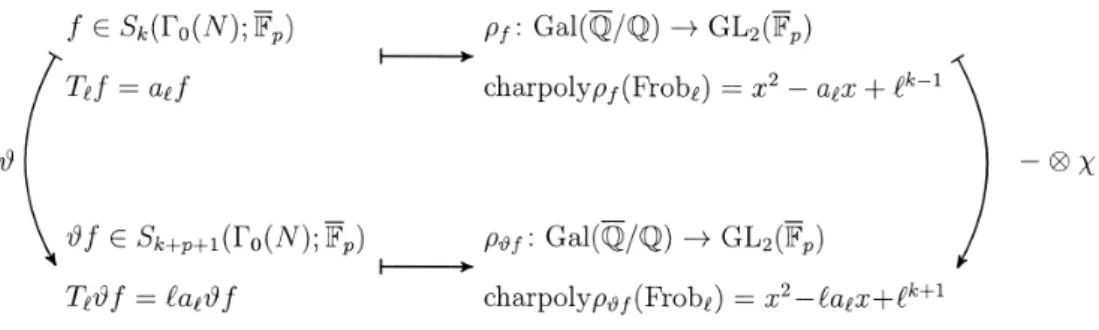
(2) 53 e. the effect of the left vertical map. \vartheta. on q‐expaılsions is simply. ( \vartheta f)(q)=q\frac{df(q)}{dq} The fact that the formal power series on the right hand side is once again a mod p. modular form (of weight k+p+1 ) is a theorem of Serre and Swinnerton‐Dyer [SD73, Section 3] in level one and of Katz [Kat77] for general level.. f\in S_{k}(\Gamma_{0}(N);\overline{\mathbb{F}}_{p}) \rho_{f}: Ga1(\overline{\mathbb{Q}}/\mathbb{Q})arrow GL_{2}(\overline{\mathbb{F}}_{p}). \varthe(_{\varthe f\inS_{k+p1}(\Gam _{0}(N);\overlin{\mathb{F}_p)^ {T_p}f=a_{\el}f mapsto^{\rho_{\varthe f}\cdotGa1(\overlin{\mathb{Q} /\mathb{Q})arowGL_{2}(\overlin{\Gam }_{p)\mapsto_{charpo1y\rho_{f} (Frob_{p})=x^{2}-a_\el}x+^{k-1}). -\otimes\chi. T_{\ell}\vartheta f=\ell a_{\ell}\vartheta f charpoly\rho_{\vartheta f} (Frob_{l})=x^{2}-\ell a_{p}x+P^{k+1}. Figure 1: The relation between the theta operator on modular forms and tensoring by the cyclotomic character on Galois representations. The fundamental property of \vartheta that makes the diagram possible is its commutation relation with the Hecke operators:. (1.1). \vartheta oT_{\ell}=\ell T_{\ell}o\vartheta.. This paper has several interrelated aims:. (a) to describe various constructions of the differential operator. \vartheta ;. (b) to survey the generalisations of these constructions to modular forms (mod p) on groups other than GL_{2}/\mathbb{Q} (in particular: Siegel, Hilbert, Picard, hermitian modular forms);. (c) to explain how commutation relations generalising Equation (1.1) give rise to relations between the attached Galois representations.. For reasons of space, we can only mention in passing the existence of similar differential operators in characteristic zero, either on C^{\infty} (rather than holomorphic) modular forms, or on p‐adic modular forms. Analytic constructions of such operators go all the way back to work of Maass and of Shimura. The modern approach uses algebraic geometric methods, which illuminate the rationality properties of these operators; for instance,. see [Kat78, Chapter II] for Hilbert modular forms, [Har81, Section 4] for Siegel modular forms or [Eis12] for modular forms on unitary groups. 1.1 Notation. We denote the space of modular forms of weight k , level \Gamma_{0}(N) and coefficicnt ring M_{k}(N;R) . The cuspidal subspace will be denoted S_{k}(N;R) .. R. by.
(3) 54 2 Analytic construction We begin by describing this construction in the case of classical modular forms. Up to minor modifications, it is a special case of the method employed by Böcherer and Nagaoka in the Siegel setting [BN07, Section 4]. It was observed long ago that the derivative of f\in M_{k}(N;\mathbb{C}) satisfies the not‐quite‐. modular relation. f'( \frac{az+b}{cz+d})=(cz+d)^{k+2}f'(z)+ck(cz+d)^{k+1}f(z). .. This failure to be modular can be exploited/fixed in a number of ways, for which we refer the reader to Zagier’s expositions in [Zag08, Chapter 5], [Zag94], One of these approaches involves taking a second form g\in M_{\ell}(N;\mathbb{C}) and defining the Rankin‐Cohen brackct. [f, g]= \frac{1}{2\pi\dot{i} (kfg'-\ell f'g)\in M_{k+\ell+2}(N;\mathbb{C}). .. This construction preserves the ring of coefficients of the Fourier expansions: if R is a subring of \mathb {C} and both f and g have coefficients in R , then so does [f, g]. We can use the Rankin‐Cohen bracket to construct a theta operator on mod p classical modular forms, as described in the following diagram:. OB f\in S_{k}(N;\mathbb{Z}[1/N])-[f, g]\in S_{k+p+1}(N;\mathbb{Z}[1/N]). OLI. modp\mathfrak{s}oR. if k \geq 2. \overline{f}\in S_{k}(N;\overline{\mathbb{F} _{p})1\cdot\cdot *\vartheta(\overline{f}):=\overline{[f,g]}\in S_{k+p+1}(N;\overline{\mathbb{F} _ {p}) In step. \copyright we. lift the mod p cusp form \overline{f} to a form f in characteristic zero. This is. known to be possible if the weight is at least two [Kat73, Theorem 1.7.1]. In step heRankinffandanaux\dot{{\imath}}1\dot{{\imath}}aryformg hatg(q)\equiv l(. OB we. take modConcretel t w Cohen bracket isensteino s er\dot{{\imath}}es=E_{p-1} rovided t such t he_{R)}^{p;} eusetheE. is simply reduction modulo. p.. The ingredients involved in this construction have been generalised to other settings:. (a) Lifting modular forms mod p to characteristic zero is possible in many situations if both the weight and the prime. p. are sufficiently large, as shown for PEL‐type Shimura. varieties by Lan‐Suh [LSII], [LS13, Theorem 8.13 and Corollary 8.14], and in the spe‐ cial case of Siegel modular forms by Hida [Hid02, Section 3.5] and Stroh [Str10], [Str13, Théorème 1.3], In cases not covered by these results, one can dispense with the lift‐. ing step at the expense of getting an operator that is only defined on the subspace of modular forms mod p that are liftablel.. 1These are colloquially referred to as. mod p. forms à la Serre (defined as reductions modulo. p. of char‐. acteristic zero forms), as opposed to mod p forms à la Katz (defined intrinsically as sections of line bundles on modular curves in positive characteristic)..
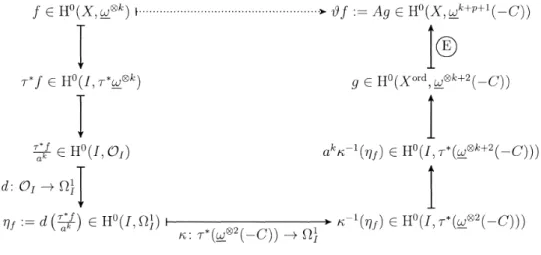
(4) 55 (b) Rankin‐Cohen brackets have been defined for Siegel modular forms [CE98, Theo‐ rem 1.4], [EI98], hermitian modular forms [MS17, Theorem 3.2], Hilbert modular forms [LeeOl, Theorem 5.1], [CKR07 Section 4], Picard modular forms [CvdGl3, Section 9], [FSM14]. There are typically several choices of brackets, many of which start with scalar‐valued forms and yield vector‐valued forms2.. (c) Characteristic zero forms whose q ‐expansion is congruent to 1 modulo p : the state of the art is the construction of such forms as theta series attached to certain special. lattices, which was accomplished in the case of Siegel modular forms [BN07, Theorem 1] and hermitian modular forms [HN09, Theorem 3.3], [KN09, Theorem 3.1], [KNII, Propositions 5.1 and 6.1]. They are obviously related to the Hasse invariants that appear in the algebraic‐geometric context described in the next section.. Putting everything together, there are analytic constructions of thcta operators for. Siegel modular forms [BN07, Theorem 4], [BN14, Theorem 4.5] and hermitian modular forms [KN17, Theorem 3]. A drawback of the method described in this section is that it is by no means clear how the resulting theta operators commute with the Hecke operators. This needs to be checked separateıy by means of rather unenlightening calculations involving explicit formulas for. the effect of Hecke operators on q‐expansions (see for exampıe [GM18, Corollary 15] for the case of the Böcherer‐Nagaoka theta operators on Siegel modular forms).. 3 Algebraic‐geometric construction This originated with Katz [Kat77]; we will describe a variant due to Gross [Gro90, Section 5], that was first brought to our attention by Eyal Goren. Let X^{ord} denote the ordinary locus of the modular curve the Igusa curve \tau:Iarrow X^{ord}.. The modular curve. X. X. :=X_{0}(N)_{\overline{\Gamma}_{p}. and consider. is endowed with an invertible sheaf \underline{\omega} (the Hodge bundle) which. gives rise to the spaces of modular forms:. M_{k}(N;\overline{\mathbb{F} _{p})=H^{0}(X, \underline{\omega}^{\otimes k}). .. The construction proceeds as indicated in Figure 2. The lower horizontal map is induced by the Kodaira‐Spencer isomorphism. \kappa:\tau^{*}(\underline{\omega}^{\otimes 2}(-C) ar ow\Omega_{I}^{1}, where C is the divisor consisting of the cusps on the modular curve X. Finally, in step OE we extend the section g from the ordinary locus to the entire modular curve: a caıculation shows that g has a simple pole at each supersingular point in X , so multiplying g by the Hasse invariant A\in H^{0}(X, \underline{\omega}^{\otimes p-1}) clears the poles.. The commutation relation (1.1) between. by determining the effect of degree. P. \vartheta. and the Hecke operator T_{\ell} can be obtained. isogenies on the various steps. All steps commute. 2Finding generators for spaces of vector‐valued forms is in fact a major application of Rankin‐Cohen brackets..
(5) 56 f\in H^{0}(X,\underline{\omega}^{\otimes k})\}\cdot\cdot \succ\vartheta f:= Ag\in H^{0}(X, \underline{\omega}^{k+p+1}(-C)). \mathfrak{s} IoE. \tau^{*}f\in H^{0}(I, \tau^{*}\underline{\omega}^{\otimes k}). g\in H^{0}(X^{ord}, \underline{\omega}^{\otimes k+2}(-C)). I. I. d:\mathcal{O}_{I}ar ow\Omega_{I}^{1}\mathfrak{s}. I. \frac{\tau^{*}f}{a^{k}}\in H^{0}(I, \mathcal{O}_{I}) a^{k}\kappa^{-1}(\eta_{f} )\in H^{0}(I, \tau^{*}(\underline{\omega}^{\otimes k+2}(-C))). \eta_{f}:=d(\frac{\tau^{*}f}{a^{k}})\in H^{0}(I, \Omega_{I}^{1})-\kappa^{-1} (\eta_{f})\in H^{0}(I, \tau^{*}(\underline{\omega}^{\otimes 2}(-C))) \kappa:\tau^{*}(\underline{\omega}^{\otimes 2}(-C) ar ow\Omega_{I}^{1}. Figure 2: Algebraic‐geometric construction of theta operator on classical modular forms mod p : the Igusa curve version with \ell‐isogenies, with the exception of the Kodaira‐Spencer isomorphism, which commutes up to multiplication by \ell.. The original form of this argument, given in [Kat77], works entirely on the modular curve. X.. The role of differentiation is played by the Gauss‐Manin connection. \nabla ,. which. is defined on de Rham cohomology (instead of sheaf cohomology). Hence it is necessary to pass from sheaf cohomology to de Rham cohomology and back, which can be done over the ordinary locus of X . Extending to all of X once again involves multiplication. by the Hasse invariant. For the details, we refer the interested reader to [Kat77] or the exposition in [Ram05]. Some of the ingredients in the above constructions are automatically defined in much greater generality. Others have been extended to more general settings:. (a) Igusa varieties for certain unitary groups [HTOI, Chapter IV] or for more general PEL‐type Shimura varieties [Man05, Section 4]; (b) Hasse invariants: Hilbert case covered in [AG05, Section 7], see [KW18, GK16] for iecent developments for general Shimura varieties.. Putting these pieces together3, there are algebraic‐geometric constructions of mod p theta operators for. (a) Hilbert modular forms [AG05, Section 15]; (b) Siegel modular forms in genus two [Yam14, Proposition 3.9] and general genus [FG]; (c) Picard modular forms [ dSG16 , Section 3], more generally forms on GU(m, n)[dSG17] and [EM17, Sections 5 and 6]. 3We took an intentionally over‐simplistic view of the process, in order to allow the big picture of the algebraic‐geometric framework to emerge. In practice, each setting has its own geometric intricacies, and dealing with these requires more than just piecing together the various ingredients..
(6) 57 4 Group‐cohomological construction For a ring R , let V_{k-2}(R)=R[x, y]_{k-2} denote the space of homogeneous polynomials of degree k-2 . We consider the cohomology group H^{1}(\Gamma, V_{k-2}(R)) where \Gamma is a congruence subgroup of SL_{2}(\mathbb{Z}) . The link with modular forms comes from the Eichler‐Shimura isomorphism. H^{1}(\Gamma, V_{k-2}(\mathbb{C}) \cong S_{k}(\Gamma;\mathbb{C})\oplus\overline {S_{k}(\Gamma;\mathbb{C})}\oplus Eis_{k}(\Gamma;\mathbb{C}). ,. where the bar indicates complex conjugation and Eis_{k} is the space spanned by the Eisen‐ stein series of weight k. We now focus on the case where the ring of coefficients R=\mathbb{F}_{p} . Consider the element \theta(x, y)=x^{p}y-xy^{p}\in V_{p+1}(\mathbb{F}_{p}) . Multiplication by \theta induces a map in cohomology. H^{1}(\Gamma, V_{k-2}(\mathbb{F}_{p}))arrow H^{1}(\Gamma, V_{k+p+{\imath}-2} (\mathbb{F}_{p})) that commutes with the Hecke operator T_{\ell} up to multiplication by \ell . The point is that \theta is a polynomial semi‐invariant of the finite group GL_{2}(\Gamma_{p}) . Despite the fact that the relation between group cohomology and modular forms is less clear‐cut in the case of mod p coefficients than for complex coefficients, there is a Hecke action and there is value in studying Hecke eigenclasses in group cohomology in their own right. The foundations were laid by Ash and Stevens in [AS86a] and pursued by them in. the GL_{2} case in [AS86b] , which includes the description of the group cohomological theta operator we gave above.. There has been a significant amount of work done in generalising this to higher GL_{n},. mostly by Ash and his collaborators4. This was motivated by their success in performing explicit computations5 with GL_{3} and GL_{4} , but also by the fact that, in sharp contrast to the classical case GL_{2} , for n>2 there is no direct link between automorphic representa‐ tions and the algebraic‐geometric framework of Shimura varieties that plays such a central role in the Langlands program. Indeed, they formulated precise conjectures positing the existence of n‐dimensional mod p Galois representations attached to Hecke eigenclasses in the cohomology of GL_{n} with \mathb {F}_{p} ‐coefficients, see [ Ash92a, Ash92b , ADP02]. Recent breakthroughs duc to Scholze resulted in the proof of a large part of these conjectures;. we refer the interested reader to [Sch15], as well as the survey [Mor16] and the recent improvements [ CGH^{+}18 , NT16]. There are group‐cohomological approaches to the study of modular forms on other groups as well, for instance: e. Hilbert modular forms [Red15] (dedicated to “weight shiftings the cohomological analogues of theta operators), see also the computational framework in [GY08];. e. Bianchi modular forms, see [ST09, §enll, §en14,. \bullet. Siegel modular forms [Bue96].. DSGG^{+}16 ];. 4At the risk of omitting names, these include Doud, Gunnells, McConnell, D. Pollack, Sinnott, Stevens. 5For an exposition of the computational methods used to study the cohomology of arithmetic groups such as GL_{n} , see [Gun14]..
(7) 58 5 Modular forms on other groups We return to the task of generalising Figure 1 to groups other than GL_{2}/\mathbb{Q} . In order. to describe the effect of (some of) the operators defined in the previous sections on the corresponding Galois representations, we need to introduce some of the representation‐ theoretic foundations of modular forms on algebraic groups. To keep the exposition clean, we restrict our attention to groups over \mathb {Q} ; the correct level of generality is to work over. number fields. F,. and we invite interested readers to consult [TV16, BG14] for the more. general setup.. Let G be a connected reductive algebraic group over \mathb {Q} . We will take it for granted that there is a notion of modular form (mod p) on the group G . This may, for instance, come from a Shimura variety attached to G , and is known to be the case for the various specific types of modular forms we consider in this paper, as summarised in Table 1. Fixing subgroups T\subset B\subset G where T is a maximal torus and B is a Borel subgroup, we have the root datum. (X^{\cdot}, \triangle., X., \triangle.). ,. where \bullet. \bullet. \bullet. X^{\cdot}=Hom(T, \mathbb{G}_{m}) is the group of characters of X. \triangle. T;. =Hom(G.., T) is the group of cocharacters of. T;. is the set of simple roots, with corresponding simple coroots \triangle.. Thcre is a natural pairing. \{\cdot, \cdot\}: X^{\cdot} \cross X. arrow Hom(\mathbb{G}_{7n}, \mathbb{G}_{m} )=\mathbb{Z} given by composition: \langle\alpha, \lambda\rangle=k where (\alpha 0\lambda)_{\wedge}(z)=z^{k} for all z\in \mathbb{G}_{m}. The dual group \hat{G} has subgroups \hat{T}\subset\hat{B}\subset G and root datum. (X., \triangle., X^{\cdot}, \triangle.) In other words, the character \alpha:Tarrow \mathbb{G}_{m} of. \hat{T}. of. \hat{T}.. T. .. is identified with the cocharacter. type of modular form. algebraic group. classical. GL_{2}. Siegel Hilbert Bianchi. {\rm Res}_{F/\mathbb{Q}}GL_{2}, {\rm Res}_{K/\mathbb{Q}}GL_{2},. Picard hermitian. GSp_{2g}. F K. \hat{\alpha}. : \mathbb{G}_{m}arrow. totally real imaginary quadratic. GU_{2,1} GU_{n,n}. Table 1: Some types of modular fornts with the corresponding algebraic gtoups over \mathb {Q}.
(8) 59 Given a prime P , the local Hecke algebra at. \ell. is. \mathcal{H}_{p}(G)=\mathcal{H}(G(\mathbb{Q}_{p}), G(\mathbb{Z}_{p}))=\{t: G(\mathbb{Q}_{\ell})arrow \mathbb{Z} locally constant, compactly supported and G(\mathbb{Z}_{\ell})-bi‐invariant}. This is a free \mathb {Z} ‐module with a basis of characteristic functions. t_{\ell,\lambda}=. char. (G(\mathbb{Z}_{\ell})\lambda(P)G(\mathbb{Z}_{\ell})). indexed by \lambda\in P^{+} , the cone of dominant coweights of P^{+}= P^{+}. Since. { \lambda\in X. |\{\alpha, \lambda\}\geq 0 for all. G:. \alpha\in\triangle. }.. is identified with the dominant weights of \hat{G} , it also indexes the irreducible. representations of \hat{G}.. This relation is made more explicit by the Satake isomorphism [Gro98, Proposition 3.6]. S_{\mathbb{Z},\ell}:\mathcal{H}_{\ell}(G)\otimes \mathbb{Z}[\ell^{\pm 1/2}] arrow R(\hat{G})\otimes \mathbb{Z}[\ell^{\pm 1/2}]. We tensor this with \overline{F}_{p} for p\neq\ell to get an isomorphism. S_{\ell}:\mathcal{H}_{\ell}(G)\otimes\overline{\mathbb{F} _{p}ar ow R(\hat{G}) \otimes\overline{\mathbb{F} _{p}. Suppose that we are given a Hecke module, that is a finite‐dimensional \overline{\mathb {F}_{p} ‐vector space endowed with an action of \prod_{\ell\neq p}\mathcal{H}_{\ell}(G) . (The examples we have in mind are spaces of modular forms (mod p) attachcd to the group G. ) Given a Hecke eigenform f\in V , we V. get the commutative diagram \mathcal{S}_{\el }. \mathcal{H}_{p}(G)\otimes\overline{\mathbb{F} _{p} R(\hat{G}) \otimes\overline{\mathbb{F} _{p}. \Psi_{f,l}\downar ow \omega_{f} \overline{\Gam a}_{p}. L. where e. the vertical arrow \Psi_{f,\el }:\mathcal{H}_{l}(G)\otimes\overline{\mathbb{F} _{p}ar ow\overline{ \mathbb{F} _{p} is the local Hecke eigensystem attached to f , that is the algebra homomorphism that maps a Hecke operator t to its eigenvalue:. tf=\Psi_{f^{p}},(t)f for all t\in \mathcal{H}_{\ell}(G)\otimes\overline{\mathbb{F} _{p} ;. \bullet. the diagonal arrow defined by. \omega_{f}. But characters of classes. s. in. \hat{G}(\overline{\Gamma}_{p}) ,. \omega_{f}:R(\hat{G})\otimes\overline{\Gamma}_{p}ar ow\overline{\mathbb{F} _{p} is the character of the representation group. :=\Psi_{f,\ell}oS_{\ell}^{-1}. R(\hat{G})\otimes\overline{\mathb {F} _{p} are in bijective correspondence with semisimple conjugacy via \omega_{s}(\lambda)=\lambda(s) for all \lambda\in X.. So the character. \omega_{f}. determines a. semisimple conjugacy class s_{f,\ell}\in\hat{G}(\overline{\mathbb{F} _{p}) , called the Satake parameter of f at \ell. Under the mod p Langlands correspondence, there is a general expectation that, to a mod p Hecke eigenform f on the group G , one can associate a mod p Galois representation \rho_{f}:Ga1(Q/\mathbb{Q})ar ow\hat{G}(\overline{\mathbb{F} _{p}) such that \rho_{f}(Frob_{l})=s_{f\ell} for all but finitely many primes P\neq p. This gives the natural generalisation of the top row of the diagram in Figure 1; the next section aims to generalise the rest of the diagram..
(9) 60 6 Effect on Galois representations Given a Hecke eigenform f defined on some group, and its image \vartheta f under a theta operator of the type discussed in the previous sections, how does one relate the Galois representa‐ tion attached to \vartheta f to that attached to f ? In the classical case illustrated in Figure 1, this follows easily from comparing the characteristic polynomials of Frobenius elements. In general, such a direct calculation is not feasible, but the relation between Galois rep‐ resentations can still be deduced, as an almost formal consequence of the commutation relation between \vartheta and the Hecke operators.. More precisely, using the Satake isomorphism we can prove (with the notation from Section 5):. Theorem 2 ([GM18]). Let f be a Hecke eigenform (mod p ) on a group G. Let \vartheta be a map of modular forms such that \vartheta f is a Hecke eigenform whose Hecke eigensystems satisfy. \Psi_{\vartheta f,p}(t_{\ell,\lambda})=\eta(\lambda(\ell) \Psi_{f,\ell} (t_{\ell,\lambda}) where \eta:Garrow \mathbb{G}_{m} is a character of. G. and. \Sigma. for all \ell\not\in\Sigma, \lambda\in P^{+}. is a finite set of primes containing p . Then. \rho_{\vartheta f}\cong(\hat{\eta}\circ\chi)\rho_{f} as Galois representations. Ga1(\overline{\mathbb{Q} /Q)ar ow\hat{G}(\overline{\Gamma}_{p}) ,. where. \chi. is the mod. p. cyclotomic character.. We illustrate this in the simplest setting:. Example 3 (Classical modular forms) Take G=GL_{2}/\mathbb{Q}. There are two dominant coweights \lambda_{i}. \mathbb{G}_{7n}arrow T to consider:. \lambda_{1}:z\mapsto\{\begin{ar ay}{l } 1 0 0 z \end{ar ay}\} , \lambda_{2}:z\mapsto\{\begin{ar ay}{l } z 0 0 z \end{ar ay}\} The corresponding elements of the local Hecke algebra are the Hecke operator T_{\ell} and multiplication by \ell.. We take. \eta. :=det:Garrow \mathbb{G}_{m} , and we verify easily that (over. \overline{\mathb {F}_{p} ) we have. a_{\ell}(\vartheta f)=\ell a_{\ell}(f) , \ell^{(k+p+1)-1}=\ell^{2}\ell^{k-1} Since. \hat{\eta}:\mathbb{G}. arrow\hat{G}\cong G is given by. \hat{\eta}:z\mapsto\{ begin{ar ay}{l} z 0 0 z \end{ar ay}\, Theorem 2 says that. \rho_{\varthetaf}\cong\{ begin{ar ay}{l} \chi 0 0 \chi \end{ar ay}\ \rho_{f}\cong\chi\otimes\rho_{f}, recovering. wha\{. nomials of. Frob_{l}.. we already knew from the direct comparison of the characteristic poly‐.
(10) 61 61 References. [ADP02]. A. Ash, D. Doud, and D. Pollack. Galois representations with conjectural connections to arithmetic cohomology. Duke Math. J., 112(3):521-579 , 2002.. [AG05]. F. Andreatta and E. Z. Goren. Hilbert modular forms: mod p and p‐‐adic. [AS86a]. A. Ash and G. Stevens. Cohomology of arithmetic groups and congruences. aspects. Mem. Amer. Math. Soc., 173(819):vi+100 , 2005.. bctwcen systems of Hecke eigenvalues. J. Reine Angew. Math., 365:192−220, 1986.. [AS86b]. A. Ash and G. Stevens. Modular forms in characteristic P and special values of their. [Ash92a]. L ‐functions.. Duke Math. J., 53(3):849-868 , 1986.. A. Ash. Galois representations and cohomology of GL(n, Z) . In Séminaire de Théorie des Nombres, Paris, 1989‐90, volume 102 of Progr. Math., pages. 9‐22. Birkhäuser Boston, Boston, MA, 1992.. [Ash92b] [BG14]. A. Ash. Galois representations attached to mod p cohomology of GL(n, Z) . Duke Math. J., 65(2):235-255 , 1992.. K. Buzzard and T. Gee. The conjectural connections between automorphic representations and Galois representations. In Automorphic forms and Galois representations. Vol. 1, volume 414 of London Math. Soc. Lecture Note Ser., pages 135‐187. Cambridge Univ. Press, Cambridge, 2014.. [BN07]. S. Böcherer and S. Nagaoka. On mod p properties of Siegel modular forms.. [BN14]. S. Böcherer and S. Nagaoka. On p‐‐adic properties of Siegel modular forms. In Automorphic forms, volume 115 of Springer Proc. Math. Stat., pages 47‐66.. Math. Ann., 338(2):421-433 , 2007.. Springer, 2014.. [Bue96]. K. Buecker. Congruences between Siegel modular forms on the level of group cohomology. Ann. Inst. Fourier (Grenoble), 46(4):877-897 , 1996.. [CE98]. Y. Choie and W. Eholzer. Rankin‐Cohen operators for Jacobi and Siegel. [CGH^{+}18]. A. Caraiani, D. Gulotta, C.‐Y. Hsu, C. Johansson, L. Mocz, E. Reinecke, and S.‐C. Shih. Shimura varieties at level \Gamma_{1}(p^{\infty}) and Galois representations.. forms. J. Number Theory, 68(2):160-177 , 1998.. arXiv:1804.00136, 2018. .. [CKR07]. Y. Choie, H. Kim, and O. K. Richter. Differential operators on Hilbert modular forms. J. Number Theory, 122(1):25-36 , 2007.. [CvdGl3]. F. Cléry and G. van der Geer. Generators for modules of vector‐valued Picard modular forms. Nagoya Math. J., 212:19−57, 2013.. [dSG16]. E. de Shalit and E. Z. Goren. A theta operator on Picard modular forms modulo an inert prime. Res. Math. Sci., 3: Paper No. 28, 65, 2016..
(11) 62 [dSG17]. E. de Shalit and E. Z. Goren. Theta operators on unitary Shimura varieties. arXiv:1712.06969, 2017. .. [DSGG^{+}16] M. Dutour Sikirič, H. Gangl, P. E. Gunnells, J. Hanke, A. Schürmann, and D. Yasaki. On the cohomology of linear groups over imaginary quadratic fields. J. Pure Appl. Algebra, 220(7):2564-2589 , 2016.. [EI98]. W. Eholzer and T. Ibukiyama. Rankin‐Cohen type differential operators for Siegel modular forms. Internat. J. Math., 9(4):443-463 , 1998.. [Eis12]. E. Eischen. p‐adic differential operators on automorphic forms on unitary groups. Ann. Inst. Fourier (Grenoble), 62(1):177-243 , 2012.. [EM17]. E. Eischen and \mu ‐ordinary. [FG]. E,. setting.. Mantovan.. ‐adic families of automorphic forms in the. \tau\succ. arXiv:1710.01864 ,. 2017.. M. Flander and A. Ghitza. A theta operator for vector‐valued Siegel modular forms. In preparation,. [FSM14]. E. Freitag and R. Salvati Manni. Vector valued modular forms on three dimensional ball.. [GK16]. arXiv:1404.3057 ,. W. Goldring and J.‐S. Koskivirta. Strata Hasse invariants, Hecke algebras and Galois representations.. [GM18]. 2014.. arXiv:1507.05032v2 ,. 2016.. A. Ghitza and A. McAndrew. Theta operators on automorphic forms and Galois representations.. arXiv:1601.01385 ,. 2018.. [Gro90]. B. Gross. A tameness criterion for Galois representations associated to mod‐ ular forms (mod p) . Duke Math. J., 61(2):445-517 , 1990.. [Gro98]. B. Gross. On the Satake isomorphism. In Galois representations in arith‐ metic algebraic geometry (Durham, 1996), volume 254 of London Math. Soc. Lecture Note Ser., pages 223‐237. Cambridge Univ. Press, Cambridge, 1998.. [Gun14]. P. E. Gunnells. Lectures on computing cohomology of arithmetic groups. In Computations with modular forms, volume 6 of Contrib. Math. Comput. Sci., pages 3‐45. Springer, Cham, 2014.. [GY08]. P. E. Gunnells and D. Yasaki. Hecke operators and Hilbert modular forms. In Algorithmic number theory, volume 5011 of Lecture Notes in Comput. Sci., pages 387‐401. Springer, Berlin, 2008.. [Har81]. M. Harris. S pecial values of zeta functions attached to Siegel modular forms. Ann. Sci. Ecole Norm. Sup. (4), 14(1):77-120 , 1981.. [Hid02]. H. Hida. Control theorems of coherent sheaves on Shimura varieties of PEL type. J. Inst. Math. Jussieu, 1(1) :1-76 , 2002.. [HN09]. M. Hentscheı and G. Nebe. Hermitian modular forms congruent to 1 modulo p . Arch. Math. (Basel), 92(3):251-256 , 2009..
(12) 63 [HTOI]. M. Harris and R. Taylor. The geometry and cohomology of some simple Shimura varieties, volume 151 of Annals of Mathematics Studies. Princeton University Press, Princeton, NJ, 2001. With an appendix by Vladimir G. Berkovich.. [Kat73]. N. Katz.. p ‐adic. properties of modular schemes and modular forms. In Mod‐. ular functions of one variable, III (Proc. Internat. Summer School, Univ. Antwerp, Antwerp, 1972), pages 69‐190. Lecture Notes in Mathematics, Vol. 350. Springer, Berlin, 1973.. [Kat77]. N. Katz. A result on modular forms in characteristic p . In Modular functions. of one varíable,. V. (Proc. Second Internat. Conf., Univ. Bonn, Bonn, 1976),. pages 53‐61. Lecture Notes in Math., Vol. 601. Springer, Berlin, 1977.. [Kat78]. N. Katz.. p ‐adic. L ‐functions. 1978.. for CM fields. Invent. Math., 49(3):199-297,. [KN09]. T. Kikuta and S. Nagaoka. Congruence properties of Hermitian modular forms. Proc. Amer. Math. Soc., 137(4):1179-1184 , 2009.. [KNII]. T. Kikuta and S. Nagaoka. On Hermitian modular forms mod p . J. Math. Soc. Japan, 63(1):211-238 , 2011.. [KN17]. T. Kikuta and S. Nagaoka. On the theta operator for Hermitian modular. forms of degree 2. Abh. Math. Semin. Univ. Hamb., 87(1):145-163 , 2017.. [KW18]. J.‐S. Koskivirta and T. Wedhorn. Generalized \mu ‐ordinary Hasse invariants. J. Algebra, 502:98−119, 2018.. [LeeOl]. M. Lee. Hilbert modular pseudodifferential operators. Proc. Amer. Math. Soc., 129(11):3151-3160 , 2001.. [LSII]. K.‐W. Lan and J. Suh. Liftability of mod p cusp forms of parallel weights. Int. Math. Res. Not. IMRN, (8) :1870-1879 , 2011.. [LS13]. K.‐W. Lan and J. Suh. Vanishing theorems for torsion automorphic sheaves on genet al PEL‐type Shimura varieties. Adv. Math., 242:228−286, 2013.. [Man05]. E. Mantovan. On the cohomology of certain PEL‐type Shimura varieties. Duke Math. J., 129(3):573-610 , 2005.. [Mor16]. S. Morel. Construction de représentations galoisiennes de torsion [d‘après Peter Scholze]. Astérisque, (380, Séminaire Bourbaki. Vol. 2014/2015 ) :Exp. No. 1102, 449‐473, 2016.. [MS17]. J. D. Martin and J. Senadheera. Differential operators for Hermitian Jacobi forms and Hermitian modular forms. Ramanujan J., 42(2):443-451 , 2017.. [NT16]. J. Newton and J. A. Thorne. Torsion Galois representations over CM fields and Hecke algebras in the derived category. Forum Math. Sigma, 4:e21,88, 2016..
(13) 64 [Ram05]. N. Ramsey. The. \theta. operator. Notes from 2005‐06 Stanford VIGRE Seminar,. 2005.. [Red15]. D. A. Reduzzi. Weight shiftings for automorphic forms on definite quaternion algebras, and Grothendieck ring. Math. Res. Lett., 22(5):1459-1490 , 2015.. [Sch15]. P. Scholze. On torsion in the cohomology of locally symmetric varieties. Ann. of Math. (2), 182(3):945-1066 , 2015.. [SD73]. H. P. F. Swinnerton‐Dyer. On \ell‐adic representations and congruences for coefficients of modular forms. pages 1‐55. Lecture Notes in Math., Vol. 350, 1973.. [genll]. M. H. $engün. On the integral cohomology of Bianchi groups. Exp. Math., 20(4):487-505 , 2011.. [§en14]. M. H. $engün. Arithmetic aspccts of Bianchi groups. In Computations with modular forms, volume 6 of Contrib. Math. Comput. Sci., pages 279‐315. Springer, Cham, 2014.. [§T09]. M. H. $engün and S. Turkelli. Weight reduction for. mod P. Bianchi modular. forms. J. Number Theory, ı29(8):2010‐2019, 2009.. [Str10]. B. Stroh. Relèvement de formes modulaires de Siegel. Proc. Amer. Math. Soc., 138(9):3089-3094 , 2010.. [Str13]. B. Stroh. Classicité en théorie de Hida. Amer. J. Math., 135(4):861-889, 2013.. [TV16]. D. Treumann and A. Venkatesh. Functoriality, Smith theory, and the Brauer homomorphism. Ann. of Math. (2), 183(1):177-228 , 2016.. [Yam14]. T. Yamauchi. The weight in Serre’s conjecture for GSp_{4}. arXiv:1410.7894v3, 2014.. [Zag94]. D. Zagier. Modular forms and differential operators. Proc. Indian Acad. Sci. Math. Sci., 104(1):57-75 , 1994. K. G. Ramanathan memorial issue.. [Zag08]. D. Zagier. Elliptic modular forms and their applications. In The 1‐2‐3 of modular forms, Universitext, pages 1‐103. Springer, Bcrlin, 2008..
(14)
図

関連したドキュメント
The fundamental idea behind our construction is to use Siegel theta functions to lift Hecke operators on scalar-valued modular forms to Hecke operators on vector-valued modular
Actually one starts there from an abelian surface satisfying certain condition, the most stringent being that the Galois representation ρ ∨ A,p must be congruent modulo p to
Our result im- proves the upper bound on the number of BSDR’s with minimal weight stated by Grabner and Heuberger in On the number of optimal base 2 representations,
Greenberg and G.Stevens, p-adic L-functions and p-adic periods of modular forms, Invent.. Greenberg and G.Stevens, On the conjecture of Mazur, Tate and
We prove a formula for the Greenberg–Benois L-invariant of the spin, standard and adjoint Galois representations associated with Siegel–Hilbert modular forms.. In order to simplify
We study the classical invariant theory of the B´ ezoutiant R(A, B) of a pair of binary forms A, B.. We also describe a ‘generic reduc- tion formula’ which recovers B from R(A, B)
We also show in 0.7 that Theorem 0.2 implies a new bound on the Fourier coefficients of automorphic functions in the case of nonuniform
Some natural operators transforming functions, vector fields, forms on some natural bundles F are used practically in all papers in which problem of prolon- gation of
