Faster Algorithms
for
Computer
Vision
Toshiyuki
Masaki
and Takahito
Kuno
Graduate School of Systems and Information Engineering,
University of Tsukuba, Ibaraki 305-8573, Japan
Abstract
In this paper, we make amodification to Karl and Hartley‘s formulation
ofproblems in computervision [3, 4], and show the resulting norm
min-imization problemcan be solvedby solving a sequence of LP problems.
We also propose an approximation of the norm minimization problem,
which reduces to one LP or SOCP problem.
Key words: Computer vision, multiple view geometry, linear
program-ming, second-order cone programming.
1.
Introduction
In recent years, problems dealt with in computer vision
are
larger in size andrequire much
more
computational time to solve than before. For example,while the traditional triangulation problem has only three variables, the
num-ber of variables in the latest structure-and-motion problem amounts to several
hundreds in
some cases.
Thus, there is a great need for faster algorithms forlarge scale problems in the
area
of computer vision. In response to this, Karland Hartley [3, 4] developed a framework for solving geometric problems, such
as
triangulation, camera-resectioning, homography-estimation andstructure-and-motion. In their framework, those problems are formulated into an $L_{\infty}$
norm
minimization problem and solved by solving a sequence of second-ordercone
programming (SOCP) problems.In this paper, we show that, if Karl and Hartley‘s formulation is slightly
modified, the norm $1ni_{I}iiInizati_{oI}i$ problem can be solved by solving a sequence
of linear programming (LP) problems. In addition,
we
proposean
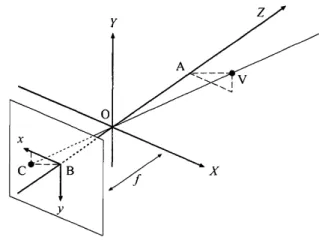
Figure 1: Geometry of a pinhole camera.
problem. Lastly, we report
some
numerical results, which demonstrate thesuperiority of our approach to Karl and Hartley‘s in both efficiency and
accu-racy.
2.
Problems
in
computer
vision
In this section, we first take triangulation
as a
typical example and illustratehow it can be formulated into an optimization problem. We also show that
many other problems in computer vision take the
same
form. Essential tothose formulations is the pinhole camem model.
Pinhole
camera
model: The pinholecamera
model describes therelation-ship between the coordinates of
a
$3D$ point and its projection onto the imageplane of
an
ideal pinhole camera, where thecamera
aperture is a pinhole andno
lensesare
used to focus light. The geometry related to the mapping ofa
pinhole
camera
is illustrated in Figure 1. Letus
denote the object point by$V=(X, Y, Z)^{T}$ in the$3D$ coordinate system withits originat the
camera
aper-ture O. Light emanating from V passes through $O$ and projects
an
invertedimage $v=(x, y)^{T}$
on
the image plane, which is parallel to the X-Y plane andlocated at the focal length $f(>0)$ from $O$ in the negative direction of the
$Z$ axis. Let A $=(0,0, Z)^{T},$ $B=(0,0, -f)^{T}$ and $C=(x, y, -f)^{T}$. Since the
Figure 2: Thriangulation using two
cameras.
or
equivalently$\{\begin{array}{l}xy1\end{array}\}=\frac{f}{Z}\{\begin{array}{l}XYZ/f\end{array}\}$
in homogeneous coordinates. It should be also noted that the image $v$ is
invariant under scaling ofV. We denote this by
$\{\begin{array}{l}xy1\end{array}\}\sim\{\begin{array}{l}XYZ/f\end{array}\}=\{\begin{array}{llll}1 0 0 00 1 0 00 0 1/f 0\end{array}\}\{\begin{array}{l}XYZ1\end{array}\}$ , (1)
and say that $(x, y, 1)^{T}$ is equivalent,
or
proportional, to $(X, Y, Z/f)^{T}$. The $3\cross 4$matrix in (1) is called the
camem
matrix.Triangulation: Triangulation (or reconstruction) is the process of
deter-mining the $3D$ coordinates of the object V, given its projection onto two, or
more, images captured by pinhole
cameras.
In theory, the triangulationprob-lem is quite trivial. Each image $v$ of V corresponds to
a
half-line in the $3D$space such that all points on the line
are
projected to $v$. Therefore, V mustlie
on
the intersection of those lines, andwe
must be able to calculate itsco-ordinates analytically from a pair of different images. In practice, however,
various types of noise, such
as
geometric noise from lens distortionor
interestpoint detection error, lead to inaccuracies in the measured image coordinates.
As a result, lines associated with different images ofV do not always intersect
Suppose that is in
an
arbitrary coordinate system, andthat there
are
$M$ images $v_{i}=(x_{i}, y_{i})^{T}$ ofV capturedbycameras
$i=1,$$\ldots,$$M$.
Let
us
denote the ithcamera
matrix by$Q_{i}=\{\begin{array}{llll}1 0 0 00 1 0 00 0 1/f_{i} 0\end{array}\}$ ,
where $f_{i}(>0)$ is the focal length of
camera
$i$. Note that V is denotedas
$B_{n}V+t_{i}$ for
some
rotation matrix $B_{\eta}$ anda
translation vector $t_{i}$ in the $3D$coordinate system with the origin at the focal point $O_{i}$ of
camera
$i$. Hence,from (1),
we
have$\{\begin{array}{l}v_{i}1\end{array}\}\sim Q_{i}\{\begin{array}{ll}R_{n} t_{i}O 1\end{array}\}\{\begin{array}{l}V1\end{array}\}$ , $i=1,$
$\ldots,$$M$.
Let
$P_{i}=\{\begin{array}{l}p_{i}^{1}p_{i}^{2}p_{i}^{3}\end{array}\}=Q_{i}\{\begin{array}{ll}R_{i} t_{i}O 1\end{array}\}$ ,
which is referred to
as
the normalizedcamem
matrix,or
simplyas
thecamem
matrix. The coordinates of the image $v_{i}=(x_{i}, y_{i})^{T}$ is then given
as
$x_{i}= \frac{p_{i}^{1}U}{p_{i}^{3}U}$, $y_{i}= \frac{p_{i}^{2}U}{p_{i}^{3}U}$,
where $U=(V^{T}, 1)^{T}$, if there is no noise. As mentioned above, however, this is
not the casein practice, and we need to determine the coordinates $(X, Y, Z)$ of
V
so
as to minimize the $2D$ residual ermr, which is defined as follows in termsof $L_{p}$
norm:
$\gamma_{i}=\Vert\frac{p_{i}^{1}U}{p_{i}^{3}U}-x_{i},\frac{p_{i}^{2}U}{p_{i}^{3}U}-y_{i}\Vert_{p}$ , $i=1,$
$\ldots,$ $M$.
If
we
measure
the magnitude of $\gamma=(\gamma_{1}, \ldots, \gamma_{M})^{T}$ in $L_{q}$ norm, thentrian-gulation reduces to an optimization problem with $(X, Y, Z)$, the first three
components of$U$,
as
the variables:minimize $\Vert\gamma\Vert_{q}$
subject to $\Vert\frac{p_{i}^{1}U}{p_{i}^{3}U}-x_{i},$$\frac{p_{i}^{2}U}{p_{i}^{3}U}-y_{i}\Vert_{p}=\gamma_{i}$, $i=1,$ $\ldots$ ,M.
Table 1: Known and unknown parameters of computer vision problems.
$\frac{problem\neq camems\neq objectsknownunknown}{triangu1ationM1P_{i},v_{i1}V_{1}}$
camera-resectioning 1 $N$ $V_{j},$ $v_{1j}$ $P_{1}$
structure-and-motion $M$ $N$ $B_{n},$$v_{ij}$ $t_{i},$$V_{j}$
Other problems: Many other computer vision problems
can
also befor-mulated into optimization problems similar to (2) except that the number of
objects is usually
more
thanone.
Suppose $N$ points $V_{j}=(X_{j}, Y_{j}, Z_{j})^{T},$ $j=1,$
$\ldots,$ $M$, are given in the $3D$
space. Let $v_{ij}=(x_{ij}, y_{ij})^{T}$ denote the image of$V_{j}$ captured by
camera
$i$. Alsolet
$\gamma_{ij}=\Vert\frac{p_{i}^{1}U_{j}}{p_{i}^{3}U_{j}}-x_{ij},$$\frac{p_{i}^{2}U_{j}}{p_{i}^{3}U_{j}}-y_{ij}\Vert_{p}$, $i=1,$
$\ldots,$$M;j=1,$ $\ldots N$,
where $U_{j}=(V_{j}^{T}, 1)^{T}$. In this case, the problem is written
as
followsminimize $\Vert\gamma\Vert_{q}$
subject to $\Vert\frac{p_{i}^{1}U_{j}}{p_{i}^{3}U_{j}}-x_{ij},$ $\frac{p_{i}^{2}U_{j}}{p_{i}^{3}U_{j}}-y_{ij}\Vert_{p}=\gamma_{ij}$, $\{\begin{array}{ll}i=1, \ldots, M (3)j=1, \ldots N, \end{array}$
where $\gamma=(\gamma_{11}, \ldots, \gamma_{MN})^{T}$. This
seems
a straightforward extension of (1),but describes various types ofproblems in computer vision depending
on
whatparameters
are
knownor
unknown. Table 1 shows three major examples; e.g.,the number of variables amounts to$3(M+N)$ in (3) associated with
a
structure-and-motion problem while that is only three in the
case
oftriangulation.3.
Solution
approaches
In [4], Kahl and Hartley proposed
a
bisection algorithm to solve (3) with$p=2$and $q=\infty$. After illustrating their algorithm, we introduce here a practical
approximation approach to (3).
Bisection approach: In the usual applications ofcomputer vision, we may
$\overline{\frac{A1gorithm1Bisectionalgorithmforthecasewherep=2andq=\infty}{Require:aninterva1[\gamma_{\ell},\gamma_{u}]knowntocontaintheoptima1va1uer^{*}and}}$
a
tolerance $\epsilon>0$.
repeat
$\gammaarrow(\gamma_{\ell}+\gamma_{u})/2$;
check if (5) is feasible
or
not, by solvingan
associated SOCP problem;if (5) is feasible then $\gamma_{u}arrow\gamma$ else $\gamma_{\ell}arrow\gamma$ end if until $\gamma_{u}-\gamma_{l}\leq\epsilon$;
when $p=2$ and $q=\infty$:
minimize $\gamma$
subject to $\Vert p_{i}^{1}U_{j}-x_{ij}p_{i}^{3}U_{j},$ $p_{i}^{2}U_{j}-y_{ij}p_{i}^{3}U_{j}\Vert_{2}\leq\gamma p_{i}^{3}U_{j}$, $\{\begin{array}{l}i=1, \ldots, Mj=1, \ldots N.\end{array}$
(4)
As is shown in Algorithm 1, the bisection algorithm solves (4) by checking
repeatedly if the following system of inequalities is feasible for a fixed $r$ in a
given interval $[\gamma_{\ell}, \gamma_{u}]$:
$\Vert p_{i}^{1}U_{j}-x_{ij}p_{i}^{3}U_{j},$ $p_{i}^{2}U_{j}-y_{ij}p_{i}^{3}U_{j}\Vert_{2}\leq\gamma p_{i}^{3}U_{j},$ $\{\begin{array}{l}i=1, \ldots, Mj=1, \ldots N.\end{array}$ (5)
Since the right-hand-sides turn into constants, the feasibility of (5) can be
checked by solving
an
SOCP problem with (5)as
constraints.As
a
natural extension of this Kahl and Hartley’s approach,we can
ap-ply the bisection algorithm to (3) with another combination of$p$ and $q$. For
example, if we choose$p=1$ and $q=\infty$, then (3) is rewritten as
minimize $\gamma$
subject to $|p_{i}^{1}U_{j}-x_{ij}p_{i}^{3}U_{j}|+|p_{i}^{2}U_{j}-y_{ij}p_{i}^{3}U_{j}|\leq\gamma p_{i}^{3}U_{j}$, $\{\begin{array}{l}i=1, \ldots, Mj=1, \ldots N.\end{array}$
(6)
Note that the inequality
is equivalent to
a
set of inequalities$-(p_{i}^{1}U_{j}-x_{ij}p_{i}^{3}U_{j})-(p_{i}^{2}U_{j}-y_{ij}p_{i}^{3}U_{j})\leq\gamma p_{i}^{3}U_{j}-(U_{j}-xp^{3}U_{j})+(-y_{ij}p^{3})\leq\gamma p^{3}U_{j}(U_{j}U_{ji}(p^{1}U-xp^{3}U)+(U_{j}p_{i}^{3}U)\leq\gamma p^{3}U_{j}p^{2}-y_{ij}p_{i}^{3})\leq\gamma p^{3}U_{j}$
.
$\}$ (7)
In other words, the constraints of (6) can be thought of
as
linear constraintsonce
the value of$\gamma$ is$fix\epsilon_{\text{ノ}}^{\backslash }(1$. Hence, Algorith11l 1
can
solve (6) by checking thefeasibility of (7) for all $i,j$, instead of (5). This
can
be done by solvingan
LPproblem with (7) for all $i,j$
as
constraints. Similarly,we
can
solve (3) with$p=\infty$ and $q=\infty$ using the bisection algorithm.
Approximation approach: The
reason
why (3) cannot be solved directlyas an
SOCPor
LP problem is that the product oftwo variables appears in theright-hand-sides of the constraints when (3) is rewritten
as
minimize $\Vert\gamma\Vert_{q}$
subject to $\Vert p_{i}^{1}U_{j}-x_{ij}p_{i}^{3}U_{j},$ $p_{i}^{2}U_{j}-y_{ij}p_{i}^{3}U_{j}\Vert_{p}=\gamma_{ij}p_{i}^{3}U_{j}$, $\{\begin{array}{l}i=1, \ldots, Mj=1, \ldots N.\end{array}$
(8)
Introducing
new
variables $\delta_{ij}$ and letting$\delta_{ij}=\gamma_{ij}p_{i}^{3}U_{j}$, $i=1,$
$\ldots,$$M;j=1,$ $\ldots,$$N$,
we
haveminimize $\Vert\delta\Vert_{q}$
subject to $\Vert p_{i}^{1}U_{j}-x_{ij}p_{i}^{3}U_{j},$ $p_{i}^{2}U_{j}-y_{ij}p_{i}^{3}U_{j}\Vert_{p}=\delta_{ij}$, $\{\begin{array}{l}i=1, \ldots, Mj=1, \ldots N,\end{array}$
(9)
where $\delta=(\delta_{11}, \ldots, \delta_{MN})^{T}$. It is easy to
see
that (9) reduces toan
SOCPproblem if $p=2$ and $q=\infty$, and is
an
LP problem if $p=1,$ $\infty$ and $q=\infty$.Furthermore, (9)
can
serve as a
good approximation for (8) (and hence (3)).Proposition 1
If
the optimal valueof
(8) vanishes, then any optimal solutionof
(8), together with$\delta=O$, solves (9) to optimality. Conversely,if
the optimalvalue
of
(9) vanishes, then any optimal solutionof
(9), together with $\gamma=O$,Table 2: CPU time (in seconds).
$\frac{p\backslash q\infty 12}{bisection\infty 0.0660.1170.729}$
$\infty$
0.003
0.0030.075
approximation
1 0.009 0.004 0.080
Table 3: $3D$ residual error (in $L_{2}$ norm).
$\frac{p\backslash q\infty 12}{bisection\infty 0.0170.0180.016}$
$\infty$ 0.036 0.036 0.035
approximation
1 0.014 0.014 0.013
Let
us
discuss thecase
where $q=\infty$ a littlemore
closely. Let $(\overline{\gamma}_{ij}, \overline{p_{i}^{3}U_{j}})$and $(\overline{\delta}_{ij},\overline{p_{i}^{3}U_{j}})\wedge$
denote the values of $(\gamma_{ij}, p_{i}^{3}U_{j})$ for optimal solutions of (8) and
(9), respectively, and define
$\gamma$
へ
$=\delta/p_{k}^{3}U_{l}$, $\overline{\delta}=\overline{\gamma}\overline{p_{r}^{3}U_{s}}$,
where $\overline{\gamma}=\overline{\gamma}_{k\ell}\in\max_{i,j}\{\overline{\gamma}_{ij}\}$ and $\hat{\delta}=\hat{\delta}_{rs}\in\max_{i,j}\{\overline{\delta}_{ij}\}$へ.
Proposition 2 When $q=\infty$, the following relations hold:
$\overline{\gamma}\leq$
へ
$\gamma\leq L\overline{\gamma}$, へ
$\delta\leq\overline{\delta}\leq L\hat{\delta}$,
where $L= \max_{i,j}\{\overline{p_{i}^{3}U_{j}}\}/\min_{i,j}\{\overline{p_{i}^{3}U_{j}}\}$. $\square$
4.
Numerical
results
Lastly,
we
reportsome
numerical results obtained with MATLAB (version 7.9,$R2009b)[5]$.
The problem used
as
a benchmark istriangulation. The number ofcameras
was
fixed at $N=25$, and eachcamera
matrix was of the form:where $z_{i}$ and $\phi_{i}$
are uniform random
numberson
the intervals [10.0, 100.0]and
$[$0.0, $\frac{\pi}{6}]$, respectively, and$\theta_{i}=\frac{2\pi}{n(i-1)}$
.
Each component ofthe object point V
was
also generated uniformly at randomin the interval $[-5.0,5.0]$
.
Associated SOCP and LP problemswere
solvedusing SeDuMi [7] and GLPK[I], respectively. Table 2 summarizes the average
CPU time in seconds taken to solve ten instances for each $p,$$q$. Table 3 shows
the average residual
error
between actualand calculatedvalues of V in$L_{2}$norm.
These results suggest that
our
approach is superior to Karl and Hartley‘s inboth efficiency and accuracy.
References
[1] GLPK(GNU LinearProgramming Kit) $http.\cdot//www$.gnu.$org/software/glpk/$.
[2] Hartley, R.I. and Sturm, P. , Triangulation In COMPUTER
ANALYSIS
OF IMAGES AND PATTERNS, pages 190-197, 1995.
[3] Kahl, F. , Multiple view geometry and the $L_{\infty}$
-norm.
In Int.Conf.
Com-puter Vision,pages 1002-1009, Beijing, China,
2005.
[4] Kahl, F. and Hartley, R.I. , Multiple View Geometry Under the $L_{\infty}$
-norm.
In IEEE Tmnsactions on Pattem Analysis and Machine Intelligence, pages
1603-1617, September 2008.
[5] MATLAB $www.mathworks.com/pmducts/matlab/$.
[6] Olsson, C. and Kahl, F. , Generalized Convexity in Multiple View
Ge-ometry. In JOURNAL OF MATHEMATICAL IMA GING AND VISION,
pages 35-51, September 2010.
[7] SeDuMi $http.\cdot//sedumi.ie.lehigh.edu/$.
[8] Seo, Y. and Hartley, R.I. , Sequential $L_{\infty}$ Norm Minimization for
Tri-angulation. In Computer Vision - ACCV 2007, vol. 4844, pages 322-331,