retrospective cohort study
学位名
修士(公衆衛生学)
学位授与機関
聖路加国際大学
学位授与年度
2020
学位授与番号
32633公修専第061
URL
http://hdl.handle.net/10285/00016411
Does frailty independently predict long-term survival time in Japanese older
patients with colorectal cancer? – A single center retrospective cohort study.
Yohnosuke Wada 1), Ohde Sachiko2)
Author note
Institutional Affiliation: 1) Nerima Hikarigaoka Hospital, 2) St. Luke’s International
University
Acknowledgements: The first author received a St. Luke’s Graduate School of Public
Health Educational Scholarship.
Correspondence concerning to this article should be addressed to Yohnosuke Wada.
Abstract
Introduction
The number of older patients with colorectal cancer (CRC) increases due to aging.
There are a number of prediction models for the purpose of estimating prognosis so that
health providers and patients can select appropriate care and cure. A nomogram
provided by the Japanese Society for Cancer of Colon and Rectum (JSCCR) for
predicting overall survival probability following colon or rectum surgery includes many
parameters that make it difficult to estimate the prognosis of patients in the clinical
setting. Also, frailty status is often not included in the nomogram. Upon deciding
treatment plan, frailty is often an important parameter to evaluate because older patients
should not be assessed by only age without consideration of their physical and cognitive
activities. The aim of this study was to assess the relationship between frailty and the
long-term outcomes of older patients with CRC and to create a novel simple prognostic
prediction model for the long-term outcomes of patients with CRC.
Methods
We conducted a retrospective cohort study for the patients with CRC who had surgery,
using the electronic medical data in Nerima Hikarigaoka Hospital during January 1st to
the 5-year overall survival. We used Cox proportional hazards model to check the
relationship between the frail group and the non-frail group. Also, we compared the area
under the receiver operating curve (AUC) for the 5-year and the 3-year overall survival
using the JSCCR nomogram and the new model.
Results
Of 51 subjects, 12 (24 %) were frail. Median age (IQR) was 78 (70.5 - 80.5) in the
frailty group and 77 (71 - 79) in the non-frailty group; 5 (41.7 %) in frailty group and 19
(37.3 %) in non-frailty group were female. There was not a significant difference in the
5-year overall survival between the frail group and non-frail group (Log-Rank test; P =
0.59). A new prognostic prediction model using the three variables (gender: female or
male; age: 75< years or 75> years, and pathological stage:Ⅰ-Ⅲ or Ⅳ) with a total
score of 4 points was constructed as follows: 1 point for male, 1 point for 75> years, 2
points for pathological stage Ⅳ. The AUC for the 5-year overall survival by the new
model was 80.8% (95%CI: [68.0 - 93.6%]), which was higher than that for 5-year
overall survival by the JSCCR nomogram (72.8%; 95%CI: [57.7 - 87.8%]).
Conclusions:
In this study, frailty defined by the Fried’s criteria did not have a statistically significant
prognostic prediction model may be more simple and easier to calculate than the JSCCR
nomogram. Further investigation should be done with a larger sample size.
Keywords
Introduction
Colorectal cancer (CRC) is the third highest diagnosed type of cancer in the
world, the proportion of which is 11 % of all cancer diagnoses (Bray et al. 2018). Day et
al. (2011) reported that new diagnosis of colorectal cancer in the US was 24% in
patients aged 64 – 74 years, 27% in those aged 75 – 84 years, and 12% in those aged 85
years or above. In Japan, Mayumi (2019) showed that the incidence rates of CRC
increased with age (21.8 % in patients aged 45-64 years, 32.3 % in patients aged 65-74
years, and 43.3 % in patients aged 75 years or above). From the report provided by
Cancer Registry and Statistics (2019), while the incidence rates increased as patients
become older, cancer mortality rates from CRC for Japanese males adjusted by gender
and age did not constantly increase with advancing years (for males more than 20% in
their 40s to 60s and less than 15% for over age 70). According to this discrepancy
between incidence rate and mortality rate, it seems that health care providers should not
decide care only by the age of patients but should also consider other patients’
characteristics such as frailty, activities of daily living (ADL) and any comorbidities
patients may have. Therefore, a screening pre-operative risk classification for the older
patient is essential not only to predict mortality and morbidity but also to present the
overall survival after surgical intervention.Several general risk scoring systems for
entire populations are commonly used worldwide. For example,there are the: American
Society of Anesthesiologists (ASA) physical status scoring system (Committee on
Economics, 2020), Goldman’s multifactorial index (Goldeman et al. 1977), Detsky
modified multifactorial index (Detsky et al. 1986), American Heart Association
Guidelines (Fleisher et al. 2007) and Cr-POSSUM (Tekkis et al. 2004). Those scoring
systems are not generally included in geriatric risk assessment.
As examples of geriatric risk assessment, there is the: Charlson comorbidity
index (Charlson et al. 1987), several models of frailty (Fried et al. 2001; Rockwood
2005; Manhoney et al. 1965), Barthel’s activities of daily living index (Solomon 1988)
and comprehensive geriatric assessment (Tan et al. 2012); all of which are often used to
predict the future conditions among older patients.
Tan et al. (2011) reported that the odds ratio linked to postoperative major
complications in patients who meet the criteria of frailty was approximately 4 times
higher (4.1, 95%CI: [1.4 -11.6]) than that of non-frail patients. However, there are few
reports from Asian countries describing the association between frailty and long-term
oncological outcomes, and the scoring systems to predict long-term mortality among
geriatric assessment was an indicator for one-year and five-year overall survival times
after surgical procedure for colorectal cancer among a group of patients aged 75 and
older in Norway. In addition, there is only one study investigating the relationship
between frailty and long-term mortality of the Japanese patients with CRC (Mima et al.
2020). Therefore similar studies should be conducted in Asian countries.
The purpose of this study is to investigate whether frailty independently
predicts the long-term outcomes of the older patients with CRC in a Japanese
population. After researching the association between frailty and long-term mortality
among older patients with CRC, we also developed a novel mortality prediction model
to predict long-term mortality among specifically older patients with CRC in Japan.
Methods
The subjects in this study were retrospectively enrolled from among the
patients with CRC who had surgery. We used the electronic medical data in Nerima
Hikarigaoka Hospital during January 1st to December 31th in 2015. In a recent article,
Kanematsu et al (2019) suggested a nomogram predicting survival and recurrence of
colon cancer in the Japanese Society for Cancer of the Colon and Rectum (hereby, the
collected: age, gender, tumor location (cecum, ascending, transverse, descending,
sigmoid and rectum), macroscopic type (0 - 5), tumor differentiation (well, moderate,
poor, signet or mucinous), extent of lymphadenectomy (D0 - D3), preoperative
carcinoembryonic antigen (CEA: ng/ml), pathological tumor category (pT1-4),
lymphatic invasion (ly0-ly3), venous invasion (V0-V3), number of lymph nodes
examined, number of metastatic lymph nodes, adjuvant chemotherapy (yes or no), and
pathological disease stage (pStageⅠ- Ⅳ). Also, we gathered the data on body mass
index (BMI), Hasegawa’s Dementia Rating Scale-Revised (HDS-R), performance status
(PS), Charlson Comorbidity Index (CCI), overall survival time and frailty. According to
the definition of frailty in this study, we used the Fried’s Frailty Index (Fried et al.
2001). This Index is one of the most well known and well-discussed scale for frailty
proposed by Linda Fried at the Cardiovascular Health Study. After describing the ability
of these criteria to prognosticate physical disability and mortality among a sample
population of older people in a community setting, this functional index is frequently
investigated to recognize persons with frailty for high risk of negative health-related
outcomes. After checking the following physical components: weight loss, walking
speed, grip strength, physical activity, and exhaustion, subjects are diagnosed as frailty
We included the subjects with CRC who had a scheduled operation, which was
excision of primary colorectal cancer by open or laparoscopic procedure. Also, the
patients who were diagnosed as clinical stage Ⅳ before surgery and whose primary
site of cancer was resected, were included. We excluded the patients who had not only
CRC but also other types of cancer. Also, patients who did not have a resection of the
primary site of colorectal cancer or who had only palliative care were excluded.
The primary outcome was defined as the 5-year overall survival. The secondary
outcomes were set as the 3-year overall survival, length of hospital stay, Charlson
Comorbidity Index, and complications after operation.
Statistical Analyses
To assess the demographics of the frail group and the non-frail group, we used
two-sample t-test if a variable was continuous and normally distributed and used
Wilcoxon Rank-Sum test if a variable was not normally distributed. Also, when
variables were categorical ones, Chi-square test was selected. To compare the primary
outcome between the frail group and the non-frail group, we used Kaplan-Meier
Survival curves and Cox proportional hazards model. We conducted sample-size
estimation with significant level 0.05 and a power of 0.8 for the comparison of survival
5% level. A p value <0.05 was considered significant and all analysis was carried out
using STATA 16.0 and R version3.6.1.
Results
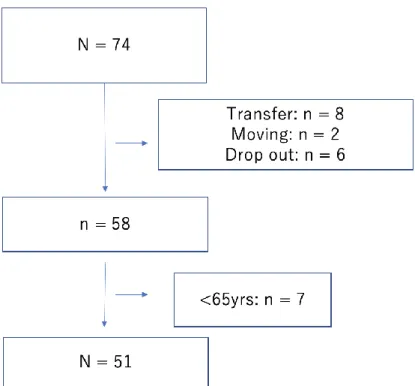
In this study, 74 subjects were enrolled and 16 subjects were excluded due to
transfer (n=8), moving (n=2), and drop out (n=6). Then, 7 patients were omitted because
of age leaving 51 subjects eligible for this study (Figure 1). Of the 51 patients, 12
(24 %) were frail and 39 (76 %) were non-frail. Among the two groups, median ages
(IQR) were 78 (70.5 - 80.5) in frailty and 77 (71 - 79) in non-frailty while 5 (41.7 %) in
frailty and 19 (37.3 %) in non-frailty were female. In terms of BMI, HDS-R,
Performance Status (PS), there were statistically significant differences between the
frail and non-frail groups (all P < .05). In addition, comparing the two groups, the length
of hospital stay (IQR) was 21.5 (17.5 - 38) in frailty group and 16 (8 - 22) in non-frailty
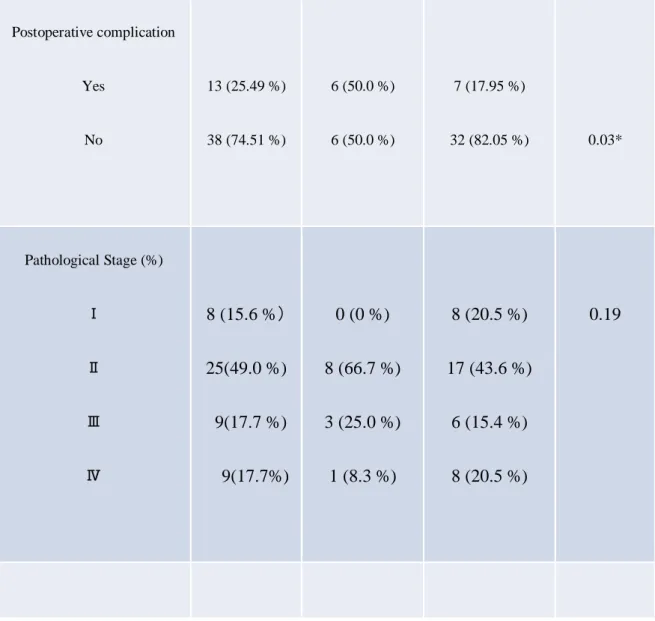
group was significantly different (P < .01). Also, postoperative complications had a
significant difference between the two groups (P = .03). For the details of postoperative
complications, four out of six subjects in the frail group had paralytic ileus, one had
enteritis, and one had a parastomal hernia. In the non-frail group, four patients had
incisional surgical site infection (SSI), and Clostridium Difficile colitis, respectively. In
terms of pathological stage, there was not a significant difference between the two
groups (P = 0.19). Furthermore, statistically significant differences were not found in
the following characteristics: age, gender, tumor location, macroscopic type, tumor
differentiation, extent of lymphadenectomy, preoperative carcinoembryonic antigen
(CEA), lymphatic invasion, venous invasion, number of lymph nodes examined,
number of metastatic lymph nodes, adjuvant chemotherapy, operation methods, and
Charlson comorbidity index. For more information of adjuvant chemotherapy by frailty,
two out of 12 (16.7 %) among frail group had a adjuvant chemotherapy and both were
categorized as pathological stageⅢ. On the other hand, 14 out of 39 (35.9 %) among
the non-frail group had adjuvant chemotherapy (three subjects in pathological stage Ⅱ,
five subjects in pathological stage Ⅲ, six subjects in pathological stage Ⅳ).
Figure 2 shows that there was not a significant difference in the 5-year overall
survival between the frail and non-frail groups (Log-Rank test; P = 0.59). Also, as
Figure 3 presents, no statistically significant difference in the 3-year overall survival
between the two groups was found (Log rank test; P=0.21).
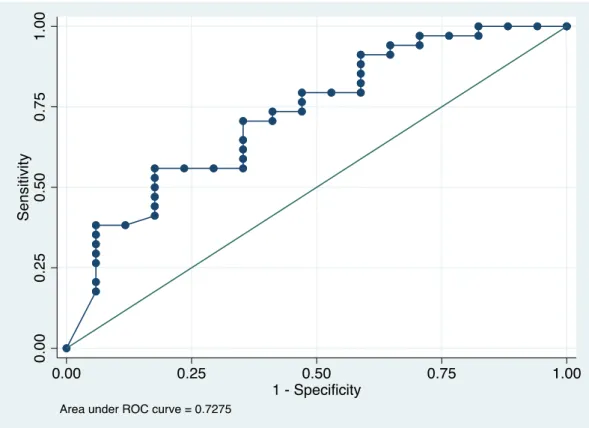
We assessed the accuracy of the JSCCR nomogram that Kanematsu et al
colorectal cancer using the data from our study. In Figure 4, the area under the receiver
operating curve (AUC) for 5-year overall survival by the JSCCR nomogram was 72.8%
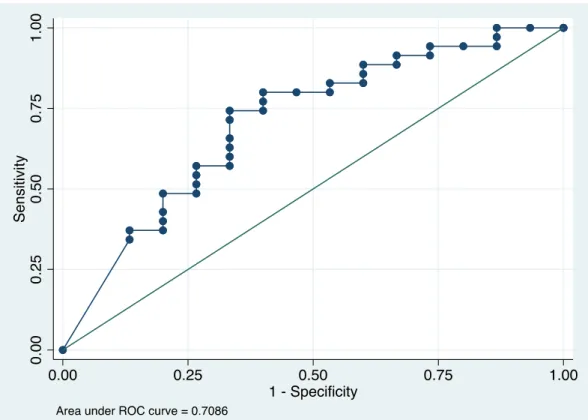
(95%CI: [57.7 - 87.8%]). Also, Figure 5 showed that AUC for 3-year overall survival
by the JSCCR nomogram was 70.9% (95%CI: [54.4 - 87.4 %]). Both of the values of
AUC for long-term outcomes were relatively high. To make a new, more simple model
for the estimation of long-term outcome among patients with CRC, the variables of the
new prediction model I selected were gender, age (<75 years, or 75>), and pathological
stage (Ⅰ-Ⅲ or Ⅳ). If gender was male, the score increased 1 point. If the age was 75
years or more, the score increased 1 point. If the pathological stage was Ⅳ, the score
increased 2 points. Then the sum of the scores was the total score. From the total score
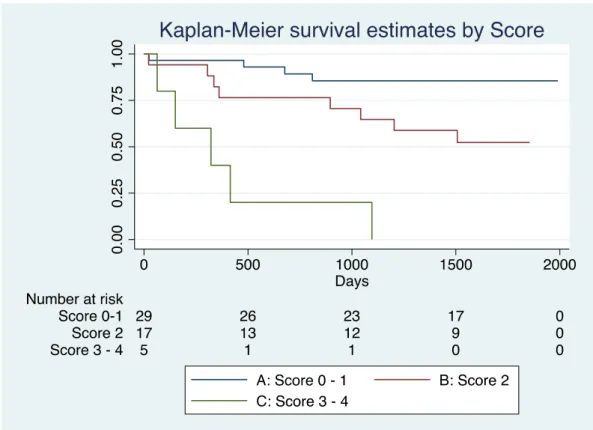
the subjects were divided into three categories; A: 0 - 1, B: 2, and C: 3 - 4 (Table 2).
Figure 6 describes the Kaplan-Meier survival curve by the three categories. As the score
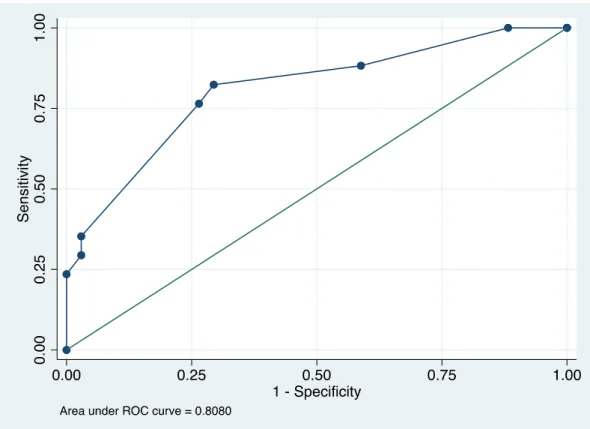
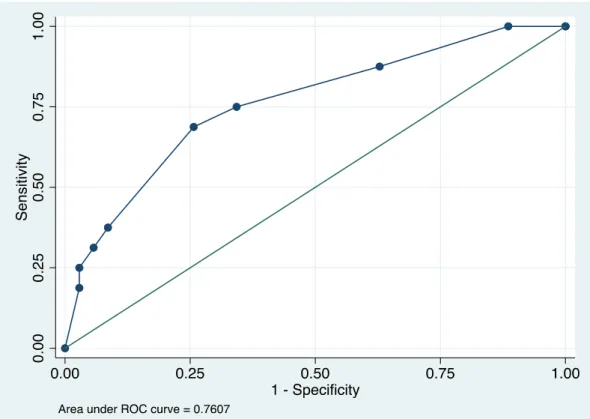
increased, survival time decreased. Then, from Figure 7 and 8, AUC for the 5-year
overall survival by the new model was 80.8% (95%CI: [68.0 - 93.6%]) and the AUC for
the 3-year overall survival was 76.1 % (95%CI: [61.7 - 90.5 %]).
Our study did not show a statistically significant different relationship between
frailty and the long-term outcomes of CRC patients, while there was a significant
difference between frailty and the short-term outcomes such as length of hospital stay,
and postoperative complications. Also, the novel prognostic prediction model for the
long-term outcome among the CRC patients had smaller number of variables, and
higher AUC than the JSCCR nomogram. In addition, it was easy to calculate because of
the simplicity of the new model.
From the study conducted in Norway, Ommundsen et al. (2014) revealed
opposite results from our study, showing that frailty based on a geriatric assessment
which is composed of ADL, use of medication, comorbidity, nutritional status,
cognitive function, and depression, is an independent predictor of survival in older
patients with colorectal cancer. This might be caused by the definition of frailty. The
difference between the definition of frailty in our study and that of Ommundsen’s study
was an item about physical activities. The Fried’s criteria is focusing mainly on physical
activities, not including patients’ comorbidity, nutritional status, mental status, and
cognitive conditions (Fried et al. 2001), so that the results that Ommundsen et al. (2014)
reported might be different if they had used the Fried’s criteria as the definition of
Mima et al. (2020) reported a strong association between frailty and recurrence and
mortality among colorectal cancer patients in pathological stage Ⅰ- Ⅲ who had
curative resection. This study was conducted in Japan. The hazard ratios of recurrence
free survival and overall survival were 1.70 (95%CI: [1.25 - 2.31], P < .001) and 2.04
(95%CI: [1.40 - 2.99], P < .001), respectively. In this study, frailty was defined using
the Clinical Frailty Scale (CFS), which divided into nine stages mainly based on
physical functions and ADL, similar to the Fried criteria (Rockwood et al. 2005).
However, in the characteristics of the study that Mima et al. (2020) conducted, the
variable, disease stage, had a significant difference between non-frail group and frail
group (P = .002). The proportion of those in disease stageⅡand Ⅲ among the frail
group is higher than among the non-frail group (85% vs 74%). This might have an
impact on the results even if the variable, disease stage, were adjusted in the
multivariable cox regression analyses. Also, the CFS has a disadvantage because it
grades by semi-quantitative classification comparing to the Fried’s criteria, which is
defined by quantitative values. This semi-quantitative and subjective aspect may affect
the results because of interobserver variability. The two reports we mentioned above
showed the opposite results compared to our study. One of the reasons for this may be
From the aspect of the definition of frailty, we might suggest that preoperative frailty
status defined by the Fried’s criteria be not an independent indicator for the long-term
outcomes among CRC patients following resection.
According to several previous cohort studies which investigated the
relationship between frailty and long-term prognosis following resection in older
patients with CRC, the three variables (age, gender, and pathological stage) were
important prognostic indicators (Aaldriks et al. 2013; Boakye et al. 2018; Mima et al.
2020; Ommundsen et al. 2018). Hence, the new model in this study adopted the three
variables and revealed its usefulness to evaluate overall mortality of older patients with
CRC following resection.
There are other reasons why this study did not show a statistically significant
difference between frailty and long-term overall survival. The distribution of
pathological stage among frail and non-frail group might influence the result. Generally,
the prognosis of CRC worsens by an increase of pathological stage. In this study, the
proportion of the frail subjects in pathological stage Ⅱ and Ⅲ was 11/12 (91.7 %),
while the proportion of the non-frail subjects in pathological stage Ⅱ and Ⅲ was
23/39 (60.0 %). Also, the proportion of the frail patients in pathological stage Ⅳ (1/12:
20.5 %). This difference might not show a statistical relationship between frailty and
long-term prognosis.
Limitations
On the whole, as a limitation of this study, small sample size and low power of
this study might lead to opposite results compared to previous studies. In a sample size
estimation under the log-rank test, estimated sample size should be more than 138 if we
set α=0.05, 1-β(Power) = 0.8, hazard ratio = 0.5 and the allocation ratio = 0.3 (frail
subjects / non-frail subjects). Also, the power of this study was under the condition of
α= 0.05, total sample size = 51, the allocation ratio = 0.3 (frail subjects / non-frail
subjects), and hazard ratio = 0.5, was 0.40. The power of this study is lower than 0.80.
For future research, we should perform and analyze the relationship between frailty and
long-term outcome of CRC patients in a larger sample size, considering the definition of
frailty. In addition, I should check external validation of the new prediction model in
larger sample size.
Conclusion
This study did not find a strong relationship between frailty based on the Fried
new prediction model for the long-term outcome among older patients with CRC had a
higher predictive ability than the JSCCR nomogram. However, further studies with a
larger sample size should be done.
Statement about Institutional Review Board (IRB) approval: This study was approved
References
Aaldriks, A. A., van der Geest, L. G., Giltay, E. J. le Cessie, S., Portielje, J. E. Tanis, B.
C., Nortier, J. W., & Maartense, E. (2013). Frailty and malnutrition predictive of
mortality risk in older patients with advanced colorectal cancer receiving
chemotherapy. Journal Geriatric Oncology, 4(3), 218 – 226.
https://pubmed.ncbi.nlm.nih.gov/24070460/
Boakye, D., Rillmann, B., Walter, V., Jansen, L., Hoffmeister, M., & Brenner, H.
(2018). Impact of comorbidity and frailty on prognosis in colorectal cancer
patients: A systematic review and meta-analysis. Cancer Treatment Review, 64,
30 – 39. https://pubmed.ncbi.nlm.nih.gov/29459248/
Bray, F., Ferlay, J., Soerjomataram, I., Siegel, R. L., Torre, L. A., & Jemal, A. (2018).
Global cancer statistics 2018: GLOBOCAN estimates of incidence and mortality
worldwide for 36 cancers in 185 countries. Cancer: A Cancer Journal for
Clinicians, 68(6), 394-424. doi:10.3322/caac.21492
Cancer Registry and Statistics. (2019). Cancer Information Service, National Cancer
Charlson, M. E., Pompei, P., Ales, K. L., & Mackenzie, C. (1987). A new method of
classifying prognostic comorbidity in longitudinal studies: Development and
validation. Journal of Chronic Diseases, 40(5), 373-383.
https//doi.org/10.1016/0021-9681(87)90171-8
Day, L. W., Walter, L. C., & Velayos, F. (2011). Colorectal cancer screening and
surveillance in the elderly patients. American Journal of Gastroenterology,
106(7), 1197-1206. https://doi.org/10.1038/ajg.2011.128
Detsky, A. S., Abrams, H. B., Mclaughlin, J. R., Drucker, D. J., Sasson, Z., Johnston,
N., . . . Hilliard, J. R. (1986). Predicting cardiac complications in patients
undergoing non-cardiac surgery. Journal of General Internal Medicine, 1(4),
211-219. doi:10.1007/bf02596184
Fleisher, L. A., Beckman, J. A., Brown, K. A., Calkins, H., Chaikof, E. L., Fleischmann,
K. E., . . . Robb, J. F. (2007). ACC/AHA 2007 Guidelines on perioperative
cardiovascular evaluation and care for noncardiac surgery. Circulation, 116(17).
doi:10.1161/circulationaha.107.185699
Fried, L. P., Tangen, C. M., Walston, J., Newman, A. B., Hirsch, C., Gottdiener, J., . . .
Journals of Gerontology Series A: Biological Sciences and Medical Sciences,
56(3). doi:10.1093/gerona/56.3.m146
Goldman, L., Caldera, D. L., Nussbaum, S. R., Southwick, F. S., Krogstad, D., Murray,
B., . . . Slater, E. E. (1977). Multifactorial index of cardiac risk in noncardiac
surgical procedures. New England Journal of Medicine, 297(16), 845-850.
doi:10.1056/nejm197710202971601
Kanemitsu, Y., Shida, D., Tsukamoto, S., Ueno, H., Ishiguro, M., Ishihara, S., . . .
Sugihara, K. (2019). Nomograms predicting survival and recurrence in colonic
cancer in the era of complete mesocolic excision. BJS Open, 3(4), 539-548.
doi:10.1002/bjs5.50167
Mahoney, F. I., Barthel, D. W. (1965). Functional evaluation: The Barthel Index.
Maryland State Medical Journal, Feb 14, 61-65.
Mayumi, D. (2019). The analysis of cancers by sex, age, and region using the data of
Nationwide Cancer Registration 2019. Japan Medical Association Research
Institute, No. 433.
Mima, K., Miyanari, N., Morito, A., Yumoto, S., Matsumoto, T., Kosumi, K., . . . Baba,
mortality following curative resection of stage I–III colorectal cancer. Annals of
Gastrointestinal Surgery, 4, 405 - 412. https://doi.org/10.1002/ags3.12337
Ommundsen, N., Wyller, T. B., Nesbakken, A., Jordhøy, M. S., Bakka, A., Skovlund,
E., & Rostoft, S. (2014). Frailty is an independent predictor of survival in older
patients with colorectal cancer. The Oncologist, 19(12), 1268-1275.
doi:10.1634/theoncologist.2014-0237
Pandit, V., Khan, M., Martinez, C., Jehan, F., Zeeshan, M., Koblinski, J., . . . Nfonsam,
V. (2018). A modified frailty index predicts adverse outcomes among patients
with colon cancer undergoing surgical intervention. The American Journal of
Surgery, 216(6), 1090-1094. doi:10.1016/j.amjsurg.2018.07.006
Rockwood, K. (2005). A global clinical measure of fitness and frailty in elderly people.
Canadian Medical Association Journal, 173(5), 489-495.
doi:10.1503/cmaj.050051
Solomon, D. H. (1988). Geriatric assessment: Methods for clinical decision making.
JAMA: The Journal of the American Medical Association, 259(16), 2450-2452.
doi:10.1001/jama.259.16.2450
Tan, K., Kawamura, Y. J., Tokomitsu, A., & Tang, T. (2012). Assessment for frailty is
resection whose comorbidities are already optimized. The American Journal of
Surgery, 204(2), 139-143. doi:10.1016/j.amjsurg.2011.08.012
Tatar, C., Benlice, C., Delaney, C. P., Holubar, S. D., Liska, D., Steele, S. R., & Gorgun,
E. (2020). Modified frailty index predicts high-risk patients for readmission after
colorectal surgery for cancer. The American Journal of Surgery, 220(1), 187-190.
doi:10.1016/j.amjsurg.2019.11.016
Tekkis, P. P., Prytherch, D. R., Kocher, H. M., Senapati, A., Poloniecki, J. D.,
Stamatakis, J. D., & Windsor, A. C. (2004). Development of a dedicated
risk-adjustment scoring system for colorectal surgery (colorectal POSSUM).
British Journal of Surgery, 91(9), 1174-1182. doi:10.1002/bjs.4430
Wilson, J. M., Holzgrefe, R. E., Staley, C. A., Schenker, M. L., & Meals, C. G. (2018).
Use of a 5-Item modified frailty index for risk stratification in patients
undergoing surgical management of distal radius fractures. The Journal of Hand
Tables and Figures
Characteristica Total Frailty P-valueb
All patients (n = 51) Frailty (n = 12) No-Frailty (n = 39)
Age in years (IQR) 77 (71, 80) 78 (70.5, 80.5) 77(71, 79) 0.56
Sex Female Male 19 (37.25 %) 32 (62.75 %) 5 (41.67 %) 7 (58.33 %) 14 (35.90 %) 25 (64.10 %) 0.13 BMI - kg/m2 (IQR) 23.2 (20.3, 26.6) 21.0 (18.0, 23.6) 24.9 (20.7, 27.1) 0.025* HDS-R - Points (IQR) 27 (23, 29) 25 (19, 27) 27 (24, 30) 0.03* Performance Status (PS) 0 1 36 (70.5 %) 10 (19.6 %) 33 (84.6 %) 5 (12.8 %) 3 (25 %) 5 (41.7 %) <0.01*
2 3 4 3 (5.9 %) 1 (2.0 %) 1 (2.0 %) 1 (2.6 %) 0 (0 %) 0 (0 %) 2 (16.7 %) 1 (8.3 %) 1 (8.3 %) Tumor location Ascending Transverse Descending Sigmoid Rectum Cecum Vermiform 9 (17.7 %) 5 (9.8 %) 3 (5.9 %) 17 (33.3 %) 12 (23.5 %) 4 (7.8 %) 1 (2.0 %) 3 (25.0 %) 0 (0 %) 2 (16.7 %) 1 (8.3 %) 5 (46.7 %) 1 (8.3 %) 0 (0 %) 6 (15.4 %) 5 (12.8 %) 1 (2.5 %) 16 (41.0%) 7 (18.0 %) 3 (7.7 %) 1 (2.6 %) 0.10 Macroscopic type 1 2 3 4 5 5 (9.80 %) 4 (7.84 %) 29 (56.86 %) 9 (17.65 %) 4 (7.84 %) 0 (0 %) 0 (0 %) 9 (75.00 %) 2 (16.67 %) 1 (8.33 %) 5 (12.82 %) 4 (10.26 %) 20 (51.28 %) 7 (17.95 %) 3 (7.69 %) 0.45
Tumor differentiation Well Moderate Poor mucinous 20 (39.22 %) 28 (54.90 %) 2 (3.92) 1 (1,96) 6 (50.00 %) 6 (50.00 %) 0 (0 %) 0 (0 %) 14 (35.90 %) 22 (56.41 %) 2 (5.13 %) 1 (2.56 %) 0.69 Extent of lymphadenectomy D1 D2 D3 1 (1.96 %) 3 (5.88 %) 47 (92.16 %) 0 (0 %) 1 (8.33 %) 11 (91.67 %) 1 (2.56 %) 2 (5.13 %) 36 (92.31 %) 0.79 Preoperative CEA <5 ng/ml 5< <10 ng/ml 10< <20 ng/ml <20 ng/ml 24 (47.06 %) 9 (17.65 %) 8 (15.69 %) 10 (19.61 %) 3 (25.00 %) 3 (25.00 %) 2 (16.67 %) 4 (33.33%) 21 (53.85 %) 6 (15.38 %) 6 (15.38 %) 6 (15.38 %) 0.31 Lymphatic invasion ly0 31 (60.78 %) 8 (66.67 %) 23 (58.97 %) 0.81
ly1 ly2 ly3 15 (29.41 %) 2 (3.92 %) 3 (5.88 %) 3 (25.00 %) 0 (0 %) 1 (8.33 %) 12 (30.77 %) 2 (5.13 %) 2 (5.13 %) Venous invasion V0 V1 V2 V3 10 (19.61 %) 13 (25.49 %) 16 (31.37 %) 12 (23.53 %) 0 (0 %) 5 (41.67 %) 4 (33.33 %) 3 (25.00 %) 10 (25.64 %) 8 (20.51 %) 12 (30.77 %) 9 (23. 08 %) 0.19
Number of Lymph nodes
examined (IQR) 22 (15, 29) 26 (18, 37) 21 (14, 26) 0.16
Number of metastatic lymph
nodes (IQR) 0 (0, 1) 0 (0, 0.5) 0 (0, 3) 0.37 Adjuvant chemotherapy No Yes 35 (68.6 %) 16 (31.4 %) 10 (83.3 %) 2 (16.7 %) 25 (64.1 %) 14 (35.9 %) 0.21
Details of adjuvant chemotherapy - yes Pathological stage Ⅰ Pathological stage Ⅱ Pathological stage Ⅲ Pathological stage Ⅳ 0 (0 %) 3 (18.8 %) 7 (43.7 %) 6 (37.5 %) 0 (0 %) 0 (0 %) 2 (100 %) 0 (0 %) 0 (0 %) 3 (21.4 %) 5 (35.7 %) 6 (42.9 %) 0.23 Operation method Laparoscopy Open 44 (86.27 %) 7 (13.73 %) 9 (75.00 %) 3 (25.00 %) 35 (89.74 %) 4 (10.26 %) 0.19
Length of Hospital Stay 16
(9, 23) 21.5 (17.5, 38) 10 (8, 22) <0.01* CCI Low Medium High Very high 32 (62.75 %) 18 (35.29 %) 1 (1.96%) 0 (0 %) 7 (58.33 %) 4 (33.33 %) 1 (8.33 %) 0 (0 %) 25 (64.10 %) 14 (35.90 %) 0 (0 %) 0 (0 %) 0.19
Postoperative complication Yes No 13 (25.49 %) 38 (74.51 %) 6 (50.0 %) 6 (50.0 %) 7 (17.95 %) 32 (82.05 %) 0.03* Pathological Stage (%) Ⅰ Ⅱ Ⅲ Ⅳ 8 (15.6 %) 25(49.0 %) 9(17.7 %) 9(17.7%) 0 (0 %) 8 (66.7 %) 3 (25.0 %) 1 (8.3 %) 8 (20.5 %) 17 (43.6 %) 6 (15.4 %) 8 (20.5 %) 0.19
Table 1. Characteristics of the subjects
Abbreviations: BMI, Body Mass Index; HDS-R, Hasegawa’s Dementia Rating
Scale-Revised; PS, Performance Status; CEA, Carcinoembryonic antigen, IQR;
InterQuartile Range, CCI; Charlson Comorbidity Index
aCategorical variables were presented as proportions. Non-normally distributed
bCategorical data were tested using the chi-square test or Fisher’s exact test.
Non-parametrically distributed data were analyzed using Wilcoxon Rank-Sum test.
Score Sex Female male 0 1 Age <75 years >75 years 0 1 Pathological stage Ⅰ− Ⅲ Ⅳ 0 2
Total Score = (Sex score) + (Age score) + (Pathological stage Score)
A: Score 0-1
B: Score 2
C: Score 3-4
Figure 4. Area under the receiver operating curve (ROC) for 5-year overall survival by
Figure 5. Area under the receiver operating curve (ROC) for 3-year overall survival by
Figure 7. Area under the receiver operating curve (ROC) for 5-year overall survival by
Figure 8 Area under the receiver operating curve (ROC) for 3-year overall survival by