Polymer Chemistry
RSC
Publishing
ARTICLE
Cite this: DOI: 10.1039/x0xx00000x
Received 00th January 2012, Accepted 00th January 2012 DOI: 10.1039/x0xx00000x
www.rsc.org/
Dual role for alkali metal cations in enhancing the
low-temperature radical polymerization of
N,N-dimethylacrylamide
Tomohiro Hirano,
a,* Tatsuya Saito,
aYoshitaka Kurano,
aYohei Miwa,
bMiyuki
Oshimura
aand Koichi Ute
aThe radical polymerization of N,N-dimethylacrylamide (DMAAm) has been investigated in
the presence of several alkali metal salts, including lithium
bis(trifluoromethanesulfonyl)imide (LiNTf2). The addition of an alkali metal salt led to a significant increase in the yield and molecular weight of the resulting polymer. NMR analysis of mixtures of DMAAm and LiNTf2 suggested that DMAAm was being activated by the coordination of Li+ to its C=O group. Electron spin resonance analysis of the DMAAm polymerization in the presence of LiNTf2 suggested that the propagating radical was being stabilized by Li+ through a single-electron lithium bond, because a signal for the propagating radical of the acrylamide derivatives was observed for the first time in solution when LiNTf2 was added. Based on these results, we have proposed a mechanism for this polymerization, where the propagation steps occur between a lithium ion-stabilized propagating radical and a lithium ion-activated incoming monomer. Furthermore, polymers with a wide range of stereoregularities, such as isotactic, syndiotactic and heterotactic systems, were successfully prepared using this method by carefully selecting the appropriate combination of solvent and alkali metal salt.
Introduction
Hydrogen bonding interactions have attracted considerable attention from numerous researchers because of their important roles in chemistry, physics, and biology.1, 2 Several unusual hydrogen bonding interactions, such as π hydrogen bonding3 and single-electron hydrogen bonding,4-12 have been proposed on the basis of recent progress in hydrogen bonding research. Given that alkali metals are congeners of hydrogen, several similar interactions have also been proposed, including cation-π13, 14 and single-electron alkali-metal bonding interactions.15-18 The enthalpic contribution of a cation-π interaction increases in the order K+ < Na+ < Li+,14 whereas the strength of single-electron alkali-metal (hydrogen) bonding interaction increases in the order H+ < Na+ < Li+.18 Among alkali metal cations, Li+ therefore exhibits the highest interaction in these unusual bonding interactions.
These results encouraged us to assess the extent to which these unusual bonding interactions could be used to control radical polymerization reactions, because it is well known that Lewis acids, such as alkali metal salts, can be used to accelerate the radical polymerization of (meth)acrylic monomers.19-29 It was envisaged that alkali metal cations could potentially play a dual role in radical polymerization reactions, with the first of these roles being the “activation of the monomer”. It was recently reported that “naked” lithium cations, derived from the lithium salt of a carborane anion, were used to catalyze the
radical polymerization of propene and other terminal olefins with triplet dioxygen or conventional radical initiators.30-32 In this particular polymerization system, the complexation of Li+ to olefins (i.e., cation-π interaction) is considered to be a key interaction in terms of favoring the addition reaction over the competing H-abstraction reaction, as predicted by calculation.33, 34
The second role for the alkali metal would involve the “stabilization of the propagating radical”. In this regard, Li+ has been reported to facilitate the homolytic cleavage of the S-S bonds of several bis(thiocarbonyl)disulfides [(RCS2)2] through the formation of chelate complexes with (RCS2)2 and fragmented radical RCS2•, as depicted in the following equation.35
[Li(RCS2)2]+ + Li+ ––> 2[Li(RCS2)]•+
The latter complex can be considered to be stabilized by a type of single-electron lithium bond.
In this study, we have demonstrated that alkali metal cations dramatically improve the efficiency of the radical polymerization of N,N-dimethylacrylamide (DMAAm) at low temperatures. Metal bis(trifluoromethanesulfonyl)imides (metal triflimides) were selected as model salts to be added to the reactions, because of the high levels of delocalization and steric hindrance associated with the triflimide counterion, which prevent it from behaving as a nucleophile and also place an
extremely high positive charge density on the metal cation.36 NMR analyses of mixtures of DMAAm and LiNTf2 suggested that the DMAAm monomer was being activated by Li+ through a coordinating interaction, instead of a cation-π interaction. Furthermore, electron spin resonance (ESR) analysis of the DMAAm polymerization suggested that the propagating radical was being stabilized by Li+ through a single-electron lithium bonding interaction.
Furthermore, it is well known that Lewis acids, such as rare earth metal trifluoromethanesulfonates [M(OTf)3], can induce isotactic specificity in the radical polymerization of (meth)acrylamide derivatives.28, 29, 37, 38 In particular, Y(OTf)
3 and Yb(OTf)3 successfully provide isotactic-rich polymers with meso (m) diad contents of 86-88 %.28, 29, 37 Therefore, we also examined stereochemistry of the resulting polymers, and found that a wide range of stereoregular polymers, such as heterotactic-rich, syndiotactic-rich and isotactic-rich polymers, were obtained depending on a combination of the solvent and alkali metal salt. The mechanisms for induced stereospecificities of this polymerization have been discussed in terms of the stoichiometry of the coordinating monomer complexes.
Experimental
Materials
Dimethyl 2,2’-azobisisobutyrate (MAIB) (supplied by Otsuka Chemical Co., Ltd., Osaka, Japan) was recrystallized from methanol (MeOH). Toluene (Kanto Chemical Co., Inc., Tokyo, Japan) was washed sequentially with sulfuric acid, water and 5% aqueous NaOH and then purified by fractional distillation prior to being used. MeOH (Kanto Chemical Co., Inc.) was purified by fractional distillation. N,N-Dimethylacrylamide (DMAAm) (Tokyo Chemical Industry, Tokyo, Japan) was purified by distillation under reduced pressure. Tetrahydrofuran (THF), acetonitrile (CH3CN) (Kanto Chemical Co., Inc.) 2,2,2-trifluoroethanol (CF3CH2OH) (Sigma-Aldrich Japan,
Tokyo, Japan), 2-propanol (iPrOH), lithium
bis(trifluoromethanesulfonyl)imide (LiNTf2) (Tokyo Chemical Industry), sodium bis(trifluoromethanesulfonyl)imide (NaNTf2), lithium trifluoromethanesulfonate (LiOTf) (Kishida Chemical Co., Ltd., Osaka, Japan), lithium chloride (LiCl) and potassium bis(trifluoromethanesulfonyl)imide (KNTf2) (Wako Pure Chemical Industries, Osaka, Japan) were used as received.
Polymerization
In a typical polymerization procedure, DMAAm (0.556 g, 5.60 mmol) and LiNTf2 (1.615 g, 5.62 mmol) were dissolved in CF3CH2OH to prepare a 5 mL solution. MAIB (0.021 g, 8.98 × 10⁻² mmol) was dissolved in CF3CH2OH to prepare a 1 mL of solution. Four milliliters of the former solution and half a milliliter of the latter solution were then transferred to a glass ampoule to give the following final concentrations: [DMAAm]0 = 1.0 mol L–1, [LiNTf2]0 = 1.0 mol L–1 and [MAIB]0 = 1.0 × 10⁻² mol L–1. The glass ampoule was then degassed under vacuum and filled with nitrogen six times at −50 °C before being set at the required polymerization temperature and irradiated at a distance of approximately 5 cm from a UV-LED lamp (LED-41UV375N100VF, λ = 375 nm, 410 mW, Optocode Co., Tokyo, Japan) to initiate the polymerization reaction. After 0.5 h, the reaction mixture was dialyzed against MeOH (Spectra/Por 3, molecular mass cutoff 3.5 kDa, Spectrum Laboratories Inc., Shiga, Japan) until it was
free from salts. The resulting dialysate was evaporated to dryness under reduced pressure to give a residue, which was dissolved in benzene and freeze-dried to give the polymer product. The polymer yield was determined gravimetrically.
Size exclusion chromatographic measurement
The molecular weight and molecular-weight distribution of the polymers were determined by size-exclusion chromatography (SEC) using a chromatogram that had been calibrated with standard poly(methyl methacrylate) (PMMA) samples. SEC was performed on an HLC 8220 chromatograph (Tosoh Corp., Tokyo, Japan) equipped with TSK gel columns [SuperHM-M (150 × 6.5 mm, i.d.) and SuperHM-H (150 × 6.5 mm, i.d.)] (Tosoh Corp.). Dimethylformamide containing 10 mmol L−1 LiBr was used as an eluent at 40 °C and a flow rate of 0.35 mL min−1. The initial polymer concentration was set at 1.0 mg mL−1.
NMR measurement
1H and 13C NMR spectra were recorded on EX-400, ECX-400 and ECA-400 spectrometers (JEOL Ltd., Tokyo, Japan), which were operated at 400 and 100 MHz for 1H and 13C spectra, respectively. Stereoregularity was investigated by 1H NMR signals of the main-chain methylene groups, which provide conclusive information about the even-number stereosequences
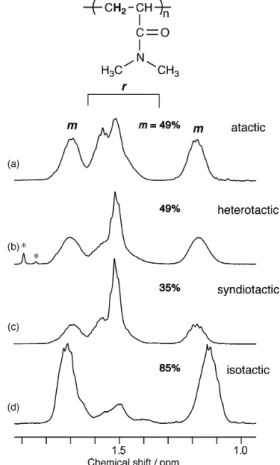
Fig. 1 1H NMR spectra of the main-chain methylene groups of the poly(DMAAm)s prepared in this study with a wide range of stereoregularities. The peaks marked with an asterisk (*) are impurities.
(e.g., diad and tetrad) of the poly(DMAAm)s. Fig. 1 shows the NMR spectra of poly(DMAAm)s, with a wide range of stereoregularities, obtained in this study. The NMR spectrum in Fig. 1b was assigned as a heterotactic-rich polymer, and the reasons for this assignment will be discussed in detail later in the manuscript.
ESR measurement
ESR samples were placed in 2 mm o.d. quartz tubes and degassed by several freeze-pump-thaw cycles before being sealed under a nitrogen atmosphere. ESR spectra were recorded on an X-band (ca. 9 GHz) FA100 spectrometer (JEOL Ltd.) at −40 °C with 100 kHz field modulation. UV irradiation (350– 370 nm) was carried out using an ultrahigh-pressure mercury lamp (SX-UI501HQ; Ushio Ltd., Tokyo, Japan) with appropriate UVD-350 (AGC Techno Glass Co., Ltd., Shizuoka, Japan) and HAF-50S-30H (Sigmakoki, Co., Ltd., Saitama, Japan) glass filters. The modulation amplitude, magnetic field width, sweep time, time constant and number of scan parameters were set at 0.5 mT, 15 mT, 4 min, 0.3 sec and 1, respectively. The magnetic field and g tensor were calibrated with Mn2+. A microwave power of 5 mW was used for the measurements. The concentration of the propagating radical species was determined by the double integration of the ESR signal and a comparison of this result with that corresponding to the ESR spectrum of a known concentration of 4-hydroxy-2,2,6,6-tetramethylpiperidine 1-oxyl (TEMPOL) in methanol.
Results and discussion
Radical polymerization of DMAAm in toluene in the presence of LiNTf2, NaNTf2 and KNTf2
The radical polymerization of DMAAm was carried out both thermally and photocatalytically in toluene at 60 and −40 °C, respectively, in the presence of a catalytic amount of LiNTf2, NaNTf2 or KNTf2 (Table 1). A high monomer concentration of 5.0 mol L–1 was adopted to dissolve the alkali metal salts because of their poor solubility in toluene. The polymerization was terminated 2 min after initiation, because longer polymerization times resulted in the system becoming heterogeneous. The effect of the addition of the alkali metal salt was clear even with a catalytic amount of 2.0 mol% relative to the DMAAm monomer at low temperatures. Significant increases were observed in the polymer yields and molecular weights at −40 °C, including 1.4- to 1.8-fold increases in the yield and 1.9- to 2.6-fold increases in the number-average molecular weight (Mn) (compare run 5 vs. runs 6, 7 and 8). The
efficiency of enhancing effect of Li+ was more pronounced than that of Na+ or K+ at elevated temperatures, with the enhancing effects of NaNTf2 and KNTf2 almost disappearing at 60 °C. The addition of Li+ at 60 °C not only led to a significant decrease in Mn, but also led to an obvious broadening of the molecular weight distribution. These changes in the properties of the polymer were probably caused by the lack of control over the polymerization temperature, because the thermal polymerization was terminated by cooling the polymerization mixture down to −50 °C at 2 min after the initiation, where it was rapidly heated to 60 °C.
To investigate the effect of adding different amounts of the cations, the radical polymerization of DMAAm was carried out in the presence of various amounts of LiNTf2 (Table 2). The monomer concentration was changed from 5.0 to 3.0 mol L–1. The polymerization was terminated at 10 sec after the initiation by turning the UV-LED light off to prevent the system from becoming heterogeneous. Increasing the added amount of LiNTf2 added to the reaction led to a significant increase in the enhancing effect of the cation on the yield and molecular weight of the resulting polymer. Notably, the polymer yield increased in a linear fashion with the amount of added LiNTf2 (Supplementary Information Fig. S1).
Fig. 2 Size exclusion chromatograms of poly(DMAAm)s obtained in
toluene at −40 °C for 10 sec in the presence of LiNTf2: [LiNTf2]0 = (a) 0.0 mol%, (b) 3.3 mol% (c) 16.7 mol% and (d) 33.3 mol% Table 1 Radical polymerization of DMAAm in toluene at 60 and −40 °C
for 2 min in the presence and absence of 2.0 mol% alkali metal saltsa
Run Temp. °C M-NTf2 Yield % Mn×10–4 b Mw/ Mn b 1 60 None 11 27.0 1.8 2 60 LiNTf2 62 4.0 7.3 3 60 NaNTf2 2 32.9 1.8 4 60 KNTf2 13 31.3 2.0 5 –40 None 10 16.2 2.1 6 –40 LiNTf2 14 31.3 1.8 7 –40 NaNTf2 18 31.2 1.7 8 –40 KNTf2 14 42.7 1.7 a [MNTf
2]0 = 0.1 mol L–1, [DMAAm]0 = 5.0 mol L–1,
[DMAAm]0/[MAIB]0 = 250.
b Determined by SEC (PMMA standards).
Table 2 Radical polymerization of DMAAm in toluene at −40 °C for 10
sec in the presence and absence of LiNTf2a
Run [LiNTf2]0 / [DMAAm]0 Yield % Diad / %b Mn×10–4 c Mw/ Mn c m r 9 0.0 1 59 41 11.7 2.4 10 0.033 2 53 47 25.3 2.1 11 0.167 8 55 45 - - 12 0.333 15 64 36 - - a [DMAAm]
0 = 3.0 mol L–1, [MAIB]0 = 2.0 × 10⁻² mol L–1. b Determined from the 1H NMR signals.
relative to [DMAAm]0. The exclusion limit of 550 × 104 was estimated from the calibration curve against PMMA standards.
Furthermore, the molecular weight of the polymers increased dramatically as the amount of Li+ increased. In particular, the addition of 16.7 and 33.3 mol% LiNTf2 led to such a significant increase in the molecular weight of the resulting polymers that they could not be determined by SEC, because their molecular weights exceeded the exclusion limit of 550 × 104 under the given conditions for SEC measurements (Fig. 2).
The addition of a moderate amount of LiNTf2 not only affected the polymer yield and molecular weight but also impacted on the stereoregularity of the resulting polymers. The m diad content gradually increased from 53 to 64% as the amount of added LiNTf2 increased, although the addition of 3.3 mol% LiNTf2 led to a decrease a 6% decrease in the m diad content (Supplementary Information Fig. S2).
Radical polymerization of DMAAm in polar solvents in the presence of an equimolar amount of LiNTf2
The enhancing effect of LiNTf2 increased as the amount of the salt added to the reaction increased, as mentioned above. However, the amount of LiNTf2 that could be added to the reaction was limited by the poor solubility of LiNTf2 in toluene. To address this issue, several polar solvents were evaluated as potential replacements for toluene, including MeOH, iPrOH, CF3CH2OH, CH3CN and THF, which allowed for the dissolution of an equimolar amount of LiNTf2 relative to the DMAAm monomer (Table 3). A monomer concentration of 1.0 mol L–1 was used to reduce amount of the added LiNTf
2. Pleasingly, a significant enhancing effect was observed for LiNTf2 even in polar solvents, which would weaken the interaction between the DMAAm and Li+. The polymer yield and molecular weight both tended to increase with the addition of LiNTf2 (Table 3). These tendencies were particularly pronounced in CF3CH2OH and CH3CN, where there were 2.2- and 3.5-fold increases in the yield and 8.9- and 6.0-fold increases in the Mn, respectively. The significant enhancements observed in these two cases were attributed to the Li+ ion being only weakly coordinated by the solvents. The basicities of CF3CH2OH and CH3CN are lower than those of MeOH and iPrOH,39 which would result in weaker coordination to the Li+
ion and therefore favor the desired interaction between the DMAAm and Li+. Moderate increases in the polymer yield and molecular weight were also observed in THF, whose basicity is comparable to that of an encumbered acyclic tertiary amine.40
The stereospecificity of the DMAAm polymerization reaction is known to be dependent on the solvents used. For example, the m diad content increases as the polarity of the solvent decreases at a fixed temperature.41 The m diad content of the polymer prepared in THF was indeed larger than those of the polymers prepared in protic solvents. The addition of an
Fig. 3 1H NMR spectra of the main-chain methylene groups of the poly(DMAAm)s obtained in CH3CN at −40 °C in the presence of different amounts of LiNTf2. The peaks marked with an asterisk (*) are impurities.
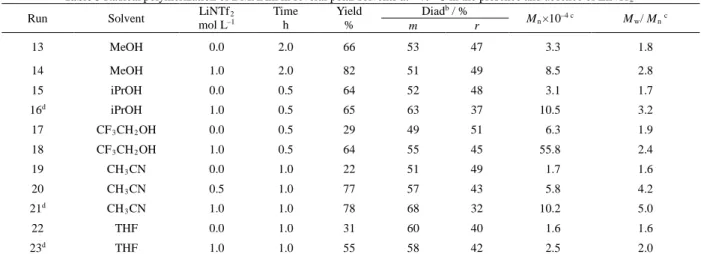
Table 3 Radical polymerization of DMAAm in several polar solvents at −40 °C in the presence and absence of LiNTf2a
Run Solvent LiNTf2
mol L–1 Time h Yield % Diadb / % Mn×10–4 c Mw/ Mn c m r 13 MeOH 0.0 2.0 66 53 47 3.3 1.8 14 MeOH 1.0 2.0 82 51 49 8.5 2.8 15 iPrOH 0.0 0.5 64 52 48 3.1 1.7 16d iPrOH 1.0 0.5 65 63 37 10.5 3.2 17 CF3CH2OH 0.0 0.5 29 49 51 6.3 1.9 18 CF3CH2OH 1.0 0.5 64 55 45 55.8 2.4 19 CH3CN 0.0 1.0 22 51 49 1.7 1.6 20 CH3CN 0.5 1.0 77 57 43 5.8 4.2 21d CH 3CN 1.0 1.0 78 68 32 10.2 5.0 22 THF 0.0 1.0 31 60 40 1.6 1.6 23d THF 1.0 1.0 55 58 42 2.5 2.0 a [Monomer]
0 = 1.0 mol L–1, [MAIB]0 = 1.0 × 10⁻² mol L–1. b Determined from the 1H NMR signals. c Determined by SEC (PMMA standards). d Polymer precipitated during polymerization reaction.
equimolar amount of LiNTf2 led to a significant increase in the m diad content in some solvents. For example, the m diad content increased by 11, 6 and 17% in iPrOH, CF3CH2OH and CH3CN, respectively (Supplementary Information Fig. S3).
Furthermore, changes in the spectral pattern of the poly(DMAAm)s prepared in CH3CN suggested that the stereospecificity of the polymerization was changing from atactic → heterotactic → isotactic as the amount of LiNTf2 added to the reaction increased (Fig. 3). The spectral pattern of the signals of the main-chain methylene protons in the r configuration suggested the induction of heterotactic specificity in the polymerization in the presence of 50 mol% LiNTf2 (Table 3, run 20).
To clarify the difference in spectral patterns between heterotactic and atactic sequence, the NMR spectra of the polymers listed in Table 2, run 11 and Table 3, run 20 are summarized in Fig. 4. The spectral patterns were quite different from each other, although both of these polymers had very similar diad tacticities (i.e., m = 55 and 57%, respectively). This result suggested that the signals of the main-chain methylene protons had been split because of stereosequences that were longer than diad, and a heterotactic-rich polymer was produced in the presence of 50 mol% LiNTf2. Alternatively, it would have to be assumed that there was a disproportionate preference for the formation of a mixture of isotactic and syndiotactic polymers or the formation of stereoblock polymers in a homogeneous radical polymerization. Further work is therefore needed to develop a deeper understanding of the assignment process for stereosequences longer than diad, because only rough assignments of isotactic and syndiotactic sequences have been reported to date for the 13C NMR signals of the C=O groups of poly(DMAAm)s.42
Fig. 4 1H NNR spectra of the main-chain methylene groups of (a) atactic and (b) heterotactic-rich poly(DMAAm)s. The peaks marked with an asterisk (*) are impurities.
In addition, the effect of LiNTf2 on radical polymerization of N-alkylmethacrylamides also supports the above-mentioned
assignment concerning heterotactic sequence. Similar effects of LiNTf2 have been observed in the radical polymerizations. In particular, heterotactic-rich polymers with mr triad of up to 64 % were obtained in CH3CN, whereas syndiotactic-rich polymer with rr triad of 70 % in the absence of LiNTf2.43 The details will be published elsewhere in the near future.
Role of Li+ in the enhancement of polymer yield and molecular
weight
Coordination complex of DMAAm with Li+ To develop a
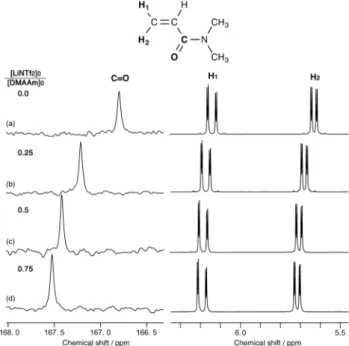
deeper understanding as to why the addition of LiNTf2 dramatically enhanced the polymer yield and molecular weight, we investigated the nature of the interaction between the DMAAm monomer and Li+ by examining changes in the chemical shifts of the NMR signals belonging to the acryloyl group of DMAAm upon mixing. Fig. 5 shows the 1H and 13C NMR spectra of the vinylidene (=CH2) and C=O groups in DMAAm, respectively, following the addition of different amounts of LiNTf2. All of these spectra were measured in CD3CN at 0 °C. The chemical shifts of the acryloyl group were found to be highly sensitive to the interaction between DMAAm and Li+ as a result of the large changes in the intra- and intermolecular electron distributions following the coordination of Li+. The signal of the carbonyl carbon showed a large downfield shift of 0.410 ppm when the DMAAm was mixed with 25 mol% LiNTf2, and this downfield shift was further enhanced as the [Li]0/[DMAAm]0 ratio was increased (Supplementary Information Fig. S4). These results indicated that DMAAm formed a complex with Li+ through a coordinating interaction between the C=O group of DMAAm and Li+ rather than a cation-π interaction between the C=C group and Li+.
Fig. 5 Expanded 13C and 1H NMR spectra of the C=O and vinylidene groups of DMAAm in the presence of LiNTf2, respectively. All of these spectra were measured in CD3CN at 0 °C.
The signals of both the H1 and H2 protons in the vinylidene group exhibited downfield shifts following the addition of LiNTf2 (Fig. 5). The magnitude of the downfield shift was larger for the H2 proton than the H1 proton, and the difference in the chemical shifts between the H1 and H2 protons consequently decreased gradually from 0.511 to 0.476 ppm as the amount of LiNTf2 added to the system increased (Supplementary Information Fig. S4). This tendency suggested that the coordinating interaction between the C=O group of DMAAm and Li+ would increase the radical polymerizability of the DMAAm monomer, because there is a strong correlation between the difference in the chemical shifts of the vinylidene protons of acrylates and the Q value of the monomer, in that the Q value increases as the chemical shift difference decreases.44
ESR analysis of the DMAAm polymerization ESR is a
powerful tool for estimating the concentration of propagating radicals.45, 46 ESR was therefore used in the current study to measure the polymerization of DMAAm (1.0 mol L–1) in MeOH at −40 °C in the presence of an equimolar amount of LiNTf2 under UV irradiation with a high-pressure mercury lamp. The concentration of MAIB used in this reaction was set at 5.0 × 10⁻² mol L–1. MeOH was selected as the solvent because polymerization proceeded relatively slowly in MeOH among the solvents, in which a positive enhancement effect on the yield and molecular weight of the resulting polymer was observed. However, MeOH is not generally considered to be a good solvent for ESR measurement because the use of polar solvents in ESR can lead to a high dielectric loss and a reduction in the ESR sensitivity.
Fig. 6 ESR spectra of the DMAAm polymerization reaction in
MeOH at −40 °C: (a) LiNTf2 under UV, (b) LiNTf2 without UV, (c) none under UV and (d) none without UV. Signals from the Mn2+ standard are shown at ca. 324 and 333 mT.
Despite these concerns, a broad three-line signal was clearly observed when the UV was irradiated in the presence of LiNTf2 (Fig. 6a). It is noteworthy that this result, to the best of our knowledge, represents the first successful observation of the ESR signals of the propagating radicals of acrylamide derivatives in the solution state. The ESR signals of the
propagating radicals of acrylamide derivatives under heterogeneous conditions have been observed in a limited number of reports, including solid-state polymerization processes such as mechanochemical polymerizations,47 photopolymerization in dried cellulose-monomer matrices,48 photopolymerization reactions in the frozen state at temperatures below −150 °C49 and precipitation polymerization.50 Notably, a similar broad three-line signal pattern was observed in all of these heterogeneous polymerization processes.
The radical concentration was estimated to be approximately 7 × 10⁻¹⁰ mol L–1. The most probable explanation for the first successful detection of the propagating radicals in this case would be the stabilization of the propagating radical by Li+ through a single-electron lithium bond between Li+ and the unpaired electron in the propagating radical, which would be delocalized over C–C–O (Scheme 1). A similar stabilization mechanism was previously reported for the unimeric model of the propagating radical of MMA, where the radical stabilization energy was calculated to be 5 to 8 kJ mol–1.51 Furthermore, the retardation of the terminating reaction caused by the viscosity effect of Li+ and/or the Coulombic repulsion of the lithium-coordinated polymer radicals would work cooperatively with the stabilization effect.25, 26, 52
Based on these results, it is clear that Li+ plays two roles in this polymerization reaction, in that Li+ activates the incoming monomer and stabilizes the propagating radical. 1H NMR analysis of a mixture of DMAAm and LiNTf2 suggested that LiNTf2 enhanced the Q value of DMAAm through complex formation, as mentioned above. The Q value is generally considered to correlate with the resonance factor of the monomer in a semiquantitative manner, and it is therefore plausible that the enhancement of the resonance factor of the monomers could lead to the enhancement of the resonance factor of the corresponding propagating radicals. Consequently, it is assumed that the propagating radical is stabilized by Li+, which had been coordinated to the carbonyl group of the incoming monomer to activate the monomer. The enhancing effect of Li+ would be observed as a result of the activating effect of the incoming monomer surpassing the stabilization effect on the propagating radical.
Scheme 1 Proposed structure for the propagating radical of
DMAAm stabilized by Li+, which had previously been coordinated by the carbonyl group of the incoming monomer.
Relationship between complex structure and stereospecificity of the polymerization
With regard to the stoichiometry of the DMAAm-Li+ complex, 1H NMR analysis was carried out on solutions of [DMAAm]
0 + [LiNTf2]0 = 0.25 mol L−1 in CD3CN at 0 °C, and the stoichiometry of the complex was evaluated using Job's method via Eq. (1)13
where δ(H1) and δ(H1)f are the chemical shifts of the H1 proton of the vinylidene group (cf. Fig. 5) of the sample mixture and DMAAm alone, respectively, relative to a TMS internal standard. Fig. S5 (Supplementary Information) shows the changes in the chemical shift of the H1 vinylidene proton resulting from variations in the initial proportion of DMAAm. The chemical shift of the H1 vinylidene proton of DMAAm alone at the corresponding concentration was denoted δ(H1)f, because chemical shifts can vary slightly with concentration. The chemical shifts for the sample mixture were roughly fitted to a cubic equation. The chemical shift for the saturated mixture, δ(H1)c, was calculated from the intercept of the cubic fit to the data. The calculated data were asymmetrically plotted, and a maximum was observed around [DMAAm]0 fraction = 0.67 (Fig. 7a). This result indicated that DMAAm and Li+ preferentially form a 2:1 complex, because the maxima at 0.5 and 0.67 represent the formation of 1:1 and 2:1 complexes, respectively.
The stereospecificity of the DMAAm polymerization reaction could be determined by the stoichiometries of the DMAAm-Li+ complexes (Scheme 2). For example, the addition of 50 mol% LiNTf2 gave heterotactic-rich polymer (cf. Figs. 3 and 4). In this particular system, a 2:1 complex of DMAAm and Li+ would be formed preferentially, and this 2:1 complex could behave as divinyl monomer. A heterotactic sequence would be formed if the stereoselectivity of the apparent intramolecular propagation was opposite to that of the apparent intermolecular propagation (e.g., m addition in the apparent intramolecular propagation and racemo (r) addition in the apparent intermolecular propagation). A similar mechanism has been proposed for the heterotactic-specific radical polymerization of 4-vinylpyridine, which forms a 2:1 inclusion complex with randomly methylated β-cyclodextorin.53
Further increasing the amount of LiNTf2 added to the system up to 100 mol% resulted in the formation of an isotactic-rich polymer (cf. Fig. 3). The use of 100 mol%
LiNTf2 would lead to a decrease in the fraction of the 2:1
complex, which would be accompanied by an increase in the fraction of 1:1 complex. These results therefore suggest that the induced stereospecificities can be varied from heterotactic to isotactic by changing the predominant complex from a 2:1 to a 1:1 complex. Similar phenomena concerning the control of the stereospecificity through the stoichiometry of monomer complexes were observed in our previous studies on the radical polymerization reactions of N-isopropylacrylamide (NIPAAm)
in the presence of phosphates54 and
N-tert-butoxycarbonylacrylamide in the presence of fluorinated alcohols.55
The mechanism for the induced isotactic specificity of this reaction currently remains unclear. However, it is assumed that a helical conformation could be induced by the electrostatic repulsion between the Li+ ion binding to the carbonyl groups of the antepenultimate, penultimate and chain-end monomeric units. Helical conformations are typically proposed to explain the isotactic-specific radical polymerization of vinyl monomers, such as methacrylic monomers bearing bulky side chains.56, 57
Scheme 2 Relationship between the stoichiometry of the
DMAAm-Li+ complex and the stereospecificity of the DMAAm polymerization.
Table 4 Radical polymerization of DMAAm in polar solvents at −40 °C in the presence of equimolar amount of alkali metal saltsa
Run Solvent alkali metal salt Time
h Yield % Diad / %b Mn×10–4 c Mw/ Mn c m r 24d CF 3CH2OH LiCl 0.5 48 49 51 51.5 2.0 25d CH 3CN LiCl 1.0 85 38 62 16.4 7.6 26d,e THF LiCl 1.0 94 35 65 2.6 5.0 27e CF 3CH2OH LiOTf 0.5 63 44 56 80.4 2.1 28e CH 3CN LiOTf 1.0 70 55 45 11.8 5.7 29 THF LiOTf 1.0 95 51 49 3.4 3.3 30d,e CF 3CH2OH NaNTf2 0.5 53 53 47 54.1 1.9 31e CH 3CN NaNTf2 1.0 80 85 15 57.2 1.9 32 THF NaNTf2 1.0 89 64 36 3.2 3.9 33d,e CF 3CH2OH KNTf2 0.5 22 49 51 9.2 2.0 34e CH 3CN KNTf2 1.0 66 66 34 9.2 4.0 35 THF KNTf2 1.0 98 55 45 1.5 2.6 a [Monomer]
0 = 1.0 mol L–1, [MAIB]0 = 1.0 × 10⁻² mol L–1, [alkali metal salts]0 = 1.0 mol L–1. b Determined from 1H NMR signals. c Determined by SEC (PMMA standards). d Alkali metal salt was not completely dissolved. e Polymer precipitated during
Fig. 7 Job’s plots for the association of DMAAm with (a) Li+, (b) Na+ and (c) K+ cations.
Effect of the structure of the alkali metal salts on the polymer yield, molecular weight and stereoregularity
To examine the extent to which the counteranion of the lithium cation affects the yield, molecular weight and stereoregularity of the polymer, LiCl and LiOTf were investigated as Li+ sources in the DMAAm polymerization instead of LiNTf2 (Table 4, runs 24–29). LiCl did not dissolve completely in the reaction mixture prior to the initiation of the polymerization reaction. Both lithium salts, however, enhanced the polymer yields and molecular weights to a similar extent to LiNTf2. For example, the addition of LiCl and LiOTf to the polymerization reactions conduced in CH3CN led to 3.9- and 3.2-fold increases in the yield and 9.6- and 6.9-fold increases in the Mn, respectively.
The counteranion of the lithium cation was found to have a significant impact on the stereospecificity of the DMAAm polymerizations (Supplementary Information Fig. S6). LiCl induced heterotactic specificity in CF3CH2OH, which was the same as LiNTf2. In contrast, LiCl induced syndiotactic specificity in CH3CN and THF, whereas LiNTf2 induced isotactic specificity under the same conditions (Table 3, runs 21 and 23). The r diad content reached up to 65% in THF, which is comparable to the highest r diad content of 69% reported to date for radically prepared poly(DMAAm)s.58 On the other hand, LiOTf exhibited a different effect to that of LiNTf2 and
LiCl, in that it gave syndiotactic-rich polymer in CF3CH2OH and atactic polymers in CH3CN and THF.
It is currently unclear how the syndiotactic specificity observed in these reactions was induced, although it is possible that the smaller positive charge density on the Li+ ions derived from LiCl and LiTOf36 failed to afford the helical conformation necessary to induce isotactic specificity. In this way, the induced stereospecificity would be changed from isotactic to syndiotactic because of a decrease in electrostatic repulsion between the Li+ binding to the monomeric units near the chain end. Similar changes in the stereospecificity were observed in our previous study on the radical polymerization of NIPAAm in the presence of hexamethylphosphoramide (HMPA) and an alkyl alcohol, where the stereospecificity could be changed from syndiotactic to isotactic by increasing the steric repulsion between the HMPA binding to the amide groups via the formation of cooperative hydrogen bonds (i.e., O–H•••O=C–N– H•••O=P).59
The addition of an equimolar amount of NaNTf2 or KNTf2 also enhanced the polymer yields and molecular weights when the DMAAm polymerization reaction was conducted in polar solvents, except for KNTf2 in CF3CH2OH (Table 4, runs 30– 35). For example, the use of NaNTf2 and KNTf2 led to 3.6- and 3.0-fold increases in the polymer yield, and 33.6- and 5.4-fold increases in the Mn, respectively, for the polymerization reactions in CH3CN. NaNTf2 and KNTf2 both induced isotactic specificity in CH3CN and THF (Supplementary Information Fig. S7). In particular, NaNTf2 induced a high level of isotactic specificity in CH3CN, where the m diad content reached up to 85%. This value is comparable to those for poly(DMAAm)s prepared in the presence of rare earth metal Lewis acids, such as Y(OTf)3 and Yb(OTf)3.28, 29, 37
The coordinating interactions of DMAAm with Na+ and K+ were also examined by 1H NMR in CD
3CN at 0 °C (Supplementary Information Fig. S4). The changes in the chemical shift of the H1 vinylidene proton following the addition of an alkali metal salt decreased in the order: Li+ > Na+ > K+, indicating that the coordinating interaction between the DMAAm and the alkali metal cation decreased in the same order. Maxima were observed in the range of 0.5–0.67 and 0.5 in the Job’s plots for the associations of DMAAm with Na+ and K+, respectively (Fig. 7). This result indicated that the predominant structure of the coordinating complex varied with the alkali metal cation as follows: 2:1 complex (Li+) → mixture of 1:1 and 2:1 complexes (Na+) → 1:1 complex (K+). This trend could be attributed to Li+ being harder than Na+ and K+ and consequently preferring to form a 2:1 complex, despite its ionic radius being smaller than those of Na+ and K+. It was therefore assumed that an increase in the fraction of the 1:1 complex would result in an enhancement in the isotactic specificity. The isotactic specificities induced by K+ were less than those induced by Na+, although K+ preferentially formed a 1:1 complex. This difference in the specificities could be attributed to the interactions between the C=O and K+ not being rigid enough to allow for strict stereochemical control during the DMAAm polymerization in polar solvents.
Conclusions
The effect of several different alkali metal salts on the radical polymerization of DMAAm has been investigated. The addition of alkali metal salts led to a significant improvement in the yield and molecular weight characteristics of the resulting poly(DMAAm)s. Spectroscopic analyses suggested that the Li+ cation was playing a dual role in the polymerization process,
with Li+ stabilizing the propagating radical species and also activating the incoming monomer. A similar mechanism to this has already been proposed for the anionic polymerization of methacrylates assisted by bulky aluminum phenoxides.60 The activation effect of the incoming monomer was greater than the stabilizing effect of the Li+ on the propagating radical, which led to the enhancing effect on the polymerization. The same explanation could be adopted for H+, because the formation of a hydrogen bond between C=O and –OH significantly enhances kp in the radical polymerization of α,β-unsaturated ester monomers.61-64 This new concept of polymerization, where an alkali metal cation is used to both activate an incoming monomer and stabilize the propagating radical chain, could lead to the development of new methods for controlling radical polymerization reactions as well as controlled/living radical polymerization reactions, where potential side reactions are suppressed by low radical concentrations.65-69
Furthermore, the stereospecificity could be successfully controlled using this new method, depending on the combination of the solvent and alkali metal salt added to the polymerization reaction. The stoichiometry of the DMAAm-M+ complex appeared to be critical to determining the stereospecificity in the DMAAm polymerization. As a result, this method could be used to provide facile access to a wide range of stereoregular polymers, including atactic, isotactic-, syndiotactic- and heterotactic-rich polymers, by simply selecting the appropriate combination of solvent and salt.
Acknowledgement
This work was supported in part by KAKENHI [a Challenging Exploratory Research (22655035)].
aDepartment of Chemical Science and Technology, Institute of
Technology and Science, Tokushima University, Minamijosanjima 2-1, Tokushima 770-8506, Japan. E-mail: [email protected]
bDepartment of Chemistry and Biomolecular Science, Faculty of
Engineering, Gifu University, Yanagido, Gifu 501-1193, Japan
Electronic Supplementary Information (ESI) available: Dependence of polymer yield on the added amount of LiNTf2 in toluene, additional 1H
NMR spectra of the main-chain methylene groups of the poly(DMAAm)s prepared in this study and changes in the chemical shifts of DMAAm in the presence of MNTf2, See DOI: 10.1039/b000000x/
Notes and references
1. G. A. Jeffrey, An Introduction to Hydrogen Bonding, Oxford University Press, New York, 1997.
2. S. Scheiner, Hydrogen Bonding: A Theoretical Perspective, Oxford University Press, New York, 1997.
3. P. Hobza and Z. Havlas, Chem. Rev., 2000, 100, 4253-4264. 4. Y. Chen, E. Tschuikow-Roux and A. Rauk, J. Phys. Chem., 1991,
95, 9832-9836.
5. E. Y. Misochko, V. A. Benderskii, A. U. Goldschleger, A. V. Akimov and A. F. Shestakov, J. Am. Chem. Soc., 1995, 117, 11997-11998.
6. H. Tachikawa, J. Phys. Chem. A, 1998, 102, 7065-7069.
7. M. Igarashi, T. Ishibashi and H. Tachikawa, J. Mol. Struct.
(THEOCHEM), 2002, 594, 61-69.
8. B.-Q. Wang, Z.-R. Li, D. Wu, X.-Y. Hao, R.-J. Li and C.-C. Sun,
Chem. Phys. Lett., 2003, 375, 91-95.
9. B. Raghavendra and E. Arunan, J. Phys. Chem. A, 2007, 111, 9699-9706.
10. R. Crespo-Otero, E. Sánchez-García, R. Suardíaz, L. A. Montero and W. Sander, Chem. Phys., 2008, 353, 193-201.
11. X. An, H. Liu, Q. Li, B. Gong and J. Cheng, J. Phys. Chem. A, 2008, 112, 5258-5263.
12. S. Hammerum, J. Am. Chem. Soc., 2009, 131, 8627-8635. 13. J. C. Ma and D. A. Dougherty, Chem. Rev., 1997, 97, 1303-1324. 14. L. K. Engerer and T. P. Hanusa, J. Org. Chem., 2011, 76, 42-49. 15. Y. Li, D. Wu, Z.-R. Li, W. Chen and C.-C. Sun, J. Chem. Phys.,
2006, 125, 084317-084317.
16. L. Zhi-Feng, Z. Yu-Quan, L. Hui-Xue, Z. Yuan-Cheng and Y. Sheng, J. Mol. Struct. (THEOCHEM), 2010, 958, 48-51.
17. L. Zhi-Feng, Z. Yuan-Cheng and L. Hui-Xue, PCCP, 2009, 11, 11113-11120.
18. Z.-F. Li, Y.-C. Zhu, G.-F. Zuo, H.-A. Tang and H.-Y. Li, Int. J.
Quantum Chem, 2011, 111, 570-577.
19. C. H. Bamford, A. D. Jenkins and R. Johnston, Proc. Roy. Soc.
London, Ser. A, 1957, 241, 364-375.
20. V. F. Gromov, T. O. Osmanov, P. M. Khomikovskii and A. D. Abkin, Eur. Polym. J., 1980, 16, 803-808.
21. D.-J. Liaw and K.-C. Chung, Makromol. Chem., 1983, 184, 29-40. 22. V. A. Kabanov, Makromol. Chem. Macromol. Symp., 1987, 10-11,
193-213.
23. J. Barton and E. Borsig, Complexes in Free-Radical
Polymerization, Elsevier, Amsterdam, 1988.
24. M. A. Diab, A. Z. El-Sonbati, A. S. Hilali, H. M. Killa and M. M. Ghoneim, Eur. Polym. J., 1990, 26, 1-3.
25. M. Seno, N. Matsumura, H. Nakamura and T. Sato, J. Appl. Polym.
Sci., 1997, 63, 1361-1368.
26. H. Nakamura, M. Seno and T. Sato, J. Polym. Sci., Part A: Polym.
Chem., 1997, 35, 153-162.
27. A. Matsumoto and S. Nakamura, J. Appl. Polym. Sci., 1999, 74, 290-296.
28. Y. Isobe, D. Fujioka, S. Habaue and Y. Okamoto, J. Am. Chem.
Soc., 2001, 123, 7180-7181.
29. S. Habaue, Y. Isobe and Y. Okamoto, Tetrahedron, 2002, 58, 8205-8209.
30. K. Vyakaranam, J. B. Barbour and J. Michl, J. Am. Chem. Soc., 2006, 128, 5610-5611.
31. K. Vyakaranam, S. Körbe and J. Michl, J. Am. Chem. Soc., 2006, 128, 5680-5686.
32. M. Janata, P. Vlček, P. Látalová, R. Svitáková, J. Kaleta, M. Valášek, V. Volkis and J. Michl, J. Polym. Sci., Part A: Polym.
Chem., 2011, 49, 2018-2023.
33. T. Clark, J. Chem. Soc., Chem. Commun., 1986, 1774-1776. 34. T. Clark, J. Am. Chem. Soc., 2006, 128, 11278-11285.
35. A. M. Mak, R. Steudel and M. W. Wong, Chem. Asian J., 2008, 3, 1026-1034.
36. S. Antoniotti, V. Dalla and E. Duñach, Angew. Chem. Int. Ed., 2010, 49, 7860-7888.
37. J.-F. Lutz, D. Neugebauer and K. Matyjaszewski, J. Am. Chem.
Soc., 2003, 125, 6986-6993.
38. Y. Sugiyama, K. Satoh, M. Kamigaito and Y. Okamoto, J. Polym.
Sci., Part A: Polym. Chem., 2006, 44, 2086-2098.
39. R. W. Taft, J.-L. M. Abboud, M. J. Kamlet and M. H. Abraham, J.
Solution Chem., 1985, 14, 153-186.
40. I. P. Oliveri, G. Maccarrone and S. Di Bella, J. Org. Chem., 2011, 76, 8879-8884.
41. W. Liu, T. Nakano and Y. Okamoto, Polym. J., 2000, 32, 771-777. 42. M. Kobayashi, S. Okuyama, T. Ishizone and S. Nakahama,
Macromolecules, 1999, 32, 6466-6477.
43. T. Hirano, T. Segata, M. Oshimura and K. Ute, Proceedings of the 10th International Conference on Ionic Polymerization, Hyogo, Japan, 2013, 153.
44. K. Hatada, T. Kitayama, T. Nishiura and W. Shibuya, Curr. Org.
Chem., 2002, 6, 121-153.
45. B. Yamada, D. G. Westmoreland, S. Kobatake and O. Konosu,
Prog. Polym. Sci., 1999, 24, 565-630.
46. M. Kamachi, J. Polym. Sci., Part A: Polym. Chem., 2002, 40, 269-285.
47. M. Kuzuya, S.-I. Kondo, A. Noguchi and N. Noda, J. Polym. Sci.,
Part A: Polym. Chem., 1991, 29, 489-494.
48. A. H. Reine, O. Hinojosa and J. C. Arthur, J. Appl. Polym. Sci., 1973, 17, 3337-3343.
49. J. A. Harris, O. Hinojosa and J. C. Arthur, J. Polym. Sci.: Polym.
50. H. Tanaka, T. Sato and T. Otsu, Makromol. Chem., 1980, 181, 2421-2431.
51. B. B. Noble, L. M. Smith and M. L. Coote, Polym. Chem., 2014, 5, 4974-4983.
52. L. Hermosilla, P. Calle, P. Tiemblo, N. García, L. Garrido and J. Guzmán, Macromolecules, 2013, 46, 5445-5454.
53. R. Saito, Y. Saito, H. Kamoshita and Y. Tokubuchi, J. Polym. Sci.,
Part A: Polym. Chem., 2012, 50, 3444-3451.
54. T. Hirano, S. Ishii, H. Kitajima, M. Seno and T. Sato, J. Polym.
Sci., Part A: Polym. Chem., 2005, 43, 50-62.
55. T. Hirano, R. Yamaoka, T. Miyazaki and K. Ute, J. Polym. Sci.,
Part A: Polym. Chem., 2010, 48, 5718-5726.
56. T. Nakano, A. Matsuda and Y. Okamoto, Polym. J., 1996, 28, 556-558.
57. N. Hoshikawa, Y. Hotta and Y. Okamoto, J. Am. Chem. Soc., 2003, 125, 12380-12381.
58. T. Hirano, S. Masuda, S. Nasu, K. Ute and T. Sato, J. Polym. Sci.,
Part A: Polym. Chem., 2009, 47, 1192-1203.
59. T. Hirano, A. Morikami, Y. Fujioka and K. Ute, Polymer, 2011, 52, 629-634.
60. T. Kitayama, T. Hirano, Y. Zhang and K. Hatada, Macromol.
Symp., 1996, 107, 297-306.
61. D. A. Morrison and T. P. Davis, Macromol. Chem. Phys., 2000, 201, 2128-2137.
62. S. Beuermann and D. Nelke, Macromol. Chem. Phys., 2003, 204, 460-470.
63. S. Beuermann, Macromolecules, 2004, 37, 1037-1041.
64. T. Y. Lee, T. M. Roper, E. S. Jönsson, C. A. Guymon and C. E. Hoyle, Macromolecules, 2004, 37, 3659-3665.
65. C. J. Hawker, A. W. Bosman and E. Harth, Chem. Rev., 2001, 101, 3661-3688.
66. M. Kamigaito, T. Ando and M. Sawamoto, Chem. Rev., 2001, 101, 3689-3746.
67. G. Moad, E. Rizzardo and S. H. Thang, Aust. J. Chem., 2005, 58, 379-410.
68. W. A. Braunecker and K. Matyjaszewski, Prog. Polym. Sci., 2007, 32, 93-146.