R E S E A R C H A R T I C L E Open Access
Factors associated with social support in child-rearing among mothers in
post-disaster communities
Mika Nishihara1* , Yasuhide Nakamura2, Toru Fuchimukai3and Mayumi Ohnishi1
Abstract
Background:Natural disasters have long-term negative impacts on the health and socioenvironmental conditions of a population, affecting the physical environment as well as the relationships within the community, including social networks. Mothers in post-disaster communities may have difficulty receiving social support not only from family members and relatives but also from members of their community, such as people in their neighborhoods.
This study focused on mothers with infants and preschool-aged children in post-disaster communities. The associations of social support with sociodemographic characteristics and socioenvironmental conditions related to child-rearing among mothers in post-disaster communities were assessed.
Methods:An anonymous self-administered questionnaire survey was conducted in October 2015 in 988 households in areas affected by the Great East Japan Earthquake and Tsunami. The data collected on
sociodemographic and socioenvironmental characteristics included the presence of pre-disaster acquaintances in the neighborhood and social support for child-rearing. The associations of sociodemographic and
socioenvironmental characteristics with social support were examined.
Results:We analyzed 215 completed questionnaires from mothers living in different houses from those they lived in before the disaster to reflect continuous relationships with people from the pre-disaster communities. Social support was significantly associated with infant sex, extended family, support obtained from relatives not living together, pre-disaster acquaintances, use of child support resources, and no perceived difficulties in child-rearing. In addition, the presence of pre-disaster acquaintances was associated with categories of mental/physical place of comfort and child-rearing support, with adjusted odds ratios of 1.88 (95% CI 1.03–3.44) and 2.84 (95% CI 1.46–5.52) compared with mothers who did not have any pre-disaster acquaintances.
Conclusions:Factors associated with the obtainment of social support in child-rearing among mothers in post- disaster communities were attributed not only to mothers themselves and family members but also to
socioenvironmental factors such as the presence of pre-disaster acquaintances. The presence of pre-disaster acquaintances promoted rich social support in child-rearing in post-disaster communities. When reconstructing a community following changes in residence location after a disaster, the pre-disaster relationships among the community dwellers should be considered from the viewpoint of child-rearing support.
Keywords:Post-disaster community, Social support, Factor analysis, Mothers in child-rearing, Great East Japan Earthquake and Tsunami
* Correspondence:[email protected]
1Graduate School of Biomedical Sciences, Nagasaki University, 1-7-1 Sakamoto, Nagasaki 852-8520, Japan
Full list of author information is available at the end of the article
© The Author(s). 2018Open AccessThis article is distributed under the terms of the Creative Commons Attribution 4.0 International License (http://creativecommons.org/licenses/by/4.0/), which permits unrestricted use, distribution, and reproduction in any medium, provided you give appropriate credit to the original author(s) and the source, provide a link to the Creative Commons license, and indicate if changes were made. The Creative Commons Public Domain Dedication waiver (http://creativecommons.org/publicdomain/zero/1.0/) applies to the data made available in this article, unless otherwise stated.
Background
The Great East Japan Earthquake and Tsunami, which struck the northeastern Japanese region of Tohoku with a magnitude of 9.0 on 11 March 2011, has been de- scribed as one of the worst natural disasters in Japanese history. According to the Ministry of Internal Affairs and Communications, 19,575 people lost their lives, 2,577 went missing, and 1,146,371 homes were destroyed or damaged in the disaster [1]. Natural disas- ters have a large long-term negative impact on the health and socioenvironmental conditions of a popula- tion, affecting not only infrastructure but also community-based resources, including social networks [2–6].
Social networks are important for physical and mental health, even under normal conditions in general popula- tions and communities [7, 8]. Social support and good social relationships have an important positive contribu- tion to health, and social support helps to provide emo- tional and practical resources to people within the community [9,10].
Studies after Hurricane Katrina in the USA indicated that social support was one of the factors most strongly related to self-rated health [11]. In addition, several pre- vious studies indicated associations of disasters with mental health issues, such as posttraumatic stress dis- order, as well as with social support [4, 12–14]. Thus, natural disasters affect not only the physical environ- ment but also the relationships within the community, including social support.
The Great East Japan Earthquake and Tsunami has af- fected the physical and socioenvironmental conditions of the local communities, including community-based social relationships, workplaces, and child-rearing [15, 16]. A previous study regarding natural disasters indicated that families are extremely important support systems and constitute the most important unit for post-disaster inter- vention efforts, especially families with children [5]. The environmental situation in post-disaster communities can have an influence on the mental and physical health status of mothers, as well as child-rearing conditions, which could affect their children’s growth and development. A previous study indicated changes in the social and physical environment for mothers and their children after the 1995 Kobe earthquake in Japan due to both direct and indirect effects, and both affected their physical and psychological status [17]. Another study indicated that community sup- port reduced depressive symptoms among mothers fol- lowing the disaster [18]. These reports suggest that the social and physical environment can influence the mother’s and children’s health, and support from the com- munity is helpful for mothers in raising their infants and preschool-aged children. Additionally, studies on the gen- eral population in Japan demonstrated that methods for
improving the community environment for mothers were needed to enhance child-rearing support in communities [19,20], as well as that social support is an important fac- tor in post-disaster communities. However, mothers may have difficulty receiving social support following socioen- vironmental changes by disaster, not only from family member and relatives but also from members of their community, such as people in their neighborhoods.
It is suggested that a post-disaster community may exhibit particular characteristics that are influenced by disasters.
Therefore, understanding the particular characteristics and current situation of child-rearing for mothers could contrib- ute to discussions and implementation of child-rearing support in post-disaster communities, as well as disaster pre- paredness in the future.
This study focused on mothers with infants and preschool-aged children in post-disaster communities.
We assessed the association of social support with socio- demographic characteristics and socioenvironmental conditions related to child-rearing among mothers living in a house different from that before the disaster as a representation of the population affected by socioenvir- onmental change. In general, it is important to under- stand the situation of mothers related to child-rearing and to clarify the strength of mothers provided by social support by taking community characteristics into consideration.
Methods
This cross-sectional design study was conducted in the Kesen region, which includes three municipalities in a coastal area of Iwate Prefecture that were heavily damaged in the Great East Japan Earthquake and Tsunami (Fig.1).
The target population was mothers with infants ranging in age from 6 to 42 months old. Information regarding households with infants in this age group was obtained from residence registries from each municipality office in the Kesen region in October 2015. A total of 988 house- holds with infants aged 6–42 months old in this region were invited to participate in this study. An anonymous self-administered questionnaire was mailed to the poten- tial participants and returned directly to the researchers after completion through the postal mailing system. Data were collected on sociodemographic characteristics (infant sex and age (in months), age group of the primary care- giver, household members, employment status of the pri- mary caregiver [not employed, irregular employment, or regular employment], type of housing [independent or non-independent, including multi-family apartments and public temporary housing]), socioenvironmental charac- teristics (housing change from before the disaster, ac- quaintances in the neighborhood from before the disaster, support from relatives not living together, and use of child support resources such as a nursery, regional child
support center, and mothers’self-help group), social sup- port for child-rearing, and feelings of difficulty regarding child-rearing. Participants living in a house different from that before the disaster were asked about the presence of acquaintances in the neighborhood from before the disas- ter (hereafter,“pre-disaster acquaintances”) to reflect con- tinuous relationships with people in the pre-disaster communities. For the purpose of this study, “acquain- tances in the neighborhood”included close friends as well as casual acquaintances. The self-reported nature of the response to this question therefore reflected the subjective feelings of the participants about their relationships with individuals in the neighborhood from before the disaster.
The responses to this question were classified into four categories (very much, much, little, or not at all) and di- vided into two groups: “not at all” was categorized as
“none,”while the other responses were classified as“yes.”
The questionnaire items developed by Teshima and Haraguchi [21,22] were used to elicit responses regarding social support for child-rearing and consisted of three cat- egories of social support for child-rearing in the Japanese context: mental support, mental/physical place of comfort, and child-rearing support. The phrasing of some question- naire items was modified, and a few questions were
excluded from this study to adjust for the situation in post-disaster communities. For example, the word“family”
was used instead of “couple [husband and wife]” because the proportion of widows was thought to be high due to the disaster and some mothers may have lost a spouse.
Additionally, some questions excluded from this study were, for example, asking about the accessibility of nearby parks because there was a lack of places for children to play due to construction work in the entire communities.
Finally, 16 of 18 questionnaire items for social support were applied in this study (the questionnaire items are shown in Additional file 1). The definitions of the three categories of social support in this study were based on the results of a factor analysis reported by Teshima and Haraguchi and another study that used the same question- naire items [21–23] and also took the situation of post-disaster communities into consideration. Mental sup- port referred to the mental stability of the mother for child-rearing through family support. A mental/physical place of comfort was defined as a place outside the home where the mother could talk about child-rearing and com- fortably allow the children to play. Child-rearing support was defined as professional and/or friendly give-and-take support in child-rearing. Responses to each question were
Fig. 1Information of Kesen region
the following: strongly applicable, moderately applicable, less applicable, and not applicable at all. The responses re- garding social support in child-rearing were used to assess the grade of social support by converting them to a score of 1 to 4 for each question, and they were used to define three categories of social support: mental support (score based on five questions [range 5–20]), mental/physical place of comfort (score based on five questions [range 5–
20]), and child-rearing support (score based on six ques- tion items [range 6–24]). Finally, each score was assigned to one of two groups based on the median: scores greater than or equal to the median were categorized as“many,”
while those less than the median was classified as“less.”
Questions regarding perceived difficulties in child- rearing were also divided into four scales as described for social support and then divided into two groups:
“not at all” was classified as “no,” while the other re- sponses were classified as“yes.”
Statistical analysis
The chi-square test was used to assess the associations between social support and each sociodemographic characteristic and socioenvironmental condition related to child-rearing. For the statistical analysis, infant age was divided into two groups based on the median (27 months). Developmentally, 27 months is considered the stage at which an ego has developed, as well as the period in which mothers change their approaches to child-rearing. Logistic regression analysis was then con- ducted to identify predictive factors influencing social support. Analysis of the sociodemographic and socioen- vironmental factors was performed using the chi-square test according to social support in each category. In all the analyses,p< 0.05 indicated statistical significance.
Results
A total of 459 questionnaires were returned (response rate 46.2%), 388 of which were from mothers themselves and had been completed with regard to all of the ques- tions regarding social support. There were no marked differences in the percentage of respondents between municipalities compared with the proportion of ques- tionnaires sent within each municipality. As this study focused on socioenvironmental changes, the responses of 215 of 388 mothers living in houses different from those before the disaster were included in the analysis.
Sociodemographic characteristics
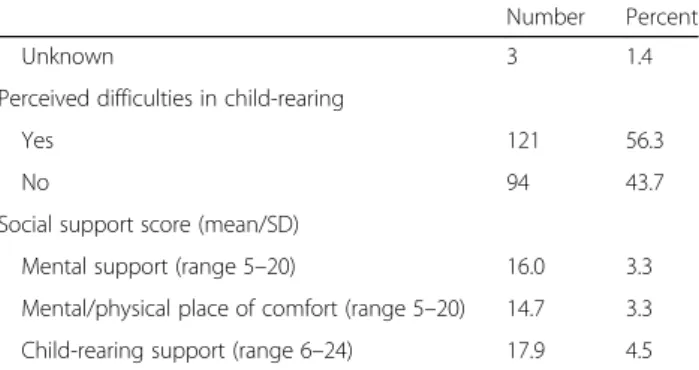
The sociodemographic characteristics of mothers in- cluded in the statistical analysis are shown in Table 1.
The mean age of their infants was 26.0 months (stand- ard deviation [SD], 10.2). The range of infant age was 6 to 42 months, and age distribution of infants was 10.2%
for age 0 (< 12 months), 29.3% for age 1 (< 24 months),
38.1% for age 2 (< 36 months), and 21.9% for age 3 (≤
42 months). Two thirds of the mothers were employed, 32.6% were regularly employed, and 27.4% ware irregu- larly employed. More than half (54.9%) of the mothers lived in independent housing, while others lived in non-independent housing, such as multi-family apart- ments (30.2%) or public temporary housing (11.2%). In addition, most of the mothers were from nuclear family households (67.0%). More than half of the mothers (58.6%) had pre-disaster acquaintances living in the current residential area. Most of the mothers (86.0%) used at least one child support resource, such as nurser- ies, regional child support centers, and mothers’
self-help groups. However, 12.6% did not use any child support resources. More than half (56.3%) of the mothers reported having difficulties in child-rearing.
With regard to the reliability of the social support in the child-rearing score, the Cronbach’s alpha of mental sup- port was 0.788, with values of 0.712 for mental/physical place of comfort and 0.824 for child-rearing support. In addition, correlations among all of the social support cat- egories were statistically significant. The coefficient of cor- relation was 0.308 (p< 0.001) between mental support and mental/physical place of comfort, 0.679 (p< 0.001) be- tween mental support and child-rearing support, and 0.472 (p< 0.001) between mental/physical place of com- fort and child-rearing support.
Factors associated with social support
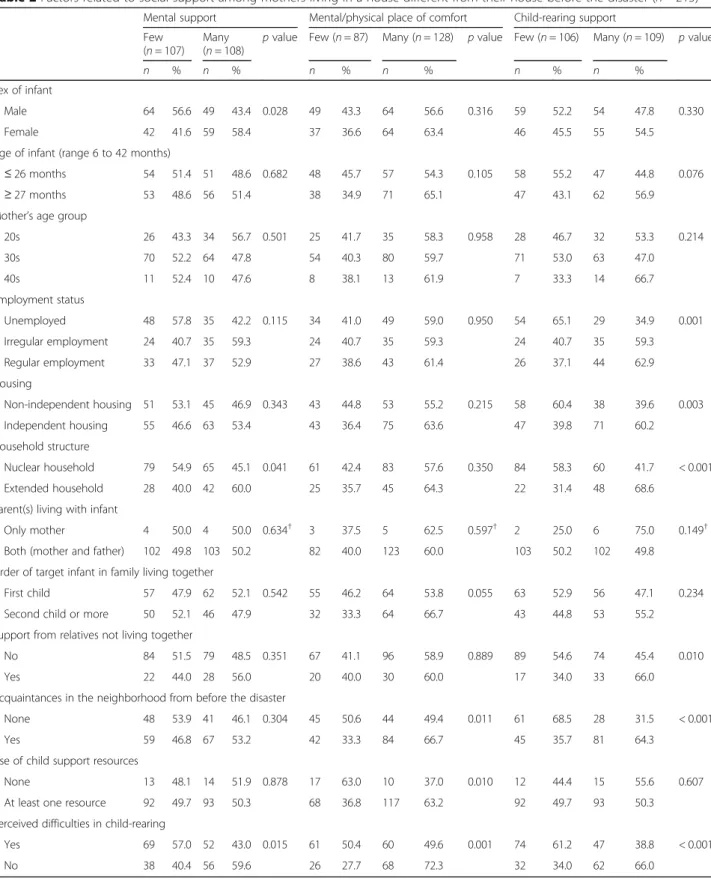
The chi-square test was used to assess factors associated with each of the social support categories (Table2). Factors that were significantly associated with obtainment of men- tal support were having a female infant, having an extended household, and no perceived difficulties in child-rearing.
Factors associated with mental/physical place of comfort were the presence of pre-disaster acquaintances, use of child support resources, and no perceived difficul- ties in child-rearing. Finally, factors associated with child-rearing support were regular employment, living in independent housing, having an extended house- hold, obtaining support from relatives not living to- gether, presence of pre-disaster acquaintances, and no perceived difficulties in child-rearing. However, there were no significant associations between infant age, mother’s age, parent(s) living with infant, birth order of target infant among siblings if any, and any social support categories. Furthermore, we investigated the relationship between infant age and social support score in each category and found that there was no significant correlation between them.
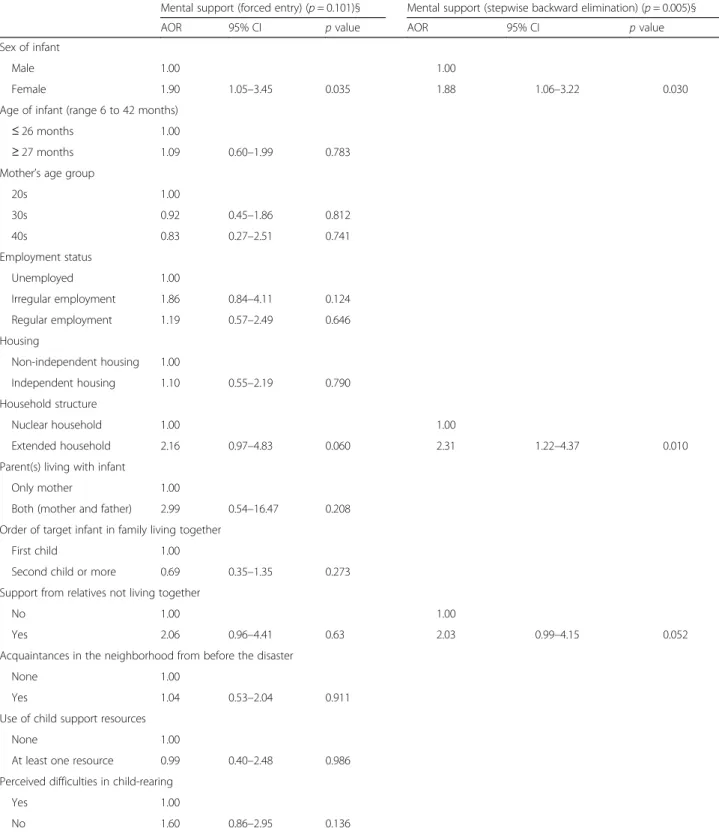
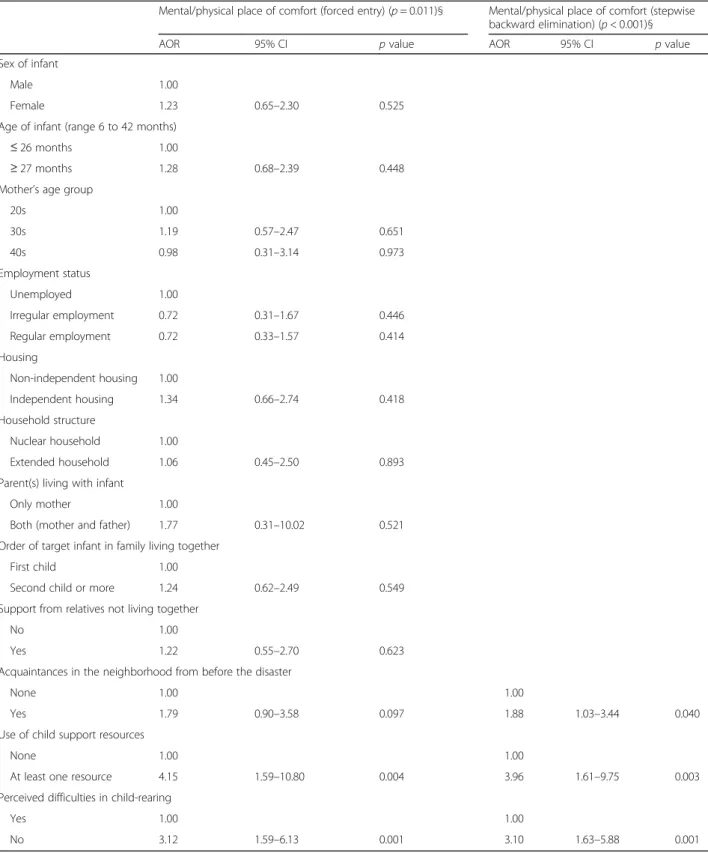
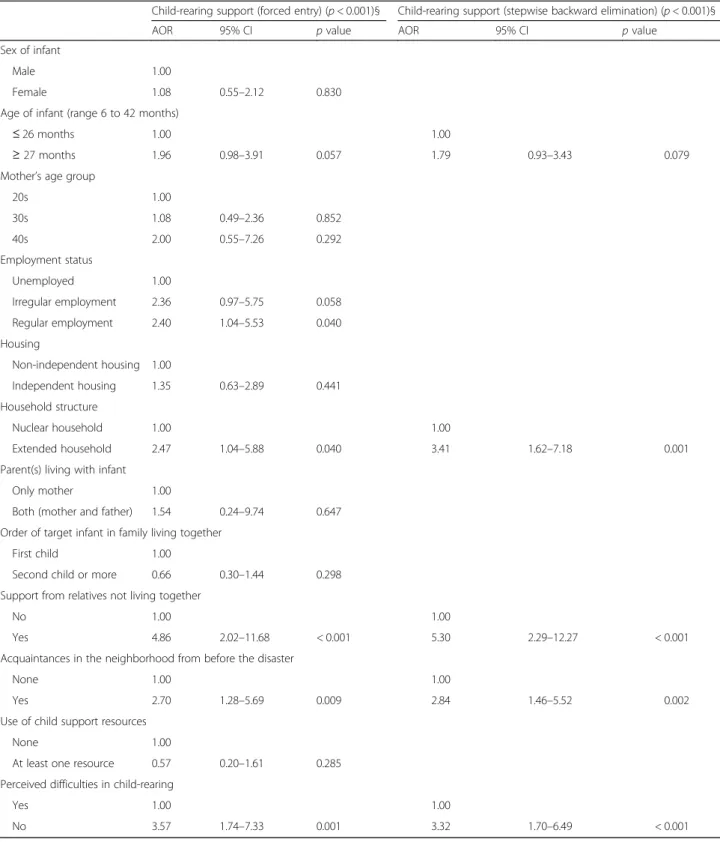
Next, we performed logistic regression analysis accord- ing to each of the three categories of social support for child-rearing with all factors that were used in the chi-square test (Tables3, 4, and 5). Factors significantly
associated with mental support were infant sex and ex- tended household, and factors associated with obtain- ment of a mental/physical place of comfort were the presence of pre-disaster acquaintances, use of child-sup- port resources, and no perceived difficulties in child-rearing. The four factors that were significantly as- sociated with obtainment of child-rearing support were extended household, obtaining support from relatives not living together, presence of acquaintances in the neighborhood from before the disaster, and no perceived difficulties in child-rearing.
Extended household was a factor among mothers who had obtained mental support and child-rearing support.
The presence of pre-disaster acquaintances and per- ceived difficulties in child-rearing were common factors among mothers who had obtained social support in two categories, namely, mental/physical place of comfort and child-rearing support. The adjusted odds ratio (AOR) for the presence of pre-disaster acquaintances with mental/
physical place of comfort was 1.88 (95% CI 1.03–3.44) and that for child-rearing support was 2.84 (95% CI 1.46–5.52). The AOR for no perceived difficulties in child-rearing was 3.10 (95% CI 1.63–5.88) for mental/
physical place of comfort support, and it was 3.32 (95%
CI 1.70–6.46) for child-rearing support.
Discussion
Factors associated with social support among mothers who were living in a house different from that before the disaster were infant sex, living with extended family, obtaining support from relatives not living together, pres- ence of pre-disaster acquaintances, use of child support resources, and no perceived difficulties in child-rearing.
The factor of living within an extended household was associated with the mental support category. The exist- ence of family would enhance a sense of ease for mothers with the knowledge that some other member of the family can keep an eye on their children. Addition- ally, extended households were also associated with the Table 1Sociodemographic and socioenvironmental
characteristics of mothers living in a house different from their house before the disaster (n= 215)
Number Percent Sex of infant
Male 113 52.6
Female 101 47.0
Unknown 1 0.5
Age of infant (range 6 to 42 months)
≤26 months 105 48.8
≥27 months 109 50.7
Unknown 1 0.5
Mother’s age group
20s 60 27.9
30s 134 62.3
40s 21 9.8
Employment status
Unemployed 83 38.6
Irregular employment 59 27.4
Regular employment 70 32.6
Unknown 3 1.4
Housing
Non-independent housing 96 44.7
Independent housing 118 54.9
Unknown 1 0.5
Household structure
Nuclear family 144 67.0
Extended family 70 32.6
Unknown 1 0.5
Parent(s) living with infant
Both (mother and father) 205 95.3
Only mother 8 3.7
Unknown 2 0.9
Order of target infant in family living together
First child 119 55.3
Second child or more 96 44.7
Support from relatives not living together
No 163 75.8
Yes 50 23.3
Unknown 2 0.9
Acquaintances in the neighborhood since before the disaster
None 89 41.4
Yes 126 58.6
Use of child support resources
None 27 12.6
At least one resource 185 86.0
Table 1Sociodemographic and socioenvironmental
characteristics of mothers living in a house different from their house before the disaster (n= 215)(Continued)
Number Percent
Unknown 3 1.4
Perceived difficulties in child-rearing
Yes 121 56.3
No 94 43.7
Social support score (mean/SD)
Mental support (range 5–20) 16.0 3.3
Mental/physical place of comfort (range 5–20) 14.7 3.3 Child-rearing support (range 6–24) 17.9 4.5
Table 2Factors related to social support among mothers living in a house different from their house before the disaster (n= 215) Mental support Mental/physical place of comfort Child-rearing support
Few (n= 107)
Many
(n= 108) pvalue Few (n= 87) Many (n= 128) pvalue Few (n= 106) Many (n= 109) pvalue
n % n % n % n % n % n %
Sex of infant
Male 64 56.6 49 43.4 0.028 49 43.3 64 56.6 0.316 59 52.2 54 47.8 0.330
Female 42 41.6 59 58.4 37 36.6 64 63.4 46 45.5 55 54.5
Age of infant (range 6 to 42 months)
≤26 months 54 51.4 51 48.6 0.682 48 45.7 57 54.3 0.105 58 55.2 47 44.8 0.076
≥27 months 53 48.6 56 51.4 38 34.9 71 65.1 47 43.1 62 56.9
Mother’s age group
20s 26 43.3 34 56.7 0.501 25 41.7 35 58.3 0.958 28 46.7 32 53.3 0.214
30s 70 52.2 64 47.8 54 40.3 80 59.7 71 53.0 63 47.0
40s 11 52.4 10 47.6 8 38.1 13 61.9 7 33.3 14 66.7
Employment status
Unemployed 48 57.8 35 42.2 0.115 34 41.0 49 59.0 0.950 54 65.1 29 34.9 0.001
Irregular employment 24 40.7 35 59.3 24 40.7 35 59.3 24 40.7 35 59.3
Regular employment 33 47.1 37 52.9 27 38.6 43 61.4 26 37.1 44 62.9
Housing
Non-independent housing 51 53.1 45 46.9 0.343 43 44.8 53 55.2 0.215 58 60.4 38 39.6 0.003
Independent housing 55 46.6 63 53.4 43 36.4 75 63.6 47 39.8 71 60.2
Household structure
Nuclear household 79 54.9 65 45.1 0.041 61 42.4 83 57.6 0.350 84 58.3 60 41.7 < 0.001
Extended household 28 40.0 42 60.0 25 35.7 45 64.3 22 31.4 48 68.6
Parent(s) living with infant
Only mother 4 50.0 4 50.0 0.634† 3 37.5 5 62.5 0.597† 2 25.0 6 75.0 0.149†
Both (mother and father) 102 49.8 103 50.2 82 40.0 123 60.0 103 50.2 102 49.8
Order of target infant in family living together
First child 57 47.9 62 52.1 0.542 55 46.2 64 53.8 0.055 63 52.9 56 47.1 0.234
Second child or more 50 52.1 46 47.9 32 33.3 64 66.7 43 44.8 53 55.2
Support from relatives not living together
No 84 51.5 79 48.5 0.351 67 41.1 96 58.9 0.889 89 54.6 74 45.4 0.010
Yes 22 44.0 28 56.0 20 40.0 30 60.0 17 34.0 33 66.0
Acquaintances in the neighborhood from before the disaster
None 48 53.9 41 46.1 0.304 45 50.6 44 49.4 0.011 61 68.5 28 31.5 < 0.001
Yes 59 46.8 67 53.2 42 33.3 84 66.7 45 35.7 81 64.3
Use of child support resources
None 13 48.1 14 51.9 0.878 17 63.0 10 37.0 0.010 12 44.4 15 55.6 0.607
At least one resource 92 49.7 93 50.3 68 36.8 117 63.2 92 49.7 93 50.3
Perceived difficulties in child-rearing
Yes 69 57.0 52 43.0 0.015 61 50.4 60 49.6 0.001 74 61.2 47 38.8 < 0.001
No 38 40.4 56 59.6 26 27.7 68 72.3 32 34.0 62 66.0
“Unknown”was excluded from analysis
Chi-square test or Fisher’s exact test (†) was conducted
Table 3Factors related to the obtainment of social support by mental support category (n= 215)
Mental support (forced entry) (p= 0.101)§ Mental support (stepwise backward elimination) (p= 0.005)§
AOR 95% CI pvalue AOR 95% CI pvalue
Sex of infant
Male 1.00 1.00
Female 1.90 1.05–3.45 0.035 1.88 1.06–3.22 0.030
Age of infant (range 6 to 42 months)
≤26 months 1.00
≥27 months 1.09 0.60–1.99 0.783
Mother’s age group
20s 1.00
30s 0.92 0.45–1.86 0.812
40s 0.83 0.27–2.51 0.741
Employment status
Unemployed 1.00
Irregular employment 1.86 0.84–4.11 0.124
Regular employment 1.19 0.57–2.49 0.646
Housing
Non-independent housing 1.00
Independent housing 1.10 0.55–2.19 0.790
Household structure
Nuclear household 1.00 1.00
Extended household 2.16 0.97–4.83 0.060 2.31 1.22–4.37 0.010
Parent(s) living with infant
Only mother 1.00
Both (mother and father) 2.99 0.54–16.47 0.208 Order of target infant in family living together
First child 1.00
Second child or more 0.69 0.35–1.35 0.273
Support from relatives not living together
No 1.00 1.00
Yes 2.06 0.96–4.41 0.63 2.03 0.99–4.15 0.052
Acquaintances in the neighborhood from before the disaster
None 1.00
Yes 1.04 0.53–2.04 0.911
Use of child support resources
None 1.00
At least one resource 0.99 0.40–2.48 0.986 Perceived difficulties in child-rearing
Yes 1.00
No 1.60 0.86–2.95 0.136
Logistic regression analysis was performed
All the factors shown in Table2were included in the analysis, namely, sex of infant, age of infant, mother’s age group, employment status, housing, household structure, parent(s) living with infant, order of target infant in family living together, support from relatives not living together, acquaintance in the neighborhood from before the disaster, use of child support resources, and perceived difficulties in child-rearing.“Unknown”was excluded from the analysis
AORadjusted odds ratio,CIconfidence interval, §p-value for the model
Table 4Factors related to obtainment of social support by mental/physical place of comfort category (n= 215)
Mental/physical place of comfort (forced entry) (p= 0.011)§ Mental/physical place of comfort (stepwise backward elimination) (p< 0.001)§
AOR 95% CI pvalue AOR 95% CI pvalue
Sex of infant
Male 1.00
Female 1.23 0.65–2.30 0.525
Age of infant (range 6 to 42 months)
≤26 months 1.00
≥27 months 1.28 0.68–2.39 0.448
Mother’s age group
20s 1.00
30s 1.19 0.57–2.47 0.651
40s 0.98 0.31–3.14 0.973
Employment status
Unemployed 1.00
Irregular employment 0.72 0.31–1.67 0.446
Regular employment 0.72 0.33–1.57 0.414
Housing
Non-independent housing 1.00
Independent housing 1.34 0.66–2.74 0.418
Household structure
Nuclear household 1.00
Extended household 1.06 0.45–2.50 0.893
Parent(s) living with infant
Only mother 1.00
Both (mother and father) 1.77 0.31–10.02 0.521
Order of target infant in family living together
First child 1.00
Second child or more 1.24 0.62–2.49 0.549
Support from relatives not living together
No 1.00
Yes 1.22 0.55–2.70 0.623
Acquaintances in the neighborhood from before the disaster
None 1.00 1.00
Yes 1.79 0.90–3.58 0.097 1.88 1.03–3.44 0.040
Use of child support resources
None 1.00 1.00
At least one resource 4.15 1.59–10.80 0.004 3.96 1.61–9.75 0.003
Perceived difficulties in child-rearing
Yes 1.00 1.00
No 3.12 1.59–6.13 0.001 3.10 1.63–5.88 0.001
Logistic regression analysis was performed
All the factors shown in Table2were included in the analysis, namely, sex of infant, age of infant, mother’s age group, employment status, housing, household structure, parent(s) living with infant, order of target infant in family living together, support from relatives not living together, acquaintance in the neighborhood from before the disaster, use of child support resources, and perceived difficulties in child-rearing.“Unknown”was excluded from the analysis
AORadjusted odds ratio,CIconfidence interval, §p-value for the model
Table 5Factors related to the obtainment of social support by child-rearing support category (n= 215)
Child-rearing support (forced entry) (p< 0.001)§ Child-rearing support (stepwise backward elimination) (p< 0.001)§
AOR 95% CI pvalue AOR 95% CI pvalue
Sex of infant
Male 1.00
Female 1.08 0.55–2.12 0.830
Age of infant (range 6 to 42 months)
≤26 months 1.00 1.00
≥27 months 1.96 0.98–3.91 0.057 1.79 0.93–3.43 0.079
Mother’s age group
20s 1.00
30s 1.08 0.49–2.36 0.852
40s 2.00 0.55–7.26 0.292
Employment status
Unemployed 1.00
Irregular employment 2.36 0.97–5.75 0.058
Regular employment 2.40 1.04–5.53 0.040
Housing
Non-independent housing 1.00
Independent housing 1.35 0.63–2.89 0.441
Household structure
Nuclear household 1.00 1.00
Extended household 2.47 1.04–5.88 0.040 3.41 1.62–7.18 0.001
Parent(s) living with infant
Only mother 1.00
Both (mother and father) 1.54 0.24–9.74 0.647 Order of target infant in family living together
First child 1.00
Second child or more 0.66 0.30–1.44 0.298 Support from relatives not living together
No 1.00 1.00
Yes 4.86 2.02–11.68 < 0.001 5.30 2.29–12.27 < 0.001
Acquaintances in the neighborhood from before the disaster
None 1.00 1.00
Yes 2.70 1.28–5.69 0.009 2.84 1.46–5.52 0.002
Use of child support resources
None 1.00
At least one resource 0.57 0.20–1.61 0.285 Perceived difficulties in child-rearing
Yes 1.00 1.00
No 3.57 1.74–7.33 0.001 3.32 1.70–6.49 < 0.001
Logistic regression analysis was performed
All the factors shown in Table2were included in the analysis, namely, sex of infant, age of infant, mother’s age group, employment status, housing, household structure, parent(s) living with infant, order of target infant in family living together, support from relatives not living together, acquaintance in the neighborhood from before the disaster, use of child support resources, and perceived difficulties in child-rearing.“Unknown”was excluded from the analysis
AORadjusted odds ratio,CIconfidence interval, §p-value for the model
child-rearing support category along with obtaining sup- port from relatives not living together. The existence of family and relatives within their household or living nearby may be an important factor for mothers because it allows mothers to ask for help easily when needed [24].
Users of child support resources benefited more from having a mental/physical place of comfort than non-users of child-support resources. This result indicated that use of child support resources would contribute to increasing opportunities for mothers to meet someone with whom they can exchange talk about child-rearing and to com- fortably allow the children to play [25].
Having no perceived difficulties in child-rearing was associated with mental/physical place of comfort support and child-rearing support but not with mental support.
These results correspond to those of previous studies in- dicating associations between perceived difficulties in child-rearing and reduced levels of social support among mothers in the general population in Japan. Previous studies showed that factors associated with no perceived difficulties in child-rearing were having someone to talk to for advice and having someone who can take care of a child other than a child support center [26,27]. The re- sults of the present study in post-disaster communities were the same as those in previous studies in the general population; thus, mental/physical place of comfort sup- port and child-rearing support are also key factors in post-disaster communities.
The presence of pre-disaster acquaintances was asso- ciated with mental/physical place of comfort support and child-rearing support. The presence of pre-disaster acquaintances was a socioenvironmental factor in the post-disaster community rather than a factor attributed to the mother or family. A previous study in the general population in Japan suggested that shallow relation- ships in the community could be a factor that influ- ences a child’s caregiver to not obtain support [26].
This result could indicate that good relationships with people in the community have a positive influence on mothers with respect to child-rearing. The results of this study indicated that the presence of pre-disaster acquaintances had a positive role in social support among mothers with infants and preschool-aged chil- dren in a post-disaster community. A previous study among the general population 1 year after the Great East Japan Earthquake and Tsunami indicated that sup- port from neighbors contributed to a reduction of psy- chological distress as well as the provision of support from family members in the area affected by the disas- ter [28]. Our study results also showed that the pres- ence of pre-disaster acquaintances was positively associated with child-rearing social support, especially mental/physical place of comfort and child-rearing sup- port. Pre-disaster acquaintances can be defined as
people who mothers felt comfortable asking for help.
This study area is characterized by robust ties within the community [29,30]. Therefore, pre-disaster acquaintances would be key individuals likely to provide social support to mothers with infants and preschool-aged children under resource-poor conditions, such as the post-disaster setting. In addition, the presence of pre-disaster acquain- tances could promote the establishment of helpful rela- tionships in the redeveloping communities through the provision of social support. The presence of people who provide support to mothers with newborn babies would be helpful to maintain a healthy mental state with respect to child-rearing in post-disaster communities [31]. The re- sults of this study suggested that the presence of pre-disaster acquaintances also contributes to the main- tenance of mental health in mothers with infants and preschool-aged children when community ties have been negatively affected by a disaster.
Many changes in the physical environment of the study area, the Kesen region in Iwate Prefecture, have continued for several years since the disaster. For ex- ample, the construction of mounds of land has contin- ued for more than 5 years even in the centers of communities. Access routes have changed several times because of road reconstruction and renovation, and many stores are still operating from temporary premises.
Furthermore, people are only now, 6 years after the dis- aster, beginning to move from temporary accommoda- tions to permanent housing [32–34]. These changes in the physical environment may affect socioenvironmental conditions, including social support, for the entire popu- lation living in areas affected by a disaster [35,36], espe- cially vulnerable populations, including mothers with infants and preschool-aged children. A study addressing resettlement and means of obtaining social support among residents of temporary housing in another pre- fecture affected by the same disaster indicated that people living close to previous community members were more likely to receive social support [37]. Perceived social support prior to Hurricane Katrina was reported to decrease the negative psychological effects of expos- ure to a natural disaster among low-income mothers [38]. Another study among older Taiwanese adults dis- placed by earthquakes showed that support by neighbors and social participation were significantly associated with lower levels of depressive symptoms 1 year after the earthquake [39]. Moreover, a previous study in a general population in Sweden indicated that having someone to talk to about personal problems was linked to reduced health problems, such as discouragement and poor self-rated health [40]. Thus, the presence of neighbors mitigates health problems and empowers par- ents even in general populations. Under fragile condi- tions, such as a post-disaster setting, the presence of
pre-disaster acquaintances contributes to rich social sup- port for mothers with infants and preschool-aged chil- dren following the significant changes in physical and social environments, including the breaking of commu- nity ties, associated with a disaster. Sharing these experi- ences with pre-disaster acquaintances may provide a sense of mutual aid.
Factors associated with obtaining social support in child-rearing among mothers were derived from the mothers themselves as well as family members, and also from socioenvironmental factors. These results sug- gested that it is necessary to consider both these factors when supporting for development process in post-disaster communities. The factors specifically needed to be considered were the family structure and perceived difficulties in child-rearing arising from the mother and family and the existence of pre-disaster ac- quaintances from the socioenvironmental factors. Con- sequently, our findings suggest that relationships with pre-disaster community members could encourage and empower mothers and families with infants and preschool-aged children in the reconstruction of the community in post-disaster residential areas.
This study had several limitations. First, the findings of this study cannot be generalized to all mothers living in post-disaster communities because this study was con- ducted in areas affected by a particular disaster, and mothers included in this study were not representative of those in other post-disaster communities. The study areas have specific characteristics, such as traditional community ties according to the main industries, includ- ing agriculture and fishing. In addition, mothers with perceived difficulties in child-rearing may not have com- pleted the questionnaire in this study for several reasons, including being overly busy or not wishing to participate in the study.
Next, this study could not clarify the causal associations of social support with sociodemographic characteristics and socioenvironmental conditions due to the cross-sectional study design. Additionally, the measure of social support in this study could not be generalized because it was modified for adjustment within a post-disaster community, even though internal consistency was confirmed.
No statistically significant relationship was found be- tween social support and infant age in this study. How- ever, infant sex was statistically significant in the mental support category. These results need to be considered in future studies since infant age and sex are likely to affect child-rearing. Additionally, the educational level of the mother and economic status were not measured in this study based on the suggestion of local government officers who have a rich knowledge of the characteristics, values, and norms of the target communities and people. This was because mothers may feel uncomfortable in
answering about their own educational status and eco- nomic status, possibly making it a deterrent to participa- tion in this study. Moreover, the proportion of extended households of this study area was higher than that at the national level [41], and invisible economic activities may exist in the communities as mutual aid among neighbors [30]. Therefore, we presumed the association between economic status and obtaining social support by using variables of the housing and the household structure as an alternative indicator of economic status. From the result of this study, mothers of nuclear families obtained less so- cial support compared with mothers of extended house- holds. This condition possibly confounded with mother’s economic status because the expenditure of the nuclear families with small children could be higher than that of the family with small children living within an extended household.
There was a possibility that economic status and the ability of child-rearing based on the mother’s educational level could be confounded. Although we have not evalu- ated these associations in this study, such evaluations can be expected in future studies. We suggest inclusion of not only income but also the invisible economic activ- ities within community-based relationships in the evalu- ation of economic status and also the health literacy and/or health-seeking skills of mothers by educational level especially with respect to child-rearing.
Additionally, information provided by the municipality offices of the study area indicated that approximately 16.5% of the target population had moved to the study area from other municipalities or regions. It is possible that mothers who reported the absence of pre-disaster acquaintances may have been relocated from other mu- nicipalities or regions. However, this study could not identify these new resident mothers in the disaster-af- fected communities. Therefore, it will be necessary to further examine the conditions of such new resident mothers, and these mothers should be included in the community network in future studies.
Conclusions
Factors associated with the obtainment of social support in child-rearing among mothers in post-disaster commu- nities were attributed not only to mothers themselves and family members but also to socioenvironmental factors such as the presence of pre-disaster acquaintances. The findings of this study indicated that the presence of pre-disaster acquaintances was one factor related to rich social support for mothers in child-rearing in post-disaster communities, especially with regard to mental/physical place of comfort support and child-rearing support.
During community reconstruction following a disaster, local government and support organizations should con- sider providing distinctive services to maintain
relationships among community dwellers from before the disaster from the viewpoint of child-rearing support. It is necessary to take into account quantitative minorities and vulnerable populations during periods of long-term post-disaster community development as well as in the development of disaster preparedness plans for dealing with future disasters.
Additional file
Additional file 1:Questions regarding social support in the present study by category. (DOCX 15 kb)
Acknowledgements
The authors are grateful to all of the study participants for their collaboration in this study. We are also grateful to the public health nurses of each municipality office for their support in conducting the study, especially Mrs.
Yoko Hanasaki, public health nurse of the Kesen Regional Health Office.
Funding
This work was supported in part by JSPS KAKENHI Grant Number 17K12615.
Availability of data and materials
The datasets generated and analyzed during the present study are not publicly available due to the ethically sensitive nature of the research.
Authors’contributions
NM conceptualized and designed the study and analyzed and interpreted the data. NY contributed to the interpretation of the findings. FT provided local management of data collection. OM made major contributions in conceptualizing and logically composing the manuscript. All authors have read and approved the final manuscript.
Ethics approval and consent to participate
This study was approved by the Ethics Committee of Nagasaki University, Graduate School of Biomedical Sciences (approval number 15082034-2). In addition, the study was approved by each municipal government in the study area. Informed consent was obtained from each participant.
Consent for publication Not applicable.
Competing interests
The authors declare that they have no competing interests.
Publisher’s Note
Springer Nature remains neutral with regard to jurisdictional claims in published maps and institutional affiliations.
Author details
1Graduate School of Biomedical Sciences, Nagasaki University, 1-7-1 Sakamoto, Nagasaki 852-8520, Japan.2School of Nursing and Rehabilitation, Konan Women’s University, 6-2-23 Morikita-machi, Higashinada-ku, Kobe 658-0001, Japan.3Iwate Prefectural Ofunato Hospital, 10-1 Yamamagoe, Ofunato-cho, Ofunato 022-8512, Japan.
Received: 30 January 2018 Accepted: 19 October 2018
References
1. The Ministry of Internal Affairs and Communications. Information about the Great East Japan Earthquake. 2017.http://www.fdma.go.jp/bn/higaihou/pdf/
jishin/156.pdf. Accessed 11 Sept 2018.
2. Akashi Y, Ohshima K, Yanagisawa K. The world and Japan in the face of catastrophes: disasters and international cooperation. Oita: Saiki Printing Co.;
2013.
3. Tatsuki S. Promotion of fostering community:in the overall verification/
proposals for the 10-year reconstruction. Hyougo prefecture. 2005.https://
web.pref.hyogo.lg.jp/kk41/documents/000038700.pdf. Accessed 11 Sept 2018.
4. Cherry KE, Sampson L, Nezat PF, Cacamo A, Marks LD, Galea S. Long-term psychological outcomes in older adults after disaster: relationships to religiosity and social support. Aging Ment Health. 2015;19:430–43.https://
doi.org/10.1080/13607863.2014.941325.
5. Norris FH. Psychosocial consequences of natural disasters in developing countries: what does past research tell us about the potential effects of the 2004 tsunami? 2005.http://medipe2.psu.ac.th/~disaster/disasterlast/
FranNorris_Tsunami.pdf
6. Carroll B, Morbey H, Balogh R, Araoz G. Flooded homes, broken bonds, the meaning of home, psychological processes and their impact on psychological health in a disaster. Health Place. 2009;15:540–7.https://doi.
org/10.1016/j.healthplace.2008.08.009.
7. Berkman LF. The role of social relations in health promotion. Psychosom Med. 1995;57:245–54.
8. Kawachi I, Berkman LF. Social ties and mental health. J Urban Health. 2001;
78(3):458–67.https://doi.org/10.1093/jurban/78.3.458.
9. Hupcey JE. Clarifying the social support theory-research linkage. J Adv Nurs.
1998;27:1231–41.
10. Wilkinson R, Marmot M, World Health Organization Regional Office for Europe, WHO Centre for Urban Health (Europe), International Centre for Health and Society. Social determinants of health: the solid facts second edition 1998.http://www.euro.who.int/__data/assets/pdf_file/0005/98438/
e81384.pdf.
11. Ruggiero KJ, Armstadter AB, Acierno R, Kilpatrick DG, Resnick HS, Tracy M, et al. Social and psychological resources associated with health status in a representative sample of adults affected by the 2004 Florida hurricanes.
Psychiatry. 2009;72(2):195–210.https://doi.org/10.1521/psyc.2009.72.2.195.
12. Paul LA, Felton JW, Adams ZW, Welsh K, Miller S, Ruggiero KJ. Mental health among adolescents exposed to a tornado: the influence of social support and its interactions with sociodemographic characteristics and disaster exposure. J Trauma Stress. 2015;28:232–9.https://doi.org/10.1002/jts.22012.
13. Zhao C, Wu Z, Xu J. The association between post-traumatic stress disorder symptoms and the quality of life among Wenchuan earthquake survivors:
the role of social support as a moderator. Qual Life Res. 2013;22:733–43.
https://doi.org/10.1007/s11136-012-0197-4.
14. Arnberg FK, Hultman CM, Michel PO, Lundin T. Social support moderates posttraumatic stress and general distress after disaster. J Trauma Stress.
2012;25:721–7.https://doi.org/10.1002/jts.21758.
15. Honma H. Led by mental health: infants of the children of Miyagi A city.
Japan J Child Adolesc Psych. 2015;56(4):584–8.
16. Oyama M, Nakamura K, Suda Y, Someya T. Social network disruption as a major factor associated with psychological distress 3 years after the 2004 Niigata-Chuetsu earthquake in Japan. Environ Health Prev Med. 2012;17:
118–23.https://doi.org/10.1007/s12199-011-0225-y.
17. Takaya Y, Yamamoto A, Kobayashi Y, Nakaoka A, Katuda H, Nakagomi S, et al. The effect of Hanshin-Awaji Earthquake on the physical and psychological health status of maternal-child and their on environment. J Jpn Acad Nurs Sci. 1998;18(2):40–50.
18. Wickrama KA, Thulitha Wickrama KA. Family context of mental health risk in tsunami affected mothers: findings from a pilot study in Sri Lanka. Soc Sci Med. 2008;66:994–1007.https://doi.org/10.1016/j.socscimed.2007.11.012.
19. Sasai T. Childrearing and childcare support in Japan. J of Population Problems. 2013;69(2):35–52.
20. Imai M, Tokiwa Y. Litrature review on the viewpoints and problems of child care support by local governments in Japan. Kitakanto Med J. 2011;61:377– 86.https://doi.org/10.2974/kmj.61.377.
21. Teshima S, Haraguchi M. Childcare support through infant health checkups:
development of the childcare stress scale. FPU J Nurs Res. 2003;1:15–27.
22. Haraguchi M, Teshima S. Structure of childcare social support. Kurume Univ Psycol Res. 2006;5:21–8.
23. Watanabe Y, Ishii M. The effect of social support and self-efficacy on childcare stress in mothers with infants. Bulletin of the Faculty of Letters, Hosei University. 2009;60:133–45.
24. Nakajima T. Social support in survivors following a natural disaster. Bulletin of Yamanashi Junior College of Nursing 1995;1:37–47.
25. Ohara T, Irie R, Minami T, Mutou Y. Childbirth and child care support for mother II: focusing on the relational structure of developmental changes in
children child care support and support sources. Japan Soc Home Econ.
2008;59(7):471–84.
26. Mochizuki Y, Tanaka E, Shinohara R, Sugisawa Y, Tomisaki E, Watanabe T, et al. The influence of caregivers’anxiety and the home environment on child abuse. A study of children attending child-care centers. Nihon Koshu Eisei Zasshi. 2014;61(6):263–74.
27. Shin S, Yamada K, Morioka I. Feelings of difficulty with child-rearing and their related factors among mothers with a baby at the age of 2–3 months.
J Japan Soc Nurs Res. 2015;38(5):33–40.https://doi.org/10.15065/jjsnr.
20150731004.
28. Sugimoto T, Umeda M, Shinozaki T, Naruse T, Miyamoto Y. Sources of perceived social support associated with reduced psychological distress at 1 year after the Great East Japan Earthquake: nationwide cross-sectional survey in 2012. Psychiatry Clin Neurosci. 2015;69:580–6.https://doi.org/10.
1111/pcn.12235.
29. Sasaki R, Iwamuro S. Nurturing the imperative monetary affluence and concept of population approach during the mid- to long-term reconstruction period. J Public Health Pract. 2013;77(9):745–9.
30. Aiba S. Town planning in earthquake disaster reconstruction. Disaster Recover Revitalization Rev. 2014;5(3):65–72.
31. Sato K, Oikawa M, Hiwatashi M, Sato M, Oyamada N. Factors relating to the mental health of women who were pregnant at the time of the Great East Japan earthquake: analysis from month 10 to month 48 after the earthquake. Biopsychosoc Med. 2016;10:22.https://doi.org/10.1186/s13030- 016-0072-6.
32. Moriyama H, Fuchimukai T, Kondo N, Takayama JI. Obesity in elementary school children after the Great East Japan Earthquake. Pediatr Int. 2018;60:
282–6.
33. Rikuzenntakata City. Earthquake disaster reconstruction plan of Rikuzen Takata City. 2017.http://www.city.rikuzentakata.iwate.jp/kategorie/fukkou/
fukkou-keikaku/fukkoukeikaku/keikaku_27-3/29-3.pdf. Accessed 11 Sept 2018.
34. Ofunato City. Reconstruction project schedule (main projects) of Ofunato City. 2017.http://www.city.ofunato.iwate.jp/www/contents/1343349172300/
files/schedule20180930.pdf. Accessed 29 Oct 2018.
35. Ohashi K, Kondo N. Rikuzen Takata City’s vision of recovery from the Great East Japan Earthquake - the Miraizu Council as a place to foster social capitalism. The Japanese journal for public health nurse. 2015;71:150–6.
36. Sasaki R, Iwamuro S. Facing newly arising inequalities. J Public Health Pract.
2013;77(12):1001–5.
37. Koyama S, Aida J, Kawachi I, Kondo N, Subramanian SV, Ito K, et al. Social support improves mental health among the victims relocated to temporary housing following the Great East Japan Earthquake and Tsunami. Tohoku J Exp Med. 2014;234:241–7.
38. Lowe SR, Chan CS, Rhodes JE. Pre-hurricane perceived social support protects against psychological distress: a longitudinal analysis of low- income mothers. J Consult Clin Psychol. 2010;78(4):551–60.https://doi.org/
10.1037/a0018317.
39. Watanabe C, Okumura J, Chiu TY, Wakai S. Social support and depressive symptoms among displaced older adults following the 1999 Taiwan earthquake. J Trauma Stress. 2004;17(1):63–7.
40. Ostberg V, Lennartsson C. Getting by with a little help: the importance of various types of social support for health problems. Scand J Public Health.
2007;35:197–204.https://doi.org/10.1080/14034940600813032.
41. Iwate Prefecture statistics database. National population census 2015.http://
www3.pref.iwate.jp/webdb/view/outside/s14Tokei/top.html. Accessed 29 Oct 2018.