Bull.Fac.Agric.&Life Sci. Hirosaki Univ. No.13: 33–37, 2010 MINI-REVIEW
INTRODUCTION
The present author has been studying the biochemical systematics of echinoids and asteroids of echinoderms by using some biochemical methods such as allozyme analysis, immunological assay, enzyme kinetic study, and comparison of amino acid composition (Matsuoka, 1980, 1986, 1987, 1992; Matsuoka et al., 1983; Matsuoka and Suzuki, 1989; Matsuoka and Hatanaka, 1991, etc.). Echinoderms are representative of sea-shore animals. Echinoderms consist of five classes: sea-lily, sea-cucumber, starfish, sea-urchin and brittle-star (Fig. 1). The author reported the phylogeny of four classes of echinoderms by the enzyme kinetic study of glucose-6-phospahte dehydrogenase (G6PD) (Matsuoka, 1992). Of these five echinodermes, echinoids have been widely used in various biological fields: developmental biology, biochemistry, physiology and ecology. These five classes are distinct groups in morphological viewpoint.
The pentamery is the common body system in echinoderms. From some viewpoint, it has been considered that echinoderms are evolutionary close related to vertebrates. In this nimi-review, I review about the molecular and non- molecular evidence of evolutionary close relationship between echinoderms and vertebrates.
DISCUSSION
The present author has been studying the molecular phylogeny of echinoids and asteroids of echinoderms (Matsuoka, 1980; Matsuoka and Suzuki, 1989; Matsuoka and Hatanaka,1991, etc.). In parallel with biochemical systematics, I have also been studying the population genetics of echinoderms by allozyme analysis. Echinoderms consist of five classes:
echinoids, asteroids, holosuloids, ophiuroids and crinoids. In this review, I report the molecular and non-molecular evidence of the evolutionary close relationship between echinoderms and vertebrates. The evidence of evolutionary close relationship between echinoderms and vertebrates is the followings: (1) They have the skeleton system. The echinoids consist of coronal plate, the arms of asteroids consist of ambulacral plate, and our vertebarates consitst of skeleton systems. (2) From the view point of developmental biology, they are similar to each other. They belong to Deuterostomea. (3) The morphology of larva in echinoderms and vertebrates is similar to each other: The larva is symmetry and it has gill, and it also has three coelomes. (4) In the comparative biochemical studies of glucose-6- phosphate dehydrogenase (G6PD), we discovered that there exist two isozymes of G6PD in animal kingdom: one is glucose-6-phosphate dehydrogense (G6PD) and the other hexose-6-phosphate dehydrogense (H6PD) (Matsuoka et al, 1977: Matsuoka and Hori, 1980). We investigated the distribution of the two isozymes (G6PD and H6PD) in animal
Corresponding author:Tel. +81-172-39-3590 Fax. +81-172-39-3590
E-mail:[email protected]
EVIDENCE OF EVOLUTIONARY CLOSE RELATIONSHIP BETWEEN ECHINODERMS AND VERTEBRATES
Norimasa MATSUOKA
Division of Molecular Evolution, Department of Biology, Faculty of Agriculture & Life Science, Hirosaki University, Hirosaki 036-8561, Japan
(Received for publication October 19, 2010)
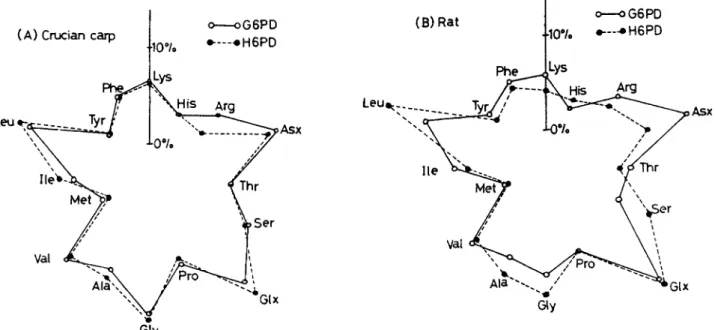
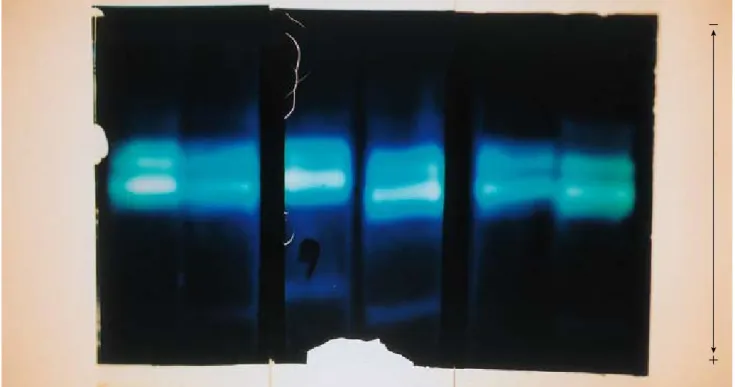
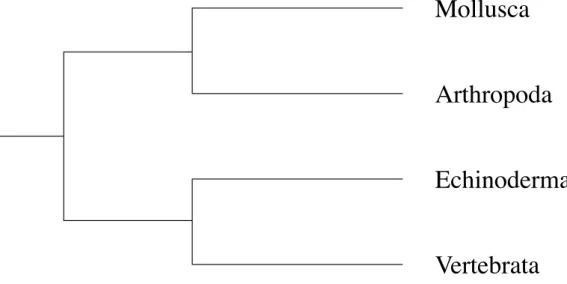
kingdom. As a result, we found that echinoderms and vertebrates have the two G6PD isozymes (G6PD and H6PD) (Matsuoka and Hori, 1980). The other invertebrates except echinoderms have G6PD, but they have not H6PD. The two isozymes are different to each other in some parameters (Table 1). G6PD has narrow substrate specificity (the substrate is G6PD and the co-enzyme NAPD), but H6PD has broad substrate specificity: it can catalyze glucose-6- phosphate (G6P), galactose-6-phosphate (Gal6P), deoxyglucose-6-phosphate (dG6P) and glucose. Further, H6PD also use two co-enzymes (NADP and NAD). The two isozymes (G6PD and H6PD) have molecular weight of 100,000 and 200,000, respectively. The chromosomes holding genes coding the two G6PD isozymes are different to each other: the gene of G6PD is on X-chromosome, but that of H6PD on autosome. The two G6PD isozymes are homologous enzymes that derived from common ancestor. I indicated that the two G6PD isozymes (G6PD and H6PD) are very similar to each other in the amino acid compositions (Matsuoka et al., 1983) (Fig. 2). This similarity of amino acid composition shows that G6PD and H6PD are homologous enzymes that derived from common ancestor. (5) Previously, we studied the protease of the starfish, Asterias amurensis. In the study, we found that the starfish protease is trypsin-like enzyme that homologous to vertebrate trypsin (Hori et al., 1977). Figure 3 shows the active band pattern of starfish protease in polyacrylamide gel electrophoresis. The starfish protease exists as inactive form in zymogen granules of pyloric caeca, and it is activated by starfish protease as well as vertebrate trypsin. (6) The echinoids have thyroid hormone (Chino et al, 1994; Saito et al., 1998). The echinoids use the thyroid hormone in metamorphosis from larva to adult. The hormone is homologous to thyroid hormone of vertebrates thyroxine. (7) In more recently, Kishimura (unpublished data) found that the asteroids have the insulin-like hormone that reduce the blood glucose. (8) The molecular phylogenetic study on DNA level indicated that echinoderms are closely related to vertebrates (Winnepenninckx et al., 1995)(Fig. 4). The molecular marker used in the study is 18S ribosomal RNA. (9) Miyata (1994) demonstrated that echinoderms are closely related to vertebrates by using multi-protein sequence analysis (Fig. 5). (10) In more recent years, Davidson (2006) reported that the genome of echinoid (Strongylocentrotus purpuratus) is very similar to the genome of human at DNA level. From these many evidence, I would like to propose that echinoderms are very important animal group in evolutionary and phylogentic position in animal kingdom.
Fig. 2: The evidence of the similarity of amino acid sequences of G6PD and H6PD. Comparison of amino acid compositions between G6PD and H6PD in crucian carp (A) and rat (B) is very similar. The figure was quoted from Matsuoka et al (1983).
Fig. 1: Echinoderms consist of five classes: 1=sea-liliy, 2=sea-cucumber, 3=starfish, 4=sea-urchin, and 5=brittle-star.
Chordata (Hsa) Chordata (Xla) Hemichordata (Sko) Echinodermata (Spu) Arthropoda (Asa) Arthropoda (Tmo) Arthropoda (Eca) Nematomorpha (Gaq) Priapullda (Pca) Mollusca (Lka) Mollusca (Aja) Mollusca (Pma) Annelida (Efe) Annelida (Lco) Acanthocephala (Mmo) Rotifera (Bpl)
Gastrotricha (Lsq) Platyhelminthes (Ovi) Nematoda (Pty) Nematoda (Cel) Nemadota (Hpl) Nematoda (Nba) Cnidaria (Asu) Cnidaria (Aku)
Ctenophora (Mle) Diploblasts Protostomes Deuterostomes
Porifera (Sci) Fungi (Sce)
100 88 79
83 83
67 65
100
100
100 100 91 96 100
99 54
−+
Fig. 3: The band pattern of protease of the starfish Asterias amurensis in polyacrylamide gel electrophoresis. The two active bands are white bands in blue-background. The stain of bands was performed in amide black.
Fig. 4: Molecular Phylogenetic tree based on DNA sequence by Winnepenninckx et al. (1995). This tree shows the close relationship between echinoderms and vertebrates.
REFERENCES
Chino, Y., Saito, M., Yamasu, K., Suyemitsu, T. and Ishihara, K. (1994) Formation of the adult rudiment of sea urchins is influenced by thyroid hormones. Dev.Biol., 161, 1–11.
Davidson, E.H. (2006) The genome of the sea urchin in Strongylocentrotus purpuratus.Science. 314, 941–952.
Hori, S.H., Tanahashi, K. and Matsuoka, N. (1977) Morphological and cytochemical studies on the secretory granules of the pyloric ceaca of the starfish, Asterias amurensis. Biol.Bull., 152, 64–74.
Matsuoka, N. (1980) Immunological relatedness of sea-urchin glucose-6-phosphate dehydrogense: Phylogenetic implication. Comp.Biochem.Physiol., 66B, 605–607.
Matsuoka, N. (1986) Futher immunological study on the phylogenetic relationships among sea-urchins of the order Echinoida. Comp.Biochem.Physiol., 84B: 465–468.
Matsuoka, N. (1987) Biochemical study on the taxonomic situation of the sea-urchin, Pseudocentrotus depressus. Zool.
Sci., 4: 339–347.
Matsuoka, N. (1992) Phylogenetic relationships of echinoderms deduced from kinetic similarity of glucose-6-phosphate dehydrogenase. Comp.Biochem.Physiol., 103: 133–137.
Matsuoka, N. and Hatanaka, T. (1991) Molecular evidence for the existence of four sibling species within the sea- urchin, Echinometra mathaei, from Japanese waters. Zool.Sci., 8: 121–133.
Matsuoka, N. and Hori, S.H. (1980) Immunological relatedness of hexose-6-phophate dehydrogenase and glucose-6- phospate dehydrogenase in echinoderms. Comp.Biochem.Physiol., 65B: 191–198.
Matsuoka, N., Mochizuki, Y. and Hori, S.H. (1977) Homology of starfish and vertebrate hexose-6-phospahte dehyrogenases.
J.Fac.Sci.Hokkaido Univ. Ser.6, Zool., 21: 12–20.
Matsuoka, N., Ohnishi, K., Takahashi, T., Oka, K. and Hori, S.H. (1983) Evidence for the homology of hexose-6- phosphate dehydrogenase and glucose-6-phosphate dehydrogenase: Comparison of the amino acid composions.
Comp.Biochem.Physiol., 76B: 811–816.
Matsuoka, N. and Suzuki, H. (1989) Electrophoretic study on the phylogenetic relationships among six species of the sea-urchins of the family Echinometridae found in Japanese waters. Zool.Sci., 6: 589–598.
Miyata (1994) Invitation to Molecular Evolution. Kodansha, Tokyo. (in Japanese)
Saito, M., Seki, M., Amemiya, S., Yamasu, K., Suyemitsu, T. and Ishihara, K. (1998) Induction of metamorphosis in the sand dollar Peronella japonica by thyroid hormones. Develop.Growth Differ., 40: 307–312.
Winnepenninckx, B., Backeljau, T., Mackey, L.Y., Brooks, J.M., Wachter, R,D., Kumar, S. and Garey, J.R. (1995) 18S rRNA data indicate that Aschelminthes are polyphyletic in origin and consist of at least three distinct clades. Mol.
Biol.Evol., 12: 1132–1137.
Mollusca Arthropoda Echinodermata
Vertebrata
Fig. 5: Molecular phylogenetic tree based on multi-protein seqence analysis by Miyata (1994). This tree shows the close relationship between echinoderms and vertebrates.