Effects of Generalized Self-efficacy, Waiting place and Waiting Time on Waiting Behavior in Female University Students
特性的自己効力感、待つ場所及び待ち時間が女子大学生の待ち行動に及ぼす効果
Takashi Mitsutomi
光富 隆
要旨
本研究の目的は特性的自己効力感、待つ場所そして待ち時間が女子大学生の待ち行動に及ぼ す効果を検討することであった。2つの質問紙、特性的自己効力感尺度とwaiting質問紙が女子 大学生に実施された。Waiting質問紙では、異なった2つの待つ場所(本屋あるいは公園)を3 つの待ち期間(5分、30分、60分)と組み合わせた6つの仮想場面において、学生は予想される フラストレーションの度合い、待っている対象の価値、待ち行動を評定した。結果は価値と待ち 行動に関しては、待つ場所と待ち時間の主効果が見られ、予想されるフラストレーションの度合 に関しては、待つ場所と待ち時間の交互作用が認められた。これらの結果は認知的価値評価モデ ルが妥当でないことを示す。自己効力感の主効果、あるいは自己効力感と状況要因の交互作用は 認められなかった。なぜなら、われわれが仮想場面を用いたからである。これらの問題は実際の 待ち場面の中で、検討すべきである。
キーワード
待ち行動、待つ場所、待ち時間、特性的自己効力感
To investigate the effects of situational factors on waiting behavior, a series of studies (Mitsutomi & Kobayashi, 2012; Mitsutomi & Kobayashi, 2014; Mitsutomi, Kobayashi &
Fukuhara, 2015) was conducted in which female university students waited for an object in a variety of hypothetical waiting situations. As a result, a number of the following situational factors were found to affect waiting behavior.
First, students had higher waiting scores when the degree of intimacy with the waiting object was higher. Second, regarding waiting place, the bookshop condition, which is associated with numerous distractions, resulted in higher waiting scores than the park condition, which is associated with relatively few distractions. Third, longer waiting time resulted in lower waiting scores.
We interpreted these results using a cognitive value evaluation model that assumes that the frustration resulting from waiting leads to a reduced value evaluation of the waiting object by the subjects, who consequently discontinue their waiting behavior. As the present study utilized a hypothetical waiting situation, we changed actual frustration to anticipated frustration.
In the purpose section, Mitsutomi & Kobayashi (2016) and Mitsutomi & Kobayashi (2018) interpreted the results regarding the intimacy of the waiting object using a cognitive value evaluation model. In these papers, we regard the intimacy factor as the between factors.
However, this is within factor. Furthermore, is difficult for the reader to understand these sentences. On the base of original paper, we revised as follows. See the note.
We also used a cognitive value evaluation model to interpret the results regarding waiting place. The subjects did not anticipate a stronger feeling of frustration in the bookshop condition, which is associated with numerous distractions, compared with the park condition, which is associated with relatively few distractions. Therefore, the value of the waiting object tended to be higher in the bookshop than in the park condition, which led to higher waiting scores for the bookshop condition.
In addition, we interpreted the results regarding waiting time using a cognitive value evaluation model. A longer waiting time led to a stronger feeling of anticipated frustration and consequently, a lower value for the waiting object. Therefore, longer waiting times might result in lower waiting scores.
Previous studies (Mitsutomi & Kobayashi, 2012, Mitsutomi & Kobayashi, 2014, Mitsutomi
& Kobayashi, & Fukuhara, 2015) have primarily focused on situational factors. However, to investigate the way in which personality factors interact with situational factors, it is necessary to examine not only situational factors, such as the level of intimacy with a waiting object, waiting place, and waiting time, but also personality factors that influence waiting behavior.
Mitsutomi and Kobayashi (2016) conceptualized aggressiveness as a personality factor and both waiting place and waiting time as situational factors. However, concerning the main effect of aggressiveness and the interaction effects between aggressiveness and situational factors such as waiting place and waiting time, no interpretable results were obtained.
Mitsutomi and Kobayashi (2018) used a coronary prone behavior pattern consisting of hostility, perfectionism, and workaholism instead of aggressiveness. Therefore, we conceptualized a coronary prone behavior pattern as a personality factor and both waiting place and waiting time as situational factors.
The interaction effect for the value of waiting object and waiting behavior between perfectionism and waiting time was observed. In the 60-minute condition, the high perfectionism group evaluated friends who made them wait for 60 minutes, i.e., loose friends, more negatively and had lower waiting scores than did the low perfectionism group.
However, compared with friends who make the subject wait for 60 minutes, those who make the subject wait for 5 or 30 minutes might not be so loose. Therefore, the high perfectionism group did not evaluate such friends very negatively.
Similarly, the low perfectionism group did not evaluate friends who made them wait for 5 or 30 minutes very negatively. Therefore, no differences in waiting scores were observed for 5 or 30 minutes between the high and low perfectionism groups. Thus, an interaction effect was observed between perfectionism as a personality factor and waiting time as a situational factor.
This research focuses on the generalized self-efficacy as the personality factor. Therefore, the present study conceptualized generalized self-efficacy as personality factors and waiting place and waiting time as situational factors. The purpose of the present study was to investigate the effect of generalized self-efficacy, waiting place and waiting time on the waiting behavior. .
Method Experimental design
The experiment used a 2 2 3 factorial design. The first factor was degree of generalized self-efficacy and consisted of a high (H) and a low (L) self-efficacy group. The second factor was waiting place and consisted of either a bookshop or a park condition. The third was waiting time and consisted of the following three waiting times: 5, 30, or 60 minutes. For the self-efficacy H and L groups, we devised six hypothetical waiting situations using a combination of various waiting places and times.
Participants
The 34 study participants were female Christian university students
Qestionnaire (1) The generalized self-efficacy scale devised by Narita, Shimonaka, kwai, Sato
& Nagata (1995) was administered to the study participants. This scale consists of 23 items.
Questionnaire (2) The waiting questionnaire consisted of a hypothetical waiting situation for which students were asked to respond using a 3-point scale (wait, not sure, do not wait). Each hypothetical waiting situation was described in detail. The basic form of the waiting situation was as follows: You have agreed to meet a casual female friend at a specific place (waiting place). You have waited for a specified number of minutes (waiting time), but your casual female friend has still not arrived.
We devised six hypothetical waiting situations with various combinations of waiting places (a bookshop or a park) and waiting times (5, 30, or 60 minutes). The waiting place was described in detail at the top of the questionnaire. For the park, we explained that there was only one bench at which to wait, and for the bookshop, we explained that it contained a large variety of books that they could browse through and read freely.
The information regarding the waiting place and waiting time was printed in Gothic type.
The students were asked to rate their level of anticipated frustration, their value for the waiting object, and their waiting behavior for the hypothetical waiting situations. First, they were asked to rate their level of anticipated frustration on a 7-point scale. The questionnaire item was as follows: How much do you experience iraira (frustration) when you are kept waiting for (waiting time: 5, 30, or 60 minutes) in a (waiting place: park or bookshop) by a casual female friend? Please anticipate.
Second, the value of the waiting object was also rated on a 7-point scale. The questionnaire item was as follows: How much would you dislike a casual female friend who made you wait for (waiting time: 5, 30, or 60 minutes) in a (waiting place: park or bookshop)?
Finally, waiting behavior was rated on a 3-point scale (wait, not sure, do not wait). The questionnaire item was as follows; Would you continue waiting for a casual female friend after you have already waited for (waiting time; 5, 30, or 60 minutes) in a (waiting place: park or bookshop)?
Procedure
The survey was administered in the student’s classroom and took about 30 minutes to complete.
Results
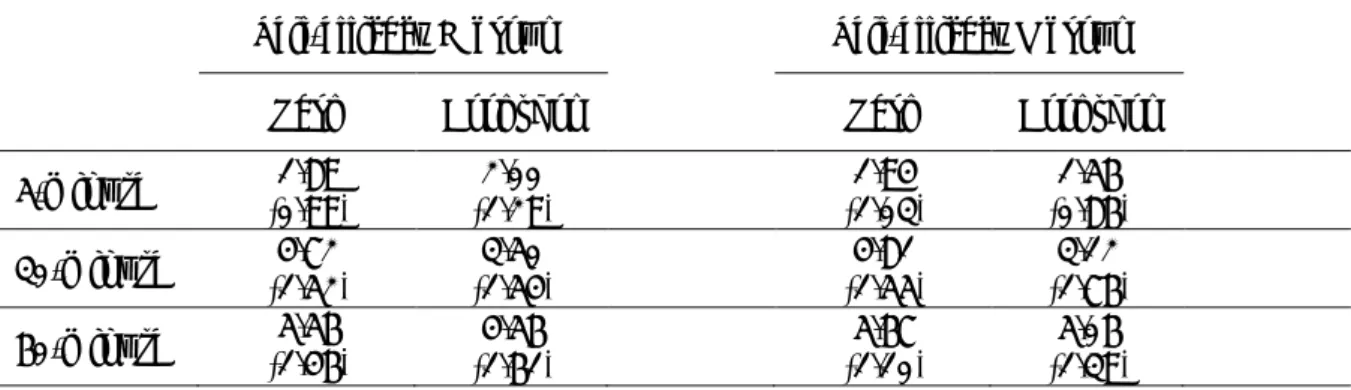
Students with generalized self-efficacy scores above and below the median were classified into the self-efficacy H and L groups. The H group significantly had the higher generalized self-efficacy scores than the L group. Table 1 shows the mean anticipated frustration scores for both groups. Using anticipated frustration scores as the dependent variable, analysis of variance (ANOVA) was performed as follows; 2 (self-efficacy) ×2 (waiting place) ×3 (waiting time). The main effect of waiting place (F=29.55, df=1/32, p<.01) and waiting time (F=146.15, df=2/64, p<.01) were significant. The 5-minute waiting condition resulted in lower anticipated frustration scores than the other two waiting condition (30-minutes: t=10.98, df=64, p<.01: 60- minute: t=16.87, df=64, p<.01) and the 30-minute condition resulted in lower anticipated frustration scores than did the 60-minute condition (t=5.88, df=64, p<.01).
Table 1 Means of anticipated Frustration for each conditions
Self-efficacy H group Self-efficacy L group
Park Bookshop Park Bookshop
5-minute 1.89
(0.99) 2.00
(1.29) 1.94
(1.03) 1.56 (0.86) 30-minute 4.72
(1.52) 3.50
(1.54) 4.81
(1.55) 3.12 (1.76) 60-minute 5.56
(1.46) 4.56
(1.61) 5.67
(1.10) 5.06 (1.39)
The interaction effect (F=16.53, df=2/64, p<.01) between waiting place and waiting time was significant. The simple main effect of waiting place was analyzed for each waiting time condition. The bookshop condition resulted in significantly lower anticipated frustration scores for two waiting time conditions (30-minute, F=53.86, df=1/96, p<.01; 60-minute, F=16.80, df=1/96,p<.01). The simple main effect of waiting time was analyzed for each waiting place condition. The simple main effect of waiting time was significant for both condition (park: F=141.70, df=2/128, p<.01: bookshop: F=86.12, df=2/128, p<.01).
For the park condition, the 5-minute waiting condition resulted in lower anticipated frustration scores than did the other two waiting conditions (30-minute; t=12.39, df=128, p<.01; 60-minute, t=16.10, df=128, p<.01) and the 30-minute waiting condition resulted in lower anticipated frustration scores than did 60-minute waiting condition (t=3.71, df=128,p<.01). For the bookshop condition, the 5-minute condition resulted in lower anticipated frustration scores than the other two condition (30-minutes, t=,6.65, df=128, p<.01, 60-minute,t=13.15, df=128, p<.01) and the 30-minute waiting condition resulted in lower anticipated frustration scores than did the 60-minute waiting cond ition (t=6.49, df=128, p<.01)..
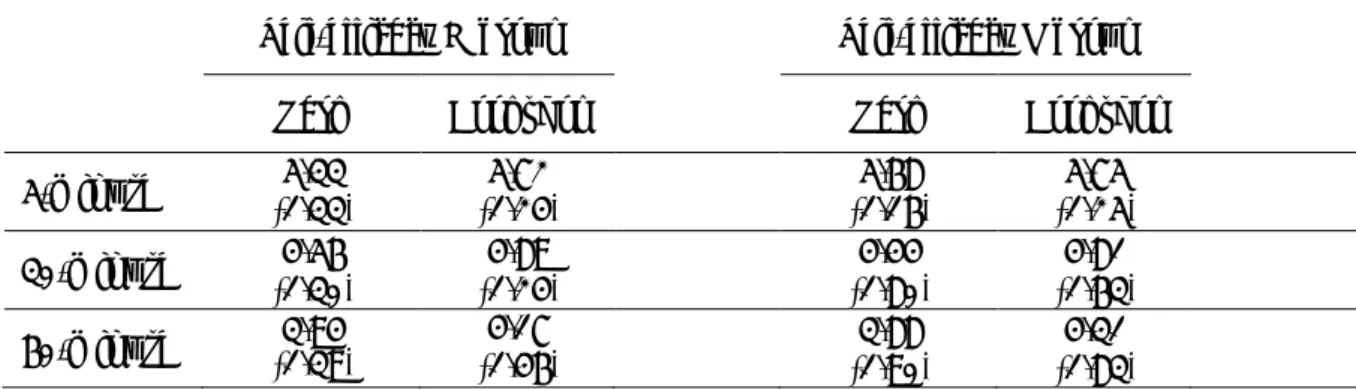
Table 2 Means of value scores for each condition
Self-efficacy H group Self-efficacy L group
Park Bookshop Park Bookshop
5-minute 5.33
(1.33) 5.72
(1.24) 5.68
(1.16) 5.75 (1.25) 30-minute 4.56
(1.30) 4.89
(1.24) 4.44
(1.80) 4.81 (1.63) 60-minute 3.94
(1.39) 4.17
(1.46) 3.88
(1.90) 4.31 (1.83)
Table 2 shows the mean scores for the value of the waiting object for the self-efficacy H and L groups. Using the value scores of the waiting object as the dependent variable, ANOVA was performed as follows: 2 (self-efficacy) ×2 (waiting place) ×3 (waiting time).
The main effect of waiting place (F=9.68, df=1/32, p<.01) and waiting time (F=51.25, df=2/64, p<.01) were significant. The 5-minute waiting condition resulted in a higher value for the waiting object than did the other two waiting condition (30-minute, t=6.16,df=64,p<.01;
60-minute,t=,10.05, df=64,p<.01) and the 30-minute waiting condition resulted in a higher value for the waiting object than did the 60-minute waiting condition (t=3.89, df=64, p<.01).
Table 3 Mean waiting scores for each condition
Self-efficay H group Self-efficacy L group
Park Bookshop Park Bookshop
5-minute 1.83 (0.37)
1.89 (0.31)
1.81 (0.53)
1.93 (0.24) 30-minute 1.28
(0.56) 1.61
(0.48) 1.43
(0.61) 1.69 (0.58) 60-minute 0.78
(0.71) 0.89
(0.81) 0.63
(0.69) 1.00 (0.79)
Table 3 shows the mean waiting scores for the self-efficacy H and L groups. Using the waiting scores as the dependent variable, ANOVA was performed as follows: 2 (self-efficacy) 2 (waiting place) ×3 (waiting time). The main effect of waiting place (F=11.29, df=1/32,p<.01) and waiting time (F=57.18, df=2/64, p<.01) were significant. The 5-minute waiting condition resulted in the higher waiting scores than the other two waiting conditions (30-minute; t=3.68, df=,64, p<.01; 60-minute; t=10.55, df=64 ,p<.01) and the 30-minute waiting condition resulted in the higher waiting scores than did the 60-minute waiting condition (t=6.87,df=64,p<.01).
Discussion
In the 5-minute condition, the anticipated frustration was already lower in the park condition. Therefore, a significant difference in the anticipated frustration was not observed between the park and bookshop conditions
However, with increased waiting time, anticipated frustration increased. In the 30- and 60- minute conditions, the bookshop condition, which is assumed to involve more distraction, was associated with lower anticipated frustration than park condition. Thus, interaction effect was observed between waiting place and waiting time.
However, for the value of waiting object and waiting time, the interaction effect between waiting place and waiting time was not observed. This result suggests that the cognitive value evaluation model was not valid. Therefore, more research is needed to investigate further the validity of the cognitive value evaluation model.
The result indicated no main effect of generalized self-efficacy and the no interaction effect between generalized self-efficacy and situational factors were observed because we used a hypothetical waiting situation; these issues should be investigated in actual waiting situations.
Note In the intimacy H condition, waiting is pleasant. Therefore, subject do not anticipate the stronger feeling of frustration in the intimacy H condition in which waiting is pleasant compared with intimacy L condition. Furthermore, traditionally, the high intimacy condition
is associated with a high degree value for the waiting object than is the intimacy L condition.
Therefore, subject place a higher value on the waiting object in the intimacy H condition compared with the intimacy L condition. Therefore, intimacy H condition lead to higher waiting scores than does the intimacy L condition.
References
Mitsutomi, T., & Kobayashi, S. (2012) The effects of situational factors on waiting behavior in adolescents. Kwassui Bulletin, 22, 1–11.
Mitsutomi, T., & Kobayashi, S. (2014) Situational factors and waiting behavior in adolescents.
The Kwassui Review, 57, 69–89.
Mitsutomi, T., Kobayashi, S., & Fukuhara, S. (2015) Do situational factors influence waiting behavior in adolescents? The Kwassui Review, 58, 149–169.
Mitsutomi, T., & Kobayashi, S. (2016) Effects of aggressiveness, waiting place and waiting time on waiting behavior among female university students. Kwassui Bulletin, 59, 143–166.
Mitsutomi, T., & Kobayashi, S. (2018) Effects of coronary-prone behavior pattern, waiting place and waiting time on waiting behavior among female university students. The Kwassui Review, 61, 51–68.
Narita,K, Shimonaka,J., Kawai,C, Sato, S & Nagata,Y,(1995) The generalized self-efficacy scale, Shinri Sokutei syakudo syu Ⅰ37-42.