• 検索結果がありません。

Orange Organic Long-persistent Luminescence from an Electron Donor/Acceptor Binary System

N/A
N/A
Protected

Academic year: 2021

シェア "Orange Organic Long-persistent Luminescence from an Electron Donor/Acceptor Binary System"

Copied!
6
0
0

読み込み中.... (全文を見る)

全文

(1)

Orange Organic Long‑persistent Luminescence from an Electron Donor/Acceptor Binary System

Author Zesen Lin, Ryota Kabe, Chihaya Adachi journal or

publication title

Chemistry Letters

volume 49

number 2

page range 203‑206

year 2019‑12‑19

Publisher The Chemical Society of Japan

Rights (C) 2020 The Chemical Society of Japan Author's flag author

URL http://id.nii.ac.jp/1394/00001355/

doi: info:doi/10.1246/cl.190823

(2)

Zesen Lin

1,2,3

, Ryota Kabe*

1,2,3

, and Chihaya Adachi*

1,2,4

1

Center for Organic Photonics and Electronics Research (OPERA), Kyushu University 744 Motooka, Nishi-ku, Fukuoka, 819-0395, Japan.

2

JST, ERATO Adachi Molecular Exciton Engineering Project, Kyushu University 744 Motooka, Nishi-ku, Fukuoka 819-0395, Japan.

3

Okinawa Institute of Science and Technology Graduate University 1919-1 Tancha, Onna-son, Kunigami-gun, Okinawa 904-0495, Japan.

4
International Institute for Carbon Neutral Energy Research (WPI-I2CNER), Kyushu University 744 Motooka, Nishi-ku, Fukuoka, 819-0395, Japan.

E-mail: [email protected]; [email protected] Organic long-persistent luminescence (LPL) materials

1

can overcome the disadvantages of inorganic LPL materials 2

in terms of element sustainability, processability, and color 3

tunability. However, all published electron donor/acceptor 4

binary organic LPL systems show green emission. Here, we 5

report an organic LPL system consisting of N,N,N’,N’- 6

tetrakis(p-diisobutylaminophenyl)-p-phenylenediamine 7

(TBAPD) as a donor dopant and 2,8- 8

bis(diphenylphosphoryl)dibenzo[b,d]thiophene (PPT) as an 9

acceptor host. The TBAPD/PPT film exhibits orange 10

photoluminescence (CIE

x

, CIE

y

= 0.49, 0.49) and LPL (CIE

x

, 11

CIE

y

= 0.51, 0.48).

12 13

Keywords: Organic long-persistent luminescence, 14

Exciplex, Charge separation 15

Long-persistent luminescence (LPL) materials, also 16

known as glow-in-the-dark or afterglow materials, are 17

widely used in emergency signs, watch indicators, safety 18

way guidance, and afterglow toys.

1-4

Glow-in-the-dark 19

materials have a long history of usage, and LPL materials 20

have been commonly used since Matsuzawa et al. developed 21

a strontium aluminate-based LPL material in the 1990s.

5

22

Many commercial high-performance LPL materials are 23

made from metal oxides doped with rare earth elements 24

such as europium and dysprosium.

1

These inorganic LPL 25

materials need high fabrication temperatures of over 26

1000 °C and to be ground into powders and blended with 27

polymers for the majority of their applications.

1,6,7

28

In 2017, we reported the first genuine organic LPL 29

(OLPL) system consisting of an electron donor N,N,N′,N′- 30

tetramethylbenzidine (TMB) and an electron acceptor 2,8- 31

bis(diphenylphosphoryl)dibenzo[b,d]thiophene (PPT).

8

This 32

TMB/PPT blend film exhibits LPL for over one hour at 33

room temperature when the concentration of the donor is 34

low (1 mol%). The LPL emission originates from the 35

excited state complex (exciplex) generated by the slow 36

recombination of long-lived intermediate charge-separated 37

(CS) states (Figure 1a). Initially, charge transfer (CT) 38

excited states (D

δ+

+ A

δ-

) are formed between the donor (D) 39

and acceptor (A) during photo-excitation. Although most of 40

the CT excited states exhibit photoluminescence after turn- 41

off of the photoexcitation, some electrons on acceptors 42

diffuse to surrounding acceptor molecules and form stable 43

charge-separated (CS) states (D

·+

+ A

·-

). Gradual 44

recombination of the electrons on the acceptor and holes on 45

the donor continuously generates CT excited states, so the 46

photoluminescence continues for a very long time. The 47

TMB/PPT film exhibits green LPL emission because the 48

exciplex emission corresponds to a transition from the 49

lowest unoccupied molecular orbital (LUMO) level of the 50

acceptor to the highest occupied molecular orbital (HOMO) 51

level of the donor. Although the donor-acceptor distance 52

and molecular conformations affect the exciplex emission, 53

the HOMO-LUMO gap play a decisive role in the exciplex 54

emission in the amorphous solid-state. A linear correlation 55

between the exciplex emission peak and the energy gap 56

between the oxidation potential of donors and the reduction 57

potential of acceptors (E

A,LUMO

– E

D,HOMO

) is reported

9-12

and 58

the HOMO and LUMO levels can be calculated from the 59

oxidation and reduction potentials.

13,14

The LPL emission 60

decay profile follows power-law decay, and the emission 61

intensity at time t is given by I(t) ~ t

−m

, with m ≈ −1.

15-19

62

This power-law emission decay differs from general room- 63

temperature phosphorescence which exhibits exponential 64

emission decay.

20-28

65

We also reported several electron donor/acceptor 66

binary OLPL systems such as m-MTDATA/PPT

29

and 67

polymer-based TMB/PBPO.

7

However, these binary OLPL 68

systems exhibit green emission. Other emission-color 69

systems have not been reported. Later, we also achieved 70

wide-range emission-color tuning from greenish-blue to red 71

and even warm white by energy transfer from the TMB/PPT 72

exciplex to additional emitter dopants.

30

The color-tuning of 73

the binary OLPL system is important because the photo- 74

absorption process is controlled by the donor or acceptor 75

molecules. A large overlap between the exciplex emission 76

and the extra dopant absorption is required for efficient 77

energy transfer.

78

Here, we report orange LPL emission from a 79

donor/acceptor binary system. To obtain a longer emission 80

wavelength from the exciplex, we adjusted the HOMO level 81

of the donor from that of TMB. Specifically, N,N,N',N'- 82

tetra(4-tolyl)-1,4-phenylenediamine (TTPD) and N,N,N’,N’- 83

tetrakis[(4-(diisobutylamino)phenyl]-1,4-phenylenediamine 84

(TBAPD) (Figure 1b) are used as donors in this study.

85

TTPD was synthesized by Buchwald-Hartwig coupling 86

and PPT was synthesized according to the literature.

31

87

Orange Organic Long-persistent Luminescence from an Electron Donor/Acceptor Binary System

(3)

TBAPD was obtained from TCI chemicals (Tokyo, Japan).

88

All samples were purified by train sublimation. The 0.4 89

mm-thick TTPD/PPT and TBAPD/PPT films for the optical 90

measurements were prepared by the melt-casting method as 91

reported previously.

30

Thin films for the UV-vis absorption 92

a b c

PPT LUMO: -2.17 eV

Donor (guest)

Acceptor (host) OLPL system

TBAPD: R = N(i-Bu)

2

HOMO: -4.24 eV;

TTPD: R = Me HOMO: -4.74 eV

-0.8 -0.6 -0.4 -0.2 0.0 0.2 0.4 0.6 0.8

Curre nt (a.u.)

Potential vs Fc/Fc+ (V) TBAPD

TTPD

TMB

93

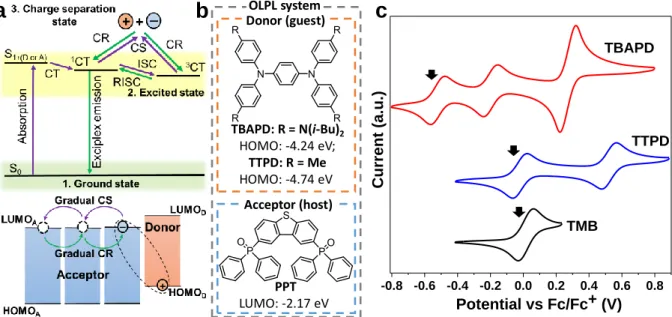
Figure 1. a. Emission mechanism of an OLPL. The dashed cycle represents the charge transfer (CT) exciton of the exciplex.

94

Abbreviations of electron donor (D), acceptor (A), lowest singlet excited state of donor or acceptor (S

1, (D or A)

), CT singlet (

1

CT) 95

and triplet excited state (

3

CT), intersystem crossing (ISC), reverse intersystem crossing (RISC), charge separation (CS), and charge 96

recombination (CR) are used. b. Chemical structures of the electron donors (TTPD and TBAPD) and electron acceptor (PPT) and 97

their corresponding HOMO or LUMO levels. c. CV curves of TMB, TTPD, and TBAPD.

98

measurements were fabricated by sandwiching the heat- 99

melted materials between two quartz substrates. The 100

concentration of the donor was 1 mol% for all films, 101

according to the previous publication

8

. 102

To achieve a longer emission wavelength, a shallower 103

HOMO level of the donor is required. Therefore, we 104

introduced electron-donating diisobutylamino substitutions 105

into the N,N,N',N'-tetraphenyl-1,4-phenylenediamine core, 106

and tetramethyl substitutions are used as the reference. The 107

HOMO levels were calculated to be −4.78 eV (TMB), −4.74 108

eV (TTPD), and −4.24 eV (TBAPD) from the first oxidation 109

potential of cyclic voltammograms. Although the TBAPD 110

and TTPD exhibit multi redox potentials, only the first 111

redox potential is important to discuss the LPL emission 112

since the system generates the radical cation of donors and 113

the radical anion of acceptors after the photoexcitation. The 114

LUMO level of PPT is −2.17 eV,

30

and the E

A,LUMO

115

E

D,HOMO

of the donor/acceptor systems were calculated to be 116

2.61 eV (TMB/PPT), 2.57 eV (TTPD/PPT), and 2.07 eV 117

(TBAPD/PPT). The energy gap of 2.07 eV corresponds to 118

emission at 599 nm, so TBAPD/PPT should exhibit yellow 119

to orange emission.

120

UV-vis absorption and photoluminescence spectra of 121

TTPD and TBAPD (toluene solutions), and PPT, 122

TTPD/PPT, and TBAPD/PPT films are shown in Figure 2.

123

LPL spectra of these two blend films are also shown. The 124

absorption of the two blend films is the sum of the 125

absorption of PPT and the corresponding donor and could 126

not observe clear CT absorption at the present condition.

127

Thus, the charge-transfer interaction at the ground state is 128

almost negligible. In contrast, the TTPD/PPT and 129

TBAPD/PPT films exhibit broad emission peak maxima at 130

506 nm and 579 nm, respectively. These peak maxima are 131

significantly redshifted compared with the fluorescence and 132

phosphorescence of PPT and the corresponding donor.

133

These emission peaks clearly indicate that the emission of 134

the two blend films originates from the exciplex. The LPL 135

spectra are slightly redshifted and broader than the 136

corresponding steady-state photoluminescence spectra. This 137

may be because of the reorganization of the emitters at the 138

excited states.

139

The photoluminescence peak maxima of the 140

TTPD/PPT and TBAPD/PPT systems are at 506 nm and 579 141

nm, corresponding to energy gaps of 2.45 eV and 2.14 eV, 142

respectively. These values show good agreement with the 143

E

A,LUMO

– E

D,HOMO

determined from the CV curves. As 144

expected, the TTPD/PPT system exhibits green 145

photoluminescence (CIE

x,y

: 0.26, 0.46) and LPL (CIE

x,y

: 146

0.31, 0.50), and the TBAPD/PPT system exhibits orange 147

photoluminescence (CIE

x,y

: 0.49, 0.49) and LPL (CIE

x,y

: 148

0.51, 0.48), as shown in Figure S1.

149

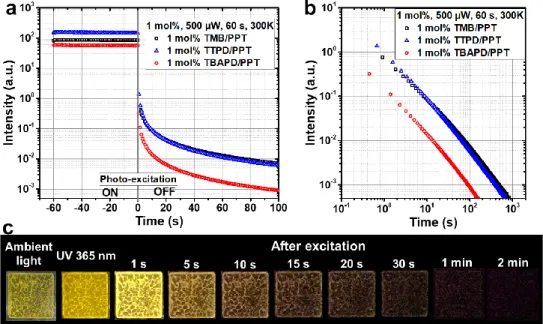
The LPL emission decay profiles of 1 mol% TMB/PPT, 150

TTPD/PPT, and TBAPD/PPT blend films under the same 151

excitation conditions are shown in Figure 3. After stopping 152

the photo-excitation, all films exhibit LPL emission with a 153

power-law decay profile at room temperature. The 1 mol%

154

(4)

TBAPD/PPT film exhibits orange LPL emission, which can 155

be recorded for several minutes using a charge-coupled- 156

device camera. Owing to the very thick film of 0.4 nm, 157

several cracks formed during the rapid cooling process.

158

Because the photoluminescence quantum yields (Φ

PL

) 159

measured under nitrogen atmosphere were 16%

160

(TBAPD/PPT), 24% (TMB/PPT) and 41% (TTPD/PPT), the 161

study-state PL intensities under photoexcitation shows the 162

same order. In contrast, the LPL duration of TMB/PPT and 163

Figure 2. a, b. UV–vis absorption and photoluminescence spectra of TTPD and TBAPD in toluene (top), PPT film (middle), and 1 164

mol% TTPD/PPT and TBAPD/PPT films (bottom). The phosphorescence spectra were obtained at 77 K. The photoluminescence 165

(PL) and LPL spectra of 1 mol% TTPD/PPT and TBAPD/PPT films were obtained at 300 K.

166

Figure 3. a, b. Semi-logarithmic plots (a) and logarithmic plots (b) of the emission decay profiles of TMB/PPT, TTPD/PPT, and 167

TBAPD/PPT at 300 K. Samples were excited for 60 s (from −60 to 0 s) by a 340-nm LED source. “PL” means the steady-state 168

photoluminescence, “LPL” means the long-persistent luminescence. c. Photographs of a 1 mol% TBAPD/PPT thick film at room 169

temperature under the ambient light, during excitation by a 365-nm UV lamp, and at various times after turning off the excitation.

170

(5)

4 TTPD/PPT films are almost identical, although the

171

TTPD/PPT film exhibits a higher Φ

PL

. Because the final 172

emission comes from the exciplex, the Φ

PL

is important for 173

LPL emitters. However, emission in the OLPL system 174

occurs through charge separation process from the CT state 175

to the CS state, charge retention in the CS state, and charge 176

recombination process from the CS state to the CT state.

177

Thus, differences such as charge separation probability from 178

the CT state to the CS state between the TMB/PPT and 179

TTPD/PPT films may lead to the difference between the 180

LPL duration and Φ

PL

. 181

In conclusion, we demonstrated orange LPL emission 182

from the donor/acceptor binary system, TBAPD/PPT, by 183

tuning the HOMO level of the donor. In contrast, TTPD 184

possesses a similar HOMO level with TMB, so the 185

TTPD/PPT and TMB/PPT blend films both exhibit green 186

LPL emission. This approach will enable control of the LPL 187

emission color of the donor/acceptor binary system.

188 189

This work was supported by the Japan Science and 190

Technology Agency (JST), ERATO, Adachi Molecular 191

Exciton Engineering Project, under JST ERATO (Grant 192

Number JPMJER1305), Japan, the International Institute for 193

Carbon Neutral Energy Research (WPI-I

2

CNER) sponsored 194

by the Ministry of Education, Culture, Sports, Science and 195

Technology (MEXT), JSPS KAKENHI (Grant Numbers 196

JP18H02049 and JP18H04522), and the Mitsubishi 197

Foundation. The first author was supported by the Japanese 198

Government (MEXT) Scholarship and also acknowledges 199

the MEXT Top Global University Project and the China 200

Scholarship Council (CSC). The authors thank Aidan G.

201

Young, PhD, from Edanz Group

202

(www.edanzediting.com/ac) for editing a draft of this 203

manuscript.

204 205

Supporting Information is available on 206

http://dx.doi.org/10.1246/cl.******.

207 208

References and Notes 209

1 J. Xu, S. Tanabe, J. Lumin. 2019, 205, 581.

210

2 Long Afterglow Phosphorescent Materials, ed. by S. Wu, Z. Pan, 211

R. Chen, X. Liu, Springer, Cham, 2017.

212

3 Y. Li, M. Gecevicius and J. Qiu, Chem. Soc. Rev., 2016, 45, 213

2090.

214

4 S. Xu, R. Chen, C. Zheng, W. Huang, Adv. Mater. 2016, 28, 215

9920.

216

5 T. Matsuzawa, Y. Aoki, N. Takeuchi, Y. Murayama, J.

217

Electrochem. Soc. 1996, 143, 2670.

218

6 M. P. Anesh, S. K. H. Gulrez, A. Anis, H. Shaikh, M. E. Ali 219

Mohsin, S. M. Al-Zahrani, Adv. Polym. Tech. 2014, 33, 21436.

220

7 Z. Lin, R. Kabe, N. Nishimura, K. Jinnai, C. Adachi, Adv. Mater.

221

2018, 30, 1803713.

222

8 R. Kabe, C. Adachi, Nature 2017, 550, 384.

223

9 A. Gilbert, J. E. Baggott and J. Baggott, Blackwell Scientific 224

Publications, London, 1991.

225

10 S. A. Jenekhe and J. A. Osaheni, Science, 1994, 265, 765.

226

11 D. Kolosov, V. Adamovich, P. Djurovich, M. E. Thompson and 227

C. Adachi, J. Am. Chem. Soc., 2002, 124, 9945.

228

12 X. K. Liu, Z. Chen, C. J. Zheng, C. L. Liu, C. S. Lee, F. Li, X. M.

229

Ou and X. H. Zhang, Adv. Mater., 2015, 27, 2378.

230

13 J. Pommerehne, H. Vestweber, W. Guss, R. F. Mahrt, H. Bässler, 231

M. Porsch and J. Daub, Adv. Mater., 1995, 7, 551.

232

14 Y. Liu, M. S. Liu and A. K.-Y. Jen, Acta Polym., 1999, 50, 105.

233

15 P. Debye, J. O. Edwards, J. Chem. Phys. 1952, 20, 236.

234

16 G. C. Abell, A. Mozumder, J. Chem. Phys. 1972, 56, 4079.

235

17 M. Tachiya and A. Mozumder, Chem. Phys. Lett., 1975, 34, 77.

236

18 Y. Hama, Y. Kimura, M. Tsumura and N. Omi, Chem. Phys., 237

1980, 53, 115.

238

19 H. Ohkita, W. Sakai, A. Tsuchida and M. Yamamoto, 239

Macromolecules, 1997, 30, 5376.

240

20 S. Hirata, K. Totani, J. Zhang, T. Yamashita, H. Kaji, S. R.

241

Marder, T. Watanabe, C. Adachi, Adv. Funct. Mater. 2013, 23, 242

3386.

243

21 S. Hirata, K. Totani, T. Yamashita, C.Adachi, M. Vacha, Nat.

244

Mater. 2014, 13, 938.

245

22 Z. An, C. Zheng, Y. Tao, R. Chen, H. Shi, T. Chen, Z. Wang, H.

246

Li, R. Deng, X. Liu, W. Huang, Nat. Mater. 2015, 14, 685.

247

23 W. Zhao, Z. He, J.W. Y. Lam, Q. Peng, H. Ma, Z. Shuai, G. Bai, 248

J. Hao, B. Z. Tang, Chem 2016, 1, 592.

249

24 H. Mieno, R. Kabe, N. Notsuka, M. D. Allendorf, C.Adachi, Adv.

250

Opt. Mater. 2016, 4, 1015.

251

25 N. Notsuka, R. Kabe, K. Goushi, C. Adachi, Adv. Funct. Mater.

252

2017, 27, 1703902.

253

26 Y. Su, S. Z. F. Phua, Y. Li, X. Zhou, D. Jana, G. Liu, W. Q. Lim, 254

W. K. Ong, C. Yang, Y. Zhao, Sci. Adv. 2018, 4, eaas9732.

255

27 D. Li, F. Lu, J. Wang, W. Hu, X.-M. Cao, X. Ma and H. Tian, J.

256

Am. Chem. Soc., 2018, 140, 1916.

257

28 L. Gu, H. Shi, L. Bian, M. Gu, K. Ling, X. Wang, H. Ma, S. Cai, 258

W. Ning, L. Fu, H. Wang, S. Wang, Y. Gao, W. Yao, F. Huo, Y.

259

Tao, Z. An, X. Liu, W. Huang, Nat. Photonics 2019, 13, 406.

260

29 K. Jinnai, N. Nishimura, R. Kabe, C. Adachi, Chem. Lett. 2019, 261

48, 270.

262

30 K. Jinnai, R. Kabe, C. Adachi, Adv. Mater. 2018, 30, 1800365.

263

31 C. Fan, C. Duan, Y. Wei, D. Ding, H. Xu, W. Huang, Chem.

264

Mater. 2015, 27, 5131.

265

(6)

Figure  1.  a.  Emission  mechanism  of  an  OLPL.  The  dashed  cycle  represents  the  charge  transfer  (CT)  exciton  of  the  exciplex
Figure 3. a, b. Semi-logarithmic plots (a) and logarithmic plots (b) of the emission decay profiles of TMB/PPT, TTPD/PPT, and 167

参照

関連したドキュメント